Mark 8:11

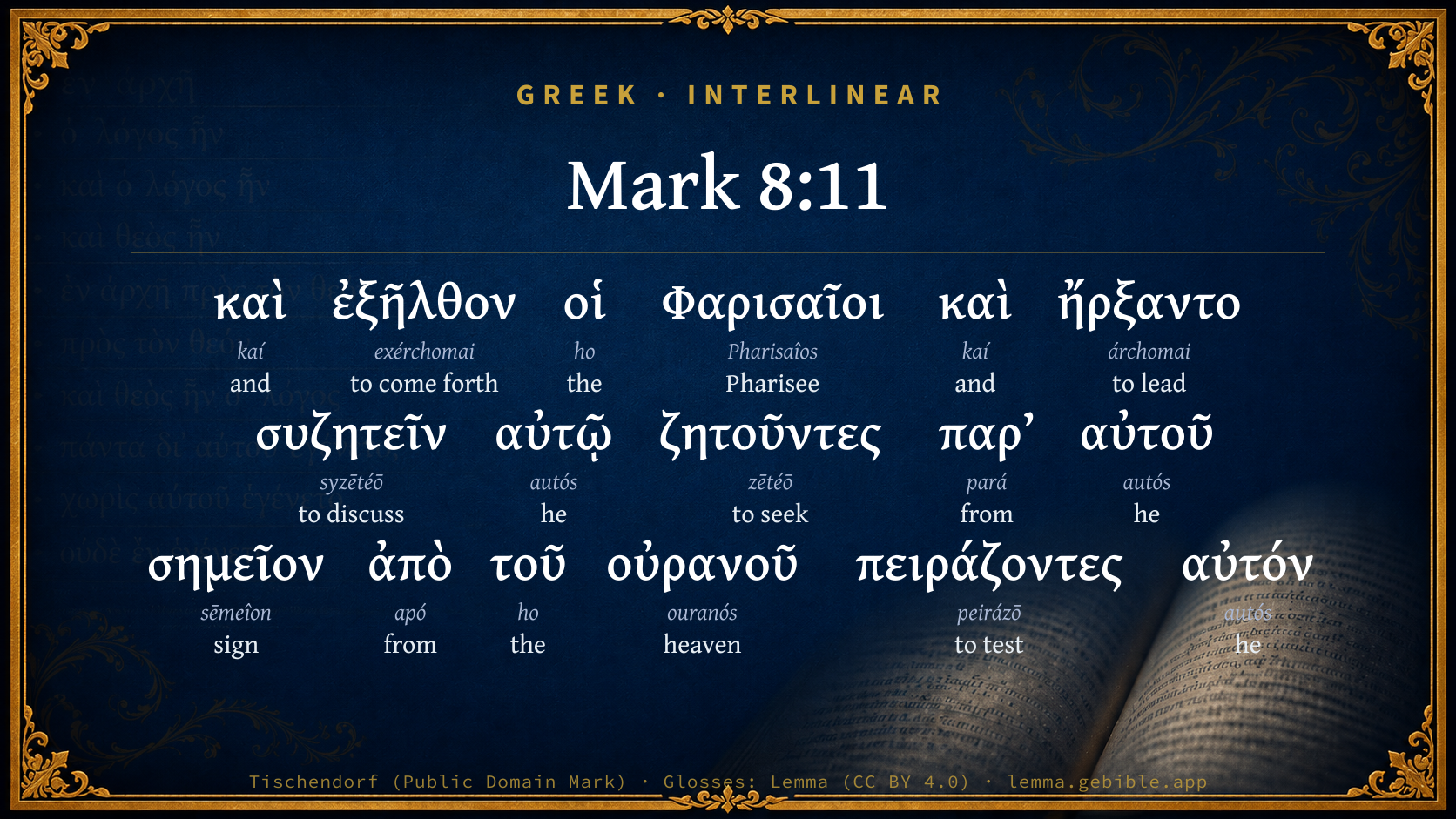
Greek (Tischendorf 8th ed.) Mark 8:11 appears in the Greek New Testament. The text above is from the Tischendorf 8th edition. Each word links to its Strong’s number and a concise gloss. Click any word for its full Thayer’s Greek Lexicon entry.
Download image
Cite this verse

Mark 8:11 (World English Bible). Public Domain. Lemma interlinear Bible study tool, https://lemma.gebible.app/v/mark/8/11.

Show BibTeX & RIS
BibTeX
RIS
English Translation
The Pharisees came out and began to question him, seeking from him a sign from heaven, and testing him.
World English Bible · Public Domain
Download a study sheet

One document with this verse’s original text, its word-by-word gloss line, the meaning frame, cross-references with their text, attributed commentary, and full source and license credits — printable, and it pastes into notes with its structure intact.

This verse Autodidact and up

Study sheet (.html) Plain text (.txt)

A passage Seminary Student

Up to 50 verses in one chapter. A passage sheet keeps up to 6 commentary sources and 12 cross-references per verse, in the order this page ranks them, and says so on the sheet whenever that leaves anything out. Ask for a single verse and you get the Autodidact verse sheet above.

Everything on this page stays free to read, with no account — the sheet is a download of what is already on screen, not access to it.

Want to remove ads? Support Godless Engineer
Compare translations 3

The same verse in 3 English versions, stacked beneath the original-language interlinear above. Click any original word for its lexicon entry.

Each is an independent rendering of the whole verse — the interlinear is not word-aligned to these translations.

Highlighted words mark where these versions differ — a whole-verse word diff, not a word-by-word alignment.

  • World English Bible Public Domain
    The Pharisees came out and began to question him, seeking from him a sign from heaven, and testing him.
  • King James Version Public Domain
    And the Pharisees came forth, and began to question with him, seeking of him a sign from heaven, tempting him.
  • unfoldingWord Literal Text CC BY-SA 4.0
    And the Pharisees came out and began to argue with him, seeking from him a sign from heaven, testing him.

unfoldingWord Literal Text — © unfoldingWord, licensed CC BY-SA 4.0. Word-aligned USFM3 via Door43 (git.door43.org/unfoldingWord/en_ult).

Versions to compare (up to 4)

3 of 4 selected

Show all 19 translations

Every available English version of this verse, each an independent rendering of the whole verse.

  • World English Bible Public Domain
    The Pharisees came out and began to question him, seeking from him a sign from heaven, and testing him.
  • Berean Standard Bible Public Domain
    Then the Pharisees came and began to argue with Jesus, testing Him by demanding from Him a sign from heaven.
  • Majority Standard Bible Public Domain
    Then the Pharisees came and began to argue with Jesus, testing Him by demanding from Him a sign from heaven.
  • King James Version Public Domain
    And the Pharisees came forth, and began to question with him, seeking of him a sign from heaven, tempting him.
  • American Standard Version (1901) Public Domain
    And the Pharisees came forth, and began to question with him, seeking of him a sign from heaven, trying him.
  • Revised Version (1885) Public Domain
    And the Pharisees came forth, and began to question with him, seeking of him a sign from heaven, tempting him.
  • Geneva Bible (1599) Public Domain
    And the Pharises came foorth, and began to dispute with him, seeking of him a signe from heauen, and tempting him.
  • Douay-Rheims (1899) Public Domain
    And the Pharisees came forth, and began to question with him, asking him a sign from heaven, tempting him.
  • Young's Literal Translation Public Domain
    and the Pharisees came forth, and began to dispute with him, seeking from him a sign from the heaven, tempting him;
  • Literal Standard Version CC BY-SA 4.0
    and the Pharisees came forth, and began to dispute with Him, seeking from Him a sign from Heaven, tempting Him;
  • Unlocked Literal Bible CC BY-SA 4.0
    Then the Pharisees came out and began to argue with him. They sought from him a sign from heaven, to test him.
  • unfoldingWord Literal Text CC BY-SA 4.0
    And the Pharisees came out and began to argue with him, seeking from him a sign from heaven, testing him.
  • Darby Bible Public Domain
    And the Pharisees went out and began to dispute against him, seeking from him a sign from heaven, tempting him.
  • World Messianic Bible Public Domain
    The Pharisees came out and began to question him, seeking from him a sign from heaven and testing him.
  • Webster's Bible Public Domain
    And the Pharisees came forth, and began to question with him, seeking from him a sign from heaven, tempting him.
  • Free Bible Version CC BY-SA 4.0
    The Pharisees arrived and began to argue with him, wanting him to give them a miraculous sign from heaven, trying to get him to prove himself.
  • Bible in Basic English Public Domain
    And the Pharisees came out and put questions to him, requesting from him a sign from heaven, testing him.
  • Text-Critical English NT CC BY 4.0
    Then the Pharisees came and began to argue with Jesus, asking him for a sign from heaven, to test him.
  • Tyndale New Testament (1534) Public Domain
    And the pharises cam forth and begane to dispute with him sekinge of him a signe from heven and temptinge him.

Literal Standard Version (2020), Covenant Press — licensed CC BY-SA 4.0. Text via the HelloAO Bible API (eBible.org). Unlocked Literal Bible (unfoldingWord) — licensed CC BY-SA 4.0. Text via the HelloAO Bible API (eBible.org). unfoldingWord Literal Text — © unfoldingWord, licensed CC BY-SA 4.0. Word-aligned USFM3 via Door43 (git.door43.org/unfoldingWord/en_ult). Free Bible Version, Dr. Jonathan Gallagher — licensed CC BY-SA 4.0. Text via the HelloAO Bible API (eBible.org).

Word by word

More ways to search: Search by grammar → Find every occurrence → Compare this word →

Practice this passage: Drill this verse → Learn its vocabulary →

συζητεῖν
syzētéō
G4802
“to discuss”
Verb, Present, Active, Infinitive
Part of Speech
Verb
Tense
Present
Voice
Active
Mood
Infinitive
Full Thayer's Definition

Origin: from G4862 and G2212

TDNT: 19:27,1

1. to seek or examine together 2. in the NT to discuss, dispute, question
  1. καὶ kaí G2532 “and” Conjunction
  2. ἐξῆλθον exérchomai G1831 “to come forth” Verb, Aorist, Active, Indicative, 3rd person, Plural
  3. οἱ ho G3588 “the” Article, Nominative, Plural, Masculine
  4. Φαρισαῖοι Pharisaîos G5330 “Pharisee” Noun, Nominative, Plural, Masculine
  5. καὶ kaí G2532 “and” Conjunction
  6. ἤρξαντο árchomai G756 “to lead” Verb, Aorist, Middle deponent, Indicative, 3rd person, Plural
  7. αὐτῷ autós G846 “he” Personal pronoun, Dative, Singular, Masculine
  8. ζητοῦντες zētéō G2212 “to seek” Verb, Present, Active, Participle, Nominative, Plural, Masculine
  9. παρ’ pará G3844 “from” Preposition
  10. αὐτοῦ autós G846 “he” Personal pronoun, Genitive, Singular, Masculine
  11. σημεῖον sēmeîon G4592 “sign” Noun, Accusative, Singular, Neuter
  12. ἀπὸ apó G575 “from” Preposition
  13. τοῦ ho G3588 “the” Article, Genitive, Singular, Masculine
  14. οὐρανοῦ ouranós G3772 “heaven” Noun, Genitive, Singular, Masculine
  15. πειράζοντες peirázō G3985 “to test” Verb, Present, Active, Participle, Nominative, Plural, Masculine
  16. αὐτόν autós G846 “he” Personal pronoun, Accusative, Singular, Masculine

About this verse

These counts appear in no published source. They are computed here, from the morphology-tagged text and Lemma’s own curated glosses. What Lemma adds →

17
words
13
distinct lemmas
Gospels
section

Notable vocabulary

The rarest word here is συζητεῖν to discuss G4802 — appearing just 10 times in the whole Greek New Testament.

Shared distinctive vocabulary

συζητεῖν to discuss G4802 occurs in 10 verses of the Greek New Testament. Also found in:

Repetition

Words recur within this verse:

Cross-references

25

Topical passages linked to Mark 8:11 in the Treasury of Scripture Knowledge — connected by theme and wording, ordered by reader-vote popularity; previews shown in the World English Bible.

  • Matthew 12:38 Then certain of the scribes and Pharisees answered, "Teacher, we want to see a sign from you."
  • John 4:48 Jesus therefore said to him, "Unless you see signs and wonders, you will in no way believe."
  • 1 Corinthians 10:9 Neither let us test the Lord, as some of them tested, and perished by the serpents.
  • Exodus 17:7 He called the name of the place Massah, and Meribah, because the children of Israel quarreled, and because they tested Yahweh, saying, "Is Yahweh among us, or not?"
  • Deuteronomy 6:16 You shall not tempt Yahweh your God, as you tempted him in Massah.
  • Malachi 3:15 Now we call the proud happy; yes, those who work wickedness are built up; yes, they tempt God, and escape.'
  • Luke 11:16 Others, testing him, sought from him a sign from heaven.
  • Luke 12:54–57 He said to the multitudes also, "When you see a cloud rising from the west, immediately you say, 'A shower is coming,' and so it happens.
  • 1 Corinthians 1:22–23 For Jews ask for signs, Greeks seek after wisdom,
  • Mark 2:16 The scribes and the Pharisees, when they saw that he was eating with the sinners and tax collectors, said to his disciples, "Why is it that he eats and drinks with tax collectors and sinners?"
  • Matthew 16:1–12 The Pharisees and Sadducees came, and testing him, asked him to show them a sign from heaven.
  • Matthew 22:34–35 But the Pharisees, when they heard that he had put the Sadducees to silence, gathered themselves together.
  • Mark 7:1–2 Then the Pharisees, and some of the scribes gathered together to him, having come from Jerusalem.
  • Mark 12:15 Shall we give, or shall we not give?" But he, knowing their hypocrisy, said to them, "Why do you test me? Bring me a denarius, that I may see it."
  • John 6:30 They said therefore to him, "What then do you do for a sign, that we may see, and believe you? What work do you do?
  • John 7:48 Have any of the rulers believed in him, or of the Pharisees?
  • Exodus 17:2 Therefore the people quarreled with Moses, and said, "Give us water to drink." Moses said to them, "Why do you quarrel with me? Why do you test Yahweh?"
  • Matthew 19:3 Pharisees came to him, testing him, and saying, "Is it lawful for a man to divorce his wife for any reason?"
  • Matthew 21:23 When he had come into the temple, the chief priests and the elders of the people came to him as he was teaching, and said, "By what authority do you do these things? Who gave you this authority?"
  • Matthew 22:15 Then the Pharisees went and took counsel how they might entrap him in his talk.
  • Matthew 22:18 But Jesus perceived their wickedness, and said, "Why do you test me, you hypocrites?
  • Matthew 22:23 On that day Sadducees (those who say that there is no resurrection) came to him. They asked him,
  • Luke 10:25 Behold, a certain lawyer stood up and tested him, saying, "Teacher, what shall I do to inherit eternal life?"
  • Luke 11:53–54 As he said these things to them, the scribes and the Pharisees began to be terribly angry, and to draw many things out of him;
  • Acts 5:9 But Peter asked her, "How is it that you have agreed together to tempt the Spirit of the Lord? Behold, the feet of those who have buried your husband are at the door, and they will carry you out."

Cross-references courtesy of OpenBible.info (CC BY 4.0).

Commentary

Notes on Mark 8:11 from classic Christian and Jewish commentators (each source and its license shown beneath its notes). The classic Christian expositions comment on the surrounding passage and are grouped to its opening verse, so a note may address several verses; the Jewish commentaries on the Tanakh (Rashi and others) are per-verse, so they appear only where the commentator wrote on this verse.

Lemma curates 59 commentaries, every one of them public domain or Creative Commons licensed, each selected and text-cleaned for this edition rather than reprinted as found. About our sources →

Whedon's Commentary on the Bible

Daniel D. Whedon

§ 70. — THE DEMAND FOR A SIGN, Mar_8:11-13.

(See notes on Mat_16:1-4.)

Daniel D. Whedon (gen. ed.), Commentary on the Old and New Testaments (1874–1909) — public domain. Text from a community e-Sword module.

The Expositor's Bible

CHAPTER 8:11-21 (Mar_8:11-21)

THE LEAVEN OF THE PHARISEES

"And the Pharisees came forth, and began to question with Him, seeking of Him a sign from heaven, tempting Him. And He sighed deeply in His spirit, and saith, Why doth this generation seek a sign? verily I say unto you, There shall no sign be given unto this generation. And He left them, and again entering into the boat departed to the other side. And they forgot to take bread; and they had not in the boat with them more than one loaf. And He charged them, saying, Take heed, beware of the leaven of the Pharisees and the leaven of Herod. And they reasoned one with another, saying, We have no bread. And Jesus perceiving it saith unto them, Why reason ye, because ye have no bread? do ye not yet perceive, neither understand? have ye your heart hardened? Having eyes, see ye not? and having ears, hear ye not? and do ye not remember? When I brake the five loaves among the five thousand, how many baskets full of broken pieces took ye up? They said unto Him, Twelve. And when the seven among the four thousand, how many basketfuls of broken pieces took ye up? And they said unto Him, Seven. And He said unto them, Do ye not yet understand?" Mar_8:11-21 (R.V.)

WHENEVER a miracle produced a deep and special impression, the Pharisees strove to spoil its effect by some counter-demonstration. By so doing, and at least appearing to hold the field, since Jesus always yielded this to them, they encouraged their own faction, and shook the confidence of the feeble and hesitating multitude. At almost every crisis they might have been crushed by an appeal to the stormy passions of those whom the Lord had blessed. Once He might have been made a king. Again and again His enemies were conscious that an imprudent word would suffice to make the people stone them. But that would have spoiled the real work of Jesus more than to retreat before them, now across the lake, or, just before, into the coasts of Tyre and Sidon. Doubtless it was this constant avoidance of physical conflict, this habitual repression of the carnal zeal of His supporters, this refusal to form a party instead of founding a Church, which renewed incessantly the courage of His often-baffled foes, and led Him, by the path of steady ceaseless self-depression, to the cross which He foresaw, even while maintaining His unearthly calm, amid the contradiction of sinners against Himself.

Upon the feeding of the four thousand, they demand of Him a sign from heaven. He had wrought for the public no miracle of this peculiar kind. And yet Moses had gone up, in the sight of all Israel, to commune with God in the mount that burned; Samuel had been answered by thunder and rain in the wheat harvest; and Elijah had called down fire both upon his sacrifice and also upon two captains and their bands of fifty. Such a miracle was now declared to be the regular authentication of a messenger from God, and the only sign which evil spirits could not counterfeit.

Moreover the demand would specially embarrass Jesus, because He alone was not accustomed to invoke heaven: His miracles were wrought by the exertion of His own will. And perhaps the challenge implied some understanding of what this peculiarity involved, such as Jesus charged them with, when putting into their mouth the words, This is the heir, come, let us kill Him. Certainly the demand ignored much. Conceding the fact of certain miracles, and yet imposing new conditions of belief, they shut their eyes to the unique nature of the works already wrought, the glory as of the Only-begotten of the Father which they displayed. They held that thunder and lightning revealed God more certainly than supernatural victories of compassion, tenderness and love. What could be done for moral blindness such as this? How could any sign be devised which unwilling hearts would not evade? No wonder that hearing this demand, Jesus signed deeply in His spirit. It revealed their utter hardness; it was a snare by which others would be entangled; and for Himself it foretold the cross.

St. Mark simply tells us that He refused to give them any sign. In St. Matthew He justifies this decision by rebuking the moral blindness which demanded it. They had material enough for judgment. The face of the sky foretold storm and fair weather, and the process of nature could be anticipated without miracles to coerce belief. And thus they should have discerned the import of the prophecies, the course of history, the signs of the times in which they lived, so plainly radiant with Messianic promise, so menacing with storm-clouds of vengeance upon sin. The sign was refused moreover to an evil and adulterous generation, as God, in the Old Testament, would not be inquired of at all by such a people as these. This indignant rejoinder St. Mark has compressed into the words, "There shall no sign be given unto this generation" -- this which has proof enough, and which deserves none. Men there were to whom a sign from heaven was not refused. At His baptism, on the Mount of Transfiguration, and when the Voice answered His appeal, "Father, glorify Thy name," while the multitude said only that it thundered--at these times His chosen ones received a sign from heaven. But from those who had not was taken away even that which they seemed to have; and the sign of Jonah availed them not.

Once more Jesus "left them" and crossed the lake. The disciples found themselves with but one loaf, approaching a wilder district, where the ceremonial purity of food could not easily be ascertained. But they had already acted on the principle which Jesus had formally proclaimed, that all meats were clean. And therefore it was not too much to expect them to penetrate below the letter of the words, "Take heed, beware of the leaven of the Pharisees, and the leaven of Herod." In giving them this enigma to discover, He acted according to His usage, wrapping the spiritual truth in earthly phrases, picturesque and impressive; and He treated them as life treats every one of us, which keeps our responsibility still upon the strain, by presenting new moral problems, fresh questions and trials of insight, for every added attainment which lays our old tasks aside. But they understood Him not. Some new ceremonial appeared to them to be designed, in which everything would be reversed, and the unclean should be those hypocrites, the strictest observers of the old code. Such a mistake, however blameworthy, reveals the profound sense of an ever-widening chasm, and an expectation of a final and hopeless rupture with the chiefs of their religion. It prepares us for what is soon to come, the contrast between the popular belief and theirs, and the selection of a rock on which a new Church is to be built. In the meantime the dire practical inconvenience of this announcement led to hot discussion, because they had no bread. And Jesus, perceiving this, remonstrated in a series of indignant questions. Personal want should not have disturbed their judgment, remembering that twice over He had fed hungry multitudes, and loaded them with the surplus of His gift. Their eyes and ears should have taught them that He was indifferent to such distinctions, and His doctrine could never result in a new Judaism. How was it that they did not understand?

Thereupon they perceived that His warning was figurative. He had spoken to them, after feeding the five thousand, of spiritual bread which He would give, even His flesh to be their food. What then could He have meant by the leaven of the Pharisees but the imparting of their religious tendencies, their teaching, and their insincerity?

Was there any real danger that these, His chosen ones, should be shaken by the demand for a sign from heaven? Did not Philip presently, when Christ spoke of seeing the Father, eagerly cry out that this, if it were granted, would suffice them? In these words he confessed the misgiving which haunted their minds, and the longing for a heavenly sign. And yet the essence of the vision of God was in the life and the love which they had failed to know. If they could not see Him in these, He must forever remain invisible to them.

We too require the same caution. When we long for miracles, neglecting those standing miracles of our faith, the gospel and the Church: when our reason is satisfied of a doctrine or a duty, and yet we remain irresolute, sighing for the impulse of some rare spiritual enlightenment or excitement, for a revival, or a mission, or an oration to lift us above ourselves, we are virtually asking to be shown what we already confess, to behold a sign, while we possess the evidence.

And the only wisdom of the languid, irresolute will, which postpones action in hope that feeling may be deepened, is to pray. It is by the effort of communion with the unfelt, but confessed Reality above us, that healthy feeling is to be recovered.

William Robertson Nicoll, ed., The Expositor's Bible (London: Hodder & Stoughton, 1887–1910) — public domain. 65 of 66 books (1 Corinthians is not separately keyed, as that volume carries no machine-parseable verse references); section-level commentary keyed to the opening verse. Introductory and overview sections not keyed to a specific passage are excluded.

Tyndale Open Study Notes

Tyndale Open Resources

8:11 The antagonism of the Pharisees was persistent (2:16-18, 24; 3:6; 7:1-5; 10:2; 12:13, 15). The request for a sign is at times acceptable (Judg 6:36-40; 2 Kgs 20:8-11; Isa 7:10-12; see also John 2:18-19), but in this case it was obstinate testing of God. • The sought-after sign was not a healing, an exorcism, a raising from the dead, or a nature miracle, for there had been many of these already, and Jesus’ ability to work such signs was well known (Mark 1:32-34, 45; 3:7-12; 6:53-56) even to the Pharisees (3:22). What they sought was a miraculous sign from heaven—that is, directly from God—that would demonstrate once for all that Jesus was the Christ. No sign, however, could ever convince them of this. For those whose hearts were open to the truth, the miracles that Jesus had already done (Luke 7:22) were clear and irrefutable signs that Jesus was the Messiah, the Son of God. For those outside (Mark 4:11-12), no sign could make them believe (cp. Luke 6:19-31).

Tyndale Open Study Notes — © Tyndale Open Resources, licensed CC BY-SA 4.0. Text via the HelloAO Bible API.

Bengel's Gnomon

Johann Albrecht Bengel

Mar 8:11. Ἤρξαντο, they began) after a temporary cessation. [πειραζοντες αὐτὸν, tempting Him) to try whether He could, after having exhibited so many signs on the earth, perform similar signs from heaven also.—V. g.]

Bengel's Gnomon of the New Testament — English translation (T&T Clark, Edinburgh, 1860) — public domain. Text from a community e-Sword module.

Meyer's Critical & Exegetical Commentary

Heinrich August Wilhelm Meyer

Mar_8:11-13. See on Mat_16:1-4, who narrates more fully out of the collection of Logia, and from the tradition adds the Sadducees.

ἐξῆλθον] namely, from their dwellings in the district there. A trait of graphic circumstantiality. Lange imports the idea: as spies out of an ambush. But it is not easy to see why Mar_8:11 should fitly attach itself, not to the history of the miraculous feeding (which could not but serve to enhance the sensation produced by Jesus), but to Mar_7:37 (Holtzmann). Between Dalmanutha and the place of the feeding there lay in fact only the lake.

ἤρξαντο συζ. αὐτῷ] How they made the beginning of disputing with Him, is told by ζητοῦντες κ.τ.λ.: so that they asked, etc.

Mar_8:12. ἀναστενάξας] after that He had heaved a sigh (comp. Mar_7:34), namely, at the hardened unbelief of those men.[111] A picturesque feature here peculiar to Mark. Comp. Mar_7:34.

ΤΊ] whyin painful certainty of the want of result, which would be associated with the granting of their request. Tota hujus orationis indoles intelligitur ex pronuntiatione, Beza.

εἰ δοθήσεται] a thoroughly Hebraistic expression of asseveration (never shall, etc.), by the well-known suppression of the apodosis. See Köster, Erläut. p. 104 ff.; Winer, p. 444 [E. T. 627]. According to Mark, therefore (who has not the significant saying as to the sign of Jonas adopted by Matthew from the collection of Logia already at Mar_10:39 ff., and in this case at Mar_16:4), a σημεῖον is altogether refused to this generation of Pharisees.[112] For themthese hardened ones, for whom the signs already given did not sufficenone should be given; the σημεῖα, which Jesus gave everywhere, were in fact sufficient even for their conversion, if they had only been willing to attend to and profit by them.

ΠΆΛΙΝ ἘΜΒΆς] without ΕἸς ΤῸ ΠΛΟῖΟΝ (see the critical remarks), which is, however, by means of ΠΆΛΙΝ obvious from Mar_8:10. Comp. Xen. Cyrop. v. 7. 7 : ὥστε ἐμβαίνειν, ὁπόταν Νότος πνέῃ, Dem. 29. 26, and many other places in the classical writers.

ΕἸς ΤῸ ΠΈΡΑΝ] to the eastern side of the lake (comp. Mar_8:10). Holtzmann is wrong in saying that Jesus here passes over for the second time to the western side; see on Mar_8:22.

[111] This is all that is shown by the following painful question. Lange arbitrarily holds that Jesus sighed on account of the commencement of His separation from the dominant popular party; that there was, at the same time, a forbearing reservation of His judicial power, and so forth.

[112] By passing over the sign of Jonas, Mark has effaced the point of the answer, which Matthew and Luke have furnished.

Meyer — Critical and Exegetical Commentary on the New Testament — English translation by Peter Christie, edited by Frederick Crombie (T&T Clark, 1880) — public domain. Text from a community e-Sword module.

Expositor's Greek Testament

ed. W. Robertson Nicoll

Mar 8:11-12 . Pharisees seek a sign (Mat 16:1-4 ).

Mar 8:11 . ἐξῆλθον οἱ φ ., the Pharisees went out, from their seat in the Holy Land into the heathen Decapolis, otherwise carefully shunned, in their zeal against Jesus. So Weiss (in Meyer).

The Expositor's Greek Testament, edited by W. Robertson Nicoll (1897–1910) — public domain. Text from a community e-Sword module.

Geneva Bible (1599)

Geneva Bible translators

The stubborn enemies of the doctrine of the Gospel, giving no credit to the miracles already done require new: but Christ being angry with them, doth utterly forsake them.

A common kind of speech, which the Hebrews use, whereby is meant that the Pharisees went from their houses of purpose, to encounter with him.

Geneva Bible (1599) marginal notes — public domain. Text via Bolls.life.

Ellicott's Commentary for English Readers

(11-12) And the Pharisees came forth.—See Notes on Mat_16:1-4. St. Mark, it may be noted, docs not mention the presence of the Pharisees, and gives only part of our Lord’s answer. On the other and, he characteristically describes the “sighing deeply in spirit” in Mar_8:12, which St. Matthew does not give.

A Bible Commentary for English Readers, edited by Charles John Ellicott (1878–1897) — public domain. Text from a community e-Sword module.

The Cambridge Bible for Schools and Colleges

gen. ed. J. J. S. Perowne

11. And the Pharisees] Our Lord seems purposely to have avoided sailing to Bethsaida or Capernaum, which lay a little north of Magdala, and which had become the head-quarters of the Pharisees; but they had apparently watched for His arrival, and now “came forth” to meet Him accompanied for the first time by the Sadducees (Mat_16:1), their rivals and enemies.

began] They had made their arrangements for a decisive contest, which began with a demand for a sign.

a sign from heaven] The same request had already been twice proffered. (1) After the first cleansing of the Temple (Joh_2:18); (2) after the feeding of the Five Thousand (Joh_6:30); and (3) again shortly after the walking through the cornfields (Mat_12:38). By such a “sign” was meant an outward and visible luminous appearance in the sky or some visible manifestation of the Shechînah, the credentials of a prophet. They asked in effect, “Give us bread from heaven, as Moses did, or signs in the sun and moon like Joshua, or call down thunder and hail like Samuel, or fire and rain like Elijah, or make the sun turn back on the dial like Isaiah, or let us hear the Bath-Kôl, the ‘daughter of the Voice,’ that we may believe Thee.”

The Cambridge Bible for Schools and Colleges (gen. ed. J. J. S. Perowne; Cambridge University Press, 1878–1918) — public domain. Text from a community e-Sword module.

John Gill's Exposition

And the Pharisees came forth,.... Out of their houses; who dwelt in the coasts of Magdala, and parts of Dalmanutha, and came to Jesus, hearing of his being arrived in their neighbourhood:

and began to question with him; or to dispute with him, it being their manner to carry on disputations by questions and answers. The Persic version has the question they put, and about which they disputed, "if thou art the Christ"; in proof of which they required a sign:

seeking of him a sign from heaven, tempting him; See Gill on Mat 16:1.

John Gill's Exposition of the Whole Bible (1746–1763) — public domain (CC PDM 1.0). Text via the HelloAO Bible API.

Trapp's Complete Commentary

John Trapp

11 And the Pharisees came forth, and began to question with him, seeking of him a sign from heaven, tempting him.

Ver. 11. {See Trapp on "Mat 16:1"}

John Trapp, A Commentary or Exposition upon All the Books of the Old and New Testament (1647–1656) — public domain. Text from a community e-Sword module.

Albert Barnes' Notes on the Bible

See this passage explained in Mat 16:1-12.

Mar 8:12

Sighed deeply in his spirit - His heart was deeply affected at their wickedness and hypocrisy. The word “spirit” here is taken as the seat of the emotions, passions, affections. He drew groans deeply from his breast.

No sign be given - That is, no such sign as they asked, to wit, a sign “from heaven.” He said a sign should be given, the same as was furnished by Jonas, Mat 16:4. But this was not what they “asked,” nor would it be given “because” they asked it.

Mar 8:15

Beware of the leaven of the Pharisees - See Mat 16:6.

Of Herod - Of the Herodians - of Herod and his followers. Matthew, instead of “Herod,” has “the Sadducees.” It is not improbably that he cautioned them against them all. The Pharisees sought his life, and were exceedingly corrupt in their doctrine and practice; the Sadducees denied some of the essential doctrines of religion, and the Herodians probably were distinguished for irreligion, sensuality, and corrupt living. They were united, therefore, with the Pharisees and Sadducees in opposing the claims of Jesus. Matthew has recorded his caution to avoid the Pharisees and Sadducees, and Mark has added, what Matthew had omitted. the caution likewise to beware of the Herodians. Thus, the evangelists speak the same thing.

Albert Barnes' Notes on the Bible (1834–1885) — public domain. Text from a community e-Sword/MySword module.

Haydock's Catholic Bible Commentary

Jesus Christ did not consent to the petition they made him, because there will be another time for signs and wonders, viz. his second coming, when the powers of heaven shall be moved, and the moon refuse her light. This his first coming is not to terrify man, but to instruct and store his mind with lessons of humility, and every other virtue. (Theophylactus)

George Leo Haydock (1774–1849), Haydock's Catholic Family Bible and Commentary, 1859 edition — public domain. Excludes Psalms (Douay-Rheims chapter numbering differs from Protestant) and Deuterocanonical books (Catholic canon only).

The Pulpit Commentary

And the Pharisees came forth St. Matthew (Mat_16:1) says that the Sadducees came with them and began to question with him, seeking of him a sign from heaven, tempting him. They had already asked for a sign from heaven; (Mat_12:38) but now this miracle gives them occasion to ask again. For when they saw how greatly it was extolled by the multitudes who had benefited by it, it was easy for them to urge that it was an earthly sign, and might have been wrought by him who is called "the God of this world;" and so they insinuated that he had wrought this miracle as well as his other miracles by the power of Satan. Therefore they seek a sign from heaven, that he who dwells in heaven might thus bear witness that he came from God, and that his doctrine was Divine; the Pharisees probably meant that if he did this they would believe in him as the Messiah, and lead the people to the same faith.

The Sadducees, who were practically atheists, thought that no sign could be given from heaven by God, seeing that in their opinion it was doubtful whether there was any God to give it.

Vers. 11-13. Signs.

This was not an isolated case of the demands on the part of the Jewish leaders that Jesus should work some miracle which they might receive as a sign from heaven. And it was not only during our Saviour"s ministry that they preferred such a request. For Paul had occasion long afterwards to complain of the Jews that they "required a sign," and were dissatisfied with the doctrines and with the evidences of Christianity.

I THE REQUEST OF THE PHARISEES. These men made a point of seeing Jesus, and seem, on this as on other occasions, to have come as a deputation from his adversaries.

1. What was it they asked? Not an ordinary miracle, for such Jesus had already repeatedly and publicly performed. It was a sign, not from himself, but from heaven. Any wonder he might work they would attribute to magic or to Beelzebub. But, such was their profession, if he would furnish them with some splendid celestial portent if he would give bread from heaven or stay the sun in its course then they would be convinced of his Messiahship.

2. Why did they ask such a sign? They were tempting, testing him putting him to the proof. Had he complied with their wish, they would have seen in him the Messiah they wanted one prepared probably to wield supernatural power for personal aggrandizement and for political dominion. Should he refuse, they would be confirmed in their rejection of his claims.

II THE REFUSAL OF CHRIST. Observe:

1. The feeling with which he refused. "He sighed deeply in his spirit." Had they come asking for healing, relief, assistance, he would have joyfully complied; but it grieved him to the heart that they should come thus. And he read in their conduct the sign of a widespread carnality, unspirituality, and unbelief.

2. He disapproved of the spirit in which the request had been made. He was not only pained by it, he censured and condemned it. They who came, came to carp and criticize, and confirm themselves in their unbelief.

3. He had already given evidence enough to justify the faith of such as were candid and open to conviction. He had wrought miracles so many and of such a kind as might assure the thoughtful and spiritually susceptible that he was from God.

4. He knew that what they asked for, if granted, would not convince them. The deficiency was not in him; it was in themselves. The principle was applicable, "If they hear not Moses and the prophets," etc.

5. There was one great sign yet to be given, in God"s time a sign that should surpass all granted in the olden days; a sign that should leave all unbelievers without excuse his resurrection from the dead.

Vers. 11-13. Seeking for a sign.

Christ knew at once what this meant. He "knew what was in man," and refused to commit himself to the pretended inquirers. We have a more difficult course to pursue.

I THE CHARACTER OF THE DEMAND DEPENDS UPON CIRCUMSTANCES. It may be made in an honest, inquiring spirit, or in order to injure religion. In the former case too much consideration can hardly be given to it, as it is the indispensable preliminary to rational conviction, and the gospel offers evidence for its claims. The spirit in which the inquiry is made may be determined by:

1. The character of those who inquire. Bad men may be genuine inquirers, but it is well to know their antecedents. Christ could read the underlying design of the Jews. It may reasonably be expected that inquirers should give some proof of their sincerity, especially if already furnished with many evidences.

2. The kind of sign asked for. Here it was "a sign from heaven," i.e. differing from the miracles and previous manifestations of Christ. This implied that they were insufficient, and indirectly pronounced judgment upon the previous words and works of Christ. A question may sometimes reveal a more thorough scepticism than a dogmatic denial. Whilst apparent liberty is given as to what particular sign might be produced, there is really a tone of dictation and unseemly assumption.

II SUCH A DEMAND EXPOSES THE REPRESENTATIVES OF CHRISTIANITY TO STRONG TEMPTATION. They are invited to criticize God"s methods of revelation, and to despise the "means of grace." A position full of unbelief and presumption may insensibly be assumed, such as that of Moses at the rock: "Must we fetch you water out of this rock?". (Num_20:10) They may be induced to attempt to "force the hand" of God. The crime of such a proceeding could only be equalled by its folly. As if those who are insensible to the cross of Christ could be converted by a thunderbolt or a merely supernatural spectacle! It is for Christ"s servants in times of popular excitement to preach the old truths, and to appeal to every man"s God. The improbability of sensationalism producing belief is a growing one. "If they hear not Moses and the prophets, neither will they be persuaded, if one rise from the dead". (Luk_16:31) So we may now add, "If they believe not One who has risen from the dead, neither will they believe, though he were to be manifested to them in heaven itself.

III EVEN WERE IT DESIRED IT WOULD BE REFUSED. "This generation" represents all who ask in a similar spirit.

1. Because the. evidence for Christianity is spiritual, not carnal; moral, and not material.

2. Because the patent, outstanding facts of the gospel are sufficient:

a. For the conversion of sinners; and

b. for the confirmation and edifying of saints.

3. Because it is part of the punishment appointed to such inquirers that they shall ask and not receive, and seek and not find.

4. Because it may become a means of turning attention back to the evidence that has been despised or ignored. It is high time our philosophical inquirers began to inquire why their researches have produced no fruits in evidence or conviction as yet. Why is it that whilst the evidence for the gospel is at least equal to that for any other matters of history, it is yet disbelieved when they are accepted? Is not the reason a moral rather than an intellectual one? M.

Vers. 11-21. Craving for signs.

I WHENCE THE CRAVING SPRINGS. "The Jews seek after a sign." It is the spirit we nowadays term "sensationalism." It is a natural desire for a certain pleasure of the mind. Fixed ideas, a sameness of mental representations, wearies and saddens the mind. Hence the craving for amusement, which gives change to the perpetual march past of the same old thoughts. The feeling is natural enough. The Jews, who had no science in our sense, and did not live in an interesting age like ours, wanted signs and wonders to amuse. We can understand the feeling, and allow it to be natural, but at the same time not religious.

II CHRIST REFUSES TO FOSTER SENSATIONALISM.

1. The form of denial and refusal is very strong and emphatic indeed. (Ver. 12) Signs will be given to those who are ready to profit by them, not to gratify idle curiosity. How severely does Christ discountenance "sensationalism" in connection with his religion! He will have as little noise, as little rumor, finger-pointing, gaping of vacant crowd, as possible. "The kingdom of God cometh not with observation.

2. Besides, an express warning is given: against "the leaven of the Pharisees and of Herod." This means much the same as the Pharisees and Sadducees, apparently. The political Herodians were many of them Sadducees. Again, the Pharisees and Sadducees had a certain common basis of teaching. Both were at once in opposition to Jesus and the aims of his kingdom. The Pharisees, strongly conservative of Judaism, would disparage Jesus and his works. The other party would object to any "kingdom of heaven," acknowledging only the Roman empire. The "leaven" means both the teaching and the spirit of it. (cf. Mat_16:12 Luk_12:1)

III THE UNSPIRITUAL MIND CONSTANTLY MISUNDERSTOOD HIM. The disciples stuck at the word "leaven leaven-loaves. "We forgot to bring provisions with us!" The error was double. They caught at the sound instead of the sense. And they showed forgetfulness of the miracle they had so recently witnessed. "How is it that you do not consider?" Christ is just as much misunderstood to-day as he was then. We forget the spirit of Christianity; we blunder over its meaning. He says to us to-day, "How is it that you do not consider?" "Moral evidence is most profitable and proper for religious truth. Lower proof is desired when higher is disregarded and despised. Forgetfulness of the past occasions needless anxiety for the future" (J. H. Godwin). J.

The Pulpit Commentary (1880–1919), ed. H.D.M. Spence-Jones & Joseph S. Exell — public domain. Text from a community e-Sword module.

John Wesley's Explanatory Notes

Tempting him - That is, trying to ensnare him. Matt. xvi, 1.

John Wesley, Explanatory Notes Upon the Whole Bible (1754–1765) — public domain. Text via the GEBible commentary corpus.

The People's New Testament

B. W. Johnson

11–13. The Pharisees came … seeking of him a sign from heaven. See notes on Matt. 16:1–4.

B. W. Johnson's The People's New Testament with Notes (1889–1891) — public domain. Electronic text from the Christian Classics Ethereal Library (CCEL) ThML edition.

unfoldingWord translationNotes

Door43 World Missions Community

Connecting Statement:

In Dalmanutha, Jesus refuses to give the Pharisees a sign before he and his disciples get in a boat and leave.

They sought from him

"They asked him for"

a sign from heaven

They wanted a sign that would prove that Jesus' power and authority were from God. Possible meanings are 1) The word "heaven" is a metonym for God. AT: "a sign from God" or 2) the word "heaven" refers to the sky. AT: "a sign from the sky" (See: Metonymy)

to test him

The Pharisees tried to test Jesus to make him prove that he was from God. Some information can be made explicit. AT: "to prove that God had sent him" (See: Assumed Knowledge and Implicit Information)

He sighed deeply in his spirit

This means that he groaned or that he let out a long deep breath that could be heard. It probably shows Jesus' deep sadness that the Pharisees refused to believe him. See how you translated this in Mark 7:34.

in his spirit

"in himself"

Why does this generation seek for a sign?

Jesus is scolding them. This question may be written as a statement. AT: "This generation should not seek a sign." (See: Rhetorical Question)

this generation

When Jesus speaks of "this generation," he is referring to the people who lived at that time. There Pharisees are included in this group. AT: "you and the people of this generation" (See: Assumed Knowledge and Implicit Information)

no sign will be given

This can be stated in active form. AT: "I will not give a sign" (See: Active or Passive)

he left them, got into a boat again

Jesus' disciples went with him. Some information can be made explicit. AT: "he left them, got into a boat again with his disciples" (See: Assumed Knowledge and Implicit Information)

to the other side

This describes the Sea of Galilee, which can be stated clearly. AT: "to the other side of the sea" (See: Assumed Knowledge and Implicit Information)

translationWords

Pharisee

miracle

heaven

test

spirit

generation

amen

Sea of Galilee

unfoldingWord translationNotes — © Distant Shores Media and the Door43 World Missions Community, licensed CC BY-SA 4.0. Source: git.door43.org/Door43/en_tn.

Cambridge Greek Testament for Schools and Colleges

11. ἐξῆλθον. As if from an ambush.

οἱ Φαρισαῖοι. Mt. adds the Sadducees, and he does so six times. Mk and Lk. mention the Sadducees only once, Jn not at all. They began once more to question with Him; for some time He had escaped them. See on Mar 1:27.

σημεῖον ἀπὸ τοῦ οὐρανοῦ. A voice, a return of the manna or of the Shechinah, the sun and the moon to stand still. They believed that with the help of Beelzebub He could work “signs” on earth, but Satanic agency would be powerless in heaven (Theoph.). This demand was made more than once (Mat 12:38; Mat 16:1). Luk 11:15-16 gives one occasion and Mk here gives the other. Such a challenge would be likely to be repeated; but the popular taste for miracles is not encouraged by Christ (see on Joh 4:48; Joh 20:29) and is disparaged by St Paul (1Co 1:22). Deissmann, Light from the Ancient East, p. 393.

πειράζοντες αὐτόν. They did not want to be convinced that He was the Messiah; they wanted material for proving that He was not. Unconsciously, they were renewing the temptation in the wilderness. Note the combination of participles. See on Mar 1:15.

Cambridge Greek Testament for Schools and Colleges (Cambridge University Press, 1896; 21 vols, various authors incl. Carr, Maclear, Plummer, Farrar, Lumby, Moule, M. R. James, Simcox) — public domain. Text from a community e-Sword module.

Alford’s Greek Testament

Henry Alford

11-13.] Request of a sign from heaven. Mat 16:1-4, who gives the account more at length: without however the graphic and affecting ἀναστ. τῷ πν. αὐ. ver. 12.

Henry Alford, The Greek Testament (1849–1861) — public domain. Text from a community e-Sword module.

International Critical Commentary

11. ἐξῆλθον οἱ Φαρισαῖοι—the Pharisees came out. Jesus has been absent in Gentile territory since his dispute with the Pharisees about the washing of hands, 7:1 sqq., and now, immediately on his return, they are on his track again. They came out, Meyer says, from their residences in the neighborhood. But see Morison’s Note. All explanations are conjectural and uncertain. Mt. couples together Pharisees and Sadducees, and the same in the warning against their leaven which follows. This is ominous of the final situation in Jerusalem, when the combination of the party of the priests and of the Scribes brought about his fate. συνζητεῖν αὐτῷ—to discuss with him.1

σημεῖον ἀπὸ τοῦ οὐρανοῦ—a sign from heaven. This was one of their cavils, like their attributing Jesus’ casting out of demons to the power of the prince of demons, by which they sought to discredit the miracles performed by him. They made a distinction between miracles that might be explained by reference to some supernatural power operating here in the world, and distinct from God, and those which came visibly from heaven, i.e. from the sky. The kind of signs demanded by them we find in the eschatological discourse, ch. 13, this being what they had been led to expect in connection with the Messianic period. See 13:24, 25. The miracles performed by Jesus were none of them, they thought, from this source. They were walking on the water, creating earthly food, healing human diseases, and so confined to this world. What they wanted was a voice from heaven, or anything coming from above. πειράζοντες αὐτόν—testing him. They wanted to put his power to perform miracles, or to produce them, to the test, and to see if he was able to give them a sign in which there should be no possibility of collusion with the powers that rule this lower world. The uniform use of tempt to translate this verb is very misleading.

International Critical Commentary — older volumes (1896–1929), various authors — public domain. Text from a community e-Sword module.

Vincent's Word Studies in the New Testament

Marvin R. Vincent

Began. The beginnings of things seem to have a peculiar interest for

Mark. See Mr 1:1, 45; Mr 4:1; Mr 5:17, 20; Mr 6:2, 7, 34, 55.

Sign [σημειον] . See on Mt 11:20. Wyc., token. As applied to the miracles of our Lord, this word emphasizes their ethical purport, as declaring that the miraculous act points back of itself to the grace and power or divine character or authority of the doer.

Marvin R. Vincent, Word Studies in the New Testament (1887–1900) — public domain. Text from a community e-Sword/MySword module.

Lesson kit

Teaching starters — assembled from the data on this page, not authored interpretation. Every prompt links to the verse data it draws on. Edit before teaching.

Mark, in the Gospels, opens this verse with 17 words (13 distinct Greek lemmas). Its most distinctive word is syzētéō (“to discuss”). A historical commentator’s framing appears above. Read the whole chapter for the surrounding context.

Discussion questions

  1. What does “to discuss” (syzētéō) contribute to the verse as a whole?
  2. How does Mark 1:27, which shares the word «to discuss», read alongside this verse?
  3. What does the repetition of “he” (3× in this one verse) do in this verse?
  4. The translations on this page render this verse differently — a whole-verse word diff, not a word-by-word alignment. What might account for the different wordings?
  5. Compare how Whedon's Commentary on the Bible and The Expositor's Bible read this verse. Where do they agree or differ?

Things to notice

Reading settings

Reading text

Shown beneath each verse's original-language words.

Old Testament
Old Testament edition

Read the OT as the Masoretic Hebrew (MT) or the Greek Septuagint (LXX).

English shown for the Greek Septuagint (in the Hebrew ↔ Greek comparison).

Comparing translations? Open the Compare panel on any verse page to stack up to four side by side.