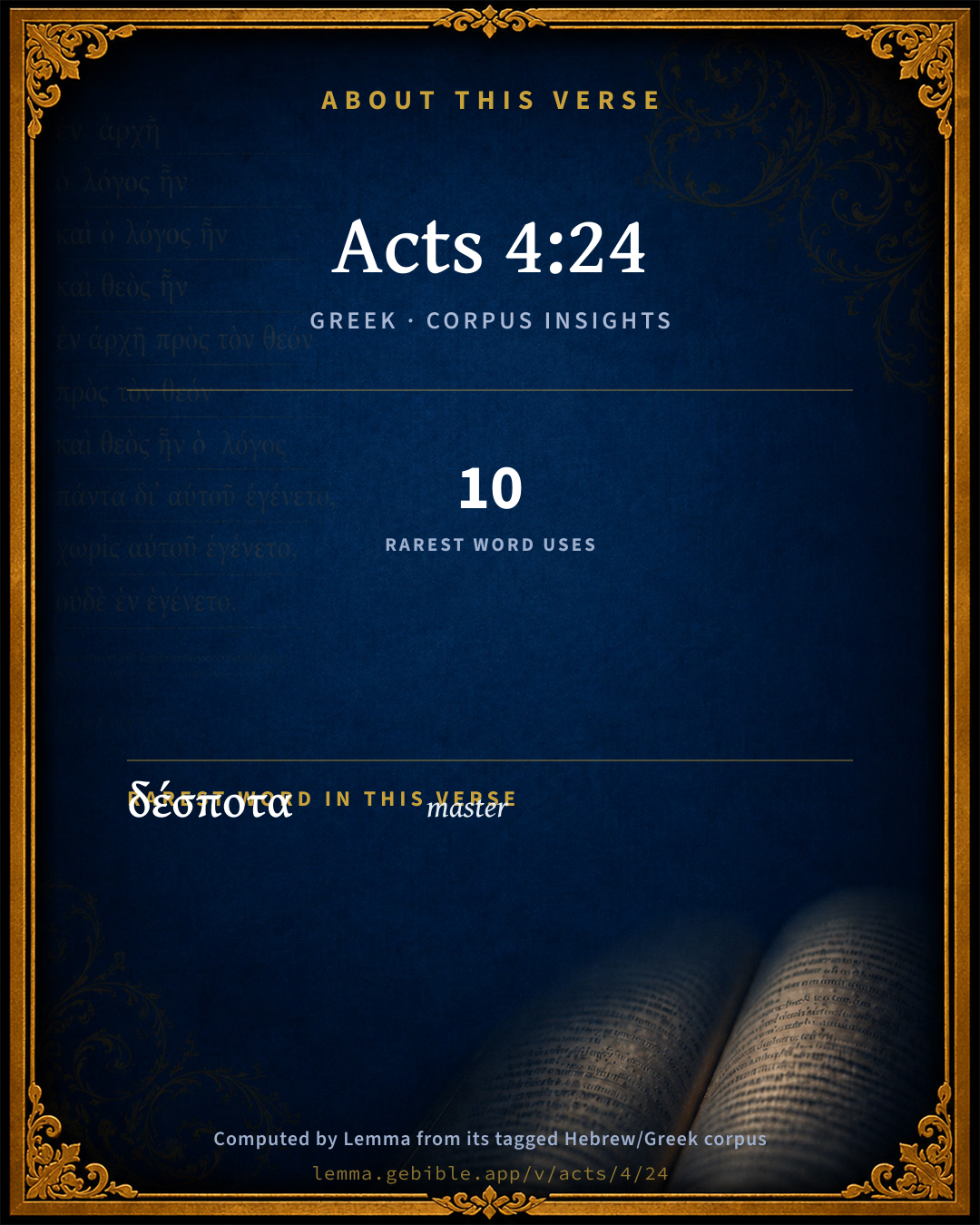
Acts 4:24

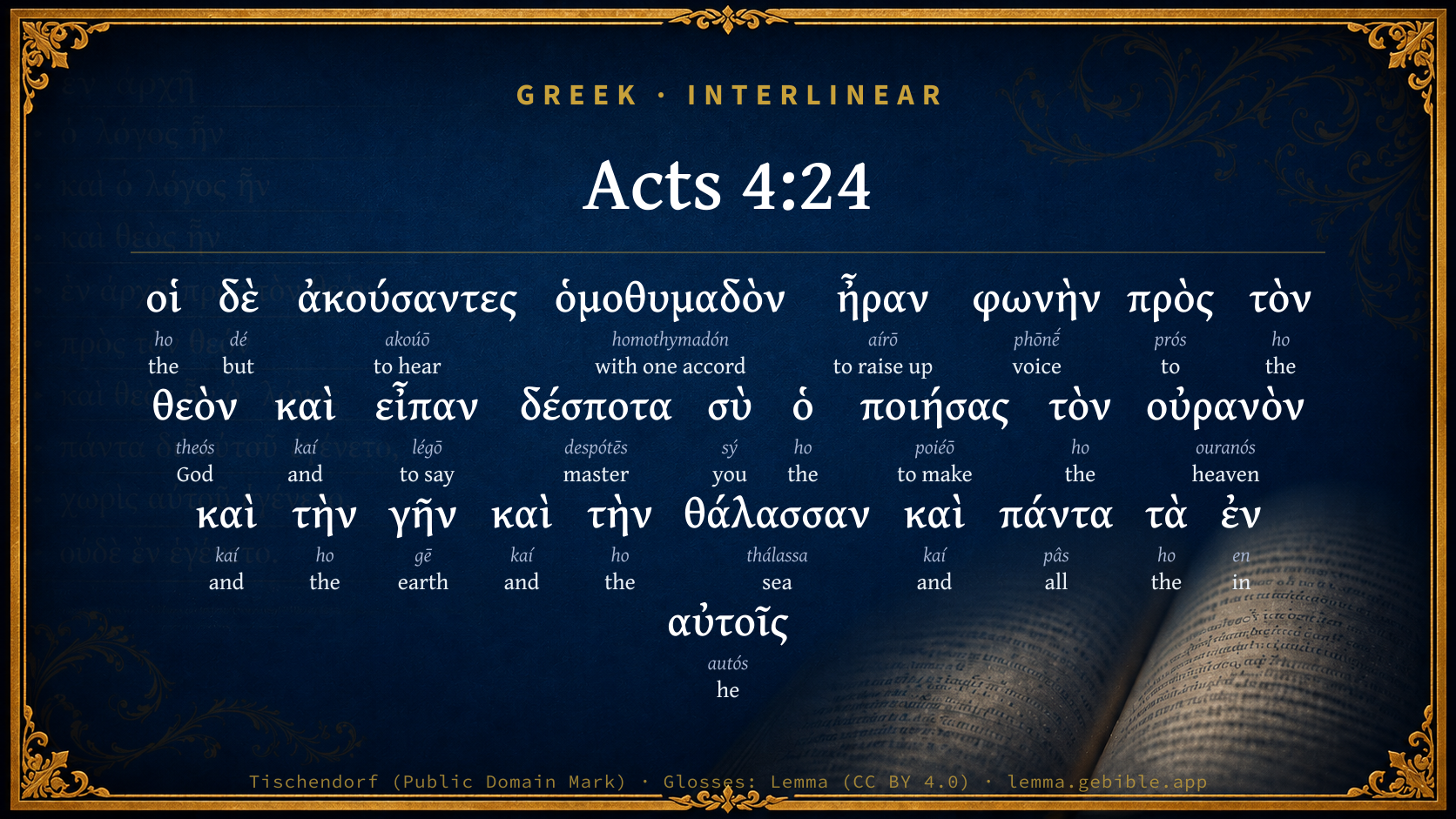
Greek (Tischendorf 8th ed.) Acts 4:24 appears in the Greek New Testament. The text above is from the Tischendorf 8th edition. Each word links to its Strong’s number and a concise gloss. Click any word for its full Thayer’s Greek Lexicon entry.
Download image
Cite this verse

Acts 4:24 (World English Bible). Public Domain. Lemma interlinear Bible study tool, https://lemma.gebible.app/v/acts/4/24.

Show BibTeX & RIS
BibTeX
RIS
English Translation
When they heard it, they lifted up their voice to God with one accord, and said, "O Lord, you are God, who made the heaven, the earth, the sea, and all that is in them;
World English Bible · Public Domain
Download a study sheet

One document with this verse’s original text, its word-by-word gloss line, the meaning frame, cross-references with their text, attributed commentary, and full source and license credits — printable, and it pastes into notes with its structure intact.

This verse Autodidact and up

Study sheet (.html) Plain text (.txt)

A passage Seminary Student

Up to 50 verses in one chapter. A passage sheet keeps up to 6 commentary sources and 12 cross-references per verse, in the order this page ranks them, and says so on the sheet whenever that leaves anything out. Ask for a single verse and you get the Autodidact verse sheet above.

Everything on this page stays free to read, with no account — the sheet is a download of what is already on screen, not access to it.

Want to remove ads? Support Godless Engineer
Compare translations 3

The same verse in 3 English versions, stacked beneath the original-language interlinear above. Click any original word for its lexicon entry.

Each is an independent rendering of the whole verse — the interlinear is not word-aligned to these translations.

Highlighted words mark where these versions differ — a whole-verse word diff, not a word-by-word alignment.

  • World English Bible Public Domain
    When they heard it, they lifted up their voice to God with one accord, and said, "O Lord, you are God, who made the heaven, the earth, the sea, and all that is in them;
  • King James Version Public Domain
    And when they heard that, they lifted up their voice to God with one accord, and said, Lord, thou art God, which hast made heaven, and earth, and the sea, and all that in them is:
  • unfoldingWord Literal Text CC BY-SA 4.0
    And having heard, they raised their voice unanimously to God and said, “Lord, you the one having made the heaven and the earth and the sea and all that in them,

unfoldingWord Literal Text — © unfoldingWord, licensed CC BY-SA 4.0. Word-aligned USFM3 via Door43 (git.door43.org/unfoldingWord/en_ult).

Versions to compare (up to 4)

3 of 4 selected

Show all 19 translations

Every available English version of this verse, each an independent rendering of the whole verse.

  • World English Bible Public Domain
    When they heard it, they lifted up their voice to God with one accord, and said, "O Lord, you are God, who made the heaven, the earth, the sea, and all that is in them;
  • Berean Standard Bible Public Domain
    When the believers heard this, they lifted up their voices to God with one accord. “Sovereign Lord,” they said, “You made the heaven and the earth and the sea and everything in them.
  • Majority Standard Bible Public Domain
    When the believers heard this, they lifted up their voices to God with one accord. “Sovereign Lord,” they said, “You are God, who made the heaven and the earth and the sea and everything in them.
  • King James Version Public Domain
    And when they heard that, they lifted up their voice to God with one accord, and said, Lord, thou art God, which hast made heaven, and earth, and the sea, and all that in them is:
  • American Standard Version (1901) Public Domain
    And they, when they heard it, lifted up their voice to God with one accord, and said, O Lord, thou that didst make the heaven and the earth and the sea, and all that in them is:
  • Revised Version (1885) Public Domain
    And they, when they heard it, lifted up their voice to God with one accord, and said, O Lord, thou that didst make the heaven and the earth and the sea, and all that in them is:
  • Geneva Bible (1599) Public Domain
    And when they heard it, they lift vp their voyces to God with one accord, and said, O Lord, thou art the God which hast made the heaue, and the earth, the sea, and all things that are in them,
  • Douay-Rheims (1899) Public Domain
    Who having heard it, with one accord lifted up their voice to God, and said: Lord, thou art he that didst make heaven and earth, the sea, and all things that are in them.
  • Young's Literal Translation Public Domain
    and they having heard, with one accord did lift up the voice unto God, and said, `Lord, thou `art' God, who didst make the heaven, and the earth, and the sea, and all that `are' in them,
  • Literal Standard Version CC BY-SA 4.0
    and they having heard, lifted up the voice to God with one accord and said, “LORD, You [are] God, who made the heaven, and the earth, and the sea, and all that [are] in them,
  • Unlocked Literal Bible CC BY-SA 4.0
    When they heard it, they raised their voices together to God and said, “Lord, you made the heavens and the earth and the sea, and all that is in them.
  • unfoldingWord Literal Text CC BY-SA 4.0
    And having heard, they raised their voice unanimously to God and said, “Lord, you the one having made the heaven and the earth and the sea and all that in them,
  • Darby Bible Public Domain
    And they, having heard [it], lifted up [their] voice with one accord to God, and said, Lord, *thou* art the God who made the heaven and the earth and the sea, and all that is in them;
  • World Messianic Bible Public Domain
    When they heard it, they lifted up their voice to God with one accord and said, “O Lord, you are God, who made the heaven, the earth, the sea, and all that is in them;
  • Webster's Bible Public Domain
    And when they heard that, they lifted up their voice to God with one accord, and said, Lord, thou art God, who hast made heaven, and earth, and the sea, and all that is in them;
  • Free Bible Version CC BY-SA 4.0
    When they heard what had happened, they prayed to God together: “Lord, you made heaven and earth and sea, and everything that is in them.
  • Bible in Basic English Public Domain
    And hearing it, they all, with one mind, made prayer to God and said, O Lord, maker of heaven and earth and the sea and all things in them:
  • Text-Critical English NT CC BY 4.0
    When they heard this, they lifted up their voices with one accord to God and said, “Master, yoʋ are God, who made the heavens, the earth, the sea, and all that is in them.
  • Tyndale New Testament (1534) Public Domain
    And when they hearde that they lyfte vp their voyces to God with one accorde and sayde: Lorde thou arte God which hast made heaven and erth the see and all that in them is

Literal Standard Version (2020), Covenant Press — licensed CC BY-SA 4.0. Text via the HelloAO Bible API (eBible.org). Unlocked Literal Bible (unfoldingWord) — licensed CC BY-SA 4.0. Text via the HelloAO Bible API (eBible.org). unfoldingWord Literal Text — © unfoldingWord, licensed CC BY-SA 4.0. Word-aligned USFM3 via Door43 (git.door43.org/unfoldingWord/en_ult). Free Bible Version, Dr. Jonathan Gallagher — licensed CC BY-SA 4.0. Text via the HelloAO Bible API (eBible.org).

Word by word

More ways to search: Search by grammar → Find every occurrence → Compare this word →

Practice this passage: Drill this verse → Learn its vocabulary →

δέσποτα
despótēs
G1203
“master”
Noun, Vocative, Singular, Masculine
Part of Speech
Noun
Case
Vocative
Number
Singular
Gender
Masculine
Full Thayer's Definition

Origin: perhaps from G1210 and posis (a husband)

TDNT: 02:44,1

1. a master, Lord
  1. οἱ ho G3588 “the” Article, Nominative, Plural, Masculine
  2. δὲ dé G1161 “but” Conjunction
  3. ἀκούσαντες akoúō G191 “to hear” Verb, Aorist, Active, Participle, Nominative, Plural, Masculine
  4. ὁμοθυμαδὸν homothymadón G3661 “with one accord” Adverb
  5. ἦραν aírō G142 “to raise up” Verb, Aorist, Active, Indicative, 3rd person, Plural
  6. φωνὴν phōnḗ G5456 “voice” Noun, Accusative, Singular, Feminine
  7. πρὸς prós G4314 “to” Preposition
  8. τὸν ho G3588 “the” Article, Accusative, Singular, Masculine
  9. θεὸν theós G2316 “God” Noun, Accusative, Singular, Masculine
  10. καὶ kaí G2532 “and” Conjunction
  11. εἶπαν légō G3004 “to say” Verb, Aorist, Active, Indicative, 3rd person, Plural
  12. σὺ sý G4771 “you” Personal pronoun, 2nd person, Nominative, Singular
  13. ὁ ho G3588 “the” Article, Nominative, Singular, Masculine
  14. ποιήσας poiéō G4160 “to make” Verb, Aorist, Active, Participle, Nominative, Singular, Masculine
  15. τὸν ho G3588 “the” Article, Accusative, Singular, Masculine
  16. οὐρανὸν ouranós G3772 “heaven” Noun, Accusative, Singular, Masculine
  17. καὶ kaí G2532 “and” Conjunction
  18. τὴν ho G3588 “the” Article, Accusative, Singular, Feminine
  19. γῆν gē G1093 “earth” Noun, Accusative, Singular, Feminine
  20. καὶ kaí G2532 “and” Conjunction
  21. τὴν ho G3588 “the” Article, Accusative, Singular, Feminine
  22. θάλασσαν thálassa G2281 “sea” Noun, Accusative, Singular, Feminine
  23. καὶ kaí G2532 “and” Conjunction
  24. πάντα pâs G3956 “all” Adjective, Accusative, Plural, Neuter
  25. τὰ ho G3588 “the” Article, Accusative, Plural, Neuter
  26. ἐν en G1722 “in” Preposition
  27. αὐτοῖς autós G846 “he” Personal pronoun, Dative, Plural, Neuter

About this verse

These counts appear in no published source. They are computed here, from the morphology-tagged text and Lemma’s own curated glosses. What Lemma adds →

28
words
19
distinct lemmas
Acts
section

Notable vocabulary

The rarest word here is δέσποτα master G1203 — appearing just 10 times in the whole Greek New Testament.

Shared distinctive vocabulary

δέσποτα master G1203 occurs in 10 verses of the Greek New Testament. Also found in:

Repetition

Words recur within this verse:

Cross-references

15

Topical passages linked to Acts 4:24 in the Treasury of Scripture Knowledge — connected by theme and wording, ordered by reader-vote popularity; previews shown in the World English Bible.

  • Exodus 20:11 for in six days Yahweh made heaven and earth, the sea, and all that is in them, and rested the seventh day; therefore Yahweh blessed the Sabbath day, and made it holy.
  • Jeremiah 32:17 Ah Lord Yahweh! behold, you have made the heavens and the earth by your great power and by your outstretched arm; there is nothing too hard for you,
  • Nehemiah 9:6 You are Yahweh, even you alone; you have made heaven, the heaven of heavens, with all their host, the earth and all things that are thereon, the seas and all that is in them, and you preserve them all; and the host of heaven worships you.
  • 2 Kings 19:15 Hezekiah prayed before Yahweh, and said, Yahweh, the God of Israel, who sit [above] the cherubim, you are the God, even you alone, of all the kingdoms of the earth; you have made heaven and earth.
  • Jeremiah 10:10–12 But Yahweh is the true God; he is the living God, and an everlasting King: at his wrath the earth trembles, and the nations are not able to abide his indignation.
  • Psalms 146:5–6 Happy is he who has the God of Jacob for his help, Whose hope is in Yahweh, his God:
  • 1 Thessalonians 5:16–18 Rejoice always.
  • Isaiah 51:12 I, even I, am he who comforts you: who are you, that you are afraid of man who shall die, and of the son of man who shall be made as grass;
  • 2 Timothy 4:17–18 But the Lord stood by me, and strengthened me, that through me the message might be fully proclaimed, and that all the Gentiles might hear; and I was delivered out of the mouth of the lion.
  • 2 Kings 19:19 Now therefore, Yahweh our God, save you us, I beg you, out of his hand, that all the kingdoms of the earth may know that you Yahweh are God alone.
  • Psalms 55:16–18 As for me, I will call on God. Yahweh will save me.
  • Psalms 62:5–8 My soul, wait in silence for God alone, For my expectation is from him.
  • Jeremiah 20:13 Sing to Yahweh, praise you Yahweh; for he has delivered the soul of the needy from the hand of evil-doers.
  • Psalms 69:29–30 But I am in pain and distress. Let your salvation, God, protect me.
  • 2 Corinthians 1:8–11 For we don't desire to have you uninformed, brothers, concerning our affliction which happened to us in Asia, that we were weighed down exceedingly, beyond our power, so much that we despaired even of life.

Cross-references courtesy of OpenBible.info (CC BY 4.0).

Where the printed editions differ

1 variant

Places in this verse where the major printed Greek editions disagree on the wording in a way that affects the translation — a comparison of editions, not a manuscript-by-manuscript collation. The editions are the modern critical texts (Nestlé-Aland 28/27, SBL, Westcott-Hort, Tregelles, Tyndale House) and the traditional texts behind the KJV (the Textus Receptus and the Byzantine/Majority text). It is not a claim about which reading is original.

  1. Extra text
    ὁ θεὸς

    “<the> God”

    In TRByz Not in NA28NA27TynSBLWHTreg

    ὁ θεὸς (ho theos) 'God' is only in traditional manuscripts (TR+Byz)

Textual data: Translators Amalgamated Greek New Testament (STEPBible TAGNT) · CC BY 4.0.

Commentary

Notes on Acts 4:24 from classic Christian and Jewish commentators (each source and its license shown beneath its notes). The classic Christian expositions comment on the surrounding passage and are grouped to its opening verse, so a note may address several verses; the Jewish commentaries on the Tanakh (Rashi and others) are per-verse, so they appear only where the commentator wrote on this verse.

Lemma curates 59 commentaries, every one of them public domain or Creative Commons licensed, each selected and text-cleaned for this edition rather than reprinted as found. About our sources →

Bengel's Gnomon

Johann Albrecht Bengel

Act 4:24. Ὁμοθύμαδον ᾖραν φωνὴν, with one accord they lifted up their voice) Peter even here seems to have led the way in this address to God: but the others also employed their voice. [The devotion of their minds was so much the more kindled thereby.—V. g.]—Δέσποτα) Lord of the family of believers.—σὺ, Thou) An enunciation, the subject of which is, Thou, O GOD, who hast made all things; then, understanding art, the predicate follows, [Thou art He] who hast spoken.—ὁ ποιήσας, who hast made) This is a lofty exordium, employed in prayers of more than ordinary solemnity. Jer 32:17, “Ah! Lord God, behold, Thou hast made the heaven and the earth by Thy great power and stretched-out arm, and there is nothing too hard for Thee.” Neh 9:6. Therefore the will of GOD is done in the heaven, earth, and sea; and the will of men on the earth ought not to be set up against it, or be put before it: it is in vain that petty men make their attempts. The Creator even by miracles refutes them.

Bengel's Gnomon of the New Testament — English translation (T&T Clark, Edinburgh, 1860) — public domain. Text from a community e-Sword module.

Expositor's Greek Testament

ed. W. Robertson Nicoll

Act 4:24 . ὁμοθυμαδὸν , see above on Act 1:14 . The word must not be pressed to mean that they all simultaneously gave utterance to the same words, or that they were able to do so, because they were repeating a familiar Hymn; it may mean that the Hymn was uttered by one of the leaders, by St. Peter, or St. James (Zöckler), and answered by the responsive Amen of the rest, or that the words were caught up by the multitude of believers as they were uttered by an inspired Apostle (so Felten, Rendall). ἦραν φωνήν : the same phrase is used in Luk 17:13 , so in Act 2:14 ; Act 14:11 ; Act 22:22 , ἐπαίρειν , and also in Luk 11:27 . Both phrases are peculiar to St. Luke, but both are found in the LXX, and both are classical (Friedrich, Das Lucasevangelium , p. 29, and Plummer on Luk 11:27 ). Δέσποτα κ . τ . λ .: the words form the earliest known Psalm of Thanksgiving in the Christian Church. In its tenor the Hymn may be compared with Hezekiah’s Prayer against the threats of Assyria, Isa 37:16 ; Isa 37:20 . It begins like many of the Psalms (18, 19, 53) with praising God as the Creator, a thought which finds fitting expression here as marking the utter impotence of worldly power to withstand Him. The word Δέσποτα , thus used in the vocative in addressing God here and in Luk 2:29 only (found nowhere else in Gospels, although several times in the Epistles), expresses the absolute control of a Master over a slave, cf. also Luk 2:29 , where τὸν δοῦλόν σου answers to it, as here τοῖς δούλοις in Act 4:29 . It also expresses here as often in the LXX the sovereignty of God over creation, cf. Job 5:8 , Wis 6:7 , Jdt 9:12 . So Jos., Ant. , iv., 3, 2, puts it into the mouth of Moses. It is very rarely used in the N.T. as a name of God or of Christ, but cf. Rev 6:10 of God, and 2Pe 2:1 of Christ (where the metaphor of the master and slave is retained), and see Jud 1:4 , R.V. (although the name may refer to God); and so in writings ascribed to men who may well have been present, and have taken part in the Hymn. The word is also used of the gods in classical Greek; but the Maker of heaven and earth was no “despot,” although His rule was absolute, for His power was never dissociated from wisdom and love, cf. Wis 11:26 , Δέσποτα φιλόψυχε . On the use of the word in Didache 1 , x., 3, in prayer to God, see Biggs’ note.

The Expositor's Greek Testament, edited by W. Robertson Nicoll (1897–1910) — public domain. Text from a community e-Sword module.

Geneva Bible (1599)

Geneva Bible translators

We ought neither to be afraid of the threatenings of our enemies, neither yet foolishly condemn their rage and madness against us: but we have to set against their force and malice, an earnest thinking upon the power and good will of God (both which we do manifestly behold in Christ) and so flee to the aid and succor of our Father.

Geneva Bible (1599) marginal notes — public domain. Text via Bolls.life.

Jamieson, Fausset & Brown

Robert Jamieson, A. R. Fausset & David Brown

they lifted up their voice--the assembled disciples, on hearing Peter's report.

with one accord--the breasts of all present echoing every word of this sublime prayer.

Lord--(See on Luk 2:29). Applied to God, the term expresses absolute authority.

God which hast made heaven and earth--against whom, therefore, all creatures are powerless.

Jamieson, Fausset & Brown — Commentary Critical and Explanatory on the Whole Bible (1871) — public domain (CC PDM 1.0). Text via the HelloAO Bible API.

Adam Clarke's Commentary

Verse 24. Lord, thou art God] Δεσποτα, συ ὁ Θεος, Thou God art the sovereign Lord. Thy rule is universal, and thy power unlimited; for thou hast the heaven and its glories, the earth and the sea, and their endlessly varied and numerous inhabitants, under thy direction and control.

Adam Clarke's Commentary on the Bible (1810–1826) — public domain. Text from a community e-Sword/MySword module.

John Calvin's Commentaries

We are taught by this example what is our duty to do when our adversaries do imperiously threaten us; for we must not carelessly laugh in time of danger, but the fear of danger ought to drive us to crave help at the hands of God, and this is a remedy to comfort and set us up on foot, lest, being terrified with threatenings, we cease off from doing our duty. Here is a double fruit of this history, that the disciples of Christ do not jest when they hear that their enemies do threaten them so sore and press so sore upon them, as careless and sluggish men use to do; but being touched with fear, they fly to seek help at the hands of God; and again, they are not terrified, neither yet do they conceive any immoderate fear; but crave of God invincible constancy with right godly petitions.

24. Thou art God, which hast created. Although this title and commendation of God’s power be general, yet it ought to be referred unto the present matter, for they do in such sort acknowledge the power of God in the creation of the whole world, that they apply the same therewithal unto the present use. In like sort, the prophets do oftentimes commend the same, to the end they may redress that fear which troubleth us when we behold the power of our enemies; secondly, they add thereunto the promise, and they make these two foundations of their boldness whereby they are emboldened to pray. And surely our prayers are such as they ought to be, and acceptable to God only then, when as staying ourselves upon his promises and power, we pray with certain hope to obtain that for which we pray, for we cannot otherwise have any true confidence unless God do will us to come unto him, and promise that he is ready to help us; and, secondly, unless we acknowledge that he is able enough to help us; wherefore let the faithful exercise themselves in this double meditation so often as they address themselves unto prayer. Furthermore, we gather hereby after what sort we ought to consider the creation of the world; to wit, that we may know that all things are subject to God, and ruled by his will, and when that the world hath done what it can, there shall no other thing come to pass but that which God hath decreed; yea, that the wantonness of the wicked is monstrous, as if the clay should resist the potter; for this is the meaning of the faithful generally, that whatsoever dangers hang over their heads, yet can God prevent the same infinite ways, forasmuch as all things are in his hand, and that he is able to make all the parts of heaven and earth (which he hath created) to obey him.

John Calvin's Commentaries (1540-1563) — public domain. Text from the Calvin Translation Society English edition (1840s-50s) via the Christian Classics Ethereal Library (ccel.org). Calvin's coverage is partial (roughly two-thirds of the Bible); uncommented books and verses are honest gaps, never fabricated. The 19th-century editor's footnotes and remarks are omitted so the notes are faithfully Calvin's own voice.

Ellicott's Commentary for English Readers

(24) They lifted up their voice to God with one accord.—The phrase seems to imply an intonation, or chant, different from that of common speech (Act_14:11; Act_22:22). The joint utterance described may be conceived as the result either (1) of a direct inspiration, suggesting the same words to all who were present; (2) of the people following St. Peter, clause by clause; (3) of the hymn being already familiar to the disciples. On the whole, (2) seems the most probable, the special fitness of the hymn for the occasion being against (3), and (1) involving a miracle of so startling a nature that we can hardly take it for granted without a more definite statement. The recurrence of St. Luke’s favourite phrase (see Note on Act_1:14) should not be passed over.

Lord.—The Greek word is not the common one for Lord (Kyrios), but Despotes, the absolute Master of the Universe. It is a coincidence worth noting that, though but seldom used of God in the New Testament, it occurs again, as used by the two Apostles who take part in it, as in 2Pe_2:1, and Rev_6:10. (See Note on Luk_2:29.) In the Greek version of the Old Testament it is found applied to the Angel of Jehovah in Jos_5:14, and to Jehovah Himself in Pro_29:25. The hymn has the special interest of being the earliest recorded utterance of the praises of the Christian Church. As such, it is significant that it begins, as so many of the Psalms begin, with setting forth the glory of God as the Creator, and rises from that to the higher redemptive work. More strict, “the heaven, the earth, and the sea,” each region of creation being contemplated in its distinctness.

A Bible Commentary for English Readers, edited by Charles John Ellicott (1878–1897) — public domain. Text from a community e-Sword module.

The Cambridge Bible for Schools and Colleges

gen. ed. J. J. S. Perowne

24. And when they heard that (better it)] The Greek = and having heard.

they lift up their voice to God with one accord, and said] The words of the prayer which follows have so direct a reference to the circumstances which had just occurred that we cannot interpret otherwise than that to the prayer, uttered by the lips of one, all the rest, with one mind, pronounced fervent Amens. “The author (says Zeller) takes no forbidden liberty when he collects the concordant expressions of individuals into one common expression.”

Lord] Lit. Master. The word is not often used of God (Luk_2:29) or Christ, but it is worth notice that St Peter (2Pe_2:1) and St Jude (4) apply it to Jesus.

thou art God] The words art God are not in the oldest MSS. but the clause reads, O Lord, thou that hast made, &c.

The Cambridge Bible for Schools and Colleges (gen. ed. J. J. S. Perowne; Cambridge University Press, 1878–1918) — public domain. Text from a community e-Sword module.

John Gill's Exposition

And when they heard that,.... The whole of the report the apostles made; and which they heard with patience, and without making any unworthy reflections upon the sanhedrim; and being, on the one hand, not over much terrified, and cast down, and, on the other hand, not sluggish, careless, and secure; they betake themselves, not to plots, conspiracies, and seditions; nor to arms to defend and avenge themselves, though their numbers were large; but to prayer, that they might not be deterred by threatenings, from speaking boldly the word of the Lord:

they lift up their voice to God with one accord; being inspired by the Holy Ghost, they not only agreed in the matter of their petitions, which agreement is of great avail with God; for whatever two or more agree in to ask of God, shall be given to them; but also in the very words which were vocally expressed by them, and that in a very loud and sonorous way, to signify the vehemency and ardour of their minds and affections:

and said, Lord, thou art God; or, as in one of Beza's copies, "Lord our God"; or, as in the Ethiopic version, "Lord, thou art our God"; addressing God, the Father of Christ, as appears from Act 4:27 as their own God, their covenant God and Father in Christ, from whom they might hope for help, and in whom they might expect safety, and every supply of grace:

which hast made heaven and earth, and the sea, and all that in them is; and which is a full proof of the omnipotence of God; an attribute of singular use to the saints in distressed circumstances; for what is it he cannot do, who made all things that are? and what is it he will not do for his saints, for the accomplishment of his purposes, the making good of his covenant and promises, the fulfilment of prophecies; the good of his people, and the glory of his name?

John Gill's Exposition of the Whole Bible (1746–1763) — public domain (CC PDM 1.0). Text via the HelloAO Bible API.

Trapp's Complete Commentary

John Trapp

24 And when they heard that, they lifted up their voice to God with one accord, and said, Lord, thou art God, which hast made heaven, and earth, and the sea, and all that in them is:

Ver. 24. Lord] Master, controller, Δεσποτα. Thou that madest and managest all things. Pitch upon fit attributes of God in prayer.

John Trapp, A Commentary or Exposition upon All the Books of the Old and New Testament (1647–1656) — public domain. Text from a community e-Sword module.

Albert Barnes' Notes on the Bible

They lifted up their voice - To lift up the voice, among the Hebrews, was a phrase denoting either an “address” to the people Jdg 9:7, or a phrase expressive of “weeping” Gen 29:11; Jdg 2:4; Rth 1:9; 1Sa 24:16, or of “prayer.” To lift up the voice to God means simply they prayed to Him.

With one accord - Unitedly. Properly, with one mind or purpose. See notes on Act 1:14. The union of the early Christians is often noticed in the Acts of the Apostles. Thus far, there was no jar or dissension in their society, and everything has the appearance of the most entire affection and confidence.

Lord - Greek: Δέσποτα Despota - “Despota.” From this word is derived the word “despot.” This is not the usual word employed by which to address God. The word commonly translated “Lord” is Κυρίος Kurios. The word used here denotes “one who rules over others,” and was applied to the highest magistrate or officer. It denotes “authority; power; absoluteness in ruling.” It is a word denoting more authority in ruling than the other. That more commonly denotes a property in a thing; this denotes “absolute rule.” It is applied to God in Luk 2:29; Rev 6:10; Jud 1:4; to Jesus Christ, 2Pe 2:1; to masters, 1Ti 6:1; Tit 2:9; 1Pe 2:18; to husbands, 1Pe 3:6; and to a possessor or owner, 2Ti 2:21.

Thou art God - This ascription of praise seems to have been designed to denote their sense of his power to deliver them, and of his right to dispose of them. They were employed in his service; they were encompassed with dangers; and they acknowledged him as their God, who had made all things, and who had an entire right to direct, and to dispose of them for his own glory. In times of danger and perplexity we should remember that God has a right to do with us as he pleases; and we should go cheerfully, and commit ourselves into his hands.

Which hast made ... - Gen. 1: This passage is taken directly from Psa 146:6. Compare Rev 14:7.

Albert Barnes' Notes on the Bible (1834–1885) — public domain. Text from a community e-Sword/MySword module.

Haydock's Catholic Bible Commentary

With one accord. With one mind, as in the Greek, and with one voice, being inspired by the Holy Ghost, they fell to prayer. (Witham)

George Leo Haydock (1774–1849), Haydock's Catholic Family Bible and Commentary, 1859 edition — public domain. Excludes Psalms (Douay-Rheims chapter numbering differs from Protestant) and Deuterocanonical books (Catholic canon only).

Matthew Poole's English Annotations

And when they, their own company, believers, unto whom they went, heard that, they lifted up their voice to God with one accord; either jointly, with one heart and spirit, agreeing in the same words, or saying Amen to the same thing.

And said, Lord; they begin prayer with such a reverend compellation, as suited best to the matter of their prayer and praises: whether by Lord they meant their Saviour, who was usually so called by them, or God the Father, (because the word here is not Κυριε, but Δεσποτα), is not material; for when any person in the Trinity is invoked, the others are included; for we worship the Trinity in Unity, and the Unity in Trinity.

Which made heaven and earth, &c.; the creation and government of the world, is a good consideration to confirm us under all things that befall us here.

Matthew Poole's English Annotations on the Holy Bible (1683–1685) — public domain. Text from a community e-Sword/MySword module.

Whedon's Commentary on the Bible

Daniel D. Whedon

24. One accord—See note on Act_2:1. This was their common prayer. Not that they all at once broke out into this utterance together, but that, uttered by some leading voice, (perhaps Luke’s own,) it was in heart the prayer of all.

God… made heaven—Their prayer is not to any saint, virgin, or angel, but to God sole and supreme, since he is both foundation and summit of all things.

Daniel D. Whedon (gen. ed.), Commentary on the Old and New Testaments (1874–1909) — public domain. Text from a community e-Sword module.

The Pulpit Commentary

They, when they heard it, lifted for when they heard that they lifted, A.V.; O Lord, thou that didst make, or as in margin, thou art he that did make, for Lord, thou art God, which hast made, T.R. and A.V.; the heaven and the earth for heaven and earth, A.V. With one accord (oJmoqumadon) occurs eleven times in the Acts (ten times in the R.T.) and only once elsewhere in the New Testament, viz. inthv, Rom_15:6. O Lord, etc. Either the margin or the A.V is preferable to the R.V, which gives an unmeaning vocative pendent. The word here used for "Lord" is despo) from which our English word "despot" comes. It means "master, owner," in respect of slaves, and "a lord" or "king," whose power over his subjects is similar to that of a master over slaves. Here, with reference to creation and God"s unlimited power overall that he has made, the Church in danger finds support and solace in the thought of God"s absolute sovereignty. The term is applied to God in the New Testament elsewhere only in; (Luk_2:29 where observe its relation to doulon 2Pe_2:1; Jud_1:4, R.T. of our Savior) and Rev_6:10, where sundouloi aujtwn immediately follows, as here in ver. 29 does "thy servants." In the LXX it sometimes answers to Elohim, and sometimes to Adonai. As regards the question how the whole assembly joined in this prayer, whether by a common inspiration, or by repeating the words after him that prayed them aloud (Alford), or by merely singing the second psalm (Baumgarten), or by all using what was already a formulary prepared for the needs of the Church (Meyer), it is difficult to speak positively, nor is it of any moment. Another possible explanation is that several members of the congregation, under the influence of the Holy Ghost, uttered brief prayers and praises, the consenting matter of which Luke thus puts together.

The Pulpit Commentary (1880–1919), ed. H.D.M. Spence-Jones & Joseph S. Exell — public domain. Text from a community e-Sword module.

John Wesley's Explanatory Notes

The sense is, Lord, thou hast all power. And thy word is fulfilled. Men do rage against thee: but it is in vain.

John Wesley, Explanatory Notes Upon the Whole Bible (1754–1765) — public domain. Text via the GEBible commentary corpus.

McGarvey & Pendleton's Commentaries

J. W. McGarvey

See notes on verse 23

J. W. McGarvey (with Philip Y. Pendleton), Commentaries on the New Testament (The Fourfold Gospel, 1914; Acts; and the epistles) — public domain. Text from a community e-Sword/MySword module.

The People's New Testament

B. W. Johnson

24. Lifted up their voice to God with one accord. All engaged in prayer. It was a time of trial. They were forbidden, under awful threats, to preach Christ. Hence they go to God.

B. W. Johnson's The People's New Testament with Notes (1889–1891) — public domain. Electronic text from the Christian Classics Ethereal Library (CCEL) ThML edition.

Cambridge Greek Testament for Schools and Colleges

24. ὁ θεὸς after σὺ omitted with אAB. Vulg. has ‘tu es qui fecisti.’

24. οἱ δὲ ἀκούσαντες, and they, having heard it, viz. the report of the threats.

ἦραν φωνήν, lifted up their voice. The compound verb ἐπαίρειν is the more common in classical Greek in this phrase. Both forms are found in the LXX. For αἴρειν φωνὴν cf. Jdg 21:2; 1Sa 11:4, and ἐπαίρειν occurs Jdg 9:7; Rth 1:9; Rth 1:14. The words of the prayer which follows have so direct a reference to the circumstances which had just occurred that we cannot interpret otherwise than that to the prayer, uttered by the lips of one, all the rest, with one mind, pronounced fervent Amens. ‘The author (says Zeller) takes no forbidden liberty when he collects the concordant expressions of individuals into one common expression.’

δέσποτα, LORD, lit. Master. The word is not often used of God (as Luk 2:29) or Christ, but it is worth notice that St Peter (2Pe 2:1) and St Jude (4) apply it to Jesus.

σὺ ὁ ποιήσας, Thou that hast made. The ὁ θεός of the Text. Recept. is an expository note, meant to explain δέσποτα.

Cambridge Greek Testament for Schools and Colleges (Cambridge University Press, 1896; 21 vols, various authors incl. Carr, Maclear, Plummer, Farrar, Lumby, Moule, M. R. James, Simcox) — public domain. Text from a community e-Sword module.

Vincent's Word Studies in the New Testament

Marvin R. Vincent

Lord [δεσποτα] . See on 2Pe 2:1.

Marvin R. Vincent, Word Studies in the New Testament (1887–1900) — public domain. Text from a community e-Sword/MySword module.

Lesson kit

Teaching starters — assembled from the data on this page, not authored interpretation. Every prompt links to the verse data it draws on. Edit before teaching.

Acts, in the Acts, opens this verse with 28 words (19 distinct Greek lemmas). Its most distinctive word is despótēs (“master”). A historical commentator’s framing appears above. Read the whole chapter for the surrounding context.

Discussion questions

  1. How does “master” (despótēs) shape what this verse is saying?
  2. How does Luke 2:29, which shares the word «master», read alongside this verse?
  3. What does the repetition of “the” (7× in this one verse) do in this verse?
  4. The translations on this page render this verse differently — a whole-verse word diff, not a word-by-word alignment. What might account for the different wordings?
  5. Compare how Bengel's Gnomon and Expositor's Greek Testament read this verse. Where do they agree or differ?

Things to notice

Reading settings

Reading text

Shown beneath each verse's original-language words.

Old Testament
Old Testament edition

Read the OT as the Masoretic Hebrew (MT) or the Greek Septuagint (LXX).

English shown for the Greek Septuagint (in the Hebrew ↔ Greek comparison).

Comparing translations? Open the Compare panel on any verse page to stack up to four side by side.