Genesis 7:19

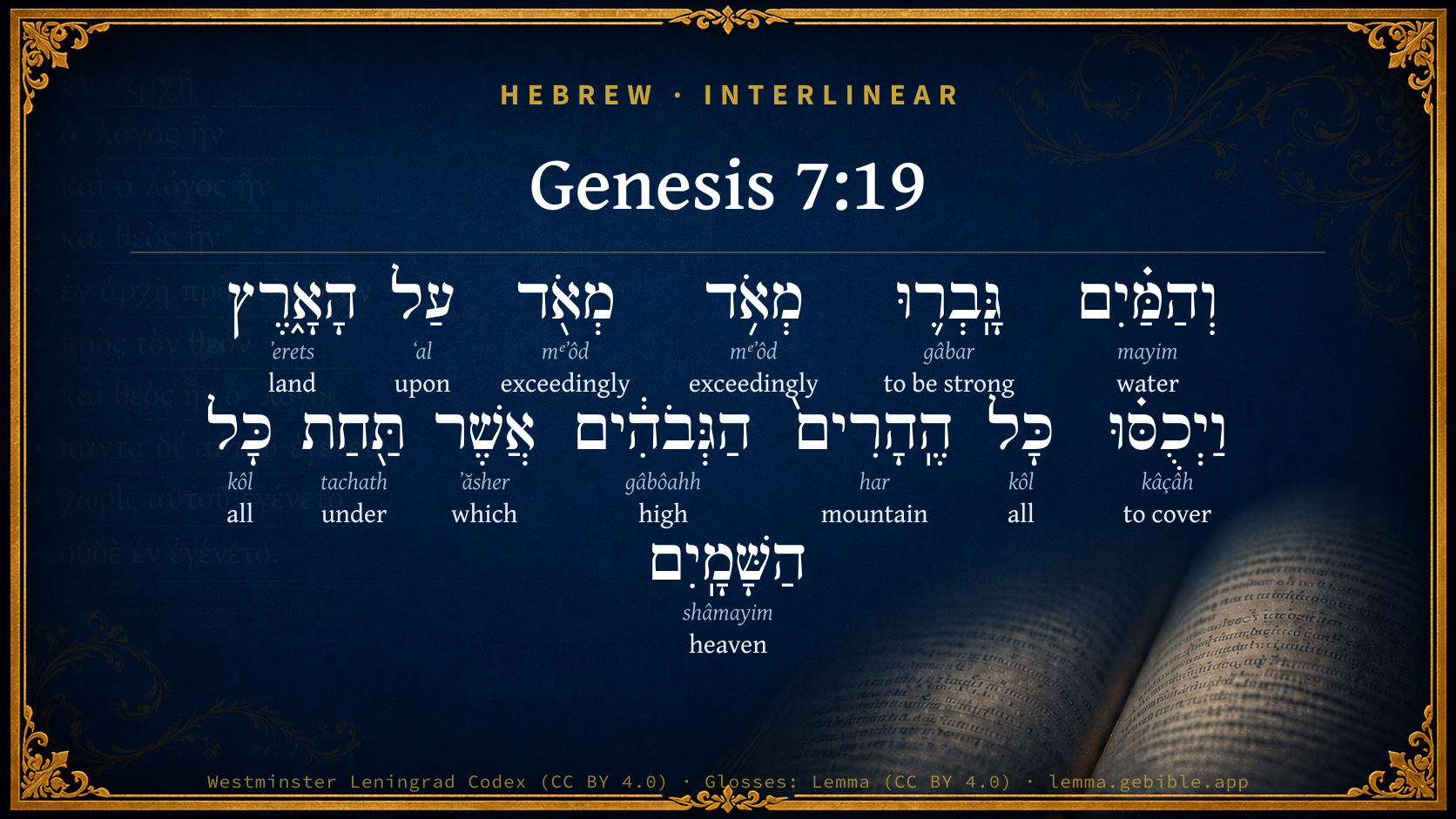
Hebrew (Westminster Leningrad Codex) Genesis 7:19 appears in the Hebrew Old Testament. The text above is from the Westminster Leningrad Codex. Each word links to its Strong’s number, a concise gloss, and parsing drawn from the Open Scriptures Hebrew Bible morphology. Click any word for its full Brown-Driver-Briggs (BDB) entry.
Download image
Cite this verse

Genesis 7:19 (World English Bible). Public Domain. Lemma interlinear Bible study tool, https://lemma.gebible.app/v/genesis/7/19.

Show BibTeX & RIS
BibTeX
RIS
English Translation
The waters prevailed exceedingly on the earth. All the high mountains that were under the whole sky were covered.
World English Bible · Public Domain
Highlights
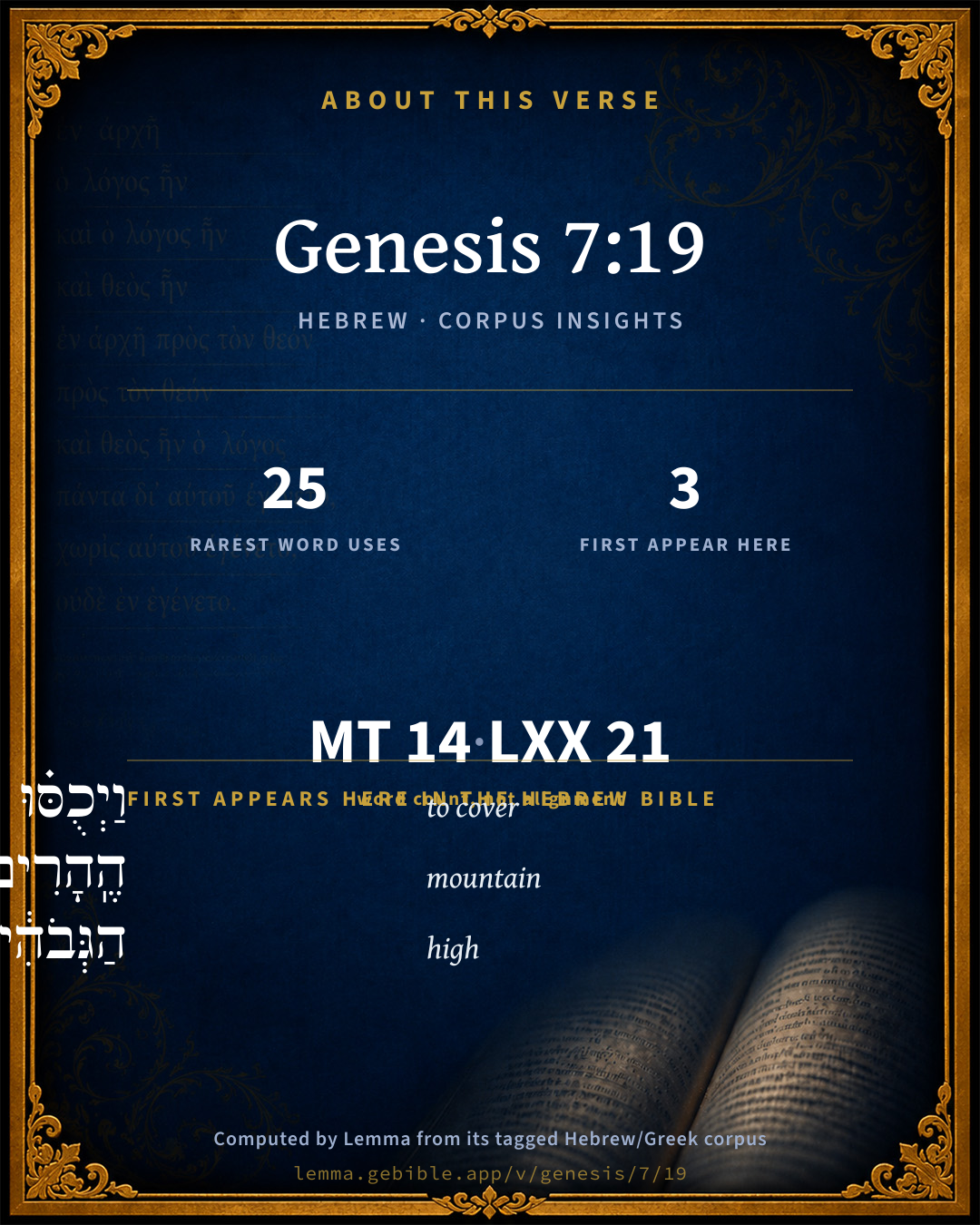
  • 3 first appearances in the Hebrew Bible
Full analysis ↓
Download a study sheet

One document with this verse’s original text, its word-by-word gloss line, the meaning frame, cross-references with their text, attributed commentary, and full source and license credits — printable, and it pastes into notes with its structure intact.

This verse Autodidact and up

Study sheet (.html) Plain text (.txt)

A passage Seminary Student

Up to 50 verses in one chapter. A passage sheet keeps up to 6 commentary sources and 12 cross-references per verse, in the order this page ranks them, and says so on the sheet whenever that leaves anything out. Ask for a single verse and you get the Autodidact verse sheet above.

Everything on this page stays free to read, with no account — the sheet is a download of what is already on screen, not access to it.

Want to remove ads? Support Godless Engineer
Compare translations 3

The same verse in 3 English versions, stacked beneath the original-language interlinear above. Click any original word for its lexicon entry.

Each is an independent rendering of the whole verse — the interlinear is not word-aligned to these translations.

Highlighted words mark where these versions differ — a whole-verse word diff, not a word-by-word alignment.

  • World English Bible Public Domain
    The waters prevailed exceedingly on the earth. All the high mountains that were under the whole sky were covered.
  • King James Version Public Domain
    And the waters prevailed exceedingly upon the earth; and all the high hills, that were under the whole heaven, were covered.
  • unfoldingWord Literal Text CC BY-SA 4.0
    And the waters rose very greatly on the earth, so that all the high mountains that under the entire heavens were covered.

unfoldingWord Literal Text — © unfoldingWord, licensed CC BY-SA 4.0. Word-aligned USFM3 via Door43 (git.door43.org/unfoldingWord/en_ult).

Versions to compare (up to 4)

3 of 4 selected

Show all 18 translations

Every available English version of this verse, each an independent rendering of the whole verse.

  • World English Bible Public Domain
    The waters prevailed exceedingly on the earth. All the high mountains that were under the whole sky were covered.
  • Berean Standard Bible Public Domain
    Finally, the waters completely inundated the earth, so that all the high mountains under all the heavens were covered.
  • Majority Standard Bible Public Domain
    Finally, the waters completely prevailed upon the earth, so that all the high mountains under all the heavens were covered.
  • King James Version Public Domain
    And the waters prevailed exceedingly upon the earth; and all the high hills, that were under the whole heaven, were covered.
  • American Standard Version (1901) Public Domain
    And the waters prevailed exceedingly upon the earth; and all the high mountains that were under the whole heaven were covered.
  • Revised Version (1885) Public Domain
    And the waters prevailed exceedingly upon the earth; and all the high mountains that were under the whole heaven were covered.
  • Geneva Bible (1599) Public Domain
    The waters preuailed so exceedingly vpon the earth, that all the high mountaines, that are vnder the whole heauen, were couered.
  • Douay-Rheims (1899) Public Domain
    And the waters prevailed beyond measure upon the earth: and all the high mountains under the whole heaven were covered.
  • Young's Literal Translation Public Domain
    And the waters have been very very mighty on the earth, and covered are all the high mountains which `are' under the whole heavens;
  • Literal Standard Version CC BY-SA 4.0
    And the waters have been very, very mighty on the earth, and all the high mountains are covered which [are] under the whole heavens;
  • Unlocked Literal Bible CC BY-SA 4.0
    The waters rose greatly on the earth so that all the high mountains that were under the entire sky were covered.
  • unfoldingWord Literal Text CC BY-SA 4.0
    And the waters rose very greatly on the earth, so that all the high mountains that under the entire heavens were covered.
  • Darby Bible Public Domain
    And the waters prevailed exceedingly on the earth; and all the high mountains that are under all the heavens were covered.
  • World Messianic Bible Public Domain
    The waters rose very high on the earth. All the high mountains that were under the whole sky were covered.
  • Webster's Bible Public Domain
    And the waters prevailed exceedingly upon the earth; and all the high hills that were under the whole heaven were covered.
  • Free Bible Version CC BY-SA 4.0
    Finally the water grew so deep that even the highest mountains were covered—all that could be seen was sky.
  • Bible in Basic English Public Domain
    And the waters overcame everything on the earth; and all the mountains under heaven were covered.
  • JPS Tanakh (1917) Public Domain
    And the waters prevailed exceedingly upon the earth; and all the high mountains that were under the whole heaven were covered.

Literal Standard Version (2020), Covenant Press — licensed CC BY-SA 4.0. Text via the HelloAO Bible API (eBible.org). Unlocked Literal Bible (unfoldingWord) — licensed CC BY-SA 4.0. Text via the HelloAO Bible API (eBible.org). unfoldingWord Literal Text — © unfoldingWord, licensed CC BY-SA 4.0. Word-aligned USFM3 via Door43 (git.door43.org/unfoldingWord/en_ult). Free Bible Version, Dr. Jonathan Gallagher — licensed CC BY-SA 4.0. Text via the HelloAO Bible API (eBible.org).

Word by word

More ways to search: Search by grammar → Find every occurrence → Compare this word →

Practice this passage: Drill this verse → Learn its vocabulary →

גָּֽבְר֛וּ
gâbar
H1396
“to be strong”
Verb, Qal, Perfect, 3rd Person, Common, Plural
Part of Speech
Verb
Stem
Qal
Form
Perfect
Person
3rd Person
Gender
Common
Number
Plural
Full BDB Definition

Origin: a primitive root

TWOT: 310

to prevail, have strength, be strong, be powerful, be mighty, be great - (Qal) - to be strong, mighty - to prevail - (Piel) to make strong, strengthen - (Hiphil) - to confirm, give strength - to confirm (a covenant) - (Hithpael) - to show oneself mighty - to act proudly (toward God)
  1. וְהַמַּ֗יִם mayim H4325 “and · the · water(s)” Conjunction + Particle, Definite Article + Noun, Common, Masculine, Plural, Absolute
  2. מְאֹ֥ד mᵉʼôd H3966 “exceedingly” Adverb
  3. מְאֹ֖ד mᵉʼôd H3966 “exceedingly” Adverb
  4. עַל ʻal H5921 “upon” Preposition
  5. הָאָ֑רֶץ ʼerets H776 “the · land” Particle, Definite Article + Noun, Common, Both, Singular, Absolute
  6. וַיְכֻסּ֗וּ kâçâh H3680 “and · to cover” Conjunction + Verb, Pual, Sequential Imperfect, 3rd Person, Masculine, Plural
  7. כָּל kôl H3605 “all of” Noun, Common, Masculine, Singular, Construct
  8. הֶֽהָרִים֙ har H2022 “the · mountains” Particle, Definite Article + Noun, Common, Masculine, Plural, Absolute
  9. הַגְּבֹהִ֔ים gâbôahh H1364 “the · high” Particle, Definite Article + Adjective, Adjective, Masculine, Plural, Absolute
  10. אֲשֶׁר ʼăsher H834 “which” Particle, Relative
  11. תַּ֖חַת tachath H8478 “under” Preposition
  12. כָּל kôl H3605 “all of” Noun, Common, Masculine, Singular, Construct
  13. הַשָּׁמָֽיִם shâmayim H8064 “the · heaven(s)” Particle, Definite Article + Noun, Common, Masculine, Plural, Absolute

About this verse

These counts appear in no published source. They are computed here, from the morphology-tagged text and Lemma’s own curated glosses. What Lemma adds →

14
words
12
distinct lemmas
Pentateuch
section

Notable vocabulary

The rarest word here is גָּֽבְר֛וּ to be strong H1396 — appearing just 25 times in the whole Hebrew Bible.

First appearance in Scripture

These words make their first canonical appearance in the Hebrew Bible here:

  • וַיְכֻסּ֗וּ to cover H3680
  • הֶֽהָרִים֙ mountain H2022
  • הַגְּבֹהִ֔ים high H1364

Shared distinctive vocabulary

גָּֽבְר֛וּ to be strong H1396 occurs in 24 verses of the Hebrew Bible. Also found in:

Grammatical profile

  • 2 verbs
  • 6 nouns
  • 1 adjective
  • 2 prepositions
  • 2 adverbs
  • 1 particle

Verb forms

  • גָּֽבְר֛וּ Qal · Perfect
  • וַיְכֻסּ֗וּ Pual · Sequential Imperfect

Repetition

Words recur within this verse — often emphatic in Hebrew:

  • מְאֹ֥ד exceedingly H3966 ×2
  • כָּל all H3605 ×2

Hebrew & Septuagint length

In English translation the verse runs 19 words from the Hebrew and 18 from the Septuagint (LXX English) — closely comparable.

A rough comparison of the two English renderings, which tokenize alike — not a word-level alignment.

Word counts can differ between the Hebrew and the Greek without any difference in meaning — e.g. the Hebrew direct-object marker אֵת has no separate Greek word, and Greek often adds the article ὁ.

In the original languages it is 14 Hebrew tokens and 21 Greek tokens — but the two are counted differently (Hebrew bundles its prefixes and suffixes into one token; the Greek is in lemma form), so that isn’t a like-for-like length.

Cross-references

5

Topical passages linked to Genesis 7:19 in the Treasury of Scripture Knowledge — connected by theme and wording, ordered by reader-vote popularity; previews shown in the World English Bible.

  • Psalms 104:6–9 You covered it with the deep as with a cloak. The waters stood above the mountains.
  • Job 12:15 Behold, he withholds the waters, and they dry up; Again, he sends them out, and they overturn the earth.
  • Psalms 46:2–3 Therefore we won't be afraid, though the earth changes, Though the mountains are shaken into the heart of the seas;
  • Jeremiah 3:23 Truly in vain is [the help that is looked for] from the hills, the tumult on the mountains: truly in Yahweh our God is the salvation of Israel.
  • 2 Peter 3:6 by which means the world that then was, being overflowed with water, perished.

Cross-references courtesy of OpenBible.info (CC BY 4.0).

Hebrew and Greek witnesses Masoretic Hebrew ↔ Greek Septuagint

The same verse in the two great witnesses to the Old Testament, shown verse-for-verse.

These are two independent witnesses, not word-aligned to each other, and the Septuagint is shown in lemma (dictionary) form.

Hebrew Genesis 7:19 Masoretic · Westminster Leningrad Codex

וְהַמַּ֗יִם גָּֽבְר֛וּ מְאֹ֥ד מְאֹ֖ד עַל הָאָ֑רֶץ וַיְכֻסּ֗וּ כָּל הֶֽהָרִים֙ הַגְּבֹהִ֔ים אֲשֶׁר תַּ֖חַת כָּל הַשָּׁמָֽיִם

The waters prevailed exceedingly on the earth. All the high mountains that were under the whole sky were covered.

World English Bible · Public Domain

Greek LXX Genesis 7:19 Septuagint · lemma form

ὁ δέ ὕδωρ ἐπικρατέω σφόδρα σφοδρῶς ἐπί ὁ γῆ καί ἐπικαλύπτω πᾶς ὁ ὄρος ὁ ὑψηλός ὅς εἰμί ὑποκάτω ὁ οὐρανός

And the water prevailed exceedingly upon the earth, and covered all the high mountains which were under heaven.

LXX2012 (modern English Septuagint) · Public Domain

Hebrew: Westminster Leningrad Codex (CC BY 4.0). Greek: Septuagint (public domain); English from LXX2012 (modern English Septuagint) (Public Domain). How the Septuagint differs from the Hebrew →

Targum (Aramaic paraphrase)

2

The Targum is the ancient Jewish Aramaic paraphrase of the Hebrew Scriptures — an interpretive translation, not the Hebrew text itself. Onkelos (literal) and Pseudo-Jonathan (expansive) render the Torah, and Jonathan the Prophets. Coverage is partial: where no permissively-licensed English translation exists for a verse, only the Aramaic is shown. This is verse-level text, not a word-by-word alignment to the Hebrew.

  1. Targum Onkelos Torah (Genesis–Deuteronomy)
    וּמַיָּא תְּקִיפוּ לַחֲדָא לַחֲדָא עַל אַרְעָא וְאִתְחֲפִיאוּ כָּל טוּרַיָּא רָמַיָּא דִּי תְחוֹת כָּל שְׁמַיָּא

    And the waters prevailed most mightily over the earth, and all the high hills were covered which were under all the heavens.

    Targum Onkelos — Aramaic: “Onkelos Genesis” (public domain); “Onkelos Exodus” (public domain); “Onkelos Leviticus” (public domain); “Onkelos Numbers” (public domain); “Onkelos Deuteronomy” (public domain). English: “Sefaria Community Translation” (CC0 1.0 (public-domain dedication)); “J.W. Etheridge. The Targums of Onkelos and Jonathan Ben Uzziel on the Pentateuch. London: Longmans, Green, 1862” (public domain). Text via Sefaria.

  2. Targum Pseudo-Jonathan Torah (Genesis–Deuteronomy)
    וּמַיָא תַקִיפוּ לַחֲדָא עַל אַרְעָא וְאִתְחַפִיאוּ כָּל טוּרַיָא רָמַיָא דִתְּחוֹת כָּל שְׁמַיָא

    And the waters prevailed greatly upon the earth, and all the high hills which were under the heavens were covered:

    Targum Pseudo-Jonathan — Aramaic: “Targum Jonathan on Genesis” (public domain); “Targum Jonathan on Exodus” (public domain); “Targum Jonathan on Leviticus” (public domain); “Targum Jonathan on Numbers” (public domain); “Targum Jonathan on Deuteronomy” (public domain). English: “The Targum of Jonathan ben Uzziel, trans. J. W. Etheridge, London, 1862” (public domain). Text via Sefaria.

Commentary

Notes on Genesis 7:19 from classic Christian and Jewish commentators (each source and its license shown beneath its notes). The classic Christian expositions comment on the surrounding passage and are grouped to its opening verse, so a note may address several verses; the Jewish commentaries on the Tanakh (Rashi and others) are per-verse, so they appear only where the commentator wrote on this verse.

Lemma curates 59 commentaries, every one of them public domain or Creative Commons licensed, each selected and text-cleaned for this edition rather than reprinted as found. About our sources →

Trapp's Complete Commentary

John Trapp

Gen 7:19 And the waters prevailed exceedingly upon the earth; and all the high hills, that [were] under the whole heaven, were covered.

Ver. 19. And all the high hills.] So high, some of them, that their tops are above the clouds and winds. And yet, as high as they were, they could not save those from the flood that fled to them. "Truly," might they say, "in vain is salvation hoped for from the mountains". {Jer 3:23} Well for them, if, taught by their present distress and danger, they could go on, with the Church there, and say, "Surely in the Lord our God is the salvation of Israel." Happy storm, that beats us into the harbour!

John Trapp, A Commentary or Exposition upon All the Books of the Old and New Testament (1647–1656) — public domain. Text from a community e-Sword module.

Joseph Benson's Commentary

Gen 7:19-20. All the high hills, and the mountains were covered — Therefore, there were hills and mountains before the flood. Deists, and other infidels, would persuade us that this was impossible, because of the vast height of divers hills and mountains. But, not to mention here that this fact has been established by the universal consent of all nations, that there was a general deluge which over-flowed the whole world, and that it has been demonstrated by different writers that there is in nature a sufficient quantity of water to deluge it, concerning both which see the Encyclopædia Britannica; it will be sufficient to observe here, that this cannot be thought impossible by any one who believes in the existence of such a being as Jehovah, a God of infinite power, to whom it surely was as easy to bring forth a sufficiency of water for this purpose, as it was to create all things by the word of his power, or to say, Let there be light, and there was light. It is evident Moses, the historian, makes no difficulty on this subject. So far from questioning whether the quantity of water in the earth and atmosphere was sufficient, he thought the sources from whence it came were not exhausted, since both of them required to be stopped by the same almighty hand that opened them, lest the flood should increase more than it actually did.

Joseph Benson's Commentary on the Old and New Testaments (1811–1818) — public domain. Text from a community e-Sword module.

The Pulpit Commentary

Ver. 19.

Was the Flood universal?

I THE BIBLICAL ACCOUNT. Unquestionably the language of the historian appears to describe a complete submergence of the globe beneath a flood of waters, and is capable of being so understood, so far as exegesis can determine. Unquestionably also that this was the writer"s meaning would never have been challenged had it not been for certain difficulties of a scientific nature, as well as of other kinds, which were gradually seen to attach to such hypothesis. But these difficulties having arisen in men"s minds led to a closer and more careful investigation of the Scripture narrative, when it was found

1. That the language of the historian did not necessarily imply that the catastrophe described was of universal extent (vide Exposition).

2. That, if it had been only partial and local in its operation, in all probability the same, or at least closely similar, terms would have been selected to depict its appearance, as observed by a spectator.

1. That the purpose for which, according to the inspired record, the Deluge was sent could have been completely effected without the submergence of the entire globe that purpose being the destruction of the human race, which, it is believed, had not at that time overspread the earth, but was confined to a limited region contiguous to the valley of the Euphrates, That

2. this last conjecture is not of recent origin, but was early entertained by theologians, is proved by the facts that Aben Ezra "confuteth the opinion of some who in his days held the Deluge not to have been universal" (Willet); that Bishop Patrick notes (Gen_7:19) that "there were those anciently, and they have their successors now, who imagined the Flood was not universal, ajll ejn w oiJ tote anrrwpoi wkoun, but only there where men then dwelt;" that Matthew Poole writes, "Peradventure this Flood might not be universal over the whole earth, but only over all the habitable world, where either men or beasts lived, which was as much as either the meritorious cause of the Flood, men"s sins, or the end of it, the destruction of all men and beasts, required"; (Synopsis, Gen_7:19) and that Bishop Stillingfleet in his "Origines Sacrae" remarks, "I cannot see any necessity, from the Scriptures, to assert that the Flood did spread itself over all the surface of the earth. That all mankind (those in the ark excepted) were destroyed by it is most certain, according to the Scriptures; but from thence follows no necessity at all of asserting the universality of it as to the globe of the earth, unless it be sufficiently proved that the earth was peopled before the Flood, which I despair of ever seeing proved" (vide "Quarry on Genesis," p. 184). This opinion, it is almost needless to observe, has been adopted by the majority of modem scholars.

3. That subsequent Scriptural references to this primeval catastrophe are at least not decidedly at variance with the notion of a limited Deluge. Gen_9:15 places emphasis on the fact that the waters will no more become a flood to destroy all flesh, i.e. all mankind. Isa_54:9, pointing back to Gen_9:15, says that as God swore in the days of Noah that the earth would be no more inundated as to carry off the entire population, so did he swear then that he would not rebuke Israel. The language does not, as Wordsworth thinks, imply the universality of the Deluge. 2Pe_2:5 2Pe_3:6 refers to the destruction of the ov ajrcai kosmov, i.e. the world of men, the kosmov ajsebwn specially mentioned in the former of these passages. So far then as Scripture is concerned we are not shut up to the necessity of regarding the Deluge as universal.

II SCIENTIFIC DIFFICULTIES.

1. Astronomical. It is urged that, as there is no sufficient evidence of any general subsidence of the earth"s crust, the theory proposed by some harmonists, that the land and water virtually exchanged places (this was supposed to be borne out by the existence of shells and corals at the top of high mountains), having now been completely abandoned (that the outlines of the great continental seas have been substantially the same from the beginningvide Genesis 1. ver. 9, Expos.), the entire surface of the globe could be covered only by a large earth"s mass. Kalisch supposes eight tunes increase of water being added to the aggregate of water contained in all the seas and oceans of the earth; that this must have produced such a shock to the solar system as to have caused a very considerable aberration in the earth"s orbit, of which: however, no trace can be detected; and that, consequently, it is unphilosophical to imagine that such a disturbance of the entire stellar world as would necessarily follow on that event would be resorted to in order to destroy a race of sinful beings in one of the smallest planets of the system. But Biblical science, which recognizes an incarnation of the Word of God in order to save man, will always hesitate to pronounce anything too great for the Almighty to permit or do in connection with man.

(2) It is gratuitous to infer that because a general subsidence of the earth"s crust cannot now be traced, there was none. Absence of evidence that a thing was is not equivalent to presence of proof that a thing was not. Witness the third day"s vegetation and antediluvian civilization.

(3) If even the earth"s surface were covered with water, it is doubtful if it would be much more in effect than the breaking out of a profuse sweat upon the human body, or the filling up with water of the indentures on the rough skin of an orange, in which case it is more than probable that the apprehended disturbance of the solar system would prove in great part imaginary.

1. Geological. At one time believed to afford incontestable evidence of a universal deluge in the drift formations, the diluvium of the earlier geologists (of late, with better reason, ascribed to the influence of a glacial, period which prevailed over the greater part of Central and Northern Europe m prehistoric times), geological science is now held to teach exactly the opposite. The extinct volcanoes of Langue-dec and Auvergne are believed to have been in operation long anterior to the time of man"s appearance on the earth, the remains of extinct animals being found among their sconce; and yet the lava cones are in many instances as perfect as when first thrown up, while the dross lies loose upon their sides, which it is scarcely, supposable would be the case had they been subjected to any cataclysmal immersion such as is presupposed in the Deluge. But here the mistake is that of imagining the Noachic Flood to have been of any such

2. violent torrential character. On the contrary, the Scripture narrative represents the waters as having risen and subsided slowly, and the whole phenomenon to have been of such a kind as, while destroying human life, to effect comparatively little change upon the face of nature; and, besides, careful scientific observers have declared that the volcanic scoriae in question is not so loose as is sometimes alleged (Smith"s "Bib. Dict.," art. Noah).

3. Zoological. This refers to the difficulty of accommodating all the animals that were then alive. So long of course as Raleigh"s computation of eighty-nine distinct species of animals was accepted as correct, the task imposed upon apologists was not of a very formidable character. But of mammalia alone there are now known to exist 1658 different species, thus making about 4000 and upwards of individuals (the clean beasts being taken in sevens or seven pairs) that required to be stalled in the ark; and when to these are added the pairs of the 6000 birds, 650 reptiles, and 550, 000 insects that are now recognized by zoologists, the difficulty is seen to be immensely increased. An obvious remark, however, in connection with this is that there is a tendency among modern zoologists unnecessarily to multiply the number of species. But in truth a prior difficulty relates to the collection of these multitudinous creatures from their respective habitats. If the entire surface of the globe was submerged, then must the fauna belonging to the different continents have been conveyed across the seas and lands towards the ark, and reconducted thence again to their appropriate settlements in some way not described and impossible to imagine; whereas if the inundated region extended (through the subsidence of the earth"s crust) to the Mediterranean on the west, and the Indian Ocean on the south and east, it is apparent that neither would this difficulty have proved insuperable, nor would the collection of the animals have been rendered unnecessary, the devastated country being so wide that only by preservation of the species could it have been speedily replenished.

III The CONCLUSION, therefore, seems to be that, while Scripture does not imperatively forbid the idea of a partial Deluge, science appears to require it, and, without ascribing to all the scientific objections that are urged against the universality of the Flood that importance which their authors assign to them, it may be safely affirmed that there is considerable reason for believing that the mabbul which swept away the antediluvian men was confined to the region which they inhabited.

The Pulpit Commentary (1880–1919), ed. H.D.M. Spence-Jones & Joseph S. Exell — public domain. Text from a community e-Sword module.

Geneva Bible (1599)

Geneva Bible translators

Hebrew, waxed very mighty.

Geneva Bible (1599) marginal notes — public domain. Text via Bolls.life.

The Cambridge Bible for Schools and Colleges

gen. ed. J. J. S. Perowne

19. all the high mountains] The account, given by P, describes the covering of the mountains of the whole earth by the waters of the Deluge. It is this hyperbolical description which has naturally seized upon the imagination of readers. It is not necessary to enlarge upon the physical impossibility of such an event. If the literal interpretation were adopted, the waters would have submerged not only the mountains of Western Asia and of Europe, but also the Andes and the Himalayas. Water at that height would have been ice: organic life would have been impossible. Geology has shewn that no such universal Deluge has ever occurred. The accumulation of the vast amount of water represented in such a scene and encompassing the whole globe is beyond the range of physical possibility.

Popular imagination working upon the tradition of a vast inundation in the Euphrates Valley lent itself to exaggeration.

The Cambridge Bible for Schools and Colleges (gen. ed. J. J. S. Perowne; Cambridge University Press, 1878–1918) — public domain. Text from a community e-Sword module.

John Gill's Exposition

And all flesh died that moved upon the earth,.... That had animal life in them, of which motion was a sign:

both of fowl, and of cattle, and of beast, and of every creeping thing that creepeth on the earth; excepting those that were in the ark. This general destruction of the creatures, as it was for the sins of men, whose they were, and by whom they were abused, and is expressive of God's hatred of sin, and of his holiness and justice in the punishment of it; so, on the other hand, it is a display both of the wisdom of God, in causing a decrease of the creatures, in proportion to the decrease of men, who now would not need so many; and of the goodness of God to those that were spared, that so the beasts of the field, especially the wilder sort, might not multiply against them, and prevail over them, see Exo 23:29.

and every man: except those in the ark; and the number of them is supposed to be as great, if not greater, than of the present inhabitants of the earth, by those who are skilful in the calculation of the increase of men. It is thought it may be easily allowed, that their number amounted to eleven billion; and some have made their number to be eighty billion (p). The Apostle Peter calls them, the world of the ungodly, Pe2 2:5.

(p) Scheuchzer. Physica Sacra, vol. 1. p. 55.

John Gill's Exposition of the Whole Bible (1746–1763) — public domain (CC PDM 1.0). Text via the HelloAO Bible API.

Matthew Poole's English Annotations

Profane wits pretend this to be impossible, because of the vast height of divers mountains. But,

1. This cannot be thought impossible by any man that believeth a God; to whom it was as easy to bring forth a sufficiency of water, for this end, as to speak a word. And if we acknowledge a miracle of the Divine power and providence here, it is no more than even heathens have confessed in other cases.

2. Peradventure this flood might not be simply universal over the whole earth, but only over all the habitable world, where either men or beasts lived; which was as much as either the meritorious cause of the flood, men’s sins, or the end of it, the destruction of all men and beasts, required. And the or that whole heaven may be understood of that which was over all the habitable parts of it. And whereas our modern heathens, that miscall themselves Christians, laugh at the history of this flood upon this and the like occasions, as if it were an idle romance; they may please to note, that their predecessors, the ancient and wiser heathens, have divers of them acknowledged the truth of it, though they also mixed it with their fables, which was neither strange nor unusual for them to do. Lactantius appeals to the heathens of his age concerning it. Nay, there is not only mention of the flood in general, but also of the dove sent out of the ark, in Plutarch, and Berosus, and Abydenus. And the memory of this general flood is preserved to this day among the poor ignorant Indians, who asked the Christians who invaded their land, whether they ever heard of such a thing, and whether another flood was to be expected? And the Chinese writers relate, that but one person, whom they call Puoncuus, with his family, were saved in the flood, and all the rest perished.

Matthew Poole's English Annotations on the Holy Bible (1683–1685) — public domain. Text from a community e-Sword/MySword module.

Whedon's Commentary on the Bible

Daniel D. Whedon

19. High hills… covered — Waters rose above the summits of the high hills, or rather, they gradually settled beneath the inundating flood, until, to the observer in the floating ark, the world was a monotonous waste of waters, vast and mighty, (Hebrews, mighty exceedingly,) and as far as the eye could see, all the high hills, that were under the whole heaven, were covered. On the usage of such universal terms, see above, note introductory to Gen_6:9.

Daniel D. Whedon (gen. ed.), Commentary on the Old and New Testaments (1874–1909) — public domain. Text from a community e-Sword module.

unfoldingWord translationNotes

Door43 World Missions Community

The waters rose greatly on the earth

"The water totally overwhelmed the earth"

fifteen cubits

"six meters." See how you translated this in Genesis 6:15.

translationWords

heaven

unfoldingWord translationNotes — © Distant Shores Media and the Door43 World Missions Community, licensed CC BY-SA 4.0. Source: git.door43.org/Door43/en_tn.

Radak

Rabbi David Kimhi (Radak)

והמים גברו, this too is meant to give us additional information. This is why the words מאד מאד have been added, each of these words alerting us to an increasing power of the waters driving the ark. Now the waters were so powerful that they drove the ark far away from where it had stood originally. The second word מאד hints at the ark rising higher than any of the surrounding mountains.

Radak on the Tanakh — English translations: “Sefaria Community Translation” (CC0 1.0 (public-domain dedication)); “Eliyahu Munk, HaChut Hameshulash” (CC BY 4.0); “Rabbi Mike Feuer, Jerusalem Anthology” (CC BY 4.0); and “R. David Kimhi on the first book of Psalms, Translated by R.G. Finch, London, 1919” (public domain). Text via Sefaria.

Lesson kit

Teaching starters — assembled from the data on this page, not authored interpretation. Every prompt links to the verse data it draws on. Edit before teaching.

Genesis, in the Pentateuch, opens this verse with 14 words (12 distinct Hebrew lemmas). Its most distinctive word is gâbar (“to be strong”). A historical commentator’s framing appears above. Read the whole chapter for the surrounding context.

Discussion questions

  1. The word gâbar carries the sense “to be strong.” How does it shape the verse?
  2. 3 words make their first appearance in Scripture here. What does this debut establish?
  3. How does Genesis 7:18, which shares the word «to be strong», read alongside this verse?
  4. What does the repetition of “exceedingly” (2× in this one verse) do in this verse?
  5. These translations render this verse differently; the difference is in the English rendering, not the original. What questions does that raise?
  6. «גָּֽבְר֛וּ» is a Qal Perfect verb. How does that grammatical form shape the action described?
  7. Compare how Trapp's Complete Commentary and Joseph Benson's Commentary read this verse. Where do they agree or differ?

Things to notice

Reading settings

Reading text

Shown beneath each verse's original-language words.

Old Testament
Old Testament edition

Read the OT as the Masoretic Hebrew (MT) or the Greek Septuagint (LXX).

English shown for the Greek Septuagint (in the Hebrew ↔ Greek comparison).

Comparing translations? Open the Compare panel on any verse page to stack up to four side by side.