
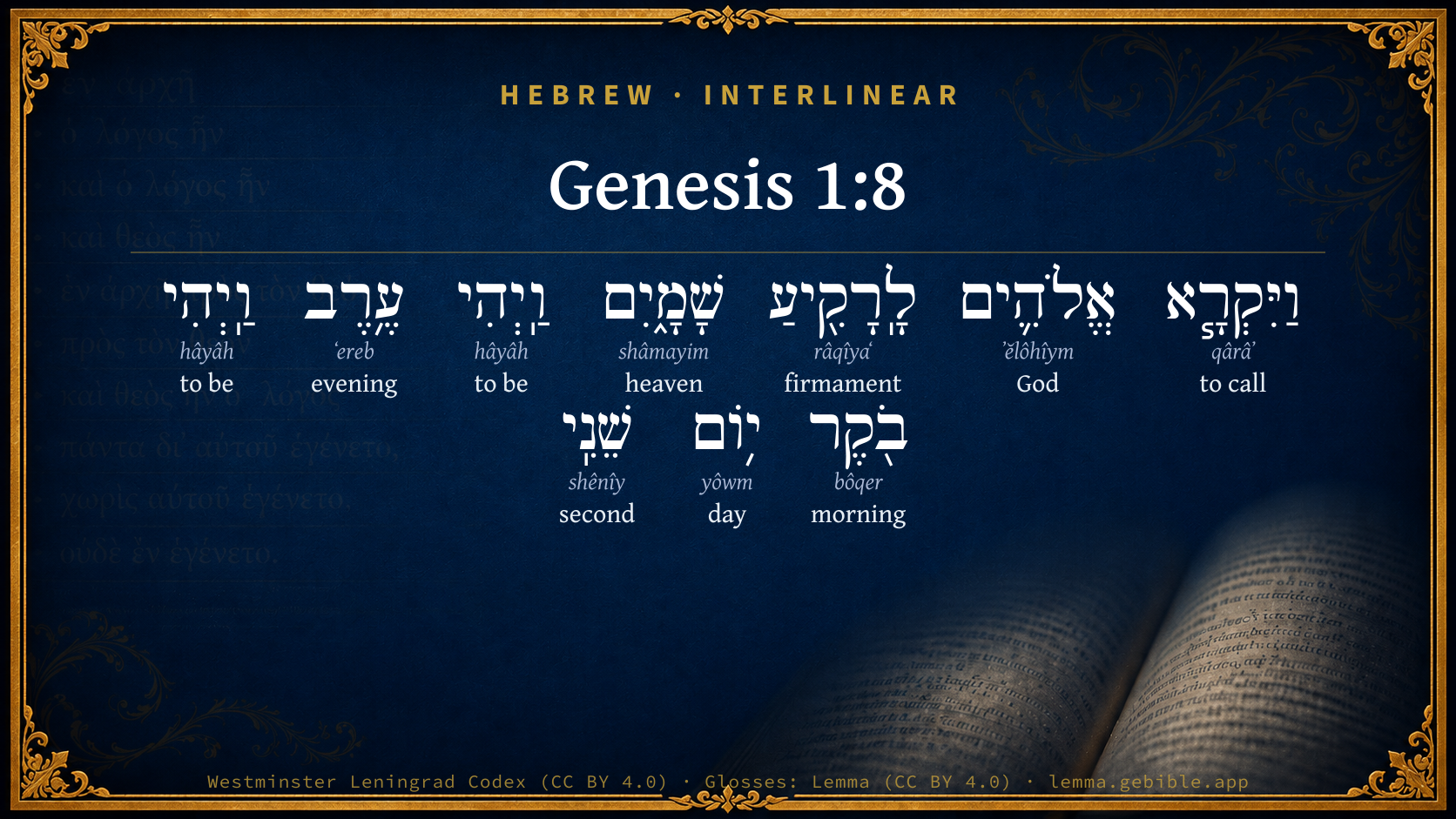
Genesis 1:8

Hebrew (Westminster Leningrad Codex) Genesis 1:8 appears in the Hebrew Old Testament. The text above is from the Westminster Leningrad Codex. Each word links to its Strong’s number, a concise gloss, and parsing drawn from the Open Scriptures Hebrew Bible morphology. Click any word for its full Brown-Driver-Briggs (BDB) entry.
Download image
Cite this verse

Genesis 1:8 (World English Bible). Public Domain. Lemma interlinear Bible study tool, https://lemma.gebible.app/v/genesis/1/8.

Show BibTeX & RIS
BibTeX
RIS
English Translation
God called the expanse sky. There was evening and there was morning, a second day.
World English Bible · Public Domain
Highlights Full analysis ↓
Download a study sheet

One document with this verse’s original text, its word-by-word gloss line, the meaning frame, cross-references with their text, attributed commentary, and full source and license credits — printable, and it pastes into notes with its structure intact.

This verse Autodidact and up

Study sheet (.html) Plain text (.txt)

A passage Seminary Student

Up to 50 verses in one chapter. A passage sheet keeps up to 6 commentary sources and 12 cross-references per verse, in the order this page ranks them, and says so on the sheet whenever that leaves anything out. Ask for a single verse and you get the Autodidact verse sheet above.

Everything on this page stays free to read, with no account — the sheet is a download of what is already on screen, not access to it.

Want to remove ads? Support Godless Engineer
Compare translations 3

The same verse in 3 English versions, stacked beneath the original-language interlinear above. Click any original word for its lexicon entry.

Each is an independent rendering of the whole verse — the interlinear is not word-aligned to these translations.

Highlighted words mark where these versions differ — a whole-verse word diff, not a word-by-word alignment.

  • World English Bible Public Domain
    God called the expanse sky. There was evening and there was morning, a second day.
  • King James Version Public Domain
    And God called the firmament Heaven. And the evening and the morning were the second day.
  • unfoldingWord Literal Text CC BY-SA 4.0
    And God called the expanse Heavens. Then there was evening, and there was morning, the second day.

unfoldingWord Literal Text — © unfoldingWord, licensed CC BY-SA 4.0. Word-aligned USFM3 via Door43 (git.door43.org/unfoldingWord/en_ult).

Versions to compare (up to 4)

3 of 4 selected

Show all 18 translations

Every available English version of this verse, each an independent rendering of the whole verse.

  • World English Bible Public Domain
    God called the expanse sky. There was evening and there was morning, a second day.
  • Berean Standard Bible Public Domain
    God called the expanse “sky.” And there was evening, and there was morning—the second day.
  • Majority Standard Bible Public Domain
    God called the expanse “sky.” And there was evening, and there was morning—the second day.
  • King James Version Public Domain
    And God called the firmament Heaven. And the evening and the morning were the second day.
  • American Standard Version (1901) Public Domain
    And God called the firmament Heaven. And there was evening and there was morning, a second day.
  • Revised Version (1885) Public Domain
    And God called the firmament Heaven. And there was evening and there was morning, a second day.
  • Geneva Bible (1599) Public Domain
    And God called the firmament Heauen. So the Euening and the morning were the second day.
  • Douay-Rheims (1899) Public Domain
    And God called the firmament, Heaven; and the evening and morning were the second day.
  • Young's Literal Translation Public Domain
    And God calleth to the expanse `Heavens;' and there is an evening, and there is a morning -- day second.
  • Literal Standard Version CC BY-SA 4.0
    And God calls the expanse “Heavens”; and there is an evening, and there is a morning—[the] second day.
  • Unlocked Literal Bible CC BY-SA 4.0
    God called the expanse “sky.” This was evening and morning, the second day.
  • unfoldingWord Literal Text CC BY-SA 4.0
    And God called the expanse Heavens. Then there was evening, and there was morning, the second day.
  • Darby Bible Public Domain
    And God called the expanse Heavens. And there was evening, and there was morning -- a second day.
  • World Messianic Bible Public Domain
    God called the expanse “sky”. There was evening and there was morning, a second day.
  • Webster's Bible Public Domain
    And God called the firmament Heaven: and the evening and the morning were the second day.
  • Free Bible Version CC BY-SA 4.0
    God called the expanse, “sky.” So there was evening, and then the morning, making day two.
  • Bible in Basic English Public Domain
    And God gave the arch the name of Heaven. And there was evening and there was morning, the second day.
  • JPS Tanakh (1917) Public Domain
    And God called the firmament Heaven. And there was evening and there was morning, a second day.

Literal Standard Version (2020), Covenant Press — licensed CC BY-SA 4.0. Text via the HelloAO Bible API (eBible.org). Unlocked Literal Bible (unfoldingWord) — licensed CC BY-SA 4.0. Text via the HelloAO Bible API (eBible.org). unfoldingWord Literal Text — © unfoldingWord, licensed CC BY-SA 4.0. Word-aligned USFM3 via Door43 (git.door43.org/unfoldingWord/en_ult). Free Bible Version, Dr. Jonathan Gallagher — licensed CC BY-SA 4.0. Text via the HelloAO Bible API (eBible.org).

Word by word

More ways to search: Search by grammar → Find every occurrence → Compare this word →

Practice this passage: Drill this verse → Learn its vocabulary →

לָֽרָקִ֖יעַ
râqîyaʻ
H7549
“to/for the · firmament”
Preposition, Determined + Noun, Common, Masculine, Singular, Absolute
Part of Speech
Preposition + Noun
Type
Common
Gender
Masculine
Number
Singular
State
Absolute
Full BDB Definition

Origin: from H7554

TWOT: 2217a

extended surface (solid), expanse, firmament - expanse (flat as base, support) - firmament (of vault of heaven supporting waters above) - considered by Hebrews as solid and supporting 'waters' above
  1. וַיִּקְרָ֧א qârâʼ H7121 “and · to call” Conjunction + Verb, Qal, Sequential Imperfect, 3rd Person, Masculine, Singular
  2. אֱלֹהִ֛ים ʼĕlôhîym H430 “God(s)” Noun, Common, Masculine, Plural, Absolute
  3. שָׁמָ֑יִם shâmayim H8064 “heaven(s)” Noun, Common, Masculine, Plural, Absolute
  4. וַֽיְהִי hâyâh H1961 “and · to be” Conjunction + Verb, Qal, Sequential Imperfect, 3rd Person, Masculine, Singular
  5. עֶ֥רֶב ʻereb H6153 “evening” Noun, Common, Masculine, Singular, Absolute
  6. וַֽיְהִי hâyâh H1961 “and · to be” Conjunction + Verb, Qal, Sequential Imperfect, 3rd Person, Masculine, Singular
  7. בֹ֖קֶר bôqer H1242 “morning” Noun, Common, Masculine, Singular, Absolute
  8. י֥וֹם yôwm H3117 “day” Noun, Common, Masculine, Singular, Absolute
  9. שֵׁנִֽי shênîy H8145 “second” Adjective, Ordinal number, Masculine, Singular, Absolute

About this verse

These counts appear in no published source. They are computed here, from the morphology-tagged text and Lemma’s own curated glosses. What Lemma adds →

10
words
9
distinct lemmas
Pentateuch
section

Notable vocabulary

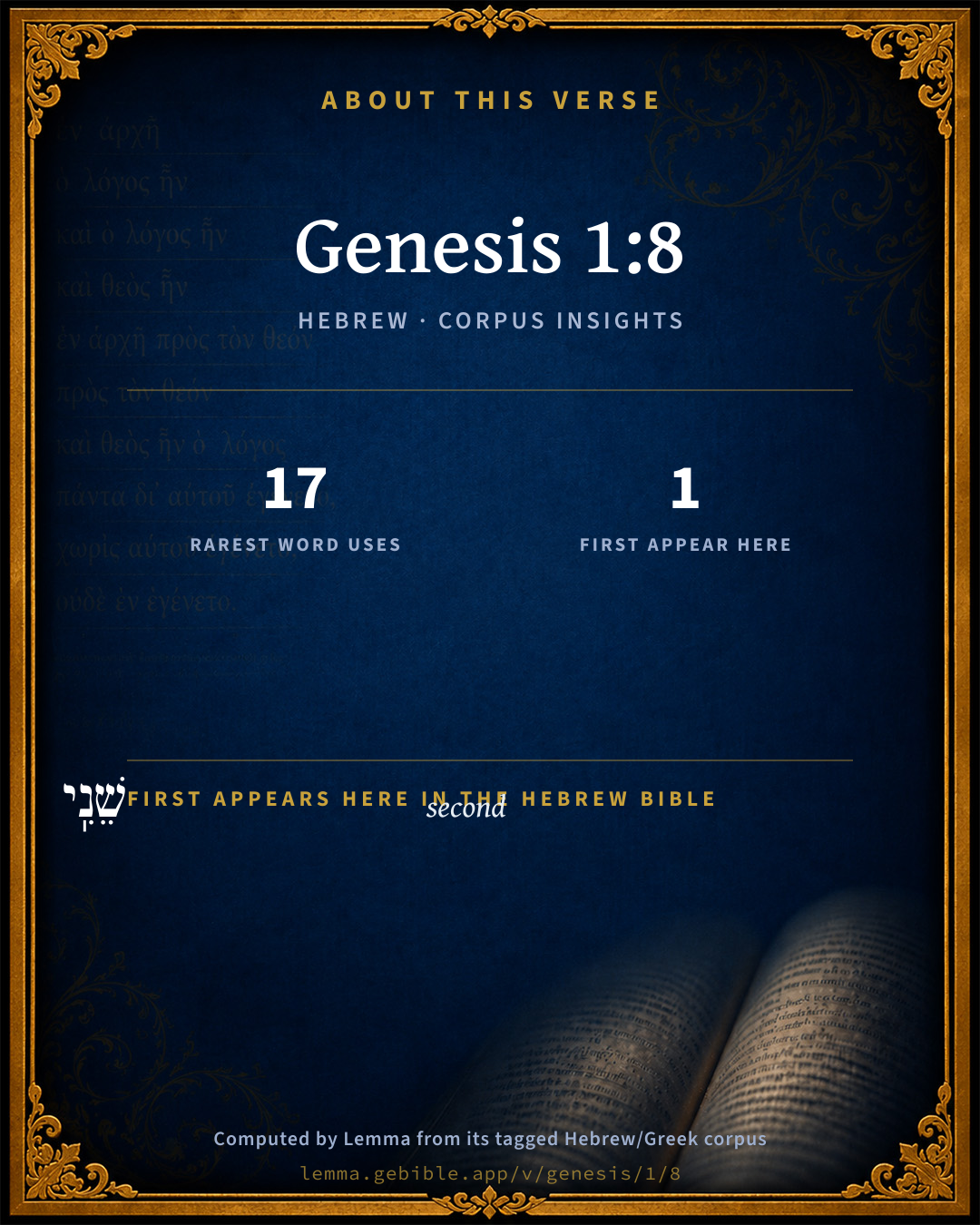
The rarest word here is לָֽרָקִ֖יעַ firmament H7549 — appearing just 17 times in the whole Hebrew Bible.

First appearance in Scripture

This word makes its first canonical appearance in the Hebrew Bible here:

  • שֵׁנִֽי second H8145

Shared distinctive vocabulary

לָֽרָקִ֖יעַ firmament H7549 occurs in 15 verses of the Hebrew Bible. Also found in:

Grammatical profile

  • 3 verbs
  • 6 nouns
  • 1 adjective

Verb forms

  • וַיִּקְרָ֧א Qal · Sequential Imperfect
  • וַֽיְהִי Qal · Sequential Imperfect
  • וַֽיְהִי Qal · Sequential Imperfect

Repetition

A word recurs within this verse — often emphatic in Hebrew:

  • וַֽיְהִי to be H1961 ×2

Hebrew & Septuagint length

In English translation the verse runs 15 words from the Hebrew and 24 from the Septuagint (LXX English) — the Septuagint runs noticeably longer here. See the side-by-side →

A rough comparison of the two English renderings, which tokenize alike — not a word-level alignment.

Word counts can differ between the Hebrew and the Greek without any difference in meaning — e.g. the Hebrew direct-object marker אֵת has no separate Greek word, and Greek often adds the article ὁ.

Hebrew and Greek witnesses Masoretic Hebrew ↔ Greek Septuagint

The same verse in the two great witnesses to the Old Testament, shown verse-for-verse.

Here the Septuagint runs noticeably longer than the Hebrew — LXX2012 (modern English Septuagint) 24 words vs World English Bible 15. A rough length comparison of the two English translations, not a word-level alignment — read both below.

These are two independent witnesses, not word-aligned to each other, and the Septuagint is shown in lemma (dictionary) form.

Hebrew Genesis 1:8 Masoretic · Westminster Leningrad Codex

וַיִּקְרָ֧א אֱלֹהִ֛ים לָֽרָקִ֖יעַ שָׁמָ֑יִם וַֽיְהִי עֶ֥רֶב וַֽיְהִי בֹ֖קֶר י֥וֹם שֵׁנִֽי

God called the expanse sky. There was evening and there was morning, a second day.

World English Bible · Public Domain

Greek LXX Genesis 1:8 Septuagint · lemma form

καί καλέω ὁ θεός ὁ στερέωμα οὐρανός καί ὁράω ὁ θεός ὅτι καλός καί γίγνομαι ἑσπέρα καί γίγνομαι πρωΐ ἡμέρα δεύτερος

And God called the firmament Heaven, and God saw that it was good, and there was evening and there was morning, the second day.

LXX2012 (modern English Septuagint) · Public Domain

On this verse, Ellicott's Commentary for English Readers discusses the Septuagint’s reading. Read the note in Commentary ↓

Hebrew: Westminster Leningrad Codex (CC BY 4.0). Greek: Septuagint (public domain); English from LXX2012 (modern English Septuagint) (Public Domain). How the Septuagint differs from the Hebrew →

Targum (Aramaic paraphrase)

2

The Targum is the ancient Jewish Aramaic paraphrase of the Hebrew Scriptures — an interpretive translation, not the Hebrew text itself. Onkelos (literal) and Pseudo-Jonathan (expansive) render the Torah, and Jonathan the Prophets. Coverage is partial: where no permissively-licensed English translation exists for a verse, only the Aramaic is shown. This is verse-level text, not a word-by-word alignment to the Hebrew.

  1. Targum Onkelos Torah (Genesis–Deuteronomy)
    וּקְרָא יְיָ לִרְקִיעָא שְׁמַיָּא וַהֲוָה רְמַשׁ וַהֲוָה צְפַר יוֹם תִּנְיָן

    (no public-domain English translation for this verse)

    Targum Onkelos — Aramaic: “Onkelos Genesis” (public domain); “Onkelos Exodus” (public domain); “Onkelos Leviticus” (public domain); “Onkelos Numbers” (public domain); “Onkelos Deuteronomy” (public domain). English: “Sefaria Community Translation” (CC0 1.0 (public-domain dedication)); “J.W. Etheridge. The Targums of Onkelos and Jonathan Ben Uzziel on the Pentateuch. London: Longmans, Green, 1862” (public domain). Text via Sefaria.

  2. Targum Pseudo-Jonathan Torah (Genesis–Deuteronomy)
    וּקְרָא יְיָ לִרְקִיעָא שְׁמַיָא וַהֲוָה רְמַשׁ וַהֲוָה צְפַר יוֹם תִּנְיָין

    And the Lord called the expanse the Heavens. And it was evening, and it was morning, the Second Day.

    Targum Pseudo-Jonathan — Aramaic: “Targum Jonathan on Genesis” (public domain); “Targum Jonathan on Exodus” (public domain); “Targum Jonathan on Leviticus” (public domain); “Targum Jonathan on Numbers” (public domain); “Targum Jonathan on Deuteronomy” (public domain). English: “The Targum of Jonathan ben Uzziel, trans. J. W. Etheridge, London, 1862” (public domain). Text via Sefaria.

Commentary

Notes on Genesis 1:8 from classic Christian and Jewish commentators (each source and its license shown beneath its notes). The classic Christian expositions comment on the surrounding passage and are grouped to its opening verse, so a note may address several verses; the Jewish commentaries on the Tanakh (Rashi and others) are per-verse, so they appear only where the commentator wrote on this verse.

Lemma curates 59 commentaries, every one of them public domain or Creative Commons licensed, each selected and text-cleaned for this edition rather than reprinted as found. About our sources →

Trapp's Complete Commentary

John Trapp

Gen 1:8 And God called the firmament Heaven. And the evening and the morning were the second day.

Ver. 8. And the evening, &c.] Here is no mention of God’s approbation of this second day’s work. Not for that hell was then created, or the reprobate angels then ejected, as the Jews give as the reason of it; but because this day’s work was left unperfected, till the next; to the which, therefore, the blessing was reserved, and is then redoubled. God delights to do his works, not all at once, but by degrees, that we may take time to contemplate them piecemeal, and see him in every one of them, as in an optic glass. "Consider the lilies of the field," saith our Saviour. {Kαταμαηετε Mat 6:28} "Go to the ant, thou sluggard," saith Solomon. {Pro 6:6} Luther {a} wished Pontanus, Chancellor of Saxony, to contemplate the star-chamber of heaven, that stupendous archwork borne up by no props or pillars, and yet not falling on our heads: the thick clouds also hanging often over us with great weight, and yet vanishing again, when they have greeted us but with their threatening looks. And cannot God as easily uphold his sinking saints, and blow over any storm that hangs over their heads? An artificer takes it ill, if when he hath finished some intricate piece of work, and sets it forth to be seen, as Apelles was wont to do, men slight it, and take no notice of his handiwork. And is there not a woe to such stupid persons as "regard not the work of the Lord, neither consider the operation of his hands?." {Isa 5:12} He was telling any tale from a bowl but that one stirred our ears, {A sino quispiam narrabat fabulam, at ille movebat aures} is a proverb among the Greeks. Christ was by at the creation, and rejoiced; {Pro 8:30} angels also were by at the doing of a great deal, and were wrapped with admiration. {Job 38:4-7} Shall they shout for joy, and we be silent? Oh, how should we vex at the vile dulness of our hearts, that are no more affected with these indelible ravishments!

{a} Proponit contemplandam pulcherrimam caeli concame rationem nullis pilis et columnis impositam, &c. - Scultet. Annal. 276

John Trapp, A Commentary or Exposition upon All the Books of the Old and New Testament (1647–1656) — public domain. Text from a community e-Sword module.

Geneva Bible (1599)

Geneva Bible translators

That is, the region of the air, and all that is above us.

Geneva Bible (1599) marginal notes — public domain. Text via Bolls.life.

Ellicott's Commentary for English Readers

(8) God called the firmament (the expanse) Heaven.—This is a Saxon word, and means something heaved up. The Hebrew probably means the heights, or upper regions, into which the walls of cities nevertheless ascend (Deu_1:28). In Gen_1:1, “the heaven” may include the abysmal regions of space; here it means the atmosphere round our earth, which, at a distance of about forty-five miles from the surface, melts away into the imponderable ether. The work of the second day is not described as being good, though the LXX. add this usual formula. Probably, however, the work of the second and third days is regarded as one. In both there was a separation of waters; but it was only when the open expanse reached the earth’s surface, and reduced its temperature, that water could exist in any other form than that of vapour. But no sooner did it exist in a fluid form than the pressure of the atmosphere would make it seek the lowest level. The cooling, moreover, of the earth’s surface would produce cracks and fissures, into which the waters would descend, and when these processes were well advanced, then at the end of the third day “God saw that it was good.”

A Bible Commentary for English Readers, edited by Charles John Ellicott (1878–1897) — public domain. Text from a community e-Sword module.

The Cambridge Bible for Schools and Colleges

gen. ed. J. J. S. Perowne

8. God called the firmament Heaven] It is clear therefore that what the Hebrews meant by “Heaven,” was neither the clouds and mist, nor the empty space of the sky. It was a solid arch, to which, as we shall see in Gen_1:14, the luminaries of the sky could be attached.

At the close of the description of the work on the other days, we find the formula “And God saw that it was good” (Gen_1:10; Gen_1:12; Gen_1:18; Gen_1:21; Gen_1:25; Gen_1:31). The omission of it here, at the close of the second day, is probably due to textual error.

LXX adds after the word “Heaven,” “and God saw that it was good.” It is more probable that the words have fallen out accidentally from the Hebrew text, than that the formula was intentionally omitted because, “the waters under the firmament” not having yet received their place, the Divine work upon the waters of the deep was regarded as still incomplete.

The Cambridge Bible for Schools and Colleges (gen. ed. J. J. S. Perowne; Cambridge University Press, 1878–1918) — public domain. Text from a community e-Sword module.

John Gill's Exposition

And God called the firmament heaven,.... Including the starry and airy heavens: it has its name from its height in the Arabic language, it being above the earth, and reaching to the third heaven; though others take the word "shamaim" to be a compound of two words, "sham" and "maim", that is, there are waters, namely, in the clouds of heaven:

and the evening; and the morning were the second day; these together made up the space of twenty four hours, which was another natural day; the body of light, created on the first day, having again moved round the chaos in that space of time; or else the chaos had turned round on its own axis in that time, which revolution produced a second day; and which, according to Capellus, was the nineteenth of April, and according to Bishop Usher the twenty fourth of October. It is an observation that everyone may make, that the phrase,

and God saw that it was good, is not used at the close of this day's work, as of the rest: the reason some Jewish writers give is, because the angels fell on this day; but it is a much better which Jarchi gives, and that is, because the work of the waters was not finished; it was begun on the second day, and perfected on the third (d); and therefore the phrase is twice used in the account of the third day's work: the Septuagint version adds it here indeed, but without any foundation.

(d) Vid. Maimon. Moreh Nevochim, par. 2. c. 30.

John Gill's Exposition of the Whole Bible (1746–1763) — public domain (CC PDM 1.0). Text via the HelloAO Bible API.

Whedon's Commentary on the Bible

Daniel D. Whedon

8. God called the firmament Heaven — Rather, called the expanse Heavens. Here the writer defines the meaning of the word “heavens,” which he had used in the first verse. And he further represents the luminaries as set in the expanse of the heavens, (Gen_1:14-17,) and the winged fowls as flying upon its face, (Gen_1:20,) and hence called the fowl of the heavens. Gen_1:26; Gen_1:28; Gen_1:30. By a most natural process the word would become associated with things above, and be used to denote the dwellingplace of God. Hence, too, the notion of many heavens. Compare 2Co_12:3.

Daniel D. Whedon (gen. ed.), Commentary on the Old and New Testaments (1874–1909) — public domain. Text from a community e-Sword module.

The Pulpit Commentary

And God called the firmament heaven. Literally, the heights, shamayim, as in ver. 1. "This," says Principal Dawson, "may be regarded as an intimation that no definite barrier separates our film of atmosphere from the boundless abyss of heaven without;" and how appropriate the designation "heights" is, as applied to the atmosphere, we are reminded by science, which informs us that, after rising to the height of forty-five miles above the earth, it becomes imperceptible, and loses itself in the universal ether with which it is surrounded. And the evening and the morning were the second day. For the literal rendering of this clause see on ver. 5, It is observable that in connection with the second day"s work the usual formula, "And God saw that it was good," is omitted. The "kain" of the Septuagint is unsupported by any ancient version. The conceit of the Rabbis, that an expression of the Divine approbation was omitted because on this day the angels fell, requires no refutation. Aben Ezra accounts for its omission by making the second day"s work terminate with ver. 10. Lange asks, "Had the prophetic author some anticipation that the blue vault was merely an appearance, whilst the sarans of the Septuagint had no such anticipation, and therefore proceeded to doctor the passage?" The explanation of Calvin, Delitzsch, Macdonald, and Alford, though declared by Kalisch to be of no weight, is probably the correct one, that the work begun on the second day was not properly terminated till the middle of the third, at which place, accordingly, the expression of Divine approbation is introduced (see ver. 10).

The Pulpit Commentary (1880–1919), ed. H.D.M. Spence-Jones & Joseph S. Exell — public domain. Text from a community e-Sword module.

Scofield Reference Notes

C. I. Scofield

firmament i.e. the expanse above, the "heaven" of the clouds. Gen 7:11; Gen 8:2.

The Scofield Reference Bible (1917 edition), notes by C. I. Scofield — public domain. Text from a community e-Sword module.

Rashi

Rabbi Shlomo Yitzchaki (Rashi)

ויקרא אלהים לרקיע שמים AND GOD CALLED THE EXPANSE HEAVEN — The word “שמים”, Heaven, may be regarded as made up of שא מים “Carry water”, or שם מים “There is water”, or אש ומים “Fire and water”. He mingled fire with water and of them He made the heavens (Chagigah 12a).

Rashi on the Tanakh — English translations: “The Judaica Press complete Tanach with Rashi, translated by A. J. Rosenberg” (CC BY 4.0); “Pentateuch with Rashi's commentary by M. Rosenbaum and A.M. Silbermann, 1929-1934” (public domain); “The Metsudah Tanach series, Lakewood, N.J” (CC BY 4.0); and “The Book of Joshua, Metsudah Publications, 1997” (CC BY 4.0). Text via Sefaria.

Ramban (Nachmanides)

Rabbi Moshe ben Nachman (Ramban / Nachmanides)

AND G-D CALLED THE FIRMAMENT HEAVEN. On the second day He gave them this name when He clothed them with the form of the firmament for on the first day the heavens were still in the process of creation, but the name was not attached to them until they took on this form.The meaning of this name [shamayim — heavens] is as if it had the sign of a segol under the letter shin [the prefix shin thus voweled means “that” or “for”] just as in Shalamah (For why) should I be as one that veileth herself? there stands for asher - asher lamah (for why). Similarly in Ibn Ezra, ibid. Likewise here, the word shamayim is as if it said asher mayim (that waters), as is explained further in the text. It is thus as if He said that they [the heavens] are waters which have congealed and stretched like a tent in the midst of the upper and lower waters. By this name shamayim He has made known the secret of their creation.In the Gemara Tractate Chagigah, the Rabbis have said, “What is the meaning of the word shamayim? It means shem mayim.” If so, there is one mem missing here in the word shamayim on account of the adjoining of two similar letters, just as in the word yeruba’al [which stands for yareb bo ba’al — let Baal contend against him]. The word shamayim is thus as if it said shem mayim, meaning that “heaven” is the name given the waters when they took on a new form. This is the plain meaning of the verses in accordance with the way of Rashi’s writing, [may be regarded as made up of either of these words]: sa mayim (carries water), etc.” Rashi. and it conforms with the opinion of Rav which we have mentioned. Thus the names “heaven” and “earth” mentioned in the first verse point to the names by which they would be called in the future, as it would be impossible to make them known in any other manner. It is, however, more correct in accordance with the meaning of the verses that we say that the heavens mentioned in the first verse are the upper heavens, which are not part of the lower spheres but are above the merkavah (the Divine Chariot), just as it is stated, And over the heads of the living creatures there was the likeness of a firmament, like the color of the transparent ice, stretched forth over their heads above. It is on account of these higher heavens that the Holy One, blessed be He, is called He Who rideth upon the heavens. Scripture, however, did not relate anything concerning their creation, just as it did not mention the creation of the angels, the chayoth of the merkavah, and all Separate Intelligences which are incorporeal. Concerning the heavens, it mentioned only in a general way that they were created, meaning that they came forth from nought. On the second day He said that there should be a firmament in the midst of the waters, meaning that from the waters, the creation of which had already been mentioned, there should come forth an extended substance separating them [into two distinct waters]. These spherical bodies He also called “heavens” by the name of the first upper heavens. This is why they are called in this chapter “the firmament of the heaven” [rather than “heavens”] — And G-d set them in the firmament of the heaven — in order to explain that they are not the heavens mentioned by that name in the first verse but merely the firmaments called “heavens.”This likewise is the opinion of our Rabbis mentioned in Bereshith Rabbah, who state, “All Rabbis say it in the name of Rabbi Chananyah the son of Rabbi Pinchas, and Rabbi Yaakov the son of Rabbi Avin says it in the name of Rabbi Shmuel the son of Rabbi Nachman: Let there be a firmament in the midst of the waters — the middle drop of water congealed, and the lower heavens and the highest heaven of heavens were formed.” This saying of the Rabbis refers to the spherical bodies in which there are the lower heavens and the upper ones, called “the heavens of heavens,” as it is written: Praise ye Him, sun and moon; praise Him, all ye stars of light. Praise Him, ye heavens of heavens, and ye waters that are above the heavens. The heavens mentioned here in the first verse, in which is the Throne of the Holy One, Blessed be He, as it is written, The heaven is My throne, are the ones mentioned in the beginning of that Psalm: Praise ye the Eternal from the heavens; praise Him in the heights. Praise ye Him, all His angels. This interpretation is correct as far as the simple meaning of the verses is concerned. But there is yet a sublime and hidden secret in the name “the heaven” and in the name “the throne” for there is a heaven to the heavens, and a throne to the throne. Based on this, the Sages use the expressions, “In order that a man may first take upon himself the yoke of the kingdom of Heaven,” and “the fear of Heaven.”, 7a. Scripture likewise says, That the heavens do rule. The Sages also have a remarkable Midrash on the verse, And Thou hear in heaven. The worthy one will see all this alluded to in the first verse.Thus the verses have explained that the first created things were from nought, and the rest were derived from the first created substance.See no objection to this explanation from the saying of Rabbi Eliezer the Great, who states, “Whence were the heavens created? From the light of the garment of the Holy One, blessed be He.” [This would apparently indicate that the heavens were not created from nought but from another preceding substance.] This opinion is also found in Bereshith Rabbah. Since the Sages wanted to elevate the first substance to the utmost and make it ethereal, they did not find it feasible that the heavens, which are moving corporeal bodies possessing matter and form, were created from nought. Instead, they said “the light of the garment” was created first, and from it came forth the real substance of the heavens. And to the earth He gave another substance, not as minute as the first [substance from which the heavens were formed], and that is “the snow under the Throne of Glory,” for the Throne of Glory was first created, and from it came forth “the snow” under it, and from it [the “snow”] was formed the substance of the earth, which was third in the order of creation.

Ramban (Nachmanides) on the Tanakh — English translation: “Commentary on the Torah by Ramban (Nachmanides). Translated and annotated by Charles B. Chavel. New York, Shilo Pub. House, 1971-1976” (CC BY 4.0). Text via Sefaria.

Radak

Rabbi David Kimhi (Radak)

ויקרא אלוקים לרקיע שמים, after the rakia had become firm, substantial, and it was capable of supporting the luminaries, G’d called it שמים, “heaven.” The name is appropriate, seeing that the rakia was now capable of absorbing luminaries just as heaven is reputed capable of receiving the creatures from the “lower” regions who possess something originating in the “higher” regions, i.e. their souls. One reason why these regions are called שמים is the fact that the luminaries are visible in the sky, heavens. Our sages, (Bereshit Rabbah 4,7) when commenting on these words, quote Rav as saying that the word שמים means a region in which fire and water coexist. Rabbi Acha son of Kahane, quoting Rav, says G’d took fire and water and thoroughly mixed the two, the result being shamayim. This is the reason why, as we mentioned already, the words כי טוב that it was good, do not appear in the report of G’d’s creative activity on the second “day.” Our sages, (Bereshit Rabbah 4,6) also say that seeing G’d’s activity on the second “day” was not completed on that day, the day’s work did not qualify for the description “it was good.” In order to compensate for this omission, we find the words וירא אלוקים כי טוב, “G’d saw that it was good,” twice in connection with His activity on the third “day.” The first such mention refers to the completion of G’d’s activity involving the waters, whereas the second mention “that it was good,” refers to the earth producing vegetation, the only activity which occurred on the third “day,” according to Ibn Ezra. Maimonides (Moreh, Kapach edition page 235) writes that the reason why the words “that it was good” do not appear in the report of G’d’s activities on the second “day,” is that because the rakia and all that is above it is part of the “waters,” and is called by that name. It is something concealed from most people, and how could one apply the words “it was good” to something that cannot seen by us to be good and useful? Seeing that the congregating of the waters to a single location, thus making the earth beneath appear could be observed universally, the expression “it was good” was withheld until the report about that stage of the creation. Even though the making of the rakia was the underlying purpose which made vegetation on earth feasible, something which is also concealed from us, the result of the achievement of this purpose was universally visible so that it qualifies as being described by the words “it was good.”

Radak on the Tanakh — English translations: “Sefaria Community Translation” (CC0 1.0 (public-domain dedication)); “Eliyahu Munk, HaChut Hameshulash” (CC BY 4.0); “Rabbi Mike Feuer, Jerusalem Anthology” (CC BY 4.0); and “R. David Kimhi on the first book of Psalms, Translated by R.G. Finch, London, 1919” (public domain). Text via Sefaria.

Lesson kit

Teaching starters — assembled from the data on this page, not authored interpretation. Every prompt links to the verse data it draws on. Edit before teaching.

Genesis, in the Pentateuch, opens this verse with 10 words (9 distinct Hebrew lemmas). Its most distinctive word is râqîyaʻ (“firmament”). The Greek Septuagint runs longer here. A historical commentator’s framing appears above. Read the whole chapter for the surrounding context.

Discussion questions

  1. How does “firmament” (râqîyaʻ) shape what this verse is saying?
  2. This is the first place “second” appears in Scripture (first appears here). What does its debut here establish?
  3. How does Genesis 1:6, which shares the word «firmament», read alongside this verse?
  4. What does the repetition of “to be” (2× in this one verse) do in this verse?
  5. The Septuagint runs longer here than the Hebrew. What might account for the difference?
  6. The translations on this page render this verse differently — a whole-verse word diff, not a word-by-word alignment. What might account for the different wordings?
  7. «וַיִּקְרָ֧א» is a Qal Sequential Imperfect verb. How does that grammatical form shape the action described?
  8. Compare how Trapp's Complete Commentary and Geneva Bible (1599) read this verse. Where do they agree or differ?

Things to notice

  • 1 word makes its first canonical appearance in Scripture here.
  • These translations choose different wording for 6 words in this verse.
  • “to be” occurs 2× in this single verse.
  • 9 distinct Hebrew lemmas span 10 words in this verse.

Reading settings

Reading text

Shown beneath each verse's original-language words.

Old Testament
Old Testament edition

Read the OT as the Masoretic Hebrew (MT) or the Greek Septuagint (LXX).

English shown for the Greek Septuagint (in the Hebrew ↔ Greek comparison).

Comparing translations? Open the Compare panel on any verse page to stack up to four side by side.