Matthew 28:2

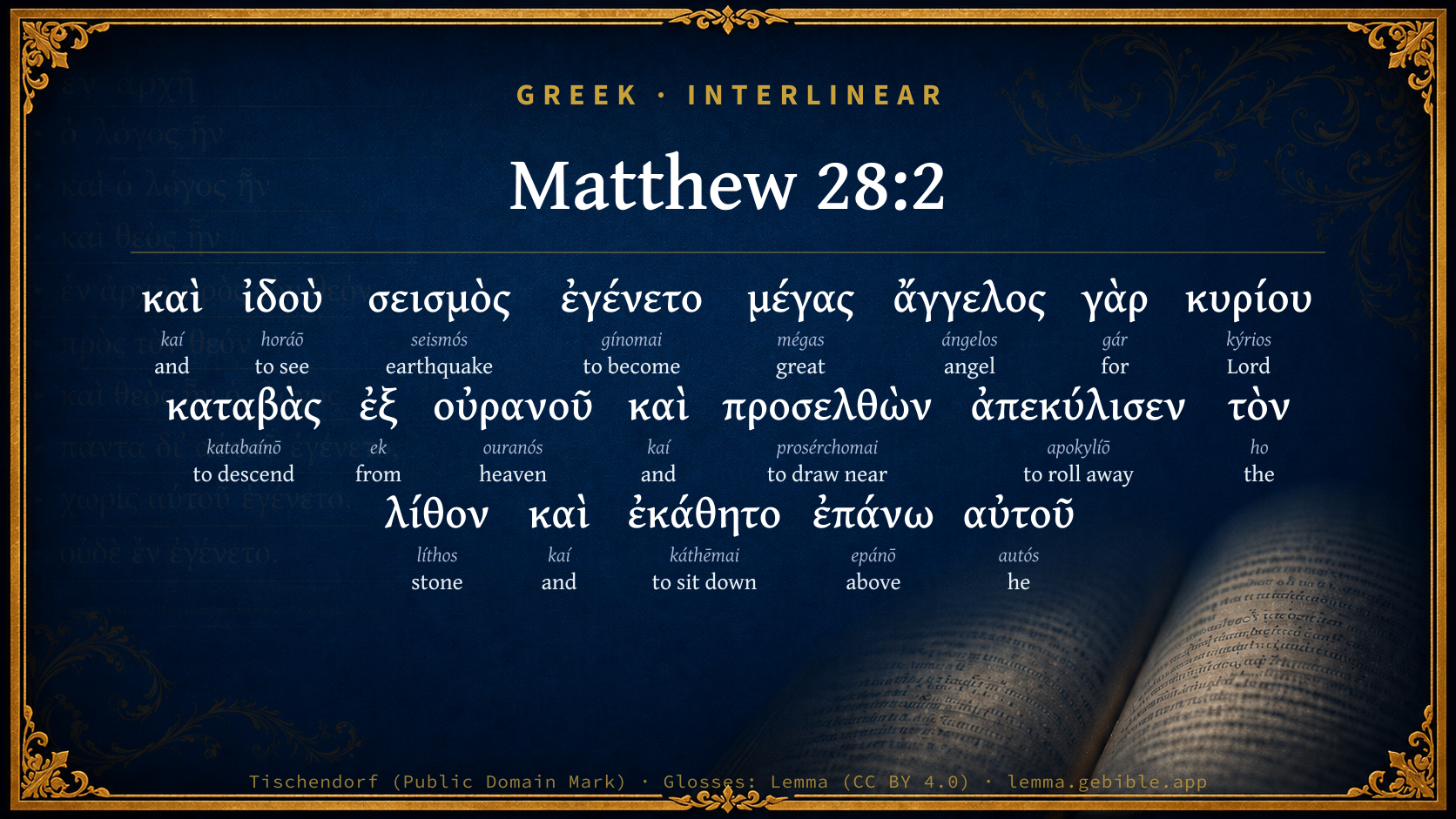
Greek (Tischendorf 8th ed.) Matthew 28:2 appears in the Greek New Testament. The text above is from the Tischendorf 8th edition. Each word links to its Strong’s number and a concise gloss. Click any word for its full Thayer’s Greek Lexicon entry.
Download image
Cite this verse

Matthew 28:2 (World English Bible). Public Domain. Lemma interlinear Bible study tool, https://lemma.gebible.app/v/matthew/28/2.

Show BibTeX & RIS
BibTeX
RIS
English Translation
Behold, there was a great earthquake, for an angel of the Lord descended from the sky, and came and rolled away the stone from the door, and sat on it.
World English Bible · Public Domain
Highlights
  • 1 first appearance in the Greek New Testament
Full analysis ↓
Download a study sheet

One document with this verse’s original text, its word-by-word gloss line, the meaning frame, cross-references with their text, attributed commentary, and full source and license credits — printable, and it pastes into notes with its structure intact.

This verse Autodidact and up

Study sheet (.html) Plain text (.txt)

A passage Seminary Student

Up to 50 verses in one chapter. A passage sheet keeps up to 6 commentary sources and 12 cross-references per verse, in the order this page ranks them, and says so on the sheet whenever that leaves anything out. Ask for a single verse and you get the Autodidact verse sheet above.

Everything on this page stays free to read, with no account — the sheet is a download of what is already on screen, not access to it.

Want to remove ads? Support Godless Engineer
Compare translations 3

The same verse in 3 English versions, stacked beneath the original-language interlinear above. Click any original word for its lexicon entry.

Each is an independent rendering of the whole verse — the interlinear is not word-aligned to these translations.

Highlighted words mark where these versions differ — a whole-verse word diff, not a word-by-word alignment.

  • World English Bible Public Domain
    Behold, there was a great earthquake, for an angel of the Lord descended from the sky, and came and rolled away the stone from the door, and sat on it.
  • King James Version Public Domain
    And, behold, there was a great earthquake: for the angel of the Lord descended from heaven, and came and rolled back the stone from the door, and sat upon it.
  • unfoldingWord Literal Text CC BY-SA 4.0
    And behold, a great earthquake happened, for an angel of the Lord, having come down from heaven and having approached, rolled away the stone and was sitting on it.

unfoldingWord Literal Text — © unfoldingWord, licensed CC BY-SA 4.0. Word-aligned USFM3 via Door43 (git.door43.org/unfoldingWord/en_ult).

Versions to compare (up to 4)

3 of 4 selected

Show all 19 translations

Every available English version of this verse, each an independent rendering of the whole verse.

  • World English Bible Public Domain
    Behold, there was a great earthquake, for an angel of the Lord descended from the sky, and came and rolled away the stone from the door, and sat on it.
  • Berean Standard Bible Public Domain
    Suddenly there was a great earthquake, for an angel of the Lord descended from heaven, rolled away the stone, and sat on it.
  • Majority Standard Bible Public Domain
    Suddenly there was a great earthquake, for an angel of the Lord descended from heaven, rolled away the stone from the entrance, and sat on it.
  • King James Version Public Domain
    And, behold, there was a great earthquake: for the angel of the Lord descended from heaven, and came and rolled back the stone from the door, and sat upon it.
  • American Standard Version (1901) Public Domain
    And behold, there was a great earthquake; for an angel of the Lord descended from heaven, and came and rolled away the stone, and sat upon it.
  • Revised Version (1885) Public Domain
    And behold, there was a great earthquake; for an angel of the Lord descended from heaven, and came and rolled away the stone, and sat upon it.
  • Geneva Bible (1599) Public Domain
    And behold, there was a great earthquake: for the Angel of the Lord descended from heauen, and came and rolled backe the stone from the doore, and sate vpon it.
  • Douay-Rheims (1899) Public Domain
    And behold there was a great earthquake. For an angel of the Lord descended from heaven, and coming, rolled back the stone, and sat upon it.
  • Young's Literal Translation Public Domain
    and lo, there came a great earthquake, for a messenger of the Lord, having come down out of heaven, having come, did roll away the stone from the door, and was sitting upon it,
  • Literal Standard Version CC BY-SA 4.0
    and behold, there came a great earthquake, for a messenger of the LORD, having come down out of Heaven, having come, rolled away the stone from the door, and was sitting on it,
  • Unlocked Literal Bible CC BY-SA 4.0
    Behold, there was a great earthquake, for an angel of the Lord descended from heaven, came and rolled away the stone, and sat on it.
  • unfoldingWord Literal Text CC BY-SA 4.0
    And behold, a great earthquake happened, for an angel of the Lord, having come down from heaven and having approached, rolled away the stone and was sitting on it.
  • Darby Bible Public Domain
    And behold, there was a great earthquake; for an angel of [the] Lord, descending out of heaven, came and rolled away the stone and sat upon it.
  • World Messianic Bible Public Domain
    Behold, there was a great earthquake, for an angel of the Lord descended from the sky and came and rolled away the stone from the door and sat on it.
  • Webster's Bible Public Domain
    And behold, there was a great earthquake: for the angel of the Lord descended from heaven, and came and rolled back the stone from the door, and sat upon it.
  • Free Bible Version CC BY-SA 4.0
    All of a sudden there was a tremendous earthquake, for an angel of the Lord came down from heaven and rolled away the stone, and sat on it.
  • Bible in Basic English Public Domain
    And there was a great earth-shock; for an angel of the Lord came down from heaven and, rolling back the stone, took his seat on it.
  • Text-Critical English NT CC BY 4.0
    And behold, there was a great earthquake, for an angel of the Lord descended from heaven and came and rolled away the stone from the entrance and sat on it.
  • Tyndale New Testament (1534) Public Domain
    And beholde ther was a greate erth quake. For the angell of the lorde descended from heven: and came and rowlled backe the stone from the dore and sate apon it.

Literal Standard Version (2020), Covenant Press — licensed CC BY-SA 4.0. Text via the HelloAO Bible API (eBible.org). Unlocked Literal Bible (unfoldingWord) — licensed CC BY-SA 4.0. Text via the HelloAO Bible API (eBible.org). unfoldingWord Literal Text — © unfoldingWord, licensed CC BY-SA 4.0. Word-aligned USFM3 via Door43 (git.door43.org/unfoldingWord/en_ult). Free Bible Version, Dr. Jonathan Gallagher — licensed CC BY-SA 4.0. Text via the HelloAO Bible API (eBible.org).

Word by word

More ways to search: Search by grammar → Find every occurrence → Compare this word →

Practice this passage: Drill this verse → Learn its vocabulary →

ἀπεκύλισεν
apokylíō
G617
“to roll away”
Verb, Aorist, Active, Indicative, 3rd person, Singular
Part of Speech
Verb
Tense
Aorist
Voice
Active
Mood
Indicative
Person
3rd person
Number
Singular
Full Thayer's Definition

Origin: from G575 and G2947

TDNT: None

1. to roll off or away This word is used in the Gospels to refer to the stone that was infront of the tomb of Jesus. In Palestine, graves were usually in adepression and the stone was rolled down an incline to cover themouth of the tomb. For a small grave, about twenty men were requiredto roll a stone down hill to cover the door of the tomb. The Bibletells us that the stone covering the door of the tomb was a largestone. The women would have needed more men than even a full Romanguard of sixteen men to roll away the stone. This was a major task.
  1. καὶ kaí G2532 “and” Conjunction
  2. ἰδοὺ horáō G3708 “to see” Verb, Aorist, Middle, Imperative, 2nd person, Singular
  3. σεισμὸς seismós G4578 “earthquake” Noun, Nominative, Singular, Masculine
  4. ἐγένετο gínomai G1096 “to become” Verb, Aorist, Middle deponent, Indicative, 3rd person, Singular
  5. μέγας mégas G3173 “great” Adjective, Nominative, Singular, Masculine
  6. ἄγγελος ángelos G32 “angel” Noun, Nominative, Singular, Masculine
  7. γὰρ gár G1063 “for” Conjunction
  8. κυρίου kýrios G2962 “Lord” Noun, Genitive, Singular, Masculine
  9. καταβὰς katabaínō G2597 “to descend” Verb, Aorist, Active, Participle, Nominative, Singular, Masculine
  10. ἐξ ek G1537 “from” Preposition
  11. οὐρανοῦ ouranós G3772 “heaven” Noun, Genitive, Singular, Masculine
  12. καὶ kaí G2532 “and” Conjunction
  13. προσελθὼν prosérchomai G4334 “to draw near” Verb, Aorist, Active, Participle, Nominative, Singular, Masculine
  14. τὸν ho G3588 “the” Article, Accusative, Singular, Masculine
  15. λίθον líthos G3037 “stone” Noun, Accusative, Singular, Masculine
  16. καὶ kaí G2532 “and” Conjunction
  17. ἐκάθητο káthēmai G2521 “to sit down” Verb, Imperfect, Middle or Passive deponent, Indicative, 3rd person, Singular
  18. ἐπάνω epánō G1883 “above” Adverb
  19. αὐτοῦ autós G846 “he” Personal pronoun, Genitive, Singular, Masculine

About this verse

These counts appear in no published source. They are computed here, from the morphology-tagged text and Lemma’s own curated glosses. What Lemma adds →

20
words
18
distinct lemmas
Gospels
section

Notable vocabulary

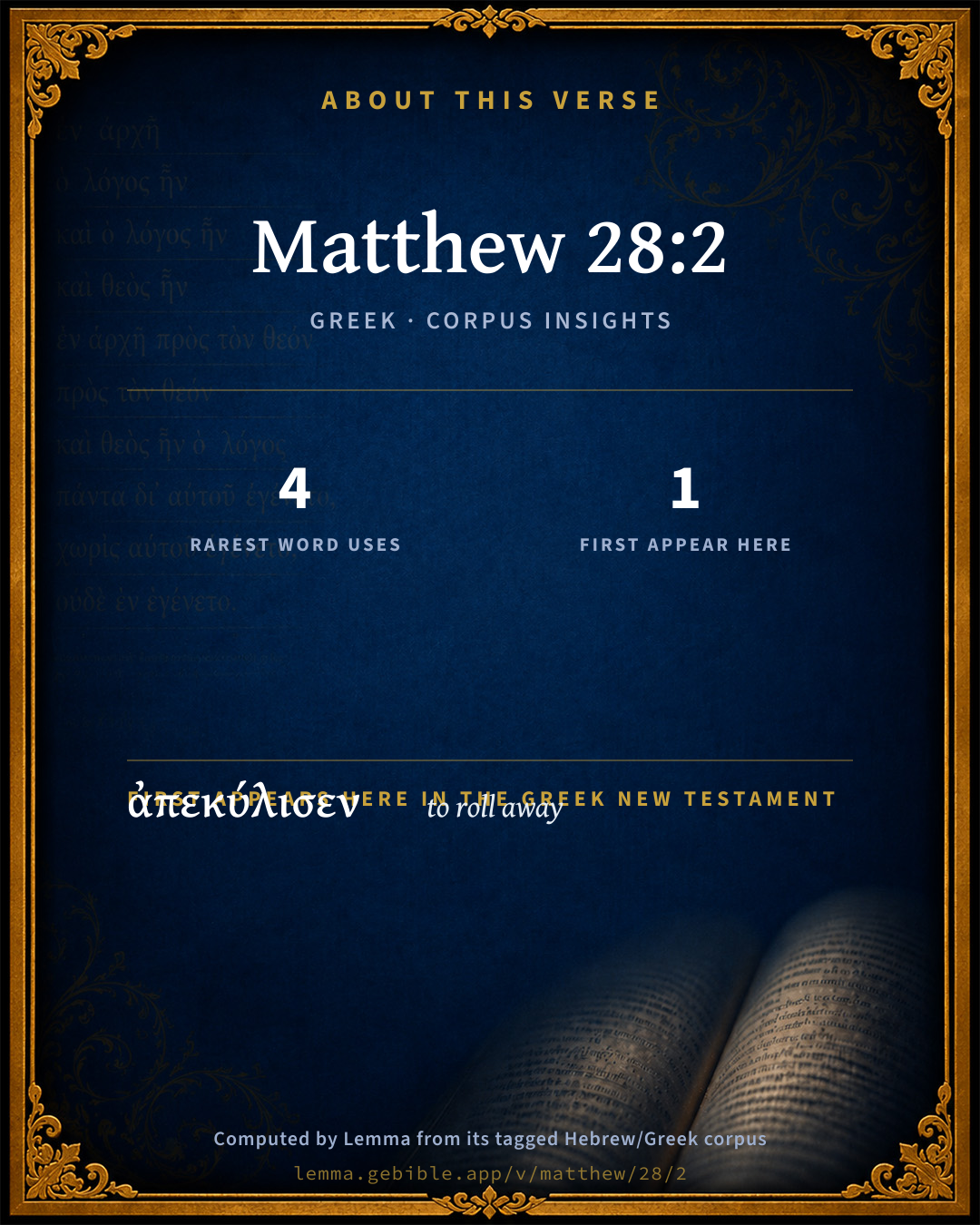
The rarest word here is ἀπεκύλισεν to roll away G617 — appearing just 4 times in the whole Greek New Testament.

First appearance in Scripture

This word makes its first canonical appearance in the Greek New Testament here:

  • ἀπεκύλισεν to roll away G617

Shared distinctive vocabulary

ἀπεκύλισεν to roll away G617 occurs in 4 verses of the Greek New Testament. Also found in:

Repetition

A word recurs within this verse:

Cross-references

9

Topical passages linked to Matthew 28:2 in the Treasury of Scripture Knowledge — connected by theme and wording, ordered by reader-vote popularity; previews shown in the World English Bible.

  • Mark 16:3–5 They were saying among themselves, "Who will roll away the stone from the door of the tomb for us?"
  • Luke 24:2–5 They found the stone rolled away from the tomb.
  • John 20:12–13 and she saw two angels in white sitting, one at the head, and one at the feet, where the body of Jesus had lain.
  • Acts 16:26 Suddenly there was a great earthquake, so that the foundations of the prison were shaken; and immediately all the doors were opened, and everyone's bonds were loosened.
  • Matthew 27:51–53 Behold, the veil of the temple was torn in two from the top to the bottom. The earth quaked and the rocks were split.
  • John 20:1 Now on the first day of the week, Mary Magdalene went early, while it was still dark, to the tomb, and saw the stone taken away from the tomb.
  • 1 Timothy 3:16 Without controversy, the mystery of godliness is great: God was revealed in the flesh, Justified in the spirit, Seen by angels, Preached among the nations, Believed on in the world, And received up in glory.
  • 1 Peter 1:12 To them it was revealed, that not to themselves, but to you, did they minister these things, which now have been announced to you through those who preached the Gospel to you by the Holy Spirit sent out from heaven; which things angels desire to look into.
  • Revelation 11:19 God's temple that is in heaven was opened, and the ark of the Lord's covenant was seen in his temple. Lightnings, sounds, thunders, an earthquake, and great hail followed.

Cross-references courtesy of OpenBible.info (CC BY 4.0).

Where the printed editions differ

1 variant

Places in this verse where the major printed Greek editions disagree on the wording in a way that affects the translation — a comparison of editions, not a manuscript-by-manuscript collation. The editions are the modern critical texts (Nestlé-Aland 28/27, SBL, Westcott-Hort, Tregelles, Tyndale House) and the traditional texts behind the KJV (the Textus Receptus and the Byzantine/Majority text). It is not a claim about which reading is original.

  1. Extra text
    ἀπὸ τῆς θύρας

    “from <the> door”

    In TRByz Not in NA28NA27TynSBLWHTreg

    ἀπὸ τῆς θύρας (apo tēs thuras) 'from door' is only in traditional manuscripts (TR+Byz)

Textual data: Translators Amalgamated Greek New Testament (STEPBible TAGNT) · CC BY 4.0.

Commentary

Notes on Matthew 28:2 from classic Christian and Jewish commentators (each source and its license shown beneath its notes). The classic Christian expositions comment on the surrounding passage and are grouped to its opening verse, so a note may address several verses; the Jewish commentaries on the Tanakh (Rashi and others) are per-verse, so they appear only where the commentator wrote on this verse.

Lemma curates 59 commentaries, every one of them public domain or Creative Commons licensed, each selected and text-cleaned for this edition rather than reprinted as found. About our sources →

The Biblical Illustrator

Joseph S. Exell

Mat_28:2-4

And behold, there was a great earthquake.

The earthquake trumpet

An earthquake was a royal trumpet to proclaim this victory, the greatest that ever was obtained against an enemy. The deep murmur and hollow sound which came from beneath the earth gave notice at one blast to heaven, and hell, and to all Judea, that the Son of God about that instant (as I do verily believe) did break the gates of brass, and smite the bars of death in sunder. (Bishop Hacket.)

Six reasons for the earthquake

I. It makes us conceit that there was a great struggling, and a combat between Christ and death.

II. It betokens what noise and tumult there shall be in all the elements at the last and great resurrection.

III. It signifies that the majesty of the Lord was upon the earth to defend His people.

IV. The anger of the Lord did roar out of the earth against those Jews who thought to prevail that death should devour him, against Pilate that allowed his seal to this conspiracy, and against the soldiers that watched the sepulchre.

V. Because the consciences of these evil men were only wounded, and no other harm done by the earthquake, therefore, some say, the place round about did rather dance for joy than quake for trembling.

VI. Is allegorical, and thus in brief, that our hearts must be shaken and inwardly troubled with compunction and repentance before we believe steadfastly in the resurrection of Jesus. (Bishop Hacket.)

Keepers like dead men

The sentinels were not as dead men long; and when they woke, they found the tomb empty, and the tenant gone. Thoughts of the spirit-land and impressions of reverence were not in their world; the shock they had received woke no thought or question, but sheer physical terror only. As horses are frightened in the flashes of the tempest, and the wild things of the woods are suddenly tame in the blow of any tremendous flood or fire; so these strong human animals were cowed by the lightning from an angels face. They would have been dauntless amidst the shock of battle and the din of arms, but they were dumb before a being who was not of flesh and blood. White as the dead, they at once burst into the presence of their masters and told all. (Charles Stanford, D. D.)

The Biblical Illustrator, edited by Joseph S. Exell (c. 1880s–1900s) — public domain. Text from a community e-Sword module.

Joseph Benson's Commentary

Mat 28:2. And behold, there was a great earthquake — While the women were making these preparations for embalming the body of Jesus, he arose from the dead; his resurrection being preceded by the descent of an angel, whose appearance at the sepulchre was ushered in with a great earthquake and probably also a storm, the word σεισμος, here rendered earthquake, signifying any shaking, whether in the earth, air, or sea. Thus, chap. Mat 8:24, σεισμος μεγας εν τη θαλλασση, is rightly rendered, a great tempest in the sea. And Eze 3:12, LXX., φωνην σεισμου μεγακου, is, the voice of a great rushing wind; and συσσεισμος, is the word by which the LXX. denote a whirlwind, such as that wherein Elijah was caught up, 2Ki 2:1. Hammond and Le Clerc interpret the words σεισμος μεγας, in this passage, of a tempest only. For the angel of the Lord descended from heaven — Probably in sight of the guards; and came and rolled back the stone, &c. — “Jesus, by his miraculous power, could easily have rolled the stone from the door of the sepulchre, and therefore the descent of an angel was not necessary in order to that; but it was necessary, among other things, to throw the guards into a consternation before Jesus came forth, lest they should have been guilty of the impiety of offering to lay violent hands on him, as was done in the garden of Gethsemane, even after he had cast the whole party down on the ground. It is true, the divine wisdom and power could have intimidated the soldiers by a variety of methods, but the one pitched upon was certainly as proper as any.” — Macknight. And sat upon it — Luke and John speak of two angels that appeared; but it seems as if one only of them had appeared sitting on the stone without the sepulchre, and then, going into it, was seen with another angel, sitting, one where the head, the other where the feet of the body had lain.

Joseph Benson's Commentary on the Old and New Testaments (1811–1818) — public domain. Text from a community e-Sword module.

Whedon's Commentary on the Bible

Daniel D. Whedon

TRANSACTIONS ON THE DAY OF RESURRECTION, BEFORE THE FIRST VISIT AT THE SEPULCHRE, Mat_28:2-4.

2. Earthquake — As there was darkness and earthquake at the death, so there is now earthquake and light at the resurrection. Both were given for the same purpose; namely, to manifest to the senses of men the mighty operations that were going on beyond the reach of sense. Death, and life, and power are secret and unseen principles; their manifestations are shown forth to mankind through the senses. The earthquake and the resurrection of course took place previous to the arrival of the women. Angels — The angel came not to awaken the corpse. That was done by the return of Jesus from his visitation to the spirit-world. No eye beheld his reviving body, warmed and loosened by the embraces of the soul. Rolled back the stone — Not that Jesus could not have burst the barrier; but the ministry of angels was necessary to give form to the transaction to human conception.

Sat upon it — Upon the conquered thing as upon a triumphal throne.

Daniel D. Whedon (gen. ed.), Commentary on the Old and New Testaments (1874–1909) — public domain. Text from a community e-Sword module.

Godbey's Commentary on the New Testament

William B. Godbey

CHAPTER 29

THE RESURRECTION

Mar 16:1. “And the Sabbath passing away, Mary Magdalene, and Mary the mother of James, and Salome, purchased aromatics, in order that, having come, they may embalm Him.” The city of Magdala, in the land of Dalmanutha, stands on the northwestern coast of the Galilean Sea, and was immortalized by the nativity and residence of the most heroic and spiritual female disciple of our Lord, cognomened Magdalene, designative of her city. I saw it frequently while sailing over that beautiful sea on the track of my Lord, and visited it once. The other Mary here mentioned, and second in prominence only to Mary Magdalene, was the mother of the Apostle James, surnamed the Less. Salome was the honored mother of James the Greater and John the beloved apostle. The hundred pounds of myrrh and aloes, furnished by Nicodemus at the time of His hurried interment on Friday evening, was only a noble beginning of that rich and royal embalmment with which they proposed to honor the One they all loved as no tongue could tell.

It is pertinent here to observe, that the disciples failed to discriminate between the prophecies appertaining to His two advents, mixing them up heterogeneously, and applied them all to His first coming; therefore we hear them certifying frequently that “when Christ comes, He will abide forever” (Dan 7:14), which was currently enunciated by the prophets. Consequently when they all see that He is dead, the result is that they give up all hope of His Christhood but still believing that when the Messiah comes, He will abide forever. However, they still believe that He is a prophet, and the greatest of all the prophets who have ever lived upon the earth, having such power as none of His predecessors ever wielded, but unfortunately, venturing too far permitted His enemies to get the advantage of Him, and consequently lost His life in the bloom of youth, at the early age of thirty-three — with the Jews, thirty being majority and fifty maturity.

Though now under the awful collapse of blighted hopes and perished aspirations, yet they love Him as no tongue can fell; and feeling assured that He is the greatest prophet God ever sent to Israel, they are determined to compliment Him with the most honorable interment, embalming His body after the Jewish method, and sparing no expenditure in procuring an abundance of the most valuable Oriental antiseptics.

History says all the apostles, and these prominent, holy women so frequently mentioned, were at the house of Rabbi Amos, a friend of Jesus in the metropolis, and were all engaged in silent mourning, alter the Jewish method of mourning for the dead seven days. Naught is heard through the long, dreary night but sighs, groans, and sobs. As deepest grief is silent, their sorrow was too great for utterance. They also spent the ensuing day and night in silent mourning, the inviolable sanctity of the Sabbath being their only guarantee against the cruel arrest, imprisonment, and execution which would, it was apprehended, certainly follow quickly the ensuing week.

Mat 28:2-4. “And, behold, there was a great earthquake; for the angel of the Lord, having descended from heaven, coming, rolled away the stone from the door, and sat upon it. And his countenance was like lightning, and his raiment white as snow. And from fear, the keepers did quake, and became like corpses.” When the great archangel, whose countenance was like lightning, his pinions like rainbows, and his feet like pillars of fire, came sweeping down from heaven, old Earth trembling and quaking, and touched the great stone, secured by the seal of the Roman Empire, it rolled away as if struck with a score of battering-rams; meanwhile those gigantic Roman soldiers, who delighted in the thunder of the battle-field, fell in their tracks on all sides, pale and motionless as dead men. And now, the Conqueror of Mount Calvary, vacating the sepulcher, walked out, as free as a bird of paradise.

William B. Godbey, Commentary on the New Testament (1896–1900) — public domain. Text from a community e-Sword module.

Bengel's Gnomon

Johann Albrecht Bengel

Mat 28:2. Ἀπὸ τῆς θύρας, from the door) sc. of the sepulchre. It did not behove that the sepulchre should remain closed.—ἐκάθητο, sat) Afterwards the angel arose with his companion. See Luk 24:4 [where it is said, “Behold two men stood by them in shining garments.]—ἐπάνω αὐτοῦ, upon it) sc. the stone: so that no one could roll it back again to the sepulchre.

Bengel's Gnomon of the New Testament — English translation (T&T Clark, Edinburgh, 1860) — public domain. Text from a community e-Sword module.

Meyer's Critical & Exegetical Commentary

Heinrich August Wilhelm Meyer

Mat_28:2. It is wrong to take the aorists in a pluperfect sense (Castalio, Kuinoel, Kern, Ebrard), or to conceive of the action of the ἦλθε as not yet completed (de Wette). Matthew represents what is here recorded as taking place in presence of the women (ἦλθε … θεωρῆσαι … καὶ ἰδού), whose attention, however, had been so much occupied with the accompanying phenomena, that they did not observe (Mat_28:5-6) the circumstance itself of our Lords emerging from the grave (which, besides, must have been invisible to the outward eye owing to the nature of the body He had now assumed, comp. on Mat_28:17). The other evangelists make no mention of this (legendary) supernatural and visible rolling away of the stone; and, though differing as to the number of the angels, they agree in representing them as having appeared inside the grave. Here, if anywhere, however, amid so much that is supernatural, must we be prepared to expect divergent accounts of what took place, above all in regard to the angelic manifestations, which are matters depending on individual observation and experience (comp. on Joh_20:12), and not the objective perceptions of impartial and disinterested spectators.

γάρ] assigning the reason for the violent earthquake which, as a divine σημεῖον, formed an appropriate accompaniment to this miraculous angelic manifestation.

κ. ἐκαθήτο, κ.τ.λ.] as the heaven-sent guardian and interpreter of the empty tomb.

Meyer — Critical and Exegetical Commentary on the New Testament — English translation by Peter Christie, edited by Frederick Crombie (T&T Clark, 1880) — public domain. Text from a community e-Sword module.

Expositor's Greek Testament

ed. W. Robertson Nicoll

Mat 28:2 . he particulars in this and the following two verses are peculiar to Mt.: first, an earthquake ( σεισμὸς ), as in Mat 27:51 ; second, an angel descending from heaven; third, the angel rolling away the stone; fourth, the angel sitting on the stone as guard.

The Expositor's Greek Testament, edited by W. Robertson Nicoll (1897–1910) — public domain. Text from a community e-Sword module.

Adam Clarke's Commentary

Verse 2. A great earthquake] σεισμος, a shaking or commotion of any kind: probably the word means no more than the confusion caused among the guards by the angel's appearance. All this had taken place before the women reached the sepulchre.

The angel of the Lord descended from heaven] Matthew is very particular in this, to show that the word angel is not to be taken in the sense of an ordinary messenger, who might have come from Joseph of Arimathea, or from any other; but in the sense of an extraordinary messenger, who descended from GOD, out of heaven, for this very purpose. It is likely that the angel had descended, rolled away the stone, and was sitting on it, before the women reached the tomb.

Adam Clarke's Commentary on the Bible (1810–1826) — public domain. Text from a community e-Sword/MySword module.

Ellicott's Commentary for English Readers

(2) There was a great earthquake.—The words imply, not that they witnessed the earthquake, but that they inferred it from what they saw. The form of the angel is described in Mar_16:5 as that of a “young man” in white or bright (Luk_24:4) raiment. This was the answer to the question they had been asking as they came, “Who shall roll away the stone for us?” (Mar_16:3). That would have been beyond their strength.

A Bible Commentary for English Readers, edited by Charles John Ellicott (1878–1897) — public domain. Text from a community e-Sword module.

The Cambridge Bible for Schools and Colleges

gen. ed. J. J. S. Perowne

2. there was a great earthquake] Peculiar to St Matthew.

the angel of the Lord] “Two men stood by them in shining garments” (Luke). “Two angels in white sitting” (John).

The Cambridge Bible for Schools and Colleges (gen. ed. J. J. S. Perowne; Cambridge University Press, 1878–1918) — public domain. Text from a community e-Sword module.

John Gill's Exposition

And behold there was a great earthquake,.... Or "there had been one"; which, how far it reached, and whether further than the spot of ground in which the sepulchre was, is not certain: it was an emblem of the shaking of the earth by the preaching of the Gospel, the sound of which was now to go after Christ's resurrection to the ends of the world; and a prelude of the general resurrection, when the earth shall be shaken, and the graves opened, and the dead come forth; and was a symbol and token of the presence and majesty of Christ, at whose rising, as at his death, the earth shook and trembled. Think whether the watch could now be asleep, as they afterwards gave out, Mat 28:13. The Persic version renders it very wrongly; "and there was great consternation and fear"; which was the consequence of the earthquake, and the descent of the angel, and was so great that it was not possible for the keepers to sleep, if ever so much inclined:

for the angel of the Lord descended from heaven; perhaps Gabriel, who brought the news of the conception of Christ to the virgin, and of his incarnation to the shepherds, and might be the same angel that strengthened him in the garden: nor is this any contradiction to the other evangelists, which speak of two angels, Luk 24:4, for Matthew does not say there were no more than one, though he makes mention but of one.

And came and rolled back the stone from the door; of the sepulchre, which by Joseph, or his orders, was put there, and was sealed by the Jews. This might be done, that way might be made for the risen body of Christ to pass out of the sepulchre; for to suppose, as some do, that he penetrated through this stone with his risen body, is not to be credited: it is true, he could have caused the stone to have given way, or removed it himself, and put it in the place again; as he caused the doors of the house in which the disciples were, to open and shut so quick, that they could not discern it when he appeared in the midst of them, Joh 20:19; see Act 12:10, but he might choose to do it by the ministry of an angel, which is no ways derogatory to his power and majesty, but rather agreeable. Moreover, this might be done, that the women might have access to the sepulchre, and enter into it, which was the thing they were concerned about by the way, who should roll away the stone for them. Besides, this the angel did, as a token that Christ was risen, and to let the guard know as much, who, if they thought fit, might come and see what was done; but chiefly the stone was rolled away by the angel, as an emblem of the acquittance and discharge of Christ, as the surety of his people. He had taken upon him their sins; he had bore them in his body on the tree; he had suffered and died for them, and was laid as a prisoner in the grave; and now full satisfaction being made, an angel is sent from heaven to roll away the stone; thereby signifying, that the debt was fully paid, and he was now legally discharged. It is added,

and sat upon it; thereby showing who it was that rolled it away; that it was done by him, not by the earthquake, nor by any human power: he sat there defying the guard of soldiers to come nigh; and waiting for the coming of the women, to tell them the good news, that their Lord was risen; and as the keeper of the sepulchre, that no corpse might be brought and laid in the room of Christ, and it be said that he was not risen. This posture of the angel does not contradict what other evangelists say of this, and the other angel, that they stood by the women, and also were sitting in the sepulchre, Mar 16:5, for each was true: when the women first came, the angel sat upon the stone; after that, with the other, stood by them; when having invited them to the grave, placed themselves, sitting the one at the head, and the other at the feet, where the body of Christ had lain.

John Gill's Exposition of the Whole Bible (1746–1763) — public domain (CC PDM 1.0). Text via the HelloAO Bible API.

Trapp's Complete Commentary

John Trapp

2 And, behold, there was a great earthquake: for the angel of the Lord descended from heaven, and came and rolled back the stone from the door, and sat upon it.

Ver. 2. And behold, &c.] The Holy Ghost here calls for as great attention as if we had been present and seen it. Remember (saith St Paul) "that Jesus Christ, of the seed of David, was raised from the dead, according to my gospel," 2Ti 2:8. All the four evangelists have therefore punctually recorded it, that we may remember and ruminate it, as amain remarkable.

There was a great earthquake] Pythagoras said the reason of earthquakes was, the meeting of the dead: an odd conceit, {a} But the true reason of this earthquake was our Saviour’s rising from the dead, in despite of infernal spirits, who therefore quaked as much as the earth did, as Hilary hath it. {b} The earth shook both at Christ’s passion and at his resurrection; Then, to show that it could not bear his suffering; now, to show that it could not hinder his rising.

Rolled back the stone] As an officer sent to let Christ out of prison, without the keeper’s consent.

And sat upon it] In contempt of all their weapons, which fell out of their hands for woe, at the sight of the angel. And as a mighty man when he sits down shakes the bench under him, so do these the earth.

{a} Nullam aliam causam dicebat terrae motus quam conventum mortuorum. Aelian.

{b} Resurgente virtutum coelestium domino infernorum trepi. datio commovetur.

John Trapp, A Commentary or Exposition upon All the Books of the Old and New Testament (1647–1656) — public domain. Text from a community e-Sword module.

Albert Barnes' Notes on the Bible

There was a great earthquake - Rather there “had been.” It does not mean that this was while they were there, or while they were going, but that there “had been” so violent a commotion as to remove the stone. The word rendered here as “earthquake” does not of necessity mean that the convulsion extended to the earth, but only that there had been such a concussion as to remove the stone.

And sat upon it - Sat upon it when the keepers saw him, Mat 28:4. It is not said that he was sitting when he appeared to the women. From Luke it would rather appear that he was standing.

Albert Barnes' Notes on the Bible (1834–1885) — public domain. Text from a community e-Sword/MySword module.

Haydock's Catholic Bible Commentary

Behold ... an angel. The angel did not remove the stone to afford a passage to Christ when he arose; for Christ most certainly arose before the angel appeared; but he removed the stone to prepare the way for the women, and to shew the soldiers that Christ was arisen. He sat on the stone, that the women might know he had removed it; and, in the second place, that they might not be terrified at the appearance of the soldiers; for he exhorted them not to fear, but to come and see; and lastly, to prevent the soldiers from putting in another body, had they been so disposed. The holy women seem not to have known that there were guards placed near the sepulchre; otherwise they would not have been so solicitous who should roll away the stone for them, as how they should deceive the guards and break the seal. (Tirinus) --- For an angel of the Lord. This angel, who came to testify Christ’s resurrection, removed the great stone; but Christ was risen before, who according to all the fathers, says Estius, rose, the sepulchre being yet shut.[2] --- St. Matthew and St. Mark name but one angel; St. Luke and St. John name two. It may be answered, that the women saw one at one time, and two at another: one upon the stone, out of the monument; (which also frightened the guards) afterwards this angel disappeared, and the women coming near, and looking into the vault, saw two angels, when he that was on the right side said, why seek you him that is living, among the dead? --- Another difference to be observed, is, that Sts. Matthew, Mark and John tell us, that the angel, or angels, sat; and St. Luke, that they stood: they might sit at one time, and stand at another. Besides that in the style of the Scriptures, standing, or sitting, many times imply no more than that they were present there. --- In the third place, we take notice that Mary Magdalene seems to have come running to St. Peter, and St. John, as soon as she saw the stone removed, with these words, They have taken away the Lord ... and we know not where they have laid him: John xx. 2, we do not there read that she said any thing of the angels. Or perhaps St. Peter and St. John ran away before they heard all that Magdalene had to say. In all these there is no contradiction; and the difficulties rise only from this, that each evangelist does not relate all the circumstances. (Witham)

===============================

[BIBLIOGRAPHY]

Estius. Est omnium Patrum sententia Christum resurrexisse clauso sepulchro.

====================

George Leo Haydock (1774–1849), Haydock's Catholic Family Bible and Commentary, 1859 edition — public domain. Excludes Psalms (Douay-Rheims chapter numbering differs from Protestant) and Deuterocanonical books (Catholic canon only).

Matthew Poole's English Annotations

Matthew alone telleth us this; all the other evangelists agree that when the women came they found the stone rolled away, which eased them of the solicitude they had as they came, saying amongst themselves,

Who shall roll us away the stone from the door of the sepulchre? Matthew saith, an angel descended and rolled away the stone, and came and sat upon it. This angel had assumed a shape, for he appeared to those that saw him, as to

his countenance, like lightning; as to his garment, as one clothed in exceeding white linen, white as snow. What doth the watch all this while? Matthew saith, they were afraid, shook, and became like dead men. Luke and John make mention of two angels. Indeed there needed not any angel at all to remove the stone, if this had been all he had come down for; He that was quickened by the Spirit, could by the same power have rolled away the stone; but as it was fit that the angels, who had been witnesses of his passion, should also be witnesses of his resurrection, that he who was justified in the Spirit, should be seen of angels, 1Ti 3:16; so it was necessary, that the keepers might give a just account to Pilate, the chief priests, and scribes. And no wonder that they were afraid, and as dead men, whereas all apparitions of this nature naturally affright us, and they had such a conscience of guilt upon them, and might justly fear what their masters should say to them, when they found the body was missing; especially also seeing, or being sensible of, the earthquake, or great concussion of the air (for though we translate it earthquake, yet the Greek saith no more than σεισμος μεγας). Besides that the presence of the angels seemed reasonable to prevent a cheat, by putting some other dead body into the sepulchre, and to direct the women who were now coming towards the sepulchre, for they were not yet come: when they were come, they found the stone rolled away; and Matthew’s relation, how the stone came removed, was doubtless not from them, but from the keepers, or some to whom they had related it.

Matthew Poole's English Annotations on the Holy Bible (1683–1685) — public domain. Text from a community e-Sword/MySword module.

The Pulpit Commentary

And, behold. A wonderful sight met their eyes. The following event took place before their arrival; they saw only the result. No mortal eye beheld, and no pen has recorded, the actual issuing of the Lord from the closed tomb. There was a great earthquake. St. Matthew does not attempt to give the exact sequence of events. Probably the shock, caused by the sudden advent and action of the angel, befell as the women were approaching the cemetery. Christ had risen before this occurrence, nothing being a barrier to his spiritual body. For the angel of the Lord... from the door. The narrator accounts for the phenomenon just mentioned. The words, "from the door," are omitted by the best manuscripts, the Vulgate, and modern editors, and seem to be a marginal interpolation. The angel rolled away the stone which Joseph had rolled up, (Mat_27:60) not in order to afford passage to the body of the Lord, who had already raised himself, but to give the women and others entrance to the empty tomb, and to strike terror into the heart of the soldiers. In the case of Lazarus the stone had to be removed to give exit to the resuscitated body a natural body; (Joh_11:39, Joh_11:41) in the case of Jesus such removal was not necessary, as his was a spiritual body, possessed of supernatural powers and qualities. (Joh_20:19) And sat upon it. In triumph, and to show that it was not to be replaced; death had done its work, and now was vanquished. Angels" appearances had always accompanied the great events in the history of the chosen people; angels had shown themselves at Christ"s birth, at his temptation, at his agony; now they guard his tomb, proving that he was well pleasing unto the Lord, and was raised from the grave by him. The narration of this awful incident was probably given by the soldiers, who alone witnessed it.

HOMILIES BY R. TUCK Ver. 2. Angel ministries.

Concerning the nature or the location of angels we do know, probably we can know, nothing. When they have come into the earthly spheres they have always appeared to be men like ourselves; their peculiarity has not been their wings, but their purity and radiancy. But one thing does come out quite clearly and impressively from every case of angel visitation. They are always ministers, engaged in some form of ministering. Whatever dignity we may think to belong to the angels, it is the dignity that lies in service. Here in our text the angel is no mere figure; he has something to do; he waits upon the rising Lord, rolls back the stone from the door, and sits upon it. Summarizing the work of the angels, it is said, "Are they not all ministering spirits, sent forth to minister for them who shall be heirs of salvation?

I THE RIGHEST DIGNITY IN THE OTHER WORLD. Angels are beings that belong to the other world; and if we can get to know about them, we get to know something of the occupations, interests, and sentiments of the other world. And this is the thing which the angels more especially teach us in that other world their highest and noblest idea is "serving one another in love." There is one characteristic of the eternal state. It is even so characteristic as to seem to be the only characteristic worth mentioning it is ministry. Heaven is heaven because every member can say, "I am among you as he that serveth." They learn this of Christ.

II THE HIGHEST DIGNITY IN THIS WORLD. The angels illustrate it, and the Lord Jesus taught it. "Whosoever will be great among you, let him be your servant." Instances may be taken from the several ages, pre-Christian and Christian; and it may be shown that we never have an angel exhibiting himself or getting for himself; they are always doing two thingsobeying and serving. Then show what an impression of the grandeur of angels we have. But what is our notion of them? Do we think of them as having extraordinary privileges? That is not their dignity. This is it they have risen into the full joy of ministering. The circle is complete: God, Christ, the Spirit, beings of the other world, redeemed men and women in this world, are one in this all are ministering. R.T.

The Pulpit Commentary (1880–1919), ed. H.D.M. Spence-Jones & Joseph S. Exell — public domain. Text from a community e-Sword module.

John Wesley's Explanatory Notes

An angel of the Lord had rolled away the stone and sat upon it - St. Luke and St. John speak of two angels that appeared: but it seems as if only one of them had appeared sitting on the stone without the sepulchre, and then going into it, was seen with another angel, sitting, one where the head, the other where the feet of the body had lain.

John Wesley, Explanatory Notes Upon the Whole Bible (1754–1765) — public domain. Text via the GEBible commentary corpus.

Scofield Reference Notes

C. I. Scofield

the angel

an angel etc. (See Scofield "Heb 1:4").

The Scofield Reference Bible (1917 edition), notes by C. I. Scofield — public domain. Text from a community e-Sword module.

Burkitt's Expository Notes on the New Testament

William Burkitt

Observe here, 1. With what pomp and triumph doth our Lord arise. The earth that quaked before at his crucifixion, quakes now again at his resurrection: it quaked then at the dissolution, now at the reunion of his human nature, to tell the world that the God of nature then suffered, and now conquered.

Observe, 2. How an angel is emplowed in Christ’s resurrection; He rolls away the stone. But could not Christ have risen then without the angel’s help? Yes sure, he that raised himself, surely could have removed the stone: but God thinks fit to send an officer from heaven to open the prison-door of the grave; and by setting our surety at liberty, proclaims our debt to the divine justice fully satisfied. Besides, it was fit that the angels who had been witnesses of our Saviour’s passion, should also be witnesses of his resurrection.

Observe, 3. How unable the keepers of the grave were to bear the sight and presence of the angel; they shook for fear, and became as dead men. Angels being pure and perfect spirits, man is not able to bear the sight of an angel, no, not in human shape, without terror and affrightment; and if the sight of an angel be so dreadful, what is the sight of God himself?

William Burkitt's Expository Notes on the New Testament (1700–1703) — public domain. Text from a community e-Sword module.

The People's New Testament

B. W. Johnson

2. Behold, there was a great earthquake. The word rendered “earthquake” is rendered tempest in Matt. 8:24. It means a “commotion.” It is not needful to decide that there was more than a local disturbance. For the angel of the Lord descended. An angel. There is no article. All the gospels speak of the angelic appearance at the tomb, though some give details omitted by others. Rolled back the stone. The commotion, or earthquake, accompanied the rolling back of the stone. “It was not for him to whom (John 20:19, 20) the stone was no hindrance, but for the women and disciples that it was rolled away.”—Alford.

B. W. Johnson's The People's New Testament with Notes (1889–1891) — public domain. Electronic text from the Christian Classics Ethereal Library (CCEL) ThML edition.

Cambridge Greek Testament for Schools and Colleges

2. ἀπὸ τῆς θύρας after λίθον omitted אBD, some versions and Origen. The words are found in the later authorities, ACE and other uncials, some versions and Fathers.

2. σεισμὸς ἐγένετο μέγας. Peculiar to St Matthew.

ἄγγελος κυρίου. ἄνδρες δύο ἐπέστησαν αὐταῖς ἐσθῆτι ἀστραπτούσῃ (Luk 24:4). δύο ἀγγέλους ἐν λευκοῖς καθεζομένους (Joh 20:12).

Cambridge Greek Testament for Schools and Colleges (Cambridge University Press, 1896; 21 vols, various authors incl. Carr, Maclear, Plummer, Farrar, Lumby, Moule, M. R. James, Simcox) — public domain. Text from a community e-Sword module.

Alford’s Greek Testament

Henry Alford

2.] This must not be taken as pluperfect, which would be altogether inconsistent with the text.

καὶ ἰδοὺ … ἐγένετο must mean that the women were witnesses of the earthquake, and that which happened.

σεισμός was not properly an earthquake, but was the sudden opening of the tomb by the descending Angel, as the γάρ shews. The rolling away was not done naturally, but by a shock, which = σεισμός.

It must not be supposed that the Resurrection of our Lord took place at this time, as sometimes imagined, and represented in paintings. It had taken place before;—ἠγέρθη κ.τ.λ. are the words of the Angel. It was not for Him, to whom (see Joh 20:19, Joh 20:26) the stone was no hindrance, but for the women and His disciples, that it was rolled away.

Henry Alford, The Greek Testament (1849–1861) — public domain. Text from a community e-Sword module.

International Critical Commentary

2-4. And, behold, there was a great earthquake: for an angel of the Lord descended from heaven, and came and rolled away the stone, and sat upon it. His appearance was as lightning, and his raiment white as snow: and from fear of him the guards were dismayed, and became as dead men.] Mk. is quite different. Mt., who has inserted the account of the sealing of the tomb and the setting of the guard, could hardly follow Mk. here in his record that the women expected to obtain access to the tomb, and thought that the stone would be the only obstacle. They came to see the tomb only. Mk vv. 3-5. have to fall out.—ἰδού] see on 1:20.—σεισμός] cf. the earthquake, 27:51.—προσελθών] see on 4:3.—ἀστραπή] cf. Dan 10:6, and note on 17:2.—ὡς χιών1 cf. Isa 1:18, Dan 7:9 (Th.) καὶ τὸ ἔνδυμα αὐτοῦ ὡσεὶ χιὼν λευκόν, Mat 17:2 D S2 latt. Rev 1:14. See Hastings, DCG. i. p. 504.

(M)

International Critical Commentary — older volumes (1896–1929), various authors — public domain. Text from a community e-Sword module.

Lesson kit

Teaching starters — assembled from the data on this page, not authored interpretation. Every prompt links to the verse data it draws on. Edit before teaching.

Matthew, in the Gospels, opens this verse with 20 words (18 distinct Greek lemmas). Its most distinctive word is apokylíō (“to roll away”). A historical commentator’s framing appears above. Read the whole chapter for the surrounding context.

Discussion questions

  1. The word apokylíō carries the sense “to roll away.” How does it shape the verse?
  2. The word “to roll away” first appears here in Scripture. What is being introduced at this debut?
  3. Mark 16:3 shares the word «to roll away» with this verse. How do the two illuminate each other?
  4. “and” occurs 3× in this one verse. What is the effect of the repetition?
  5. These translations render this verse differently; the difference is in the English rendering, not the original. What questions does that raise?
  6. Reading how The Biblical Illustrator and Joseph Benson's Commentary read this verse, where do the two commentators agree and where do they part?

Things to notice

  • 1 word makes its first canonical appearance in Scripture here.
  • These translations choose different wording for 16 words in this verse.
  • “and” occurs 3× in this single verse.
  • 18 distinct Greek lemmas span 20 words in this verse.

Reading settings

Reading text

Shown beneath each verse's original-language words.

Old Testament
Old Testament edition

Read the OT as the Masoretic Hebrew (MT) or the Greek Septuagint (LXX).

English shown for the Greek Septuagint (in the Hebrew ↔ Greek comparison).

Comparing translations? Open the Compare panel on any verse page to stack up to four side by side.