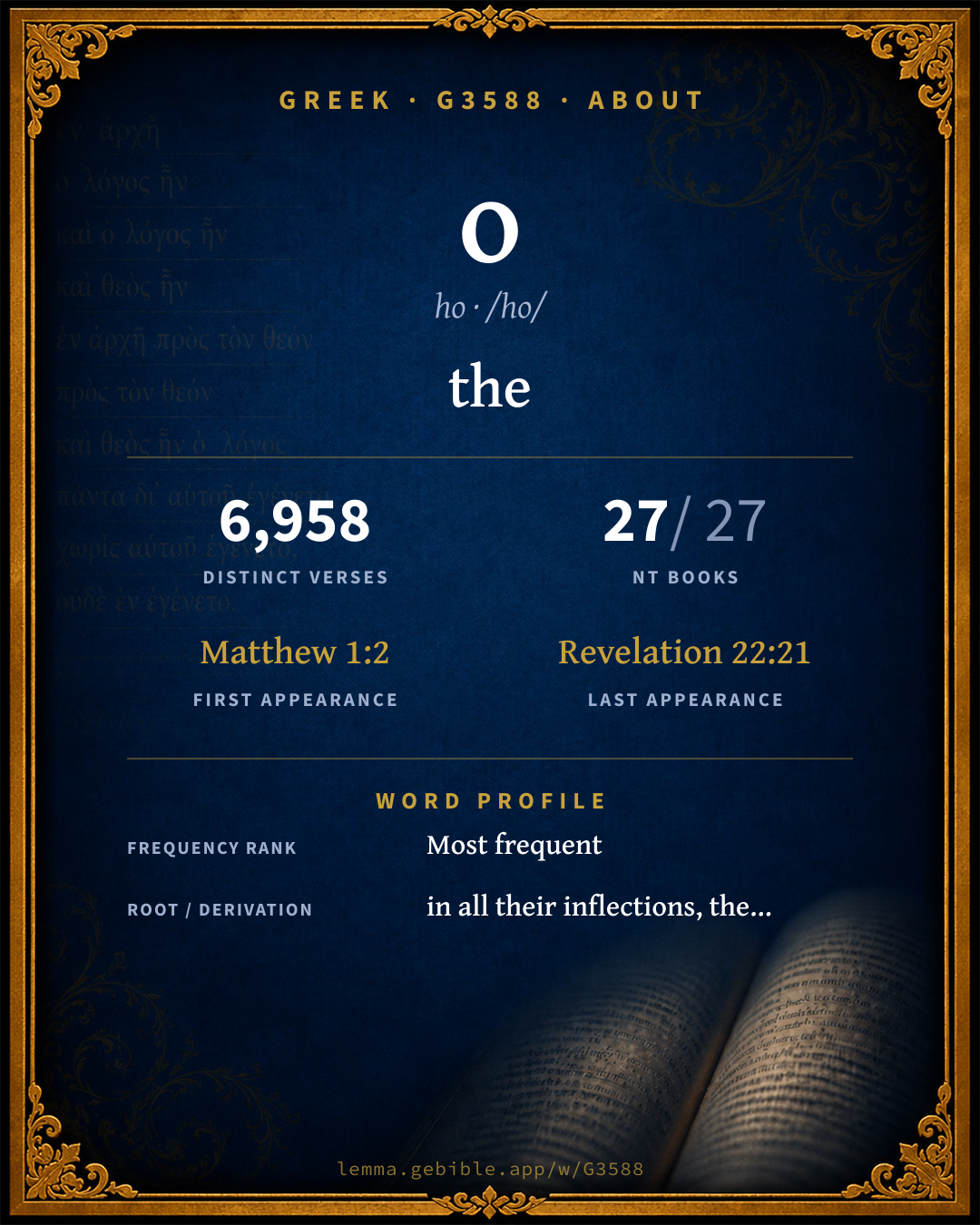
ο
the
Full lexicon entry — Thayer's Greek Lexicon
From Thayer's Greek Lexicon
Where this word appears
See every Nominative-case word in the Greek New Testament →
Grammar key — what these labels mean
Part of speech
- Article
- The Greek definite article (“the”), agreeing with its noun in case, number, and gender.
Case
- Nominative
- The case of the subject (and the predicate nominative).
- Genitive
- The case of source, possession, or “of” — answers “whose / from what.”
- Accusative
- The case of the direct object and of extent.
- Dative
- The case of the indirect object, means, or location — “to / for / with / in.”
Gender
- Masculine
- Grammatically masculine.
- Feminine
- Grammatically feminine.
- Neuter
- Grammatically neuter.
Number
- Singular
- One.
- Plural
- More than one.
Page 1 of 3 — showing verses 1–200 of 551 distinct verses where G3588 appears in the Nominative case in the Book of John. Filtered view — show all forms. Click any verse to open its interlinear word-by-word view. Verse text shown in the World English Bible for context — . Each verse’s Greek form is shown with its reference; the English is not keyword-highlighted, since the data carries no word-level English alignment. Use “Compare translations” on any verse to read it across multiple English versions. This concordance covers the Greek New Testament; Septuagint (Greek Old Testament) occurrences of this word are not indexed here.
John
- John 1:1 ὁ ὁ τὸν ὁ art nom sg masc art nom sg masc art acc sg masc art nom sg masc In the beginning was the Word, and the Word was with God, and the Word was God.
- John 1:4 ἡ τὸ τῶν art nom sg fem art nom sg neut art gen pl masc In him was life, and the life was the light of men.
- John 1:5 τὸ τῇ ἡ art nom sg neut art dat sg fem art nom sg fem The light shines in the darkness, and the darkness hasn't overcome it.
- John 1:8 τὸ τοῦ art nom sg neut art gen sg neut He was not the light, but was sent that he might testify about the light.
- John 1:9 τὸ τὸ τὸν art nom sg neut art nom sg neut art acc sg masc The true light that enlightens everyone was coming into the world.
- John 1:10 τῷ ὁ ὁ art dat sg masc art nom sg masc art nom sg masc He was in the world, and the world was made through him, and the world didn't recognize him.
- John 1:11 τὰ οἱ art acc pl neut art nom pl masc He came to his own, and those who were his own didn't receive him.
- John 1:14 ὁ τὴν art nom sg masc art acc sg fem The Word became flesh, and lived among us. We saw his glory, such glory as of the one and only Son of the Father, full of grace and truth.
- John 1:15 ὁ art nom sg masc John testified about him. He cried out, saying, "This was he of whom I said, 'He who comes after me has surpassed me, for he was before me.'"
- John 1:17 ὁ ἡ ἡ art nom sg masc art nom sg fem art nom sg fem For the law was given through Moses. Grace and truth came through Jesus Christ.
- John 1:18 ὁ ὁ τὸν τοῦ art nom sg masc art nom sg masc art acc sg masc art gen sg masc No one has seen God at any time. The one and only Son, who is in the bosom of the Father, he has declared him.
- John 1:19 ἡ τοῦ οἱ art nom sg fem art gen sg masc art nom pl masc This is John's testimony, when the Jews sent priests and Levites from Jerusalem to ask him, "Who are you?"
- John 1:20 ὁ art nom sg masc He confessed, and didn't deny, but he confessed, "I am not the Christ."
- John 1:21 ὁ art nom sg masc They asked him, "What then? Are you Elijah?" He said, "I am not." "Are you the Prophet?" He answered, "No."
- John 1:23 τῇ τὴν ὁ art dat sg fem art acc sg fem art nom sg masc He said, "I am the voice of one crying in the wilderness, 'Make straight the way of the Lord,' as Isaiah the prophet said."
- John 1:25 ὁ ὁ art nom sg masc art nom sg masc They asked him, "Why then do you baptize, if you are not the Christ, nor Elijah, nor the Prophet?"
- John 1:26 ὁ art nom sg masc John answered them, "I baptize in water, but among you stands one whom you don't know.
- John 1:27 ὁ τὸν τοῦ art nom sg masc art acc sg masc art gen sg neut He is the one who comes after me, who is preferred before me, whose sandal strap I'm not worthy to loosen."
- John 1:28 τοῦ ὁ art gen sg masc art nom sg masc These things were done in Bethany beyond the Jordan, where John was baptizing.
- John 1:29 Τῇ τὸν ὁ τοῦ ὁ τὴν τοῦ art dat sg fem art acc sg masc art nom sg masc art gen sg masc art nom sg masc art acc sg fem art gen sg masc The next day, he saw Jesus coming to him, and said, "Behold, the Lamb of God, who takes away the sin of the world!
- John 1:33 ὁ τὸ ὁ art nom sg masc art acc sg neut art nom sg masc I didn't recognize him, but he who sent me to baptize in water, he said to me, 'On whomever you will see the Spirit descending, and remaining on him, the same is he who baptizes in the Holy Spirit.'
- John 1:34 ὁ τοῦ art nom sg masc art gen sg masc I have seen, and have testified that this is the Son of God."
- John 1:35 Τῇ ὁ τῶν art dat sg fem art nom sg masc art gen pl masc Again, the next day, John was standing with two of his disciples,
- John 1:36 τῷ ὁ τοῦ art dat sg masc art nom sg masc art gen sg masc and he looked at Jesus as he walked, and said, "Behold, the Lamb of God!"
- John 1:37 οἱ τῷ art nom pl masc art dat sg masc The two disciples heard him speak, and they followed Jesus.
- John 1:38 ὁ art nom sg masc Jesus turned, and saw them following, and said to them, "What are you looking for?" They said to him, "Rabbi" (which is to say, being interpreted, Teacher), "where are you staying?"
- John 1:39 οἱ art nom pl masc He said to them, "Come, and see." They came and saw where he was staying, and they stayed with him that day. It was about the tenth hour.
- John 1:41 ὁ τῶν τῶν art nom sg masc art gen pl masc art gen pl masc He first found his own brother, Simon, and said to him, "We have found the Messiah!" (which is, being interpreted, Christ).
- John 1:42 τὸν τὸν τὸν ὅ art acc sg masc art acc sg masc art acc sg masc art nom sg masc He brought him to Jesus. Jesus looked at him, and said, "You are Simon the son of Jonah. You shall be called Cephas" (which is by interpretation, Peter).
- John 1:43 τὸν ὁ ὁ ὃ art acc sg masc art nom sg masc art nom sg masc art nom sg masc On the next day, he was determined to go out into Galilee, and he found Philip. Jesus said to him, "Follow me."
- John 1:44 Τῇ τὴν ὁ art dat sg fem art acc sg fem art nom sg masc Now Philip was from Bethsaida, of the city of Andrew and Peter.
- John 1:45 ὁ τῆς art nom sg masc art gen sg fem Philip found Nathanael, and said to him, "We have found him, of whom Moses in the law, and the prophets, wrote: Jesus of Nazareth, the son of Joseph."
- John 1:46 τὸν τῷ οἱ τοῦ τὸν art acc sg masc art dat sg masc art nom pl masc art gen sg masc art acc sg masc Nathanael said to him, "Can any good thing come out of Nazareth?" Philip said to him, "Come and see."
- John 1:50 ὁ τοῦ τοῦ art nom sg masc art gen sg masc art gen sg masc Jesus answered him, "Because I told you, 'I saw you underneath the fig tree,' do you believe? You will see greater things than these!"
- John 2:1 τῇ τῇ τῆς ἡ τοῦ art dat sg fem art dat sg fem art gen sg fem art nom sg fem art gen sg masc The third day, there was a marriage in Cana of Galilee. Jesus' mother was there.
- John 2:2 ὁ οἱ τὸν art nom sg masc art nom pl masc art acc sg masc Jesus also was invited, with his disciples, to the marriage.
- John 2:3 ὁ τοῦ ἡ τοῦ art nom sg masc art gen sg masc art nom sg fem art gen sg masc When the wine ran out, Jesus' mother said to him, "They have no wine."
- John 2:4 ὁ ἡ art nom sg masc art nom sg fem Jesus said to her, "Woman, what does that have to do with you and me? My hour has not yet come."
- John 2:5 ἡ τοῖς art nom sg fem art dat pl masc His mother said to the servants, "Whatever he says to you, do it."
- John 2:7 ὁ τὰς art nom sg masc art acc pl fem Jesus said to them, "Fill the water pots with water." They filled them up to the brim.
- John 2:8 τῷ οἱ art dat sg masc art nom pl masc He said to them, "Now draw some out, and take it to the ruler of the feast." So they took it.
- John 2:9 ὁ τὸ οἱ οἱ τὸ τὸν ὁ art nom sg masc art acc sg neut art nom pl masc art nom pl masc art acc sg neut art acc sg masc art nom sg masc When the ruler of the feast tasted the water now become wine, and didn't know where it came from (but the servants who had drawn the water knew), the ruler of the feast called the bridegroom,
- John 2:11 τῶν ὁ τῆς τὴν οἱ art gen pl neut art nom sg masc art gen sg fem art acc sg fem art nom pl masc This beginning of his signs Jesus did in Cana of Galilee, and revealed his glory; and his disciples believed in him.
- John 2:12 ἡ οἱ οἱ art nom sg fem art nom pl masc art nom pl masc After this, he went down to Capernaum, he, and his mother, his brothers, and his disciples; and they stayed there a few days.
- John 2:13 τὸ τῶν ὁ art nom sg neut art gen pl masc art nom sg masc The Passover of the Jews was at hand, and Jesus went up to Jerusalem.
- John 2:17 οἱ ὁ τοῦ art nom pl masc art nom sg masc art gen sg masc His disciples remembered that it was written, "Zeal for your house will eat me up."
- John 2:18 οἱ art nom pl masc The Jews therefore answered him, "What sign do you show us, seeing that you do these things?"
- John 2:20 οἱ ὁ art nom pl masc art nom sg masc The Jews therefore said, "Forty-six years was this temple in building, and will you raise it up in three days?"
- John 2:22 οἱ τῇ τῷ ὁ art nom pl masc art dat sg fem art dat sg masc art nom sg masc When therefore he was raised from the dead, his disciples remembered that he said this, and they believed the Scripture, and the word which Jesus had said.
- John 3:2 τὰ ὁ art acc pl neut art nom sg masc The same came to him by night, and said to him, "Rabbi, we know that you are a teacher come from God, for no one can do these signs that you do, unless God is with him."
- John 3:4 ὁ τὴν τῆς art nom sg masc art acc sg fem art gen sg fem Nicodemus said to him, "How can a man be born when he is old? Can he enter a second time into his mother's womb, and be born?"
- John 3:6 τὸ τῆς τὸ τοῦ art nom sg neut art gen sg fem art nom sg neut art gen sg neut That which is born of the flesh is flesh. That which is born of the Spirit is spirit.
- John 3:8 τὸ τὴν ὁ τοῦ art nom sg neut art acc sg fem art nom sg masc art gen sg neut The wind blows where it wants to, and you hear its sound, but don't know where it comes from and where it is going. So is everyone who is born of the Spirit."
- John 3:10 ὁ τοῦ art nom sg masc art gen sg masc Jesus answered him, "Are you the teacher of Israel, and don't understand these things?
- John 3:13 τὸν ὁ τοῦ ὁ τοῦ ὁ τῷ art acc sg masc art nom sg masc art gen sg masc art nom sg masc art gen sg masc art nom sg masc art dat sg masc No one has ascended into heaven, but he who descended out of heaven, the Son of Man, who is in heaven.
- John 3:15 ὁ art nom sg masc that whoever believes in him should not perish, but have eternal life.
- John 3:16 ὁ τὸν τὸν τὸν ὁ art nom sg masc art acc sg masc art acc sg masc art acc sg masc art nom sg masc For God so loved the world, that he gave his one and only Son, that whoever believes in him should not perish, but have eternal life.
- John 3:17 ὁ τὸν τὸν τὸν ὁ art nom sg masc art acc sg masc art acc sg masc art acc sg masc art nom sg masc For God didn't send his Son into the world to judge the world, but that the world should be saved through him.
- John 3:18 ὁ ὁ τὸ τοῦ τοῦ art nom sg masc art nom sg masc art acc sg neut art gen sg masc art gen sg masc He who believes in him is not judged. He who doesn't believe has been judged already, because he has not believed in the name of the one and only Son of God.
- John 3:19 ἡ τὸ τὸν οἱ τὸ τὸ τὰ art nom sg fem art nom sg neut art acc sg masc art nom pl masc art acc sg neut art acc sg neut art nom pl neut This is the judgment, that the light has come into the world, and men loved the darkness rather than the light; for their works were evil.
- John 3:20 ὁ τὸ τὸ τὰ art nom sg masc art acc sg neut art acc sg neut art nom pl neut For everyone who does evil hates the light, and doesn't come to the light, lest his works would be exposed.
- John 3:21 ὁ τὴν τὸ τὰ art nom sg masc art acc sg fem art acc sg neut art nom pl neut But he who does the truth comes to the light, that his works may be revealed, that they have been done in God."
- John 3:22 ὁ οἱ τὴν art nom sg masc art nom pl masc art acc sg fem After these things, Jesus came with his disciples into the land of Judea. He stayed there with them, and baptized.
- John 3:28 ὁ art nom sg masc You yourselves testify that I said, 'I am not the Christ,' but, 'I have been sent before him.'
- John 3:29 ὁ τὴν ὁ τοῦ ὁ τὴν τοῦ ἡ ἡ art nom sg masc art acc sg fem art nom sg masc art gen sg masc art nom sg masc art acc sg fem art gen sg masc art nom sg fem art nom sg fem He who has the bride is the bridegroom; but the friend of the bridegroom, who stands and hears him, rejoices greatly because of the bridegroom's voice. This, my joy, therefore is made full.
- John 3:31 ὁ ὁ τῆς τῆς τῆς ὁ τοῦ art nom sg masc art nom sg masc art gen sg fem art gen sg fem art gen sg fem art nom sg masc art gen sg masc He who comes from above is above all. He who is from the Earth belongs to the Earth, and speaks of the Earth. He who comes from heaven is above all.
- John 3:33 ὁ τὴν ὁ art nom sg masc art acc sg fem art nom sg masc He who has received his witness has set his seal to this, that God is true.
- John 3:34 ὁ τὰ τοῦ τὸ art nom sg masc art acc pl neut art gen sg masc art acc sg neut For he whom God has sent speaks the words of God; for God gives the Spirit without measure.
- John 3:35 ὁ τὸν τῇ art nom sg masc art acc sg masc art dat sg fem The Father loves the Son, and has given all things into his hand.
- John 3:36 ὁ τὸν ὁ τῷ ἡ τοῦ art nom sg masc art acc sg masc art nom sg masc art dat sg masc art nom sg fem art gen sg masc One who believes in the Son has eternal life, but one who disobeys the Son won't see life, but the wrath of God remains on him."
- John 4:1 ὁ οἱ art nom sg masc art nom pl masc Therefore when the Lord knew that the Pharisees had heard that Jesus was making and baptizing more disciples than John
- John 4:2 οἱ art nom pl masc (although Jesus himself didn't baptize, but his disciples),
- John 4:6 τοῦ ὁ τῆς τῇ art gen sg masc art nom sg masc art gen sg fem art dat sg fem Jacob's well was there. Jesus therefore, being tired from his journey, sat down by the well. It was about the sixth hour.
- John 4:7 τῆς ὁ art gen sg fem art nom sg masc A woman of Samaria came to draw water. Jesus said to her, "Give me a drink."
- John 4:8 οἱ τὴν art nom pl masc art acc sg fem For his disciples had gone away into the city to buy food.
- John 4:9 ἡ ἡ art nom sg fem art nom sg fem The Samaritan woman therefore said to him, "How is it that you, being a Jew, ask for a drink from me, a Samaritan woman?" (For Jews have no dealings with Samaritans.)
- John 4:10 τὴν τοῦ ὁ art acc sg fem art gen sg masc art nom sg masc Jesus answered her, "If you knew the gift of God, and who it is who says to you, 'Give me a drink,' you would have asked him, and he would have given you living water."
- John 4:11 ἡ τὸ τὸ τὸ art nom sg fem art nom sg neut art acc sg neut art acc sg neut The woman said to him, "Sir, you have nothing to draw with, and the well is deep. From where then have you that living water?
- John 4:12 τοῦ τὸ οἱ τὰ art gen sg masc art acc sg neut art nom pl masc art nom pl neut Are you greater than our father, Jacob, who gave us the well, and drank of it himself, as did his children, and his cattle?"
- John 4:13 ὁ τοῦ art nom sg masc art gen sg neut Jesus answered her, "Everyone who drinks of this water will thirst again,
- John 4:14 τοῦ τὸν τὸ art gen sg neut art acc sg masc art nom sg neut but whoever drinks of the water that I will give him will never thirst again; but the water that I will give him will become in him a well of water springing up to eternal life."
- John 4:15 ἡ τὸ art nom sg fem art acc sg neut The woman said to him, "Sir, give me this water, so that I don't get thirsty, neither come all the way here to draw."
- John 4:17 ἡ ὁ art nom sg fem art nom sg masc The woman answered, "I have no husband." Jesus said to her, "You said well, 'I have no husband,'
- John 4:19 ἡ art nom sg fem The woman said to him, "Sir, I perceive that you are a prophet.
- John 4:20 οἱ τῷ ὁ art nom pl masc art dat sg neut art nom sg masc Our fathers worshiped in this mountain, and you Jews say that in Jerusalem is the place where people ought to worship."
- John 4:21 ὁ τῷ τῷ art nom sg masc art dat sg neut art dat sg masc Jesus said to her, "Woman, believe me, the hour comes, when neither in this mountain, nor in Jerusalem, will you worship the Father.
- John 4:22 ἡ τῶν art nom sg fem art gen pl masc You worship that which you don't know. We worship that which we know; for salvation is from the Jews.
- John 4:23 οἱ τῷ ὁ τοὺς art nom pl masc art dat sg masc art nom sg masc art acc pl masc But the hour comes, and now is, when the true worshippers will worship the Father in spirit and truth, for the Father seeks such to be his worshippers.
- John 4:24 ὁ τοὺς art nom sg masc art acc pl masc God is spirit, and those who worship him must worship in spirit and truth."
- John 4:25 ἡ ὁ art nom sg fem art nom sg masc The woman said to him, "I know that Messiah comes," (he who is called Christ). "When he has come, he will declare to us all things."
- John 4:26 ὁ ὁ art nom sg masc art nom sg masc Jesus said to her, "I am he, the one who speaks to you."
- John 4:27 οἱ art nom pl masc At this, his disciples came. They marveled that he was speaking with a woman; yet no one said, "What are you looking for?" or, "Why do you speak with her?"
- John 4:28 τὴν ἡ τὴν τοῖς art acc sg fem art nom sg fem art acc sg fem art dat pl masc So the woman left her water pot, and went away into the city, and said to the people,
- John 4:29 ὁ art nom sg masc "Come, see a man who told me everything that I did. Can this be the Christ?"
- John 4:31 τῷ οἱ art dat sg masc art nom pl masc In the meanwhile, the disciples urged him, saying, "Rabbi, eat."
- John 4:32 ὁ art nom sg masc But he said to them, "I have food to eat that you don't know about."
- John 4:33 οἱ art nom pl masc The disciples therefore said one to another, "Has anyone brought him something to eat?"
- John 4:34 ὁ τὸ τοῦ τὸ art nom sg masc art acc sg neut art gen sg masc art acc sg neut Jesus said to them, "My food is to do the will of him who sent me, and to accomplish his work.
- John 4:35 ὁ τοὺς τὰς art nom sg masc art acc pl masc art acc pl fem Don't you say, 'There are yet four months until the harvest?' Behold, I tell you, lift up your eyes, and look at the fields, that they are white for harvest already.
- John 4:36 ὁ ὁ ὁ art nom sg masc art nom sg masc art nom sg masc He who reaps receives wages, and gathers fruit to eternal life; that both he who sows and he who reaps may rejoice together.
- John 4:37 ὁ ὁ ὁ art nom sg masc art nom sg masc art nom sg masc For in this the saying is true, 'One sows, and another reaps.'
- John 4:40 οἱ art nom pl masc So when the Samaritans came to him, they begged him to stay with them. He stayed there two days.
- John 4:42 τῇ τὴν ὁ τοῦ art dat sg fem art acc sg fem art nom sg masc art gen sg masc They said to the woman, "Now we believe, not because of your speaking; for we have heard for ourselves, and know that this is indeed the Christ, the Savior of the world."
- John 4:45 τὴν οἱ τῇ τὴν art acc sg fem art nom pl masc art dat sg fem art acc sg fem So when he came into Galilee, the Galileans received him, having seen all the things that he did in Jerusalem at the feast, for they also went to the feast.
- John 4:46 τὴν τῆς τὸ ὁ art acc sg fem art gen sg fem art acc sg neut art nom sg masc Jesus came therefore again to Cana of Galilee, where he made the water into wine. There was a certain nobleman whose son was sick at Capernaum.
- John 4:48 ὁ art nom sg masc Jesus therefore said to him, "Unless you see signs and wonders, you will in no way believe."
- John 4:49 ὁ τὸ art nom sg masc art acc sg neut The nobleman said to him, "Sir, come down before my child dies."
- John 4:50 ὁ ὁ ὁ τῷ ὁ art nom sg masc art nom sg masc art nom sg masc art dat sg masc art nom sg masc Jesus said to him, "Go your way. Your son lives." The man believed the word that Jesus spoke to him, and he went his way.
- John 4:51 οἱ ὁ art nom pl masc art nom sg masc As he was now going down, his servants met him and reported, saying "Your child lives!"
- John 4:52 τὴν ὁ art acc sg fem art nom sg masc So he inquired of them the hour when he began to get better. They said therefore to him, "Yesterday at the seventh hour, the fever left him."
- John 4:53 ὁ τῇ ὁ ὁ ἡ art nom sg masc art dat sg fem art nom sg masc art nom sg masc art nom sg fem So the father knew that it was at that hour in which Jesus said to him, "Your son lives." He believed, as did his whole house.
- John 4:54 ὁ τῆς τὴν art nom sg masc art gen sg fem art acc sg fem This is again the second sign that Jesus did, having come out of Judea into Galilee.
- John 5:1 ἡ τῶν art nom sg fem art gen pl masc After these things, there was a feast of the Jews, and Jesus went up to Jerusalem.
- John 5:6 ὁ art nom sg masc When Jesus saw him lying there, and knew that he had been sick for a long time, he asked him, "Do you want to be made well?"
- John 5:7 ὁ τὸ τὴν art nom sg masc art nom sg neut art acc sg fem The sick man answered him, "Sir, I have no one to put me into the pool when the water is stirred up, but while I'm coming, another steps down before me."
- John 5:8 ὁ τὸν art nom sg masc art acc sg masc Jesus said to him, "Arise, take up your mat, and walk."
- John 5:9 ὁ τὸν τῇ art nom sg masc art acc sg masc art dat sg fem Immediately, the man was made well, and took up his mat and walked. Now it was the Sabbath on that day.
- John 5:10 οἱ τῷ τὸν art nom pl masc art dat sg masc art acc sg masc So the Jews said to him who was cured, "It is the Sabbath. It is not lawful for you to carry the mat."
- John 5:11 ὁ τὸν art nom sg masc art acc sg masc He answered them, "He who made me well, the same said to me, 'Take up your mat, and walk.'"
- John 5:12 ὁ ὁ art nom sg masc art nom sg masc Then they asked him, "Who is the man who said to you, 'Take up your mat, and walk'?"
- John 5:13 ὁ ὁ τῷ art nom sg masc art nom sg masc art dat sg masc But he who was healed didn't know who it was, for Jesus had withdrawn, a crowd being in the place.
- John 5:14 ὁ τῷ art nom sg masc art dat sg neut Afterward Jesus found him in the temple, and said to him, "Behold, you are made well. Sin no more, so that nothing worse happens to you."
- John 5:15 ὁ τοῖς ὁ art nom sg masc art dat pl masc art nom sg masc The man went away, and told the Jews that it was Jesus who had made him well.
- John 5:16 οἱ τὸν art nom pl masc art acc sg masc For this cause the Jews persecuted Jesus, and sought to kill him, because he did these things on the Sabbath.
- John 5:17 ὁ ὁ art nom sg masc art nom sg masc But Jesus answered them, "My Father is still working, so I am working, too."
- John 5:18 οἱ τὸ τὸν τῷ art nom pl masc art acc sg neut art acc sg masc art dat sg masc For this cause therefore the Jews sought all the more to kill him, because he not only broke the Sabbath, but also called God his own Father, making himself equal with God.
- John 5:19 ὁ ὁ τὸν ὁ art nom sg masc art nom sg masc art acc sg masc art nom sg masc Jesus therefore answered them, "Most assuredly, I tell you, the Son can do nothing of himself, but what he sees the Father doing. For whatever things he does, these the Son also does likewise.
- John 5:20 ὁ τὸν art nom sg masc art acc sg masc For the Father has affection for the Son, and shows him all things that he himself does. He will show him greater works than these, that you may marvel.
- John 5:21 ὁ τοὺς ὁ art nom sg masc art acc pl masc art nom sg masc For as the Father raises the dead and gives them life, even so the Son also gives life to whom he desires.
- John 5:22 ὁ τὴν τῷ art nom sg masc art acc sg fem art dat sg masc For the Father judges no one, but he has given all judgment to the Son,
- John 5:23 τὸν τὸν ὁ τὸν τὸν τὸν art acc sg masc art acc sg masc art nom sg masc art acc sg masc art acc sg masc art acc sg masc that all may honor the Son, even as they honor the Father. He who doesn't honor the Son doesn't honor the Father who sent him.
- John 5:24 ὁ τὸν τῷ τοῦ τὴν art nom sg masc art acc sg masc art dat sg masc art gen sg masc art acc sg fem "Most assuredly I tell you, he who hears my word, and believes him who sent me, has eternal life, and doesn't come into judgment, but has passed out of death into life.
- John 5:25 οἱ τῆς τοῦ τοῦ οἱ art nom pl masc art gen sg fem art gen sg masc art gen sg masc art nom pl masc Most assuredly, I tell you, the hour comes, and now is, when the dead will hear the Son of God's voice; and those who hear will live.
- John 5:26 ὁ τῷ art nom sg masc art dat sg masc For as the Father has life in himself, even so he gave to the Son also to have life in himself.
- John 5:28 οἱ τοῖς τῆς art nom pl masc art dat pl neut art gen sg fem Don't marvel at this, for the hour comes, in which all that are in the tombs will hear his voice,
- John 5:29 οἱ τὰ οἱ τὰ art nom pl masc art acc pl neut art nom pl masc art acc pl neut and will come out; those who have done good, to the resurrection of life; and those who have done evil, to the resurrection of judgment.
- John 5:30 ἡ ἡ τὸ τὸ τὸ τοῦ art nom sg fem art nom sg fem art acc sg neut art acc sg neut art acc sg neut art gen sg masc I can of myself do nothing. As I hear, I judge, and my judgment is righteous; because I don't seek my own will, but the will of my Father who sent me.
- John 5:31 ἡ art nom sg fem "If I testify about myself, my witness is not valid.
- John 5:32 ὁ ἡ art nom sg masc art nom sg fem It is another who testifies about me. I know that the testimony which he testifies about me is true.
- John 5:35 ὁ ὁ τῷ art nom sg masc art nom sg masc art dat sg neut He was the burning and shining lamp, and you were willing to rejoice for a while in his light.
- John 5:36 τὴν τοῦ τὰ ὁ τὰ ὁ art acc sg fem art gen sg masc art nom pl neut art nom sg masc art nom pl neut art nom sg masc But the testimony which I have is greater than that of John, for the works which the Father gave me to accomplish, the very works that I do, testify about me, that the Father has sent me.
- John 5:37 ὁ art nom sg masc The Father himself, who sent me, has testified about me. You have neither heard his voice at any time, nor seen his form.
- John 5:39 τὰς αἱ art acc pl fem art nom pl fem "You search the Scriptures, because you think that in them you have eternal life; and these are they which testify about me.
- John 5:45 τὸν ὁ art acc sg masc art nom sg masc "Don't think that I will accuse you to the Father. There is one who accuses you, even Moses, on whom you have set your hope.
- John 6:1 ὁ τῆς τῆς τῆς art nom sg masc art gen sg fem art gen sg fem art gen sg fem After these things, Jesus went away to the other side of the sea of Galilee, which is also called the Sea of Tiberias.
- John 6:4 τὸ ἡ τῶν art nom sg neut art nom sg fem art gen pl masc Now the Passover, the feast of the Jews, was at hand.
- John 6:5 τοὺς ὁ art acc pl masc art nom sg masc Jesus therefore lifting up his eyes, and seeing that a great multitude was coming to him, said to Philip, "Where are we to buy bread, that these may eat?"
- John 6:7 ὁ art nom sg masc Philip answered him, "Two hundred denarii worth of bread is not sufficient for them, that everyone of them may receive a little."
- John 6:8 τῶν ὁ art gen pl masc art nom sg masc One of his disciples, Andrew, Simon Peter's brother, said to him,
- John 6:10 ὁ τοὺς τῷ οἱ τὸν art nom sg masc art acc pl masc art dat sg masc art nom pl masc art acc sg masc Jesus said, "Have the people sit down." Now there was much grass in that place. So the men sat down, in number about five thousand.
- John 6:11 τοὺς ὁ τοῖς τῶν art acc pl masc art nom sg masc art dat pl masc art gen pl neut Jesus took the loaves; and having given thanks, he distributed to the disciples, and the disciples to those who were sitting down; likewise also of the fish as much as they desired.
- John 6:14 Οἱ ὁ ὁ τὸν art nom pl masc art nom sg masc art nom sg masc art acc sg masc When therefore the people saw the sign which Jesus did, they said, "This is truly the prophet who comes into the world."
- John 6:16 οἱ τὴν art nom pl masc art acc sg fem When evening came, his disciples went down to the sea,
- John 6:17 τῆς ἡ art gen sg fem art nom sg fem and they entered into the boat, and were going over the sea to Capernaum. It was now dark, and Jesus had not come to them.
- John 6:18 ἥ art nom sg fem The sea was tossed by a great wind blowing.
- John 6:20 ὁ art nom sg masc But he said to them, "I AM. Don't be afraid."
- John 6:21 τὸ τὸ τὴν art acc sg neut art nom sg neut art acc sg fem They were willing therefore to receive him into the boat. Immediately the boat was at the land where they were going.
- John 6:22 Τῇ ὁ ὁ τῆς τοῖς ὁ τὸ οἱ art dat sg fem art nom sg masc art nom sg masc art gen sg fem art dat pl masc art nom sg masc art acc sg neut art nom pl masc On the next day, the multitude that stood on the other side of the sea saw that there was no other boat there, except the one in which his disciples had embarked, and that Jesus hadn't entered with his disciples into the boat, but his disciples had gone away alone.
- John 6:24 ὁ οἱ τὰ τὸν art nom sg masc art nom pl masc art acc pl neut art acc sg masc When the multitude therefore saw that Jesus wasn't there, nor his disciples, they themselves got into the boats, and came to Capernaum, seeking Jesus.
- John 6:26 ὁ τῶν art nom sg masc art gen pl masc Jesus answered them, "Most assuredly I tell you, you seek me, not because you saw signs, but because you ate of the loaves, and were filled.
- John 6:27 τὴν τὴν τὴν τὴν ὁ τοῦ ὁ ὁ art acc sg fem art acc sg fem art acc sg fem art acc sg fem art nom sg masc art gen sg masc art nom sg masc art nom sg masc Don't work for the food which perishes, but for the food which remains to eternal life, which the Son of Man will give to you. For God the Father has sealed him."
- John 6:29 τὸ τοῦ art nom sg neut art gen sg masc Jesus answered them, "This is the work of God, that you believe in him whom he has sent."
- John 6:31 οἱ τὸ τῇ τοῦ art nom pl masc art acc sg neut art dat sg fem art gen sg masc Our fathers ate the manna in the wilderness. As it is written, 'He gave them bread out of heaven to eat.'"
- John 6:32 ὁ τὸν τοῦ ὁ τὸν τοῦ τὸν art nom sg masc art acc sg masc art gen sg masc art nom sg masc art acc sg masc art gen sg masc art acc sg masc Jesus therefore said to them, "Most assuredly, I tell you, it wasn't Moses who gave you the bread out of heaven, but my Father gives you the true bread out of heaven.
- John 6:33 ὁ τοῦ ὁ τοῦ τῷ art nom sg masc art gen sg masc art nom sg masc art gen sg masc art dat sg masc For the bread of God is that which comes down out of heaven, and gives life to the world."
- John 6:35 ὁ ὁ τῆς ὁ ὁ art nom sg masc art nom sg masc art gen sg fem art nom sg masc art nom sg masc Jesus said to them, "I am the bread of life. He who comes to me will not be hungry, and he who believes in me will never be thirsty.
- John 6:37 ὁ τὸν art nom sg masc art acc sg masc All those who the Father gives me will come to me. Him who comes to me I will in no way throw out.
- John 6:39 τὸ τοῦ τῇ art nom sg neut art gen sg masc art dat sg fem This is the will of my Father who sent me, that of all he has given to me I should lose nothing, but should raise him up at the last day.
- John 6:40 τὸ τοῦ ὁ τὸν τῇ art nom sg neut art gen sg masc art nom sg masc art acc sg masc art dat sg fem This is the will of the one who sent me, that everyone who sees the Son, and believes in him, should have eternal life; and I will raise him up at the last day."
- John 6:41 οἱ ὁ ὁ τοῦ art nom pl masc art nom sg masc art nom sg masc art gen sg masc The Jews therefore murmured concerning him, because he said, "I am the bread which came down out of heaven."
- John 6:42 ὁ τὸν τὴν τοῦ art nom sg masc art acc sg masc art acc sg fem art gen sg masc They said, "Isn't this Jesus, the son of Joseph, whose father and mother we know? How then does he say, 'I have come down out of heaven?'"
- John 6:44 ὁ ὁ τῇ art nom sg masc art nom sg masc art dat sg fem No one can come to me unless the Father who sent me draws him, and I will raise him up in the last day.
- John 6:45 τοῖς ὁ τοῦ art dat pl masc art nom sg masc art gen sg masc It is written in the prophets, 'They will all be taught by God.' Therefore everyone who hears from the Father, and has learned, comes to me.
- John 6:46 τὸν ὁ τοῦ τὸν art acc sg masc art nom sg masc art gen sg masc art acc sg masc Not that anyone has seen the Father, except he who is from God. He has seen the Father.
- John 6:47 ὁ art nom sg masc Most assuredly, I tell you, he who believes in me has eternal life.
- John 6:48 ὁ τῆς art nom sg masc art gen sg fem I am the bread of life.
- John 6:49 οἱ τῇ τὸ art nom pl masc art dat sg fem art acc sg neut Your fathers ate the manna in the wilderness, and they died.
- John 6:50 ὁ ὁ τοῦ art nom sg masc art nom sg masc art gen sg masc This is the bread which comes down out of heaven, that anyone may eat of it and not die.
- John 6:51 ὁ ὁ ὁ τοῦ τοῦ τὸν ὁ τῆς τοῦ ἡ art nom sg masc art nom sg masc art nom sg masc art gen sg masc art gen sg masc art acc sg masc art nom sg masc art gen sg fem art gen sg masc art nom sg fem I am the living bread which came down out of heaven. If anyone eats of this bread, he will live forever. Yes, the bread which I will give for the life of the world is my flesh."
- John 6:52 οἱ τὴν art nom pl masc art acc sg fem The Jews therefore contended with one another, saying, "How can this man give us his flesh to eat?"
- John 6:53 ὁ τὴν τοῦ τοῦ τὸ art nom sg masc art acc sg fem art gen sg masc art gen sg masc art acc sg neut Jesus therefore said to them, "Most assuredly I tell you, unless you eat the flesh of the Son of Man and drink his blood, you don't have life in yourselves.
- John 6:54 ὁ τὴν τὸ τῇ art nom sg masc art acc sg fem art acc sg neut art dat sg fem He who eats my flesh and drinks my blood has eternal life, and I will raise him up at the last day.
- John 6:55 ἡ τὸ art nom sg fem art nom sg neut For my flesh is food indeed, and my blood is drink indeed.
- John 6:56 ὁ τὴν τὸ art nom sg masc art acc sg fem art acc sg neut He who eats my flesh and drinks my blood lives in me, and I in him.
- John 6:57 ὁ τὸν ὁ art nom sg masc art acc sg masc art nom sg masc As the living Father sent me, and I live because of the Father; so he who feeds on me, he will also live because of me.
- John 6:58 ὁ ὁ οἱ ὁ τὸν τὸν art nom sg masc art nom sg masc art nom pl masc art nom sg masc art acc sg masc art acc sg masc This is the bread which came down out of heaven-- not as our fathers ate the manna, and died. He who eats this bread will live forever."
- John 6:60 τῶν ὁ art gen pl masc art nom sg masc Therefore many of his disciples, when they heard this, said, "This is a hard saying! Who can listen to it?"
- John 6:61 ὁ οἱ art nom sg masc art nom pl masc But Jesus knowing in himself that his disciples murmured at this, said to them, "Does this cause you to stumble?
- John 6:62 τὸν τοῦ τὸ art acc sg masc art gen sg masc art nom sg neut Then what if you would see the Son of Man ascending to where he was before?
- John 6:63 τὸ τὸ ἡ τὰ art nom sg neut art nom sg neut art nom sg fem art nom pl neut It is the spirit who gives life. The flesh profits nothing. The words that I speak to you are spirit, and are life.
- John 6:64 ὁ οἱ ὁ art nom sg masc art nom pl masc art nom sg masc But there are some of you who don't believe." For Jesus knew from the beginning who they were who didn't believe, and who it was who would betray him.
- John 6:67 ὁ τοῖς art nom sg masc art dat pl masc Jesus said therefore to the twelve, "You don't also want to go away, do you?"
- John 6:69 ὁ τοῦ art nom sg masc art gen sg masc We have come to believe and know that you are the Christ, the Son of the living God."
- John 7:1 ὁ τῇ τῇ οἱ art nom sg masc art dat sg fem art dat sg fem art nom pl masc After these things, Jesus was walking in Galilee, for he wouldn't walk in Judea, because the Jews sought to kill him.
- John 7:2 ἡ τῶν ἡ art nom sg fem art gen pl masc art nom sg fem Now the feast of the Jews, the Feast of Booths, was at hand.
- John 7:3 οἱ τὴν οἱ τὰ art nom pl masc art acc sg fem art nom pl masc art acc pl neut His brothers therefore said to him, "Depart from here, and go into Judea, that your disciples also may see your works which you do.
- John 7:5 οἱ art nom pl masc For even his brothers didn't believe in him.
- John 7:6 ὁ ὁ ὁ ὁ ὁ art nom sg masc art nom sg masc art nom sg masc art nom sg masc art nom sg masc Jesus therefore said to them, "My time has not yet come, but your time is always ready.
- John 7:7 ὁ τὰ art nom sg masc art nom pl neut The world can't hate you, but it hates me, because I testify about it, that its works are evil.
- John 7:8 τὴν τὴν ὁ art acc sg fem art acc sg fem art nom sg masc You go up to the feast. I am not yet going up to this feast, because my time is not yet fulfilled."
About this entry
At a glance — auto-summarized from this page’s data, not written by a person. Every figure links to its source below. This summary describes the numbers; it doesn’t interpret them.
ο (ho) is a Greek word most often rendered “the.” Its English rendering has broadened — “which” classically, “the” (Berean Standard Bible) in modern versions; see the renderings breakdown. Spanning 6,958 verses in 27 books, it ranks among the most common words of the Greek New Testament. It first appears in Matthew 1:2. Related forms include τανυν, οδε and οιος. For the data behind this summary, explore the sense tree and the renderings breakdown below.
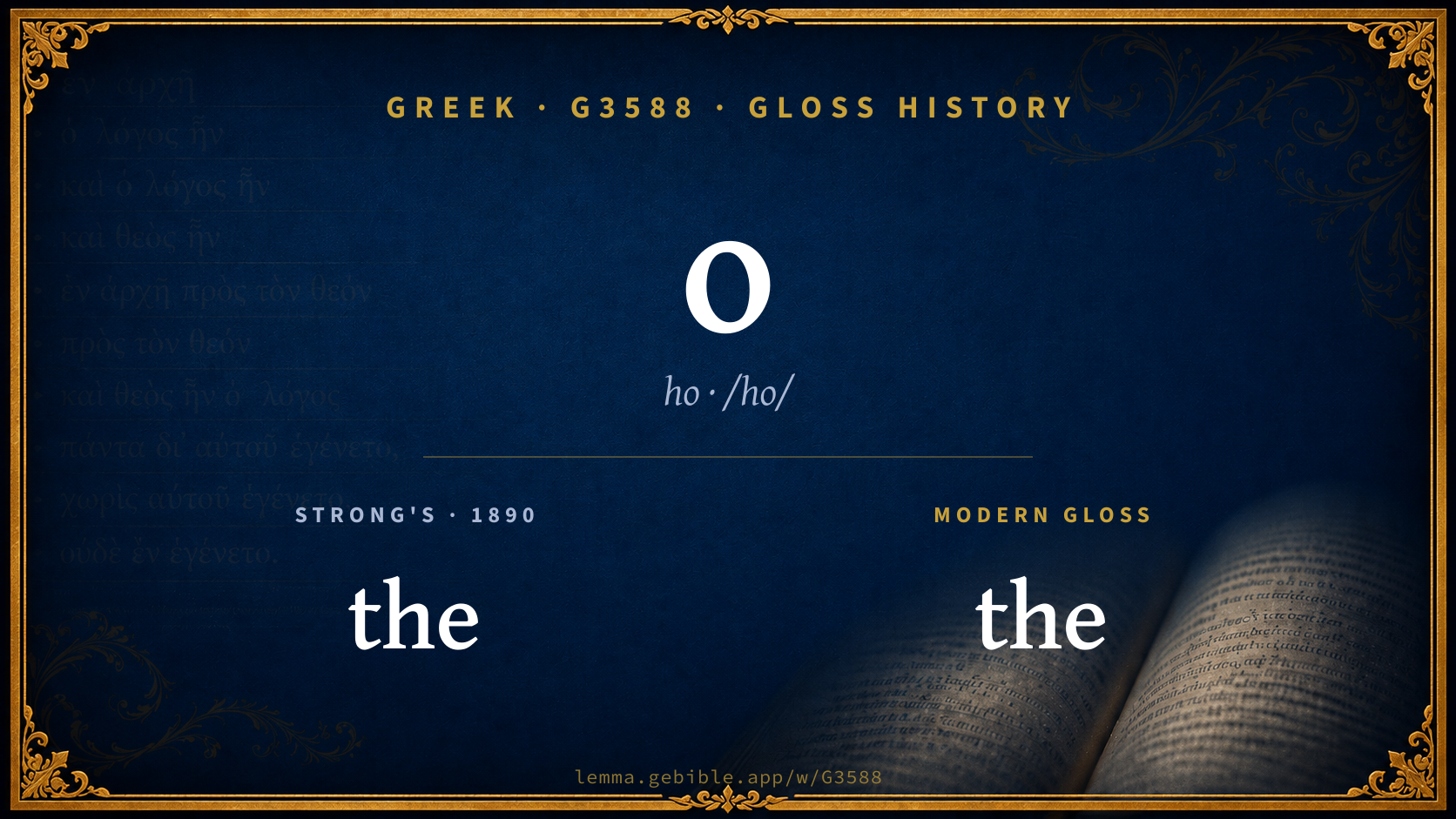
Gloss history
Strong's 1890 vs modern scholarship
About this word
Strong's G3588 catalogs a Greek word from the Greek New Testament.
These counts are not copied from any lexicon or concordance. They are computed here, from the morphology-tagged Greek New Testament. What Lemma adds →
- 6,958
- distinct verses
- The word appears in 6,958 distinct verses.
- 27 / 27
- NT books
- The word appears in 27 of 27 New Testament books.
- #1
- by frequency
- Most frequent Greek word — of 5,347 Greek words by occurrence.
View all 6,958 occurrences in the concordance →
By section of the New Testament
By traditional corpus
Conventional, traditional groupings — biblical authorship is debated, so this is a traditional corpus grouping, not an authorship claim. Some books belong to more than one corpus (Luke is in both the Gospels and the Lukan corpus, and so on), so these shares overlap and need not total 100%. Each figure is a share of the word’s 6,958 distinct verses.
- Gospels 3,366 verses · 48%
- Lukan (Luke–Acts) 1,951 verses · 28%
- Pauline corpus 1,635 verses · 23%
- Johannine 1,309 verses · 19%
- Revelation 386 verses · 6%
- General (Catholic) Epistles 371 verses · 5%
- Hebrews 263 verses · 4%
How translations render this word
Counts come from each version’s own published word-to-Strong’s tagging or interlinear alignment — an approximate guide to how each version renders this word, not a word-level alignment the data otherwise carries. Because each total is that version’s own tagged count, the per-version totals vary from one another and need not match the appearance or distinct-verse counts above. These counts may also differ from a printed concordance because Lemma counts each distinctly tagged rendering and does not collapse phrase taggings into a single head-word total. This is a fixed set of word-tagged versions (KJV, ASV, BSB, ULT) and does not change with the reading translation you choose elsewhere. Each version’s license is shown beside its name below (and on Sources).
- King James Version: Which 391×, Who 79×, Things 12×
- American Standard Version: That 206×, Who 79×, Which 73×
- Berean Standard Bible: The 7,625×, Who 563×, Of 346×
- unfoldingWord Literal Text: The 7,661×, God 966×, One 603×
King James Version Public Domain
Renders G3588 across 542 tagged occurrences — most commonly:
Plus other, less common renderings. Plus 22 renderings that appear only once — usually multi-word phrases or single function words the recovered tagging swept in, not distinct renderings. Not rendered by a distinct English word in 1 further occurrence.
American Standard Version Public Domain
Renders G3588 across 1,005 tagged occurrences — most commonly:
Plus other, less common renderings. Plus 68 renderings that appear only once — usually multi-word phrases or single function words the recovered tagging swept in, not distinct renderings. Not rendered by a distinct English word in 2 further occurrences.
Berean Standard Bible Public Domain
Renders G3588 across 9,912 tagged occurrences — most commonly:
Plus other, less common renderings. Plus 107 renderings that appear only once — usually multi-word phrases or single function words the recovered tagging swept in, not distinct renderings. Not rendered by a distinct English word in 9,622 further occurrences.
unfoldingWord Literal Text CC BY-SA 4.0
Renders G3588 across 20,796 tagged occurrences — most commonly:
Plus other, less common renderings. Plus 1,052 renderings that appear only once — usually multi-word phrases or single function words the recovered tagging swept in, not distinct renderings. Not rendered by a distinct English word in 3 further occurrences.
Senses in Thayer's
The 1 sense Thayer's distinguishes for this word, in lexicon order (not ranked by frequency or importance). The full entry — with sub-senses — is in the Lexicon Entry tab.
- this, that, these, etc.
Word origin
Origin: in all their inflections, the definite article
the masculine feminine (second) and neuter (third) forms in all their inflections; the definite article; the (sometimes to be supplied at others omitted in English idiom): - the this that one he she it etc.
— Strong’s Exhaustive Concordance (1890), public domain.
Forms in the corpus
The 42 distinct written forms G3588 takes in the Greek New Testament, most frequent first — each parse links to that case’s occurrences in the concordance.
Same root — word family
Other Thayer's entries built from the same root as G3588, grouped by Strong’s listed origin. These share a root / origin per the lexicon — not necessarily a shared meaning. Each links to that word’s own entry.
Derived from this word
- τανυν tanŷn G3569 present
- οδε hóde G3592 this
- οιος hoîos G3634 what sort of
- ος hós G3739 who
- ουτος hoûtos G3778 this
- σημερον sḗmeron G4594 this day
- ταυτα tautá G5024 thus
- τηλικουτος tēlikoûtos G5082 of such size
- τοι toí G5104 truly
- τοσουτος tosoûtos G5118 so great
- τοτε tóte G5119 then
- του toû G5120 his
- τουναντιον tounantíon G5121 on the contrary
- τουνομα toúnoma G5122 by name
Proper names from this root
People and places named from this root — a name, not an additional meaning of the word.
- θεος theós G2316 God
- ο ων και ο ην και ο ερχομενος ho ṑn kaí ho ēn kaí ho erchómenos G3801 He who is
Compare all same-root words → Showing 4 of 17 — not the complete family. 2 of the same-root words are proper names (people or places). They share a root, not necessarily a meaning.
Septuagint usage
The same Greek word ο appears 68,018 times in the Greek Old Testament (Septuagint), across 19,787 verses in 38 books.
- 68,018
- LXX occurrences
- Tagged occurrences of this Greek word in the Septuagint.
- 19,787
- verses
- Distinct Septuagint verses containing this word.
- 38 / 39
- OT books
- The word appears in 38 of the 39 Old Testament books.
Sample Septuagint occurrences
- Genesis 1:1 ὁ
- Exodus 1:1 ὁ
- Leviticus 1:1 ὁ
- Numbers 1:1 ὁ
- Deuteronomy 1:1 ὁ
- Joshua 1:1 ὁ
- Judges 1:1 ὁ
- Ruth 1:1 ὁ
- 1 Samuel 1:2 ὁ
- 2 Samuel 1:1 ὁ
- 1 Kings 1:1 ὁ
- 2 Kings 1:1 ὁ
Septuagint occurrences (same lexeme)
Every verse where the same Strong’s number (G3588) appears in the Greek Septuagint — showing the first 50 of 19,787. Verse text shown in the World English Bible for context; the Greek form is the matched word — the English is not keyword-highlighted.
- Genesis 1:1 ὁ In the beginning God created the heavens and the earth.
- Genesis 1:2 ὁ Now the earth was formless and empty. Darkness was on the surface of the deep. God's Spirit was hovering over the surface of the waters.
- Genesis 1:3 ὁ God said, "Let there be light," and there was light.
- Genesis 1:4 ὁ God saw the light, and saw that it was good. God divided the light from the darkness.
- Genesis 1:5 ὁ God called the light Day, and the darkness he called Night. There was evening and there was morning, one day.
- Genesis 1:6 ὁ God said, "Let there be an expanse in the midst of the waters, and let it divide the waters from the waters."
- Genesis 1:7 ὁ God made the expanse, and divided the waters which were under the expanse from the waters which were above the expanse, and it was so.
- Genesis 1:8 ὁ God called the expanse sky. There was evening and there was morning, a second day.
- Genesis 1:9 ὁ God said, "Let the waters under the sky be gathered together to one place, and let the dry land appear," and it was so.
- Genesis 1:10 ὁ God called the dry land Earth, and the gathering together of the waters he called Seas. God saw that it was good.
- Genesis 1:11 ὁ God said, "Let the earth put forth grass, herbs yielding seed, and fruit trees bearing fruit after their kind, with its seed in it, on the earth," and it was so.
- Genesis 1:12 ὁ The earth brought forth grass, herbs yielding seed after their kind, and trees bearing fruit, with its seed in it, after their kind: and God saw that it was good.
- Genesis 1:14 ὁ God said, "Let there be lights in the expanse of sky to divide the day from the night; and let them be for signs, and for seasons, and for days and years;
- Genesis 1:15 ὁ and let them be for lights in the expanse of sky to give light on the earth," and it was so.
- Genesis 1:16 ὁ God made the two great lights: the greater light to rule the day, and the lesser light to rule the night. He also made the stars.
- Genesis 1:17 ὁ God set them in the expanse of sky to give light to the earth,
- Genesis 1:18 ὁ and to rule over the day and over the night, and to divide the light from the darkness. God saw that it was good.
- Genesis 1:20 ὁ God said, "Let the waters swarm with swarms of living creatures, and let birds fly above the earth in the open expanse of sky."
- Genesis 1:21 ὁ God created the large sea creatures, and every living creature that moves, with which the waters swarmed, after their kind, and every winged bird after its kind. God saw that it was good.
- Genesis 1:22 ὁ God blessed them, saying, "Be fruitful, and multiply, and fill the waters in the seas, and let birds multiply on the earth."
- Genesis 1:24 ὁ God said, "Let the earth bring forth living creatures after their kind, cattle, creeping things, and animals of the earth after their kind," and it was so.
- Genesis 1:25 ὁ God made the animals of the earth after their kind, and the cattle after their kind, and everything that creeps on the ground after its kind. God saw that it was good.
- Genesis 1:26 ὁ God said, "Let us make man in our image, after our likeness: and let them have dominion over the fish of the sea, and over the birds of the sky, and over the cattle, and over all the earth, and over every creeping thing that creeps on the earth."
- Genesis 1:27 ὁ God created man in his own image. In God's image he created him; male and female he created them.
- Genesis 1:28 ὁ God blessed them. God said to them, "Be fruitful, multiply, fill the earth, and subdue it. Have dominion over the fish of the sea, over the birds of the sky, and over every living thing that moves on the earth."
- Genesis 1:29 ὁ God said, "Behold, I have given you every herb yielding seed, which is on the surface of all the earth, and every tree, which bears fruit yielding seed. It will be your food.
- Genesis 1:30 ὁ To every animal of the earth, and to every bird of the sky, and to everything that creeps on the earth, in which there is life, I have given every green herb for food." And it was so.
- Genesis 1:31 ὁ God saw everything that he had made, and, behold, it was very good. There was evening and there was morning, the sixth day.
- Genesis 2:1 ὁ The heavens and the earth were finished, and all the host of them.
- Genesis 2:2 ὁ On the seventh day God finished his work which he had made; and he rested on the seventh day from all his work which he had made.
- Genesis 2:3 ὁ God blessed the seventh day, and made it holy, because he rested in it from all his work which he had created and made.
- Genesis 2:4 ὁ This is the history of the generations of the heavens and of the earth when they were created, in the day that Yahweh God made earth and the heavens.
- Genesis 2:5 ὁ No plant of the field was yet in the earth, and no herb of the field had yet sprung up; for Yahweh God had not caused it to rain on the earth. There was not a man to till the ground,
- Genesis 2:6 ὁ but a mist went up from the earth, and watered the whole surface of the ground.
- Genesis 2:7 ὁ Yahweh God formed man from the dust of the ground, and breathed into his nostrils the breath of life; and man became a living soul.
- Genesis 2:8 ὁ Yahweh God planted a garden eastward, in Eden, and there he put the man whom he had formed.
- Genesis 2:9 ὁ Out of the ground Yahweh God made every tree to grow that is pleasant to the sight, and good for food; the tree of life also in the midst of the garden, and the tree of the knowledge of good and evil.
- Genesis 2:10 ὁ A river went out of Eden to water the garden; and from there it was parted, and became four heads.
- Genesis 2:11 ὁ The name of the first is Pishon: this is the one which flows through the whole land of Havilah, where there is gold;
- Genesis 2:12 ὁ and the gold of that land is good. There is aromatic resin and the onyx stone.
- Genesis 2:13 ὁ The name of the second river is Gihon: the same river that flows through the whole land of Cush.
- Genesis 2:14 ὁ The name of the third river is Hiddekel: this is the one which flows in front of Assyria. The fourth river is the Euphrates.
- Genesis 2:15 ὁ Yahweh God took the man, and put him into the garden of Eden to dress it and to keep it.
- Genesis 2:16 ὁ Yahweh God commanded the man, saying, "Of every tree of the garden you may freely eat:
- Genesis 2:17 ὁ but of the tree of the knowledge of good and evil, you shall not eat of it: for in the day that you eat of it you will surely die."
- Genesis 2:18 ὁ Yahweh God said, "It is not good that the man should be alone; I will make him a helper suitable for him."
- Genesis 2:19 ὁ Out of the ground Yahweh God formed every animal of the field, and every bird of the sky, and brought them to the man to see what he would call them. Whatever the man called every living creature, that was its name.
- Genesis 2:20 ὁ The man gave names to all cattle, and to the birds of the sky, and to every animal of the field; but for man there was not found a helper suitable for him.
- Genesis 2:21 ὁ Yahweh God caused a deep sleep to fall on the man, and he slept; and he took one of his ribs, and closed up the flesh in its place.
- Genesis 2:22 ὁ He made the rib, which Yahweh God had taken from the man, into a woman, and brought her to the man.
These are occurrences of the same Greek lexeme (G3588) in the Septuagint — not a translation of any one Hebrew word. The store carries no word-level Hebrew↔Greek alignment, so no Hebrew original is asserted here. Counts come from the recovered LXX Strong's tagging — high-frequency vocabulary is well covered, while rare or late forms may be untagged — so they reflect tagged occurrences and may slightly undercount.