
Genesis 1:25

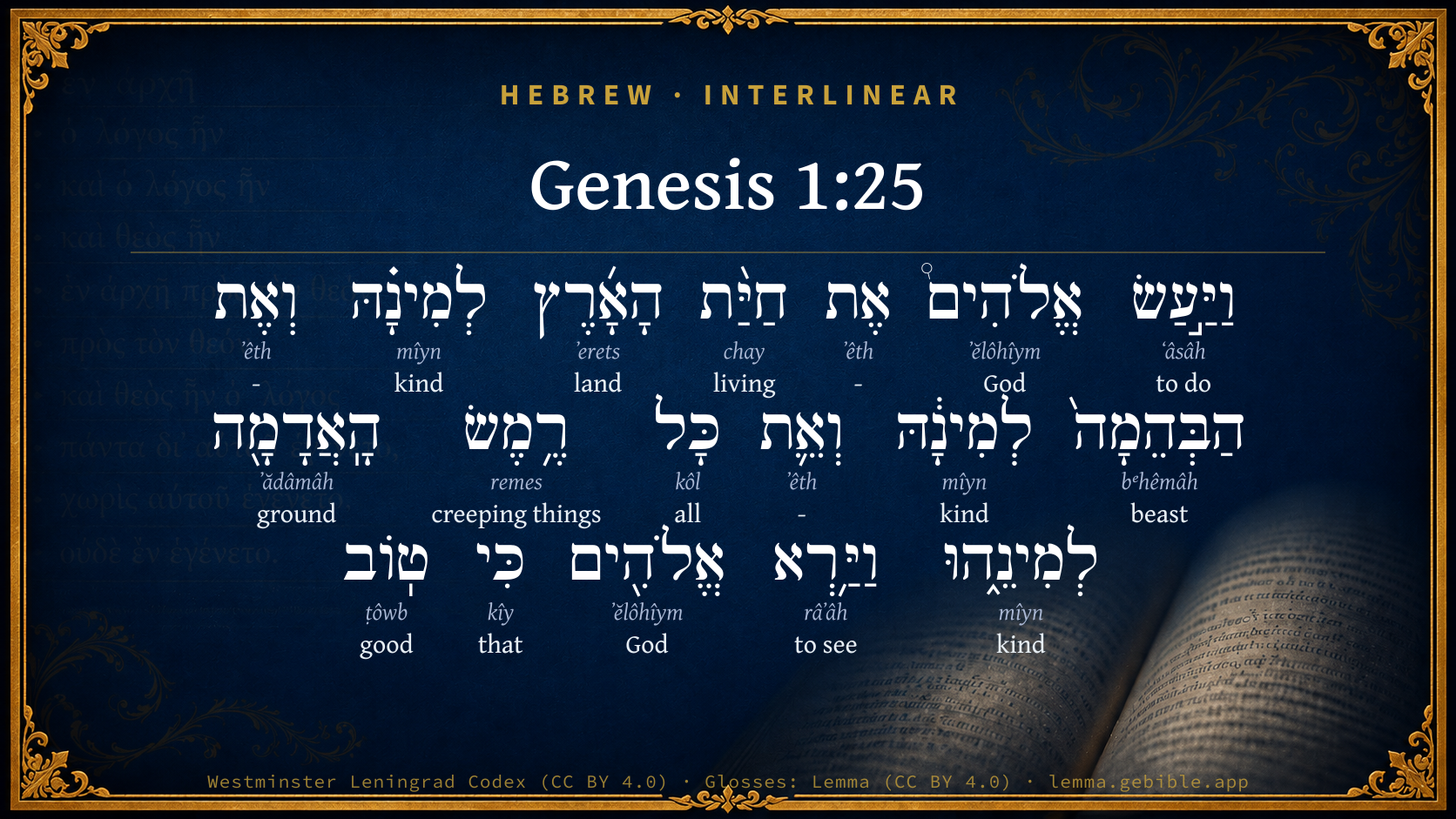
Hebrew (Westminster Leningrad Codex) Genesis 1:25 appears in the Hebrew Old Testament. The text above is from the Westminster Leningrad Codex. Each word links to its Strong’s number, a concise gloss, and parsing drawn from the Open Scriptures Hebrew Bible morphology. Click any word for its full Brown-Driver-Briggs (BDB) entry.
Download image
Cite this verse

Genesis 1:25 (World English Bible). Public Domain. Lemma interlinear Bible study tool, https://lemma.gebible.app/v/genesis/1/25.

Show BibTeX & RIS
BibTeX
RIS
English Translation
God made the animals of the earth after their kind, and the cattle after their kind, and everything that creeps on the ground after its kind. God saw that it was good.
World English Bible · Public Domain
Highlights
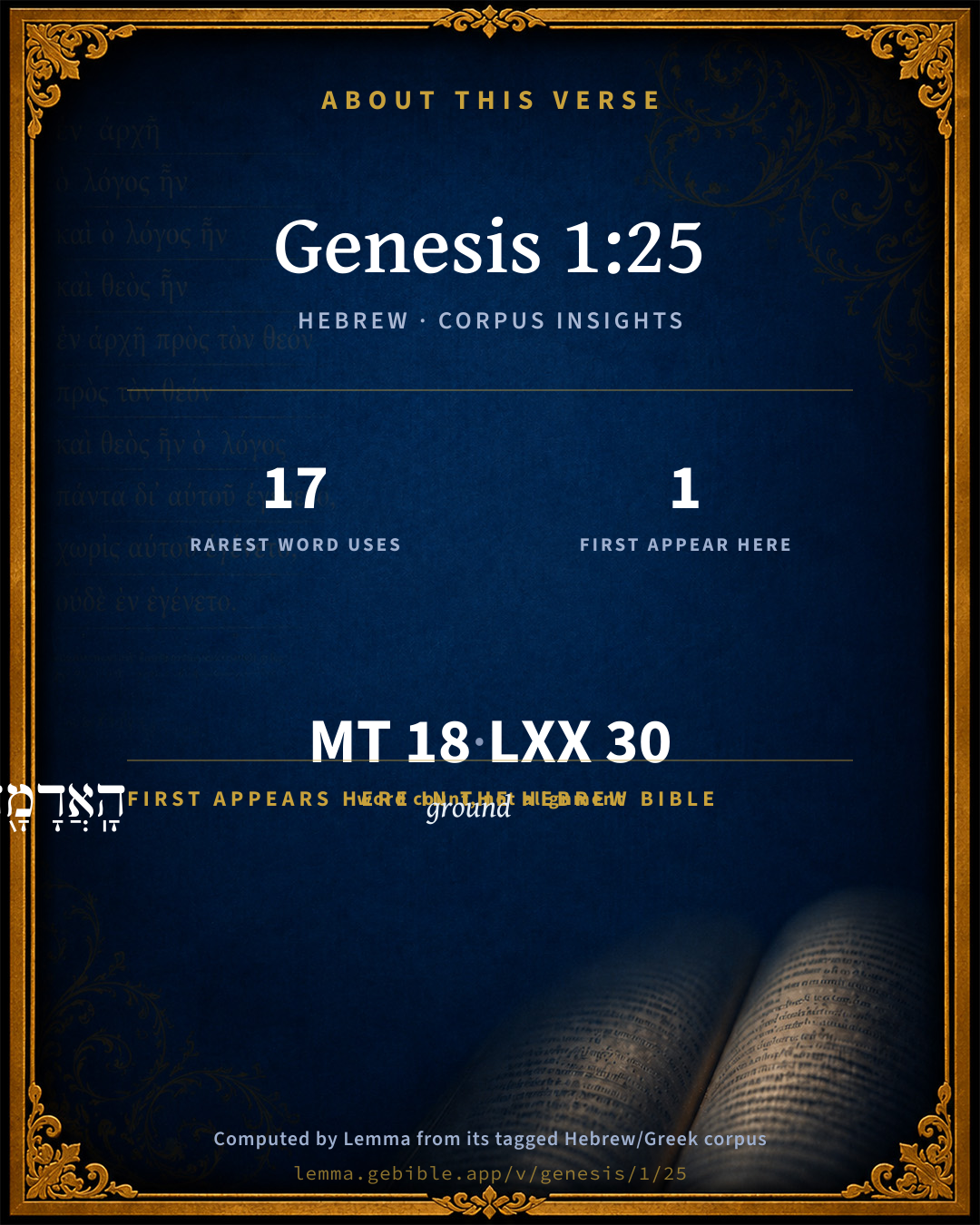
  • 1 first appearance in the Hebrew Bible
Full analysis ↓
Download a study sheet

One document with this verse’s original text, its word-by-word gloss line, the meaning frame, cross-references with their text, attributed commentary, and full source and license credits — printable, and it pastes into notes with its structure intact.

This verse Autodidact and up

Study sheet (.html) Plain text (.txt)

A passage Seminary Student

Up to 50 verses in one chapter. A passage sheet keeps up to 6 commentary sources and 12 cross-references per verse, in the order this page ranks them, and says so on the sheet whenever that leaves anything out. Ask for a single verse and you get the Autodidact verse sheet above.

Everything on this page stays free to read, with no account — the sheet is a download of what is already on screen, not access to it.

Want to remove ads? Support Godless Engineer
Compare translations 3

The same verse in 3 English versions, stacked beneath the original-language interlinear above. Click any original word for its lexicon entry.

Each is an independent rendering of the whole verse — the interlinear is not word-aligned to these translations.

Highlighted words mark where these versions differ — a whole-verse word diff, not a word-by-word alignment.

  • World English Bible Public Domain
    God made the animals of the earth after their kind, and the cattle after their kind, and everything that creeps on the ground after its kind. God saw that it was good.
  • King James Version Public Domain
    And God made the beast of the earth after his kind, and cattle after their kind, and every thing that creepeth upon the earth after his kind: and God saw that it was good.
  • unfoldingWord Literal Text CC BY-SA 4.0
    So God made creature of the earth according to its kind, and the livestock according to its kind, and every crawling creature of the ground according to its kind. And God saw that good.

unfoldingWord Literal Text — © unfoldingWord, licensed CC BY-SA 4.0. Word-aligned USFM3 via Door43 (git.door43.org/unfoldingWord/en_ult).

Versions to compare (up to 4)

3 of 4 selected

Show all 18 translations

Every available English version of this verse, each an independent rendering of the whole verse.

  • World English Bible Public Domain
    God made the animals of the earth after their kind, and the cattle after their kind, and everything that creeps on the ground after its kind. God saw that it was good.
  • Berean Standard Bible Public Domain
    God made the beasts of the earth according to their kinds, the livestock according to their kinds, and everything that crawls upon the earth according to its kind. And God saw that it was good.
  • Majority Standard Bible Public Domain
    God made the beasts of the earth according to their kinds, the livestock according to their kinds, and everything that crawls upon the earth according to its kind. And God saw that it was good.
  • King James Version Public Domain
    And God made the beast of the earth after his kind, and cattle after their kind, and every thing that creepeth upon the earth after his kind: and God saw that it was good.
  • American Standard Version (1901) Public Domain
    And God made the beasts of the earth after their kind, and the cattle after their kind, and everything that creepeth upon the ground after its kind: and God saw that it was good.
  • Revised Version (1885) Public Domain
    And God made the beast of the earth after its kind, and the cattle after their kind, and every thing that creepeth upon the ground after its kind: and God saw that it was good.
  • Geneva Bible (1599) Public Domain
    And God made the beast of the earth according to his kinde, and the cattell according to his kinde, and euery creeping thing of the earth according to his kind: and God saw that it was good.
  • Douay-Rheims (1899) Public Domain
    And God made the beasts of the earth according to their kinds, and cattle, and every thing that creepeth on the earth after its kind. And God saw that it was good.
  • Young's Literal Translation Public Domain
    And God maketh the beast of the earth after its kind, and the cattle after their kind, and every creeping thing of the ground after its kind, and God seeth that `it is' good.
  • Literal Standard Version CC BY-SA 4.0
    And God makes the beast of the earth after its kind, and the livestock after their kind, and every creeping thing of the ground after its kind, and God sees that [it is] good.
  • Unlocked Literal Bible CC BY-SA 4.0
    God made the beasts of the earth after their kind, the livestock after their kinds, and everything that creeps upon the ground after its kind. He saw that it was good.
  • unfoldingWord Literal Text CC BY-SA 4.0
    So God made creature of the earth according to its kind, and the livestock according to its kind, and every crawling creature of the ground according to its kind. And God saw that good.
  • Darby Bible Public Domain
    And God made the beast of the earth after its kind, and the cattle after their kind, and every creeping thing of the ground after its kind. And God saw that it was good.
  • World Messianic Bible Public Domain
    God made the animals of the earth after their kind, and the livestock after their kind, and everything that creeps on the ground after its kind. God saw that it was good.
  • Webster's Bible Public Domain
    And God made the beast of the earth after his kind, and cattle after their kind, and every animal that creepeth upon the earth after his kind: and God saw that it was good.
  • Free Bible Version CC BY-SA 4.0
    God made the wild animals, the livestock, and the creatures that run along the ground, all according to their own kind. God saw that it was good.
  • Bible in Basic English Public Domain
    And God made the beast of the earth after its sort, and the cattle after their sort, and everything moving on the face of the earth after its sort: and God saw that it was good.
  • JPS Tanakh (1917) Public Domain
    And God made the beast of the earth after its kind, and the cattle after their kind, and every thing that creepeth upon the ground after its kind; and God saw that it was good.

Literal Standard Version (2020), Covenant Press — licensed CC BY-SA 4.0. Text via the HelloAO Bible API (eBible.org). Unlocked Literal Bible (unfoldingWord) — licensed CC BY-SA 4.0. Text via the HelloAO Bible API (eBible.org). unfoldingWord Literal Text — © unfoldingWord, licensed CC BY-SA 4.0. Word-aligned USFM3 via Door43 (git.door43.org/unfoldingWord/en_ult). Free Bible Version, Dr. Jonathan Gallagher — licensed CC BY-SA 4.0. Text via the HelloAO Bible API (eBible.org).

Word by word

More ways to search: Search by grammar → Find every occurrence → Compare this word →

Practice this passage: Drill this verse → Learn its vocabulary →

רֶ֥מֶשׂ
remes
H7431
“creeping things of”
Noun, Common, Masculine, Singular, Construct
Part of Speech
Noun
Type
Common
Gender
Masculine
Number
Singular
State
Construct
Full BDB Definition

Origin: from H7430

TWOT: 2177a

creeping things, moving things, creeping organism - creeping things - gliding things (of sea animals) - moving things (of all animals)
  1. וַיַּ֣עַשׂ ʻâsâh H6213 “and · to do” Conjunction + Verb, Qal, Sequential Imperfect, 3rd Person, Masculine, Singular
  2. אֱלֹהִים֩ ʼĕlôhîym H430 “God(s)” Noun, Common, Masculine, Plural, Absolute
  3. אֶת ʼêth H853 “-” Particle, Direct Object
  4. חַיַּ֨ת chay H2416 “living of” Noun, Common, Feminine, Singular, Construct
  5. הָאָ֜רֶץ ʼerets H776 “the · land” Particle, Definite Article + Noun, Common, Both, Singular, Absolute
  6. לְמִינָ֗הּ mîyn H4327 “to/for · kind · her” Preposition + Noun, Common, Masculine, Singular, Construct + Suffix, Personal, 3rd Person, Feminine, Singular
  7. וְאֶת ʼêth H853 “and · -” Conjunction + Particle, Direct Object
  8. הַבְּהֵמָה֙ bᵉhêmâh H929 “the · beast” Particle, Definite Article + Noun, Common, Feminine, Singular, Absolute
  9. לְמִינָ֔הּ mîyn H4327 “to/for · kind · her” Preposition + Noun, Common, Masculine, Singular, Construct + Suffix, Personal, 3rd Person, Feminine, Singular
  10. וְאֵ֛ת ʼêth H853 “and · -” Conjunction + Particle, Direct Object
  11. כָּל kôl H3605 “all of” Noun, Common, Masculine, Singular, Construct
  12. הָֽאֲדָמָ֖ה ʼădâmâh H127 “the · ground” Particle, Definite Article + Noun, Common, Feminine, Singular, Absolute
  13. לְמִינֵ֑הוּ mîyn H4327 “to/for · kind · his” Preposition + Noun, Common, Masculine, Singular, Construct + Suffix, Personal, 3rd Person, Masculine, Singular
  14. וַיַּ֥רְא râʼâh H7200 “and · to see” Conjunction + Verb, Qal, Sequential Imperfect, 3rd Person, Masculine, Singular
  15. אֱלֹהִ֖ים ʼĕlôhîym H430 “God(s)” Noun, Common, Masculine, Plural, Absolute
  16. כִּי kîy H3588 “that” Conjunction
  17. טֽוֹב ṭôwb H2896 “good” Adjective, Adjective, Masculine, Singular, Absolute

About this verse

These counts appear in no published source. They are computed here, from the morphology-tagged text and Lemma’s own curated glosses. What Lemma adds →

18
words
13
distinct lemmas
Pentateuch
section

Notable vocabulary

The rarest word here is רֶ֥מֶשׂ creeping things H7431 — appearing just 17 times in the whole Hebrew Bible.

First appearance in Scripture

This word makes its first canonical appearance in the Hebrew Bible here:

  • הָֽאֲדָמָ֖ה ground H127

Shared distinctive vocabulary

רֶ֥מֶשׂ creeping things H7431 occurs in 17 verses of the Hebrew Bible. Also found in:

Grammatical profile

  • 2 verbs
  • 11 nouns
  • 1 adjective
  • 1 conjunction
  • 3 particles

Verb forms

  • וַיַּ֣עַשׂ Qal · Sequential Imperfect
  • וַיַּ֥רְא Qal · Sequential Imperfect

Repetition

Words recur within this verse — often emphatic in Hebrew:

  • לְמִינָ֗הּ kind H4327 ×3
  • אֱלֹהִים֩ God H430 ×2

Hebrew & Septuagint length

In English translation the verse runs 32 words from the Hebrew and 37 from the Septuagint (LXX English) — closely comparable.

A rough comparison of the two English renderings, which tokenize alike — not a word-level alignment.

Word counts can differ between the Hebrew and the Greek without any difference in meaning — e.g. the Hebrew direct-object marker אֵת has no separate Greek word, and Greek often adds the article ὁ.

In the original languages it is 18 Hebrew tokens and 30 Greek tokens — but the two are counted differently (Hebrew bundles its prefixes and suffixes into one token; the Greek is in lemma form), so that isn’t a like-for-like length.

Cross-references

4

Topical passages linked to Genesis 1:25 in the Treasury of Scripture Knowledge — connected by theme and wording, ordered by reader-vote popularity; previews shown in the World English Bible.

  • Jeremiah 27:5 I have made the earth, the men and the animals that are on the surface of the earth, by my great power and by my outstretched arm; and I give it to whom it seems right to me.
  • Job 12:8–10 Or speak to the earth, and it shall teach you; The fish of the sea shall declare to you.
  • Genesis 2:19–20 Out of the ground Yahweh God formed every animal of the field, and every bird of the sky, and brought them to the man to see what he would call them. Whatever the man called every living creature, that was its name.
  • Job 26:13 By his Spirit the heavens are garnished. His hand has pierced the swift serpent.

Cross-references courtesy of OpenBible.info (CC BY 4.0).

Hebrew and Greek witnesses Masoretic Hebrew ↔ Greek Septuagint

The same verse in the two great witnesses to the Old Testament, shown verse-for-verse.

These are two independent witnesses, not word-aligned to each other, and the Septuagint is shown in lemma (dictionary) form.

Hebrew Genesis 1:25 Masoretic · Westminster Leningrad Codex

וַיַּ֣עַשׂ אֱלֹהִים֩ אֶת חַיַּ֨ת הָאָ֜רֶץ לְמִינָ֗הּ וְאֶת הַבְּהֵמָה֙ לְמִינָ֔הּ וְאֵ֛ת כָּל רֶ֥מֶשׂ הָֽאֲדָמָ֖ה לְמִינֵ֑הוּ וַיַּ֥רְא אֱלֹהִ֖ים כִּי טֽוֹב

God made the animals of the earth after their kind, and the cattle after their kind, and everything that creeps on the ground after its kind. God saw that it was good.

World English Bible · Public Domain

Greek LXX Genesis 1:25 Septuagint · lemma form

καί ποιέω ὁ θεός ὁ θηρίον ὁ γῆ κατά γένος καί ὁ κτῆνος κατά γένος καί πᾶς ὁ ἑρπετόν ὁ γῆ κατά γένος αὐτός καί ὁράω ὁ θεός ὅτι καλός

And God made the wild beasts of the earth according to their kind, and cattle according to their kind, and all the reptiles of the earth according to their kind, and God saw that they were good.

LXX2012 (modern English Septuagint) · Public Domain

Hebrew: Westminster Leningrad Codex (CC BY 4.0). Greek: Septuagint (public domain); English from LXX2012 (modern English Septuagint) (Public Domain). How the Septuagint differs from the Hebrew →

Targum (Aramaic paraphrase)

2

The Targum is the ancient Jewish Aramaic paraphrase of the Hebrew Scriptures — an interpretive translation, not the Hebrew text itself. Onkelos (literal) and Pseudo-Jonathan (expansive) render the Torah, and Jonathan the Prophets. Coverage is partial: where no permissively-licensed English translation exists for a verse, only the Aramaic is shown. This is verse-level text, not a word-by-word alignment to the Hebrew.

  1. Targum Onkelos Torah (Genesis–Deuteronomy)
    וַעֲבַד יְיָ יָת חֵוַת אַרְעָא לִזְנַהּ וְיָת בְּעִירָא לִזְנַהּ וְיָת כָּל רִחֲשָׁא דְאַרְעָא לִזְנוֹהִי וַחֲזָא יְיָ אֲרֵי טָב

    (no public-domain English translation for this verse)

    Targum Onkelos — Aramaic: “Onkelos Genesis” (public domain); “Onkelos Exodus” (public domain); “Onkelos Leviticus” (public domain); “Onkelos Numbers” (public domain); “Onkelos Deuteronomy” (public domain). English: “Sefaria Community Translation” (CC0 1.0 (public-domain dedication)); “J.W. Etheridge. The Targums of Onkelos and Jonathan Ben Uzziel on the Pentateuch. London: Longmans, Green, 1862” (public domain). Text via Sefaria.

  2. Targum Pseudo-Jonathan Torah (Genesis–Deuteronomy)
    וַעַבַד יְיָ יַת חֵיוַת אַרְעָא לִזְנָהּ זְנֵי דַכְיָין וּזְנֵי דְלָא דַכְיָין וְיַת בְּעִירָא לִזְנָהּ וְיַת כָּל רִחִיש אַרְעָא לִזְנָהּ זְנֵי דַכְיָין וּזְנֵי דְלָא דַכְיָין וַחֲמָא יְיָ אֲרוּם טַב

    And the Lord made the beast of the earth after his kind, the clean and the unclean, and cattle after their kind, and every reptile of the earth after its kind, the clean and the unclean. And the Lord saw that it was good.

    Targum Pseudo-Jonathan — Aramaic: “Targum Jonathan on Genesis” (public domain); “Targum Jonathan on Exodus” (public domain); “Targum Jonathan on Leviticus” (public domain); “Targum Jonathan on Numbers” (public domain); “Targum Jonathan on Deuteronomy” (public domain). English: “The Targum of Jonathan ben Uzziel, trans. J. W. Etheridge, London, 1862” (public domain). Text via Sefaria.

Commentary

Notes on Genesis 1:25 from classic Christian and Jewish commentators (each source and its license shown beneath its notes). The classic Christian expositions comment on the surrounding passage and are grouped to its opening verse, so a note may address several verses; the Jewish commentaries on the Tanakh (Rashi and others) are per-verse, so they appear only where the commentator wrote on this verse.

Lemma curates 59 commentaries, every one of them public domain or Creative Commons licensed, each selected and text-cleaned for this edition rather than reprinted as found. About our sources →

Trapp's Complete Commentary

John Trapp

Gen 1:25 And God made the beast of the earth after his kind, and cattle after their kind, and every thing that creepeth upon the earth after his kind: and God saw that [it was] good.

Ver. 25. And all creeping things of the earth.] God assigns the parts of the people as of the gnat, saith an ancient. {Disponit Deus membra publicis et culicis.} And the wisdom of men and angels, saith a modern writer, cannot mend the least thing in a fly. The figure, colour, quality, quantity of every worm, and every flower, with what exactness is it ordered! as if God nod nothing else to do, but to bring forth such a creature into the world, as the product of his infinite wisdom. The devil, with all his skill, could not create a louse. {Exo 8:18} Myrmecides spent more time to make an artificial bee, than some do to build a house. Pliny {a} makes mention of one who had spent sixty-eight years in searching out the nature of the bee, and yet had not fully found it out. God is the greatest in the smallest matters. {Deus est maximus in mininis.} Holy Mr Dod, being at Holmeby, and invited by an honourable person to see that once stately house, desired to be excused, and to sit still, looking on a flower which he had in his hand. "In this flower," saith he, "I can see more of God than in all the beautiful buildings in the world." {b}

{a} Plin. l. xi. c. 9.

{b} Full. Chur. Hist. p. 210.

John Trapp, A Commentary or Exposition upon All the Books of the Old and New Testament (1647–1656) — public domain. Text from a community e-Sword module.

Adam Clarke's Commentary

Verse 25. And God made the beast of the earth after his kind, &c.] Every thing both in the animal and vegetable world was made so according to its kind, both in genus and species, as to produce its own kind through endless generations. Thus the several races of animals and plants have been kept distinct from the foundation of the world to the present day. This is a proof that all future generations of plants and animals have been seminally included in those which God formed in the beginning.

Adam Clarke's Commentary on the Bible (1810–1826) — public domain. Text from a community e-Sword/MySword module.

The Cambridge Bible for Schools and Colleges

gen. ed. J. J. S. Perowne

25. And God made] Notice the word “made,” Lat. fecit, not “created”; cf. Gen_1:7; Gen_1:16.

and God saw that it was good] It is noticeable that the blessing, which followed these words after the creation of the water animals and the birds (Gen_1:22), is here omitted. Either the blessing was allowed to drop out, in order that the description of the sixth day might not become too long in comparison with that of the previous five days; or the blessing so fully pronounced upon man in Gen_1:28-30 may be considered to embrace also the living creatures created on the same sixth day.

The Cambridge Bible for Schools and Colleges (gen. ed. J. J. S. Perowne; Cambridge University Press, 1878–1918) — public domain. Text from a community e-Sword module.

John Gill's Exposition

And God made the beast of the earth after his kind,.... The wild beasts, and the several sorts of them; beginning the account with the last mentioned, as is frequent in the Hebrew language, and so he made all the rest:

and cattle after their kind, and everything that creepeth upon the earth after his kind; tame creatures, and all the reptiles of the earth: this most clearly shows and proves that the above creatures were not produced by the mere force of nature, or the powers the earth were possessed of, however the matter of it might be disposed and prepared, but by the omnipotent hand of God:

and God saw that it was good; that every creature he had made would some way or other be for his glory, and for the benefit of man. Picherellus thinks that all this belongs to the work of the fifth day, not the sixth; because as the vegetables, herbs, and trees were produced on the same day, the third day; so animals, whether in the waters, air, or earth, were made on one and the same day; and that it was proper a separate day should be allotted for the formation of rational creatures, Adam and Eve, and that it might appear that the same blessing was not conferred on brutes as on reasonable beings; and therefore the words with which Gen 1:24 begins should be rendered, "but after God had said, let the earth", &c. that is, after God had ordered this, and it was done, then "the evening and the morning were the fifth day"; which is what rhetoricians call an "hysteron proteron".

John Gill's Exposition of the Whole Bible (1746–1763) — public domain (CC PDM 1.0). Text via the HelloAO Bible API.

The Pulpit Commentary

And God made (asah, not beta, the principle of life being not now introduced for the first time, as in ver. 21) the beast of the earth (the chayyah) after his kind, and cattle (behemah ) after their kind, and every thing that creepeth on the earth (literally, every reraes of the ground) after his kind. The order of creation (ver. 25) differs from that in which they were summoned into existence (ver. 24). The latter may be the order of time, the former the order of rank; or there may have been two divisions of the work, in the former of which the herbivora took the lead, and in the latter the carnivora. According to the witness of geology, "the quadrupeds did not all come forth together. Large and powerful herbivore first take the field, with only a few carnivora. These pass away. Other herbivora, with a larger proportion of carnivora, next appear. These also are exterminated, and so with others. Then the carnivora appear in vast numbers and power, and the herbivore also abound. Moreover, these races attain a magnitude and number far surpassing all that now exist. As the mammalian age draws to a close, the ancient carnivora and herbivora of that era all pass away, excepting, it is believed, a few that are useful to man. New creations of smaller size people the groves" (Dana. Quoted by Dawson, "O.W." p. 224). And God saw that it was good. As in the third day"s work each branch is sealed by the Divine approbation, so in this. The creation of the higher animals completed the earth"s preparation for the advent of man; to which, doubtless, the Creator"s commendation of his finished work had a special reference. Everything was in readiness for the magnum opus which was to close his creative labor and crown his completed cosmos.

The Pulpit Commentary (1880–1919), ed. H.D.M. Spence-Jones & Joseph S. Exell — public domain. Text from a community e-Sword module.

Rashi

Rabbi Shlomo Yitzchaki (Rashi)

ויעש AND HE MADE — He formed them with their full volition and in their full stature (Chullin 60a).

Rashi on the Tanakh — English translations: “The Judaica Press complete Tanach with Rashi, translated by A. J. Rosenberg” (CC BY 4.0); “Pentateuch with Rashi's commentary by M. Rosenbaum and A.M. Silbermann, 1929-1934” (public domain); “The Metsudah Tanach series, Lakewood, N.J” (CC BY 4.0); and “The Book of Joshua, Metsudah Publications, 1997” (CC BY 4.0). Text via Sefaria.

Radak

Rabbi David Kimhi (Radak)

ויעש אלוקים, the reason why the Torah reports G’d as ויעש, completing something after having already written ויהי כן signaling that G’d’s directives had been carried out, is that G’d’s directive consisted of 3 parts in addition to the directive to create man, i.e. domestic mammals, free-roaming mammals and creeping creatures. G’d constructed each category in such a way that they would make their habitat on different parts of the earth. This has been emphasised by the words למינה, למחנה, למינהו, being inserted between the names of each category of creatures. G’d did all this in order that one category of creature should not inflict harm, damage on its counterpart by interfering with the other’s lifestyle in its respective domain. This is also the reason why He did not bless them. How could G’d have blessed them with the formula: “be fruitful and multiply and fill the earth,” seeing that He did not want that the harmful creatures amongst them would multiply in such a fashion? Some of these animals’ very grazing on the earth would be a form of causing irreparable harm on the surface of the earth. Our sages (Rashi on verse 22) claim that the reason G’d did not extend His blessing to these beasts was on account of the serpent which became a destructive force.

הבהמה, these are the animals which live in close proximity to man, are used by him on a daily basis. This includes, cattle, sheep, goats, horses donkeys and camels.

חית הארץ, this includes “wild” beasts such as lions, tigers, bears, wolves, etc., beasts which are predators. G’d arranged for the nature of these beasts to be such that they do not choose urban areas as their natural habitat. If they would tend to make their habitat on earth indiscriminate instead of confining themselves to virgin regions, they would lay the earth waste, and would take over by multiplying themselves while devouring weaker species. (compare Exodus 23,29) you will find that anywhere in Scripture where mention is made of the destruction of man’s habitat, that the wild beasts took over the regions formerly inhabited by man. (Leviticus 26,22)

ורמש האדמה, this also refers to specific locations in certain deserts, as mentioned by Moses in Deut. 8,15, when he mentioned the presence of such lethal snakes, etc., in certain areas in the desert. Other creeping creatures are found on a regular basis also in the regions inhabited by man, and those do not pose a threat to man. The expression רמש, refers to a type of motion. Note how G’d in His wisdom arranged all this. The worms which appear to spontaneously develop from decaying vegetable or animal matter have not been mentioned at all in connection with G’d’s creative activities, even though they possess the ability to move.

וירא אלוקים כי טוב, even though among these newly created creatures there are those which function as predators, and otherwise harmful beings, they still are also useful in many respects as has been proven by a number of scientists who are able to use the stings of wasps, etc., to help extract poisonous venom from human tissue and neutralise it. G’d provided each of the species with limbs or organs suitable to their individual lifestyle. The lion and other predators are equipped with special teeth and claws in order to facilitate their attacks on more peaceful creatures who serve as their food. At the same time, gazelles, deer, etc., which are primary targets of these ferocious beasts have been given musculature to enable them to escape from the clutches of such predators by their superior speed. Each species has been equipped with means to help it to ensure its survival in a hostile environment. This is proved by the fact that these species have not become extinct over thousands of years. Although, basically the animal kingdom can be divided into the aggressors and the victims, G’d has provided nourishment for both types of species. Each type of animal enjoys the food G’d has provided for them in nature. At the same time, each will have to die in due course. The predators will meet death either at the hands of hunters or other stronger predators, or through natural disasters depriving them of their means of survival. Job 4,11 “the lion perishes for lack of prey,” already attests to this phenomenon, as does Amos 3,4 in which the prophet describes that when these beasts succeed in killing their prey they call out in triumph. The prophet Nachum (2,13), as well as many other verses in the Bible testify to the fact that even these ferocious beasts are frequently neutralised by natural disasters. Still, the fact is that none of these predators are genetically unable to subsist on a vegetarian diet, else, at the time when G’d created them and there were only herbs to feed on, they would have perished before being able to even reproduce themselves. If, at that time, the lion had already fed on sheep, one of G’d’s species would have been eliminated from earth, contrary to G’d’s design. He had not created them in order for them to become extinct. It is quite clear from verse 30 in our chapter that originally, G’d had assigned the herbs as food for all חיות, free-roaming animals.

Radak on the Tanakh — English translations: “Sefaria Community Translation” (CC0 1.0 (public-domain dedication)); “Eliyahu Munk, HaChut Hameshulash” (CC BY 4.0); “Rabbi Mike Feuer, Jerusalem Anthology” (CC BY 4.0); and “R. David Kimhi on the first book of Psalms, Translated by R.G. Finch, London, 1919” (public domain). Text via Sefaria.

Lesson kit

Teaching starters — assembled from the data on this page, not authored interpretation. Every prompt links to the verse data it draws on. Edit before teaching.

Genesis, in the Pentateuch, opens this verse with 18 words (13 distinct Hebrew lemmas). Its most distinctive word is remes (“creeping things”). A historical commentator’s framing appears above. Read the whole chapter for the surrounding context.

Discussion questions

  1. The word remes carries the sense “creeping things.” How does it shape the verse?
  2. The word “ground” first appears here in Scripture. What is being introduced at this debut?
  3. Genesis 1:24 shares the word «creeping things» with this verse. How do the two illuminate each other?
  4. “kind” occurs 3× in this one verse. What is the effect of the repetition?
  5. These translations render this verse differently; the difference is in the English rendering, not the original. What questions does that raise?
  6. The verb «וַיַּ֣עַשׂ» is Qal Sequential Imperfect. How does its form color the action?
  7. Reading how Trapp's Complete Commentary and Adam Clarke's Commentary read this verse, where do the two commentators agree and where do they part?

Things to notice

Reading settings

Reading text

Shown beneath each verse's original-language words.

Old Testament
Old Testament edition

Read the OT as the Masoretic Hebrew (MT) or the Greek Septuagint (LXX).

English shown for the Greek Septuagint (in the Hebrew ↔ Greek comparison).

Comparing translations? Open the Compare panel on any verse page to stack up to four side by side.