
John 3:36

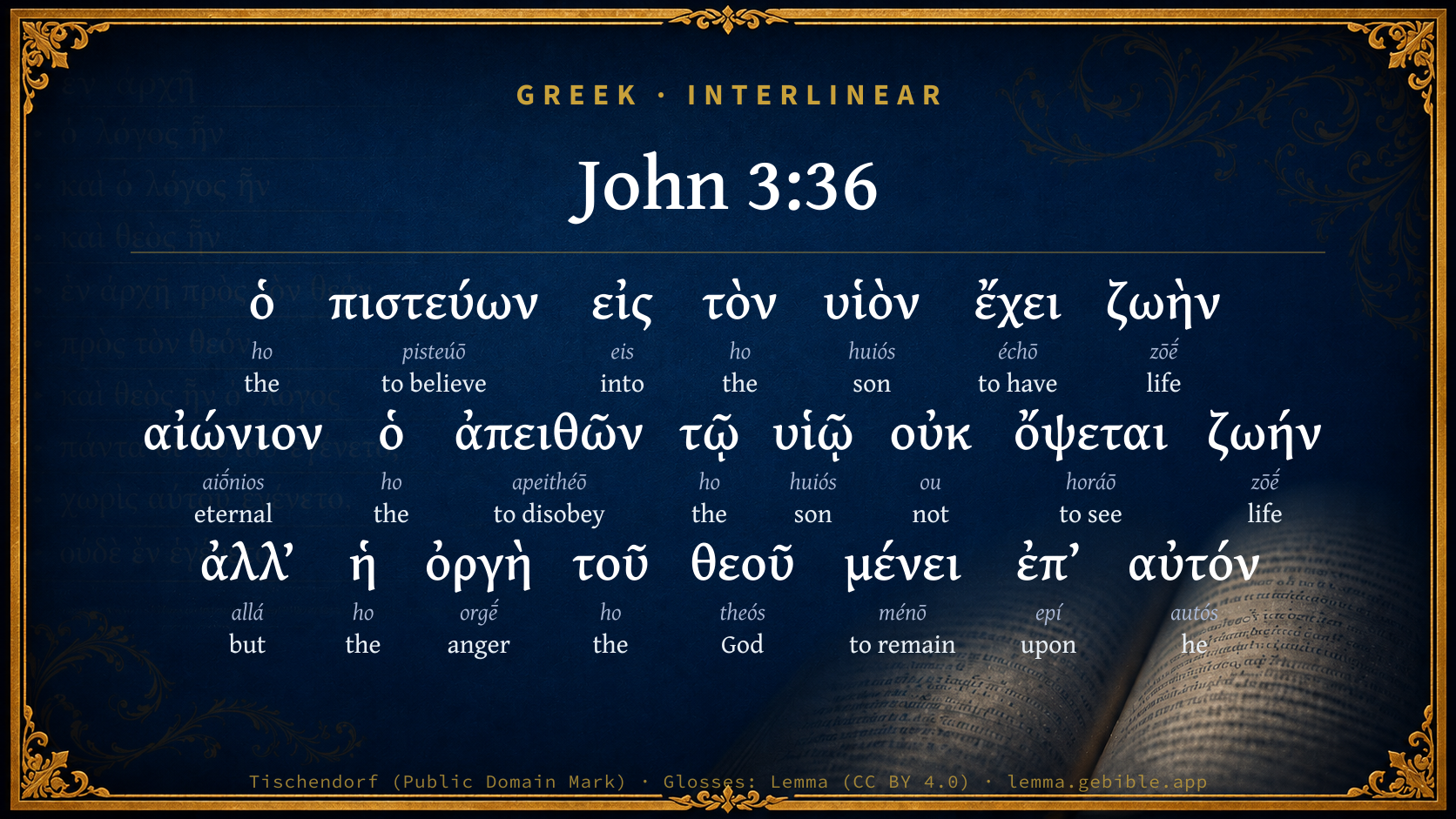
Greek (Tischendorf 8th ed.) John 3:36 appears in the Greek New Testament. The text above is from the Tischendorf 8th edition. Each word links to its Strong’s number and a concise gloss. Click any word for its full Thayer’s Greek Lexicon entry.
Download image
Cite this verse

John 3:36 (World English Bible). Public Domain. Lemma interlinear Bible study tool, https://lemma.gebible.app/v/john/3/36.

Show BibTeX & RIS
BibTeX
RIS
English Translation
One who believes in the Son has eternal life, but one who disobeys the Son won't see life, but the wrath of God remains on him."
World English Bible · Public Domain
Highlights
  • 1 first appearance in the Greek New Testament
Full analysis ↓
Download a study sheet

One document with this verse’s original text, its word-by-word gloss line, the meaning frame, cross-references with their text, attributed commentary, and full source and license credits — printable, and it pastes into notes with its structure intact.

This verse Autodidact and up

Study sheet (.html) Plain text (.txt)

A passage Seminary Student

Up to 50 verses in one chapter. A passage sheet keeps up to 6 commentary sources and 12 cross-references per verse, in the order this page ranks them, and says so on the sheet whenever that leaves anything out. Ask for a single verse and you get the Autodidact verse sheet above.

Everything on this page stays free to read, with no account — the sheet is a download of what is already on screen, not access to it.

Want to remove ads? Support Godless Engineer
Compare translations 3

The same verse in 3 English versions, stacked beneath the original-language interlinear above. Click any original word for its lexicon entry.

Each is an independent rendering of the whole verse — the interlinear is not word-aligned to these translations.

Highlighted words mark where these versions differ — a whole-verse word diff, not a word-by-word alignment.

  • World English Bible Public Domain
    One who believes in the Son has eternal life, but one who disobeys the Son won't see life, but the wrath of God remains on him."
  • King James Version Public Domain
    He that believeth on the Son hath everlasting life: and he that believeth not the Son shall not see life; but the wrath of God abideth on him.
  • unfoldingWord Literal Text CC BY-SA 4.0
    The one believing in the Son has eternal life, but the one disobeying the Son will not see life, but the wrath of God remains on him.”

unfoldingWord Literal Text — © unfoldingWord, licensed CC BY-SA 4.0. Word-aligned USFM3 via Door43 (git.door43.org/unfoldingWord/en_ult).

Versions to compare (up to 4)

3 of 4 selected

Show all 19 translations

Every available English version of this verse, each an independent rendering of the whole verse.

  • World English Bible Public Domain
    One who believes in the Son has eternal life, but one who disobeys the Son won't see life, but the wrath of God remains on him."
  • Berean Standard Bible Public Domain
    Whoever believes in the Son has eternal life. Whoever rejects the Son will not see life. Instead, the wrath of God remains on him.”
  • Majority Standard Bible Public Domain
    Whoever believes in the Son has eternal life. Whoever rejects the Son will not see life. Instead, the wrath of God remains on him.”
  • King James Version Public Domain
    He that believeth on the Son hath everlasting life: and he that believeth not the Son shall not see life; but the wrath of God abideth on him.
  • American Standard Version (1901) Public Domain
    He that believeth on the Son hath eternal life; but he that obeyeth not the Son shall not see life, but the wrath of God abideth on him.
  • Revised Version (1885) Public Domain
    He that believeth on the Son hath eternal life; but he that obeyeth not the Son shall not see life, but the wrath of God abideth on him.
  • Geneva Bible (1599) Public Domain
    Hee that beleeueth in the Sonne, hath euerlasting life, and hee that obeyeth not the Sonne, shall not see life, but the wrath of God abideth on him.
  • Douay-Rheims (1899) Public Domain
    He that believeth in the Son, hath life everlasting; but he that believeth not the Son, shall not see life; but the wrath of God abideth on him.
  • Young's Literal Translation Public Domain
    he who is believing in the Son, hath life age-during; and he who is not believing the Son, shall not see life, but the wrath of God doth remain upon him.'
  • Literal Standard Version CC BY-SA 4.0
    he who is believing in the Son has continuous life; and he who is not believing the Son will not see life, but the wrath of God remains on him.”
  • Unlocked Literal Bible CC BY-SA 4.0
    He who believes in the Son has eternal life, but the one who disobeys the Son will not see life, but the wrath of God stays on him.”
  • unfoldingWord Literal Text CC BY-SA 4.0
    The one believing in the Son has eternal life, but the one disobeying the Son will not see life, but the wrath of God remains on him.”
  • Darby Bible Public Domain
    He that believes on the Son has life eternal, and he that is not subject to the Son shall not see life, but the wrath of God abides upon him.
  • World Messianic Bible Public Domain
    One who believes in the Son has eternal life, but one who disobeys the Son won’t see life, but the wrath of God remains on him.”
  • Webster's Bible Public Domain
    He that believeth on the Son, hath everlasting life: and he that believeth not the Son, shall not see life; but the wrath of God abideth on him.
  • Free Bible Version CC BY-SA 4.0
    Anyone who trusts in the Son has eternal life, but anyone who refuses to trust the Son will not experience eternal life but remains under God's condemnation.
  • Bible in Basic English Public Domain
    He who has faith in the Son has eternal life; but he who has not faith in the Son will not see life; God's wrath is resting on him.
  • Text-Critical English NT CC BY 4.0
    Whoever believes in the Son has eternal life, but whoever disobeys the Son will not see life; rather, the wrath of God remains upon him.
  • Tyndale New Testament (1534) Public Domain
    He that beleveth on the sonne hath everlastynge lyfe: and he that beleveth not the sonne shall not se lyfe but the wrathe of God abydeth on him.

Literal Standard Version (2020), Covenant Press — licensed CC BY-SA 4.0. Text via the HelloAO Bible API (eBible.org). Unlocked Literal Bible (unfoldingWord) — licensed CC BY-SA 4.0. Text via the HelloAO Bible API (eBible.org). unfoldingWord Literal Text — © unfoldingWord, licensed CC BY-SA 4.0. Word-aligned USFM3 via Door43 (git.door43.org/unfoldingWord/en_ult). Free Bible Version, Dr. Jonathan Gallagher — licensed CC BY-SA 4.0. Text via the HelloAO Bible API (eBible.org).

Word by word

More ways to search: Search by grammar → Find every occurrence → Compare this word →

Practice this passage: Drill this verse → Learn its vocabulary →

ἀπειθῶν
apeithéō
G544
“to disobey”
Verb, Present, Active, Participle, Nominative, Singular, Masculine
Part of Speech
Verb
Tense
Present
Voice
Active
Mood
Participle
Case
Nominative
Number
Singular
Gender
Masculine
Full Thayer's Definition

Origin: from G545

TDNT: 06:10,8

1. not to allow one's self to be persuaded a. to refuse or withhold belief b. to refuse belief and obedience 2. not to comply with
  1. ὁ ho G3588 “the” Article, Nominative, Singular, Masculine
  2. πιστεύων pisteúō G4100 “to believe” Verb, Present, Active, Participle, Nominative, Singular, Masculine
  3. εἰς eis G1519 “into” Preposition
  4. τὸν ho G3588 “the” Article, Accusative, Singular, Masculine
  5. υἱὸν huiós G5207 “son” Noun, Accusative, Singular, Masculine
  6. ἔχει échō G2192 “to have” Verb, Present, Active, Indicative, 3rd person, Singular
  7. ζωὴν zōḗ G2222 “life” Noun, Accusative, Singular, Feminine
  8. αἰώνιον aiṓnios G166 “eternal” Adjective, Accusative, Singular, Feminine
  9. ὁ ho G3588 “the” Article, Nominative, Singular, Masculine
  10. τῷ ho G3588 “the” Article, Dative, Singular, Masculine
  11. υἱῷ huiós G5207 “son” Noun, Dative, Singular, Masculine
  12. οὐκ ou G3756 “not” Particle, Negative
  13. ὄψεται horáō G3708 “to see” Verb, Future, Middle deponent, Indicative, 3rd person, Singular
  14. ζωήν zōḗ G2222 “life” Noun, Accusative, Singular, Feminine
  15. ἀλλ’ allá G235 “but” Conjunction
  16. ἡ ho G3588 “the” Article, Nominative, Singular, Feminine
  17. ὀργὴ orgḗ G3709 “anger” Noun, Nominative, Singular, Feminine
  18. τοῦ ho G3588 “the” Article, Genitive, Singular, Masculine
  19. θεοῦ theós G2316 “God” Noun, Genitive, Singular, Masculine
  20. μένει ménō G3306 “to remain” Verb, Present, Active, Indicative, 3rd person, Singular
  21. ἐπ’ epí G1909 “upon” Preposition
  22. αὐτόν autós G846 “he” Personal pronoun, Accusative, Singular, Masculine

About this verse

These counts appear in no published source. They are computed here, from the morphology-tagged text and Lemma’s own curated glosses. What Lemma adds →

23
words
16
distinct lemmas
Gospels
section

Notable vocabulary

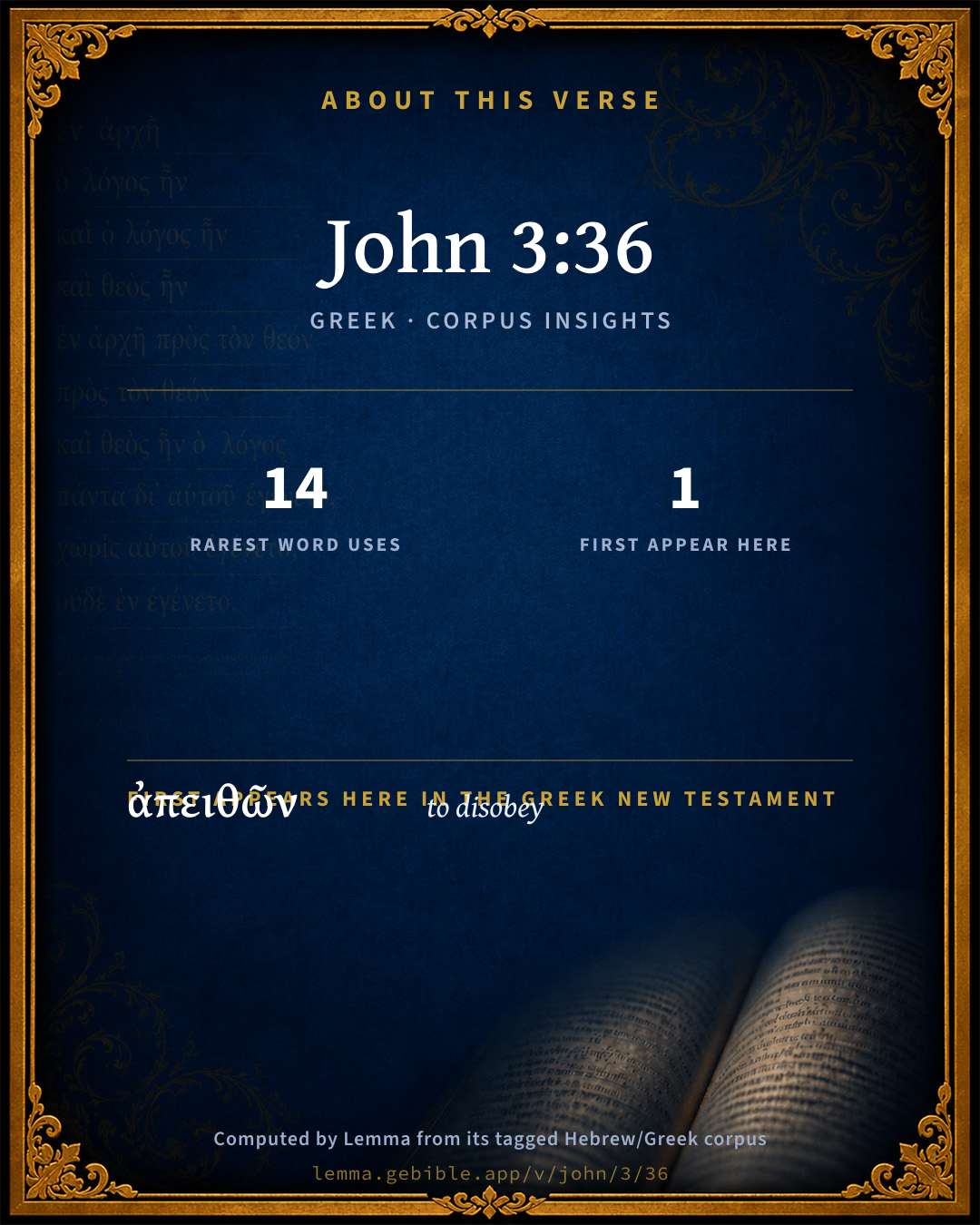
The rarest word here is ἀπειθῶν to disobey G544 — appearing just 14 times in the whole Greek New Testament.

First appearance in Scripture

This word makes its first canonical appearance in the Greek New Testament here:

  • ἀπειθῶν to disobey G544

Shared distinctive vocabulary

ἀπειθῶν to disobey G544 occurs in 14 verses of the Greek New Testament. Also found in:
Repetition

Words recur within this verse:

Cross-references

31

Topical passages linked to John 3:36 in the Treasury of Scripture Knowledge — connected by theme and wording, ordered by reader-vote popularity; previews shown in the World English Bible.

  • John 5:24 "Most assuredly I tell you, he who hears my word, and believes him who sent me, has eternal life, and doesn't come into judgment, but has passed out of death into life.
  • John 1:12 But as many as received him, to them he gave the right to become God's children, to those who believe in his name:
  • 1 Thessalonians 5:9 For God didn't appoint us to wrath, but to the obtaining of salvation through our Lord Jesus Christ,
  • Ephesians 5:6 Let no one deceive you with empty words. For because of these things, the wrath of God comes on the children of disobedience.
  • John 3:15–16 that whoever believes in him should not perish, but have eternal life.
  • 1 John 5:10–13 He who believes in the Son of God has the testimony in himself. He who doesn't believe God has made him a liar, because he has not believed in the testimony that God has given concerning his Son.
  • Romans 1:17–18 For in it is revealed God's righteousness from faith to faith. As it is written, "But the righteous shall live by faith."
  • Romans 5:9 Much more then, being now justified by his blood, we will be saved from God's wrath through him.
  • John 8:51 Most assuredly, I tell you, if a person keeps my word, he will never see death."
  • John 3:3 Jesus answered him, "Most assuredly, I tell you, unless one is born anew, he can't see the Kingdom of God."
  • John 10:28 I give eternal life to them. They will never perish, and no one will snatch them out of my hand.
  • John 6:47–54 Most assuredly, I tell you, he who believes in me has eternal life.
  • 1 Thessalonians 1:10 and to wait for his Son from heaven, whom he raised from the dead-- Jesus, who delivers us from the wrath to come.
  • 1 John 3:14–15 We know that we have passed out of death into life, because we love the brothers. He who doesn't love his brother remains in death.
  • Revelation 21:8 But for the cowardly, unbelieving, sinners, abominable, murderers, sexually immoral, sorcerers, idolaters, and all liars, their part is in the lake that burns with fire and sulfur, which is the second death."
  • Numbers 32:11 Surely none of the men who came up out of Egypt, from twenty years old and upward, shall see the land which I swore to Abraham, to Isaac, and to Jacob; because they have not wholly followed me:
  • Psalms 106:4–5 Remember me, Yahweh, with the favor that you show to your people. Visit me with your salvation,
  • Romans 8:1 There is therefore now no condemnation to those who are in Christ Jesus, who don't walk according to the flesh, but according to the Spirit.
  • Revelation 6:16–17 They told the mountains and the rocks, "Fall on us, and hide us from the face of him who sits on the throne, and from the wrath of the Lamb,
  • Psalms 36:9 For with you is the spring of life. In your light shall we see light.
  • Romans 8:24–25 For we were saved in hope, but hope that is seen is not hope. For who hopes for that which he sees?
  • Job 33:28 He has redeemed my soul from going into the pit, My life shall see the light.'
  • Psalms 49:19 He shall go to the generation of his fathers. They shall never see the light.
  • Luke 3:6 All flesh will see God's salvation.'"
  • Galatians 3:10 For as many as are of the works of the law are under a curse. For it is written, "Cursed is everyone who doesn't continue in all things that are written in the book of the law, to do them."
  • Hebrews 2:3 how will we escape if we neglect so great a salvation-- which at the first having been spoken through the Lord, was confirmed to us by those who heard;
  • Psalms 2:12 Kiss the son, lest he be angry, and you perish in the way, For his wrath will soon be kindled. Blessed are all those who take refuge in him.
  • Habakkuk 2:4 Behold, his soul is puffed up. It is not upright in him, but the righteous will live by his faith.
  • Hebrews 10:29 How much worse punishment, do you think, will he be judged worthy of, who has trodden under foot the Son of God, and has counted the blood of the covenant with which he was sanctified an unholy thing, and has insulted the Spirit of grace?
  • Romans 4:15 For the law works wrath, for where there is no law, neither is there disobedience.
  • Luke 2:30 For my eyes have seen your salvation,

Cross-references courtesy of OpenBible.info (CC BY 4.0).

Commentary

Notes on John 3:36 from classic Christian and Jewish commentators (each source and its license shown beneath its notes). The classic Christian expositions comment on the surrounding passage and are grouped to its opening verse, so a note may address several verses; the Jewish commentaries on the Tanakh (Rashi and others) are per-verse, so they appear only where the commentator wrote on this verse.

Lemma curates 59 commentaries, every one of them public domain or Creative Commons licensed, each selected and text-cleaned for this edition rather than reprinted as found. About our sources →

The Biblical Illustrator

Joseph S. Exell

Joh_3:36

He that believeth on the Son hath everlasting life

Faith and unbelief; with their respective consequences

There are three kinds of death.

1. Temporal: the separation of soul from body, the approach of which is usually marked by failure of mental energy and increasing bodily debility.

2. Spiritual: the separation of both body and soul from the Divine favour in this life--the symptoms of which are ignorance of God, neglect of His Word, worldliness, and carelessness about salvation.

3. Eternal: the separation of the whole man from the Divine presence and glory in the world to come--the ills of which will be hope destroyed, despair, the awakening and disappointment of insatiable desire, tormenting sensibility of sin and irremediable woe. This state of things induced by the Fall, Christ has come to remedy. Note

I. THE HAPPY CONSEQUENCE OF BELIEVING ON THE SON OF GOD. He that believeth on the Son hath

1. Life in his Redeemer. God gave us life in Adam, which, with its attendant happiness, we lost, This is restored not directly to us, but in His Son.

2. Life in himself. Once he was unconcerned about spiritual things, buried in the cares, business, and pleasures of the world. Now the Spirit of life having breathed upon him, he is alive from the dead, and the life he now lives in the flesh he lives by the faith of the Son of God. He is a fruit-bearing branch of the living Vine, a lively stone of a living Temple. This life derived from Christ is maintained by communion with Him.

3. Life in promise. The exceeding great and precious promises bear upon this, and support the Christian amidst his conflicts and weakness.

4. Life in prospect. He shall dwell in a paradise fairer than Eden for ever, without care, pain, disease, sin, in unalloyed happiness. Because his Redeemer lives he shall live also.

II. THE UNHAPPY CONSEQUENCES OF NOT BELIEVING ON THE SON OF GOD. The unbeliever shall not see life. Of all that the believer enjoys he is deprived, and will be, if he persists, for ever. He may have a name to live, but he is dead, condemned already, bearing the eternal wrath of God. If these things be so, then see

1. What is the great condemning sin of the world, the sin comprehending every other sin--Unbelief. For this makes God a liar, tramples on Christs salvation, does despite to the Spirit of grace, shuts heaven and opens hell.

2. What is the faith of the gospel. Not a dead, inoperative belief, but a vigorous, influential principle, moved by the Holy Spirit, to serve and please God, to fear His displeasure, to obey His will out of love and not from dread of punishment or hope of reward.

3. Who alone are secure from Divine displeasure. Those only who are found in Christ (Act_4:10-12).

4. How we may escape Gods wrath. By taking shelter in Christ through faith. (W. Mudge, B. A.)

Faith and unbelief

Evangelical texts lose their freshness from overfamiliarity. In order to appreciate their power we must realize their effects on those who have them for the first time. Let us reduce the text to a series of propositions.

I. THAT THE HIGHEST GOOD IS ETERNAL LIFE. No heathen needs to be informed that life is more than existence. We cannot feel for a stone as we do for a tree which possesses life in its lowest form. We have a mere community of feeling for animal life; but this is as nothing compared with our regard for human nature. For rational life is better than irrational. But this can be conceived without the capacity of moral distins-tions--which men have, however. But, alas! we know that this moral life, if it may be so called, is quite compatible with spiritual death. Men are alive to the perception of moral good, but dead to its enjoyment. Is it not plain that a resurrection from this exalts us into a higher life, spiritual, not merely the life of our spirits, for in a lower sense they were alive before, but a life produced by the Spirit of God and doing Gods will and enjoying His favour. This is the highest life of which a creature is capable in kind; its purification from the evils that mar it, its endlessness, and the perfection of its blessedness for body and soul in heaven, make it the highest life in degree.

II. Let us suppose a serious heathen to have formed this conception of eternal life, and to be filled with admiration. He would soon compare it with his own experience and see that between him and it there was a great gulf fixed. That life presupposes a God holy in Himself and in His requisitions. The inquirer thus sees himself opposite to God and odious in proportion to His excellence. A fond hope arises. As sin has been his death, he will sin no more. Now comes a new revelation. He is the slave of sin, and his heart is dead in sin. Can he give it life? No. Here is a new despair.

He turns to another method of escape. God will forgive him, and by a sovereign act make him a new creature. As he looks towards the inaccessible light he is completely undeceived on this point. He sees no shadow of connivance at sin. He withdraws his eyes, as he thinks, in eternal darkness. But on that darkness a new light begins to steal. His eye follows it to a point beyond himself, an intermediate object between Gods inexorable justice and himself. Sin may be punished and the sinner saved. But a cloud passes over this celestial light. All men are alike, and if a man cannot make satisfaction for himself, how can he for another? But may not God? The thought seems impious till the lost veil is withdrawn and the astonished soul beholds the great mystery of godliness. God manifested in the flesh and becoming the propitiation for sin. But the work demanded of the sinner is hard because so easy: hard to do nothing when we think we must do all, to believe we have only to believe, when we expected to achieve our redemption. When once the soul is brought, however, to see that this is truly Gods plan--that the Son of God is able and willing to save, and accepts this salvation, the work is done, and the man justified and safe for ever. By some such process we may suppose a heathen to arrive at the second proposition, viz., THAT ETERNAL LIFE MAY BE ATTAINED BY SIMPLY BELIEVING IN THE SON OF GOD.

III. From this He would infer THAT UNBELIEF INVOLVES THE LOSS OF ALL THAT PERFECT AND ENDURING BLESSEDNESS CALLED ETERNAL LIFE. But here he would be liable to error. The mere loss of heaven would not affect the hearts of those who know it not. Indeed, they refuse it, preferring the pleasures of sin. Deprivation, therefore, would be no punishment. The doctrine of the gospel is that he that loses heaven loses this world also. The wrath of God abideth on him. Hell is the deprivation of all that makes a life of sin tolerable here.

1. Sinners here participate in the outward advantages of the believer, but the wrath of God will separate the lost from the saved for ever, and from all the advantages of order, comfort, and mutual constraint consequent.

2. Sinners have positive enjoyment in sin--those are sentenced to be only for a season, and its native tendency to misery to go on for ever.

3. Sinners are ignorant of anything better which could make the most dissatisfied wish sinful pleasure. The wrath of God will awaken conscience, which will have sufficient light to plant its daggers with unerring accuracy, and the sinner shall know What he has lost.

IV. WHAT THESE TRUTHS WOULD BE TO A HEATHEN THEY ARE TO US. If to him they involve the whole way of salvation, they involve no less to us. We have here

1. The great end of existence, eternal life and Divine favour.

2. Its opposite, eternal death and Divine wrath.

3. The way of life by faith.

4. The object of this faith the Son of God, the one sacrifice for sin.

In conclusion. On the unbeliever the wrath of God abides already. Let the procrastinating soul be undeceived. Distance of time and place works strange transformations. Tell one who violates the law of man that he will be condemned for it, and he may laugh the law and you to scorn. But bow few laugh when told that they are condemned already. Look at the convict at the bar, and see how different his aspect and demeanour from his aspect and demeanour when at large. Such is yon, case. You are not yet arrested, bat you are under sentence. You are condemned already, and reprieve or pardon is your only hope. (J. A. Alexander, D. D.)

Everlasting life connected with believing on the Son of God

I. WHAT IS THIS BELIEVING ON THE SON?

1. This believing on the Son, as here mentioned, supposes a distinct knowledge of Him--of His person, natures, and offices.

2. It includes assent to the record that God the Father has given of Him.

3. It includes, in consequence of both the knowledge of Him, and assent to the testimony of God concerning Him, our hearty approbation of Him, as every way qualified, able, faithful, and willing, to save to the uttermost all that believe (Heb_7:25; Heb_2:17; Joh_6:37).

4. Chiefly it includes a cordial acceptance of Christ, as offered in the gospel.

II. SHOW IN WHAT RESPECTS TRUE BELIEVERS IN CHRIST MAY BE SAID TO HAVE EVERLASTING LIFE.

1. They have it in title and right of purchase.

2. They have the blessedness of the heavenly state in the promises of it; therefore it is called eternal life, which God, that cannot lie, has promised Tit_1:2).

3. Believers have the eternal happiness of heaven in their glorified Head and forerunner. He, as their Forerunner, is entered into heaven for them Heb_6:20); has taken, as it were, possession in their name.

4. They have everlasting life in the first-fruits of it. They have already received some part of their future blessedness in the graces and comforts of the Holy Spirit, which are therefore called the first-fruits of the Spirit Rom_8:23), and the earnest of the heavenly inheritance Eph_1:14). (Sketches of Sermons.)

The unbelievers unhappy condition

John the Baptist was a preacher who knew how to discriminate. He does not address the people as all lost or saved, but shows the two classes and the line of demarcation.

I. THE GUILTY ONES.

1. They are common. They abound in our sanctuaries, and are to be met by thousands in our streets.

2. They are not necessarily sceptics. Many of them are quite orthodox.

3. Not a few are blameless in morals, but like the young man lack the great thing.

4. Many are religious after a sort, attend worship, read the Bible, etc,, but alas! there is a worm at the centre of all this fair fruit.

5. If they were criminals no one would wonder, but many of them are highly respectable.

II. THEIR OFFENCE. They have not believed on the Son of God.

1. They refuse to accept the mercy of God. Men rejected Gods law, now they reject His gospel. To refuse such a blessing provided at such a cost, cannot be a small sin. It is the greatest, for when the Holy Ghost comes to convince the world of sin, that sin is unbelief.

2. In this rejection the unbeliever displays an intense venom against God. He must either accept mercy or condemnation. He chooses the latter. What has God done to deserve this?

3. The unbeliever touches God in a very tender place: slighting the greatest manifestation of His love.

4. He perpetrates an offence against every person in the blessed Trinity.

5. He insults every Divine attributes justice, wisdom, mercy.

III. THE SOURCES OF THIS UNBELIEF.

1. In many, careless ignorance of the way of salvation, and this in a land of churches and Bibles, is so far from being an excuse that it is an aggravation.

2. Indifference. Men are aware that they are not quite right, but hope to be at last; meanwhile it does not trouble them. What grosser impertinence can there be against the supreme Ruler?

3. Pride. Salvation is all very well for harlots, drunkards, etc.

4. Love of sin.

IV. THE TERRIBLE RESULT. The wrath of God abideth now and always.

1. You will not escape by ceasing to exist. The Divine wrath cannot rest on a non-existent creature.

2. This must be so because you reject the only remedy. There is but one door, and you close it by unbelief.

3. The wrath will produce no saving or softening effect, but will go on to harden.

4. God has never taken an oath against any but unbelievers. To whom sware He in His wrath that they should not enter into His rest, but to them that believed not? Continued unbelief God will never forgive, because His word binds Him not to do so. In conclusion. There is a blessed alternative: He that believeth on the Son hath everlasting life. (C. H. Spurgeon.)

The life eternal

I. LIFE ETERNAL IN THIS WORLD.

1. It has its origin here. It is not death, but regeneration--that is the entrance gate to it. He begins to live the same life as he will live in heaven--only that here he is in a state of childhood, and many are the childish things which he does.

2. It is nourished here. God has promised food for it; He has stewards to furnish it with nourishment in due season; and the cupboard and larder is open for it to help itself whenever it likes. The food contained in the Bible is the produce of its native country, and it will not look well unless it will feed often on this.

3. It is trained here for its home. It is away from home here, in an ungenial climate and a strange land. It is not to be wondered at if at times it appears to be weak and feeble; it must do so if it remain long in the unhealthy atmosphere of this world. There is something tender, yet strong, about it. It is too strong ever to die, but it is tender enough to appear sickly.

II. LIFE ETERNAL IN THE WORLD TO COME.

1. It will be of age there--a perfect man unto the measure of the stature of the fulness of Christ. The believer is but an infant, in his minority, here. Parents do not allow very young children to enter their drawing-rooms and mingle with their distinguished guests; but they have to wait until they are of a fit age, and know how to conduct themselves in noble company. When they are infants they are not allowed to meddle with the papers and writings of their father; but as they approach maturity it is pleasant to see them take interest in the circumstances and movements of the household.

2. It will be in its own climate there. There are many impediments to its progress here. It is exposed to many diseases, and the believer has to take many a bitter drug, and has to undergo treatment oftentimes which is, for the present, not joyous, but grievous. But by such things is the inward man renewed day by day. The bitter things will not be needed in the world to come; there the climate will be genial, the atmosphere perfectly healthy; and none of the inhabitants shall say, I am sick.

3. It will then be in its home. It is but a pilgrim here, travelling through the enemys land; the god of this world and the children of this world are hostile to it, and do their best to kill it. The Christian has often feared that the Divine nature has received a death-blow, he felt so weak and faint.

4. It will be in its Fathers house. The believer is away at school; and the only intercourse between him and the Father is by correspondence.

Note

1. Heaven or hell will be but a continuation of what man is here. The principle which is now in thy soul, having reached its climax, will constitute thy heaven or thy hell; and that in its native element.

2. All men begin in this world to live the eternal life or begin to die the eternal death. (David Roberts, D. D.)

Christ is the sinners only hope

On a huge cross by the side of an Italian highway hung a hideous caricature of the Beloved of our souls, who poured out His life for our redemption. Out of reverence to the living Christ we turned aside, disgusted, from the revolting image, but not until we had espied the words Spes unica in capitals over its head. Here was truth emblazoned on an idol. Yes, indeed, Jesus, our now exalted, but once crucified Lord, is the sole and only hope of man. Assuredly, O Lord Jesus, thou art spes unica to our soul. Other refuge have we none, Hangs our helpless soul on Thee. We found this diamond in the mire of superstition: does it sparkle any the less?

Believe or perish

Faith in Jesus is the only way of salvation, and if I will not walk in that way, there is no other. Our Lords teaching leaves us no room to hope for the salvation of unbelievers. He that believeth and is baptized shall be saved; but what of those who do not believe? May they not be sincerely mistaken? May they not be very good people after all, and be saved in their own way? Our Lords reply is sharp, clear, and decisive, He that believeth not shall be damned. He hath nothing else for them but that. Christ is too great and too honest to court popularity, as many do nowadays, by an affectation that right and wrong are much the same. The wicked charity of this age sickens us with its deceptive cant, as it whines out, It will little matter what you believe; nothing nowadays is of very great consequence; believe what you like, and it shall be all right in the long run. Nay, but according to the gospel of Jesus you must believe the truth, and have faith in the power of the truth, for a lie will not regenerate you, a lie will not fit you to see the face of God, a lie will not conduct you to heaven, but only that truth which hath the stamp and seal of God and of His Holy Spirit. (C. H. Spurgeon.)

The peril of unbelievers

Your peace, sinner, is that terribly prophetic calm which the traveller occasionally perceives upon the higher Alps. Everything is still. The birds suspend their notes, fly low, and cower down with fear. The hum of bees among the flowers is hushed. A horrible stillness rules the hour, as if death had silenced all things by stretching over them his awful sceptre. Perceive ye not what is surely at hand? The tempest is preparing; the lightning will soon cast abroad its flames of fire. Earth will rock with thunderblasts; granite peaks will be dissolved; all nature will tremble beneath the fury of the storm. Yours is that solemn calm to-day, sinner. Rejoice not in it, for the hurricane of wrath is coming, the whirlwind and the tribulation which shall sweep you away and utterly destroy you.

The dreadful wrath of God

A young man went to hear Mr. Whitefield, who took the above passage for his text. Mr. Whitefield, said the young man, described the Sadducees character; this did not touch me--I thought myself as good a Christian as any man in England. From this he went to that of the Pharisees. He described their exterior decency, but observed that the poison of hypocrisy rankled in their hearts. This rather shook me. At length, in the course of his sermon, he abruptly broke off, paused for a few moments, then burst into a flood of tears, lifted up his eyes and hands and exclaimed, My hearers! the wrath to come! the wrath to come! These words sank into my heart, like lead in the waters. I wept, and when the sermon ended, retired alone. For days and weeks I could think of nothing else. Those awful words would follow me wherever I went. The wrath to come! the wrath to come! The result was that the young man soon after made a public profession of religion, and in a short time became an eminent preacher.

Christ the only refuge from apprehensions of the future

I. ALL MEN NEED SOME REFUGE FROM THESE APPREHENSIONS. Our ignorance prevents us from seeing into a future state, and our sinfulness damps what discoveries we may make by a sense of foreboding and an apprehension of punishment. Man needs light and peace.

II. MOST MEN FEEL THIS NEED MORE OR LESS, AND RESORT TO EXPEDIENTS AGAINST THE FEAR OF WHAT FOLLOWS DEATH. No man of ordinary culture is asleep on this point, and this leads to modes of thinking and action which only disappoint.

III. APART FROM REVELATION, ALL SYSTEMS IN WHICH MEN SEEK REFUGE ARE VAIN. Some, indeed, have been partially successful. Cf. the rites of Paganism and the delusions of Mohammed. But go where we will, if not to Christ, we have no rest.

1. Shall we go to atheism, the madness of human nature? This does not extinguish fear. It is certain we exist now. Howl By chance, says the atheist. But on the same principle of chance may not life be protracted after death?

2. Shall we go to Deism? Nothing can assure the Deist that the Bible is not the Word of God. All he can say is probably it is not. But suppose it should be true, what is his position then?

IV. CHRIST ONLY HAS THE GIFT OF ETERNAL LIFE.

1. He is the only effective teacher of it. The idea of immortality existed before; but He brought it down from the clouds into sober certainty Joh_5:25-25). So with the apostles (2Co_5:1). Who dared to say We know but disciples of this Master?

2. He has revealed the only scheme of it consistent with the principles of the Divine government. By answering all the designs of justice in punishing, it has removed the necessity of punishment, and gives room for salvation.

3. The miracles of Jesus prove that He has eternal life

(1) By establishing the divinity of His mission.

(2) By proving His power to do whatever He has promised.

4. Facts of every-day occurrence prove that Jesus has eternal life. We do not see Him call Lazarus from the grave, but daily He calls dead souls into life. Every true Christian has witness within himself of this.

Conclusion.

1. Those who reject the Gospel Saviour reject their life.

2. Those who receive Him are eternally secure. (A. MClelland, D. D.)

The wrath of God

The wrath of man is fearful to view, and especially to feel. But the wrath of God--no pen can describe it, or imagination conceive it. What will the realization of it be? And this wrath impends over every impenitent sinner.

I. It is SURE TO FALL UPON HIM IN DUE TIME.

1. It is not a simple possibility.

2. Not a threat to terrify.

3. It is as sure as God Almightys throne.

(1) Eternal and Omnipotent Justice has decreed it.

(2) Revelation declares it on almost every page.

(3) The providence of God illustrates and confirms His Word.

II. It is sure in due time TO FALL UPON THE SINNER IN ALL THE TERRIBLENESS OF ITS POWER AND SEVERITY.

1. Here mercy tempers justice. Wrath is restrained and grace works.

2. This is the world of probation, not of final award.

3. The day of reckoning is appointed after death.

III. THIS WRATH IS JUSTLY DESERVED.

1. It might have been turned aside.

2. Voluntary sin and the persistent refusal of mercy and grace provoke it. (J. M. Sherwood, D. D.)

.

The Biblical Illustrator, edited by Joseph S. Exell (c. 1880s–1900s) — public domain. Text from a community e-Sword module.

Tyndale Open Study Notes

Tyndale Open Resources

3:36 God gave the gift of eternal life, promising new life and intimacy in a present experience with God. • Those who reject the Son will not see life. The world in its darkness stands under God’s angry judgment (Rom 1–3).

Tyndale Open Study Notes — © Tyndale Open Resources, licensed CC BY-SA 4.0. Text via the HelloAO Bible API.

Bengel's Gnomon

Johann Albrecht Bengel

Joh 3:36. Ἔχει, hath) The present, the future being included. See on ch. Joh 5:24, “He that heareth My word, and believeth on Him that sent Me, hath everlasting life, and shall not come into condemnation; but is passed from death unto life.”—οὐκ ὄψεται, shall not see) Future, in which the present is included.—ὀργή, wrath) For he has no experimental sense of the love with which the Father loves the Son, and those alone who believe in the Son.—μένει) Others read μενεῖ [Fut. So the old Lat. [60]; Memph[61] and Syr[62] Versions: but [63][64][65][66][67][68] support μένει[69]]; but see Joh 3:18, “He that believeth on Him, is not condemned; but he that believeth not, is condemned already,” etc., ἤδη κέκριται, is already judged; the wrath of God abideth on him: there is no need that it should at last come [on him].

[60] Veronensis, do.

[61] emph. the Memphitic, or Coptic Version from Egypt: third cent.: publ. by Wilkins at Oxford, 1716.

[62] yr. the Peschito Syriac Version: second cent.: publ. and corrected by Cureton, from MS. of fifth cent.

[63] the Alexandrine MS.: in Brit. Museum: fifth century: publ. by Woide, 1786–1819: O. and N. Test. defective.

[64] the Vatican MS., 1209: in Vat. Iibr., Rome: fourth cent.: O. and N. Test. def.

[65] Bezæ, or Cantabrig.: Univ. libr., Cambridge: fifth cent.: publ. by Kipling, 1793: Gospels, Acts, and some Epp. def.

[66] Vercellensis of the old ‘Itala,’ or Latin Version before Jerome’s, probably made in Africa, in the second century: the Gospels.

[67] Colbertinus, do.

[68] Cantabrigiensis, do.: the Gospels, Acts , , 3 d Ep. John.

[69] Which reading, in the margin of the Larger Ed. being marked with the sign γ, afterwards more decidedly, in Ed. 2, was reckoned among the readings less to be relied on; in which the Obs. Gnomon and Vers. Germ. agree.—E. B.

Bengel's Gnomon of the New Testament — English translation (T&T Clark, Edinburgh, 1860) — public domain. Text from a community e-Sword module.

Meyer's Critical & Exegetical Commentary

Heinrich August Wilhelm Meyer

Joh_3:36. All the more weighty in their results are faith in the Son and unbelief! Genuine prophetic conclusion to life or death.

ἔχειζ. αἰ.] he has eternal life, i.e. the Messianic ζωή, which, in its temporal development, is already a present possession of the believer; see on Joh_3:15-16. At the Second Advent it will be completed and glorified; and therefore the antithesis οὐκ ὄψεται ζωήν, referring to the future αἰών, is justified, because it presupposes the οὐκ ἔχει ζ.

ἀπειθῶν] not: he who does not believe on the Son (Luther and the Fathers), but: he who is disobedient to the Son; yet, according to the context, so far as the Son requires faith. Comp. Act_14:2; Act_19:9; Rom_11:30; Fritzsche, ad Rom. I. p. 17. Contrasted herewith is the ὑπακοὴ πίστεως, Rom_1:5.

ἡ ὀργή] not punishment, but wrath, as the necessary emotion of holiness; see on Rom_1:18; Eph_2:3; Mat_3:7.

μένει] because unreconciled, inasmuch as that which appropriates reconciliation, i.e. faith (Joh_3:16), is rejected; comp. Joh_9:41. This μένει (it is not termed ἔρχεται) implies that the person who rejects faith is still in a moral condition which is subject to the divine wrath,a state of subjection to wrath, which, instead of being removed by faith, abides upon him through his unbelief. The wrath, therefore, is not first awakened by the refusal to believe (Ritschl, de ira Dei, pp. 18, 19; Godet), but is already there, and through that refusal remains.[180] Whether or not this wrath rests upon the man from his birth (Augustine; Thomasius, Chr. Pers. u. Werk, I. p. 289), this text gives no information. See on Eph_2:3.

That the Baptist could already speak after this manner, is evident from chap. Joh_1:29.

ἐπʼ αὐτόν] as in Joh_1:32-33.

[180] This is also against Hengstenberg. But certainly the μένει must, according to the context, be an eternal abiding, if the ὑπακοὴ πίστεως never occurs.

Meyer — Critical and Exegetical Commentary on the New Testament — English translation by Peter Christie, edited by Frederick Crombie (T&T Clark, 1880) — public domain. Text from a community e-Sword module.

Expositor's Greek Testament

ed. W. Robertson Nicoll

Joh 3:36 . ὁ πιστεύων … ἐπʼ αὐτόν . Christ has been represented as Sovereign, commissioned with supreme powers, especially for the purpose of saving men and restoring them to God. Hence “he that believeth on the Son hath eternal life”. He who through the Son finds and accepts the Father has life in this very vision and fellowship of the Supreme; cf. Joh 17:3 . But “he that refuses to be persuaded,” lit. “he that disobeyeth”. Beza points out that in N.T. there is a twofold ἀπείθεια , one of the intellect, dissenting from truth presented, as here and in Act 14:2 ; the other of the will and life, see Rom 11:30 . But will enters into the former as well as the latter. ἡ ὀργὴ τοῦ θεοῦ , the wrath of God denotes “the fixed and necessary hostility of the Divine nature to sin”; what appears in a righteous man as indignation; and also the manifestation of that hostility in acts of retributive justice. This is the only place in the Gospel where it occurs; but in Rev 6:16 , we have “the wrath of the Lamb”; also Joh 16:19 , “the wine of the fury of His wrath”; also Joh 14:10 , Joh 11:18 , Joh 19:15 . In Paul “the coming wrath” is frequently alluded to; as also “the day of wrath,” “the children” or “vessels” of wrath. On the refuser of Christ the wrath of God, instead of removing from him, abides, μένει ; not, as Theophylact reads, μενεῖ , “will abide”.

The Expositor's Greek Testament, edited by W. Robertson Nicoll (1897–1910) — public domain. Text from a community e-Sword module.

Godet's Commentaries

Frédéric Louis Godet

Ver. 36. “He that believeth on the Son hath eternal life; but he that obeyeth not the Son shall not see life, but the wrath of God abideth on him.”

This is the practical consequence to be drawn from the supreme greatness of the Son. These last words present a great similarity to the close of Psalms 2 : “Do reverence to the Son, lest he be angry, and ye perish in the way when, in a little time, his wrath will be kindled; but blessed are they that put their trust in him.” Only John, the reverse of the Psalmist and of Jesus Himself (Joh 3:19-21), begins with believers, to end with unbelievers. It is because he would give a stern and last warning to his disciples and the entire nation John declares, as Jesus had said to Nicodemus, that all depends for every man on faith and unbelief, and that the absolute value of these two moral facts arises from the supreme dignity of Him who is the object of them: the Son. This name is sufficient to explain why faith gives life, why unbelief brings wrath. The phrase ὁ ἀπειθῶν, he who disobeys, brings out the voluntary side in unbelief, that of revolt.

The Son is the legitimate sovereign; unbelief is the refusal to submit. The words: the wrath abides, have often been understood in this sense: The naturalcondemnation abides, because the act which alone could have removed it, that of faith, has not taken place. But this sense seems to us weak and strained, and is only imperfectly connected with what precedes. The question is rather of the wrath called forth by the very refusal of obedience, and falling upon the unbeliever as such. Is it not just that God should be angry? If faith seals the veracity of God (Joh 3:33), unbelief makes God a liar (1Jn 5:10).—The future shall see is opposed to the present has. Not only does he not have life now, but when it shall be outwardly revealed in its perfect form—that of glory—he shall not behold it; it shall be for him as though it were not. Here is a word which shows clearly that the ordinary eschatology is by no means foreign to the fourth Gospel. The verb μενει,abides, in spite of its correlation with the future ὄψεται, shall see, is a present, and should be written μένει . The present abides expresses, much better than the future shall abide, the notion of permanence. All other wrath is revocable; that which befalls unbelief abides forever. Thus the epithet eternal of the first clause has its counterpart in the second.

Respecting the fact which we have just been studying, the following is Renan’s judgment: “The twenty-second and following verses, as far as Joh 4:2, transport us into what is thoroughly historical....This is extremely remarkable.

The Synoptics have nothing like it” (p. 491).—As to the discourse, it may be called: the last word of the Old Covenant. It recalls that threatening of Malachi which closes the Old Testament: “Lest I come and smite the earth with a curse.” It accords thus with the given situation: In view of the unbelief which was emphatically manifested even among his disciples, the forerunner completes his previous calls to faith by a menacing warning. All the details of the discourse are in harmony with the character of the person of the Baptist. There is not a word which cannot be fully explained in his mouth. Joh 3:27; Joh 3:29-30 have a seal of inimitable originality; no other than the forerunner, in his unique situation, would have been able to create them. Joh 3:35 is simply the echo of the divine declaration which he had himself heard at the moment of the baptism. In Joh 3:34 there is formulated no less simply the entire content of the vision which was beheld at that same moment. Joh 3:28 is the reproduction of his own testimony in the Synoptics (Matthew 3 and parallels). Joh 3:36 also recalls his former preachings on the wrath to come (Mat 3:7) and that axe already laid unto the root of the trees (Joh 3:10) with which he had threatened Israel. There remain only Joh 3:31-32. We believe we have indicated the very probable origin of these verses (see on Joh 3:32). Will any one find an objection in the Johannean coloring of the style? But we must recall to mind the fact that we have here the Greek reproduction by the evangelist’s pen of a discourse given in Aramaic (see Introd. pp. 172-175). It is entirely impossible to imagine a writer of a later epoch carrying himself back thus into the midst of the facts, drawing all the words from the given situation, and, above all, adapting to it with so much precision the progress of the discourse (John and Jesus), and binding together the two parts of it by the admirable saying of Joh 3:30. Weizsacker himself cannot refrain from acknowledging (p. 268) “that there are in this discourse elements of detail which distinctly mark the Baptist’s own point of view” (Joh 3:27; Joh 3:34-36).

We have already replied to the objection derived from the special and independent position which John the Baptist keeps, instead of going to rank himself among the disciples of Jesus. As long as the aim of his mission—to lead Israel to Jesus,—was so far from being attained, that preparatory mission continued, and the Baptist was not free to exchange it for the position of a disciple which would have been more satisfactory to him (Joh 3:29). It is asked how, after such a discourse of their Master, John’s disciples could have subsequently formed themselves into an anti-Christian sect? But a small number from among the innumerable multitude of those baptized by John were present at this scene, and it would, in truth, be much to expect of a discourse—to suppose that it could have extirpated a feeling of jealousy which was so deep that we even find the traces of it again in the Synoptics (Mat 9:14 and parallels). On the point in Mat 11:2, also alleged in opposition to the authenticity of this discourse, see on Joh 1:34.

Weiss holds, like Reuss, that this discourse contains authentic elements, but worked over by the evangelist, and that he has fused them into one whole with his own ideas. Thus, he proves the authenticity of the saying of Joh 3:34 by this argument: The perfection of Jesus’ teaching is here ascribed by the forerunner to the action of the Holy Spirit, while John the Evangelist ascribes it to the remembrance which He had of His knowledge of the Father in His pre-existent state. This difference between the idea of the evangelist and that of the Baptist must prove the historical character of the discourse, at least in this point. But we have seen hitherto and we shall continue to discover that this way of conceiving of the higher knowledge of Jesus, which Weiss attributes to the evangelist, is by no means in harmony with the text and with the thought of our fourth Gospel. This alleged difference between his conception and that of the Baptist does not exist.

Our Gospel does not give an account of the imprisonment of John the Baptist. But the saying of Jesus (Joh 3:35) implies the disappearance of the forerunner. This took place, therefore, very shortly after this last testimony uttered by him in Judea (see at Joh 4:1). The fact of John’s death was omitted here, like so many other facts with which the author knows that his readers are well acquainted, and the mention of which does not fall within his plan.

I cannot believe (see p. 258) that the account which occupies our attention was written without some allusion to the disciples of John, who were moving about in considerable numbers in Asia Minor; not, surely, that I would wish to claim, that the entire fourth Gospel owes its existence to this polemical design, but it has entered as a factor into its composition (comp. Introd., pp. 213, 214).

Frédéric Louis Godet — Commentaries on Luke, John, Romans, and 1 Corinthians — English translation (T&T Clark, Edinburgh, 1870s–1890s) — public domain. Text from a community e-Sword module.

Geneva Bible (1599)

Geneva Bible translators

Shall not enjoy.

Geneva Bible (1599) marginal notes — public domain. Text via Bolls.life.

Jamieson, Fausset & Brown

Robert Jamieson, A. R. Fausset & David Brown

hath everlasting life--already has it. (See on Joh 3:18 and Joh 5:24).

shall not see life--The contrast here is striking: The one has already a life that will endure for ever--the other not only has it not now, but shall never have it--never see it.

abideth on him--It was on Him before, and not being removed in the only possible way, by "believing on the Son," it necessarily remaineth on him! Note.--How flatly does this contradict the teaching of many in our day, that there neither was, nor is, anything in God against sinners which needed to be removed by Christ, but only in men against God!

Next: John Chapter 4

Jamieson, Fausset & Brown — Commentary Critical and Explanatory on the Whole Bible (1871) — public domain (CC PDM 1.0). Text via the HelloAO Bible API.

Adam Clarke's Commentary

Verse 36. Hath everlasting life] He has already the seed of this life in his soul, having been made a partaker of the grace and spirit of him in whom he has believed. See Clarke on Joh 3:8.

He that believeth not] Or, obeyeth not - απειθων: from α, negative, and πειθω, to persuade, or πειθομαι, to obey-the want of the obedience of faith. The person who will not be persuaded, in consequence, does not believe; and, not having believed, he cannot obey.

Shall not see life] Shall never enjoy it: there being no way to the kingdom of God, but through Christ Jesus, Ac 4:12. And none can expect to enter into this kingdom but those who obey him; for to such only he is the author of eternal salvation, Heb 5:9.

But the wrath of God abideth on him] οπγη, the displeasure of God. I should prefer displeasure to wrath, because the common acceptation of the latter (fury, rage) is not properly applicable here. Perhaps the original word is used in the same sense here as in Ro 2:5; Ro 3:5; Ro 13:4-5; Eph 5:6; 1Th 1:10; 1Th 5:9; where it evidently means punishment, which is the effect of irritated justice. Taken in this sense, we may consider the phrase as a Hebraism: punishment of God, i.e. the most heavy and awful of all punishments; such as sin deserves, and such as it becomes Divine justice to inflict. And this abideth on him-endures as long as his unbelief and disobedience remain! And how shall these be removed in a hell of fire! Reader! pray God that thou mayest never know what this continuing punishment means!

THERE are many very important topics brought forward in this chapter; the principal of which have been already illustrated in the notes: the subject in the 29th verse Joh 3:29 is of great consequence, and requires some farther explanation.

The friend of the bridegroom is the person called among the Jews שושבי shoshabin; and παρανυμφος, paranymph, among the Greeks. Several matters are found in the Jewish writings relative to these, which may serve to throw light, not only on the discourse of John, but also on other passages of Scripture.

1. There were generally two shoshabinim; one for the bride, another for the bridegroom: though in many instances we find the shoshabin of the bride only mentioned.

2. These officers were chosen out of the most intimate and particular friends of the parties:-a brother might be shoshabin or paranymph to his brother.

3. Though it is probable that such persons were not always found in ordinary weddings, yet they were never absent from the marriages of kings, princes, and persons of distinction.

4. The Jews believe that this was an ordinance appointed by God; and that he himself was shoshabin to Adam. But in Bereshith Rabba it is said, that God took the cup of blessing and blessed the first pair; and that Michael and Gabriel were shoshabins to Adam.

5. So important was this office esteemed among them, that it was reckoned one of the indispensable works of charity: much depending on the proper discharge of it, as we shall afterwards find.

6. Those who were engaged in this office, were excused, for the time, from some of the severer duties of religion, because they had so much to do about the new-married pair, especially during the seven days of the marriage feast.

These shoshabinan had a threefold office to fulfil, viz. before, at, and after the marriage: of each of these in order.

I. Before the marriage: it was the business of the shoshabin:-

1. To procure a husband for the virgin, to guard her, and to bear testimony to her corporeal and mental endowments; and it was upon this testimony of this friend that the bridegroom chose his bride.

2. He was the internuncio between her and her spouse elect; carrying all messages from her to him, and from him to her: for before marriage young women were very strictly guarded at home with their parents or friends.

II. At the wedding: it was the business of the shoshabin, if necessary:-

1. To vindicate the character of the bride.

2. To sleep in an apartment contiguous to the new-married pair, to prevent the bride from receiving injury.

3. It was his office to see that neither the bride nor bridegroom should be imposed on by each other; and therefore it was his business to examine and exhibit the tokens of the bride's purity, according to the law, De 22:13-21. Of their office, in this case, the rabbins thus speak: Olim in Judea paranymphi perscrutati sunt locum (lectum) sponsi et sponsae-ad scrutandum et officiose observandum ea, quae sponsi illa nocte fecerint: ne scilicet alter alteri dolo damnum inferat: ne sponsus sanguinem virginitatis agnoscat, illum celet aut tollat: et ne sponsa pannum sanguine tinctum secum inferat.

4. When they found that their friend had got a pure and chaste virgin, they exulted greatly; as their own character and the happiness of their friend, were at stake. To this the Baptist alludes, Joh 3:29, This my joy is fulfilled.

5. They distributed gifts to the new-married couple, which, on their marriage, were repaid either by their friend, or by his father. The same thing is done at what are called the biddings, at marriages in Wales, to the present day.

6. They continued with the bride and bridegroom the seven days of the marriage, and contributed variously to the festivity and hilarity of the occasion.

III. After marriage.

1. The shoshabin was considered the patron and advocate of the wife, and in some sort her guardian, to which the apostle alludes, 2Co 11:2. He was generally called in to compose any differences which might happen between her and her husband, and reconcile them when they had been at variance.

2. They appear to have had the keeping of the marriage contract, which in certain cases they tore; when they had reason to suspect infidelity on the part of the woman, by which the marriage was dissolved; and thus the suspected person was prevented from suffering capitally. Schoettgen produces a case like this from R. Bechai, in legem, fol. 114. "A king visited foreign parts, and left his queen with her maids: they raised an evil report on her, and the king purposed to put her to death. The shoshabin hearing of it, tore the matrimonial contract, that he might have it to say, the marriage is dissolved. The king, having investigated the case, found the queen innocent: she was immediately reconciled to her husband, and the shoshabin was directed to write another contract."

3. Schoettgen very modestly hazards a conjecture, that, if the husband had either abandoned or divorced his wife, the shoshabin took her, and acted to her as a brother-in-law; which is probable from the place to which he refers, Jdg 14:20: But Samson's wife was given to his companion, whom he had used as his friend: or, as both the Syriac and the Targum have it, she was given, שושביניה shoshebeeneyah, to his paranymph; which is agreeable to the Alexandrian copy of the Septuagint, Και συνῳκησεν ἡ γυνη Σαμψων τῳ Νυμφαγωγῳ αυτου, ὁς ην ἑταιρος αυτου. And Samson's wife dwelt (or cohabited) with his paranymph, who had been his companion. The same reading is found in the Complutensian Polyglott.

From the preceding particulars, collated with the speech of John in Joh 3:29, and with the words of St. Paul, 2Co 11:2, it is plain that Christ is represented as the BRIDEGROOM: the Church, or his genuine disciples, the BRIDE: the ministers of the Gospel, the שושבינים SHOSHBEENIM, whose great and important duty it is to present to the bridegroom a pure, uncontaminated virgin, i.e. a Church without spot, or wrinkle, or any such thing, Eph 5:27, alluding evidently to the office of the paranymph, on whom the bridegroom depended to procure him, for wife, a chaste and pure virgin. Hence that saying of St. Paul, who considered himself the paranymph to Jesus Christ: I am jealous over you with godly jealousy: for I have espoused you to one husband, that I may present you as a chaste virgin to Christ, 2Co 11:2.

From all these particulars, we see that the office of the shoshabin, or paranymph, was a very important one among the Jews; and that, to it, some interesting references are made in the New Testament, the force and true meaning of which passages cannot be discerned without considering the character and office of the Jewish paranymph. See several good observations on this in Lightfoot's notes on Joh 2:1, and Schoettgen, on Joh 3:29.

As the Christian Church was now to take place of the Jewish, and the latter was about to be cast off because it was polluted, John, by using the simile of the bride, bridegroom, and paranymph, or friend of the bridegroom, points out, as it were prophetically, of what kind the Christian Church must be: it must be as holy and pure as an uncontaminated virgin, because it is to be the bride or spouse of our Lord Jesus Christ: and God honours the Baptist by making him the paranymph; and indeed his whole preaching and baptism were excellently calculated to produce this great effect, as be strongly proclaimed the necessity of a total reformation of heart and manners, among all classes of the people. See the notes on Mt 3:8-12, and on Lu 3:10-14. He heard the bridegroom's voice-he faithfully communicated what he had received from heaven, Joh 3:27, and he rejoiced exceedingly to find that he had got a people prepared for the Lord. The success of John's preaching greatly contributed to the success of that of Christ and his disciples. For this purpose he was endued with power from on high, and chosen to be the paranymph of the heavenly bridegroom.

Adam Clarke's Commentary on the Bible (1810–1826) — public domain. Text from a community e-Sword/MySword module.

John Calvin's Commentaries

36. He who believeth in the Son. This was added, not only to inform us that we ought to ask all good things from Christ, but likewise to make us, acquainted with the manner in which they are enjoyed. He shows that enjoyment consists in faith; and not without reason, since by means of it we possess Christ, who brings along with him both righteousness and life, which is the fruit of righteousness. When faith in Christ is declared to be the cause of life, we learn from it that life is to be found in Christ alone, and that in no other way do we become partakers of it than by the grace of Christ himself. But all are not agreed as to the way in which the life of Christ comes to us. Some understand it thus: “as by believing we receive the Spirit, who regenerates us in order to justification, by that very regeneration we obtain salvation.” For my own part, though I acknowledge it to be true, that we are renewed by faith, so that the Spirit of Christ governs us, yet I say that we ought first to take into consideration the free forgiveness of sins, through which we are accepted by God. Again, I say that on this all our confidence of salvation is founded, and in this it consists; because justification before God cannot be reckoned to us in any other way than when he does not impute to us our sins.

But he who believeth not in the Son. As he held out life in Christ, by the sweetness of which he might allure us, so now he adjudges to eternal death all who do not believe in Christ. And, in this way, he magnifies the kindness of God, when he warns us, that there is no other way of escaping death, unless Christ deliver us; for this sentence depends on the fact, that we are all accursed in Adam. Now if it be the office of Christ to save what was lost, they who reject the salvation offered in him are justly suffered to remain in death. We have just now said that this belongs peculiarly to those who reject the gospel which has been revealed to them; for though all mankind are involved in the same destruction, yet a heavier and double vengeance awaits those who refuse to have the Son of God as their deliverer. And, indeed, it cannot be doubted that the Baptist, when he denounced death against unbelievers, intended to excite us, by the dread of it, to the exercise of faith in Christ. It is also manifest; that all the righteousness which the world thinks that it has out of Christ is condemned and reduced to nothing. Nor is any one enabled to object that it is unjust that those who are otherwise devout and holy should perish, because they do not believe; for it is folly to imagine that there is any holiness in men, unless it have been given to them by Christ.

To see life is here put for “enjoying life.” But to express more clearly that no hope remains for us, unless we are delivered by Christ, he says that the wrath of God abideth on unbelievers. Though I am not dissatisfied with the view given by Augustine, that John the Baptist used the word abideth, in order to inform us that, from the womb we were appointed to death, because we are all born the children of wrath, (Ephesians 2:3.) At least, I willingly admit an allusion of this sort, provided we hold the true and simple meaning to be what I have stated, that death hangs over all unbelievers, and keeps them oppressed and overwhelmed in such a manner that they can never escape. And, indeed, though already the reprobate are naturally condemned, yet by their unbelief they draw down on themselves a new death. And it is for this purpose that the power of binding was given to the ministers of the gospel; for it is a just vengeance on the obstinacy of men, that they who shake off the salutary yoke of God should bind themselves with the chains of death.

John Calvin's Commentaries (1540-1563) — public domain. Text from the Calvin Translation Society English edition (1840s-50s) via the Christian Classics Ethereal Library (ccel.org). Calvin's coverage is partial (roughly two-thirds of the Bible); uncommented books and verses are honest gaps, never fabricated. The 19th-century editor's footnotes and remarks are omitted so the notes are faithfully Calvin's own voice.

Ellicott's Commentary for English Readers

(36) Here too we have, in the words of John, thoughts which we have found already (Joh_3:15-16), and shall find again (Joh_5:24), in the words of Christ Himself.

He that believeth not the Son.—Better, he that obeyeth not the Son. The word, which occurs only here in the Gospels, is not the same as that at the beginning of the verse, and shows that the faith there intended is the subjection of the will to the Son, to whom the Father hath given all things (Joh_3:35). (Comp. “obedience to the faith,” Rom_1:5.)

Shall not see life is contrasted with the present possession of the believer. He has life; the man who disobeys has not, and while he disobeys shall not see life, for he cannot be a subject of a kingdom to whose laws he refuses allegiance. But there is also a fearful positive contrast. There is for him a present possession, which shall also remain.

The wrath of God abideth on him.—Once only in the four Gospels does this term, so full of tremendous meaning, meet us, and that in the Gospel of fullest love, and in a context which speaks of the Father’s love to the Son, and of eternal life, which is the portion of all who believe on the Son. It must be so. This wrath (comp. Rom_2:8; Eph_4:31; Col_3:8; Rev_19:15) is not the fierceness of passion, nor is it the expression of fixed hatred. It is the necessary aspect of love and holiness toward those who reject love, and wilfully sin. It is not here spoken of as coming upon them, or as passing from them. It abideth, ever has and ever must; for the wrath of love must abide on hatred, the wrath of holiness must abide on sin. But none need hate, and none need live in wilful sin. “He that believeth”—how vast the love and bright the hope of the all-including words—“hath eternal life”! (Comp. Note on Joh_6:56.)

A Bible Commentary for English Readers, edited by Charles John Ellicott (1878–1897) — public domain. Text from a community e-Sword module.

The Cambridge Bible for Schools and Colleges

gen. ed. J. J. S. Perowne

36. hath everlasting life] Or, eternal life (see on Joh_3:16). Note the tense; ‘hath’ not ‘shall have.’ Believers are already in possession of eternal life. Christians often think of eternal life as something yet to be won. It has been already given to them; the question is whether they will lose it again or not. The struggle is not to gain but to retain. Comp. Joh_17:3.

he that believeth not] This may also mean he that obeyeth not, and this is better, for it is not the same word as ‘he that believeth’ with the negative added. The same correction seems to be needed, Act_14:2; Act_19:9; Rom_11:30 (see margin). Comp. Heb_4:6; Heb_4:11; 1Pe_4:17.

shall not see] Not only has not beheld, but has no prospect of beholding.

the wrath of God] This phrase occurs nowhere else in the Gospels. It is the necessary complement of the love of God. If there is love for those who believe, there must be wrath for those who refuse to believe. Comp. Mat_3:7; Luk_3:7; Rom_1:18; Rom_9:22; Rom_12:19.

abideth] Not ‘shall come to him:’ this is his portion already. He is under a ban until he believes, and he refuses to believe: therefore the ban remains. He, like the believer, not only will have but has his portion; it rests with him also, whether the portion continues his. He has to struggle, not to avert a sentence, but to be freed from it.

The Cambridge Bible for Schools and Colleges (gen. ed. J. J. S. Perowne; Cambridge University Press, 1878–1918) — public domain. Text from a community e-Sword module.

John Gill's Exposition

There was a man of the Pharisees,.... The Syriac version adds, "there"; that is, at Jerusalem; and who was among those that believed in the name of Christ, upon seeing the miracles he did at the feast of the passover, in that place. This man was not a common and ordinary man, but a man of note and eminence, of dignity and figure; and who was of the sect of the Pharisees, which was the strictest sect for religion and holiness, among the Jews; and which, as corrupt as it was, was also the soundest; as having not only a regard to a Messiah, and to all the writings of the Old Testament, but also believed the doctrines of angels and spirits, and the resurrection of the dead, which the Sadducees denied; but yet they were implacable enemies of Christ; and therefore it is the more to be wondered at, that such an one should come to him, and desire a conversation with him:

named Nicodemus; frequent mention is made of , "Nicodemon ben Gorion", the brother of Josephus ben Gorion (p), the writer of the Wars and Antiquities of the Jews; and there are some things which make it probable, that he was the same with this Nicodemus; for the Nicodemon the Jews speak so much of, lived in this age; as appears, not only from his being the brother of Josephus, but also from his being contemporary with R. Jochanan ben Zaccai, who lived in this time, and until the destruction of the temple; since these two are said (q) to be together at a feast, made for the circumcision of a child. Moreover, he is represented as very rich, and is said to be one of the three rich men in Jerusalem (r), and who was able to have maintained a city ten years (s); and they speak of his daughter, as exceeding rich: they say, that she had for her dowry a thousand thousand golden denarii, or pence; and that her bed was strewed with (i.e. the furniture of it cost) twelve thousand golden denarii; and that a Tyrian golden denarius was spent upon her every week, for a certain kind of soup (t); and the wise men decreed her four hundred golden denarii, for a box of spices every day (u); and it is elsewhere (w) said, five hundred: and this our Nicodemus was very rich, as appears from his liberality at the funeral of our Lord, Joh 19:39. Moreover, the Nicodemon of the Jews, is said to be a counsellor (x) in Jerusalem; and so was this, as seems evident from Joh 7:32 and it may be further observed (y), that the right name of Nicodemon, was Boni (z); now Boni elsewhere (a), is said to be one of the disciples of Jesus, as Nicodemus was secretly, and perhaps at, and after his death openly, as his associate Joseph of Arimathea was; to which may be added, the extreme poverty that his daughter is by them said to be reduced unto; for they report, that R. Jochanan ben Zaccai saw her gathering barley corns from under the horses' hoofs in Aco (b); or as it is elsewhere said, out of the dung of the beasts of the Arabians; when she asked alms of him, and he inquired of her, what was become of her father's substance. Now to this low estate, the family of our Nicodemus might be reduced, through the persecution of the Christians by the Jews. The name is Greek, as at this time many Greek names were in use among the Jews, and signifies the same as Nicolas; but the Jews give an etymology of it, agreeably to the Hebrew language; and say, that he was so called, because the sun, "shone out for his sake": the occasion and reason of it, they tell us, were this (c); Nicodemon, upon want of water at one of the feasts, agreed with a certain man for twelve wells of water, to be returned on such a day, or pay twelve talents of silver; the day being come, the man demanded the water, or the money; Nicodemon went and prayed, and a plentiful rain fell, and filled the wells with water; but meeting the man, he insisted on it that the day was past, the sun being set, and therefore required the money; Nicodemon went and prayed again, and the sun shone out; and they add, that there are three persons for whom the sun "was prevented", detained, or hindered in its course, (a word nearer his name than the former,) Moses, and Joshua, and Nicodemon ben Gorion; for the two former they produce Scripture, and for the latter tradition: hence it is elsewhere said (d), that as the sun stood still for Joshua, so it stood still for Moses, and for Nicodemon ben Gorion: but to proceed with the account of our Nicodemus, he was

a ruler of the Jews; not a civil magistrate; for the civil government was now in the hands of the Romans; but an ecclesiastical ruler; he was a member of the sanhedrim, which consisted of the doctors, or wise men, and priests, Levites, and elders of the people; and so was a dignified person, and as afterwards called, a master in Israel.

(p) Ganz Tzemach David, par. 1. fol. 25. 1. Shalshalet Hakabala, fol. 19. 1. (q) Pirke Eliezer, c. 2. & Juchasin, fol. 23. 2. (r) T. Bab. Gittin, fol. 56. 1. (s) Midrash Kohelet, fol. 75. 4. (t) Abot R. Nathan, c. 6. fol. 3. 2. (u) T. Bab. Cetubot, fol. 66. 2. (w) Echa Rabbati, fol. 49. 2. (x) Echa Rabbati, fol. 46. 3. Midrash Kohelet, fol. 75. 1. (y) T. Bab. Taanith, fol. 20. 1. (z) T. Bab. Sanhedrin, fol. 43. 1. (a) Echa Rabbati, fol. 49. 3. (b) T. Bab. Cetubot, fol. 66. 2. (c) T. Bab. Taanith, fol. 20. 1. (d) T. Bab. Avoda Zara, fol. 25. 1.

John Gill's Exposition of the Whole Bible (1746–1763) — public domain (CC PDM 1.0). Text via the HelloAO Bible API.

Trapp's Complete Commentary

John Trapp

36 He that believeth on the Son hath everlasting life: and he that believeth not the Son shall not see life; but the wrath of God abideth on him.

Ver. 36. Hath eternal life] 1. In promisso. In promise. 2. In pretio. In reward, 3. In primitiis. In beginnings. He stands already on the battlements of heaven, he hath one foot in the porch of paradise.

He that believeth not] There is a two-fold unbelief, one in the understanding, and is opposed to faith, απιστια; the other in the will and lives, and is opposed to obedience, απειθεια, Heb 8:10. For cure of both, God hath promised to write his laws both in the minds of his people and in their hearts too.

The wrath of God abides upon him] μενει, as in its mansion-place, as upon its basis, tanquam trabali clave fixa, saith one; there it nestles, settles, and never will away. The unbeliever can neither avoid it nor abide it.

John Trapp, A Commentary or Exposition upon All the Books of the Old and New Testament (1647–1656) — public domain. Text from a community e-Sword module.

Albert Barnes' Notes on the Bible

Hath everlasting life - Has or is in possession of that which is a recovery from spiritual death, and which will result in eternal life in heaven. Piety here is the same that it will be there, except that it will be expanded, matured, purified, made more glorious. It is here life begun the first breathings and pantings of the soul for immortality; yet it is life, though at first feeble and faint, which is eternal in its nature, and which shall be matured in the full and perfect bliss of heaven. The Christian here has a foretaste of the world of glory, and enjoys the same kind of felicity, though not the same degree, that he will there.

Shall not see life - Shall neither enjoy true life or happiness here nor in the world to come. Shall never enter heaven.

The wrath of God - The anger of God for sin. His opposition to sin, and its terrible effects in this world and the next.

Abideth on him - This implies that he is “now” under the wrath of God, or under condemnation. It implies, also, that it will continue to remain on him. It will “abide” or “dwell” there as its appropriate habitation. As there is no way of escaping the wrath of God but by the Lord Jesus Christ, so those who will not believe must go to eternity “as they are,” and bear alone and unpitied all that God may choose to inflict as the expression of “his” sense of sin. Such is the miserable condition of the sinner! Yet thousands choose to remain in this state, and to encounter alone all that is terrible in the wrath of Almighty God, rather than come to Jesus, who has borne their sins in his own body on the tree, and who is willing to bless them with the peace, and purity, and joy of immortal life.

Albert Barnes' Notes on the Bible (1834–1885) — public domain. Text from a community e-Sword/MySword module.

Haydock's Catholic Bible Commentary

The divinity of the Son is in this chapter proved as clearly as in 1 John v. 7. "There are three who give testimony in heaven; the Father, the Word, and the Holy Ghost; and these three are one." Which verse is entirely omitted by Luther in his version; for which omission he is severly reproved by keckerman. But while Catholics and Protestants deduce from this and many other places in Scripture, the divinity of Jesus Christ, as an indubitable and irrefragable consequence, how may learned Arians, Socinians, and Unitarians read the saem texts, and deduce quite contrary consequences? How clearly does this preove that the Bible only cannot prove the exclusive rule of faith. With reason does the Cambridge divinity professor, Dr. Herbert Marsh, ask in his late publication on this subject, p. 18, "Are all Protestants alike in their religion? Have we not got Protestants of the Church of England, Protestants of the Church of Scotland, Protestants who hold the profession of Augsburgh? Have we not both Arminian and Calvinistic Protestants? Are not the Moravians, the Methodists, the Baptists, the Quakers, and even the Jumpers, the Dunkers, the Swedenborgians, all Protestants? Since, then Protestantism assumes so many different forms, men speak quite indefinitely, if they speak of it without explaining the particular kind wich they mean. When I hear of a Swedish or a Danish Protestant, I know that it means a person whose religion is the Bible only, as expounded by the Synod of Dort. In like manner a Protestant of the Church of England, is a person whose religion is the Bible only; but the Bible as expounded by its Liturgy and Articles. How, therefore, can we know, if we give the Bible only, what sort of Protestantism well be deduced from it?" --- In the same publication, Dr. Herbert Marsh, p. 21, adds, "Protestants of every description, however various adn even opposite in their opinions, claim severally for themselves the honour of deducing from the Bible irrefragable and indubitable consequences. The doctrine of conditional salvation is an indubitable consequence to the Arminian. The doctrine of absolute decree, an indubitable consequence to the Calvinist. The doctrines of the trinity, the atonement and the sacraments, which the Church of England considers as indubitable consequences of the Bible, would not be so, if the Unitarians and Quakers were right in the consequences which they draw from the Bible. But the consequences which they deduce appear indubitable to them." This the professor properly styles protestantism in the abstract, or generalized, and nearly allied to apostacy from Christianity: a system, p. 16, "by which many a pilgrim has lost his way between the portal of the temple and the altar --- disdaining the gate belonging only to the priests, adn approaching at once the portals of the the temple, they have ventured without a clue, to explore the inmost recesses; and have been bewildered in their way, till at length they have wandered to the devious passage, where Christianity itself becomes lost from the view." See his Inquiry into the consequences of neglecting to give the Prayer-Book with the Bible.

George Leo Haydock (1774–1849), Haydock's Catholic Family Bible and Commentary, 1859 edition — public domain. Excludes Psalms (Douay-Rheims chapter numbering differs from Protestant) and Deuterocanonical books (Catholic canon only).

Matthew Poole's English Annotations

He that, hearing the proposition of the gospel, so agreeth to it, as with his heart he receiveth him as his Saviour, and trusteth and hopeth in him, hath everlasting life; that is, a certain and just title to it, nay, in the first fruits; being actually delivered from condemnation, Rom 8:1, to which, without faith, he is exposed: he already liveth a spiritual life, Gal 2:20; and having Christ in him, hath the hope of glory, into the possession of which he shall most certainly come. But he that receiveth not the gospel published by him who is the Son of God, and doth not embrace him as his Saviour, and yield obedience to him, shall not be saved. The word here translated believeth not, is απειθων, which often signifieth, one that is not obedient. But this is the command of God, That men should believe on his Son, 1Jo 3:23. The commandment doth not only respect love, but faith in the first place; for faith worketh by love; so as there is an απειθεια, a disobedience in the understanding, as well as in the conversation; and he that so believeth not, as to obey, shall never come into heaven, which felicity is here expressed by seeing life; as not seeing death is not dying, so not seeing life is dying. And as he was by nature a child of wrath, Eph 2:3, subject and exposed to the wrath of God, so that wrath abideth on him: being justified by faith, he hath peace with God, Rom 5:1.

Matthew Poole's English Annotations on the Holy Bible (1683–1685) — public domain. Text from a community e-Sword/MySword module.

Whedon's Commentary on the Bible

Daniel D. Whedon

36. Believeth on the Son—Accepts him as God incarnate.

Hath everlasting life—It is already within him, the gift of the Son.

Shall not see life—A life which is over and above the earthly life he now sees, and which is the gift of the Son conditioned on faith.

Wrath—The reverse of that eternal life.

Abideth on him—It is now upon him, and it is permanent upon him. Though he has now a mortal life, he has not the Son-given, immortal, celestial life; but is spiritually, and so permanently and eternally, dead, unless he obtain the higher life by faith. Hence: 1. Eternal life is the gift of Christ, and is implanted in principle and germ within the believer, in and over this temporal life. 2. Heavenly life is the perpetuity and perfection of the life now within the soul implanted by Christ. 3. Eternal death, the wrath of God, is the perpetuity of the present spiritual death. 4. Eternal life is for him alone who believeth.

Daniel D. Whedon (gen. ed.), Commentary on the Old and New Testaments (1874–1909) — public domain. Text from a community e-Sword module.

The Pulpit Commentary

He that believeth on the Son hath eternal life. (cf. here, vers. 16, 17 Joh_17:3 1Jn_5:10) These words, which above every other clause in this "swanlike song," are suffused with a glow that it is difficult to believe issued from the heart of the forerunner, unless we may make the supposition already referred to, that some of John"s former disciples had carried to his earlier master the grand refrain of the discourse to Nicodemus. The entrusting of the soul in utter moral surrender to the Son of God, is life eternal life. All cruel suspicions of God vanish when the veil is lifted which sin and the corruption of the human heart have hung over the holiest of all. John had passed into a new world when he discovered the true nature of the kingdom the tempted, humbled, sacrificial, triumphant character of the Son of God. To believe on the Son is to have the life. But he that is disobedient to the Son. The words o apeiywn are, in the English Version, translated "believeth not," and again Rom_11:30, where apistein and apeiyein are used interchangeably. The word means one who is (apeiyhv distrustful, who refuses to be persuaded, is contumacious and expresses the opposite to faith in active exercise, who repudiates faith on its fiducial and practical side. Nothing is said of those who have had no opportunity of coming to a knowledge of the Son of God. Shall not see life; shall not even see so as to be able to conceive of, much less enjoy, life (Westcott; see ver. 3). There is a blinding power in disobedience, which prevents those who are actively hostile to the essential excellences and glories of Christ from even knowing what life is. Life is obviously here and elsewhere more than physical existence, or than its continuance, or than its resuscitation after death; it is the activity of the new spirit, the supernatural and eternal blessedness wrought by "birth of the Spirit." Nor is the calamity referred to a mere negation. John may be said here to have gone beyond the words of the Master in the previous discourse, and, moreover, it is in fiery earnestness that he speaks. The wrath of God, which has already been called down upon him by his disobedience, abideth on him. God"s orgh had been spoken of by the Baptist; (Mat_3:7 Luk_3:7) and the term, wherever used, is far more than "the consuming fire of infinite love," into which many strive to resolve it. It represents active and terrible displeasure revealed from heaven. (Rom_1:18 Rom_3:5 1Th_1:10 1Th_2:16) Much of the wrath of the Lord is said to be temporary in its character; (RAPC Wis 16:5 18:20) but this is abiding, and, so far as is here revealed, permanent. The most terrible expression in the New Testament is the "wrath of the Lamb". (Rev_6:16) The last word of the Baptist, even in the Fourth Gospel, is a word of thunder, and he disappears from view when he has delivered this terrible condemnation on those who are wilfully, actively resisting that Son whom "the Father loves," and to whose hands he has "entrusted all things." The ministry of John is, after all, that of the Elijah, not that of the Christ. To the last word, even if the phraseology has been moulded in the Greek of the fourth evangelist into a closer resemblance to his own vocabulary, and if by his attempt to epitomize what may have taken hours to say in varied phrase, the apostle has unconsciously adopted some of his own favourite terms, yet the message flashes with the fire of the prophet of the wilderness; and men are threatened with the peril of abiding under the wrath of Almighty God.

The Pulpit Commentary (1880–1919), ed. H.D.M. Spence-Jones & Joseph S. Exell — public domain. Text from a community e-Sword module.

John Wesley's Explanatory Notes

He that believeth on the Son hath everlasting life - He hath it already. For he loves God. And love is the essence of heaven. He that obeyeth not - a consequence of not believing.

John Wesley, Explanatory Notes Upon the Whole Bible (1754–1765) — public domain. Text via the GEBible commentary corpus.

Burkitt's Expository Notes on the New Testament

William Burkitt

Learn, 1. That though all power be given to Christ, to dispense grace here, and glory hereafter, yet none must expect to enjoy it, but upon condition of believing in him, and of obeying him, for the original word signifies both. No faith is acceptable to Christ, nor available to our salvation, but that which is the parent and principle of obedience.

Learn, 2. That the final unbelief renders a man infallibly an object of the eternal wrath of God; he that believeth not the Son, the wrath of God abideth on him. The unbeliever now lies under the sentence of God’s wrath, hereafter he shall lie under the full and final execution of it.

Lord! how sad is it to be here in a state of condemnation! but how in tolerable will it be in hell, to continue eternally under the power of condemnation! To lie for ever in that mysterious fire of hell, whose strange property is always to torture, but never to kill; or always to kill, but never to consume: for after millions of years are expired, still it is a wrath to come; and though the unbeliever has felt and endured never so much, yet still the wrath of God abideth on him. Every word carries dread and terror with it.

The wrath, not the anger; and the wrath of God, not of man, at whose rebukes the devils tremble. And this wrath of God not only flashes out the lightening, but abides, dwells, and sticks fast upon him; that is, on his person, the whole man, soul and body.

William Burkitt's Expository Notes on the New Testament (1700–1703) — public domain. Text from a community e-Sword module.

The People's New Testament

B. W. Johnson

36. He that believeth on the Son hath everlasting life. Eternal life and eternal death turn upon trust in Christ. He who believes on the Son with a heartfelt, obedient faith, a faith that trusts all and surrenders all to the will of Christ, is born again and “hath eternal life.” The faith that saves is a faith that moves us to come to Christ.

B. W. Johnson's The People's New Testament with Notes (1889–1891) — public domain. Electronic text from the Christian Classics Ethereal Library (CCEL) ThML edition.

Cambridge Greek Testament for Schools and Colleges

36. ἔχει ζ. αἰώνιον. See on Joh 3:16. Present; ‘hath,’ not ‘shall have.’ Believers already have eternal life. We often think of it as something to be won; but it has already been given. The struggle is not to gain, but to retain: Joh 5:24, Joh 6:47; Joh 6:54, Joh 17:3. Winer, p. 332.

ὁ ἀπειθῶν. He that disobeyeth, rather than ‘he that believeth not.’ Unbelief may be the result of ignorance; disobedience must be voluntary. A similar correction of A.V. seems to be needed Act 14:2; Act 19:9; Rom 11:30 (margin). Comp. Heb 4:6; Heb 4:11; 1Pe 4:1.

οὐκ ὄψεται. Has not seen and has no prospect of seeing.

ἡ ὀργὴ τ. θεοῦ. This phrase occurs nowhere else in the Gospels, and its unique character is against this passage (31–36) being the comment of the Evangelist and not the Baptist’s speech. The wrath of God is the necessary complement of the love of God. If there is love for those who believe, there must be wrath for those who refuse. Comp. Mat 3:7; Luk 3:7; Rom 1:18; Rom 9:22; Rom 12:19; 1Jn 3:14.

μένει, not μενεῖ; abideth, not ‘will abide.’ He is under a ban until he believes, and he refuses; therefore his ban remains (comp. 1Jn 5:12). He, like the believer, not only will have, but has his portion. It rests with him also, whether the portion continues his. He has to struggle, not to avert a sentence, but to be freed from it. Thus the last-spoken words of O.T. prophecy resemble its last-written words. We have here the last utterance of the Baptist. Its sternness recalls and enforces the last solemn warning of Malachi:—‘lest I come and smite the earth with a curse.’

Cambridge Greek Testament for Schools and Colleges (Cambridge University Press, 1896; 21 vols, various authors incl. Carr, Maclear, Plummer, Farrar, Lumby, Moule, M. R. James, Simcox) — public domain. Text from a community e-Sword module.

Alford’s Greek Testament

Henry Alford

36.] Compare ch. 1:12, 13; ver. 15.

ἀπειθῶν may mean disbelieving, see reff. Unbelief implies disobedience.

μένει] It was on him, see ver. 18, in his state of darkness and nature,—and can only be removed by faith in the Son of God, which he has not.

Henry Alford, The Greek Testament (1849–1861) — public domain. Text from a community e-Sword module.

International Critical Commentary

36. ὁ πιστεύων εἰς τὸν υἱὸν ἔχει ζωὴν αἰώνιον (see on 6:27, 29). We have had almost the same sentence above, 3:15, where see note, and cf. also 6:47. The present participles πιστεύων … ἀπειθῶν are noteworthy, as indicating continuous belief or disobedience. A single Credo does not gain “eternal life,” nor for a single act of disobedience or faithlessness does “the wrath of God” necessarily “abide” on a sinner. It is the temper and trend of the life that count with God.

ἀπειθέω does not occur again in Jn. It is, strictly, “to be disobedient,” as opposed to πείθομαι, “to allow oneself to be persuaded”; but rather implies a rebellious mind than a series of disobedient acts. Sometimes it expresses unbelief rather than disobedience, as at Act 14:2. In the present passage there is a variant ἀπιστῶν for ἀπειθῶν found in a few cursives, and the Vulgate, following the “European” and “Italian” O.L. versions, has accordingly incredulus. But the African O.L. follows the better reading ἀπειθῶν, understanding by it disobedience rather than unbelief. That this is the meaning is confirmed by the remarkable parallel in Eph 5:6: ἔρχεται ἡ ὀργὴ τοῦ θεοῦ ἐπὶ τοὺς υἱοὺς τῆς ἀπειθείας.

It is not always possible to distinguish the two shades of meaning in ἀπειθεῖν. To “believe” is to have “eternal life,” and this “eternal life” is God’s commandment (ἡ ἐντολὴ αὐτοῦ ζωὴ αἰώνιός ἐστιν, 12:50); so that “to believe” is “to obey.”

οὐκ ὄψεται ζωήν. Cf. v. 3, οὐ δύναται ἰδεῖν βασιλείαν τοῦ θεοῦ, and also 8:51, 52, where “seeing” death is equivalent to “tasting” death. The rebel (ἀπειθῶν) will not “see” life, because he cannot appreciate or assimilate it. Cf. 6:53, and esp. 1Jn 5:12, ὁ μὴ ἔχων τὸν υἱὸν τοῦ θεοῦ τὴν ζωὴν οὐκ ἔχει.

ἡ ὀργὴ τοῦ θεοῦ is not mentioned again in Jn., although often in Paul (Rom 1:18, Eph 5:6; and cf. Rev 19:15 etc.). It is a thoroughly Hebraic conception, the phrase being common in the LXX; and John the Baptist spoke of “the wrath to come” (Mat 3:7, Luk 3:7). The expression does not appear in the Synoptic reports of the words of Jesus, and He may never have used it, preferring to dwell on the fatherly love of God rather than on His hatred of sin. The phrase ἡ ὀργὴ τοῦ θεοῦ has nothing in common with Greek philosophy or religion, but it has its roots in that conception of God as essentially a moral Being, to whom therefore sin is hateful, which is behind all the teaching of Christ.

μένει is the pres. tense, not the future (μενεῖ), as some Latin authorities take it to be. Not only in the world to come, but in this world, the “wrath of God” abides upon him who is continuously rebellious, in will and deed, against the heavenly vision.

The Second Witness of John the Baptist (Vv. 22-30)

International Critical Commentary — older volumes (1896–1929), various authors — public domain. Text from a community e-Sword module.

Lesson kit

Teaching starters — assembled from the data on this page, not authored interpretation. Every prompt links to the verse data it draws on. Edit before teaching.

John, in the Gospels, opens this verse with 23 words (16 distinct Greek lemmas). Its most distinctive word is apeithéō (“to disobey”). A historical commentator’s framing appears above. Read the whole chapter for the surrounding context.

Discussion questions

  1. The word apeithéō carries the sense “to disobey.” How does it shape the verse?
  2. This is the first place “to disobey” appears in Scripture (first appears here). What does its debut here establish?
  3. How does Acts 14:2, which shares the word «to disobey», read alongside this verse?
  4. What does the repetition of “son” (2× in this one verse) do in this verse?
  5. These translations render this verse differently; the difference is in the English rendering, not the original. What questions does that raise?
  6. Compare how The Biblical Illustrator and Tyndale Open Study Notes read this verse. Where do they agree or differ?

Things to notice

  • 1 word makes its first canonical appearance in Scripture here.
  • These translations choose different wording for 15 words in this verse.
  • “son” occurs 2× in this single verse.
  • 16 distinct Greek lemmas span 23 words in this verse.

Reading settings

Reading text

Shown beneath each verse's original-language words.

Old Testament
Old Testament edition

Read the OT as the Masoretic Hebrew (MT) or the Greek Septuagint (LXX).

English shown for the Greek Septuagint (in the Hebrew ↔ Greek comparison).

Comparing translations? Open the Compare panel on any verse page to stack up to four side by side.