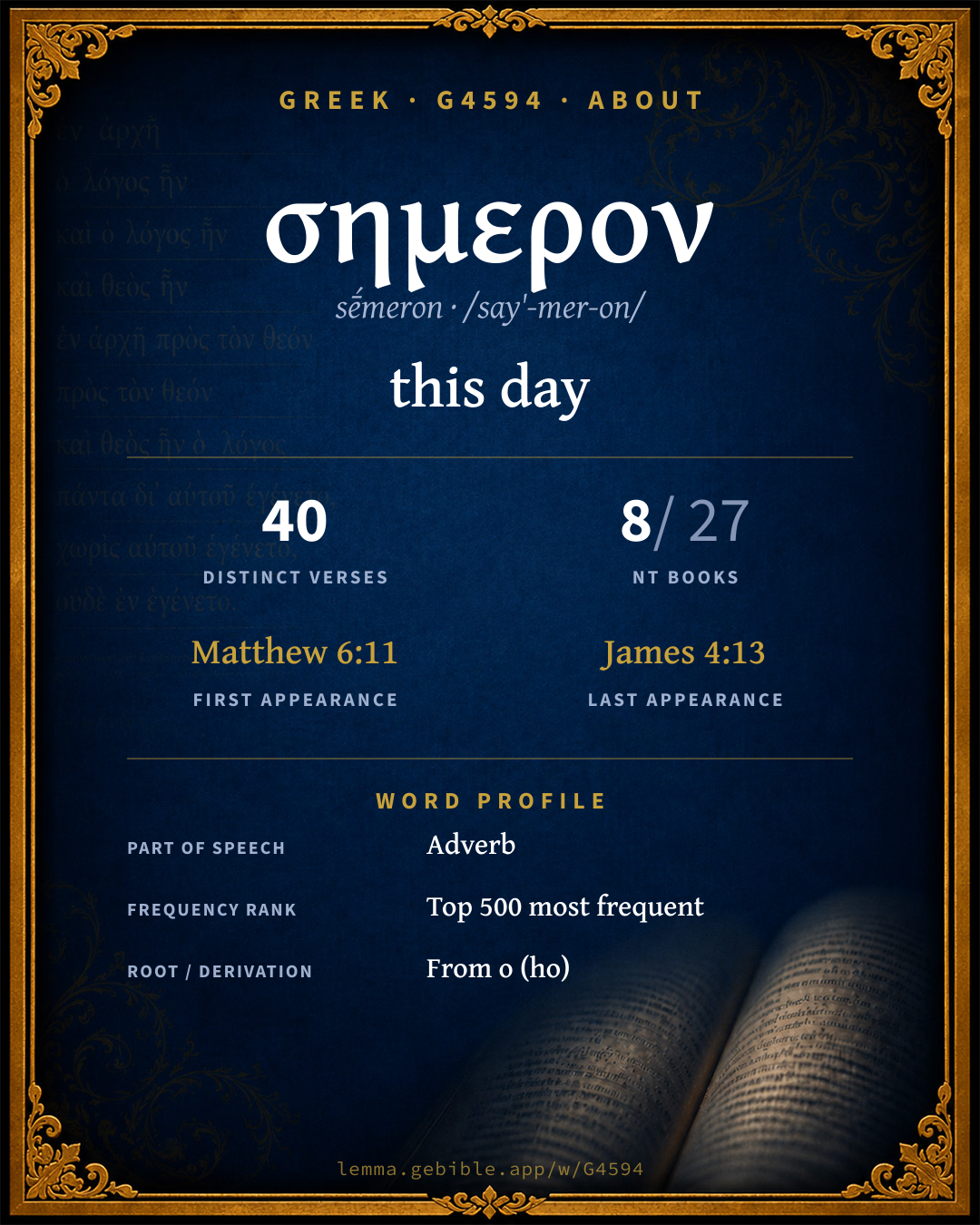
σήμερον
this day
‘this day’ is one of 2 main senses fuller range ↓
Full lexicon entry — Thayer's Greek Lexicon
From Thayer's Greek Lexicon
Where this word appears
Grammar key — what these labels mean
Part of speech
- Adverb
- A word that modifies a verb, adjective, or other adverb.
Every verse where G4594 appears — 40 distinct verses across 8 books. Click any verse to open its interlinear word-by-word view. Verse text shown in the World English Bible for context — . Each verse’s Greek form is shown with its reference; the English is not keyword-highlighted, since the data carries no word-level English alignment. Use “Compare translations” on any verse to read it across multiple English versions. This concordance covers the Greek New Testament; Septuagint (Greek Old Testament) occurrences of this word are not indexed here.
Matthew 8 verses
- Matthew 6:11 σήμερον adv Give us today our daily bread.
- Matthew 6:30 σήμερον adv But if God so clothes the grass of the field, which today exists, and tomorrow is thrown into the oven, won't he much more clothe you, you of little faith?
- Matthew 11:23 σήμερον adv You, Capernaum, who are exalted to Heaven, you will go down to Hades. For if the mighty works had been done in Sodom which were done in you, it would have remained until this day.
- Matthew 16:3 σήμερον adv In the morning, 'It will be foul weather today, for the sky is red and threatening.' Hypocrites! You know how to discern the appearance of the sky, but you can't discern the signs of the times!
- Matthew 21:28 σήμερον adv But what do you think? A man had two sons, and he came to the first, and said, 'Son, go work today in my vineyard.'
- Matthew 27:8 σήμερον adv Therefore that field was called "The Field of Blood" to this day.
- Matthew 27:19 σήμερον adv While he was sitting on the judgment seat, his wife sent to him, saying, "Have nothing to do with that righteous man, for I have suffered many things this day in a dream because of him."
- Matthew 28:15 σήμερον adv So they took the money and did as they were told. This saying was spread abroad among the Jews, and continues until this day.
Mark 1 verse
Luke 11 verses
- Luke 2:11 σήμερον adv For there is born to you, this day, in the city of David, a Savior, who is Christ the Lord.
- Luke 4:21 σήμερον adv He began to tell them, "Today, this Scripture has been fulfilled in your hearing."
- Luke 5:26 σήμερον adv Amazement took hold on all, and they glorified God. They were filled with fear, saying, "We have seen strange things today."
- Luke 12:28 σήμερον adv But if this is how God clothes the grass in the field, which today exists, and tomorrow is cast into the oven, how much more will he clothe you, O you of little faith?
- Luke 13:32 σήμερον adv He said to them, "Go and tell that fox, 'Behold, I cast out demons and perform cures today and tomorrow, and the third day I complete my mission.
- Luke 13:33 σήμερον adv Nevertheless I must go on my way today and tomorrow and the next day, for it can't be that a prophet perish outside of Jerusalem.'
- Luke 19:5 σήμερον adv When Jesus came to the place, he looked up and saw him, and said to him, "Zacchaeus, hurry and come down, for today I must stay at your house."
- Luke 19:9 σήμερον adv Jesus said to him, "Today, salvation has come to this house, because he also is a son of Abraham.
- Luke 22:34 σήμερον adv He said, "I tell you, Peter, the rooster will by no means crow today until you deny that you know me three times."
- Luke 22:61 σήμερον adv The Lord turned, and looked at Peter. Then Peter remembered the Lord's word, how he said to him, "Before the rooster crows you will deny me three times."
- Luke 23:43 σήμερον adv Jesus said to him, "Assuredly I tell you, today you will be with me in Paradise."
Acts 9 verses
- Acts 4:9 σήμερον adv if we are examined today concerning a good deed done to a crippled man, by what means this man has been healed,
- Acts 13:33 σήμερον adv that God has fulfilled the same to us, their children, in that he raised up Jesus. As it is also written in the second psalm, 'You are my Son. Today I have become your father.'
- Acts 19:40 σήμερον adv For indeed we are in danger of being accused concerning this day's riot, there being no cause. Concerning it, we wouldn't be able to give an account of this commotion."
- Acts 20:26 σήμερον adv Therefore I testify to you this day that I am clean from the blood of all men,
- Acts 22:3 σήμερον adv "I am indeed a Jew, born in Tarsus of Cilicia, but brought up in this city at the feet of Gamaliel, instructed according to the strict manner of the law of our fathers, being zealous for God, even as you all are this day.
- Acts 24:21 σήμερον adv unless it is for this one thing that I cried standing among them, 'Concerning the resurrection of the dead I am being judged before you today!'"
- Acts 26:2 σήμερον adv "I think myself happy, King Agrippa, that I am to make my defense before you this day concerning all the things that I am accused by the Jews,
- Acts 26:29 σήμερον adv Paul said, "I pray to God, that whether with little or with much, not only you, but also all that hear me this day, might become such as I am, except for these bonds."
- Acts 27:33 σήμερον adv While the day was coming on, Paul begged them all to take some food, saying, "This day is the fourteenth day that you wait and continue fasting, having taken nothing.
Romans 1 verse
2 Corinthians 2 verses
Hebrews 7 verses
- Hebrews 1:5 σήμερον adv For to which of the angels did he say at any time, "You are my Son, Today have I become your father?" and again, "I will be to him a Father, And he will be to me a Son?"
- Hebrews 3:7 σήμερον adv Therefore, even as the Holy Spirit says, "Today if you will hear his voice,
- Hebrews 3:13 σήμερον adv but exhort one another day by day, so long as it is called "today;" lest any one of you be hardened by the deceitfulness of sin.
- Hebrews 3:15 σήμερον adv while it is said, "Today if you will hear his voice, Don't harden your hearts, as in the rebellion."
- Hebrews 4:7 σήμερον σήμερον adv adv he again defines a certain day, today, saying through David so long a time afterward (just as has been said), "Today if you will hear his voice, Don't harden your hearts."
- Hebrews 5:5 σήμερον adv So also Christ didn't glorify himself to be made a high priest, but it was he who said to him, "You are my Son. Today I have become your father."
- Hebrews 13:8 σήμερον adv Jesus Christ is the same yesterday, today, and forever.
James 1 verse
About this entry
At a glance — auto-summarized from this page’s data, not written by a person. Every figure links to its source below. This summary describes the numbers; it doesn’t interpret them.
The Greek verb σημερον centers on the idea of “this day.” The King James Version usually renders it “day,” while modern versions prefer “today” (Berean Standard Bible) — see the renderings breakdown. Spanning 40 verses in 8 books, it ranks among the moderately common words of the Greek New Testament. Luke dominates its distribution — 11 of 40 verses. Thayer's distinguishes 2 senses for it. For the data behind this summary, explore the sense tree and the renderings breakdown below.
Gloss history
Strong's 1890 vs modern scholarship

About this word
Strong's G4594 catalogs a Greek word from the Greek New Testament.
These counts are not copied from any lexicon or concordance. They are computed here, from the morphology-tagged Greek New Testament. What Lemma adds →
- 40
- distinct verses
- The word appears in 40 distinct verses.
- 8 / 27
- NT books
- The word appears in 8 of 27 New Testament books.
- #364
- by frequency
- Top 500 most frequent Greek words (rank 364 of 5,347 Greek words by occurrence).
View all 40 occurrences in the concordance →
By section of the New Testament
By traditional corpus
Conventional, traditional groupings — biblical authorship is debated, so this is a traditional corpus grouping, not an authorship claim. Some books belong to more than one corpus (Luke is in both the Gospels and the Lukan corpus, and so on), so these shares overlap and need not total 100%. Each figure is a share of the word’s 40 distinct verses.
- Gospels 20 verses · 50%
- Lukan (Luke–Acts) 20 verses · 50%
- Hebrews 7 verses · 18%
- Pauline corpus 3 verses · 8%
- General (Catholic) Epistles 1 verse · 3%
How translations render this word
Counts come from each version’s own published word-to-Strong’s tagging or interlinear alignment — an approximate guide to how each version renders this word, not a word-level alignment the data otherwise carries. Because each total is that version’s own tagged count, the per-version totals vary from one another and need not match the appearance or distinct-verse counts above. These counts may also differ from a printed concordance because Lemma counts each distinctly tagged rendering and does not collapse phrase taggings into a single head-word total. This is a fixed set of word-tagged versions (KJV, ASV, BSB, ULT) and does not change with the reading translation you choose elsewhere. Each version’s license is shown beside its name below (and on Sources).
- King James Version: Day 37×
- American Standard Version: Day 19×, To-day 16×, This 2×
- Berean Standard Bible: Today 30×, Day 5×, Very 2×
- unfoldingWord Literal Text: Today 38×
King James Version Public Domain
Renders G4594 across 40 tagged occurrences — most commonly:
Plus 3 renderings that appear only once — usually multi-word phrases or single function words the recovered tagging swept in, not distinct renderings. Not rendered by a distinct English word in 1 further occurrence.
American Standard Version Public Domain
Renders G4594 across 42 tagged occurrences — most commonly:
Plus 5 renderings that appear only once — usually multi-word phrases or single function words the recovered tagging swept in, not distinct renderings.
Berean Standard Bible Public Domain
Renders G4594 across 40 tagged occurrences — most commonly:
Plus 3 renderings that appear only once — usually multi-word phrases or single function words the recovered tagging swept in, not distinct renderings. Not rendered by a distinct English word in 1 further occurrence.
unfoldingWord Literal Text CC BY-SA 4.0
Renders G4594 across 42 tagged occurrences — most commonly:
Plus 4 renderings that appear only once — usually multi-word phrases or single function words the recovered tagging swept in, not distinct renderings.
Senses in Thayer's
The 2 senses Thayer's distinguishes for this word, in lexicon order (not ranked by frequency or importance). The full entry — with sub-senses — is in the Lexicon Entry tab.
- this (very) day)
- what has happened today
Word origin
Derived from ο (ho) (G3588).
Same root — word family
Other Thayer's entries built from the same root as G4594, grouped by Strong’s listed origin. These share a root / origin per the lexicon — not necessarily a shared meaning. Each links to that word’s own entry.
Derives from
Shares the same root
- τανυν tanŷn G3569 present
- οδε hóde G3592 this
- οιος hoîos G3634 what sort of
- ος hós G3739 who
- ουτος hoûtos G3778 this
- ταυτα tautá G5024 thus
- τηλικουτος tēlikoûtos G5082 of such size
- τοι toí G5104 truly
- τοσουτος tosoûtos G5118 so great
- τοτε tóte G5119 then
- του toû G5120 his
- τουναντιον tounantíon G5121 on the contrary
- τουνομα toúnoma G5122 by name
Proper names from this root
People and places named from this root — a name, not an additional meaning of the word.
- θεος theós G2316 God
- ο ων και ο ην και ο ερχομενος ho ṑn kaí ho ēn kaí ho erchómenos G3801 He who is
Compare all same-root words → Showing 4 of 17 — not the complete family. 2 of the same-root words are proper names (people or places). They share a root, not necessarily a meaning.
Septuagint usage
The same Greek word σημερον appears 248 times in the Greek Old Testament (Septuagint), across 232 verses in 22 books.
- 248
- LXX occurrences
- Tagged occurrences of this Greek word in the Septuagint.
- 232
- verses
- Distinct Septuagint verses containing this word.
- 22 / 39
- OT books
- The word appears in 22 of the 39 Old Testament books.
Sample Septuagint occurrences
- Genesis 4:14 σήμερον
- Exodus 2:18 σήμερον
- Leviticus 9:4 σήμερον
- Numbers 22:30 σήμερον
- Deuteronomy 1:10 σήμερον
- Joshua 4:9 σήμερον
- Judges 6:17 σήμερον
- Ruth 2:19 σήμερον
- 1 Samuel 4:3 σήμερον
- 2 Samuel 3:8 σήμερον
- 1 Kings 1:25 σήμερον
- 2 Kings 2:3 σήμερον
Septuagint occurrences (same lexeme)
Every verse where the same Strong’s number (G4594) appears in the Greek Septuagint — showing the first 50 of 232. Verse text shown in the World English Bible for context; the Greek form is the matched word — the English is not keyword-highlighted.
- Genesis 4:14 σήμερον Behold, you have driven me out this day from the surface of the ground. I will be hidden from your face, and I will be a fugitive and a wanderer in the earth. It will happen that whoever finds me will kill me."
- Genesis 19:37 σήμερον The firstborn bore a son, and named him Moab. The same is the father of the Moabites to this day.
- Genesis 19:38 σήμερον The younger also bore a son, and called his name Ben Ammi. The same is the father of the children of Ammon to this day.
- Genesis 21:26 σήμερον Abimelech said, "I don't know who has done this thing. Neither did you tell me, neither did I hear of it, until today."
- Genesis 22:14 σήμερον Abraham called the name of that place Yahweh-Jireh. As it is said to this day, "In Yahweh's mountain it will be provided.
- Genesis 24:12 σήμερον He said, "Yahweh, the God of my master Abraham, please give me success this day, and show kindness to my master Abraham.
- Genesis 24:42 σήμερον I came this day to the spring, and said, 'Yahweh, the God of my master Abraham, if now you do prosper my way which I go.
- Genesis 25:31 σήμερον Jacob said, "First, sell me your birthright."
- Genesis 25:33 σήμερον Jacob said, "Swear to me first." He swore to him. He sold his birthright to Jacob.
- Genesis 26:33 σήμερον He called it Shibah. Therefore the name of the city is Beersheba to this day.
- Genesis 30:16 σήμερον Jacob came from the field in the evening, and Leah went out to meet him, and said, "You must come in to me; for I have surely hired you with my son's mandrakes." He lay with her that night.
- Genesis 30:32 σήμερον I will pass through all your flock today, removing from there every speckled and spotted one, and every black one among the sheep, and the spotted and speckled among the goats. This will be my hire.
- Genesis 31:43 σήμερον Laban answered Jacob, "The daughters are my daughters, the children are my children, the flocks are my flocks, and all that you see is mine: and what can I do this day to these my daughters, or to their children whom they have borne?
- Genesis 31:46 σήμερον Jacob said to his relatives, "Gather stones." They took stones, and made a heap. They ate there by the heap.
- Genesis 35:4 σήμερον They gave to Jacob all the foreign gods which were in their hands, and the rings which were in their ears; and Jacob hid them under the oak which was by Shechem.
- Genesis 35:20 σήμερον Jacob set up a pillar on her grave. The same is the Pillar of Rachel's grave to this day.
- Genesis 40:7 σήμερον He asked Pharaoh's officers who were with him in custody in his master's house, saying, "Why do you look so sad today?"
- Genesis 41:9 σήμερον Then the chief cupbearer spoke to Pharaoh, saying, "I remember my faults today.
- Genesis 41:41 σήμερον Pharaoh said to Joseph, "Behold, I have set you over all the land of Egypt."
- Genesis 42:13 σήμερον They said, "We, your servants, are twelve brothers, the sons of one man in the land of Canaan; and, behold, the youngest is this day with our father, and one is no more."
- Genesis 42:32 σήμερον We are twelve brothers, sons of our father; one is no more, and the youngest is this day with our father in the land of Canaan.'
- Genesis 47:23 σήμερον Then Joseph said to the people, "Behold, I have bought you and your land today for Pharaoh. Behold, here is seed for you, and you shall sow the land.
- Genesis 50:20 σήμερον As for you, you meant evil against me, but God meant it for good, to bring to pass, as it is this day, to save many people alive.
- Exodus 2:18 σήμερον When they came to Reuel, their father, he said, "How is it that you have returned so early today?"
- Exodus 5:14 σήμερον The officers of the children of Israel, whom Pharaoh's taskmasters had set over them, were beaten, and demanded, "Why haven't you fulfilled your quota both yesterday and today, in making brick as before?"
- Exodus 13:4 σήμερον This day you go forth in the month Abib.
- Exodus 14:13 σήμερον Moses said to the people, "Don't be afraid. Stand still, and see the salvation of Yahweh, which he will work for you today: for the Egyptians whom you have seen today, you shall never see them again.
- Exodus 16:25 σήμερον Moses said, "Eat that today, for today is a Sabbath to Yahweh. Today you shall not find it in the field.
- Exodus 19:10 σήμερον Yahweh said to Moses, "Go to the people, and sanctify them today and tomorrow, and let them wash their garments,
- Exodus 32:29 σήμερον Moses said, "Consecrate yourselves today to Yahweh, yes, every man against his son, and against his brother; that he may bestow on you a blessing this day."
- Leviticus 9:4 σήμερον and an ox and a ram for peace offerings, to sacrifice before Yahweh; and a meal offering mixed with oil: for today Yahweh appears to you.'"
- Leviticus 10:19 σήμερον Aaron spoke to Moses, "Behold, this day they have offered their sin offering and their burnt offering before Yahweh; and such things as these have happend to me: and if I had eaten the sin offering today, would it have been pleasing in the sight of Yahweh?"
- Numbers 22:30 σήμερον The donkey said to Balaam, Am I not your donkey, on which you have ridden all your life long to this day? was I ever wont to do so to you? and he said, No.
- Deuteronomy 1:10 σήμερον Yahweh your God has multiplied you, and, behold, you are this day as the stars of the sky for multitude.
- Deuteronomy 1:39 σήμερον Moreover your little ones, whom you said should be a prey, and your children, who this day have no knowledge of good or evil, they shall go in there, and to them will I give it, and they shall possess it.
- Deuteronomy 2:18 σήμερον You are this day to pass over Ar, the border of Moab:
- Deuteronomy 4:1 σήμερον Now, Israel, listen to the statutes and to the ordinances, which I teach you, to do them; that you may live, and go in and possess the land which Yahweh, the God of your fathers, gives you.
- Deuteronomy 4:2 σήμερον You shall not add to the word which I command you, neither shall you diminish from it, that you may keep the commandments of Yahweh your God which I command you.
- Deuteronomy 4:4 σήμερον But you who did cleave to Yahweh your God are alive everyone of you this day.
- Deuteronomy 4:8 σήμερον What great nation is there, that has statutes and ordinances so righteous as all this law, which I set before you this day?
- Deuteronomy 4:26 σήμερον I call heaven and earth to witness against you this day, that you shall soon utterly perish from off the land whereunto you go over the Jordan to possess it; you shall not prolong your days on it, but shall utterly be destroyed.
- Deuteronomy 4:38 σήμερον to drive out nations from before you greater and mightier than you, to bring you in, to give you their land for an inheritance, as at this day.
- Deuteronomy 4:39 σήμερον Know therefore this day, and lay it to your heart, that Yahweh he is God in heaven above and on the earth beneath; there is none else.
- Deuteronomy 4:40 σήμερον You shall keep his statutes, and his commandments, which I command you this day, that it may go well with you, and with your children after you, and that you may prolong your days in the land, which Yahweh your God gives you, forever.
- Deuteronomy 5:3 σήμερον Yahweh didn't make this covenant with our fathers, but with us, even us, who are all of us here alive this day.
- Deuteronomy 6:2 σήμερον that you might fear Yahweh your God, to keep all his statutes and his commandments, which I command you, you, and your son, and your son's son, all the days of your life; and that your days may be prolonged.
- Deuteronomy 6:6 σήμερον These words, which I command you this day, shall be on your heart;
- Deuteronomy 6:24 σήμερον Yahweh commanded us to do all these statutes, to fear Yahweh our God, for our good always, that he might preserve us alive, as at this day.
- Deuteronomy 7:11 σήμερον You shall therefore keep the commandment, and the statutes, and the ordinances, which I command you this day, to do them.
- Deuteronomy 8:1 σήμερον All the commandment which I command you this day shall you observe to do, that you may live, and multiply, and go in and possess the land which Yahweh swore to your fathers.
These are occurrences of the same Greek lexeme (G4594) in the Septuagint — not a translation of any one Hebrew word. The store carries no word-level Hebrew↔Greek alignment, so no Hebrew original is asserted here. Counts come from the recovered LXX Strong's tagging — high-frequency vocabulary is well covered, while rare or late forms may be untagged — so they reflect tagged occurrences and may slightly undercount.