John 6:53

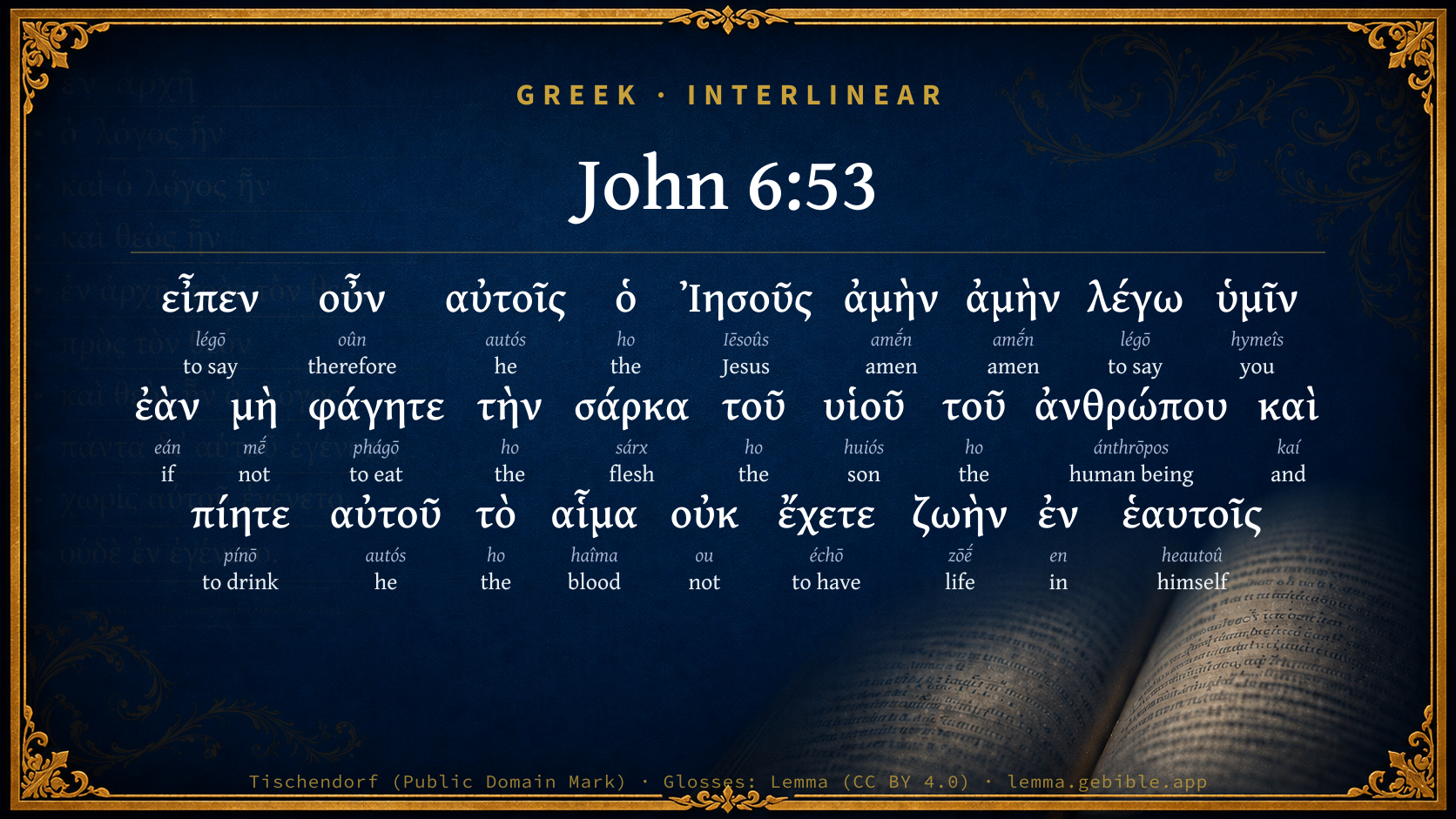
Greek (Tischendorf 8th ed.) John 6:53 appears in the Greek New Testament. The text above is from the Tischendorf 8th edition. Each word links to its Strong’s number and a concise gloss. Click any word for its full Thayer’s Greek Lexicon entry.
Download image
Cite this verse

John 6:53 (World English Bible). Public Domain. Lemma interlinear Bible study tool, https://lemma.gebible.app/v/john/6/53.

Show BibTeX & RIS
BibTeX
RIS
English Translation
Jesus therefore said to them, "Most assuredly I tell you, unless you eat the flesh of the Son of Man and drink his blood, you don't have life in yourselves.
World English Bible · Public Domain
Download a study sheet

One document with this verse’s original text, its word-by-word gloss line, the meaning frame, cross-references with their text, attributed commentary, and full source and license credits — printable, and it pastes into notes with its structure intact.

This verse Autodidact and up

Study sheet (.html) Plain text (.txt)

A passage Seminary Student

Up to 50 verses in one chapter. A passage sheet keeps up to 6 commentary sources and 12 cross-references per verse, in the order this page ranks them, and says so on the sheet whenever that leaves anything out. Ask for a single verse and you get the Autodidact verse sheet above.

Everything on this page stays free to read, with no account — the sheet is a download of what is already on screen, not access to it.

Want to remove ads? Support Godless Engineer
Compare translations 3

The same verse in 3 English versions, stacked beneath the original-language interlinear above. Click any original word for its lexicon entry.

Each is an independent rendering of the whole verse — the interlinear is not word-aligned to these translations.

Highlighted words mark where these versions differ — a whole-verse word diff, not a word-by-word alignment.

  • World English Bible Public Domain
    Jesus therefore said to them, "Most assuredly I tell you, unless you eat the flesh of the Son of Man and drink his blood, you don't have life in yourselves.
  • King James Version Public Domain
    Then Jesus said unto them, Verily, verily, I say unto you, Except ye eat the flesh of the Son of man, and drink his blood, ye have no life in you.
  • unfoldingWord Literal Text CC BY-SA 4.0
    Therefore, Jesus said to them, “Truly, truly, I say to you, unless you would eat the flesh of the Son of Man and would drink his blood, you do not have life in yourselves.

unfoldingWord Literal Text — © unfoldingWord, licensed CC BY-SA 4.0. Word-aligned USFM3 via Door43 (git.door43.org/unfoldingWord/en_ult).

Versions to compare (up to 4)

3 of 4 selected

Show all 19 translations

Every available English version of this verse, each an independent rendering of the whole verse.

  • World English Bible Public Domain
    Jesus therefore said to them, "Most assuredly I tell you, unless you eat the flesh of the Son of Man and drink his blood, you don't have life in yourselves.
  • Berean Standard Bible Public Domain
    So Jesus said to them, “Truly, truly, I tell you, unless you eat the flesh and drink the blood of the Son of Man, you have no life in you.
  • Majority Standard Bible Public Domain
    So Jesus said to them, “Truly, truly, I tell you, unless you eat the flesh and drink the blood of the Son of Man, you have no life in you.
  • King James Version Public Domain
    Then Jesus said unto them, Verily, verily, I say unto you, Except ye eat the flesh of the Son of man, and drink his blood, ye have no life in you.
  • American Standard Version (1901) Public Domain
    Jesus therefore said unto them, Verily, verily, I say unto you, Except ye eat the flesh of the Son of man and drink his blood, ye have not life in yourselves.
  • Revised Version (1885) Public Domain
    Jesus therefore said unto them, Verily, verily, I say unto you, Except ye eat the flesh of the Son of man and drink his blood, ye have not life in yourselves.
  • Geneva Bible (1599) Public Domain
    Then Iesus saide vnto them, Verely, verely I say vnto you, Except yee eate the flesh of the Sonne of man, and drinke his blood, yee haue no life in you.
  • Douay-Rheims (1899) Public Domain
    The Jews therefore strove among themselves, saying: How can this man give us his flesh to eat
  • Young's Literal Translation Public Domain
    Jesus, therefore, said to them, `Verily, verily, I say to you, If ye may not eat the flesh of the Son of Man, and may not drink his blood, ye have no life in yourselves;
  • Literal Standard Version CC BY-SA 4.0
    Jesus, therefore, said to them, “Truly, truly, I say to you, if you may not eat the flesh of the Son of Man, and may not drink His blood, you have no life in yourselves;
  • Unlocked Literal Bible CC BY-SA 4.0
    Then Jesus said to them, “Truly, truly, unless you eat the flesh of the Son of Man and drink his blood, you will not have life in yourselves.
  • unfoldingWord Literal Text CC BY-SA 4.0
    Therefore, Jesus said to them, “Truly, truly, I say to you, unless you would eat the flesh of the Son of Man and would drink his blood, you do not have life in yourselves.
  • Darby Bible Public Domain
    Jesus therefore said to them, Verily, verily, I say unto you, Unless ye shall have eaten the flesh of the Son of man, and drunk his blood, ye have no life in yourselves.
  • World Messianic Bible Public Domain
    Yeshua therefore said to them, “Most certainly I tell you, unless you eat the flesh of the Son of Man and drink his blood, you don’t have life in yourselves.
  • Webster's Bible Public Domain
    Then Jesus said to them, Verily, verily, I say to you, Except ye eat the flesh of the Son of man, and drink his blood, ye have no life in you.
  • Free Bible Version CC BY-SA 4.0
    Jesus told them, “I tell you the truth, unless you eat the flesh of the Son of man and drink his blood, you cannot truly live.
  • Bible in Basic English Public Domain
    Then Jesus said to them, Truly I say to you, If you do not take the flesh of the Son of man for food, and if you do not take his blood for drink, you have no life in you.
  • Text-Critical English NT CC BY 4.0
    So Jesus said to them, “Truly, truly, I say to you, if you do not eat the flesh of the Son of Man and drink his blood, you have no life in yourselves.
  • Tyndale New Testament (1534) Public Domain
    Then Iesus sayde vnto them: Verely, verely I saye vnto you except ye eate the flesshe of the sonne of man and drinke his bloude ye shall not have lyfe in you.

Literal Standard Version (2020), Covenant Press — licensed CC BY-SA 4.0. Text via the HelloAO Bible API (eBible.org). Unlocked Literal Bible (unfoldingWord) — licensed CC BY-SA 4.0. Text via the HelloAO Bible API (eBible.org). unfoldingWord Literal Text — © unfoldingWord, licensed CC BY-SA 4.0. Word-aligned USFM3 via Door43 (git.door43.org/unfoldingWord/en_ult). Free Bible Version, Dr. Jonathan Gallagher — licensed CC BY-SA 4.0. Text via the HelloAO Bible API (eBible.org).

Word by word

More ways to search: Search by grammar → Find every occurrence → Compare this word →

Practice this passage: Drill this verse → Learn its vocabulary →

πίητε
pínō
G4095
“to drink”
Verb, Aorist, Active, Subjunctive, 2nd person, Plural
Part of Speech
Verb
Tense
Aorist
Voice
Active
Mood
Subjunctive
Person
2nd person
Number
Plural
Full Thayer's Definition

Origin: "a prolonged form of pio pee'-o; which (together with another form poo po'-o, occurs only as an alternate in certain tenses"

TDNT: 08:15,8

1. to drink 2. figuratively, to receive into the soul what serves to refresh strengthen, nourish it unto life eternal
  1. εἶπεν légō G3004 “to say” Verb, Aorist, Active, Indicative, 3rd person, Singular
  2. οὖν oûn G3767 “therefore” Conjunction
  3. αὐτοῖς autós G846 “he” Personal pronoun, Dative, Plural, Masculine
  4. ὁ ho G3588 “the” Article, Nominative, Singular, Masculine
  5. Ἰησοῦς Iēsoûs G2424 “Jesus” Noun, Nominative, Singular, Masculine
  6. ἀμὴν amḗn G281 “amen” Hebrew transliteration
  7. ἀμὴν amḗn G281 “amen” Hebrew transliteration
  8. λέγω légō G3004 “to say” Verb, Present, Active, Indicative, 1st person, Singular
  9. ὑμῖν hymeîs G5210 “you” Personal pronoun, 2nd person, Dative, Plural
  10. ἐὰν eán G1437 “if” Conditional
  11. μὴ mḗ G3361 “not” Particle, Negative
  12. φάγητε phágō G5315 “to eat” Verb, Aorist, Active, Subjunctive, 2nd person, Plural
  13. τὴν ho G3588 “the” Article, Accusative, Singular, Feminine
  14. σάρκα sárx G4561 “flesh” Noun, Accusative, Singular, Feminine
  15. τοῦ ho G3588 “the” Article, Genitive, Singular, Masculine
  16. υἱοῦ huiós G5207 “son” Noun, Genitive, Singular, Masculine
  17. τοῦ ho G3588 “the” Article, Genitive, Singular, Masculine
  18. ἀνθρώπου ánthrōpos G444 “human being” Noun, Genitive, Singular, Masculine
  19. καὶ kaí G2532 “and” Conjunction
  20. αὐτοῦ autós G846 “he” Personal pronoun, Genitive, Singular, Masculine
  21. τὸ ho G3588 “the” Article, Accusative, Singular, Neuter
  22. αἷμα haîma G129 “blood” Noun, Accusative, Singular, Neuter
  23. οὐκ ou G3756 “not” Particle, Negative
  24. ἔχετε échō G2192 “to have” Verb, Present, Active, Indicative, 2nd person, Plural
  25. ζωὴν zōḗ G2222 “life” Noun, Accusative, Singular, Feminine
  26. ἐν en G1722 “in” Preposition
  27. ἑαυτοῖς heautoû G1438 “himself” Reflexive pronoun, 2nd person, Dative, Plural, Masculine

About this verse

These counts appear in no published source. They are computed here, from the morphology-tagged text and Lemma’s own curated glosses. What Lemma adds →

28
words
21
distinct lemmas
Gospels
section

Repetition

Words recur within this verse:

  • εἶπεν to say G3004 ×2
  • ἀμὴν amen G281 ×2
  • ὁ the G3588 ×5
  • αὐτοῖς he G846 ×2

Cross-references

15

Topical passages linked to John 6:53 in the Treasury of Scripture Knowledge — connected by theme and wording, ordered by reader-vote popularity; previews shown in the World English Bible.

  • 1 John 5:12 He who has the Son has the life. He who doesn't have God's Son doesn't have the life.
  • Matthew 26:26–28 As they were eating, Jesus took bread, gave thanks for it, and broke it. He gave to the disciples, and said, "Take, eat; this is my body."
  • John 6:55 For my flesh is food indeed, and my blood is drink indeed.
  • John 6:47 Most assuredly, I tell you, he who believes in me has eternal life.
  • John 15:4 Remain in me, and I in you. As the branch can't bear fruit by itself, unless it remains in the vine, so neither can you, unless you remain in me.
  • John 6:26–27 Jesus answered them, "Most assuredly I tell you, you seek me, not because you saw signs, but because you ate of the loaves, and were filled.
  • John 3:3 Jesus answered him, "Most assuredly, I tell you, unless one is born anew, he can't see the Kingdom of God."
  • Revelation 2:17 He who has an ear, let him hear what the Spirit says to the assemblies. To him who overcomes, to him I will give of the hidden manna, and I will give him a white stone, and on the stone a new name written, which no one knows but he who receives it.
  • John 3:36 One who believes in the Son has eternal life, but one who disobeys the Son won't see life, but the wrath of God remains on him."
  • Matthew 18:3 and said, "Most assuredly I tell you, unless you turn, and become as little children, you will in no way enter into the Kingdom of Heaven.
  • John 3:5 Jesus answered, "Most assuredly I tell you, unless one is born of water and spirit, he can't enter into the Kingdom of God!
  • Luke 13:3 I tell you, no, but, unless you repent, you will all perish in the same way.
  • Luke 13:5 I tell you, no, but, unless you repent, you will all perish in the same way."
  • Matthew 5:18 For most assuredly, I tell you, until heaven and earth pass away, not even one smallest letter or one tiny pen stroke shall in any way pass away from the law, until all things are accomplished.
  • John 13:8 Peter said to him, "You will never wash my feet!" Jesus answered him, "If I don't wash you, you have no part with me."

Cross-references courtesy of OpenBible.info (CC BY 4.0).

Commentary

Notes on John 6:53 from classic Christian and Jewish commentators (each source and its license shown beneath its notes). The classic Christian expositions comment on the surrounding passage and are grouped to its opening verse, so a note may address several verses; the Jewish commentaries on the Tanakh (Rashi and others) are per-verse, so they appear only where the commentator wrote on this verse.

Lemma curates 59 commentaries, every one of them public domain or Creative Commons licensed, each selected and text-cleaned for this edition rather than reprinted as found. About our sources →

Tyndale Open Study Notes

Tyndale Open Resources

6:53-58 eat the flesh . . . drink his blood: Jesus answered the question the people asked (6:52). His words hinted at the Lord’s Supper yet to come (see Luke 22:19). Since “flesh and blood” was a Jewish idiom for the whole person, Jesus might have been calling people to consume him fully by completely believing in him. Some Christian traditions see the bread as Christ’s literal flesh broken for us and the wine as his literal blood poured out for us. Others take the meaning in purely spiritual terms. Either way, receiving communion means no less than embracing Jesus’ life-giving sacrifice.

Tyndale Open Study Notes — © Tyndale Open Resources, licensed CC BY-SA 4.0. Text via the HelloAO Bible API.

Bengel's Gnomon

Johann Albrecht Bengel

Joh 6:53. Ἐὰν μή, if you do not) The Jews were questioning as to the possibility: Jesus replies as to the necessity: for in fact the latter infers the former.

Bengel's Gnomon of the New Testament — English translation (T&T Clark, Edinburgh, 1860) — public domain. Text from a community e-Sword module.

Expositor's Greek Testament

ed. W. Robertson Nicoll

Joh 6:53-54 . εἶπεν οὖν … ἡμέρᾳ . Instead of explaining the mode Jesus merely reiterates the statement. The reason of this is that their attention was thus more likely to be fixed on the necessity of using Him as the living bread. The difficulty of the statement disappears when it is perceived that the figure of speech is not to be found in the words “flesh” and “blood,” but in the words “eating” and “drinking”. The actual flesh and blood, the human life of Christ, was given for men; and men eat His flesh and drink His blood, when they use for their own advantage His sacrifice, when they assimilate to their own being all the virtue that was in Him, and that was manifested for their sakes. As Lücke points out, the σὰρξ καὶ αἷμα form together one conception and are equivalent to the με of Joh 6:57 . If αἷμα stood alone it might refer especially to the death of Christ, but taken along with σάρξ it is more natural to refer the double expression to the whole manifestation of Christ; and the “eating and drinking” can only mean the complete acceptance of Him and union with Him as thus manifested. [ τρώγω , originally the munching of herbivorous animals, was latterly applied to ordinary human eating.]

The Expositor's Greek Testament, edited by W. Robertson Nicoll (1897–1910) — public domain. Text from a community e-Sword module.

Godet's Commentaries

Frédéric Louis Godet

Vv. 53-55. “Jesus therefore said to them: Verily, verily, I say to you, that unless you eat the flesh of the Son of man and drink his blood, you will not have life in yourselves. 54. He who eats my flesh and drinks my blood has eternal life; and I will raise him up at the last day. 55. For my flesh is truly food and my blood is truly drink.”

Verily: “It is so, whatever you may think of it!” The Lord attests this first in the negative form (Joh 6:53), then positively (Joh 6:54). The term Son of man, recalls the notion of the incarnation, by means of which the eternal life, realized in Him in a human life, is placed within reach of the faith of man. Reuss and Keil think that the terms flesh and blood may be understood here as in the passages where the expression flesh and blood denotes a living human person, for example, Gal 1:16.

But in these cases the blood is regarded as contained in the flesh which lives by means of it, while in our passage the two elements are considered as separated. The blood is shed since it is drunk; and the flesh is broken since the blood is shed. These expressions imply that Jesus has present to His thought the type of the Paschal lamb. It was the blood of this victim which, sprinkled on the lintels of the doors, had in Egypt secured the people from the stroke of the angel of death and which, in the ceremony of the sacrifice of the lamb in the temple, was poured out on the horns of the altar, taking the place in this case of the doors of the Israelite houses; its flesh it was which formed the principal food of the Paschal supper. The shed blood represents expiation; and to drink this blood is to appropriate to oneself by faith the expiation and find in it reconciliation with God, the basis of salvation. The flesh broken represents the holy life of Christ; and to eat it, is to appropriate to oneself that life of obedience and love; it is to receive it through the action of the Spirit who makes it our life. In these two inward facts salvation is summed up. If then Jesus does not directly answer the How? of the Jews, He nevertheless does give indirectly, as He had done with Nicodemus, the desired explanation. As in chap. 3. He had substituted for the expression “born anew” the more explicit words “born of water and Spirit,” so He here completes the expression “to eat His flesh” by the expression “to drink His blood,” which was suited to recall the type of the lamb and to give these Jews, who celebrated the Paschal feast every year, a glimpse of the truth declared in this paradoxical form. The ἐν ἑαυτοῖς, in yourselves, recalls the word addressed to the Samaritan woman Joh 4:14. Here again is the idea of the possession in Christ of a fountain of life springing up continually within the believer.

Frédéric Louis Godet — Commentaries on Luke, John, Romans, and 1 Corinthians — English translation (T&T Clark, Edinburgh, 1870s–1890s) — public domain. Text from a community e-Sword module.

Geneva Bible (1599)

Geneva Bible translators

If Christ be present, life is present, but when Christ is absent, then is death present.

Geneva Bible (1599) marginal notes — public domain. Text via Bolls.life.

Jamieson, Fausset & Brown

Robert Jamieson, A. R. Fausset & David Brown

Except ye eat the flesh . . . and drink the blood . . . no life, &c.--The harshest word He had yet uttered in their ears. They asked how it was possible to eat His flesh. He answers, with great solemnity, "It is indispensable." Yet even here a thoughtful hearer might find something to temper the harshness. He says they must not only "eat His flesh" but "drink His blood," which could not but suggest the idea of His death--implied in the separation of one's flesh from his blood. And as He had already hinted that it was to be something very different from a natural death, saying, "My flesh I will give for the life of the world" (Joh 6:51), it must have been pretty plain to candid hearers that He meant something above the gross idea which the bare terms expressed. And farther, when He added that they "had no life in them unless they thus ate and drank," it was impossible they should think He meant that the temporal life they were then living was dependent on their eating and drinking, in this gross sense, His flesh and blood. Yet the whole statement was certainly confounding, and beyond doubt was meant to be so. Our Lord had told them that in spite of all they had "seen" in Him, they "did not believe" (Joh 6:36). For their conviction therefore he does not here lay Himself out; but having the ear not only of them but of the more candid and thoughtful in the crowded synagogue, and the miracle of the loaves having led up to the most exalted of all views of His Person and Office, He takes advantage of their very difficulties and objections to announce, for all time, those most profound truths which are here expressed, regardless of the disgust of the unteachable, and the prejudices even of the most sincere, which His language would seem only designed to deepen. The truth really conveyed here is no other than that expressed in Joh 6:51, though in more emphatic terms--that He Himself, in the virtue of His sacrificial death, is the spiritual and eternal life of men; and that unless men voluntarily appropriate to themselves this death, in its sacrificial virtue, so as to become the very life and nourishment of their inner man, they have no spiritual and eternal life at all. Not as if His death were the only thing of value, but it is what gives all else in Christ's Incarnate Person, Life, and Office, their whole value to us sinners.

Jamieson, Fausset & Brown — Commentary Critical and Explanatory on the Whole Bible (1871) — public domain (CC PDM 1.0). Text via the HelloAO Bible API.

Adam Clarke's Commentary

Verse 53. Except ye eat the flesh of the Son of man] Unless ye be made partakers of the blessings about to be purchased by my blood, passion, and violent death, ye cannot be saved. As a man must eat bread and flesh, in order to be nourished by them, so a man must receive the grace and Spirit of Christ, in order to his salvation. As food in a rich man's store does not nourish the poor man that needs it, unless it be given him, and he receive it into his stomach, so the whole fountain of mercy existing in the bosom of God, and uncommunicated, does not save a soul: he who is saved by it must be made a partaker of it. Our Lord's meaning appears to be, that, unless they were made partakers of the grace of that atonement which he was about to make by his death, they could not possibly be saved. Bishop Pearce justly observes that the ideas of eating and drinking are here borrowed to express partaking of, and sharing in. Thus spiritual happiness on earth, and even in heaven, is expressed by eating and drinking; instances of which may be seen, Mt 8:11; Mt 26:29; Lu 14:15; Lu 22:30; and Re 2:17. Those who were made partakers of the Holy Spirit are said by St. Paul, 1Co 12:13, to be made to drink into (or of) one Spirit. This, indeed, was a very common mode of expression among the Jews.

Adam Clarke's Commentary on the Bible (1810–1826) — public domain. Text from a community e-Sword/MySword module.

John Calvin's Commentaries

53. Verily, verily, I say to you. The just resentment which Christ felt, when he saw his grace rejected with such haughty disdain, constrained him to employ this oath. For he does not now make use of simple doctrine, but likewise mingles threatenings for the purpose of striking terror. He denounces eternal perdition against all who refuse to seek life from his flesh; as if he had said, “If you hold my flesh in contempt, rest assured that there remains for you no other hope of life.” The vengeance that awaits all despisers of the grace of Christ is, that with their pride they miserably perish; and the reason why they must be urged with plainness and severity is, that they may not continue to flatter themselves. For if we threaten with death those diseased persons who refuse to take medicines, what must we do with wicked men, when they strive, as far as lies in their power, to destroy life itself?

Unless you eat the flesh of the Son of man. When he says, the flesh of the Son of man, the expression is emphatic; for he reproves them for their contempt, which arose from perceiving that he resembled other men. The meaning therefore is: “Despise me as much as you please, on account of the mean and despicable appearance of my flesh, still that despicable flesh contains life; and if you are destitute of it, you will nowhere else find any thing else to quicken you.”

The ancients fell into a gross error by supposing that little children were deprived of eternal life, if they did not dispense to them the eucharist, that is, the Lord’s Supper; for this discourse does not relate to the Lord’s Supper, but to the uninterrupted communication of the flesh of Christ, which we obtain apart from the use of the Lord’s Supper. Nor were the Bohemians in the right, when they adduced this passage to prove that all without exception ought to be admitted to the use of the cup. With respect to young children, the ordinance of Christ forbids them to partake of the Lord’s Supper; because they are not yet able to know or to celebrate the remembrance of the death of Christ. The same ordinance makes the cup common to all, for it commands us all to drink of it, (Matthew 26:27.)

John Calvin's Commentaries (1540-1563) — public domain. Text from the Calvin Translation Society English edition (1840s-50s) via the Christian Classics Ethereal Library (ccel.org). Calvin's coverage is partial (roughly two-thirds of the Bible); uncommented books and verses are honest gaps, never fabricated. The 19th-century editor's footnotes and remarks are omitted so the notes are faithfully Calvin's own voice.

Ellicott's Commentary for English Readers

(53) Then Jesus said unto them.—This is hardly strong enough for the original. It is rather, Jesus therefore said unto them. The words follow upon those he has heard from them.

Some of them have spoken of eating His flesh. Others may even have pressed this to the reductio ad horribile. Eat His flesh! Shall we, then, drink His blood too? In no less than seven passages of the Pentateuch had the eating of blood been forbidden (Gen_9:4; Lev_3:17; Lev_7:26-27; Lev_17:10-14; Lev_19:26; Deu_12:16; Deu_12:23-24; Deu_15:23); and we find in later times the strength of the feeling of abhorrence, as in 1Sa_14:32, and Eze_33:25, and in the decree of the first Judæo-Christian Council (Act_15:29). In the fullest of these passages (Lev_17:10-14), the prohibition is grounded upon the facts that the blood is the physical seat of animal life, and that the blood maketh atonement for the soul. It was the life-element poured out before God instead of the life of the soul that sinned. Such would be the thoughts of those who strove among themselves as to what His words could mean; and to these thoughts He speaks with the “Verily, verily,” which ever expresses a spiritual truth that He alone could reveal.

Except ye eat the flesh of the Son of man.—The words point more definitely than those which have gone before to His death. The blood is spoken of as distinct from the flesh, and in this is involved physical death. The eating the flesh would itself involve, as we have seen above, the thoughts of sacrifice and of sustenance, the removal of the death-penalty attached to sin, and the strength of life sustained by food. But the spiritual truth is fuller and deeper than this; and the true element of life in the soul depends upon such communion with Christ as is expressed by drinking the blood itself: that is, by receiving into the human spirit the atonement represented by it. and with this the very principle of life. They may not receive into the human frame the principle of animal life, but no man really has spiritual life who does not receive into the inmost source of his being the life-principle revealed in the person of Christ. This is to pass through and through his moral frame, like the blood which traverses the body, hidden from sight, but passing from the central heart through artery and vein, bearing life in its course to muscle, and nerve, and tissue. It is to traverse the soul, passing from the Eternal Life and Love, which is the heart of the universe, through the humanity of Christ, and carrying in its course life and energy for every child of man.

Life in you.—More exactly, life in yourselves. This is more fully expressed in Joh_6:56-57.

A Bible Commentary for English Readers, edited by Charles John Ellicott (1878–1897) — public domain. Text from a community e-Sword module.

The Cambridge Bible for Schools and Colleges

gen. ed. J. J. S. Perowne

53. Then said Jesus] Better, Therefore said Jesus: see on Joh_6:45.

and drink his blood] Christ not only accepts what they have added to His words, but still further startles them by telling them that they must drink His Blood; an amazing statement to a Jew, who was forbidden to taste even the blood of animals (Gen_9:4; Lev_17:10-16). These words point still more distinctly to His propitiatory death; for ‘the blood is the life’ which He offered up for the sins of the world. The eating and drinking are not faith, but the appropriation of His death; faith leads us to eat and drink and is the means of appropriation. Taken separately, the Flesh represents sacrifice and sustenance, the Blood represents atonement and life.

no life in you] Literally, no life in yourselves: for the source of life is absent. The next four verses explain more fully how this is.

The Cambridge Bible for Schools and Colleges (gen. ed. J. J. S. Perowne; Cambridge University Press, 1878–1918) — public domain. Text from a community e-Sword module.

John Gill's Exposition

For my flesh is meat indeed,.... Not in a corporeal, but in a spiritual sense; and the same is said of his blood:

and my blood is drink indeed, &c. that is, they are both "truly" meat and drink, as the Vulgate Latin, Syriac, and Ethiopic versions render it; or are "true" meat and drink, as the Arabic version: in opposition to what was typical meat and drink; as the manna in the wilderness, the water out of the rock, the flesh and wine at the passover, the meat and drink offerings under the law, or any other meats and drinks under that dispensation; and which, though not when Christ said these words, yet now are abolished, being unprofitable, and not to be fed upon. Moreover, these phrases may denote the reality, substance, and solidity of that spiritual food believers have in Christ, in opposition to the imaginary food of sensual sinners, who feed on ashes and bread of deceit; and to that of self-righteous persons, who spend their labour and money for, and live upon that which is not bread, even upon their works of righteousness; and to the superficial tastes of hypocrites and formal professors; and to the charge of enthusiasm; and even to the outward elements of bread, and wine, in the Lord's supper, since instituted; and as it may be attended upon by persons destitute of the grace of God. And these words may also be expressive of the virtue, efficacy, and excellency of this food, it being soul quickening, nourishing, strengthening, satisfying, and delightful food, as well as spiritual and savoury; not to carnal persons, or outward professors, but to new born babes, and true believers; and which, by them, may be had, and to the full, and that in due season, even every day, and is what will abide for ever.

John Gill's Exposition of the Whole Bible (1746–1763) — public domain (CC PDM 1.0). Text via the HelloAO Bible API.

Trapp's Complete Commentary

John Trapp

53 Then Jesus said unto them, Verily, verily, I say unto you, Except ye eat the flesh of the Son of man, and drink his blood, ye have no life in you.

Ver. 53. Except ye eat the flesh, &c.] Fulbert, Bishop of Chartres (who lived in the eleventh century), speaking upon the eucharist, hath these words, "Except ye eat the flesh of the Son of man," &c. Facinus vel flagitium videtur iubere. Figura ergo est, praecipiens passioni Domini esse communicandum tantum, et suaviter et utiliter recondendum in memoria, quod pro nobis caro eius crucifixa et vulnerata est. Now in the year of Christ 1608, there was set out an edition of him in Paris, where we have interserted, after Figura ergo est, these words, Dicit Haereticus, to make what Fulbert spoke assertive from Augustine, to speak recitative of the heretic, as if the heretic should say, This is a figure, &c., which if admitted, then there is no transubstantiation. The words produced by Fulbert are indeed St Augustine’s. {a} And the publisher of Fulbert being told hereof, that the words were Augustine’s, that he had branded with heresy, he put afterwards his Dicit Haereticus among his errata, as ye may read in Bishop Ussher’s answer to the Jesuit’s challenge, page 15.

Except ye eat the flesh] That is, except ye spiritually apprehend Christ by faith, Crede et manducasti, saith Austin, Believe and thou hast eaten. By the actuation of our faith we even lean on Christ’s bosom as that beloved disciple did; Cruci haeremus, sanguinem fugimus, et intra ipsa Redemptoris nostri vulnera fugimus linguam, saith Cyprian.

{a} De Doct. Christ. ii. 16.

John Trapp, A Commentary or Exposition upon All the Books of the Old and New Testament (1647–1656) — public domain. Text from a community e-Sword module.

Albert Barnes' Notes on the Bible

In these verses Jesus repeats what he had in substance said before.

Except ye eat the flesh ... - He did not mean that this should be understood literally, for it was never done, and it is absurd to suppose that it was intended to be so understood. Nothing can possibly be more absurd than to suppose that when he instituted the Supper, and gave the bread and wine to his disciples, they literally ate his flesh and drank his blood. Who can believe this? There he stood, a living man - his body yet alive, his blood flowing in his veins; and how can it be believed that this body was eaten and this blood drunk? Yet this absurdity must be held by those who hold that the bread and wine at the communion are “changed into the body, blood, and divinity of our Lord.” So it is taught in the decrees of the Council of Trent; and to such absurdities are men driven when they depart from the simple meaning of the Scriptures and from common sense. It may be added that if the bread and wine used in the Lord’s Supper were not changed into his literal body and blood when it was first instituted, they have never been since.

The Lord Jesus would institute it just as he meant it should be observed, and there is nothing now in that ordinance which there was not when the Saviour first appointed it. His body was offered on the cross, and was raised up from the dead and received into heaven. Besides, there is no evidence that he had any reference in this passage to the Lord’s Supper. That was not yet instituted, and in that there was no literal eating of his flesh and drinking of his blood. The plain meaning of the passage is, that by his bloody death - his body and his blood offered in sacrifice for sin - he would procure pardon and life for man; that they who partook of that, or had an interest in that, should obtain eternal life. He uses the figure of eating and drinking because that was the subject of discourse; because the Jews prided themselves much on the fact that their fathers had eaten manna; and because, as he had said that he was the bread of life, it was natural and easy, especially in the language which he used, to carry out the figure, and say that bread must be eaten in order to be of any avail in supporting and saving men. To eat and to drink, among the Jews, was also expressive of sharing in or partaking of the privileges of friendship. The happiness of heaven and all spiritual blessings are often represented under this image, Mat 8:11; Mat 26:29; Luk 14:15, etc.

Joh 6:55

Is meat indeed - Is truly food. My doctrine is truly that which will give life to the soul.

Albert Barnes' Notes on the Bible (1834–1885) — public domain. Text from a community e-Sword/MySword module.

Haydock's Catholic Bible Commentary

Because the Jews said it was impossible to give them his flesh to eat, Christ answers them by telling them, that so far from being impossible, it is very necessary that they should eat it. "Unless you eat," &c. (St. John Chrysostom) --- It is not the flesh of merely a man, but it is the flesh of a God, able to make man divine, inebriating him, as it were, with the divinity. (Theophylactus) See Maldonatus.

George Leo Haydock (1774–1849), Haydock's Catholic Family Bible and Commentary, 1859 edition — public domain. Excludes Psalms (Douay-Rheims chapter numbering differs from Protestant) and Deuterocanonical books (Catholic canon only).

Matthew Poole's English Annotations

The short and true sense of these words is, that without a true believing in the Lord Jesus Christ, as he who died for our sins, no man hath any thing in him of true spiritual life, nor shall ever come to eternal life. Here are two questions arise from this verse and what follows.

1. Whether the flesh of Christ, that is, his human nature, giveth life, or all our life floweth from the Divine nature? That is a question between the Lutherans and the Calvinists; the former affirming, that there is a quickening virtue in the human nature of Christ by virtue of its personal union with the Divine nature. It is a curious question, serving to up great edification; those who have a mind to be satisfied in it, and to read what is said on either side, may read Tarnovius on this text, and Zanchy, in his book Deu Incarnatione, p. 540.

2. The other is a question between the papists and us, Whether this and the following verses spake any thing about the eating of the flesh and drinking the blood of Christ in the sacrament. All protestants deny it, both Lutherans and Calvinists. The papists most absurdly affirm it, to maintain their most absurd doctrine of transubstantiation.

The vanity of their assertion, as to this text, appears:

1. Because it was a year and upwards after this before the sacrament of the Lord’s supper was instituted; and it is very absurd to think that our Saviour should speak of an institution not in being, his doctrine about it being what it was impossible people should understand. Nor:

2. Is the proposition true, of sacramental eating; for many may have never sacramentally eaten the flesh and drank the blood of Christ, and yet be spiritually alive, and be saved eternally. Besides that mere sacramental eating the flesh and drinking the blood of Christ will not give life; but the eating here spoken of giveth life, eternal life, Joh 6:56,58.

3. Besides, it is plain from Joh 6:29, that the eating here spoken of is believing; but it is plain, that eating the flesh and drinking the blood of Christ in the sacrament is not believing. By all which, it is apparent, that our Saviour saith nothing in this text of a sacramental eating the flesh and drinking the blood of Christ.

Matthew Poole's English Annotations on the Holy Bible (1683–1685) — public domain. Text from a community e-Sword/MySword module.

Whedon's Commentary on the Bible

Daniel D. Whedon

53. Drink his blood—From bread to flesh, and now from flesh we come to the blood. So far from shrinking back before the face of these Jews, Jesus presses forward with firmer face, with stronger language, and deeper mysteries. Deep mystery, indeed, this word blood contained; for even his twelve understood not until his cross explained it, and the Spirit of the Pentecost elevated their souls to take in its whole true meaning. The soul of man must by faith eat and drink in the efficacy of Christ’s slain body and shed blood, in order to its attainment of eternal life. While, then, these words drove off the clan of perverts to their own fixed affinities and their own proper place, they opened (like the parables; see our note on Mat_3:1,) to his faithful believers lessons full of increasing meaning with advancing time. These words, by their very force of parabolic language, fixed themselves upon the memory, especially of this disciple whom Jesus loved. They were spoken then by Jesus with a resistless persistence, even for us upon whom these ends of the world are come.

Daniel D. Whedon (gen. ed.), Commentary on the Old and New Testaments (1874–1909) — public domain. Text from a community e-Sword module.

The Pulpit Commentary

Vers. 53, 51. Jesus said to them, Verily, verily, I say unto you, Except ye have eaten the flesh of the Son of man, and have drunk his blood, ye have not life in yourselves. He that eateth (trwgwn , "eateth with pleasure, eagerness," is repeated four times, as perhaps a stronger expression than fagwn) my flesh and drinketh my blood, hath eternal life; and I will raise him up at the last day. This result, it should be seen, is identical with the promises made to beholding," coming," believing." Life and resurrection will really follow these acts and conditions; but then it is obvious that "beholding," "coming," "believing," must veritably cover what is contained in this last statement. There is no mere tautology. These words express more fully the original condition. They are not new conditions, but a further imaginative exposition of the former ones. The believing involves an assimilation into the very substance of the believer"s nature of that which he here specifies as "flesh and blood." Reuss and Luthardt, and to some extent Moulton, admit that by "flesh and blood" he means no more than "flesh;" that under "flesh" is included "blood;" that by both he simply means "himself." Lunge urges that by "flesh" is meant "human nature his "manhood;" but by "flesh and blood", (see Mat_16:17 Gal_1:16) "inherited nature the humanity of Christ in historical manifestation." But he passes on to say that this manifestation culminates, is completed, in death, and, thus completed, the life of Christ is the nourishment of the real life of man. Tholuck: "The addition of aima to sorx only expresses, by its main constituents, the sensible human nature." The great bulk of interpreters take the additional mention of drinking of his blood to connote an entire acceptance of the atoning sacrifice, of the Paschal blood shedding, to be effected for the deliverance of the world (so Augustine, Luther, Calvin, Grotius, Lucke, Neander, Keim, Meyer, Weiss, etc.). "Eating of the flesh," then, would mean acceptance of his humanity, of the manifestation of the eternal love in the Son of man; and "drinking his blood" would mean entire mental assimilation also of the terrible culmination of his mission in violent, sacrificial death. This momentous condition of life eternal is stated both negatively and positively. Without the participation in this twofold aspect of the Lord and his work, there is no life. Unless "coming to him," "believing on him," means an acceptance of his humanity, an apprehension of that Personality in whom the Word was incarnate, and an utter surrender of the soul to the rending of that flesh and shedding of the blood which is the life, i.e. to the death of the Son of man, it is not the coming to him and believing on him of which he has already spoken. He that does thus eat and drink will satisfy a craving after nourishment and refreshment. Unless a man consciously or unconsciously accepts, absorbs, the sublime and wondrous gift of the Divine humanity from the second Man, the Lord from heaven, rather than from the first man, he has no life in himself. Human nature apart item the new creation and the new beginning is a dying, not a living, entity. The new life quickened by the Incarnation is not all that Christ would give. The blood of the Son of man, to be accepted in the same way. is a further exposition of the object of faith. The "eating" and "drinking" are therefore phrases which portray the very intimate and close form of that contact with, and dependence upon, the incarnation and the sacrifice of the Son of God, which Christ erewhile defines in broader, vaguer metaphor. A great question has arisen on these verses whether our Lord is pointing to, or making prophetic reference to, the institution of the Eucharist, about which the fourth evangelist is strangely silent.Certain of the early Fathers Chrysostom, Cyril, and Theophylact have given it this meaning, though the great bulk of the patristic writers Ignatius, Irenseus, Origen, Clemens Alex., Tertullian, and even Cyprian (though the passage may be applied by them to the Eucharist as one way or method of spiritually eating and drinking the Son of man) do most obviously interpret the passage itself of direct and spiritual, not the indirect and sacramental manducation of the living Bread. The same view is presented by Eusebius, Athanasius, and Cyril of Alexandria. For the first four centuries all that was done was to apply the argument of ch. 6, in order to press the importance of communicating sacramentally. This led the Romanist writers to go further, and regard the participation in the sacramental body and blood as essential to life eternal. Pope Innocent I, Bishop of Rome, A.D. 402, was the first distinguished man who brought up out of this passage "the necessity of communicating infants;" and from the time of his synodical epistle (A.D. 417) the Latin Chinches interpreted the passage, "Except you receive the Eucharist, you have no life in you." The views of Augustine were vacillating or are dubious. Fulgentius shows that he had, to some extent, broken loose from this narrow view when he concluded that baptism without the Eucharist did convey all the benefits of the body and blood of Christ. Numerous Schoolmen (see Albertinus, "De Eucharistia," lib. i.e. 30; and Wake, "Disc. of the Eucharist," p. 20) rejected the sacramental interpretation, and the Reformers most justly repudiated it. Luther, Melancthon, Beza, Grotius, Owen, Lampe, Cocceius, asserted that the whole construction of the passage, which treats "coming," "believing," as the complete conditions of life and resurrection, must not be held to transform an, as yet, uninstituted ceremonial into the sole method of "believing." Notwithstanding this wide protest, the opponents of the authenticity of the Fourth Gospel Bretschneider, Strauss, Baur, Thoma, Hilgenfeld, and numerous others see in this passage the conception of a mystically disposed second-century divine, who placed the Eucharistic ceremony in the lips of Jesus long before the institution. But while this view can be without hesitation rejected, it is obvious that there was a spiritual participation in the "humanity" and the "sacrifice" of the Son of God which Christ called upon the Capernaites to experience one which must have been possible to Old Testament saints, to little children; to all who are acceptable to God and accepted by him. Such participation is, without doubt, aided and rendered peculiarly possible, thinkable, in the Eucharist. These words were timed, therefore, to bear the rich and twofold sense of Holy Scripture. Observe:

(1) The use of swma rather than sarx , in every account of the institution of the Supper, is not without special meaning; sarx and aima meaning the whole of his humanity, and the entire fulness of the sacrifice for the world; while swma kai aima suggest that organized personal life in which the Incarnation culminated, and the blood which was shed for the remission of sins. The swma is not without reference to the new "body" in which the spirit would be ultimately enshrined.

(2) The phrase, "drinking of the blood," is peculiar to these verses. In the Eucharist we "drink of the cup which is the new covenant in the blood of Christ." "The hand of history," says Edersheim, "has drawn out the telescope; and, as we gaze through it, every sentence and word sheds light upon the cross, and light from the cross carrying to us the twofold meaning his death and its celebration in the great Christian sacrament."

The Pulpit Commentary (1880–1919), ed. H.D.M. Spence-Jones & Joseph S. Exell — public domain. Text from a community e-Sword module.

John Wesley's Explanatory Notes

Unless ye eat the flesh of the Son of man - Spiritually: unless ye draw continual virtue from him by faith. Eating his flesh is only another expression for believing.

John Wesley, Explanatory Notes Upon the Whole Bible (1754–1765) — public domain. Text via the GEBible commentary corpus.

The People's New Testament

B. W. Johnson

53–56. Except ye eat of the flesh of the Son of man, and drink his blood. Appropriate these by faith. Whosoever by faith trusts in the death of Christ and is “baptized into his death” (Rom. 6:3), spiritually partakes of the body and blood of Christ. So does he also who eats in loving remembrance of him the emblems that represent his body and blood. Verse 63 shows that his words must be taken in a spiritual rather than a literal sense.

My flesh is meat indeed. Food indeed; for the soul, hence partaken of by faith.

Dwelleth in me. See Rom. 6:1–8.

B. W. Johnson's The People's New Testament with Notes (1889–1891) — public domain. Electronic text from the Christian Classics Ethereal Library (CCEL) ThML edition.

Cambridge Greek Testament for Schools and Colleges

53. πίητε αὐτ. τ. αἶμα. Christ not only accepts what they have added to His words, but still further startles them by telling them that they must drink His Blood; an amazing statement to a Jew, who was forbidden to taste even the blood of animals (Gen 9:4; Lev 17:10-16). These words are the answer to their πῶς; by an expansion of the previous statement (comp. the answer to the πῶς; of Nicodemus, Joh 4:5). The words point still more distinctly to His propitiatory death; for ‘the blood is the life’ which He offered up for the sins of the world. The eating and drinking are not faith, but the appropriation of His death; faith leads us to eat and drink and is the means of appropriation. Taken separately, the Flesh represents sacrifice and sustenance, the Blood represents atonement and life, life by means of His death.

ἐν ἑαντοῖς. In yourselves; for the source of life is absent.

Cambridge Greek Testament for Schools and Colleges (Cambridge University Press, 1896; 21 vols, various authors incl. Carr, Maclear, Plummer, Farrar, Lumby, Moule, M. R. James, Simcox) — public domain. Text from a community e-Sword module.

Alford’s Greek Testament

Henry Alford

53.] Our Lord not only ratifies their φαγεῖν, but adds to it a more wonderful thing; that they must also do that against which a prohibition might seem to have existed from Noah downwards,—drink His Blood. But observe, this Blood is not to be eaten in the Flesh, which was the forbidden thing (Gen 9:4: Lev 17:10-16), in its strict literal form: but to be drunk, separate from the flesh: again presupposing death. Now as the Flesh of Christ (see above) is the Resurrection-Body which He now has, and in which all things consist: so is His Blood (“the blood is the life.” Lev 17:11, Lev 17:14) the Life which He gave up, paid down, as the penalty for the sin of the world. By the shedding, pouring forth, of that Blood, is remission of sin.

It is quite impossible that these words should, as De Wette maintains, be merely an expansion of τὴν σάρκα φαγεῖν. Even had the idea of τὸ αἷμα πίνειν been one familiar to the Jews, the construction would not have allowed such an interpretation;—but new as it was, and abhorrent from their habits and law, we must regard it as specially and purposely added.

But what is this eating and drinking? Clearly, not merely faith: for faith answers to the hand reached forth for the food,—but is not the act of eating. Faith is a necessary condition of the act: so that we can hardly say with Augustine, “crede, et manducasti;” but ‘crede et manducabis.’ Inasmuch as Faith will necessarily in its energizing lead to this partaking, we sometimes incorrectly say that it is Faith:—but for strict accuracy this is not enough. To eat the flesh of Christ, is to realize, in our inward life, the mystery of His Body now in heaven,—to digest and assimilate our own portion in that Body.

To drink His Blood, is to realize, in our inward life, the mystery of His satisfaction for sin,—to digest and assimilate our own portion in that satisfaction, the outpouring of that Blood. And both these definitions may be gathered into one, which is: The eating of His Flesh and drinking of His Blood import the making to ourselves and using as objectively real, those two great Truths of our Redemption in Him, of which our Faith subjectively convinces us.

And of this realizing of Faith He has been pleased to appoint certain symbols in the Holy Communion, which He has commanded to be received; to signify to us the spiritual process, and to assist us towards it.

οὐκ ἔχ. ζωὴν ἐν ἑαυτ.] ‘Ye have not in you that spring of life, which shall overcome death, and lead (ver. 54) to the resurrection in the true sense:’ see above, ver. 44, and notice again the solemn refrain.

τρώγων] It is not necessary to see any more literal ‘eating’ in the word than in φαγών:—it expresses the present of φαγών, which must be either τρώγων or ἐσθίων,—and the real sense conveyed is, that by the very act of inward realization, which is the ‘manducatio,’ the possession of eternal life is certified.

Henry Alford, The Greek Testament (1849–1861) — public domain. Text from a community e-Sword module.

International Critical Commentary

53. The answer of Jesus repeats (see on 3:5) what He has said already, but in even more difficult terms. For while in v. 51 He spoke only of His Flesh, He now goes on to couple the drinking of His Blood with the eating of His Flesh. Such an expression as “to drink blood” would be especially startling to a Jew, for whom the blood of animals was tabu, and was expressly forbidden to be used as food (Gen 9:4, Deu 12:16). The prohibition was based on the doctrine that “the blood is the life” (Deu 12:23), i.e. that the blood was the seat of the “soul” or נפשׁ, the vital principle.

The phrase πίνειν τὸ αἷμα does not occur again in the N.T.

It should be noted, further, that the use of this expression, as distinct from φαγεῖν τὴν σάρκα, indicates that the Flesh and Blood have been separated, and thus it suggests death, even more definitely than φαγεῖν τὴν σάρκα does.

ἀμὴν ἀμήν κτλ. See on 1:51.

For φάγητε, D (supported by a) has λάβητε. See on v. 56.

τὴν σάρκα τοῦ υἱοῦ τοῦ ἀνθρώπου. The form of expression is changed from ἡ σάρξ μου of v. 51, after a fashion frequent in the Johannine discourses. But no new idea is introduced by the change, for “the Son of Man” has already (v. 27) been mentioned as the future giver of the heavenly food. For this title, see Introd., p. cxxx.

οὐκ ἔχετε ζωὴν ἐν ἑαυτοῖς. The issue of this mystical “eating and drinking” is life, both here and hereafter, as has been said already (v. 51). A little before (v. 47) we had ὁ πιστεύων ἔχει ζωὴν αἰώνιον, and the juxtaposition of these affirmations indicates that there is an intimate connexion between the “faith” which is in continual contact with Christ, and that eating and drinking of His Flesh and Blood—the assimilation or appropriation of His humanity—which is the theme of vv. 51b-58. See on 3:15, and cf. 20:31. Here the doctrine is stated negatively, and in an even more startling fashion: “If ye do not eat the Flesh of the Son of Man, and drink His Blood, ye have no life in yourselves.” This is the only way to attain to Life.

The Flesh and the Blood are the full Life; their communication is the communication of eternal life. It is possible that Jn.’s insistence on the flesh and blood of Christ has some connexion with his purpose of refuting Docetic doctrines which denied the reality of both (see on 1:14).

After ζωήν, א adds αἰώνιον (from v. 54).

54 ff. The sequence of thought is simple. He who feeds on Christ has life, here and hereafter (v. 54), inasmuch as he thus appropriates the life of Christ (v. 56), which is the life of God (v. 57); hence he who feeds on Christ will live for ever (v. 58). The fourfold repetition of ὁ τρώγων … (vv. 54, 56, 57, 58) is thoroughly Johannine in its cadences.

The verb τρώγειν challenges attention. In ordinary Greek, it is used of men eating fruit or vegetables, but no instance has been produced of its use for the eating of flesh (Abbott, Diat. 1710h). It seems to connote eating of delicacies, or eating with enjoyment; and in the only place in the N.T. outside Jn. in which it is found, viz. Mat 24:38, where the careless ones before the Flood are described as τρώγοντες καὶ πίνοντες, this suggestion is perhaps involved. Besides the present passage, we have it again at 13:18 (where see note) as a quotation from Psa 41:9, ἐσθίων of the LXX being altered by Jn. to τρώγων. That is, Jn. always uses this verb of “eating” at the Last Supper or the Eucharist (for this is undoubtedly indicated in vv. 51-58 here), although Mk. and Mt. have ἐσθίειν in their narratives of the Last Supper (Mar 14:18, Mar 14:22, Mat 26:21, Mat 26:26). The Synoptists use the verb ἐσθίειν 34 times in all, but it never appears in Jn.

τρώγειν is used of spiritual feeding in a remarkable sentence of Irenæus (Hær. iv. xxxviii. 1) which seems to be reminiscent of the present passage. He is speaking of Christ, ὁ ἄρτος ὁ τέλειος τοῦ πατρός, and of His gradual revelation of Himself. First, He offered Himself to us as milk is offered to infants, in order that being thus nourished from the breast of His flesh (ὑπὸ μασθοῦ τῆς σαρκὸς αὐτοῦ), “we might become accustomed to eat and drink the Word of God (τρώγειν καὶ πίνειν τὸν λόγον τοῦ θεοῦ), and contain within ourselves the Bread of immortality (τὸν τῆς ἀθανασίας ἄρτον), which is the Spirit of the Father.”

The language of Ignatius (Rom_7), in like manner, reproduces words of this chapter: ἄρτον θεοῦ θέλω, ὅ ἐστιν σὰρξ τοῦ Χριστοῦ … καὶ πόμα θέλω τὸ αἷμα αὐτοῦ. So Justin (Apol. i. 66) says that the eucharistic elements are Ἰησοῦ καὶ σάρκα καὶ αἷμα. See Introd., p. clxviii.

International Critical Commentary — older volumes (1896–1929), various authors — public domain. Text from a community e-Sword module.

Vincent's Word Studies in the New Testament

Marvin R. Vincent

Eat the flesh. Appropriate the life. Compare Gal 2:20; Eph 3:17.

Drink His blood. Appropriate the saving merit of His death. The passover was approaching, and the reference may well have been to the flesh and blood of the paschal lamb.

Have no life in you [ουκ εχετε ζωην εν εαυτοις] . Not according to the Greek. Rightly, as Rev., ye have not life in yourselves. All true life must be in Christ. Compare Col 3:3.

Marvin R. Vincent, Word Studies in the New Testament (1887–1900) — public domain. Text from a community e-Sword/MySword module.

Lesson kit

Teaching starters — assembled from the data on this page, not authored interpretation. Every prompt links to the verse data it draws on. Edit before teaching.

John, in the Gospels, opens this verse with 28 words (21 distinct Greek lemmas). Its most distinctive word is pínō (“to drink”). A historical commentator’s framing appears above. Read the whole chapter for the surrounding context.

Discussion questions

  1. What does “to drink” (pínō) contribute to the verse as a whole?
  2. How does 1 John 5:12, which shares this passage’s theme, read alongside this verse?
  3. What does the repetition of “to say” (2× in this one verse) do in this verse?
  4. These translations render this verse differently. What is at stake in choosing one wording over another?
  5. Compare how Tyndale Open Study Notes and Bengel's Gnomon read this verse. Where do they agree or differ?

Things to notice

Reading settings

Reading text

Shown beneath each verse's original-language words.

Old Testament
Old Testament edition

Read the OT as the Masoretic Hebrew (MT) or the Greek Septuagint (LXX).

English shown for the Greek Septuagint (in the Hebrew ↔ Greek comparison).

Comparing translations? Open the Compare panel on any verse page to stack up to four side by side.