John 3:15

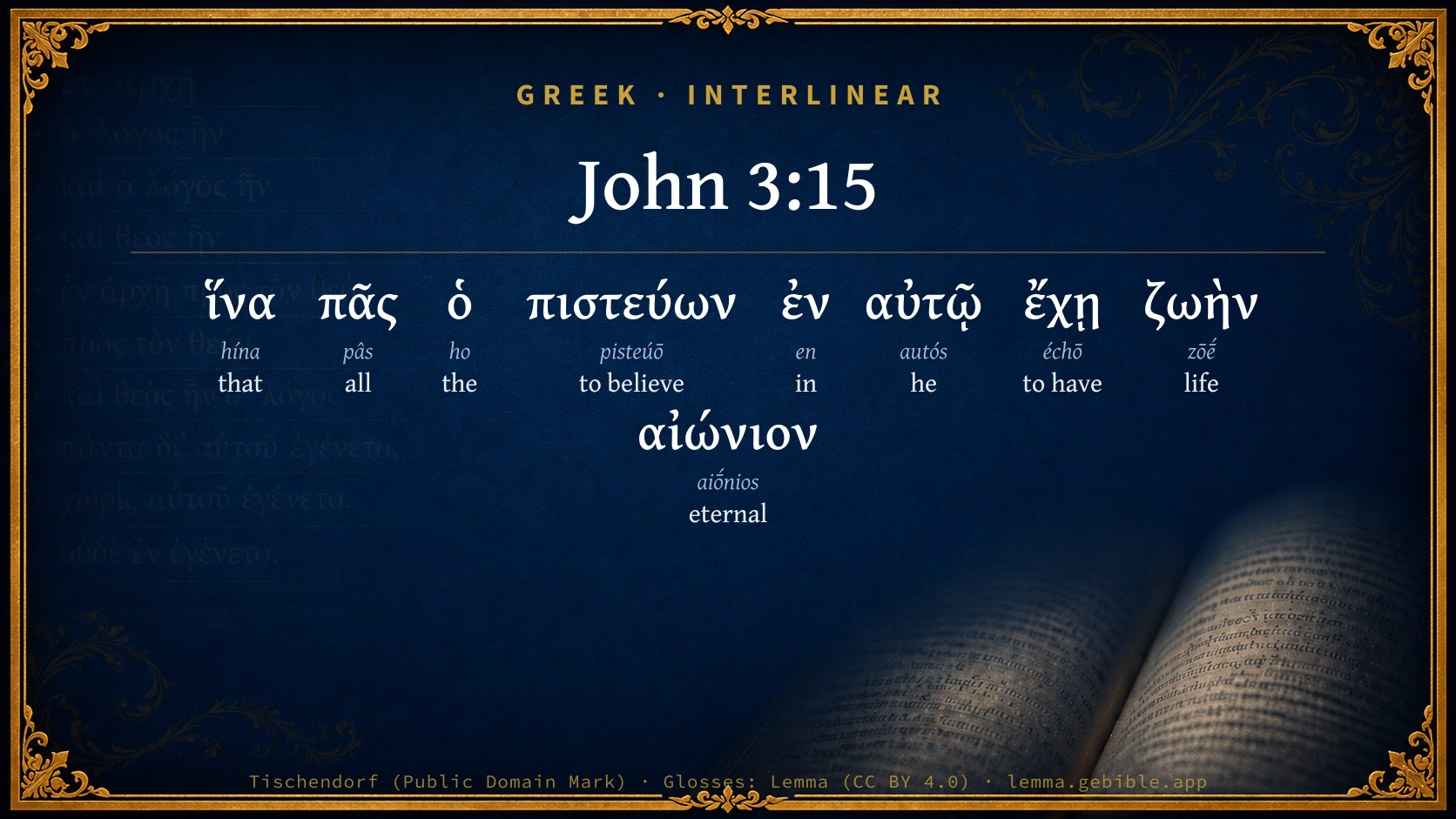
Greek (Tischendorf 8th ed.) John 3:15 appears in the Greek New Testament. The text above is from the Tischendorf 8th edition. Each word links to its Strong’s number and a concise gloss. Click any word for its full Thayer’s Greek Lexicon entry.
Download image
Cite this verse

John 3:15 (World English Bible). Public Domain. Lemma interlinear Bible study tool, https://lemma.gebible.app/v/john/3/15.

Show BibTeX & RIS
BibTeX
RIS
English Translation
that whoever believes in him should not perish, but have eternal life.
World English Bible · Public Domain
Download a study sheet

One document with this verse’s original text, its word-by-word gloss line, the meaning frame, cross-references with their text, attributed commentary, and full source and license credits — printable, and it pastes into notes with its structure intact.

This verse Autodidact and up

Study sheet (.html) Plain text (.txt)

A passage Seminary Student

Up to 50 verses in one chapter. A passage sheet keeps up to 6 commentary sources and 12 cross-references per verse, in the order this page ranks them, and says so on the sheet whenever that leaves anything out. Ask for a single verse and you get the Autodidact verse sheet above.

Everything on this page stays free to read, with no account — the sheet is a download of what is already on screen, not access to it.

Want to remove ads? Support Godless Engineer
Compare translations 3

The same verse in 3 English versions, stacked beneath the original-language interlinear above. Click any original word for its lexicon entry.

Each is an independent rendering of the whole verse — the interlinear is not word-aligned to these translations.

Highlighted words mark where these versions differ — a whole-verse word diff, not a word-by-word alignment.

  • World English Bible Public Domain
    that whoever believes in him should not perish, but have eternal life.
  • King James Version Public Domain
    That whosoever believeth in him should not perish, but have eternal life.
  • unfoldingWord Literal Text CC BY-SA 4.0
    so that everyone believing in him may have eternal life.

unfoldingWord Literal Text — © unfoldingWord, licensed CC BY-SA 4.0. Word-aligned USFM3 via Door43 (git.door43.org/unfoldingWord/en_ult).

Versions to compare (up to 4)

3 of 4 selected

Show all 19 translations

Every available English version of this verse, each an independent rendering of the whole verse.

  • World English Bible Public Domain
    that whoever believes in him should not perish, but have eternal life.
  • Berean Standard Bible Public Domain
    that everyone who believes in Him may have eternal life.
  • Majority Standard Bible Public Domain
    that everyone who believes in Him may not perish, but may have eternal life.
  • King James Version Public Domain
    That whosoever believeth in him should not perish, but have eternal life.
  • American Standard Version (1901) Public Domain
    that whosoever believeth may in him have eternal life.
  • Revised Version (1885) Public Domain
    that whosoever believeth may in him have eternal life.
  • Geneva Bible (1599) Public Domain
    That whosoeuer beleeueth in him, shoulde not perish, but haue eternall life.
  • Douay-Rheims (1899) Public Domain
    That whosoever believeth in him, may not perish; but may have life everlasting.
  • Young's Literal Translation Public Domain
    that every one who is believing in him may not perish, but may have life age-during,
  • Literal Standard Version CC BY-SA 4.0
    that everyone who is believing in Him may not perish, but may have continuous life,
  • Unlocked Literal Bible CC BY-SA 4.0
    so that all who believe in him may have eternal life.
  • unfoldingWord Literal Text CC BY-SA 4.0
    so that everyone believing in him may have eternal life.
  • Darby Bible Public Domain
    that every one who believes on him may [not perish, but] have life eternal.
  • World Messianic Bible Public Domain
    that whoever believes in him should not perish, but have eternal life.
  • Webster's Bible Public Domain
    That whoever believeth in him should not perish, but have eternal life.
  • Free Bible Version CC BY-SA 4.0
    so that everyone who trusts in him will have eternal life.
  • Bible in Basic English Public Domain
    So that whoever has faith may have in him eternal life.
  • Text-Critical English NT CC BY 4.0
    so that everyone who believes in him should not perish but have eternal life.
  • Tyndale New Testament (1534) Public Domain
    that none that beleveth in him perisshe: but have eternall lyfe.

Literal Standard Version (2020), Covenant Press — licensed CC BY-SA 4.0. Text via the HelloAO Bible API (eBible.org). Unlocked Literal Bible (unfoldingWord) — licensed CC BY-SA 4.0. Text via the HelloAO Bible API (eBible.org). unfoldingWord Literal Text — © unfoldingWord, licensed CC BY-SA 4.0. Word-aligned USFM3 via Door43 (git.door43.org/unfoldingWord/en_ult). Free Bible Version, Dr. Jonathan Gallagher — licensed CC BY-SA 4.0. Text via the HelloAO Bible API (eBible.org).

Word by word

More ways to search: Search by grammar → Find every occurrence → Compare this word →

Practice this passage: Drill this verse → Learn its vocabulary →

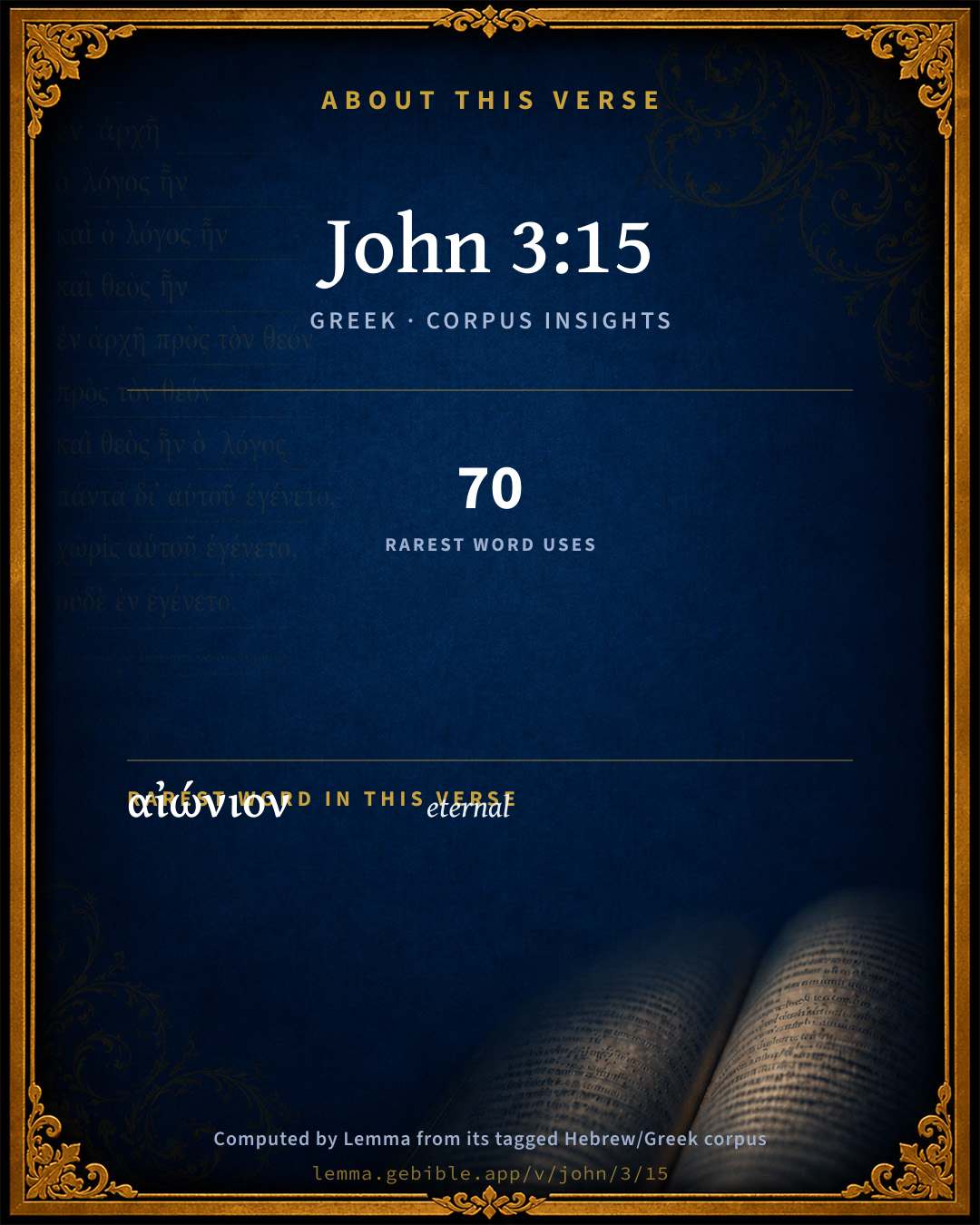
About this verse

These counts appear in no published source. They are computed here, from the morphology-tagged text and Lemma’s own curated glosses. What Lemma adds →

9
words
9
distinct lemmas
Gospels
section

Cross-references

33

Topical passages linked to John 3:15 in the Treasury of Scripture Knowledge — connected by theme and wording, ordered by reader-vote popularity; previews shown in the World English Bible.

  • John 3:16 For God so loved the world, that he gave his one and only Son, that whoever believes in him should not perish, but have eternal life.
  • John 6:40 This is the will of the one who sent me, that everyone who sees the Son, and believes in him, should have eternal life; and I will raise him up at the last day."
  • John 3:36 One who believes in the Son has eternal life, but one who disobeys the Son won't see life, but the wrath of God remains on him."
  • John 12:44–46 Jesus cried out and said, "Whoever believes in me, believes not in me, but in him who sent me.
  • 1 John 5:11–13 The testimony is this, that God gave to us eternal life, and this life is in his Son.
  • John 10:28–30 I give eternal life to them. They will never perish, and no one will snatch them out of my hand.
  • John 20:31 but these are written, that you may believe that Jesus is the Christ, the Son of God, and that believing you may have life in his name.
  • Romans 10:9–14 that if you will confess with your mouth the Lord Jesus, and believe in your heart that God raised him from the dead, you will be saved.
  • Hebrews 7:25 Therefore he is also able to save to the uttermost those who draw near to God through him, seeing he ever lives to make intercession for them.
  • 1 John 5:1 Whoever believes that Jesus is the Christ is born of God. Whoever loves the father also loves the child who is born of him.
  • 1 John 5:20 We know that the Son of God has come, and has given us an understanding, that we know him who is true, and we are in him who is true, in his Son Jesus Christ. This is the true God, and eternal life.
  • Isaiah 45:22 Look to me, and be you saved, all the ends of the earth; for I am God, and there is none else.
  • John 1:12 But as many as received him, to them he gave the right to become God's children, to those who believe in his name:
  • John 6:47 Most assuredly, I tell you, he who believes in me has eternal life.
  • John 11:25–26 Jesus said to her, "I am the resurrection and the life. He who believes in me, though he die, yet will he live.
  • Acts 16:30–31 and brought them out and said, "Sirs, what must I do to be saved?"
  • Luke 19:10 For the Son of Man came to seek and to save that which was lost."
  • John 5:24 "Most assuredly I tell you, he who hears my word, and believes him who sent me, has eternal life, and doesn't come into judgment, but has passed out of death into life.
  • John 17:2–3 even as you gave him authority over all flesh, he will give eternal life to all whom you have given him.
  • Romans 6:22–23 But now, being made free from sin, and having become servants of God, you have your fruit of sanctification, and the result of eternal life.
  • Galatians 2:16 yet knowing that a man is not justified by the works of the law but through the faith of Jesus Christ, even we believed in Christ Jesus, that we might be justified by faith in Christ, and not by the works of the law, because no flesh will be justified by the works of the law.
  • Mark 16:16 He who believes and is baptized will be saved; but he who disbelieves will be condemned.
  • Acts 8:36 As they went on the way, they came to some water, and the eunuch said, "Behold, here is water. What is keeping me from being baptized?"
  • Hebrews 10:39 But we are not of those who shrink back to destruction, but of those who have faith to the saving of the soul.
  • 1 John 2:25 This is the promise which he promised us, the eternal life.
  • Matthew 18:10 See that you don't despise one of these little ones, for I tell you that in heaven their angels always see the face of my Father who is in heaven.
  • Acts 13:41 'Behold, you scoffers, and wonder, and perish; For I work a work in your days, A work which you will in no way believe, if one declares it to you.'"
  • Romans 5:1–2 Being therefore justified by faith, we have peace with God through our Lord Jesus Christ;
  • Romans 5:21 that as sin reigned in death, even so might grace reign through righteousness to eternal life through Jesus Christ our Lord.
  • 1 Corinthians 1:18 For the word of the cross is foolishness to those who are dying, but to us who are saved it is the power of God.
  • 2 Corinthians 4:3 Even if our Gospel is veiled, it is veiled in those who perish;
  • Galatians 2:20 I have been crucified with Christ, and it is no longer I that live, but Christ living in me. That life which I now live in the flesh, I live by faith in the Son of God, who loved me, and gave himself up for me.
  • John 16:33 I have told you these things, that in me you may have peace. In the world you have oppression; but cheer up! I have overcome the world."

Cross-references courtesy of OpenBible.info (CC BY 4.0).

Where the printed editions differ

1 variant

Places in this verse where the major printed Greek editions disagree on the wording in a way that affects the translation — a comparison of editions, not a manuscript-by-manuscript collation. The editions are the modern critical texts (Nestlé-Aland 28/27, SBL, Westcott-Hort, Tregelles, Tyndale House) and the traditional texts behind the KJV (the Textus Receptus and the Byzantine/Majority text). It is not a claim about which reading is original.

  1. Extra text
    μὴ ἀπόληται ἀλλ᾽

    “not may perish but”

    In TRByz Not in NA28NA27TynSBLWHTreg

    μὴ ἀπόληται ἀλλ᾽ (mē apolētai all᾽) 'not may perish but' is only in traditional manuscripts (TR+Byz)

Textual data: Translators Amalgamated Greek New Testament (STEPBible TAGNT) · CC BY 4.0.

Commentary

Notes on John 3:15 from classic Christian and Jewish commentators (each source and its license shown beneath its notes). The classic Christian expositions comment on the surrounding passage and are grouped to its opening verse, so a note may address several verses; the Jewish commentaries on the Tanakh (Rashi and others) are per-verse, so they appear only where the commentator wrote on this verse.

Lemma curates 59 commentaries, every one of them public domain or Creative Commons licensed, each selected and text-cleaned for this edition rather than reprinted as found. About our sources →

John Gill's Exposition

For God so loved the world,.... The Persic version reads "men": but not every man in the world is here meant, or all the individuals of human nature; for all are not the objects of God's special love, which is here designed, as appears from the instance and evidence of it, the gift of his Son: nor is Christ God's gift to every one; for to whomsoever he gives his Son, he gives all things freely with him; which is not the case of every man. Nor is human nature here intended, in opposition to, and distinction from, the angelic nature; for though God has showed a regard to fallen men, and not to fallen angels, and has provided a Saviour for the one, and not for the other; and Christ has assumed the nature of men, and not angels; yet not for the sake of all men, but the spiritual seed of Abraham; and besides, it will not be easily proved, that human nature is ever called the world: nor is the whole body of the chosen ones, as consisting of Jews and Gentiles, here designed; for though these are called the world, Joh 6:33; and are the objects of God's special love, and to them Christ is given, and they are brought to believe in him, and shall never perish, but shall be saved with an everlasting salvation; yet rather the Gentiles particularly, and God's elect among them, are meant; who are often called "the world", and "the whole world", and "the nations of the world", as distinct from the Jews; see Rom 11:12, compared with Mat 6:32. The Jews had the same distinction we have now, the church and the world; the former they took to themselves, and the latter they gave to all the nations around: hence we often meet with this distinction, Israel, and the nations of the world; on those words,

""let them bring forth their witness", that they may be justified, Isa 43:9 (say (b) the doctors) these are Israel; "or let them hear and say it is truth", these are "the nations of the world".''

And again (c),

"the holy, blessed God said to Israel, when I judge Israel, I do not judge them as "the nations of the world":''

and so in a multitude of places: and it should be observed, that our Lord was now discoursing with a Jewish Rabbi, and that he is opposing a commonly received notion of theirs, that when the Messiah came, the Gentiles should have no benefit or advantage by him, only the Israelites; so far should they be from it, that, according to their sense, the most dreadful judgments, calamities, and curses, should befall them; yea, hell and eternal damnation.

"There is a place (they say (d),) the name of which is "Hadrach", Zac 9:1. This is the King Messiah, who is, , "sharp and tender"; sharp to "the nations", and tender to "Israel".''

And so of the "sun of righteousness", in Mal 4:2, they say (e),

"there is healing for the Israelites in it: but the idolatrous nations shall be burnt by it.''

And that (f).

"there is mercy for Israel, but judgment for the rest of the nations.''

And on those words in Isa 21:12, "the morning cometh", and also the night, they observe (g),

"the morning is for the righteous, and the night for the wicked; the morning is for Israel, and the night for "the nations of the world".''

And again (h),

"in the time to come, (the times of the Messiah,) the holy, blessed God will bring "darkness" upon "the nations", and will enlighten Israel, as it is said, Isa 60:2.''

Once more (i),

"in the time to come, the holy, blessed God will bring the nations of the world, and will cast them into the midst of hell under the Israelites, as it is said, Isa 43:3.''

To which may be added that denunciation of theirs (k).

"woe to the nations of the world, who perish, and they know not that they perish: in the time that the sanctuary was standing, the altar atoned for them; but now who shall atone for them?''

Now, in opposition to such a notion, our Lord addresses this Jew; and it is as if he had said, you Rabbins say, that when the Messiah comes, only the Israelites, the peculiar favourites of God, shall share in the blessings that come by, and with him; and that the Gentiles shall reap no advantage by him, being hated of God, and rejected of him: but I tell you, God has so loved the Gentiles, as well as the Jews,

that he gave his only begotten Son; to, and for them, as well as for the Jews; to be a covenant of the people, the Gentiles, the Saviour of them, and a sacrifice for them; a gift which is a sufficient evidence of his love to them; it being a large and comprehensive one, an irreversible and unspeakable one; no other than his own Son by nature, of the same essence, perfections, and glory with him; begotten by him in a way inconceivable and expressible by mortals; and his only begotten one; the object of his love and delight, and in whom he is ever well pleased; and yet, such is his love to the Gentiles, as well as Jews, that he has given him, in human nature, up, into the hands of men, and of justice, and to death itself:

that whosoever believeth in him, whether Jew or Gentile,

should not perish, but have everlasting life; See Gill on Joh 3:15.

(b) T. Bab. Avoda Zara, fol. 2. 1. (c) Ib. fol. 4. 1. Vid. T. Bab. Sanhedrin, fol. 91. 2. & Bereshit Rabba, fol. 11. 3. (d) Shirhashirim Rabba, fol. 24. 1. Jarchi & Kimchi in Zech. ix. 1. (e) Zohar in Gen. fol. 112. 2. (f) Zohar in Exod. fol. 15. 1, 2. (g) T. Hieros. Taaniot, fol. 64. 1. (h) Shemot Rabba, sect. 14. fol. 99. 4. (i) Ib sect. 11. fol. 98. 3. (k) T. Bab. Succa, fol. 55. 2.

John Gill's Exposition of the Whole Bible (1746–1763) — public domain (CC PDM 1.0). Text via the HelloAO Bible API.

Bengel's Gnomon

Johann Albrecht Bengel

Joh 3:15. Ἵνα, that) The goodness to us of the Son in Joh 3:15, and of the Father in Joh 3:16, is described in the same words. [The grace of the Son is what is most frequently noted, and the love of the Father (2Co 13:14, the benediction).—V. g.] Comp. ch. Joh 6:37, “All that the Father giveth Me shall come to Me: and him that cometh to Me I will in no wise cast out;” notes, ch. Joh 10:28-29, “Neither shall any pluck them out of My hand:—none is able to pluck them out of My Father’s hand:—ὁ πιστεύων, who believeth) Now Jesus begins a plainer style of speech. Faith, in the case of those needing to be saved, is what looking to the uplifted serpent was in the case of those needing to be healed.—εἰς αὐτόν, in Him) as lifted up. The cross [is] the ladder to heaven.—μὴ ἀπόληται, should not perish) by the poison of sin.—ζωὴν αἰώνιον, eternal life) by regeneration and faith. This mention of eternal life is made at the earliest time in each instance, in the discourses of the Saviour, and occurs in this passage first. He takes it for granted as very well known from the Old Testament: ch. Joh 5:39, “Search the Scriptures: for in them ye think ye have eternal life.” See Dan 12:2, “Many of them that sleep in the dust of the earth shall awake, some to everlasting life,” etc.; Luk 10:25, [The lawyer’s question] “Master, what shall I do to inherit eternal life?”

Bengel's Gnomon of the New Testament — English translation (T&T Clark, Edinburgh, 1860) — public domain. Text from a community e-Sword module.

Expositor's Greek Testament

ed. W. Robertson Nicoll

Joh 3:15 . The words μὴ ἀπόληται ἀλλʼ of the T.R. are omitted by Tisch [41] , W.H [42] , and R.V [43] Further, the same editors replace the words εἰς αὐτὸν by ἐν αὐτῷ , and the R.V [44] translates “that whosoever believeth may in Him have eternal life,” in accordance with Johannine usage, which does not support the rendering “believeth in Him”. This is the object to be accomplished by the “elevation” of the Son of Man, viz. , that whoever, Jew or Gentile, believes that there is life in Him that is thus exalted, may have life eternal.

[41] Tischendorf.

[42] Westcott and Hort.

[43] Revised Version.

[44] Revised Version.

The Expositor's Greek Testament, edited by W. Robertson Nicoll (1897–1910) — public domain. Text from a community e-Sword module.

Cambridge Greek Testament for Schools and Colleges

15. ἐν αὐτῷ for εἰς αὐτόν (a correction to S. John’s usual construction): μὴ ἀπόληται ἀλλ’ before ἔχῃ is an insertion (A) from Joh 3:16; אBL omit.

15. ἵνα. see on Joh 1:8. The eternal life of all believers, whether Jew or Gentile, is the purpose of the Divine δεῖ. The lifting up on the Cross was the turning-point in the faith of Nicodemus (Joh 19:39).

ἐν αὐτῷ. This goes with ἔχῃ rather than πιστεύων; that every one (Joh 11:25, Joh 12:46) that believeth may in Him have eternal life. Authorities are much divided between ἐν and ἐπ, αὐτῷ, εἰς and ἐπ’ αὐτόν. The confusion partly arose from the insertion of μὴ ἀπόληται ἀλλ’ from Joh 3:16 before ἔχῃ, causing the preposition and pronoun to be taken with πιστεύων.

ζωὴν αἰώνιον. This is one of S. John’s favourite phrases. It occurs 17 times in the Gospel (8 in the Synoptics) and 6 in the First Epistle. In neither Gospel nor Epistle does he apply αἰώνιος to anything but ζωή. The phrase ἔχειν ζωὴν αἰώνιον is also one of S. John’s phrases, Joh 3:36, Joh 5:24, Joh 6:40; Joh 6:47; Joh 6:54; 1Jn 3:15; 1Jn 5:12.

Cambridge Greek Testament for Schools and Colleges (Cambridge University Press, 1896; 21 vols, various authors incl. Carr, Maclear, Plummer, Farrar, Lumby, Moule, M. R. James, Simcox) — public domain. Text from a community e-Sword module.

Vincent's Word Studies in the New Testament

Marvin R. Vincent

Believeth in Him [πιστευων εις αυτον] . The best texts read ejn aujtw, construing with have eternal life, and rendering may in Him have eternal life. So Rev..

Should not perish, but. The best texts omit.

Have eternal life. A characteristic phrase of John for live forever. See vv. 16, 36; Joh 5:24; Joh 6:40, 47, 54; 1Jo 3:15; 1Jo 5:12.

The interview with Nicodemus closes with ver. 15; and the succeeding words are John's. This appears from the following facts :

1. The past tenses loved and gave, in ver. 16, better suit the later point of view from which John writes, after the atoning death of Christ was an accomplished historic fact, than the drift of the present discourse of Jesus before the full revelation of that work.

2. It is in John's manner to throw in explanatory comments of his own (i. 16 - 18; 1Jo 12:37 - 41), and to do so abruptly. See Joh 1:15, 16, and on and, Joh 1:16.

3. Ver. 19 is in the same line of thought with Joh 1:9 - 11 in the Prologue; and the tone of that verse is historic, carrying the sense of past rejection, as loved darkness; were evil.

4. The phrase believe on the name is not used elsewhere by our Lord, but by John (i. 12; Joh 2:23; 1Jo 5:13).

5. The phrase only - begotten son is not elsewhere used by Jesus of himself, but in every case by the Evangelist (i. 14, 18; 1Jo 4:9).

6. The phrase to do truth (ver. 21) occurs elsewhere only in 1Jo 1:6. 2 3

Marvin R. Vincent, Word Studies in the New Testament (1887–1900) — public domain. Text from a community e-Sword/MySword module.

Adam Clarke's Commentary

Verse 15. That whosoever believeth] Bp. Pearce supposes that this verse is only the conclusion of the 16th, and that it has been inserted in this place by mistake. The words contain the reason of the subject in the following verse, and seem to break in upon our Lord's argument before he had fully stated it. The words, μη αποληται αλλα, may not perish but, are omitted by some very ancient MSS. and versions.

Adam Clarke's Commentary on the Bible (1810–1826) — public domain. Text from a community e-Sword/MySword module.

Ellicott's Commentary for English Readers

(15) Not perish, but . . .—These words have been added here from the following verse. Omitting them, the sentence should be rendered, that every one who believeth may have in Him eternal life. This construction is borne out by a comparison of Joh_5:39; Joh_16:33; Joh_20:31. “To believe in Him” is not used by St. John. (See Note on Joh_1:12.) The thought of this verse is that as every Israelite, believing in God, had in the brazen serpent a message from God; so every man who believes in God ever has this message from God in the crucified Son of Man. The object of faith is not here expressed. The words speak only of the man who believeth, whose heart is open to spiritual truth. That man has, in Jesus Christ and Him crucified, a truth which goes to his inmost spirit, sending a new life through his whole being. To the non-believer this may be but the self-sacrifice of heroism. To the believer it is Light breaking upon the darkness of his soul; it is Life bursting the cold sepulchre of a deadened spirit; it is Love winning its way through the scales of a hardened heart; it is Mercy deeper and wider even than his sin; it is Hope bracing the man to a new life of holiness; it is the Word of God, and in Him he has eternal life. The reader will not forget that the lifting up the serpent of brass followed the confession of the people. “We have sinned . . . pray unto the Lord that He take away the serpents from us” (Num_21:7).

A Bible Commentary for English Readers, edited by Charles John Ellicott (1878–1897) — public domain. Text from a community e-Sword module.

The Cambridge Bible for Schools and Colleges

gen. ed. J. J. S. Perowne

15. That] The eternal life of believers is the purpose of the ‘must’ in Joh_3:14. For ‘should’ read may both here and in Joh_3:16.

not perish, but] These words are not genuine here, but have been taken from the next verse. When they are struck out it is better to take ‘in Him’ with ‘have’ than with ‘believeth:’ that every one who believeth may have in Him eternal life.

The Cambridge Bible for Schools and Colleges (gen. ed. J. J. S. Perowne; Cambridge University Press, 1878–1918) — public domain. Text from a community e-Sword module.

Trapp's Complete Commentary

John Trapp

15 That whosoever believeth in him should not perish, but have eternal life.

Ver. 15. That whosoever believeth] Faith is the soul’s hand ( fidei mendica manus, saith Luther); foot, whereby we come to Christ; mouth ( hic credere est edere, saith Austin); wing, whereby we soar up and fetch Christ into the heart, Joh 6:35-36.

John Trapp, A Commentary or Exposition upon All the Books of the Old and New Testament (1647–1656) — public domain. Text from a community e-Sword module.

Albert Barnes' Notes on the Bible

That whosoever - This shows the fulness and freeness of the gospel. All may come and be saved.Believeth in him - Whosoever puts confidence in him as able and willing to save. All who feel that they are sinners, that they have no righteousness of their own, and are willing to look to him as their only Saviour.

Should not perish - They are in danger, by nature, of perishing - that is, of sinking down to the pains of hell; of being “punished with everlasting destruction” from the presence of the Lord and from the glory of his power, 2Th 1:9. All who believe on Jesus shall be saved from this condemnation and be raised up to eternal life. And from this we learn:

1.That there is salvation in no other.

2.That salvation is here full and free for all who will come.

3.That it is easy. What was more easy for a poor, wounded, dying Israelite, bitten by a poisonous serpent, than to look up to a brass serpent? So with the poor, lost, dying sinner. And what more foolish than for such a wounded, dying man to refuse to look on a remedy so easy and effectual? So nothing is more foolish man for a lost and dying sinner to “refuse” to look on God’s only Son, exalted on a cross to die for the sins of men, and able to save to the uttermost “all” who come to God by him.

Albert Barnes' Notes on the Bible (1834–1885) — public domain. Text from a community e-Sword/MySword module.

Matthew Poole's English Annotations

Here our Lord openeth the instrumental cause of justification and salvation, that is, believing εις αυτον,

in him. It is one thing to believe in him as a teacher, another thing to believe in him as a Saviour. The object of the first is a proposition; we believe a person when we assent and give credit to what he saith, because he saith it. The object of the latter is the person and merits of the Mediator. As the looking up to the brazen serpent healed the person, not by any physical operation, but from the goodness of God, as it was an act of obedience to the Divine institution for that end; so neither doth faith in the Mediator justify and obtain pardon for any soul from any meritorious virtue in that act, but from God’s gracious ordination, that so it shall be; he hath so ordained, that whosoever shall rest upon Christ, and receive him by faith as his Mediator and Saviour, should not perish, but live for ever. There are other things besides faith necessary to salvation, such are repentance, love, and new obedience; nor is faith only mentioned because they are ingredients into it, but because faith is the root of all those, and that from which they must necessarily flow; for it is as impossible that any should truly hope, and trust in, and rest upon Christ for that life which he hath only promised to those that obey him, as it is impossible that any should indeed trust in and rest upon a man who hath promised a reward upon a condition for that reward, without any care to fulfil that condition. But by this and other places, where faith alone in Christ is mentioned as necessary to salvation. Nicodemus was taught, that no obedience to the works of the law without this faith in the Mediator would bring the soul to eternal life and salvation.

Matthew Poole's English Annotations on the Holy Bible (1683–1685) — public domain. Text from a community e-Sword/MySword module.

Whedon's Commentary on the Bible

Daniel D. Whedon

15. Whosoever believeth—The offers of the means of salvation are universal; extended to the entire world. The salvation itself is limited only by the unbelief of man. The atonement is unlimited by God’s design; the salvation, by application of the atonement, is limited by man’s rejection. This whosoever takes in every individual person; just as the term world takes in the sum total.

Perish… have eternal life—Perishing and eternal life are placed in opposition, and so aid to explain each other.

Daniel D. Whedon (gen. ed.), Commentary on the Old and New Testaments (1874–1909) — public domain. Text from a community e-Sword module.

John Wesley's Explanatory Notes

That whosoever - He must be lifted up, that hereby he may purchase salvation for all believers: all those who look to him by faith recover spiritual health, even as all that looked at that serpent recovered bodily health.

John Wesley, Explanatory Notes Upon the Whole Bible (1754–1765) — public domain. Text via the GEBible commentary corpus.

Alford’s Greek Testament

Henry Alford

15.] The corresponding clause applying to the type is left to be supplied—‘And as every one who looked on it was healed, so …’

πιστ. ἐν αὐτῷ] This expression, here only used by John, implies His exaltation,—see ch. 12:32. It is a belief in (abiding in, see note on ver. 18) His Person being what God by His sufferings and exaltation hath made Him to be, and being that to me. This involves, on the part of the believer, the anguish of the bite of the fiery serpent,—and the earnest looking on Him in Whom sin is crucified, with the inner eye of faith.

ἔχῃ ζ. αἰ.] Just as in the type, God did not remove the fiery serpents,—or not all at once,—but healing was to be found in the midst of them by looking to the brazen serpent (πᾶς ὁ δεδηγμένος ἰδὼν αὐτὸν ζήσεται, LXX),—so the temptations and conflicts of sin shall not leave the believer,—but in the midst of these, with the Eye of Faith fixed on the uplifted Son of Man, he has eternal life; perishes not of the bite, but ζήσεται.

See on this verse the remarkable passage, Wisd. 16:5-13, where as much of the healing sign is opened as could be expected before the great Antitype Himself appeared.

Henry Alford, The Greek Testament (1849–1861) — public domain. Text from a community e-Sword module.

International Critical Commentary

15. Before ἔχῃ the rec. text interpolates μὴ ἀπόληται ἀλλʼ (from v. 16) with אΓΔΘ, but the words are omitted here by אBLTb 33 fam. 1, etc.

The rec. has εἰς αὐτὸν after πιστεύων (a common constr in Jn.; see on 1:12) with אΓΔΘ; but recent editors have generally followed BTbW in reading ἐν αὐτῷ Yet the constr. πιστεύειν ἔν τινι never appears in Jn., so that if we read ἐν αὐτῷ, πιστεύων must be taken in an absolute sense (see on 1:7 for this usage), and we must translate, with the R.V., “Whosoever believeth may in Him have eternal life.” (Cf. for the constr. 1:4.) The thought of the believer being “in Christ” is thoroughly Johannine (15:4, 1Jn 5:20) as well as Pauline. But we prefer the reading εἰς αὐτόν, which has good MS. support. See on v. 16.

The connexion between faith and eternal life runs through the Gospel, the purpose of its composition being ἵνα πιστεύοντες ζωὴν ἔχητε ἐν τῷ ὀνόματι αὐτοῦ (20:31). Cf. 6:47 ὁ πιστεύων ἔχει ζωὴν αἰώνιον and 3:36 ὁ πιστεύων εἰς τὸν υἱὸν ἔχει ζω. αἰώ, where see note.

The adj. αἰώνιος is always associated in Jn. with ζωή (never, as in Mt. or Mk., with “sin” or “fire”), the expression ζωὴ αἰώνιος occurring 17 times in the Gospel and 6 times in 1 Jn. (in the form ἡ ζωὴ ἡ αἰώνιος in 1Jn 1:2, 1Jn 2:25). ζωὴ αἰώνιος as the portion of the righteous is mentioned Dan 12:2, and thereafter the expression is found in the Psalter of Solomon (iii. 16) and in Enoch.1 It occurs frequently in the Synoptists and in Paul, and always in the sense of the future life after death (but see on 12:50). This significance it has also in Jn. many times; e.g. in the present passage this is the primary meaning. Cf. esp. 12:25, and see note on 4:14. But for Jn, and for him alone among N.T. writers (although cf. 1Ti 6:19), ζωὴ αἰώνιος may be a present possession of the believer (3:36, 5:24, 6:47, 1Jn 5:13), which continues and abides after the shock of death (6:54). “To have eternal life” means more than “to live for ever”; the stress is not so much upon the duration of the life, as upon its quality. To have eternal life is to share in the life of God (5:26) and of Christ (l:4), which is unfettered by the conditions of time. And so it is defined as the knowledge of God and of Christ (17:3), for true knowledge cannot be without affinity. Thus ὁ ἔχων τὸν υἱὸν ἔχει τὴν ζωήν (1Jn 5:12). See Introd., p. clx.

The Evangelist’s Comment on the Preceding Discourse (Vv. 16-21, 31-36)

International Critical Commentary — older volumes (1896–1929), various authors — public domain. Text from a community e-Sword module.

Godet's Commentaries

Frédéric Louis Godet

Vv. 15 finishes the application of the type. To the look of the dying Israelite the faith of the sinner in the crucified one corresponds; to the life restored to the wounded one, the salvation granted to the believer.— Πᾶς, whosoever extends to the whole of humanity the application of the Israelitish type, while emphatically individualizing the act of faith (ὁ).—The reading of the T. R. εἰς αὐτόν, to or on Him, is the one which best suits the context (the look turned towards ...); faith looks to its object. If we consider how little the Alexandrian authorities agree among themselves, the received reading will be acknowledged as, on the whole, the best supported one. Tischendorf (8th ed.) reads ἐν αὐτῷ, after the Vatican MS.; in that case, this limiting phrase may be connected with ἔχῃ, as Weiss and Keil connect it, rather than withπιστεύων . But, in this context, the connection with πιστεύων remains, nevertheless, the most natural relation. The Alexandrian authorities reject the words μὴ ἀπόληται ἀλλά should not perish, but; they may certainly have been introduced here from Joh 3:16. Even in that case we are struck with the rhythmic relation between the last words of these two verses; it is the sign of the stirring of feeling and elevation of thought (Introd., p. 137). We comprehend, indeed, what an impression this first revelation of His future suffering of punishment must have produced on Jesus Himself; comp. Joh 12:27.

As for Nicodemus, we also account for what he experienced when on the Holy Friday he saw Jesus suspended on the cross. That spectacle, instead of being for him, as for others, a stumbling-block, a ground of unbelief and despair, causes his latent faith to break forth (Joh 19:39). This fact is the answer to de Wette’s question, who asks if this anticipatory revelation of the death of the Messiah was not contrary to the pedagogic wisdom of Jesus. Weiss, who is not willing to admit that Jesus so early foresaw and predicted His death, thinks that Jesus did not express Himself in so precise a way, but that he spoke vaguely of some lifting up which would be accorded to Him during His earthly life, to the end that He might be recognized as Messiah by the Jews. But, in that case, it is necessary to suppose: 1. That John positively falsified the account of the words of Jesus; 2. That Jesus spoke of something which was never realized, for we know not what that supposed lifting-up can be; 3. There no longer remains, in this case, any relation between the prophecy of Jesus and the matter of the brazen serpent. From the cross Jesus ascends to God, from whose love this decree emanates (δεῖ must, Joh 3:14).

Frédéric Louis Godet — Commentaries on Luke, John, Romans, and 1 Corinthians — English translation (T&T Clark, Edinburgh, 1870s–1890s) — public domain. Text from a community e-Sword module.

Lesson kit

Teaching starters — assembled from the data on this page, not authored interpretation. Every prompt links to the verse data it draws on. Edit before teaching.

John, in the Gospels, opens this verse with 9 words (9 distinct Greek lemmas). Its most distinctive word is aiṓnios (“eternal”). A historical commentator’s framing appears above. Read the whole chapter for the surrounding context.

Discussion questions

  1. The word aiṓnios carries the sense “eternal.” How does it shape the verse?
  2. John 3:16 shares this passage’s theme. How do the two illuminate each other?
  3. The translations on this page render this verse differently — a whole-verse word diff, not a word-by-word alignment. What might account for the different wordings?
  4. Reading how John Gill's Exposition and Bengel's Gnomon read this verse, where do the two commentators agree and where do they part?

Things to notice

Reading settings

Reading text

Shown beneath each verse's original-language words.

Old Testament
Old Testament edition

Read the OT as the Masoretic Hebrew (MT) or the Greek Septuagint (LXX).

English shown for the Greek Septuagint (in the Hebrew ↔ Greek comparison).

Comparing translations? Open the Compare panel on any verse page to stack up to four side by side.