
1 Timothy 6:17

Greek (Tischendorf 8th ed.) 1 Timothy 6:17 appears in the Greek New Testament. The text above is from the Tischendorf 8th edition. Each word links to its Strong’s number and a concise gloss. Click any word for its full Thayer’s Greek Lexicon entry.
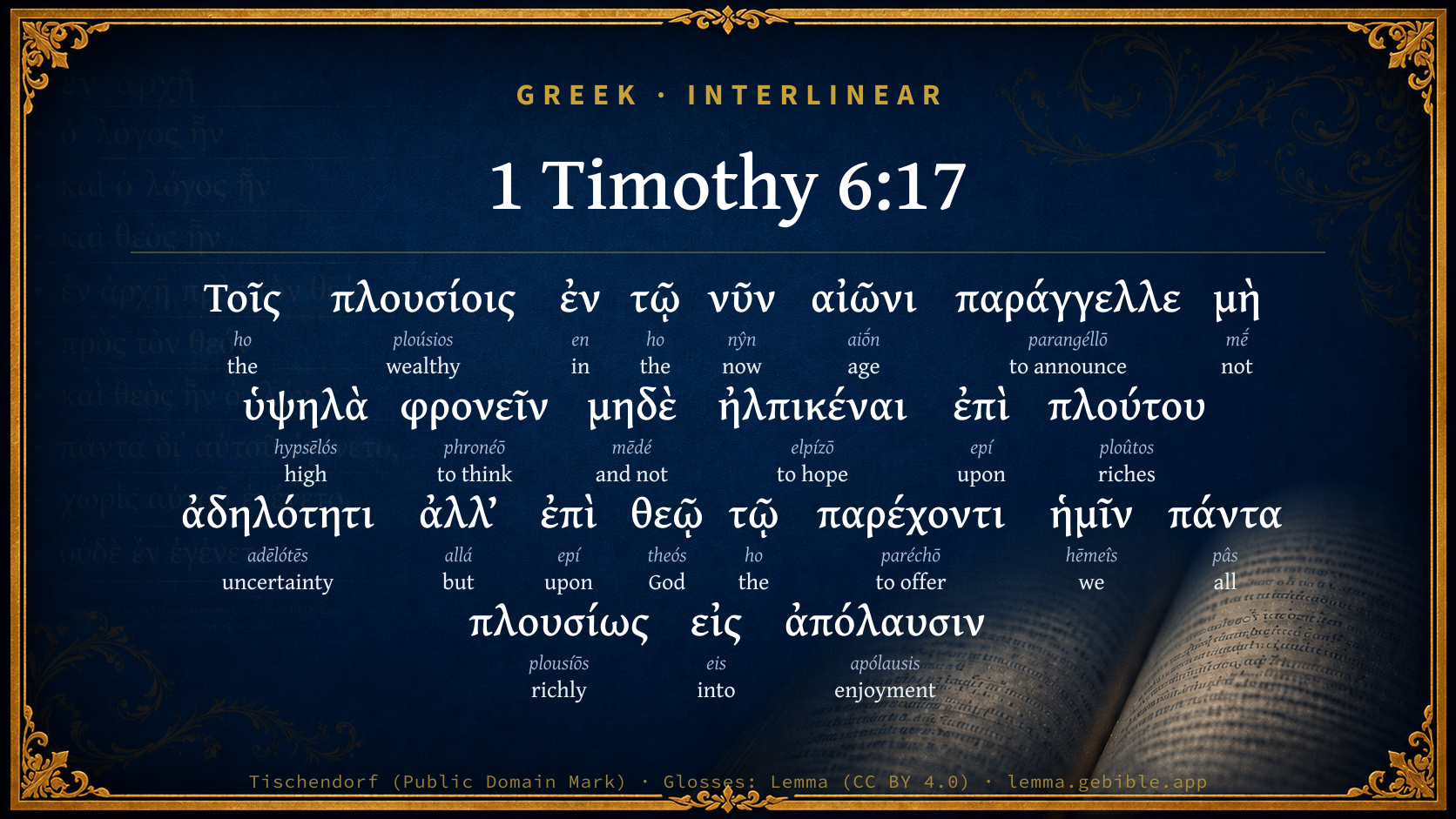
Download image
Cite this verse

1 Timothy 6:17 (World English Bible). Public Domain. Lemma interlinear Bible study tool, https://lemma.gebible.app/v/1-timothy/6/17.

Show BibTeX & RIS
BibTeX
RIS
English Translation
Charge those who are rich in this present world that they not be haughty, nor have their hope set on the uncertainty of riches, but on the living God, who richly provides us with everything to enjoy;
World English Bible · Public Domain
Highlights
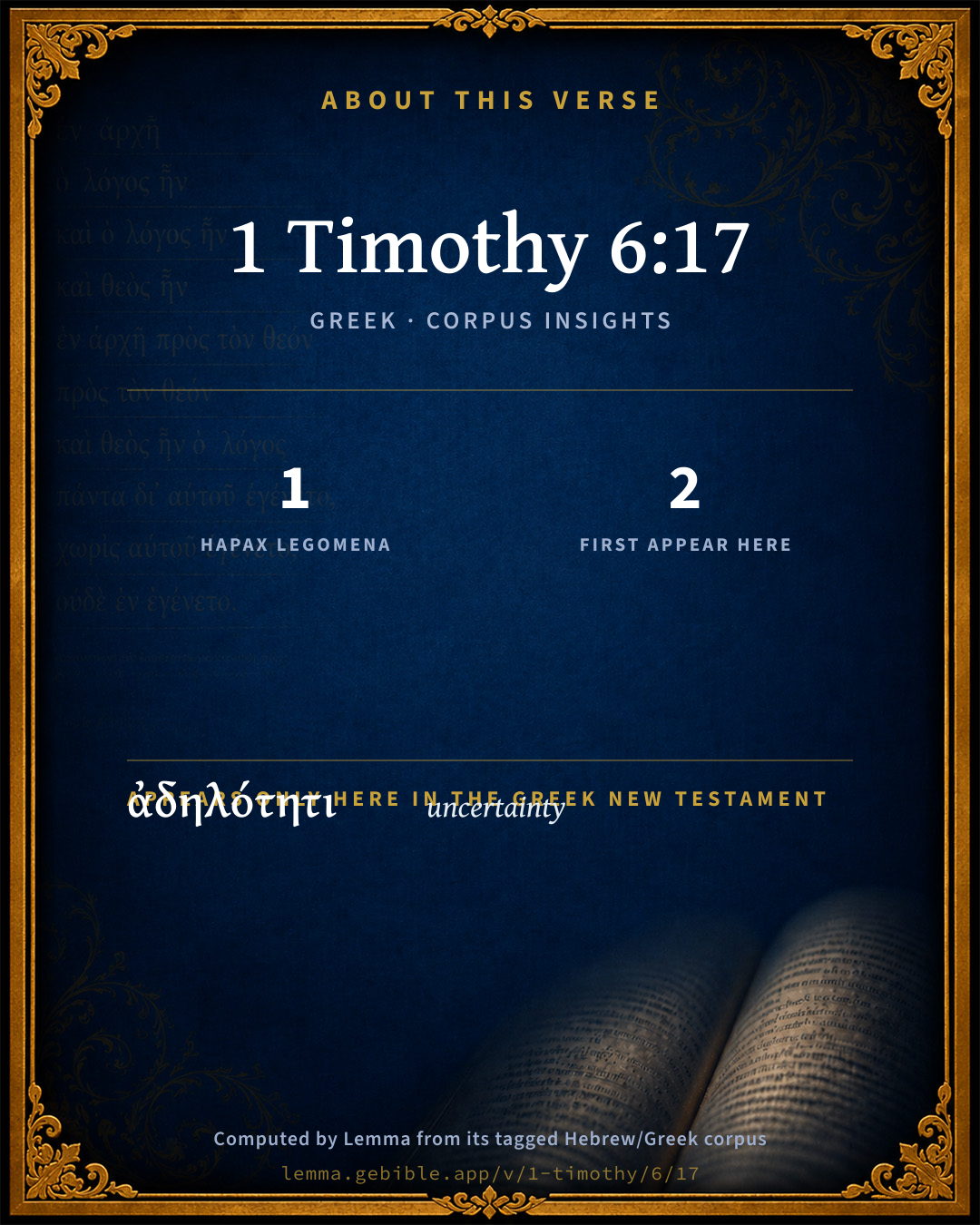
  • 1 hapax legomenon — only here in the Greek New Testament
  • 2 first appearances in the Greek New Testament
Full analysis ↓
Download a study sheet

One document with this verse’s original text, its word-by-word gloss line, the meaning frame, cross-references with their text, attributed commentary, and full source and license credits — printable, and it pastes into notes with its structure intact.

This verse Autodidact and up

Study sheet (.html) Plain text (.txt)

A passage Seminary Student

Up to 50 verses in one chapter. A passage sheet keeps up to 6 commentary sources and 12 cross-references per verse, in the order this page ranks them, and says so on the sheet whenever that leaves anything out. Ask for a single verse and you get the Autodidact verse sheet above.

Everything on this page stays free to read, with no account — the sheet is a download of what is already on screen, not access to it.

Want to remove ads? Support Godless Engineer
Compare translations 3

The same verse in 3 English versions, stacked beneath the original-language interlinear above. Click any original word for its lexicon entry.

Each is an independent rendering of the whole verse — the interlinear is not word-aligned to these translations.

Highlighted words mark where these versions differ — a whole-verse word diff, not a word-by-word alignment.

  • World English Bible Public Domain
    Charge those who are rich in this present world that they not be haughty, nor have their hope set on the uncertainty of riches, but on the living God, who richly provides us with everything to enjoy;
  • King James Version Public Domain
    Charge them that are rich in this world, that they be not highminded, nor trust in uncertain riches, but in the living God, who giveth us richly all things to enjoy;
  • unfoldingWord Literal Text CC BY-SA 4.0
    Command the rich in the present age not to be proud, nor to hope in the uncertainty of riches, but in God, the one providing us all things richly for enjoyment,

unfoldingWord Literal Text — © unfoldingWord, licensed CC BY-SA 4.0. Word-aligned USFM3 via Door43 (git.door43.org/unfoldingWord/en_ult).

Versions to compare (up to 4)

3 of 4 selected

Show all 19 translations

Every available English version of this verse, each an independent rendering of the whole verse.

  • World English Bible Public Domain
    Charge those who are rich in this present world that they not be haughty, nor have their hope set on the uncertainty of riches, but on the living God, who richly provides us with everything to enjoy;
  • Berean Standard Bible Public Domain
    Instruct those who are rich in the present age not to be conceited and not to put their hope in the uncertainty of wealth, but in God, who richly provides all things for us to enjoy.
  • Majority Standard Bible Public Domain
    Instruct those who are rich in the present age not to be conceited and not to put their hope in the uncertainty of wealth, but in the living God, who richly provides all things for us to enjoy.
  • King James Version Public Domain
    Charge them that are rich in this world, that they be not highminded, nor trust in uncertain riches, but in the living God, who giveth us richly all things to enjoy;
  • American Standard Version (1901) Public Domain
    Charge them that are rich in this present world, that they be not highminded, nor have their hope set on the uncertainty of riches, but on God, who giveth us richly all things to enjoy;
  • Revised Version (1885) Public Domain
    Charge them that are rich in this present world, that they be not highminded, nor have their hope set on the uncertainty of riches, but on God, who giveth us richly all things to enjoy;
  • Geneva Bible (1599) Public Domain
    Charge them that are rich in this world, that they be not high minded, and that they trust not in vncertaine riches, but in the liuing God, (which giueth vs aboundantly, all things to enioy)
  • Douay-Rheims (1899) Public Domain
    Charge the rich of this world not to be highminded, nor to trust in the uncertainty of riches, but in the living God, (who giveth us abundantly all things to enjoy,)
  • Young's Literal Translation Public Domain
    Those rich in the present age charge thou not to be high-minded, nor to hope in the uncertainty of riches, but in the living God, who is giving to us all things richly for enjoyment; --
  • Literal Standard Version CC BY-SA 4.0
    Charge those rich in the present age not to be high-minded, nor to hope in the uncertainty of riches, but in the living God, who is giving to us all things richly for enjoyment—
  • Unlocked Literal Bible CC BY-SA 4.0
    Tell the rich in this world not to be proud, and not to hope in riches, which are uncertain. Instead, they should hope in God. He offers to us all the true riches to enjoy.
  • unfoldingWord Literal Text CC BY-SA 4.0
    Command the rich in the present age not to be proud, nor to hope in the uncertainty of riches, but in God, the one providing us all things richly for enjoyment,
  • Darby Bible Public Domain
    Enjoin on those rich in the present age not to be high-minded, nor to trust on the uncertainty of riches; but in the God who affords us all things richly for [our] enjoyment;
  • World Messianic Bible Public Domain
    Charge those who are rich in this present age that they not be arrogant, nor have their hope set on the uncertainty of riches, but on the living God, who richly provides us with everything to enjoy;
  • Webster's Bible Public Domain
    Charge them that are rich in this world, that they be not high-minded, nor trust in uncertain riches, but in the living God, who giveth us richly all things to enjoy;
  • Free Bible Version CC BY-SA 4.0
    Warn those who are rich in the present world not to become proud. Tell them not to place their trust in wealth that is so insecure but in God who so freely gives us everything for our enjoyment.
  • Bible in Basic English Public Domain
    Give orders to those who have money and goods in this life, not to be lifted up in their minds, or to put their hope in the uncertain chances of wealth, but in God who gives us in full measure all things for our use;
  • Text-Critical English NT CC BY 4.0
    Command those who are rich in this present age not to be haughty or to put their hope in the uncertainty of riches, but in the living God, who richly provides us with everything for our enjoyment.
  • Tyndale New Testament (1534) Public Domain
    Charge them that are ryche in this worlde that they be not excedynge wyse and that they trust not in the vncertayne ryches but in the livynge god which geveth vs aboundantly all thynges to enioye them

Literal Standard Version (2020), Covenant Press — licensed CC BY-SA 4.0. Text via the HelloAO Bible API (eBible.org). Unlocked Literal Bible (unfoldingWord) — licensed CC BY-SA 4.0. Text via the HelloAO Bible API (eBible.org). unfoldingWord Literal Text — © unfoldingWord, licensed CC BY-SA 4.0. Word-aligned USFM3 via Door43 (git.door43.org/unfoldingWord/en_ult). Free Bible Version, Dr. Jonathan Gallagher — licensed CC BY-SA 4.0. Text via the HelloAO Bible API (eBible.org).

Word by word

More ways to search: Search by grammar → Find every occurrence → Compare this word →

Practice this passage: Drill this verse → Learn its vocabulary →

ἀδηλότητι
adēlótēs
G83
“uncertainty”
Noun, Dative, Singular, Feminine
Part of Speech
Noun
Case
Dative
Number
Singular
Gender
Feminine
Full Thayer's Definition

Origin: from G82

TDNT: None

1. uncertainty
  1. Τοῖς ho G3588 “the” Article, Dative, Plural, Masculine
  2. πλουσίοις ploúsios G4145 “wealthy” Adjective, Dative, Plural, Masculine
  3. ἐν en G1722 “in” Preposition
  4. τῷ ho G3588 “the” Article, Dative, Singular, Masculine
  5. νῦν nŷn G3568 “now” Adverb
  6. αἰῶνι aiṓn G165 “age” Noun, Dative, Singular, Masculine
  7. παράγγελλε parangéllō G3853 “to announce” Verb, Present, Active, Imperative, 2nd person, Singular
  8. μὴ mḗ G3361 “not” Particle, Negative
  9. ὑψηλὰ hypsēlós G5308 “high” Adjective, Accusative, Plural, Neuter
  10. φρονεῖν phronéō G5426 “to think” Verb, Present, Active, Infinitive
  11. μηδὲ mēdé G3366 “and not” Conjunction, Negative
  12. ἠλπικέναι elpízō G1679 “to hope” Verb, Perfect, Active, Infinitive
  13. ἐπὶ epí G1909 “upon” Preposition
  14. πλούτου ploûtos G4149 “riches” Noun, Genitive, Singular, Masculine
  15. ἀλλ’ allá G235 “but” Conjunction
  16. ἐπὶ epí G1909 “upon” Preposition
  17. θεῷ theós G2316 “God” Noun, Dative, Singular, Masculine
  18. τῷ ho G3588 “the” Article, Dative, Singular, Masculine
  19. παρέχοντι paréchō G3930 “to offer” Verb, Present, Active, Participle, Dative, Singular, Masculine
  20. ἡμῖν hēmeîs G2249 “we” Personal pronoun, 1st person, Dative, Plural
  21. πάντα pâs G3956 “all” Adjective, Accusative, Plural, Neuter
  22. πλουσίως plousíōs G4146 “richly” Adverb
  23. εἰς eis G1519 “into” Preposition
  24. ἀπόλαυσιν apólausis G619 “enjoyment” Noun, Accusative, Singular, Feminine

About this verse

These counts appear in no published source. They are computed here, from the morphology-tagged text and Lemma’s own curated glosses. What Lemma adds →

25
words
22
distinct lemmas
Pauline Epistles
section

Notable vocabulary

1 hapax legomenon — a word that appears only here in the entire Greek New Testament:

  • ἀδηλότητι uncertainty G83

First appearance in Scripture

These words make their first canonical appearance in the Greek New Testament here:

  • ἀδηλότητι uncertainty G83
  • ἀπόλαυσιν enjoyment G619

Shared distinctive vocabulary

ἀπόλαυσιν enjoyment G619 occurs in 2 verses of the Greek New Testament. Also found in:
Repetition

Words recur within this verse:

Cross-references

55

Topical passages linked to 1 Timothy 6:17 in the Treasury of Scripture Knowledge — connected by theme and wording, ordered by reader-vote popularity; previews shown in the World English Bible.

  • Proverbs 11:28 He who trusts in his riches will fall, But the righteous shall flourish as the green leaf.
  • Acts 14:17 Yet he didn't leave himself without witness, in that he did good and gave you rains from the sky and fruitful seasons, filling our hearts with food and gladness."
  • Matthew 19:23 Jesus said to his disciples, "Most assuredly I say to you, a rich man will enter into the Kingdom of Heaven with difficulty.
  • Proverbs 27:24 For riches are not forever, Nor does even the crown endure to all generations.
  • 1 Timothy 4:10 For to this end we both labor and suffer reproach, because we have set our trust in the living God, who is the Savior of all men, especially of those who believe.
  • James 1:9–10 But let the brother in humble circumstances glory in his high position;
  • Jeremiah 9:23–24 Thus says Yahweh, Don't let the wise man glory in his wisdom, neither let the mighty man glory in his might, don't let the rich man glory in his riches;
  • Proverbs 30:9 Lest I be full, deny you, and say, 'Who is Yahweh?' Or lest I be poor, and steal, And so dishonor the name of my God.
  • Jeremiah 17:7–8 Blessed is the man who trusts in Yahweh, and whose trust Yahweh is.
  • Deuteronomy 8:17 and [lest] you say in your heart, My power and the might of my hand has gotten me this wealth.
  • Psalms 84:11–12 For Yahweh God is a sun and a shield. Yahweh will give grace and glory. He withholds no good thing from those who walk blamelessly.
  • Proverbs 23:5 Why do you set your eyes on that which is not? For it certainly sprouts wings like an eagle and flies in the sky.
  • Titus 2:12 instructing us to the intent that, denying ungodliness and worldly lusts, we would live soberly, righteously, and godly in this present world;
  • Psalms 104:28 You give to them; they gather. You open your hand; they are satisfied with good.
  • Ecclesiastes 5:18–19 Behold, that which I have seen to be good and proper is for one to eat and to drink, and to enjoy good in all his labor, in which he labors under the sun, all the days of his life which God has given him; for this is his portion.
  • Daniel 5:19–23 and because of the greatness that he gave him, all the peoples, nations, and languages trembled and feared before him: whom he would he killed, and whom he would he kept alive; and whom he would he raised up, and whom he would he put down.
  • Romans 11:20 True; by their unbelief they were broken off, and you stand by your faith. Don't be conceited, but fear;
  • Colossians 3:16 Let the word of Christ dwell in you richly; in all wisdom teaching and admonishing one another with psalms, hymns, and spiritual songs, singing with grace in your heart to the Lord.
  • Genesis 13:2 Abram was very rich in cattle, in silver, and in gold.
  • 2 Chronicles 26:16 But when he was strong, his heart was lifted up, so that he did corruptly, and he trespassed against Yahweh his God; for he went into the temple of Yahweh to burn incense on the altar of incense.
  • 2 Chronicles 32:25–26 But Hezekiah didn't render again according to the benefit done to him; for his heart was lifted up: therefore there was wrath on him, and on Judah and Jerusalem.
  • Job 1:1–3 There was a man in the land of Uz, whose name was Job. That man was blameless and upright, and one who feared God, and turned away from evil.
  • Job 31:24–25 "If I have made gold my hope, And have said to the fine gold, 'You are my confidence;'
  • Psalms 10:3–4 For the wicked boasts of his heart's cravings, He blesses the greedy, and condemns Yahweh.
  • Psalms 52:7 "Behold, this is the man who didn't make God his strength, But trusted in the abundance of his riches, And strengthened himself in his wickedness."
  • Psalms 62:10 Don't trust in oppression. Don't become vain in robbery. If riches increase, Don't set your heart on them.
  • Psalms 118:8–9 It is better to take refuge in Yahweh, Than to put confidence in man.
  • Ecclesiastes 5:13–14 There is a grievous evil which I have seen under the sun: wealth kept by its owner to his harm.
  • Ezekiel 16:56 For your sister Sodom was not mentioned by your mouth in the day of your pride,
  • Hosea 13:6 According to their pasture, so were they filled; They were filled, and their heart was exalted. Therefore they have forgotten me.
  • Luke 12:15–21 He said to them, "Beware! Keep yourselves from covetousness, for a man's life doesn't consist of the abundance of the things which he possesses."
  • Luke 19:2 There was a man named Zacchaeus. He was a chief tax collector, and he was rich.
  • Acts 17:25 neither is he served by men's hands, as though he needed anything, seeing he himself gives to all life and breath, and all things.
  • Ephesians 5:5 Know this for sure, that no sexually immoral person, nor unclean person, nor covetous man, who is an idolater, has any inheritance in the Kingdom of Christ and God.
  • 1 Thessalonians 1:9 For they themselves report concerning us what kind of a reception we had from you; and how you turned to God from idols, to serve a living and true God,
  • 1 Timothy 1:3 As I exhorted you to stay at Ephesus when I was going into Macedonia, that you might charge certain men not to teach a different doctrine,
  • Titus 3:6 which he poured out on us richly, through Jesus Christ our Savior;
  • Deuteronomy 33:15 For the chief things of the ancient mountains, For the precious things of the everlasting hills,
  • Psalms 73:5–9 They are free from burdens of men, Neither are they plagued like other men.
  • Jeremiah 2:31 Generation, see the word of Yahweh. Have I been a wilderness to Israel? or a land of thick darkness? why say my people, We are broken loose; we will come no more to you?
  • Mark 10:24 The disciples were amazed at his words. But Jesus answered again, "Children, how hard is it for those who trust in riches to enter into the Kingdom of God!
  • 1 Timothy 3:15 but if I wait long, that you may know how men ought to behave themselves in the house of God, which is the assembly of the living God, the pillar and ground of the truth.
  • Revelation 18:6–7 Return to her just as she returned, and repay her double as she did, and according to her works. In the cup which she mixed, mix to her double.
  • Deuteronomy 6:10–12 It shall be, when Yahweh your God shall bring you into the land which he swore to your fathers, to Abraham, to Isaac, and to Jacob, to give you, great and goodly cities, which you didn't build,
  • Psalms 62:8 Trust in him at all times, you people. Pour out your heart before him. God is a refuge for us. Selah.
  • Ezekiel 16:49–50 Behold, this was the iniquity of your sister Sodom: pride, fullness of bread, and prosperous ease was in her and in her daughters; neither did she strengthen the hand of the poor and needy.
  • Daniel 4:30 The king spoke and said, Is not this great Babylon, which I have built for the royal dwelling-place, by the might of my power and for the glory of my majesty?
  • Habakkuk 1:15–16 He takes up all of them with the hook. He catches them in his net, and gathers them in his dragnet. Therefore he rejoices and is glad.
  • Matthew 6:32 For the Gentiles seek after all these things, for your heavenly Father knows that you need all these things.
  • Matthew 27:57 When evening had come, a rich man from Arimathaea, named Joseph, who himself was also Jesus' disciple came.
  • Luke 19:9–10 Jesus said to him, "Today, salvation has come to this house, because he also is a son of Abraham.
  • Acts 14:27 When they had arrived, and had gathered the assembly together, they reported all the things that God had done with them, and that he had opened a door of faith to the Gentiles.
  • 1 Timothy 6:13 I charge you before God, who gives life to all things, and before Christ Jesus, who before Pontius Pilate testified the good confession,
  • 2 Timothy 4:10 for Demas left me, having loved this present world, and went to Thessalonica; Crescens to Galatia, and Titus to Dalmatia.
  • 1 Timothy 5:21 I charge you in the sight of God, and Christ Jesus, and the chosen angels, that you observe these things without prejudice, doing nothing by partiality.

Cross-references courtesy of OpenBible.info (CC BY 4.0).

Where the printed editions differ

1 variant

Places in this verse where the major printed Greek editions disagree on the wording in a way that affects the translation — a comparison of editions, not a manuscript-by-manuscript collation. The editions are the modern critical texts (Nestlé-Aland 28/27, SBL, Westcott-Hort, Tregelles, Tyndale House) and the traditional texts behind the KJV (the Textus Receptus and the Byzantine/Majority text). It is not a claim about which reading is original.

  1. Extra text
    τῷ ζῶντι

    “who is living”

    In TRByz Not in NA28NA27TynSBLWHTreg

    τῷ ζῶντι (tō zōnti) 'who is living' is only in traditional manuscripts (TR+Byz)

Textual data: Translators Amalgamated Greek New Testament (STEPBible TAGNT) · CC BY 4.0.

Commentary

Notes on 1 Timothy 6:17 from classic Christian and Jewish commentators (each source and its license shown beneath its notes). The classic Christian expositions comment on the surrounding passage and are grouped to its opening verse, so a note may address several verses; the Jewish commentaries on the Tanakh (Rashi and others) are per-verse, so they appear only where the commentator wrote on this verse.

Lemma curates 59 commentaries, every one of them public domain or Creative Commons licensed, each selected and text-cleaned for this edition rather than reprinted as found. About our sources →

The Biblical Illustrator

Joseph S. Exell

1Ti_6:17; 1Ti_6:19

Charge them that are rich in this world.

The perils and possibilities of the rich

I. The dangers of the rich are manifold, but only two or three are suggested here.

1. The danger of self-conceit is hinted at in the words, Charge them that are rich in this world that they be not high-minded. The vulgar boasting of wealth, and the ostentatious display of it, are indications of this. Again, the self-sufficiency that leads a successful man to attribute all his gains to his own shrewdness and diligence, and to speak contemptuously of those who never get on in the world, as if God had nothing to do with his physical energy and mental calibre, with the education and training of his youth, or with the unexpected opportunities of his manhood, is another sign of high-mindedness. The pride which refuses to associate with those whose income is smaller, and which will hold aloof from intelligent and religious men and women, in order to cultivate acquaintance with those whose minds are shallow, but whose establishments are costly, and whose influence in the money market is great.

2. Another danger threatening rich men is that of trusting to uncertain riches. It is on this evanescence that Paul lays stress when he speaks of the folly of trusting to them. He hints at the conquest of this by exercising confidence in the living God, who giveth us all things richly to enjoy. The remembrance of the fact that God gave you money adds sacredness to it, a sense of responsibility in the use of it, and arouses the gratitude and praise which are His due.

II. The opportunities of the rich are as noteworthy as their dangers.

1. They can do good to others, and many a noble institution has its source in the generous and wise gifts of those whom God has prospered. But besides this--

2. They can do noble things. The words used by Paul, which are both rendered good (in the R.V. as well as the A.V.), have not the same meaning in Greek. They would be better translated, Charge them that they do good, and that they be rich in noble deeds. The latter word used by Paul signifies what is honourable and lovely in itself. It fell from the lips of our Lord when He described Marys act of devotion. Rich men can afford to make wise and noble experiments in philanthropy and in Christian enterprise.

III. The recompense of the rich who are thus faithful is not obscurely taught in the words which describe them as laying up in store for themselves a good foundation against the time to come, that they may lay hold on eternal life. Of course, Paul does not mean that they gain eternal life by their good works. No one insists more strongly than he does on the fact that salvation is the gift of sovereign grace to the sinful and undeserving. But from its nature this grace becomes a talent, with which we are to do service for God. And since the nature of the future recompense is found in the development of life, all that makes that life more full of possibility and of result lays up in store a good foundation against the time to come. The fact is, that the connection between this life and that is far closer than many imagine it to be. (A. Rowland, LL. B.)

Trust in God, and not in riches

1. To trust in riches, is to trust in what we may never acquire; to trust in God, is to trust in Him whom we may always depend on finding.

2. To trust in riches, is to trust in what cannot avail us in the various calamities which occur in the course of human life; to trust in God, is to trust in One who will always be with us in all our straits and trials.

3. To trust in riches, is to trust in what cannot meet the wants of the heart, if it is found; to trust in God, is to trust in One who can fully supply all our need.

4. To trust in riches, is to trust in what we may be deprived of in a moment, or may gradually lose; to trust in God, is to trust in One whom we can never be deprived of, and never shall lose.

5. To trust in riches, is to trust in what we must all part with at last; to trust in God, is to trust in One who will be ours for ever.

6. Many and great are the blessings of every kind which this trust in God, rather than in riches, will secure to us.

(1) It will teach us to moderate our desires after riches, and to be less eager than we often are in the pursuit of them.

(2) It will show us how we may mingle the right pursuit of temporal things with that supreme regard to spiritual things which their paramount importance entitles them to.

(3) It will enable us, when worldly losses come, to bear up patiently and hopefully under them, and to hear the voice of God speaking to us in them.

(4) It will teach us the responsibility which is always connected with the possession of any portion of earthly things, and remind us of the account which we must give to God for the way we have used them. (Alex. Reid.)

Human affections raised, not destroyed, by the gospel

The apostle sets before us, in the text, two applications of the same human affection. He bids us not to trust in uncertain riches, but to trust in the living God. He assumes that this trusting impulse exists, and he would not destroy but reform it. He would exhibit the true and eternal object for a tendency in itself indestructible; and would intimate that there is pre pared for the just desires of the soul a sphere of being, adequate to these desires, and from which the present detains us, only as the counterfeit and mockery of it! On the one hand uncertain riches; on the other the parallel announcement, that God giveth us richly all things to enjoy. And thus the Spirit, that spoke in the exhortation of Paul, instructs in the great truth, that the faculties of men are themselves a mechanism for eternity; that it is not they--it is not Love, and Reliance, and Hope, and Desire--but their habitual objects, that man must toil to change. On this important matter, then, I shall first endeavour briefly to engage your attention, and I shall then attempt to illustrate the melancholy extent of the actual perversion of our nature, by showing how, even in their wanderings, these affections betray the higher purpose for which they were primarily intended, and how--more especially in the instance noted in the text, the trust in riches man still unconsciously invests with the very attributes of perfect felicity,, of heaven, and of God, the earthly idol to which he sacrifices both! There are those, then, who speak with solemn and prophetic truth of the change which comes over the aspect of the human soul, when, for the first time, awaking to righteousness, it is introduced (while yet in the world of time) into the eternal world, and becomes cognizant of the glories, till then unseen, that surround the throne of God and the Lamb. But when, from the dignity and circumstances of the change, men pass to define its natured there is often, it seems to me, much inaccuracy and some imprudence in their statements. We find it sometimes described as if no one element of human nature were to remain in the regenerate spirit. The declaration that a new heart is bestowed is taken in almost the fulness of a literal acceptation. All the old machinery of humanity is discarded; the works are, as it were, taken out of the case of the instrument, and a totally new organization of passions and affections provided. The spiritual renewal is thus falsely, I think, and dangerously, made to consist, not in setting our emancipated affections upon things above--not in the privilege of having the whole body, and soul, and spirit preserved blameless until the coming of Christ, but in the acquisition of some indescribable affections (if such they may be called), which, though they be named love and desire, are no longer human love and human desire, but differing almost as much, it would seem, from these affections as they are in our hearts, as love and hate differ from each other! Hence that mystic and dangerous mode of representation too common among a large class of teachers, which would exalt the love to God, for example, beyond all human conception, not merely in the dignity of its object (in which, I need not say, no language could overstate it), but even in the very nature of the feeling; as if the love of a devoted friend was one thing and intelligible, but the love to God quite another affection, and all but incomprehensible! The error of all such cases is the same--the notion that in the work of renewal new faculties are given us, instead of a new direction to the old ones; the notion that God annihilates human nature when He only perfects it; to destroy the channels themselves, instead of cleansing their polluted streams, and then replenishing them for ever with the waters of Paradise! As long as men conceived that the religious affections are in their essence wholly different from every other affection, they will inevitably conclude that the training and discipline for them must be itself equally different. So far for the general principle involved in the particular exhortation of the apostle, the principle that the same affections which cling to the lowly earth are those which must struggle, under celestial guidance, to find their rest in God. Trust not in riches, but [trust] in the living God! Blessed invitation I How it exalts, even while it reproves, our fettered nature! Trust, yes, trust with a devotedness such as the wildest frenzy of avarice has never exhibited! Trust, and fear not! It is among the noblest energies of your being--it was never given in vain. Trust, but trust in the living God! Preserve unbroken every element of your affections; they are all alike the property of heaven. Be ambitious, but ambitious of the eternal heritage, Labour after knowledge, but let it be the light of the knowledge of the glory of God in the face of Jesus Christ! Be it ours to find in the new world unveiled in the gospel the true materials of these holy desires, and so to train them while on earth for the society of heaven. I have but this moment glanced at a topic which might well demand deeper and fuller illustration. I mean the change which the fact of the incarnation of God most rightfully make in all that concerns the laws and regulation of the human affections. For, after all, these affections do, doubtless, strive, in the first instance, towards human objects; human themselves, they naturally cling to the human outside and beyond them. Ever since God became incarnate, this tendency precludes not their direct passage to heaven; nay, it quickens and guides it. It would have been little short of miracle, that even the most pious should maintain the state of perpetual contemplative affection towards the awful essence of the unmingled God. But when that God became man this difficulty was removed. The direct pathway to heaven was opened to the human heart. And the more you regard the passage, the more will you perceive that such views as those I have sketched were, in substance, the views which occupied the inspired teacher. His whole object is manifestly to contrast the two rivals for the human heart, the worlds visible and invisible; and hence it is that the text before us is the natural sequel to the preceding verse, where the glory of the eternal God is unveiled in all its majesty as the object which is to fix the affections of man. There is, proclaims St. Paul (1Ti_6:15), a blessed and only Potentate, who is hereafter to determine, in His own time (as it is emphatically called), the appearing of Christ Jesus in glory. This Being demands, as His inalienable right, all the energies of all the affections; for no inferior claimant can interfere with Him, who is King of kings and Lord of lords. Then comes the exhortation. Seeing that such a privilege as this is ours (1Ti_6:17), charge them that are rich in this world, that they interpose not a veil between themselves and this Father of their spirits, or suffer the clouds and vapours of earth to sully or eclipse the beams of this eternal sun. Charge them, that they be not high-minded, nor trust in uncertain riches, but in the living God, who giveth us richly all things to enjoy! Our earthly objects of pursuit are themselves clad by hope with colours that rightfully belong only to their celestial rivals; our ordinary earthly longings themselves strain after a really heavenly happiness, while they miss so miserably the way to reach it; that, in other words, in the treasuries of heaven are laid up all that you truly covet, even while, by a wretched illusion, you labour after their mockeries on earth! Surely, if this can be proved, no conceivable argument can more powerfully demonstrate how we are made for religion, and can only find our true rest there! Now the truth is, so wholly are we framed for the eternal world, that we must make a heaven of earth before we can fully enjoy it. God has so inwoven, in the innermost texture of our nature, the title and testimonies of the immortal state for which He made us, that, mingled with the perishable elements of earth, it is, even now, for ever around us; it rises in all our dreams, it colours all our thoughts, it haunts us with longings we cannot repel; in our very vices it reveals itself, for they cannot charm us till they have more or less counterfeited it. There are aspirations turned astray, that, even in their distortion, attest their origin and purpose, There are warped, and crippled, and polluted hopes, that, even from their dungeon of flesh, still cry to heaven. In the spirit of these convictions, turn again to the text. To whom does the apostle enjoin the exhortation? To them that are rich in this world. What does he here assume? He assumes the existence of wealth, and, involved in that existence, the desire to attain it, which is the necessary motive for its accumulation. He assumes that there resides in the heart of man the desire to build up around it the means of perpetual enjoyment, to secure to itself the materials of happiness--of happiness, for such is the specific essence of moneyed wealth, that may be independent of the moment, and which (as it were, condensed in its representative) may be preserved for a period indefinitely future. But what terms, save these, shall we employ, when we would depict the heaven of the Scripture revelation? What characters are these but the very properties of Gods eternal world? And so far is it not manifest that the votary of earthly wealth does in fact, with all the energies of his nature, strain after that very security of unchangeable bliss which we preach; but, mistaking the illusory phantom, weds his whole soul to the fictitious heaven, which the powers of evil have clothed in colours stolen from the skies? The delusion produces its own delusive results. But these also are but the shadowy copies of a bright and holy reality. Every attribute of the eager candidate for earthly happiness and security is but the poor semblance of the very state the Christian already possesses or anticipates. The rich are first warned of the peril of what is here called high-mindedness; a word whose happy ambiguity perfectly corresponds to my argument. But as there is a worldly and Satanic high-mindedness, so is this, as before, but the counterfeit presentment of a high-mindedness God-given and celestial. Laying deep its foundations in self-abasement, the doctrine of faith alone bestows the blessed confidence, without which the Christian may be the inconsolable penitent, the mortified ascetic, the prostrate trembler before an offended God; but without which he is, nevertheless, but half a Christian. The happy confidence of the children of God is an element which, though false teaching may exaggerate, no true teaching will ever discard. It is not for nothing that he is bid to rest upon the Rock of Ages, and to anticipate upon earth the repose of immortality. Here, then, is the high-mindedness of the Christian; here is the truth to match that worldly falsehood, that high-mindedness base and debasing; here is the bright, unchanging fire, which the votary of this world would rake among the dust and ashes of earth to enkindle! Once more, the rich in this world is warned, not merely of the peril of self-exaltation, but also of that of unbounded trust in the fleeting riches he accumulates. The contrast I need not here insist on. We have already noticed it, and the apostle himself has expressly enforced it. The living God and His liberal graces arise to claim the homage of the trusting heart. The dependent on riches makes them his god, in making them the object of his dependence. Heaven is here again defrauded of its own, and all the charms of the Divine character, the charms that fix and fascinate the adoring believer in Christ--its abiding permanence, its just sovereignty, its fixed security, its unshaken falthfulness--all are torn from the throne of God to clothe the idol of the worshipper of wealth! (W. A. Butler.)

The duties of the rich

Every condition of life hath its peculiar dangers to be avoided and duties to be done, but none hath dangers more threatening or duties more important than that of the rich and great: whose situation, notwithstanding, is seldom considered by those who are in it as having anything to be feared; and is generally imagined by others to comprehend almost everything that is to be wished. To be thus environed with temptations, and probably sensible of none of them, is a most pitiable condition. Now the peculiar dangers of the rich and great arises either from the eminence of their station or the abundance of their wealth: and therefore the text points a caution against each. But I shall be able at present to treat only of the first: which is, that they be not high-minded. Every superiority of every sort, which men only imagine themselves possessed of, is too liable to be over-rated and improperly used. But superior fortune and condition are advantages so visible to all eyes, create such dependences, and give such influence, that it is no wonder if they tempt to uncommon haughtiness. Now undoubtedly distinguished rank is entitled to distinguished regard; and the good order of society very much depends on keeping up that regard; and therefore the great should in a proper manner be much more careful to keep it up than many of them are. But when they nurse up the consciousness of their own superiority into a contemptuous neglect of others and insolent expectations of unfit submissions from them, they have great need to be reminded that respect is paid to wealth and birth because the common good requires it, not because the persons who receive it are always worthy of it; but their dishonourable behaviour will be the more conspicuous for their honourable station. And even supposing them guilty of nothing else to lessen the esteem they claim, yet claiming too much of it, or too openly, will frustrate their intention most effectually. For neither equals nor inferiors will suffer near so much to be extorted from them as they would have bestowed most freely on their own accord. But one sort of condescension to inferiors may be of peculiar advantage; I mean listening to useful information and advice from them, things which the great are very apt to think themselves above, when every one else sees they have much need of them. Neither affluence nor high rank by any means imply superiority of judgment. But if humility in the great could be no ether way beneficial to them, yet avoiding the guilt of so injurious a behaviour as indulging a proud spirit prompts them to, is surely a motive important enough. Thus too many treat their tenants hardly, or permit them to be so treated. Another sort of persons, for whom superiors too commonly will not vouchsafe to have the consideration that they ought, are those who come to them upon business. Obliging such to an unreasonable attendance, making them wait long, and it may be return often, is a very provoking and a very injurious kind of stateliness. But there is another fault still worse frequently joined with this; deeming it beneath their notice whether such of their inferiors as have just and reasonable demands upon them are paid when they ought. Another very blameable and very pernicious instance of high-mindedness in the great is imagining the management of their families an attention too low for them. Even that of their children they very commonly despise to an astonishing degree. Or if they have humility enough to inspect some part of their education, it is usually the outward and showy but less material part. Now proceed to the latter, trusting in uncertain riches: which phrase comprehends placing the happiness of life either in wealth itself or in those pleasures and amusements which it is commonly made the instrument of procuring. The prohibition therefore of doing this extends to regulate the acquisition, the possession, and use of a great fortune; and to go through the subject fully, each of these points must be considered.

1. The acquisition. In speculation it seems hardly to be expected that any one who is once master of enough to answer his real and reasonable wants should feel any desire almost, on his own account, of having more: that he should take much pains about is very wonderful; and that he should do anything wrong for it quite unaccountable. No temptation is a warrant for doing wrong; but to do wrong without anything that deserves the name of a temptation is exceedingly bad. And it cannes be nature, but merely an absurd habit wilfully indulged, that tempts men to accumulate what they have no need of. But though riches alone render eagerness for more very blameable and unbecoming, yet greatness added to them doubles the fault. For exalted rank absolutely calls for the exercise of honourable disinterestedness.

2. Concerning the possession of it. Now keeping a heap of wealth merely for the sake of keeping it is an apparent absurdity. Keeping it merely for the repute of having it is a very low inducement. And if laying up against future accidents be pretended, a moderate store will suffice for a reasonable security, and nothing can secure us absolutely. Indeed the larger the fortune, the more room for accidents in one part or another of it; and the loss of a small part will be as grievous to a heart set upon riches as that of a larger to another man. Besides, whoever lives only to the purpose of saving and accumulating will be tempted by this ruling passion to a sinful neglect of the poor and the worthy among his friends and dependants, perhaps among his relations and very children. But besides the sins which may be committed in the getting or keeping of wealth, there are--

3. Others, committed too frequently in using it; which persons of superior fortune and rank must be charged to avoid, and which undoubtedly the text comprehends. For putting their trust in riches is just as much the description of those who place the happiness of life in the enjoyment of large estates as those who place it in the possession of them. Some trust in their riches so very inconsiderately that they trust there will never be an end of them, let them be squandered as extravagantly as they will. So they set out with gratifying themselves in everything. Others, if they do not dissipate their estates in so wild a manner, yet use them principally to minister to their sensuality and debauchery; vices which men of superior fortune somehow imagine they have a sort of right to be guilty of. Another very bad use of wealth, in which too many seem to place no small part of their happiness, is that of gaming. But supposing wealth be neither spent in this nor any of the gross vices mentioned before, yet if it be employed in ministering to a course of more decent and refined luxury, or in supporting such a pomp of life as nourishes vanity and pride, or in filling so much time with unprofitable entertainment, that little room is left in the mind for objects of importance: these things also the rich and great must be charged to amend.

I proceed to the duties of which he enjoins they shall be peculiarly reminded.

1. The first is, to trust in the living God, who giveth us all things richly to enjoy. After warning them against placing their happiness in the pre-eminences, the possessions or pleasures of this world, it was very natural to direct them where they should place it: for somewhere-we must. And his precept carries the proof of its own fitness along with it. For the living God must have the greatest power to reward our trust, and He who giveth us all things richly to enjoy hath shown Himself to have the greatest will also. Some persons, it may be, when they are pressed upon the subject, will plead that they are by no means without inward regard to God; though they cannot say they give much outward demonstration of it in acts of worship. But supposing them sincere, what reason can there be why respect to God should not be paid outwardly when respect to every superior besides is? But it is possible for us to keep up a sufficient possession of religion to secure both public order and domestic tranquility, yet by no means have a sufficient sense of it for obtaining eternal life; and what will the former avail us without the latter? We should all, therefore, learn to live more to our Maker; to imprint on our hearts and exert in our whole behaviour a stronger sense of His present providence and future rewards. It would be a direction, a security, an improvement, a comfort to us beyond expression.

2. The second duty prescribed in the text as peculiarly necessary for the rich and great is that they do good, that they be rich in good works. If men of rank and fortune observe duly the preceding part of the apostles charge, they will easily be induced to observe the concluding one. If they are neither so high-minded as to neglect and despise their fellow-creatures, nor so selfish as to trust in uncertain riches, in the acquisition, the possession, or voluptuous enjoyment of them, for their happiness, but expect it only from their acceptance with the living God; they will naturally imitate Him whom they desire to please, particularly in His beneficence, the most amiable of all His perfections. And it is not by their wealth only that they are able and therefore called to do good, but by their whole behaviour. But still, though almsgiving is by no means the whole of beneficence, yet it is an essential part in those whom God hath qualified for it. And He hath given them all things richly and in plenty, not merely for themselves to enjoy in the vulgar sense, but that others may enjoy a due share of them and they the pleasure of imparting it; the worthiest and highest enjoyment of wealth that can be. But, in general, that both our charity and our generosity should bear some decent and liberal proportion to our abilities, and the rich in this world be rich in good works also. Nor is it sufficient for the rich to give plentifully, but they must do it on every fit occasion speedily; be ready to distribute and not stay till the circumstances of the poor are beyond recovery or their spirits broken under the weight of their misfortunes, but make haste to help them and, as far as possible, prevent distress. (T. Seeker.)

God the giver of wealth

A good example of liberality was given by Mr. Thornton, of Clapham, a noble-hearted Christian merchant. One morning, when he had received news of a failure that involved him in a loss of no less than a hundred thousand pounds, a minister from the country called at his countinghouse to ask a subscription for an important object. Hearing that Mr. Thornton had suffered that loss, he apologized for having called. But Mr. Thornton took him kindly by the hand: My dear sir, the wealth I have is not mine, but the Lords. It may be that He is going to take it out of my hands and give it to another; and if so, this is a good reason why I should make a good use of what is left. He then doubled the subscription he had formerly intended to give.

That they do good.--

Live for some purpose

Live for some purpose in the world. Act your part well. Fill up the measure of duty to others. Conduct yourselves so that you shall be missed with sorrow when you are gone. Multitudes of our species are living in such a selfish manner that they are not likely to be remembered after their disappearance. They leave behind them scarcely any traces of their existence, but are forgotten almost as though they had never been. They are, while they live, like one pebble lying unobserved amongst a million on the shore; and when they die, they are like that same pebble thrown into the sea, which just ruffles the surface, sinks, and is forgotten, without being missed from the beach. They are neither regretted by the rich, wanted by the poor, nor celebrated by the learned. Who has been the better for their life? Who has been the worse for their death? Whose tears have they dried up? whose wants supplied? whose miseries have they healed? Who would unbar the gate of life to re-admit them to existence? or what face would greet them back again to our world with a smile? Wretched, unproductive mode of existence! Selfishness is its own curse; it is a starving vice. The man who does no good gets none. He is like the heath in the desert, neither yielding fruit nor seeing when good cometh--a stunted, dwarfish, miserable shrub. (J. A. James.)

The opportunity of doing good

We shall then know better than we do now know that every soul on its way to eternity has its appointed times and seasons of good, which, if they be allowed to pass away shall never, never return again. Though the person be not lost, yet the innocence, the heroism, the saintliness, may be. We must, therefore, lose no opportunity of doing good to the souls and bodies of those whom Gods good providence has put under our care, because if we miss it by our own fault, it may never again be allowed to us; the persons whom God intended us to profit may be taken out of our reach, may be taken into another world before they come in our way again. (John Keble.)

Doing good

An eminent surgeon, who was also an eminent Christian, visited a lady who was a professed believer in Christ, but who, like some ladies I have heard of, was frequently troubled with imaginary diseases. The good doctor was frequently called in, until at last he said to her, Madam, I will give you a prescription which I am certain will make a healthy woman of you, if you will follow it. Sir, she said, I shall be so glad to have good health that I will be sure to follow it. Madam, I will send you the prescription this evening. When it arrived it consisted of these words, Do good to somebody. She roused herself to relieve a poor neighbour, and then sought out others who needed her help, and the Christian woman, who had been so constantly desponding and nervous, became a healthy, cheerful woman, for she had an object to live for, and found joy in doing good to others. (C. H. Spurgeon.)

The Biblical Illustrator, edited by Joseph S. Exell (c. 1880s–1900s) — public domain. Text from a community e-Sword module.

Joseph Benson's Commentary

1Ti 6:17-19. What follows seems to be a kind of postscript. Charge them that are rich in this world — Rich in such beggarly riches as this world affords. For the clause, εν τω νυν αιωνι, seems evidently to be added to extenuate the value of riches, which extend only to this transitory and precarious world, and cannot attend us into the other; nor, if they did, could at all influence our happiness there; that they be not high-minded — That they do not think better of themselves on account of their money, or any thing it can purchase. But, alas! who regards this advice? Nor trust in uncertain riches — Which they may lose in an hour, either for happiness or defence. Those who place their happiness in the enjoyment of sensual pleasure, or in the possession of the conveniences and elegancies of life, naturally trust to their riches for their happiness, because by their money they can procure these things; and thus they become dead to all sense of their dependance on God and his providence for their happiness. But in the living God — All the rest is dead clay; who giveth us — As it were, holding them out in his hand; richly — Freely, plentifully; all things — Which we have; to enjoy — As his gift, in him and for him. When we use them thus, we do indeed enjoy all things. That they do good — Make this their daily employ; that they be rich — That they abound; in good works — To their utmost ability; ready to distribute — Singly, to particular persons; willing to communicate — To join in all public works of benevolence and beneficence. These advices clearly show that there was not, at this time, a community of goods among Christians in general: for in that case there could have been no room for the exhortation here given, and the distinction on which it is founded. Laying up in store for themselves a good foundation — Hereby manifesting the truth of their faith in Christ, and in the promises of his gospel, and the genuineness of their love to God and mankind, and thereby proving that they are united to Christ, and made heirs through him of the heavenly inheritance; and, by bringing forth these fruits of righteousness, obtain for themselves, from the free mercy of God in Christ, an everlasting and abundant reward; that they may lay hold on eternal life — This cannot be done by alms-deeds, or any good works that we can perform; which are all so defective, that they have need of a pardon, instead of being sufficient to procure for us eternal life. They, however, when performed, as here directed, both manifest the reality of our grace, and come up for a memorial before God, Act 10:4; and while they are, through Christ Jesus, to the praise and glory of God, (Php 1:11,) shall assuredly meet with an ample recompense from Him who is not unfaithful to forget that work and labour of love which his children thus show to his name, Heb 6:10; Gal 6:9.

Joseph Benson's Commentary on the Old and New Testaments (1811–1818) — public domain. Text from a community e-Sword module.

The Preacher's Complete Homiletical Commentary

Joseph S. Exell (gen. ed.)

CRITICAL AND EXPLANATORY NOTES

1Ti_6:17. Nor trust in uncertain riches.—R.V. “nor have their hope set on the uncertainty of riches.” Perhaps they would say riches were not uncertain. But the moralists do not agree with the “Northern Farmer.” Who giveth us richly all things to enjoy.—On God’s giving see St. James’s words (1Ti_1:5.) But this marks the end of that giving for enjoyment.

1Ti_6:19. Laying up in store for themselves.—Lit. “Treasuring away for themselves.” The similarity of this verse to Tob_4:9 is too close to allow us to say it was not in St. Paul’s thoughts. A good foundation against the time to come.—Not simply against the decrepitude of old age, for which in some respects “money is a defence,” but against that day when money and its owners shall fail (Luk_16:9).

MAIN HOMILETICS OF THE PARAGRAPH.—1Ti_6:17-19

The True Use of Riches—

I. Is not to trust in them but in God the Giver of all things (1Ti_6:17).—Riches are given for use, not for storage. The moment we begin to selfishly store them, we begin to trust in them. Money is a circulating medium, and its true value is in its wise and judicious circulation. Our use of money is part of our education in life, and needs as much care and thought as the business that produces it. God only, and not wealth, maintains the world: riches not properly used only make people proud and lazy. The Greeks spoke of Plutus, the god of riches, as a fickle divinity, representing him as blind, to intimate that he distributes his favours indiscriminately; as lame, to denote the slowness with which he approaches; and winged, to imply the velocity with which he flies away. Wealth is but one of God’s gifts: to trust in it is to trust in the creature rather than the Creator. To trust in riches is committing ourselves to a great uncertainty.

II. To distribute them with a liberal and cheerful benevolence (1Ti_6:18).—To lavish wealth on personal luxuries is to abuse it and ourselves. On the statue of Joseph Brotherton is the inscription, “A man’s riches consist not in the amount of his wealth, but in the fewness of his wants.” Zeno, the philosopher, remonstrating with certain of his pupils for their extravagance, they excused themselves by saying that they were rich enough to indulge in extravagance. “Would you,” said he, “excuse a cook who should over-salt his meat because he had a superabundance of salt?” Wealth is kept sweet and sound by liberal distribution. The rich man is a steward of God’s gifts, and will have to give an account of the use he has made of his wealth. The noblest use of money is to do good to others, and to help to extend the kingdom of Christ. It is better to be rich in good works than in good investments.

III. Will be rewarded with eternal felicity (1Ti_6:19).—To spend life in getting and keeping money is to be poor indeed; to spend it in a liberal use of our means in the cause of God is to be enriched with eternal life—which is life indeed. There is truth and instruction in the inscription on an Italian tombstone, “What I gave away I saved; what I spent I used; what I kept I lost.” Giving to the Lord, says one, is but transporting our goods to a higher floor. The Princess Eugenie, sister to the King of Sweden, once sold her diamonds to raise funds to complete a hospital. When the building was completed, she visited the hospital, and standing beside a suffering inmate who thanked her with tears of gratitude, she exclaimed, “Ah, now I see my diamonds again!”

Lessons.—

1. Riches are a great responsibility.

2. A liberal hand creates many a cheerful heart.

3. Earthly wealth may be transformed into heavenly riches.

GERM NOTES ON THE VERSES

1Ti_6:17. Human Affections raised, not destroyed, by the Gospel.

I. The same affections which cling to the lowly earth are those which must struggle, under celestial guidance, to find their rest in God.

II. The glory of the eternal God is unveiled in all its majesty as the object which is to fix the affections of man.

III. In the treasuries of heaven are laid up all that you truly covet, even while you labour after their mockeries on earth.

IV. Every attribute of the eager candidate for earthly happiness and security is but the poor semblance of the very state the Christian already possesses or anticipates.—A. Butler.

1Ti_6:18-19. Good Works.

I. Good works are not grounds of acceptance.—

1. The true and only ground of a sinner’s reconciliation with God is the atonement of Christ and God’s free grace.

2. Good works are not preparations for our acceptance.

II. Good works are measures of reward.—

1. God’s own glory is promoted by them.

2. They are disciplinary, and constitute the most effective means of religious improvement.

3. They comprehend all the acts by which misery can be redressed, happiness increased, and souls saved.—Olin.

The Preacher's Complete Homiletical Commentary (gen. ed. Joseph S. Exell; Funk & Wagnalls, c. 1892) — public domain (pre-1929). A full-Bible homiletical/sermon-outline anthology covering 65 of 66 books (2 John is absent from the source module). Text from a community e-Sword module.

Kretzmann's Popular Commentary

Paul E. Kretzmann

Final Admonitions and Conclusion. 1Ti 6:17-21

v. 17. Charge them that are rich in this world that they be not high-minded, nor trust in uncertain riches, but in the living God, who giveth us richly all things to enjoy;

v. 18. that they do good, that they be rich in good works, ready to distribute, willing to communicate;

v. 19. laying up in store for themselves a good foundation against the time to come, that they may lay hold on eternal life.

v. 20. O Timothy, keep that which is committed to thy trust, avoiding profane and vain babblings, and oppositions of science falsely so called;

v. 21. which some professing have erred concerning the faith. Grace be with thee! Amen.

The admonition which Timothy is to address to the rich people of the world is by no means a mere postscript, but shows the application of the doctrinal exposition in the early part of this chapter. Of the desire to get rich quickly and its dangerous consequences the apostle had treated; to the rich themselves he says: Those that are rich in this present world-period charge not to be proud-minded, not to have their hope rest on the uncertainty of riches, but upon the living God, who offers everything to us richly for enjoyment. St. Paul speaks of the rich in this present period of the world, of men that are wealthy in the goods pertaining to this temporal life. These goods are for the moment only, they are transitory, they are vain. For that reason the wealthy people should not be supercilious, proud-minded, a vice to which they are peculiarly addicted. In reality, they have nothing to be proud of, for their possessions arc merely entrusted to them by God for a season, and they are transitory and evanescent. How foolish for them to indulge in sinful pride! Another thought brought out by the apostle is this, that the wealthy should not rest their hope on the uncertainty of their wealth. The riches of this present world are an uncertain quantity, subject to rapid change, gained today, lost tomorrow. To place one’s hope and confidence in wealth is to place it on an uncertain, deceitful foundation. Instead, the rich people should let their hope rest in God, who is not a dead idol like the money which these people adore, but is the living God, the God and Fountain of life. He it is that offers and provides us with all that we need in this life, and in rich measure at that. As a rule, we receive far more than we actually and absolutely need and can use; we are able not only to satisfy our immediate wants, but also to enjoy the gifts of God in quantities above our actual needs. How foolish, then, for men to put their trust in riches!

Instead of this the apostle admonishes that the rich of this world prove themselves faithful stewards of the gifts entrusted to their care: TO do good, to be rich in good works, to be liberal, ready to share, laying down for themselves a good foundation for the future, that they may take hold on the real life. The apostle uses synonymous expressions in order to emphasize his point. The rich people, as stewards of God’s gifts to them, should be ready with the proper conduct toward men in all circumstances of life. They will therefore excel, be especially rich, in good works which map be done with the aid of money and earthly goods: that is a wealth which far surpasses that of mere money. They should be liberal, generous, where the need is shown to exist; they should be cheerfully willing to be of service to their neighbor at all times In this way they will gather for themselves true treasures, such as have a lasting value, beyond the transitoriness of this present age and world, Luk 16:9; Luk 6:35; Pro 19:17. Every gift that comes from a heart full of true love, all assistance that flows from real interest in our neighbor’s welfare, is a jewel in the eyes of God. He, therefore, that has many deeds of true kindness to his credit will have a large treasure standing in his name. a capital bearing interest in the best sense of the word. On the Great Day, when the Lord will render to every man his account, He mill pay interest of mercy to him that was rich in good works, and he will be able to lay hold on eternal life. 11-hat an inducement to us to trust in Him as our faithful and gracious God, to fear, lore, and trust in Him, to show Him our gratitude by never forgetting or forsaking our neighbor in any case of real want!

The apostle cannot close without addressing a most urgent and cordial call to his pupil: O Timothy, guard what is entrusted to thee, strictly avoiding profane and vain disputations and contradictions of what is falsely called knowledge. Timothy had been entrusted with the precious gift of the Gospel and its pure proclamation; he had, indeed, been charged to preach it in its full power and purity. As a faithful guardian he should now watch over this treasure lest it become contaminated in the interest of false unionism or weak compliance with liberalism. To do this, Timothy was to avoid the profane and senseless disputings and babblings of which Paul had spoken in the body of his letter, chap. 1:4; 4:7. Such empty word-quarrels and vain talk as that which was indulged in by the false teachers invariably degrades the truth of salvation and profanes the holy name of God and Christ. And in this case they were not satisfied with such an attitude, but actually had the temerity to come out with contradictions of the truth. These stilted arguments and the system based upon them they called true knowledge. But it was not even a good imitation; it was abominable philosophy, without proper understanding and discrimination. In the case of such people the apostle’s advice teaches the only correct attitude, namely, that of aloofness; the best plan is to ignore them entirely. State the truth of Scriptures briefly, succinctly, clearly, and do not begin to argue a philosophy falsely so-called.

How necessary such a warning is at all times appears from the apostle’s remark: Which some professing have gone astray concerning the faith. There is always danger that shallow natures may be influenced by the show of wisdom presented by teachers of the class described by the apostle. Some there are to whom the soundness of the old catechism-truths does not appeal, who have ears itching for something new all the time. But it is dangerous to listen to the arguments of the errorists, to heed their plausible speculations. A person indulging in this pastime will quickly find himself on the way to eternal damnation. The faith that saves clings entirely and alone to the knowledge of Jesus Christ, the Savior of the world, and to His redemption. All other understanding in the field of religion is secondary and, if combined with human speculations, dangerous.

Paul’s final greeting to Timothy and also to the congregation in his charge was: Grace with you! If the grace, the unmerited favor of God the Father, in His Son Jesus Christ, is in and with the Christians, then they are in need of no other spiritual gift; for this grace assures them of the fullness of heavenly bliss and glory, world without end. Amen.

Summary

The apostle gives rules of conduct for slaves, warns against covetousness, and shows the advantages of contentment, urges Timothy to give a good account of himself as a soldier of Christ, includes a charge to the rich, and closes with a final admonition to firmness and a personal greeting.

Paul E. Kretzmann, Popular Commentary of the Bible (1921–1924) — public domain. Text from a community e-Sword module.

Tyndale Open Study Notes

Tyndale Open Resources

6:17-19 In light of 6:11-16, it is folly to treasure the transient wealth of this age (Jas 5:3). It is better to store up treasure for the coming age through trust in God and by being rich in good works and generous in love for others (see 1 Tim 1:5).

6:17-18 for our enjoyment: Christian hope does not lead to asceticism or communism but to the management of resources (Gen 1:28-30; 2:15), which we are to use for enjoyment (see 1 Tim 4:3-5; Ps 145:16; Acts 14:17) and for sharing Christ’s love with others (see Luke 12:16-34; 2 Cor 8:1–9:15).

Tyndale Open Study Notes — © Tyndale Open Resources, licensed CC BY-SA 4.0. Text via the HelloAO Bible API.

Bengel's Gnomon

Johann Albrecht Bengel

1Ti 6:17. Τοῖς πλουσίοις, the rich) There were many rich men at Ephesus. This forms the Appendix (the Postscript) of the epistle, which is of great importance.—ἠλπικέναι, to have trust) This bad ‘trust,’ which nerves the grasp with which they cling to riches, checks the enjoyment (ἀπόλαυσιν), which Paul presently mentions.—ἀδηλότητι, uncertain) [lit. the uncertainty of riches]. We ought for this reason not to trust in wealth, because it is most uncertain, as regards the time to come (εἰς τὸ μέλλον, 1Ti 6:19).—ἐπὶ τῷ Θεῷ, upon, or in God) Al. Aug. 6, Boerner. Clar. Colb. 7, even more than these have ἐπί. So the antithesis is more expressly marked to the words, ἐπὶ πλούτου ἀδηλότητι. Trust, when leaning upon God, is strong. The common reading has ἐν, subjoining τῷ Θεῷ τῷ ζῶντι, taken from ch. 1Ti 4:10, as I think; for Al. Boern. Colb. 7, Rae. 2, Aeth. Lat. in M.S., Reutling, Gildas, Haimo, have not τῷ ζῶντι.[54]—πλουσίως, richly) otherwise no one would be πλούσιος, rich.—εἰς ἀπόλαυσιν, to enjoy) Enjoyment consists in giving, not in holding fast. Inactivity (i.e. the state of non-employment) should be far removed, as from man, so also from his resources: Jas 5:2-3.

[54] Ἐπὶ is the reading of Lachm., with AD(Δ) corrected, G Orig. 1, 709b cod. Tisch., with less authority, viz. f Vulg. Orig. cod., and Rec. Text, reads ἐν. These latter, except Vulg. (best MSS.), add τῷ ζῶντι to Θεῷ; and so also D(Δ) and both Syr. Versions. But AG Orig. cod., g Vulg.(Amiat.) Memph. and Theb. omit τῷ ζῶντι.—ED.

Bengel's Gnomon of the New Testament — English translation (T&T Clark, Edinburgh, 1860) — public domain. Text from a community e-Sword module.

Meyer's Critical & Exegetical Commentary

Heinrich August Wilhelm Meyer

1Ti_6:17. The apostle might have stopped at 1Ti_6:16; but, glancing back to 1Ti_6:9 ff., he adds another injunction in regard to the rich.[209]

τοῖς πλουσίοις ἐν τῷ νῦν αἰῶνι] Chrysostom: ΕἸΣῚ ΓᾺΡ ΚΑῚ ἌΛΛΟΙ ΠΛΟΎΣΙΟΙ ἘΝ Τῷ ΜΈΛΛΟΝΤΙ. Still we cannot press the contrast so far as to make the earthly riches necessarily exclude the heavenly (wealth in God, Luk_12:21).

ΠΑΡΆΓΓΕΛΛΕ ΜῊ ὙΨΗΛΟΦΡΟΝΕῖΝ] ὙΨΗΛΟΦΡΟΝΕῖΝ only here and at Rom_11:20 (Rom_12:16 : ΤᾺ ὙΨΗΛᾺ ΦΡΟΝΕῖΝ): exalt themselves haughtily over others because of their possessions.

ΜΗΔῈ ἨΛΠΙΚΈΝΑΙ ἘΠῚ ΠΛΟΎΤΟΝ ἈΔΗΛΌΤΗΤΙ] ἈΔΗΛΌΤΗς (ἍΠ. ΛΕΓ.), from ἌΔΗΛΟς, which is equivalent to not manifest, hidden, is properly hiddenness, then uncertainty. The word indicates that it is uncertain whether or not riches continue to him who possesses them (comp. 1Co_9:26 : ἀδήλως). Instead of the substantive, we might have had the adjective: ἘΠῚ Τῷ ΠΛΟΎΤῼ Τᾷ ἈΔΉΛῼ (Luther: on uncertain riches); still the form of expression here makes the idea of uncertainty more prominent (see Winer, p. 221 [E. T. p. 296]), and that is all the more appropriate here that it points out more forcibly the folly of the hope. Hofmann explains ἈΔΗΛΌΤΗς unsuitably by hiddenness, in the sense of the rich man having put his riches safely away, as if riches would be put safely away by being hidden.

ἈΛΛʼ ἘΝ Τῷ ΘΕῷ] The construction of ἙΛΠΊΖΕΙΝ with ἘΝ is in the N. T. the more uncommon one, but comp. Eph_1:12; 1Co_15:19.

The truth that all hope must rest on God is confirmed by adding the words: Τῷ ΠΑΡΈΧΟΝΤΙ ἩΜῖΝ ΤᾺ ΠΆΝΤΑ (i.e. all that we possess) πλουσίως εἰς ἀπόλαυσιν] εἰς ἀπόλαυσιν (comp. 1Ti_4:3 : ΕἸς ΜΕΤΆΛΗΨΙΝ) is not added by way of opposition to a wrong abstinence, but in opposition to the ὙΨΗΛΟΦΡΟΝΕῖΝ and ἨΛΠΙΚΈΝΑΙ ἘΠῚ ΠΛΟΎΤῼ. The apostle means to say that God does not give us earthly blessings that we may possess them and be proud over them, but that we may enjoy them,according to His will,and therefore use them rightly.

[209] There Paul had spoken of the dangers of those who wish to become rich; now he turns to those who are rich (van Oosterzee).

Meyer — Critical and Exegetical Commentary on the New Testament — English translation by Peter Christie, edited by Frederick Crombie (T&T Clark, 1880) — public domain. Text from a community e-Sword module.

Expositor's Greek Testament

ed. W. Robertson Nicoll

1Ti 6:17 . ἐν τῷ νῦν αἰῶνι : It is the present contrast, not that between riches in this world and riches in the world to come (as Chrys.), that the apostle has in mind. Those who have money may, as well as those “that are poor as to the world,” be “rich in faith, and heirs of the kingdom, etc.” (Jas 2:5 ). The passage indicates that the Church had affected Society more widely in Ephesus than it had at Corinth when St. Paul wrote, “Not many mighty, not many noble, are called” (1Co 1:26 ). It is to be observed that the expression ὁ νῦν αἰών is only found in N.T. in the Pastoral Epistles (see reff.). ὁ αἰὼν οὗτος is the expression elsewhere in N.T. (Mat 12:32 ; Luk 16:8 ; Luk 20:34 ; Rom 12:2 ; 1Co 1:20 ; 1Co 2:6 (bis), 1Co 2:8 , 1Co 3:18 ; 2Co 4:4 ; Eph 1:21 ). Both represent the Rabbinic עולם הזה , the present age, as contrasted with עולם הבא , the age to come. St. Paul also has ὁ κόσμος οὗτος in 1Co 3:19 ; 1Co 5:10 ; 1Co 7:31 , and ὁ νῦν καιρός in Rom 3:26 ; Rom 8:18 ; Rom 11:5 , 2Co 8:14 . See Dean Armitage Robinson’s note on Eph 1:21 . It does not follow that because these are renderings of the same Hebrew expression, they meant the same to a Greek ear. In the three places in which ὁ νῦν αἰών occurs it has a definite material physical sense; whereas ὁ αἰὼν οὗτος has a more notional ethical force.

ἠλπικέναι ἐπί : have their hope set on . See note on 1Ti 4:10 . For the thought compare Job 31:24 , Psa 49:6 ; Psa 52:7 , Pro 11:28 , Mar 10:24 .

ἠλπικ . ἐπὶ πλούτου ἀδηλότητι : This vigorous oxymoron is not quite parallel in form to ἐν καινότητι ζωῆς , Rom 6:4 , as Ell. suggests. There ζωῆς is a further definition of the καινότης , the prominent notion. This is a rhetorical intensifying of riches which are uncertain ; πλούτου is the prominent word. “When the genitive stands before the governing noun, it is emphatic” (Winer-Moulton, Gram . p. 240). For the thought cf. Pro 23:5 ; Pro 27:24 .

ἀλλʼ ἐπὶ θεῷ : God who cannot change, who abides faithful, is contrasted with the uncertainty of riches which are unreal.

τῷ παρέχ . πάντα πλουσίως : cf. Act 14:17 .

εἰς ἀπόλαυσιν : This is a greater concession to the sensuous view of life than the εἰς μετάλημψιν of 1Ti 4:3 . It approaches the declaration of the Preacher that for a man to “eat and drink, and make his soul enjoy good in his labour … is from the hand of God” (Ecc 2:24 ), “the gift of God” (Ecc 3:13 ; Ecc 5:19 ). No good purpose is served by pretending that God did not intend us to enjoy the pleasurable sensations of physical life. After all, things that have been enjoyed have served their purpose; they have “perished,” yet “with the using” (Col 2:22 ). Obviously, they cannot take God’s place as an object of hope.

The Expositor's Greek Testament, edited by W. Robertson Nicoll (1897–1910) — public domain. Text from a community e-Sword module.

Geneva Bible (1599)

Geneva Bible translators

He addeth for an overplus as it were a sharp admonition to the rich, that they chiefly take heed of two mischiefs, to wit, of pride, and deceitful hope, against which he setteth three excellent virtues, hope in the living God, liberality towards their neighbor, and gentle conditions.

In things pertaining to this life, with whom those men are compared which are rich in good works.

Who only is, and that everlasting: for he setteth the frail nature of riches against God.

Geneva Bible (1599) marginal notes — public domain. Text via Bolls.life.

Jamieson, Fausset & Brown

Robert Jamieson, A. R. Fausset & David Brown

Resuming the subject from above, Ti1 6:5, Ti1 6:10. The immortality of God, alone rich in glory, and of His people through Him, is opposed to the lust of money (compare Ti1 6:14-16). From speaking of the desire to be rich, he here passes to those who are rich: (1) What ought to be their disposition; (2) What use they ought to make of their riches, and, (3) The consequences of their so using them.

rich in this world--contrasted with the riches of the future kingdom to be the portion of believers at Christ's "appearing," Ti1 6:14.

high-minded--often the character of the rich (see Rom 12:16).

trust--Greek, "to have their trust resting."

in . . . in--rather, "upon . . . upon," as the oldest manuscripts.

uncertain riches--rather as Greek, "the uncertainty of riches." They who rest their trust on riches, rest trust on uncertainty itself (Pro 23:5). Now they belong to one person, now to another, and that which has many masters is possessed by none [THEODORET].

living God--The best manuscripts and versions omit "living." He who trusts in riches transfers to them the duty he owes to God [CALVIN].

who giveth--Greek, "affordeth."

all things richly--temporal and eternal, for the body and for the soul. In order to be truly rich, seek to be blessed of, and in, God (Pro 10:22; Pe2 1:3).

to enjoy--Greek, "for enjoyment." Not that the heart may cleave to them as its idol and trust (Ti1 4:3). Enjoyment consists in giving, not in holding fast. Non-employment should be far removed, as from man, so from his resources (Jam 5:2-3) [BENGEL].

Jamieson, Fausset & Brown — Commentary Critical and Explanatory on the Whole Bible (1871) — public domain (CC PDM 1.0). Text via the HelloAO Bible API.

Adam Clarke's Commentary

Verse 17. Charge them that are rich] He had before, in 1Ti 6:9-10, given them a very awful lesson concerning their obtaining riches; and now he gives them one equally so concerning their use of them.

That they be not high-minded] That they do not value themselves on account of their wealth, for this adds nothing to mind or moral worth.

Nor trust in uncertain riches] πλουτου αδηλοτητι. The uncertainty of riches; things which are never at a stay, are ever changing, and seldom continue long with one proprietor; therefore, as well as on many other accounts, they are not to be trusted in: they cannot give happiness, because they are not fixed and permanent; neither can they meet the wishes of an immortal spirit; but in the living God, who is the unchangeable fountain of perfection.

Who giveth us richly all things to enjoy] Who not only has all good, but dispenses it liberally for the supply of the wants of all his creatures; and he does not give merely what is necessary, but he gives what tends to render life comfortable. The comforts of life come from God, as well as the necessaries. He not only gives us a bare subsistence, but he gives us enjoyments. Were it not for the oppression and rapine of wicked men, every situation and state in life would be comparatively comfortable. God gives liberally; man divides it badly.

Adam Clarke's Commentary on the Bible (1810–1826) — public domain. Text from a community e-Sword/MySword module.

John Calvin's Commentaries

17 Command (or charge) those who are rich There being many among Christians who were poor and in a mean condition, it is probable that they were despised (as usually happens) by the rich; and especially this might be common at Ephesus, which was a wealthy city; for in such cities, for the most part, pride is more extensively prevalent. And hence we infer how dangerous is a great abundance of riches. Nor are there wanting good reasons why Paul addresses so severe an admonition to the rich; but it is for the purpose of remedying faults which almost always follow riches in the same manner as the shadow follows the body; and that through the depravity of our natural disposition, for out of the gifts of God we always draw an occasion for sinning.

That they be not haughty, nor hope in the uncertainty of riches He expressly mentions two things against which rich men ought to be on their guard, pride and deceitful hope, of which the former springs from the latter. Accordingly, Paul appears to have added, in the same place, “nor hope in the uncertainty of riches,” in order to point out the source of all pride. For whence comes it, that rich men grow insolent, and take extreme delight in despising others, but because they imagine that they are supremely happy? Vain confidence goes first, and then arrogance follows.

Rich in this world When Paul wishes to correct those faults, he first speaks contemptuously of riches; for the phrase, in this world, is intended to lower them in our esteem. All that is in the world has the taste of its nature; so that it is fading, and quickly passes away. The uncertainty and vanity of the hope that is placed in riches are shewn by him from this consideration, that the possession of them is so transitory that it is like a thing unknown; for, while we think that we hold them, they slip out of our hands in a moment. How foolish is it, therefore, to place our hope in them!

But in the living God He who understands this will find no difficulty in withdrawing his hope from riches; for, if it is God alone who supplies us with everything for the necessary purposes of life, we transfer to riches what is this prerogative, when we place hope in them. Now observe that there is an implied contrast, when he affirms that God giveth abundantly to all. The meaning is, that, although we have a full and overflowing abundance of all things, yet we have nothing but from the blessing of God alone; for it is that blessing alone which imparts to us all that is needful.

Hence it follows, that they are egregiously mistaken, who rely on riches, and do not depend entirely on the blessing of God, in which consists a sufficiency of food and of everything else. Hence also we conclude, that we are forbidden to trust in riches, not only because they belong to the use of mortal life, but likewise because they are nothing but smoke; for we are fed, not by bread only, but by the blessing of God. (Deuteronomy 8:3.)

When he says πλουσίως εἰς ἀπόλαυσιν, abundantly for enjoyment, he describes how kind God is to us, and even to all men, and to the brute beasts; for his kindness extends far and wide beyond our necessity. (Psalm 36:6.)

John Calvin's Commentaries (1540-1563) — public domain. Text from the Calvin Translation Society English edition (1840s-50s) via the Christian Classics Ethereal Library (ccel.org). Calvin's coverage is partial (roughly two-thirds of the Bible); uncommented books and verses are honest gaps, never fabricated. The 19th-century editor's footnotes and remarks are omitted so the notes are faithfully Calvin's own voice.

Ellicott's Commentary for English Readers

(17) Charge them that are rich.—Paul had traced up the error of the false teachers—against whose work and influence he had so earnestly warned Timothy—to covetousness, to an unholy love of money; he then spoke of this unhappy covetousness—this greed of gain, this wish to be rich—as the root of every evil. From this fatal snare he warned the “man of God” to flee, bidding him take courage in the high service to which he was dedicated, and to be fearless of all consequences, for he served the King of kings. But in the congregations of Ephesus there were many, owing to birth or to other circumstances, already rich and powerful, already in the possession of gold and rank, in varied degrees. Before closing the letter to the chief pastor, Timothy, he must add a word of encouragement and also of special warning to these. Above all things he would have no mistake as to his meaning: the wish to be rich was a sure root of error and of evil, but the being rich was a very different thing; this class was surrounded, indeed, with special perils, but still, even “as rich” they might serve God faithfully. So in his charge to them he commands them not to strip themselves of their wealth, but to use it wisely, generously.

In this world.—The Greek word rendered “world” signifies, in its literal sense, age, and includes the period which closes with the second coming of the Lord. Now, as St; Paul had just made a reference to the probable speedy coming of the Lord in judgment in Timothy’s lifetime, the words “the rich in this world” have a special signification. Very fleeting indeed will be those riches of which their possessors were so foolishly proud [be not high-minded, St. Paul urges]; these riches were a possession always terminable with life—possibly, let them bear in mind, much sooner.

Nor trust in uncertain riches.—The literal translation of the Greek here is more forcible—“nor trust in the uncertainty of riches.” Uncertainty—for (1) the very duration of life, even for a day, is uncertain; and (2) the numberless accidents of life—in war, for instance, and commerce—are perpetually reminding us of the shifting nature of these earthly possessions.

But in the living God, who giveth us richly all things to enjoy.—The Greek word rendered “living” does not occur in the more ancient authorities. Its removal from the text in nowise alters the sense of the passage. The rich should set their affections and place their trust, not in these uncertain riches, but in God, the bestower of them, who wills, too, that His creatures should find pleasure in these His gifts—given to us to enjoy.

This is another of the many sayings of the old man St. Paul, in which he urges on the people of God, that their kind Master in heaven not only allows men reasonable pleasures and gratifications, but even Himself abundantly provides such for them.

A Bible Commentary for English Readers, edited by Charles John Ellicott (1878–1897) — public domain. Text from a community e-Sword module.

The Cambridge Bible for Schools and Colleges

gen. ed. J. J. S. Perowne

17. them that are rich in this world] Or more exactly in the present world, this being the peculiar phrase of these Epistles equivalent to the general ‘this world.’ So 2Ti_4:10, of Demas ‘having loved the present world;’ Tit_2:12, ‘live soberly … in this present world.’ The word ‘world’ is literally ‘age,’ having original reference to time, and so denoting the physical, social, or spiritual state of things at the given time.

be not highminded] Not as we now speak of a ‘noble highminded man,’ but as of ‘too high and mighty a bearing,’ cf. Psa_131:1, Prayer-Book, ‘Lord, I am not highminded: I have no proud looks.’ The compound verb occurs in N.T. only Rom_11:20, ‘Be not highminded, but fear;’ ‘do not, because of your Christian standing, assume a lofty superiority over your “broken” Jewish brother;’ and the phrase of which it is compounded only Rom_12:16, ‘Be of the same mind one toward another. Set not your mind on high things, but condescend to things that are lowly.’

nor trust in uncertain riches] it is the same perfect as 1Ti_4:10 and 1Ti_5:5, and the substantive of character; R.V. accurately, nor have their hope set on the uncertainty of riches.

in the living God] The ms. authority is against the adjective here, and in favour of the preposition ‘upon’ rather than ‘in,’ but on God. ‘Living’ has come in from 1Ti_4:10, where (see note) it has its own appropriateness.

all things] Relative or rhetorical, not absolute; as 1Ti_6:10.

to enjoy] Lit. ‘for enjoyment’; the word in N.T. recurs only Heb_11:25 of Moses at court, ‘to have enjoyment of sin for a season.’

17–19. A last direction. The Duties of the Rich

A postscript follows, with an omitted last word for the richer classes at Ephesus. The ‘special aspect’ under which the last warning about false teachers has been viewed by St Paul, and its reflexion in the last charge to Timothy, suggests a last addition to the pastoral directions. Men and women in their general religious duties, presbyters and deacons and deaconesses in their special offices, family ties and Church charity, the existing problem of slavery, have been provided for; but the needs of a life free to ‘enjoy the world’ through the possession of wealth have been as yet untouched. St Paul will add a word of practical guidance here after the grand climax of lofty praise. It is no forger’s hand here; but the natural abruptness of old age, and of a St Paul.

The Cambridge Bible for Schools and Colleges (gen. ed. J. J. S. Perowne; Cambridge University Press, 1878–1918) — public domain. Text from a community e-Sword module.

John Gill's Exposition

Charge them that are rich in this world,.... Or in the things of this world. The Arabic version reads, "in this present world": in distinction from the world to come: some are poor in this world, and rich in another; others are rich in this world, and poor, and wretched, and miserable in the world to come: some are rich in both worlds, and such were at least some of those the apostle here refers to, who were members of the church at Ephesus, which was a rich city, and some rich men in it were called by the grace of God; and to distinguish these from others, who, though poor in this world, were rich in grace and in spiritual gifts, he so calls them; as well as to observe that their riches were like the world they were in, deceitful, empty, unsatisfying, and perishing: these the apostle would have not only spoke to, instructed, exhorted, and entreated, but strictly charged and commanded, without paying any regard to their worldly grandeur and riches,

that they be not high minded; the Ethiopic version reads, "that they be not lifted up in this world"; with their wealth and worldly substance, and look down from the height of their honour and riches with contempt upon the poor, entertaining high thoughts of themselves, as if their bodies were of another matter and make, when they have all one Maker, are of one blood, and of the earth, earthly, and must return to it; or as if their souls were more large and capacious, and they were wiser and more knowing, whereas riches are not always to men of understanding, a fool may be rich, and a wise man poor; or as if they were the peculiar favourites of heaven, when, for the most part, God chooses and calls the poor of this world; or as if others were unworthy of their looks, company, and conversation. Riches produce pride; rich men are apt to be proud of themselves, and despise others; and therefore this evil is taken notice of, as what they are to be cautioned against, and charged to the contrary:

nor trust in uncertain riches; or "in the uncertainty of riches"; they are here today, and gone tomorrow; no man that is possessed of them can be sure of them a moment; they make themselves wings and flee away; he that gives them, can take them away at pleasure: and there are various ways by which they are suddenly, and at once taken from the owners of them; as by loss in trade, by shipwreck, by inundations, by fire, by thieves, &c, and yet men are apt to promise themselves a continuance of them, and to have their dependence upon them, and place their trust and confidence in them, yea, even good men; and that very much to the neglect of, and disregard to the providence of God, which is always best and safest in every circumstance and station of life to depend upon, as follows:

but in the living God, who giveth us richly all things to enjoy; almost every word carries in it an argument or reason why he should be trusted, because he is God, and not a creature; the "living" God, who has life in himself, essentially and originally; is the author, giver, and maintainer of life in others; and who always is, ever continues unchangeably the same: and "giveth all things"; every good gift comes from him; all the gifts of nature, and bounties of Providence; and as he gives, he can take away, and therefore should be only regarded; and he gives all things "richly", largely, and plenteously; what is necessary and convenient, and abundantly more than men deserve: and that "to enjoy"; not to lay up, but to use for support, refreshment, and pleasure, though not to abuse.

John Gill's Exposition of the Whole Bible (1746–1763) — public domain (CC PDM 1.0). Text via the HelloAO Bible API.

Trapp's Complete Commentary

John Trapp

17 Charge them that are rich in this world, that they be not highminded, nor trust in uncertain riches, but in the living God, who giveth us richly all things to enjoy;

Ver. 17. That they be not highminded] The devil will easily blow up his blab, if we watch not. Should the ant think herself some great business, because gotten upon her hillock? or the sumpter horse, because laden with treasure? Should the Egyptian ass think himself worshipful for bearing the golden Isis upon his back? And yet so it happens in common experience. Many men’s good and their blood rise together; their hearts are lifted up with their estates, as a boat that riseth with the rising of the water. Every grain of riches hath a vermin of pride and ambition in it. Magna cognatio ut rei, sic et nominis, divitiis et vitiis.

In uncertain riches] Riches were never true to any that trusted to them. Vitrea est fortuna: cum splendet, frangitur. Riches, as glass, are bright but brittle. (Mimus.) Some render it the unevidence of riches (αδηλοτης); and indeed they do not evidence God’s special love; they are blessings of his left hand, of his footstool, bona scabelli. "Not many rich," &c.

Who giveth us all things richly to enjoy] Thus riches cannot do for us. The covetous enjoy nothing, nor the sick, nor the discontented, nor any else, unless with riches God gives us himself. Our God should therefore be trusted, because he Isa 1:1-31. A living God. 2. A giving God. The Athenians made their gods standing with their hands upwards, as if they were more willing to receive than to give. (Archaeol. Attic. xlvi.) But our God openeth his hand, and lets fall his blessing upon everything living, and holds it a more blessed thing "to give than to receive," Act 20:35.

John Trapp, A Commentary or Exposition upon All the Books of the Old and New Testament (1647–1656) — public domain. Text from a community e-Sword module.

Albert Barnes' Notes on the Bible

Charge them that are rich in this world, that they be not high-minded - One of the evils to which they are particularly exposed. The idea is, that they should not value themselves on account of their wealth, or look down with pride and arrogance on their inferiors. They should not suppose that they are any better people or any nearer heaven, because they are wealthy. Property really makes no distinction in the great things that pertain to character and salvation, It does not necessarily make one wise, or learned, or great, or good. In all these things, the man who has not wealth may be vastly the superior of him who has; and for so slight and unimportant a distinction as gold can confer, no man should be proud. Besides, let such a man reflect that his property is the gift of God; that he is made rich because God has chosen to arrange things so that he should be; that it is not primarily owing to any skill or wisdom which he has; that his property only increases his responsibility, and that it must all soon be left, and he be as poor as the “beggar that lies at his gate;” and he will see ample reason why he should not be proud.

Nor trust in uncertain riches - Margin, “The uncertainty of.” The margin expresses the meaning of the Greek more accurately than the text, but the sense is not materially varied. Riches are uncertain because they may soon be taken away. No dependence can be placed on them in the emergencies of life. He who is rich today, has no security that he will be tomorrow; and if he shall be rich tomorrow, he has no certainty that his riches will meet his necessities then. A man whose house is in flames, or who is shipwrecked, or whose child lies dying, or who is himself in the agonizes of death, can derive no advantage from the fact that he is richer than other people; see notes on Luk 12:16-21. That against which Paul here directs Timothy to caution the rich, is that to which they are most exposed. A man who is rich, is very liable to “trust” in His riches, and to suppose that he needs nothing more; compare Luk 12:19. He feels that he is not dependent on his fellow-men, and he is very likely to feel that he is not dependent on God. It is for this cause that God has recorded so many solemn declarations in his word respecting the instability of riches (compare Pro 23:5), and that he is furnishing so many instructive lessons in his providence, showing how easily riches may suddenly vanish away.

But in the living God -

(1) He is able to supply all our needs, and to do for us what riches cannot do; and,

(2) He never changes, or leaves those who put their trust in him. He is able to meet our needs if in the flames, or in a storm at sea, or when a friend dies, or when we lie down on a bed of death, or wherever we may be in the eternal world.

Who giveth us richly all things to enjoy - The meaning of this seems to be, that God permits us to enjoy everything. Everything in the works of creation and redemption he has given to man for his happiness, and he should therefore trust in him. He has not merely given wealth for the comfort of people, but he has given everything, and he on whom so many and so great blessings have been bestowed for his comfort, should trust in the great Benefactor himself, and not rely merely on one of his gifts; compare notes on 1Co 3:21-23.

Albert Barnes' Notes on the Bible (1834–1885) — public domain. Text from a community e-Sword/MySword module.

Haydock's Catholic Bible Commentary

Charge the rich of this world not to confide in such uncertain goods; to strive to be rich in good works; to communicate [10] in lending, assisting, giving to others, by which they will lay up an everlasting treasure. (Witham)

===============================

[BIBLIOGRAPHY]

Communicare, Greek: koinonikous. See Greek: koinonein, Romans xii. &c.

George Leo Haydock (1774–1849), Haydock's Catholic Family Bible and Commentary, 1859 edition — public domain. Excludes Psalms (Douay-Rheims chapter numbering differs from Protestant) and Deuterocanonical books (Catholic canon only).

Matthew Poole's English Annotations

Charge them that are rich in this world: those that are rich in grace, and the good things of another life, need not this charge; but there are divers at Ephesus who have great estates in goods, or houses, or lands, and but poor in gracious habits, charge them.

That they be not highminded; that their riches do not lift them up into a high conceit or opinion of themselves, which worldly riches often do.

Nor trust in uncertain riches; and that they repose no confidence in them, making them their strong city, Pro 10:15, as if they could secure them from evil, or make them happy.

But in the living God; but let them repose their trust in God, who hath life in himself, giveth life unto all other things, and liveth for ever.

Who giveth us richly all things to enjoy; and is he who gives us all we have, though it be bought with our penny.

Matthew Poole's English Annotations on the Holy Bible (1683–1685) — public domain. Text from a community e-Sword/MySword module.

Whedon's Commentary on the Bible

Daniel D. Whedon

17. Charge—Again this solemn word, full of admonition to Timothy and to the rich whom he is to address.

In this world—Who may be millionaires here, and miserable paupers in the world to come.

Uncertain—The wings with which riches fly away have long lived in proverb, and are so verified in experience as not likely soon to die out.

The living God—As your riches are a dead god.

Richly—The apostle repeats in spiritual connexion the words of wealth, rich in good works. Laying up (Greek, treasuring) in store.

Richly… enjoy—Literally, affording to us richly all things for enjoyment. It is better to have the permanent divine source of wealth than the transient wealth itself.

Daniel D. Whedon (gen. ed.), Commentary on the Old and New Testaments (1874–1909) — public domain. Text from a community e-Sword module.

The Pulpit Commentary

This present for this, A.V; have their hope set on the uncertainty of for trust in uncertain, A.V; on God for in the living God, A.V and T.R. Charge (paraggelle); as in 1Ti_1:3 1Ti_4:11 1Ti_5:7; and in ver. 13, and elsewhere frequently. Rich in this present world. Had St. Paul in his mind the parable of Dives and Lazarus? (comp. Luk_16:19, Luk_16:25) That they be not high-minded (mh uJyhlofronein); elsewhere only inv Rom_11:20. The words compounded with uJyhlo have mostly a bad sense "boastfulness," and the like. The uncertainty (ajdhlothti); here only in the New Testament, but used in the same sense in Polybius. (see adhlov inlwv 1Co_14:8; and ajdh in 1Co_9:6) The A.V, though less literal, expresses the sense much better than the R.V, which is hardly good English. Who giveth us richly all things to enjoy; for enjoyment. The gifts are God"s. Trust, therefore, in the Giver, not in the gift. The gift is uncertain; the Giver liveth forever. (For the sentiment that God is the Giver of all good, comp. Jam_1:17; Psa_104:28 Psa_145:16, etc.)

Vers. 17-19.

A word of admonition and encouragement to the rich.

The counsel carries us back to what he had been saying in previous verses.

I THE RICH ARE WARNED AGAINST A TWOFOLD DANGER. "To those who are rich in this present world give in charge not to be high-minded." It is implied that there were rich men as well as poor slaves in the Church at Ephesus.

1. The danger of high-mindedness. A haughty disposition is often engendered by wealth. The rich may be tempted to look down with contempt on the poor, as if they, forsooth, were the special favorites of Heaven because they had been so highly favored with worldly substance.

2. The danger of trustiest in wealth. "Nor to set their hope upon the uncertainty of riches.

(1) It is a great risk for a rich man to say to gold, "Thou art my hope; and to the fine gold, Thou art my confidence", (Job_31:24)

(2) Our tenure of wealth is very uncertain. It is uncertain

(a) because riches may take to themselves wings and flee away;

(b) because we may be taken away by death from the enjoyment of our possessions;

(c) because riches cannot satisfy the deep hunger of the human heart.

3. The safety of trusting in God. "But upon the living God, who giveth us all things richly for enjoyment.

(1) God is the sole Giver of all we possess.

(2) He giveth to us all richly according to our need.

(3) He giveth it for our enjoyment, so that we may take comfort in his rich provision.

(4) As the living God, he is an unexhaustible Fountain of blessings, so that no uncertainty can ever attach to the supply.

II THE RICH ARE ENCOURAGED TO MAKE A RIGHT USE OF THEIR WEALTH.

1. "That they do good.

(1) Rich men may do evil to others by fraud or oppression, and evil to themselves by habits of luxury and intemperance.

(2) They are rather to abound in acts of beneficence to all men, and especially to the household of faith, after the example of him who "went about every day doing good". (Act_10:38)

1. Rich in good works," as if in opposition to the riches of this world. They are to abound in the doing of them, like Dorcas, who was "full of good works and almsdeeds." Wealth of this sort is the least disappointing both here and hereafter, and has no uncertainty in its results.

2. "Ready to distribute." Willing to give unasked; cheerful in the distribution of their favors; giving without grudging and without delay.

3. "Willing to communicate." As if to recognize, not merely a common humanity, but a common Christianity with the poor. The rich ought to share their possessions with the poor.

III ENCOURAGEMENTS TO THE DISCHARGE OF THESE DUTIES. "Laying up in store for themselves as a treasure a good foundation against the time to come, that they may lay hold upon the true life.

1. It is possible for rich believers to lay up treasure in heaven. This treasure is a foundation against the time to come.

(1) Not a foundation of merit, for we are only saved by the merits of Christ;

(2) but a foundation in heaven, solid, substantial, and durable unlike uncertain riches of earth; good in its nature and results unlike earthly riches, which often are the undoing of men. "Make to yourselves friends of the mammon of unrighteousness". (Luk_16:9)

2. Our riches may have an influence on our true life hereafter. "That they may lay hold on the true life.

(1) Not in the way of merit;

(2) but in the way of grace, fro" the very rewards of the future are of grace;

(3) the end of all our effort is the true life, in contrast to the vain, transitory, short-sighted life of earth. T.C.

Vers. 17-21.

Parting words.

I WARNING TO THE RICH. "Charge them that are rich in this present world, that they be not high-minded, nor have their hope set on the uncertainty of riches, but on God, who giveth us richly all things to enjoy." The apostle"s fear of worldliness in the Church still possesses him. He does not now regard those who wish to be rich, but those who are rich. He at once reminds them of the relative value of their riches, as extending only to this present world. He warns them against the danger of being high-minded, i.e. lifted up above others under a sense of their importance on account of their riches. He warns them also against the kindred danger, which separates, not so much from men as from God, viz. their setting their hope on their riches. Jesus looked round about, and saith unto his disciples, How hardly shall they that have riches enter into the kingdom of God!" And the disciples were astonished at his words. But Jesus answered again, and said unto them, "Children, how hard is it for them that trust in riches to enter into the kingdom of God? The difficulty of the rich is that they are tempted to set their hope on their riches. One reason for their not doing so, is that their hope should not be set on an uncertainty such as riches is. The true Object of our hope is God, who is of a liberal disposition. He giveth us not merely the necessaries of life, but he giveth us richly all things. In his disposition we have a better guarantee for our not wanting, than in clutching to any riches. He giveth us things to enjoy, not to draw us away from our fellow-men, not to draw us away from himself, but to enjoy as his gifts, through which he would tell us of the kindness of his heart.

II THE RIGHT COURSE FOR THEM. "That they do good, that they be rich in good works, that they be ready to distribute, willing to communicate." They were to seek to promote the happiness of others. As they were rich, they had it in their power, above others, to do beautiful actions. They were to be free in making distribution of what they had. They were to be ready to admit others to share with them. In a word, they were to counteract worldly habits of mind by cultivating habits of benevolence. There is the duty of giving the Lord the first fruits of our substance, a proportion of our income; there is here inculcated the cultivation of the disposition toward others that is to go along with that.

III ADVANTAGE OF THE RIGHT COURSE. "Laying up in store for themselves a good foundation against the time to come, that they may lay hold on the life which is life indeed." What they took from their plenty and gave for others they were not to lose, but were to have it as a treasure laid up for them. "Their estates will not die with them, but they will have joy and comfort of them in the other world, and have cause to bless God for them to all eternity" (Beveridge). The treasure is thought of as a good foundation, by resting on which they would lay hold on the life which was life indeed. The time is coming when this world will be taken away from beneath our feet. What have we sent before us into the next world, so as to keep us from sinking in the new condition of things, to bear us up so that we shall not earn, but receive, from Christ"s hand and through Christ"s merit, the life indeed? The answer here is what we have denied ourselves, what we have unselfishly sacrificed for others.

IV CONCLUDING EARNEST ADDRESS TO TIMOTHY.

1. What he was to keep. "O Timothy, guard that which is committed unto thee." The deposit is the doctrine delivered to Timothy to preach, as opposed to what follows. "We have an exclamation alike of foreknowledge and of fondness. For he foresaw future errors, which he mourned over beforehand. What does he mean by guarding the deposit? Guard it, says he, on account of thieves, on account of enemies who while men sleep may sow tares amidst the good seed. What is the deposit? It is that which was entrusted to thee, not found by thee; which thou hast received, not invented; a matter, not of genius, but of teaching; not of private usurpation, but of public tradition; a matter brought to thee, not put forth by thee; in which thou oughtest to be, not an enlarger, but a guardian; not an originator, but a disciple; not leading, but following. Keep, saith he, the deposit; preserve intact and inviolate the talent of the catholic faith. What has been entrusted to thee, let the same remain with thee; let that same be handed down by thee. Gold thou hast received, gold return. I should be sorry thou shouldst substitute ought else. I should be sorry that for gold thou shouldst substitute lead, impudently, or brass, fraudulently. I do not want the mere appearance of gold, but its actual reality. Not that there is to

2. be no progress in religion, in Christ"s Church. Let there be so by all means, and the greatest progress; but, then, let it be real progress, not a change of faith. Let the intelligence of the whole Church and its individual members increase exceedingly, provided it be only on its own head, the doctrine being still the same.

3. What he was to avoid. "Turning away from the profane babblings and oppositions of the knowledge which is falsely so called; which some professing have erred concerning the faith." The errors are called profane babblings, similarly to the characterization of them in 1Ti_1:6 and 4:7. They are also called oppositions of a falsely named gnosis, i.e. to the true gnosis in the gospel. There were some defections on account of Gnostic tendencies even in the apostle"s day; and it was very much the design of this letter to warn his pupil against them.

V BENEDICTION. "Grace be with you." It seems better to regard the benediction for Timothy alone. He has been so busy in laying down ecclesiastical rules for the direction of Timothy as superintendent, that he has no space left for personal references, but closes abruptly with the briefest form of benediction. R.F.

The Pulpit Commentary (1880–1919), ed. H.D.M. Spence-Jones & Joseph S. Exell — public domain. Text from a community e-Sword module.

John Wesley's Explanatory Notes

What follows seems to be a kind of a postscript. Charge the rich in this world - Rich in such beggarly riches as this world affords. Not to be highminded - O who regards this! Not to think better of themselves for their money, or anything it can purchase. Neither to trust in uncertain riches - Which they may lose in an hour; either for happiness or defense. But in the living God - All the rest is dead clay. Who giveth us - As it were holding them out to us in his hand. All things - Which we have. Richly - Freely, abundantly. To enjoy - As his gift, in him and for him. When we use them thus, we do indeed enjoy all things. Where else is there any notice taken of the rich, in all the apostolic writings, save to denounce woes and vengeance upon them?

John Wesley, Explanatory Notes Upon the Whole Bible (1754–1765) — public domain. Text via the GEBible commentary corpus.

Fairbairn on Ezekiel, Jonah & the Pastoral Epistles

Patrick Fairbairn

Ver. 17. The apostle here again reverts to the subject of riches, but now under a different aspect, with reference not to those who made wealth their idol, and were ready to sacrifice principle and character for its attainment, but to such as, having acquired riches, still retain their Christianity, and are willing to use what they possess in accordance with the truth of God and their own best interests. Charge them that are rich in this world not to be high-minded, nor to set their hopes on the uncertainty of riches, but on God, who ministers to us all things richly for enjoyment. The instruction to give such a charge obviously implies, that there already were persons in the church at Ephesus to whom the epithet rich might not improperly be applied. But that, as every one knows, is a relative term, and in one country or one stage of social progress might include persons whom none almost would think of associating with it in another. It is absurd, therefore, to find an argument against the early existence of the epistle—as is done by Schleiermacher and others—in the mention of rich persons in the church at Ephesus; and, indeed, the disturbance occasioned there many years before the real date of the epistle by Demetrius and his craftsmen, was alone a proof that even then the movement from the old worship in favour of Christianity must have embraced individuals in various grades of society; not a few that were well-to-do in the world, as well as those who were comparatively poor. The persons who might be deemed relatively rich were to be exhorted not to be high-minded, nor to have their hopes set on the uncertainty of riches—ἠλπικέναι ἐπὶ πλούτου ἀδηλότητι, a very Striking expression. The verb is in the perfect; and being used in connection with a charge to the persons in question, it must mean that they ought not to have done so in the past, nor continue to do so now—not so to hope in such an object as if it were a settled and abiding habit of mind. Then, instead of putting riches as the object of the hope, the apostle rather indicates the quality in riches which rendered it peculiarly unsuitable for such a purpose. It is a rhetorical rather than a strictly grammatical construction; for the term for riches is undoubtedly the principal substantive, and the natural construction would have been to put it in the dative, and couple it with an adjective, expressive of the uncertain element adhering to them—πλούτῳ τῷ ἀδήλῳ). But the mode of expression in the text is not arbitrary; as Winer remarks (Gr. § 34, 3, a), “it is chosen for the purpose of giving more prominence to the main idea, which, if expressed by means of an adjective, would be thrown more into the background: hence it belongs to rhetoric, not to grammar.” To trust in riches, the apostle would have it understood, is virtually to make uncertainty one’s confidence, since both their continuance with us, and our possession of them, may at any moment come to a termination. The contrast to such an insecure foundation is God, the eternal, the all-sufficient, who ministers richly to His people’s necessities and just desires, and who, as a source of enjoyment to those who trust in Him, can never fail.

Patrick Fairbairn — An Exposition of Ezekiel (1851), Jonah (1849), and The Pastoral Epistles (1874) — public domain. Text from a community e-Sword module.

Burkitt's Expository Notes on the New Testament

William Burkitt

Our apostle having in a very solemn manner exhorted Timothy to avoid that dangerous sin of covetousness himself, in the foregoing verses he doth in these verses require him to lay the same charge upon others, particularly upon worldly rich men; Charge them that are rich.

Observe here, 1. Timothy’s duty, not barely to exhort and teach, but to charge and command. True, the ministers of Christ are servants to their people; but servants to their souls, not to their wills, much less to their lusts: there is an authority in our office, which empowers us to command for God, as well as to entreat.

Observe, 2. The subject of this Charge: them that are rich in this world.

Mark, no man is forbidden to be rich, nor yet to use such lawful means by which, through God’s blessing thereupon, man may be rich; but rich men need a charge; they want plain dealing from ministers, because they meet with so little of it from other men; for some flatter them, others fear them: God’s ministers ought surely to deal fairly with them.

Observe, 3. The charge itself; and this is set down negatively, and affirmatively, both, twofold.

1. The negative matter of the charge, That they be not high-minded; pride of heart, and haughtiness of mind and spirit, is one special sin which great men are subject to.

When God lifts them up by his providence, they lift themselves up by pride: there is a secret malignity in riches when they meet with men’s corruptions, to lift them above their due region: though neither the wiser, the holier, the nearer heaven, for all their wealth, nay, perhaps a great deal nearer hell for the abuse of it, yet still the rich think high, look big, breathe scorn, talk with disdain, forgetting that God gives them riches to exalt him, and not themselves.

Next part of the negative charge is, That they trust not in uncertain riches; intimating that creature-confidence, or making an idol or wealth, is the dreadful bane and ruin of rich men; their actions say to the gold, Thou art my hope, and to the fine gold, Thou art my confidence; but the vanity and sinfulness of this appears by the apostle’s calling them uncertain riches; uncertain in their abode and continuances with us, uncertain in their promises and pretences to us: we expect more from them than ever we find in them.

Observe, 4. The positive part of the charge;

1. To trust in God, the living God, a bountiful God; he giveth riches; they buy, they do not give, he giveth all things; all the wealth in the world cannot give a mouthful of air or ray of light if God withholds it. God is the giver of all: he giveth richly all things; the most miserable man cannot number the rich mercies which he doth receive; and he giveth all things richly to enjoy: that is, he gives an heart to take and taste the comfort of what he gives; he gives not only possessions, but fruition. Riches can do none of these things; why then should we trust in uncertain riches and not in the living God?

Observe, 5. Another duty exhorted to; and that is, to imitate God in the works of bounty; to do good. Rich men are to make their wealth the materials of good works; nay, they must not only do good works, but be rich in good works; as their estate is plentiful, so must their charity be proportionable: they must do it copiously, be rich in good works; they must do it cheerfully, ready to distribute, without grudging, and without delay; they must do it diffusively, willing to communicate, that is, to do as much good to the community as possibly they can, upon principles of Christianity also.

Observe, 6. The encouragements given to this duty.

1. Thus to lay out is to lay up, and that as in a treasury; it is like scattering of seed, in order to an increase and harvest.

2. Thus to lay out upon others, is to lay up for themselves; they have the comfort here, and the reward hereafter.

3. It is to lay up for themselves a foundation; not by way of merit towards God, but by way of evidence in regard of ourselves; a testimony of our reconciliation to, and acceptance with, God.

4. It is a good foundation for the time to come: all our glory, wealth, and substance, is no durable foundation; here to-day, and gone to-morrow; but good works are a bank in heaven: all is deposited in a safe hand that we lay out for God.

5. It shall be rewarded with eternal life; Laying up for themselves a good foundation against the time to come, that they may lay hold on eternal life.

Now from the whole learn, 1. That the wisdom of God has seen fit to make a great distinction between men in this world; some are poor, others rich, as God sees best for both.

Learn, 2. That some are rich who are not rich in this world; rich in faith, heirs of a kingdom, yet wandering in deserts, dens, and caves.

3. That there are many who are only rich in this world; look beyond the grave, and they are poor men, miserable men, having great possessions in this world, but no provisions for the next.

Learn, 4. That the great design which all men, especially rich men, should pursue and prosecute in this life, is, how they may in this life secure and lay hold of eternal life: blessed be God, it may be laid hold upon; it is worth laying hold upon; it is life, it is eternal life.

Quest. But how should we lay hold upon eternal life?

Ans. 1. In our judgments; by having them convinced of the transcendant excellency of it, and by having them approve of the strictest conditions upon which it is tendered.

2. In our affections; by strong and vehement desires after eternal life.

3. In our endeavours; by a diligent use of all means in order to the obtaining of it, and particularly by doing good, by being rich in good works, by being ready to distribute, and willing to communicate: for hereby shall we lay up for ourselves a good foundation against the time to come, and at length lay hold of eternal life.

William Burkitt's Expository Notes on the New Testament (1700–1703) — public domain. Text from a community e-Sword module.

The People's New Testament

B. W. Johnson

17–19. Charge them that are rich. Some in Ephesus had riches. These must be humble and “condescend to men of low estate.” Their trust must be in God, rather than in uncertain riches.

B. W. Johnson's The People's New Testament with Notes (1889–1891) — public domain. Electronic text from the Christian Classics Ethereal Library (CCEL) ThML edition.

unfoldingWord translationNotes

Door43 World Missions Community

Tell the rich

Here "rich" is a nominal adjective. It can be stated as an adjective. AT: "Tell those who are rich" (See: Nominal Adjectives)

in riches, which are uncertain

"in the many things that they own that they may lose." The reference here is to physical objects.

all the true riches

"all the things that will make us truly happy." The reference here may include physical objects, but it more likely refers to states like love, joy, and peace that people try to obtain by means of physical objects.

be rich in good works

Paul speaks of spiritual blessings as if they were earthly wealth. AT: "serve and help others in many ways" (See: Metaphor)

they will store up for themselves a good foundation for what is to come

Here Paul speaks about God's blessings that he gives in heaven as if they are riches that a person is storing away for later use. And, the certainty of these blessings that people will never lose is spoke of as if they were the foundation of a building. AT: "it will be as though they were storing up for themselves many things that God will give them" (See: Metaphor)

take hold of real life

This recalls the sports metaphor of 1 Timothy 6:12, where the prize is something that the winner can actually hold in his hands. Here the "prize" is "real" life. (See: Metaphor)

translationWords

proud

hope

God

true

good

works

found

life

unfoldingWord translationNotes — © Distant Shores Media and the Door43 World Missions Community, licensed CC BY-SA 4.0. Source: git.door43.org/Door43/en_tn.

Cambridge Greek Testament for Schools and Colleges

17–19. ii. CHARGE TO THE RICH CHRISTIANS AT EPHESUS

17. Tischendorf follows אin reading ὑψηλὰ φρονεῖν, which is also placed in Westcott and Hort’s margin (cp. Rom 11:20). ὑψηλοφρονεῖν is read by AD2EGKLP.

ἐπὶ θεῷ. (i.) For ἐπὶ (found in אAD2*GP) the rec. text has ἐν supported by D2cKL. (ii.) The rec. text, with AD2cEKLP, inserts τῷ before θεῷ; the article is omitted by אD2*G. (iii.) The rec. text with D2EKL adds τῷ ζῶντι after θεῷ; this is omitted by אAGP &c., and was apparently introduced from ch. 1Ti 4:10.

πάντα πλουσίως. This is the uncial order; the rec. text has πλουσίως πάντα following cursive authority.

17. That some, at least, of the Ephesian Christians were well-to-do is evident from the implication that there were among them the owners of slaves (1Ti 6:2 above); and that Ephesus in the days of St Paul was a wealthy city we know from many sources.

τοῖς πλουσίοις ἐν τῷ νῦν αἰῶνι, those who are rich in the present world, described thus fully to distinguish them from those who lay up treasure εἰς τὸ μέλλον (1Ti 6:19), though, of course, the two classes overlap. The usual phrase in St Paul (Rom 12:2; 1Co 2:6; Eph 1:21 &c.) and in the Synoptic Gospels (Mat 12:32; Luk 16:8) for ‘the present world’ is ὁ αἰὼν οὗτος (see on 1Ti 1:17); but in the Pastorals (see 2Ti 4:10; Tit 2:12) it is ὁ νῦν αἰών. St Paul elsewhere has the similar expression ὁ νῦν καιρός (Rom 3:26; Rom 8:18; 2Co 8:13).

μὴ ὑψηλοφρονεῖν, not to be high-minded, i.e. because they are rich; the pride of purse is not only vulgar, it is sinful. Compare Jer 9:23 μὴ καυχάσθω ὁ πλούσιος ἐν τῷ πλούτῳ αὐτοῦ and Rom 12:16. See crit. note.

μηδὲ ἠλπικέναι ἐπὶ πλούτου ἀδηλότητι, nor have their hope set on the uncertainty of riches. The ἀδηλότης of wealth, the familiar fact that it so often takes to itself wings and flies away (Pro 23:5), is indeed the very reason why we should not set our hopes on it. The phrase is thus more forcible, if less precise, than ἐπὶ τῷ πλούτῳ τῷ ἀδήλῳ. Compare Psa 62:10, “If riches increase, set not your heart thereon.”

ἀδηλότης does not occur elsewhere in the Greek Bible, but St Paul has ἀδήλως, ἄδηλος in 1Co 9:26; 1Co 14:8.

ἀλλʼ ἐπὶ θεῷ. For ἐλπίζειν followed by ἐπί with the dative, see on 1Ti 4:10 above. The reading is not quite certain here; see crit. note.

τῷ παρέχοντι ἡμῖν πάντα πλουσίως εἰς ἀπόλαυσιν. The true object of hope is the unchangeable God who is the Giver of all good things, who giveth us all things richly to enjoy. Riches are a good, if rightly used, and they are the gift of God: cp. 1Ti 4:3 where it is said that meats were created εἰς μετάλημψιν. The similar phrase εἰς ἀπόλαυσιν must here be given its full force; riches (as all other gifts of God) are not given to be possessed merely, but to be enjoyed, and (as is immediately explained in the next verse) to be used for good purposes.

ἀπόλαυσις is a strong word, almost connoting sensual enjoyment; it only occurs again in the Greek Bible at Heb 11:25. In [2 Clem.] § 10 ἡ ἐνθάδε ἀπόλαυσις is contrasted with ἡ μέλλουσα ἐπαγγελία.

Cambridge Greek Testament for Schools and Colleges (Cambridge University Press, 1896; 21 vols, various authors incl. Carr, Maclear, Plummer, Farrar, Lumby, Moule, M. R. James, Simcox) — public domain. Text from a community e-Sword module.

Alford’s Greek Testament

Henry Alford

17-19.] Precepts for the rich. Not a supplement to the Epistle, as commonly regarded: the occurrence of a doxology is no sufficient ground for supposing that the Apostle intended to close with it: cf. ch. 1:17. Rather, the subject is resumed from verses 6-10. We may perhaps make an inference as to the late date of the Epistle, from the existence of wealthy members in the Ephesian church.

17.] To those who are rich in this present world (no τοῖς before ἐν τῷ νῦν αἰ., because πλούσιοι-ἐν-τῷ-νῦν-αἰῶνι is the designation of the persons spoken of. Had there been a distinction such as Chrys. brings out,—εἰσὶ γὰρ καὶ ἄλλοι πλούσιοι ἐν τῷ μέλλοντι (τῷ δὲ διορισμῷ ἁναγκαίως ἐχρήσατο· εἰσὶ γὰρ πλούσιοι καὶ τοῦ μέλλοντος αἰῶνος, οἱ τὸν μόνιμον πλοῦτον καὶ διαρκῆ κεκτημένοι. Thdrt.), the τοῖς would have been more naturally prefixed. Such a distinction would besides have been improbable, as drawing a line between the two characters, which it is the object of the exhortation to keep united in the same persons. See the distinction in Luk 12:21) give in charge not to be high-minded (ταῦτα παραινεῖ, εἰδὼς ὅτι οὐδὲν οὕτω τίκτει τῦφον, καὶ ἀπόνοιαν, καὶ ἀλαζονείαν, ὡς χρήματα, Chrys.), nor to place their hope (i.e. to have hoped, and continue to be hoping: see on ch. 4:10) on the uncertainty (reff.) of riches (not = τῷ πλούτῳ τῷ ἀδήλῳ, but far more forcible, hyperbolically representing the hope as reposed on the very quality in riches which least justified it. On the sense, Thdrt. says, ἄδηλον γὰρ τοῦ πλούτου τὸ κτῆμα· νῦν μὲν γὰρ παρὰ τούτῳ φοιτᾷ, νῦν δὲ πρὸς ἐκεῖνον μεταβαίνει· καὶ πολλοὺς ἔχων κυρίους, οὐδενός ἐστι κτῆμα. An uncertain author, in the Anthology, having complained of the fickleness of Fortune, says, μισῶ τὰ πάντα τῆς ἀδηλίας χάριν), but in (see var. readd.: no distinction of meaning need be sought between ἐπί and ἐν: see Winer, edn. 6, § 50. 2) God (‘transfertur Ejus officium ad divitias, si spes in iis locatur,’ Calv.), who affordeth us all things richly (πλοῦτος of a nobler and higher kind is included in His bounty: that βούλεσθαι πλουτεῖν which is a bane and snare in its worldly sense, will be far better attained in the course of his abundant mercies to them who hope in Him. And even those who would be wealthy without Him are in fact only made rich by His bountiful hand: ‘alias nemo foret πλούσιος,’ Beng.) for enjoyment (for the purpose of enjoying: cf. ch. 4:3, εἰς μετάλημψιν. The term ἀπόλαυσις, the reaping enjoyment from, and so having done with (cf. ἀπέχω &c), forms a contrast to ἠλπικέναι ἐπί, in which riches are not the subject of ἀπόλαυσις, but are looked on as a reliance for the future);—to do good (ref.: ‘to practise benevolence,’ as Conyb.), to be rich in good works (honourable deeds: ἀγαθός is good towards another, καλός good in itself, noble, honourable),—to be free-givers, ready-contributors (Chrys. takes κοινωνικούς for affable, communicative,—ὁμιλητικούς, φησι, προσηνεῖς: so also Thdrt.: τὸ μὲν (εὐμεταδ.) ἐστι τῆς τῶν χρημάτων χορηγίας· τὸ δὲ τῆς τῶν ἠθῶν μετριότητος· κοινωνικοὺς γὰρ καλεῖν εἰώθαμεν τοὺς ἄτυφον ἦθος ἔχοντας. But it seems much better to take it of communicating their substance, as the verb in Gal 6:6, and κοινωνία in Heb 13:16, where it is coupled with εὐποιΐα), (by this means) (‘therefrom,’ implied in the ἀπό) laying up for themselves as a treasure (hoarding up, not uncertain treasure for the life here, but a substantial pledge of that real and endless life which shall be hereafter. So that there is no difficulty whatever in the conjunction of ἀποθησαυρίζοντας θεμέλιον, and no need for the conjectures κειμήλιον (Le Clerc) or θέμα λίαν καλόν (! Lamb-Bos). For the expression, cf. ch. 3:13) a good foundation (reff., and Luk 6:48) for the future (belongs to ἀποθησαυρίζοντας), that (in order that, as always: not the mere result of the preceding: ‘as it were,’ says De W., ‘setting foot on this foundation,’ or firm ground) they may lay hold of (ver. 12) that which is really (reff.) life (not merely the goods of this life, but the possession and substance of that other, which, as full of joy and everlasting, is the only true life).

20,

Henry Alford, The Greek Testament (1849–1861) — public domain. Text from a community e-Sword module.

International Critical Commentary

17-19. Advice to the rich.

Paraphrase. I have warned teachers against the desire for riches; but there are other members in your church rich in this world’s good, and they will need your guidance. Bid them not to be purse-proud or conceited, not to set their hopes for hereafter on so uncertain a reed as riches, but on God; and Him they should try to imitate; for He has all the riches of the whole world, and He gives them out liberally to us men that we may enjoy them thoroughly; so they should do good like Him; they should have for their riches a store of good deeds: they should be quick to give to others, ready to share with their friends: in this way they store up true treasures for themselves which form a firm foundation on which they can build for the future; such use of wealth will help them to lay hold of the only life that is worthy of the name.

The paragraph is awkwardly placed here, breaking the connexion between 16 and 20; von Soden suggests that it has been accidentally misplaced, and should come after 2; but it is natural advice to a church in a rich city like Ephesus (cf. Act 19:25, which shows that St. Paul’s teaching had been attacked there, as endangering the wealth of the trade); the thought may have been suggested by 9, 10; and it is more appropriate after these verses than they would be after it. There may be also consciously a link with 11-16 in the thought of eternal life (cf. note there). That thought suggests to the writer’s mind the special danger in which the rich are of losing eternal life 19.

The thought and language may be based on Our Lord’s words, cf. Mat 6:19, Luk 12:16-21, Luk 16:9. But the thoughts of the uncertainty of riches, of the treasure laid up in heaven by good use of wealth here, even that of the imitation of God in the use of wealth are thoroughly Jewish (cf. Philo, de Josepho, c. 43, and Abrahams, Studies in Pharisaism and the Gospels, c. xiv.), and found in pagan thought; cf. the epitaph in Or. Henz. 6042, bene fac, hoc tecum feres. So Dill, Roman Society from Nero, p. 190, “Seneca enforces the duty of universal kindness and helpfulness by the example of God, who is bounteous and merciful even to the evil-doer” (de Benef. iv. 5, iv. 26, iv. 28), and p. 232, “Herodes used to say that the true use of money was to succour the needs of others; riches which were guarded with a niggard hand were only dead wealth.” Clement of Alexandria’s Quis Dives Salvetur is an interesting commentary on the section (especially c. 16), but shows no knowledge of it.

17. μὴ ὑψηλοφρονεῖν] cf. Jer 9:23, Rom 11:20, Rom 12:16, Jas 1:9-11, Jas 2:1-5 Clem. Alex. Quis Dives, 1, τῆς περιουσίας καθʼ αὑτὴν ἱκανῆς οὔσης χαυνῶσαι τὰς ψυχὰς τῶν κεκτημένων. As ταπεινοφρονεῖν was among the Greeks a term of reproach but in the Bible a virtue, so ὑψηλοφρονεῖν was a term of praise and becomes a reproach (Wohlenberg from Hofmann).

ἠλπικέναι] cf. 1Co 15:19 ἠλπικότες ἐσμέν: Job 31:24 εἰ λίθῳ πολυτελεῖ ἐπεπόθησα. The perfect tense either looks back to the beginning of the rich man’s hopes, or possibly anticipates his feelings at the παρουσία: “Alas, alas, I have placed my hopes on that which has failed me!” cf. II 4:8 ἠγαπηκόσι.

ἀδηλότητι] Cf. Jas 1:10, Anthol. Gr. i. 80, 19:

ὅταν λογισμοῖς καταμάθω τὰ πράγματα

καὶ τὰς ἀκαίρους τοῦ βίου μεταστροφὰς

καὶ ῥεῦμʼ ἄπιστον τῆς ἀνωμάλου τυχῆς,

πῶς τοὺς πένητας πλουσίους ἐργάζεται

καὶ τοῦς ἔχοντας χρημαίτων ἀποστερεῖ,

τότε κατʼ ἐμαυτὸν τῇ πλάνῃ σκοτουμένος

μισῶ τὰ πάντα τῆς ἀδηλίας χάριν. (Wetstein.)

εἰς ἀπόλαυσιν] stronger than εἰς μετάληψιν, 4:3. There is a true “apolaustic” life, but it comes from realizing that the simple blessings of nature (τὸν ἀέρα, τὸ φῶς, τὸ ὕδωρ, τὰ ἄλλα πάντα, Chrys.) are gifts to each from God; cf. Traherne’s Meditations, and Didache 10. τροφήν τε καὶ ποτὸν ἒο͂ωκας τοῖς ἀνθρώποις εἰς ἀπόλαυσιν.

International Critical Commentary — older volumes (1896–1929), various authors — public domain. Text from a community e-Sword module.

Vincent's Word Studies in the New Testament

Marvin R. Vincent

Them that are rich in this world [τοις πλουσιοις εν τω νυν αιωνι] . forming one conception. Chrysostom says :; "Rich in this world, for others are rich in the world to come." Comp. Luk 16:25. Plousiov rich, by Paul only metaphorically. See 2Co 8:9; Eph 2:4. The phrase oJ nun aijwn the now age, only here and Tit 2:19, the usual expression being oJ aijwn ou=tov this age or world, which is not found in Pastorals.

Be not highminded [μη υψηλοφρονειν] . The verb N. T. o. o LXX, o Class. Comp. Rom 11:20; Rom 12:16.

Uncertain riches [πλουτου αδηλοτητι] . A rendering which weakens the sense by withdrawing the emphasis from the thought of uncertainty. Rend. the uncertainty of riches. For a similar construction see Rom 6:4. Adhlothv uncertainty, N. T. o. o LXX Originally obscurity. Ploutov wealth, frequent in Paul, but never in the material sense. The play upon the word rich in this and the next verse will be noticed.

To enjoy [εις απολαυσιν] . Lit. for enjoyment. Only here and Heb 11:25. See 3 Macc. 7 16. In class. occasionally, but the verb ajpolauein to have enjoyment or benefit is common. A contrast is implied between being highminded on account of wealth - cherishing and worshipping it - and rightly enjoying it. The true character of such enjoyment is shown in the next verse.

Marvin R. Vincent, Word Studies in the New Testament (1887–1900) — public domain. Text from a community e-Sword/MySword module.

Lesson kit

Teaching starters — assembled from the data on this page, not authored interpretation. Every prompt links to the verse data it draws on. Edit before teaching.

1 Timothy, in the Pauline Epistles, opens this verse with 25 words (22 distinct Greek lemmas). Its most distinctive word is adēlótēs (“uncertainty”). A historical commentator’s framing appears above. Read the whole chapter for the surrounding context.

Discussion questions

  1. The word adēlótēs carries the sense “uncertainty.” How does it shape the verse?
  2. 1 word here appears nowhere else in the Greek New Testament. Why might the author reach for such rare wording?
  3. 2 words make their first appearance in Scripture here. What does this debut establish?
  4. How does Hebrews 11:25, which shares the word «enjoyment», read alongside this verse?
  5. What does the repetition of “upon” (2× in this one verse) do in this verse?
  6. These translations render this verse differently. What is at stake in choosing one wording over another?
  7. Compare how The Biblical Illustrator and Joseph Benson's Commentary read this verse. Where do they agree or differ?

Things to notice

  • 1 word in this verse appears nowhere else in the Greek New Testament.
  • 2 words make their first canonical appearance in Scripture here.
  • These translations choose different wording for 25 words in this verse.
  • “upon” occurs 2× in this single verse.
  • 22 distinct Greek lemmas span 25 words in this verse.

Reading settings

Reading text

Shown beneath each verse's original-language words.

Old Testament
Old Testament edition

Read the OT as the Masoretic Hebrew (MT) or the Greek Septuagint (LXX).

English shown for the Greek Septuagint (in the Hebrew ↔ Greek comparison).

Comparing translations? Open the Compare panel on any verse page to stack up to four side by side.