John 2:22

Greek (Tischendorf 8th ed.) John 2:22 appears in the Greek New Testament. The text above is from the Tischendorf 8th edition. Each word links to its Strong’s number and a concise gloss. Click any word for its full Thayer’s Greek Lexicon entry.
Download image
Cite this verse

John 2:22 (World English Bible). Public Domain. Lemma interlinear Bible study tool, https://lemma.gebible.app/v/john/2/22.

Show BibTeX & RIS
BibTeX
RIS
English Translation
When therefore he was raised from the dead, his disciples remembered that he said this, and they believed the Scripture, and the word which Jesus had said.
World English Bible · Public Domain
Download a study sheet

One document with this verse’s original text, its word-by-word gloss line, the meaning frame, cross-references with their text, attributed commentary, and full source and license credits — printable, and it pastes into notes with its structure intact.

This verse Autodidact and up

Study sheet (.html) Plain text (.txt)

A passage Seminary Student

Up to 50 verses in one chapter. A passage sheet keeps up to 6 commentary sources and 12 cross-references per verse, in the order this page ranks them, and says so on the sheet whenever that leaves anything out. Ask for a single verse and you get the Autodidact verse sheet above.

Everything on this page stays free to read, with no account — the sheet is a download of what is already on screen, not access to it.

Want to remove ads? Support Godless Engineer
Compare translations 3

The same verse in 3 English versions, stacked beneath the original-language interlinear above. Click any original word for its lexicon entry.

Each is an independent rendering of the whole verse — the interlinear is not word-aligned to these translations.

Highlighted words mark where these versions differ — a whole-verse word diff, not a word-by-word alignment.

  • World English Bible Public Domain
    When therefore he was raised from the dead, his disciples remembered that he said this, and they believed the Scripture, and the word which Jesus had said.
  • King James Version Public Domain
    When therefore he was risen from the dead, his disciples remembered that he had said this unto them; and they believed the scripture, and the word which Jesus had said.
  • unfoldingWord Literal Text CC BY-SA 4.0
    Therefore, when he was raised from the dead, his disciples remembered that he said this, and they believed the Scripture and the word that Jesus had spoken.

unfoldingWord Literal Text — © unfoldingWord, licensed CC BY-SA 4.0. Word-aligned USFM3 via Door43 (git.door43.org/unfoldingWord/en_ult).

Versions to compare (up to 4)

3 of 4 selected

Show all 19 translations

Every available English version of this verse, each an independent rendering of the whole verse.

  • World English Bible Public Domain
    When therefore he was raised from the dead, his disciples remembered that he said this, and they believed the Scripture, and the word which Jesus had said.
  • Berean Standard Bible Public Domain
    After He was raised from the dead, His disciples remembered that He had said this. Then they believed the Scripture and the word that Jesus had spoken.
  • Majority Standard Bible Public Domain
    After He was raised from the dead, His disciples remembered that He had said this. Then they believed the Scripture and the word that Jesus had spoken.
  • King James Version Public Domain
    When therefore he was risen from the dead, his disciples remembered that he had said this unto them; and they believed the scripture, and the word which Jesus had said.
  • American Standard Version (1901) Public Domain
    When therefore he was raised from the dead, his disciples remembered that he spake this; and they believed the scripture, and the word which Jesus had said.
  • Revised Version (1885) Public Domain
    When therefore he was raised from the dead, his disciples remembered that he spake this; and they believed the scripture, and the word which Jesus had said.
  • Geneva Bible (1599) Public Domain
    Assoone therefore as he was risen from the dead, his disciples remembred that hee thus sayde vnto them: and they beleeued the Scripture, and the worde which Iesus had saide.
  • Douay-Rheims (1899) Public Domain
    When therefore he was risen again from the dead, his disciples remembered, that he had said this, and they believed the scripture, and the word that Jesus had said.
  • Young's Literal Translation Public Domain
    when, then, he was raised out of the dead, his disciples remembered that he said this to them, and they believed the Writing, and the word that Jesus said.
  • Literal Standard Version CC BY-SA 4.0
    when, then, He was raised out of the dead, His disciples remembered that He said this to them, and they believed the Writing, and the word that Jesus said.
  • Unlocked Literal Bible CC BY-SA 4.0
    After he was raised from the dead, his disciples remembered that he said this, and they believed the scripture and this statement that Jesus had spoken.
  • unfoldingWord Literal Text CC BY-SA 4.0
    Therefore, when he was raised from the dead, his disciples remembered that he said this, and they believed the Scripture and the word that Jesus had spoken.
  • Darby Bible Public Domain
    When therefore he was raised from among [the] dead, his disciples remembered that he had said this, and believed the scripture and the word which Jesus had spoken.
  • World Messianic Bible Public Domain
    When therefore he was raised from the dead, his disciples remembered that he said this, and they believed the Scripture and the word which Yeshua had said.
  • Webster's Bible Public Domain
    When therefore he had risen from the dead, his disciples remembered that he had said this to them: and they believed the scripture, and the word which Jesus had spoken.
  • Free Bible Version CC BY-SA 4.0
    After he was raised from the dead, his disciples remembered what he said, and so they believed in Scripture and Jesus' own words.
  • Bible in Basic English Public Domain
    So when he had come back again from the dead, the memory of these words came back to the disciples, and they had faith in the holy Writings and in the word which Jesus had said.
  • Text-Critical English NT CC BY 4.0
    So when he was raised from the dead, his disciples remembered that he had said this, and they believed the Scripture and the word that Jesus had spoken.
  • Tyndale New Testament (1534) Public Domain
    Assone therfore as he was rysen from deeth agayne his disciples remembred that he thus sayde. And they beleved the scripture and the wordes which Iesus had sayde.

Literal Standard Version (2020), Covenant Press — licensed CC BY-SA 4.0. Text via the HelloAO Bible API (eBible.org). Unlocked Literal Bible (unfoldingWord) — licensed CC BY-SA 4.0. Text via the HelloAO Bible API (eBible.org). unfoldingWord Literal Text — © unfoldingWord, licensed CC BY-SA 4.0. Word-aligned USFM3 via Door43 (git.door43.org/unfoldingWord/en_ult). Free Bible Version, Dr. Jonathan Gallagher — licensed CC BY-SA 4.0. Text via the HelloAO Bible API (eBible.org).

Word by word

More ways to search: Search by grammar → Find every occurrence → Compare this word →

Practice this passage: Drill this verse → Learn its vocabulary →

ἐμνήσθησαν
mimnḗskō
G3403
“to remind”
Verb, Aorist, Passive, Indicative, 3rd person, Plural
Part of Speech
Verb
Tense
Aorist
Voice
Passive
Mood
Indicative
Person
3rd person
Number
Plural
Full Thayer's Definition

Origin: a prolonged form of G3415 (from which some of the tenses are borrowed)

TDNT: None

1. to remind a. to be recalled or to return to one's mind, to remind one's self of, to remember b. to be recalled to mind, to be remembered, had in remembrance c. to remember a thing d. be mindful of
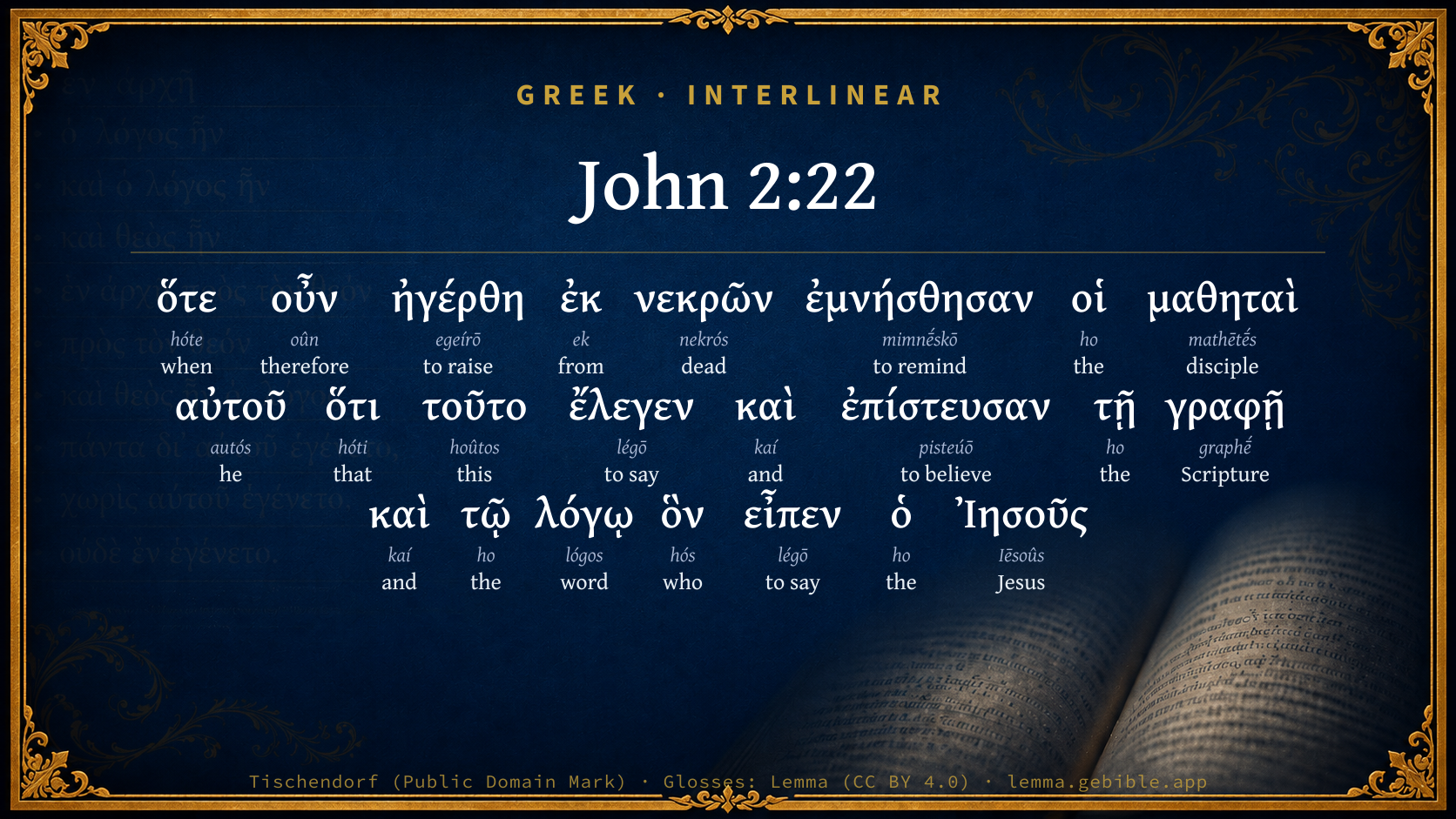
  1. ὅτε hóte G3753 “when” Adverb
  2. οὖν oûn G3767 “therefore” Conjunction
  3. ἠγέρθη egeírō G1453 “to raise” Verb, Aorist, Passive, Indicative, 3rd person, Singular
  4. ἐκ ek G1537 “from” Preposition
  5. νεκρῶν nekrós G3498 “dead” Adjective, Genitive, Plural, Masculine
  6. οἱ ho G3588 “the” Article, Nominative, Plural, Masculine
  7. μαθηταὶ mathētḗs G3101 “disciple” Noun, Nominative, Plural, Masculine
  8. αὐτοῦ autós G846 “he” Personal pronoun, Genitive, Singular, Masculine
  9. ὅτι hóti G3754 “that” Conjunction
  10. τοῦτο hoûtos G3778 “this” Demonstrative pronoun, Accusative, Singular, Neuter
  11. ἔλεγεν légō G3004 “to say” Verb, Imperfect, Active, Indicative, 3rd person, Singular
  12. καὶ kaí G2532 “and” Conjunction
  13. ἐπίστευσαν pisteúō G4100 “to believe” Verb, Aorist, Active, Indicative, 3rd person, Plural
  14. τῇ ho G3588 “the” Article, Dative, Singular, Feminine
  15. γραφῇ graphḗ G1124 “Scripture” Noun, Dative, Singular, Feminine
  16. καὶ kaí G2532 “and” Conjunction
  17. τῷ ho G3588 “the” Article, Dative, Singular, Masculine
  18. λόγῳ lógos G3056 “word” Noun, Dative, Singular, Masculine
  19. ὃν hós G3739 “who” Relative pronoun, Accusative, Singular, Masculine
  20. εἶπεν légō G3004 “to say” Verb, Aorist, Active, Indicative, 3rd person, Singular
  21. ὁ ho G3588 “the” Article, Nominative, Singular, Masculine
  22. Ἰησοῦς Iēsoûs G2424 “Jesus” Noun, Nominative, Singular, Masculine

About this verse

These counts appear in no published source. They are computed here, from the morphology-tagged text and Lemma’s own curated glosses. What Lemma adds →

23
words
18
distinct lemmas
Gospels
section

Notable vocabulary

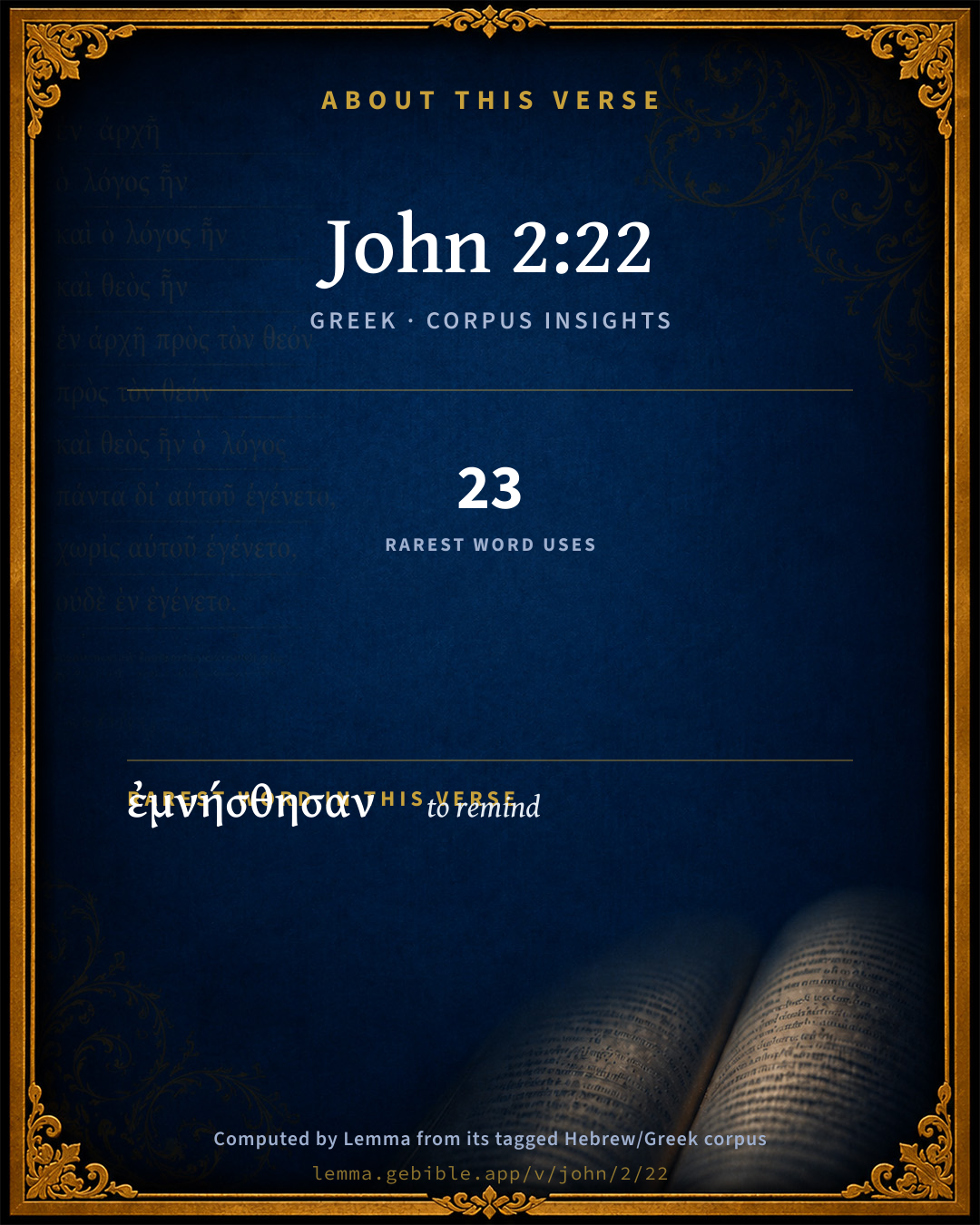
The rarest word here is ἐμνήσθησαν to remind G3403 — appearing just 23 times in the whole Greek New Testament.

Shared distinctive vocabulary

ἐμνήσθησαν to remind G3403 occurs in 23 verses of the Greek New Testament. Also found in:

Repetition

Words recur within this verse:

Cross-references

10

Topical passages linked to John 2:22 in the Treasury of Scripture Knowledge — connected by theme and wording, ordered by reader-vote popularity; previews shown in the World English Bible.

  • John 12:16 His disciples didn't understand these things at first, but when Jesus was glorified, then they remembered that these things were written about him, and that they had done these things to him.
  • Psalms 16:10 For you will not leave my soul in Sheol, Neither will you allow your holy one to see corruption.
  • Luke 24:7–8 saying that the Son of Man must be delivered up into the hands of sinful men, and be crucified, and the third day rise again?"
  • John 14:26 But the Counselor, the Holy Spirit, whom the Father will send in my name, he will teach you all things, and will remind you of all that I said to you.
  • John 16:4 But I have told you these things, so that when the time comes, you may remember that I told you about them. I didn't tell you these things from the beginning, because I was with you.
  • John 2:17 His disciples remembered that it was written, "Zeal for your house will eat me up."
  • Acts 11:16 I remembered the word of the Lord, how he said, 'John indeed baptized in water, but you will be baptized in the Holy Spirit.'
  • Luke 24:44 He said to them, "This is what I told you, while I was still with you, that all things which are written in the law of Moses, the prophets, and the psalms, concerning me must be fulfilled."
  • John 2:11 This beginning of his signs Jesus did in Cana of Galilee, and revealed his glory; and his disciples believed in him.
  • John 20:8–9 So then the other disciple who came first to the tomb also entered in, and he saw and believed.

Cross-references courtesy of OpenBible.info (CC BY 4.0).

Commentary

Notes on John 2:22 from classic Christian and Jewish commentators (each source and its license shown beneath its notes). The classic Christian expositions comment on the surrounding passage and are grouped to its opening verse, so a note may address several verses; the Jewish commentaries on the Tanakh (Rashi and others) are per-verse, so they appear only where the commentator wrote on this verse.

Lemma curates 59 commentaries, every one of them public domain or Creative Commons licensed, each selected and text-cleaned for this edition rather than reprinted as found. About our sources →

Tyndale Open Study Notes

Tyndale Open Resources

2:22 they believed: Witnessing a miracle from God can inspire belief, but it is not the deepest faith possible (20:29).

Tyndale Open Study Notes — © Tyndale Open Resources, licensed CC BY-SA 4.0. Text via the HelloAO Bible API.

Bengel's Gnomon

Johann Albrecht Bengel

Joh 2:22. Was risen) His Resurrection, not His glorification, is appealed to, because the sign was fulfilled by His resurrection. Comp. ἐγερῶ, I will raise, Joh 2:19.—ἐμνήσθησαν, they remembered) Faith and memory lend mutual help to one another in this passage; and ch. Joh 12:16, Joh 16:4, “These things have I told you, that when the time shall come, ye may remember that I told you of them:” they also work together; Mat 16:8-9, “O ye of little faith—Do ye not yet—remember the five loaves,” etc.; Psa 106:13, “They soon forgat His works;” Joh 2:12, having just before stated, “Then believed they His words.”—τῇ γραφῇ καὶ τῷ λόγῳ, the Scripture and the word) concerning the raising of the temple: both being alike divine.

Bengel's Gnomon of the New Testament — English translation (T&T Clark, Edinburgh, 1860) — public domain. Text from a community e-Sword module.

Godet's Commentaries

Frédéric Louis Godet

Ver. 22. “When, therefore, he was risen from the dead, his disciples remembered that he had said this, and they believed the Scripture and the word which Jesus had said.”

Into docile hearts the light came, although slowly. The event explained the word, as in its turn the word contributed to disclose the deep meaning of the event. It is surprising to meet here the limiting words τῇ γραφῇ, the Scripture; for the Scripture had not been quoted by Jesus, unless we think, with Weiss, of Joh 2:17, which is unnatural in view of the formal opposition established by Joh 2:22 between the time of the one and that of the other reminiscence. The evangelist undoubtedly wishes to intimate that the first point on which the light fell, in the hearts of the apostles, after the resurrection, was the prophecies of the Old Testament which announced that event (Psalms 16; Isaiah 53; Hosea 6; the prophet Jonah), and that it was by the intermediate agency of the interpreted prophecies that the present word of Jesus came back to their remembrance and was also made clear to them.

This little point which belongs to the inner biography of the apostles, stamps the narrative with the seal of historical reality. Let the reader picture to himself, with Baur, a pseudo-John, in the second century, inventing this momentary want of intelligence in the disciples with regard to a saying which he had himself ascribed to Jesus! The moral impossibility of such a strange charlatanism as this is obvious. This remark applies to the similar points, Joh 4:32-33; Joh 7:39; Joh 11:12; Joh 12:16; Joh 12:33; Joh 13:28, etc.

The Synoptics relate an act of Jesus similar to this; which they place at the beginning of the week of the Passion, either on Palm-day (Matthew 21; Luke 19), or more exactly on the next day after that (Mark 11). We might naturally enough suppose that these three evangelists, having omitted all the first year of Jesus’ ministry, were led thereby to locate this event in the only visit to Jerusalem of which they relate the story. This is the opinion of Lucke, de Wette, Ewald, Weiss, etc. Keim goes much further; he claims that it would have been the grossest want of tact on Jesus’ part thus at the start to advertise His Messiahship, and to break with the old Judaism as He does in John. But what gives to the corporeal act its meaning and its character is the words with which Jesus accompanies it. Now these words, which constitute the soul of the narrative, are very different in the Synoptics and in John, to such a degree that it would be impossible to unite them in one consecutive discourse. In the Synoptics, Jesus claims, on the ground of Isa 56:7 (“My house shall be called a house of prayer for all peoples”), the right of the Gentiles to the place which, from the beginning, had been conceded to them in the temple (1Ki 8:41-43). In John, there is no trace of this intention; Jesus has in view Israel itself and only Israel.

This difference, as well as the characteristic reply, Joh 2:19, argues two distinct events. If, as we may not doubt, the abuse which is in question really existed at the moment when Jesus presented Himself for the first time as Messiah, and as Son of God, it was impossible that He should tolerate it. It would have been to declare Himself Messiah and abdicate the Messianic office by one act. Thus John’s narrative is self-justified. But it is, also, wholly true that if, after having been reduced during more than two years to the simple activity of a prophet, Jesus wished to reassume on Palm-Sunday His office as Messiah-King, and thus to take up again a connection with His beginnings, He could not do so better than by repeating that act by which He had entered upon His career, and by repressing again that abuse which had not been slow in reproducing itself. By the first expulsion He had invited the people to the reformation which could save them; by the second, He protested against the profane spirit which was about to destroy them. Thus the narrative of John and the Synoptic narrative equally justify themselves.

This contrast between the two situations agrees with the difference between the words uttered. In John, seeing His appeal repelled, Jesus thinks of His death, the fatal limit of that first rejection; in the Synoptics, seeing the fall of Israel consummated, He proclaims the right of the Gentiles, who are soon going to be substituted for the Jews. As forKeim’s objection, this author forgets that, by acting in this way, Jesus made an appeal precisely to that which was deepest in the consciousness of every true member of the theocracy, respect for the temple. Beyschlag has justly called this proceeding on the part of Jesus, “the most profoundly conservative Jewish act.” It was precisely the wonderful character of this act, that it inaugurated the revolution which was preparing, by connecting it with that which was most vital in the Israelitish past.

Frédéric Louis Godet — Commentaries on Luke, John, Romans, and 1 Corinthians — English translation (T&T Clark, Edinburgh, 1870s–1890s) — public domain. Text from a community e-Sword module.

Jamieson, Fausset & Brown

Robert Jamieson, A. R. Fausset & David Brown

believed the scripture--on this subject; that is, what was meant, which was hid from them till then. Mark (1) The act by which Christ signalized His first public appearance in the Temple. Taking "His fan in His hand, He purges His floor," not thoroughly indeed, but enough to foreshadow His last act towards that faithless people--to sweep them out of God's house. (2) The sign of His authority to do this is the announcement, at this first outset of His ministry, of that coming death by their hands, and resurrection by His own, which were to pave the way for their judicial ejection.

Jamieson, Fausset & Brown — Commentary Critical and Explanatory on the Whole Bible (1871) — public domain (CC PDM 1.0). Text via the HelloAO Bible API.

Adam Clarke's Commentary

Verse 22. Remembered that he had said this unto them] αυτοις, to them, is wanting in AEHLMS, Matt. BV, upwards of one hundred others; both the Syriac; Persic, Arabic, Coptic, AEthiopic, Armenian, Slavonic, Vulgate, and Itala. Griesbach has left it out of the text.

They believed the scripture] The scripture which the evangelist immediately refers to may have been Ps 16:10. Compare this with Ac 2:31-32, and with Ac 13:35-37. See also Ps 2:7, and compare it with Heb 1:5, and Heb 5:5, and with Ac 13:33. They understood these scriptures in a sense in which they never before understood them.

It is the property of many prophecies never to be understood except by their accomplishment; but these are so marked that, when their fulfilment takes place, they cannot be misunderstood, or applied to any other event.

Adam Clarke's Commentary on the Bible (1810–1826) — public domain. Text from a community e-Sword/MySword module.

Ellicott's Commentary for English Readers

(22) That he had said this unto them.—The better texts omit “unto them.” For the way in which the saying, hard to be understood, fixed itself in men’s minds, comp. Mat_26:61; Mat_27:40; Mar_14:58; Mar_15:29; Act_6:13. It becomes in the mouth of false witnesses the accusation by means of which its meaning is accomplished. The death on the cross is the destruction of the Temple, but it is not unaccompanied by the rent veil; the two meanings are linked together.

It fixed itself, too, on the disciples’ minds; but weeks, months, years, did not cast any light upon it until the Resurrection. These passages of those familiar Old Testament writings then came to men who had been slow of heart to see them, with the quickening power of a new life. They saw that Christ ought to have suffered these things, and to enter into His glory. They saw in Moses and the Prophets the things concerning Him, and they believed in a new and higher sense the written and the spoken word. (Comp. Luk_24:26 et seq.)

A Bible Commentary for English Readers, edited by Charles John Ellicott (1878–1897) — public domain. Text from a community e-Sword module.

The Cambridge Bible for Schools and Colleges

gen. ed. J. J. S. Perowne

22. was risen] Better, was raised. Comp. Joh_21:14; Act_3:15; Act_4:10; Act_5:30.

his disciples remembered] They recollected it when the event that explained it took place; meanwhile what had not been understood had been forgotten. Would anyone but a disciple give us these details about the disciples’ thoughts? See on Joh_2:11.

the scripture] O.T. prophecy, viz., Psa_16:10; see on Joh_10:35.

had said] Better, spake, on the present occasion.

The Cambridge Bible for Schools and Colleges (gen. ed. J. J. S. Perowne; Cambridge University Press, 1878–1918) — public domain. Text from a community e-Sword module.

John Gill's Exposition

Now when he was in Jerusalem at the passover,.... Whither he went, in order to keep it, that being at hand, and now come; see Joh 2:13;

in the feast day; either on the day the Chagigah was eaten, which was sometimes emphatically called "the feast", as in Num 28:16, "and in the fourteenth day of the first month, is the passover of the Lord; and in the fifteenth day of this month, is the feast"; the passover lamb was eaten on the fourteenth day of the month "Nisan", and the "Chagigah" was on the fifteenth; in the former only a lamb was eaten, in the other, cattle out of the herds; hence mention is made, both of flocks and herds, for the keeping the passover, Deu 16:2. Jarchi's note upon the place is, that the herds were for the Chagigah, with which the Talmud (l) agrees; and Jonathan ben Uzziel paraphrases the words thus,

"and ye shall slay the passover before the Lord your God, between the evenings, and the sheep and oxen on the morrow, in that very day, for the joy of the feast;''

for it was observed with great joy and mirth: and the rather this is here meant, since the "Chagigah" is not only called "the feast", but this here is distinguished from the passover, as that is in the passage above cited, Num 28:16. For the passover here, seems to be the general name for the whole seven days of the festival; and the feast to be the particular feast of the first day of it, which was the fifteenth; to which may be added, that on this day all the males made their appearance in court (m); and so was a very proper time for Christ to work his miracles in, when there were so many spectators: though it may design the whole time of the feast, all the seven days of unleavened bread; during which time Christ was at Jerusalem, and wrought miracles, which had the following effect:

many believed in his name; that he was some great prophet, or the prophet, or the Messiah; they gave an historical assent unto him as such, at least for that time:

when they saw the miracles which he did; for as miracles, according to the prophecies of the Old Testament, were to be performed by the Messiah, such as giving sight to the blind, causing the deaf to hear, the dumb to speak, and the lame to walk, Isa 35:5; so they were expected by the ancient Jews, that they would be wrought by him, when he came; wherefore these Jews, seeing such like wonderful things wrought by Jesus, they concluded he must be the Messiah: though the modern ones, in order to shift off the evidence of Jesus being the Messiah, from his miracles, deny that miracles are the characteristic of the Messiah, or will be performed by him; at least, that there is no necessity of them to prove him to be the person. What miracles these were, which were now wrought by Christ, are not recorded by this, or any other evangelist; see Joh 20:30. However, being surprised at the marvellous things he did, and upon the evidence of these extraordinary works, there were many that concluded he must be come from God; among these it seems as if Nicodemus was one; see Joh 3:2; great part of these, at least some of them, were only nominal and temporary believers, who were not to be confided in as true disciples, and hearty followers of Christ; and who continued not long in the same mind and profession, as appears by what follows.

(l) Pesachim, fol. 70. 2. (m) Maimon. Hilch. Chagigah, c. 1. sect. 1.

John Gill's Exposition of the Whole Bible (1746–1763) — public domain (CC PDM 1.0). Text via the HelloAO Bible API.

Trapp's Complete Commentary

John Trapp

22 When therefore he was risen from the dead, his disciples remembered that he had said this unto them; and they believed the scripture, and the word which Jesus had said.

Ver. 22. His disciples remembered] In the mean time they murmured not, much less opposed. "We can do nothing against the truth," when at worst, "but for the truth," 2Co 13:8. They laid up what they understood not; and as the water casts up her dead, so did their memories that which seemed dead therein, by the help of the Holy Ghost.

John Trapp, A Commentary or Exposition upon All the Books of the Old and New Testament (1647–1656) — public domain. Text from a community e-Sword module.

Albert Barnes' Notes on the Bible

When he was risen from the dead ... - This saying of our Saviour at that time seemed obscure and difficult. The disciples did not understand it, but they treasured it up in their memory, and the event showed what was its true meaning. Many prophecies are obscure when spoken which are perfectly plain when the event takes place. We learn from this, also, the importance of treasuring up the truths of the Bible now, though we may not perfectly understand them. Hereafter they may be plain to us. It is therefore important that “children,” should learn the truths of the sacred Scriptures. Treasured up in their memory, they may not be understood “now,” but hereafter they may be clear to them. Every one engaged in teaching a Sunday school, therefore, may be imparting instruction which may be understood, and may impart comfort, long after the teacher has gone to eternity.

They believed - That is, “after” he rose from the dead.

The scripture - The Old Testament, which predicted his resurrection. Reference here must be made to Psa 16:10; compare Act 2:27-32; Act 13:35-37; Psa 2:7; compare Act 13:33. They understood those Scriptures in a sense different from what they did before.

The word which Jesus had said - The prediction which he had made respecting his resurrection in this place and on other occasions. See Mat 20:19; Luk 18:32-33.

Albert Barnes' Notes on the Bible (1834–1885) — public domain. Text from a community e-Sword/MySword module.

Matthew Poole's English Annotations

Even Christ’s own disciples at the first rather admired than perfectly understood their Lord. It is said of Christ, Luk 24:45, a little before his ascension into heaven, Then opened he their understanding, that they might understand the Scripture. The disciples did not distinctly understand many things till after Christ’s resurrection from the dead, when they saw the things accomplished, and when Christ further opened their eyes; which was also further done when the Holy Ghost came upon them in the days of Pentecost. Thus we hear for the time to come; and the seed which lieth a long time under the clods, at last springeth up through the influence of heaven upon it.

And they believed the Scripture, and the word which Jesus had said; the disciples then more clearly and more firmly believed the Scriptures, and were able to make a clearer application and interpretation of them. By the Scripture here, are meant the Scriptures of the Old Testament; to which is added, and the word which Jesus had said. Christ’s words gave them a clearer insight into the Scriptures of the Old Testament; and the harmony of the writings of the Old Testament with Christ’s words under the New Testament, confirmed the disciples’ faith in both.

Matthew Poole's English Annotations on the Holy Bible (1683–1685) — public domain. Text from a community e-Sword/MySword module.

Whedon's Commentary on the Bible

Daniel D. Whedon

22. Said this unto them—The them of this clause must refer to the Jews.

They believed the Scripture—That is, they believed this new matter and meaning now first discovered as concealed in the Scriptures. See note on Joh_2:11.

The word which Jesus had said—That word unfolded its new force and true divinity to their belief. And that new force gave a conclusive corroboration to the whole body of Messianic Scripture. They had in a true sense never before believed the Scripture; for they did not know herein what Scripture contained.

Daniel D. Whedon (gen. ed.), Commentary on the Old and New Testaments (1874–1909) — public domain. Text from a community e-Sword module.

The Pulpit Commentary

When therefore he was raised from the dead, his disciples remembered that he spake this (to them), and believed the Scripture, and the word which Jesus said. This frequent contrast instituted by the apostle between the first impression produced on the disciples (himself among them) and that which was produced by subsequent reflection after the resurrection of Jesus and gift of the Spirit, becomes a powerful mark of authenticity (compare the passages which Godet has here cited, Joh_4:32, 33 7:39 11:12 12:16, 33 13:28; with many others). "A pseudo-John imagining, in the second century, this ignorance of the apostle in regard to a saying which he had invented himself, is "criticism" dashing itself against moral impossibility." These quiet "asides" and reflections of the biographer on the mistaken ideas which he cites and corrects, are of consummate value, as pointing out the stages by which the most stupendous ideas that have taken human spirits captive dawned on the most susceptible minds. The "Word" and the "Scripture" helped the disciples to subsequent faith. Why is "Scripture" in the singular, seeing that John used this form of expression ten times when he had one definite passage of Scripture in his mind, and used the plural when the general authority of Scripture was appealed to? Many have looked to one or another definite Scripture text supposed to predict the resurrection of Christ, such as Psa_16:10 and Isa 53. (some, very wrongly, to Hos_6:2, where no reference can be established to this great event) Dr. Moulton points back to Ps 69, and the impression which the Lord"s "zeal" had produced on the disciples. It seems better to recall Christ"s own words, and the comment of Luke, in Luk_24:25-27, where the whole Scripture seems to have been laid under contribution to establish the grand expectation. Further, of Joh_20:9, where John, referring to the same subject, uses the word grafh in the singular, for the general tendency of Scripture. All the passages which couple suffering and apparent defeat with triumph and victory, did prepare the mind of thoughtful men for the better understanding of the Resurrection. Thus Psalm 22 and the closing words of Ps 89 Ps 110; and Isa 53 thereupon come into view; and, in fact, all the Scriptures which anticipate the glorious reign and victory of the Christ and the extension of his kingdom, when coupled with those which portrayed the sorrows of Messiah and of the ideal Sufferer, implicitly convey the same thought. Consequently, numerous passages in Isaiah. (Micah, Daniel, Zechariah, Malachi, with Ps 2 and Ps 72 Ps 45, etc., taken in connection with prediction of the sorrows of Messiah, did prepare the disciples to believe that the Holy One could not be holden by the pangs of Act_2:24, etc.) Before closing this paragraph, we must notice that, in this entire transaction, the Lord is not separating himself from the existing theocracy, hut interpreting its highest meaning. In the cleansing of the temple at the last he was judging and condemning. The vindication by our Lord of his own action was very different on the latter occasion from what it is here, (cf. Joh_2:16 with Mar_11:17) and numerous other accompaniments are profoundly different; nor did he then speak of the destruction of the temple, although, as we have seen, much exaggerated and mis-apprehensive talk concerning him had been floating among the people. (Mat_26:61)

The Pulpit Commentary (1880–1919), ed. H.D.M. Spence-Jones & Joseph S. Exell — public domain. Text from a community e-Sword module.

John Wesley's Explanatory Notes

They believed the scripture, and the word which Jesus had said - Concerning his resurrection.

John Wesley, Explanatory Notes Upon the Whole Bible (1754–1765) — public domain. Text via the GEBible commentary corpus.

Cambridge Greek Testament for Schools and Colleges

22. TRUSTING BELIEF

ἠγέρθη. Was raised. Comp. Joh 21:14; Act 3:15; Act 4:10; Act 5:30. They recollected it when the event which explained it took place; meanwhile what had not been understood had been forgotten. Would any but a disciple give these details about the disciples’ thoughts? See on Joh 2:11.

τῇ γραφῇ. Not εἰς τὴν γραφήν: they believed what the Scripture (Psa 16:10) said. See on Joh 1:12. Ἡγραφή commonly means a particular passage (Joh 7:38; Joh 7:42, Joh 10:35, Joh 13:18, Joh 19:24; Joh 19:28; Joh 19:36-37; Mar 12:10; Luk 4:21; Act 8:32; Act 8:35), whereas αἱ γραφαί means Scripture generally (Joh 5:39; Mat 21:42; Mat 22:29; Mat 26:54; Mat 26:56; Mar 12:24, &c.) Of course only the O.T. can be meant.

εἶπεν. Spake, on this occasion.

Cambridge Greek Testament for Schools and Colleges (Cambridge University Press, 1896; 21 vols, various authors incl. Carr, Maclear, Plummer, Farrar, Lumby, Moule, M. R. James, Simcox) — public domain. Text from a community e-Sword module.

Alford’s Greek Testament

Henry Alford

22.] τῇ γραφῇ, by all analogy, must mean the O.T. scriptures. That the resurrection of the Lord is the subject of O.T. prophecy, we find in several passages of the N.T., see ch. 20:9: Luk 24:26, Luk 24:27: 1Co 15:4. At first sight it appears difficult to fix on any passage in which it is directly announced: but with the deeper understanding of the Scriptures which the Holy Spirit gave the Apostles and still gives the Christian Church, such prophecies as that in Psa_16 are recognized as belonging to Him in Whom alone they are properly fulfilled: see also Hos 6:2.

Henry Alford, The Greek Testament (1849–1861) — public domain. Text from a community e-Sword module.

International Critical Commentary

22. ἐμνήσθησαν οἱ μαθηταί (see on v. 2) in v. 17 recalls what the disciples remembered at the time, i.e. they thought of Psa 69:9 when they saw the burning zeal of their Master; in this verse it recalls what they thought after His Resurrection of the meaning of His words recorded in v. 19. So, again, in 12:16 Jn. tells that it was not until after Jesus was glorified that the disciples understood the forward reference of Zec 9:9;1 cf. Luk 24:8 and Joh 13:19, Joh 14:29.

ἐπίστευσαν τῇ γραφῇ. ἡ γραφή seems to refer in Jn. to a definite passage of Scripture,2 as it does throughout the N.T., rather than to the O.T. generally (which would be αἱ γραφαί) At Joh 10:35, Joh 13:18 (17:12), 19:24, 28, 36, 37 the actual passage is quoted; at Joh 7:38, Joh 7:42 (which see) the reference is not quite certain; while here and at 20:9 no clue is given to the passage to which allusion is made. But as it is plain from Act 2:31, Act 13:35 that Psa 16:10, “Neither wilt thou suffer thy Holy One to see corruption,” was cited by Peter and Paul alike as predictive of the Resurrection of Christ, we may conclude that this is the verse in the evangelist’s mind when he says that the disciples after the Resurrection “believed the Scripture.” Psa 16:10 was the “proof text” to which the Apostolic age referred.

καὶ τῷ λόγῳ ὃν εἶπεν ὁ Ἰη., “and the saying which Jesus spake,” i.e. the saying in v. 19. ὁ λόγος is often thus used of a “saying” of Jesus; e.g. ἐπίστευσεν ὁ ἄνθρωπος τῶ λόγῳ ὃν εἶπεν αὐτῷ ὁ Ἰη. (4:50); cf. 6:60, 7:36, 15:20, 18:9, 32, 21:23. ὅν is read by אBLTb, the rec. having ᾧ with ANWΓΔΘ.

Sojourn at Jerusalem (Vv. 23-25)

International Critical Commentary — older volumes (1896–1929), various authors — public domain. Text from a community e-Sword module.

Vincent's Word Studies in the New Testament

Marvin R. Vincent

Was risen [ηγερθη] . Rev., more correctly, was raised. The same verb as in vv. 19, 20.

Had said [ελεγεν] . Rev., more correctly, He spake. The best texts omit unto them.

Believed the Scripture [επιστευσαν τη γραφη] . Notice that ejpioteusan, believed, is used here with the simple dative, and not with the preposition eijv, into (see on 1 12). The meaning is, therefore, they believed that the Scripture was true. On grafh, a passage or section of Scripture, see on Mr 12:10.

In John, as elsewhere, the word almost always refers to a particular passage cited in the context. The only two exceptions are Joh 17:12; Joh 20:9. For the Old Testament, as a whole, John always uses the plural aiJ grafai The passage referred to here is probably Psa 16:10. Compare Act 2:27, 31; Act 13:35.

The word. The saying just uttered concerning the destruction of the temple.

Marvin R. Vincent, Word Studies in the New Testament (1887–1900) — public domain. Text from a community e-Sword/MySword module.

Lesson kit

Teaching starters — assembled from the data on this page, not authored interpretation. Every prompt links to the verse data it draws on. Edit before teaching.

John, in the Gospels, opens this verse with 23 words (18 distinct Greek lemmas). Its most distinctive word is mimnḗskō (“to remind”). A historical commentator’s framing appears above. Read the whole chapter for the surrounding context.

Discussion questions

  1. The word mimnḗskō carries the sense “to remind.” How does it shape the verse?
  2. How does Matthew 5:23, which shares the word «to remind», read alongside this verse?
  3. What does the repetition of “to say” (2× in this one verse) do in this verse?
  4. The translations on this page render this verse differently — a whole-verse word diff, not a word-by-word alignment. What might account for the different wordings?
  5. Compare how Tyndale Open Study Notes and Bengel's Gnomon read this verse. Where do they agree or differ?

Things to notice

  • These translations choose different wording for 4 words in this verse.
  • “to say” occurs 2× in this single verse.
  • 18 distinct Greek lemmas span 23 words in this verse.

Reading settings

Reading text

Shown beneath each verse's original-language words.

Old Testament
Old Testament edition

Read the OT as the Masoretic Hebrew (MT) or the Greek Septuagint (LXX).

English shown for the Greek Septuagint (in the Hebrew ↔ Greek comparison).

Comparing translations? Open the Compare panel on any verse page to stack up to four side by side.