John 5:29

Greek (Tischendorf 8th ed.) John 5:29 appears in the Greek New Testament. The text above is from the Tischendorf 8th edition. Each word links to its Strong’s number and a concise gloss. Click any word for its full Thayer’s Greek Lexicon entry.
Download image
Cite this verse

John 5:29 (World English Bible). Public Domain. Lemma interlinear Bible study tool, https://lemma.gebible.app/v/john/5/29.

Show BibTeX & RIS
BibTeX
RIS
English Translation
and will come out; those who have done good, to the resurrection of life; and those who have done evil, to the resurrection of judgment.
World English Bible · Public Domain
Download a study sheet

One document with this verse’s original text, its word-by-word gloss line, the meaning frame, cross-references with their text, attributed commentary, and full source and license credits — printable, and it pastes into notes with its structure intact.

This verse Autodidact and up

Study sheet (.html) Plain text (.txt)

A passage Seminary Student

Up to 50 verses in one chapter. A passage sheet keeps up to 6 commentary sources and 12 cross-references per verse, in the order this page ranks them, and says so on the sheet whenever that leaves anything out. Ask for a single verse and you get the Autodidact verse sheet above.

Everything on this page stays free to read, with no account — the sheet is a download of what is already on screen, not access to it.

Want to remove ads? Support Godless Engineer
Compare translations 3

The same verse in 3 English versions, stacked beneath the original-language interlinear above. Click any original word for its lexicon entry.

Each is an independent rendering of the whole verse — the interlinear is not word-aligned to these translations.

Highlighted words mark where these versions differ — a whole-verse word diff, not a word-by-word alignment.

  • World English Bible Public Domain
    and will come out; those who have done good, to the resurrection of life; and those who have done evil, to the resurrection of judgment.
  • King James Version Public Domain
    And shall come forth; they that have done good, unto the resurrection of life; and they that have done evil, unto the resurrection of damnation.
  • unfoldingWord Literal Text CC BY-SA 4.0
    and will come out—the ones having done good, to a resurrection of life, but the ones having practiced evil, to a resurrection of judgment.

unfoldingWord Literal Text — © unfoldingWord, licensed CC BY-SA 4.0. Word-aligned USFM3 via Door43 (git.door43.org/unfoldingWord/en_ult).

Versions to compare (up to 4)

3 of 4 selected

Show all 19 translations

Every available English version of this verse, each an independent rendering of the whole verse.

  • World English Bible Public Domain
    and will come out; those who have done good, to the resurrection of life; and those who have done evil, to the resurrection of judgment.
  • Berean Standard Bible Public Domain
    and come out—those who have done good to the resurrection of life, and those who have done evil to the resurrection of judgment.
  • Majority Standard Bible Public Domain
    and come out—those who have done good to the resurrection of life, and those who have done evil to the resurrection of judgment.
  • King James Version Public Domain
    And shall come forth; they that have done good, unto the resurrection of life; and they that have done evil, unto the resurrection of damnation.
  • American Standard Version (1901) Public Domain
    and shall come forth; they that have done good, unto the resurrection of life; and they that have done evil, unto the resurrection of judgment.
  • Revised Version (1885) Public Domain
    And shall come forth; they that have done good, unto the resurrection of life; and they that have done ill, unto the resurrection of judgment.
  • Geneva Bible (1599) Public Domain
    And they shall come foorth, that haue done good, vnto ye resurrection of life: but they that haue done euil, vnto the resurrection of condemnation.
  • Douay-Rheims (1899) Public Domain
    And they that have done good things, shall come forth unto the resurrection of life; but they that have done evil, unto the resurrection of judgment.
  • Young's Literal Translation Public Domain
    and they shall come forth; those who did the good things to a rising again of life, and those who practised the evil things to a rising again of judgment.
  • Literal Standard Version CC BY-SA 4.0
    and they will come forth; those who did good things to a resurrection of life, and those who practiced evil things to a resurrection of judgment.
  • Unlocked Literal Bible CC BY-SA 4.0
    and will come out. Those who have done good to the resurrection of life, and those who have done evil to the resurrection of judgment.
  • unfoldingWord Literal Text CC BY-SA 4.0
    and will come out—the ones having done good, to a resurrection of life, but the ones having practiced evil, to a resurrection of judgment.
  • Darby Bible Public Domain
    and shall go forth; those that have practised good, to resurrection of life, and those that have done evil, to resurrection of judgment.
  • World Messianic Bible Public Domain
    and will come out; those who have done good, to the resurrection of life; and those who have done evil, to the resurrection of judgment.
  • Webster's Bible Public Domain
    And shall come forth; they that have done good to the resurrection of life; and they that have done evil, to the resurrection of damnation.
  • Free Bible Version CC BY-SA 4.0
    and will rise again: those who have done good to the resurrection of life, and those who have done evil to the resurrection of condemnation.
  • Bible in Basic English Public Domain
    And they will come out; those who have done good, into the new life; and those who have done evil, to be judged.
  • Text-Critical English NT CC BY 4.0
    and come out, those who have done good to a resurrection of life, and those who have done evil to a resurrection of judgment.
  • Tyndale New Testament (1534) Public Domain
    and shall come forthe: they that have done good vnto the resurreccion of lyfe: and they that have done evyll vnto the resurreccion of dampnacion.

Literal Standard Version (2020), Covenant Press — licensed CC BY-SA 4.0. Text via the HelloAO Bible API (eBible.org). Unlocked Literal Bible (unfoldingWord) — licensed CC BY-SA 4.0. Text via the HelloAO Bible API (eBible.org). unfoldingWord Literal Text — © unfoldingWord, licensed CC BY-SA 4.0. Word-aligned USFM3 via Door43 (git.door43.org/unfoldingWord/en_ult). Free Bible Version, Dr. Jonathan Gallagher — licensed CC BY-SA 4.0. Text via the HelloAO Bible API (eBible.org).

Word by word

More ways to search: Search by grammar → Find every occurrence → Compare this word →

Practice this passage: Drill this verse → Learn its vocabulary →

φαῦλα
phaûlos
G5337
“worthless”
Adjective, Accusative, Plural, Neuter
Part of Speech
Adjective
Case
Accusative
Number
Plural
Gender
Neuter
Full Thayer's Definition

Origin: apparently a primary word

TDNT: None

1. easy, slight, ordinary, mean, worthless, of no account 2. ethically, bad, base, wicked
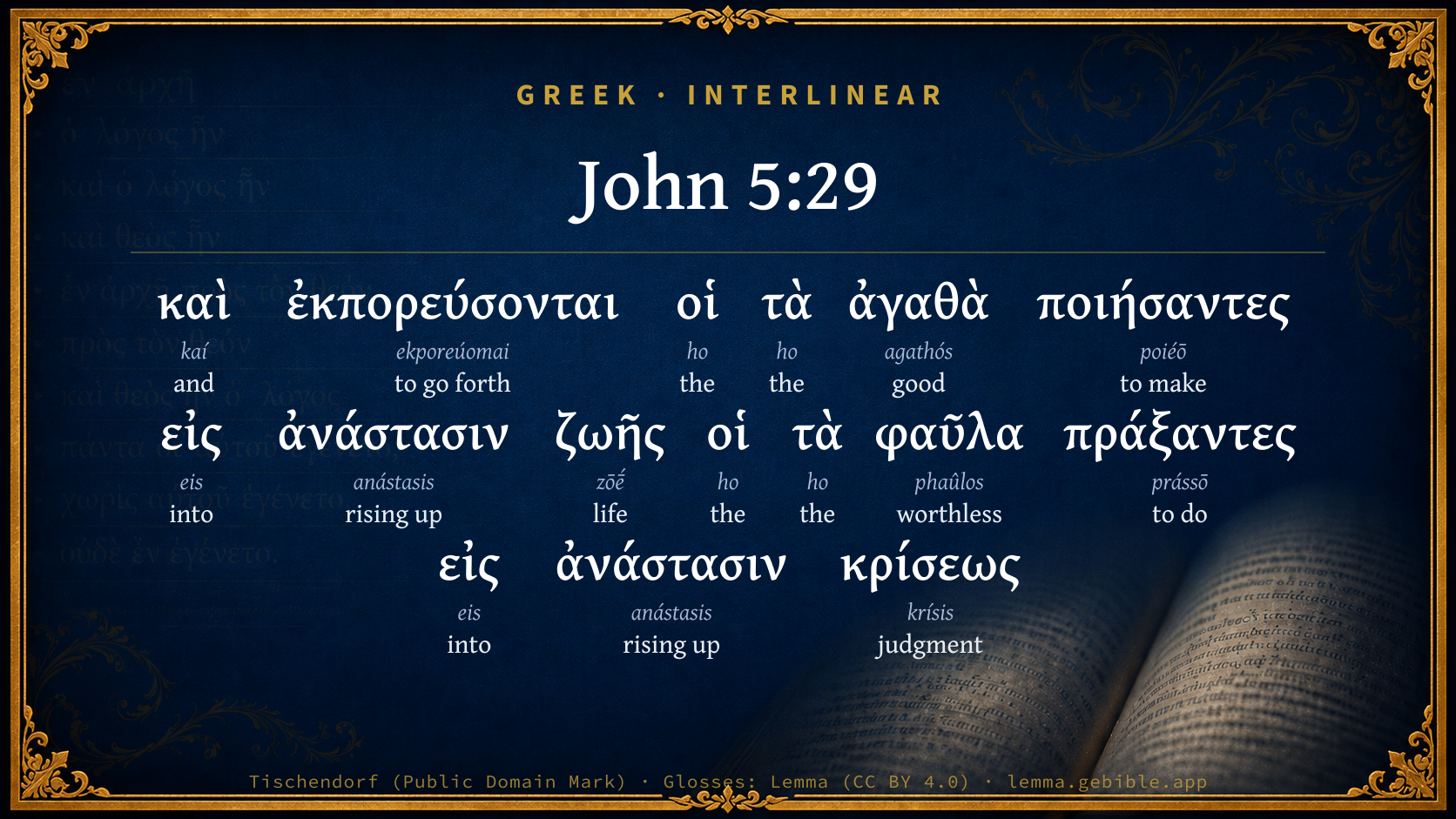
  1. καὶ kaí G2532 “and” Conjunction
  2. ἐκπορεύσονται ekporeúomai G1607 “to go forth” Verb, Future, Middle deponent, Indicative, 3rd person, Plural
  3. οἱ ho G3588 “the” Article, Nominative, Plural, Masculine
  4. τὰ ho G3588 “the” Article, Accusative, Plural, Neuter
  5. ἀγαθὰ agathós G18 “good” Adjective, Accusative, Plural, Neuter
  6. ποιήσαντες poiéō G4160 “to make” Verb, Aorist, Active, Participle, Nominative, Plural, Masculine
  7. εἰς eis G1519 “into” Preposition
  8. ἀνάστασιν anástasis G386 “rising up” Noun, Accusative, Singular, Feminine
  9. ζωῆς zōḗ G2222 “life” Noun, Genitive, Singular, Feminine
  10. οἱ ho G3588 “the” Article, Nominative, Plural, Masculine
  11. τὰ ho G3588 “the” Article, Accusative, Plural, Neuter
  12. πράξαντες prássō G4238 “to do” Verb, Aorist, Active, Participle, Nominative, Plural, Masculine
  13. εἰς eis G1519 “into” Preposition
  14. ἀνάστασιν anástasis G386 “rising up” Noun, Accusative, Singular, Feminine
  15. κρίσεως krísis G2920 “judgment” Noun, Genitive, Singular, Feminine

About this verse

These counts appear in no published source. They are computed here, from the morphology-tagged text and Lemma’s own curated glosses. What Lemma adds →

16
words
11
distinct lemmas
Gospels
section

Notable vocabulary

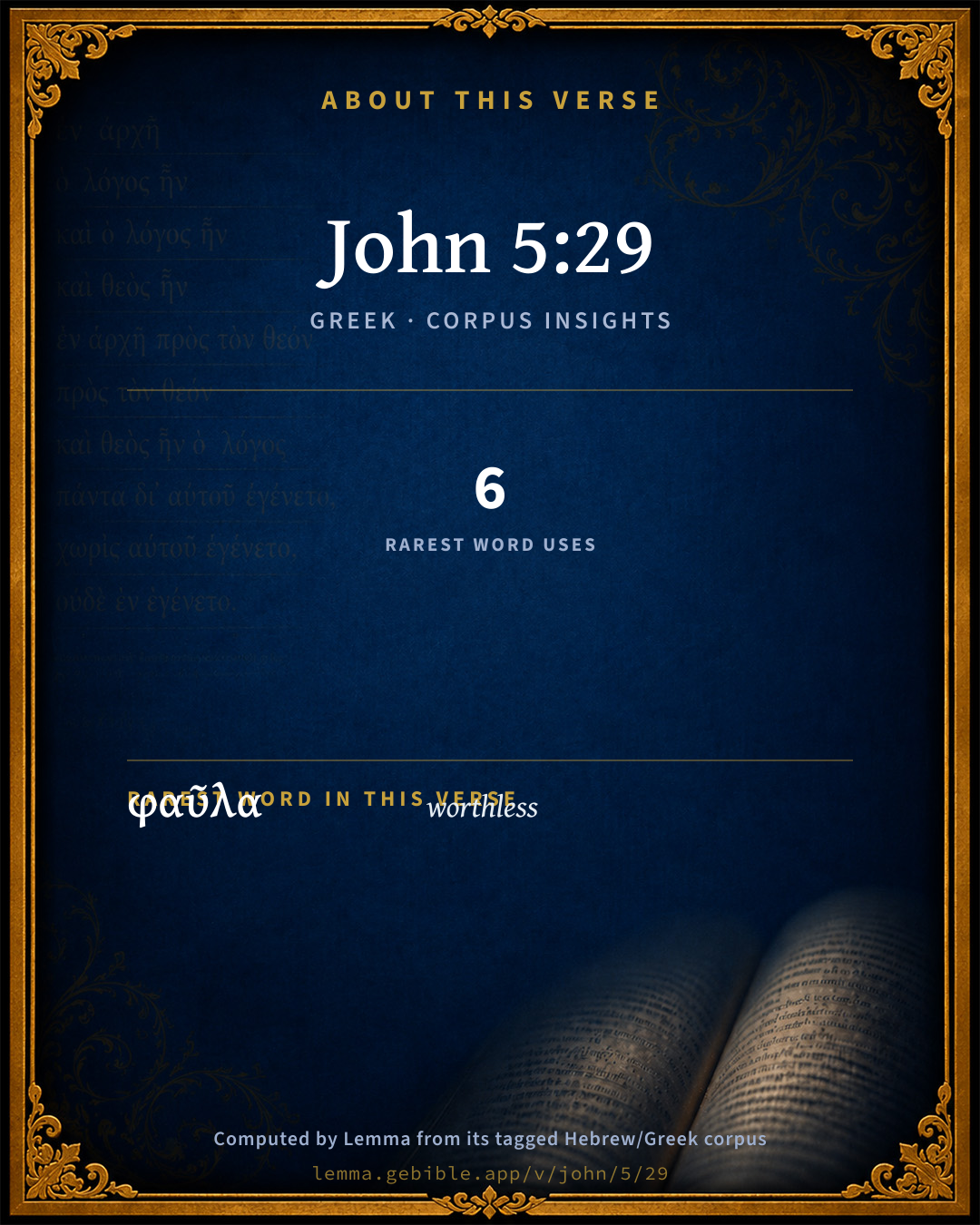
The rarest word here is φαῦλα worthless G5337 — appearing just 6 times in the whole Greek New Testament.

Shared distinctive vocabulary

φαῦλα worthless G5337 occurs in 6 verses of the Greek New Testament. Also found in:

Repetition

Words recur within this verse:

  • εἰς into G1519 ×2
  • ἀνάστασιν rising up G386 ×2
  • οἱ the G3588 ×4

Cross-references

9

Topical passages linked to John 5:29 in the Treasury of Scripture Knowledge — connected by theme and wording, ordered by reader-vote popularity; previews shown in the World English Bible.

  • Daniel 12:2–3 Many of those who sleep in the dust of the earth shall awake, some to everlasting life, and some to shame and everlasting contempt.
  • Romans 2:6–10 who "will pay back to everyone according to their works:"
  • Acts 24:15 having hope toward God, which these also themselves look for, that there will be a resurrection of the dead, both of the just and unjust.
  • Matthew 25:31–46 "But when the Son of Man comes in his glory, and all the holy angels with him, then he will sit on the throne of his glory.
  • Luke 14:14 and you will be blessed, because they don't have the resources to repay you. For you will be repaid in the resurrection of the righteous."
  • Galatians 6:8–10 For he who sows to his own flesh will from the flesh reap corruption. But he who sows to the Spirit will from the Spirit reap eternal life.
  • 1 Timothy 6:18 that they do good, that they be rich in good works, that they be ready to distribute, willing to communicate;
  • Hebrews 13:16 But don't forget to be doing good and sharing, for with such sacrifices God is well pleased.
  • 1 Peter 3:11 Let him turn away from evil, and do good. Let him seek peace, and pursue it.

Cross-references courtesy of OpenBible.info (CC BY 4.0).

Commentary

Notes on John 5:29 from classic Christian and Jewish commentators (each source and its license shown beneath its notes). The classic Christian expositions comment on the surrounding passage and are grouped to its opening verse, so a note may address several verses; the Jewish commentaries on the Tanakh (Rashi and others) are per-verse, so they appear only where the commentator wrote on this verse.

Lemma curates 59 commentaries, every one of them public domain or Creative Commons licensed, each selected and text-cleaned for this edition rather than reprinted as found. About our sources →

Bengel's Gnomon

Johann Albrecht Bengel

Joh 5:29. Ἀνάστασιν ζωῆς) the resurrection of life, ordained to live.[107] [108][107] τὰ φαῦλα, evil) Dost thou desire to know whether thy portion shall be in the resurrection of life or of condemnation? Then sift thoroughly thy course of action, whether it is good or bad; but remember to examine thine accounts, not according to thine own fancy, but according to the truth of the case.—V. g.

[108] ἀνάστασιν κρίσεως, the resurrection of condemnation) It would be inappropriate to term it the resurrection of death: but yet it is opposed to the resurrection of life. Therefore sinners indeed shall rise again, but from death to death; their resurrection shall not be a regeneration [Mat 19:28.—E. and T.], but an abortion.—V. g.

Bengel's Gnomon of the New Testament — English translation (T&T Clark, Edinburgh, 1860) — public domain. Text from a community e-Sword module.

Geneva Bible (1599)

Geneva Bible translators

To that resurrection which had life everlasting following it: against which is set the resurrection of condemnation: that is, which condemnation followeth.

Faith and infidelity shall be judged by their fruits.

Of their graves.

Geneva Bible (1599) marginal notes — public domain. Text via Bolls.life.

Jamieson, Fausset & Brown

Robert Jamieson, A. R. Fausset & David Brown

resurrection of life--that is, to life everlasting (Mat 25:46).

of damnation--It would have been harsh to say "the resurrection of death," though that is meant, for sinners rise from death to death [BENGEL]. The resurrection of both classes is an exercise of sovereign authority; but in the one case it is an act of grace, in the other of justice. (Compare Dan 12:2, from which the language is taken). How awfully grand are these unfoldings of His dignity and authority from the mouth of Christ Himself! And they are all in the third person; in what follows He resumes the first person.

Jamieson, Fausset & Brown — Commentary Critical and Explanatory on the Whole Bible (1871) — public domain (CC PDM 1.0). Text via the HelloAO Bible API.

John Calvin's Commentaries

29. And they who have done good. He points out believers by good works, as he elsewhere teaches that a tree is known by its fruit, (Matthew 7:16; Luke 6:44.) He praises their good works, to which they have begun to devote themselves since they were called. For the robber, to whom Christ on the cross (Luke 23:42) promised life, and who had all his life been given up to crimes, expresses a desire to do good with his latest breath; but as he is born again a new man, and from being the slave of sin begins to be a servant of righteousness, the whole course of his past life is not taken into account before God. Besides, the sins themselves, on account of which believers every day subject themselves to condemnation, are not imputed to them. For without the pardon which God grants to those who believe in Him, there never was a man in the world of whom we can say that he has lived well; nor is there even a single work that will be reckoned altogether good, unless God pardon the sins which belong to it, for all are imperfect and corrupted. Those persons, therefore, are here called doers of good works whom Paul calls earnestly desirous or zealous of them, (Titus 2:14.) But this estimate depends on the fatherly kindness of God, who by free grace approves what deserved to be rejected.

The inference which the Papists draw from those passages — that eternal life is suspended on the merits of works — may be refuted without any difficulty. For Christ does not now treat of the cause of salvation, but merely distinguishes the elect from the reprobate by their own mark; and he does so in order to invite and exhort his own people to a holy and blameless life. And indeed we do not deny that the faith which justifies us is accompanied by an earnest desire to live well and righteously; but we only maintain that our confidence cannot rest on any thing else than on the mercy of God alone.

John Calvin's Commentaries (1540-1563) — public domain. Text from the Calvin Translation Society English edition (1840s-50s) via the Christian Classics Ethereal Library (ccel.org). Calvin's coverage is partial (roughly two-thirds of the Bible); uncommented books and verses are honest gaps, never fabricated. The 19th-century editor's footnotes and remarks are omitted so the notes are faithfully Calvin's own voice.

Ellicott's Commentary for English Readers

(29) Damnation.—Better, judgment. See Note on Joh_3:20. On “done good” and “done (practised) evil,” see Notes on Joh_3:20-21. It is remarkable that these are the only instances where the words here and there used for “practice” and for “evil” occur in St. John. This double opposition, and the use of words which He does not use again, support the distinction in the earlier Note. The passages are comments on each other. The law of the spiritual resurrection now is the law of that which shall be hereafter. Those who, working out the truth, come to the light now, that their deeds may be manifested, because they are wrought in God, shall in the final testing, when the secrets of every heart shall be revealed, rise unto the resurrection of life, to dwell in eternal light. Those who, practising evil, choose the darkness now, shall in that final testing, when whatsoever has been spoken in the darkness shall be heard in the light, rise unto the resurrection of condemnation (Act_24:15), bound in chains of darkness, and be cast into outer darkness. (Comp. Notes on Mat_8:12; Mat_25:46 and 1Co_3:13 et seq.)

A Bible Commentary for English Readers, edited by Charles John Ellicott (1878–1897) — public domain. Text from a community e-Sword module.

The Cambridge Bible for Schools and Colleges

gen. ed. J. J. S. Perowne

29. done evil] Or, practised worthless things. See on Joh_3:20.

unto the resurrection of damnation] Better, unto the resurrection of judgment. It is the same Greek word as is used in Joh_5:22; Joh_5:27. These words are the strongest proof that spiritual resurrection cannot be meant. Spiritual resurrection must always be a resurrection of life, a passing from spiritual death to spiritual life. A passing from spiritual death to judgment is not spiritual resurrection. This passage, and Act_24:15, are the only direct assertions in N.T. of a bodily resurrection of the wicked. It is implied, Mat_10:28; Rev_20:12-13. A satisfactory translation for the Greek words meaning ‘judge’ and ‘judgment’ cannot be found: they combine the notions of ‘separating’ and ‘judging,’ and from the context often acquire the further notion of ‘condemning.’ See on Joh_3:17-18.

The Cambridge Bible for Schools and Colleges (gen. ed. J. J. S. Perowne; Cambridge University Press, 1878–1918) — public domain. Text from a community e-Sword module.

John Gill's Exposition

And shall come forth,.... Out of their graves, as Lazarus came forth from his at the word of command, and as the bodies of the saints did after the resurrection of Christ, when their graves were opened:

they that have done good; which none of Adam's posterity naturally do, or can do of themselves: such are designed here who believe in Christ, which to do is the work of God, and the greatest and best of worlds; and without which it is impossible to please God in any; and indeed, whatever is not of faith is sin, and cannot be a good work: a good work is that which is done according to the will of God, from love to him, in faith, and with a view to his glory; and those that do such works shall come forth

unto the resurrection of life; that is, unto everlasting life, glory, and happiness; this is the first and better resurrection; and those that have part in it, over them the second death shall have no power. All shall rise to life, to an immortal life, so as never to die more; yet only good men shall rise to enjoy an happy and glorious life; which will lie in communion with God, angels, and saints, and in conformity to Christ, and in the everlasting vision of him:

and they that have done evil; who give up themselves to work wickedness; whose continual employment, and the business, series, and course of whose lives it is to commit sin; who are slaves unto it, and vassals of it, and are properly workers of iniquity; otherwise there is no man but what does that which is evil, and that daily: these shall come forth

unto the resurrection of damnation; that is, to everlasting damnation, shame, and reproach; they shall be condemned by the Judge of the whole earth, and shall be pronounced cursed; and shall be ordered to go into everlasting fire, and shall go into everlasting punishment; which will be a punishment both of loss and sense: they will lose, or be deprived of, the presence of God, and feel his wrath in their consciences. All will rise, but with a difference; the dead in Christ will rise first, in the morning of the resurrection, in the beginning of the thousand years, and therefore are here mentioned first; the rest the wicked, will not rise until the evening of that day, till the thousand years are ended, and therefore are spoken of last. The former will rise by virtue of union to Christ, the other by his power, and both at hearing his voice; the saints will rise with bodies glorious, powerful, and spiritual; and wicked men, though with bodies immortal, yet vile, and dishonourable: the one will rise to a life of joy and happiness that will last for ever, and which will be properly life; the other, though they will rise and live for ever, yet in misery and woe, and which will be the second, or eternal death; see a like distinction in Dan 12:2, to which there seems to be some, reference here. And he at whose voice all this shall be, must be equal to God.

John Gill's Exposition of the Whole Bible (1746–1763) — public domain (CC PDM 1.0). Text via the HelloAO Bible API.

Trapp's Complete Commentary

John Trapp

29 And shall come forth; they that have done good, unto the resurrection of life; and they that have done evil, unto the resurrection of damnation.

Ver. 29. They that have done good] In die iudicii plus valebit conscientia pura quam marsupia plena. Bern., Dan 12:1-2. Though other things be darkly delivered, yet when the Jews were to lose land and life, the resurrection is plainly described. So Heb 11:35.

Unto the resurrection of damnation] As Pharaoh’s baker came forth to be hanged when the butler was exalted. Good therefore is the counsel given us by the heathen orator, Ita vivamus ut rationem nobis reddendem arbitremur. The wicked shall come forth of their graves like filthy toads, against that terrible storm, Psa 9:17. The elements shall melt like scalding lead upon them, &c., 2Pe 3:10;

John Trapp, A Commentary or Exposition upon All the Books of the Old and New Testament (1647–1656) — public domain. Text from a community e-Sword module.

Albert Barnes' Notes on the Bible

Shall come forth - Shall come out of their graves. This was the language which he used when he raised up Lazarus, Joh 11:43-44.

They that have done good - That is, they who are righteous, or they who have by their good works “shown” that they were the friends of Christ. See Mat 25:34-36.

Resurrection of life - Religion is often called life, and everlasting life. See the notes at Joh 5:24. In the resurrection the righteous will be raised up to the full enjoyment and perpetual security of that life. It is also called the resurrection of life, because there shall be no more “death,” Rev 21:4. The enjoyment of God himself and of his works; of the society of the angels and of the redeemed; freedom from sickness, and sin, and dying, will constitute the life of the just in the resurrection. The resurrection is also called the resurrection of the just Luk 14:14, and the first resurrection, Rev 20:5-6.

The resurrection of damnation - The word “damnation” means the sentence passed on one by a judge - judgment or condemnation. The word, as we use it, applies only to the judgment pronounced by God on the wicked; but this is not its meaning always in the Bible. Here it has, however, that meaning. Those who have done evil will be raised up “to be condemned or damned.” This will be the object in raising them up - this the sole design. It is elsewhere said that they shall then be condemned to everlasting punishment Mat 25:46, and that they shall be punished with everlasting destruction 2Th 1:8-9; and it is said of the unjust that they are reserved unto the day of judgment to be punished, 2Pe 2:9. That this refers to the future judgment - to the resurrection then, and not to anything that takes place in this life - is clear from the following considerations:

1. Jesus had just spoken of what would be done in this life - of the power of the gospel, Joh 5:25. He adds here that something still more wonderful - something beyond this - would take place. “All that are in the graves” shall hear his voice.

2. He speaks of those who are in their graves, evidently referring to the dead. Sinners are sometimes said to be dead in sin, but sinners are not said to be “in a grave.” This is applied in the Scriptures only to those who are deceased.

3. The language used here of the “righteous” cannot be applied to anything in this life. When God converts men, it is not because they “have been good.”

4. Nor is the language employed of the evil applicable to anything here. In what condition among men can it be said, with any appearance of sense, that they are brought forth from their graves to the resurrection of damnation? The doctrine of those Universalists who hold that all people will be saved immediately at death, therefore, cannot be true. This passage proves that at the day of judgment the wicked will be condemned. Let it be added that if “then” condemned they will be lost forever. Thus, in Mat 25:46, it is said to be “everlasting” punishment; 2Th 1:8-9, it is called “everlasting” destruction. There is no account of redemption in hell - no Saviour, no Holy Spirit, no offer of mercy there.

Albert Barnes' Notes on the Bible (1834–1885) — public domain. Text from a community e-Sword/MySword module.

Haydock's Catholic Bible Commentary

Unto the resurrection of judgment. That is, condemnation. (Challoner)

George Leo Haydock (1774–1849), Haydock's Catholic Family Bible and Commentary, 1859 edition — public domain. Excludes Psalms (Douay-Rheims chapter numbering differs from Protestant) and Deuterocanonical books (Catholic canon only).

Matthew Poole's English Annotations

And come forth; not all to be made partakers of eternal life and glory; there shall be a resurrection unto life, which only they shall obtain

who have done good, walking in the commandments of God; not because they have done good, as if their goodness had merited any such thing, for eternal life is the gift of God, Rom 6:23. But others, who have, wrought iniquity, and died without repentance and faith in me, shall arise, that the justice of God may by me, the Judge of the quick and the dead, be exceeded upon them unto eternal condemnation. This Daniel, Dan 12:2, calleth shame, and everlasting contempt. Our Saviour, Mat 25:46, calls it everlasting punishment.

Matthew Poole's English Annotations on the Holy Bible (1683–1685) — public domain. Text from a community e-Sword/MySword module.

Whedon's Commentary on the Bible

Daniel D. Whedon

29. Shall come forth—The coming forth of all precedes the judgment. At one hour, one voice, one coming forth, is the resurrection of all, preparatory to the judgment at once performed.

Resurrection of life—In which the spiritual life, implanted in the soul at the first resurrection, (Joh_5:24-25,) is developed into the glorified life. Resurrection of damnation—Opposed to the resurrection of life; and so, is a resurrection to eternal death.

Daniel D. Whedon (gen. ed.), Commentary on the Old and New Testaments (1874–1909) — public domain. Text from a community e-Sword module.

John Wesley's Explanatory Notes

The resurrection of life - That resurrection which leads to life everlasting.

John Wesley, Explanatory Notes Upon the Whole Bible (1754–1765) — public domain. Text via the GEBible commentary corpus.

Cambridge Greek Testament for Schools and Colleges

29. τὰ φ. πράξ. Practised worthless things. see on Joh 3:20.

εἰς ἀνάστ. κρ. Unto the resurrection of judgment. These words are the strongest proof that spiritual resurrection cannot be meant. Spiritual resurrection must always be a resurrection of life, a passing from spiritual death to spiritual life. A passing from spiritual death to judgment is not spiritual resurrection. This passage, and Act 24:15, are the only direct assertions in N.T. of a bodily resurrection of the wicked. It is implied, Mat 10:28; Rev 20:12-13. Comp. Dan 12:2. A satisfactory translation for κρίνειν and κρίσις is not easy to find: they combine the notions of ‘separating’ and ‘judging,’ and from the context often acquire the further notion of ‘condemning.’ see on Joh 3:17-18, and for the genitive Winer, p. 235.

Cambridge Greek Testament for Schools and Colleges (Cambridge University Press, 1896; 21 vols, various authors incl. Carr, Maclear, Plummer, Farrar, Lumby, Moule, M. R. James, Simcox) — public domain. Text from a community e-Sword module.

Alford’s Greek Testament

Henry Alford

29.] μὴ θαυμ., as ch. 3:7, introduces a matter of even greater wonder to them;—the astounding proof which shall be given in the face of the universe that this is so.

ἔρχεται ὥρα, but not καὶ νῦν ἐστιν this time,—because He is now speaking of the great day of the resurrection: when not merely οἱ νεκροί, but πάντες οἱ ἐν τοῖς μνημείοις, shall hear His voice, and οἱ ἀκούσαντες are not specified, because all shall hear in the fullest sense. Observe that here, as elsewhere, when the judgment according to works is spoken of, it is the great general resurrection of Mat 25:31-46, which (and the notes) compare. So here we have not οἱ πιστεύσαντες and οἱ μὴ πιστεύσαντες, but the categories reach far wider, including indeed in this most general form the first resurrection unto life also—and the two great classes are described as οἱ τὰ ἀγ. ποιήσαντες and οἱ τὰ φαῦλα πράξαντες.

On the difference between ποιεω and πράσσω, see note on ch. 3:20, 21.

Observe, that ζωή and κρίσις stand opposed here, as in ver. 24:—not that there is no such thing as an ἀνάστασις θανάτου (Schleiermacher, in Stier, iv. 194, edn. 2), but that it is involved in this κρίσις.

Olshausen observes (ii. 153) that this, and Act 24:15, are the only direct declarations in the N.T. of a bodily resurrection of the unjust as well as of the just. It is implied in some places, e.g. Mat 10:28, and less plamly in Mat 25:34 ff.: Rev 20:5, Rev 20:12, and directly asserted in the O.T., Dan 12:2. In 1Co_15,—as the object was to convince believers in Christ of the truth of the resurrection of their bodies,—no allusion is made to those who are not believers.

Henry Alford, The Greek Testament (1849–1861) — public domain. Text from a community e-Sword module.

International Critical Commentary

29. The word ἀνάστασις is used by Æschylus (Eum. 648) of “rising up” from the grave, that is, of “resurrection.” In the LXX it is infrequent, and occurs with this meaning at 2 Macc. 7:14, 12:43 only (cf. Psa_66tit). The Synoptists have it in the narrative of the questioning Sadducees (Mar 12:18f., Mat 22:23f., Luk 20:27f.); and, besides, Lk. has the phrase “the resurrection of the just” (14:14). We have ἀνάστασις in Jn. again at 11:24, 25.

There are the two resurrections: one of life, the other of judgment. For the former, cf. 2 Macc. 7:14 σοὶ μὲν γὰρ ἀνάστασις εἰς ζωὴν οὐκ ἔσται. The two are mentioned together Dan 12:2.

For τὰ φαῦλα πράξαντες (πράσσοντες D), see on 3:20.

Life and judgment begin in this world, but the life once secured continues eternally, the future judgment being already anticipated. The evil-doer is to rise after death, for a judgment which, although predetermined, has not yet been fully exhibited or revealed. See on 3:18f.

Jesus Appeals to the Witness to His Claims Provided by God (Vv. 32, 37), By the Baptist (V. 33), By His Own Works (V. 36), And by the O.T. (V. 39)

International Critical Commentary — older volumes (1896–1929), various authors — public domain. Text from a community e-Sword module.

Vincent's Word Studies in the New Testament

Marvin R. Vincent

Have done good - have done evil. Note again the use of the different verbs for doing with good and evil. See on 3 21. On the word for evil [φαυλα] , see on 3 20.

Resurrection of life [εαν εγω] . The phrase occurs only here in the New Testament : so resurrection of judgment [αναστασιν κρισεως] .

Marvin R. Vincent, Word Studies in the New Testament (1887–1900) — public domain. Text from a community e-Sword/MySword module.

Lesson kit

Teaching starters — assembled from the data on this page, not authored interpretation. Every prompt links to the verse data it draws on. Edit before teaching.

John, in the Gospels, opens this verse with 16 words (11 distinct Greek lemmas). Its most distinctive word is phaûlos (“worthless”). A historical commentator’s framing appears above. Read the whole chapter for the surrounding context.

Discussion questions

  1. The word phaûlos carries the sense “worthless.” How does it shape the verse?
  2. How does John 3:20, which shares the word «worthless», read alongside this verse?
  3. What does the repetition of “into” (2× in this one verse) do in this verse?
  4. These translations render this verse differently. What is at stake in choosing one wording over another?
  5. Compare how Bengel's Gnomon and Geneva Bible (1599) read this verse. Where do they agree or differ?

Things to notice

Reading settings

Reading text

Shown beneath each verse's original-language words.

Old Testament
Old Testament edition

Read the OT as the Masoretic Hebrew (MT) or the Greek Septuagint (LXX).

English shown for the Greek Septuagint (in the Hebrew ↔ Greek comparison).

Comparing translations? Open the Compare panel on any verse page to stack up to four side by side.