John 4:7

Greek (Tischendorf 8th ed.) John 4:7 appears in the Greek New Testament. The text above is from the Tischendorf 8th edition. Each word links to its Strong’s number and a concise gloss. Click any word for its full Thayer’s Greek Lexicon entry.
Download image
Cite this verse

John 4:7 (World English Bible). Public Domain. Lemma interlinear Bible study tool, https://lemma.gebible.app/v/john/4/7.

Show BibTeX & RIS
BibTeX
RIS
English Translation
A woman of Samaria came to draw water. Jesus said to her, "Give me a drink."
World English Bible · Public Domain
Download a study sheet

One document with this verse’s original text, its word-by-word gloss line, the meaning frame, cross-references with their text, attributed commentary, and full source and license credits — printable, and it pastes into notes with its structure intact.

This verse Autodidact and up

Study sheet (.html) Plain text (.txt)

A passage Seminary Student

Up to 50 verses in one chapter. A passage sheet keeps up to 6 commentary sources and 12 cross-references per verse, in the order this page ranks them, and says so on the sheet whenever that leaves anything out. Ask for a single verse and you get the Autodidact verse sheet above.

Everything on this page stays free to read, with no account — the sheet is a download of what is already on screen, not access to it.

Want to remove ads? Support Godless Engineer
Compare translations 3

The same verse in 3 English versions, stacked beneath the original-language interlinear above. Click any original word for its lexicon entry.

Each is an independent rendering of the whole verse — the interlinear is not word-aligned to these translations.

Highlighted words mark where these versions differ — a whole-verse word diff, not a word-by-word alignment.

  • World English Bible Public Domain
    A woman of Samaria came to draw water. Jesus said to her, "Give me a drink."
  • King James Version Public Domain
    There cometh a woman of Samaria to draw water: Jesus saith unto her, Give me to drink.
  • unfoldingWord Literal Text CC BY-SA 4.0
    A woman from Samaria comes to draw water. Jesus says to her, “Give me to drink,”

unfoldingWord Literal Text — © unfoldingWord, licensed CC BY-SA 4.0. Word-aligned USFM3 via Door43 (git.door43.org/unfoldingWord/en_ult).

Versions to compare (up to 4)

3 of 4 selected

Show all 19 translations

Every available English version of this verse, each an independent rendering of the whole verse.

  • World English Bible Public Domain
    A woman of Samaria came to draw water. Jesus said to her, "Give me a drink."
  • Berean Standard Bible Public Domain
    When a Samaritan woman came to draw water, Jesus said to her, “Give Me a drink.”
  • Majority Standard Bible Public Domain
    When a Samaritan woman came to draw water, Jesus said to her, “Give Me a drink.”
  • King James Version Public Domain
    There cometh a woman of Samaria to draw water: Jesus saith unto her, Give me to drink.
  • American Standard Version (1901) Public Domain
    There cometh a woman of Samaria to draw water: Jesus saith unto her, Give me to drink.
  • Revised Version (1885) Public Domain
    There cometh a woman of Samaria to draw water: Jesus saith unto her, Give me to drink.
  • Geneva Bible (1599) Public Domain
    There came a woman of Samaria to drawe water. Iesus sayd vnto her, Giue me drinke.
  • Douay-Rheims (1899) Public Domain
    There cometh a woman of Samaria, to draw water. Jesus saith to her: Give me to drink.
  • Young's Literal Translation Public Domain
    there cometh a woman out of Samaria to draw water. Jesus saith to her, `Give me to drink;'
  • Literal Standard Version CC BY-SA 4.0
    there comes a woman out of Samaria to draw water. Jesus says to her, “Give Me to drink”;
  • Unlocked Literal Bible CC BY-SA 4.0
    A Samaritan woman came to draw water, and Jesus said to her, “Give me some water to drink.”
  • unfoldingWord Literal Text CC BY-SA 4.0
    A woman from Samaria comes to draw water. Jesus says to her, “Give me to drink,”
  • Darby Bible Public Domain
    A woman comes out of Samaria to draw water. Jesus says to her, Give me to drink
  • World Messianic Bible Public Domain
    A woman of Samaria came to draw water. Yeshua said to her, “Give me a drink.”
  • Webster's Bible Public Domain
    There cometh a woman of Samaria to draw water: Jesus saith to her, Give me to drink.
  • Free Bible Version CC BY-SA 4.0
    A Samaritan woman came to fetch water. Jesus said to her, “Please could you give me a drink?”
  • Bible in Basic English Public Domain
    A woman of Samaria came to get water, and Jesus said to her, Give me some water.
  • Text-Critical English NT CC BY 4.0
    When a woman from Samaria came to draw water, Jesus said to her, “Give me some water to drink.”
  • Tyndale New Testament (1534) Public Domain
    and there came a woman of Samaria to drawe water. And Iesus sayde vnto her: geve me drynke.

Literal Standard Version (2020), Covenant Press — licensed CC BY-SA 4.0. Text via the HelloAO Bible API (eBible.org). Unlocked Literal Bible (unfoldingWord) — licensed CC BY-SA 4.0. Text via the HelloAO Bible API (eBible.org). unfoldingWord Literal Text — © unfoldingWord, licensed CC BY-SA 4.0. Word-aligned USFM3 via Door43 (git.door43.org/unfoldingWord/en_ult). Free Bible Version, Dr. Jonathan Gallagher — licensed CC BY-SA 4.0. Text via the HelloAO Bible API (eBible.org).

Word by word

More ways to search: Search by grammar → Find every occurrence → Compare this word →

Practice this passage: Drill this verse → Learn its vocabulary →

ἀντλῆσαι
antléō
G501
“to draw water”
Verb, Aorist, Active, Infinitive
Part of Speech
Verb
Tense
Aorist
Voice
Active
Mood
Infinitive
Full Thayer's Definition

Origin: from antlos (the hold of a ship)

TDNT: None

1. to draw out of a ship's bilge-water, to bale or pump out 2. to draw water
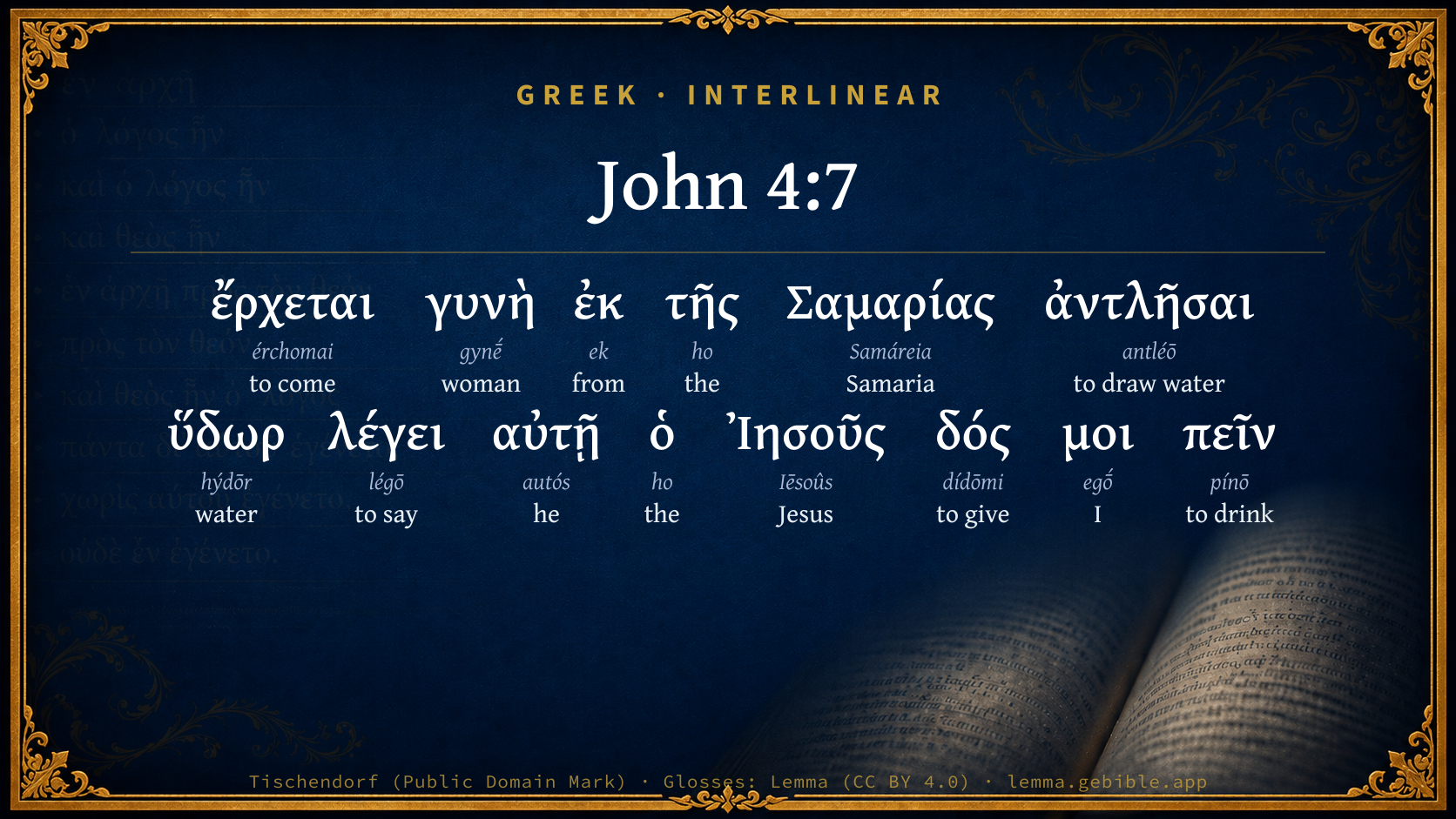
  1. ἔρχεται érchomai G2064 “to come” Verb, Present, Middle or Passive deponent, Indicative, 3rd person, Singular
  2. γυνὴ gynḗ G1135 “woman” Noun, Nominative, Singular, Feminine
  3. ἐκ ek G1537 “from” Preposition
  4. τῆς ho G3588 “the” Article, Genitive, Singular, Feminine
  5. Σαμαρίας Samáreia G4540 “Samaria” Noun, Genitive, Singular, Feminine
  6. ὕδωρ hýdōr G5204 “water” Noun, Accusative, Singular, Neuter
  7. λέγει légō G3004 “to say” Verb, Present, Active, Indicative, 3rd person, Singular
  8. αὐτῇ autós G846 “he” Personal pronoun, Dative, Singular, Feminine
  9. ὁ ho G3588 “the” Article, Nominative, Singular, Masculine
  10. Ἰησοῦς Iēsoûs G2424 “Jesus” Noun, Nominative, Singular, Masculine
  11. δός dídōmi G1325 “to give” Verb, Aorist, Active, Imperative, 2nd person, Singular
  12. μοι egṓ G1473 “I” Personal pronoun, 1st person, Dative, Singular
  13. πεῖν pínō G4095 “to drink” Verb, Aorist, Active, Infinitive

About this verse

These counts appear in no published source. They are computed here, from the morphology-tagged text and Lemma’s own curated glosses. What Lemma adds →

14
words
13
distinct lemmas
Gospels
section

Notable vocabulary

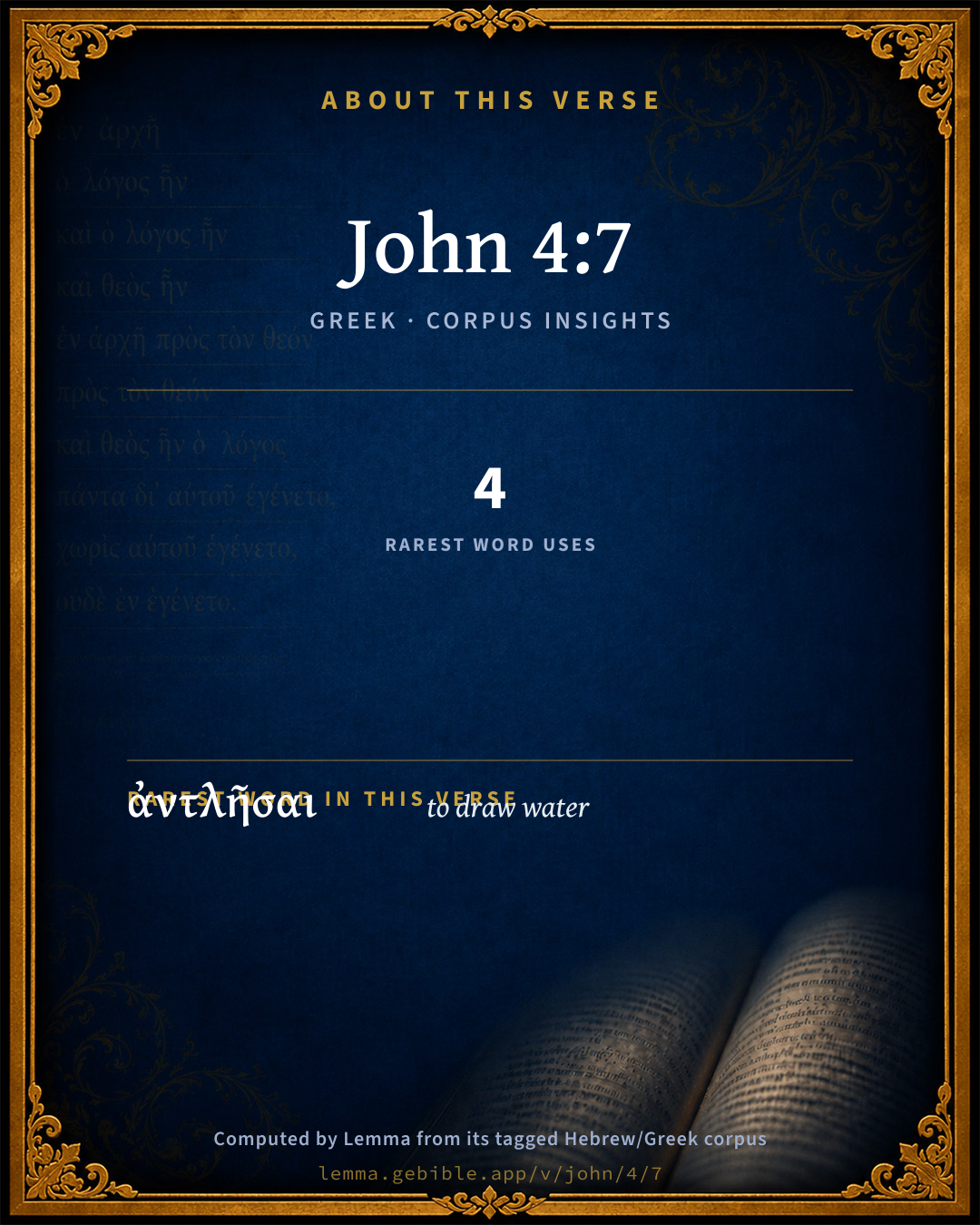
The rarest word here is ἀντλῆσαι to draw water G501 — appearing just 4 times in the whole Greek New Testament.

Shared distinctive vocabulary

ἀντλῆσαι to draw water G501 occurs in 4 verses of the Greek New Testament. Also found in:

Repetition

A word recurs within this verse:

Cross-references

6

Topical passages linked to John 4:7 in the Treasury of Scripture Knowledge — connected by theme and wording, ordered by reader-vote popularity; previews shown in the World English Bible.

  • Matthew 10:42 Whoever gives one of these little ones just a cup of cold water to drink in the name of a disciple, most assuredly I tell you he will in no way lose his reward."
  • 1 Kings 17:10 So he arose and went to Zarephath; and when he came to the gate of the city, behold, a widow was there gathering sticks: and he called to her, and said, Please get me a little water in a vessel, that I may drink.
  • John 19:28 After this, Jesus, seeing that all things were now finished, that the Scripture might be fulfilled, said, "I am thirsty."
  • Genesis 24:43 Behold, I am standing by the spring of water. Let it happen, that the maiden who comes forth to draw, to whom I will say, Give me, I pray you, a little water from your pitcher to drink.
  • 2 Samuel 23:15–17 David longed, and said, Oh that one would give me water to drink of the well of Bethlehem, which is by the gate!
  • John 4:10 Jesus answered her, "If you knew the gift of God, and who it is who says to you, 'Give me a drink,' you would have asked him, and he would have given you living water."

Cross-references courtesy of OpenBible.info (CC BY 4.0).

Commentary

Notes on John 4:7 from classic Christian and Jewish commentators (each source and its license shown beneath its notes). The classic Christian expositions comment on the surrounding passage and are grouped to its opening verse, so a note may address several verses; the Jewish commentaries on the Tanakh (Rashi and others) are per-verse, so they appear only where the commentator wrote on this verse.

Lemma curates 59 commentaries, every one of them public domain or Creative Commons licensed, each selected and text-cleaned for this edition rather than reprinted as found. About our sources →

Joseph Benson's Commentary

Joh 4:7-8. There cometh — At the very juncture of time; a woman of Samaria to draw water — The providence of God so ordering it, that she might have an opportunity of hearing the truth, in order to her salvation. Jesus — With a view to introduce a discourse which he graciously intended should be the means of her conversion; saith to her, Give me to drink — And it is remarkable, that in this one conversation he brought her to that knowledge which the apostles were so long in attaining. For his disciples were gone unto the city — Otherwise they might have assisted him to get water, and he would not have needed to have asked her.

Joseph Benson's Commentary on the Old and New Testaments (1811–1818) — public domain. Text from a community e-Sword module.

Whedon's Commentary on the Bible

Daniel D. Whedon

Conversation of Jesus with the woman of Samaria, Joh_4:7-26.

Upon this memorable narrative we may remark: 1. It stands in striking comparison with the Lord’s discourse with Nicodemus. The one was indeed with a leading metropolitan Doctor of the Jews, the latter with a poor country woman, and a Samaritan at that. The former shows our Lord’s dealing with, and mastery over, and development of, the higher minds of the day, in bringing them from their proud half-scepticism to the deepest and most humbling heart-truths of his Gospel. The latter shows how he would take a rude mind of humble rank, and raise it to a knowledge of himself, and in himself to a grasp of the sublimest truths of eternity and God. 2. Modern rationalists have expressed much contempt at the want of dignity of Jesus’s holding this converse with a garrulous female at a country well. Still greater was the contempt of the Jewish rabbis for woman. “No man salutes a woman,” says one doctor. “He plays the fool who instructs his daughter in the law,” says another. This condescension of the Saviour, therefore, crosses alike the pride of the rationalist and of the rabbi. Doubtless it was Jesus’s intention to cross the pride of both. Those sublime truths which the philosophers of Greece could impart only to the schools, Christianity brings down to the masses of society; to its humblest ranks; to women and to children. 3. This female, however, evidently possessed great strength of womanly character; a strength of passion which had exposed her to the extraordinary guilt of her past life; strength, nevertheless, of religious conviction powerfully struggling with her guilty nature; and strength of intellect, exhibited not only in the keenness of her insight into his remarks in the dialogue, but displayed in the powerful effect of her report upon the action of her townsmen. 4. The successive steps by which the Lord reveals himself furnish a beautiful study into the operations of mind. He presents himself first as a man and a Jew, 7-9; he proposes himself to her faith as a spiritual life-giver, 10-15; he confirms the faith in his offer by proving himself a holy prophet, 16-19; he so unfolds the truths of God as to be accepted as Messias, 20-26. Through all this progress he carries also the thought of her sin and his salvation.

7. Of Samaria—Not of the city of Samaria, the ancient capital, which lay upon a mountain-top eight miles distant, but of the province and race of Samaria.

To draw water—Bringing her own cord and pitcher “to draw with.” As Shechem is two miles distant she probably came from the field of labour, probably the flourishing grain field of Mukhnah. The town may, however, have then stretched nearer to the well.

Give me to drink— Making a request from which the whole revelations that follow could be gradually drawn.

Daniel D. Whedon (gen. ed.), Commentary on the Old and New Testaments (1874–1909) — public domain. Text from a community e-Sword module.

MacLaren's Expositions of Holy Scripture

Alexander MacLaren

John

‘GIVE ME TO DRINK’

Joh 4:7, Joh 4:26.

This Evangelist very significantly sets side by side our Lord’s conversations with Nicodemus and with the woman of Samaria. The persons are very different: the one a learned Rabbi of reputation, influence, and large theological knowledge of the then fashionable kind; the other an alien woman, poor-for she had to do this menial task of water-drawing in the heat of the day-and of questionable character.

The diversity of persons necessitates great differences in the form of our Lord’s address to each; but the resemblances are as striking as the divergencies. In both we have His method of gradually unveiling the truth to a susceptible soul, beginning with symbol and a hint, gradually enlarging the hint and translating the symbol; and finally unveiling Himself as the Giver and the Gift. There is another resemblance; in both the characteristic gift is that of the Spirit of Life, and, perhaps, in both the symbol is the same. For we read in one of ‘water and the Spirit’; and in the other of the fountain within, springing into everlasting life. However that may be, the process of teaching is all but identical in substance in both cases, though in form so various.

The words of our Lord which I have taken for our text now are His first and last utterance in this conversation. What a gulf lies between! They are linked together by the intervening sayings, and constitute with these a great ladder, of which the foot is fast on earth, and the top fixed in heaven. On the one hand, He owns the lowest necessities; on the other, He makes the highest claims. Let us ponder on this remarkable juxtaposition, and try to gather the lessons that are plain in it.

I. First, then, I think we see here the mystery of the dependent Christ.

‘Give Me to drink’: ‘I am He.’ Try to see the thing for a moment with the woman’s eyes. She comes down from her little village, up amongst the cliffs on the hillside, across the narrow, hot valley, beneath the sweltering sunshine reflected from the bounding mountains, and she finds, in the midst of the lush vegetation round the ancient well, a solitary, weary Jew, travel-worn, evidently exhausted-for His disciples had gone away to buy food, and He was too wearied to go with them-looking into the well, but having no dipper or vessel by which to get any of its cool treasure. We lose a great deal of the meaning of Christ’s request if we suppose that it was merely a way of getting into conversation with the woman, a ‘breaking of the ice.’ It was a great deal more than that. It was the utterance of a felt and painful necessity, which He Himself could not supply without a breach of what He conceived to be His filial dependence. He could have brought water out of the well. He did not need to depend upon the pitcher that the disciples had perhaps unthinkingly carried away with them when they went to buy bread. He did not need to ask the woman to give, but He chose to do so. We lose much if we do not see in this incident far more than the woman saw, but we lose still more if we do not see what she did see. And the words which the Master spoke to her are no mere way of introducing a conversation on religious themes; but He asked for a draught which He needed, and which He had no other way of getting.

So, then, here stands, pathetically set forth before us, our Lord’s true participation in two of the distinguishing characteristics of our weak humanity-subjection to physical necessities and dependence on kindly help. We find Him weary, hungry, thirsty, sometimes slumbering. And all these instances are documents and proofs for us that He was a true man like ourselves, and that, like ourselves, He depended on ‘the woman that ministered to Him’ for the supply of His necessities, and so knew the limitations of our social and else helpless humanity.

But then a wearied and thirsty man is nothing of much importance. But here is a Man who humbled Himself to be weary and to thirst. The keynote of this Gospel, the one thought which unlocks all its treasures, and to the elucidation of which, in all its aspects, the whole book is devoted, is, ‘The Word was made flesh.’ Only when you let in the light of the last utterance of our text, ‘I that speak unto thee am He,’ do we understand the pathos, the sublimity, the depth and blessedness of meaning which lie in the first one, ‘Give Me to drink.’ When we see that He bowed Himself, and willingly stretched out His hands for the fetters, we come to understand the significance of these traces of His manhood. The woman says, with wonder, ‘How is it that Thou, being a Jew, askest drink of me?’ and that was wonderful. But, as He hints to her, if she had known more clearly who this Person was, that seemed to be a Jew, a deeper wonder would have crept over her spirit. The wonder is that the Eternal Word should need the water of the well, and should ask it of a poor human creature.

And why this humiliation? He could, as I have said, have wrought a miracle. He that fed five thousand, He that had turned water into wine at the rustic marriage-feast, would have had no difficulty in quenching His thirst if he had chosen to use His miraculous power therefore. But He here shows us that the true filial spirit will rather die than cast off its dependence on the Father, and the same motive which led Him to reject the temptation in the wilderness, and to answer with sublime confidence, ‘Man doth not live by bread alone, but by every word from the mouth of God,’ forbids Him here to use other means of securing the draught that He so needed than the appeal to the sympathy of an alien, and the swift compassion of a woman’s heart.

And then, let us remember that the motive of this willing acceptance of the limitations and weaknesses of humanity is, in the deepest analysis, simply His love to us; as the mediaeval hymn has it, ‘Seeking me, Thou satest weary.’

In that lonely Traveller, worn, exhausted, thirsty, craving for a draught of water from a stranger’s hand, is set forth ‘the glory of the Father, full of grace and truth.’ A strange manifestation of divine glory this! But if we understand that the glory of God is the lustrous light of His self-revealing love, perhaps we shall understand how, from that faint, craving voice, ‘Give Me to drink,’ that glory sounds forth more than in the thunders that rolled about the rocky peak of Sinai. Strange to think, brethren, that the voice from those lips dry with thirst, which was low and weak, was the voice that spoke to the sea, ‘Peace! be still,’ and there was a calm; that said to demons, ‘Come out of him!’ and they evacuated their fortress; that cast its command into the grave of Lazarus, and he came forth; and which one day all that are in the grave shall hear, and hearing shall obey. ‘Give Me to drink.’ ‘I that speak unto thee am He.’

II. Secondly, we may note here the self-revealing Christ.

The process by which Jesus gradually unveils His full character to this woman, so unspiritual and unsusceptible as she appeared at first sight to be, is interesting and instructive. It would occupy too much of your time for me to do more than set it before you in the barest outline. Noting the singular divergence between the two sayings which I have taken as our text, it is interesting to notice how the one gradually merges into the other. First of all, Jesus Christ, as it were, opens a finger of His hand to let the woman have a glimpse of the gift lying there, that that may kindle desire, and hints at some occult depth in His person and nature all undreamed of by her yet, and which would be the occasion of greater wonder, and of a reversal of their parts, if she knew it. Then, in answer to her, half understanding that He meant more than met the ear, and yet opposing the plain physical difficulties that were in the way, in that He had ‘nothing to draw with, and the well is deep,’ and asking whether He were greater than our father Jacob, who also had given, and given not only a draught, but the well, our Lord enlarges her vision of the blessedness of the gift, though He says but little more of its nature, except in so far as that may be gathered from the fact that the water that He will give will be a permanent source of satisfaction, forbidding the pangs of unquenched desire ever again to be felt as pangs; and from the other fact that it will be an inward possession, leaping up with a fountain’s energy, and a life within itself, towards, and into everlasting life. Next, he strongly assails conscience and demands repentance, and reveals Himself as the reader of the secrets of the heart. Then He discloses the great truths of spiritual worship. And, finally, as a prince in disguise might do, He flings aside the mantle of which He had let a fold or two be blown back in the previous conversation, and stands confessed. ‘I that speak unto thee am He.’ That is to say, the kindling of desire, the proffer of the all-satisfying gift, the quickening of conscience, the revelation of a Father to be worshipped in spirit and in truth, and the final full disclosure of His person and office as the Giver of the gift which shall slake all the thirsts of men-these are the stages of His self-revelation.

Then note, not only the process, but the substance of the revelation of Himself. The woman had a far more spiritual and lofty conception of the office of Messiah than the Jews had. It is not the first time that heretics have reached a loftier ideal of some parts of the truth than the orthodox attain. To the Jew the Messiah was a conquering king, who would help them to ride on the necks of their enemies, and pay back their persecutions and oppressions. To this Samaritan woman-speaking, I suppose, the conceptions of her race-the Messiah was One who was to ‘tell us all things.’

Jesus Christ accepts the position, endorses her anticipations, and in effect presents Himself before her and before us as the Fountain of all certitude and knowledge in regard to spiritual matters. For all that we can know, or need to know, with regard to God and man and their mutual relations; for all that we can or need know in regard to manhood, its ideal, its obligations, its possibilities, its destinies; for all that we need to know of men in their relation to one another, we have to turn to Jesus Christ, the Messiah, who ‘will tell us all things.’ He is the Fountain of light; He is the Foundation of certitude; and they who seek, not hypotheses and possibilities and conjectures and dreams, but the solid substance of a reliable knowledge, must grasp Him, and esteem the words of His mouth and the deeds of His life more than their necessary food.

He meets this woman’s conceptions as He had met those of Nicodemus. To him He had unveiled Himself as the Son of God, and the Son of Man who came down from heaven, and is in heaven, and ascends to heaven. To the woman He reveals Himself as the Messiah, who will tell us all truth, and to both as the Giver of the gift which shall communicate and sustain and refresh the better life. But I cannot help dwelling for a moment upon the remarkable, beautiful, and significant designation which our Lord employs here. ‘I that speak unto thee.’ The word in the original, translated by our version ‘speak,’ is even more sweet, because more familiar, and conveys the idea of unrestrained frank intercourse. Perhaps we might render ‘I who am talking with Thee!’ and that our Lord desired to emphasise to the woman’s heart the notion of His familiar intercourse with her, Messiah though He were, seems to me confirmed by the fact that He uses the same expression, with additional grace and tenderness about it, when He says, with such depth of meaning, to the blind man whom He had healed, ‘Thou hast both seen Him,’ with the eyes to which He gave sight and object of sight, ‘and it is He that talketh with thee.’ The familiar Christ who will come and speak to us face to face and heart to heart, ‘as a man speaketh with his friend,’ is the Christ who will tell us all things, and whom we may wholly trust.

Note too how this revelation has for its condition the docile acceptance of the earlier and imperfect teachings. If the woman had not yielded herself to our Lord’s earlier words, and, though with very dim insight, yet with a heart that sought to be taught, followed Him as He stepped from round to round of the ascending ladder, she had never stood on the top and seen this great vision. If you see nothing more in Jesus Christ than a man like yourself, compassed with our infirmities, and yet sweet and gracious and good and pure, be true to what you know, and put it into practice, and be ready to accept all the light that dawns. They that begin down at the bottom with hearing ‘Give me to drink,’ may stand at the top, and hear Him speak to them His unveiled truth and His full glory. ‘To him that hath shall be given.’ ‘If any man wills to do His will he shall know of the teaching.’

III. Lastly, we have here the universal Christ.

The woman wondered that, being a Jew, He spoke to her. As I have said, our Lord’s first utterance is simply the expression of a real physical necessity. But it is none the less what the woman felt it to be, a strange overleaping of barriers that towered very high. A Samaritan, a woman, a sinner, is the recipient of the first clear confession from Jesus Christ of His Messiahship and dignity. She was right in her instinct that something lay behind His sweeping aside of the barriers and coming so close to her with His request. These two, the prejudices of race and the contempt for woman, two of the crying evils of the old world, were overpassed by our Lord as if He never saw them. They were too high for men’s puny limbs; they made no obstacle to the march of His divine compassion. And therein lies a symbol, if you like, but none the less a prophecy that will be fulfilled, of the universal adaptation and destination of the Gospel, and its independence of all distinctions of race and sex, condition, moral character. In Jesus Christ ‘there is neither Jew nor Greek, male nor female, neither bond nor free’; ye ‘are all one in Christ.’ If He had been but a Jew, it was wonderful that He should talk to a Samaritan. But there is nothing in the character and life of Christ, as recorded in Scripture, more remarkable and more plain than the entire absence of any racial peculiarities, or of characteristics owing to His position in space or time. So unlike His nation was He that the very elite of His nation snarled at Him and said, ‘Thou art a Samaritan!’ So unlike them was He that one feels that a character so palpitatingly human to its core, and so impossible to explain from its surroundings, is inexplicable, but on the New Testament theory that He is not a Jew, or man only, but the Son of Man, the divine embodiment of the ideal of humanity, whose dwelling was on earth, but His origin and home in the bosom of God. Therefore Jesus Christ is the world’s Christ, your Christ, my Christ, every man’s Christ, the Tree of Life that stands in the midst of the garden, that all men may draw near to it and gather of its fruit.

Brother, answer His proffer of the gift as this woman did: ‘Sir, give me this water, that I thirst not; neither go all the way to the world’s broken cisterns to draw’; and He will put into your hearts that indwelling fountain of life, so that you may say like this woman’s townspeople: ‘Now I have heard Him myself, and know that this is indeed the Christ, the Saviour of the world.’

Alexander MacLaren, Expositions of Holy Scripture (1904–1910) — public domain. Text from a community e-Sword module.

Tyndale Open Study Notes

Tyndale Open Resources

4:7 Due to the heat, it was customary for the women to draw water in early morning or evening. However, this woman lived in isolation, separated from her community. Jesus was compassionate toward outcasts.

Tyndale Open Study Notes — © Tyndale Open Resources, licensed CC BY-SA 4.0. Text via the HelloAO Bible API.

Bengel's Gnomon

Johann Albrecht Bengel

Joh 4:7.[81] Ἐκ τῆς, of) Construe with γυνή, a woman.—δός μοι πιεῖν, give Me to drink) At precisely the seventh subsequent alternation [vicissitudine] in the conference, until the disciples come, reckoning from this address, which would seem to be indifferent, Jesus wonderfully brings on the matter to that crowning point, I am the Messiah, Joh 4:26; a point, to learn which the apostles required so long a time [ch. Joh 16:31, “Jesus answered them, Do ye now believe?”] In fact the tree takes longer to grow than the ear of corn. So also He led on the nobleman to faith by but two utterances; Joh 4:48; Joh 4:50, “Except ye see signs and wonders, ye will not believe:” and, “Go thy way, thy son liveth.”

[81] ἔρχεται γυνή, there cometh a woman) The external opportunities [conveniences] of every-day life subserve the progressive advances of the kingdom of GOD.—V. g.

Bengel's Gnomon of the New Testament — English translation (T&T Clark, Edinburgh, 1860) — public domain. Text from a community e-Sword module.

Meyer's Critical & Exegetical Commentary

Heinrich August Wilhelm Meyer

Joh_4:7-9. Γυνὴ ἐκ τ. Σαμαρ.] to be taken as one designation, a Samaritan-woman. John gives prominence to the country to which she belonged, to prepare the way for the characteristic features of the following interview. It is not the town two miles distant (Sebaste) that is meant, but the country.

ἀντλῆσαι ὕδωρ] The modern Nablus lies half an hour distant from the southern well, and has many wells of its own close by; see Robinson, III. 333. It is therefore all the more probable that Sychar, out of which the woman came,[185] was a separate town. As to the forms πεῖν and ΠῖΝ (so Jacobs, Del. epigr. vi. 78), see Herm. Herodian. § 47; Buttmann, N. T. Gr. p. 58 [E. T. p. 66], who prefers πῖν, though this is regarded by Fritzsche (de conform. Lachm. p. 27) as the mistake of a copyist. As to the phrase δίδωμι πιεῖν, without any object expressed, see Krüger, § 55. 3. 21. It is an arbitrary supposition in itself, to imagine, as Hengstenberg does, that this Give me to drink had underlying it a spiritual sense, Give me spiritual refreshment (by thy conversion), and is opposed to Joh_4:8, which by no means gives a general reason why Jesus entered into conversation with the woman; for He might have done this in the apostles presence, though, according to Hengstenberg, He must have sent them away (all excepting John[186]), on purpose to have an undisturbed interview with the woman. All this is mere imagination.

Joh_4:8. ΓΆΡ] The reason why he asked the services of the woman; the disciples, whose services he would otherwise have claimed, were absent.

ἵνα τροφὰς ἀγορ.] According to later tradition (Samaritanis panem comedere aut vinum bibere prohibitum est, Raschi, ad Sota, 515), this would not have been allowed. But the separation could not have been so distinctly marked at that time, especially as to commercial dealings and intercourse with the Galileans, since their road lay through Samaria. Jesus, moreover, was raised above these hostile divisions which existed among the people (Luk_9:52).

Joh_4:9. The woman recognised that Jesus was a Jew by His language, and not by His accent merely.

πῶς] qui fit ut. The words of the woman indicate the pert feminine caprice of national feeling. There is no ground whatever for supposing (Hengstenberg) that the woman had at this stage any presentiment that He who addressed her was any other than an ordinary Jew.

οὐ γὰρ, κ.τ.λ.] not a parenthesis, but the words of the evangelist.

Jews with Samaritans, without the article.

[185] That, considering the sacred character of the water, she did not hesitate about the distance of the well from Sychem (Hengstenberg), is without any hint in the text.

[186] Who must, according to Godet also, have remained with Him. A gratuitous addition, made for the purpose of securing a guarantee for the accuracy of the narrative.

Meyer — Critical and Exegetical Commentary on the New Testament — English translation by Peter Christie, edited by Frederick Crombie (T&T Clark, 1880) — public domain. Text from a community e-Sword module.

Expositor's Greek Testament

ed. W. Robertson Nicoll

Joh 4:7 . ἔρχεται … ὕδωρ , apparently this clause is prepared for by the preceding, “There comes a woman of Samaria,” that is, a Samaritan woman, not, of course, “from the city Samaria,” which is two hours distant from the well, ἀντλῆσαι ὕδωρ , infinitive and aorist, both classical; cf. Rebecca in Gen 24:11 , etc., having her ὑδρία on her shoulder or on her head, ἄγγος ἐπὶ τῇ κεφαλῇ ἔχουσα , Herod., Joh 4:12 ; and Ovid’s “Ponitur e summa fictilis urna coma”. [Elsner] ἄντλος is the hold of a ship where the bilge settles: ἀντλέω , to bale a ship; hence, to draw water. To her Jesus says, Δός μοι πιεῖν , the usual formula; cf. δώσω πιεῖν , Pherecrates, Frag. , 67, and Aristoph., Pax , 49.

The Expositor's Greek Testament, edited by W. Robertson Nicoll (1897–1910) — public domain. Text from a community e-Sword module.

Jamieson, Fausset & Brown

Robert Jamieson, A. R. Fausset & David Brown

Give me to drink--for the heat of a noonday sun had parched His lips. But "in the last, that great day of the feast," Jesus stood and cried, saying, "If any man thirst let him come unto Me and drink" (Joh 7:37).

Jamieson, Fausset & Brown — Commentary Critical and Explanatory on the Whole Bible (1871) — public domain (CC PDM 1.0). Text via the HelloAO Bible API.

Adam Clarke's Commentary

Verse 7. There cometh a woman of Samaria to draw water] That this was the employment of the females, we see in different parts of the Sacred Writings. See Ge 24:11, c. Ex 2:16, and the note at the end of that chapter. The Jews say that those who wished to get wives went to the wells where young women were accustomed to come and draw water; and it is supposed that women of ill fame frequented such places also. See several proofs in Schoettgen.

Adam Clarke's Commentary on the Bible (1810–1826) — public domain. Text from a community e-Sword/MySword module.

John Calvin's Commentaries

7. A woman came from Samaria. When he asks water from the woman, he does it not merely with the intention of obtaining an opportunity to teach her; for thirst prompted him to desire to drink. But this cannot hinder him from availing himself of the opportunity of instruction which he has obtained, for he prefers the salvation of the woman to his own wants. Thus, forgetting his own thirst, as if he were satisfied with obtaining leisure and opportunity for conversation, that he might instruct her in true godliness, he draws a comparison between the visible water and the spiritual, and waters with heavenly doctrine the mind of her who had refused him water to drink.

John Calvin's Commentaries (1540-1563) — public domain. Text from the Calvin Translation Society English edition (1840s-50s) via the Christian Classics Ethereal Library (ccel.org). Calvin's coverage is partial (roughly two-thirds of the Bible); uncommented books and verses are honest gaps, never fabricated. The 19th-century editor's footnotes and remarks are omitted so the notes are faithfully Calvin's own voice.

Ellicott's Commentary for English Readers

(7) Of Samaria—i.e., of the country (Joh_4:1), not of the city, which was nine miles farther north. She was of the people inhabiting the valley between Ebal and Gerizim, not, like Himself, a chance passenger by the well. The contrast is at once drawn between Him, a Jew and a man, and her, of Samaria and a woman.

Give me to drink is the almost always asked and almost never refused favour as the traveller meets the native by the well-side. He was wearied by the heat of the journey, and seeks the ordinary refreshment.

A Bible Commentary for English Readers, edited by Charles John Ellicott (1878–1897) — public domain. Text from a community e-Sword module.

The Cambridge Bible for Schools and Colleges

gen. ed. J. J. S. Perowne

7. a woman of Samaria] i.e. of the province; not of the city of Samaria, at that time called Sebaste, in honour of Augustus, who had given it to Herod the Great. Herod’s name for it survives in the modern Sebustieh. A woman of the city of Samaria would not have come all that distance to fetch water. In legends this woman is called Photina.

Give me to drink] Quite literal, as the next verse shews. He asked her for refreshment because His disciples had gone away. ‘Give me the spiritual refreshment of thy conversion’ is a meaning read into the words and not found in them.

The Cambridge Bible for Schools and Colleges (gen. ed. J. J. S. Perowne; Cambridge University Press, 1878–1918) — public domain. Text from a community e-Sword module.

John Gill's Exposition

There cometh a woman of Samaria,.... Or "out of Samaria"; not out of the city of Samaria, but out of the country of Samaria; out of Sychar, a city of Samaria: her coming was not by chance, but by the providence of God, and agreeably to his purpose, who orders all things according to the counsel of his will; and it is an amazing instance of grace, that a woman, a Samaritan woman, a lewd and infamous one, should be a chosen vessel of salvation, should be the object of divine favour, and be effectually called by the grace of God; when so many wise, learned, and religious men in Judea, were passed by; and not only so, but she was the happy means of conveying the knowledge of the Saviour to many of her neighbours: she came, indeed,

to draw water; for her present temporal use and service; she little thought of meeting at Jacob's well, with Christ the fountain of gardens, and well of living water; she came for natural water, having no notion of water in a spiritual sense: or of carrying back with her the water of life, even a well of it, springing up to everlasting life:

Jesus saith unto her, give me to drink; that is, water to drink, out of the pot or pitcher, she brought with her, for he was athirst; which is another proof of the truth of his human nature, and of his taking it, with the sinless infirmities of it: though indeed this request was made, to introduce a discourse with the woman, he having a more violent thirst, and a stronger desire, after the welfare of her immortal soul.

John Gill's Exposition of the Whole Bible (1746–1763) — public domain (CC PDM 1.0). Text via the HelloAO Bible API.

Trapp's Complete Commentary

John Trapp

7 There cometh a woman of Samaria to draw water: Jesus saith unto her, Give me to drink.

Ver. 7. A woman of Samaria] A poor cupbearer, such as Festus calls Canalicolas, quod circa canalem fori consisterent, lazy people because they were much about the conduits of the forum. (Becman. de Originib.)

John Trapp, A Commentary or Exposition upon All the Books of the Old and New Testament (1647–1656) — public domain. Text from a community e-Sword module.

Albert Barnes' Notes on the Bible

Of Samaria - Not of the “city” of Samaria, for this was at a distance of 8 miles, but a woman who was a Samaritan, and doubtless from the city of Sychar.

Give me to drink - This was in the heat of the day, and when Jesus was weary with his journey. The request was also made that it might give him occasion to discourse with her on the subject of religion, and in this instance we have a specimen of the remarkably happy manner in which he could lead on a conversation so as to introduce the subject of religion.

Albert Barnes' Notes on the Bible (1834–1885) — public domain. Text from a community e-Sword/MySword module.

Matthew Poole's English Annotations

It is uncertain whether this woman was a citizen of Samaria, which city is said to be at two miles distance from this place, or one of that country, which went by that name (for Samaria was the name of that region, as well as of a city). She came not out of any design to meet with Christ there, but came to draw water; they having not pumps and wells so common as we have, were forced to travel for water for their necessary uses. Thus it often happeneth that we meet with Divine mercy when we think not of it. God is found of those who seek him not, nor inquire after him, Isa 65:1; which lets us see how all our motions and actions are at the Divine disposal and government. Rachel went not to the well to meet with the tidings of a husband, but to water her father’s flock; but yet there she met with Jacob, Gen 29:9; as it had happened to Rebekah before, Gen 24:15. This woman (as appeareth by what followeth) was no better than a harlot; to her Christ (fleeing from the Pharisees, the great doctors of the Jews) bringeth the glad tidings of the gospel, and she receives them. So admirable are the dispensations of Divine Providence. He prevents this woman, saying unto her,

Give me to drink.

Matthew Poole's English Annotations on the Holy Bible (1683–1685) — public domain. Text from a community e-Sword/MySword module.

The Pulpit Commentary

Vers. 7-26. (2) The revelations and misunderstandings comprised in the interview with the Samaritaness.

Vers. 7-9. (a) The Giver of all asks alms, submitting to conditions of humanity.

There cometh a woman of Samaria to draw water. The ek thv Samareiav undoubtedly qualifies the word gunh , and not ercetai ; ; therefore the country, not the city, of Samaria is referred to. Besides, that city was at much too great a distance to be the home of this Samaritaness. There were other springs still nearer to the city of Sychar, which the women of the place would frequent. We need not, with Hengstenberg, suppose that, from a religious motive, one of reverence for the well of Jacob, this woman had chosen the longer walk and greater exertion, in the heat of the day. No hint of the kind occurs. The simple supposition that her home was hard by the well is sufficient to explain the somewhat unusual circumstance that she should have come alone and at midday. No longer, as in ancient times, did women of social position perform this duty. (Gen_24:15 Exo_2:16) She by her action proclaimed her humble station in life. Hard work is performed by women at the present day in the East and South. Jesus saith to her, Give me to drink. This form of expression is not uncommon. The Lord was not only weary, but veritably thirsty. He had taken upon himself all our innocent desires and cravings. "He would know all, that he might succour all," and was intent upon conferring a blessing by asking a favour. He put it into her power to do him a kindness, just as when God evermore says, "Give me thy heart," when he is yearning to give himself to us. "It is more blessed to give than to receive." He will at once confer on this poor "waif and stray" the unspeakable privilege of bestowing the cup of cold water on the Lord of all. It is not that in the first instant he implied that he was thirsting for her salvation; that interpretation would almost lift the narrative into the purely symbolic region, greatly to its injury, and to the damage of the entire Gospel.

Vers. 7-14. The conversation with the Samaritan woman.

I THE FIRST APPROACH IS MADE ON OUR LORD"S SIDE. "Give me to drink.

1. Consider the person addressed. "There cometh a woman of Samaria to draw water.

(1) It was a woman. Rabbinic prejudice discouraged the fuller religious instruction of woman, but Jesus trampled such a prejudice underfoot. It is interesting to notice that a woman was the first convert in Samaria, as Lydia was the first convert in Europe.

(2) It was a Samaritan, "an alien from the commonwealth of Israel;" yet Jesus passed beyond the limits of Judaism in his errand of mercy.

(3) It was a poor woman, for drawing water was no longer, as in more ancient times, the work of women of rank; yet Jesus preaches the gospel to the poor.

(4) She was degraded. She was an adulteress; yet Jesus had mercy to offer to this sinner.

2. Consider how he seeks to elicit her thought and to gain her soul. He asks a favour. "Give me to drink." This was to recognize her momentary superiority.

II THE QUICK RECOLLECTION ON HER SIDE OF THE WALL OF SEPARATION BETWEEN JEW AND SAMARITAN. "How is it that thou, being a Jew, askest drink of me, which am a woman of Samaria?

1. She identified Jesus as a Jew by his dress or his accent or by both.

2. Consider the embittering alienations wrought by religious differences.

"For the Jews have no dealings with the Samaritans." Yet the Galilaeans, like our Lord and his disciples, may have been less influenced by the policy of isolation than the people of Judaea, for while Jesus asked a drink from a Samaritan, his disciples went to a Samaritan city to buy meat.

3. Mark the perpetuity of religious hatred. It dated from the age of the Captivity. It still exists to separate Samaritans both from Jews and from Christians.

III OUR LORD"S OFFER OF THE BEST GIFT TO THE SAMARITAN WOMAN. "If thou knewest the gift of God, and who it is that saith to thee, Give me to drink; thou wouldest have asked of him, and he would have given thee living water.

1. The gift of God is the living water, as he who speaks to her is the Agent of imparting it to the soul of man.

(1) The living water is eternal life (vers. 13, 14).

(2) It is adapted to satisfy the thirst of the human soul for fellowship with God.

(3) It is ever fresh, as it springs from an unfailing source. (Gen_26:19)

2. Mark how it is to be obtained. "Thou wouldest have asked of him." It is by prayer the prayer of faith. Some say that we are not to pray for salvation, but simply to believe in order to salvation.

(1) But our Lord here sanctions prayer for it, and Peter enjoins it upon Simon Magus: "Pray God, if perhaps the thought of thine heart may be forgiven thee.

(2) It is the duty of an unconverted man to pray, as it is his duty to believe. His unbelief is no excuse for the neglect of this duty. Why otherwise is the neglect of prayer charged as a sin? (Zep_1:6 Hos_7:7)

(3) If a sinner takes salvation before he prays, and does so because he has not faith to pray, he is saved before he has faith. It is absurd, then, to counsel the sinner against praying because prayer implies faith, and yet to exhort him to take salvation which is impossible without faith. On such a principle a sinner can neither pray nor believe.

3. Mark the cause of the sinner not receiving the gift of God. "If thou knewest the gift of God." Ignorance of the worth of Christ is the great cause of the gift not being appropriated. The Samaritan woman has so little idea of the import of our Lord"s words that she thinks only of the water of Jacob"s well, and therefore our Lord has to set the truth in a new and striking light before her.

IV THE TRUE NATURE OF THE LIVING WATER THAT IS IN CHRIST"S DISPOSAL.

1. It satisfies more than mere momentary wants. The water of Jacob"s well would satisfy a thirst that would recur again. This living water would fully satisfy the thirst of the immortal spirit, and finally end the inward unrest. "Whosoever shall drink of this water shall thirst again: but whosoever drinketh of the water that I shall give him shall never thirst." Earthly satisfactions leave an emptiness in the soul which needs an ever fresh supply from external sources.

2. The living water is

(1) a well more inexhaustible than Jacob"s well, for it is supplied by the fountain of God"s grace.

(2) It is a fountain leaping up in abounding plenty, so as to supply all the vast variety of human need.

(3) It springs up to eternal life in its issue. "The fountain itself is Jesus glorified in the heart by the Holy Spirit."

The Pulpit Commentary (1880–1919), ed. H.D.M. Spence-Jones & Joseph S. Exell — public domain. Text from a community e-Sword module.

John Wesley's Explanatory Notes

Give me to drink - In this one conversation he brought her to that knowledge which the apostles were so long in attaining.

John Wesley, Explanatory Notes Upon the Whole Bible (1754–1765) — public domain. Text via the GEBible commentary corpus.

Kretzmann's Popular Commentary

Paul E. Kretzmann

The beginning of the conversation:

v. 7. There cometh a woman of Samaria to draw water. Jesus saith unto her, Give Me to drink.

v. 8. (For His disciples were gone away unto the city to buy meat.)

v. 9. Then saith the woman of Samaria unto Him, How is it that Thou, being a Jew, askest drink of me, which am a woman of Samaria? For the Jews have no dealings with the Samaritans.

v. 10. Jesus answered and said unto her, If thou knewest the gift of God, and who it is that saith to thee, Give Me to drink, thou wouldest have asked of Him, and He would have given thee living water.

While Jesus was sitting there, exhausted, hungry, and thirsty, there came a Samaritan woman out of the city to draw water from the well, the work of the Oriental women to this day. Here was an opportunity to do work in the interest of saving a soul, and Jesus took good care to make use of the chance. He deliberately began a conversation with the woman, by asking her for a drink of water. Time and occasion were auspicious, since they were undisturbed, the disciples, as the evangelist notes, having gone to the city to buy food for the little company. The woman was surprised at the request of Jesus. In her astonishment she asks how it came about that He, of whom she could tell that He was a Jew, yet asked this favor of her who was a Samaritan. The evangelist explains this by saying that there was no communication between Jews and Samaritans, the hostility going so far as to exclude even all courtesies by the way. See Luk 9:53. But Jesus has no time for racial prejudices when there is a chance to speak of the heavenly wisdom. Instead of being surprised at the question, the woman should have turned right around and, on her own part, made a request. If she had any idea of the fact that the gift of God in the person and work of Jesus is free for all men; if she had an inkling of the beauty and glory of that gift; if she were aware of the identity of Him that had spoken to her, she would waste no time in idle. questions as to proprieties. She would have begged Him at once most urgently and eagerly, and He could and would have given her living water. Jesus here testifies of Himself, of His own person. Living water, in the spiritual sense, from Him, the fountain of life, a water to refresh the soul, a water that gives life. Christ’s Word and His salvation, which are given freely according to the grace and mercy of God, were here offered to the woman of Samaria. Incidentally, Jesus challenged the curiosity of the woman by emphasizing living water. The pool before them was probably rainwater, gathered here from the surrounding hills. But the water which He had in mind was far from being stagnant: it had life and strength in fullness.

Paul E. Kretzmann, Popular Commentary of the Bible (1921–1924) — public domain. Text from a community e-Sword module.

Burkitt's Expository Notes on the New Testament

William Burkitt

Observe here, 1. How all our motions and actions are under the direction and Government of God, and how divine providence doth sometimes dispose of small matters to become occassions of great good. This poor woman’s coming to the well to draw water, became the means of her conversion.

Observe, 2. Christ speaks to, and seeks after this poor woman, before she takes any notice of him; God is found of that seek him not, and makes himself manifest to them that enquire not after him. Jesus said unto her, Give me to drink.

Observe, 3. The great poverty of our Lord’s outward condition, he wanted a draught of water for his refreshment, and a meal’s meat now at dinner-time, to refresh his wearied nature.

Oh! what a contempt did Christ cast upon the world when he was here in it! He would not honour it so far as to keep any part of it in his own hand.

Yet observe, 4. That though Christ had neither house nor land, nor money of his own, yet he lived not by begging, or upon mere alms. The disciples were now gone into the city to buy, not to beg meat: for there was a bag which required a bearer, Joh 12:6 And our Saviour’s friends and followers supplied him with money for his necessary occasions: His disciples were gone to buy bread,

Observe lastly, How bitter is the enmity which differences in religion, and diversities of opinions do occasion; they do not only alienate affections, but even violate the bonds of civil society and common conversation. The Jews had no dealings with the Samaritans; would neither eat nor drink with them.

William Burkitt's Expository Notes on the New Testament (1700–1703) — public domain. Text from a community e-Sword module.

The People's New Testament

B. W. Johnson

7, 8. There cometh a woman of Samaria. A Samaritan woman of the city of Sychar. Why she should come so far from the city for water is a matter of conjecture.

B. W. Johnson's The People's New Testament with Notes (1889–1891) — public domain. Electronic text from the Christian Classics Ethereal Library (CCEL) ThML edition.

Cambridge Greek Testament for Schools and Colleges

7. ἐκ τ. Σαμ. Of the province, not of the city of Samaria. A woman of the city would not have come all that distance for water. The city was at that time called Sebaste, a name given to it by Herod the Great in honour of Augustus (Σεβαστός), who had granted the place to Herod on the death of Antony and Cleopatra (see on Joh 6:1). Herod’s name Sebaste survives in the modern Sebustieh. In legends this woman is called Photina. For ἀντλῆσαι, comp. Joh 2:8.

δός μοι πεῖν. Quite literal, as the next verse shews: He asked her for refreshment because His disciples were not there to give it. ‘Give Me the spiritual refreshment of thy conversion’ is a meaning read into the words, not found in them. This request and κεκοπιακὼς ἐκ τ. ὁδ. (Joh 4:6) shew how untenable is the view that the Fourth Evangelist held Docetic views: the reality of Christ’s human form is very plain here (see on Joh 19:35). The reality of His human sympathy appears also; for often the best way to win a person is to ask a favour.

Cambridge Greek Testament for Schools and Colleges (Cambridge University Press, 1896; 21 vols, various authors incl. Carr, Maclear, Plummer, Farrar, Lumby, Moule, M. R. James, Simcox) — public domain. Text from a community e-Sword module.

Alford’s Greek Testament

Henry Alford

7.] ἐκ τ. Σ., i.e. a Samaritan—so γυνὴ Χαναν. ἀπὸ τῶν ὁρίων ἐκείνων, Mat 15:22.

Henry Alford, The Greek Testament (1849–1861) — public domain. Text from a community e-Sword module.

International Critical Commentary

7. “A woman of Samaria” (ἐκ τῆς Σαμαρίας: cf. 1:44). In later days she was commemorated as St. Photina, on March 20.

For ἀντλεῖν, the regular word for drawing water from a well, see on 2:8, 9 above.

δός μοι πεῖν. So א*B*C*DL the rec. has πιεῖν. This is a common Greek constr.; cf. Xen. Cyrop. vii. i. 1, τῷ δὲ Κύρῳ … προσήνεγκαν ἐμφαγεῖν καὶ πιεῖν, and see v. 33.

International Critical Commentary — older volumes (1896–1929), various authors — public domain. Text from a community e-Sword module.

Vincent's Word Studies in the New Testament

Marvin R. Vincent

A woman. Held in low esteem by the popular teachers; a Samaritan, and therefore despised by the Jews; poor, for drawing water was not, as in earlier times, performed by women of station (Gen 24:15; Gen 29:9). Of Samaria. Literally, out of Samaria [εκ] . Not of the city of Samaria, which was some six miles distant, but the country. A Samaritan by race and religion.

To draw. See on 2 8.

Marvin R. Vincent, Word Studies in the New Testament (1887–1900) — public domain. Text from a community e-Sword/MySword module.

Godet's Commentaries

Frédéric Louis Godet

Vv. 7-9. “A woman of Samaria comes to draw water. Jesus says to her: Give me to drink. 8. For his disciples had gone to the city to buy food. 9. The Samaritan woman therefore says to him: How is it that thou, being a Jew, dost ask drink of me who am a Samaritan woman. (For the Jews have no dealings with the Samaritans.”)

How was it that this woman came so far to seek water, and at such an hour? She had undoubtedly been working in the fields, and was coming to draw water on her return to her home at the hour of dinner (see at Joh 4:15). It has been thought that this feature suits an evening hour better, since that is ordinarily the hour when the women go to the well. But in that case this woman would undoubtedly not have been found here alone (Meyer, Weiss).

The objective phrase: of Samaria, depends on the word woman, and not on the verb comes; for, in the latter case, Samaria would mean the city of that name; an impossible meaning, since that city was situated three leagues to the northeast. The request of Jesus must be understood in the most simple sense, and regarded as serious. There is no allegory in it; He is really thirsty; this follows from the word wearied. But this does not prevent Him, in beginning a conversation with the woman, from obeying another necessity than that of thirst—namely, of saving (Joh 4:32; Joh 4:34). He is not unaware that the way to gain a soul is often to ask a service of it; there is thus conceded to it a kind of superiority which flatters it. “The effect of this little word was great; it began to overturn the wall which had for ages separated the two peoples,” says Lange. The remark of Joh 4:8 is intended to explain that, if the disciples had been present, they would have had a vessel, an ἄντλημα, to let down into the well. Indeed, in the East, every caravan is provided with a bucket for drawing from the wells which appear on the road (see Joh 4:11). This explanation given by the evangelist, proves the complete reality, in his view, of the need which called forth the request of Jesus. There is no longer here anything of docetism! Does the expression, the disciples, denote all the disciples without exception? Might not one of them, John, for example, have remained with Jesus? It would be strange enough that Jesus should have been left there, absolutely alone, in the midst of a hostile population; and twelve men were not necessary to procure provisions! Meyer’s prudery is offended at such a simple supposition, and Reuss goes so far as to say: “The luminous idea has been formed of leaving John at the place to take notes.”— The Jewish doctors said: “He who eats bread with a Samaritan is as he who eats swine’s flesh.” This prohibition, however, was not absolute; it did not apply either to fruits or to vegetables. As to corn and wine, we are ignorant. Uncooked eggs were allowed; whether cooked, was a question (Hausrath, Neutest. Zeitgesch., I., p. 22). It is proved, however, that the most strict Rabbinical regulations belong to a later epoch.

How did the Samaritan woman recognize Jesus as a Jew. By His dress or His accent? Stier has observed that in some words which Jesus had just spoken the letter שׁ occurred, which, according to Jdg 12:6, distinguished the two pronunciations, the Jewish (sch), and the Samaritan (s); לשׁחת תני (teni lischechoth; Samaritan: lisechoth).—The last words (οὐ γὰρ συγχρῶνται) are a remark of the evangelist, with a view to his Gentile readers who might be unacquainted with the origin of the Samaritan people (2Ki 17:24 ff.). It was a mixture of five nations transported from the East by Esarhaddon to re-people the kingdom of Samaria, the inhabitants of which his predecessor had removed. To the worship of their national gods, they united that of the divinity of the country, Jehovah. After the return from the Babylonish captivity, they offered the Jews their services for the rebuilding of the temple. Being rejected, they used all their influence with the kings of Persia, to hinder the re-establishment of the Jewish people. They built for themselves a temple on Mount Gerizim. Their first priest was Manasseh, a Jewish priest who had married a Persian wife. They were more detested by the Jews than the Gentiles themselves were. Samaritan proselytes were not received. It has been thought that the woman, in frolicsomeness, exaggerated somewhat the consequences of the hostility between the two peoples, and that in submitting to Jesus this insignificant question, she wished to enjoy for a moment the superiority which her position gave her. This shade of thought does not appear from the text. The Samaritan woman naively expresses her surprise.

Frédéric Louis Godet — Commentaries on Luke, John, Romans, and 1 Corinthians — English translation (T&T Clark, Edinburgh, 1870s–1890s) — public domain. Text from a community e-Sword module.

Lesson kit

Teaching starters — assembled from the data on this page, not authored interpretation. Every prompt links to the verse data it draws on. Edit before teaching.

John, in the Gospels, opens this verse with 14 words (13 distinct Greek lemmas). Its most distinctive word is antléō (“to draw water”). A historical commentator’s framing appears above. Read the whole chapter for the surrounding context.

Discussion questions

  1. What does “to draw water” (antléō) contribute to the verse as a whole?
  2. John 2:8 shares the word «to draw water» with this verse. How do the two illuminate each other?
  3. “the” occurs 2× in this one verse. What is the effect of the repetition?
  4. These translations render this verse differently. What is at stake in choosing one wording over another?
  5. Reading how Joseph Benson's Commentary and Whedon's Commentary on the Bible read this verse, where do the two commentators agree and where do they part?

Things to notice

Reading settings

Reading text

Shown beneath each verse's original-language words.

Old Testament
Old Testament edition

Read the OT as the Masoretic Hebrew (MT) or the Greek Septuagint (LXX).

English shown for the Greek Septuagint (in the Hebrew ↔ Greek comparison).

Comparing translations? Open the Compare panel on any verse page to stack up to four side by side.