John 1:26

Greek (Tischendorf 8th ed.) John 1:26 appears in the Greek New Testament. The text above is from the Tischendorf 8th edition. Each word links to its Strong’s number and a concise gloss. Click any word for its full Thayer’s Greek Lexicon entry.
Download image
Cite this verse

John 1:26 (World English Bible). Public Domain. Lemma interlinear Bible study tool, https://lemma.gebible.app/v/john/1/26.

Show BibTeX & RIS
BibTeX
RIS
English Translation
John answered them, "I baptize in water, but among you stands one whom you don't know.
World English Bible · Public Domain
Download a study sheet

One document with this verse’s original text, its word-by-word gloss line, the meaning frame, cross-references with their text, attributed commentary, and full source and license credits — printable, and it pastes into notes with its structure intact.

This verse Autodidact and up

Study sheet (.html) Plain text (.txt)

A passage Seminary Student

Up to 50 verses in one chapter. A passage sheet keeps up to 6 commentary sources and 12 cross-references per verse, in the order this page ranks them, and says so on the sheet whenever that leaves anything out. Ask for a single verse and you get the Autodidact verse sheet above.

Everything on this page stays free to read, with no account — the sheet is a download of what is already on screen, not access to it.

Want to remove ads? Support Godless Engineer
Compare translations 3

The same verse in 3 English versions, stacked beneath the original-language interlinear above. Click any original word for its lexicon entry.

Each is an independent rendering of the whole verse — the interlinear is not word-aligned to these translations.

Highlighted words mark where these versions differ — a whole-verse word diff, not a word-by-word alignment.

  • World English Bible Public Domain
    John answered them, "I baptize in water, but among you stands one whom you don't know.
  • King James Version Public Domain
    John answered them, saying, I baptize with water: but there standeth one among you, whom ye know not;
  • unfoldingWord Literal Text CC BY-SA 4.0
    John answered them, saying, “I baptize in water. In the midst of you stands one you do not know,

unfoldingWord Literal Text — © unfoldingWord, licensed CC BY-SA 4.0. Word-aligned USFM3 via Door43 (git.door43.org/unfoldingWord/en_ult).

Versions to compare (up to 4)

3 of 4 selected

Show all 19 translations

Every available English version of this verse, each an independent rendering of the whole verse.

  • World English Bible Public Domain
    John answered them, "I baptize in water, but among you stands one whom you don't know.
  • Berean Standard Bible Public Domain
    “I baptize with water,” John replied, “but among you stands One you do not know.
  • Majority Standard Bible Public Domain
    “I baptize with water,” John replied, “but among you stands One you do not know.
  • King James Version Public Domain
    John answered them, saying, I baptize with water: but there standeth one among you, whom ye know not;
  • American Standard Version (1901) Public Domain
    John answered them, saying, I baptize in water: in the midst of you standeth one whom ye know not,
  • Revised Version (1885) Public Domain
    John answered them, saying, I baptize with water: in the midst of you standeth one whom ye know not,
  • Geneva Bible (1599) Public Domain
    Iohn answered them, saying, I baptize with water: but there is one among you, whom ye knowe not.
  • Douay-Rheims (1899) Public Domain
    John answered them, saying: I baptize with water; but there hath stood one in the midst of you, whom you know not.
  • Young's Literal Translation Public Domain
    John answered them, saying, `I baptize with water, but in midst of you he hath stood whom ye have not known, this one it is who is coming after me, who hath been before me,
  • Literal Standard Version CC BY-SA 4.0
    John answered them, saying, “I immerse in water, but in the midst of you has stood He whom you have not known, it is this One who is coming after me, who has been before me,
  • Unlocked Literal Bible CC BY-SA 4.0
    John answered them, saying, “I baptize with water. But among you stands someone you do not know.
  • unfoldingWord Literal Text CC BY-SA 4.0
    John answered them, saying, “I baptize in water. In the midst of you stands one you do not know,
  • Darby Bible Public Domain
    John answered them saying, I baptise with water. In the midst of you stands, whom ye do not know,
  • World Messianic Bible Public Domain
    Yochanan answered them, “I immerse in water, but among you stands one whom you don’t know.
  • Webster's Bible Public Domain
    John answered them, saying, I baptize with water: but there standeth one among you, whom ye know not;
  • Free Bible Version CC BY-SA 4.0
    John replied, “I baptize with water, but standing among you is someone you don't know.
  • Bible in Basic English Public Domain
    John's answer was: I give baptism with water; but there is one among you of whom you have no knowledge;
  • Text-Critical English NT CC BY 4.0
    John answered them, “I baptize with water, but among you stands someone you do not know.
  • Tyndale New Testament (1534) Public Domain
    Iohn answered them sayinge: I baptise with water: but one is come amonge you whom ye knowe not

Literal Standard Version (2020), Covenant Press — licensed CC BY-SA 4.0. Text via the HelloAO Bible API (eBible.org). Unlocked Literal Bible (unfoldingWord) — licensed CC BY-SA 4.0. Text via the HelloAO Bible API (eBible.org). unfoldingWord Literal Text — © unfoldingWord, licensed CC BY-SA 4.0. Word-aligned USFM3 via Door43 (git.door43.org/unfoldingWord/en_ult). Free Bible Version, Dr. Jonathan Gallagher — licensed CC BY-SA 4.0. Text via the HelloAO Bible API (eBible.org).

Word by word

More ways to search: Search by grammar → Find every occurrence → Compare this word →

Practice this passage: Drill this verse → Learn its vocabulary →

στήκει
stḗkō
G4739
“to stand firm”
Verb, Present, Active, Indicative, 3rd person, Singular
Part of Speech
Verb
Tense
Present
Voice
Active
Mood
Indicative
Person
3rd person
Number
Singular
Full Thayer's Definition

Origin: from the perfect tense of G2476

TDNT: 17:36,1

1. to stand firm 2. to persevere, to persist 3. to keep one's standing
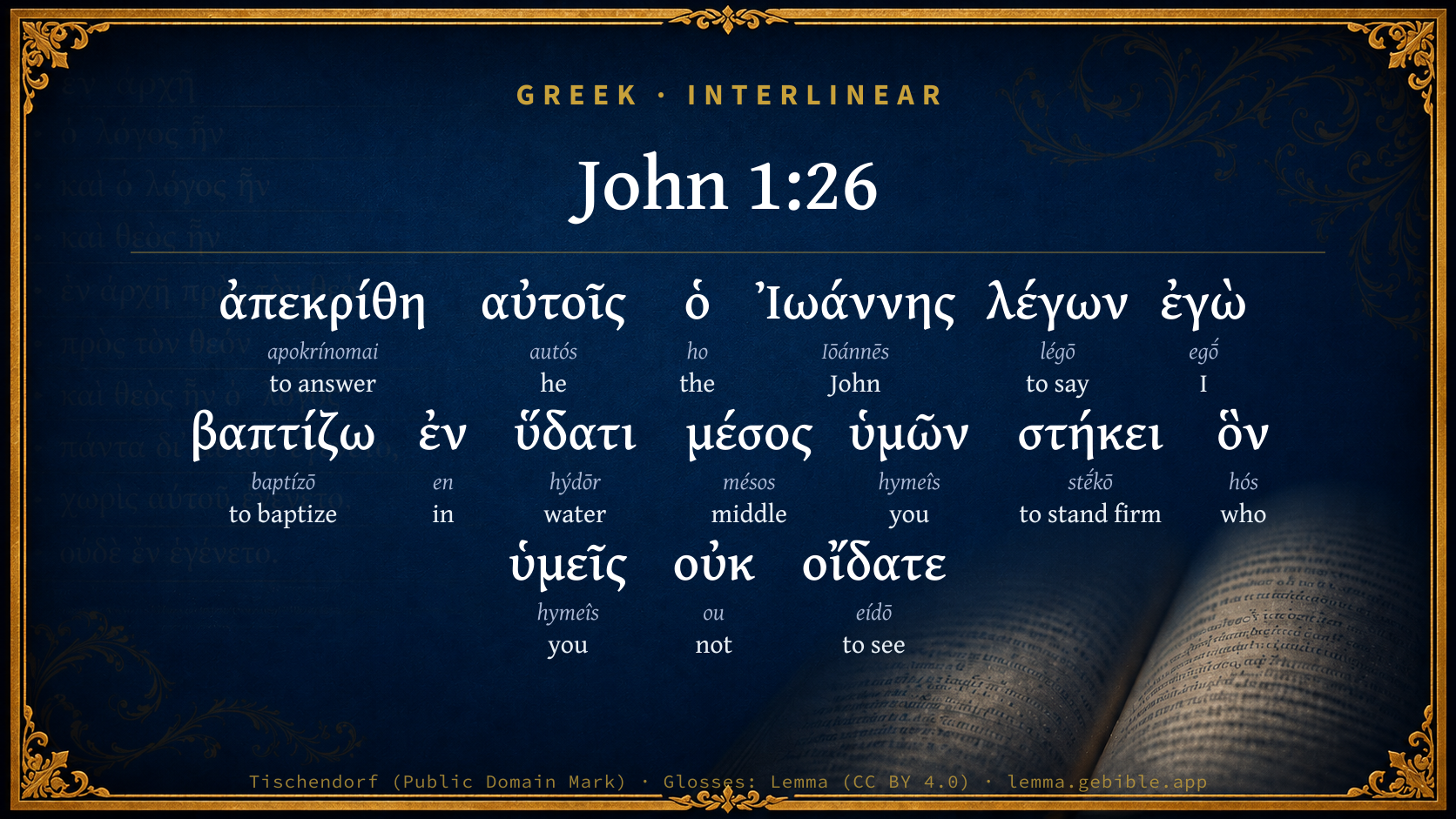
  1. ἀπεκρίθη apokrínomai G611 “to answer” Verb, Aorist, Middle deponent, Indicative, 3rd person, Singular
  2. αὐτοῖς autós G846 “he” Personal pronoun, Dative, Plural, Masculine
  3. ὁ ho G3588 “the” Article, Nominative, Singular, Masculine
  4. Ἰωάννης Iōánnēs G2491 “John” Noun, Nominative, Singular, Masculine
  5. λέγων légō G3004 “to say” Verb, Present, Active, Participle, Nominative, Singular, Masculine
  6. ἐγὼ egṓ G1473 “I” Personal pronoun, 1st person, Nominative, Singular
  7. βαπτίζω baptízō G907 “to baptize” Verb, Present, Active, Indicative, 1st person, Singular
  8. ἐν en G1722 “in” Preposition
  9. ὕδατι hýdōr G5204 “water” Noun, Dative, Singular, Neuter
  10. μέσος mésos G3319 “middle” Adjective, Nominative, Singular, Masculine
  11. ὑμῶν hymeîs G5210 “you” Personal pronoun, 2nd person, Genitive, Plural
  12. ὃν hós G3739 “who” Relative pronoun, Accusative, Singular, Masculine
  13. ὑμεῖς hymeîs G5210 “you” Personal pronoun, 2nd person, Nominative, Plural
  14. οὐκ ou G3756 “not” Particle, Negative
  15. οἴδατε eídō G1492 “to see” Verb, Perfect, Active, Indicative, 2nd person, Plural

About this verse

These counts appear in no published source. They are computed here, from the morphology-tagged text and Lemma’s own curated glosses. What Lemma adds →

16
words
15
distinct lemmas
Gospels
section

Notable vocabulary

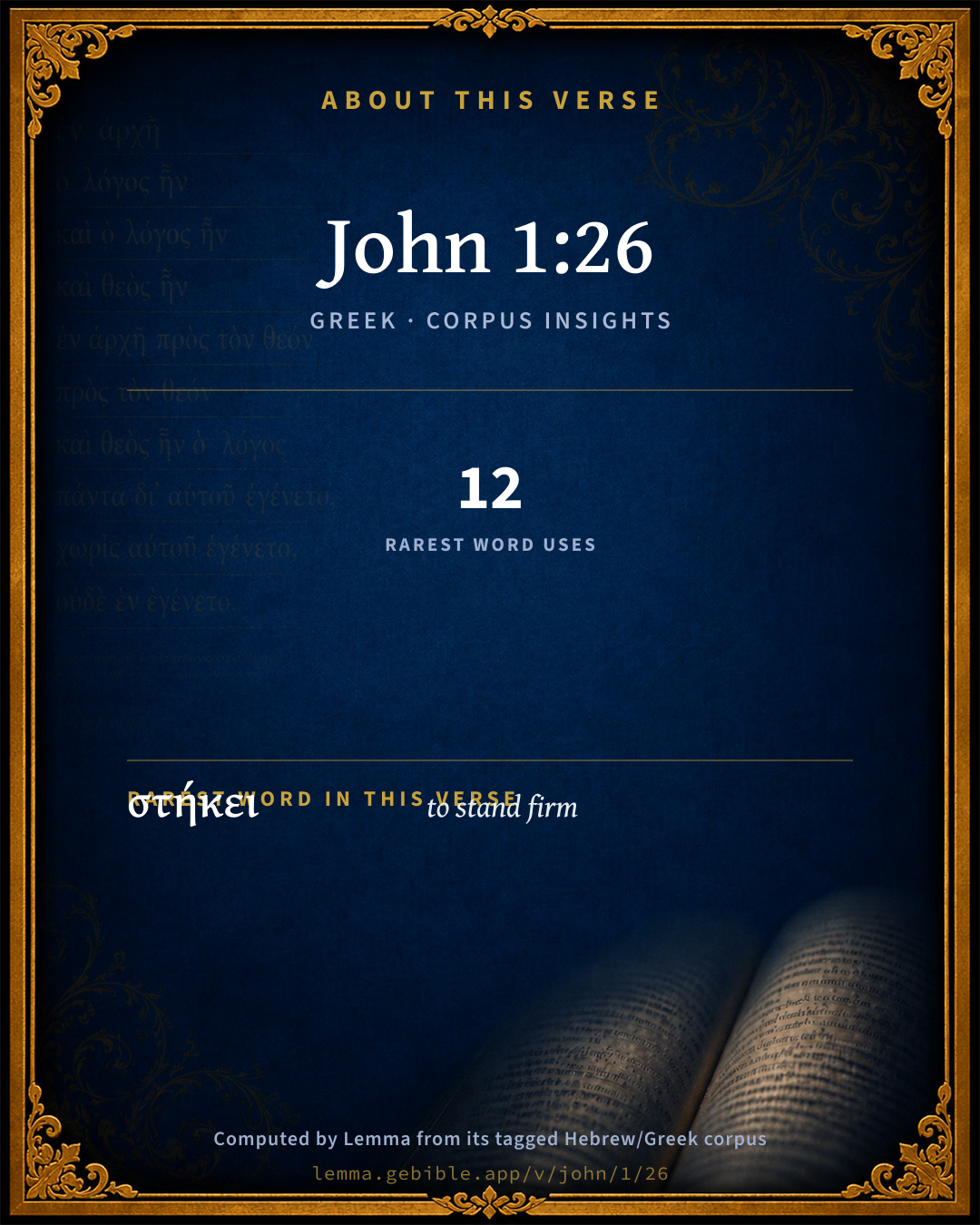
The rarest word here is στήκει to stand firm G4739 — appearing just 12 times in the whole Greek New Testament.

Shared distinctive vocabulary

στήκει to stand firm G4739 occurs in 12 verses of the Greek New Testament. Also found in:

Repetition

A word recurs within this verse:

  • ὑμῶν you G5210 ×2

Cross-references

12

Topical passages linked to John 1:26 in the Treasury of Scripture Knowledge — connected by theme and wording, ordered by reader-vote popularity; previews shown in the World English Bible.

  • Luke 3:16 John answered them all, "I indeed baptize you with water, but he comes who is mightier than I, the latchet of whose sandals I am not worthy to loosen. He will baptize you in the Holy Spirit and fire,
  • John 1:10–11 He was in the world, and the world was made through him, and the world didn't recognize him.
  • Acts 1:5 For John indeed baptized in water, but you will be baptized in the Holy Spirit not many days from now."
  • Matthew 3:11 I indeed baptize you in water for repentance, but he who comes after me is mightier than I, whose shoes I am not worthy to carry. He will baptize you in the Holy Spirit.
  • Mark 1:8 I baptized you in water, but he will baptize you in the Holy Spirit."
  • John 8:19 They said therefore to him, "Where is your Father?" Jesus answered, "You know neither me, nor my Father. If you knew me, you would know my Father also."
  • Acts 11:16 I remembered the word of the Lord, how he said, 'John indeed baptized in water, but you will be baptized in the Holy Spirit.'
  • John 17:3 This is eternal life, that they should know you, the only true God, and him whom you sent, Jesus Christ.
  • John 17:25 Righteous Father, the world hasn't known you, but I knew you; and these knew that you sent me.
  • 1 John 3:1 Behold, how great a love the Father has bestowed on us, that we should be called children of God! For this cause the world doesn't know us, because it didn't know him.
  • John 16:3 They will do these things because they have not known the Father, nor me.
  • Malachi 3:1–2 "Behold, I send my messenger, and he will prepare the way before me; and the Lord, whom you seek, will suddenly come to his temple; and the messenger of the covenant, whom you desire, behold, he comes!" says Yahweh of hosts.

Cross-references courtesy of OpenBible.info (CC BY 4.0).

Commentary

Notes on John 1:26 from classic Christian and Jewish commentators (each source and its license shown beneath its notes). The classic Christian expositions comment on the surrounding passage and are grouped to its opening verse, so a note may address several verses; the Jewish commentaries on the Tanakh (Rashi and others) are per-verse, so they appear only where the commentator wrote on this verse.

Lemma curates 59 commentaries, every one of them public domain or Creative Commons licensed, each selected and text-cleaned for this edition rather than reprinted as found. About our sources →

The Biblical Illustrator

Joseph S. Exell

Joh_1:26

I baptize with water

The baptism of John

If the rite, which the Forerunner of our Lord administered, is not to be considered as a Christian institute, to what dispensation are we to assign it, since it is manifestly no part of the economy of Moses?

The reply is that it was the symbol of a peculiar dispensation, which was neither entirely legal nor Evangelical, but occupied an intermediate station, possessing something of the character and attributes of both; a kind of twilight, equally removed from the obscurity of the first, and the splendour of the last and perfect economy of religion. The light which he emitted, though it greatly surpassed every preceding illumination, was of short duration, being soon eclipsed and extinguished by that ineffable effulgence, before which nothing can retain its splendour. (Robert Hall.)

.

One among you

Christ among us

1. As to His human nature, as one of yourselves, as He took upon Him the form of man and became the servant of men, and is among you as once He sat in the midst of the doctors in the Temple.

2. As to the Divine nature He is amongst you, for He filleth all in all, and is very nigh to every one.

3. He is among you as the Light which lighteth every man, and as the Word of Wisdom in the heart of all His people.

4. Among you as the Mediator between man and God, and seeking to draw all men to God.

5. Not as the Baptist in the desert, but in the midst of the cities of men.

6. Among you all, for the benefit of all, as the true tree of life in the midst of the garden of this world for the life and for the healing of all. (W. Denton, M. A.)

The unknown presence

We can imagine the Master visiting various spheres in the modern world with the same result.

I. BUSINESS.

II. PLEASURE.

III. THE CHURCH.

IV. AFFLICTION. (H. J. W. Buxton, M. A.)

Christ near yet unperceived

I. THE WORLDS CREATOR A STRANGER IN HIS OWN DOMINIONS.

1. In part arising from the intentional obscurity that veiled His appearance among man for purposes of their own earthly sovereigns often travel in disguise; but the world has never witnessed so strange an incognito as this. The King of Glory laid aside His robes of light, and in the simple garb of a suffering man, hid Himself from the wise and prudent that He might reveal Himself to the lowly and the meek. From His own disciples at times He purposely veiled His identity (Joh_20:14; Joh_21:4; Luk_24:16; Luk_24:31).

2. Too largely owing to the blinding effect of sin. The other and gentler John affirms the same mysterious but humbling fact, and enumerates the accumulating evidence of its truth. For ages the true Light shined in promise, prophecy, holy law and inward conscience, yet the darkness discovered it not (verse 5). In the fulness of time the Creator came to visit this province of His empire, and was unrecognized upon His own estate (verse 10). More humbling still, when He came to His own possessions His own people received Him not (verse 11). Even those to whom He made Himself known were but imperfectly acquainted with Him.

II. THE IGNORANCE OF MAN CONCERNING THAT WHICH THEY MOST NEED TO KNOW. Ignorance baneful, knowledge beneficial; yet vast numbers are strangers to the source, centre and sum of all wisdom.

1. With some the knowledge of Christ is only indirect; the evidence of vague rumours or the acceptance of testimony; a secondhand knowledge.

2. Personal knowledge exists in varying degrees. Some are only on terms of distant acquaintance; others have occasional communications; others have intimate friendship; with the most loyal and loving Christ sustains confidential relations.

3. To be ignorant of Him is the worst privation man can suffer (2Co_4:8; 2Co_4:4).

4. When He is known He is admired, loved, trusted and obeyed (chap. 4:10).

III. THE SAVIOURS KINDNESS AND COMPASSION IN REVEALING HIMSELF TO THEM THAT SEEK HIM.

1. He has no wish to be unrecognized. He stands, waits, knocks Rev_3:20).

2. He awaits our entreaty to remove His disguise (Jer_14:5).

3. Once admitted to His friendship we shall grow in intimacy with Him.

4. In His own home hereafter He will show us more and more of His hidden glory. (R. Lewis.)

Christ unrecognized

I. A STARTLING WONDER. Christ unknown.

1. Not from want of evidence then or previously.

(1) The world manifested its Maker;

(2) Conscience reflected His light;

(3) Prophecy and type shadowed His person and ministry. Abraham saw His day. Moses spoke of Him. To Him gave all the prophets witness.

(4) John proclaimed Him.

2. Not from want of evidence now. In addition to all the above,

(1) The Holy Spirit testifies of Him.

(2) The Christian consciousness of eighteen centuries fulfils the promise of His perpetual presence.

(3) His ambassadors declare Him.

(4) His sacraments embody Him. How strange that He should be amongst the children of His people, the hearers of His gospel, and yet not be known!

II. A STERN NECESSITY. In the knowledge of Him, and in that alone standeth our eternal life. That knowledge is the beginning, the middle and the end of Christianity.

1. The beginning. Christs first invitation echoed by His first convert was Come and see. Isaiah saw His glory, and was cleansed for service. When Paul saw Christ he became a new man.

2. The continuance. The development of Christian life depends on growing knowledge of Him (2Pe_3:18; Philip 3:10; Heb_12:2; cf. Heb_3:1).

3. Its consummation is in heaven, where we shall see His face, and be like Him, because we shall see Him as He is.

III. A BLESSED OPPORTUNITY. There standeth.

1. How?

(1) Stationary--not shifting, coming and going.

(2) Patient--not wearied by procrastination, but waiting to be gracious.

(3) Accessible. Lo, I am with you alway. Now is the accepted time.

2. What as?

(1) A sympathizer.

(2) A Saviour.

(3) A personal friend.

IV. A FEARFUL ALTERNATIVE.

1. To know Christ is to be known of Him. Christ knows His sheep. He recognizes us when our friends have ceased to do so; when it is difficult to do so; in poverty and obloquy; at the last day.

2. Not to know Christ is to be disowned by Him. I never knew you. (J. W. Burn.)

He it is, who, coming after me, is preferred before me

The magnanimity of the Baptist

The world recognizes jealousy as the chief weakness of popular leaders and preachers. Such men are spiritual athletes, who cannot bear a rival. The greatest of popular preachers, the darling of Antioch and Constantinople, admits that he who can overcome this is almost like the disembodied spirits, whose lives, pure as the crystal stream, can never be darkened by any shadow of envy or vainglory. But the leader of a great party in a nation; the founder of a sect, which has vitality enough to live on for years; who was regarded by some as probably the Messiah--that he should have bowed down in prostrate humiliation before a younger successor, this is original indeed. (Bp. Alexander.)

The best servant the most humble

As the lark that soars the highest, builds her nest the lowest; the nightingale that sings the sweetest, sings in the shade when all things rest; the branches that are most laden with ripe fruit, bend lowest; the valleys are fruitful in their lowliness; and the ship most laden sinks deepest in the water, so the holiest Christians are the humblest. (J. Mason.)

Humility not contemptible

Humility did not make John the Baptist contemptible; but when he refused the name of a prophet, Christ said that he was more than a prophet. Humility did not make Moses contemptible; but as he was the mildest man upon earth, so he was the greatest upon earth. Humility did not make David contemptible; but when he humbled himself, he said unto Michal, I will be more humble yet, and lowly in mine own sight, yet thou and thy maids shall honour me. As Christ ceased not to be a king because He was like a servant, nor to be a lion because He was a lamb, nor to be a judge because He was judged; so man doth not lose his honour by humility; but he shall be honoured for his humility, as the son was honoured when he was humbled (Luk_15:18-25). Thus humility hath found that which pride sought; like little David, which was least accounted of, and yet got the victory, yea, when no man durst encounter with the giant (1Sa_17:28). (Henry Smith.)

The Biblical Illustrator, edited by Joseph S. Exell (c. 1880s–1900s) — public domain. Text from a community e-Sword module.

Bengel's Gnomon

Johann Albrecht Bengel

Joh 1:26. Μέσος[30]) ὑμῶν, in the midst of you) especially at the time of His baptism.—ἕστηκεν) Hath taken His stand [statuit sese].—οὐκ οἴδατε, ye know not) He addresses the inhabitants of Jerusalem, who had not been present at the baptism of Jesus: and he whets their desires, that they may be anxious to become acquainted with Him.

[30] δέ, but) The Antithesis is to be taken from the pre-eminence of Him who followed after John: He truly baptizes with the Holy Ghost, ver. 33.—V. g.

Bengel's Gnomon of the New Testament — English translation (T&T Clark, Edinburgh, 1860) — public domain. Text from a community e-Sword module.

Cambridge Greek Testament for Schools and Colleges

26. The Baptist’s words seem scarcely a reply to the question. Perhaps the connexion is—‘You ask for my credentials; and all the while He who is far more than credentials to me is among you.’

ἐν ὕδατι. In water: note the preposition here and Joh 1:26; Joh 1:33.

Cambridge Greek Testament for Schools and Colleges (Cambridge University Press, 1896; 21 vols, various authors incl. Carr, Maclear, Plummer, Farrar, Lumby, Moule, M. R. James, Simcox) — public domain. Text from a community e-Sword module.

Godet's Commentaries

Frédéric Louis Godet

Vv. 26, 27. “John answered them saying, Yea, I baptize with water;in the midst of you there standeth one whom you know not; 27. He who comes after me—but who was before me — the latchet of whose sandal I am not worthy to loose.”

This reply has been regarded as not very clear and as embarrassed. De Wette even thinks that it does not correspond altogether with the question proposed. The generally adopted explanation is the following: “My baptism with water does not, in any case, encroach upon that of the Messiah, which is of an altogether superior nature; it is only preparatory for it.” John would in some sort excuse his baptism by trying to diminish it, and by reminding them that beyond this ceremony the Messianic baptism maintains the place which belongs to it. But, first of all, this would be to evade the question which was put; and the criticism of de Wette would remain a well- founded one. For the baptism of John was attacked in itself and not as being derogatory to that of the Messiah. Then, the words ἐν ὕδατι, with water, should be placed at the beginning: “It is only with water that I baptize,” and the baptism of the Spirit would necessarily be mentioned in the following clause, as an antithesis. Finally, it would scarcely be in harmony with the character of the Baptist to shelter himself under the insignificance of his office and to present his baptism as an inoffensive novelty. This reply, properly understood, is, on the contrary, full of solemnity, dignity, even threatening; it makes apparent the importance of the present situation, into the mystery of which John alone, until now, is initiated. “The Messiah is present: this is the reason why I baptize!” If the Messianic time has really come, and he is himself charged with inaugurating it, his baptism is thereby justified (see Joh 1:23).

This feeling of the gravity of the situation and of the importance of his part is expressed in the ἐγώ, I, placed at the beginning of the answer, the meaning of which, as the sequel proves, is this: “I baptize with water, and in acting thus I know what I do: for He is present who...” We have given the force of this pronoun by the affirmation Yea! The ἐγώ, I, is ordinarily contrasted with the Messiah, by making an antithesis between the baptism of water and the baptism of the Spirit. But this latter is not even mentioned, and this interpretation results from a recollection of the words of the Baptist in the Synoptics. Hence also probably came the introduction of the particle δέ, but (in what follows after the word μέσος), which is rightly omitted by the Alexandrian authorities. It is precisely because he knows that the Messiah is present among them, that he baptizes with water and that he has the right to do so. This reply, accompanied as it undoubtedly was, with a significant look cast upon the crowd, in which the mysterious personage of whom he was thinking could be found, must have produced a profound sensation among his hearers. The two readings ἕστηκεν and στήκει, although one is in the perfect and the other in the present, have the same sense: He stands there. The important words are these:Whom you know not. The word you contrasts John’s hearers, who are still ignorant, with John himself, who already knows. This expression necessarily assumes that, at the time when the forerunner was speaking, the baptism of Jesus was already an accomplished fact. For it was by means of that ceremony that, in conformity with the divine promise (Joh 1:33), the person of the Messiah was to have been pointed out to him.

In Joh 1:31; Joh 1:33, He Himself affirms that, up to the moment of the baptism, he did not know Him. It is impossible, then, to place the baptism of Jesus, with Olshausen and Hengstenberg, on this same day or the next, with Baumlein, between Joh 1:28 and Joh 1:29, or, with Ewald, between Joh 1:31 and Joh 1:32. Moreover, this testimony, whateverWeiss may say of it, is wholly different from the preachings of John which are reported in the Synoptics, and which had preceded the baptism of Jesus. The very terms which the forerunner here employs contain a very clear allusion to previous declarations in which he had announced a personage who was to follow him; this is especially evident if we read ὁ before ὀπίσω μου ἐρχόμενος, “the one coming after me whom I have announced to you.” This testimony has an altogether new character: “The Messiah is present, and I know him.” This is the first declaration which refers personally to Jesus; it is for his hearers the true starting-point of faith in Him. The words it is he (αὐτός ἐστιν), omitted by the Alexandrian authorities, sometimes omitted and sometimes read by Origen, are not indispensable, and may have been added either by copyists who wrongly identified this testimony with that of Joh 1:15 (οὖτος ἦν), or by others who wished to bring out better the allusion to the previous testimonies related by the Synoptics.

It is otherwise with the words, who was before me, which the Alexandrian authorities, Origen and the Curetonian Syriac omit, but which 15 Mjj. and the two ancient versions, Itala and Peschito, read. The relation between this testimony and that of Joh 1:30, which will follow, renders these words indispensable in Joh 1:27. For in Joh 1:30, John reproduces expressly (“he it is of whom I said [yesterday]”), the testimony of Joh 1:27, and not, as is imagined, that of Joh 1:15, which is itself only a quotation of our Joh 1:30 (see on Joh 1:15). The first day, John uttered, without yet designating Jesus, the declaration of Joh 1:26-27; the second day, he repeated it, as it is related in Joh 1:30, this time applying it to Jesus as present. Gess rightly says, “If the shorter reading of Joh 1:27 were the true one, the evangelist would refer in Joh 1:30 to a fact which had not been related by him” (i. p. 345). These words: who was before me, are, in Joh 1:27, a sort of parenthesis inserted by the forerunner: “Come after me? Yes, and yet in reality, my predecessor!” (See on Joh 1:15).

By the expression “to loose the latchet of the sandals,” John means to designate the humble office of a slave. On the pleonasm of οὗ and αὐτοῦ Baumlein rightly says: “imitation of the Hebrew construction.” Philologues discuss the question whether the form ἄξιος ἵνα implies a weakening of the sense of the conjunction ἵνα, which becomes here, according to some, a simple paraphrase of the infinitive (worthy to loose), so Baumlein, or whether this conjunction always retains the idea of purpose (Meyer). Baumlein rests upon the later Greek usage and on the νά of the modern Greek, which, with the verb in the subjunctive mood, supplies the place of the infinitive. Nevertheless, we hold, with Meyer, that the idea of purpose is never altogether lost in the ἵναof the New Testament; he who is worthy of doing a thing, is, as it were, intended to do it.

Frédéric Louis Godet — Commentaries on Luke, John, Romans, and 1 Corinthians — English translation (T&T Clark, Edinburgh, 1870s–1890s) — public domain. Text from a community e-Sword module.

Geneva Bible (1599)

Geneva Bible translators

Whom all the world seeth not, and is even amongst you.

Geneva Bible (1599) marginal notes — public domain. Text via Bolls.life.

Jamieson, Fausset & Brown

Robert Jamieson, A. R. Fausset & David Brown

there standeth--This must have been spoken after the baptism of Christ, and possibly just after His temptation (see on Joh 1:29).

Jamieson, Fausset & Brown — Commentary Critical and Explanatory on the Whole Bible (1871) — public domain (CC PDM 1.0). Text via the HelloAO Bible API.

Adam Clarke's Commentary

Verse 26. I baptize with water] See Clarke on Mr 1:8. I use the common form, though I direct the baptized to a different end, viz. that they shall repent of their sins, and believe in the Messiah.

There standeth one among you] That is, the person whose forerunner I am is now dwelling in the land of Judea, and will shortly make his appearance among you. Christ was not present when John spoke thus, as may be seen from Joh 1:29.

Adam Clarke's Commentary on the Bible (1810–1826) — public domain. Text from a community e-Sword/MySword module.

John Calvin's Commentaries

26. I baptize with water. This ought to have been abundantly sufficient for the correction of their mistake, but a reproof otherwise clear is of no advantage to the deaf; for, when he sends them to Christ, and declares that Christ is present, this is a clear proof not only that he was divinely appointed to be a minister of Christ, but that he is the true Elijah, who is sent to testify that the time is come for the renovation of the Church. There is a contrast here which is not fully stated; for the spiritual baptism of Christ is not expressly contrasted with the external baptism of John, but that latter clause about the baptism of the Spirit might easily be supplied, and shortly afterwards both are set down by the Evangelist.

This answer may be reduced to two heads: first, that John claims nothing for himself but what he has a right to claim, because he has Christ for the Author of his baptism, in which consists the truth of the sign; and, secondly, that he has nothing but the administration of the outward sign, while the whole power and efficacy is in the hands of Christ alone. Thus he defends his baptism so far as its truth depends on anything else; but, at the same time, by declaring that he has not the power of the Spirit, he exalts the dignity of Christ, that the eyes of men may be fixed on him alone. This is the highest and best regulated moderation, when a minister borrows from Christ whatever authority he claims for himself, in such a manner as to trace it to him, ascribing to him alone all that he possesses.

It is a foolish mistake, however, into which some people have been led, of supposing that John’s baptism was different from ours; for John does not argue here about the advantage and usefulness of his baptism, but merely compares his own person with the person of Christ. In like manner, if we were inquiring, at the present day, what part belongs to us, and what belongs to Christ, in baptism, we must acknowledge that Christ alone performs what baptism figuratively represents, and that we have nothing beyond the bare administration of the sign. There is a twofold way of speaking in Scripture about the sacraments; for sometimes it tells us that they are the laver of regeneration, (Titus 3:5;) that by them our sins are washed away, (1 Peter 3:21;) that we

are in-grafted into the body of Christ, that our old man is crucified, and that we rise again to newness of life, (Romans 6:4, 5, 6;)

and, in those cases, Scripture joins the power of Christ with the ministry of man; as, indeed, man is nothing else than the hand of Christ. Such modes of expression show, not what man can of himself accomplish, but what Christ performs by man, and by the sign, as his instruments. But as there is a strong tendency to fall into superstition, and as men, through the pride which is natural to them, take from God the honor due to him, and basely appropriate it to themselves; so Scripture, in order to restrain this blasphemous arrogance, sometimes distinguishes ministers from Christ, as in this passage, that we may learn that ministers are nothing and can do nothing.

One standeth in the midst of you. He indirectly charges them with stupidity, in not knowing Christ, to whom their minds ought to have been earnestly directed; and he always insists earnestly on this point, that nothing can be known about his ministry, until men have come to him who is the Author of it. When he says that Christ standeth in the midst of, them, it is that he may excite their desire and their exertion to know him. The amount of what he says is, that he wishes to place himself as low as possible, lest any degree of honor improperly bestowed on him might obscure the excellence of Christ. It is probable that he had these sentences frequently in his mouth, when he saw himself immoderately extolled by the perverse opinions of men.

John Calvin's Commentaries (1540-1563) — public domain. Text from the Calvin Translation Society English edition (1840s-50s) via the Christian Classics Ethereal Library (ccel.org). Calvin's coverage is partial (roughly two-thirds of the Bible); uncommented books and verses are honest gaps, never fabricated. The 19th-century editor's footnotes and remarks are omitted so the notes are faithfully Calvin's own voice.

Ellicott's Commentary for English Readers

(26) I baptize with water.—The passage of Ezekiel is probably present to the mind, with its contrast between water and spirit.

A Bible Commentary for English Readers, edited by Charles John Ellicott (1878–1897) — public domain. Text from a community e-Sword module.

The Cambridge Bible for Schools and Colleges

gen. ed. J. J. S. Perowne

26. ‘You ask for my credentials; and all the while He Who is far more than credentials to me is among you. I am not a prophet to foretell His coming, but a herald to proclaim that He has come.’

The Cambridge Bible for Schools and Colleges (gen. ed. J. J. S. Perowne; Cambridge University Press, 1878–1918) — public domain. Text from a community e-Sword module.

John Gill's Exposition

John answered them, saying, I baptize with water,.... Or in water, so the Vulgate Latin, and all the Oriental versions render it. The sense of the answer is, that he indeed baptized persons in water, which was all that he could do, or pretended to do; and he owned, that this was a new rite, and that he was the administrator of a new ordinance; but he suggests, as may be supplied from Mat 3:11 that there was one at hand, and even now among them, that should baptize, and so it is read in one of Stephens's copies here, in the Holy Ghost, and in fire; and it was by his authority, by a commission he had received from him, that he baptized in water; and that his speedy manifestation and appearance as the Messiah, which would be confirmed by his power of baptizing in the Holy Ghost, and by his ministry and miracles, would be a sufficient vindication of his conduct, and support him in his administration of water baptism:

but there standeth one among you; or "hath stood", as the Vulgate Latin version renders it; referring, not to his being among them at twelve years of age, but a few days ago when he came to John to be baptized, and was baptized by him; for from Joh 1:29 it is plain he was not now, or "today", as Nounus expresses it, standing in the midst of them. The Ethiopic version renders it, there is one about to stand among you, as he did the next day: though the meaning of the phrase may only be, that he was then in being, and dwelt somewhere among them, and not that he was personally present at that time:

whom ye know not; neither from whence he is, nor who he is, or what is his work and office; neither the dignity of his person, nor the end of his coming into the world, nor the nature of his business in it.

John Gill's Exposition of the Whole Bible (1746–1763) — public domain (CC PDM 1.0). Text via the HelloAO Bible API.

Trapp's Complete Commentary

John Trapp

26 John answered them, saying, I baptize with water: but there standeth one among you, whom ye know not;

Ver. 26. I baptize with water] The Baptist here meaneth the same that St Paul doth, 1Co 3:6-7. {See Trapp on "Mat 3:11"} Christ rains down righteousness upon all his baptized; to whom it is not only a sign, but also a seal, as circumcision is called, not only by St Paul, Rom 4:11, but also by a Jewish doctor, more ancient than their Talmud. Of Wilfride, first Bishop of Chichester, A.D. 700, it is reported that he converted to the faith many pagans in those parts. And a day being appointed for their baptism, they had no sooner received the same, but immediately it rained plentifully, the want whereof had caused a dearth for three years before; so that many died daily for hunger, and serveral joining hand-in-hand (forty or fifty in a company) threw themselves headlong into the sea.

John Trapp, A Commentary or Exposition upon All the Books of the Old and New Testament (1647–1656) — public domain. Text from a community e-Sword module.

Albert Barnes' Notes on the Bible

I baptize - He did not deny it; nor did he condescend to state his authority. That he had given. He “admitted” that he had introduced an important “change” in the rites of religion, and he goes on to tell them that this was not all. Greater and more important changes would soon take place without their authority. The Messiah was about to come, and the “power” was about to depart from “their” hands.

There standeth one - There is one.

Among you - In the midst of you. He is undistinguished among the multitude. The Messiah had already come, and was about to be manifested to the people. It was not until the next day Joh 1:29 that Jesus was manifested or proclaimed as the Messiah; but it is not improbable that he was then among the people that were assembled near the Jordan, and mingled with them, though he was undistinguished. He had gone there, probably, with the multitudes that had been drawn thither by the fame of John, and had gone without attracting attention, though his real object was go receive baptism in this public manner, and to be exhibited and proclaimed as the Messiah.

Whom ye know not - Jesus was not yet declared publicly to be the Christ. Though it is probable that he was then among the multitude, yet he was not known as the Messiah. We may hence learn:

That there is often great excellency in the world that is obscure, undistinguished, and unknown. Jesus was near to all that people, but they were not conscious of his presence, for he was retired and obscure. Though the greatest personage ever in the world, yet he was not externally distinguished from others. Jesus may be near to men of the world, and yet they know him not. He is everywhere by his Spirit, yet few know it, and few are desirous of knowing it.

Albert Barnes' Notes on the Bible (1834–1885) — public domain. Text from a community e-Sword/MySword module.

Haydock's Catholic Bible Commentary

Hath stood. St. John the Baptist, by these words, which he spoke to the priests and Levites, sent to him by the Pharisees, did not mean to tell them, that Jesus was either at the present time standing amongst them, or that he had ever been in the presence of the self same people; but they may be understood two different ways, either with regard to his divinity; an din that sense, Jesus was always by his divine presence amongst them; or in regard to his humanity; either that he lived in the same country, and among their countrymen, or, that he stood actually amongst them, because Jesus was accustomed yearly to go up to Jerusalem on the festival of the Pasch. (Denis the Carthusian)

George Leo Haydock (1774–1849), Haydock's Catholic Family Bible and Commentary, 1859 edition — public domain. Excludes Psalms (Douay-Rheims chapter numbering differs from Protestant) and Deuterocanonical books (Catholic canon only).

Matthew Poole's English Annotations

This was no strict answer to their question, which was not, how, but why he baptized? But proper replies are often called answers in Scripture, though not apposite to the question.

I baptize with water; I baptize you with mere water:

but there standeth one among you, whom ye know not; but there hath stood one amongst you, εστηκεν, or (by a usual putting of one tense for another) there standeth one; Christ had been there with the crowd, Luk 3:15,21, and possibly was amongst them still when John spake these words; whom you know not, not so much as ore tenus, by face.

Matthew Poole's English Annotations on the Holy Bible (1683–1685) — public domain. Text from a community e-Sword/MySword module.

Whedon's Commentary on the Bible

Daniel D. Whedon

26. I baptize with water—John’s answer is very pertinent. My baptism is the symbol and precursor of a real baptism by the great Baptizer.

Standeth one among you—Not necessary that he was at that moment there standing; but that he was then living and being among the people, to them unknown.

Daniel D. Whedon (gen. ed.), Commentary on the Old and New Testaments (1874–1909) — public domain. Text from a community e-Sword module.

The Pulpit Commentary

Vers. 26, 27. The answer is not very explicit. John answered them and said, I baptize with water; not as Messiah, or Elijah, or a resuscitated prophet, not as making proselytes to the faith of Abraham"s sons, not as an Essene admitting the children of the kingdom to a close spiritual corporation, but because the Messiah has come. Some have laid great emphasis on the limitation which John assigns to his baptism. It is said he thus anticipated the contrast afterwards expressed between it and the Spirit baptism of Jesus. This is. however, reserved for a later utterance. The baptism with water inaugurated the Messianic kingdom, prepared the people to receive the Lord. If, then, Messiah were reasonably expected thus to create a fellowship of those, who, substituted this simple lustration for a cumbrous cycle of ceremonial purifications, John, as the "voice," the "herald," the "crier" in the wilderness, was justified in administering the rite. I baptize with water, seeing that there standethin the midst of you one (whom you know not) who is coming after me, whose shoe"s latchet I am not worthy to loose. This standing in the very crowd before him of the Mightier than John, now being searched out as it were by the glances of the Baptist, and recognized by him as One over whom the heavens had opened, gave ample support to the Baptist in his baptismal functions. The One coming after John, i.e. "after," because of John"s chronological precedence in showing himself to Israel, is yet of such lofty rank and mighty power that John is not fit in his own opinion to be his humblest slave. This solemn assurance justifies to the Sanhedrin the preparatory rite. This closes the first great testimony. Before proceeding to the second, the evangelist supplies a geographical hint, which up to the present day has not been satisfactorily interpreted.

The Pulpit Commentary (1880–1919), ed. H.D.M. Spence-Jones & Joseph S. Exell — public domain. Text from a community e-Sword module.

John Wesley's Explanatory Notes

John answered, I baptize - To prepare for the Messiah; and indeed to show that Jews, as well as Gentiles, must be proselytes to Christ, and that these as well as those stand in need of being washed from their sins.

John Wesley, Explanatory Notes Upon the Whole Bible (1754–1765) — public domain. Text via the GEBible commentary corpus.

The People's New Testament

B. W. Johnson

26, 27. I baptize with water. See notes on Matt. 3:11.

B. W. Johnson's The People's New Testament with Notes (1889–1891) — public domain. Electronic text from the Christian Classics Ethereal Library (CCEL) ThML edition.

unfoldingWord translationNotes

Door43 World Missions Community

General Information:

Verse 28 tells us background information about the setting of the story. (See: Background Information)

who comes after me

You may need to make explicit what he will do when he has come. AT: "who will preach to you after I am gone" (See: Assumed Knowledge and Implicit Information)

me, the strap of whose sandal I am not worthy to untie

Untying sandals was the work of a slave or servant. These words are a metaphor for the most unpleasant work of a servant. AT: "me, whom I am not worthy to serve in even the most unpleasant way" or "me. I am not even worthy to untie the strap of his sandal" (See: Metaphor)

translationWords

John (the Baptist)

baptize

sandal

worthy

Bethany

Jordan River

unfoldingWord translationNotes — © Distant Shores Media and the Door43 World Missions Community, licensed CC BY-SA 4.0. Source: git.door43.org/Door43/en_tn.

International Critical Commentary

26. The attitude of the Baptist to Jesus is explained more clearly in vv. 25-34 than it is in the Synoptists, whose source of knowledge about him was tradition and not personal acquaintance. This is what we should expect if the ultimate author of the Fourth Gospel were John the son of Zebedee, for he seems to have been one of the Baptist’s disciples (see on v. 35). Jn. does not narrate the Baptism of Jesus directly, but what he tells is consistent with the Marcan story.

We have, first, the Proclamation of the Coming One (Mar 1:7, Mat 3:11, Luk 3:16), to which reference is made several times in this chapter. But when the proclamation was first made, the Baptist did not know (except in Mt.’s account; see on v. 31) that Jesus was the Predestined One for whose Advent he looked. Both in the Synoptists and in Jn. is the contrast drawn out between baptism ἐν ὕδατι (which was all that John offered) and baptism ἐν πνεύματι ἁγίῳ (which was to be the work of the Christ). When Jesus presented Himself for baptism, the Baptist noticed a dove alighting on His head (v. 32); and as he looked he became conscious that this was the sign of the Spirit, and that Jesus was the expected One who should baptize ἐν πνεύματι ἁγίῳ. All this is now to be set out in detail.

ἀπεκρίθη αὐτοῖς ὁ Ἰωάνης λέγων. In Jn. we nearly always have the constr. ἀπεκρίθη καὶ εἶπεν (see on v. 50 below), but here and at 12:23 ἀπεκρ. λέγων seems to be the true reading.

The Baptist had been asked, “Why do you baptize?” What authority have you? (v. 25). He gives no direct answer; but before he speaks of Him whose herald he was, he admits that he did baptize, but only “with water.” ἐγὼ βαπτίζω ἐν ὕδατι. ἐγώ is emphatic: “Yes, I baptize, I administer a symbolic rite of purification, of cleansing with water.” The words are in all the Synoptic accounts of the Proclamation, where the contrast with the baptism with the Holy Spirit (v. 33) immediately follows (Mar 1:8 and parallels). Here, at v. 26, ἐγὼ βαπτίζω ἐν ὕδατι is only a reiteration of the claim for himself which he was accustomed to make as he predicted the Coming of a Greater One (see on v. 33).

μέσος ὑμῦν. The rec. text (so NΘ) inserts δέ after μέσος, but om. אBC*LTb. It is not required by the sense. A new sentence begins with μέσος, in Johannine style without any connecting particle. We should have expected ἐν μέσῳ ὑμῶν, but Jn. never uses this constr.; cf. 19:18 μέσον δὲ τὸν Ἰησοῦν, and see on [8]:3, 9.

στήκει is read by BLTb, and א has ἐστήκει: the rec. with ACΔWNΘ gives the more usual ἕστηκεν. But στήκει, “standeth up” or “standeth fast,” is more dramatic, and well attested.

μέσος ὑμῶν στήκει. Apparently Jesus was actually present on this occasion, which is subsequent to His Baptism, as appears from the fact that the Baptist now knows Him for what He is, although the questioners did not: ὃν ὑμεῖς οὐκ οἴδατε, ὑμεῖς being emphatic. Perhaps the Baptist’s statement that the Coming One was even in their midst was treated as of no serious importance; there is no record, at any rate, of his being further questioned as to what he meant, or to which person of the company his words were applicable.

οἴδατε. εἰδέναι is a favourite verb with Jn., occurring three times as often in the Fourth Gospel as in the Synoptists. It is not easy to distinguish it in meaning from γινώσκειν (see on 1:48), although Westcott (on Joh 2:24) has made a subtle analysis of the two verbs. Probably we might say that γινώσκειν generally stands for relative, acquired knowledge, gradually perfected, while εἰδέναι indicates a complete and absolute knowledge of the object. The latter would be the natural verb to express Divine knowledge (but cf. 17:25), although it would include also human certainty (see 2:9). But it is doubtful if the two verbs can be differentiated with any precision.1 Both are frequently used in the LXX to render יָדַע; and the following list of passages shows that they are often used in Jn. without any perceptible difference of meaning.

Both verbs are used of Christ’s knowledge of the Father; γινώσκω at 10:15, 17:25, οἶδα at 7:29, 8:55. Both are used of the world’s knowledge (or ignorance) of God, or of that possessed by the Jews: γινώσκω at 1:l0, 17:23, 25, 8:55, 16:3, 1Jn 3:1, 1Jn 3:6; οἶδα at 7:28, 8:19, 15:21. Both are used of man’s knowledge of God and Christ: γινώσκω at 14:7, 9, 17:3, 1Jn 2:4, 1Jn 2:13, 1Jn 2:14, 1Jn 2:4:6, 1Jn 2:7, 1Jn 2:8, 1Jn 2:5:20, and οἶδα at 1:31, 33, 4:22, 14:7. Both are used of Christ’s knowledge of men or of ordinary facts, e.g. γινώσκω at 2:25, 5:6, 42, 6:15, 10:14, 27, and οἶδα at 6:64, 8:37, 13:3. The word used for the Father’s knowledge of the Son is γινώσκω (10:15), and not οἶδα as we should have expected. With this array of passages before us, we shall be slow to accept conclusions which are based on any strict distinction in usage between the two verbs.

International Critical Commentary — older volumes (1896–1929), various authors — public domain. Text from a community e-Sword module.

Lesson kit

Teaching starters — assembled from the data on this page, not authored interpretation. Every prompt links to the verse data it draws on. Edit before teaching.

John, in the Gospels, opens this verse with 16 words (15 distinct Greek lemmas). Its most distinctive word is stḗkō (“to stand firm”). A historical commentator’s framing appears above. Read the whole chapter for the surrounding context.

Discussion questions

  1. What does “to stand firm” (stḗkō) contribute to the verse as a whole?
  2. Mark 3:31 shares the word «to stand firm» with this verse. How do the two illuminate each other?
  3. “you” occurs 2× in this one verse. What is the effect of the repetition?
  4. The translations on this page render this verse differently — a whole-verse word diff, not a word-by-word alignment. What might account for the different wordings?
  5. Reading how The Biblical Illustrator and Bengel's Gnomon read this verse, where do the two commentators agree and where do they part?

Things to notice

Reading settings

Reading text

Shown beneath each verse's original-language words.

Old Testament
Old Testament edition

Read the OT as the Masoretic Hebrew (MT) or the Greek Septuagint (LXX).

English shown for the Greek Septuagint (in the Hebrew ↔ Greek comparison).

Comparing translations? Open the Compare panel on any verse page to stack up to four side by side.