John 7:6

Greek (Tischendorf 8th ed.) John 7:6 appears in the Greek New Testament. The text above is from the Tischendorf 8th edition. Each word links to its Strong’s number and a concise gloss. Click any word for its full Thayer’s Greek Lexicon entry.
Download image
Cite this verse

John 7:6 (World English Bible). Public Domain. Lemma interlinear Bible study tool, https://lemma.gebible.app/v/john/7/6.

Show BibTeX & RIS
BibTeX
RIS
English Translation
Jesus therefore said to them, "My time has not yet come, but your time is always ready.
World English Bible · Public Domain
Download a study sheet

One document with this verse’s original text, its word-by-word gloss line, the meaning frame, cross-references with their text, attributed commentary, and full source and license credits — printable, and it pastes into notes with its structure intact.

This verse Autodidact and up

Study sheet (.html) Plain text (.txt)

A passage Seminary Student

Up to 50 verses in one chapter. A passage sheet keeps up to 6 commentary sources and 12 cross-references per verse, in the order this page ranks them, and says so on the sheet whenever that leaves anything out. Ask for a single verse and you get the Autodidact verse sheet above.

Everything on this page stays free to read, with no account — the sheet is a download of what is already on screen, not access to it.

Want to remove ads? Support Godless Engineer
Compare translations 3

The same verse in 3 English versions, stacked beneath the original-language interlinear above. Click any original word for its lexicon entry.

Each is an independent rendering of the whole verse — the interlinear is not word-aligned to these translations.

Highlighted words mark where these versions differ — a whole-verse word diff, not a word-by-word alignment.

  • World English Bible Public Domain
    Jesus therefore said to them, "My time has not yet come, but your time is always ready.
  • King James Version Public Domain
    Then Jesus said unto them, My time is not yet come: but your time is alway ready.
  • unfoldingWord Literal Text CC BY-SA 4.0
    Jesus therefore says to them, “My time is not yet come, but your time is always ready.

unfoldingWord Literal Text — © unfoldingWord, licensed CC BY-SA 4.0. Word-aligned USFM3 via Door43 (git.door43.org/unfoldingWord/en_ult).

Versions to compare (up to 4)

3 of 4 selected

Show all 19 translations

Every available English version of this verse, each an independent rendering of the whole verse.

  • World English Bible Public Domain
    Jesus therefore said to them, "My time has not yet come, but your time is always ready.
  • Berean Standard Bible Public Domain
    Therefore Jesus told them, “Although your time is always at hand, My time has not yet come.
  • Majority Standard Bible Public Domain
    Therefore Jesus told them, “Although your time is always at hand, My time has not yet come.
  • King James Version Public Domain
    Then Jesus said unto them, My time is not yet come: but your time is alway ready.
  • American Standard Version (1901) Public Domain
    Jesus therefore saith unto them, My time is not yet come; but your time is always ready.
  • Revised Version (1885) Public Domain
    Jesus therefore saith unto them, My time is not yet come; but your time is alway ready.
  • Geneva Bible (1599) Public Domain
    Then Iesus saide vnto them, My time is not yet come: but your time is alway readie.
  • Douay-Rheims (1899) Public Domain
    Then Jesus said to them: My time is not yet come; but your time is always ready.
  • Young's Literal Translation Public Domain
    Jesus, therefore, saith to them, `My time is not yet present, but your time is always ready;
  • Literal Standard Version CC BY-SA 4.0
    Jesus, therefore, says to them, “My time is not yet present, but your time is always ready;
  • Unlocked Literal Bible CC BY-SA 4.0
    Jesus therefore said to them, “My time has not yet come, but your time is always ready.
  • unfoldingWord Literal Text CC BY-SA 4.0
    Jesus therefore says to them, “My time is not yet come, but your time is always ready.
  • Darby Bible Public Domain
    Jesus therefore says to them, My time is not yet come, but your time is always ready.
  • World Messianic Bible Public Domain
    Yeshua therefore said to them, “My time has not yet come, but your time is always ready.
  • Webster's Bible Public Domain
    Then Jesus said to them, My time is not yet come: but your time is always ready.
  • Free Bible Version CC BY-SA 4.0
    Jesus told them, “This is not my time to go, not yet; but you can go whenever you want, for any time's the right time for you.
  • Bible in Basic English Public Domain
    Jesus said to them, My time is still to come, but any time is good for you.
  • Text-Critical English NT CC BY 4.0
    So Jesus said to them, “My time has not yet come, but your time is always at hand.
  • Tyndale New Testament (1534) Public Domain
    Then Iesus sayd vnto them: My tyme is not yet come youre tyme is all waye redy.

Literal Standard Version (2020), Covenant Press — licensed CC BY-SA 4.0. Text via the HelloAO Bible API (eBible.org). Unlocked Literal Bible (unfoldingWord) — licensed CC BY-SA 4.0. Text via the HelloAO Bible API (eBible.org). unfoldingWord Literal Text — © unfoldingWord, licensed CC BY-SA 4.0. Word-aligned USFM3 via Door43 (git.door43.org/unfoldingWord/en_ult). Free Bible Version, Dr. Jonathan Gallagher — licensed CC BY-SA 4.0. Text via the HelloAO Bible API (eBible.org).

Word by word

More ways to search: Search by grammar → Find every occurrence → Compare this word →

Practice this passage: Drill this verse → Learn its vocabulary →

ὑμέτερος
hyméteros
G5212
“your”
Possessive pronoun, 2nd person, Nominative, Plural, Masculine
Part of Speech
Possessive pronoun
Person
2nd person
Case
Nominative
Number
Plural
Gender
Masculine
Full Thayer's Definition

Origin: from G5210

TDNT: None

1. you, yours a. to be possessed by you b. to be allocated by you c. proceeding from you
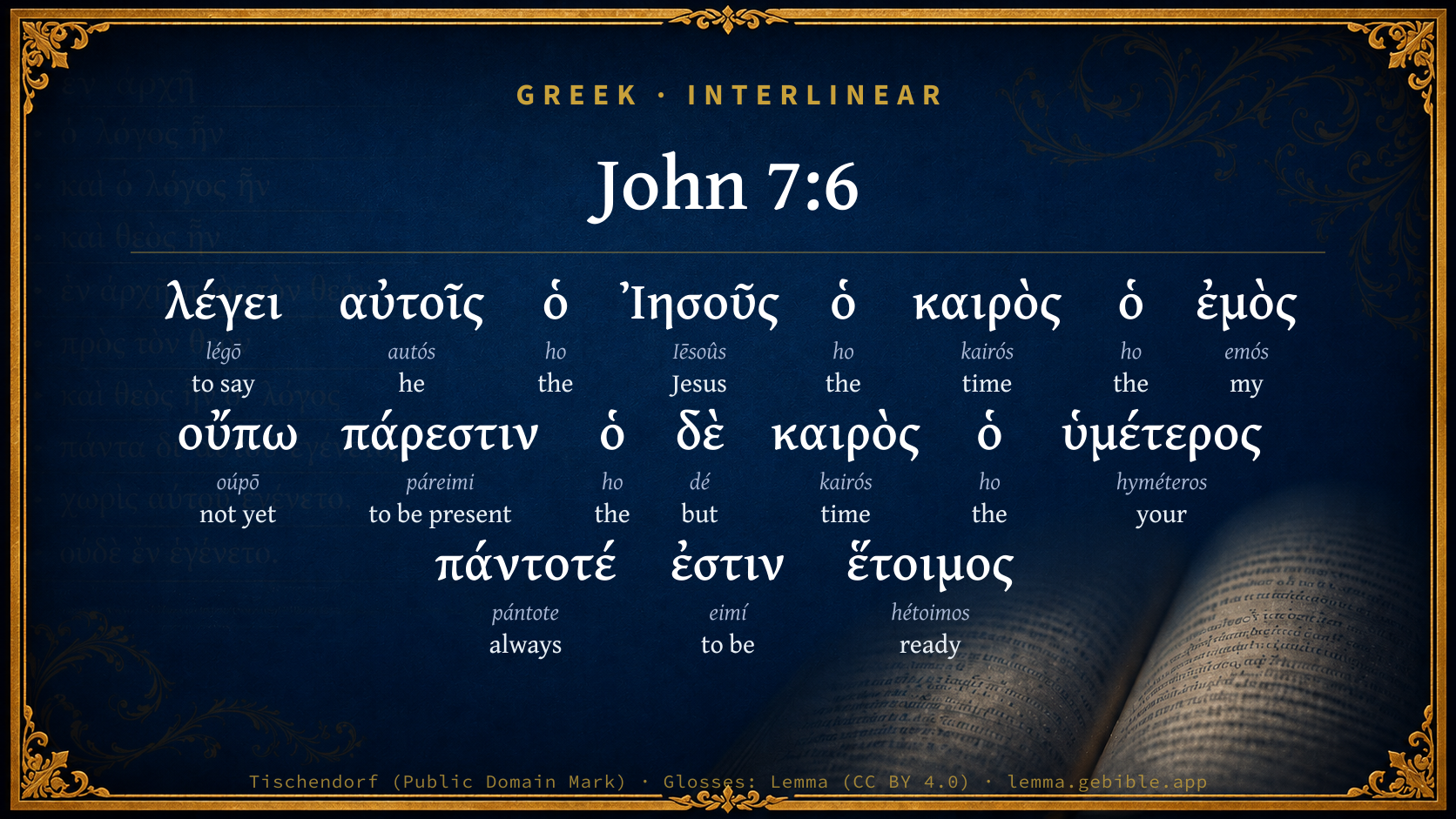
  1. λέγει légō G3004 “to say” Verb, Present, Active, Indicative, 3rd person, Singular
  2. αὐτοῖς autós G846 “he” Personal pronoun, Dative, Plural, Masculine
  3. ὁ ho G3588 “the” Article, Nominative, Singular, Masculine
  4. Ἰησοῦς Iēsoûs G2424 “Jesus” Noun, Nominative, Singular, Masculine
  5. ὁ ho G3588 “the” Article, Nominative, Singular, Masculine
  6. καιρὸς kairós G2540 “time” Noun, Nominative, Singular, Masculine
  7. ὁ ho G3588 “the” Article, Nominative, Singular, Masculine
  8. ἐμὸς emós G1699 “my” Possessive pronoun, 1st person, Nominative, Singular, Masculine
  9. οὔπω oúpō G3768 “not yet” Adverb, Negative
  10. πάρεστιν páreimi G3918 “to be present” Verb, Present, Active, Indicative, 3rd person, Singular
  11. ὁ ho G3588 “the” Article, Nominative, Singular, Masculine
  12. δὲ dé G1161 “but” Conjunction
  13. καιρὸς kairós G2540 “time” Noun, Nominative, Singular, Masculine
  14. ὁ ho G3588 “the” Article, Nominative, Singular, Masculine
  15. πάντοτέ pántote G3842 “always” Adverb
  16. ἐστιν eimí G1510 “to be” Verb, Present, Active, Indicative, 3rd person, Singular
  17. ἕτοιμος hétoimos G2092 “ready” Adjective, Nominative, Singular, Masculine

About this verse

These counts appear in no published source. They are computed here, from the morphology-tagged text and Lemma’s own curated glosses. What Lemma adds →

18
words
13
distinct lemmas
Gospels
section

Notable vocabulary

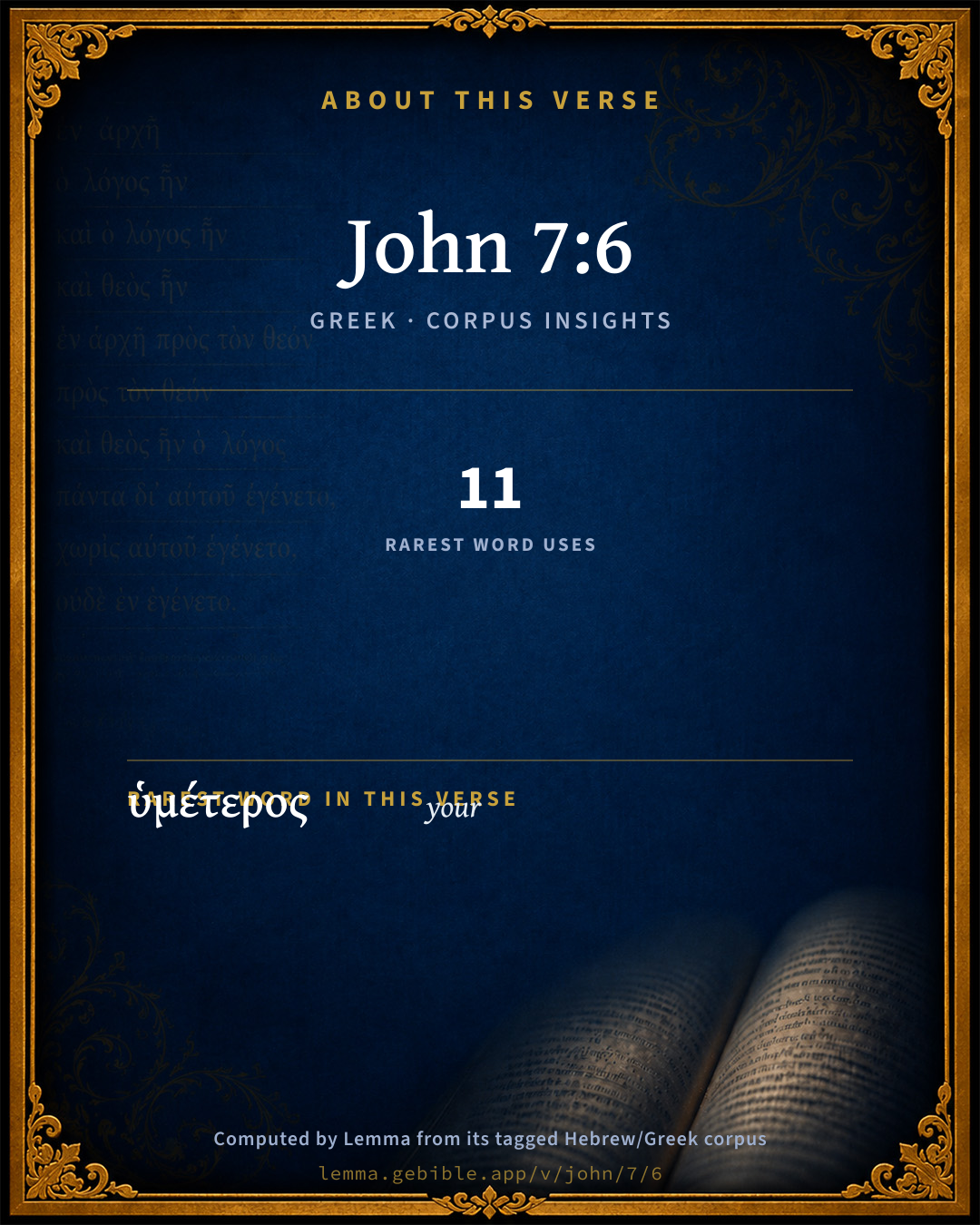
The rarest word here is ὑμέτερος your G5212 — appearing just 11 times in the whole Greek New Testament.

Shared distinctive vocabulary

ὑμέτερος your G5212 occurs in 11 verses of the Greek New Testament. Also found in:

Repetition

Words recur within this verse:

Cross-references

10

Topical passages linked to John 7:6 in the Treasury of Scripture Knowledge — connected by theme and wording, ordered by reader-vote popularity; previews shown in the World English Bible.

  • John 7:8 You go up to the feast. I am not yet going up to this feast, because my time is not yet fulfilled."
  • John 2:4 Jesus said to her, "Woman, what does that have to do with you and me? My hour has not yet come."
  • John 7:30 They sought therefore to take him; but no one laid a hand on him, because his hour had not yet come.
  • John 17:1 Jesus said these things, and lifting up his eyes to heaven, he said, "Father, the time has come. Glorify your Son, that your Son may also glorify you;
  • John 13:1 Now before the feast of the Passover, Jesus knowing that his time had come that he would depart from this world to the Father, having loved his own who were in the world, he loved them to the end.
  • John 8:20 Jesus spoke these words in the treasury, as he taught in the temple. Yet no one arrested him, because his hour had not yet come.
  • Matthew 26:18 He said, "Go into the city to a certain person, and tell him, 'The Teacher says, "My time is at hand. I will keep the Passover at your house with my disciples."'"
  • Acts 1:7 He said to them, "It isn't for you to know times or seasons which the Father has set within His own authority.
  • Psalms 102:13 You will arise and have mercy on Zion; For it is time to have pity on her. Yes, the set time has come.
  • Ecclesiastes 3:1–15 For everything there is a season, and a time for every purpose under heaven:

Cross-references courtesy of OpenBible.info (CC BY 4.0).

Commentary

Notes on John 7:6 from classic Christian and Jewish commentators (each source and its license shown beneath its notes). The classic Christian expositions comment on the surrounding passage and are grouped to its opening verse, so a note may address several verses; the Jewish commentaries on the Tanakh (Rashi and others) are per-verse, so they appear only where the commentator wrote on this verse.

Lemma curates 59 commentaries, every one of them public domain or Creative Commons licensed, each selected and text-cleaned for this edition rather than reprinted as found. About our sources →

Tyndale Open Study Notes

Tyndale Open Resources

7:6-8 Jesus said that it was not the right time for him to go publicly to Jerusalem, although he later went secretly (7:10; cp. study note on 12:23).

Tyndale Open Study Notes — © Tyndale Open Resources, licensed CC BY-SA 4.0. Text via the HelloAO Bible API.

Bengel's Gnomon

Johann Albrecht Bengel

Joh 7:6.[164] Πάντοτε, always) There is no need that your time should come at last.

[164] σὔπω, not yet) Jesus was aware that at the commencement of the feast, the hatred would be besides more violent than after an interval of some days.—V. g.

Bengel's Gnomon of the New Testament — English translation (T&T Clark, Edinburgh, 1860) — public domain. Text from a community e-Sword module.

Expositor's Greek Testament

ed. W. Robertson Nicoll

Joh 7:6 . His answer was ὁ καιρὸς ὁ ἐμὸς οὔπω πάρεστιν … ἕτοιμος . The time for my manifestation to the authorities as Messiah is not yet come; but no time is inappropriate or unsafe for you to show yourselves.

The Expositor's Greek Testament, edited by W. Robertson Nicoll (1897–1910) — public domain. Text from a community e-Sword module.

Godet's Commentaries

Frédéric Louis Godet

Vv. 6-8. “Jesus therefore says to them: My time is not yet come; but your time is always ready. 7. The world cannot hate you; but it hates me, because I bear testimony concerning it that its works are evil. 8. Go ye up to the feast, I go not up to this feast, because my time is not yet fulfilled.”

The meaning of the demand of the brethren of Jesus was that He should present Himself at last at Jerusalem as the Messiah, and obtain there the recognition of that dignity, which could not be refused Him, if He was really what He claimed to be. Jesus could not explain to His brethren the reasons which prevented Him from deferring to their wish. If He had wished to answer altogether openly, He would have said to them: “What you ask of me would be the signal of my death; but it is not yet time for me to leave the earth.” Of this explanation, into which Jesus does not wish to enter, He gives a hint. The words: The world hates me, sufficiently express the prudence which is required of Him. The term καιρός, favorable moment, must be understood in a manner sufficiently broad to make it possible to apply it both to Jesus (Joh 7:6 a) and to His brethren (Joh 7:6 b). It denotes therefore the moment of showing oneself publicly as one is: for the brethren, as faithful Jews, by going up to this feast; for Jesus, as Messiah, by manifesting Himself as such at one of the great feasts of His people, at Jerusalem.

The seventh verse explains this contrast between His position and theirs. There is a certain irony in the reason alleged by Jesus: “Your works and your words are not sufficiently out of harmony with those of the world to make it possible for you to provoke its hatred.” It is otherwise in His case, who by His words and His life does not cease to unveil its deep depravity concealed under the outward show of Pharisaic right-eousness (Joh 7:42; Joh 7:44; Joh 7:47).

Frédéric Louis Godet — Commentaries on Luke, John, Romans, and 1 Corinthians — English translation (T&T Clark, Edinburgh, 1870s–1890s) — public domain. Text from a community e-Sword module.

Geneva Bible (1599)

Geneva Bible translators

We must not follow the foolish desires of our friends.

Geneva Bible (1599) marginal notes — public domain. Text via Bolls.life.

Jamieson, Fausset & Brown

Robert Jamieson, A. R. Fausset & David Brown

My time is not yet come--that is, for showing Himself to the world.

your time is always ready--that is "It matters little when we go up, for ye have no great plans in life, and nothing hangs upon your movements. With Me it is otherwise; on every movement of Mine there hangs what ye know not. The world has no quarrel with you, for ye bear no testimony against it, and so draw down upon yourselves none of its wrath; but I am here to lift up My voice against its hypocrisy, and denounce its abominations; therefore it cannot endure Me, and one false step might precipitate its fury on its Victim's head before the time. Away, therefore, to the feast as soon as it suits you; I follow at the fitting moment, but 'My time is not yet full come.'"

Jamieson, Fausset & Brown — Commentary Critical and Explanatory on the Whole Bible (1871) — public domain (CC PDM 1.0). Text via the HelloAO Bible API.

Adam Clarke's Commentary

Verse 6. My time is not yet come] It is probable our Lord meant no more than this, that he had some business to transact before he could go to Jerusalem; but his brethren, having nothing to hinder them might set off immediately. Others think he speaks of his passion: My time of suffering is not yet come: as ye are still in friendship with the world, ye need not be under any apprehension of danger: ye may go when ye please. The first sense I think is the best.

Adam Clarke's Commentary on the Bible (1810–1826) — public domain. Text from a community e-Sword/MySword module.

John Calvin's Commentaries

6. My time is not yet come. There are some who erroneously interpret this as referring to the time of his death, for it denotes the time of his setting out on the journey to go to the feast. He assures them that, in this respect, he differs from his relations. They may freely and without danger appear, at all hours, before the world, because the world is friendly and favorable to them; but he is in dread of his person, and justly, because the world is his mortal enemy. By these words he means that they do wrong in giving advice on a matter which they do not understand.

John Calvin's Commentaries (1540-1563) — public domain. Text from the Calvin Translation Society English edition (1840s-50s) via the Christian Classics Ethereal Library (ccel.org). Calvin's coverage is partial (roughly two-thirds of the Bible); uncommented books and verses are honest gaps, never fabricated. The 19th-century editor's footnotes and remarks are omitted so the notes are faithfully Calvin's own voice.

Ellicott's Commentary for English Readers

(6) My time is not yet come.—Comp. Note on Joh_2:4. Here, as there, He regards the events of life as marked out by divinely-ordered seasons. There is for Him a time for solemnly entering Jerusalem with a throng of pilgrims going up to a feast, and in a few months it will have come; but it has not come yet. It is at the feast of the Paschal Lamb, already set apart, and not with the joyous shouts of harvest-tide.

Your time is alway ready.—They may go now as then. Of the nation, their thoughts and feelings are in sympathy with the national feasts. They can join in the festive throng keeping holiday, and take their part in the Temple service. For Him present events have another meaning. Desertion of disciples, threatenings of Jews, unbelief of brethren—all this means that the end is approaching, and that His time is at hand.

A Bible Commentary for English Readers, edited by Charles John Ellicott (1878–1897) — public domain. Text from a community e-Sword module.

The Cambridge Bible for Schools and Colleges

gen. ed. J. J. S. Perowne

6. Then Jesus said] Better, Jesus therefore saith.

My time is not yet come] i.e. My time for manifesting Myself to the world; with special reference to the Passion. It is inadequate to interpret it of the time for going up to the Feast. Moreover, what sense would there be in ‘Your time for going up to the Feast is always ready?’ Whereas ‘You can always manifest yourselves’ makes excellent sense. See last note on Joh_2:4.

The Cambridge Bible for Schools and Colleges (gen. ed. J. J. S. Perowne; Cambridge University Press, 1878–1918) — public domain. Text from a community e-Sword module.

John Gill's Exposition

The world cannot hate you,.... Because they were of the world, belonged to it; they were like unto it, and every like loves its like; and they were the world's own, and therefore instead of being hated, were loved by it; and they walked according to the course of it; and wicked men not only take pleasure in sin, but in them that do it:

but me it hateth; though without a cause; that is, without a just cause, or reason; a cause there was, and it follows:

because I testify of it, that the works thereof are evil; even those works of it, which were reckoned good works; Christ bore his testimony of these, that they were evil; being done either not according to the command of God, but the traditions of the elders; or not from a right principle, as of faith and love, nor to a right end, as the glory of God; but only to be seen of men: and very severely did he inveigh against the pride, covetousness, hypocrisy, and uncleanness of the Scribes and Pharisees: and so he continued to do, and this drew upon him their hatred and ill will.

John Gill's Exposition of the Whole Bible (1746–1763) — public domain (CC PDM 1.0). Text via the HelloAO Bible API.

Trapp's Complete Commentary

John Trapp

6 Then Jesus said unto them, My time is not yet come: but your time is alway ready.

Ver. 6. My time is not yet come] sc. My time of journeying to Jerusalem; I must take my best opportunity, when I may go up with most safety. You may take your own time: you can hardly take amiss, since the world loveth his own, Joh 15:19; and huggeth them to death, as the ape doth her young.

John Trapp, A Commentary or Exposition upon All the Books of the Old and New Testament (1647–1656) — public domain. Text from a community e-Sword module.

Albert Barnes' Notes on the Bible

My time ... - The proper time for my going up to the feast. We know not why it was not yet a proper time for him to go. It might be because if he went then, in their company, while multitudes were going, it would have too much the appearance of parade and ostentation; it might excite too much notice, and be more likely to expose him to the envy and opposition of the rulers.

Your time ... - It makes no difference to you when you go up. Your going will excite no tumult or opposition; it will not attract attention, and will not endanger your lives. Jesus therefore chose to go up more privately, and to remain until the multitude had gone. They commonly traveled to those feasts in large companies, made up of most of the families in the neighborhood. See the notes at Luk 2:44.

Albert Barnes' Notes on the Bible (1834–1885) — public domain. Text from a community e-Sword/MySword module.

Matthew Poole's English Annotations

My time is not yet come; the time of my death, say some; of my manifestation to the world, say others: but questionless our Saviour intends no more than his time for going up to this feast, for we shall read that he did go up afterward; but, saith he, as yet I cannot go up.

Your time is alway ready; you may go when you please: and this he further openeth, saying, .(See Joh 7:7)

Matthew Poole's English Annotations on the Holy Bible (1683–1685) — public domain. Text from a community e-Sword/MySword module.

Whedon's Commentary on the Bible

Daniel D. Whedon

6. My time—My time for challenging the nation at the metropolis. The word time here has no doubtful meaning. See note on John 2. It has not the slightest reference, as some suppose, to his death. Jesus goes not up to this feast, because the divinely appointed and divinely signified time for going to it has not yet come. When that comes he will go.

Your time—Is your own, and acknowledges no divine regulation.

Alway ready—When you please.

Daniel D. Whedon (gen. ed.), Commentary on the Old and New Testaments (1874–1909) — public domain. Text from a community e-Sword module.

The Pulpit Commentary

Jesus then saith to them (to his brothers), My time (the "season" for my full manifestation to the nation of what I am, or the time to disclose my own idea of my own commission) is notyet present. The season or opportunity for my final self-revelation pauses, and I pause for an intimation of the Father"s will. This language corresponds with the reply to his mother, "My hour is not yet come" to do what you blindly desire. The kind of manifestation he subsequently made on that occasion was one of love to the needy, not one of power to dazzle the world. (see notes, Joh_2:11) The underlying thought which the postponement suggested was that the approach of Jesus to Jerusalem with the pilgrim throng would be the signal for the final outburst of bitter hostility which he knew was smouldering in the hearts of the Sanhedrists, and would also be the torch applied to the magazine of combustible passion in which he would sacrifice his life. But your time (the season which is yours) is always ready. The brothers were at liberty at any time to show themselves and their works to the world. They had plans akin to those of the world. They shared the fashion of religious thought, the ideal of the Israelitish world, completely. James, for instance, Nazarite though he may have been, punctilious in traditionary ritual, and honouring the conservative passions of his order, might at any time secure the acclamations or approval of the chief powers of the world their little world. "I" (Christ implied) "wait for the predetermined hour, for the kind of appearance in Jerusalem which will be the giving of my flesh for the life of the world. You are so much in harmony with the world that at any time you may say all that is in your heart. If I go as,you suggest, it must be as Messiah; you go as pious pilgrims to share in this national celebration.

HOMILIES BY B. THOMAS Ver. 6. Jesus in relation to time.

Notice

I THE TIME OF JESUS. "My time is not yet come." His time to go up to the feast, or his time to manifest himself. We have here:

1. Jesus as the Subject of time. During his earthly career he was the Subject of time, and dependent upon it. He who was before and really above time was now its Subject. As such:

(1) He had regard to its events; what were taking place in the social and religious world around him, their bearings upon each other, and especially upon his movements and actions, and the bearings of his movements upon the events of the time.

(2) He had regard to the character of his time; to the men who acted in it men of religious and social authority and power to their principles and attitude towards him and the great mission of his life.

(3) He shaped his course accordingly. He had a certain amount of time to live and do his work. He could escape death if he wished; but could not have escaped death and perform the mission of his life. He might have shortened his days, and frustrated their end by indiscreetly rushing into the teeth of danger; but as a Subject of time he had due regard to current events and public feelings in relation to him, so that he acted with perfect wisdom and discretion.

2. Jesus as the Manager of time.

(1) To him time was very precious. His time was very short, and he had an immense work to do. Never was so little time given for such a great work. Every moment was an age, and ages were compressed into a moment. He made the best of time. Every moment was infinitely precious.

(2) He had a special time for every work. He never performed a single miracle nor preached a single discourse at random. There was perfect adaptation and correspondence between his actions and the time. They fitted in with the natural sequence of events, and with the state of thoughts and feelings. They could not be performed at any other time with the same results. They were like the growth of spring and the ripe fulness of harvest.

(3) He had some special work for every portion of time, so that every hour was well occupied and every minute well spent. He had a season for everything, and everything was in its season.

(4) The exact time for all his movements was well known to him. He knew when it had not and when it had come, so that he was never too soon nor too late. He could not be induced to move by the solicitations of friends before his time; neither could he be stopped, nor be driven from the scene of duty, when his time had arrived. Punctuality was one of his characteristics. He was at every station and every duty in due time, and not before. He was never waiting, and no one had to wait for him. He was bound to time, and time was bound to him. He was both its Subject and its King.

II THE TIME OF HIS BRETHREN. Their time and his differed materially.

1. Their time was always ready. This was true with regard to going up to the feast, and also to the manifestation of Christ according to their ideas. They were ever ready and anxious for this. But Christ"s time was not yet come. Man"s time is often before that of God. His ideas are more limited. God"s thoughts and plans move in an infinite circle, and take a longer time to be accomplished. Man"s time is often after that of God. Now is God"s accepted time to repent and believe. It is at some more convenient season often with man.

2. Their time was by self; his by the general good. Their notions were carnal and selfish, and were inspired in all their movements by principles of self-interest; but Christ"s notions were spiritual and Divine, and he was ever inspired in all his movements by Divine and benevolent principles the glory of God and the spiritual redemption of the human family. There is a vast difference between the time of selfishness and that of self-sacrificing love.

3. Their time was by the present; his was by the future as well. They were prompted by present advantage, by considerations which only embraced the limited period of their own life; but Jesus was prompted by future advantages, and by considerations which embraced endless futurity. Every step he gave was given with regard to all future ages. His time was regulated by eternity, and the eternity of myriads depended on his time.

4. Their time was by earth; his was by heaven. Theirs was by the material sun; his was by the eternal throne. Their principles were in perfect accord with those of the world, and their notions of the Messiah were those of the nation at large. So that they could move with perfect safety whenever they liked, they were in no danger. But the principles of Jesus were in perfect accord with those of God they were holiness, spirituality, benevolence, self-sacrifice, and mercy, and thus in direct antagonism to the world; so that an unwise move might result in an untimely and fatal collision.

5. Their time was by unbelief; his was by faith. We are told that his brothers did not really believe on him. And unbelief is ever impatient, commanding, and always ready for some carnal demonstration and material sign. Faith is patient, submissive, and ever grateful for a vision when it comes; but if it comes not at the time and in the way expected it waits and trusts and obeys. Jesus was the Messiah and the Saviour of faith. He revealed himself to faith, and faith is the only power on earth which could see, comprehend, and appreciate his real character and his Divine mission; consequently all his movements, although not regardless of unbelief as precautionary, yet were directly made in the interest of faith. When faith is ready, he will be at the feast, and will manifest himself at any risk.

LESSONS.

1. We are in as much danger often from mistaken friends as from open foes. Jesus was so now from his brethren and the multitude; they wished to make him King.

2. A word or a deed in season is much more effective than otherwise.

Christ"s words and deeds were ever seasonable. God has his set time for punishment and salvation.

1. In order that our time should correspond with that of Jesus, let us believe on him. If we wish to have his company to the feast, let us exercise implicit trust in him.

2. If we wish to make the most of time, let us follow Jesus in watching the best season for everything. Random shots seldom kill anything. We should not merely be diligent, but take aim. B.T.

The Pulpit Commentary (1880–1919), ed. H.D.M. Spence-Jones & Joseph S. Exell — public domain. Text from a community e-Sword module.

John Wesley's Explanatory Notes

Jesus saith, Your time is always ready - This or any time will suit you.

John Wesley, Explanatory Notes Upon the Whole Bible (1754–1765) — public domain. Text via the GEBible commentary corpus.

Kretzmann's Popular Commentary

Paul E. Kretzmann

The refusal of Jesus:

v. 6. Then Jesus said unto them, My time is not yet come, but your time is alway ready.

v. 7. The world cannot hate you; but Me it hateth because I testify of it that the works thereof are evil.

v. 8. Go ye up unto this feast; I go not up yet unto this feast; for My time is not yet full come.

v. 9. When He had said these words unto them, He abode still in Galilee.

Jesus refused to listen to the proposals of His brothers. His time for revealing Himself publicly, especially in the manner which their suggestion implied, had not yet come. In the sense of their words He never wanted to become King of Israel, a temporal, earthly ruler. In His own way and at His own time He wanted to reveal Himself as the Son of God and the Savior of the world. But for His brothers it was always time to show themselves before the world. In the disposition which they exhibited at that time, they fitted in very well with the other mockers and scoffers. They were in no danger, for they were among friends in Jerusalem. The world, the wicked, hostile Jewish leaders, could not hate the brothers, for they shared the same opinion, they adhered to the same idea. But the testimony of Jesus concerning the works of this same world branded Him in their eyes as an enemy, whom they therefore hated with all the intensity of the hatred of darkness for the light. If Jesus had merely referred to notorious sins, blasphemy, murder, robbery, adultery, the leaders of the Jews would have agreed with Him readily, holding up, at the same time, pious hands in sanctimonious horror over the depravity of the rabble. But since Jesus points a revealing finger at them and rebukes their hypocrisy and lack of true charity, they are scandalized at His insinuations, and all the more, since their own consciences could not gainsay His words. As long as a preacher speaks in general terms of depravity and sin, the assenting nods come from all directions, but when he makes the application to the individual, hidden sins and holds forth on the personal responsibility, the situation changes very quickly. But Jesus urged His brothers to go up to Jerusalem, to attend to their duty as members of the Jewish Church. His time for manifesting Himself publicly had not yet come, and He did not wish to go up for the display which they believed He should make in establishing His claims. For the time being, He stayed in Galilee.

Paul E. Kretzmann, Popular Commentary of the Bible (1921–1924) — public domain. Text from a community e-Sword module.

Burkitt's Expository Notes on the New Testament

William Burkitt

Here we have Christ’s answer and refusal returned to his brethren’s desire: he tells them, That they might go up to the feast of Jerusalem, when they pleased, and as publicly; but it was not fit for him to appear so publicly, because the doctrine which he taught was odious to the pharisees, and the prevailing power at Jerusalem: he therefore resolves to go up privately, that he might not stir up the jealousy of the sanhedrim: but for them, they were out of danger of the world’s hatred: for, being the children of it, the world would love its own; but him it hated because he reproved its sins.

Where we may remark, That though our Lord Jesus Christ was most freely willing, and ready, to lay down his life for sinners, when the time was come that God the Father called for it; yet he would not expose his life to hazard and danger unseasonalby. Teaching us by his example, as not to decline sufferings when God calls us to them: so not to tempt God by running into them, when we may inoffensively avoid them. Your time is always ready, mine is not yet come.

William Burkitt's Expository Notes on the New Testament (1700–1703) — public domain. Text from a community e-Sword module.

The People's New Testament

B. W. Johnson

6. My time is not yet come. For the full manifestation of himself. This required his death and resurrection.

B. W. Johnson's The People's New Testament with Notes (1889–1891) — public domain. Electronic text from the Christian Classics Ethereal Library (CCEL) ThML edition.

Cambridge Greek Testament for Schools and Colleges

6. ὁ καιρὸς ὁ ἐμ. see on Joh 8:31. My time for manifesting Myself to the world is not yet present; with special reference to the Passion. It is inadequate to interpret it of the time for going up to the Feast. Moreover, what sense would there be in ‘Your time for going up to the Feast is always ready?’ Whereas ‘You can always manifest yourselves’ makes excellent sense. See last note on Joh 2:4. Καιρός, frequent in the Synoptists, occurs here only in S. John, Joh 5:4 being a gloss: S. John’s word is ὥρα. Καιρός is Christ’s opportunity on the human side, ὤρα is His hour on the Divine side, i.e. as ordained by God.

Cambridge Greek Testament for Schools and Colleges (Cambridge University Press, 1896; 21 vols, various authors incl. Carr, Maclear, Plummer, Farrar, Lumby, Moule, M. R. James, Simcox) — public domain. Text from a community e-Sword module.

Alford’s Greek Testament

Henry Alford

6-9.] ὁ καιρ. ὁ ἐμ. can hardly be taken as directly meaning ‘the time of my sufferings and death,’—but as ἡ ὥρα μου in ch. 2:4: ‘My time for the matter of which you speak, viz. manifestation to the world.’ That (ch. 12:32) was to take place in a very different manner. But they, having no definite end before them, no glory of God to shew forth, but being of the world, always had their opportunity ready of mingling with and standing well with the world. Then (ver. 7), ‘you have no hatred of the world in your way: but its hatred to Me on account of my testimony against it, causes me to exercise this caution which you so blame.’

In ver. 8, it is of little import (see var. readd.) whether we read οὐκ or οὔπω: the sense will be the same, both on account of the present, ἀναβαίνω (not ἀναβήσομαι, which would express the disavowal of an intention to go up), and of οὔπω afterwards. οὐκ ἀναβ. would mean, I am not (at present) going up. Meyer attributes to our Lord change of purpose, and justifies his view by the example of His treatment of the Syrophœnician woman, whom He at first repulsed, but afterwards had compassion on. Mat 15:26 ff. The same Commentator directs attention to the emphatic ταύτην, as implying that our Lord had it in His mind to go up to some future feasts, but not to this one.

οὔπω πεπλήρ., is not yet fully come: see Luk 9:51 and note.

Henry Alford, The Greek Testament (1849–1861) — public domain. Text from a community e-Sword module.

International Critical Commentary

6. λέγει οὖν. So אcBLNΓΔΘ, but om. οὖν א*DW and syrr. For οὖν in Jn., see on 1:22.

ὁ καιρὸς ὁ ἐμὸς οὔπω πάρεστιν, “my time is not yet come.” καιρός is a word which Jn. uses only in this passage; it stands for the moment of opportunity, the fitting occasion, rather than for the “predestined hour” (ὥρα), on which the Fourth Gospel dwells with such insistence (see on 2:4). The fitting time had not yet come, Jesus says in reply to the suggestion, “reveal Thyself to the world” (v. 4); and by this is meant not the hour of His Passion, but rather the best time for that public manifestation of Himself as Messiah, which He would make when He went up to the Feast of Tabernacles (v. 8). Such public declaration was made, when He did go up: cf. vv. 29, 33, 8:12, 28 etc.

ὁ δὲ καιρὸς ὁ ὑμέτερος πάντοτέ ἐστιν ἕτοιμος. Their case was different from His. It did not matter when they went up to the feast; it was one of strict obligation, but the exact day on which they would present themselves in Jerusalem was of no consequence, provided that they attended. Any day would be a fitting day (καιρός) for them to arrive, for they would not be received with hostility, but rather with indifference.

International Critical Commentary — older volumes (1896–1929), various authors — public domain. Text from a community e-Sword module.

Vincent's Word Studies in the New Testament

Marvin R. Vincent

Time [καιρος] . See on Mt 12:1; Luk 1:20; Act 12:1. The appropriate season or juncture.

Alway ready. The disciples might at any time associate with the world, with which they were still in sympathy. Not so Jesus, who was in essential antagonism to the world.

Marvin R. Vincent, Word Studies in the New Testament (1887–1900) — public domain. Text from a community e-Sword/MySword module.

Lesson kit

Teaching starters — assembled from the data on this page, not authored interpretation. Every prompt links to the verse data it draws on. Edit before teaching.

John, in the Gospels, opens this verse with 18 words (13 distinct Greek lemmas). Its most distinctive word is hyméteros (“your”). A historical commentator’s framing appears above. Read the whole chapter for the surrounding context.

Discussion questions

  1. What does “your” (hyméteros) contribute to the verse as a whole?
  2. Luke 6:20 shares the word «your» with this verse. How do the two illuminate each other?
  3. “time” occurs 2× in this one verse. What is the effect of the repetition?
  4. These translations render this verse differently. What is at stake in choosing one wording over another?
  5. Reading how Tyndale Open Study Notes and Bengel's Gnomon read this verse, where do the two commentators agree and where do they part?

Things to notice

  • These translations choose different wording for 6 words in this verse.
  • “time” occurs 2× in this single verse.
  • 13 distinct Greek lemmas span 18 words in this verse.

Reading settings

Reading text

Shown beneath each verse's original-language words.

Old Testament
Old Testament edition

Read the OT as the Masoretic Hebrew (MT) or the Greek Septuagint (LXX).

English shown for the Greek Septuagint (in the Hebrew ↔ Greek comparison).

Comparing translations? Open the Compare panel on any verse page to stack up to four side by side.