John 4:28

Greek (Tischendorf 8th ed.) John 4:28 appears in the Greek New Testament. The text above is from the Tischendorf 8th edition. Each word links to its Strong’s number and a concise gloss. Click any word for its full Thayer’s Greek Lexicon entry.
Download image
Cite this verse

John 4:28 (World English Bible). Public Domain. Lemma interlinear Bible study tool, https://lemma.gebible.app/v/john/4/28.

Show BibTeX & RIS
BibTeX
RIS
English Translation
So the woman left her water pot, and went away into the city, and said to the people,
World English Bible · Public Domain
Download a study sheet

One document with this verse’s original text, its word-by-word gloss line, the meaning frame, cross-references with their text, attributed commentary, and full source and license credits — printable, and it pastes into notes with its structure intact.

This verse Autodidact and up

Study sheet (.html) Plain text (.txt)

A passage Seminary Student

Up to 50 verses in one chapter. A passage sheet keeps up to 6 commentary sources and 12 cross-references per verse, in the order this page ranks them, and says so on the sheet whenever that leaves anything out. Ask for a single verse and you get the Autodidact verse sheet above.

Everything on this page stays free to read, with no account — the sheet is a download of what is already on screen, not access to it.

Want to remove ads? Support Godless Engineer
Compare translations 3

The same verse in 3 English versions, stacked beneath the original-language interlinear above. Click any original word for its lexicon entry.

Each is an independent rendering of the whole verse — the interlinear is not word-aligned to these translations.

Highlighted words mark where these versions differ — a whole-verse word diff, not a word-by-word alignment.

  • World English Bible Public Domain
    So the woman left her water pot, and went away into the city, and said to the people,
  • King James Version Public Domain
    The woman then left her waterpot, and went her way into the city, and saith to the men,
  • unfoldingWord Literal Text CC BY-SA 4.0
    Then the woman left her water pot and went back into the town and says to the men,

unfoldingWord Literal Text — © unfoldingWord, licensed CC BY-SA 4.0. Word-aligned USFM3 via Door43 (git.door43.org/unfoldingWord/en_ult).

Versions to compare (up to 4)

3 of 4 selected

Show all 19 translations

Every available English version of this verse, each an independent rendering of the whole verse.

  • World English Bible Public Domain
    So the woman left her water pot, and went away into the city, and said to the people,
  • Berean Standard Bible Public Domain
    Then the woman left her water jar, went back into the town, and said to the people,
  • Majority Standard Bible Public Domain
    Then the woman left her water jar, went back into the town, and said to the people,
  • King James Version Public Domain
    The woman then left her waterpot, and went her way into the city, and saith to the men,
  • American Standard Version (1901) Public Domain
    So the woman left her waterpot, and went away into the city, and saith to the people,
  • Revised Version (1885) Public Domain
    So the woman left her waterpot, and went away into the city, and saith to the men,
  • Geneva Bible (1599) Public Domain
    The woman then left her waterpot, and went her way into the citie, and said to the men,
  • Douay-Rheims (1899) Public Domain
    The woman therefore left her waterpot, and went her way into the city, and saith to the men there:
  • Young's Literal Translation Public Domain
    The woman then left her water-jug, and went away to the city, and saith to the men,
  • Literal Standard Version CC BY-SA 4.0
    The woman then left her water-jug and went away into the city, and says to the men,
  • Unlocked Literal Bible CC BY-SA 4.0
    So the woman left her water pot, went back to the town, and said to the people,
  • unfoldingWord Literal Text CC BY-SA 4.0
    Then the woman left her water pot and went back into the town and says to the men,
  • Darby Bible Public Domain
    The woman then left her waterpot and went away into the city, and says to the men,
  • World Messianic Bible Public Domain
    So the woman left her water pot, went away into the city, and said to the people,
  • Webster's Bible Public Domain
    The woman then left her waterpot, and went into the city, and saith to the men,
  • Free Bible Version CC BY-SA 4.0
    The woman left her water jar behind and ran back to the town, telling the people,
  • Bible in Basic English Public Domain
    Then the woman put down her water-pot and went into the town, and said to the people,
  • Text-Critical English NT CC BY 4.0
    Then the woman left her water jar, went into the town, and said to the people,
  • Tyndale New Testament (1534) Public Domain
    The woman then lefte her waterpot and went her waye into the cite and sayde to the men.

Literal Standard Version (2020), Covenant Press — licensed CC BY-SA 4.0. Text via the HelloAO Bible API (eBible.org). Unlocked Literal Bible (unfoldingWord) — licensed CC BY-SA 4.0. Text via the HelloAO Bible API (eBible.org). unfoldingWord Literal Text — © unfoldingWord, licensed CC BY-SA 4.0. Word-aligned USFM3 via Door43 (git.door43.org/unfoldingWord/en_ult). Free Bible Version, Dr. Jonathan Gallagher — licensed CC BY-SA 4.0. Text via the HelloAO Bible API (eBible.org).

Word by word

More ways to search: Search by grammar → Find every occurrence → Compare this word →

Practice this passage: Drill this verse → Learn its vocabulary →

ὑδρίαν
hydría
G5201
“water jar”
Noun, Accusative, Singular, Feminine
Part of Speech
Noun
Case
Accusative
Number
Singular
Gender
Feminine
Full Thayer's Definition

Origin: from G5204

TDNT: None

1. a vessel for holding water 2. a water jar, a water pot
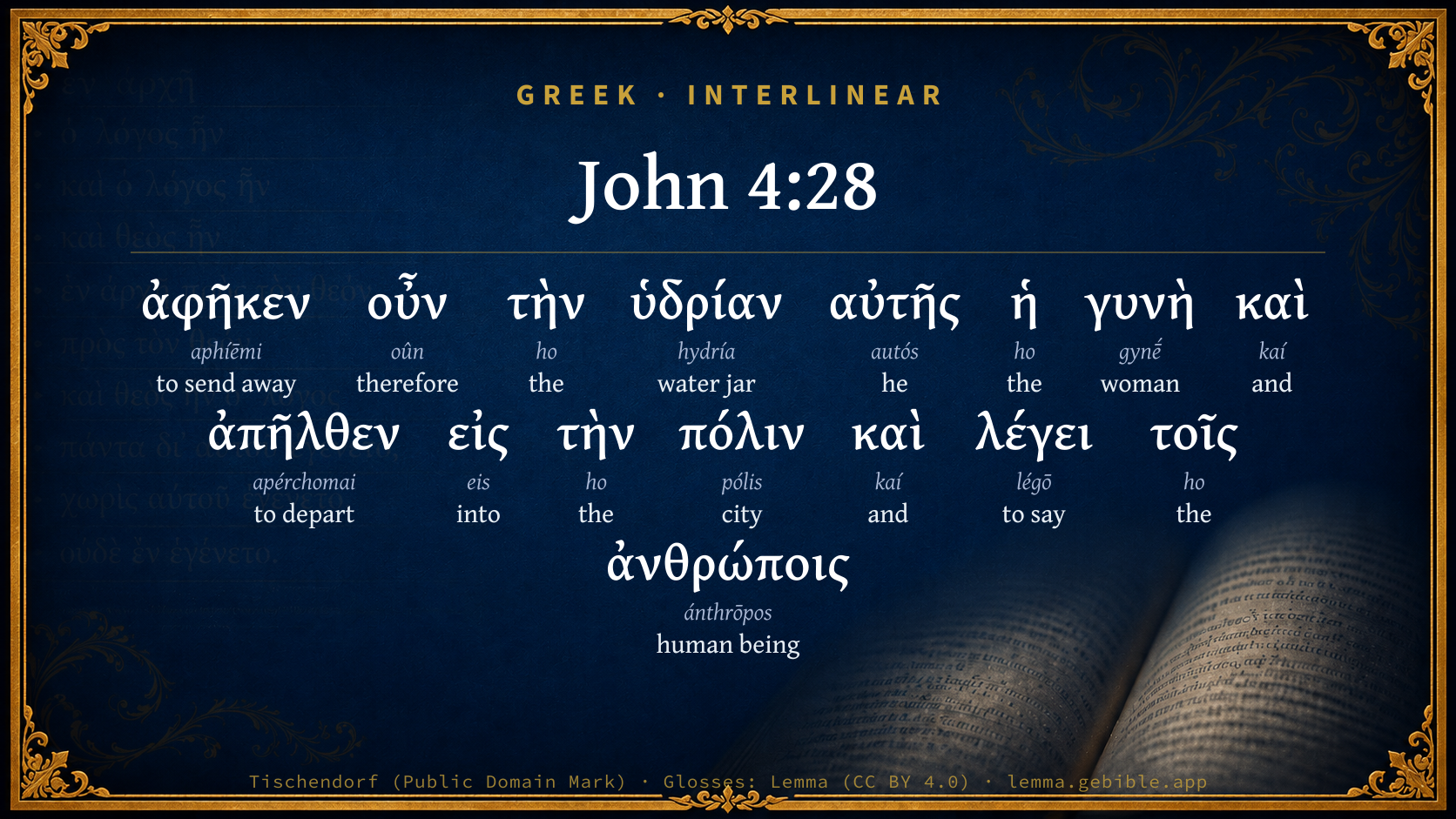
  1. ἀφῆκεν aphíēmi G863 “to send away” Verb, Aorist, Active, Indicative, 3rd person, Singular
  2. οὖν oûn G3767 “therefore” Conjunction
  3. τὴν ho G3588 “the” Article, Accusative, Singular, Feminine
  4. αὐτῆς autós G846 “he” Personal pronoun, Genitive, Singular, Feminine
  5. ἡ ho G3588 “the” Article, Nominative, Singular, Feminine
  6. γυνὴ gynḗ G1135 “woman” Noun, Nominative, Singular, Feminine
  7. καὶ kaí G2532 “and” Conjunction
  8. ἀπῆλθεν apérchomai G565 “to depart” Verb, Aorist, Active, Indicative, 3rd person, Singular
  9. εἰς eis G1519 “into” Preposition
  10. τὴν ho G3588 “the” Article, Accusative, Singular, Feminine
  11. πόλιν pólis G4172 “city” Noun, Accusative, Singular, Feminine
  12. καὶ kaí G2532 “and” Conjunction
  13. λέγει légō G3004 “to say” Verb, Present, Active, Indicative, 3rd person, Singular
  14. τοῖς ho G3588 “the” Article, Dative, Plural, Masculine
  15. ἀνθρώποις ánthrōpos G444 “human being” Noun, Dative, Plural, Masculine

About this verse

These counts appear in no published source. They are computed here, from the morphology-tagged text and Lemma’s own curated glosses. What Lemma adds →

16
words
12
distinct lemmas
Gospels
section

Notable vocabulary

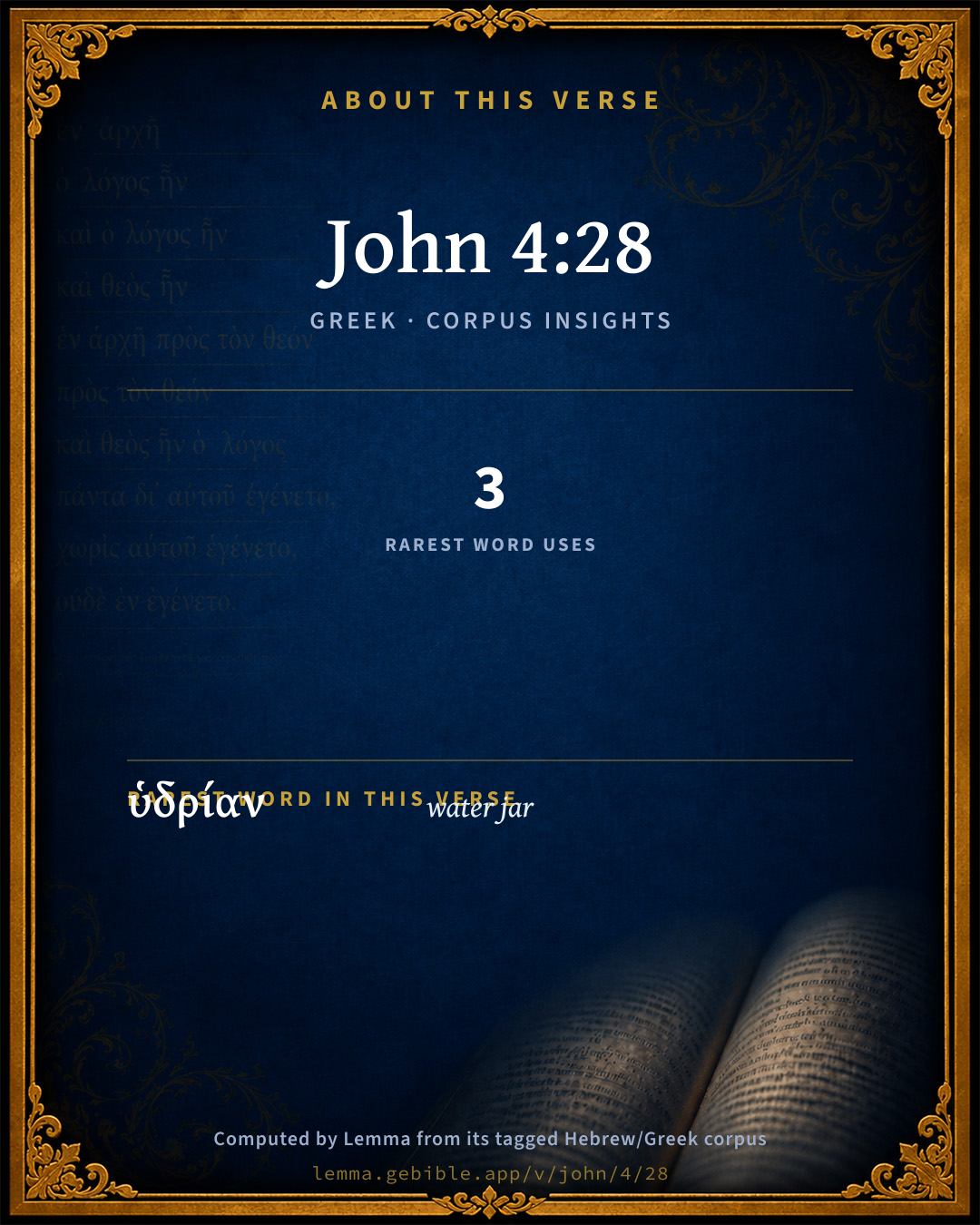
The rarest word here is ὑδρίαν water jar G5201 — appearing just 3 times in the whole Greek New Testament.

Shared distinctive vocabulary

ὑδρίαν water jar G5201 occurs in 3 verses of the Greek New Testament. Also found in:

Repetition

Words recur within this verse:

Cross-references

5

Topical passages linked to John 4:28 in the Treasury of Scripture Knowledge — connected by theme and wording, ordered by reader-vote popularity; previews shown in the World English Bible.

  • John 4:7 A woman of Samaria came to draw water. Jesus said to her, "Give me a drink."
  • Matthew 28:8 They departed quickly from the tomb with fear and great joy, and ran to bring his disciples word.
  • Luke 24:33 They rose up that very hour, returned to Jerusalem, and found the eleven gathered together, and those who were with them,
  • Mark 16:8–10 They went out, and fled from the tomb, for trembling and astonishment had come on them. They said nothing to anyone; for they were afraid.
  • Luke 24:9 returned from the tomb, and told all these things to the eleven, and to all the rest.

Cross-references courtesy of OpenBible.info (CC BY 4.0).

Commentary

Notes on John 4:28 from classic Christian and Jewish commentators (each source and its license shown beneath its notes). The classic Christian expositions comment on the surrounding passage and are grouped to its opening verse, so a note may address several verses; the Jewish commentaries on the Tanakh (Rashi and others) are per-verse, so they appear only where the commentator wrote on this verse.

Lemma curates 59 commentaries, every one of them public domain or Creative Commons licensed, each selected and text-cleaned for this edition rather than reprinted as found. About our sources →

The Biblical Illustrator

Joseph S. Exell

Joh_4:28-30

The woman left her waterpot, and went her way into the city

A womans zeal

I.

THE ENGROSSING NATURE OF CONVERSION.

1. To meet Christ causes ordinary events to shrink into insignificance. Paul for three days did neither eat nor drink. Bunyan ran about the streets distracted. Fuller was so moved that he was unable to pursue his customary avocations. These were extraordinary cases, but it is impossible to be turned from darkness to light and remain impassive. The adjusting of eternal relationships and attending to immortal interests may well make a man distracted.

2. It were better to renounce all work than to attend to the demands of the soul. To neglect the latter for the former is neither reason nor duty.

3. Religion will afterwards not impede but assist the performance of duty. The woman no doubt regained her waterpot, and cheerfully resumed her domestic toil.

4. All our instruments may become useful illustrations of Gods spiritual work. The waterpot must have been a continual reminder.

II. THE MISSIONARY SPIRIT EVOKED.

1. Religious joy seeks to make others share in it. Every Christian should be a centre of light and usefulness.

2. She wisely acted on the spur of the moment. Had she waited courage might have failed or excuses suggested. Nothing quenches fire like delay.

3. She hasted lest Christ should depart. The waterpot would impede her. Any time would do for water. There are times when Jesus is at the door; if these are neglected He may not return.

III. THE FORCIBLE APPEAL.

1. Attention called to an object of acknowledged importance.

2. An inference suggested from a fact of personal history.

3. An invitation given (Joh_1:46; Joh_1:39).

IV. THE HEARTY RESPONSE. (S. R. Aldridge, LL. B.)

The Woman of Samaria

In the conversion of the woman of Samaria, we have an example of this grace; an example

1. Its freeness: in selecting for its object a profligate creature, not only without her desert, but without her desire.

2. Its sweetness: in having no recourse to violence or terror, but in adopting the most suitable, gentle, and insinuating means to convince and soften her.

3. Its power: in changing her heart and sanctifying her life.

4. Its effects: for here we see grace in its triumph, grace in its glory. No sooner is she enlightened, than she is inflamed; no sooner is she a convert, than she becomes a preacher. However this may be, the character of the persons to whom our Saviour reveals Himself has always scandalized flesh and blood. If the disciples were astonished at our Saviours conversation with the woman, their behaviour was dutiful and submissive; they said nothing, but acquiesced in the rectitude of His procedure. And hence I would remark two things. The first regards the advice of Solomon, If thou hast thought evil, lay thine hand upon thy mouth. Honour our Lord with our reverence and implicit confidence when we meet with anything in His conduct that seems inexplicable.

Short as the interview was, our Saviour had effectually gained her heart.

1. Perhaps it was from kindness to our Lord and His disciples.

2. Perhaps she left her waterpot from indifference. Wholly occupied now about greater things, she forgot her errand. The feelings of young converts are often very lively.

3. Perhaps, finally, she left it as an impediment to her haste, willing to lose no time in bearing home the welcome intelligence. No sooner is her opportunity of getting good over, than she seizes an opportunity of doing good.

Five things may be remarked.

1. I admire her benevolence.

2. I admire her zeal. See how urgent she is. She even begins with a pressing invitation, Come.

3. I admire her wisdom. Come, see a man who told me all things that I did: is not this the Christ? You all acknowledge that Messiah cometh, and that when He is come He will tell us all things.

4. I admire her honesty. She does not say, He has told me everything pertaining to the worship of God; but all things that ever I did. Now, if a person knew your faults, you would wish to have him shunned.

5. I admire her courage. It was no small trial for a plain and wicked woman to go openly and address the inhabitants of the place where she lived, and was perhaps well known, upon a religious subject.

We now conclude, with observing

1. What a real and wonderful change does conversion always accomplish.

2. Divine grace is not an inoperative principle. As the sun no sooner rises than it shines, and as fire is no sooner kindled than it burns, so grace acts as soon as it exists.

3. Behold an apology for what some would deem officiousness. How often do you hear, as soon as any attempt is made to bring people to seriousness,

Pray do not intermeddle with us. Go to heaven your own way, and leave us to go ours. Is not charity to the soul, the soul of charity?

4. Be persuaded to resemble this woman. Endeavour to diffuse the savour of the Redeemers knowledge, and to bring souls to Christ. It is absurd to complain of a want of opportunities and means. Much is in your power, much more than you are willing to allow. (W. Jay.)

The home missionary

1. The impulse is natural to communicate to others what- ever may have been imparted to ourselves. The successful son sends word quickly home; the soldier of the forlorn hope hastens to communicate intelligence of his safety and success. The shepherd calls his neighbours to rejoice with him, and the father of the prodigal throws open his banqueting halls; Mary Magdalene departed quickly from the sepulchre to the disciples to communicate her joy. So with the woman of Samaria.

2. This is ever the result of saving conversion. Christianity must be expansive. The work of the Spirit is a life ever giving.

3. How unlike the selfish, grasping spirit of the world! 4. Christian influence is not confined to the active. The sick Christian may speak with a speechless eloquence. Notice

I. THE WOMANS CREDENTIALS.

1. Honesty and outspoken candour. In ordinary circumstances she would have shrunk from such a self-revelation. We should have expected efforts to keep them from Christ lest He should disclose more. But her honest avowal could not but have its weight with her fellow-townsmen.

2. Her earnestness; perhaps at first derided as fanatical, or hypocritical to serve her own ends. But her pleadings are irresistible. Earnestness is the power of the ministry, not charm of intellect or subtlety of reasoning, or sorcery of eloquence, but living words welling up from experience.

3. Her happiness. She had what they all wanted.

II. THE SUBJECT OF HER MESSAGE. She tells what we should have expected her to withhold.

2. She omits what we should have expected her to proclaim--the well, everlasting life.

3. The effective and influential characteristic of the gospel message is not figurative descriptions and metaphysical disputes, but the direct commending of the truth to the conscience, awakening the sense of sin, and thus preparing it for the remedy. In conclusion, notice the power of feeble influences. Never undervalue weak instrumentality. (J. R. Macduff.)

The forgotten waterpot

She came to draw water, and when she had lighted upon the true Well, she after that despised the material one; teaching us even by this trifling instance when we are listening to spiritual matters to overlook the things of this life, and make no account of them. For what the apostles did, that, after her ability, did this woman also. They, when they were called, left their nets: she of her own accord, without the command of any, leaves her waterpot, and winged by joy performs the office of evangelists. And she calls not one or two, as did Andrew and Philip, but having aroused a whole city and so brought them to Him. (Chrysostom.)

With her waterpot on her shoulder she had hitherto been listening to the Lords discourse. She was the forerunner of those Bechuan women who would stand for hours together, with their milking-pails in their hands, as if rooted to the ground, whilst Moffat was preaching to them the gospel of the living water. (R. Berser, D. D.)

Sudden conversion

Here was a genuine case. This woman came a prejudiced Samaritan, and left a believing Christian; she came a confirmed sinner, and left a contrite and believing penitent; she came absorbed in the temporalities of life, and left engrossed with eternal solemnities. In the New Testament there are twenty-four cases, including this, of sudden conversion. Let us then never call in question the possibility of a sinner being led to Christ in the course of a few hours. (J. H. Hitchens, D. D.)

The expansive power of Christianity

The work of the Spirit of God in the heart is not a fiction, not a form, but a life. To use the simile of this narrative, it is a fountain not only springing up (bubbling up), but overflowing its cistern, and the superfluous supply going forth to gladden other waste places. Not the mass of stagnant water without outlet, but the clear, sparkling lake, discharging its rush of living streams which sing their joyous way along the contiguous valleys, and make their course known by the thread of green beautifying and fertilizing as they flow, Or, if we may employ another figure, let it be the stone thrown into the same still lake. The ripples formed are deepest in the centre. Christianity is deepest in the heart in which its truths have sunk; but its influence expands in everwidening concentric circles, till the wavelets touch the shore. Religion, intensest in a mans own soul and life, should embrace family, household, kindred, neighbourhood, country, until it knows no circumference but the world! Christianity breaks down all walls of narrow isolation, and proclaims the true brotherhood of the race. Selfishness closes the heart, shuts out from it the rains and dews and summer sunshine; but Christianity, or rather the great Sun of light, shines;--the closed petals gradually unfold in the genial beams: and they keep not their fragrance to themselves, but waft it all around. Every such flower--the smallest that blushes unseen to the world--becomes a little censer swinging its incense-perfume in the silent air, or sending it far and wide by the passing breeze. (J. R.Macduff, D. D.)

God wilt honour zeal

While I was in London there was a man away off in India--a godly father--who had a son in London, and the father obtained a furlough and came right from India to England to see after his boys spiritual welfare. Do you think God let that man come thus far without honouring that faith? No. He converted that son. (D. L. Moody.)

The Biblical Illustrator, edited by Joseph S. Exell (c. 1880s–1900s) — public domain. Text from a community e-Sword module.

Joseph Benson's Commentary

Joh 4:28-30. The woman then — Seeing other company coming up to interrupt the discourse, immediately left her water-pot — Or pail, behind her, forgetting smaller things, while her thoughts were engrossed with matters of the greatest importance; and went her way with all haste into the city — Where she published the news in the streets, and said to all she met with, Come, see a man which told me all things that ever I did — Even the most secret circumstances of my past life. Our Lord had told her but a few things, but his words awakened her conscience, which soon told her all the rest. Is not this the Christ? — She does not doubt of it herself, but speaks thus to excite them to make the inquiry. Then they went out of the city, &c. — The Samaritans, struck both with wonder and curiosity, did not delay, but accompanied her instantly, wishing, no doubt, that her news might prove true.

Joseph Benson's Commentary on the Old and New Testaments (1811–1818) — public domain. Text from a community e-Sword module.

Bengel's Gnomon

Johann Albrecht Bengel

Joh 4:28. Ἀφῆκεν, left) either about to fill her water-vessel afterwards, or forgetful of lesser things, through joy; also being thus about to run the less encumbered. The woman treats the water as Jesus treated bread, as a secondary consideration, Joh 4:32, [To His disciples, urging Him to eat] “I have meat to eat that ye know not of” [Without delay, and by a spontaneous effort, faith, and the joy and certainty of it, are brought to hear in leading others also to the chief good, when once discovered.—V. g.]

Bengel's Gnomon of the New Testament — English translation (T&T Clark, Edinburgh, 1860) — public domain. Text from a community e-Sword module.

Meyer's Critical & Exegetical Commentary

Heinrich August Wilhelm Meyer

Joh_4:28-30. Οὖν] in consequence of the disciples coming, which interrupted the interview with Jesus.

ἀφῆκεν, κ.τ.λ.] οὕτως ἀνήφθη τῷ πυρὶ τῶν πνευματικῶν ναμάτων, ὡς καὶ τὸ ἄγγος ἀφεῖναι καὶ τὴν χρείαν, διʼ ἣν παρεγένετο, Euthymius Zigabenus. How great the power of the decisive awakening of the new life in this woman!

πάντα ἅσα] often thus used together in the classics; Xen. Anab. ii. 1. 2; Soph. El. 370, 880, 884; Bornem. ad Anab. i. 10. 3.

ἐποίησα] thus from a sense of guilt she described what Jesus had said to her. His words were therefore the summary of her moral history.

μήτι οὗτος, κ.τ.λ.] not must he not be really the Messiah? as if the question implied an affirmation. So Lücke, but against the constant use of μήτι as simply interrogative, in keeping with which we should rather render the words, yet is not perhaps this man the Messiah? which supposes a negative answer; to be explained, however, as arising psychologically from the fear and bashfulness of surprise at the newly discovered fact, too great for belief. The woman believes it; but startled at the greatness of the discovery, she does not trust herself, and ventures modestly only to ask as one in doubt. See on Mat_12:23; Baeumlein, Partik. 302. Observe in Joh_4:30 the change from ἐξῆλθον to the vividly descriptive ἤρχοντο (see on Joh_4:27; Joh_20:3). In the latter word the reader sees the crowd coming. Comp. Joh_4:40, where they arrive.

Meyer — Critical and Exegetical Commentary on the New Testament — English translation by Peter Christie, edited by Frederick Crombie (T&T Clark, 1880) — public domain. Text from a community e-Sword module.

Expositor's Greek Testament

ed. W. Robertson Nicoll

Joh 4:28 . ἀφῆκεν οὖν … ἡ γυνὴ . “The woman accordingly,” that is, because of the interruption, “left her pitcher,” forgetting the object of her coming, in the greater discovery she had made; and also unconsciously showing that she meant to return. καὶ ἀπῆλθεν … ὁ χριστός ; and went to the city and says to the men, easily accessible because lounging in groups at the hottest hour of the day, “Come, see a man who told me all I ever did”. The woman’s absorption in the thought of the prophet’s endowment causes her to forget the shame of the declaration which had convinced her. She does not positively affirm that He is the Christ, but says μήτι οὗτός ἐστιν ὁ χριστός ; This is what grammarians call the “tentative” use of μήτι . The A.V [49] “Is not this the Christ?” is not so correct as R.V [50] “Can this be the Christ?” The Syriac has “Is not this perhaps the Christ?” The Vulgate has “Numquid ipse est Christus?” In some passages of the N.T. (Mat 7:16 , Act 10:47 ) μήτι is used in questions which expect a more decided and exclusive negative than the simple μή , “certainly not,” “not at all”. But here and in Mat 12:23 mere doubt expresses itself, doubt with rather a leaning to an affirmative answer ( cf. Hoogeveen, Doctrina Partic. , under μήτι ; and Pape’s Lexicon , where it is rendered “ob etwa”). The Greek commentators unite in lauding the skill with which the woman excites the curiosity of the men and leads without seeming to lead. [Euthymius says: τὸ δὲ μήτι οὗτός ἐστιν ὁ χριστός ; ἀντὶ τοῦ , μήποτε οὗτός ἐστιν ; ὑποκρίνεται γὰρ , οἷον ἐπιδιστάζειν , ὥστε παρʼ αὐτῶν γενέσθαι τὴν κρίσιν .]

[49] Authorised Version.

[50] Revised Version.

The Expositor's Greek Testament, edited by W. Robertson Nicoll (1897–1910) — public domain. Text from a community e-Sword module.

Jamieson, Fausset & Brown

Robert Jamieson, A. R. Fausset & David Brown

left her water-pot--How exquisitely natural! The presence of strangers made her feel that it was time for her to withdraw, and He who knew what was in her heart, and what she was going to the city to do, let her go without exchanging a word with her in the hearing of others. Their interview was too sacred, and the effect on the woman too overpowering (not to speak of His own deep emotion) to allow of its being continued. But this one artless touch--that she "left her water-pot"--speaks volumes. The living water was already beginning to spring up within her; she found that man doth not live by bread nor by water only, and that there was a water of wondrous virtue that raised people above meat and drink, and the vessels that held them, and all human things. In short, she was transported, forgot everything but One, and her heart running over with the tale she had to tell, she hastens home and pours it out.

Jamieson, Fausset & Brown — Commentary Critical and Explanatory on the Whole Bible (1871) — public domain (CC PDM 1.0). Text via the HelloAO Bible API.

Adam Clarke's Commentary

Verse 28. Left her waterpot] She was so penetrated with the great truths which Jesus had announced that she forgot her errand to the well, and returned to the city without the water for which she came out!

Adam Clarke's Commentary on the Bible (1810–1826) — public domain. Text from a community e-Sword/MySword module.

John Calvin's Commentaries

28. Therefore the woman left her pitcher. This circumstance is related by the Evangelist to express the ardor of her zeal; for it is an indication of haste, that she leaves her pitcher, and returns to the city. And this is the nature of faith, that when we have become partakers of eternal life, we wish to bring others to share with us; nor is it possible that the knowledge of God shall lie buried and inactive in our hearts without being manifested before men, for that saying must be true:

I believed, and therefore I will speak, (Psalm 116:10.)

The earnestness and promptitude of the woman are so much the more worthy of attention, that it was only a small spark of faith that kindled them; for scarcely had she tasted Christ when she spreads his name throughout the whole city. In those who have already made moderate progress in his school, sluggishness will be highly disgraceful. But she may appear to deserve blame on this account, that while she is still ignorant and imperfectly taught, she goes beyond the limits of her faith. I reply, she would have acted inconsiderately, if she had assumed the office of a teacher, but when she desires nothing more than to excite her fellow-citizens to hear Christ speaking, we will not say that she forgot herself, or proceeded farther than she had a right to do. She merely does the office of a trumpet or a bell to invite others to come to Christ.

John Calvin's Commentaries (1540-1563) — public domain. Text from the Calvin Translation Society English edition (1840s-50s) via the Christian Classics Ethereal Library (ccel.org). Calvin's coverage is partial (roughly two-thirds of the Bible); uncommented books and verses are honest gaps, never fabricated. The 19th-century editor's footnotes and remarks are omitted so the notes are faithfully Calvin's own voice.

Ellicott's Commentary for English Readers

(28) The woman then left her waterpot.—The waterpot left behind was a pledge of her return; and it is to us a mark of the presence of him who has related the incidents.

A Bible Commentary for English Readers, edited by Charles John Ellicott (1878–1897) — public domain. Text from a community e-Sword module.

The Cambridge Bible for Schools and Colleges

gen. ed. J. J. S. Perowne

28. The woman then] Better, The woman therefore; because of the interruption.

left her waterpot] Same word for ‘waterpot’ as in the miracle at Cana, and used nowhere else. Her leaving it shews that her errand is forgotten, or neglected as of no moment compared with what now lies before her. This graphic touch comes from one who was there, and saw, and remembered.

The Cambridge Bible for Schools and Colleges (gen. ed. J. J. S. Perowne; Cambridge University Press, 1878–1918) — public domain. Text from a community e-Sword module.

John Gill's Exposition

The woman then left her water pot,.... Her pail, or bucket, she brought with her to the well to draw water in: this she left, either for Christ and his disciples to make use of; or rather through forgetfulness, her mind being greatly impressed, and her thoughts much taken up with what Christ had said to her, and she being in haste to acquaint others with it: so the disciples left their nets, their business, their friends, and all for Christ; and so the saints are brought to quit their earthly and worldly things for the sake of Christ, and his Gospel. The Ethiopic version renders it, "she left her disputation": she left off discoursing with Christ upon the disciples coming to him.

And went her way into the city: the city of Sychar, to inform her friends, relations, and neighbours what she had met with: so Andrew and Philip, when they had found Christ themselves, acquaint others with it, and bring them to him; so Levi, the publican, being called himself by Christ, makes a feast for Christ, and invites many publicans and sinners to sit down with him, that they might know him as well as himself; so the Apostle Paul, when converted, expresses a great concern for his brethren and kinsmen according to the flesh; and such is the nature of true grace, that those that have it would have others partakers of it likewise:

and saith to the men. The Ethiopic version adds, "of her house"; no doubt the men of the place in general are meant; not only those of her family, but the inhabitants of the city. The Syriac version leaves out the words, "to the men". The Jews will not allow the Cuthites, or Samaritans, to be called "men"; this they peculiarly ascribe to priests, Levites, and Israelites (u).

(u) T. Bab. Yebamot, fol. 61. 1. & Tosephot in ib.

John Gill's Exposition of the Whole Bible (1746–1763) — public domain (CC PDM 1.0). Text via the HelloAO Bible API.

Trapp's Complete Commentary

John Trapp

28 The woman then left her waterpot, and went her way into the city, and saith to the men,

Ver. 28. Left her waterpot] She had now greater things in hand, better things to look after. As Alexander, hearing of the riches of the Indies, divided his kingdom among his captains.

John Trapp, A Commentary or Exposition upon All the Books of the Old and New Testament (1647–1656) — public domain. Text from a community e-Sword module.

Albert Barnes' Notes on the Bible

Left her water-pot - Her mind was greatly excited. She was disturbed, and hastened to the city in great agitation to make this known. She seems to have been convinced that he was the Messiah, and went immediately to make it known to others. Our first business, when we have found the Saviour, should be to make him known also to others.

Albert Barnes' Notes on the Bible (1834–1885) — public domain. Text from a community e-Sword/MySword module.

Matthew Poole's English Annotations

She had no sooner tasted of the living water spoken of by Christ, but she left her water pot: thus Peter tells our Saviour, that they had left all and followed him. She goeth into the city Sichem (no doubt) or Sychar, mentioned Joh 4:5; and doth not herself enter into a long discourse with the citizens, only invites the citizens to come and see Christ, that they might judge from the hearing of their own ears, and the sight of their own eyes.

Matthew Poole's English Annotations on the Holy Bible (1683–1685) — public domain. Text from a community e-Sword/MySword module.

Whedon's Commentary on the Bible

Daniel D. Whedon

28. Left her waterpot—Either because she brought it from the field with intent to carry water thither; or, more probably, because, in her haste, her mind rose above the water as Jesus’s did above the meat.

Daniel D. Whedon (gen. ed.), Commentary on the Old and New Testaments (1874–1909) — public domain. Text from a community e-Sword module.

The Pulpit Commentary

Vers. 28, 29. The woman then (i.e. in consequence of the arrival of the disciples) left her water pot (afhke); left it to itself, forgot the object of her visit to the well, so engrossed was she with the new teaching, so amazed with his revelations; or perhaps, with womanly tact, left it that the disciples might, if they would, make use of it for their Master. Most commentators suggest that she left it, intending by the very act to come back again shortly for water. But this is scarcely the idea conveyed by afhke . Archdeacon Watkius truly says that this notice "is a mark of the presence of him who has related the incidents." And she went her way to the city probably beyond her home (see note, ver. 7), constituting herself at once the messenger and missionary of the new Teacher and Prophet, who had declared himself to be the Messiahand saith to the men whom she found in the marketplace or highway, Come, see a man who told me all things that ever I did. This exaggeration of the self-revelation was due to the deep conviction of her mind that the Prophet had read her whole life its weakness and its follies, and it may have been its sins and crimes, not unknown, alas! to others as well. Chrysostom says, "She might have said, "Come and see One that prophesieth;" but when the soul is aflame with holy fire it looks then to nothing earthly, neither to glory nor to shame, but belongs to one thing alone, the flame which occupieth it." There is a touch of naivete, of loquacity, of impetuous womanhood, about this, that thrills with life. She was not afraid, in the first gush of her new-found joy, to brave the unflattering scorn of the men to whom such a confession was made; and then, in most natural and appropriate fashion, added, He is not however the Christ, is he? The question, by its form, suggests a negative answer; "but," Westcott says, "hope bursts through it." (cf. Mat_12:23) She knows that he is the Christ, but she wishes the townspeople to guess it to come to a like conclusion with herself.

The Pulpit Commentary (1880–1919), ed. H.D.M. Spence-Jones & Joseph S. Exell — public domain. Text from a community e-Sword module.

John Wesley's Explanatory Notes

The woman left her water pot - Forgetting smaller things.

John Wesley, Explanatory Notes Upon the Whole Bible (1754–1765) — public domain. Text via the GEBible commentary corpus.

unfoldingWord translationNotes

Door43 World Missions Community

Come, see a man who told me everything that I have ever done

The Samaritan woman exaggerates to show that she is impressed by how much Jesus knows about her. AT: "Come see a man who knows very much about me, even though I have never met him before" (See: Hyperbole and Generalization)

This could not be the Christ, could it?

The woman is not sure that Jesus is the Christ, so she asks a question that expects "no" for an answer, but she also asks a question instead of making a statement because she wants the people to decide for themselves.

translationWords

Christ

unfoldingWord translationNotes — © Distant Shores Media and the Door43 World Missions Community, licensed CC BY-SA 4.0. Source: git.door43.org/Door43/en_tn.

Cambridge Greek Testament for Schools and Colleges

28. οὖν. Therefore, because of the interruption: see on Joh 3:25. Ὑδρία occurs Joh 2:6-7 and nowhere else. Her leaving it to take care of itself (Joh 4:3) shews that her original errand is of no moment compared with what now lies before her; it is also a pledge for her speedy return. This graphic touch is from one who was there, and saw, and remembered.

τοῖς ἀνθρώποις. The people, those whom she met anywhere. She feels that the wonderful news is for all, not for her ‘husband’ only (Joh 4:16). Like Andrew, John, and Philip, her first impulse is to tell others of what she has found, and in almost the same words; ‘Come, see’ (Joh 1:41-46). The learned Nicodemus had given no sign of being convinced. This ignorant schismatic goes forth in the enthusiasm of conviction to proclaim her belief.

Cambridge Greek Testament for Schools and Colleges (Cambridge University Press, 1896; 21 vols, various authors incl. Carr, Maclear, Plummer, Farrar, Lumby, Moule, M. R. James, Simcox) — public domain. Text from a community e-Sword module.

Alford’s Greek Testament

Henry Alford

28-30.] She does not mention to the men His own announcement of Himself,—but as is most natural under such circumstances, rests the matter on the testimony likely to weigh most with them,—her own. We often, and that unconsciously, put before another not our strongest, but what is likely to be his strongest reason. At the same time she shews how the suspicion expressed in ver. 25 arose in her own mind.

Henry Alford, The Greek Testament (1849–1861) — public domain. Text from a community e-Sword module.

International Critical Commentary

28. The woman was so much impressed that she went off to tell her friends in Sychar. She left her waterpot, or ὑδρία, which was a large, heavy vessel (cf. 2:6), behind her, as she intended to return speedily. Probably it had not yet been filled, as she had been engrossed with the conversation (cf. v. 7), and it was useless to carry it backwards and forwards.

International Critical Commentary — older volumes (1896–1929), various authors — public domain. Text from a community e-Sword module.

Vincent's Word Studies in the New Testament

Marvin R. Vincent

Water - pot. See on 2 6.

Marvin R. Vincent, Word Studies in the New Testament (1887–1900) — public domain. Text from a community e-Sword/MySword module.

Godet's Commentaries

Frédéric Louis Godet

Vv. 28, 29. “The woman therefore left her water-pot and went away into the city and says to the men: 29.Come, see a man who hath told me all the things that I have done; can this be the Christ?”

Therefore: following upon the declaration of Joh 4:26, she does not speak, she acts, as one does when the heart is profoundly moved. She leaves her water-pot: this circumstance, apparently insignificant, is not without importance. It is the pledge of her early return, the proof that she goes to seek her husband and those whom she will find. She constitutes herself thereby a messenger, and, as it were, a missionary of Jesus. What a contrast between the vivacity of this conduct and the silent and meditative departure of Nicodemus! And what truth in the least details of this narrative!— Τοῖς ἀνθρώποις (to the men), to the first persons whom she met in the public square.

There is great simplicity in the expression: All the things which I have done. She does not fear to awaken by this expression recollections which are by no means flattering to herself. She formulates her question in a way which seems to anticipate a negative answer (μήτι, not however?). “This is not, however, the Christ, is it?” She believes more than she says, but she does not venture to set forth, even as probable, so great a piece of news. What can be more natural than this little touch.

Frédéric Louis Godet — Commentaries on Luke, John, Romans, and 1 Corinthians — English translation (T&T Clark, Edinburgh, 1870s–1890s) — public domain. Text from a community e-Sword module.

Lesson kit

Teaching starters — assembled from the data on this page, not authored interpretation. Every prompt links to the verse data it draws on. Edit before teaching.

John, in the Gospels, opens this verse with 16 words (12 distinct Greek lemmas). Its most distinctive word is hydría (“water jar”). A historical commentator’s framing appears above. Read the whole chapter for the surrounding context.

Discussion questions

  1. How does “water jar” (hydría) shape what this verse is saying?
  2. How does John 2:6, which shares the word «water jar», read alongside this verse?
  3. What does the repetition of “the” (4× in this one verse) do in this verse?
  4. These translations render this verse differently; the difference is in the English rendering, not the original. What questions does that raise?
  5. Compare how The Biblical Illustrator and Joseph Benson's Commentary read this verse. Where do they agree or differ?

Things to notice

Reading settings

Reading text

Shown beneath each verse's original-language words.

Old Testament
Old Testament edition

Read the OT as the Masoretic Hebrew (MT) or the Greek Septuagint (LXX).

English shown for the Greek Septuagint (in the Hebrew ↔ Greek comparison).

Comparing translations? Open the Compare panel on any verse page to stack up to four side by side.