John 6:16

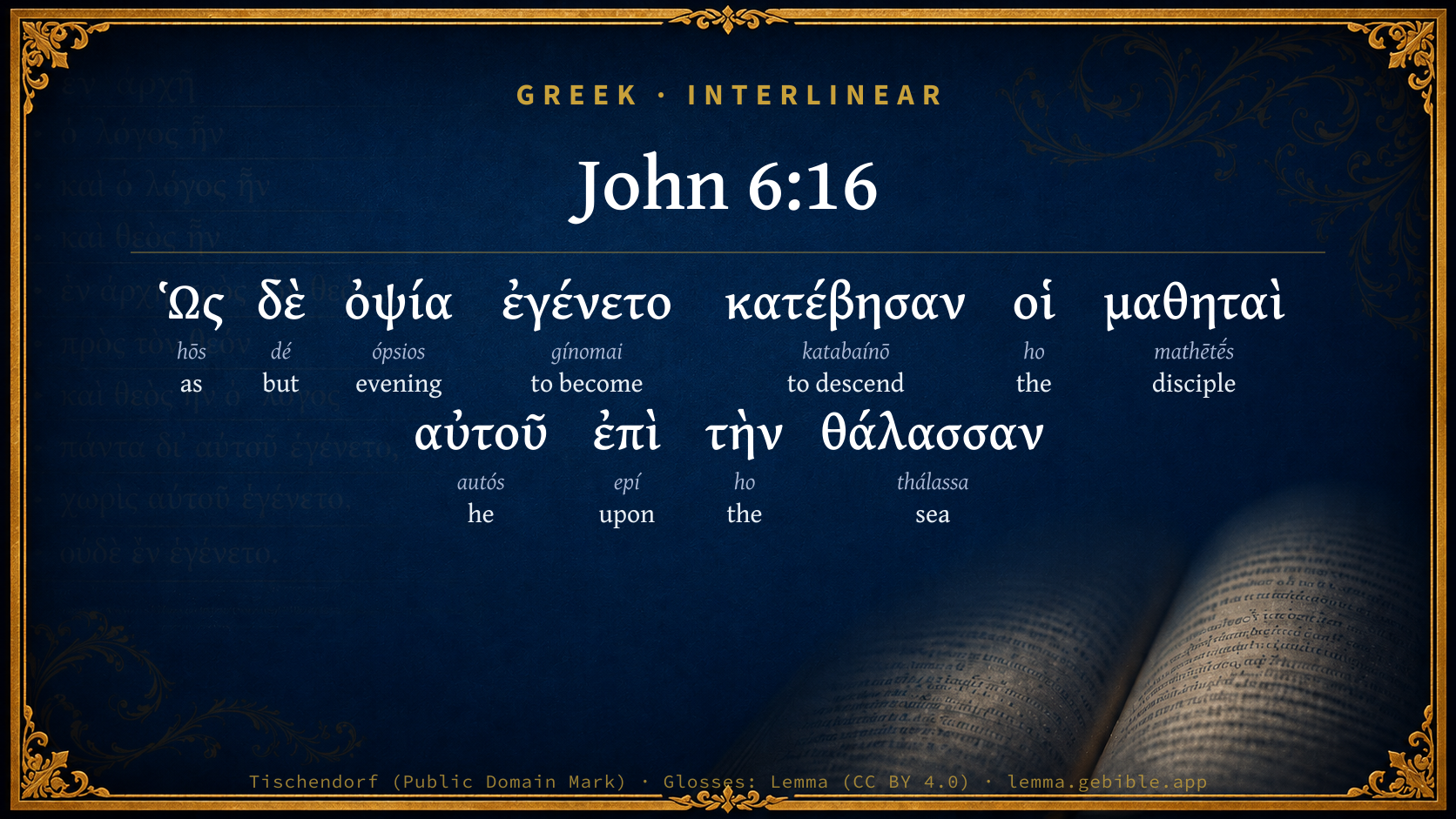
Greek (Tischendorf 8th ed.) John 6:16 appears in the Greek New Testament. The text above is from the Tischendorf 8th edition. Each word links to its Strong’s number and a concise gloss. Click any word for its full Thayer’s Greek Lexicon entry.
Download image
Cite this verse

John 6:16 (World English Bible). Public Domain. Lemma interlinear Bible study tool, https://lemma.gebible.app/v/john/6/16.

Show BibTeX & RIS
BibTeX
RIS
English Translation
When evening came, his disciples went down to the sea,
World English Bible · Public Domain
Download a study sheet

One document with this verse’s original text, its word-by-word gloss line, the meaning frame, cross-references with their text, attributed commentary, and full source and license credits — printable, and it pastes into notes with its structure intact.

This verse Autodidact and up

Study sheet (.html) Plain text (.txt)

A passage Seminary Student

Up to 50 verses in one chapter. A passage sheet keeps up to 6 commentary sources and 12 cross-references per verse, in the order this page ranks them, and says so on the sheet whenever that leaves anything out. Ask for a single verse and you get the Autodidact verse sheet above.

Everything on this page stays free to read, with no account — the sheet is a download of what is already on screen, not access to it.

Want to remove ads? Support Godless Engineer
Compare translations 3

The same verse in 3 English versions, stacked beneath the original-language interlinear above. Click any original word for its lexicon entry.

Each is an independent rendering of the whole verse — the interlinear is not word-aligned to these translations.

Highlighted words mark where these versions differ — a whole-verse word diff, not a word-by-word alignment.

  • World English Bible Public Domain
    When evening came, his disciples went down to the sea,
  • King James Version Public Domain
    And when even was now come, his disciples went down unto the sea,
  • unfoldingWord Literal Text CC BY-SA 4.0
    Now as it became evening, his disciples went down to the sea,

unfoldingWord Literal Text — © unfoldingWord, licensed CC BY-SA 4.0. Word-aligned USFM3 via Door43 (git.door43.org/unfoldingWord/en_ult).

Versions to compare (up to 4)

3 of 4 selected

Show all 19 translations

Every available English version of this verse, each an independent rendering of the whole verse.

  • World English Bible Public Domain
    When evening came, his disciples went down to the sea,
  • Berean Standard Bible Public Domain
    When evening came, His disciples went down to the sea,
  • Majority Standard Bible Public Domain
    When evening came, His disciples went down to the sea,
  • King James Version Public Domain
    And when even was now come, his disciples went down unto the sea,
  • American Standard Version (1901) Public Domain
    And when evening came, his disciples went down unto the sea;
  • Revised Version (1885) Public Domain
    And when evening came, his disciples went down unto the sea;
  • Geneva Bible (1599) Public Domain
    When euen was nowe come, his disciples went downe vnto the sea,
  • Douay-Rheims (1899) Public Domain
    And when evening was come, his disciples went down to the sea.
  • Young's Literal Translation Public Domain
    And when evening came, his disciples went down to the sea,
  • Literal Standard Version CC BY-SA 4.0
    And when evening came, His disciples went down to the sea,
  • Unlocked Literal Bible CC BY-SA 4.0
    When it became evening, his disciples went down to the sea.
  • unfoldingWord Literal Text CC BY-SA 4.0
    Now as it became evening, his disciples went down to the sea,
  • Darby Bible Public Domain
    But when evening was come, his disciples went down to the sea,
  • World Messianic Bible Public Domain
    When evening came, his disciples went down to the sea.
  • Webster's Bible Public Domain
    And when evening had now come, his disciples went down to the sea,
  • Free Bible Version CC BY-SA 4.0
    When evening came, his disciples went down to the sea,
  • Bible in Basic English Public Domain
    When evening came the disciples went down to the sea;
  • Text-Critical English NT CC BY 4.0
    When evening came, his disciples went down to the sea,
  • Tyndale New Testament (1534) Public Domain
    And when even was come his disciples wet vnto the see

Literal Standard Version (2020), Covenant Press — licensed CC BY-SA 4.0. Text via the HelloAO Bible API (eBible.org). Unlocked Literal Bible (unfoldingWord) — licensed CC BY-SA 4.0. Text via the HelloAO Bible API (eBible.org). unfoldingWord Literal Text — © unfoldingWord, licensed CC BY-SA 4.0. Word-aligned USFM3 via Door43 (git.door43.org/unfoldingWord/en_ult). Free Bible Version, Dr. Jonathan Gallagher — licensed CC BY-SA 4.0. Text via the HelloAO Bible API (eBible.org).

Word by word

More ways to search: Search by grammar → Find every occurrence → Compare this word →

Practice this passage: Drill this verse → Learn its vocabulary →

About this verse

These counts appear in no published source. They are computed here, from the morphology-tagged text and Lemma’s own curated glosses. What Lemma adds →

11
words
10
distinct lemmas
Gospels
section

Notable vocabulary

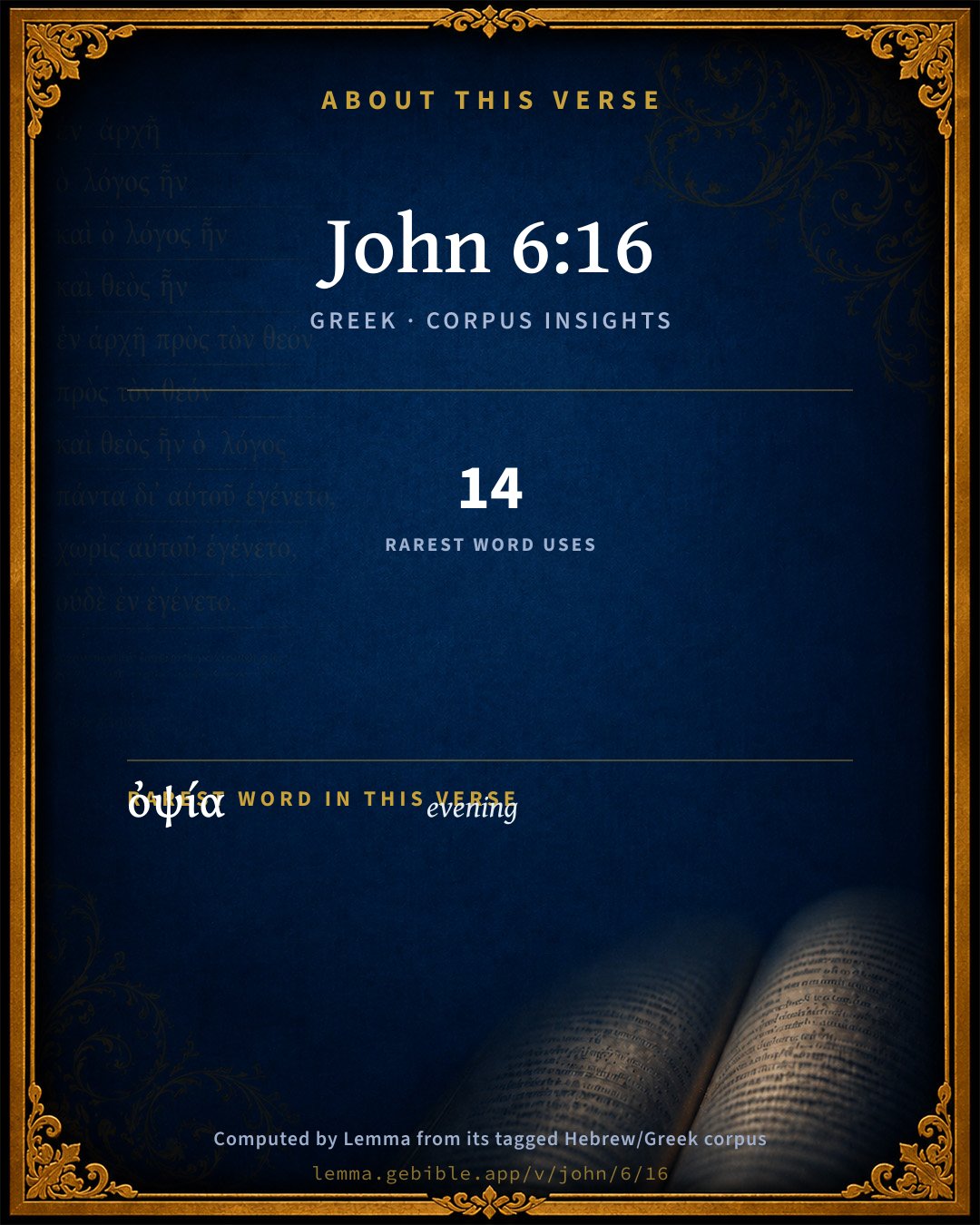
The rarest word here is ὀψία evening G3798 — appearing just 14 times in the whole Greek New Testament.

Shared distinctive vocabulary

ὀψία evening G3798 occurs in 14 verses of the Greek New Testament. Also found in:

Repetition

A word recurs within this verse:

Commentary

Notes on John 6:16 from classic Christian and Jewish commentators (each source and its license shown beneath its notes). The classic Christian expositions comment on the surrounding passage and are grouped to its opening verse, so a note may address several verses; the Jewish commentaries on the Tanakh (Rashi and others) are per-verse, so they appear only where the commentator wrote on this verse.

Lemma curates 59 commentaries, every one of them public domain or Creative Commons licensed, each selected and text-cleaned for this edition rather than reprinted as found. About our sources →

The Preacher's Complete Homiletical Commentary

Joseph S. Exell (gen. ed.)

EXPLANATORY AND CRITICAL NOTES

Joh_6:17. Jesus was not yet come.—They had probably understood that He was to meet them at some point on the shore.

Joh_6:19. As the stretch from the point where they set sail to Tiberias was perhaps seven to eight miles, the disciples had probably made only about half the distance (Mar_6:47). Jesus walking on the sea (ἐπὶ τῆς θαλάσσης).—Not along the shore, as some rationalistic critics suggest. The whole narrative is against such an interpretation (see also Mat_14:28-33), which is quite conclusive against this conjecture.

Joh_6:21. They willingly.—They were willing to receive Him, etc.

MAIN HOMILETICS OF THE PARAGRAPH.—Joh_6:16-21

Christ the hope of the faithful and of His Church in peril.—This narrative of St. John must be taken in connection with the parallel passages in the Synoptists (Mat_14:22-33; Mar_6:45-52, which see), which give a more full and circumstantial account of this incident. St. John’s purpose, it may be, in his manner of narrating the incident, was to emphasise our Lord’s true kingship. He would not consent to be made a king after the desire of the Jews; but He showed in this miracle His true royal dignity. It was for this reason in part that He constrained His disciples to depart to the other side, whilst He remained behind. He did not wish them to be infected with the carnal enthusiasm of the people, and it was perhaps the rising desire in their hearts that He would comply with the wishes of the people that made it necessary for Him to constrain them (Mat_14:22) to depart. And besides, He would turn the occasion into a means of strengthening and confirming their faith.

I. Peace on the mountain side.—

1. After the miracle of feeding the five thousand, which had been wrought on some plain near the lake most likely, our Lord retired alone to the mountain (whither He had gone before the miracle, Joh_6:3), in order to escape the throng of people who wished to proclaim Him a king. But as His kingdom was not of this world, His crown no tinsel or even golden crown of earth, to be placed on His head with acclamation by men, but, so far as this world was concerned, a crown of thorns, He went in the gathering darkness to the solitary mountain side.

2. Yet another purpose also impelled Him thither. It is true the divine Son was ever conscious of His Father’s presence; but as the Son incarnate He needed these periods of restful, undisturbed communion with the Father, whence He came forth strengthened for His work.

3. And especially at such a time would He need this strengthening. The people altogether misunderstood His mission; even His disciples were prone to be led away by the prevailing Messianic conceptions, whilst one of them “had a devil” (Joh_6:70). Therefore the incarnate Son needed to be strengthened now by close and uninterrupted communion with the Father, as in Gethsemane and in other crises of His ministry.

II. Trouble on the sea.—

1. Meantime the disciples had embarked for Capernaum. It would almost seem as if they had tarried for Him at some point along the eastern shore; but, as He had not come, in obedience to His order, previously given no doubt, they launched forth (Joh_6:17):

2. One of those sudden storms which sweep down on the deep trough in which this land-locked lake lies arose soon after the disciples set sail, and drove them, in spite of laborious rowing, toward the middle of the lake, so that when the fourth watch of the night began the toiling vessel was still far from its destination.

3. When suddenly, in the “struggling moonbeams’ misty light,” shining intermittently through the storm-rack, they saw that which confounded and terrified them—a human form treading securely over the heaving waters.

III. Peace on the troubled waters.—

1. On the solitary mountain side Jesus did not forget His followers. As before said, His intention was doubtless to strengthen their faith by that night’s experience. He saw them as they toiled in rowing. But they must be prepared for the hour when He should have to go hence, and they should be left alone to buffet with the winds and waves of the world’s opposition.

2. But when the moment He saw fittest had come He appeared near them walking on the storm-tossed waters. The first effect on them of His appearance was a sensation of terror. They forgot their Master’s power—that once before He had risen from sleep and stilled the storm, with words of rebuke to them for the weakness of their faith (comp. Mat_8:26). They forgot that His power had, but a few hours before, been manifested in the feeding of the multitude. They had now to learn that that power availed though space and storm should for the moment sunder them from Him. And in His cheering hail over the stormy waters, “It is I, be not afraid,” we hear the prelude of the comforting words, “Let not your heart be troubled,” and the resurrection greeting, “Peace be unto you” (Joh_14:1; Joh_20:19; Joh_20:26).

3. Now they joyfully recognised their Lord, and were willing—heartfeltly willing—to receive Him into the ship. And after the incident in which Peter figures conspicuously, and which is recorded by the other Evangelists, Jesus entered the ship, the storm subsided (Mat_14:32), and the vessel, obeying Him who rules in all the realms of being, was “immediately at the land whither they went.”

IV. Christ comes still to His people in storm and trouble.—

1. This miracle, like most of those wrought by our Lord, has a spiritual purpose, as well as that it was immediately intended to effect. His words of cheer, “It is I, be not afraid,” still ring out in the night and storm and tempest to comfort His people, and have done so in all the centuries since that night on Galilee.

2. Christ has passed from our view into the heavenly mount of God, and we have perforce to launch out here on the stormy sea of life. But shall we not, even in the darkest and most troubled hour, remember all He has done for us, His miracles of mercy and power in the past—all His goodness? and can we forget that the Shepherd of Israel, of His own people, neither slumbers nor sleeps, and that in the hour of need He will appear to our aid?

3. And when He does come it may be in unwonted fashion, it may seem as “purposing to pass by” (Mar_6:48), or as to the disciples at Emmaus “as though He would go further.” Yet it is but to quicken our faith and lead us to put confidence in Him, and trust in the fulfilment of His promise that He is with us always (Mat_28:20), even when we cannot recognise Him in the events and circumstances that surround us. And thus, even in the solemn hour when we must fare forth across the waters of death, we shall, if faithful, know that He is near, and hear His cheering word, “It is I, be not afraid.”

4. The Church has fitly appropriated this incident as a type of her experience at earnest periods of her history. So, in these latter days, when fiercer storms than she has before experienced beat upon her, and her company strain wearily, it may often seem vainly, at the labouring oar, let them take courage, remember the past, and believe that He is near.

“And all is well, tho’ faith and form

Be sunder’d in the night of fear;

Well roars the storm to those that hear

A deeper voice across the storm.”

Tennyson.

HOMILETIC NOTES

Joh_6:17. The Christian life under the figure of a voyage.—We see:—

I. The peaceful commencement;

II. The stormy progress;

III. The happy termination.

Joh_6:18. The progress of Christ’s Church on earth like that of a ship.

I. The ship has to contend with the winds and waves;

II. The ship’s company are fainthearted and fearful often;

III. But the Lord leads it by His powerful hand to the quiet haven.—J. L. Sommer.

Joh_6:18. Storms on the Galilean lake.—The traveller on first viewing the Lake of Galilee, approaching it either from the heights above or the Jordan valley, generally looks on a calm and tranquil scene. Lying far below the level of the Mediterranean Sea (600 feet), shut in by sloping hillsides, which are in reality depressions of great tablelands, it seems always the same peaceful, beautiful sheet of water. Its rippling wavelets glitter in the sunshine and murmur gently along the shore; and over the sunlit reaches the wild aquatic birds wing their flight. It would almost seem as if no wild commotion could break in on and disturb the restful scene. But in Syria and Palestine during winter and spring sudden storms arise at pretty regular intervals, lasting usually two or three or more days. Then the turmoil of the elements is often awe-inspiring and grand. The rains fall with tropical violence, lightning flashes all around, whilst the thunder crashes overhead and reverberates among the valleys and ravines of the hillsides. From those heights the storm-winds rush in fury and roar over the level country, lashing the waters of those inland lakes into stormy commotion, and sending foam-capped waves dashing on the shore. It was probably such a storm as this—one of the last of the season—that met the disciples. We have several hints of this well-known phenomenon of the regularly recurring winter and spring storms in Syria in the gospel narrative, not the least interesting being the graphic description in the concluding parable in the Sermon on the Mount.

Joh_6:19. The will of Christ potential in the miracle of walking on the sea.—It is a docetic view of the person of Christ which conceives of His body as permanently exempt from the law of gravitation, and in this way explains the miracle; a hard and mechanical view, which places the seat of the miracle in the waters, rendered solid under His feet. Rather was it the will of Christ which bore Him triumphantly above those waters; even as it was the will of Peter, that will, indeed, made in the highest degree active and potential by faith in the Son of God, which should in like manner have enabled him to walk on the great deep, and, though with partial and transient failure, did so enable him. It has been already urged that the miracle, according to its true idea, is not the suspension, still less the violation of law; but the incoming of a higher law, as of a spiritual in the midst of natural laws; and so far as its range and reach extend, the assertion for that higher law of the predominance which it was intended to have, and but for man’s fall it would always have had, over the lower; and with this a prophetic anticipation of the abiding predominance which it shall one day recover. Exactly thus was there here a sign of the lordship of man’s will, when that will is in absolute harmony with God’s will, over external nature. In regard of this very law of gravitation, a feeble remnant of his power, and one for the most part unconsciously possessed, survives to man in the unquestionable fact that his body is lighter when he is awake than sleeping; a fact which every nurse who has carried a child can attest. From this we conclude that the human consciousness, as an inner centre, works as an opposing force to the attraction of the earth and the centripetal force of gravity, however unable in this present time to overbear it.—Archbishop Trench.

Joh_6:19-21. The threefold word of comfort from our Gospel unto all troubled souls.

I. Be not afraid! for we have near us One who is our Lord and who will be with us even to the end of the world (Joh_6:19-20).

II. Be not afraid! for however strange and unwonted the manner in which He may come to us, His presence will ever bring us joy (Joh_6:21; Joh_6:1 st cl.);

III. Be not afraid! for when He is with us we shall speedily arrive at the desired haven; His presence will bring us success in our labours for Him (Joh_6:21; Joh_6:2 nd cl.).

ILLUSTRATIONS

Joh_6:18. Who is Christ?—Are our opponents right, and has Jesus gone never to return? The ground seems to be giving way beneath our feet! Now, indeed, is the time when faith must “be silent” before the Lord. Yet, what is it comes toward us through the darkness of the night? What kind of appearance is it for whose feet the rolling waters form themselves into a bridge? “It is a spirit”—so imagined the troubled ship’s company on Galilee.… [Equally astray are] those shortsighted interpreters who seek to lead men to trace back the greatness of Christ to a delusion, a seeming greatness, projected on the uncertain and wavering mists of tradition, on the concave mirror of a lively imagination. “He cannot have been really and truly the Son of God; but the superstitious and easily misled multitude proclaimed Him to be so. He did not speak the word of life, nor was He Himself the Word of life, but simply a pious fraud, a spontaneous poetical creation invented by various accomplices. Thus the forgery was executed. He will not quicken us either now or hereafter; but in our common speech and in our thought we may keep Him continually in existence from generation to generation. In all the history there is only a small kernel of fact worthy of belief: the envelope is a floating cometic mantle composed of sheer imaginations, legends, exaggerations, and misunderstandings.” Church of the Lord, can this be the foundation of your confidence!—Translated from Dr. R. Kögel.

Joh_6:19. “It is I, be not afraid.”—But a familiar voice says, “Be of good cheer,” etc. It is I. Thus spake this same voice to thee, my friend, as thy house became lonely and a bier was carried out, as thy heart felt unspeakably wretched. Then that star in heaven—the faith in thy heart—grew dim. But, trouble which appeared like blind chance—a malignant fate, a spectre—death, that grinning skeleton and king of terrors, laid aside the mask, and behold! it was the Lord. Then in quietness and assurance thou wert helped by Him. “It is I.” So the Lord ever makes Himself known to His Church, when, e.g., the State removes the accustomed supports, when Rome furbishes her weapons and increases her fastnesses, when materialism scornfully seeks the outward and visible; and the multitude with their voice ever-changing, now for, now against, like ebb and flow; and parties with their cry of “Here is Christ, or there,” seek reciprocally to excommunicate each other, and finally are in danger of banishing Christ altogether,—then the ground trembles. But everything will turn out otherwise from what men suppose. Only in Jesus has no one ever been deceived. Do the people of Capernaum ask Him, as it is in our text, Rabbi, when (rather how) camest Thou hither? No philosopher can explain this, that Jesus walks on the waters, making what seems firm to be unstable, and what is fluctuating, stable. The conflict of opinions, the loudness of calumny, the raging of passion, the power and roar of the billows, the thunder-roll of events, will at the decisive moment be overpowered at the word of the Church’s Lord. “Ye, My disciples, be of good cheer. It is I, be not afraid.” “The Lord is in His holy temple; be still before Him, all the earth.”—Translated from Dr. R. Kögel.

Joh_6:19. Faith amid the storm.—To the confidence and peace reached by the disciples on this occasion Christian people may and do attain, have trusted and not been afraid in storm and trouble (Psalms 46). A missionary thus described an incident on a great steamship during a terrible storm on the Atlantic. A fearful hurricane swept over the ocean, raising a tremendous sea, in the trough of which the great vessel tossed, helpless and unmanageable. It did not seem that if the storm lasted during the night the ship could weather it. The seamen could not cross the wave-swept decks; and the passengers were shut up in the great saloon. A crowd of anxious men and terror-stricken women, they clustered together, holding tightly to any fixed object. Only the children did not seem to realise all the terror of the situation. The minister-missionary was asked to engage in prayer. He did so, kneeling and grasping with his hands the edge of one of the fixed tables. He did not, however, utter any set ordinary form of prayer. It was just a simple talk with his God and Redeemer, just such a talk, as he expressed it, as a child would have with a loving parent. All were calmed and comforted by the simple prayer of faith, and took courage. Toward morning the storm abated, the ship was got under control, and they were safe.

“Thou Framer of the light and dark,

Guide through the tempest Thine own ark;

Amid the howling wintry sea

We are in port if we have Thee.”

The Preacher's Complete Homiletical Commentary (gen. ed. Joseph S. Exell; Funk & Wagnalls, c. 1892) — public domain (pre-1929). A full-Bible homiletical/sermon-outline anthology covering 65 of 66 books (2 John is absent from the source module). Text from a community e-Sword module.

Meyer's Critical & Exegetical Commentary

Heinrich August Wilhelm Meyer

Joh_6:16-21. Comp. Mat_14:22 ff., Mar_6:45 ff., which do not refer to a different walking on the sea (Chrysostom, Lücke).

ὡς δὲ ὀψία ἐγένετο] According to Joh_6:17, the time meant is late in the evening, i.e. the so-called second evening, as in Mat_14:24, from the twelfth hour until the (σκοτία, Joh_6:17. See on Mat_14:15.

εἰς τὸ πλοῖον] into the ship, in which they had crossed over (Joh_6:1). In it they now return to the western side of the lake. So Luthardt rightly. But it does not follow that Jerusalem could not have been the place of departure in Joh_6:1; Joh_6:1 rather implies that they had travelled from Jerusalem to the western shore of the lake, and had crossed over from thence.

ἤρχοντο] They were upon their return journey, coming across, but the coming was not yet completed. Lampe and Paulus erroneously speak of their actual arrival, what follows being taken as supplementary. In Mar_6:45 Bethsaida is named (on the western shore). An immaterial discrepancy. See on Mat_14:22-23.

καὶ σκοτία … διηγείρετο] describing how little they could have expected that Jesus would come after them.

Joh_6:19. ὡς σταδίους … τριά κοντα] indicative of an eye-witness, and almost agreeing with μέσον in Mat_14:24, for the lake was forty stadia or one geographical mile wide (Josephus, Bell. iii. 10. 7).

θεωροῦσι and ἐφοβήθ.] Correlatives; quite unfavourable to the naturalistic interpretation, according to which ἐπὶ τ. θαλ. is said to mean not on the sea, but towards the sea (so Paulus, Gfrörer, and many, even B. Crusius; but see, on the contrary, note on Mat_14:25).

Joh_6:21. ἤθελον, κ.τ.λ.] comp. Joh_1:44; but observe the Imperfect here. After Jesus had reassured them by His call, they wish to take Him into the ship, and straightway (while entertaining this ἐθέλειν) the ship is at the land, i.e. by the wonder working power of Jesus, both with respect to the distance from the shore, which was still far off, and the fury of the sea, which had just been raging, but was now suddenly calmed. The idea that Jesus, to whom the disciples had stretched out their hands, had just come on board the ship, introduces a foreign element (against Luthardt and Godet), for the sake of bringing the account into harmony with Matthew and Mark. The discrepancy with Matthew and Mark, according to whom Christ was actually received into the ship, must not be explained away, especially as in John a more wonderful point, peculiar to his account, is introduced by the καὶ εὐθέως, etc., which makes the actual reception superfluous (Hengstenberg, following Bengel, regards it as implied). An unhappy attempt at harmonizing renders it, they willingly received Him (Beza, Grotius, Kuinoel, Ammon, etc.; see, on the contrary, Winer, p. 436 [E. T. p. 586]; Buttmann, N. T. Gk. p. 321 [E. T. p. 375]), which cannot be supported by a supposed antithesis of previous unwillingness (Ebrard, Tholuck), but would be admissible only if the text represented the will and the deed as undoubtedly simultaneous. See the passages given in Sturz, Lex. Xen.; Ast, Lex. Plat. I. 596. John would in that case have written ἐθέλοντες οὖν ἔλαβον.

εἰς ἣ ὑπῆγον] to which they were intending by this journey to remove.

The miracle itself cannot be resolved into a natural occurrence,[228] nor be regarded as a story invented to serve Docetic views (Hilgenfeld); see on Mat_14:24-25. The latter opinion appears most erroneous, especially in the case of John,[229] not only generally because his Gospel, from Joh_1:14 onwards to its close, excludes all Docetism, but also because he only introduces, with all brevity, the narrative before us by way of transition to what follows, without taking pains to lay emphasis upon the miraculous, and without adding any remark or comment, and consequently without any special doctrinal purpose; and thus the attribution of the occurrence of any symbolical design, e.g. prophetically to shadow forth the meetings of the risen Lord with His disciples (Luthardt), or the restless sea of the world upon which Christ draws nigh to His people after long delay (Hengstenberg), is utterly remote from a true exegesis. Weizsäckers narrowing of the event, moreover,abstracting the miraculous element in the development of the history,into an intervention of the Lord to render help, does such violence to the text, and to the plain meaning of the evangelist, that the main substance of the narrative would be thus explained away. The design, however, which Baur propounds, viz. that the greedy importunity of the people might be set forth, only to experience the cold hand of denial, and to bring out the spiritual side of the miracle of the feeding, would not have required this miraculous voyage in order to its realization.

[228] Ewald probably comes to that conclusion, for he takes θεωροῦσι, ver. 19, to denote a mere vision (phantasmagoria?), and ἐφοβήθησαν to signify disquietude of conscience: He finds them not pure in spirit.

[229] Who, moreover, in the deviations from Matthew and Mark, possesses the deciding authority (against Märcker, p. 14).

Meyer — Critical and Exegetical Commentary on the New Testament — English translation by Peter Christie, edited by Frederick Crombie (T&T Clark, 1880) — public domain. Text from a community e-Sword module.

Godet's Commentaries

Frédéric Louis Godet

ADDITIONAL NOTES BY THE AMERICAN EDITOR.

Vv. 16-21 contain the account of the second miracle mentioned in this chapter. This miracle is inserted between the first miracle and the discourse which followed on the next day. If the narrative is viewed simply in the light of biography, the reason why the event is placed here is obvious; it is placed where it belongs in the order of time. But if we look at the plan of the book as related to the purpose stated in Joh 20:30-31, it is worthy of notice that this chapter presents two developments of faith. The multitude, who were impressed by the miracle of the loaves, declared their conviction that Jesus was the Messiah. They accordingly believed; but the course which they pursued the next day, and the effect upon their minds of His presentation of the necessity of living in and upon Him (see Joh 6:60; Joh 6:66), prove that their faith was like that of those who are mentioned in Joh 2:23-25. The apostles, on the other hand, are not only described as having a faith of a higher order than that of these half-way disciples, but are represented as giving utterance to a more confident and established belief than they had expressed at any previous moment (Joh 6:68-69). Is it not probable that the second miracle, following upon the first—a miracle which was so peculiarly fitted to produce a deep impression, both in itself and in the circumstances attendant upon it—was an essential element in this new development of the apostles’ faith? May we not account for the upward movement of their belief, as contrasted with the downward movement in that of the many who went back, as connected partly with this second wonderful fact? Certainly the fact that it followed so immediately after the miracle of the loaves was calculated to make them ready and able to say, not only: We have believed, but: We have believed and know that Thou art the Holy One of God. The insertion of this miracle, therefore, as well as the other, falls most naturally within the line of the writer’s great purpose. The reader who will place himself in thought in the circumstances in which the apostles were at the time, and will open his mind, as they did, to the reception of the evidences, cannot fail to see how their faith grew stronger, or to feel that his own faith is growing stronger under the same influence. The signs which were given in the presence of the disciples, says the author, are written in his book that the reader may, by following the record of them, be led forward in the same progress of faith.

In the account of this second miracle which is given by Matthew, Mat 14:33, the apostles in the boat are represented as saying, as they witnessed it, “Of a truth Thou art the Son of God.” If this is the record of what they actually said at this moment, it may suggest, in connection with John Joh 6:14, the likeness and also the difference between the belief of the multitude and that of the Twelve. If, on the other hand, as may not improbably be the fact, Matthew, in his more brief narrative of the whole occasion, places at this point what, in the succession of the events, was really said by Peter in the name of the apostles at the time indicated by John in Joh 6:69, we have a suggestion in Matthew’s narrative of that which is represented by John as the result of the miracles and the discourse taken together.

May not the words of Mark (Mar 6:51-52), who says that the apostles were exceedingly amazed when Jesus entered the boat and the wind ceased, but that they did not understand concerning the loaves, suggest that the full conviction indicated in Mat 14:33 came only after the discourse, as indicated in John Joh 6:69?

The difficulty connected with the words ἤθελον and εὐθέως is to be recognized. In the story as given by Mark and Matthew, Jesus seems to be represented as entering the boat (in Matthew, with Peter, who had gone to meet Him on the sea), and the boat seems to have moved gradually towards the shore, only over calm waters. In John’s account, on the other hand, the impression which the reader would naturally get from the verb ἤθελον is that Jesus did not enter the boat, and εὐθέως would imply that the boat reached the shore immediately. The explanation given by Godet is a possible one, but can hardly be considered altogether satisfactory. It is to be observed, however, that in brief stories such as we find in the Gospels, which are told by all the writers for a purpose which is beyond the mere details considered in themselves, differences of this sort are not unnatural—differences which may not be altogether explicable at a distance of centuries from the date of writing, but with reference to which, even now, we may see possibilities capable of removing them. The New Testament narratives, in this regard, may fairly claim to be treated by opposing critics with as calm a consideration of all these possibilities as should be given in the case of other histories. The harmonists and the critics alike have sometimes been disposed to demand too much of the Gospel writers in this regard.

Vv. 16-18. “When the evening was come, his disciples went down to the seashore; 17 and having entered into the boat, they were crossing the sea towards Capernaum; and it was already dark and Jesus had not come to them. And the sea was agitated by a strong wind.”

The word went down does not imply that they were still on the heights where they had spent the first part of the day with Jesus, but only (see the πάλιν of Joh 6:15) that the place where the miracle occurred was situated above the shore properly so called. What order had Jesus given His disciples before leaving them? According to the Synoptics, that they should embark for the other side of the sea. This is likewise implied by the narrative of John; for the supposition is inadmissible that they would have embarked, as is related in Joh 6:17, leaving Jesus alone on the eastern shore, if He had not made known to them His will in this regard. They even hesitate, as we see from Joh 6:16-17, to execute this command; they wait for this until the last light of the day. But how can we explain the end of Joh 6:17?

These last words seem to say that they were expecting Jesus, as if He had had the intention of rejoining them (a view which is rendered more probable by the reading οὔπω, not yet, of the Alexandrian authorities). But this would be in contradiction to the order to depart which He must have given them. It has been held that the words: He had not yet rejoined them, were written only from the standpoint of that which really happened later, when Jesus came to them miraculously on the water;— but this sense seems quite unnatural. I think it is more simple to suppose that, inasmuch as the direction from Bethsaida Julias to Capernaum is nearly parallel with that of the northern shore of the lake, Jesus had appointed for them a meeting-place at some point on that side, at the mouth of the Jordan, for example, where he counted upon joining them again. If not, it only remains to hold with Weiss that the pluperfects (the night had already come; Jesus had not rejoined them) refer, not to the moment when the disciples were already on the sea, but to that when they embarked. But it is difficult to reconcile the imperfect ἤρχοντο, literally they were coming, with this meaning. It would be necessary in that case to suppose that in Joh 6:17-18 John wished only to bring together the different grounds of anxiety which weighed upon the disciples; the night which prevented them from making their course on the water, the absence of Jesus and the violence of the tempest. Is not this rather an expedient than an explanation?

Frédéric Louis Godet — Commentaries on Luke, John, Romans, and 1 Corinthians — English translation (T&T Clark, Edinburgh, 1870s–1890s) — public domain. Text from a community e-Sword module.

Geneva Bible (1599)

Geneva Bible translators

The godly are often in peril and danger, but Christ cometh to them in time, even in the midst of the tempests, and bringeth them to the heaven.

Geneva Bible (1599) marginal notes — public domain. Text via Bolls.life.

Jamieson, Fausset & Brown

Robert Jamieson, A. R. Fausset & David Brown

when even was come--(See on Mar 6:35).

entered into a ship--"constrained" to do so by their Master (Mat 14:22; Mar 6:45), in order to put an end to the misdirected excitement in His favor (Joh 6:15), into which the disciples themselves may have been somewhat drawn. The word "constrained" implies reluctance on their part, perhaps from unwillingness to part with their Master and embark at night, leaving Him alone on the mountain.

went--rather, "were proceeding."

toward Capernaum--Mark says (Mar 6:45), "unto Bethsaida," meaning "Bethsaida of Galilee" (Joh 12:21), on the west side of the lake. The place they left was of the same name (see on Mar 6:32).

Jesus was not come to them--They probably lingered in hopes of His still joining them, and so let the darkness come on.

Jamieson, Fausset & Brown — Commentary Critical and Explanatory on the Whole Bible (1871) — public domain (CC PDM 1.0). Text via the HelloAO Bible API.

John Calvin's Commentaries

16. His disciples went down. Christ undoubtedly intended to conceal himself until the crowd should disperse. We know how difficult it is to allay a popular tumult. Now, if they had openly attempted to do what they had intended, it would have been no easy matter afterwards to wipe off the stain which had once been fixed upon him. Meanwhile, he spent all that time in prayer, as the other Evangelists (Matthew 14:23; Mark 6:46) relate; probably, that God the Father might repress that folly of the people. As to his crossing the lake in a miraculous manner, it is intended to profit his disciples by again confirming their faith. The advantage extended still farther; for next day all the people would easily see that he had not been brought thither by a boat or ship, but that he had come by his own power; for they blockaded the shore from which he had to set out, and would scarcely have been drawn away from it, if they had not seen the disciples cross to a different place.

John Calvin's Commentaries (1540-1563) — public domain. Text from the Calvin Translation Society English edition (1840s-50s) via the Christian Classics Ethereal Library (ccel.org). Calvin's coverage is partial (roughly two-thirds of the Bible); uncommented books and verses are honest gaps, never fabricated. The 19th-century editor's footnotes and remarks are omitted so the notes are faithfully Calvin's own voice.

Ellicott's Commentary for English Readers

(16) And when even was now come.—Comp. Note on Mat_14:15.

A Bible Commentary for English Readers, edited by Charles John Ellicott (1878–1897) — public domain. Text from a community e-Sword module.

The Cambridge Bible for Schools and Colleges

gen. ed. J. J. S. Perowne

16–21. The Sign on the Lake; Walking on the Water

16. when even was now come] S. Matthew (Mat_14:15; Mat_14:23) makes two evenings; this was in accordance with Jewish custom. It is the second evening that is here meant, from 6 p.m. to dark.

went down] From Mat_14:22 and Mar_6:45 we learn that Christ ‘constrained’ His disciples to embark: this points either to their general unwillingness to leave Him, or to their having shared the wish to make Him a king by force. S. Luke omits the whole incident.

The Cambridge Bible for Schools and Colleges (gen. ed. J. J. S. Perowne; Cambridge University Press, 1878–1918) — public domain. Text from a community e-Sword module.

John Gill's Exposition

And when even was now come,.... The last of the evenings, when night was coming on; for the first of the evenings took place before they sat down to eat, when the above miracle was wrought; see Mat 14:15.

His disciples went down unto the sea; of Galilee, or Tiberias, to the sea side; and this was by the order, and even constraint of Christ, who would have them go before him, that he might be clear of the multitude, and have an opportunity for solitary prayer, See Gill on Mat 14:22, Mar 6:45.

John Gill's Exposition of the Whole Bible (1746–1763) — public domain (CC PDM 1.0). Text via the HelloAO Bible API.

Trapp's Complete Commentary

John Trapp

16 And when even was now come, his disciples went down unto the sea,

Ver. 16. His disciples went down to the sea] By Christ’s own command, Mat 14:22; Mar 6:45, yet they met with a sore storm. So may the best with trouble, in their most lawful employmeats, Psa 34:18. But these make them look to their tackling, patience; to their anchor, hope; to their helm, faith; to their ace card, the Word; to their Captain, Christ, who is ever at hand.

John Trapp, A Commentary or Exposition upon All the Books of the Old and New Testament (1647–1656) — public domain. Text from a community e-Sword module.

Albert Barnes' Notes on the Bible

See this miracle of walking on the sea explained in the notes at Mat 14:22-33. Compare Mar 6:45-52.

Joh 6:21

Immediately - Quickly. Before a long time. How far they were from the land we know not, but there is no evidence that there was a miracle in the case. The word translated “immediately” does not of necessity imply that there was no interval of time, but that there was not a long interval. Thus, in Mat 13:5, in the parable of the sower, “and immediately (the same word in Greek) they sprung up,” etc., Mar 4:17; Mat 24:29; 3Jo 1:14.

Albert Barnes' Notes on the Bible (1834–1885) — public domain. Text from a community e-Sword/MySword module.

Matthew Poole's English Annotations

This piece of history is related much more fully by the other evangelists, Mat 14:23-33 Mar 6:46-52. See Poole on "Mat 14:23", and following verses to Mat 14:33. See Poole on "Mar 6:46", and following verses to Mar 6:52.

Matthew Poole's English Annotations on the Holy Bible (1683–1685) — public domain. Text from a community e-Sword/MySword module.

Whedon's Commentary on the Bible

Daniel D. Whedon

16-21. Compare notes on parallel passage in Matthew.

Daniel D. Whedon (gen. ed.), Commentary on the Old and New Testaments (1874–1909) — public domain. Text from a community e-Sword module.

The Pulpit Commentary

Vers. 16-21. (2) The mastery of the forces of nature a "sign" of love.

Vers. 16, 17. Now when it became evening. This must have been the "second evening;" for the miracle itself was said to he wrought when the day began to decline. (Mat_14:15 Luk_9:12) The first evening (oqia) lasted from three to six p.m., the "second evening" stretched from sundown to darkness (skotia). The night was drawing on. His disciples went down from the higher ground or grassy slopes to the sea (epi thlassan), and having embarked in a ship, they were making for the other side of the sea to Capernaum; or as Mark (Mar_6:45) says, "towards Bethsaida." This occasions no difficulty to those who remember that there were two Bethsaidas one, "Bethsaida Julias," on the northeastern end of the lake; and the other near to Capernaum, called "Bethsaida of Galilee. The two towns were so near that the latter Bethsaida might reasonably he regarded as the port of Capernaum.

Vers. 16-21. Christ walking on the sea.

Our Lord had sent the disciples across to Capernaum, to detach them from the influence of the excited multitude.

I THE DISCIPLES EXPOSED TO DANGER ON THE LAKE. "And it was now dark, and Jesus was not come to them. And the sea was agitated by a great wind that blew.

1. The sea of Galilee was often exposed to dangerous storms.

2. The darkness of the night must hare intensified the fears of the disciples.

3. The absence of Jesus must have made them feel their helplessness.

4. They were not relieved till the danger had reached its highest point. The boat had now reached the middle of the lake; "they had rowed about five and twenty or thirty stadia." As it was about six miles across, the boat was therefore in the middle of the lake.

II CHRIST"S SUDDEN INTERVENTION. "They see Jesus walking on the sea, and drawing nigh unto the ship: and they were afraid.

1. Nothing will keep Christ from his people in their hour of danger.

2. He is superior to winds and waves. He can walk on the surface of the water; he can still the winds.

3. The words of Jesus still the fears of his people. "It is I; be not afraid." His gracious presence supports us in all risks and in all afflictions.

4. The willingness of the disciples to receive Jesus in their distress. "Then they were willing to receive him into the ship." How dear he is in the hours of our loneliness, our desertion, our helplessness!

5. Jesus does not leave his disciples till he sees them in absolute safety. "And immediately the ship was at the land whither they were going."

The Pulpit Commentary (1880–1919), ed. H.D.M. Spence-Jones & Joseph S. Exell — public domain. Text from a community e-Sword module.

John Wesley's Explanatory Notes

Matt. xiv, 22; Mark vi, 45.

John Wesley, Explanatory Notes Upon the Whole Bible (1754–1765) — public domain. Text via the GEBible commentary corpus.

Burkitt's Expository Notes on the New Testament

William Burkitt

Observe here, 1. The great danger the disciples were in, and the difficulties they encounter with, after they had enjoyed the sweet privileges of Christ’s gracious presence with them. They were tossed upon a tempestuous sea.

Learn thence, That it is not unusual, after sweet refreshment and manifestations from Christ unto his people, to meet with a stormy and sharp exercise of faith and patience; such was the lot of his disciples here; a constant gale of sweetness, an uninterrupted course of prosperity and happiness, as it is not to be expected here, so neither can it be enjoyed here, without great peril and danger.

Observe, 2. What haste our Saviour makes towards his disciples, when they were tossed upon a tempestuous sea; Jesus drew nigh unto the ship. Nothing can separate between, nor keep Christ from his children and people in a suffering hour. He that waded through a sea of wrath to save his people, will walk upon a sea of water to succour and relieve them in an hour of tribulation.

Observe, 3. The disciples not discerning Christ, not knowing him to be their Saviour, were afraid of him. Christ may be coming to save his people, and they not able at present to discern and apprehend him; but their fears may be highest, when their deliverer and deliverance is nearest.

Observe, 4. How speedily Christ relieves them of their fears, by telling them who he was; It is I, be not afraid. It is a sufficient support in all our afflictions to be assured of Christ’s gracious presence with us. Say but, O Saviour, It is I, and then let evils do their worst: that one word, It is I, is sufficient to allay all storms, and to calm a thousand tempests.

Observe lastly, with what joy and gladness the disciples received and entertained Christ in this hour of their distress: They willingly received him into the ship. Though the company of Christ is always sweet and welcome to his disciples and friends, yet never is it so very agreeable and desirable to them as in the hour of trial and temptation; then they willingly receive him, and joyfully welcome and entertain him.

William Burkitt's Expository Notes on the New Testament (1700–1703) — public domain. Text from a community e-Sword module.

The People's New Testament

B. W. Johnson

16–21. His disciples … entered into a ship. For notes on this storm on the sea, and the Lord coming to his disciples in the storm, see Matt. 14:22–31. Compare Mark 6:46–54.

It is I; be not afraid. This is the gospel message of peace, on the ground—the simple ground—“It is I.” Christ's presence is peace to the soul. How often has he to speak this word of encouragement, even to his own! almost always when they are brought suddenly, or in an unusual way, face to face with him!

B. W. Johnson's The People's New Testament with Notes (1889–1891) — public domain. Electronic text from the Christian Classics Ethereal Library (CCEL) ThML edition.

unfoldingWord translationNotes

Door43 World Missions Community

Connecting Statement:

This is the next event in the story. Jesus' disciples go out onto the lake in a boat.

It was dark by this time, and Jesus had not yet come to them

Use your language's way of showing that this is background information. (See: Background Information)

translationWords

disciple

Sea of Galilee

Capernaum

unfoldingWord translationNotes — © Distant Shores Media and the Door43 World Missions Community, licensed CC BY-SA 4.0. Source: git.door43.org/Door43/en_tn.

Cambridge Greek Testament for Schools and Colleges

16–21. THE SIGN ON THE LAKE; WALKING ON THE WATER

16. ὀψία. The second (6 P.M. to dark) of the two evenings which S. Matthew (Mat 14:15; Mat 14:23) gives in accordance with Jewish usage. The narrative here makes a fresh start: κατέβησαν does not imply that the disciples went up again with Jesus; this is excluded by αὐτὸς μόνος.

Cambridge Greek Testament for Schools and Colleges (Cambridge University Press, 1896; 21 vols, various authors incl. Carr, Maclear, Plummer, Farrar, Lumby, Moule, M. R. James, Simcox) — public domain. Text from a community e-Sword module.

Alford’s Greek Testament

Henry Alford

16-21.] Jesus walks on the sea. Mat 14:22-33.Mar 6:45-52Mar 6:45-52. Omitted by Luke. An important and interesting question arises, Why is this miracle here inserted by St. John? That he ever inserts for the mere purpose of narration, I cannot believe. The reason seems to me to be this: to give to the Twelve, in the prospect of so apparently strange a discourse respecting His Body, a view of the truth respecting that Body, that it and the things said of it were not to be understood in a gross corporeal, but in a supernatural and spiritual sense. And their very terror, and reassurance, tended to impress that confidence in Him which kept them firm, when many left Him, ver. 66.

16.] ὀψία, here, will be during the time between the ὀψία of Mat 14:15, and that of ib. ver. 23. [The Jews commonly reckoned two evenings: see the introductory note on Mat 26:17-19.]

κατέβησαν—by the command of Jesus (Matt., Mark).

Henry Alford, The Greek Testament (1849–1861) — public domain. Text from a community e-Sword module.

International Critical Commentary

16. ὀψία may indicate any time in the late afternoon (cf. 20:19 and Mat 14:15, Mat 14:23). The sun set after the disciples had started, and it became dark (σκοτία, v. 17) while they were on the lake. Mar 6:48 notes that Jesus met them “about the fourth watch of the night,” i.e. about 3 a.m.

κατέβησαν, “they descended,” sc. from the slopes of the hill.

16 ff. The incident is described with vividness. It was late in the evening when the boat started on the return journey to Capernaum (v. 17; see on v. 1). The wind had risen, and the lake was stormy. Mk. does not say that the destination of the boat was Capernaum, although that is what we should have expected: his words are ἠνάγκασεν τοὺς μαθητὰς … προάγειν εἰς τὸ πέραν πρὸς Βηθσαϊδάν (Mar 6:45), and he goes on to tell that, driven by the storm, they landed ultimately at Gennesaret, which is a little to the south of Capernaum. That is to say, according to Mk., they made for Bethsaida in the first instance; whether because they wished to take Jesus on board there, or to land one of the party (it was the home of some of them; see on 1:44), or because they wished to keep under the lee of the land, in view of the impending storm, we cannot tell. In any case the storm caught them, and when they had rowed 25 or 30 furlongs, that is, about 3 or 4 miles, they see Jesus περιπατοῦντα ἐπὶ τῆς θαλάσσης, and coming near the boat. Now by this time, having rowed nearly 4 miles, they must have been close to the western shore of the lake, and so Jn. says: εὐθέως τὸ πλοῖον ἐγένετο ἐπὶ τῆς γῆς εἰς ἣν ὑπῆγον.

If we had only Jn.’s account of this incident, we should have no reason to suppose that he intended to record any “miracle.” The phrase ἐπὶ τὴς θαλάσσης (v. 19) is used by Jn. again at 21:1, where it undoubtedly means “by the sea shore”; and it is probable that he means here that when the boat got into the shallow water near the western shore, the disciples saw Jesus in the uncertain light walking by the lake, and were frightened, not being sure what they saw. Jn. does not say, as Mk. does, that Jesus was received into the boat; he only says that they were desirous to have Him with them, when they found that the voyage was already over (v. 21). Nor does Jn. say anything about a miraculous stilling of the storm (cf. Mar 6:51). Nor does he say (as Mar 6:49, Mat 14:26) that the disciples thought they had seen a phantasm (φάντασμα). So far from it being true that we always find in Jn. an enhancement of the miraculous, in this particular case, while the story as narrated by Mk. (followed by Mt.) is miraculous, in Jn. there is no miracle whatever. Nor does Jn. call the incident a “sign,” as he is accustomed to speak of the miracles which he records (cf. v. 14). In short, this story, as told by Jn., is exactly the kind of story that we might expect from John the son of Zebedee, a fisherman with experience of the lake in all its moods, well accustomed to its sudden storms, and knowing the distance from one point to another (v. 19). See Introd., p. clxxvi.

International Critical Commentary — older volumes (1896–1929), various authors — public domain. Text from a community e-Sword module.

Vincent's Word Studies in the New Testament

Marvin R. Vincent

Even [οψια] . An adjective; oyiov, late with wra, hour, understood.

Marvin R. Vincent, Word Studies in the New Testament (1887–1900) — public domain. Text from a community e-Sword/MySword module.

Lesson kit

Teaching starters — assembled from the data on this page, not authored interpretation. Every prompt links to the verse data it draws on. Edit before teaching.

John, in the Gospels, opens this verse with 11 words (10 distinct Greek lemmas). Its most distinctive word is ópsios (“evening”). A historical commentator’s framing appears above. Read the whole chapter for the surrounding context.

Discussion questions

  1. The word ópsios carries the sense “evening.” How does it shape the verse?
  2. Matthew 8:16 shares the word «evening» with this verse. How do the two illuminate each other?
  3. “the” occurs 2× in this one verse. What is the effect of the repetition?
  4. These translations render this verse differently; the difference is in the English rendering, not the original. What questions does that raise?
  5. Reading how The Preacher's Complete Homiletical Commentary and Meyer's Critical & Exegetical Commentary read this verse, where do the two commentators agree and where do they part?

Things to notice

Reading settings

Reading text

Shown beneath each verse's original-language words.

Old Testament
Old Testament edition

Read the OT as the Masoretic Hebrew (MT) or the Greek Septuagint (LXX).

English shown for the Greek Septuagint (in the Hebrew ↔ Greek comparison).

Comparing translations? Open the Compare panel on any verse page to stack up to four side by side.