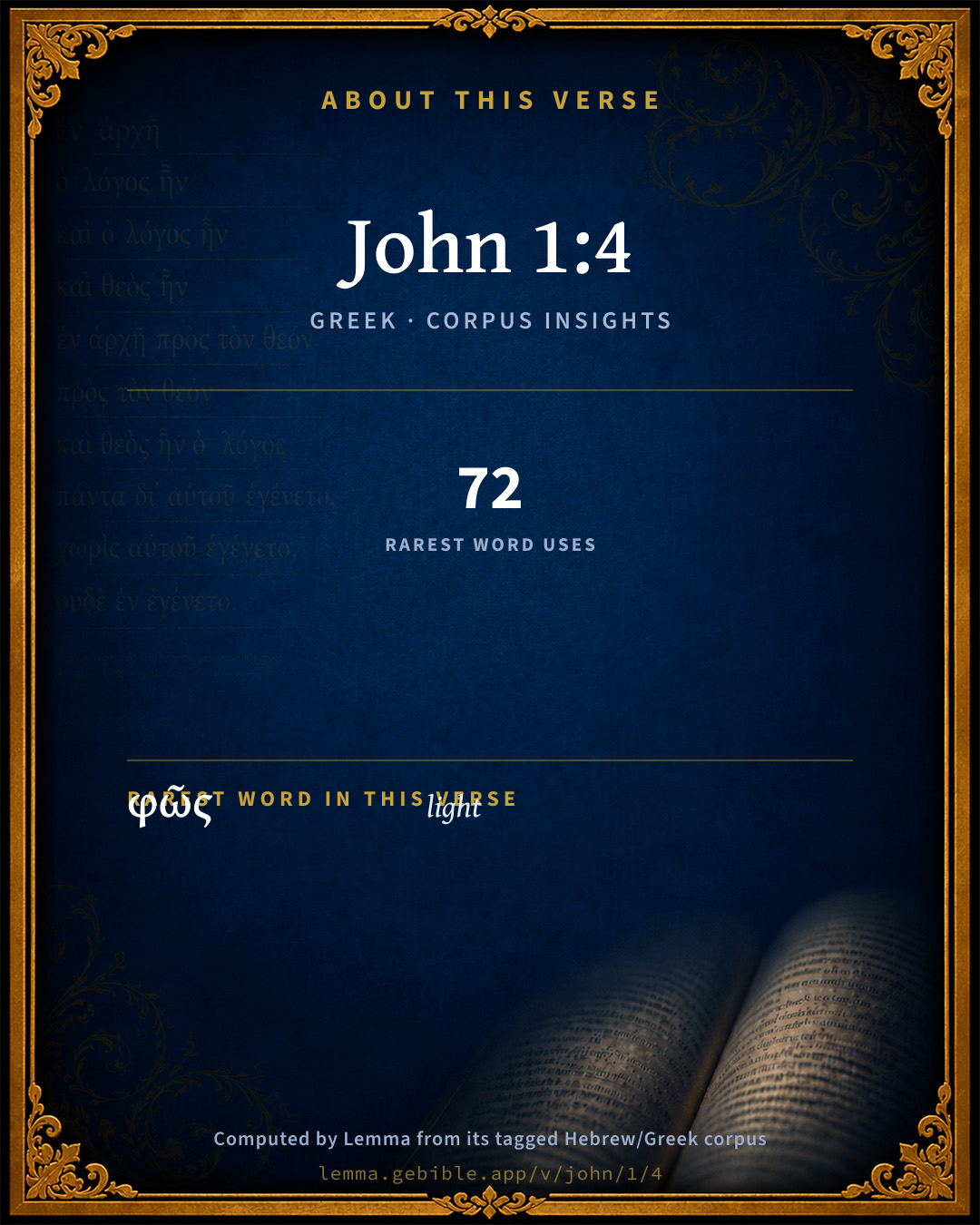
John 1:4

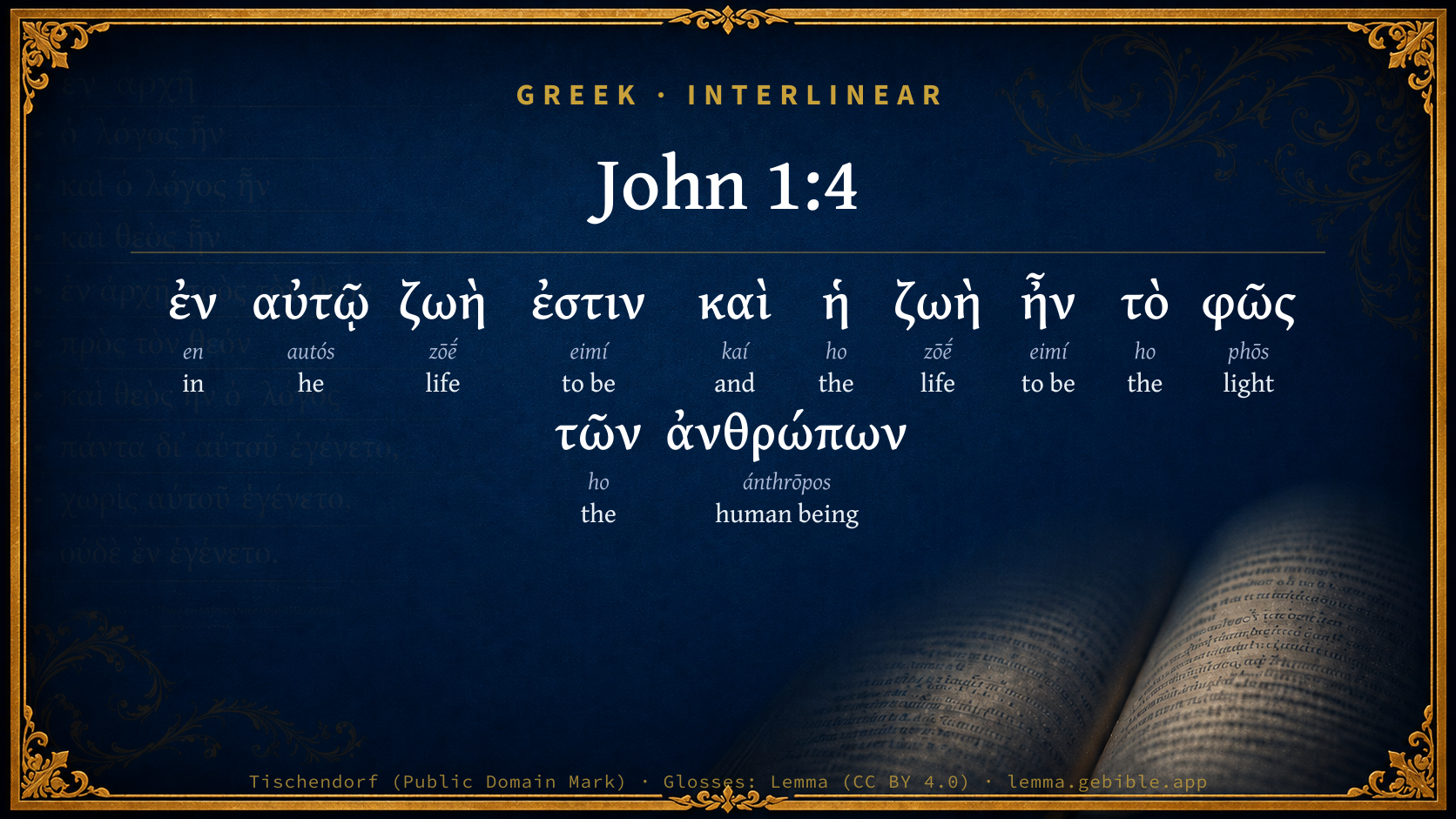
Greek (Tischendorf 8th ed.) John 1:4 appears in the Greek New Testament. The text above is from the Tischendorf 8th edition. Each word links to its Strong’s number and a concise gloss. Click any word for its full Thayer’s Greek Lexicon entry.
Download image
Cite this verse

John 1:4 (World English Bible). Public Domain. Lemma interlinear Bible study tool, https://lemma.gebible.app/v/john/1/4.

Show BibTeX & RIS
BibTeX
RIS
English Translation
In him was life, and the life was the light of men.
World English Bible · Public Domain
Download a study sheet

One document with this verse’s original text, its word-by-word gloss line, the meaning frame, cross-references with their text, attributed commentary, and full source and license credits — printable, and it pastes into notes with its structure intact.

This verse Autodidact and up

Study sheet (.html) Plain text (.txt)

A passage Seminary Student

Up to 50 verses in one chapter. A passage sheet keeps up to 6 commentary sources and 12 cross-references per verse, in the order this page ranks them, and says so on the sheet whenever that leaves anything out. Ask for a single verse and you get the Autodidact verse sheet above.

Everything on this page stays free to read, with no account — the sheet is a download of what is already on screen, not access to it.

Want to remove ads? Support Godless Engineer
Compare translations 3

The same verse in 3 English versions, stacked beneath the original-language interlinear above. Click any original word for its lexicon entry.

Each is an independent rendering of the whole verse — the interlinear is not word-aligned to these translations.

Highlighted words mark where these versions differ — a whole-verse word diff, not a word-by-word alignment.

  • World English Bible Public Domain
    In him was life, and the life was the light of men.
  • King James Version Public Domain
    In him was life; and the life was the light of men.
  • unfoldingWord Literal Text CC BY-SA 4.0
    In him was life, and the life was the light of men.

unfoldingWord Literal Text — © unfoldingWord, licensed CC BY-SA 4.0. Word-aligned USFM3 via Door43 (git.door43.org/unfoldingWord/en_ult).

Versions to compare (up to 4)

3 of 4 selected

Show all 19 translations

Every available English version of this verse, each an independent rendering of the whole verse.

  • World English Bible Public Domain
    In him was life, and the life was the light of men.
  • Berean Standard Bible Public Domain
    In Him was life, and that life was the light of men.
  • Majority Standard Bible Public Domain
    In Him was life, and that life was the light of men.
  • King James Version Public Domain
    In him was life; and the life was the light of men.
  • American Standard Version (1901) Public Domain
    In him was life; and the life was the light of men.
  • Revised Version (1885) Public Domain
    In him was life; and the life was the light of men.
  • Geneva Bible (1599) Public Domain
    In it was life, and that life was the light of men.
  • Douay-Rheims (1899) Public Domain
    In him was life, and the life was the light of men.
  • Young's Literal Translation Public Domain
    In him was life, and the life was the light of men,
  • Literal Standard Version CC BY-SA 4.0
    In Him was life, and the life was the light of men,
  • Unlocked Literal Bible CC BY-SA 4.0
    In him was life, and the life was the light of men.
  • unfoldingWord Literal Text CC BY-SA 4.0
    In him was life, and the life was the light of men.
  • Darby Bible Public Domain
    In him was life, and the life was the light of men.
  • World Messianic Bible Public Domain
    In him was life, and the life was the light of men.
  • Webster's Bible Public Domain
    In him was life; and the life was the light of men.
  • Free Bible Version CC BY-SA 4.0
    In him was life, the life that was the light of everyone.
  • Bible in Basic English Public Domain
    What came into existence in him was life, and the life was the light of men.
  • Text-Critical English NT CC BY 4.0
    In him was life, and the life was the light of men.
  • Tyndale New Testament (1534) Public Domain
    In it was lyfe and the lyfe was the lyght of men

Literal Standard Version (2020), Covenant Press — licensed CC BY-SA 4.0. Text via the HelloAO Bible API (eBible.org). Unlocked Literal Bible (unfoldingWord) — licensed CC BY-SA 4.0. Text via the HelloAO Bible API (eBible.org). unfoldingWord Literal Text — © unfoldingWord, licensed CC BY-SA 4.0. Word-aligned USFM3 via Door43 (git.door43.org/unfoldingWord/en_ult). Free Bible Version, Dr. Jonathan Gallagher — licensed CC BY-SA 4.0. Text via the HelloAO Bible API (eBible.org).

Word by word

More ways to search: Search by grammar → Find every occurrence → Compare this word →

Practice this passage: Drill this verse → Learn its vocabulary →

φῶς
phōs
G5457
“light”
Noun, Nominative, Singular, Neuter
Part of Speech
Noun
Case
Nominative
Number
Singular
Gender
Neuter
Full Thayer's Definition

Origin: from an obsolete phao (to shine or make manifest, especially by rays, cf G5316 , G5346 )

TDNT: 14:10,1

1. light a. the light 1. emitted by a lamp 2. a heavenly light such as surrounds angels when they appear on earth b. anything emitting light 1. a star 2. fire because it is light and sheds light 3. a lamp or torch c. light, i.e brightness 1. of a lamp 2. metaph. a. God is light because light has the extremely delicate, subtle, pure, brilliant quality b. of truth and its knowledge, together with the spiritual purity associated with it c. that which is exposed to the view of all, openly, publicly d. reason, mind 1. the power of understanding esp. moral and spiritual truth
  1. ἐν en G1722 “in” Preposition
  2. αὐτῷ autós G846 “he” Personal pronoun, Dative, Singular, Masculine
  3. ζωὴ zōḗ G2222 “life” Noun, Nominative, Singular, Feminine
  4. ἐστιν eimí G1510 “to be” Verb, Present, Active, Indicative, 3rd person, Singular
  5. καὶ kaí G2532 “and” Conjunction
  6. ἡ ho G3588 “the” Article, Nominative, Singular, Feminine
  7. ζωὴ zōḗ G2222 “life” Noun, Nominative, Singular, Feminine
  8. ἦν eimí G1510 “to be” Verb, Imperfect, Active, Indicative, 3rd person, Singular
  9. τὸ ho G3588 “the” Article, Nominative, Singular, Neuter
  10. τῶν ho G3588 “the” Article, Genitive, Plural, Masculine
  11. ἀνθρώπων ánthrōpos G444 “human being” Noun, Genitive, Plural, Masculine

About this verse

These counts appear in no published source. They are computed here, from the morphology-tagged text and Lemma’s own curated glosses. What Lemma adds →

12
words
8
distinct lemmas
Gospels
section

Repetition

Words recur within this verse:

Cross-references

26

Topical passages linked to John 1:4 in the Treasury of Scripture Knowledge — connected by theme and wording, ordered by reader-vote popularity; previews shown in the World English Bible.

  • John 8:12 Again, therefore, Jesus spoke to them, saying, "I am the light of the world. He who follows me will not walk in the darkness, but will have the light of life."
  • John 12:46 I have come as a light into the world, that whoever believes in me may not remain in the darkness.
  • John 5:26 For as the Father has life in himself, even so he gave to the Son also to have life in himself.
  • 1 John 1:5–7 This is the message which we have heard from him and announce to you, that God is light, and in him is no darkness at all.
  • John 9:5 While I am in the world, I am the light of the world."
  • Luke 1:78–79 Because of the tender mercy of our God, Whereby the dawn from on high will visit us,
  • John 11:25 Jesus said to her, "I am the resurrection and the life. He who believes in me, though he die, yet will he live.
  • Isaiah 42:6–7 I, Yahweh, have called you in righteousness, and will hold your hand, and will keep you, and give you for a covenant of the people, for a light of the Gentiles;
  • John 14:6 Jesus said to him, "I am the way, the truth, and the life. No one comes to the Father, except through me.
  • 1 John 5:11 The testimony is this, that God gave to us eternal life, and this life is in his Son.
  • Ephesians 5:14 Therefore he says, "Awake, you who sleep, and arise from the dead, and Christ will shine on you."
  • John 12:35 Jesus therefore said to them, "Yet a little while the light is with you. Walk while you have the light, that darkness doesn't overtake you. He who walks in the darkness doesn't know where he is going.
  • Matthew 4:16 The people who sat in darkness saw a great light, To those who sat in the region and shadow of death, To them light has dawned."
  • Isaiah 42:16 I will bring the blind by a way that they don't know; in paths that they don't know will I lead them; I will make darkness light before them, and crooked places straight. These things will I do, and I will not forsake them.
  • Colossians 3:4 When Christ, our life, is revealed, then you will also be revealed with him in glory.
  • Acts 26:23 how the Christ must suffer, and how, by the resurrection of the dead, he would be first to proclaim light both to these people and to the Gentiles."
  • Luke 2:32 A light for revelation to the Gentiles, And the glory of your people Israel."
  • John 1:8–9 He was not the light, but was sent that he might testify about the light.
  • John 5:21 For as the Father raises the dead and gives them life, even so the Son also gives life to whom he desires.
  • Psalms 84:11 For Yahweh God is a sun and a shield. Yahweh will give grace and glory. He withholds no good thing from those who walk blamelessly.
  • 1 John 1:2 (and the life was revealed, and we have seen, and testify, and declare to you the life, the eternal life, which was with the Father, and was revealed to us);
  • Malachi 4:2 But to you who fear my name shall the sun of righteousness arise with healing in its wings. You will go out, and leap like calves of the stall.
  • Revelation 22:16 I, Jesus, have sent my angel to testify these things to you for the assemblies. I am the root and the offspring of David; the Bright and Morning Star."
  • Isaiah 35:4–5 Tell those who are of a fearful heart, Be strong, don't be afraid: behold, your God will come [with] vengeance, [with] the recompense of God; he will come and save you.
  • 1 Corinthians 15:45 So also it is written, "The first man, Adam, became a living soul." The last Adam became a life-giving spirit.
  • Revelation 22:1 He showed me a river of water of life, clear as crystal, proceeding out of the throne of God and of the Lamb,

Cross-references courtesy of OpenBible.info (CC BY 4.0).

Commentary

Notes on John 1:4 from classic Christian and Jewish commentators (each source and its license shown beneath its notes). The classic Christian expositions comment on the surrounding passage and are grouped to its opening verse, so a note may address several verses; the Jewish commentaries on the Tanakh (Rashi and others) are per-verse, so they appear only where the commentator wrote on this verse.

Lemma curates 59 commentaries, every one of them public domain or Creative Commons licensed, each selected and text-cleaned for this edition rather than reprinted as found. About our sources →

The Biblical Illustrator

Joseph S. Exell

Joh_1:4

In Him was life, and the life was the light of men.

The life which Christ lived was so radiant that it fills our lives with light. It was God-life, without pause or interruption.

I. CHRIST THE TRUE LIFE.

1. A life of the highest knowledge. No man knoweth the Father but the Son. By His knowledge shall my righteous servant justify many. Any life, to be strong and influential, must have a mighty grasp of the highest truths. The highest knowledge is that of the moral nature of God, the spiritual nature of man, and the true nature of the relations between God and man. This knowledge is threefold in its contents, and is the blended result of the perceptions of the intellect, heart, and conscience. Neither alone can reach it; for to obtain even glimpses of it we must be elevated above the uncertainties of the intellect, the selfishness of the heart, and the bewilderments of conscience. This is life eternal; and Christ possessed it in its fulness, because He had this knowledge in absolute fulness and certainty, and came to bear witness to it, and thus to bridge over the gulf which the greatest geniuses had failed to span.

2. A life of perfect love. Knowledge the most perfect is only one element. Love is the grandest form of life, because it includes all the other virtues, which without it are nothing. Consider the infinite difference between the sentiments we cherish towards Shakespeare and Christ. We admire and wonder in the one case; we admire and worship in the other. The one added immensely to our literature and our knowledge; the other created a new religion and discovered a God of greater goodness than the world had ever known, because the key-note of His life was sacrifice and its crown the cross.

3. A life of perfect doing. The greatest life is that in which the grandest ideas, emotions, and actions are perfectly blended. Such was His life. Human nature is ordinarily so poor, that often the men with large emotional natures have a difficulty in keeping themselves pure, and are not great in ideas, and vice versa. Consider the life that must have been in Christ. Not to insist on the wonderful quantity of work that Christ did! Look at its transcendant quality, the nature of His acts and their motive.

II. THE LIFE OF CHRIST IS THE LIGHT OF MEN, because it is

1. A glorious revelation. His life, composed of the highest knowledge, etc., was a revelation. It is not speculation that can teach us the highest religious truth, but that truth embodied in a life. We live in an age which denies or questions the truths which for nineteen centuries have constituted the hope of the Church. What is God, man, life, destiny? Some are able to answer these questions off-hand by turning to their systems of theology. But men will continue to ask them, unsatisfied with such ready-made, second-hand answers; and the only answers that will carry any sufficient weight of evidence are those obtained by men who understand the life and death of our Lord. He is the light of the world, the revelation of the Father, and of what man may become. But we cannot perceive the light or enter into the revelation if we stand out of personal relation to Him.

2. A great quickening power, like the sun. We know how one human life will act upon another. If we place ourselves in the light of Christs life, we shall soon begin to realize a change in our thoughts, hearts, conscience, and will. (C. Short, M. A.)

The life and the light

Where Christianity is not, there are darkness and death; where Christianity is, there are light and life. Myriads of men testify that some Divine power in Christianity has made them new creatures. These are facts of Christian history, present results of Christian experience. We are not the apologists of a discredited or doubtful cause; we press the arguments on those who oppose. Christianity is a fact that must be accounted for. One branch of the argument is the practical influence of Christ, His fitness and fulness as the life and light of men.

I. THERE IS MATERIAL FOR THE CHRISTIAN ARGUMENT IN THE VERY CONCEPTION AND FORM OF SUCH A STATEMENT.

1. It is one of those profound and pregnant statements characteristic of the Christian writings, and especially of St. John. How is it that these simple chroniclers attained to ideas more spiritual, profound, and luminous than those of the greatest philosophers? Whence these conceptions of Christ, so unique, that no other was ever imagined like Him, and yet so congruous and vital that men confess and worship Him?

2. Not only profoundness, but peculiarity of meaning in this conception of Christ and His work. It might have been written yesterday, in the light of Christian history, so exact and adequate is the representation of the peculiar facts and influence of Christs work.

(1) It roots all the religious powers of Christianity in the person of Christ. The way of life not taught by, but life was in Him. Not that His words gave light, but His life.

(2) The life and light of all men are in Him. Not merely that He lived, but was the fountain whence every stream of life flows; and all the light that shines about our lives and illumines our souls, bringing the life and knowledge of God.

(3) The life was the source of the light. In the worlds darkness, He, the living Mediator, stands an incarnate, luminous manifestation of God; so that whoever looks on Him sees wondrous revelations. Just as all things upon the earths surface are physically enlightened when it turns towards the sun, so are all men spiritually enlightened as they turn towards Him.

II. WHAT LIGHT THE LIFE OF CHRIST THROWS ON THE GREAT PROBLEMS OF LIFE AND DESTINY. We speculate on these problems, and call ourselves theologians; we try to resolve them by practical experiments, and call ourselves moralists. But how perplexed the theology; how uncertain the morality! What human thought has thrown any light upon them? In Christ the only solution of them lies.

1. Has God given us a supernatural revelation of His character and will? It is sufficient to point to Christ. The life is its own light. It is the greatest miracle of history. The impression of perfect goodness is produced by every word and manifested feeling; perfect holiness blends with perfect tenderness into an excellency which has neither defect nor excess. Christs innocence, contrary to ours, was marked by no ignorance. Virtues almost incongruous blend in Him--greatness and gentleness, holiness and pity, strength and sympathy. He is nobler than the greatest man, tenderer than the gentlest woman. He commands not only the homage of the good, but of the wise. His intellectual character is as great as His moral. The very conception of His kingdom is a miracle--a spiritual, holy, catholic kingdom of God, the consummation of which should be the conversion and service of a whole world. Does not this marvellous life solve the problem of Divine manifestation? Who could have invented it? With it before us, to ask for proofs of the truth of Christianity is as reasonable as to ask at noonday for astronomical proofs of the sun.

2. Men are perplexed with the question of human sin. Wherever they are found they are conscious of wrong-doing. Philosophers and poets of all ages recognize it and lament over it; and the religious problem of every age in the face of it is, How Shall a man be just with God? What human philosophy has furnished a solution? What can appease my awakened conscience, the memory of a guilty life? Not a mere general assurance of Gods mercy. I recognize something beside mercy, even an inflexible righteousness. And just in proportion as I believe in that, my hope is disabled. It is only when Christ is offered as the Mediator between a holy God and sinful men that light is thrown on the problem. When He is recognized as having been offered as a propitiation for human guilt, then God is seen to be just, and the justifier of the ungodly. His salvation respects every requirement of the Divine government, and satisfies every demand of our moral nature. How can this salvation be a personal experience? In Christ is the answer. The same cross which honours the Divine law attracts human hearts, and through Him I receive the atonement.

3. Next comes the problem of human character; its degradation, unholiness, selfishness, and shame. What hope is there for mans moral future? Apart from Christ, none. In Him is the only regenerating power to be found.

(1) Through Him we receive the great teaching and gift of the Holy Spirit. With the teaching of holiness, comes a Divine power to enable it. Man wanted moral light, but moral life also. Quickened from death in trespasses and sins, he has the power of spiritual vision given him; he sees the blessed light. But

(2) he has in Christ the ideal of holiness, and after what a perfect and noble life he has to strive. This model we may imitate, and be ever approaching that peerless example.

(3) Christ in His sympathetic brotherhood encourages us not to despair at failure and gives us grace which strengthens.

4. There is the problem of human sorrow. But suffering is relieved from its anathema, exalted into sacrifice, converted into a gospel, and made the minister of the noblest perfection in the human life of Christ.

5. There is the problem of death. But Christ has brought life and immortality to light. Even death becomes a gospel to immortal men; the transition from this darkness to that light, this sinfulness to that holiness, this sorrow to that blessedness. (H. Allen, D. D.)

The life and light of men

I. THE SUBLIME DECLARATION. In its ultimate origin all life is mysterious. It must rest on an eternal life. The Divine life the only true life. In Him life was. In us dependent, continually becoming. The text a contradiction if employed of a mere man. The life in Christ was the life of the Spirit. Reason leads us to the conception of a continually ascending life, vegetable, animal, rational. Revelation adds the spiritual--the life of inspired men, of fellowship with God, of angels of Christ who had the Spirit without measure. His was the life of God--perfect purity, ceaseless activity, infinite love.

II. THE PROCLAMATION. The life was the light of men.

1. In paradise. Man walked in it and saw God face to face.

2. Then followed a long period during which the light shone on chosen men, places, institutions. Light in the midst of gross darkness. The heathen world was full of evil. Some light shined here and there.

3. When the fulness of time came the life was the light of men. Power, gladness, graciousness, adaptation, acceptability of the gospel represented in the analogy of light in darkness. Light calls out energies, helps growth, reveals faces, turns bloom to fruit, and fruit to perfection. Life and light intimately blended.

4. What was wanted then is wanted now; light of men as well as of man; in communities, nations, individual heart and conscience. Light in the household--among dark anxieties, sorrows, desolation. Light in the prospects of mankind--a bright future the outcome of the light of Jesus. Light on the sepulchre--not now a mere sombre monument of fallen pride, but affections memorial written in the language of hope. The life will reappear, and we shall appear with Him and be like Him, and so be ourselves that life and light of men. (R. A. Redford, M. A.)

Christ the life and light of men

I. IN HIM WAS LIFE. God is self-existent. Every being but He had a beginning. Every other being, therefore, must have been created. All life which had a commencement must be derived and not inherent. Christs life was un-derived and inherent. Therefore He was Divine.

II. THE LIFE WAS THE LIGHT OF MEN. John does not declare it to be the life of men; which would be true. Every tribe of animated existence draws its life from God: But man placed above beasts and birds. The difference consists in deriving life from the Word and having the life which was in Him as our enlivening, illuminating principle in us. This light is that which enables man to walk in a wholly different region from the beasts which perish, penetrating the wonders and scanning the boundaries of the universe, while other creatures are limited to a single and insignificant province. This light is the soul: reason, judgment, conscience. If this soul be eclipsed man is morally and spiritually blind. It is a fine testimony to this light when we find it described as the life which was from all eternity in the Word. It gives a majesty to reason and a dignity to conscience when a man realizes that these are part of the life of his Creator. The man who debases them debases no earthborn or perishable thing. The Word endowed human nature with His own life; hanging up in its chambers a lamp, and continually feeding the flame with the flashings of His own eternity. Shall this lamp be substituted now that it has been fractured, its light dimmed, for the Word Himself? Or shall we boast ourselves free from all need of Him just because there glows in us a principle derived from Him? The strangest spectacle is that of a man taking reason and rejecting Christ as his guide, fancying that in directing himself by the shining of his own spirit he shows himself independent of Christ. Man shows his ignorance of creation in putting scorn on redemption. He draws from the Word those very energies by which he would prove himself independent of the Word. The intellectual capacities were Christs shinings into the uncorrupted, even as our pardon, and renewal, and acceptance into the depraved and ruined. What gave virtue to His sacrifice was that the Self-existent died, and that which gave this worth was emphatically our light. Reason still burns brightly, conscience is not quenched, and immortality is assured because the Word who never had a beginning consented to be born; the Word who never can end consented to die. (H. Melvill, B. D.)

Christ the life and light of men

I. He is ESSENTIALLY LIFE--the Living One, as opposed to dying men.

II. He is the EXEMPLARY LIFE; for all things exist in the Word, which is the idea of all things living.

III. He is the CAUSE AND SOURCE OF NATURAL LIFE to all; the Maker of all things, from whom life has been communicated to all things living; and He is also the sustainer of that life which at the first He imparted; both the giver and the preserver of life to all.

IV. He is the CAUSE AND SOURCE OF SUPERNATURAL LIFE; the grace and the glory of all Gods faithful children; commencing this life by the communication of His grace, and so bestowing upon men faith, hope, and charity; perfecting this life by the communication of His glory, in which we shall enjoy the beatific vision of God. (W. Denton, M. A.)

Christ the life and light of individual men

I have seen one out of whom had gone all heavenly resemblance, and in whom all rudeness, coarseness, profanity, worldly lusts were incarnate. There was no pressure that inclined him downward, to which he did not yield. Had his soul been of stone, it could not have been less responsive to the Divine solicitations. There was not a function in him which was not petrified on its heavenward side; there was not a capacity in him that did not, so far as righteous action goes, lie dead. Well, mark now; one night, while he was lying on his bed, the Lord, in the shadow of the darkness--not violently, but still as the stillness around and above his bed, more dreadful, perhaps, because of the stillness; perhaps more gentle because of it--drew near to this dead soul; breathed on it once, gently took its hand and said, Soul, arise! And that dead soul felt strange currents run through all its frame; felt the thrill of Divine life charge through its veins, until the frozen current melted, ran, became warm, began to throb, and life came into it--life to stand, to move; and that dead soul arose and stood before the Lord, and then full of rapture bowed down and worshipped. And, ever after--for I knew him well--that man lived a life that took knowledge of all Gods mercies, a life as innocent as the birds is that has no beak nor talons, and cannot wound nor strike, but can only sing; yea, as innocent as the little stream that has no deep, dark places in it, into which children can fall, unawares, and be drowned, but which runs clear and cool, shallow and safe--content to minister to the roots of flowers that fringe it, and be drunk up of thirsty cattle and labouring men. So he lived his life, I say, and in him I saw what regeneration meant: what the life that Christ said He was, meant. (W. H. H. Murray.)

Christ the light and life of nature and of grace

If I walk the fields of science and nature gives up one secret after another, and if I then turn to the sublimer mysteries of grace, and study the amazing record of the winning back of this earth from the bondage of corruption, they are not different beings to whom the different investigations prove me debtor. Whilst led by reason across the spreadings of space, and enabled by intellect to take the span and the altitude of the architecture of God, I owe all to the Word just as truly as when I feel myself strengthened to east off evil. As a rational being I owe everything to the Word; as a redeemed being I owe everything to the Word. His the intelligence by which I may count the stars; His the atonement through which I may be furnished for life. His the memory in which I can treasure truth and the righteousness in which I may come before God. His the judgment by which I can weigh conflicting propositions as well as the intercession by which I can be sheltered from wrath. His the imagination by which I can wander through immensity; His the purchasing of the inheritance for outshining all I can conceive. If, then, because of redemption I adore the Word made flesh, shall I not, because endowed with reason, magnify the Word as the Self-existent? If as a redeemed creature I give thanks to the Word that He humbled Himself and became obedient unto the death of the Cross, shall not I as a rational creature pour forth this grateful tribute to the Word: In Him was life, and the life was the light of men? (H. Melvill, B. D.)

Christs influence as the light and life most productive to-day

Never was there a time when there was so much of Christ in the world as now, because the human race was never so largely in a condition to accept the Divine activity, and to be rendered productive by it. As the sun never had such harvests as now, so there never were such harvests of the Sun of Righteousness. As there is more raised in the State of Illinois in a year now than there was in ten thousand years before the prairies were brought into a state of cultivation, so the products of morality and spirituality are more abundant than they ever were before. In proportion as the minds of men are cleared and rendered susceptible to the activity of the Divine mind, human inspiration is increased individual by individual, family by family, nation by nation. (H. W. Beecher.)

The difference between life and light

I. In the SON OF GOD.

II. In THE WORLD

III. In MAN.

IV. In the CHRISTIAN LIFE. (Lange.)

The life a light of men

I. In man: consciousness.

II. FOR man: the works of God as the signs and words of God.

III. RESPECTING man: Christ the light of the life. (Lange.)

Christ was the light and life of men

in that He delivered men from ignorance, unbelief, and vice, and from the ruin and misery which are their invariable attendants; and brought them to the knowledge of Divine things, to faith and holiness, and to that temporal and eternal happiness with which these are inseparably connected. This change He effected

I. BY HIS DOCTRINE, which is of Divine efficacy, not only for enlightening, but for purifying and transforming the soul, and imparting consolation and happiness.

II. BY HIS INCARNATION, LIFE AND DEATH. For these were the clearest revelation of God, the benevolence of His nature, and His paternal love to men, of the Saviour, and His great and glorious work, of the dignity of man, and the certainty of a state of immortal existence beyond death and the grave.

III. BY HIS EXAMPLE. The example

1. Of His holiness, which gave evidence and efficiency to His doctrine.

2. Of His sufferings, and the glory that should follow, in which He is our pattern (2Ti_2:11; Rom_8:17; Rom_8:29).

IV. BY HIS INSTITUTIONS. Shedding down the Holy Ghost upon the apostles, instituting baptism, the Lords Supper, the Christian ministry, public worship, and other religious exercises, which are the most effectual means for banishing ignorance, and unbelief, impiety, and misery from the earth, and for the diffusion and establishment of knowledge and faith, virtue and genuine happiness among men. Thus extensive is the signification, whilst the primary idea is that of felicity, to which He leads men in many ways. (C. G. Tittman, D. D.)

Christs life she light of men

It was not the wisdom of Christs words, nor the splendour of His works that filled those three years and a half with great event; it was He, the life that was in Him; and with all that was stimulating in His discourses, startling in His works of wonder, and harrowing in His sufferings, the life that was in Him would be quite as likely to issue in effects that would be healing, when its creeping forth was a quiet and stealthy one, just as it is the light, not the lightning that best fills the earth with radiance; not the hurricane, but the gentle breath out of the south that stirs air and sea and standing corn into most healthful play, and not the deluge but the rain that drops upon the furrows with most of fertility. (C. H. Parkhurst, D. D.)

Life in Christ

To know the scope of the Word, we begin with life in its lowest and simplest forms, as it is seen in the Arctic moss or the ooze brought up from the sea-depths by the Challenger. Even in such lower forms the physiologist cannot tell us what life is, nor the microscopist, nor the chemist, nor the wisest philosopher. They can tell us the signs of it, and the laws according to which it is continued or extinguished; but that is about all. From the lowest and simplest we pass upwards, through one order of being after another, till we come to man, in whom life reveals itself so much more marvellously, in sense, intellect, emotion, conscience, will. We mark how different a thing it is in different cases: to the unlettered peasant and the man of profound and various culture; to the playful child and the grey-haired saint, ready to enter the perfect kingdom of righteousness and peace and joy in the Holy Ghost. In this passage the term life is not to be restricted to any single province, wide or narrow, physical, moral, spiritual, or eternal, but is to be taken in the whole breadth of its significance. Besides the marvel and mystery of life in its nature and infinitely various forms, there is also its immensity of volume--all that is, all that has been, in air, and earth, and sea. As an illustration of the impossibility of dealing with this aspect of the ease, a single fact may be selected from the microscopic researches of Ehrenberg: one cubic inch of the hardened clay called tripoli he found to contain between forty and fifty thousand millions of the silicious fossil shells of infusoria. In presence of such a fact our minds are utterly helpless to conceive the extent of life even in this little globe that we inhabit. All the life of creation, so vast in its sum, so wonderful and glorious, from the life that lasts only a summer evening to that of the archangel who bows before the eternal throne --all that life, the Evangelist tells us, was in Him. He is the Fount whence it has all proceeded. Being in Him, the outcome was a necessity. If there is life in the vine, it comes out in branch, and leaf, and grape cluster. So with the life that was in the Word: it has come out in the vast and varied life of creation. Because in Him was life, therefore this is a living world, and not a mere material and ponderable ball, or a world of automatons, destitute of understanding and volition. All the life of which we have any knowledge is the out-blossoming and fruiting of the life that was in Him. (J. Culross, D. D.)

Life in Christ

There is a project for turning the great desert of North-Western Africa into an inland sea by cutting through the bank which separates its vast depressed surface from the Atlantic; so that large existing populations may be reached, and new towns and fertile country may fringe the then obliterated wilderness of death with smiling contentment and prosperity. It may be but a scientific romance. But it points to the holy privilege and blessed service of the Christian Church. Our Master says: Speak the words of this life. Cut through the bank of ignorance and prejudice and worldliness and sin, and admit upon the vast spiritual deadness of the world, the rolling tide of a pure and immortal life, that souls and churches and nations may spring up in the freshness of gospel life, and wear the everlasting beauty of Him who has redeemed them from darkness to light, and from the power of Satan unto God. And lo! I am with you alway, even unto the end. (W. H. Jackson.)

Gods self-revelation through life

I. THIS SCRIPTURE OPENS UP TO US GODS LIVING WAY OF MAKING HIMSELF KNOWN TO US. The Bible is the record and interpretation of a way of creation and life, which leads from the promise of the beginning on and on, with a purpose never given up, and toward a goal never lost from sight, and against all human gravitation downward from its high intent until it completes its course in that one sinless life through which God shines--the true light. God has been present as a living power in mans life, as the educating and redemptive power in Israel, as the grace and truth of life in Jesus Christ.

II. THIS SCRIPTURE DISCLOSES GODS WAY OF ILLUMINING OUR LIVES. Christ entering into human life is its light. He lights up all our history. Other lights of human kindling illumine but portions of our life, and all go out in death. But there is no phase of our nature, no need of our common humanity, no possibility of our love and hope which His life does not purify and irradiate. God with us in our life is alone adequate to human nature. Shall I not trust myself to the life which meets at every point my life? The real gospel thus is Gods life through Christ touching our life and making it new. It has Divine right in the midst of the business of the world. It cannot, without disloyalty, be divorced from common life, sundered from its vital relation to the trade, the politics, and the conduct of men. Jesus Christ brought the kingdom of heaven down to the streets of Capernaum, and what the Church wants is to bring His life through the relations of society around the whole circumference of human life.

III. ONLY THROUGH LIVES IN REAL SYMPATHY WITH GOD AND CHRIST ARE WE TO RECEIVE THE LIGHT OF THE WORLD. Not that the mystery of God in Christ is not to be the subject of theological inquiry, but that we are to learn Christian truth, first and best of all in the school where Jesus came to teach it--the school of real life. Our best light always is the kindling of the life into truth. Through life to knowledge is the Christian way. As God has come home to man through the life of Christ, so are we to draw near unto God through the Christian life. If we will live Christ-like lives doubt not that God will reveal His truth and His goodness through them. (Newman Smyth.)

The joy of living

I. All men desire to live. Life, if it be healthy, is joyful. All lives created of God are happy, for He is happy.

II. This instinct to live is EVIDENCE OF OUR DIVINE ORIGIN AND QUALITY. However stained and defiled, the image within us is not wholly forgetful of its origin. Within us lingers a sentiment which forbids life to despair of itself. Hence out of the fulness and joyfulness of life springs the conception of immortality.

III. We know that all life is of God, that of the bee, the bird, the dog, and other wonderful and fine expressions of life. But finer and more wonderful THE LIFE WHICH HE BREATHES INTO THE SPIRIT OF FALLEN MAN. The new birth is the waking up of dormant faculties, the resurrection of buried powers. Then power comes to the man, spiritual, soul power. The mans life becomes Divine in its harmonies. He begins to grow.

IV. This new life WIDENS THE RANGE OF EXISTENCE.

V. ALL LIFE HATES DEATH. We sympathize with the falling leaf, weep over the dying friend, in spite of all the natural and spiritual knowledge which recognizes in death the gate of life. But what must God feel as He beholds the death of the soul.

VI. THE JOY OF LIVING IS FOUND IN THE PURE AND PROPER GOVERNMENT OF THE LIFE. The life of Christ, therefore, or growth into a life like to the one He lived, is a growth into joy.

VII. ALL HUMAN LIVES THAT ARE NOT SELF-DESTRUCTIVE ARE GROWING TOWARDS HAPPINESS. The old aches cannot always last, or the old pains for ever sting us. So there is a hand somewhere that shall take all weakness up, and wipe all tears away. (W. H. H. Murray.)

Gods living light

There are three words around which we may group our thoughts of Christ.

I. MAN. These words touch and lay bare the distinctive necessity of mans nature. When that nature awakes to the true knowledge of itself it becomes conscious of needing the direction and sustenance of a higher life. We do not attain satisfaction when we seek it on a level with the animal creation, although we belong to it. Nothing is plainer than mans need of God. He must have relation to the inexhaustible and changeless; and if he is to receive a light that can shine on the problems of his own being, that light must be a life.

II. REVELATION. The text reveals the distinctive provision of Christianity. God is the creator of this deep necessity, and He has made it not to mock it, but to satisfy it. God hath given us eternal life, and this life is in His Son. Christ is exhibited not as some gorgeous pageant to be admired, nor as a carefully filled museum to be wondered at; He is a new communication from the Eternal Father. And the design of the Christian faith is not grasped by us, nor its provision enjoyed until we see all its avenues leading up to the disclosure that our Lord came to give life. The unique life has established itself as the light of men, wise to guide and safe to follow. The distinctive need of man is met by the distinctive power of Christ.

III. USEFULNESS. These words provide us with a Divine test of the value of all churches and Christian work. As the life is mens light, so holding forth the Word of Life is the Christians duty. To this test we must bring our schools, societies, literature, methods, principles. None of them are good unless they serve His purpose, as lamp-stands from which the life of Christ can shine more widely and brightly upon the hearts of men. (W. H. Jackson.)

Life in Christ

I. CHRIST IS THE SOURCE OF LIFE AS HE IS THE CREATOR OF EXISTENCE.

1. This is true in the widest sense.

2. He is Creator, not by delegation, but as Principle.

3. This claim He vindicated in His miracles.

II. CHRIST IS THE SOURCE OF LIFE AS HE IS THE REDEEMER OF HUMAN EXISTENCE.

1. This is the one rational explanation of His death.

2. Redemption is by price.

3. Redemption is also by power.

III. MANS TRUE LIFE CONSISTS IN HIS UNION WITH CHRIST.

1. There is no true human life apart from God.

2. This true human life we forfeited by sin.

3. But we recover it in Christ. (Homiletic Magazine.)

The light of life

I. THAT THIS LIFE IS ITS OWN EVIDENCE.

1. For life is a resisting force.

(1) Inanimate things are submissive to the forces of nature. Thus a stone is obedient, without resistance, to the law of gravitation.

(2) But things of life resist the mechanical forces. Thus even a blade of grass pushes its way upwards through the resisting soil, in the direction opposite to that of gravitation. As we ascend in the scale of life, these resistances become more remarkable. The eagle darts sun-ward, in every stroke of its pinion resisting and triumphing over the force of gravitation.

(3) Men who are spiritually dead are like the stone or the feather, under the control of worldly fashion and sinful influences. They are carried captive by the devil at his will.

(4) Men who are spiritually alive resist and vanquish these influences. To do this the more effectually they avail themselves, by prayer, of the promised help of God. So, like the eagles, they mount sun-ward (cf. Isa_40:31)

. Thus spiritual life is its own evidence.

2. Life is an appropriating force.

(1) A living animal seizes the vegetables around it and appropriates them as food for its nourishment. A dead animal is a prey to the chemistry of nature.

(2) Life is an appropriation, even in the vegetable form. The root of the plant performs functions analagous to those of the animal stomach, absorbing from the soil, digesting, and elaborating the juice which nourish its stem and branches. The leaves perform functions analogous to the twigs.

(3) The Christian will avail himself of the means of grace, public, domestic, private. He is not in them, like the formalist, a mere observer of what is passing. He is in them as feeder.

3. Life is a propagating force.

(1) Let a stone be buried, and after thousands of years it will be found as it was. Witness the Nineveh marbles. Let an acorn be buried; it will germinate and develop into an oak.

(2) So the germ of religious life unfolds into the maturity of Christian manhood. It exerts a propagating influence upon the spirits of other men.

(3) The waste of life in nature is enormous. So is the waste of spiritual life in the Church. The failure of the propagating energies of spritual life is serious.

II. THAT THIS LIFE LIGHTS UP IMMORTALITY.

1. Life touches everything into beauty.

(1) During winter the face of nature is dreary.

(2) But what beauty is comparable to that of holiness which springs from spiritual life? The beauty of the saint is the reflection of the image of God. It is seen in the integrity that cannot be bribed. It is seen in the magnanimity of sacrifice. It is seen in the tenderness of kindly sympathy.

2. Life illuminates the chambers of the tomb.

(1) It prevents not the dissolution of the body. The saintliest die.

(2) But while spiritual life prevents not physical dissolution, it modifies death into sleep. The Christian sleeps in Jesus. The sleeper expects an awakening.

(3) The labourer sleeps expecting not only to awake, but to awake refreshed. So does the Christian worker. No more weariness.

3. Life is the germ of immortality.

(1) The spiritual life here is the power of an endless life hereafter. The principle is even more than the promise of immortality.

(2) Hence the kingdom of heaven is within you. The heaven of heavens is love.

(3) Christ is eternal life. Having Him, we have eternal life (cf. Joh_3:16; Joh_5:24; Joh_11:25; Joh_14:6; Joh_1:1-2; Joh_5:11-12; Joh_5:20).

(Homiletic Magazine.)

Christ the pre-eminent and illuminating Life

I. HIS LIFE WAS PRE-EMINENT. In Him was life.

1. In Him was life without beginning. Life in all other existences had a commencement.

2. In Him was life without dependence.

3. In Him was life without limitation. All other life has its limits, not so with His. His is without limit

(1) As to kind. In His life were the germs and archetypes of all other life, material and spiritual.

(2) As to amount. All other life is circumscribed.

(3) As to communicativeness.

(4). As to duration.

II. HIS LIFE WAS ILLUMINATING. And the life was the light of men. Christs life, whatever its variety and fulness, had all a moral character, for He was a moral Being. There are several things taught here concerning His life as light:

1. That His life was the light of men.

2. That this light was heralded by the Baptist.

3. That this light become available by faith.

4. That this light is the true light of every man (D. Thomas, D. D.)

Christians the reflectors of this light

There is a little church on a lonely hill-side where they had neither gas nor lamps, and yet on darkest nights they hold Divine service. Each worshipper, coming a great distance from village or moorland home, brings with him a taper and lights it from the one supplied and carried by the minister of the little church. The building is thronged, and the scene is said to be most brilliant! Let each one of our lives be but a little taper--lighted from the life of Christ, and carrying His flame--and we shall help to fill this great temple of human need and human sin with the light of the knowledge of the glory of God. The life of Christ will be the new sunshine of the world. Men shall be blessed in Him; all nations shall call Him blessed; universal man shall receive Gods Living Light. (D. Thomas, D. D.)

Christ living

A missionary in China stated that on one occasion a number of persons who were hearing him, mostly women, manifested the greatest astonishment when he told them that the God he worshipped and wished them to worship was a living God. Uttering an exclamation peculiar to themselves when much surprised, they said, The foreigners God is better than ours--ours has no life.

Christ the universal light

The sun does not shine for a few trees and flowers, but for the wide worlds joy. The lonely pine on the mountain top waves its sombre boughs and cries, Thou art my sun. And the little meadow violet lifts its cup of blue, and whispers with its perfumed breath, Thou art my sun. And the grain in a thousand fields rustles in the wind, and makes answer, Thou art my sun. (H. W. Beecher.)

Christ a living Saviour

A Smyrna native agent came across a Turk from some town in the interior, who showed considerable acquaintance with the Christian Scriptures. He said he had long studied the gospel, and had once nearly got into trouble through it. He was called before the authorities for reading Christian books, but before judgment was passed upon him he begged to be allowed to ask a question. Permission having been granted, he said, I am travelling; I come to a part where the road branches off in two ways; I look around for some direction and discover two men; one is dead, the other alive. Which of the two am I to ask for advice--the dead or the living? Oh, the living, of course! all cried out. Well, he added, why require me to go to Mahomet, who is dead, instead of to Christ, who is alive? Go, go about your business! were the words with which he was dismissed.

Christs influence in relation to human cooperation

You cannot tell how much is done by the pure shining of His light and the emission of this life, and how much by your own receptivity, bier is it necessary. Christ fructifies and stimulates the original and moral faculties and makes them productive. If I take a plant out of a cellar where it has grown etiolated, and without chlorophyl, and put it where the light will shine upon it, and when it turns green, will you tell me what part of the green is plant and what part sun? I would say that the sun developes this chlorophyl by injecting itself, so to speak, into the leaf. So that the light and the life cooperate with the faith, the love, the receptivity of the individual who receives them. (H. W. Beecher.)

Christs influence known by its fruits

What is the evidence that the sun is active? The fact that every root is sprouting. What is the evidence that the sun has brought summer? The fruits of summer. What is the evidence that the sun has been shedding down upon the earth its light and warmth and ripening power? The flavour of the fruit. Bring me an apple. If it is hard and acid I know that it is the product of a rainy sunless summer. Bring me another, and if it is mellow and full of sugar and aroma, I know that the sugar and aroma do not come out of the ground, but from where there was light and, heat. And I can judge of the influence, under which nations have been unfolded by the nature of the fruit they produce. Show me a nation developing coarse animation, and I will show you a nation that has not been true to the light. On the other hand, show me an individual, a family, a community that yields the products of a higher moral nature, and I will pronounce that higher moral nature to be the result of the life and light of men. (H. W. Beecher.)

The Biblical Illustrator, edited by Joseph S. Exell (c. 1880s–1900s) — public domain. Text from a community e-Sword module.

Joseph Benson's Commentary

Joh 1:4-5. In him — Or, through him, as Beza understands it; was life — He was the living and powerful Word, which was the source of life to every living creature, as well as of being to all that exists. And the life was the light of men — He, who is essential life, and the author of life to all that live, was also the fountain of wisdom, holiness, and happiness to man in his original state. And the light shineth in darkness — Namely, in the darkness, or amid the ignorance and folly, sinfulness and wretchedness of fallen man. This has been the case from the time of man’s fall, through all ages, and in all nations of the world; the light of reason and conscience, as well as the light issuing from the works of creation and providence, and the various discoveries of God and his will made to and by the patriarchs and prophets, being through and from him: But the darkness comprehended it not — Did not advert to it, so as to understand and profit by it, as it might have done by the instruction thus communicated. It became necessary, therefore, in order to the more full illumination and the salvation of mankind, that God should give a more perfect revelation of his mind and will, than he had given in former ages. Of this the evangelist speaks next.

Joseph Benson's Commentary on the Old and New Testaments (1811–1818) — public domain. Text from a community e-Sword module.

Tyndale Open Study Notes

Tyndale Open Resources

1:4-5 God created light and dispelled the darkness (Gen 1:2-5). The darkness resists God (John 3:19-21; 12:35; Matt 6:23; Acts 26:17-18; Eph 4:17-19; 5:7-14; 2 Pet 1:19; 1 Jn 1:5-7; 2:9-11).

1:4 The Word gave life: Life was God’s original gift to his creatures (Gen 1:20-28; 2:7). Now the logos would give these creatures the possibility of new life through rebirth (John 1:13). • As one of his first creative acts, God brought light (Gen 1:3). Now, in the re-creation of humanity through Jesus Christ, God offered light and life anew. Light is a key theme in John’s Gospel.

Tyndale Open Study Notes — © Tyndale Open Resources, licensed CC BY-SA 4.0. Text via the HelloAO Bible API.

Bengel's Gnomon

Johann Albrecht Bengel

Joh 1:4. Ἐν, in) First, John says, In Him was life: (comp. ch. Joh 5:26, “For as the Father hath life in Himself, so hath He given to the Son to have life in Himself”). Then he calls Him the Life. So in 1Jn 1:1-2, first he calls Him the Word of Life, then the Life; and in the same chapter, Joh 1:5; Joh 1:7, God is said to be Light, and to be in the light. John especially imitates the expressions of the Lord Jesus.[12]—ΖΩΉ, life) After the consideration of being [esse], the next consideration is as to living [vivere]. Then [the result of life entering the world] there is no death, there is then no nature devoid of grace.—καὶ ἡ ζωή, and the Life) The Subject: the Life, bestowing life on all things, which were alive.—ἦν τὸ φῶς, was the Light) Light and Life together: ch. Joh 8:12, “He that followeth Me shall not walk in darkness, but shall have the light of life: 1Ti 6:16, “Who only hath immortality, dwelling in the light, which no man can approach unto:” Php 2:15-16, “Ye shine as lights in the world, holding forth the word of life.” As on the opposite side, צלמות, Darkness and death. Quickening is, however, prior to illumination.—ΤῶΝ ἈΝΘΡΏΠΩΝ, of men) Of all men in the state of innocency, from which there ought not to be separated the consideration as to the Logos.[13] Men: nowhere is this expression used for Adam and his wife; so it denotes mankind. The evangelist here is come from the whole to the part—from those things which were made, or which were alive, to rational beings. In relation to the several particulars, ὁ λογος, the Speech [Sermo], has the signification suited to each.

[12] Joh 8:12. That which thus harmonizes with the intimate relation between the beloved disciple and Jesus, is made a ground of cavil by Rationalists; viz. that elsewhere John puts into Jesus’ mouth a phraseology which is not Jesus’ but his own.—E.

[13] Or, of man in his ideal.—E.

Bengel's Gnomon of the New Testament — English translation (T&T Clark, Edinburgh, 1860) — public domain. Text from a community e-Sword module.

Meyer's Critical & Exegetical Commentary

Heinrich August Wilhelm Meyer

Joh_1:4. An advance to the nature of the Logos[77] as life, and thereby as light.

ἐν αὐτῷ ζωὴ ἦν] in Him, was life, He was πηγὴ ζωῆς (Philo). Life was that which existed in Him, of which He was full. This must be taken in the most comprehensive sense, nothing that is life being excluded, physical, moral, eternal life (so already Chrysostom),all life was contained in the Logos, as in its principle and source. No limitation of the conception, especially as ζωή is without the article (comp. Joh_5:26), has any warrant from the context; hence it is not to be understood either merely of physical life, so far as it may be the sustaining power (B. Crusius, comp. Chrysostom, Euthymius Zigabenus, Calvin), or of spiritual and eternal life,of the Johannean ζωὴ αἰώνιος (Origen, Maldonatus, Lampe, Kuinoel, Köstlin, Hengstenberg, Weiss), where Hengstenberg drags in the negative notion that the creature was excluded from life until Christ was manifested in the flesh, and that down to the time of His incarnation He had only been virtually life and light.

καὶ ἡ ζωὴ, κ.τ.λ.] and the life, of which the Logos was the possessor, was the light of men. The exposition then passes over from the universal to the relation of the Logos to mankind; for, being Himself the universal source of life to the world made by Him, He was as such unable to remain inactive, least of all with respect to men, but shows Himself as operating upon them conformably to their rational and moral nature, especially as the light, according to the necessary connection of life and light in opposition to death and darkness. (Comp. Joh_8:12; Psa_36:10; Eph_5:14; Luk_1:78-79.) The light is truth pure and divine, theoretical and moral (both combined by an inner necessity, and not simply the former, as Weiss maintains), the reception and appropriation of which enlightens the man (υἱὸς φωτός, Joh_12:36), whose non-appropriation and non-acceptance into the consciousness determines the condition of darkness. The Life was the Light of men, because in its working upon them it was the necessary determining power of their illumination. Comp. such expressions as those in Joh_11:25, Joh_14:6, Joh_17:3. Nothing as yet is said of the working of the Logos after His incarnation (Joh_14:6), but (observe the ἦν) that the divine truth in that primeval time came to man from the Logos as the source of life; life in Him was for mankind the actively communicating principle of the divine ἀλήθεια, in the possession of which they lived in that fair morning of creation, before through sin darkness had broken in upon them. This reference to the time when man, created after Gods image, remained in a state of innocency, is necessarily required by the ἦν, which, like the preceding ἦν, must refer to the creation-period indicated in Joh_1:3. But we are thus at the same time debarred from understanding, as here belonging to the enlightening action of the Logos, Gods revelations to the Hebrews and later Jews (comp. Isa_2:5), by the prophets, etc. (Ewald), or even from thinking of the elements of moral and religious truth to be found in heathendom (λόγος σπερματικός). In that fresh, untroubled primeval age, when the Logos as the source of life was the Light of men, the antithesis of light and darkness did not yet exist; this tragic antithesis, however, as Johns readers knew, originated with the fall, and had continued ever after. There follows, therefore, after a fond recalling of that fair bygone time (Joh_1:4), the painful and mournful declaration of the later and still enduring relation (Joh_1:5), where the light still shines indeed, but in darkness,a darkness which had not received it. If that reference, however, which is to be kept closely in view, of ἦν to the time of the worlds creation, and also this representation of the onward movement of our narrative, be correct, it cannot also be explained of the continuous (Joh_1:17) creative activity of the Logos, through which a consciousness and recognition of the highest truth have been developed among men (De Wette); and just as little may we find in τὸ φῶς τ. ἀνθρ. what belongs to the Logos in His essence only, in which case the reading ἐστί would (against Brückner) be more appropriate; comp. φωτίζει, Joh_1:9. As in ἐν αὐτῷ ζωὴ ἦν, so also by ἦν τὸ φῶς τ. ἀνθρ. must be expressed what the Logos was in His historical activity, and not merely what He was virtually (Hengstenberg). Comp. Godet, who, however, without any hint from the text, or any historical appropriateness whatever, finds in life and light a reminiscence of the trees of life and of knowledge in Paradise.

[77] The Logos must necessarily be taken as in vv. 13, but not from ver. 4 onwards in Hofmanns sense, as no longer a person but a thing, viz. the Gospel, as Röhricht (p. 315) maintains, as if the verbum vocale were now a designation of Christ, who is the bearer of it. No such change of meaning is indicated in the text, and it only brings confusion into the clear advance of the thought.

Meyer — Critical and Exegetical Commentary on the New Testament — English translation by Peter Christie, edited by Frederick Crombie (T&T Clark, 1880) — public domain. Text from a community e-Sword module.

Expositor's Greek Testament

ed. W. Robertson Nicoll

Joh 1:4 . ἐν αυτῷ ζωὴ ἦν . “In Him was life”; that power which creates life and maintains all else in existence was in the Logos. To limit “life” here to any particular form of life is rendered impossible by Joh 1:3 . In John ζωή is generally eternal or spiritual life, but here it is more comprehensive. In the Logos was life, and it is of this life all things have partaken and by it they exist. Cf. Philo’s designation of the Logos as πηγὴ ζωῆς . καὶ ἡ ζωὴ ἧν τὸ φῶς τῶν ἀνθρώπων , “and the life was the light of men”; the life which was the fountain of existence to all things was especially the light of man Lücke). It was not the Logos directly but the life which was in the Logos which was the light of men. O. Holtzmann thinks this only means that as men received life from the Logos they might be expected in the gift to recognise the Giver. Godet says: “The Logos is light; but it is through the mediation of life that He must become so always; this is precisely the relation which the Gospel restores. We recover through the new creation in Jesus Christ an inner light which springs up from the life.” Stevens says: “The Word represents the self-manifesting quality of the Divine life. This heavenly light shines in the darkness of the world’s ignorance and sin.” The words seem to mean that the life which appears in the variety, harmony, and progress of inanimate nature, and in the wonderfully manifold yet related forms of animate existence, appears in man as “light,” intellectual and moral light, reason and conscience. To the Logos men may address the words of Psa 36:9 , παρὰ σοὶ πηγὴ ζωῆς , ἐν τῷ φωτί σου ὀψόμεθα φῶς .

The Expositor's Greek Testament, edited by W. Robertson Nicoll (1897–1910) — public domain. Text from a community e-Sword module.

Godet's Commentaries

Frédéric Louis Godet

[See also the "General Considerations on the Prologue" in the comments of Joh 1:18.]

Vv. 4: “In Him there was life, and the life was the light of men.” A large number of authorities join with this verse the words ὃ γέγονεν (that which subsists), which we have united with the preceding verse; so already the Gnostic Heracleon, then Origen, the Syriac versions, the MSS. A C D (א B, have no punctuation), and the Latin Fathers. Several modern editors (Wetstein, Lachmann, Westcott, etc.), do the same. On this view, we can translate in three ways. Either, with Cyril of Alexandria: “That which exists...there was life in him” (in that existing being); or: “That which exists in him was living” (placing the comma after αὐτῷ); or finally: “That which exists, had life (was living) in him” (the comma beforeαὐτῷ). The first meaning is grammatically forced; the thought, moreover, is an idle one. Of the other two constructions, the simplest, the one also which gives the most natural meaning, is certainly the second. For the idea which needs to be determined and explained by the defining words ἐν αὐτῷ (in him), is not the subject, that which subsists, which is made sufficiently plain by Joh 1:3, but the predicate was life. This last interpretation, however, is also inadmissible. With this meaning, John would have said, not: was life (a far too strong expression), but: “had life in him.” The expression ζωὴν ἔχειν is familiar to him in the sense of participating in life (Joh 3:15-16;Joh 5:24; Joh 6:47, etc.).

The words ὅ γέγονεν, therefore, cannot in any way belong to Joh 1:4; and the subject of the first proposition of this verse is, consequently, the word ζωή, life: “Life was in Him.” But what meaning is to be given to these words? Must we, with Weiss, apply the term life to the life of the Logos Himself. The Logos had life, as unceasingly in communication with the Father (Joh 1:1). But why return to the description of the nature of the Logos, already described in Joh 1:1-2, and after His first manifestation, the act of creation, had already been mentioned? Weiss answers that, as Joh 1:1-2, had prepared the way for the mentioning of the creative work (Joh 1:3), Joh 1:4 returns to the nature of the Logos in order to prepare for that which is about to be said in Joh 1:5 of His illuminating activity. But this alleged symmetry between Joh 1:4 and Joh 1:1 is very forced. There is constant progress, and no going backward. It is an altogether simple course to regard Joh 1:4 as continuing the description of the work of the Logos. The world, after having received existence through Him (Joh 1:3), gained in Him the life which it enjoyed. There is here a double gradation: first, from the idea of existence to that of life, then from “through Him” to “in Him.” Compare an analogous double gradation in Col 1:16-17 : “All things have been created through Him (δἰ αὐτοῦ ἔκτισται)...; and they subsist in Him (ἐν αὐτῷ συνέστηκε).”

Life, indeed, is more than existence. It is existence saturated with force, existence in its state of normal progress towards the perfect destination of being. And this first gradation is connected with the second: It is through the Logos that the world exists; it is in intimate relation with Him (“in Him”) that it receives the life-giving forces by means of which it subsists and is developed. With the same meaning, Gess says: “The creation has not been abandoned by the Logos subsequently to the act of creation; but He penetrated it with forces which were able to make it prosper, make it move onward with success.” Some interpreters apply the term life here solely to the physical life (Calvin, etc.); others, to the spiritual life (Origen, Hengstenberg, Weiss). But this distinction is out of place in this passage. For, as the question in hand is as to what the Logos was for created beings, it follows from this fact that He communicates life to each one of them in a different measure, and in a form appropriate to its aspirations and capacities; to some, physical life only; to others, that life, and besides one or another degree of the higher life, Thus, the want of the article before the word ζωή (life), is very fully explained; the purpose being to leave this word in its most unlimited and most variously applicable sense. The reading ἐστι (is), instead of ἦν (was), in the Sinaitic and Cambridge manuscripts, has been wrongly adopted by Tischendorf, in his eighth edition; it is incompatible with the ἦν of the following clause. It is, undoubtedly, a correction arising from the interpretation of those who connect the words ὃ γέγονε with Joh 1:4; since this perfectγέγονε, being in sense a present, demands in the verb of the principal clause the present (is), and not the imperfect (was).

To what moment of history must we refer the fact declared in this proposition? Hengstenberg and Brucknerthink that the question is of a purely ideal relation; the first, in this sense: “The Logos must one day (at the moment of His incarnation) become the life, that is to say, the salvation of the world;” the second: “The Logos would have been the life of the world, had it not been for sin, which has broken the bond between the world and Him.” But these two explanations violate the sense of the word was, which must express a reality, as well as the was in Joh 1:1-2.

In the first editions of this Commentary, suffering myself to be guided by the connection between Joh 1:3 and Joh 1:4, I referred Joh 1:4, with Meyer, to the time which immediately followed the creation, to that moment of normal opening to life when the Word, no longer meeting any obstacle to His beneficent action in nature and in humanity, poured forth abundantly to every being the riches of life; these words designated thus the paradisaical condition. In this way, Joh 1:4 answered to Genesis 2, as Joh 1:3 to Genesis 1, and Joh 1:5 to Genesis 3 (the fall). The two imperfects was, in this verse, are in harmony with this view. I am obliged, however, to give up this view now, in consequence of a change which I have felt compelled, since the second edition, to make in my interpretation of Joh 1:5 (see on that verse). If the 5th verse is referred, as I now refer it, not to the fall and the condition which followed it, but to the appearance of the Logos at His coming in the flesh, and to the rejection of Him by mankind, the interval between Joh 1:4 (Paradise) and Joh 1:5 (the rejection of Christ) would be too considerable to be included in the simple καί, and, at the beginning of Joh 1:5. We must therefore necessarily extend the epoch described in Joh 1:4 to the whole time which elapsed from the creation (Joh 1:3) to the coming of Christ (Joh 1:5). During all that period of the history of humanity, the world subsisted and was developed only by virtue of the life which was communicated to it by the Logos. The Logos was, as Schaff says, “the life of every life.” Not only all existence, but all force, all enjoyment, all progress in the creation were His gift.

The meaning of the second proposition naturally follows from that which has been given to the first. If, asWeiss thinks, the first referred to the life which the Logos possesses in Himself, the second would signify that this same Logos, in so far as He possesses the spiritual life through the perfect knowledge which He has of God, became the light of men by communicating it to them. But John does not say in Joh 1:4 that the Logos was Himself the light of men; he makes the light proceed from the life which the Logos communicated to them. And this is the reason why he limits the word life in the second proposition by the article: That life, which the world received from the Logos become light in men, it opened itself in them and in them alone, in virtue of their inborn aptitudes, in the form of light.

Light, with John, is one of those extremely rich expressions which it is difficult accurately to define. It does not designate an exclusively moral idea, salvation, as Hengstenberg thinks, or holiness, the true mode of being, asLuthardt says; for in these two senses it could not be sufficiently distinguished from life. No more is it a purely intellectual notion: reason (Calvin, de Wette), for John could not say, in this sense: God is light, (1Jn 1:5). In this last passage, John adds: “And there is in him no darkness.” If he means by this last term moral evil, the depravity of the will uniting with it the inward falsehood, the darkening of the intelligence which results from it, the light will be, to his thought, moral good, holiness, together with the inward clearness, the general intuition of the truth which arises from a good will; let us say: the distinct consciousness of oneself and of God in the common sphere of good, the possession of the true view-point with respect to all things through uprightness of heart, holiness joyously contemplating its own reality and thereby all truth. This inward light is an emanation of the life, of the life as moral life. Here is the explanation of the objective phrase: of men; for men alone, as intelligent and free beings, as moral agents, are capable of the enjoyment of such light. This word would certainly have a very natural application to the primitive state of man in paradise. But it can be extended to the human condition in general, even after the fall. God has continued to reveal to man “the end and the way” (Gess). From existence, as it appeared in man, determined by the consciousness of moral obligation, there has sprung up in all times and in all places a certain light concerning man, concerning his relations with God, concerning God Himself, and concerning the world; comp. as to the Jews Joh 7:17, and as to the Gentiles Joh 10:16; Joh 11:52; so also in Paul: Rom 1:19; Rom 1:21; 1Co 1:21; Act 14:17. The various forms of worship and the indisputable traces of a certain moral sense, even among peoples the most degraded, are the proofs of this universal light emanating from the Logos. All the rays of the sentiment of the beautiful, the true and the just which have illuminated and which ennoble humanity, justify the expression of John (comp. Joh 1:10). It is this fundamental truth which was formulated by the Fathers (Justin, Clem. Alex.) in their doctrine of the λόγος σπερματικός . There is nothing more contrary to the idea of an original dualism which Baur and his school ascribe to John, than this expression: of men, which embraces all humanity without any distinction.

Frédéric Louis Godet — Commentaries on Luke, John, Romans, and 1 Corinthians — English translation (T&T Clark, Edinburgh, 1870s–1890s) — public domain. Text from a community e-Sword module.

Geneva Bible (1599)

Geneva Bible translators

That is, by him: and it is spoken after the manner of the Hebrews, meaning thereby that by his force and working power all life cometh to the world.

That force of reason and understanding, which is kindled in our minds to acknowledge him, the author of so great a benefit.

To wit, even then, when all things are made by him, for else he would have said, Life is in him, and not life was.

Geneva Bible (1599) marginal notes — public domain. Text via Bolls.life.

Jamieson, Fausset & Brown

Robert Jamieson, A. R. Fausset & David Brown

In Him was life--essentially and originally, as the previous verses show to be the meaning. Thus He is the Living Word, or, as He is called in Jo1 1:1-2, "the Word of Life."

the life . . . the light of men--All that in men which is true light--knowledge, integrity, intelligent, willing subjection to God, love to Him and to their fellow creatures, wisdom, purity, holy joy, rational happiness--all this "light of men" has its fountain in the essential original "life" of "the Word" (Jo1 1:5-7; Psa 36:9).

Jamieson, Fausset & Brown — Commentary Critical and Explanatory on the Whole Bible (1871) — public domain (CC PDM 1.0). Text via the HelloAO Bible API.

Adam Clarke's Commentary

Verse 4. In him was life] Many MSS., versions, and fathers, connect this with the preceding verse, thus: All things were made by him, and without him was nothing made. What was made had life in it; but THIS LIFE was the light of men. That is, though every thing he made had a principle of life in it, whether vegetable, animal, or intellectual, yet this, that life or animal principle in the human being, was not the light of men; not that light which could guide them to heaven, for the world by wisdom knew not God, 1Co 1:21. Therefore, the expression, in him was life, is not to be understood of life natural, but of that life eternal which he revealed to the world, 2Ti 1:10, to which he taught the way, Joh 14:6, which he promised to believers, Joh 10:28, which he purchased for them, Joh 6:51; Joh 6:53-6:54, which he is appointed to give them, Joh 17:2, and to which he will raise them up, Joh 5:29, because he hath the life in himself, Joh 5:26. All this may be proved:

1. From the like expressions; 2Jo 5:11, This is the promise that God hath given unto us, eternal life, and this life is in his Son: whence he is styled the true God and eternal life, 1Jo 5:20; the resurrection and the life, Joh 11:25; the way, the truth, and the life, Joh 14:6.

2. From these words, Joh 1:7, John came to bear witness of this light, that all might believe through him, viz. to eternal life, 1Ti 1:16; for so John witnesseth, Joh 3:15; Joh 3:36.

And hence it follows that this life must be the light of men, by giving them the knowledge of this life, and of the way leading to it. See Whitby on the place. Is there any reference here to Ge 3:20: And Adam called his wife's name Eve, חוה chava, ζωη, LIFE, because she was the mother of all living? And was not Jesus that seed of the woman that was to bruise the head of the serpent, and to give life to the world?

Adam Clarke's Commentary on the Bible (1810–1826) — public domain. Text from a community e-Sword/MySword module.

John Calvin's Commentaries

4. In him was life. Hitherto he has taught us, that by the Speech of God all things were created. He now attributes to him, in the same manner, the preservation of those things which had been created, as if he had said, that in the creation of the world there was not merely displayed a sudden exercise of his power, which soon passed away, but that it is manifested in the steady and regular order of nature, as he is said to uphold all things by the word or will of his power, (Hebrews 1:3). This life may be extended either to inanimate creatures, (which live after their own manner, though they are devoid of feeling,) or may be explained in reference to living creatures alone. It is of little consequence which you choose; for the simple meaning is, that the Speech of God was not only the source of life to all the creatures, so that those which were not began to be, but that his life-giving power causes them to remain in their condition; for were it not that his continued inspiration gives vigor to the world, every thing that lives would immediately decay, or be reduced to nothing. In a word, what Paul ascribes to God, that in him we are, and move, and live, (Acts 17:28,) John declares to be accomplished by the gracious agency of the Speech; so that it is God who gives us life, but it is by the eternal Speech

The life was the light of men. The other interpretations, which do not accord with the meaning of the Evangelist, I intentionally pass by. He speaks here, in my opinion, of that part of life in which men excel other animals; and informs us that the life which was bestowed on men was not of an ordinary description, but was united to the light of understanding. He separates man from the rank of other creatures; because we perceive more readily the power of God by feeling it in us than by beholding it at a distance. Thus Paul charges us not to seek God at a distance, because he makes himself to be felt within us, (Acts 17:27.) After having presented a general exhibition of the kindness of Christ, in order to induce men to take a nearer view of it, he points out what has been bestowed peculiarly on themselves; namely, that they were not created like the beasts, but having been endued with reason, they had obtained a higher rank. As it is not in vain that God imparts his light to their minds, it follows that the purpose for which they were created was, that they might acknowledge Him who is the Author of so excellent a blessing. And since this light, of which the Speech was the source, has been conveyed from him to us, it ought to serve as a mirror, in which we may clearly behold the divine power of the Speech

John Calvin's Commentaries (1540-1563) — public domain. Text from the Calvin Translation Society English edition (1840s-50s) via the Christian Classics Ethereal Library (ccel.org). Calvin's coverage is partial (roughly two-thirds of the Bible); uncommented books and verses are honest gaps, never fabricated. The 19th-century editor's footnotes and remarks are omitted so the notes are faithfully Calvin's own voice.

Ellicott's Commentary for English Readers

(4) In him was life.—The creation, the calling into existence life in its varied forms, leads up to the source of this life. It is in the Word by original being, while of the highest creature made “in the image of God” we are told that God “breathed into his nostrils the breath of life, and man became a living soul” (Gen_2:7).

“Life” has here no limitation, and is to be understood in its widest sense; the life of the body, even of organisms which we commonly think of as inanimate, the life of the soul, the life of the spirit; life in the present, so far as there is communion with the eternal source of life; life in the future, when the idea shall be realised and the communion be complete.

Was.—This is in the Greek the same verb of existence that we have had in Joh_1:1-2, and is different from the word in Joh_1:3. Comp. Notes on Joh_1:6, and Joh_8:58. It places us, then, at the same starting point of time. The Word was ever life, and from the first existence of any creature became a source of life to others. But the “was” of the first clause of this verse should not be pressed, for we are not quite certain that the original text contained it. Two of our oldest MSS. have “is,” which is supported by other evidence, and is not in itself an improbable reading. The meaning in this case would be “in the Word there ever is life.” Creation is not merely a definite act. There is a constant development of the germs implanted in all the varied forms of being, and these find their sustaining power in the one central source of life. The thought will meet us again in Joh_1:17; but see especially the expression, “upholding all things by the word of his power” (Heb_1:3, Note).

And the life was the light of men.—We are led from the relation of the Word to the universe to His relation to mankind. That which to lower beings in the scale of creation was more or less fully life, as the nature of each was more or less receptive of its power, is to the being endowed with a moral nature and made in the divine image the satisfaction of every moral need, and the revelation of the divine Being. The “was” still carries us back to the first days of time, when creation in all the beauty of its youth was unstained by sin, when no night had fallen on the moral world, but when there was the brightness of an ever-constant noon-tide in the presence of God. But here, too, the “was” passes in sense into the “is.” “God is light, and in Him there is no darkness at all.” In every man there are rays of light, stronger or feebler, in greater or lesser darkness. In every man there is a power to see the light, and open his soul to it, and the more he has it still to crave for more. This going forth of the soul to God, is the seeking for life. The Word is the going forth of God to the soul. He is life. In the feeling after, there is finding. The moral struggle is the moral strength. The eye that seeks for light cannot seek in vain. The life was and is the light of men.

A Bible Commentary for English Readers, edited by Charles John Ellicott (1878–1897) — public domain. Text from a community e-Sword module.

The Cambridge Bible for Schools and Colleges

gen. ed. J. J. S. Perowne

4. In him was life] He was the well-spring from which every form of life—physical, intellectual, moral, spiritual, eternal—flows. See on Joh_5:26.

Observe how frequently S. John’s thoughts overlap and run into one another. Creation leads on to life, and life leads on to light. Without life creation would be unintelligible; without light all but the lowest forms of life would be impossible.

the light] Not ‘light,’ but ‘the Light,’ the one true Light; absolute Truth both intellectual and moral, free from all ignorance and all stain. The Source of life is the Source of light.

the light of men] Man shares life with all organic creatures; light, or Revelation, is for him alone. The communication of Divine truth before the Fall is specially meant.

The Cambridge Bible for Schools and Colleges (gen. ed. J. J. S. Perowne; Cambridge University Press, 1878–1918) — public domain. Text from a community e-Sword module.

John Gill's Exposition

In him was life,.... The Persic version reads in the plural number, "lives". There was life in the word with respect to himself; a divine life, the same with the life of the Father and of the Spirit; and is in him, not by gift, nor by derivation or communication; but originally, and independently, and from all eternity: indeed he lived before his incarnation as Mediator, and Redeemer. Job knew him in his time, as his living Redeemer; but this regards him as the word and living God, and distinguishes him from the written word, and shows that he is not a mere idea in the divine mind, but a truly divine person: and there was life in Christ the word, with respect to others; the fountain of natural life is in him, he is the efficient cause, and preserver of it; whether vegetative, animal, or rational; and proves him to be truly God, and that he existed before his incarnation; since creatures, who have received such a life from him, did: and spiritual life was also in him; all his elect are dead in trespasses and sins, and cannot quicken themselves. Christ has procured life for them, and gives it to them, and implants it in them; a life of sanctification is from him; and a life of justification is upon him, and of faith is by him; all the comforts of a spiritual life, and all things appertaining to it, are from him, and he maintains, and preserves it. Eternal life is in him, and with him; not the purpose of it only, nor the promise of it barely, but the gift of it itself; which was granted in consequence of his asking it, and which he had by way of stipulation; and hence has a right and power to bestow it: now, this being in him proves him to be the true God, and shows us where life is to be had, and the safety and security of it:

and the life was the light of men; the life which was in, and by the word, was, with respect to men, a life of light, or a life attended with light: by which is meant, not a mere visive faculty, receptive of the sun's light, but rational knowledge and understanding; for when Christ, the word, breathed into man the breath of life, and he became a living soul, he filled him with rational light and knowledge. Adam had a knowledge of God; of his being, and perfections; of the persons in the Trinity; of his relation to God, dependence on him, and obligation to him; of his mind and will; and knew what it was to have communion with him. He knew much of himself, and of all the creatures; this knowledge was natural and perfect in its kind, but loseable; and different from that which saints now have of God, through Christ, the Mediator; and since this natural light was from Christ, the word, as a Creator, he must be the eternal God. The Socinians are not willing to allow this sense, but say that Christ is the light of men, by preaching the heavenly doctrine, and by the example of his holy life; but hereby he did not enlighten every man that cometh into the world; the greatest part of men, before the preaching, and example of Christ, sat in darkness; and the greatest part of the Jews remained in darkness, notwithstanding his preaching, and example; and the patriarchs that were enlightened under the former dispensation, were not enlightened this way: it will be owned, that all spiritual and supernatural light, which any of the sons of men have had, since the fall, was from Christ, from whom they had their spiritual life; even all spiritual light in conversion, and all after degrees of light; through him they enjoyed the light of God's countenance, and had the light of joy and gladness here, and of glory hereafter.

John Gill's Exposition of the Whole Bible (1746–1763) — public domain (CC PDM 1.0). Text via the HelloAO Bible API.

Trapp's Complete Commentary

John Trapp

4 In him was life; and the life was the light of men.

Ver. 4. In him was life] As he created, so he quickeneth and conserveth all, being the Prince and principle of life, Act 3:15; both of natural life, Act 17:28; (the heathen could say as much), {a} and of spiritual, 1Jn 5:12. Hence his members are called "heirs of the grace of life," 1Pe 3:7, and all others are said to be "dead in trespasses and sins," Eph 2:1, living carcases, walking sepulchres of themselves. In most families (as in Egypt, Exo 12:40) there is not one, but many dead corpses, as being "alienated from the life of God, through the ignorance that is in them," Eph 4:18.

{a} Est Deus in nobis, agitante calescimus illo. This is a God in us, we are warmed by that stirring.

John Trapp, A Commentary or Exposition upon All the Books of the Old and New Testament (1647–1656) — public domain. Text from a community e-Sword module.

Albert Barnes' Notes on the Bible

In him was life - The evangelist had just affirmed Joh 5:3 that by the λόγος Logos or “Word” the world was originally created. One part of that creation consisted “in breathing into man the breath of life,” Gen 2:7. God is declared to be “life,” or the “living” God, because he is the source or fountain of life. This attribute is here ascribed to Jesus Christ. He not merely made the material worlds, but he also gave “life.” He was the agent by which the vegetable world became animated; by which brutes live; and by which man became a living soul, or was endowed with immortality. This was a “higher” proof that the “Word was God,” than the creation of the material worlds; but there is another sense in which he was “life.” The “new creation,” or the renovation of man and his restoration from a state of sin, is often compared with the “first creation;” and as the λόγος Logos was the source of “life” then, so, in a similar but higher sense, he is the source of “life” to the soul dead in trespasses and sins, Eph 2:1. And it is probably in reference to this that he is so often called “life” in the writings of John. “For as the Father hath life in himself, so hath he given to the Son to have life in him self,” Joh 5:26; “He giveth life unto the world,” Joh 6:33; “I am the resurrection and the life,” Joh 11:25; “This is the true God and eternal life,” Joh 5:20. See also 1Jo 1:1-2; 1Jo 5:11; Act 3:15; Col 3:4. The meaning is: that he is the source or the fountain of both natural and spiritual life. Of course he has the attributes of God.

The life was the light of men - “Light” is that by which we see objects distinctly. The light of the sun enables us to discern the form, the distance, the magnitude, and the relation of objects, and prevents the perplexities and dangers which result from a state of darkness. Light is in all languages, therefore, put for “knowledge” - for whatever enables us to discern our duty, and that saves us from the evils of ignorance and error. “Whatsoever doth make manifest is light,” Eph 5:13. See Isa 8:20; Isa 9:2. The Messiah was predicted as the “light” of the world, Isa 9:2, compared with Mat 4:15-16; Isa 60:1. See Joh 8:12; “I am the light of the world;” Joh 12:35-36, Joh 12:46; “I am come a light into the world.” The meaning is, that the λόγος Logos or Word of God is the “instructor or teacher” of mankind. This was done before his advent by his direct agency in giving man reason or understanding, and in giving his law, for the “law was ordained by angels ‘in the hand of a mediator’” Gal 3:19; after his advent by his personal ministry when on earth, by his Spirit Joh 14:16, Joh 14:26, and by his ministers since, Eph 4:11; 1Co 12:28.

Albert Barnes' Notes on the Bible (1834–1885) — public domain. Text from a community e-Sword/MySword module.

Haydock's Catholic Bible Commentary

In him: i.e. in this word, or Son of God, was life; because he give life to every creature. Or, as Maldonatus expounds it, because he is the author of grace, which is the spiritual life of our souls. --- And the life was the light of men, whether we expound it of a rational soul and understanding, which he gives to all men; or of the spiritual life, and those lights of graces, which he gives to Christians. (Witham)

George Leo Haydock (1774–1849), Haydock's Catholic Family Bible and Commentary, 1859 edition — public domain. Excludes Psalms (Douay-Rheims chapter numbering differs from Protestant) and Deuterocanonical books (Catholic canon only).

Matthew Poole's English Annotations

In him was life; in this Word was life corporal, spiritual, eternal; it was in him as in the fountain. Some understand this of corporal life, both in the first being and preservation of it; it is certain that this is in Christ, for he upholdeth all things by the word of his power, Heb 1:3; Act 17:28; and thus it is another demonstration of the Deity of Christ. Others think that here is rather a transition from creation to redemption; you hath he quickened, Eph 2:1. Others understand it of eternal life, because our evangelist most generally taketh the term life, as a benefit flowing from Christ, in this sense, as Eph 3:16, and Eph 4:14, and in a multitude of other texts. I know no reason why we should not understand it of all life; all life being in Christ, as God equal with the Father; and spiritual and eternal life flowing also from him in a more peculiar consideration, as Mediator.

And the life was the light of men: but though as God he distributes life according to their degree to all his creatures, yet he is the peculiar light of men, enlightening their minds with light of which vegetative and sensitive creatures are not capable; so as by light is not here to be understood the emanations of any lucid bodies, as that of the sun or stars, for other creatures as well as men are capable of that; nor is it to be understood of the light of reason, though that be the candle of the Lord in the soul; but that light by which we discern the things of God; in which sense the apostle saith, Eph 5:8, Ye were darkness, but now ye are light in the Lord. And therefore he saith of men, exclusively to angels, who though lightsome, noble creatures, yet had not their nature assumed by Christ, Heb 2:16. Besides that it is said in the next verse, that this light shineth in darkness, that is, amongst many men who yet had reasonable souls, but the darkness comprehended it not. That cannot be, that men did not comprehend reason, but even rational men comprehended not this light of supernatural revelation. So John is said to have come to testify of that light; who did not come to testify of Christ, as the author of reason. Nor is there any text of Scripture in which the term light signifieth reason.

Matthew Poole's English Annotations on the Holy Bible (1683–1685) — public domain. Text from a community e-Sword/MySword module.

Whedon's Commentary on the Bible

Daniel D. Whedon

4. In him was life—Life original and essential. For had he not possessed original life, neither life, nor motion, nor sense could have ever existed in the universe. And from his original life all other life is derived. And this life is more than mere existence. A thing may exist and yet have no life. Life is the opposite of death; existence is the opposite of annihilation or non-existence. Existence is at the bottom and is the basis, and life overlies it.

And the life was the light of men—This life imparted by the Logos to man became the light; that is, the consciousness. It appears as the physical or sensitive consciousness by which men feel; the intellectual consciousness by which they perceive and reason. But this light, thus far, is possessed, more or less distinctly, by mere animals. But it is rather the light possessed by men alone, over and above mere animal nature, that our Evangelist speaks of. There is the moral and spiritual consciousness by which men have eternal and divine conceptions: such as conceptions of God, of absolute right, of holiness, and of immortality. And this highest consciousness of the human spirit is the basis of the operation of the divine Spirit in and upon man, by which he is able to be in himself a responsible and a holy being. Thus have we the climax of existence, of life, and of consciousness, intellectual and spiritual.

Daniel D. Whedon (gen. ed.), Commentary on the Old and New Testaments (1874–1909) — public domain. Text from a community e-Sword module.

The Pulpit Commentary

(a) The Life, and therefore inclusive of the fact that the Logos always has been and now is

(b) the Light of men.

In him waslife. "Life" in all its fulness of meaning that grand addition to things which confers upon them all their significance for men. There is one impassable chasm which neither history, nor science, nor philosophy can span, viz. that between nothing and something. The evangelist has found the only possible method of facing it by the conception of One who from eternity has within himself the potency of the transition. There is another impassable chasm in thought that between non-living atoms and living energies and individualities. The assertion now is that life, zwh , with all its manifestations and in all its regions; that the life of plant, tree, and animal, the life of man, of society, and of worlds as such; that the life of the body, soul, and spirit, the life transitory and the life eternal (zwh aiwniov), was in the Logos, "who was God and in the beginning with God." Elsewhere in the Gospel Jesus said that "as the Father had life in himself, so he gave to the Son to have life in himself"; (Joh_5:26) i.e. he communicated to the Son his own Divine self-dependence. The Gospel, however, lays the greatest emphasis on the life-giving powers of the Christ as incarnate Logos. The healing of the impotent man, (Joh 5) the raising of the dead Lazarus, (Joh 11) are chosen proofs of his life-giving energy. His claim (Joh 10) to retake the life that he would voluntarily relinquish, and the august majesty with which, in his resurrection life, (Joh 20,joh 21) he proclaimed his absolute and final victory over death, constitute the reasons which induced the evangelist to lay down at the very outset that in the Logos was life. Life, in all its energies, past, present, and future, is an outcome, an effluence, of the Eternal Word. And the life was (and is) the light of men. Observe, it is not said here that physical life is a consequence or issue of the solar beam, or of the Word which in the beginning called light out of darkness. All the religious systems of the East and all modern sciences agree to extol and all but worship the light force, with all that seems so inseparably associated with it. The evangelist was reaching after something far more momentous even than that dogma of ancient faith and modern science. He is not speaking of "the light of the sun," but of "the light of men." Whatever this illumination may include, John does not refer it directly to the Logos, but to the life which is "in him." "The light of men" has been differently conceived by expositors. Calvin supposed that the "understanding" was intended the life of men was not of an ordinary description, but was united to the light of understanding," and is that by which man is differentiated from animals. Hengstenberg regards it, in consequence of numerous associations of "light" with "salvation" in Holy Scripture, as equivalent to salvation; Luthardt with "holiness;" and many with the "eternal life," which would introduce great tautology. The context is our best guide. This light is said to be the veritable light which lighteth every man, and to be shining into darkness. Consequently, to make it the complex of all the gracious processes which beautify the renewed soul is to hurry on faster than the apostle, and to anticipate the evolution of his thought. "The light of men" seems to be the faculty or condition, the inward and outward means, by which men know God. "The light of men" is the conscience and reason, the eye of the soul by which the human race comes into contact with truth and right and beauty. The perfections of God answering to these functions of the soul are not, and were never, manifested in mere matter or force. Until we survey the operations of God in life we have no hint of either. The lower forms of life in plant or animal may reveal the wisdom and beneficence and "beauty of the Logos, and so far some light shines upon man; but even these have never been adequately appreciated until the life of man himself comes into view, then the Divine perfections of righteousness and moral loveliness break upon the eye of the soul. In the life of conscience and reason a higher and more revealing light is made to shine upon man, upon his origin, upon his Divine image, upon his destiny. In the spiritual life which has been superinduced upon the life of the conscience and of the flesh, there is the highest light, the brightest and warmest and most potent rays of the whole spectrum of Divine illumination. "The life" which was in the Logos "was," has always been, is now, will ever be, "the light of men." The plural, "of men" (twn anyrwpwn), justifies this larger and sweeping generalization. The two "imperfects" (hn) placing the process in the past do not compel us to limit the operation to the past or ideal sphere. They assert what was "in the beginning," and which can never cease to be; but they partly imply further consequences, which the actual condition of man has introduced.

HOMILIES BY D. YOUNG Ver. 4. The life that gives light to men.

"In the beginning God created the heaven and the earth:" so runs the first verse of the Book of Genesis. "In the beginning was the Word:" so runs the first verse in the Gospel of John. This resemblance prompts us to look for other resemblances. "God said, Let there be light: and there was light:" so runs the third verse of the Book of Genesis. And then we perceive that John, correspondingly, would lead his readers to think of the greatest of all lights which come from God. He speaks of the Word that he may tell us of the Life in it, and of the Life that he may tell us of the Light in it. The Word is a living and light giving one. What are sun, moon, and stars, and all lamps compared with this light? John is speaking here for the eye of the heart.

I THE DARKNESS THIS LIGHT IS MEANT TO ILLUMINATE. Be thankful for the lights forming part of the physical creation. There is sunlight even when there is not sunshine. Be thankful for the higher lights of civilization. Also the increasing light coming with every new discovery and invention. Each new generation finds the world better to live in, in many respects, Magnify what light you have outside of Christ; then you will better understand how small it is compared with what he has to give. For a while we may not at all feel the need of Christ"s light. But the world becomes gloomy and cheerless enough to many who once reckoned it constantly radiant with brightness. The world very soon puzzles and perplexes those who are thoroughly in earnest. Life is such a short and broken thing to many. The longest life is like a candle; it burns and burns till it burns down to the socket, but it burns none the less; and then what is there left to show? God has noticed whatever darkness there may be in your heart. "God is light, and in him there is no darkness at all;" and he wants us to be the same wants to lead us into the light of constant peace, joy, and purity.

II THE REASON THIS LIGHT IS SO POWERFUL TO TAKE THE DARKNESS AWAY. The light that God sends is a life. What power often dwells in a word a true and fitting word, coming from the heart, giving just the information and encouragement needed! But then the kindest and wisest human speakers cannot be always present. And so God has a word for us in a life that can never pass away. Think of the power in his life; of the things he did, and did in such a way as to show he could do a great deal more. Think of the goodness of his life goodness whereby he did good, and goodness whereby he resisted temptation. Think of the joy abounding in his life, even in the midst of straits and sufferings. Think of the confidence he carried through everything, never doubting whence he had come or what he could do. Think especially of the Resurrection, and life in heaven. It is from a world of life and light that this luminous life shines down upon us.

III HOW THIS LIGHT BECOMES AVAILABLE TO US. He who told his disciples to shine, does his very best to shine himself. But then we must open our eyes to see this light. Lamps are nothing save as men are willing to use them. It is light we have to seek for: the darkness comes without seeking. Let Jesus shine in our hearts for spiritual blessings corresponding to those natural ones which come through ordinary lights. Let us aim to look back from the safety and fulness of the perfect day, saying, "Christ has indeed been a Light to me. Y.

The Pulpit Commentary (1880–1919), ed. H.D.M. Spence-Jones & Joseph S. Exell — public domain. Text from a community e-Sword module.

John Wesley's Explanatory Notes

In him was life - He was the foundation of life to every living thing, as well as of being to all that is. And the life was the light of men - He who is essential life, and the giver of life to all that liveth, was also the light of men; the fountain of wisdom, holiness, and happiness, to man in his original state.

John Wesley, Explanatory Notes Upon the Whole Bible (1754–1765) — public domain. Text via the GEBible commentary corpus.

Burkitt's Expository Notes on the New Testament

William Burkitt

Here we have a farther proof of Christ’s divinity, and an evidence that he had a being as God, before his incarnation: forasmuch as life is centered in him, communicated by him, and derived from him. In him was life, formaliter et causaliter. Life was formally in Christ, as the subject of it; and also casually in him as the fountain of it.

Learn, 1. That Christ is Author and Dispenser of all life unto his creatures. He is the original life in the order of nature, because by him man was created, Gen 1:26 He is spiritual life in the order of grace, I am the way, the truth, and the life. Joh 14:6 He is eternal life in the order of glory, This is the true God, and eternal life. 1Jn 5:20

Learn, 2. That all creatures receiving light and life from Christ, not as an instrument, but as the fountain from whence it floweth, and in which it is preserved, is an evident proof of his divintiy, and an argument that he is truly and really God. In him was life, and the life was the light of men.

William Burkitt's Expository Notes on the New Testament (1700–1703) — public domain. Text from a community e-Sword module.

The People's New Testament

B. W. Johnson

4, 5. In him was life. He had life in himself, and hence is a fountain from whence life flows to man. Death could not hold him, because in him is life, and he became “the Resurrection and the Life” for us. The life was the light of men. The life that Christ bestows enlightens men. He is the Light of the World. His light chases away the darkness of the earth, though, when John wrote, the darkness did not receive it. Men, in darkness, had eyes and saw not. All history demonstrates that Christ is the Light of the World; every redeemed soul recognizes the fact.

B. W. Johnson's The People's New Testament with Notes (1889–1891) — public domain. Electronic text from the Christian Classics Ethereal Library (CCEL) ThML edition.

unfoldingWord translationNotes

Door43 World Missions Community

In him was life, and the life was the light of men

"In him was life" is a metonym for causing everything to live. And, "light" here is a metaphor for "truth." AT: "He is the one who caused everything to live. And he revealed to people what is true about God" (See: Metonymy and Metaphor)

In him

Here "him" refers to the one who is called the Word.

life

Here use a general term for "life." If you must be more specific, translate as "spiritual life."

The light shines in the darkness, and the darkness did not overcome it

Here "light" is a metaphor for what is true and good. Here "darkness" is a metaphor what is false and evil. AT: "The truth is like a light shining into a dark place, and no one in the dark place could put out the light" (See: Metaphor)

translationWords

life

light

darkness

unfoldingWord translationNotes — © Distant Shores Media and the Door43 World Missions Community, licensed CC BY-SA 4.0. Source: git.door43.org/Door43/en_tn.

Cambridge Greek Testament for Schools and Colleges

4. ἐν αὐτῷ ζωή. He was the well-spring of life, from which every form of life—physical, intellectual, moral, spiritual, eternal,—flows.

Observe how frequently S. John’s thoughts overlap and run into one another. Creation leads on to life, and life leads on to light. Without life creation would be unintelligible; without light all but the lowest forms of life would be impossible.

ἦν. Two important MSS. (אD. with old Latin and old Syriac Versions) have ἐστίν; but the weight of authority is against this reading, which would not be in harmony with the context. The Apostle is not contemplating the Christian dispensation, but a period long previous to it. The group of authorities which supports ἐστίν has a tendency to insert interpretations as readings.

καὶ ἡ ζωὴ ἦν τὸ φῶς. Not φῶς, but τὸ Φῶς, the one true Light, absolute Truth both intellectual and moral, free from ignorance and free from stain. The Source of Life is the Source of Light: He gives the power to know what is morally good.

τὸ φῶς τ. ἀν. Man shares life with all organic creatures: light, or Revelation, is for him alone; but for the whole race, male and female, Jew and Gentile (τῶν ἀνθρώπων). Luk 2:32. What is specially meant is the communication of Divine Truth before the Fall.

Cambridge Greek Testament for Schools and Colleges (Cambridge University Press, 1896; 21 vols, various authors incl. Carr, Maclear, Plummer, Farrar, Lumby, Moule, M. R. James, Simcox) — public domain. Text from a community e-Sword module.

Alford’s Greek Testament

Henry Alford

4. ἐν αὐτῷ ζωὴ ἦν] Compare 1Jn 5:11; 1Jn 1:1, 1Jn 1:2, and ch. 6:33.

ζωή is not merely ‘spiritual life,’ nor ‘the recovery of blessedness,’—as Tholuck, Kuinoel, &c. explain it:—the λόγος is the source of all life to the creature, not indeed ultimately, but mediately (see ch. 5:26: 1Jn 5:11).

κ. ἡ ζωὴ ἦν τ. φῶς τ. ἀνθ] This is not to be understood of the teaching of the Incarnate Logos, but of the enlightening and life-sustaining influence of the eternal Son of God, in Whom was life. In the material world, light, the offspring of the Word of God, is the condition of life, and without it life degenerates and expires:—so also in the spiritual world that life which is in Him, is to the creature the very condition of all development and furtherance of the life of the spirit. All knowledge, all purity, all love, all happiness, spring up and grow from this life, which is the light to them all.

It is not φῶς, but τὸ φῶς:—because this is the only true light: see ver. 9, also 1Jn 1:5.

Henry Alford, The Greek Testament (1849–1861) — public domain. Text from a community e-Sword module.

International Critical Commentary

4. ὃ γέγονεν ἐν αὐτῷ ζωὴ ἦν, “That which has come into being was, in Him, Life,” i.e. the life which was eternally in the Word, when it goes forth, issues in created life, and this is true both of (a) the physical and (b) the spiritual world. (a) Jesus Christ, the Son and the Word, is the Life (11:25, 14:6), the Living One (ὁ ζῶν, Rev 1:17); and it is through this Life of His that all created things hold together and cohere (τὰ πάντα ἐν αὐτῷ συνέστηκεν, Col 1:17). (b) In the spiritual order, this is also true. The Son having life in Himself (5:26) gives life to whomsoever he wishes (οὓς θέλει ζωοποιεῖ, 5:21). Cf. 1Jn 5:11, and see on 17:24. The children of God are those who are quickened by a spiritual begetting (see on v. 13). See also on 6:33.

If ἐν αὐτῷ is the true reading at 3:15 (where see note), we have another instance there of ἐν αὐτῷ being awkwardly placed in the sentence.

Presumably because of this awkward position of ἐν αὐτῷ, some Western authorities אD, many Old Latin texts, and the Old Syriac, replace ἦν by ἐστίν; interpreting, as it seems, the sentence to mean “that which has come into being in Him is life.” But this reading and rendering may safely be set aside as due to misapprehension of the meaning.

καὶ ἡ ζωὴ ἦν τὸ φῶς τῶν ἀνθρώπων. The first movement of the Divine Word at the beginning was the creation of Light (Gen 1:3). This was the first manifestation of Life in the κόσμος, and the Psalmist speaks of the Divine Life and the Divine Light in the same breath: “With Thee is the fountain of life, and in Thy light shall we see light” (Psa 36:9). God is Light (1Jn 1:5) as well as Life, if indeed there is any ultimate difference between these two forms of energy (see on 8:12).

In this verse, Jn. does not dwell on the thought of the Word’s Life as the Light of the κόσμος, but passes at once to the spiritual creation; the Life of the Word was, at the beginning, the Light of men. Cf. 12:46, 9:5, and see especially on 8:12 for the Hebrew origins and development of this thought, which reaches its fullest expression in the majestic claim ἐγώ εἰμι τὸ φῶς τοῦ κόσμου (8:12).

Philo speaks of the sun as a παραδεῖγμα of the Divine Word (de somn. i. 15); but he does not, so far as I have noticed, connect life and light explicitly.

International Critical Commentary — older volumes (1896–1929), various authors — public domain. Text from a community e-Sword module.

Vincent's Word Studies in the New Testament

Marvin R. Vincent

In Him was life [εν αυτω ζωη ην] . He was the fountain of life - physical, moral, and eternal - its principle and source. Two words for life are employed in the New Testament : biov and zwh. The primary distinction is that zwh means existence as contrasted with death, and biov, the period, means, or manner of existence. Hence biov is originally the higher word, being used of men, while zwh is used of animals [ζωα] . We speak therefore of the discussion of the life and habits of animals as zoology; and of accounts of men's lives as biography. Animals have the vital principle in common with men, but men lead lives controlled by intellect and will, and directed to moral and intellectual ends. In the New Testament, biov means either living, i e., means of subsistence (Mr 12:44; Luk 8:43), or course of life, life regarded as an economy (Luk 8:14; 1Ti 2:2; 2Ti 2:4). Zwh occurs in the lower sense of life, considered principally or wholly as existence (1Pe 3:10; Act 8:33; xvi

Marvin R. Vincent, Word Studies in the New Testament (1887–1900) — public domain. Text from a community e-Sword/MySword module.

Lesson kit

Teaching starters — assembled from the data on this page, not authored interpretation. Every prompt links to the verse data it draws on. Edit before teaching.

John, in the Gospels, opens this verse with 12 words (8 distinct Greek lemmas). Its most distinctive word is phōs (“light”). A historical commentator’s framing appears above. Read the whole chapter for the surrounding context.

Discussion questions

  1. How does “light” (phōs) shape what this verse is saying?
  2. John 8:12 shares this passage’s theme. How do the two illuminate each other?
  3. “life” occurs 2× in this one verse. What is the effect of the repetition?
  4. Reading how The Biblical Illustrator and Joseph Benson's Commentary read this verse, where do the two commentators agree and where do they part?

Things to notice

Reading settings

Reading text

Shown beneath each verse's original-language words.

Old Testament
Old Testament edition

Read the OT as the Masoretic Hebrew (MT) or the Greek Septuagint (LXX).

English shown for the Greek Septuagint (in the Hebrew ↔ Greek comparison).

Comparing translations? Open the Compare panel on any verse page to stack up to four side by side.