
John 4:52

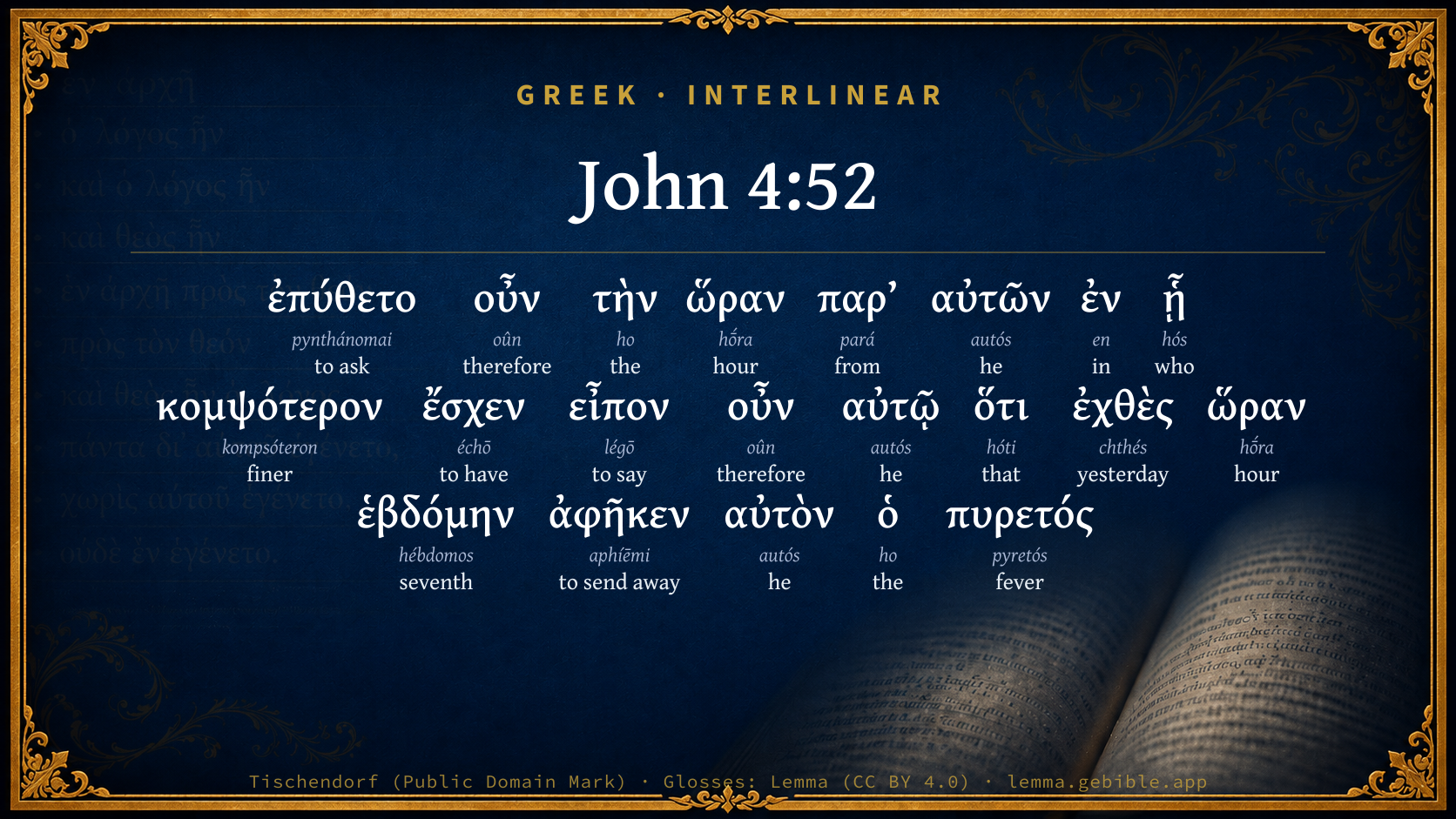
Greek (Tischendorf 8th ed.) John 4:52 appears in the Greek New Testament. The text above is from the Tischendorf 8th edition. Each word links to its Strong’s number and a concise gloss. Click any word for its full Thayer’s Greek Lexicon entry.
Download image
Cite this verse

John 4:52 (World English Bible). Public Domain. Lemma interlinear Bible study tool, https://lemma.gebible.app/v/john/4/52.

Show BibTeX & RIS
BibTeX
RIS
English Translation
So he inquired of them the hour when he began to get better. They said therefore to him, "Yesterday at the seventh hour, the fever left him."
World English Bible · Public Domain
Highlights
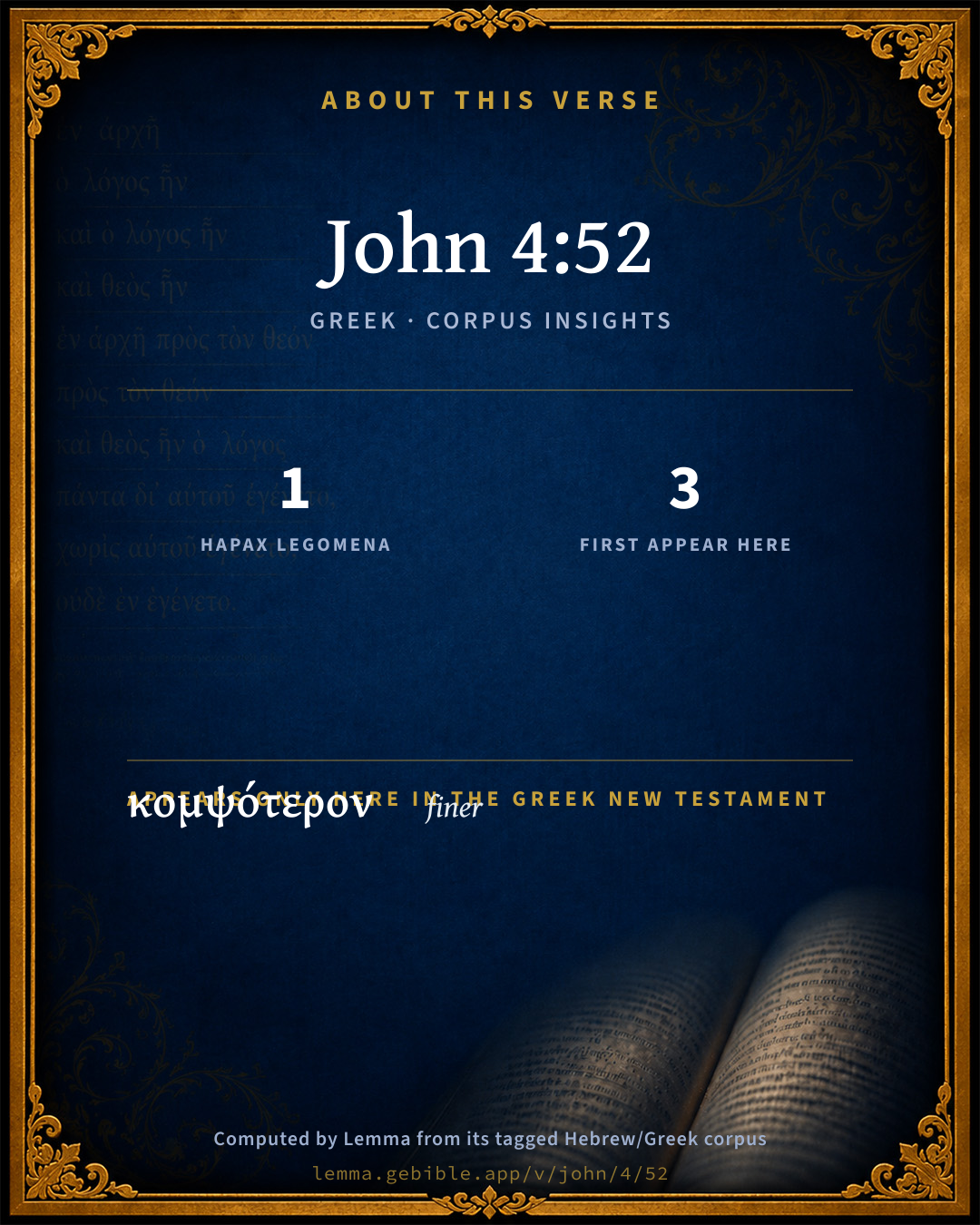
  • 1 hapax legomenon — only here in the Greek New Testament
  • 3 first appearances in the Greek New Testament
Full analysis ↓
Download a study sheet

One document with this verse’s original text, its word-by-word gloss line, the meaning frame, cross-references with their text, attributed commentary, and full source and license credits — printable, and it pastes into notes with its structure intact.

This verse Autodidact and up

Study sheet (.html) Plain text (.txt)

A passage Seminary Student

Up to 50 verses in one chapter. A passage sheet keeps up to 6 commentary sources and 12 cross-references per verse, in the order this page ranks them, and says so on the sheet whenever that leaves anything out. Ask for a single verse and you get the Autodidact verse sheet above.

Everything on this page stays free to read, with no account — the sheet is a download of what is already on screen, not access to it.

Want to remove ads? Support Godless Engineer
Compare translations 3

The same verse in 3 English versions, stacked beneath the original-language interlinear above. Click any original word for its lexicon entry.

Each is an independent rendering of the whole verse — the interlinear is not word-aligned to these translations.

Highlighted words mark where these versions differ — a whole-verse word diff, not a word-by-word alignment.

  • World English Bible Public Domain
    So he inquired of them the hour when he began to get better. They said therefore to him, "Yesterday at the seventh hour, the fever left him."
  • King James Version Public Domain
    Then enquired he of them the hour when he began to amend. And they said unto him, Yesterday at the seventh hour the fever left him.
  • unfoldingWord Literal Text CC BY-SA 4.0
    So he asked from them the hour in which he began to improve. Therefore, they replied to him, “Yesterday at the seventh hour the fever left him.”

unfoldingWord Literal Text — © unfoldingWord, licensed CC BY-SA 4.0. Word-aligned USFM3 via Door43 (git.door43.org/unfoldingWord/en_ult).

Versions to compare (up to 4)

3 of 4 selected

Show all 19 translations

Every available English version of this verse, each an independent rendering of the whole verse.

  • World English Bible Public Domain
    So he inquired of them the hour when he began to get better. They said therefore to him, "Yesterday at the seventh hour, the fever left him."
  • Berean Standard Bible Public Domain
    So he inquired as to the hour when his son had recovered, and they told him, “The fever left him yesterday at the seventh hour.”
  • Majority Standard Bible Public Domain
    So he inquired as to the hour when his son had recovered, and they told him, “The fever left him yesterday at the seventh hour.”
  • King James Version Public Domain
    Then enquired he of them the hour when he began to amend. And they said unto him, Yesterday at the seventh hour the fever left him.
  • American Standard Version (1901) Public Domain
    So he inquired of them the hour when he began to amend. They said therefore unto him, Yesterday at the seventh hour the fever left him.
  • Revised Version (1885) Public Domain
    So he inquired of them the hour when he began to amend. They said therefore unto him, Yesterday at the seventh hour the fever left him.
  • Geneva Bible (1599) Public Domain
    Then enquired he of them the houre when he began to amend. And they said vnto him, Yesterday the seuenth houre the feuer left him.
  • Douay-Rheims (1899) Public Domain
    He asked therefore of them the hour wherein he grew better. And they said to him: Yesterday, at the seventh hour, the fever left him.
  • Young's Literal Translation Public Domain
    he inquired then of them the hour in which he became better, and they said to him -- `Yesterday at the seventh hour the fever left him;'
  • Literal Standard Version CC BY-SA 4.0
    he inquired then of them the hour in which he became better, and they said to him, “Yesterday at the seventh hour the fever left him”;
  • Unlocked Literal Bible CC BY-SA 4.0
    So he asked them the hour when he began to improve. They replied to him, “Yesterday at the seventh hour the fever left him.”
  • unfoldingWord Literal Text CC BY-SA 4.0
    So he asked from them the hour in which he began to improve. Therefore, they replied to him, “Yesterday at the seventh hour the fever left him.”
  • Darby Bible Public Domain
    He inquired therefore from them the hour at which he got better. And they said to him, Yesterday at the seventh hour the fever left him.
  • World Messianic Bible Public Domain
    So he inquired of them the hour when he began to get better. They said therefore to him, “Yesterday at the seventh hour, the fever left him.”
  • Webster's Bible Public Domain
    Then he inquired of them the hour when he began to amend: and they said to him, Yesterday at the seventh hour the fever left him.
  • Free Bible Version CC BY-SA 4.0
    He asked them what time it was when his son began to get better. “Yesterday at one p.m. the fever left him,” they told him.
  • Bible in Basic English Public Domain
    So he put a question to them as to the hour when he became better; and they said to him, The disease went from him yesterday at the seventh hour.
  • Text-Critical English NT CC BY 4.0
    So he asked them the hour when he began to get better. They said to him, “Yesterday at the seventh hour the fever left him.”
  • Tyndale New Testament (1534) Public Domain
    Then enquyred he of the the houre when he begane to amende. And they sayde vnto him: Yester daye the sevethe houre the fever lefte him.

Literal Standard Version (2020), Covenant Press — licensed CC BY-SA 4.0. Text via the HelloAO Bible API (eBible.org). Unlocked Literal Bible (unfoldingWord) — licensed CC BY-SA 4.0. Text via the HelloAO Bible API (eBible.org). unfoldingWord Literal Text — © unfoldingWord, licensed CC BY-SA 4.0. Word-aligned USFM3 via Door43 (git.door43.org/unfoldingWord/en_ult). Free Bible Version, Dr. Jonathan Gallagher — licensed CC BY-SA 4.0. Text via the HelloAO Bible API (eBible.org).

Word by word

More ways to search: Search by grammar → Find every occurrence → Compare this word →

Practice this passage: Drill this verse → Learn its vocabulary →

κομψότερον
kompsóteron
G2866
“finer”
Adverb, Comparative
Part of Speech
Adverb
Degree
Comparative
Full Thayer's Definition

Origin: neuter comparative of a derivative of the base of G2865 (meaning properly, well dressed, i.e. nice)

TDNT: None

1. more finely, better
  1. ἐπύθετο pynthánomai G4441 “to ask” Verb, Aorist, Middle deponent, Indicative, 3rd person, Singular
  2. οὖν oûn G3767 “therefore” Conjunction
  3. τὴν ho G3588 “the” Article, Accusative, Singular, Feminine
  4. ὥραν hṓra G5610 “hour” Noun, Accusative, Singular, Feminine
  5. παρ’ pará G3844 “from” Preposition
  6. αὐτῶν autós G846 “he” Personal pronoun, Genitive, Plural, Masculine
  7. ἐν en G1722 “in” Preposition
  8. ᾗ hós G3739 “who” Relative pronoun, Dative, Singular, Feminine
  9. ἔσχεν échō G2192 “to have” Verb, Aorist, Active, Indicative, 3rd person, Singular
  10. εἶπον légō G3004 “to say” Verb, Aorist, Active, Indicative, 3rd person, Plural
  11. οὖν oûn G3767 “therefore” Conjunction
  12. αὐτῷ autós G846 “he” Personal pronoun, Dative, Singular, Masculine
  13. ὅτι hóti G3754 “that” Conjunction
  14. ἐχθὲς chthés G5504 “yesterday” Adverb
  15. ὥραν hṓra G5610 “hour” Noun, Accusative, Singular, Feminine
  16. ἑβδόμην hébdomos G1442 “seventh” Adjective, Accusative, Singular, Feminine
  17. ἀφῆκεν aphíēmi G863 “to send away” Verb, Aorist, Active, Indicative, 3rd person, Singular
  18. αὐτὸν autós G846 “he” Personal pronoun, Accusative, Singular, Masculine
  19. ὁ ho G3588 “the” Article, Nominative, Singular, Masculine
  20. πυρετός pyretós G4446 “fever” Noun, Nominative, Singular, Masculine

About this verse

These counts appear in no published source. They are computed here, from the morphology-tagged text and Lemma’s own curated glosses. What Lemma adds →

21
words
16
distinct lemmas
Gospels
section

Notable vocabulary

1 hapax legomenon — a word that appears only here in the entire Greek New Testament:

  • κομψότερον finer G2866

First appearance in Scripture

These words make their first canonical appearance in the Greek New Testament here:

  • κομψότερον finer G2866
  • ἐχθὲς yesterday G5504
  • ἑβδόμην seventh G1442

Shared distinctive vocabulary

ἐχθὲς yesterday G5504 occurs in 3 verses of the Greek New Testament. Also found in:
Repetition

Words recur within this verse:

  • οὖν therefore G3767 ×2
  • ὥραν hour G5610 ×2
  • αὐτῶν he G846 ×3
  • τὴν the G3588 ×2

Where the printed editions differ

1 variant

Places in this verse where the major printed Greek editions disagree on the wording in a way that affects the translation — a comparison of editions, not a manuscript-by-manuscript collation. The editions are the modern critical texts (Nestlé-Aland 28/27, SBL, Westcott-Hort, Tregelles, Tyndale House) and the traditional texts behind the KJV (the Textus Receptus and the Byzantine/Majority text). It is not a claim about which reading is original.

  1. Extra text
    οὖν

    “therefore”

    In NA28NA27TynSBLWHTreg Not in TRByz

    οὖν (oun) 'therefore' is only in older manuscripts (NA28+NA27+Tyn+SBL+WH+Treg)

Textual data: Translators Amalgamated Greek New Testament (STEPBible TAGNT) · CC BY 4.0.

Commentary

Notes on John 4:52 from classic Christian and Jewish commentators (each source and its license shown beneath its notes). The classic Christian expositions comment on the surrounding passage and are grouped to its opening verse, so a note may address several verses; the Jewish commentaries on the Tanakh (Rashi and others) are per-verse, so they appear only where the commentator wrote on this verse.

Lemma curates 59 commentaries, every one of them public domain or Creative Commons licensed, each selected and text-cleaned for this edition rather than reprinted as found. About our sources →

Bengel's Gnomon

Johann Albrecht Bengel

Joh 4:52. Τὴν ὤραν, hour) The more carefully the Divine works and benefits are considered, the more nourishment faith acquires.—ὁ πυρετός, the fever) This disease, under ordinary circumstances, is slow in its retiring.—κομψότερον, better) [lit. more adorned] A delightful word to use of one becoming convalescent, especially a boy. He was supposing that it was only the risk of death that had been overcome; but there follows an account of the fever having been entirely removed [lit. quenched].

Bengel's Gnomon of the New Testament — English translation (T&T Clark, Edinburgh, 1860) — public domain. Text from a community e-Sword module.

Expositor's Greek Testament

ed. W. Robertson Nicoll

Joh 4:52 . ἐπύθετο οὗν … κομψότερον ἔσχε . “Amoenum verbum, de convalescente, puero praesertim” Bengel. Theophylact explains by ἐπὶ τὸ βέλτιον καὶ εὐρωστότερον μετῆλθεν ὁ παῖς : Euthymius by τὸ ῥᾳότερον , τὸ κουφότερον , as we speak of a sick person being “easier,” “lighter”. The best illustration is Raphel’s from Epictetus ( Diss. , 3, 10), who bids a patient not be too much uplifted if the physician says to him κομψῶς ἔχεις , you are doing well. The servants name the seventh hour, i.e. , 1 p.m. of the previous day, as the time when the fever left him. [Accus. of time when, rare; Winer explains as if it meant the approximate time with a περί or ὡσεί understood; Act 10:3 ; Rev 3:3 .] And this the father recognised as the time at which Jesus had said “Thy son liveth”. The distance between Cana and Capernaum is about twenty-five miles, so that it would appear as if the father had needlessly delayed on the road. But he may have had business for Herod or for himself on the road, or the beast he rode may have been unequal to the double journey. At any rate it seems illegitimate to say with Weiss that “yesterday” means before sundown; or to ascribe the father’s delay to the confidence he had in Jesus’ word. The discovery of the coincidence in point of time produces a higher degree of faith, ἐπίστευσεν αὐτὸς καὶ ἡ οἰκία αὐτοῦ ὅλη . The cure brings into prominence this distinctive peculiarity of a miracle that it consists of a marvel which is coincident with an express announcement of it.

The Expositor's Greek Testament, edited by W. Robertson Nicoll (1897–1910) — public domain. Text from a community e-Sword module.

Adam Clarke's Commentary

Verse 52. Then inquired he of them the hour] The servants, overjoyed to find their master's son so suddenly restored, set off to meet him, that they might impart to him tidings which they knew would be so very agreeable; and he, intent on having his faith settled, began immediately to inquire what time it was when the fever left him, to see whether his cure was the effect of some natural cause, or whether it was done by the power of Christ.

Yesterday at the seventh hour] At the time we would call one o'clock. Dr. Macknight thinks the Roman hour is intended; i.e. seven o'clock in the evening; and this he thinks is the reason why our Lord did not accompany the nobleman: for, as Cana was a day's journey from Capernaum, had our Lord gone at that hour he must have travelled in the night, from which it might have been inferred that he could not cure the child without being personally present. Harmony, vol. i. p. 52.

Adam Clarke's Commentary on the Bible (1810–1826) — public domain. Text from a community e-Sword/MySword module.

John Calvin's Commentaries

52. Therefore he inquired at them. That this courtier asked his servants at what time his son began to recover, was done by a secret impulse from God, that the truth of the miracle might be rendered more conspicuous. For by nature we have an exceedingly wicked disposition to extinguish the light of the power of God, and Satan labors, by various means, to hide the works of God from our view; and, therefore, in order that they may obtain from us that praise which is due to them, they must be made so manifest that no room is left for doubt. Whatever then may be the ingratitude of men, still this circumstance does not permit so illustrious a work of Christ to be ascribed to chance.

John Calvin's Commentaries (1540-1563) — public domain. Text from the Calvin Translation Society English edition (1840s-50s) via the Christian Classics Ethereal Library (ccel.org). Calvin's coverage is partial (roughly two-thirds of the Bible); uncommented books and verses are honest gaps, never fabricated. The 19th-century editor's footnotes and remarks are omitted so the notes are faithfully Calvin's own voice.

Ellicott's Commentary for English Readers

(52) Then enquired he of them.—But these two facts—the assurance at Cana, and the actual healing powers at Capernaum—were they in truth related to each other? He remembers the hour at which one was spoken; he inquires the hour at which the other was realised. He does not even now grasp the full meaning of the words, and thinks of the gradual abatement of the fever, and the slow convalescence, and asks when the child “began to amend.” They have seen the sudden change as of a new power passing into the body on the point of death. They have spoken of this as a new life, and they now think of the fever as having completely left him.

Yesterday at the seventh hour.—We have seen (Joh_1:39) that there is no sufficient reason for thinking that St. John uses the western method of counting the hours of the day. Still less is it likely that Galilean servants, who are here the speakers, should have done so. To believe, moreover, that it was seven o’clock in the morning or evening adds to, and does not remove, the difficulty of the length of time implied in “yesterday.” To say that the father remained some time with Jesus, and that “the believer doth not make haste,” is to pervert both the spirit and the words of the text. He clearly went at once (Joh_4:50), and his anxiety naturally quickened his speed. The distance was not more than twenty-five English miles, and he had not travelled the whole of it, for the servants had gone to meet him. The supposed explanation cannot therefore be explained. But the words, if taken in their simple meaning, involve no such difficulty. These Jews, as all Jews, meant by the “seventh hour” the seventh from sunrise, what we should call one o’clock. After sunset the same evening they would have commenced a new day (comp. Excursus F.), and this seventh hour would be to them as one o’clock the day before, or the seventh hour yesterday. We have thus an interval of five or six hours between the words spoken by our Lord and their confirmation by the servants.

A Bible Commentary for English Readers, edited by Charles John Ellicott (1878–1897) — public domain. Text from a community e-Sword module.

The Cambridge Bible for Schools and Colleges

gen. ed. J. J. S. Perowne

52. began to amend] Or, was somewhat better; a colloquial expression. The father fancies that the cure will be gradual. The fever will depart at Christ’s word, but will depart in the ordinary way. He has not yet fully realised Christ’s power. The reply of the servants shews that the cure was instantaneous.

Yesterday at the seventh hour] Once more we have to discuss S. John’s method of counting the hours of the day. (See on Joh_1:39 and Joh_4:6.) Obviously the father set out as soon after Jesus said ‘thy son liveth’ as possible; he had 20 or 25 miles to go to reach home, and he would not be likely to loiter on the way. 7 a.m. is incredible; he would have been home long before nightfall, and the servants met him some distance from home. 7 p.m. is improbable; the servants would meet him before midnight. Thus the modern method of reckoning from midnight to midnight does not suit. Adopting the Jewish method from sunset to sunset, the seventh hour is 1 p.m. He would scarcely start at once in the mid-day heat; nor would the servants. Supposing they met him after sunset, they might speak of 1 p.m. as ‘yesterday.’ (But see on Joh_20:19, where S. John speaks of the late hours of the evening as belonging to the day before sunset.) Still, 7 p.m. is not impossible, and this third instance must be regarded as not decisive. But the balance here seems to incline to what is antecedently more probable, that S. John reckons the hours, like the rest of the Evangelists, according to the Jewish method.

The Cambridge Bible for Schools and Colleges (gen. ed. J. J. S. Perowne; Cambridge University Press, 1878–1918) — public domain. Text from a community e-Sword module.

John Gill's Exposition

Then inquired he of them the hour,.... He did not at all hesitate about the truth of it, or was in any surprise upon it; but that he might compare things together, he asked the exact time,

when he began to amend; or grow better; for he seemed to think, that his recovery might be gradual, and not all at once, as it was:

and they said unto him, yesterday at the seventh hour; which was one o'clock in the afternoon:

the fever left him; entirely at once, so that he was perfectly well immediately.

John Gill's Exposition of the Whole Bible (1746–1763) — public domain (CC PDM 1.0). Text via the HelloAO Bible API.

Trapp's Complete Commentary

John Trapp

52 Then enquired he of them the hour when he began to amend. And they said unto him, Yesterday at the seventh hour the fever left him.

Ver. 52. Then inquired he, &c.] By a sweet providence, that God might be the more glorified and the man’s faith confirmed. "All things cooperate," &c., Rom 8:28. So at the same time wherein the states of Germany (after long debate) concluded for the truth of the gospel, Luther came leaping out of his closet where he had been praying (though many miles distant) with vicimus, vicimus we conquer, we conquer, in his mouth. So Musselborough field was won by the English the selfsame day and hour wherein those Balaam’s blocks (idolatrous images) were burnt at London by order of Parliament.

John Trapp, A Commentary or Exposition upon All the Books of the Old and New Testament (1647–1656) — public domain. Text from a community e-Sword module.

Albert Barnes' Notes on the Bible

The seventh hour - About one o’clock in the afternoon.

The same hour - The very time when Jesus spoke.

The fever left him - It seems that it left him suddenly and entirely; so much so that his friends went to inform the father, and to comfort him, and also, doubtless, to apprise him that it was not necessary to ask aid from Jesus. From this miracle we may learn,

1. That Jesus has an intimate knowledge of all things. He knew the case of this son - the extent of his disease where he was and thus had power to heal him.

2. That Jesus has almighty power. Nothing else could have healed this child. Nor could it be pretended that he did it by any natural means. He was far away from him, and the child knew not the source of the power that healed him. It could not be pretended that there was any collusion or jugglery. The father came in deep anxiety. The servants saw the cure. Jesus was at a distance. Everything in the case bears the mark of being the simple energy of God - put forth with equal ease to heal, whether far or near. Thus, he can save the sinner.

3. We see the benevolence of Jesus. Ever ready to aid, to heal, or to save, he may be called on at all times, and will never be called on in vain.

Albert Barnes' Notes on the Bible (1834–1885) — public domain. Text from a community e-Sword/MySword module.

Matthew Poole's English Annotations

He inquires the precise time; they tell him it was about

the seventh hour. The miracle appeared in the suddenness of the recovery, and also that it was without the application of means, at least any that could have produced so sudden an effect.

Matthew Poole's English Annotations on the Holy Bible (1683–1685) — public domain. Text from a community e-Sword/MySword module.

Whedon's Commentary on the Bible

Daniel D. Whedon

52. At the seventh hour—At one o’clock P.M. Jesus spake the word, and the man started for home. At one o’clock P.M. it was, as the servants declare, that the boy recovered. The nobleman had naturally imagined that Jesus must visit the son to heal. But Jesus, adding awakening wonder to the miracle, heals at a distance. The man can measure the sign by a timepiece.

Daniel D. Whedon (gen. ed.), Commentary on the Old and New Testaments (1874–1909) — public domain. Text from a community e-Sword module.

The Pulpit Commentary

The father is full of joy at the blessed intelligence, but naturally seeks at once to link the event with the word and will of Jesus. He therefore inquired from them the hour in which he began to amend (komqoteron esce ). (This peculiar phrase is suitable on the lips of a man of rank; literally, "he did bravely, exceedingly well;" and komqwv ecein is occasionally used in contradistinction with kakwv ecein in a similar sense. Epictetus, "Diss.," 3:10-13.) They say to him, therefore, Yesterday during the seventh hour the fever left him. The advocates of John"s adoption of the Roman computation of time suppose that this was seven p.m., and, therefore, that a night had intervened on the return journey (so Westcott, Edersheim, and Moulton). This is not necessary, because, even on the Jewish computation, from sunrise to sunset, though the seventh hour must then mean between noon and one p.m., it could not have happened that much before midnight he should have broken into the streets of Capernaum. At that hour the noon might be spoken of as "yesterday." This, however, is not imperative; for, if the distance between Capernaum and Cana was from twenty to twenty-five miles, and if the nobleman had travelled to Cana on the day that he presented his request, it is clear that a night"s halt might easily have been required. Baur and Hilgenfeld make the note of time an attempt on the part of the writer to exaggerate the marvel, as if the distance through which the will of Christ asserted itself could augment the wonder, or that the real supernatural could be measured by milestones. And Thoma thinks so poorly of the originality of the Johannist, that he imagines him to have worked into his narrative some of the small details of the Cornelius and Peter interviews in Ac 10.

The Pulpit Commentary (1880–1919), ed. H.D.M. Spence-Jones & Joseph S. Exell — public domain. Text from a community e-Sword module.

John Wesley's Explanatory Notes

He asked the hour when he amended - The more exactly the works of God are considered, the more faith is increased.

John Wesley, Explanatory Notes Upon the Whole Bible (1754–1765) — public domain. Text via the GEBible commentary corpus.

Cambridge Greek Testament for Schools and Colleges

52. τὴν ὥραν παρ’ αὐτῶν for παρ’ αὐ. τ. ὥρ., a correction to bring παρ’ αὐτῶν nearer to ἐπύθετο.

52. κομψότερον ἔσχεν. Literally, got somewhat better; a colloquial expression: κομψῶς ἔχεις, ‘you are getting on nicely,’ occurs as a doctor’s expression, Arrian, Diss. Epict. III. x. 13. The father expects the cure to be gradual: the fever will depart at Christ’s word, but in the ordinary way. He has not yet fully realised Christ’s power. The servants’ reply shews that the cure was instantaneous.

ἐχθὲς ὥραν ἑβδ. Accusative; during or in the seventh hour. Once more we nave to discuss S. John’s method of counting the hours. (See on Joh 1:39, Joh 4:6.) Obviously the father set out as soon after Jesus said ‘thy son liveth’ as possible; he had 20 or 25 miles to go to reach home, and would not be likely to loiter. 7 A.M. is incredible; he would have been home long before nightfall, and the servants met him some distance from home. 7 P.M. is improbable; the servants would meet him before midnight. Thus the modern method of reckoning from midnight to midnight does not suit. Adopting the Jewish method from sunset to sunset, the seventh hour is 1 P.M. He would scarcely start at once in the mid-day heat; nor would the servants. Supposing they met him after sunset, they might speak of 1 P.M. as ‘yesterday.’ (But see on Joh 20:19, where S. John speaks of the late hours of the evening as belonging to the day before sunset.) Still, 7 P.M. is not impossible, and this third instance must be regarded as not decisive. But the balance here seems to incline to what is antecedently more probable, that S. John reckons the hours, like the rest of the Evangelists, according to the Jewish method.

Cambridge Greek Testament for Schools and Colleges (Cambridge University Press, 1896; 21 vols, various authors incl. Carr, Maclear, Plummer, Farrar, Lumby, Moule, M. R. James, Simcox) — public domain. Text from a community e-Sword module.

International Critical Commentary

52. ἐπύθετο. This is the best attested reading. Fam. 13 give the more usual form ἐπυνθάνετο. πυνθάνομαι does not occur again in Jn.

τὴν ὥραν παρʼ αὐτῶν. So אACDNWΘ; the rec. has παρʼ αὐτῶν τὴν ὥραν; B omits παρʼ αὐτῶν, and has τὴν ὥραν ἐκεινήν.

ἐν ᾗ κομψότερον ἔσχεν, “in which he got better,” the aor. marking a definite change in his condition. κομψότερον is not found again in the LXX or N.T., but the phrase κομψῶς ἔχεις, “you are doing finely,” occurs in Arrian, Epict. iii. 10. 13, an apposite passage cited by Wetstein. κομψότερον ἔσχεν is good, idiomatic Greek, and does not read like a translation from the Aramaic. Cf. Introd., p. lxvii.

εἶπαν οὖν. So BCLNW; the rec. has καὶ εἶπον (אADΘ).

ὅτι (recitantis) introduces the actual words of the servants.

The spelling ἐχθές (אAB*CDWΘ) must be preferred to the rec. χθές (cf. Act 7:28, Heb 13:8).

ὥραν ἑβδόμην, sc. about the seventh hour, the acc. being less definite than the dat. of v. 53; see Exo 9:18 ταύτην τὴν ὥραν αὔριον, “to-morrow about this hour” (cf. Rev_3 ποίαν ὥραν). The seventh hour was 1 p.m. (see on 1:39). The point may be, however, that it was common belief that the seventh hour of fever was the critical hour. Clement of Alexandria (Strom. vi. 16) thought that the seventh day of any disease marked the crisis.

ὁ πυρετός, “the fever”. The word occurs again in N.T. only at Mat 8:15, Mar 1:31, Luk 4:38, Luk 4:39, Act 28:8.

International Critical Commentary — older volumes (1896–1929), various authors — public domain. Text from a community e-Sword module.

Lesson kit

Teaching starters — assembled from the data on this page, not authored interpretation. Every prompt links to the verse data it draws on. Edit before teaching.

John, in the Gospels, opens this verse with 21 words (16 distinct Greek lemmas). Its most distinctive word is kompsóteron (“finer”). A historical commentator’s framing appears above. Read the whole chapter for the surrounding context.

Discussion questions

  1. The word kompsóteron carries the sense “finer.” How does it shape the verse?
  2. This verse holds 1 word here found nowhere else in the Greek New Testament. What might the rare word draw attention to?
  3. 3 words here appear for the first time in Scripture. What is being introduced at this debut?
  4. Acts 7:28 shares the word «yesterday» with this verse. How do the two illuminate each other?
  5. “therefore” occurs 2× in this one verse. What is the effect of the repetition?
  6. These translations render this verse differently. What is at stake in choosing one wording over another?
  7. Reading how Bengel's Gnomon and Expositor's Greek Testament read this verse, where do the two commentators agree and where do they part?

Things to notice

  • 1 word in this verse appears nowhere else in the Greek New Testament.
  • 3 words make their first canonical appearance in Scripture here.
  • These translations choose different wording for 12 words in this verse.
  • “therefore” occurs 2× in this single verse.
  • 16 distinct Greek lemmas span 21 words in this verse.

Reading settings

Reading text

Shown beneath each verse's original-language words.

Old Testament
Old Testament edition

Read the OT as the Masoretic Hebrew (MT) or the Greek Septuagint (LXX).

English shown for the Greek Septuagint (in the Hebrew ↔ Greek comparison).

Comparing translations? Open the Compare panel on any verse page to stack up to four side by side.