
John 4:17

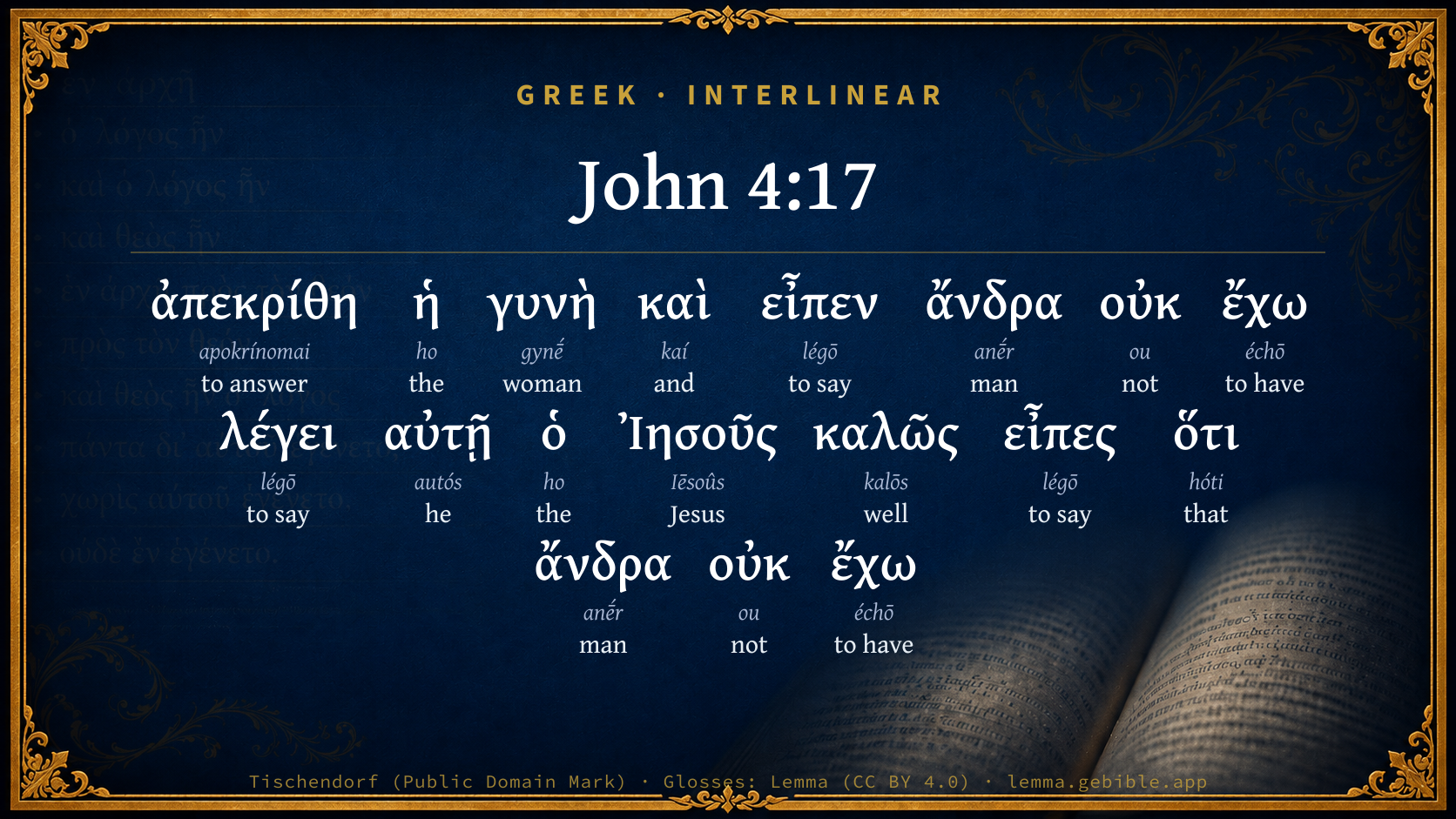
Greek (Tischendorf 8th ed.) John 4:17 appears in the Greek New Testament. The text above is from the Tischendorf 8th edition. Each word links to its Strong’s number and a concise gloss. Click any word for its full Thayer’s Greek Lexicon entry.
Download image
Cite this verse

John 4:17 (World English Bible). Public Domain. Lemma interlinear Bible study tool, https://lemma.gebible.app/v/john/4/17.

Show BibTeX & RIS
BibTeX
RIS
English Translation
The woman answered, "I have no husband." Jesus said to her, "You said well, 'I have no husband,'
World English Bible · Public Domain
Download a study sheet

One document with this verse’s original text, its word-by-word gloss line, the meaning frame, cross-references with their text, attributed commentary, and full source and license credits — printable, and it pastes into notes with its structure intact.

This verse Autodidact and up

Study sheet (.html) Plain text (.txt)

A passage Seminary Student

Up to 50 verses in one chapter. A passage sheet keeps up to 6 commentary sources and 12 cross-references per verse, in the order this page ranks them, and says so on the sheet whenever that leaves anything out. Ask for a single verse and you get the Autodidact verse sheet above.

Everything on this page stays free to read, with no account — the sheet is a download of what is already on screen, not access to it.

Want to remove ads? Support Godless Engineer
Compare translations 3

The same verse in 3 English versions, stacked beneath the original-language interlinear above. Click any original word for its lexicon entry.

Each is an independent rendering of the whole verse — the interlinear is not word-aligned to these translations.

Highlighted words mark where these versions differ — a whole-verse word diff, not a word-by-word alignment.

  • World English Bible Public Domain
    The woman answered, "I have no husband." Jesus said to her, "You said well, 'I have no husband,'
  • King James Version Public Domain
    The woman answered and said, I have no husband. Jesus said unto her, Thou hast well said, I have no husband:
  • unfoldingWord Literal Text CC BY-SA 4.0
    The woman answered and said to him, “I do not have a husband.” Jesus says to her, “You have rightly said, ‘I do not have a husband,’

unfoldingWord Literal Text — © unfoldingWord, licensed CC BY-SA 4.0. Word-aligned USFM3 via Door43 (git.door43.org/unfoldingWord/en_ult).

Versions to compare (up to 4)

3 of 4 selected

Show all 18 translations

Every available English version of this verse, each an independent rendering of the whole verse.

  • World English Bible Public Domain
    The woman answered, "I have no husband." Jesus said to her, "You said well, 'I have no husband,'
  • Berean Standard Bible Public Domain
    “I have no husband,” the woman replied. Jesus said to her, “You are correct to say that you have no husband.
  • Majority Standard Bible Public Domain
    “I have no husband,” the woman replied. Jesus said to her, “You are correct to say that you have no husband.
  • King James Version Public Domain
    The woman answered and said, I have no husband. Jesus said unto her, Thou hast well said, I have no husband:
  • American Standard Version (1901) Public Domain
    The woman answered and said unto him, I have no husband. Jesus saith unto her, Thou saidst well, I have no husband:
  • Revised Version (1885) Public Domain
    The woman answered and said unto him, I have no husband. Jesus saith unto her, Thou saidst well, I have no husband:
  • Geneva Bible (1599) Public Domain
    The woman answered, and saide, I haue no husband. Iesus said vnto her, Thou hast well said, I haue no husband.
  • Young's Literal Translation Public Domain
    the woman answered and said, `I have not a husband.' Jesus saith to her, `Well didst thou say -- A husband I have not;
  • Literal Standard Version CC BY-SA 4.0
    the woman answered and said, “I do not have a husband.” Jesus says to her, “Well did you say—I do not have a husband;
  • Unlocked Literal Bible CC BY-SA 4.0
    The woman answered and said to him, “I do not have a husband.” Jesus replied, “You are right in saying, 'I have no husband,'
  • unfoldingWord Literal Text CC BY-SA 4.0
    The woman answered and said to him, “I do not have a husband.” Jesus says to her, “You have rightly said, ‘I do not have a husband,’
  • Darby Bible Public Domain
    The woman answered and said, I have not a husband. Jesus says to her, Thou hast well said, I have not a husband;
  • World Messianic Bible Public Domain
    The woman answered, “I have no husband.” Yeshua said to her, “You said well, ‘I have no husband,’
  • Webster's Bible Public Domain
    The woman answered and said, I have no husband. Jesus said to her, Thou hast well said, I have no husband:
  • Free Bible Version CC BY-SA 4.0
    “I don't have a husband,” the woman answered. “You're right in saying you don't have a husband,” Jesus told her.
  • Bible in Basic English Public Domain
    In answer, the woman said, I have no husband. Jesus said to her, You have said rightly, I have no husband:
  • Text-Critical English NT CC BY 4.0
    The woman said in response, “I have no husband.” Jesus said to her, “Yoʋ have rightly said, ‘I have no husband,’
  • Tyndale New Testament (1534) Public Domain
    The woman answered and sayde to him: I have no husband. Iesus sayde to her. Thou hast well sayd I have no husbande.

Literal Standard Version (2020), Covenant Press — licensed CC BY-SA 4.0. Text via the HelloAO Bible API (eBible.org). Unlocked Literal Bible (unfoldingWord) — licensed CC BY-SA 4.0. Text via the HelloAO Bible API (eBible.org). unfoldingWord Literal Text — © unfoldingWord, licensed CC BY-SA 4.0. Word-aligned USFM3 via Door43 (git.door43.org/unfoldingWord/en_ult). Free Bible Version, Dr. Jonathan Gallagher — licensed CC BY-SA 4.0. Text via the HelloAO Bible API (eBible.org).

Word by word

More ways to search: Search by grammar → Find every occurrence → Compare this word →

Practice this passage: Drill this verse → Learn its vocabulary →

καλῶς
kalōs
G2573
“well”
Adverb
Part of Speech
Adverb
Full Thayer's Definition

Origin: from G2570

TDNT: None

1. beautifully, finely, excellently, well a. rightly, so that there shall be no room for blame, well, truly b. excellently, nobly, commendably c. honourably, in honour 1. in a good place, comfortable d. to speak well of one, to do good e. to be well (of those recovering health)
  1. ἀπεκρίθη apokrínomai G611 “to answer” Verb, Aorist, Middle deponent, Indicative, 3rd person, Singular
  2. ἡ ho G3588 “the” Article, Nominative, Singular, Feminine
  3. γυνὴ gynḗ G1135 “woman” Noun, Nominative, Singular, Feminine
  4. καὶ kaí G2532 “and” Conjunction
  5. εἶπεν légō G3004 “to say” Verb, Aorist, Active, Indicative, 3rd person, Singular
  6. ἄνδρα anḗr G435 “man” Noun, Accusative, Singular, Masculine
  7. οὐκ ou G3756 “not” Particle, Negative
  8. ἔχω échō G2192 “to have” Verb, Present, Active, Indicative, 1st person, Singular
  9. λέγει légō G3004 “to say” Verb, Present, Active, Indicative, 3rd person, Singular
  10. αὐτῇ autós G846 “he” Personal pronoun, Dative, Singular, Feminine
  11. ὁ ho G3588 “the” Article, Nominative, Singular, Masculine
  12. Ἰησοῦς Iēsoûs G2424 “Jesus” Noun, Nominative, Singular, Masculine
  13. εἶπες légō G3004 “to say” Verb, Aorist, Active, Indicative, 2nd person, Singular
  14. ὅτι hóti G3754 “that” Conjunction
  15. ἄνδρα anḗr G435 “man” Noun, Accusative, Singular, Masculine
  16. οὐκ ou G3756 “not” Particle, Negative
  17. ἔχω échō G2192 “to have” Verb, Present, Active, Indicative, 1st person, Singular

About this verse

These counts appear in no published source. They are computed here, from the morphology-tagged text and Lemma’s own curated glosses. What Lemma adds →

18
words
12
distinct lemmas
Gospels
section

Shared distinctive vocabulary

καλῶς well G2573 occurs in 36 verses of the Greek New Testament. Also found in:
Repetition

Words recur within this verse:

  • εἶπεν to say G3004 ×3
  • ἄνδρα man G435 ×2
  • ἔχω to have G2192 ×2
  • ἡ the G3588 ×2
  • οὐκ not G3756 ×2

Commentary

Notes on John 4:17 from classic Christian and Jewish commentators (each source and its license shown beneath its notes). The classic Christian expositions comment on the surrounding passage and are grouped to its opening verse, so a note may address several verses; the Jewish commentaries on the Tanakh (Rashi and others) are per-verse, so they appear only where the commentator wrote on this verse.

Lemma curates 59 commentaries, every one of them public domain or Creative Commons licensed, each selected and text-cleaned for this edition rather than reprinted as found. About our sources →

The Expositor's Bible

Chapter 10

JESUS DECLARES HIMSELF.

The woman answered and said unto Him, I have no husband. Jesus saith unto her, Thou saidst well, I have no husband: for thou hast had five husbands; and he whom thou now hast is not thy husband: this hast thou said truly. The woman saith unto Him, Sir, I perceive that Thou art a prophet. Our fathers worshipped in this mountain; and ye say, that in Jerusalem is the place where men ought to worship. Jesus saith unto her, Woman, believe Me, the hour cometh, when neither in this mountain, nor in Jerusalem, shall ye worship the Father. Ye worship that which ye know not: we worship that which we know: for salvation is from the Jews. But the hour cometh, and now is, when the true worshippers shall worship the Father in spirit and in truth: for such doth the Father seek to be His worshippers. God is a Spirit: and they that worship Him must worship in spirit and truth. The woman saith unto Him, I know that Messiah cometh (which is called Christ): when He is come, He will declare unto us all things. Jesus saith unto her, I that speak unto thee am He.- Joh_4:17-26.

In this conversation at Jacobs well the woman for some time, quite naturally, misses the point of what Jesus says. It does not occur to her that by water He means anything else than what she could carry in her pitcher. Even when He speaks of causing a well to spring up within herself, she still thinks merely of the domestic convenience of some such arrangement, and begs Him to give what would save Her the endless trouble of coming to draw water out of Jacobs well. This simplicity has its good side, as also has her obvious confidence in His words. Jesus sees in this child-like simplicity and directness a much more hopeful soil for His message than He had found even in a thoughtful man of education like Nicodemus. He seeks, therefore, to prepare the soil further by quickening within her a sense of spiritual want. This may best be effected by backing her into her actual life. Therefore He says, Go, call thy husband, and come hither. And in this simple way He leads the woman at once to recognise His prophetic insight into her condition, and to bring His offers into connection with her character and her life. And there was that in her manner of owning Him as a prophet, a frankness and a simplicity in uttering her mind and listening to His explanations, that prompted Him explicitly to say, I that speak unto thee am the Messiah.

To this unfortunate and ill-living alien woman, then, Jesus declared Himself as He had not declared Himself to the well-to-do, respectable Jewish rabbis. The reason of this difference in our Lords treatment of individuals arises from the different dispositions they manifest. Acknowledgment of His power to work miracles may seem at first sight as good a certificate for Christian discipleship as acknowledgment of His prophetic power. But it is not so; because such an acknowledgment of His prophetic insight as this woman made is an acknowledgment of His power over the human heart and life. He who is thus felt to penetrate to the hidden acts, and to lay His hand upon the deepest secrets of the heart, is recognised as in a personal connection with the individual; and this is the foundation on which Christ can build, this is the beginning of that vital connection with Him which gives newness of life. Those who are merely solving a problem when they are considering the claims of Christ, are not likely to have any personal revelation made to them. But to every one, who, like this woman, shows some desire to receive His gifts, and who is not above owning that life is a very poor affair without some such thing as He offers; to every one who is conscious of sin, and who looks to Him as able to deliver from all its foul entanglement, He does make Himself known. To such persons He will disclose Himself when He sees that they are ripe for the disclosure. To such the moment of moments will come, when to them He will say: I that speak unto thee am He.

This distinction between the chemist who analyses the living water, and the thirsting soul that uses it, runs very deep, and may be commended to the consideration of any who are apt to be carried away by the current of unbelief that characterizes much of our literature. I think it may be said that in writers distinguished by a lack of Christian belief there will commonly be found an absence of what is popularly and fitly called an awakened conscience. It will be found that they do not know what it is to look at Christ from the point of view of this woman, from the point of view of a shattered and wretched life, and a conscience that day by day is saying, It is I myself who have broken my life, and doing so I have become a transgressor, and need pardon, guidance, strength. Acute thought, an admirable faculty of explaining and enforcing what is thought, we find in abundance; but we certainly do not find a spirit humbled by a sense of sin and a conscience alive to the deepest obligations. So far as can be gathered from the writings of the most conspicuous unbelievers, they do not possess the first requisite for discerning a Saviour-namely, a sense of need. They lack the prime preparation for speaking on such a subject; they have never dealt fairly with their own sin. We do not consult a deaf man if we wish to ascertain whether the noise we have heard is thunder or the rumbling of a cart; neither can we expect that those will be the best teachers regarding God in whom the faculty by which we chiefly discern God-viz., the conscience-has been less exercised than any other. It is through the conscience God makes Himself most distinctly felt; it is in connection with the moral law we come most clearly in contact with Him; and convictions of Gods Being and connection with us root themselves in the soul that a sense of sin has ploughed.

I am far from saying that in deciding upon the claims of Christ the understanding is to have no voice. The understanding must have a voice here as elsewhere. But it is a strong presumption in Christs favour that He offers precisely what sinners need; and it is decisive in His favour when we find that He actually gives what sinners need. If it is practically found that He is the force that lifts thousands and thousands of human beings out of sin; if He has, in point of fact, brought light to those in deep darkness, comfort and courage to the desolate and heavily burdened, consecration and purity to the outcast and the corrupt, then, plainly, He is what He claims to be, and we owe Him our faith.

If God is to reveal Himself at all, the revelation must be made not solely or chiefly to the understanding, but to that part of us which determines character, and is capable of appreciating character. The revelation must be moral not intellectual. As our Lords ministry proceeded He recognised that it was always the simple who most readily accepted and trusted Him; and He recognised that this was a thing to be thankful for: I thank Thee, O Father, Lord of heaven and earth, that Thou hast hid these things from the wise and prudent, and hast revealed them unto babes. And every one who thinks of it sees that it must be so-that a mans destiny must be decided not by his understanding, but by his character and leanings; not by his ability or disability to believe this or that, or to prove that his belief is well grounded, but by his aspirations, by the real bent of his heart. We should feel that there was something very far wrong if our faith depended upon proofs that not every one could master, and if thus the clever man had an advantage over the humble and contrite. The evidence must be such that spiritual character shall be an element in the acceptance of it. And such we find it to be. The reality and the significance of the revelation of God in Christ are more readily apprehended by the spiritually than by the intellectually gifted. Persons who are either by nature humble and docile, or whom life has taught to be so, persons who feel their need of God, and deeply long for an eternal state of peace and purity, these are the persons to whom God finds it possible to make Himself known. And if it be thought that this circumstance, that simple and docile spirits are convinced while hard-headed men are unconvinced, throws some suspicion on the reality of the revelation, if it be thought that the God and the eternity they believe in are but fancies of their own, it may fairly be replied, that there is no more reason for such a thought than for supposing that the rapture of a trained musician is fanciful and self-created, and not excited by any corresponding reality, because it is not shared by those whose taste for music is unawakened.

Convinced that Jesus was a prophet, the woman proposes to Him the standing subject of debate between Jews and Samaritans. Her statement of it is abrupt, and offers some appearance of being intended to turn the conversation away from herself; but this does not harmonise with her simple and direct character, and it is quite possible that in the midst of her confused and disappointed life she had sometimes wondered whether all her misery did not arise from her being a Samaritan. She knew what the Jews said of the Samaritan worship. She knew that they mocked at the Temple which stood on the hill over against Jacobs well; and when she found how very little her worship had helped her, she may have begun to suspect that there was truth in the Jewish allegations. Evidently the aspect of the Messiah, which had chiefly struck her, was His power to lead men into all truth, to teach them all things. Persons in her station, and quite as much overborne by sin as she, often retain their hold upon religious teaching; and in the midst of much that is superstitious they have a spark of true hope and longing for redemption. Jesus shows by the gravity and importance of His answer that He considered the woman sincere in the statement of her difficulty, and anxious to know where God might really be found. Perplexed and bewildered by her earthly experience, as so many of us are, she suddenly awakes to the consciousness that here, before her, and conversing with her, is a prophet; and at once she utters to Him what had been burning in her heart, Where, where is God to be found?

And so in reply to the inquiry of one sincere woman Jesus makes that great announcement which has ever since stood as the manifesto of spiritual worship. Not in any particular and isolated place, He tells the woman, is God to be found, not in the temple at Jerusalem, nor in the rival structure on Gerizim, but in spirit. God is a Spirit, and they that worship Him must worship in spirit and in truth. As our Lord intimates, this was a new kind of worship, essentially different from that to which Jews and Samaritans, and indeed all men, had hitherto been accustomed.

The magnitude of the contents of such sayings can as little be comprehended as their significance can be exhausted. We have first of all the central affirmation: God is a Spirit. To fill out this definition with intelligible ideas is difficult. It implies that He is a Personal Being, that He is self-conscious, possessed of intelligence and will; but although Personal His Personality transcends our conception. So far as regards the immediate application of the definition by our Lord at this time, it suffices to note its primary meaning that God has not a body, and consequently is subject to none of the limitations and conditions to which the possession of a body subjects human persons. He needs no local dwelling-place, no temple, no material offerings. In local worship there was an advantage while the world was young, and men could best be taught by symbols. A house in their midst, of which they might say, God is there, was undoubtedly an aid to faith. But it had its disadvantages. For the more a worshipper fixed his mind on the one local habitation, the less could he carry with him the consciousness of Gods presence in all places.

Very slowly do we learn that God is a Spirit. We think nothing is more surely believed among us. Alas! make almost any application of this radical truth, and we find how little it is believed. Take, for example, the appearances and voices by which intimations were made to godly men in Old Testament times. Why are many people reluctant to allow that these manifestations were inward and to conscience, that they came as convictions wrought by an unseen power, rather than as outward appearances or audible voices? Is it not because the truth that God is a Spirit is not adequately apprehended? Or why again do we so crave for signs, for clearer demonstrations of Gods being and of His presence? Ought we not to be satisfied if He responds to spiritual aspirations, and if we find that our craving for holiness is met and gratified?

The inference drawn by our Lord from the truth that God is a Spirit is one which needs still to be pressed. God seeks to be worshipped not by outward forms or elaborate ritual but in spirit. Ordinary teachers would have put in a saving clause to preserve some forms of worship; Christ puts in none. Let men worship God in spirit, and let forms take their chance. To worship God in spirit is to yield the unseen but motive powers within us to the unseen but Almighty influences which we recognise as Divine. It is to prostrate our spirit before the Divine Spirit. It is in our deepest being, in will and intention, to offer ourselves up to Him in whom goodness is personified. When a man is doing that, what does it matter what he says to God, or with what forms of worship he comes before Him? That alone is acceptable worship which consists in the devout approach of the human spirit to the Divine; and that is accomplished often as effectually in our business intercourse with men when tempted to injustice, or in our homes when tempted to anger or to laxity, as when we are in the house of God. Worship in the spirit needs no words, no appointed place, but only a human soul that bows inwardly before the goodness of God, and submits itself cordially to His sovereign and loving will.

This certainly is a strong argument for simplicity of worship. Why, it may indeed be said, why have any outward worship at all? Why have churches and why have Divine service? Well, it would have been better for the Church if there had been far less outward worship than there commonly has been. For by its elaborate services the Church has far too much identified religion with that worship which can only be rendered in church. No one can be surprised that in utter disgust at the disproportion between outward and spiritual worship, between the gorgeous and fussy services that profess so much, and the slender and rare devotion of the soul to God, discerning men should have turned their back on the whole business, and declined to be partakers in so huge and profane a farce. Milton in his later years attended no Church and belonged to no communion. This certainly is to run to the opposite extreme. No doubt that worship may be real and acceptable which is offered in the silence and solitude of a mans spirit; but we naturally utter what we feel, and by the utterance strengthen the feelings that are good, and rid ourselves of the bitterness and strain of those that are painful and full of sorrow. Besides, the Church is, before all else, a society. Our religion is meant to bring us together; and though it does so more effectually by inspiring us with kindliness and helpfulness in life than by a formal meeting together for no purposes of active charity, yet the one fellowship aids the other, as many of us well know.

While, then, we accept Christs statement in its fullest significance, and maintain that our reasonable service is the offering of ourselves as living sacrifices, that spiritual worship is offered not in church only or mainly, but in doing Gods will with a hearty good-will, we all the rather see how needful it is to utter ourselves to God as we do in our social worship; for as the wife would need some patience who was cared for indeed by her husband in the supply of her common wants, but had never a word of affection spoken to her, so our relations to God are not satisfactory unless we utter to Him our devotion as well as show it in our life. He was one of the wisest of English writers who said, I always thought fit to keep up some mechanical forms of good breeding (in my family), without which freedom ever destroys friendship. Precisely so, he who omits the outward and verbal expression of regard to God, will soon lose that regard itself.

But if the words of Christ were not intended to put an end to outward worship altogether, they do, as I have said, form a strong argument for simplicity of worship. No forms whatever are needed that our spirit may come into communion with God. Let us begin with this. As true and perfect worship may be rendered by the dying man, who cannot lift an eyelid or open his lips, as by the most ornate service that combines perfect liturgical forms with the richest music man has ever written. Rich music, striking combinations of colour and of architectural forms, are nothing to God so far as worship goes, except in so far as they bring the human spirit into fellowship with Him. Persons are differently constituted, and what is natural to one will be formal and artificial to another. Some worshippers will always feel that they get closer to God in private, in their own silent room, and with nothing but their own circumstances and wants to stimulate them; they feel that a service carefully arranged and abounding in musical effects does indeed move them, but does not make it easier for them to address themselves to God. Others, again, feel differently; they feel that they can best worship God in spirit when the forms of worship are expressive and significant. But in two points all will agree: first, that in external worship, while we strive to keep it simple we should also strive to make it good-the best possible of its kind. If we are to sing Gods praise at all, then let the singing be the best possible, the best music a congregation can join in, and executed with the utmost skill that care can develop. Music which cannot be sung save by persons of exceptional musical talent is unsuitable for congregational worship; but music which requires no consideration, and admits of no excellence, is hardly suitable for the worship of God. I do not know what idea of Gods worship is held by persons who never put themselves to the least trouble to improve it so far as they are concerned.

The other point in which all will agree, is that where the spirit is not engaged there is no worship at all. This goes without saying. And yet, subtract from our worship all that is merely formal, and how much do you leave? Worse still, there are those who do not even strive after the fit and decorous form, who do not bow their heads in prayer, who are not ashamed to be seen looking about them during the most solemn acts of worship, who show that they are indevout, thoughtless, profane.

The true worshippers shall worship the Father not only in spirit, but also in truth. The word truth here probably covers two ideas-the ideas of reality and of accuracy. It is opposed to symbolic worship and to ignorant worship. It does not mean that worship was now to be sincere, for that it had already been both among Samaritans and Jews. But among the Jews the worship of God had been symbolical, and among the Samaritans it had been ignorant.

The Jewish worship had been symbolical, every person and thing, every colour, gesture, movement, having a meaning for the initiated. The time for this, says our Lord, is past. We are to worship really. They need no longer take an animal to the temple to symbolise that they gave themselves to God; they were to spend their whole care on the real thing, on giving themselves to God; they were not to set candles about their altars to show that light was come into the world, they were themselves to shine as lights lit by Christ; they were not to swing censers to symbolise the sweet-smelling prayers of the saints, they were to offer prayers from humble hearts. In effect Christ said, You are grown up now, and can understand the realities; put away then these childish things. And those who continue to worship with various robes, and prescribed gesticulations and movements, and pictures, and altars, and everything to impress the senses, write themselves down children among grown-up people.

Truth is opposed also to error or misconception about the object of worship. Christ, by His presence, enables men to worship the Father in truth. He gives them the true idea of God. He makes God real, giving an actuality to our thought of God which we could not otherwise arrive at; and He shows us God as He truly is, connected with ourselves by love; holy, merciful, just.

William Robertson Nicoll, ed., The Expositor's Bible (London: Hodder & Stoughton, 1887–1910) — public domain. 65 of 66 books (1 Corinthians is not separately keyed, as that volume carries no machine-parseable verse references); section-level commentary keyed to the opening verse. Introductory and overview sections not keyed to a specific passage are excluded.

Bengel's Gnomon

Johann Albrecht Bengel

Joh 4:17. Καλῶς) well, i.e. truly. There is the utmost gravity in the Lord’s speech combined with the utmost courtesy. This plain assertion altogether convicted the Samaritan woman.

Bengel's Gnomon of the New Testament — English translation (T&T Clark, Edinburgh, 1860) — public domain. Text from a community e-Sword module.

Meyer's Critical & Exegetical Commentary

Heinrich August Wilhelm Meyer

Joh_4:17-18. The woman is taken aback; her light, naive, bantering manner is now completely gone, and she quickly seeks to shun the sensitive point with the answer, true only in words, οὐκ ἔχω ἄνδρα; but Jesus goes deeper still.

καλῶς] rightly, truly; Joh_8:48; Mat_15:7; Luk_20:39. How far truly, what follows shows,namely, only relatively, and therefore the approval is only apparent, and in some degree ironical.

ἄνδρα οὐκ ἔχω] a husband I have not; as it is the conception of ἀνήρ which Jesus has to emphasize, it stands first.

πέντε γὰρ, κ.τ.λ.] It is doubtful whether she really had five successive husbands, from whom she had been separated either by death or by divorce, or whether Jesus included paramours, using ἄνδρας in a varying sense according to the varying subjects; or whether, again, He meant that all five were scortatores (Chrysostom, Maldonatus, and most others). The first supposition is to be adopted, because the present man, who is not her husband, stands in contrast with the former husbands. She had been therefore five times married (such a history had already seared her conscience, Joh_4:29; how? is not stated), and now she was either a widow or a divorced wife, and had a paramour (νόθον ἀκοίτην, Nonnus), who lived with her as a husband, but really was not her husband (hence the οὐκ ἔστι is emphatically put first). To interpret the story of the five husbands as a whole as a symbolical history of the Samaritan nation (according to 2Ki_17:24 ff.; Josephus, Antt. ix. 14. 3 : πέντε ἔθνη … ἕκαστον ἴδιον θεὸν εἰς Σαμαρ. κομίσαντες), either as a divinely intended coincidence (Hengstenberg, Köstlin, comp. Baumgarten and Scholten), or as a type in the mind of the evangelist (Weizsäcker, p. 387), so that the symbolic meaning excludes any actual fact (Keim, Gesch. J. p. 116), or again as fiction (B. Bauer), whose mythical basis was that history (Strauss), is totally destitute of any historical warrant. For the man whom the woman now had must, symbolically understood, represent Jehovah; and He had been the God of the Samaritans before the introduction of false gods, and therefore it would have been more correct to speak of six husbands (Heracleon actually read ἕξ). But how incredible is it, that Jesus would represent Jehovah under the similitude of a paramour (for the woman was now living in concubinage), and the fivefold heathenism of the nation under the type of real marriages!

For the rest, the knowledge which Jesus had of the womans circumstances was immediate and supernatural. To assume that He had ascertained her history from others (Paulus, Ammon), is opposed to the Johannean view; while the notion that the disciples introduced into the history what they afterwards discovered (Schweizer, p. 139) is psychologically groundless, if once we admit that Jesus possessed a knowledge of the moral state of others (and here we have not merely a knowledge of outward circumstances,against De Wette) beyond that attainable by ordinary means.[189] Lange invents the strange and unnecessary (Joh_2:24 f.) addition, that the psychical effects produced by the five husbands upon the woman were traceable in her manner and mien, and these were recognised by Jesus.

ἀληθές] as something true. See Winer, p. 433 [E. T. p. 582]. Comp. Plato, Gorg. p. 493 D: τοῦτʼ ἀληθέστερον εἴρηκας; Soph. Phil. 909; Lucian, D. M. vi. 3; Tim. 20.

[189] We must not therefore suppose, as Ewald does, that Jesus named simply a round number of husbands, which in a wonderful manner turned out to be right.

Meyer — Critical and Exegetical Commentary on the New Testament — English translation by Peter Christie, edited by Frederick Crombie (T&T Clark, 1880) — public domain. Text from a community e-Sword module.

Expositor's Greek Testament

ed. W. Robertson Nicoll

Joh 4:17 . The woman shrinks from exposure and replies οὐκ ἔχω ἄνδρα , “I have no husband”. A literal truth, but scarcely honest in intention. Jesus at once veils her deceit, καλῶς εἶπας , etc., and disposes of her equivocation by emphasising the ἄνδρα . Thou hast well said, I have no husband . πέντε γὰρ … εἴρηκας . “He whom thou now hast is not thy husband: in this [so far] you said what is true.” In Malachi’s time facility for divorce was producing disastrous consequences, and probably many women, not only in Samaria but among the poorer Jews, had a similar history to relate. The stringency with which our Lord speaks on this subject suggests that matters were fast approaching the condition in which they now are in Mohammedan countries. Lane tells us that “there are certainly not many persons in Cairo who have not divorced one wife if they have been long married,” and that there are many who have in the course of ten years married twenty or thirty or more wives ( cf. Lecky’s European Morals for the state of matters in the Roman world). Jerome, Ep. ad Ageruch , 123, mentions a Roman woman who had had twenty-two husbands. Serious attention need scarcely be given to the fancy of “the critical school” that the woman with her five husbands is intended as an allegorical representation of Samaria with the [seven] gods of the five nations who peopled the country. See 2Ki 17:24-31 . Consistently the man with whom the woman now lived would represent Jehovah. Holtzmann, shrinking from this, suggests Simon Magus. Heracleon discovered in the husband that was not a husband the woman’s guardian angel or Pleroma (Bigg’s Neoplatonism , 150).

The Expositor's Greek Testament, edited by W. Robertson Nicoll (1897–1910) — public domain. Text from a community e-Sword module.

John Calvin's Commentaries

17. I have not a husband. We do not yet fully perceive the fruit of this advice, by which Christ intended to pierce the heart of this woman, to lead her to repentance. And, indeed, we are so intoxicated, or rather stupified, by our self-love, that we are not at all moved by the first wounds that are inflicted. But Christ applies an appropriate cure for this sluggishness, by pressing the ulcer more sharply, for he openly reproaches her with her wickedness; though I do not think that it is a single case of fornication that is here pointed out, for when he says that she has had five husbands, the reason of this probably was, that, being a froward and disobedient wife, she constrained her husbands to divorce her. I interpret the words thus: “Though God joined thee to lawful husbands, thou didst not cease to sin, until, rendered infamous by numerous divorces, thou prostitutedst thyself to fornication.”

John Calvin's Commentaries (1540-1563) — public domain. Text from the Calvin Translation Society English edition (1840s-50s) via the Christian Classics Ethereal Library (ccel.org). Calvin's coverage is partial (roughly two-thirds of the Bible); uncommented books and verses are honest gaps, never fabricated. The 19th-century editor's footnotes and remarks are omitted so the notes are faithfully Calvin's own voice.

Ellicott's Commentary for English Readers

(17) I have no husband.—The stroke has left its mark. It lays bare to her own consciousness the past and present life, but she does not know that it is laid bare to His. The reply is no longer prefaced by the half-sarcastic “Thou, being a Jew,” or the reverential “Sir.” The tone has passed from vivacity to earnestness, and from earnestness to sadness. That one word—what a history it has revealed! But she will hide it from Him and from herself. “I have no husband” (or, according to the Sinaitic MS., more emphatically still, A husband I have not).

A Bible Commentary for English Readers, edited by Charles John Ellicott (1878–1897) — public domain. Text from a community e-Sword module.

The Cambridge Bible for Schools and Colleges

gen. ed. J. J. S. Perowne

17. hast well said] i.e. saidst rightly. Comp. Joh_8:48; Mat_15:7; Luk_20:39. There is perhaps a touch of irony in the ‘well.’

The Cambridge Bible for Schools and Colleges (gen. ed. J. J. S. Perowne; Cambridge University Press, 1878–1918) — public domain. Text from a community e-Sword module.

John Gill's Exposition

The woman answered and said, I have no husband,.... Which was a truth she would not have spoke at another time and place, or to any of her neighbours; but Christ being a stranger, and no odium incurring upon her by it; and this serving a purpose to excuse her going to call him, she declares the truth of the matter:

Jesus said unto her, thou hast well said, I have no husband; this is the truth, it is really fact, and is the true state of the case, between thee and him, who goes for thy husband.

John Gill's Exposition of the Whole Bible (1746–1763) — public domain (CC PDM 1.0). Text via the HelloAO Bible API.

Trapp's Complete Commentary

John Trapp

17 The woman answered and said, I have no husband. Jesus said unto her, Thou hast well said, I have no husband:

Ver. 17. I have no husband] Lucretius ait, quasdam mulieres effugere unius viri torum, ut omnium fiant torus. (Sphinx Philos.)

" Iesuitae etiam sunt

Connubisanctifugae, clammeretricitegae."

John Trapp, A Commentary or Exposition upon All the Books of the Old and New Testament (1647–1656) — public domain. Text from a community e-Sword module.

Albert Barnes' Notes on the Bible

I have no husband - This was said, evidently, to evade the subject. Perhaps she feared that if she came there with the man that she lived with, the truth might be exposed. It is not improbable that by this time she began to suspect that Jesus was a prophet.

Hast well said - Hast said the truth.

Albert Barnes' Notes on the Bible (1834–1885) — public domain. Text from a community e-Sword/MySword module.

Matthew Poole's English Annotations

I have no husband; that is, none who is my lawful husband she denieth not that she had one whom she used and lived with as a husband, but that she had any legal husband, to whom she clave, and to no other: still she goeth on, thinking to deceive Christ, and to put tricks upon him. Christ tells her, she in this did speak truth; he knew she had no legal husband.

Matthew Poole's English Annotations on the Holy Bible (1683–1685) — public domain. Text from a community e-Sword/MySword module.

Whedon's Commentary on the Bible

Daniel D. Whedon

17. I have no husband—How must she have shrunk from the glance of that pure eye with shame as she faltered forth these words!

Daniel D. Whedon (gen. ed.), Commentary on the Old and New Testaments (1874–1909) — public domain. Text from a community e-Sword module.

The Pulpit Commentary

Vers. 17, 18. The woman answered, and said to him, I have no husband. Jesus saith unto her, Thou said correctly, Husband have I none: for thou hast had five husbands; and he whom thou now hast is not thy husband. This true thing hast thou spoken. The woman resists the description which Jesus assumes that she bears to the man with whom she stands in illegal relations. Convinced, brought to bay, she cannot lie to Jesus. She says, in penitence and shame, "I have no husband." There is no concealment of the fact; she must need the cleansing of the life-giving stream. Jesus, not without a tone of solemn remonstrance, accuses her of a life of loose morals. It is implied that the first five husbands were conventionally allowable; but the suggestion is that, either by divorce or wanton rushing to further nuptials if the former had been ruptured by death, her character had been ever deteriorating until, under present circumstances, she was committing an overt act of illegality and impurity. "In saying thou hast no husband, thou hast spoken to the point, and for the reasons I recite thou hast made a true statement." As the woman in ver. 27 tells her friends "He told me all things that ever I did," we may easily believe that she felt, under his searching glance, that no folly, no weakness, no rebellious deed, no damning compromise, was hidden from him. How much more he said we can only conjecture. The revelation thus recorded is akin to other events in our Lord"s life, which we cannot account for by the supposition that information concerning her had been conveyed by some rumour which thus he flashed upon her. This would suffer from the intolerable supposition that his claim to have prophetic light was a self-conscious fraud, and that by such a subterfuge the entire Samaritan mission had been characterized and controlled. Lunge thought that the definite traces of the five marriages were in some mysterious fashion hieroglyphed upon her face. This is a great extravagance of the working of natural law, to avoid the supernatural perception which our Lord exercised whenever he chose to draw upon the inexhaustible resources and powers at his disposal. Hengstenberg ("Contributions to Genuineness of the Pentateuch," and in his "Commentary"), while he recognizes the historical fact here mentioned and penetrated by our Lord, considered that there was a twofold meaning in our Lord"s reply. Thou hast had five husbands; i.e. there were five gods those of Cuthah, Babylon, Ava, Hamath, and Sepharvaim, (Josephus, "Ant.," 9:14, 3 2Ki_17:24) whose worship by spiritual adultery the Samaritan people (of which you are a representative) have tolerated, and HE, Jehovah, whom thou now hast by surreptitious claim, is not thy covenanted Lord. Unfortunately, this too ingenious interpretation fails, first of all in this, that to the five nations seven gods are reckoned. (2Ki_17:30, 2Ki_17:31) Again, it is inconceivable that the worship of Jehovah should be represented as on a par with these idolatries, and that Jehovah himself should be set forth as the sixth and worst of the theocratic husbands of the Samaritan state. Nor can we suppose that Christ, who said such wondrous things about the spirituality and the love of God to man, and was in the same breath about to utter one of the grandest of them, should thus have poured contumely on the Samaritan worship of Jehovah. Thoma practically adopts Hengstenberg"s speculative interpretation. Strauss (1st and 2nd edit. "Leb. Jes.") made use of Hengstenberg"s admission to find in the whole narrative a mythical fiction; and Keim has only made matters worse by ascribing the entire narrative to the unknown author of the Fourth Gospel. Christ"s own Divine penetration revealed the woman to herself, and she knew how hateful her life must have been in his sight. She made no attempt at denial, or concealment, or self-justification. The events referred to had burnt themselves on her memory, and her only refuge is in a bold admission of the right of the unknown Stranger to teach. She concedes his claim to solve perplexities, and penetrate other mysteries as well as the depths of her own heart.

The Pulpit Commentary (1880–1919), ed. H.D.M. Spence-Jones & Joseph S. Exell — public domain. Text from a community e-Sword module.

John Wesley's Explanatory Notes

Thou hast well said - We may observe in all our Lord's discourses the utmost weightiness, and yet the utmost courtesy.

John Wesley, Explanatory Notes Upon the Whole Bible (1754–1765) — public domain. Text via the GEBible commentary corpus.

The People's New Testament

B. W. Johnson

17. I have no husband. The words have their designed effect. She has a man, but not a husband.

B. W. Johnson's The People's New Testament with Notes (1889–1891) — public domain. Electronic text from the Christian Classics Ethereal Library (CCEL) ThML edition.

unfoldingWord translationNotes

Door43 World Missions Community

You are right in saying ... What you have said is true

Jesus repeats this statement to emphasize that he knows the woman is telling the truth.

translationWords

Jesus

unfoldingWord translationNotes — © Distant Shores Media and the Door43 World Missions Community, licensed CC BY-SA 4.0. Source: git.door43.org/Door43/en_tn.

Cambridge Greek Testament for Schools and Colleges

17. οὐκ ἔχω ἄνδ. Her volubility is checked: in the fewest possible words she tries to stop a dangerous subject at once.

καλῶς. There is perhaps a touch of irony, as in Mat 15:7; 2Co 11:4. Comp. Joh 8:48; Luk 20:39.

Cambridge Greek Testament for Schools and Colleges (Cambridge University Press, 1896; 21 vols, various authors incl. Carr, Maclear, Plummer, Farrar, Lumby, Moule, M. R. James, Simcox) — public domain. Text from a community e-Sword module.

Alford’s Greek Testament

Henry Alford

17.] This answer is not for a moment to be treated as something unexpected by Him who commanded her (Lücke). He has before Him her whole life of sin, which she in vain endeavours to cover by the doubtful words of this verse.

Henry Alford, The Greek Testament (1849–1861) — public domain. Text from a community e-Sword module.

International Critical Commentary

17. καὶ εἶπεν. So אcADLNΓΔΘ, but BCW Syr. sin. and Syr. cur. add αὐτῷ.

The woman, by this time, feels that she is in the presence of One to whom she cannot lie, and she confesses, “I have no husband.” Jesus gently shows her that He knows all about that, and about her past. “You had five husbands, and he whom thou hast now is not thy husband.” Jn. frequently lays stress on the power which Jesus had of reading men’s hearts (cf. 1:48, 2:24, 25). If the report of His words here is precise, He showed more than natural insight, and this the evangelist evidently means to suggest. But (see on v. 18) we have to remember that the record of this conversation probably depends on the subsequent report of the woman (v. 27), and in regard to some details she may have confused what her own guilty conscience told her with what Jesus saw in her face. On the other hand, to have had five husbands in succession would be an unusual experience, and the woman may have been notorious for the number of her marriages. But there is no hint in the narrative that Jesus had heard of her before, although there is nothing to exclude this possibility.

International Critical Commentary — older volumes (1896–1929), various authors — public domain. Text from a community e-Sword module.

Vincent's Word Studies in the New Testament

Marvin R. Vincent

Well [καλως] . Aptly, truly. Compare Joh 8:48; Mt 14:7; Luk 20:39.

Marvin R. Vincent, Word Studies in the New Testament (1887–1900) — public domain. Text from a community e-Sword/MySword module.

Lesson kit

Teaching starters — assembled from the data on this page, not authored interpretation. Every prompt links to the verse data it draws on. Edit before teaching.

John, in the Gospels, opens this verse with 18 words (12 distinct Greek lemmas). Its most distinctive word is kalōs (“well”). A historical commentator’s framing appears above. Read the whole chapter for the surrounding context.

Discussion questions

  1. What does “well” (kalōs) contribute to the verse as a whole?
  2. How does Matthew 12:12, which shares the word «well», read alongside this verse?
  3. What does the repetition of “to say” (3× in this one verse) do in this verse?
  4. These translations render this verse differently. What is at stake in choosing one wording over another?
  5. Compare how The Expositor's Bible and Bengel's Gnomon read this verse. Where do they agree or differ?

Things to notice

  • These translations choose different wording for 6 words in this verse.
  • “to say” occurs 3× in this single verse.
  • 12 distinct Greek lemmas span 18 words in this verse.

Reading settings

Reading text

Shown beneath each verse's original-language words.

Old Testament
Old Testament edition

Read the OT as the Masoretic Hebrew (MT) or the Greek Septuagint (LXX).

English shown for the Greek Septuagint (in the Hebrew ↔ Greek comparison).

Comparing translations? Open the Compare panel on any verse page to stack up to four side by side.