
John 1:46

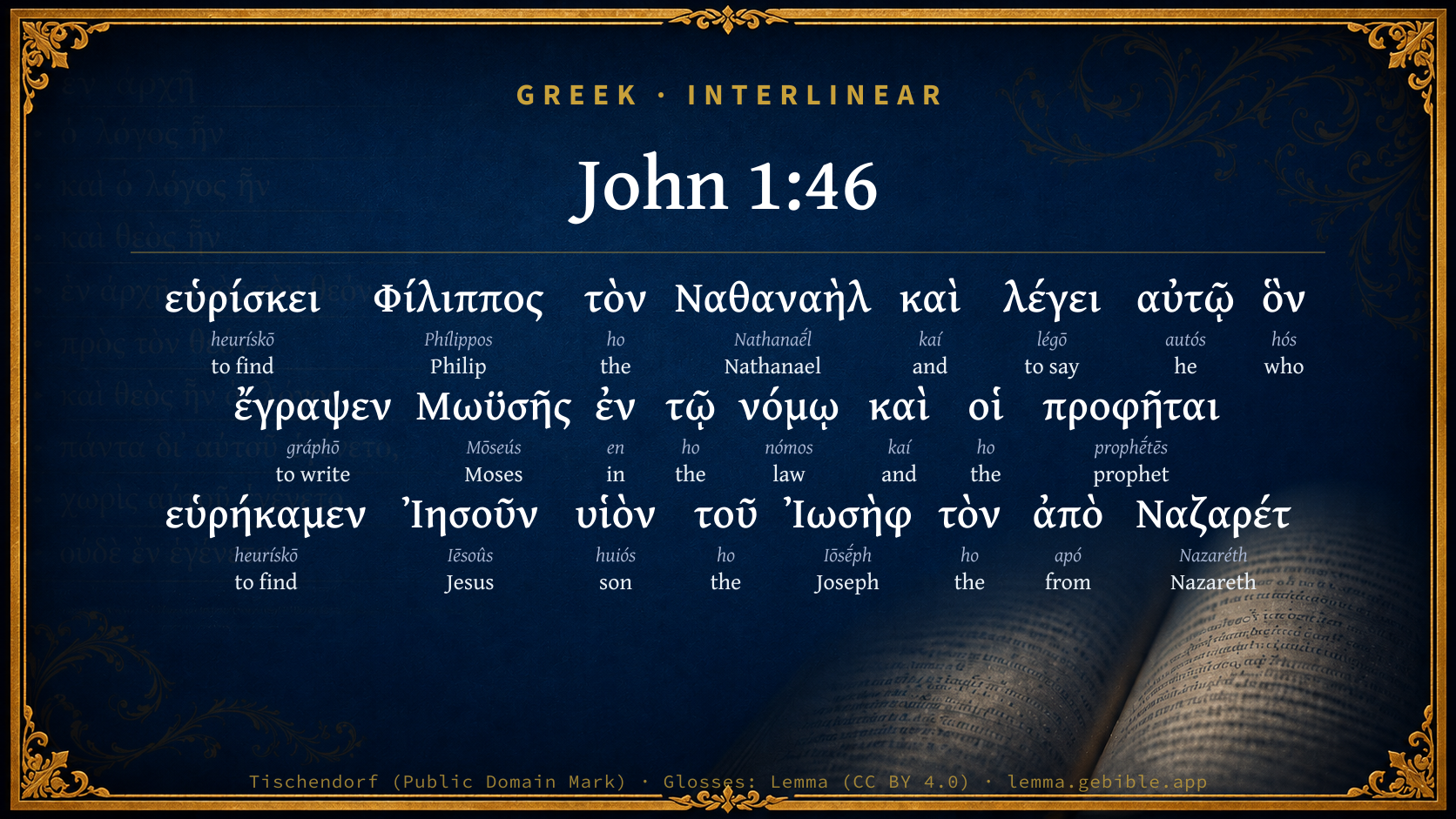
Greek (Tischendorf 8th ed.) John 1:46 appears in the Greek New Testament. The text above is from the Tischendorf 8th edition. Each word links to its Strong’s number and a concise gloss. Click any word for its full Thayer’s Greek Lexicon entry.
Download image
Cite this verse

John 1:46 (World English Bible). Public Domain. Lemma interlinear Bible study tool, https://lemma.gebible.app/v/john/1/46.

Show BibTeX & RIS
BibTeX
RIS
English Translation
Nathanael said to him, "Can any good thing come out of Nazareth?" Philip said to him, "Come and see."
World English Bible · Public Domain
Highlights
  • 1 first appearance in the Greek New Testament
Full analysis ↓
Download a study sheet

One document with this verse’s original text, its word-by-word gloss line, the meaning frame, cross-references with their text, attributed commentary, and full source and license credits — printable, and it pastes into notes with its structure intact.

This verse Autodidact and up

Study sheet (.html) Plain text (.txt)

A passage Seminary Student

Up to 50 verses in one chapter. A passage sheet keeps up to 6 commentary sources and 12 cross-references per verse, in the order this page ranks them, and says so on the sheet whenever that leaves anything out. Ask for a single verse and you get the Autodidact verse sheet above.

Everything on this page stays free to read, with no account — the sheet is a download of what is already on screen, not access to it.

Want to remove ads? Support Godless Engineer
Compare translations 3

The same verse in 3 English versions, stacked beneath the original-language interlinear above. Click any original word for its lexicon entry.

Each is an independent rendering of the whole verse — the interlinear is not word-aligned to these translations.

Highlighted words mark where these versions differ — a whole-verse word diff, not a word-by-word alignment.

  • World English Bible Public Domain
    Nathanael said to him, "Can any good thing come out of Nazareth?" Philip said to him, "Come and see."
  • King James Version Public Domain
    And Nathanael said unto him, Can there any good thing come out of Nazareth? Philip saith unto him, Come and see.
  • unfoldingWord Literal Text CC BY-SA 4.0
    And Nathaniel said to him, “Is any good thing able to be from Nazareth?” Philip says to him, “Come and see.”

unfoldingWord Literal Text — © unfoldingWord, licensed CC BY-SA 4.0. Word-aligned USFM3 via Door43 (git.door43.org/unfoldingWord/en_ult).

Versions to compare (up to 4)

3 of 4 selected

Show all 19 translations

Every available English version of this verse, each an independent rendering of the whole verse.

  • World English Bible Public Domain
    Nathanael said to him, "Can any good thing come out of Nazareth?" Philip said to him, "Come and see."
  • Berean Standard Bible Public Domain
    “Can anything good come from Nazareth?” Nathanael asked. “Come and see,” said Philip.
  • Majority Standard Bible Public Domain
    “Can anything good come from Nazareth?” Nathanael asked. “Come and see,” said Philip.
  • King James Version Public Domain
    And Nathanael said unto him, Can there any good thing come out of Nazareth? Philip saith unto him, Come and see.
  • American Standard Version (1901) Public Domain
    And Nathanael said unto him, Can any good thing come out of Nazareth? Philip saith unto him, Come and see.
  • Revised Version (1885) Public Domain
    And Nathanael said unto him, Can any good thing come out of Nazareth? Philip saith unto him, Come and see.
  • Geneva Bible (1599) Public Domain
    Then Nathanael sayde vnto him, Can there any good thing come out of Nazareth? Philip saide to him, Come, and see.
  • Douay-Rheims (1899) Public Domain
    And Nathanael said to him: Can any thing of good come from Nazareth? Philip saith to him: Come and see.
  • Young's Literal Translation Public Domain
    and Nathanael said to him, `Out of Nazareth is any good thing able to be?' Philip said to him, `Come and see.'
  • Literal Standard Version CC BY-SA 4.0
    And Nathanael said to him, “Is any good thing able to be out of Nazareth?” Philip said to him, “Come and see.”
  • Unlocked Literal Bible CC BY-SA 4.0
    Nathaniel said to him, “Can any good thing come out of Nazareth?” Philip said to him, “Come and see.”
  • unfoldingWord Literal Text CC BY-SA 4.0
    And Nathaniel said to him, “Is any good thing able to be from Nazareth?” Philip says to him, “Come and see.”
  • Darby Bible Public Domain
    And Nathanael said to him, Can anything good come out of Nazareth? Philip says to him, Come and see.
  • World Messianic Bible Public Domain
    Nathanael said to him, “Can any good thing come out of Nazareth?” Philip said to him, “Come and see.”
  • Webster's Bible Public Domain
    And Nathanael said to him, Can there any good thing come out of Nazareth? Philip saith to him, Come and see.
  • Free Bible Version CC BY-SA 4.0
    “From Nazareth? Can anything good come from there?” Nathanael wondered. “Just come and see,” Philip replied.
  • Bible in Basic English Public Domain
    Nazareth! said Nathanael, Is it possible for any good to come out of Nazareth? Philip said to him, Come and see.
  • Text-Critical English NT CC BY 4.0
    Nathanael said to him, “Can anything good come from Nazareth?” Philip said to him, “Come and see.”
  • Tyndale New Testament (1534) Public Domain
    And Nathanael sayde vnto him: can ther eny good thinge come out of Nazareth? Philip sayde to him: come and se.

Literal Standard Version (2020), Covenant Press — licensed CC BY-SA 4.0. Text via the HelloAO Bible API (eBible.org). Unlocked Literal Bible (unfoldingWord) — licensed CC BY-SA 4.0. Text via the HelloAO Bible API (eBible.org). unfoldingWord Literal Text — © unfoldingWord, licensed CC BY-SA 4.0. Word-aligned USFM3 via Door43 (git.door43.org/unfoldingWord/en_ult). Free Bible Version, Dr. Jonathan Gallagher — licensed CC BY-SA 4.0. Text via the HelloAO Bible API (eBible.org).

Word by word

More ways to search: Search by grammar → Find every occurrence → Compare this word →

Practice this passage: Drill this verse → Learn its vocabulary →

Ναθαναὴλ
Nathanaḗl
G3482
“Nathanael”
Noun, Proper, indeclinable
Part of Speech
Noun · Proper, indeclinable
Full Thayer's Definition

Origin: of hebrew origin H5417

TDNT: None

Nathanael = "gift of God" 1. an intimate disciple of Jesus Christ, he is commonly thought to be the same person as Bartholomew
  1. εὑρίσκει heurískō G2147 “to find” Verb, Present, Active, Indicative, 3rd person, Singular
  2. Φίλιππος Phílippos G5376 “Philip” Noun, Nominative, Singular, Masculine
  3. τὸν ho G3588 “the” Article, Accusative, Singular, Masculine
  4. καὶ kaí G2532 “and” Conjunction
  5. λέγει légō G3004 “to say” Verb, Present, Active, Indicative, 3rd person, Singular
  6. αὐτῷ autós G846 “he” Personal pronoun, Dative, Singular, Masculine
  7. ὃν hós G3739 “who” Relative pronoun, Accusative, Singular, Masculine
  8. ἔγραψεν gráphō G1125 “to write” Verb, Aorist, Active, Indicative, 3rd person, Singular
  9. Μωϋσῆς Mōseús G3475 “Moses” Noun, Nominative, Singular, Masculine
  10. ἐν en G1722 “in” Preposition
  11. τῷ ho G3588 “the” Article, Dative, Singular, Masculine
  12. νόμῳ nómos G3551 “law” Noun, Dative, Singular, Masculine
  13. καὶ kaí G2532 “and” Conjunction
  14. οἱ ho G3588 “the” Article, Nominative, Plural, Masculine
  15. προφῆται prophḗtēs G4396 “prophet” Noun, Nominative, Plural, Masculine
  16. εὑρήκαμεν heurískō G2147 “to find” Verb, Perfect, Active, Indicative, 1st person, Plural
  17. Ἰησοῦν Iēsoûs G2424 “Jesus” Noun, Accusative, Singular, Masculine
  18. υἱὸν huiós G5207 “son” Noun, Accusative, Singular, Masculine
  19. τοῦ ho G3588 “the” Article, Genitive, Singular, Masculine
  20. Ἰωσὴφ Iōsḗph G2501 “Joseph” Noun, Proper, indeclinable
  21. τὸν ho G3588 “the” Article, Accusative, Singular, Masculine
  22. ἀπὸ apó G575 “from” Preposition
  23. Ναζαρέτ Nazaréth G3478 “Nazareth” Noun, Proper, indeclinable

About this verse

These counts appear in no published source. They are computed here, from the morphology-tagged text and Lemma’s own curated glosses. What Lemma adds →

24
words
18
distinct lemmas
Gospels
section

Notable vocabulary

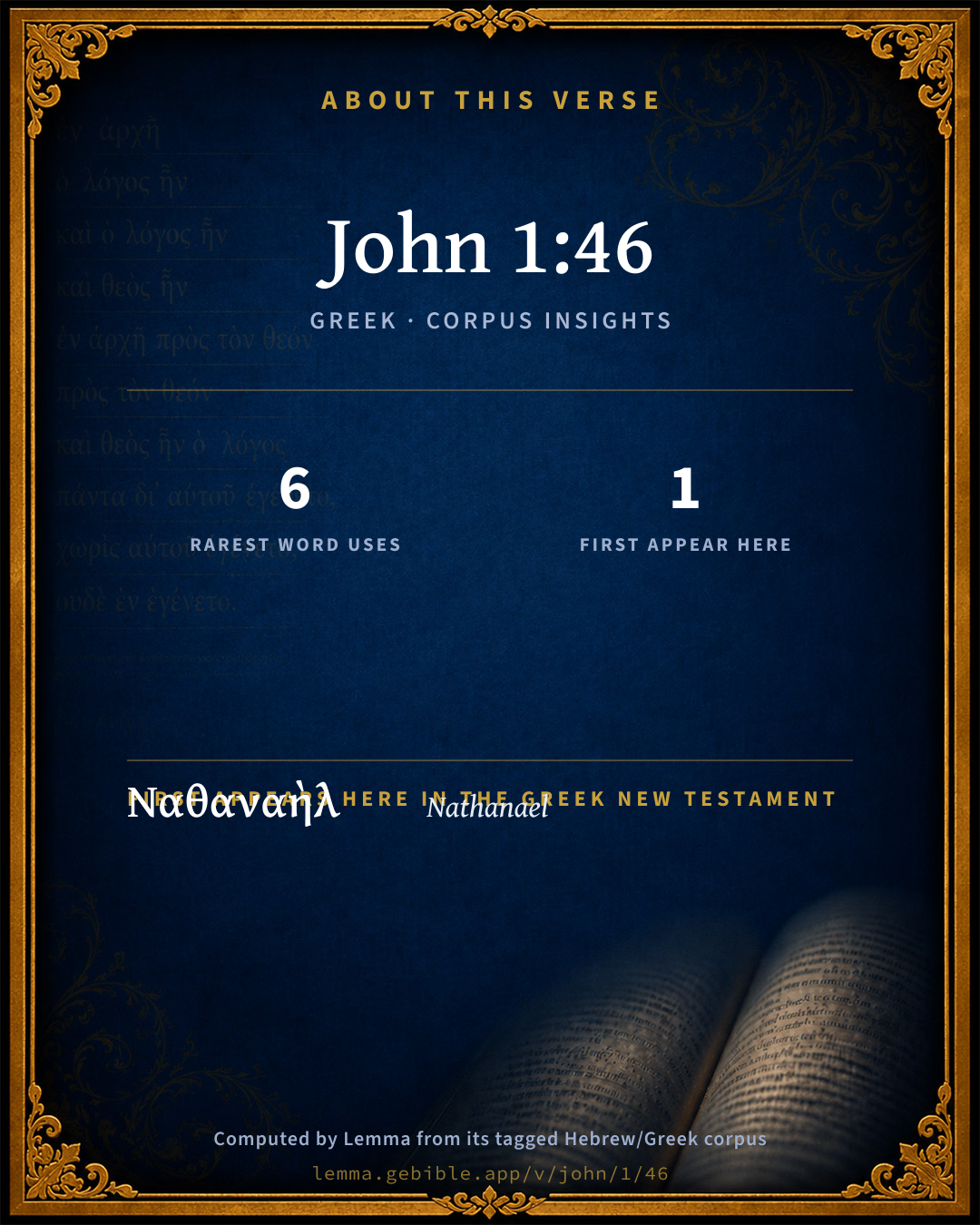
The rarest word here is Ναθαναὴλ Nathanael G3482 — appearing just 6 times in the whole Greek New Testament.

First appearance in Scripture

This word makes its first canonical appearance in the Greek New Testament here:

  • Ναθαναὴλ Nathanael G3482

Shared distinctive vocabulary

Ναθαναὴλ Nathanael G3482 occurs in 6 verses of the Greek New Testament. Also found in:
Repetition

Words recur within this verse:

  • εὑρίσκει to find G2147 ×2
  • τὸν the G3588 ×5
  • καὶ and G2532 ×2

Cross-references

5

Topical passages linked to John 1:46 in the Treasury of Scripture Knowledge — connected by theme and wording, ordered by reader-vote popularity; previews shown in the World English Bible.

  • John 7:52 They answered him, "Are you also from Galilee? Search, and see that no prophet has arisen out of Galilee."
  • John 7:41–42 Others said, "This is the Christ." But some said, "What, does the Christ come out of Galilee?
  • John 4:29 "Come, see a man who told me everything that I did. Can this be the Christ?"
  • 1 Thessalonians 5:21 Test all things, and hold firmly that which is good.
  • Luke 12:57 Why don't you judge for yourselves what is right?

Cross-references courtesy of OpenBible.info (CC BY 4.0).

Commentary

Notes on John 1:46 from classic Christian and Jewish commentators (each source and its license shown beneath its notes). The classic Christian expositions comment on the surrounding passage and are grouped to its opening verse, so a note may address several verses; the Jewish commentaries on the Tanakh (Rashi and others) are per-verse, so they appear only where the commentator wrote on this verse.

Lemma curates 59 commentaries, every one of them public domain or Creative Commons licensed, each selected and text-cleaned for this edition rather than reprinted as found. About our sources →

Tyndale Open Study Notes

Tyndale Open Resources

1:46 Can anything good come from Nazareth? This village was not considered famous enough to be the hometown for a great leader (cp. Matt 13:53-58).

Tyndale Open Study Notes — © Tyndale Open Resources, licensed CC BY-SA 4.0. Text via the HelloAO Bible API.

Bengel's Gnomon

Johann Albrecht Bengel

Joh 1:46. Δύναταί τι) can anything? Therefore there were many worthless characters. Comp. as to that whole region, ch. Joh 7:52, “Search and look; for out of Galilee ariseth no prophet” [the Pharisees to Nicodemus]. Nathanael’s question is however more modest and cautious, than if he categorically denied [that anything good could come from Galilee]. Christ did not owe His excellency to His native land on earth [His excellency was not to be set down to the account of His earthly country]. He came from heaven.—ἀγαθόν, good) But how great a Good, Christ! ch. Joh 7:12, “Some said, He is a good man.”—ἔρχου καὶ ἴδε, come and see) The best remedy against preconceived opinions. What Jesus the day before had replied to the disciples [Joh 1:39], “Come and see”: that now Philip replies to others, Ἴδε, see, i.e. you will see. Often an imperative after an imperative has the force of a future; Gen 17:1, “Walk before Me, and be thou perfect”= and thus thou shall be, Amo 5:4, “Seek ye Me and ye shall live.” See Glass. Phil. Can. xliii, de Verbo.

Bengel's Gnomon of the New Testament — English translation (T&T Clark, Edinburgh, 1860) — public domain. Text from a community e-Sword module.

Meyer's Critical & Exegetical Commentary

Heinrich August Wilhelm Meyer

Joh_1:46. Εὑρίσκει] when and where in the course of the journey we are not told,perhaps at some distance from the road, so that Philip, observing him, quitted the road, and went towards him. According to Ewald, not till after their arrival in the village of Cana, which nevertheless is named for the first time in Joh_2:1, and to which Nathanael belonged (Joh_21:2). The supposition, however, that Nathanael was on his way to Johns baptism (Godet) is quite groundless.

Ναθαναήλ, נְתַנְאֵל, i.e. Theodorus (Num_1:8; 1Ch_2:14), is identical with Bartholomaeus. For, according to this passage, in the midst of calls to the apostleship, comp. Joh_21:2, he appears as one of the twelve; while in the lists of the apostles (Mat_10:3; Luk_6:14; Mar_1:18; Act_1:13), where his name is wanting, we find Bartholomaeus, and placed, moreover, side by side with Philip (only in Act_1:13 with Matthew;[124] comp. Constitt. Apol. vi. 14. 1). This identity is all the more probable, because Bartholomew is only a patronymic, and must have become the ordinary name of the individual, and that in most frequent use; and thus it came to pass that his own distinctive name does not appear in the synoptic narrative.

ὃν ἔγραψε] of whom, etc. See on Rom_10:5

Μωϋσῆς] Deu_18:15, and generally in his Messianic references and types. See on Joh_1:46.

ΤῸΝ ἈΠῸ ΝΑΖΑΡΈΤ] for Nazareth, where Jesus had lived with His parents from infancy upwards, passed for His birth-place. Philip may have obtained his knowledge from Andrew and Peter, or even from Jesus Himself, who had no occasion at this time to state more fully and minutely his relation to Nazareth; while the τὸν υἱὸν τοῦ Ἰωσήφ, which must rest upon a communication from Jesus, leaves His divine Sonship undisturbed. To attribute to Philip knowledge of the facts of the case with regard to both points (Hengstenberg) is in itself improbable, and is not in keeping with the simplicity of his words. But it is a groundless assumption to suppose that John knew nothing of the birth at Bethlehem; for it is Philips own words that he records (against Strauss, De Wette). See on Joh_7:41.

[124] Hilgenfeld regarded him as identical with Matthew; but how much opposed is this view to the history of Matthews call! though the meaning of his name is not different from that of Matthews. Very recently, however, Hilgenfeld has supposed that the name answers to the Matthias who was appointed in the place of Judas (N. T. extra canon. IV. p. 105). Schleiermacher, L. J. p. 368, considers it very doubtful whether Nathanael belonged to the twelve at all. Chrysostom, Augustine, and others, long ago denied that he did, but this is already assumed in the duae viae (Hilgenfeld, N. T. extra canon. IV.). According to Spaeth, in Hilgenfelds Zeitschrift, 1868, p. 168 ff., Nathanael is to be taken as a symbolical name, invented by the writer, under which the Apostle John himself is said to be represented. The author of the Appendix, chap. Joh_21:2, where Nathanael is expressly distinguished from the sons of Zebedee, is said to have made a mistake.

Meyer — Critical and Exegetical Commentary on the New Testament — English translation by Peter Christie, edited by Frederick Crombie (T&T Clark, 1880) — public domain. Text from a community e-Sword module.

Expositor's Greek Testament

ed. W. Robertson Nicoll

Joh 1:46 . εὑρίσκει … Ναζαρέτ . Philip in turn finds Nathanael, probably on the road from the Bethany ford homewards. Nathanael is probably the same person as is spoken of in the Synoptical Gospels as Bartholomew, i.e. , Bar Tolmai, son of Ptolemy. This is usually inferred from the following: (1) Both here and in chap. Joh 21:2 he is classed with apostles; (2) in the lists of apostles given in the Synoptical Gospels Bartholomew is coupled with Philip; (3) while Nathanael is never mentioned by the Synoptists, Bartholomew is not mentioned by John. The two names might quite well belong to one man, Bartholomew being a patronymic. Nathanael means “God’s gift,” Theodore, or, like Augustine’s son, Adeodatus. Philip announces the discovery in the words ὃν ἔγραψεν … Ναζαρέτ . On which Calvin remarks: “Quam tenuis fuerit modulus fidei in Philippo hinc patet, quod de Christo quatuor verba profari nequit, quin duos crassos errores permisceat. Facit ilium filium Joseph, et patriam Nazareth falso illi assignat.” This is too stringent. He draws the conclusion that where there is a sincere purpose to do good and to proclaim Christ, success will follow even where there is error. Nazareth lies due west from the south end of the Sea of Galilee, and about midway between it and the Mediterranean.

The Expositor's Greek Testament, edited by W. Robertson Nicoll (1897–1910) — public domain. Text from a community e-Sword module.

Geneva Bible (1599)

Geneva Bible translators

We must especially take heed of false presumptions, which shut up against us the entrance to Christ.

Geneva Bible (1599) marginal notes — public domain. Text via Bolls.life.

Jamieson, Fausset & Brown

Robert Jamieson, A. R. Fausset & David Brown

any good out of Nazareth--remembering Bethlehem, perhaps, as Messiah's predicted birthplace, and Nazareth having no express prophetic place at all, besides being in no repute. The question sprang from mere dread of mistake in a matter so vital.

Come and see--Noble remedy against preconceived opinions [BENGEL]. Philip, though he could not perhaps solve his difficulty, could show him how to get rid of it. (See on Joh 6:68).

Jamieson, Fausset & Brown — Commentary Critical and Explanatory on the Whole Bible (1871) — public domain (CC PDM 1.0). Text via the HelloAO Bible API.

Adam Clarke's Commentary

Verse 46. Can there any good thing come out of Nazareth?] Bp. Pearce supposes that the τι αγαθον of the evangelist has some particular force in it: for, in Jer 33:14, God says, I will perform that good thing which I promised, c. and this, in Jer 33:15 is explained to mean, his causing the branch of righteousness (i.e. the Messiah) to grow up unto David, from whom Jesus was descended: in this view, Nathanael's question seems to imply, that not Nazareth, but Bethlehem, was to be the birth-place of the Messiah, according to what the chief priests and scribes had determined, Mt 2:4-6. If this conjecture be not thought solid, we may suppose that Nazareth, at this time, was become so abandoned that no good could be expected from any of those who dwelt in it, and that its wickedness had passed into a proverb: Can any thing good be found in Nazareth? Or, that the question is illiberal, and full of national prejudice.

Come and see.] He who candidly examines the evidences of the religion of Christ will infallibly become a believer. No history ever published among men has so many external and internal proofs of authenticity as this has. A man should judge of nothing by first appearances, or human prejudices. Who are they who cry out, The Bible is a fable? Those who have never read it, or read it only with the fixed purpose to gainsay it. I once met with a person who professed to disbelieve every tittle of the New Testament, a chapter of which, he acknowledged, he had never read. I asked him, had he ever read the Old? He answered, No! And yet this man had the assurance to reject the whole as an imposture! God has mercy on those whose ignorance leads them to form prejudices against the truth; but he confounds those who take them up through envy and malice, and endeavour to communicate them to others.

Adam Clarke's Commentary on the Bible (1810–1826) — public domain. Text from a community e-Sword/MySword module.

John Calvin's Commentaries

46. Can any good thing come out of Nazareth? At first, Nathanael refuses, the place of Christ’s nativity (as described by Philip) having given him offense. But, first of all, he is deceived by the inconsiderate discourse of Philip; for what Philip foolishly believed Nathanael receives as certain. Next, there is added a foolish judgment arising from hatred or contempt of the place. Both of these points ought to be carefully observed by us. This holy man was not far from shutting out against himself all approach to Christ. Why was this? Because he rashly believes what Philip spoke incorrectly about Christ; and next, because his mind was under the influence of a preconceived opinion that no good thing could come out of Nazareth. If then we are not carefully on our guard, we shall be liable to the same danger; and Satan labors every day, by similar obstacles, to hinder us from coming to Christ; for he has the dexterity to spread many falsehoods, the tendency of which is to excite our hatred or suspicion against the Gospel, that we may not venture to taste it. And next, he ceases not to try another method, namely, to make us look on Christ with contempt; for we see how many there are who take offense at the degradation of the cross, which appears both in Christ the head and in his members. But as we can hardly be so cautious as not to be tempted by those stratagems of Satan, let us at least remember immediately this caution:

Come and see. Nathanael allowed his twofold error to be corrected by this expression which Philip uttered. Following his example, let us first show ourselves to be submissive and obedient; and next, let us not shrink from inquiry, when Christ himself is ready to remove the doubts which harass us. Those who read these words not as a question, but as an affirmation, Some good thing may come out of Nazareth, are greatly mistaken. For, in the first place, how trivial would such an observation be? And next, we know that the city Nazareth was not at that time held in estimation; and Philip’s reply shows plainly enough that it was expressive of hesitation and distrust.

John Calvin's Commentaries (1540-1563) — public domain. Text from the Calvin Translation Society English edition (1840s-50s) via the Christian Classics Ethereal Library (ccel.org). Calvin's coverage is partial (roughly two-thirds of the Bible); uncommented books and verses are honest gaps, never fabricated. The 19th-century editor's footnotes and remarks are omitted so the notes are faithfully Calvin's own voice.

Ellicott's Commentary for English Readers

(46) The question is not, “Can the Messiah come out of Nazareth,” but “Can there any good thing come?” The question is asked by an inhabitant of a neighbouring village who looks upon the familiar town with something of local jealousy and scorn; but the form of the question would seem to point to an ill repute in reference to its people. The place is unknown to earlier history, and is not mentioned even in Josephus; but what we find in Mar_6:6 and Luk_4:29 agrees with Nathanael’s opinion. (For account of the town, comp. Note on Luk_1:26.)

Come and see expresses the fulness of his own conviction. An interview had brought certainty to his own mind. It would do so likewise to that of his friend.

A Bible Commentary for English Readers, edited by Charles John Ellicott (1878–1897) — public domain. Text from a community e-Sword module.

The Cambridge Bible for Schools and Colleges

gen. ed. J. J. S. Perowne

46. Can there any good thing, &c.] All Galileans were despised for their want of culture, their rude dialect, and contact with Gentiles. They were to the Jews what Bœotians were to the Athenians. But here it is a Galilean who reproaches Nazareth in particular. Apart from the Gospels we know nothing to the discredit of Nazareth; neither in O.T. nor in Josephus is it mentioned; but what we are told of the people by the Evangelists is mostly bad. Christ left them and preferred to dwell at Capernaum (Mat_4:13); He could do very little among them, ‘because of their unbelief’ (Mat_13:58), which was such as to make Him marvel (Mar_6:6); and once they tried to kill Him (Luk_4:29). S. Augustine would omit the question. Nathanael ‘who knew the Scriptures excellently well, when he heard the name Nazareth, was filled with hope, and said, From Nazareth something good can come.’ But this is not probable. Possibly he meant no more than ‘Can any good thing come out of despised Galilee?’ Nazareth being in Galilee.

Come and see] The best cure for ill-founded prejudice. Philip shews the depth of his own conviction in suggesting this test, which seems to have been in harmony with the practical bent of his own mind. See on Joh_12:21 and Joh_14:8.

The Cambridge Bible for Schools and Colleges (gen. ed. J. J. S. Perowne; Cambridge University Press, 1878–1918) — public domain. Text from a community e-Sword module.

John Gill's Exposition

And Nathanael said unto him,.... Taking notice of, and laying hold on what Philip said, that he was of Nazareth, which at once stumbled, and prejudiced him against Jesus being the Messiah; knowing very well that Bethlehem was to be the place of his birth:

can there any good thing come out of Nazareth? The whole country of Galilee was had in contempt with the Jews; but Nazareth was so mean a place, that it seems it was even despised by its neighbours, by the Galilaeans themselves; for Nathanael was a Galilean, that said these words. It was so miserable a place that he could hardly think that any sort of good thing, even any worldly good thing, could come from thence; and it was so wicked, as appears from their murderous designs upon our Lord, that he thought no good man could arise from hence; and still less, any prophet, any person of great note; and still least of all, that that good thing, or person, the Messiah, should spring from it: so that his objection, and prejudice, proceeded not only upon the oracle in Mic 5:2, which points out Bethlehem as the birthplace of the Messiah; but upon the wickedness, and meanness, and obscurity of Nazareth,

Philip saith unto him, come and see; who though he might not be master of this point, and knew not how to solve this difficulty, and remove this prejudice from Nathanael's mind, yet persuades him to go with him to Jesus; who, he doubted not, would give him full satisfaction in this, and all other points; and then it would most clearly appear to him, as it had done to him, that he was the true Messiah. The phrase, , "come, see", is often used in the book of Zohar (q): so it is, and likewise, , "come and see", in the Talmudic writings (r),

(q) In Gen. fol. 13. 1. & 14. 3. & 16. 1, 2. & in Exod. fol. 83. 4. & passim. (r) T. Bab. Taanith, fol. 8. 1. & 23. 2. & 24. 1. Kiddushin, fol. 20. 1. & 33. 1. & Sota, fol. 5. 1, 2. & passim.

John Gill's Exposition of the Whole Bible (1746–1763) — public domain (CC PDM 1.0). Text via the HelloAO Bible API.

Trapp's Complete Commentary

John Trapp

46 And Nathanael said unto him, Can there any good thing come out of Nazareth? Philip saith unto him, Come and see.

Ver. 46. Can there any good, &c.] When men take a toy in their heads against a place or person, they are ready to reason in this manner. Good Nathanael was in the common error, as was likewise Philip, in the former verse, with his Jesus of Nazareth, the son of Joseph. Four words only, and scarcely ever a true one. Epidemic diseases are soon caught.

John Trapp, A Commentary or Exposition upon All the Books of the Old and New Testament (1647–1656) — public domain. Text from a community e-Sword module.

Albert Barnes' Notes on the Bible

Can any good thing ... - The character of Nazareth was proverbially bad. To be a Galilean or a Nazarene was an expression of decided contempt, Joh 7:52. See the notes at Mat 2:23. Nathanael asked, therefore, whether it was possible that the Messiah should come from a place proverbially wicked. This was a mode of judging in the case not uncommon. It is not by examining evidence, but by prejudice. Many persons suffer their minds to be filled with prejudice against religion, and then pronounce at once without examination. They refuse to examine the subject, for they have set it down that it cannot be true. It matters not where a teacher comes from, or what is the place of his birth, provided he be authorized of God and qualified for his work.

Come and see - This was the best way to answer Nathanael. He did not sit down to reason with him, or speculate about the possibility that a good thing could come from Nazareth; but he asked him to go and examine for himself, to see the Lord Jesus, to hear him converse, to lay aside his prejudice, and to judge from a fair and candid personal inquiry. So we should beseech sinners to lay aside their prejudices against religion, and “to be Christians,” and thus make trial for themselves. If men can be persuaded to come to Jesus, all their petty and foolish objections against religion will vanish. They will be satisfied from their own experience that it is true, and in this way only will they ever be satisfied.

Albert Barnes' Notes on the Bible (1834–1885) — public domain. Text from a community e-Sword/MySword module.

Haydock's Catholic Bible Commentary

Can any thing of good come from Nazareth? Nathanael did not think it consistent with the predictions of the prophets, that the Messias, who was to be the Son of David, and to be born at Bethlehem, should be of the town of Nazareth; which he did not imagine could be the place of Jesus’s birth. But when he came to Jesus, and found that he knew the truth of things done in private, and in his absence, he professed his belief in Jesus in these words: Rabbi, thou art the Son of God, thou art the king of Israel. We may here take notice, with Dr. Pearson, on the second article of the Creed, that the Jews, before the coming of Christ, were convinced that he was to be the Son of God; (though they have denied it since that time) for they interpreted, as foretold of their Messias, these words: (Psalm ii. 7.) The Lord said to me, thou art my Son, this day have I begotten thee: and this is what Nathanael here confessed. The same is confirmed by the famous confession of St. Peter, (Matthew xvi. 16.) Thou art the Christ, the Son of the living God; by the words of Martha, (John xi. 27.) I have believed that thou art the Christ, the Son of the living God, who art come into the world: In fine, by the question which the Jewish priest put to our Saviour, (Matthew xxvi. 63.) I adjure thee by the living God, that thou tell us whether thou be the Christ the Son of God. See also John vi. 17. and John xx. 31. (Witham)

George Leo Haydock (1774–1849), Haydock's Catholic Family Bible and Commentary, 1859 edition — public domain. Excludes Psalms (Douay-Rheims chapter numbering differs from Protestant) and Deuterocanonical books (Catholic canon only).

Matthew Poole's English Annotations

The words of Philip begat a prejudice in Nathanael, as to what he said. It was prophesied, Mic 5:2, that the Messiah should come out of Bethlehem. So, Joh 7:41,42, some of the people said, Shall Christ come out of Galilee? Hath not the Scripture said, That Christ cometh of the seed of David, and out of the town of Bethlehem, where David was? Nazareth was not only a poor little place, (for so Bethlehem also was), but a place which the Scripture never mentioned as the place from whence the Messiah should arise; a place that God had not honoured with the production of a prophet. By

any good thing seems to be meant, the Messiah, or any prophet, or (more generally) any thing which is noble and excellent, and of any remark. So prone are we to think that the kingdom of God comes with observation, that we know not how to fancy how great things should be done by little means, and great persons should arise out of little, contemptible places. Whereas God chooseth the foolish things of the world to confound the wise; and the weak things to confound the mighty; and base things of the world, to confound the wise, 1Co 1:25-28.

Philip saith unto him, Come and see; Philip, not knowing how to answer Nathanael’s objection, and to remove his prejudice, wishes him himself to go, and make up a judgment. Wise men ought to do this, and not to take up prejudices from reports and common vogue.

Matthew Poole's English Annotations on the Holy Bible (1683–1685) — public domain. Text from a community e-Sword/MySword module.

Whedon's Commentary on the Bible

Daniel D. Whedon

46. Good thing… out of Nazareth—Some object that there is no proof of any special stigma adhering to Nazareth; and hence apologists have endeavoured to explain these words as simply referring to the insignificance of Nazareth as a very small unknown town. We should rather reply, that the passage itself is ample proof of a contempt attaching to Nazareth. How much know we of any ancient Nazareth at all without the Gospels? It may have had a generally bad reputation; or it may have merely suffered the odium which Nathanael’s neighbouring little town of Cana, with the usual jealousy of rival villages, attached to it.

Daniel D. Whedon (gen. ed.), Commentary on the Old and New Testaments (1874–1909) — public domain. Text from a community e-Sword module.

The Pulpit Commentary

Vers. 46-49. (c) The Son of God and King of Israel.

And Nathanael said to him, Can any good thing come out of Nazareth? The ordinary interpretations of the meaning of this question are not satisfactory.

(1) The prejudice against Nazareth as being a Galilean town cannot have weighed with Nathanael of Cane in Galilee, (Joh_21:2) even though he may have shared the ignorant opinion that "out of Galilee ariseth no prophet". (Joh_7:52) He might have known that Jonah, Hosea, Nahum, probably Elijah, Elisha, and Amos, were Galileans.

(2) That Nazareth was a secluded and contemptible village seems disproved by the interesting papers of Dr. Selah Merrill, on "Galilee in the Time of our Lord," Amer. Bibl. Sacra., January and April, 1874.

(3) That the character of its people should have been jealous, turbulent, capricious, and led to our Lord"s subsequent preference for Capernaum, does not explain the force of the inquiry. The "good thing" may, however, be the contrast between the unimportance of the place in the political or religious history of the people, as compared with Jerusalem, Tiberias, Jericho, Bethlehem. It is never mentioned in the Old Testament or in Josephus. Nathanael may have known its mediocrity, and have been startled by the possibility of a carpenter"s son, in a spot utterly undistinguished, being the Messiah of whom their sacred writers spoke. "Despised Nazareth" is a phrase rather due to the splendour of the flower that grew upon its barren soil, and became contrasted afterwards with the unlooked for glory and claims of the Nazarene. Philip saith unto him, Come and see. This was his strongest argument. To look upon him is to believe. He had much more to learn in after days. (Joh_14:8, Joh_14:9) At this moment he and Nathanael stood on ground consecrated by ancient history, and thrilling with the thunder peals of the Baptist, mazed and wistful from much longing, thinking of the union between heaven and earth which had been revealed in the experience of ancient prophets, dwelling on the careers of Israel, Moses, and Elijah in their rapt transports, musing under fig trees or the like, and longing for the great King. He may naturally have reasoned on this wise: "Can it be true that the Christ, the King of Israel, the Lord of the temple, the Baptizer with the Holy Ghost, is indistinguishable from the rest of mankind in this very crowd? Would that I too might see in him, as John has done, some vision of the opened heaven, that I too might hear some unmistakable voice!" If these were the musings of Nathanael and surely there is not a trace of unreason in such meditations in the breast of a disciple of the Baptist the conversation which follows is more easy to understand.

"Come and see!

This was the proper counsel for Philip to give to Nathanael, and for every true friend to give to the man whose mind is possessed with incredulity or with prejudice regarding Christ and his claims. Reasoning is very well; but an appeal to personal experience is in many cases far better. Many a man will draw a just inference for himself, which he will not allow another man to draw for him. In giving this advice Philip showed his knowledge of human nature.

I COME AND SEE WHAT CHRIST IS. There are many persons who are indifferent to the Saviour only because they do not know him because he is to them nothing but a name.

1. Study the record of his earthly ministry, and you will find that his character and life possess a peerless interest. Few have really read and studied the four Gospels without feeling themselves brought into contact with a Being altogether unrivalled in human history for qualities of the spiritual nature, for profundity of moral teaching, for self-sacrificing benevolence. And many have, by such study, been brought under a spell for which no ordinary principles could account, and have felt, not only that no personage in human history can rank with Christ, but that none cart even be compared with him.

2. Ponder the character, the claims, the acknowledged work, of Christ, and you will be convinced of his Divine nature and authority. Men who judge of him by hearsay, or by their own preconceptions, may think of Jesus as of an ordinary man; but this is not the case with those who "come and see," who allow him to make his own impression upon their minds. Such are found exclaiming, with the officers, "Never man spake like this Man!" with the disciples, "What manner of Man is this!" with Peter, "Thou art the Christ!" with this very Nathanael, to whom the words of the text were addressed, "Thou art the Son of God; thou art the King of Israel!" with the centurion at the Crucifixion, "Truly this was a righteous Man, this was the Son of God!

II COME AND SEE WHAT CHRIST HAS DONE.

1. This test a very reasonable one may be applied in individual cases. What did Christ effect for Saul of Tarsus? Did he not change him from a zealous and narrow formalist into a man whose name has become the synonym for spirituality of religion, for breadth and catholicity of doctrine, for grandeur of plan and of hope with regard to this ransomed humanity? Did he not find Augustine a wilful and pleasure-seeking young man, who almost broke a pious mother"s heart? and did he not transform him into a penitent, a saint, a mighty theologian, a holy power in the realm of human thought? What did Christ do for Luther? He visited him when he was depressed and hopeless because of the conscience of sin, spoke to him the word of peace, called and strengthened him to become the Reformer of half Christendom, the founder of an epoch of light and liberty for mankind. Such instances, to be found in the annals of the illustrious and influential among men, might be multiplied. But it is not only over the great and famous that the Divine Jesus has exercised his power. Among the poorest, the meanest, the feeblest, nay, the vilest, he has proved himself to be the Friend of sinners and the Brother of man. There is no circle of society in any Christian land where evidences of this kind do not abound. You need not go far to see what the Lord Christ can do; this you may learn at your own doors, and every day.

2. But the educated and well informed have within their reach a wider range of proof. The history of Christendom is written in a vast, an open book a book which the intelligent, and those capable of taking a wide survey of human affairs, are at liberty to read. Secular historians have traced the influence of Christianity upon society, upon the code of morals, upon slavery, upon war, upon the position of woman in society, upon the education of the young, upon the treatment of the poor, the sick, the afflicted. No doubt, exaggeration has often distinguished the treatment of these matters by Christian advocates. Yet, in all fairness and candour, it must be admitted that a contrast between unchristian and Christian society yields results immensely in favour of our religion. Christ has been the chief Benefactor of the human race, has done more than any beside to ameliorate and to improve the conditions and to brighten the prospects of mankind.

III COME AND SEE WHAT CHRIST WILL DO FOR YOU. This is not a matter of speculation, but of practical moment and interest. It is well to form a just estimate of the character, the mission, the work, of the Son of God. But it is better to take the benefit which he offers to every believing hearer of his gospel.

1. See whether he can give you peace of conscience, by securing to you the pardon of sin, and acceptance with the God against whom you have sinned. This he professes to do; this multitudes will assure you he has done for them. If this is with you an urgent need, will it not be reasonable to put Christ to that test of experience to which he invites you?

2. See whether he can supply you with the highest law and the most sacred motive for the moral life. All human standards are imperfect, and no human principle is sufficient to ensure obedience. What no other can offer, the Saviour claims to impart, and it is reasonable to test his ability and his willingness to fulfil his promises.

3. See whether his fellowship and friendship can uphold and cheer you amidst the sorrows, temptations, and uncertainties of this earthly life. He says, "My grace is sufficient for you." Verify the assertion in your own experience. If he cannot supply this want, certain it is that none else can do so.

4. See whether the Lord Christ can vanquish death for you, and give you the assurance of a blessed immortality. Apart from him, the future is very dark; try his power to illumine that darkness with rays of heavenly light.

APPLICATION.

1. Defenders and promulgators of Christianity will do well to address to their fellow men the invitation Philip addressed to Nathanael. If they cannot always answer men"s cavils and objections, and satisfy men"s intellectual difficulties, they can bring men face to face with Christ himself, and leave the interview to produce its own effects. Let men be encouraged to come, to see, and to judge for themselves.

2. The undecided hearers of the gospel may well accept the challenge here given. Why should they shrink from it? It is an opportunity which should not be neglected, an invitation which should not he refused. T.

The Pulpit Commentary (1880–1919), ed. H.D.M. Spence-Jones & Joseph S. Exell — public domain. Text from a community e-Sword module.

John Wesley's Explanatory Notes

Can any good thing come out of Nazareth? - How cautiously should we guard against popular prejudices? When these had once possessed so honest a heart as that of Nathanael, they led him to suspect the blessed Jesus himself for an impostor, because he had been brought up at Nazareth. But his integrity prevailed over that foolish bias, and laid him open to the force of evidence, which a candid inquirer will always be glad to admit, even when it brings the most unexpected discoveries. Can any good thing - That is, have we ground from Scripture to expect the Messiah, or any eminent prophet from Nazareth? Philip saith, Come and see - The same answer which he had received himself from our Lord the day before.

John Wesley, Explanatory Notes Upon the Whole Bible (1754–1765) — public domain. Text via the GEBible commentary corpus.

The People's New Testament

B. W. Johnson

46. Come and see. That is the best answer to the skeptic. Bring him to Christ, let him consider him, and what he has done for mankind. The strongest proof that Jesus is the Christ is Jesus himself.

B. W. Johnson's The People's New Testament with Notes (1889–1891) — public domain. Electronic text from the Christian Classics Ethereal Library (CCEL) ThML edition.

unfoldingWord translationNotes

Door43 World Missions Community

Nathaniel said to him

"Nathaniel said to Philip"

Can any good thing come out of Nazareth?

This remark appears in the form of a question in order to add emphasis. AT: "No good thing can come out of Nazareth!" (See: Rhetorical Question)

in whom is no deceit

This can be stated in a positive way. AT: "a completely truthful man" (See: Litotes)

translationWords

Israel

deceive

fig

unfoldingWord translationNotes — © Distant Shores Media and the Door43 World Missions Community, licensed CC BY-SA 4.0. Source: git.door43.org/Door43/en_tn.

Cambridge Greek Testament for Schools and Colleges

46. εὑρίσκει Φ. Thus the spiritual λαμπαδηφορία proceeds: the receivers of the sacred light hand it on to others, Et quasi cursores vitai lampada tradunt (Lucr. ii. 77).

Ναθαναήλ = ‘Gift of God.’ The name occurs Num 1:8; 1Ch 2:14; 1Es 1:9; 1Es 9:22. Nathanael is commonly identified with Bartholomew; (1) Bartholomew is only a patronymic and the bearer would be likely to have another name (comp. Barjona of Simon, Barnabas of Joses); (2) S. John never mentions Bartholomew, the Synoptists never mention Nathanael; (3) the Synoptists in their lists place Bartholomew next to Philip, as James next his probable caller John, and Peter (in Matt. and Luke) next his caller Andrew; (4) all the other disciples mentioned in this chapter become Apostles, and none are so highly commended as Nathanael; (5) all Nathanael’s companions named in Joh 21:2 were Apostles (see note there). But all these reasons do not make the identification more than probable. The framers of our Liturgy do not countenance the identification: this passage appears neither as the Gospel nor as a Lesson for S. Bartholomew’s Day.

ὃν ἔγραψεν Μ. κ.τ.λ. Luthardt contrasts this elaborate profession with the simple declaration of Andrew (Joh 1:42). The divisions of the O.T. here given are quite in harmony with Jewish phraseology. Moses wrote of Him not merely in Deu 18:15, but in all the various Messianic types and promises.

τοῦ Ἰωσὴφ τ. ἀπὸ Ν. The words are Philip’s, and express the common contemporary belief about Jesus. As His home was there, τὸν ἀπὸ Ναζαρέτ was both natural and true: and τοῦ Ἰωσὴφ was natural enough, if untrue. That the Evangelist is ignorant of the birth at Bethlehem, or of its miraculous character, in no way follows from this passage. Rather he is an honest historian, who records exactly what was said, without alterations or additions of his own. “Here we observe for the first time a peculiarity in the narrative of S. John. It seems that the author takes pleasure in recalling certain objections to the Messianic dignity of Jesus, leaving them without reply, because every one acquainted with the Gospel history made short work of them at once; comp. Joh 7:27; Joh 7:35; Joh 7:42, &c.” (Godet.)

Cambridge Greek Testament for Schools and Colleges (Cambridge University Press, 1896; 21 vols, various authors incl. Carr, Maclear, Plummer, Farrar, Lumby, Moule, M. R. James, Simcox) — public domain. Text from a community e-Sword module.

Alford’s Greek Testament

Henry Alford

46.] It does not appear where Nathanael was found: but he is described, ch. 21:2, as ὁ ἀπὸ Κανᾶ τῆς Γαλιλαίας: and as we find Jesus there, ch. 2:1, it is probable the call may have taken place in its neighbourhood. Nathanael (“נְהַנְאֵל, i. q. Θεόδωρος, gift of God.” Wordsw.) is mentioned only in these two places. From them we should gather that he was an Apostle; and as his name is no where found in the catalogues of the Twelve, but Philip is associated in three of them (Mat 10:3: Mar 3:18: Luk 6:14) with Bartholomew, it has been supposed that Nathanael and Bartholomew were the same person (see note on Mat 10:3). This is however mere conjecture.

Μωυσῆς ἐν τ. ν., probably in Deu 18:15; but also in the promises to Abraham, Gen 17:7 al.: and in the prophecy of Jacob, Gen 49:10, and the Prophets, passim: see the reff. in E. V.

τὸν υἱὸν τοῦ Ἰωσ. τ. ἀπὸ .] This expression seems to shew previous acquaintance on the part of Philip with Jesus. No stress can be laid, as has been most unfairly done by Lücke, De Wette, and others, on Jesus being called by Philip, the son of Joseph, as indicating that the history of His birth and childhood, as related by Matt. and Luke, was unknown to John. Philip expresses what was the prevailing belief, in the ordinary words, as Olshausen remarks. In an admirable note, Leben Jesu, p. 23 ff., Neander remarks, that by combining the two declarations of John, that in Jesus the Eternal Word of God became flesh (ver. 14), and that ‘that which is born of the flesh is flesh’ (ch. 3:6), we cannot escape the inference, that a supernatural working of God in the conception of the Man Christ Jesus is implied.

Henry Alford, The Greek Testament (1849–1861) — public domain. Text from a community e-Sword module.

International Critical Commentary

46. Nathanael’s rejoinder has been taken by some to be a meditative comment on what Philip has said rather than a question, viz. “Some good might come out of Nazareth.” But the order of the words is in favour of it being taken interrogatively, “Can any good thing come out of Nazareth?” Nazareth is not mentioned in the O.T., so that there was nothing to connect the place with the prophecies of Messiah. See on 7:41, 52. But Nathanael’s question has something of scorn in it, as if Nazareth had a bad name; however, of this there is no evidence. Nathanael was of Cana, and the rivalry between neighbouring villages might account for his expression of incredulity as to Nazareth being a prophet’s home. That he does not seem to have heard of Jesus before shows how retired His life had been before He began His public ministry.

International Critical Commentary — older volumes (1896–1929), various authors — public domain. Text from a community e-Sword module.

Godet's Commentaries

Frédéric Louis Godet

Vv. 46: “Philip finds Nathanael and says to him: We have found Him of whom Moses, in the law, and the prophets did write, Jesus, the son of Joseph, of Nazareth.”

Philip’s part in the calling of Nathanael is like that of Andrew in the calling of Peter, and that of Peter and Andrew in his own. One lighted torch serves to light another; thus faith propagates itself. Luthardt sets forth finely the heavy and complicated form of Philip’s profession; those long preliminary considerations, that full and formal Messianic certificate, which is in contrast with the lively and unconstrained style of Andrew’s profession (Joh 1:42). The same traits of character are met with again in the two disciples in Joh 6:1-13, and perhaps also in Joh 12:21-22. From the fact that Philip designates Jesus as the son of Joseph, and as a native of Nazareth, Strauss, de Wette, and others, conclude that the fourth evangelist either was ignorant of, or did not admit, the miraculous origin of Jesus and His birth at Bethlehem; as if it were the evangelist who was here speaking, and not Philip! And that disciple, after exchanging ten words with Jesus, must have been already thoroughly acquainted with the most private circumstances of His birth and infancy! Is it Andrew and Peter who must have informed him of them?

But whence could they have got the knowledge of them themselves? Or Jesus? We must suppose, then, that this was the first thing that Jesus hastened to communicate to them: that He was not the son of the man who was said to be His father, that He was miraculously born! How criticism can become foolish, through its desire of being sagacious! The place where Nathanael was met by Jesus and His disciples, when returning to Galilee, is not pointed out. The most probable supposition is, that they met each other in the course of the journey. Philip, who was his fellow-citizen—Nathanael was also of Cana (Joh 21:2)—became the connecting-link between him and Jesus. We may suppose that Nathanael was returning home from the presence of John the Baptist, or that, like all his pious fellow-countrymen, he was going to be baptized by him. At all events, he had just rested for a few moments in the shade of a fig-tree, when he met Jesus and His companions (comp. Joh 1:48).

Ewald wrongly supposes the meeting to have taken place at Cana. The circumstantial account of the calling of Nathanael leads us to believe that he afterwards became one of the apostles: for this is the case with all the disciples mentioned in this narrative. It appears, moreover, from Joh 21:2, where the apostles are distinguished from the mere disciples, and where Nathanael is placed among the former. As this name does not figure in the apostolic catalogues (Mat 10:3; Mar 3:18; Luk 6:14; Act 1:13), it is generally admitted that Nathanael is no other than Bartholomew, whose name is connected with that of Philip in almost all these lists. Bartholomew being only a patronymic (son of Tolmai or Ptolemy), there is no difficulty in this supposition. As for the hypothesis of Spath, that Nathanael is a symbolic name (this word signifies gift of God), invented by the later author to designate the apostle John, it is one of those fancies of the criticism of the day, which, if it needed any refutation, would be refuted by its insoluble inconsistency with Joh 21:2.

Frédéric Louis Godet — Commentaries on Luke, John, Romans, and 1 Corinthians — English translation (T&T Clark, Edinburgh, 1870s–1890s) — public domain. Text from a community e-Sword module.

Lesson kit

Teaching starters — assembled from the data on this page, not authored interpretation. Every prompt links to the verse data it draws on. Edit before teaching.

John, in the Gospels, opens this verse with 24 words (18 distinct Greek lemmas). Its most distinctive word is Nathanaḗl (“Nathanael”). A historical commentator’s framing appears above. Read the whole chapter for the surrounding context.

Discussion questions

  1. What does “Nathanael” (Nathanaḗl) contribute to the verse as a whole?
  2. The word “Nathanael” first appears here in Scripture. What is being introduced at this debut?
  3. John 1:47 shares the word «Nathanael» with this verse. How do the two illuminate each other?
  4. “to find” occurs 2× in this one verse. What is the effect of the repetition?
  5. These translations render this verse differently; the difference is in the English rendering, not the original. What questions does that raise?
  6. Reading how Tyndale Open Study Notes and Bengel's Gnomon read this verse, where do the two commentators agree and where do they part?

Things to notice

  • 1 word makes its first canonical appearance in Scripture here.
  • These translations choose different wording for 7 words in this verse.
  • “to find” occurs 2× in this single verse.
  • 18 distinct Greek lemmas span 24 words in this verse.

Reading settings

Reading text

Shown beneath each verse's original-language words.

Old Testament
Old Testament edition

Read the OT as the Masoretic Hebrew (MT) or the Greek Septuagint (LXX).

English shown for the Greek Septuagint (in the Hebrew ↔ Greek comparison).

Comparing translations? Open the Compare panel on any verse page to stack up to four side by side.