
John 5:30

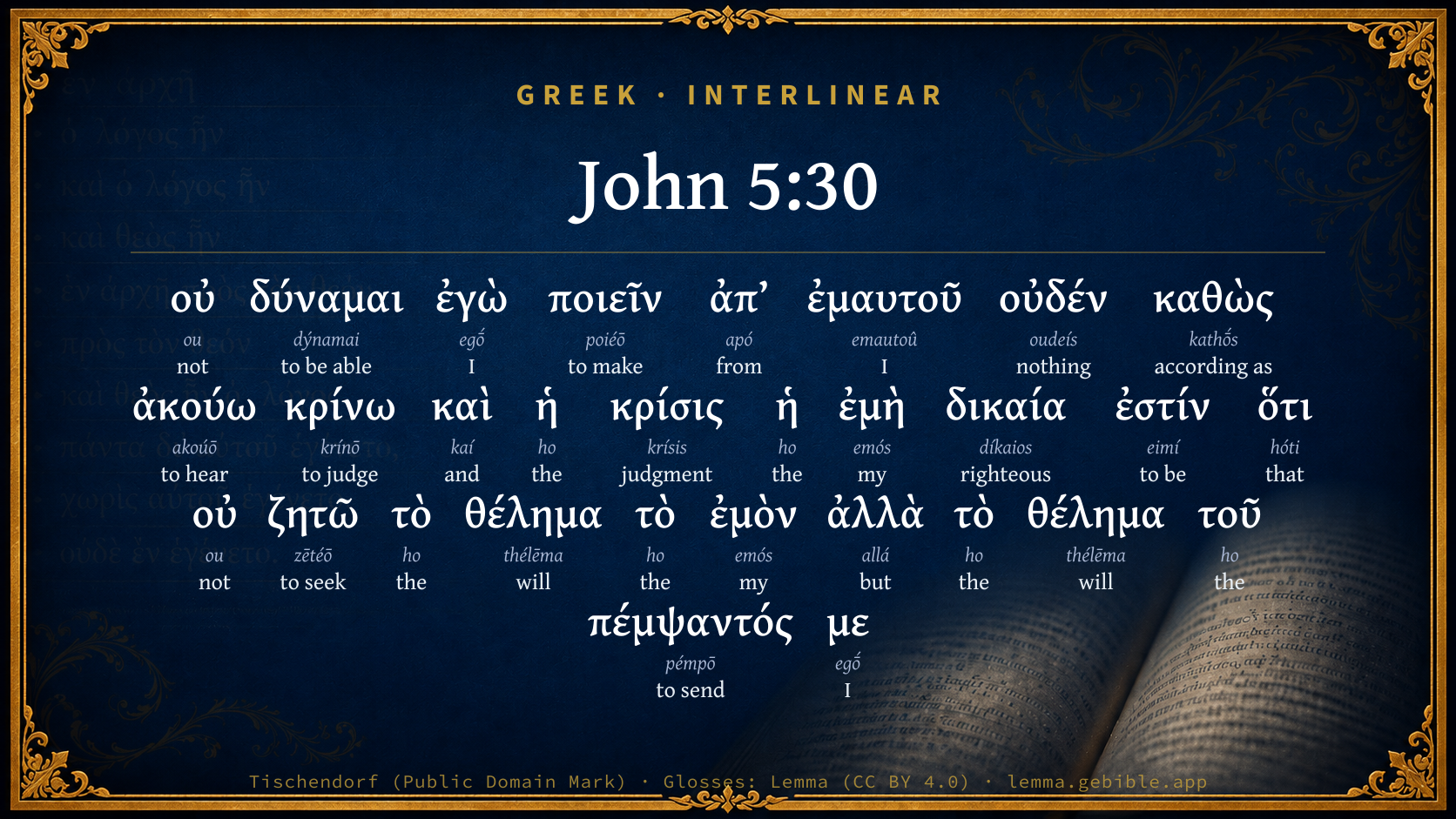
Greek (Tischendorf 8th ed.) John 5:30 appears in the Greek New Testament. The text above is from the Tischendorf 8th edition. Each word links to its Strong’s number and a concise gloss. Click any word for its full Thayer’s Greek Lexicon entry.
Download image
Cite this verse

John 5:30 (World English Bible). Public Domain. Lemma interlinear Bible study tool, https://lemma.gebible.app/v/john/5/30.

Show BibTeX & RIS
BibTeX
RIS
English Translation
I can of myself do nothing. As I hear, I judge, and my judgment is righteous; because I don't seek my own will, but the will of my Father who sent me.
World English Bible · Public Domain
Download a study sheet

One document with this verse’s original text, its word-by-word gloss line, the meaning frame, cross-references with their text, attributed commentary, and full source and license credits — printable, and it pastes into notes with its structure intact.

This verse Autodidact and up

Study sheet (.html) Plain text (.txt)

A passage Seminary Student

Up to 50 verses in one chapter. A passage sheet keeps up to 6 commentary sources and 12 cross-references per verse, in the order this page ranks them, and says so on the sheet whenever that leaves anything out. Ask for a single verse and you get the Autodidact verse sheet above.

Everything on this page stays free to read, with no account — the sheet is a download of what is already on screen, not access to it.

Want to remove ads? Support Godless Engineer
Compare translations 3

The same verse in 3 English versions, stacked beneath the original-language interlinear above. Click any original word for its lexicon entry.

Each is an independent rendering of the whole verse — the interlinear is not word-aligned to these translations.

Highlighted words mark where these versions differ — a whole-verse word diff, not a word-by-word alignment.

  • World English Bible Public Domain
    I can of myself do nothing. As I hear, I judge, and my judgment is righteous; because I don't seek my own will, but the will of my Father who sent me.
  • King James Version Public Domain
    I can of mine own self do nothing: as I hear, I judge: and my judgment is just; because I seek not mine own will, but the will of the Father which hath sent me.
  • unfoldingWord Literal Text CC BY-SA 4.0
    I am able to do nothing from myself. Just as I hear, I judge, and my judgment is righteous because I do not seek my own will but the will of the one having sent me.

unfoldingWord Literal Text — © unfoldingWord, licensed CC BY-SA 4.0. Word-aligned USFM3 via Door43 (git.door43.org/unfoldingWord/en_ult).

Versions to compare (up to 4)

3 of 4 selected

Show all 19 translations

Every available English version of this verse, each an independent rendering of the whole verse.

  • World English Bible Public Domain
    I can of myself do nothing. As I hear, I judge, and my judgment is righteous; because I don't seek my own will, but the will of my Father who sent me.
  • Berean Standard Bible Public Domain
    I can do nothing by Myself; I judge only as I hear. And My judgment is just, because I do not seek My own will, but the will of Him who sent Me.
  • Majority Standard Bible Public Domain
    I can do nothing by Myself; I judge only as I hear. And My judgment is just, because I do not seek My own will, but the will of the Father who sent Me.
  • King James Version Public Domain
    I can of mine own self do nothing: as I hear, I judge: and my judgment is just; because I seek not mine own will, but the will of the Father which hath sent me.
  • American Standard Version (1901) Public Domain
    I can of myself do nothing: as I hear, I judge: and my judgment is righteous; because I seek not mine own will, but the will of him that sent me.
  • Revised Version (1885) Public Domain
    I can of myself do nothing: as I hear, I judge: and my judgment is righteous; because I seek not mine own will, but the will of him that sent me.
  • Geneva Bible (1599) Public Domain
    I can doe nothing of mine owne selfe: as I heare, I iudge: and my iudgement is iust, because I seeke not mine owne will, but the will of the Father who hath sent me.
  • Douay-Rheims (1899) Public Domain
    I cannot of myself do any thing. As I hear, so I judge: and my judgment is just; because I seek not my own will, but the will of him that sent me.
  • Young's Literal Translation Public Domain
    `I am not able of myself to do anything; according as I hear I judge, and my judgment is righteous, because I seek not my own will, but the will of the Father who sent me.
  • Literal Standard Version CC BY-SA 4.0
    I am not able of Myself to do anything; according as I hear I judge, and My judgment is righteous, because I do not seek My own will, but the will of the Father who sent Me.
  • Unlocked Literal Bible CC BY-SA 4.0
    I can do nothing from myself. As I hear, I judge, and my judgment is righteous because I am not seeking my own will but the will of him who sent me.
  • unfoldingWord Literal Text CC BY-SA 4.0
    I am able to do nothing from myself. Just as I hear, I judge, and my judgment is righteous because I do not seek my own will but the will of the one having sent me.
  • Darby Bible Public Domain
    I cannot do anything of myself; as I hear, I judge, and my judgment is righteous, because I do not seek my will, but the will of him that has sent me.
  • World Messianic Bible Public Domain
    I can of myself do nothing. As I hear, I judge; and my judgment is righteous, because I don’t seek my own will, but the will of my Father who sent me.
  • Webster's Bible Public Domain
    I can of my own self do nothing: as I hear, I judge: and my judgment is just; because I seek not my own will, but the will of the Father who hath sent me.
  • Free Bible Version CC BY-SA 4.0
    I can do nothing by myself. I judge based on what I'm told, and my decision is right, for I'm not doing my own will but the will of the one who sent me.
  • Bible in Basic English Public Domain
    Of myself I am unable to do anything: as the voice comes to me so I give a decision: and my decision is right because I have no desire to do what is pleasing to myself, but only what is pleasing to him who sent me.
  • Text-Critical English NT CC BY 4.0
    “I can do nothing on my own. As I hear, I judge, and my judgment is just, because I seek not my own will, but the will of the Father who sent me.
  • Tyndale New Testament (1534) Public Domain
    I can of myne awne selfe do nothinge at all. As I heare I iudge and my iudgement is iust because I seke not myne awne will but the will of the father which hath sent me.

Literal Standard Version (2020), Covenant Press — licensed CC BY-SA 4.0. Text via the HelloAO Bible API (eBible.org). Unlocked Literal Bible (unfoldingWord) — licensed CC BY-SA 4.0. Text via the HelloAO Bible API (eBible.org). unfoldingWord Literal Text — © unfoldingWord, licensed CC BY-SA 4.0. Word-aligned USFM3 via Door43 (git.door43.org/unfoldingWord/en_ult). Free Bible Version, Dr. Jonathan Gallagher — licensed CC BY-SA 4.0. Text via the HelloAO Bible API (eBible.org).

Word by word

More ways to search: Search by grammar → Find every occurrence → Compare this word →

Practice this passage: Drill this verse → Learn its vocabulary →

ἐμαυτοῦ
emautoû
G1683
“I”
Reflexive pronoun, 1st person, Genitive, Singular, Masculine
Part of Speech
Reflexive pronoun
Person
1st person
Case
Genitive
Number
Singular
Gender
Masculine
Full Thayer's Definition

Origin: genitive case compound of G1700 and G846

TDNT: None

1. I, me, myself etc.
  1. οὐ ou G3756 “not” Particle, Negative
  2. δύναμαι dýnamai G1410 “to be able” Verb, Present, Middle or Passive deponent, Indicative, 1st person, Singular
  3. ἐγὼ egṓ G1473 “I” Personal pronoun, 1st person, Nominative, Singular
  4. ποιεῖν poiéō G4160 “to make” Verb, Present, Active, Infinitive
  5. ἀπ’ apó G575 “from” Preposition
  6. οὐδέν oudeís G3762 “nothing” Adjective, Accusative, Singular, Neuter, Negative
  7. καθὼς kathṓs G2531 “according as” Adverb
  8. ἀκούω akoúō G191 “to hear” Verb, Present, Active, Indicative, 1st person, Singular
  9. κρίνω krínō G2919 “to judge” Verb, Present, Active, Indicative, 1st person, Singular
  10. καὶ kaí G2532 “and” Conjunction
  11. ἡ ho G3588 “the” Article, Nominative, Singular, Feminine
  12. κρίσις krísis G2920 “judgment” Noun, Nominative, Singular, Feminine
  13. ἡ ho G3588 “the” Article, Nominative, Singular, Feminine
  14. ἐμὴ emós G1699 “my” Possessive pronoun, 1st person, Nominative, Singular, Feminine
  15. δικαία díkaios G1342 “righteous” Adjective, Nominative, Singular, Feminine
  16. ἐστίν eimí G1510 “to be” Verb, Present, Active, Indicative, 3rd person, Singular
  17. ὅτι hóti G3754 “that” Conjunction
  18. οὐ ou G3756 “not” Particle, Negative
  19. ζητῶ zētéō G2212 “to seek” Verb, Present, Active, Indicative, 1st person, Singular
  20. τὸ ho G3588 “the” Article, Accusative, Singular, Neuter
  21. θέλημα thélēma G2307 “will” Noun, Accusative, Singular, Neuter
  22. τὸ ho G3588 “the” Article, Accusative, Singular, Neuter
  23. ἐμὸν emós G1699 “my” Possessive pronoun, 1st person, Accusative, Singular, Neuter
  24. ἀλλὰ allá G235 “but” Conjunction
  25. τὸ ho G3588 “the” Article, Accusative, Singular, Neuter
  26. θέλημα thélēma G2307 “will” Noun, Accusative, Singular, Neuter
  27. τοῦ ho G3588 “the” Article, Genitive, Singular, Masculine
  28. πέμψαντός pémpō G3992 “to send” Verb, Aorist, Active, Participle, Genitive, Singular, Masculine
  29. με egṓ G1473 “I” Personal pronoun, 1st person, Accusative, Singular

About this verse

These counts appear in no published source. They are computed here, from the morphology-tagged text and Lemma’s own curated glosses. What Lemma adds →

30
words
21
distinct lemmas
Gospels
section

Shared distinctive vocabulary

ἐμαυτοῦ I G1683 occurs in 37 verses of the Greek New Testament. Also found in:
Repetition

Words recur within this verse:

Cross-references

19

Topical passages linked to John 5:30 in the Treasury of Scripture Knowledge — connected by theme and wording, ordered by reader-vote popularity; previews shown in the World English Bible.

  • John 6:38 For I have come down from heaven, not to do my own will, but the will of him who sent me.
  • John 5:19 Jesus therefore answered them, "Most assuredly, I tell you, the Son can do nothing of himself, but what he sees the Father doing. For whatever things he does, these the Son also does likewise.
  • John 4:34 Jesus said to them, "My food is to do the will of him who sent me, and to accomplish his work.
  • John 14:10 Don't you believe that I am in the Father, and the Father in me? The words that I tell you, I speak not from myself; but the Father who lives in me does his works.
  • Matthew 26:39 He went forward a little, fell on his face, and prayed, saying, "My Father, if it is possible, let this cup pass away from me; nevertheless, not what I desire, but what you desire."
  • John 8:28 Jesus therefore said to them, "When you have lifted up the Son of Man, then you will know that I am he, and I do nothing of myself, but as my Father taught me, I say these things.
  • Psalms 40:7–8 Then I said, "Behold, I have come. It is written about me in the book in the scroll.
  • John 8:15–16 You judge according to the flesh. I judge no one.
  • Isaiah 11:3–4 His delight shall be in the fear of Yahweh; and he shall not judge after the sight of his eyes, neither decide after the hearing of his ears;
  • Romans 15:3 For even Christ didn't please himself. But, as it is written, "The reproaches of those who reproached you fell on me."
  • John 8:42 Therefore Jesus said to them, "If God were your Father, you would love me, for I came out and have come from God. For I haven't come of myself, but he sent me.
  • John 8:50 But I don't seek my own glory. There is one who seeks and judges.
  • John 17:4 I glorified you on the earth. I have accomplished the work which you have given me to do.
  • Psalms 96:13 Before Yahweh; for he comes, For he comes to judge the earth. He will judge the world with righteousness, The peoples with his truth.
  • John 18:11 Jesus therefore said to Peter, "Put the sword into its sheath. The cup which the Father has given me, shall I not surely drink it?"
  • Genesis 18:25 Be it far from you to do things like that, to kill the righteous with the wicked, that so the righteous should be as the wicked. May that be far from you. Shouldn't the Judge of all the earth do right?"
  • Hosea 10:7–10 Samaria and her king float away, Like a twig on the water.
  • Romans 2:5 But according to your hardness and unrepentant heart you are treasuring up for yourself wrath in the day of wrath, revelation, and of the righteous judgment of God;
  • Romans 2:2 We know that the judgment of God is according to truth against those who practice such things.

Cross-references courtesy of OpenBible.info (CC BY 4.0).

Where the printed editions differ

1 variant

Places in this verse where the major printed Greek editions disagree on the wording in a way that affects the translation — a comparison of editions, not a manuscript-by-manuscript collation. The editions are the modern critical texts (Nestlé-Aland 28/27, SBL, Westcott-Hort, Tregelles, Tyndale House) and the traditional texts behind the KJV (the Textus Receptus and the Byzantine/Majority text). It is not a claim about which reading is original.

  1. Extra text
    πατρός.

    “[the] Father.”

    In TRByz Not in NA28NA27TynSBLWHTreg

    πατρός.¶ (patros) '[the] Father.' is only in traditional manuscripts (TR+Byz)

Textual data: Translators Amalgamated Greek New Testament (STEPBible TAGNT) · CC BY 4.0.

Commentary

Notes on John 5:30 from classic Christian and Jewish commentators (each source and its license shown beneath its notes). The classic Christian expositions comment on the surrounding passage and are grouped to its opening verse, so a note may address several verses; the Jewish commentaries on the Tanakh (Rashi and others) are per-verse, so they appear only where the commentator wrote on this verse.

Lemma curates 59 commentaries, every one of them public domain or Creative Commons licensed, each selected and text-cleaned for this edition rather than reprinted as found. About our sources →

The Biblical Illustrator

Joseph S. Exell

Joh_5:30

I can of My own self do nothing; as I hear I judge

Christs present judgment

This verse is a conclusion of this part of Christs apology for His curing of the man, and commanding him to carry his bed on the Sabbath day, and for His asserting His unity and equality with the Fathel; wherein, from the former purpose, be sums up these conclusions:

1.

That He is inseparable from the Father in operation (Joh_5:19), having no private power of His own (as they conceived of Him as a mere man); but the same in essence, power, and operation with Him.

2. That He is in all the Fathers counsels, and hath the power of administration of all things communicate to Him from the Father, which is pointed out under the name of hearing, as it is Joh_5:19, by seeing, to hold forth the spirituality of the way of communicating, and His infinite comprehension of all that is communicate, as hearing and seeing all.

3. That His government and administration is most just, as seeking no satisfaction to any will of His own, contrary to, or diverse from the Fathers, as He is God; and that He doth this not only as God simply, but as God now incarnate also, being the same still With the Father, and acting in all things according to the will of God. And though as man, He have a will distinct from His will as God, and so diverse from the Fathers will, yet that did act in subordination to the will of God (Mat_26:39).

Whence learn:

1. The divinity of Christ is a truth that may no ways be quarrelled with, and doth call for our second and serious thoughts; therefore doth He recapitulate His apology, that this truth may be inculcate.

2. Such is the strict conjunction and perfect unity of the Father and the Son, that the Son neither doth, nor can do anything without the fellowship of the Father; so that in all His working the Father is to be seen and taken up; for I can of Mine own self do nothing, saith He.

3. Christ, in the administration of all things, and executing of His purposes in this life, and at the day of judgment, is upon the Fathers counsel, acting from Him, and all Christs administrations are upon counsel and conclusion taken betwixt the Father and the Son, for, saith he, As I hear, I judge.

4. Christs administrations and sentences are all just and right, doing injury and violence to no man, nor ought they to be stumbled at by any, for, My judgment is just, saith He.

5. The reason of the justice of Christs judgment is because it is agreeable to the will of the Father, with whom He is one, and whose will is the rule of justice, as being supreme and absolute Lord; which will Christ, being incarnate and God-man, did conform Himself unto in all things, for, My judgment is just, because I seek not Mine own will (nor have any will, contrary to, or diverse from His, as hath been explained), but the will of the Father, which hath sent Me. (G. Hutcheson.)

Christs present judgment

Note

1. There is a moral difference in the judgment of men concerning Divine truth.

2. Diversity of judgment is dependent on moral condition.

3. Moral condition is resolvable into one of two great principles of action--self-seeking or God-seeking.

4. Adoption of the Divine will is the essential condition of just judgments.

Their principles

1. Explain the perversion of the Bible by its avowed disciples.

2. Indicate the method in which the gospel should be preached.

3. Supply a test of fitness for the work of the gospel ministry.

4. Show the necessity of Divine influence. (W. H. Van Doren, D. D.)

The unclouded heart

1. For the training of goodness, the ancient reliance was on the right discipline of habit and affection: the modern is rather on the illumination of the understanding. Vice is made a blunder of intellect, and, like optical delusions, to be cured by the most approved instruments for seeing.

2. This prescription is attractive from its apparent simplicity. It seems to take away all mystery from the moral emotions. But its value disappears the moment we use is, as, say, the miser, the cheat, the insane candidate for glory. When has it ever made such generous, just, and meek. It is true that you have only to give the slave of passion a different view of the objects of his desire and he is set free. It is equally true that you have only to make the paralytic run and he will be well.

3. Christ, reversing the order of the explanation, placed the truth in a juster point of view. He knew that if sometimes because the reason is darkened the passions are awake, it more often happens that because the passions are awake the reason is darkened. Pure sympathies make a clear intellect. When auditors, feeling that, never man spake like this man, asked, how knowest this man letters? etc., He said, My judgment is just because I seek not Mine own will, etc.; and He instructed others how to gain a like discernment: If any man do His will, etc. Whatever be the word on which the judgment may be engaged, it will be invariably ordered by the sympathies of a just, disinterested, and holy mind.

4. Even in His abstruser toils, these are the wise mans mightiest power. The most turbid clouds which darken reason are those which interest, fear, and ambition spread, and these the pure affections sweep away. How often will a child penetrate the centre of some great truth. A pure-hearted man will be a right-minded man.

5. All the great hindrances to impartiality in the quest of truth have their seat in some class of selfish feelings. The excessive eagerness about reputation produces a thousand pitiable distortions of understanding. In one it takes the shape of a determination to be original and so extinguishes his perception of all ancient excellence, in another it passes into the pride of being moderate and sound, and so he dreads eccentricities far more than falsehoods. And what is partizanship but a collection of selfish feelings, fatal to all the equities of reason.

6. But the mere absence of selfishness is not the only condition for a just judgment. Inpartiality will accomplish nothing without impulse. Clearness of intellectual view will be found not-in one who follows the light without the deep love of it, but in Him who seeks the will of One who sent Him, and who trusts it with a love that casteth out fear!

I. ON QUESTIONS OF PRACTICAL MORALS this principle holds good. The moral habits and tastes of men form their opinions much more frequently than their opinions form their habits, so that their theoretical sentiments are little more than a systematic defence after the act. Any moral practice may be recommended; yet how many things we palliate would be condemned by the very act of expounding them to others--duelling, e.g. It is fearful to reflect how the moral sentiments are modified by the atmosphere of social influence; how the indications of the unperverted conscience may become obscured or lost, and the possibility of remorse killed out.

II. IN ITS JUDGMENT OF HUMAN CHARACTER the same principle rules. The pure affections still the confusion of the senses and remove all motive for not seeing men and life exactly as they are. One who looks on the world as his appointed post of strenuous duty and feels on him the Divine charge to leave it better than he found it must close neither eye nor heart against its ills; and as for its charities and virtues, delighting in them all, he discerns them all; bringing as they do the refreshment of a generous veneration what temptation has he to doubt or decry them. To the selfish, on the other hand, men are tools and have to be flattered into service, and accustomed to speak of good qualities which they do not possess, the mind dwells to such an extent on the negation of excellence that it ceases to believe in it, and thus the nobler half of human nature undergoes permanent eclipse.

III. Those who seek their own will, are liable to error respecting those CHANGES IN SOCIETY which are brought about by the nobler forces of the human will. It is happy for the world that over the vision of its greatest enemies, their own selfishness spreads a film concealing the powers which will effect their over-throw. In spite of all the pampered despots vigilance, conspiracy, conducted by lean and praying patriots, has gone on unnoticed before his very eyes, and suddenly the tempest bursts. It is of the very nature of guilty power to be surprised by the apparition of high-minded virtue in a people. Conclusion:

1. Selfishness under the form of jealousy draws another cloud over the judgment and hides from it all that is fairest in kindred minds.

2. But our judgments will not be right unless our sympathies be not only disinterested but pure. In addition to not seeking our own will, we must seek Gods. The partialities of the affections are nobler every way than those of self-love; but they are partialities still; and while they make our judgments merciful, may prevent their being just. (J. Martineau, D. D.)

The Biblical Illustrator, edited by Joseph S. Exell (c. 1880s–1900s) — public domain. Text from a community e-Sword module.

Bengel's Gnomon

Johann Albrecht Bengel

Joh 5:30. Ποιεῖν, do) Understand, and judge.—καθὼς ἀκούω, as I hear) from the Father. Comp. Joh 5:19, “The Son can do nothing of Himself, but what He seeth the Father do:” seeth: [ch Joh 16:13, The Spirit of truth shall not speak of Himself; but whatsoever He shall hear, that shall He speak.]—κείνω, I judge) Understand, and do.—ἀλλὰ τὸ ζέλημα, but the will) which is a just will.

Bengel's Gnomon of the New Testament — English translation (T&T Clark, Edinburgh, 1860) — public domain. Text from a community e-Sword module.

Expositor's Greek Testament

ed. W. Robertson Nicoll

Joh 5:30 . This judgment claimed by Jesus is, however, engaged in, not in any spirit of self-exaltation or human arbitrariness, nor can it err, because it is merely as the executor of the Father’s will He judges. οὐ δύναμαι … οὐδέν . The first statement of the verse is a return upon Joh 5:19 , “The Son can do nothing of Himself”; but now it is specially applied to the work of judgment. καθῶς ἀκούω κρίνω . As He said of His giving life, that He was merely the Agent of God, doing what He saw the Father do: so now He speaks what He hears from the Father. His judgment He knows to be just, because He is conscious that He has no personal bias, but seeks only to carry out the will of the Father. In Joh 5:31-40 Jesus substantiates these great claims which He has made in the foregoing verses. He refers to the μαρτυρία borne by John the Baptist, by the works given Him by the Father, and by the Father in Scripture.

The Expositor's Greek Testament, edited by W. Robertson Nicoll (1897–1910) — public domain. Text from a community e-Sword module.

Godet's Commentaries

Frédéric Louis Godet

Ver. 30. “I can do nothing of myself; as I hear, I judge; and my judgment is just, because I seek not mine own will, but the will of him who sent me.”

Can Joh 5:30 be connected with what immediately precedes, by the idea of judgment which is common to this verse and Joh 5:29? But the present tense: I judge (Joh 5:30) does not suit the idea of the future judgment (Joh 5:29); and the first clause: I can do nothing of myself, impresses at once on the thought of Joh 5:30 a much more general bearing. We are evidently brought back to the idea of Joh 5:19, which served as the starting-point of the preceding development: the infallibility of the Son’s work finding its guarantee in its complete dependence on that of the Father. As Reuss well says: “The last verse reproduces the substance of the first; and the discourse thus is rounded out even externally.” After having ascribed to Himself the most wonderful operations, Jesus seems to feel the need of sinking again, as related to the Father, into a sort of nothingness. He who successively accomplishes the greatest works, is powerless to accomplish by Himself the humblest act.

The pronoun ἐγώ (I), positively applies to that visible and definite personality which they have before their eyes the unheard of things which He has just affirmed, in a more abstract way, of the Son. This is the first difference between Joh 5:30 and Joh 5:19; the following is the second: In order to describe the total subordination of His work to that of the Father, Jesus made use of figures borrowed from the sense of sight: the Father shows, the Son sees. Here He borrows His figures from the sense of hearing: the Son hears, evidently from His Father’s lips, the sentences which He is to pronounce, and it is only thus that He judges. Moreover, of the two divine works which He accomplishes,raising from the dead and judging, it was especially the first which Jesus had in view in Joh 5:19, in relation to the miracle wrought on the impotent man; He here makes the second prominent, in connection with the supreme act indicated in Joh 5:29. The sentences of which He speaks are the acts of absolution or of condemnation, which He accomplishes here on earth, by saying to one: “Thy sins are forgiven thee,” to the other: “Thy works are evil.” Before declaring Himself thus, Jesus meditates in Himself; He listens to the Father’s voice, and only opens His mouth after He has heard. It is upon this perfect docility that He rests the infallibility of His judgments, and not upon an omniscience incompatible with His humanity: “And —that is, and thus— my judgment is just.” But there is a condition necessary for listening and hearing in this way; it is to have no will of one’s own; hence the ὅτι (because), which follows. No doubt, Jesus, Himself also, has a natural will distinct from that of God; His prayer in Gethsemane clearly proves it: “Not my will, but thine be done.”

But, in a being entirely consecrated to God, as Jesus was, this natural will (my will), exists only to be unceasingly submitted or sacrificed to the Father’s will: “I seek not mine own will, but the will of Him that hath sent me.” From the ontological point of view, the Monothelites, therefore, well deserved to be condemned; for in denying to Jesus a will distinct from that of God, they suppressed the human nature in Him. And yet morally speaking, they were right. For all self-will in Jesus was a will continually and freely sacrificed. It is on this unceasing submission that the absolute holiness of His life rests, and from this holiness it is that the infallibility of His knowledge and His words results. He declares this here Himself.—The τοῦ πέμψαντός με of Him who sent me, is not a mere paraphrase of the name of God. It is argumentative: the one sent does the work of the sender.

What an existence is that of which this passage, Joh 5:19-30, traces for us the type! Such a relationship with God must have been lived, in order to be thus described: to act only after having seen, to speak only after having heard, what a picture of filial consciousness, of filial teaching, of filial activity! And all this attaching itself to a mere healing, accomplished on the initiative of the Father! Do we not see clearly that the essential idea of Joh 5:17 is that of the relation of dependence of the Son’s work towards the Father’s, and by no means that of the Sabbath, of which not the least mention is made in all this development? At the same time, this passage gives us, so to speak, access even to the inner laboratory of our Lord’s thought and allows us to study the manner in which His word was produced. The miracle performed and the accusations which He excites awaken His reflection. He collects Himself, and the profound relation of His work to that of His Father formulates itself in His consciousness in the form of that simple, summary, oracle-like thesis of Joh 5:17. This is the theme which He develops afterwards. At the first moment (Joh 5:19-20), He remains in the highest generalities of the paternal and filial relation. Then there are precisely formulated in His thought the two essential works which result from this relation: making alive, judging (Joh 5:21-23); finally, those two works themselves are presented to His mind in a more and more concrete form, in their progressive historical realization; first in themoral domain (Joh 5:24-27), then in that of external realities (Joh 5:28-29). Where in this incomparable passage is what is called religious metaphysics? From the first word to the last, everything breathes that sentiment of filial abnegation which is the heart of Jesus’ heart.

Frédéric Louis Godet — Commentaries on Luke, John, Romans, and 1 Corinthians — English translation (T&T Clark, Edinburgh, 1870s–1890s) — public domain. Text from a community e-Sword module.

Geneva Bible (1599)

Geneva Bible translators

As my father directeth me, who dwelleth in me.

See verse 22.

The father is the author and approver of all things which Christ doeth.

Geneva Bible (1599) marginal notes — public domain. Text via Bolls.life.

Jamieson, Fausset & Brown

Robert Jamieson, A. R. Fausset & David Brown

of mine own self do nothing--that is, apart from the Father, or in any interest than My own. (See on Joh 5:19).

as I hear--that is, "My judgments are all anticipated in the bosom of My Father, to which I have immediate access, and by Me only responded to and reflected. They cannot therefore err, as I live for one end only, to carry into effect the will of Him that sent Me."

Jamieson, Fausset & Brown — Commentary Critical and Explanatory on the Whole Bible (1871) — public domain (CC PDM 1.0). Text via the HelloAO Bible API.

Adam Clarke's Commentary

Verse 30. I can of mine own self do nothing] Because of my intimate union with God. See Clarke on Joh 5:19.

I seek not mine own will] I do not, I cannot attempt to do any thing without God. This, that is, the Son of man, the human nature which is the temple of my Divinity, Joh 1:14, is perfectly subject to the Deity that dwells in it. In this respect our blessed Lord is the perfect pattern of all his followers. In every thing their wills should submit to the will of their heavenly Father. Nothing is more common than to hear people say, I will do it because I choose. He who has no better reason to give for his conduct than his own will shall in the end have the same reason to give for his eternal destruction. "I followed my own will, in opposition to the will of God, and now I am plunged in the lake that burneth with fire and brimstone."

Reader, God hath sent thee also to do his will: his will is that thou shouldst abandon thy sins, and believe in the Lord Jesus. Hast thou yet done it?

Adam Clarke's Commentary on the Bible (1810–1826) — public domain. Text from a community e-Sword/MySword module.

John Calvin's Commentaries

30. I can do nothing of myself. It would be superfluous here to enter into abstruse reasonings, whether the Son of God can do any thing of himself or otherwise, so far as relates to his eternal Divinity; for he did not intend to keep our minds employed about such trifles. Consequently there was no reason why the ancients should have given themselves so much anxiety and distress about refuting the calumny of Arius. That scoundrel gave out that the Son is not equal to the Father because he can do nothing of himself The holy men reply, that the Son justly claims for himself all that can be ascribed to the Father, from whom he takes his commencement, with respect to his person. But, in the first place, Christ does not speak of his Divinity simply, but warns us that, so far as he is clothed with our flesh, we ought not to judge of him from the outward appearance, because he has something higher than man. Again, we ought to consider with whom he has to deal. His intention was, to refute the Jews who were endeavoring to contrast him with God. He therefore affirms that he does nothing by human power, because he has for his guide and director God who dwells in him.

We ought always to keep in remembrance that, whenever Christ speaks concerning himself, he claims only that which belongs to man; for he keeps his eye upon the Jews, who erroneously said that he was merely one of the ordinary rank of men. For the same reason, he ascribes to the Father whatever is higher than man. The word judge belongs properly to doctrine, but is intended also to apply to the whole of his administration, as if he had said, that he acts by the Father’s direction in all things, that the Father’s will is his rule, and therefore that He will defend him against all adversaries.

And my judgment is just. He concludes that his actions and sayings are beyond the risk of blame, because he does not allow himself to attempt anything but by the command and direction of the Father; for it ought to be regarded as beyond all controversy that whatever proceeds from God must be right. This modesty ought to be held by us as the first maxim of piety, to entertain such reverence for the word and works of God, that the name of God would alone be sufficient to prove their justice and rectitude; but how few are to be found who are ready to acknowledge that God is just, unless they are compelled to do so! I acknowledge, indeed, that God demonstrates his righteousness by experience; but to limit it to the perception of our flesh, so as to have no opinion respecting it but what our own mind suggests, is wicked and daring impiety. Let us, therefore, set it down as certain and undoubted, that whatever is from God is right and true, and that it is impossible for God not to be true in all his words, just and right in all his actions. We are likewise reminded that the only rule for acting well is, to undertake nothing but by the direction and commandment of God. And if after this the whole world should rise against us, we shall still have this invincible defense, that he who follows God cannot go astray.

Because I seek not my own will. He does not here make his own will and that of his Father to clash with each other, as if they were contrary things, but only refutes the false opinion which they entertained, that he was impelled by human presumption rather than guided by the authority of God. He affirms, therefore, that he has no disposition which is peculiar to himself and separate from the command of the Father.

John Calvin's Commentaries (1540-1563) — public domain. Text from the Calvin Translation Society English edition (1840s-50s) via the Christian Classics Ethereal Library (ccel.org). Calvin's coverage is partial (roughly two-thirds of the Bible); uncommented books and verses are honest gaps, never fabricated. The 19th-century editor's footnotes and remarks are omitted so the notes are faithfully Calvin's own voice.

Ellicott's Commentary for English Readers

(30) For “the will of the Father which hath sent Me,” in the last clause, read, with nearly all the best MSS., the will of Him that sent Me. (Comp. Joh_5:36-37.)

The verse is the expression, once again, but now with special reference to judgment, of the thought with which the discourse opened, and which runs as a current through the whole. (Comp. Notes on Joh_5:19; Joh_5:22). As in all His works (Joh_5:19), so in the greater works of life-giving (Joh_5:26) and of judgment, the Son cannot act apart from the Father. The judgment must be just, because it is not one of an isolated will, but one in accord with the eternal will of God. He seeth the Father’s works (Joh_5:19), and in like manner doeth them; He heareth the Father’s will, and that alone He seeketh.

The tenses in this verse are present, and the judgment is therefore to be interpreted without limitation of time. It is one which He is evermore passing on every act and word and thought. (Comp. Joh_9:39.)

A Bible Commentary for English Readers, edited by Charles John Ellicott (1878–1897) — public domain. Text from a community e-Sword module.

The Cambridge Bible for Schools and Colleges

gen. ed. J. J. S. Perowne

30. The Son’s qualification for these high powers is the perfect harmony between His will and that of the Father.

I can of mine own self] Change to the first person. He identifies Himself with the Son. It is because He is the Son that He cannot act independently: it is impossible for Him to will to do anything but what the Father wills.

as I hear] From the Father: Christ’s judgment is the declaration of that which the Father communicates to Him. And hence Christ’s judgment must be just, for it is in accordance with the Divine Will; and this is the strongest possible guarantee of its justice. Comp. Mat_26:39.

The Cambridge Bible for Schools and Colleges (gen. ed. J. J. S. Perowne; Cambridge University Press, 1878–1918) — public domain. Text from a community e-Sword module.

John Gill's Exposition

I can of mine own self do nothing,.... This is the conclusion of the matter, the winding up of the several arguments concerning the Son's equality to the Father, and the application of the whole to Christ. He had before been chiefly speaking of the Son, in relation to the Father, as if he was a third person; but now he applies what he had said of the Son to himself: and it is as if he had said, I am the Son that can do nothing separate from the Father, and contrary to his will, but do all things in conjunction with him; who sees all that he does, by being in him, and co-operating with him, and do the selfsame. I am the Son to whom the Father shows, and by whom he does, all he does; and to whom he will show, and by whom he will do, as a co-efficient with him, greater works than what, as yet, he has done: I am the Son that quickens whom he pleases, and to whom all judgment is committed, and have the same honour the Father has: I am he that quickens dead sinners now, and will raise all the dead at the last day; and have authority to execute judgment on all mankind: and,

as I hear, I judge; not as he hears men, or, according to the evidence men will give one of another; for it is denied of him, that he will proceed in judgment in this manner, Isa 11:3, but as he hears his Father; for being in his bosom, and one with him, as he sees, and knows all he does, his whole plan of operations, and acts according to them; so he hears, knows, and is perfectly acquainted with all his counsels, purposes, and rules of judgment, and never deviates from them. Hearing here signifies perfect knowledge, and understanding of a cause; and so it is used in the Jewish writings, in matters of difficulty, that come before a court of judicature (h):

"there were three courts of judicature; one that sat at the gate of the mountain of the house; and one that sat at the gate of the court; and another that sat in the paved chamber: they go (first) to that which is at the gate of the mountain of the house, and say, so have I expounded, and so have the companions expounded; so have I taught, and so have the companions (or colleagues) taught: , "if they hear", they say; (i.e. as one of their commentators explains it (i), if they know the law, and hear, or understand the sense of the law; in such a case they declare what they know;) if not, they go to them that are at the gate of the court, and say (as before).--And, "if they hear", they tell them; but if not, they go to the great sanhedrim in the paved chamber, from whence goes forth the law to all Israel.''

Christ was now before the great sanhedrim, and speaks to them in their own language, and as a superior judge to them:

and my judgment is just; in the administration of the affairs of his church, which are done in the strictest justice; just and true are all his ways, as King of saints; and in the execution of the last judgment, which will be in righteousness and truth; the judgment he passes must be right, since it is according to that perfect knowledge he has of his Father's will, which is an infallible rule of judgment:

because I seek not mine own will, but the will of the Father which hath sent me; that is, he did not seek to gratify his own will, as distinct from his Father's, or in opposition to it; for he had no private end to answer, or separate interest, or advantage to pursue; and seeing therefore he acted according to his Father's will, and not his own, as contrary to that; his judgment must be just, and the sentence he passes right; since the will of God is indisputably such. The Vulgate Latin, and all the Oriental versions, the Alexandrian copy, and two of Beza's copies, leave out the word "father", without altering or hurting the sense at all.

(h) Misn. Sanhedrin, c. 10. sect. 2. (i) Maimon. in ib.

John Gill's Exposition of the Whole Bible (1746–1763) — public domain (CC PDM 1.0). Text via the HelloAO Bible API.

Trapp's Complete Commentary

John Trapp

30 I can of mine own self do nothing: as I hear, I judge: and my judgment is just; because I seek not mine own will, but the will of the Father which hath sent me.

Ver. 30. I can of mine own self do nothing] But by the power communicated unto me, in that eternal generation.

As I hear] So Joh 5:19; "as I see," which Beza understandeth to be spoken in respect of his human nature, as it is hypostatically united to the Divine.

John Trapp, A Commentary or Exposition upon All the Books of the Old and New Testament (1647–1656) — public domain. Text from a community e-Sword module.

Albert Barnes' Notes on the Bible

Of mine own self - See Joh 5:19. The Messiah, the Mediator, does nothing without the concurrence and the authority of God. Such is the nature of the union subsisting between them, that he does nothing independently of God. Whatever he does, he does according to the will of God.

As I hear I judge - To “hear” expresses the condition of one who is commissioned or instructed. Thus Joh 8:26, “I speak to the world those things which I have “heard” of him;” Joh 8:28, “As the Father hath taught me, I speak those things.” Jesus here represents himself as commissioned, taught, or sent of God. When he says, “as I ‘hear,’” he refers to those things which the Father had “showed” him Joh 5:20 - that is, he came to communicate the will of God; to show to man what God wished man to know.

I judge - I determine or decide. This was true respecting the institutions and doctrines of religion, and it will be true respecting the sentence which he will pass on mankind at the day of judgment. He will decide their destiny according to what the Father wills and wishes - that is, according to justice.

Because I seek ... - This does not imply that his own judgment would be wrong if he sought his own will, but that he had no “private” ends, no selfish views, no improper bias. He came not to aggrandize himself, or to promote his own views, but he came to do the will of God. Of course his decision would be impartial and unbiased, and there is every security that it will be according to truth. See Luk 22:42, where he gave a memorable instance, in the agony of the garden, of his submission to his Father’s will.

Albert Barnes' Notes on the Bible (1834–1885) — public domain. Text from a community e-Sword/MySword module.

Haydock's Catholic Bible Commentary

I can do nothing of myself, &c. See ver. 19. St. John Chrysostom also take notice, that it may be no less with truth said of the Father, that he can do nothing of himself, nor without his Son, nor both of them without the Holy Ghost; because both they, and their actions, are inseparable. (Witham)

George Leo Haydock (1774–1849), Haydock's Catholic Family Bible and Commentary, 1859 edition — public domain. Excludes Psalms (Douay-Rheims chapter numbering differs from Protestant) and Deuterocanonical books (Catholic canon only).

Matthew Poole's English Annotations

I can of mine own self do nothing; neither considered as God, nor as Mediator. As God, the Father and Christ were one, and what one Person in the Holy Trinity doth, all do; so that has did nothing in that capacity separately from his Father. As Mediator, he did nothing of himself; he finished the work which his Father gave him to do.

As I hear, I judge; and my judgement is just; as the Father revealed his will to him, for the administration of his mediatory kingdom in the world, so he judged; and therefore his judgment must necessarily be just and true.

Because I seek not mine own will, but the will of the Father which hath sent me; for his will was not a will proper to himself, so as it was not also common to his Father, but diverse from the will of his Father; but as his essence, so his will, was the same with his Father; and he being by the Father sent into the world to do his will, accordingly did nothing as Mediator but what was his Father’s will as well as his own, in nothing diverse from his Father’s.

Matthew Poole's English Annotations on the Holy Bible (1683–1685) — public domain. Text from a community e-Sword/MySword module.

Whedon's Commentary on the Bible

Daniel D. Whedon

30. Of mine own self—Either as Son of God or Son of man he received the sustentation of the Father, and hence his action was sustained by omnipotent authority.

Judgment is just—Even though human, the work of a man, that judgment has no human fallibility or wrong.

Seek not mine own will—At his temptation Satan would have seduced him to seek his own will. But, in the freedom of his own will, he chose to lose his own will in the will of his Father; and thenceforth forever does his finite will, freely and with all the force of its energies, enter into and cooperate with the will of his Father.

Daniel D. Whedon (gen. ed.), Commentary on the Old and New Testaments (1874–1909) — public domain. Text from a community e-Sword module.

The Pulpit Commentary

Vers. 30-40. (c) The witness borne to these claims.

The Lord, still preserving the consciousness of his own ego, continues to speak through human lips to human ears. He deprecates the criticism, "Who and what canst thou be, that thou shouldst execute judgment, or bring us to thy bar, or compel us to come from our hidden places to thy judgment seat?" It is not as mere man that he will judge the world; God will judge through trim. Moreover, the equality of "life" and "honour" and "authority" that he has with the Father, as the veritable Son of God, is nevertheless a life derived, a being generated, an honour given. He here opens up on this basis a new class of instruction, and proceeds to explain the threefold nature of the testimony borne to his present claim to be the Representative and co-Agent of the Father. He goes back in these words to the great text of the discourse, viz. "My Father worketh hitherto, and I work" (ver. 19). I (the egw is very emphatic, the individual standing before them associates himself, and is identified, with the one Being who, as Son of God and Son of man, has done, is doing, and will yet do, wonderful things)I can of mine own self, from any separate or self-originating source in myself, apart from the Father, do nothing. He subsequently said to his disciples, "Without me ye can do nothing." He claims a higher source than himself for all his own power (dunamiv). When referring to the same subject (vers. 19, 20), he drew his illustration from the sense of sight. The Father "shews" to him, and he "sees" all things that the Father doeth. Here he adds, with special reference to the last and consummating manifestation of relation with the Father, As I hear, I judge: and my judgment of men is righteous; because I seek not my own will, but the will of himwho sent me. Christ refers to his judgments of absolution or condemnation upon things or men, positively declaring them to be either right or wrong; e.g. he claimed the power to say, "Thy sins be forgiven;" "The faith hath saved thee;" "It is better for this man that he had never been born;" "Come unto me;" "Depart from me;" "I never knew you." These and all his other judgments on scribes and Pharisees, on devils and hypocrites, on Pilate and Herod, on Jerusalem and the world, are revelations of the Father"s mind are in themselves just judgments, absolutely free from any selfhood, from any reflex influence or reaction from men to himself. They are the true and infallible expression of the Divine will. Because of the entire conformity of his will and himself to the Divine will, the judgment must correspond to that which is, in its very nature, right and true. If this be so, we can scarcely refrain from asking, "Wherein, then, lies the consolation and encouragement derivable from the fact that the execution of judgment is placed for man"s sake in the hands of the Son of man?" It lies here, that the Incarnation is perfect; that the manhood has not obliterated the Divinity, nor the Godhead absorbed the manhood, of the Christ. The human consciousness of the Son becomes the basis for the Father"s judgment, which is uttered thus absolutely and finally through human lips. It is impossible to imagine thoughts like these arising in the mind of some thinker of the second century. Great as the prologue to this Gospel unquestionably is, this unveiling of the heart of the Son of God incarnate is immeasurably greater. The consciousness of Christ is unique. Neither legend nor imagination, to say nothing of history, has ever transcended it. Here, too, the enormous difference between the Johannine Christ and the Philonic Logos comes into startling prominence.

The Pulpit Commentary (1880–1919), ed. H.D.M. Spence-Jones & Joseph S. Exell — public domain. Text from a community e-Sword module.

John Wesley's Explanatory Notes

I can do nothing of myself - It is impossible I should do any thing separately from my Father. As I hear - Of the Father, and see, so I judge and do; A because I am essentially united to him. See ver. 19.

John Wesley, Explanatory Notes Upon the Whole Bible (1754–1765) — public domain. Text via the GEBible commentary corpus.

Burkitt's Expository Notes on the New Testament

William Burkitt

Here Christ declares to the Jews, and in them all mankind, that they might assure themselves his judgment would be exactly righteous, because he had no private will or power of his own, contrary to, or different from, his Father.

Learn hence, that the Lord Jesus Christ, being the same in essence and nature, in power and operation, with the Father, had no private will or interest of his own, but acted all things as God, in co-ordination with the Father; and, as man, insubordination to him; I can of mine own self do nothing; that is, neither as God nor as Mediator: not as God, for God the Father and Christ being one, equal in power, what one person did, the other doth; not as Mediator, for so Christ finished the work which his Father gave him to do: the will of the Father, and the will of Christ, being both one. As Christ was sent by his Father’s order, so he was altogether guided by his Father’s will, wherewith his own will exactly concurred.

William Burkitt's Expository Notes on the New Testament (1700–1703) — public domain. Text from a community e-Sword module.

unfoldingWord translationNotes

Door43 World Missions Community

the will of him who sent me

The word "him" refers to God the Father.

There is another who testifies about me

"There is someone else who tells people about me"

another

This refers to God.

the testimony that he gives about me is true

"what he tells people about me is true"

translationWords

judge

righteous

will of God

testimony

true

unfoldingWord translationNotes — © Distant Shores Media and the Door43 World Missions Community, licensed CC BY-SA 4.0. Source: git.door43.org/Door43/en_tn.

Cambridge Greek Testament for Schools and Colleges

30. The Son’s qualification for these high powers is the perfect harmony between His Will and that of the Father.

οὐ δύν. ἐγώ. Change to the first person, as in Joh 6:35. He identifies Himself with the Son. It is because He is the Son that He cannot act independently: it is impossible for Him to will to do anything but what the Father wills. See on Joh 5:19.

καθὼς ἀκούω. From the Father: Christ’s judgment is the declaration of that which the Father communicates to Him. Hence Christ’s judgment must be just, for it is in accordance with the Divine Will; and this is the strongest possible guarantee of its justice. Mat 26:39. The Jews were seeking to do their own will, and their judgment was not just.

Cambridge Greek Testament for Schools and Colleges (Cambridge University Press, 1896; 21 vols, various authors incl. Carr, Maclear, Plummer, Farrar, Lumby, Moule, M. R. James, Simcox) — public domain. Text from a community e-Sword module.

Alford’s Greek Testament

Henry Alford

30.] Here begins (see Stier, iv. 195, edn. 2) the second part of the discourse,—but bound on most closely to the first (ver. 23),—treating of the testimony by which these things were substantiated, and which they ought to have received. This verse is, however, perhaps rather a point of transition to the next, at which the testimony is first introduced.

As the Son does nothing of Himself,—but His working and His judgment all spring from His deep unity of will and being with the Father,—this His great and last judgment, and all His other ones, will be just and holy (He being not separate from God, but one with Him); and therefore His witness given of Himself ver. 17, and called by them blasphemy, is true and holy also.

Observe, the discourse here passes into the first person, which was understood before, because he had called himself the Son of God,—but is henceforth used expressly.

Henry Alford, The Greek Testament (1849–1861) — public domain. Text from a community e-Sword module.

International Critical Commentary

30. The discourse returns to the first person, from the third; the thought, “I can do nothing of myself,” returning to v. 19, where see note (cf. 8:28 ἀπʼ ἐμαυτοῦ ποιῶ οὐδέν).

ἐμαυτός is used by Jesus of Himself 16 times in Jn., never in the Synoptists, where it occurs only Mat 8:9, Luk 7:7, Luk 7:8.

καθὼς ἀκούω κρίνω ,i.e. “as I hear from the Father (see on v. 19), I judge.” The authority to judge is delegated to Him (v. 27); and His judgments are righteous because they reflect the judgments of God Himself. ἡ κρίσις ἡ ἐμὴ δικαία ἐστίν (cf. Psa 7:11 of God, the Righteous judge) is repeated 8:16 in the form ἡ κρίσις ἡ ἐμὴ ἀληθινή ἐστιν. There is no self-will in the passing of these judgments, οὑ ζητῶ τὸ θέλημα τὸ ἐμόν, but rather τὸ θέλημα τοῦ πέμψαντός με. For this last phrase, see 6:38, 39, 40, where it recurs, and 4:34. Cf. especially the notes on 7:16, 17, 18.

Thus to seek that God’s will be done, in every decision of life, was perfectly realised only in the Son of Man Himself. But the precept of Rabbi Gamaliel may apply to every man, however imperfectly it may be obeyed: “Do His will as if it were thy will, that He may do thy will as if it were His will.”1

The rec. adds πατρός after τοῦ πέμψαντός με (cf. 6:40), but om. אABDLNW

International Critical Commentary — older volumes (1896–1929), various authors — public domain. Text from a community e-Sword module.

Vincent's Word Studies in the New Testament

Marvin R. Vincent

Of the Father. Omit. Rev., of Him that sent.

Marvin R. Vincent, Word Studies in the New Testament (1887–1900) — public domain. Text from a community e-Sword/MySword module.

Lesson kit

Teaching starters — assembled from the data on this page, not authored interpretation. Every prompt links to the verse data it draws on. Edit before teaching.

John, in the Gospels, opens this verse with 30 words (21 distinct Greek lemmas). Its most distinctive word is emautoû (“I”). A historical commentator’s framing appears above. Read the whole chapter for the surrounding context.

Discussion questions

  1. How does “I” (emautoû) shape what this verse is saying?
  2. How does Matthew 8:9, which shares the word «I», read alongside this verse?
  3. What does the repetition of “will” (2× in this one verse) do in this verse?
  4. The translations on this page render this verse differently — a whole-verse word diff, not a word-by-word alignment. What might account for the different wordings?
  5. Compare how The Biblical Illustrator and Bengel's Gnomon read this verse. Where do they agree or differ?

Things to notice

Reading settings

Reading text

Shown beneath each verse's original-language words.

Old Testament
Old Testament edition

Read the OT as the Masoretic Hebrew (MT) or the Greek Septuagint (LXX).

English shown for the Greek Septuagint (in the Hebrew ↔ Greek comparison).

Comparing translations? Open the Compare panel on any verse page to stack up to four side by side.