John 6:8

Greek (Tischendorf 8th ed.) John 6:8 appears in the Greek New Testament. The text above is from the Tischendorf 8th edition. Each word links to its Strong’s number and a concise gloss. Click any word for its full Thayer’s Greek Lexicon entry.
Download image
Cite this verse

John 6:8 (World English Bible). Public Domain. Lemma interlinear Bible study tool, https://lemma.gebible.app/v/john/6/8.

Show BibTeX & RIS
BibTeX
RIS
English Translation
One of his disciples, Andrew, Simon Peter's brother, said to him,
World English Bible · Public Domain
Download a study sheet

One document with this verse’s original text, its word-by-word gloss line, the meaning frame, cross-references with their text, attributed commentary, and full source and license credits — printable, and it pastes into notes with its structure intact.

This verse Autodidact and up

Study sheet (.html) Plain text (.txt)

A passage Seminary Student

Up to 50 verses in one chapter. A passage sheet keeps up to 6 commentary sources and 12 cross-references per verse, in the order this page ranks them, and says so on the sheet whenever that leaves anything out. Ask for a single verse and you get the Autodidact verse sheet above.

Everything on this page stays free to read, with no account — the sheet is a download of what is already on screen, not access to it.

Want to remove ads? Support Godless Engineer
Compare translations 3

The same verse in 3 English versions, stacked beneath the original-language interlinear above. Click any original word for its lexicon entry.

Each is an independent rendering of the whole verse — the interlinear is not word-aligned to these translations.

Highlighted words mark where these versions differ — a whole-verse word diff, not a word-by-word alignment.

  • World English Bible Public Domain
    One of his disciples, Andrew, Simon Peter's brother, said to him,
  • King James Version Public Domain
    One of his disciples, Andrew, Simon Peter's brother, saith unto him,
  • unfoldingWord Literal Text CC BY-SA 4.0
    One of his disciples, Andrew, the brother of Simon Peter, says to him,

unfoldingWord Literal Text — © unfoldingWord, licensed CC BY-SA 4.0. Word-aligned USFM3 via Door43 (git.door43.org/unfoldingWord/en_ult).

Versions to compare (up to 4)

3 of 4 selected

Show all 19 translations

Every available English version of this verse, each an independent rendering of the whole verse.

  • World English Bible Public Domain
    One of his disciples, Andrew, Simon Peter's brother, said to him,
  • Berean Standard Bible Public Domain
    One of His disciples, Andrew, Simon Peter’s brother, said to Him,
  • Majority Standard Bible Public Domain
    One of His disciples, Andrew, Simon Peter’s brother, said to Him,
  • King James Version Public Domain
    One of his disciples, Andrew, Simon Peter's brother, saith unto him,
  • American Standard Version (1901) Public Domain
    One of his disciples, Andrew, Simon Peter's brother, saith unto him,
  • Revised Version (1885) Public Domain
    One of his disciples, Andrew, Simon Peter’s brother, saith unto him,
  • Geneva Bible (1599) Public Domain
    Then saide vnto him one of his disciples, Andrew, Simon Peters brother,
  • Douay-Rheims (1899) Public Domain
    One of his disciples, Andrew, the brother of Simon Peter, saith to him:
  • Young's Literal Translation Public Domain
    one of his disciples -- Andrew, the brother of Simon Peter -- saith to him,
  • Literal Standard Version CC BY-SA 4.0
    one of His disciples—Andrew, the brother of Simon Peter—says to Him,
  • Unlocked Literal Bible CC BY-SA 4.0
    One of the disciples, Andrew, the brother of Simon Peter, said to Jesus,
  • unfoldingWord Literal Text CC BY-SA 4.0
    One of his disciples, Andrew, the brother of Simon Peter, says to him,
  • Darby Bible Public Domain
    One of his disciples, Andrew, Simon Peter's brother, says to him,
  • World Messianic Bible Public Domain
    One of his disciples, Andrew, Simon Peter’s brother, said to him,
  • Webster's Bible Public Domain
    One of his disciples, Andrew, Simon Peter's brother, saith to him,
  • Free Bible Version CC BY-SA 4.0
    One of his disciples, Andrew, Simon Peter's brother, spoke up.
  • Bible in Basic English Public Domain
    One of his disciples, Andrew, the brother of Simon Peter, said to Jesus,
  • Text-Critical English NT CC BY 4.0
    Then one of his disciples, Andrew, the brother of Simon Peter, said to him,
  • Tyndale New Testament (1534) Public Domain
    Then sayde vnto him one of his disciples Andrew Simon Peters brother.

Literal Standard Version (2020), Covenant Press — licensed CC BY-SA 4.0. Text via the HelloAO Bible API (eBible.org). Unlocked Literal Bible (unfoldingWord) — licensed CC BY-SA 4.0. Text via the HelloAO Bible API (eBible.org). unfoldingWord Literal Text — © unfoldingWord, licensed CC BY-SA 4.0. Word-aligned USFM3 via Door43 (git.door43.org/unfoldingWord/en_ult). Free Bible Version, Dr. Jonathan Gallagher — licensed CC BY-SA 4.0. Text via the HelloAO Bible API (eBible.org).

Word by word

More ways to search: Search by grammar → Find every occurrence → Compare this word →

Practice this passage: Drill this verse → Learn its vocabulary →

Ἀνδρέας
Andréas
G406
“Andrew”
Noun, Nominative, Singular, Masculine
Part of Speech
Noun
Case
Nominative
Number
Singular
Gender
Masculine
Full Thayer's Definition

Origin: from G435

TDNT: None

Andrew = "manly" 1. A native of Bethsaida in Galilee, brother of Simon Peter, a disciple of John the Baptist, and afterwards an apostle of Christ. He is said to have been crucified at Patrae in Archaia.
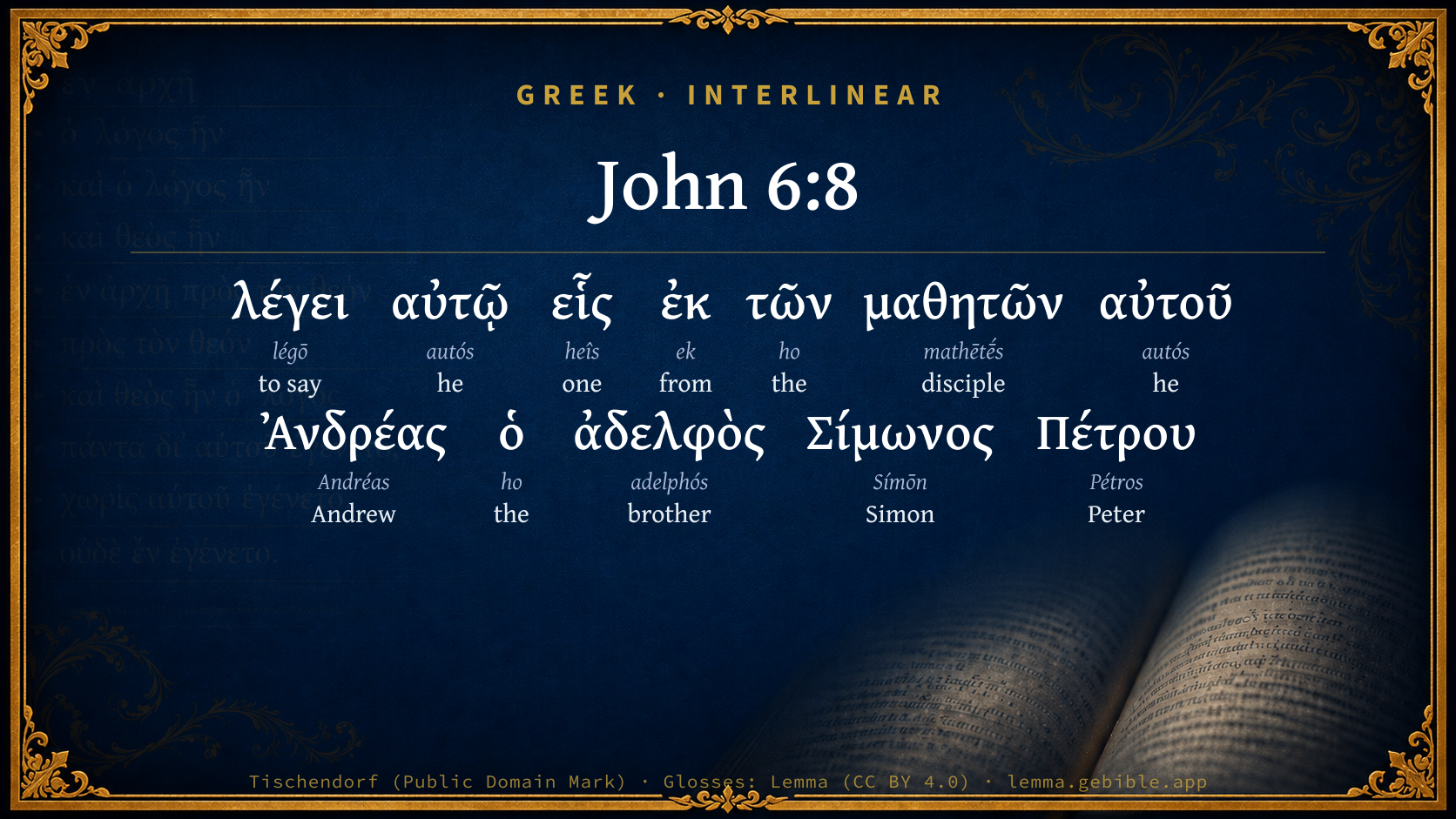
  1. λέγει légō G3004 “to say” Verb, Present, Active, Indicative, 3rd person, Singular
  2. αὐτῷ autós G846 “he” Personal pronoun, Dative, Singular, Masculine
  3. εἷς heîs G1520 “one” Adjective, Nominative, Singular, Masculine
  4. ἐκ ek G1537 “from” Preposition
  5. τῶν ho G3588 “the” Article, Genitive, Plural, Masculine
  6. μαθητῶν mathētḗs G3101 “disciple” Noun, Genitive, Plural, Masculine
  7. αὐτοῦ autós G846 “he” Personal pronoun, Genitive, Singular, Masculine
  8. ὁ ho G3588 “the” Article, Nominative, Singular, Masculine
  9. ἀδελφὸς adelphós G80 “brother” Noun, Nominative, Singular, Masculine
  10. Σίμωνος Símōn G4613 “Simon” Noun, Genitive, Singular, Masculine
  11. Πέτρου Pétros G4074 “Peter” Noun, Genitive, Singular, Masculine

About this verse

These counts appear in no published source. They are computed here, from the morphology-tagged text and Lemma’s own curated glosses. What Lemma adds →

12
words
10
distinct lemmas
Gospels
section

Notable vocabulary

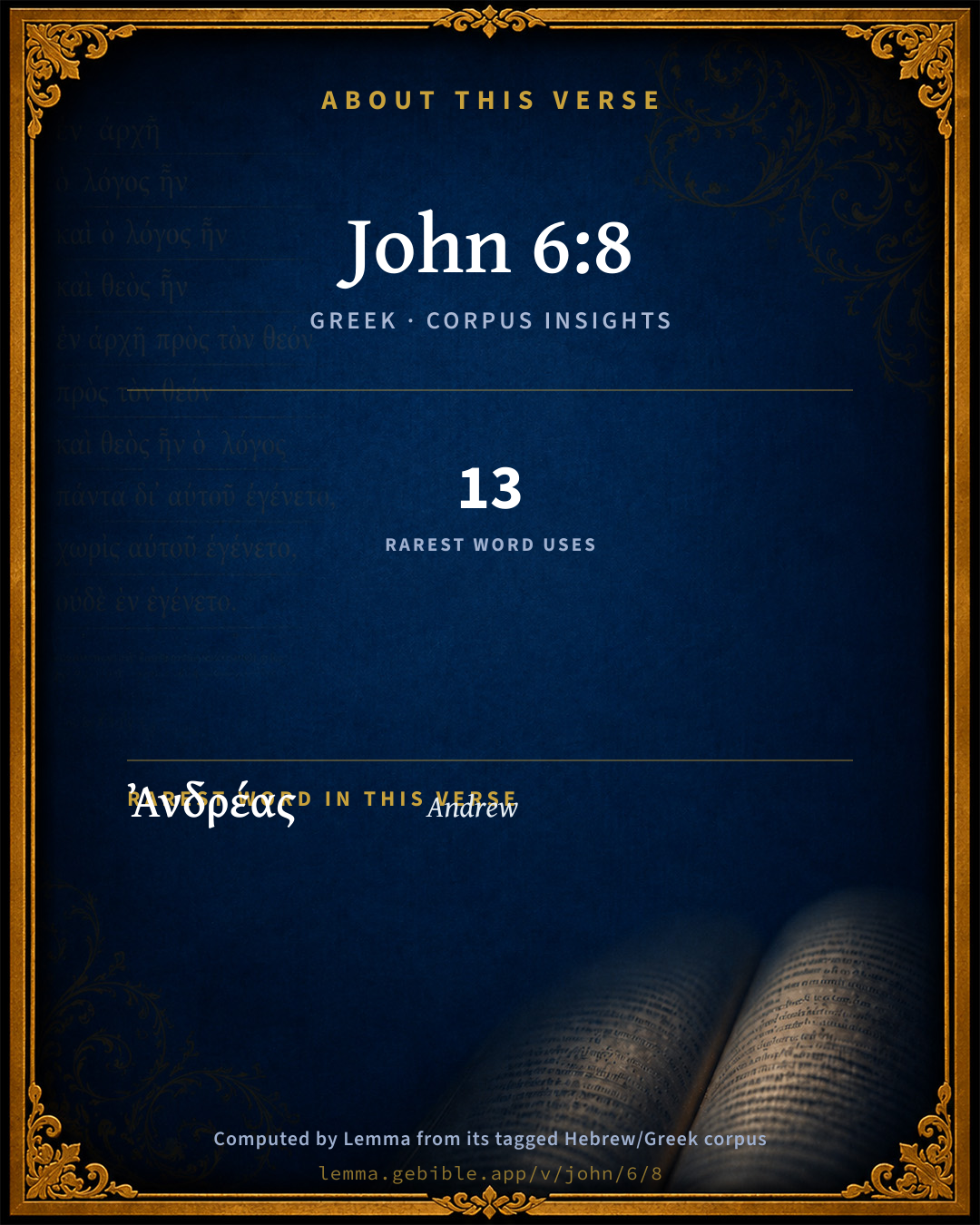
The rarest word here is Ἀνδρέας Andrew G406 — appearing just 13 times in the whole Greek New Testament.

Shared distinctive vocabulary

Ἀνδρέας Andrew G406 occurs in 12 verses of the Greek New Testament. Also found in:

Repetition

Words recur within this verse:

  • αὐτῷ he G846 ×2
  • τῶν the G3588 ×2

Cross-references

2

Topical passages linked to John 6:8 in the Treasury of Scripture Knowledge — connected by theme and wording, ordered by reader-vote popularity; previews shown in the World English Bible.

  • Matthew 4:18 Walking by the sea of Galilee, he saw two brothers: Simon, who is called Peter, and Andrew, his brother, casting a net into the sea; for they were fishermen.
  • John 1:40–44 One of the two who heard John, and followed him, was Andrew, Simon Peter's brother.

Cross-references courtesy of OpenBible.info (CC BY 4.0).

Commentary

Notes on John 6:8 from classic Christian and Jewish commentators (each source and its license shown beneath its notes). The classic Christian expositions comment on the surrounding passage and are grouped to its opening verse, so a note may address several verses; the Jewish commentaries on the Tanakh (Rashi and others) are per-verse, so they appear only where the commentator wrote on this verse.

Lemma curates 59 commentaries, every one of them public domain or Creative Commons licensed, each selected and text-cleaned for this edition rather than reprinted as found. About our sources →

Bengel's Gnomon

Johann Albrecht Bengel

Joh 6:8. Ὁ ἀδελφός, brother) Peter, therefore, at that time and place in which John wrote, had been better known than Andrew, either because he was older, or because he survived Andrew.

Bengel's Gnomon of the New Testament — English translation (T&T Clark, Edinburgh, 1860) — public domain. Text from a community e-Sword module.

Expositor's Greek Testament

ed. W. Robertson Nicoll

Joh 6:8 . With the same matter-of-factness as Philip εἷς … Πέτρου , “one of His disciples, Andrew, the brother of Simon Peter,” a description apparently inserted in forget fulness that it has already been given, Joh 1:41 , supplementing Philip’s judgment, cf. Joh 12:22 , λέγει αὐτῳ , “says to Him” [the dative still holds its place after λέγει , and has not quite given way, as in modern Greek, to πρός with accusative, cf. Joh 6:5 ]. Ἔστι παιδάριον ἓν ὧδε . “There is here one little boy.” [ ἓν is rejected by modern editors. May it not have been rejected because unnecessary? At the same time it must be borne in mind that although in Mt. (Mat 8:19 ; Mat 26:69 ) εἷς is used as an indefinite article as in German, French, etc. it is not so used in John. The Vulgate has “est puer unus hic”. Meyer thinks it is inserted to bring out the meagreness of the resources, “but one small boy”.]

The Expositor's Greek Testament, edited by W. Robertson Nicoll (1897–1910) — public domain. Text from a community e-Sword module.

Adam Clarke's Commentary

Verse 8. Andrew, Simon Peter's brother, saith] The other evangelists attribute this answer to the apostles in general. See the passages referred to above.

Adam Clarke's Commentary on the Bible (1810–1826) — public domain. Text from a community e-Sword/MySword module.

Ellicott's Commentary for English Readers

(8) One of his disciples.—Within the inner circle around Him—and this, too, is told us only by St. John—is another of the early disciples. He was one of the two disciples of the Baptist who first followed Jesus, and John’s own companion (Joh_1:40). He is always named as one of the first group of the Twelve (comp. Note on Mat_10:2), and in some way was specially connected with Philip (Joh_1:44). Here, and in Joh_12:22 (see Note), they are named together, and also in the lists in Mar_3:18 and Act_1:13.

A Bible Commentary for English Readers, edited by Charles John Ellicott (1878–1897) — public domain. Text from a community e-Sword module.

The Cambridge Bible for Schools and Colleges

gen. ed. J. J. S. Perowne

8. One of his disciples] Of course this does not imply that Philip was not a disciple; the meaning rather is, that a disciple had been appealed to without results, and now a disciple makes a communication out of which good results flow. There seems to have been some connexion between S. Andrew and S. Philip (Joh_1:44, Joh_12:22). In the lists of the Apostles in Mark 3 and Acts 1 S. Philip’s name immediately follows Andrew’s. On S. Andrew see notes on Joh_1:40-41. The particulars about Philip and Andrew here are not found in the Synoptists’ account.

The Cambridge Bible for Schools and Colleges (gen. ed. J. J. S. Perowne; Cambridge University Press, 1878–1918) — public domain. Text from a community e-Sword module.

John Gill's Exposition

One of his disciples, Andrew, Simon Peter's brother,.... Who also, and his brother Peter, were of Bethsaida, as well as Philip, and was a disciple of Christ's; he hearing what Christ said to Philip, and what answer he returned,

saith unto him; to Christ, with but little more faith than Philip, if any.

John Gill's Exposition of the Whole Bible (1746–1763) — public domain (CC PDM 1.0). Text via the HelloAO Bible API.

Trapp's Complete Commentary

John Trapp

8 One of his disciples, Andrew, Simon Peter’s brother, saith unto him,

Ver. 8. One of his disciples] He uttered the sense of all the twelve, Mar 6:37, being no whit wiser than the rest, though the eldest disciple of them all, Joh 1:41.

John Trapp, A Commentary or Exposition upon All the Books of the Old and New Testament (1647–1656) — public domain. Text from a community e-Sword module.

Matthew Poole's English Annotations

The story is the same, in all substantial parts, with the relations of Matthew, Mark, and Luke, in the before mentioned places. See the annotations on those chapters.

Matthew Poole's English Annotations on the Holy Bible (1683–1685) — public domain. Text from a community e-Sword/MySword module.

The Pulpit Commentary

Vers. 8, 9. Then saith one of his disciples to him, viz. Andrew, Simon Peter"s brother. The spokesman is here specially indicated. On other occasions Andrew is singled out as the brother of Simon and friend of Philip. (Joh_1:44 Joh_12:22) This repeated reference to the illustrious brother of Simon is a refutation of the ill-natured charge against the author of the Gospel, that he aimed at the depreciation of the character of the great apostle. Moreover, it is interesting to remember that in the Muratorian fragment on the Canon, "Andrew" is specially mentioned as being one of those present with John in Ephesus, who urged him to write his Gospel (see Introduction, IV 2 (3)). There is alad here (possibly a lad who was brought with themselves, or who had attached himself to the twelve) who has five barley loaves, the bread of the poorest classes. Of this there is ample proof ("Sotah," 2:1, quoted by Edersheim, vol. 1:681): "While all other meat offerings were of wheat, that brought by the woman accused of adultery was to be of barley, because, as her deed is that of the animals, so her offering is of the food of animals." If this lad was conveying the food stock of the Lord and his apostles, it is an impressive but accidental hint that "for our sakes he became poor," and classed himself socially with the humblest. And two fishes. The use of this word is peculiar to our Gospel (Luke, icyuev ; Mark, icyuav , the ordinary word for "fish; "but John uses the word oqaria , the diminutive of the Greek word oqon , which means "savoury," eaten with bread). This opsarion mostly consisted of small fishes caught in the lake, which were dried, salted as "sardines" or "anchovies" are with ourselves for a similar purpose. This habit belonged locally to the neighbourhood of the lake, and reveals the Galilman origin or associations of the writer. The Aramaic word, ophsonim, is derived from the Greek opson, and that of aphjain, or aphiz, is the name for a small fish caught in the lake, the drying of which was a lucrative source of industry. Edersheim reminds us that the fish laid on the charcoal fire (Joh_21:9, Joh_21:10, Joh_21:13) was opsarion," and that of this the risen Lord, on the shore of this very lake, gave to his disciples to eat, though he guided them at that time to a shoal of great fishes, icquwn megalwn , and bade them add some of these to the oqaria , which he was content to use still. The use of this word on these two occasions shows that, at the last, our Lord reminds his disciples of the miraculous feeding by the shore of the lake; and both narratives breathe the air of the northern parts of Galilee. But what are these among so many? The same lesson of the insufficiency of human resources to meet great human needs is suggested by Num_11:21-23. Our resources at the very best are quite exhausted. Our best, our all, avails little an expression which would apply to the numberless offers of our poor humanity and of our limited faculties to meet the moral starvation of the world. Take the Old Testament: how can the dispensation of all its provision satisfy per se the need of mankind as a whole? Greek philosophy, even if it satisfy the few, the leisurely, the cynical, the learned, the wise men of the West, what will it do for the poor, the broken hearted, the consciously guilty? The good things of this life are equally powerless, and the proposals of even truth itself, apart from the gracious operations of the Spirit, would fail to meet the wants or necessities of the unbelieving.

The Pulpit Commentary (1880–1919), ed. H.D.M. Spence-Jones & Joseph S. Exell — public domain. Text from a community e-Sword module.

Cambridge Greek Testament for Schools and Colleges

8. εἷς ἐκ τ. μαθ. Of course this does not imply that Philip was not a disciple; the meaning rather is, that a disciple had been appealed to without results, and now a disciple makes a communication out of which good results flow. The name of this second disciple comes in as a sort of afterthought. There seems to have been some connexion between S. Andrew and S. Philip (Joh 1:44, Joh 12:22). In the lists of the Apostles in Mark 3 and Acts 1. S. Philip’s name immediately follows S. Andrew’s. On S. Andrew see notes on Joh 1:40-41. The particulars about Philip and Andrew here are not found in the Synoptists’ account.

Cambridge Greek Testament for Schools and Colleges (Cambridge University Press, 1896; 21 vols, various authors incl. Carr, Maclear, Plummer, Farrar, Lumby, Moule, M. R. James, Simcox) — public domain. Text from a community e-Sword module.

Alford’s Greek Testament

Henry Alford

8.] Meyer remarks, that εἷς ἐκ τῶν μαθητῶν αὐτοῦ may seem strange, seeing that Philip also was this: but that it has its pragmatic value, seeing that, Philip having been asked in vain, one from among the circle of the disciples answers, and is afterwards specified as having been Andrew.

In the three other Gospels, the loaves and fishes appear as the disciples’ own;—and we have thus a very simple but very instructive instance of the way in which differences in detail arose. They were their own,—but not till they had bought them.

Henry Alford, The Greek Testament (1849–1861) — public domain. Text from a community e-Sword module.

International Critical Commentary

8. εἷς ἐκ τῶν μαθητῶν αὐτοῦ. This description of an apostle is not found in the Synoptists (except at Mar 13:1, without ἐκ); but Jn. has it again at 12:4, 13:23; cf. 18:17, 25. For the constr. εἷς ἐκ followed by a gen. plur., see on 1:40.

For the designation of Andrew as “Simon Peter’s brother,” see on 1:40. His first impulse of discipleship was to find Peter and bring him to Jesus (1:41). He appears here as a resourceful person who tries to find a practical answer to the question put to Philip by Jesus, although he does not think that he has been successful in gathering a sufficient supply of food. In 12:20-22 Philip and Andrew are again associated in somewhat similar fashion, Philip not knowing what to do until he has consulted Andrew. These notices in Jn. supply the only indications of Andrew’s character that we have, and it is interesting to observe their consistency with each other. The only distinctive mention of Andrew in the Synoptists is at Mar 13:3, where he appears as associated with the inner circle of the Twelve—Peter, James, and John.

A second-century notice of Andrew and Philip shows that they were held to be among the leaders of the Twelve. When Papias collected traditions from the elders of his day, he used to ask them, “What did Andrew and what did Peter say? Or what did Philip? Or what Thomas or James or John or Matthew?” (Eus. H.E. iii. 39. 4), placing them respectively first and third of the apostles whom he names.

In the Muratorian Fragment on the Canon, Andrew is specially associated with the writing of the Fourth Gospel: “eadem nocte revelatum Andreae ex apostolis ut, recognoscentibus cunctis, Johannes suo nomine cuncta describeret”; and it is possible that his intimacy with John the son of Zebedee was handed down by tradition, although it cannot be held that he lived until the Gospel was published (see Introd., p. lvi).

International Critical Commentary — older volumes (1896–1929), various authors — public domain. Text from a community e-Sword module.

Godet's Commentaries

Frédéric Louis Godet

Vv. 8, 9. “One of his disciples, Andrew, Simon Peter’s brother, says to him: 9. There is a lad here, who has five barley loaves and two fishes: but what are these for so many?”

John mentions, first, in an indefinite way, one disciple; then he makes a precise statement: “It was Andrew.” We can believe that we hear him telling the story. And how can we fail to remember here, that Andrew was precisely the one, who, according to the tradition in the Muratorian Fragment, was present at the time of the composition of the Gospel? His character as brother of Simon Peter had already been pointed out in Joh 1:41. Was not this sufficient? Certainly; but the person of Andrew cannot present itself to the mind of John, without his recalling to mind how nearly connected he was with Simon Peter, the principal one among the apostles. And yet it is claimed that one of the tendencies of the Johannean narrative is to disparage Peter! Andrew, thus, falls into the trap laid for his fellow-disciple, and it is, no doubt, with a sort of malicious humor that the evangelist is pleased to report in extenso their words, which form so strong a contrast to the magnificent display of power which is in preparation. The word ἕν, one only, which was restored by Tischendorf in 1859, is suppressed by him in his 8th ed., according to the Alexandrian authorities and Origen; but certainly wrongly. We can more easily understand how it may have been omitted than added. It brings out the scantiness of the resources which are at hand: “One only who has anything, and he how little!” It was some petty trader whom Andrew had just noticed in the crowd. Barley-bread was that used by the poorer classes.

Frédéric Louis Godet — Commentaries on Luke, John, Romans, and 1 Corinthians — English translation (T&T Clark, Edinburgh, 1870s–1890s) — public domain. Text from a community e-Sword module.

Lesson kit

Teaching starters — assembled from the data on this page, not authored interpretation. Every prompt links to the verse data it draws on. Edit before teaching.

John, in the Gospels, opens this verse with 12 words (10 distinct Greek lemmas). Its most distinctive word is Andréas (“Andrew”). A historical commentator’s framing appears above. Read the whole chapter for the surrounding context.

Discussion questions

  1. The word Andréas carries the sense “Andrew.” How does it shape the verse?
  2. How does Matthew 4:18, which shares the word «Andrew», read alongside this verse?
  3. What does the repetition of “he” (2× in this one verse) do in this verse?
  4. These translations render this verse differently. What is at stake in choosing one wording over another?
  5. Compare how Bengel's Gnomon and Expositor's Greek Testament read this verse. Where do they agree or differ?

Things to notice

Reading settings

Reading text

Shown beneath each verse's original-language words.

Old Testament
Old Testament edition

Read the OT as the Masoretic Hebrew (MT) or the Greek Septuagint (LXX).

English shown for the Greek Septuagint (in the Hebrew ↔ Greek comparison).

Comparing translations? Open the Compare panel on any verse page to stack up to four side by side.