
John 3:28

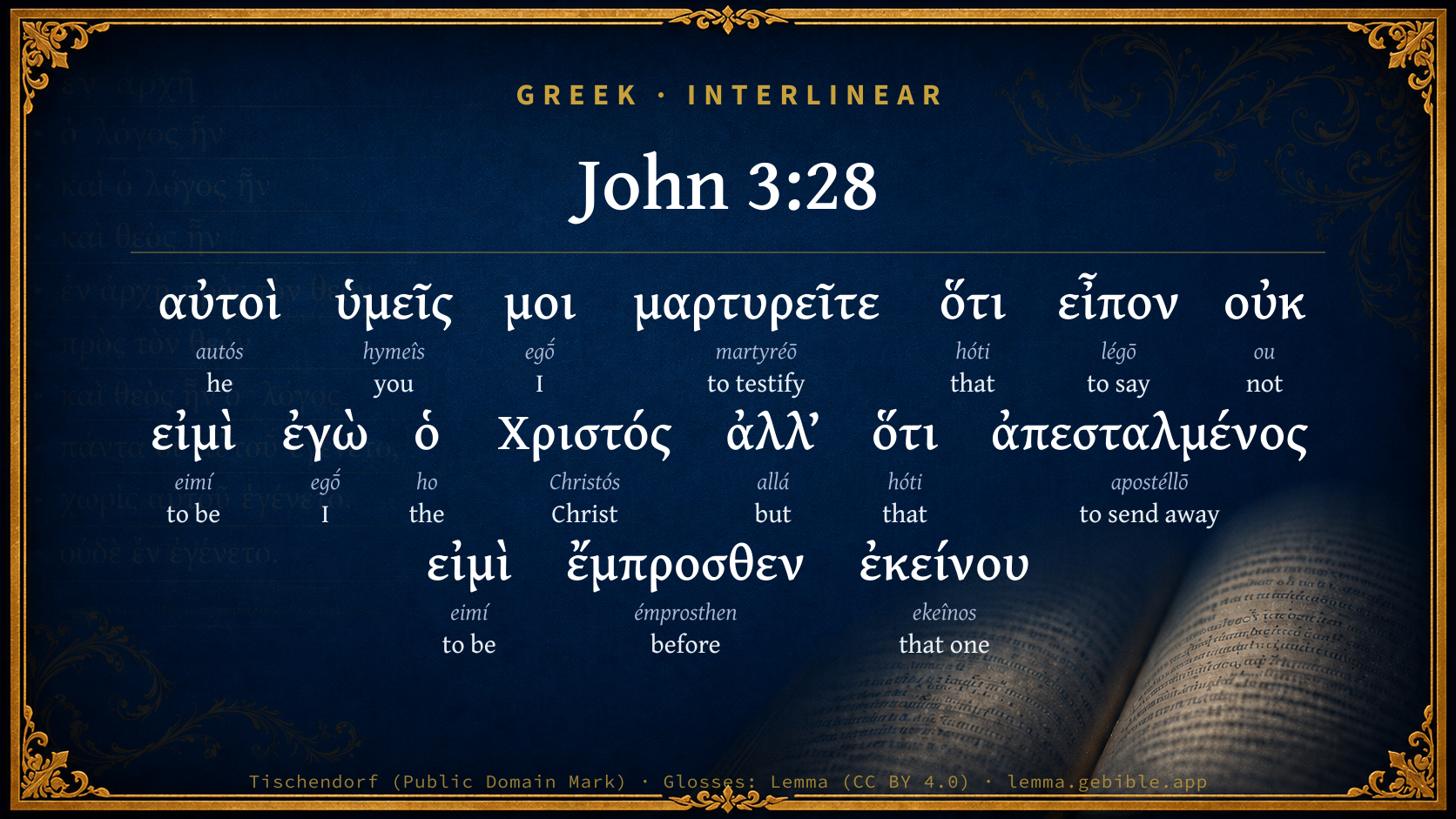
Greek (Tischendorf 8th ed.) John 3:28 appears in the Greek New Testament. The text above is from the Tischendorf 8th edition. Each word links to its Strong’s number and a concise gloss. Click any word for its full Thayer’s Greek Lexicon entry.
Download image
Cite this verse

John 3:28 (World English Bible). Public Domain. Lemma interlinear Bible study tool, https://lemma.gebible.app/v/john/3/28.

Show BibTeX & RIS
BibTeX
RIS
English Translation
You yourselves testify that I said, 'I am not the Christ,' but, 'I have been sent before him.'
World English Bible · Public Domain
Download a study sheet

One document with this verse’s original text, its word-by-word gloss line, the meaning frame, cross-references with their text, attributed commentary, and full source and license credits — printable, and it pastes into notes with its structure intact.

This verse Autodidact and up

Study sheet (.html) Plain text (.txt)

A passage Seminary Student

Up to 50 verses in one chapter. A passage sheet keeps up to 6 commentary sources and 12 cross-references per verse, in the order this page ranks them, and says so on the sheet whenever that leaves anything out. Ask for a single verse and you get the Autodidact verse sheet above.

Everything on this page stays free to read, with no account — the sheet is a download of what is already on screen, not access to it.

Want to remove ads? Support Godless Engineer
Compare translations 3

The same verse in 3 English versions, stacked beneath the original-language interlinear above. Click any original word for its lexicon entry.

Each is an independent rendering of the whole verse — the interlinear is not word-aligned to these translations.

Highlighted words mark where these versions differ — a whole-verse word diff, not a word-by-word alignment.

  • World English Bible Public Domain
    You yourselves testify that I said, 'I am not the Christ,' but, 'I have been sent before him.'
  • King James Version Public Domain
    Ye yourselves bear me witness, that I said, I am not the Christ, but that I am sent before him.
  • unfoldingWord Literal Text CC BY-SA 4.0
    You yourselves testify to me that I said, ‘I am not the Christ,’ but, ‘I have been sent before that one.’

unfoldingWord Literal Text — © unfoldingWord, licensed CC BY-SA 4.0. Word-aligned USFM3 via Door43 (git.door43.org/unfoldingWord/en_ult).

Versions to compare (up to 4)

3 of 4 selected

Show all 19 translations

Every available English version of this verse, each an independent rendering of the whole verse.

  • World English Bible Public Domain
    You yourselves testify that I said, 'I am not the Christ,' but, 'I have been sent before him.'
  • Berean Standard Bible Public Domain
    You yourselves can testify that I said, ‘I am not the Christ, but am sent ahead of Him.’
  • Majority Standard Bible Public Domain
    You yourselves can testify that I said, ‘I am not the Christ, but am sent ahead of Him.’
  • King James Version Public Domain
    Ye yourselves bear me witness, that I said, I am not the Christ, but that I am sent before him.
  • American Standard Version (1901) Public Domain
    Ye yourselves bear me witness, that I said, I am not the Christ, but, that I am sent before him.
  • Revised Version (1885) Public Domain
    Ye yourselves bear me witness, that I said, I am not the Christ, but, that I am sent before him.
  • Geneva Bible (1599) Public Domain
    Yee your selues are my witnesses, that I sayde, I am not that Christ, but that I am sent before him.
  • Douay-Rheims (1899) Public Domain
    You yourselves do bear me witness, that I said, I am not Christ, but that I am sent before him.
  • Young's Literal Translation Public Domain
    ye yourselves do testify to me that I said, I am not the Christ, but, that I am having been sent before him;
  • Literal Standard Version CC BY-SA 4.0
    you yourselves testify to me that I said, I am not the Christ, but that I am having been sent before Him;
  • Unlocked Literal Bible CC BY-SA 4.0
    You yourselves can testify that I said, 'I am not the Christ,' but instead, 'I have been sent before him.'
  • unfoldingWord Literal Text CC BY-SA 4.0
    You yourselves testify to me that I said, ‘I am not the Christ,’ but, ‘I have been sent before that one.’
  • Darby Bible Public Domain
    Ye yourselves bear me witness that I said, I am not the Christ, but, that I am sent before him.
  • World Messianic Bible Public Domain
    You yourselves testify that I said, ‘I am not the Messiah,’ but, ‘I have been sent before him.’
  • Webster's Bible Public Domain
    Ye yourselves bear me testimony, that I said I am not the Christ, but that I am sent before him.
  • Free Bible Version CC BY-SA 4.0
    “You yourselves can testify that I declared, ‘I'm not the Messiah. I've been sent to prepare his way.’
  • Bible in Basic English Public Domain
    You yourselves give witness that I said, I am not the Christ. What I said was, I am sent before the Christ.
  • Text-Critical English NT CC BY 4.0
    You yourselves can testify that I said, ‘I am not the Christ,’ but rather, ‘I have been sent ahead of him.’
  • Tyndale New Testament (1534) Public Domain
    Ye youre selves are witnesses how that I sayde: I am not Christ but am sent before him.

Literal Standard Version (2020), Covenant Press — licensed CC BY-SA 4.0. Text via the HelloAO Bible API (eBible.org). Unlocked Literal Bible (unfoldingWord) — licensed CC BY-SA 4.0. Text via the HelloAO Bible API (eBible.org). unfoldingWord Literal Text — © unfoldingWord, licensed CC BY-SA 4.0. Word-aligned USFM3 via Door43 (git.door43.org/unfoldingWord/en_ult). Free Bible Version, Dr. Jonathan Gallagher — licensed CC BY-SA 4.0. Text via the HelloAO Bible API (eBible.org).

Word by word

More ways to search: Search by grammar → Find every occurrence → Compare this word →

Practice this passage: Drill this verse → Learn its vocabulary →

ἔμπροσθεν
émprosthen
G1715
“before”
Preposition
Part of Speech
Preposition
Full Thayer's Definition

Origin: from G1722 and G4314

TDNT: None

1. in front, before a. before, i.e. in that local region which is in front of a person or thing b. before, in the presence of, i.e. opposite to, over against one c. before, in the sight of d. before, denoting rank
  1. αὐτοὶ autós G846 “he” Personal pronoun, Nominative, Plural, Masculine
  2. ὑμεῖς hymeîs G5210 “you” Personal pronoun, 2nd person, Nominative, Plural
  3. μοι egṓ G1473 “I” Personal pronoun, 1st person, Dative, Singular
  4. μαρτυρεῖτε martyréō G3140 “to testify” Verb, Present, Active, Indicative, 2nd person, Plural
  5. ὅτι hóti G3754 “that” Conjunction
  6. εἶπον légō G3004 “to say” Verb, Aorist, Active, Indicative, 1st person, Singular
  7. οὐκ ou G3756 “not” Particle, Negative
  8. εἰμὶ eimí G1510 “to be” Verb, Present, Active, Indicative, 1st person, Singular
  9. ἐγὼ egṓ G1473 “I” Personal pronoun, 1st person, Nominative, Singular
  10. ὁ ho G3588 “the” Article, Nominative, Singular, Masculine
  11. Χριστός Christós G5547 “Christ” Noun, Nominative, Singular, Masculine
  12. ἀλλ’ allá G235 “but” Conjunction
  13. ὅτι hóti G3754 “that” Conjunction
  14. ἀπεσταλμένος apostéllō G649 “to send away” Verb, Perfect, Passive, Participle, Nominative, Singular, Masculine
  15. εἰμὶ eimí G1510 “to be” Verb, Present, Active, Indicative, 1st person, Singular
  16. ἐκείνου ekeînos G1565 “that one” Demonstrative pronoun, Genitive, Singular, Masculine

About this verse

These counts appear in no published source. They are computed here, from the morphology-tagged text and Lemma’s own curated glosses. What Lemma adds →

17
words
14
distinct lemmas
Gospels
section

Shared distinctive vocabulary

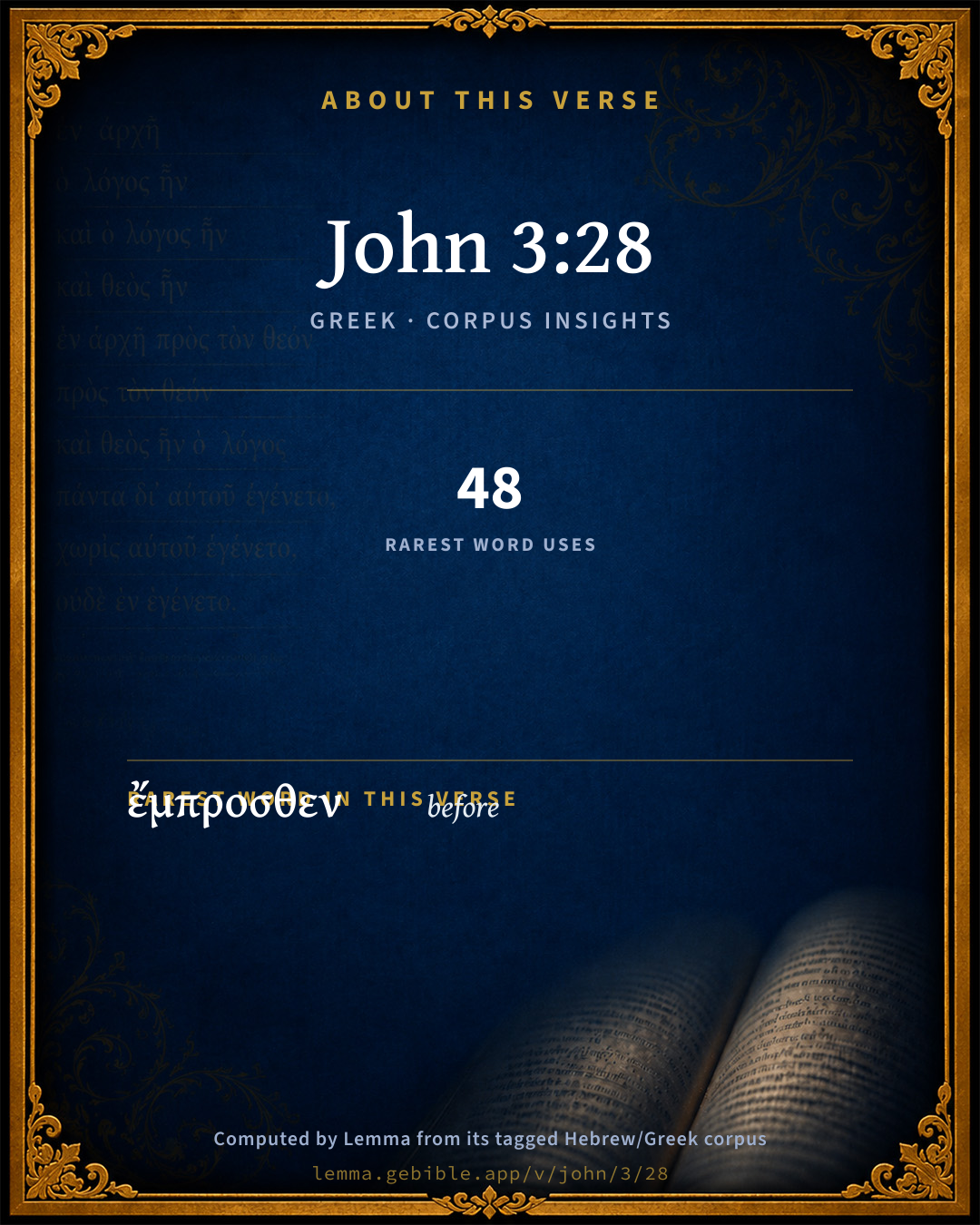
ἔμπροσθεν before G1715 occurs in 45 verses of the Greek New Testament. Also found in:
Repetition

Words recur within this verse:

Cross-references

11

Topical passages linked to John 3:28 in the Treasury of Scripture Knowledge — connected by theme and wording, ordered by reader-vote popularity; previews shown in the World English Bible.

  • John 1:20 He confessed, and didn't deny, but he confessed, "I am not the Christ."
  • John 1:23 He said, "I am the voice of one crying in the wilderness, 'Make straight the way of the Lord,' as Isaiah the prophet said."
  • Matthew 3:11–12 I indeed baptize you in water for repentance, but he who comes after me is mightier than I, whose shoes I am not worthy to carry. He will baptize you in the Holy Spirit.
  • Luke 1:16–17 He will turn many of the children of Israel to the Lord, their God.
  • Malachi 3:1 "Behold, I send my messenger, and he will prepare the way before me; and the Lord, whom you seek, will suddenly come to his temple; and the messenger of the covenant, whom you desire, behold, he comes!" says Yahweh of hosts.
  • John 1:25 They asked him, "Why then do you baptize, if you are not the Christ, nor Elijah, nor the Prophet?"
  • Matthew 3:3 For this is he who was spoken of by Isaiah the prophet, saying, "The voice of one crying in the wilderness, Make ready the way of the Lord, Make his paths straight."
  • Mark 1:2–3 As it is written in the prophets, "Behold, I send my messenger before your face, Who will prepare your way before you.
  • Luke 1:76 And you, child, will be called a prophet of the Most High, For you will go before the face of the Lord to make ready his ways,
  • Malachi 4:4–5 "Remember the law of Moses my servant, which I commanded to him in Horeb for all Israel, even statutes and ordinances.
  • Luke 3:4–6 As it is written in the book of the words of Isaiah the prophet, "The voice of one crying in the wilderness, 'Make ready the way of the Lord. Make his paths straight.

Cross-references courtesy of OpenBible.info (CC BY 4.0).

Commentary

Notes on John 3:28 from classic Christian and Jewish commentators (each source and its license shown beneath its notes). The classic Christian expositions comment on the surrounding passage and are grouped to its opening verse, so a note may address several verses; the Jewish commentaries on the Tanakh (Rashi and others) are per-verse, so they appear only where the commentator wrote on this verse.

Lemma curates 59 commentaries, every one of them public domain or Creative Commons licensed, each selected and text-cleaned for this edition rather than reprinted as found. About our sources →

Bengel's Gnomon

Johann Albrecht Bengel

Joh 3:28. Ἔμπροσθεν ἐκείνου, before Him) Him, concerning whom Joh 3:26 treats. So Joh 3:30, “He must increase, but I must decrease.” John did not openly term Jesus the Christ: but however he spake so concerning Him, that He might easily be recognised.

Bengel's Gnomon of the New Testament — English translation (T&T Clark, Edinburgh, 1860) — public domain. Text from a community e-Sword module.

Expositor's Greek Testament

ed. W. Robertson Nicoll

Joh 3:28 . αὐτοὶ ὑμεῖς … ἐκείνου . John’s disciples should have been prepared for what they now see happening. He had emphatically declared that he was not the Christ, but only His forerunner (Joh 1:19-27 ; Joh 1:30 ).

The Expositor's Greek Testament, edited by W. Robertson Nicoll (1897–1910) — public domain. Text from a community e-Sword module.

John Calvin's Commentaries

28. You are witnesses to me. John expostulates with his disciples that they did not give credit to his statements. He had often warned them that he was not the Christ; and, therefore, it only remained that he should be a servant and subject to the Son of God along with others. And this passage is worthy of notice; for, by affirming that he is not the Christ, he reserves nothing for himself but to be subject to the head, and to serve in the Church as one of the rest, and not to be so highly exalted as to obscure the honor of the Head. He says that he was sent before, to prepare the way for Christ, as kings are wont to have heralds or forerunners.

John Calvin's Commentaries (1540-1563) — public domain. Text from the Calvin Translation Society English edition (1840s-50s) via the Christian Classics Ethereal Library (ccel.org). Calvin's coverage is partial (roughly two-thirds of the Bible); uncommented books and verses are honest gaps, never fabricated. The 19th-century editor's footnotes and remarks are omitted so the notes are faithfully Calvin's own voice.

Ellicott's Commentary for English Readers

(28) Ye yourselves bear me witness.—They remembered (Joh_3:26) that John had borne witness to Jesus. Did they not remember too what he had said? He had from the first known his own work, and the greater work. Some of his disciples had known it also, and had gone from him to Jesus. This which they see was the necessary result of the truth he had ever declared.

A Bible Commentary for English Readers, edited by Charles John Ellicott (1878–1897) — public domain. Text from a community e-Sword module.

The Cambridge Bible for Schools and Colleges

gen. ed. J. J. S. Perowne

28. Ye yourselves] Though you are so indignant on my account.

bear me witness, that I said] They had appealed to his testimony (Joh_3:26); he turns it against them.

before him] ‘Before Him, of whom you complain, whom I proclaim to be the Christ.’ In Joh_1:26; Joh_1:30, John spoke less clearly.

The Cambridge Bible for Schools and Colleges (gen. ed. J. J. S. Perowne; Cambridge University Press, 1878–1918) — public domain. Text from a community e-Sword module.

John Gill's Exposition

He that hath the bride,.... By whom particular persons seem here to be meant, who were called, converted, and brought to Christ, and were made his disciples, and baptized, and so were openly espoused unto him; though sometimes it designs a particular church of Christ, and even the whole general assembly, and church of the firstborn, whose names are written in heaven; all the elect of. God, whether among Jews, or Gentiles; see Co2 11:2. These Christ has in a conjugal relation; and he came, and comes to have them after this manner: he saw them in his Father's purposes, and decrees, in all the glory he meant to bring them to; and loved them, and desired them of his Father, as his spouse, who gave them to him, as such; and he betrothed them to himself for ever; and in time he sends his ministering servants with his Gospel, to engage and betroth them to him; and by the power of his grace, he makes them willing to give up themselves to him; which is the open espousal of them; and at the last day, when the number of the elect are completed, the marriage of the Lamb will be publicly solemnized, and a marriage supper will be made; and all that are called, and ready, will enter into the marriage chamber, and share in the joys, and pleasures of that day: thus by virtue of the Father's gift, Christ has them now as his own property, as his portion, his jewels, his bride, and wife; and by, and through his great love to them, he has them not only in his arms, from whence they can never be plucked; but in his heart, where they are set as a seal; and by virtue of this love, they are united to him, become one with him, are members of his body, flesh, and bones; and are one spirit with him, and nothing can be able to separate them; and he will have them all with, him to all eternity, to be where he is, and behold his glory: and now, he that has the bride in this sense,

is the bridegroom; and such is Christ; see Mat 9:15; and he acts, and behaves, as such; he loves the saints, as a bridegroom loves his bride, with a love prior to theirs; with a love of complacency and delight, which is single, chaste, and inviolable; free, and sovereign, wonderful, unchangeable, and from everlasting to everlasting: he sympathises with them in all their adversities, and afflictions; he nourishes, and cherishes them, and provides everything for them, for food, and clothing, for refreshment and protection; and interests them in all he has: and an amazing instance of grace this is, that such who are no better than others, children of wrath by nature; exceeding great sinners, guilty, and filthy; bankrupts, and beggars on the dunghill; and yet are taken into so near a relation to him; who is in the form of God, and equal to him, the brightness of his glory, and the express image of his person, the Son of God, in whom all the fulness of the Godhead dwells; the King of kings, and Lord of lords. And this being the case, John suggests, that by these persons following Christ, and giving up themselves to him, it appeared that he was the bridegroom; and to whom should they betake themselves but to him? Nor did it become him, or any other, to seek to draw them from him; nor should any envy his enjoyment of them, since they were his in so peculiar a sense, and in so near a relation:

but the friend of the bridegroom; meaning himself: and such is every true minister of the Gospel; he is a lover of Christ, a friend to his interest, and seeks by all means to promote it, and to bring souls unto him. The allusion is to a custom among the Jews, who, at their marriages, used to have persons both on the side of the bride, and of the bridegroom, as companions that attended each, and were called their friends; see Jdg 14:20. Such an one is called by the Rabbins, and this word is interpreted by "a lover", or "friend", the same as here; and by "his" (the bridegroom's) "friend" in the time of his marriage (s). There were two of these, one for the bride, and another for the bridegroom; for so it is said (t), formerly they appointed two

""friends", one for him (the bridegroom), and one for her (the bride), that they might minister to the bridegroom, and do all things at their entrance into the marriage chamber. --And formerly, these friends slept where the bridegroom and bride slept.''

And so as John is here represented as the friend of Christ, the bridegroom of the church; the Jews speak of Moses as the friend of God, the bridegroom of the people of Israel. So one of their writers (u), having delivered a parable concerning a certain king going into a far country, and leaving his espoused wife with his maid-servants, who raising an evil report on her, his friend tore in pieces the matrimonial contract, thus applies it:

"the king, this is the holy, blessed God; the maidens, these are the mixed multitude; and "the friend", this is Moses; and the spouse of the holy, blessed God is Israel.''

The Jews say (w), that Michael and Gabriel were the "bridal friends" to the first Adam.

Which standeth; the phrase may be seen in the above parable of the Jewish writer (x) referred to, , "his friend standeth": this was the posture of servants, and is fitly applied to John, who was the harbinger of Christ, and judged himself unworthy to bear his shoes; and well agrees with the ministers of the Gospel, who stand before Christ, wait upon him, and minister in his name, and are the servants of the churches for his sake:

and heareth him; hearkens to his words; observes, and obeys them; hears his voice, so as to understand it, and distinguish it from another's; and hears it with delight and pleasure, as every true friend of Christ does his Gospel, which is his voice, and is a joyful sound; and so

rejoiceth greatly because of the bridegroom's voice: such an one rejoices at the sight of his person, and in communion with him; he rejoices at the sound of his voice; and is delighted to hear him in the ministry of the word, calling to one, and to another, to come unto him, and causing them to believe in him, and give up themselves to him.

This my joy therefore is fulfilled; in Christ, he being come in person, and his voice heard in the land of Judea, and multitudes of souls flocking to him, who believing in him, were baptized; than which nothing could be a greater pleasure to John, or to any Gospel minister. This was the accomplishment and perfection of his joy, which carried it to its utmost height: this was what he wished for; and now he had the desire of his heart. It was usual for the friend of the bridegroom to carry provisions with him, and eat and drink with the bridegroom, and rejoice with him; and this rejoicing was mutual. Hence those words,

"give me "my friend", that I may rejoice with him:''

the gloss upon it is,

"and eat at his marriage, even as he also rejoiced, and ate at my marriage (y).''

To this rejoicing the allusion is here.

(s) Misn. Sanhedrin, c. 3. sect. 5. & Bartenora in ib. (t) T. Bab. Cetubot, fol. 12. 1. (u) Jarchi in Exod. xxxiv. 1. Vid. Shemot Rabba, sect. 46. fol. 142. 2. (w) Bereshit Rabba, sect. 8. fol. 8. 2. (x) Jarchi in ib. (y) T. Bab. Bava Bathra, fol. 144. 2. & 145. 1.

John Gill's Exposition of the Whole Bible (1746–1763) — public domain (CC PDM 1.0). Text via the HelloAO Bible API.

Trapp's Complete Commentary

John Trapp

28 Ye yourselves bear me witness, that I said, I am not the Christ, but that I am sent before him.

Ver. 28. Ye yourselves bear me witness] I should rather choose the just commendation of one good man (saith Rolloc upon this text) than the foolish admiration of a whole multitude, Equidem pluris fecerim iustam commendationem, &c. Demetrius hath good report of the truth itself, that is enough for him, 3Jn 1:12.

John Trapp, A Commentary or Exposition upon All the Books of the Old and New Testament (1647–1656) — public domain. Text from a community e-Sword module.

Albert Barnes' Notes on the Bible

Bear me witness - You remember that at first I told you I was not the Messiah. As he had been “witness” to Jesus - as he came for no other end but to point him out to the Jews, they ought not to suppose that he was his superior. It was but reasonable to expect that Christ himself would be more successful than his forerunner. “I came, not to form a separate party, a special sect, but to prepare the way that he might be more successful, and that the people might be ready for his coming, and that he might have the success which he has actually met with. You should rejoice, therefore, at that success, and not envy it, for ‘his success’ is the best proof of the greatness of my word, and of its ‘success also.’”

Albert Barnes' Notes on the Bible (1834–1885) — public domain. Text from a community e-Sword/MySword module.

Matthew Poole's English Annotations

I appeal to you that are my disciples, Did not I always plainly tell yea that I was not the Christ? It belongeth unto Christ alone, who is the Head of the church, to send out such as shall labour in it, and to restrain those that labour in it; would you have me silence or suspend him? I told you, that I was but one of his ministers,

sent before him to prepare his way, Joh 1:20,23.

Matthew Poole's English Annotations on the Holy Bible (1683–1685) — public domain. Text from a community e-Sword/MySword module.

Whedon's Commentary on the Bible

Daniel D. Whedon

28. Yourselves bear me witness—So clearly did Peter and John (who were originally the Baptist’s disciples) understand that the Baptist was the mere herald of Jesus the Messiah, that they left John and went to Jesus. It seems strange, therefore, that any of John’s disciples should fail to understand John’s subordination. He therefore rebukes them by appealing to their own recollection of his testimony.

I said, I am not the Christ—Not the Messiah.

Sent before him—Not as a superior, but as a herald before a superior. This humility of the Baptist, as narrated by our Evangelist, is more fully, but not more energetically, expressed in the previous Gospels. In the first three Gospels John is a voice proclaiming a reality; a herald preceding a coming Jehovah; he is the sandal-bearer of a Master, unworthy to unloose his shoe-lachet; he is the outpourer of mere water, shadowing the Outpourer of the Spirit, who is therefore God, who is Author of final judgment and retribution. Now much is said in the fourth Gospel more diffuse and extended, but nothing more intense and decisive.

Daniel D. Whedon (gen. ed.), Commentary on the Old and New Testaments (1874–1909) — public domain. Text from a community e-Sword module.

The Pulpit Commentary

Ye yourselves (cf. 1Th_4:9 for similar emphatic pronoun) bear me witness you will do it readily, if I challenge you, for my testimonies were frequent and varied (in fact, the synoptists and the fourth evangelist are equally explicit here)that I said, I am not the Messiah. (Joh_1:20 Mat_3:11, 12 Luk_3:15-17) This announcement, made with great publicity at Bethany, was the basis of the present remonstrance; and the words which follow strongly sustain John"s reference to the Divine predestination in his own case and that of Jesus (all oti may point back to the discourse of John, or may simply indicate transition to the second statement). But that I am one sent (on a special mission) before him. He boldly implies, "This is more than I have already testified concerning "the Christ;" and my place is not at his side, not following in his train. I am "a voice;" my work is continuously to break up a way for him. I am here still, making the mountains low, and filling up the valleys for the approach of the great King." A man can receive nothing in the shape of lifework except that which is assigned to him out of heaven.

The Pulpit Commentary (1880–1919), ed. H.D.M. Spence-Jones & Joseph S. Exell — public domain. Text from a community e-Sword module.

Cambridge Greek Testament for Schools and Colleges

28. αὐτοὶ ὑμεῖς. ‘Ye yourselves, though you are so indignant on my behalf.’ They had appealed to his testimony (Joh 3:26); he turns it against them. He is not responsible for their error.

ἔμπ. ἐκ. John speaks more plainly in Joh 1:26; Joh 1:30: now that Jesus has manifested Himself he feels free to declare Him to be the Christ.

Cambridge Greek Testament for Schools and Colleges (Cambridge University Press, 1896; 21 vols, various authors incl. Carr, Maclear, Plummer, Farrar, Lumby, Moule, M. R. James, Simcox) — public domain. Text from a community e-Sword module.

Alford’s Greek Testament

Henry Alford

28.] ‘Not only so, but I have always given the same consistent testimony; that I was only the forerunner of One greater than myself.’ ἐκείνου does not refer to ὁ χριστός, in which case it would have been αὐτοῦ (see, however, apparent exceptions to this, ch. 7:45: Act 3:13; see also Winer, Gr., edn. 6, § 23. 1): but to Jesus, as the subject of ver. 26; and thus is not merely a general testimony with regard to the Messiah, but a personal one to Jesus.

Henry Alford, The Greek Testament (1849–1861) — public domain. Text from a community e-Sword module.

Godet's Commentaries

Frédéric Louis Godet

Ver. 28. “Ye yourselves bear me witness that I said: I am not the Christ, but I am sent before him.”

John expressly applies to himself the maxim of Joh 3:26. He has informed his disciples, from the beginning, of the fact of which they are complaining. He has always said to them, that it was not given to him to be the Christ, that his mission went no further than to open the way for Him. He appeals, with respect to this point, to their own recollection and discharges Himself thus from all responsibility for their jealous humor towards Jesus. The words: “Ye bear me witness,” seem to allude to their own expression, in Joh 3:26, where they had recalled the conduct of John with reference to Jesus. Then, he explains to them, by a comparison, the feeling which he experiences and which is so different from theirs.

Frédéric Louis Godet — Commentaries on Luke, John, Romans, and 1 Corinthians — English translation (T&T Clark, Edinburgh, 1870s–1890s) — public domain. Text from a community e-Sword module.

Lesson kit

Teaching starters — assembled from the data on this page, not authored interpretation. Every prompt links to the verse data it draws on. Edit before teaching.

John, in the Gospels, opens this verse with 17 words (14 distinct Greek lemmas). Its most distinctive word is émprosthen (“before”). A historical commentator’s framing appears above. Read the whole chapter for the surrounding context.

Discussion questions

  1. The word émprosthen carries the sense “before.” How does it shape the verse?
  2. Matthew 5:16 shares the word «before» with this verse. How do the two illuminate each other?
  3. “to be” occurs 2× in this one verse. What is the effect of the repetition?
  4. The translations on this page render this verse differently — a whole-verse word diff, not a word-by-word alignment. What might account for the different wordings?
  5. Reading how Bengel's Gnomon and Expositor's Greek Testament read this verse, where do the two commentators agree and where do they part?

Things to notice

  • These translations choose different wording for 9 words in this verse.
  • “to be” occurs 2× in this single verse.
  • 14 distinct Greek lemmas span 17 words in this verse.

Reading settings

Reading text

Shown beneath each verse's original-language words.

Old Testament
Old Testament edition

Read the OT as the Masoretic Hebrew (MT) or the Greek Septuagint (LXX).

English shown for the Greek Septuagint (in the Hebrew ↔ Greek comparison).

Comparing translations? Open the Compare panel on any verse page to stack up to four side by side.