John 6:35

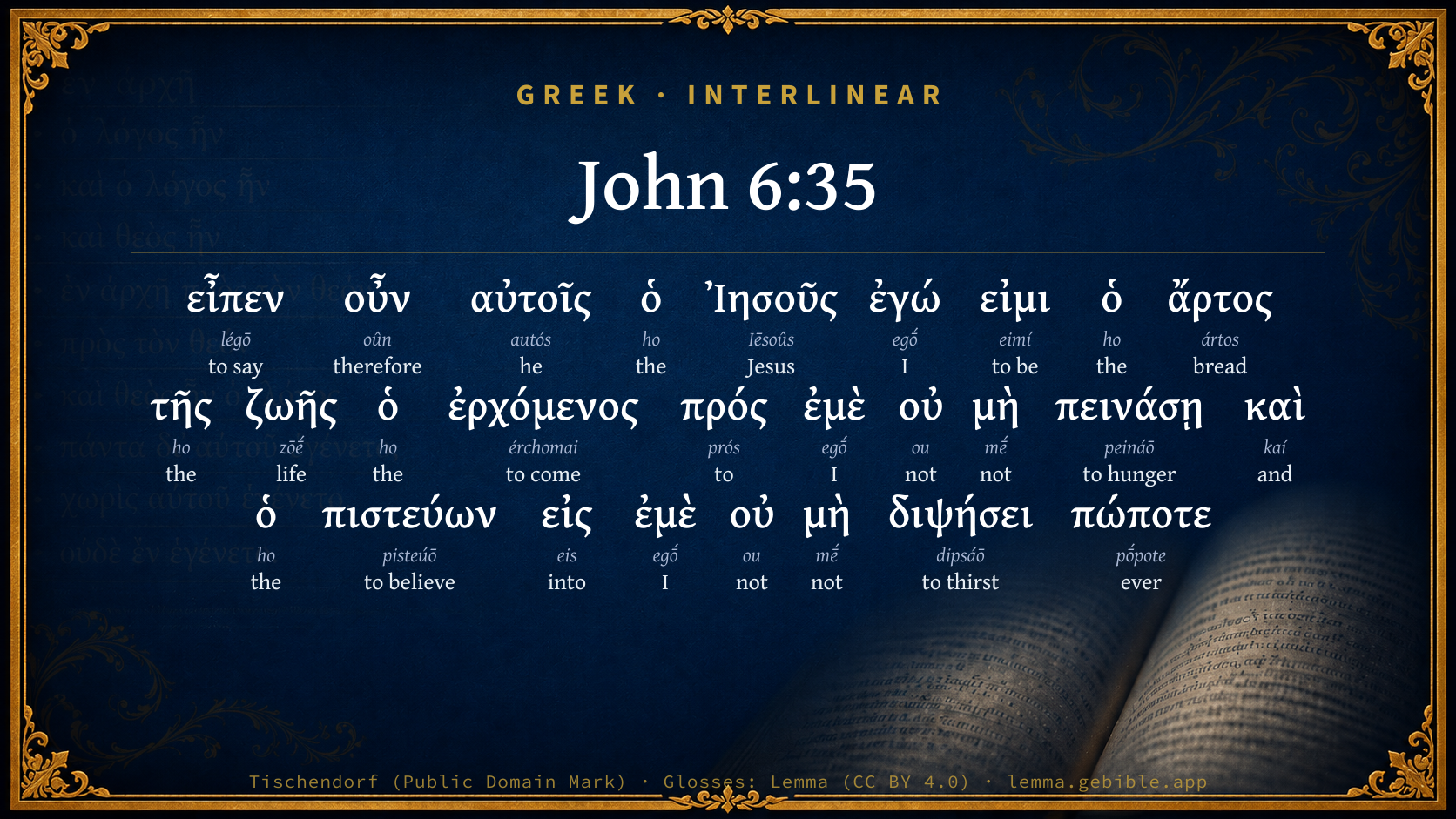
Greek (Tischendorf 8th ed.) John 6:35 appears in the Greek New Testament. The text above is from the Tischendorf 8th edition. Each word links to its Strong’s number and a concise gloss. Click any word for its full Thayer’s Greek Lexicon entry.
Download image
Cite this verse

John 6:35 (World English Bible). Public Domain. Lemma interlinear Bible study tool, https://lemma.gebible.app/v/john/6/35.

Show BibTeX & RIS
BibTeX
RIS
English Translation
Jesus said to them, "I am the bread of life. He who comes to me will not be hungry, and he who believes in me will never be thirsty.
World English Bible · Public Domain
Download a study sheet

One document with this verse’s original text, its word-by-word gloss line, the meaning frame, cross-references with their text, attributed commentary, and full source and license credits — printable, and it pastes into notes with its structure intact.

This verse Autodidact and up

Study sheet (.html) Plain text (.txt)

A passage Seminary Student

Up to 50 verses in one chapter. A passage sheet keeps up to 6 commentary sources and 12 cross-references per verse, in the order this page ranks them, and says so on the sheet whenever that leaves anything out. Ask for a single verse and you get the Autodidact verse sheet above.

Everything on this page stays free to read, with no account — the sheet is a download of what is already on screen, not access to it.

Want to remove ads? Support Godless Engineer
Compare translations 3

The same verse in 3 English versions, stacked beneath the original-language interlinear above. Click any original word for its lexicon entry.

Each is an independent rendering of the whole verse — the interlinear is not word-aligned to these translations.

Highlighted words mark where these versions differ — a whole-verse word diff, not a word-by-word alignment.

  • World English Bible Public Domain
    Jesus said to them, "I am the bread of life. He who comes to me will not be hungry, and he who believes in me will never be thirsty.
  • King James Version Public Domain
    And Jesus said unto them, I am the bread of life: he that cometh to me shall never hunger; and he that believeth on me shall never thirst.
  • unfoldingWord Literal Text CC BY-SA 4.0
    Jesus said to them, “I am the bread of life. The one coming to me will certainly not hunger, and the one believing in me will certainly not ever thirst.

unfoldingWord Literal Text — © unfoldingWord, licensed CC BY-SA 4.0. Word-aligned USFM3 via Door43 (git.door43.org/unfoldingWord/en_ult).

Versions to compare (up to 4)

3 of 4 selected

Show all 19 translations

Every available English version of this verse, each an independent rendering of the whole verse.

  • World English Bible Public Domain
    Jesus said to them, "I am the bread of life. He who comes to me will not be hungry, and he who believes in me will never be thirsty.
  • Berean Standard Bible Public Domain
    Jesus answered, “I am the bread of life. Whoever comes to Me will never hunger, and whoever believes in Me will never thirst.
  • Majority Standard Bible Public Domain
    Jesus answered, “I am the bread of life. Whoever comes to Me will never hunger, and whoever believes in Me will never thirst.
  • King James Version Public Domain
    And Jesus said unto them, I am the bread of life: he that cometh to me shall never hunger; and he that believeth on me shall never thirst.
  • American Standard Version (1901) Public Domain
    Jesus said unto them. I am the bread of life: he that cometh to me shall not hunger, and he that believeth on me shall never thirst.
  • Revised Version (1885) Public Domain
    Jesus said unto them, I am the bread of life: he that cometh to me shall not hunger, and he that believeth on me shall never thirst.
  • Geneva Bible (1599) Public Domain
    And Iesus saide vnto them, I am that bread of life: he that commeth to me, shall not hunger, and he that beleeueth in me, shall neuer thirst.
  • Douay-Rheims (1899) Public Domain
    And Jesus said to them: I am the bread of life: he that cometh to me shall not hunger: and he that believeth in me shall never thirst.
  • Young's Literal Translation Public Domain
    And Jesus said to them, `I am the bread of the life; he who is coming unto me may not hunger, and he who is believing in me may not thirst -- at any time;
  • Literal Standard Version CC BY-SA 4.0
    And Jesus said to them, “I AM the bread of life; he who is coming to Me may not hunger, and he who is believing in Me may not thirst—at any time;
  • Unlocked Literal Bible CC BY-SA 4.0
    Jesus said to them, “I am the bread of life; he who comes to me will not be hungry, and he who believes in me will never be thirsty.
  • unfoldingWord Literal Text CC BY-SA 4.0
    Jesus said to them, “I am the bread of life. The one coming to me will certainly not hunger, and the one believing in me will certainly not ever thirst.
  • Darby Bible Public Domain
    [And] Jesus said to them, I am the bread of life: he that comes to me shall never hunger, and he that believes on me shall never thirst at any time.
  • World Messianic Bible Public Domain
    Yeshua said to them, “I am the bread of life. Whoever comes to me will not be hungry, and whoever believes in me will never be thirsty.
  • Webster's Bible Public Domain
    And Jesus said to them, I am the bread of life: he that cometh to me, shall never hunger; and he that believeth on me, shall never thirst.
  • Free Bible Version CC BY-SA 4.0
    “I am the bread of life,” Jesus replied. “Anyone who comes to me will never be hungry again, and anyone who trusts in me will never be thirsty again.
  • Bible in Basic English Public Domain
    And this was the answer of Jesus: I am the bread of life. He who comes to me will never be in need of food, and he who has faith in me will never be in need of drink.
  • Text-Critical English NT CC BY 4.0
    Jesus said to them, “I am the bread of life; he who comes to me will never hunger, and he who believes in me will never thirst.
  • Tyndale New Testament (1534) Public Domain
    And Iesus sayde vnto them: I am that breed of life. He that cometh to me shall not honger: and he that beleveth on me shall never thurst.

Literal Standard Version (2020), Covenant Press — licensed CC BY-SA 4.0. Text via the HelloAO Bible API (eBible.org). Unlocked Literal Bible (unfoldingWord) — licensed CC BY-SA 4.0. Text via the HelloAO Bible API (eBible.org). unfoldingWord Literal Text — © unfoldingWord, licensed CC BY-SA 4.0. Word-aligned USFM3 via Door43 (git.door43.org/unfoldingWord/en_ult). Free Bible Version, Dr. Jonathan Gallagher — licensed CC BY-SA 4.0. Text via the HelloAO Bible API (eBible.org).

Word by word

More ways to search: Search by grammar → Find every occurrence → Compare this word →

Practice this passage: Drill this verse → Learn its vocabulary →

πώποτε
pṓpote
G4455
“ever”
Adverb
Part of Speech
Adverb
Full Thayer's Definition

Origin: from G4452 and G4218

TDNT: None

1. ever, at any time
  1. εἶπεν légō G3004 “to say” Verb, Aorist, Active, Indicative, 3rd person, Singular
  2. οὖν oûn G3767 “therefore” Conjunction
  3. αὐτοῖς autós G846 “he” Personal pronoun, Dative, Plural, Masculine
  4. ὁ ho G3588 “the” Article, Nominative, Singular, Masculine
  5. Ἰησοῦς Iēsoûs G2424 “Jesus” Noun, Nominative, Singular, Masculine
  6. ἐγώ egṓ G1473 “I” Personal pronoun, 1st person, Nominative, Singular
  7. εἰμι eimí G1510 “to be” Verb, Present, Active, Indicative, 1st person, Singular
  8. ὁ ho G3588 “the” Article, Nominative, Singular, Masculine
  9. ἄρτος ártos G740 “bread” Noun, Nominative, Singular, Masculine
  10. τῆς ho G3588 “the” Article, Genitive, Singular, Feminine
  11. ζωῆς zōḗ G2222 “life” Noun, Genitive, Singular, Feminine
  12. ὁ ho G3588 “the” Article, Nominative, Singular, Masculine
  13. ἐρχόμενος érchomai G2064 “to come” Verb, Present, Middle or Passive deponent, Participle, Nominative, Singular, Masculine
  14. πρός prós G4314 “to” Preposition
  15. ἐμὲ egṓ G1473 “I” Personal pronoun, 1st person, Accusative, Singular
  16. οὐ ou G3756 “not” Particle, Negative
  17. μὴ mḗ G3361 “not” Particle, Negative
  18. πεινάσῃ peináō G3983 “to hunger” Verb, Aorist, Active, Subjunctive, 3rd person, Singular
  19. καὶ kaí G2532 “and” Conjunction
  20. ὁ ho G3588 “the” Article, Nominative, Singular, Masculine
  21. πιστεύων pisteúō G4100 “to believe” Verb, Present, Active, Participle, Nominative, Singular, Masculine
  22. εἰς eis G1519 “into” Preposition
  23. ἐμὲ egṓ G1473 “I” Personal pronoun, 1st person, Accusative, Singular
  24. οὐ ou G3756 “not” Particle, Negative
  25. μὴ mḗ G3361 “not” Particle, Negative
  26. διψήσει dipsáō G1372 “to thirst” Verb, Future, Active, Indicative, 3rd person, Singular

About this verse

These counts appear in no published source. They are computed here, from the morphology-tagged text and Lemma’s own curated glosses. What Lemma adds →

27
words
19
distinct lemmas
Gospels
section

Notable vocabulary

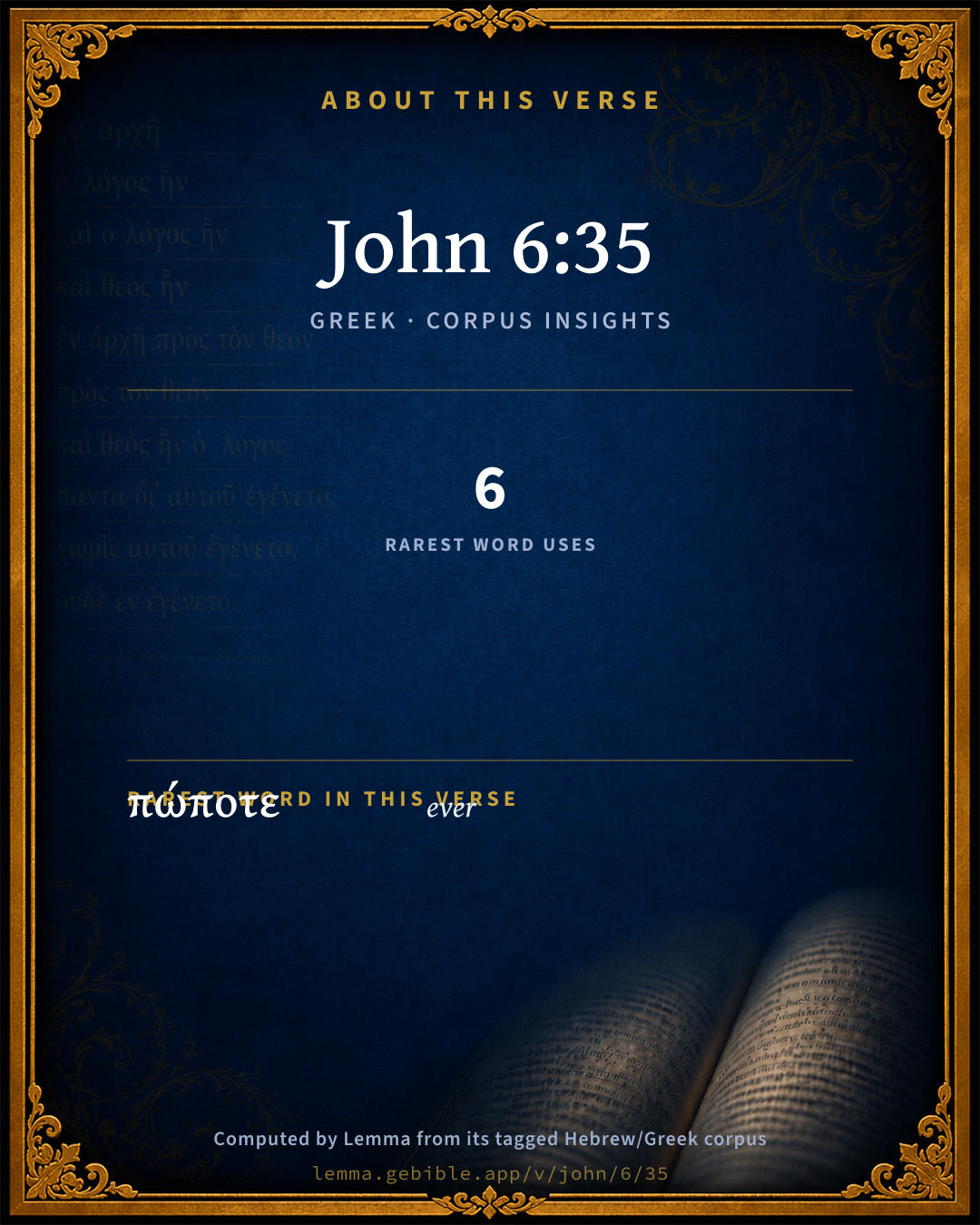
The rarest word here is πώποτε ever G4455 — appearing just 6 times in the whole Greek New Testament.

Shared distinctive vocabulary

πώποτε ever G4455 occurs in 6 verses of the Greek New Testament. Also found in:

Repetition

Words recur within this verse:

Cross-references

16

Topical passages linked to John 6:35 in the Treasury of Scripture Knowledge — connected by theme and wording, ordered by reader-vote popularity; previews shown in the World English Bible.

  • John 6:48–58 I am the bread of life.
  • Isaiah 55:1–3 Ho, everyone who thirsts, come you to the waters, and he who has no money; come you, buy, and eat; yes, come, buy wine and milk without money and without price.
  • Revelation 22:17 The Spirit and the bride say, "Come!" He who hears, let him say, "Come!" He who is thirsty, let him come. He who desires, let him take the water of life freely.
  • John 6:41 The Jews therefore murmured concerning him, because he said, "I am the bread which came down out of heaven."
  • Isaiah 49:10 They shall not hunger nor thirst; neither shall the heat nor sun strike them: for he who has mercy on them will lead them, even by springs of water will he guide them.
  • John 7:37–38 Now on the last and greatest day of the feast, Jesus stood and cried out, "If anyone is thirsty, let him come to me and drink!
  • Revelation 7:16 They will never be hungry, neither thirsty any more; neither will the sun beat on them, nor any heat;
  • Matthew 11:28 "Come to me, all you who labor and are heavily burdened, and I will give you rest.
  • John 4:13–14 Jesus answered her, "Everyone who drinks of this water will thirst again,
  • 1 Corinthians 11:23–29 For I received from the Lord that which also I delivered to you, that the Lord Jesus on the night in which he was betrayed took bread.
  • John 6:37 All those who the Father gives me will come to me. Him who comes to me I will in no way throw out.
  • Luke 6:25 Woe to you, you who are full now! For you will be hungry. Woe to you who laugh now! For you will mourn and weep.
  • 1 Corinthians 10:16–18 The cup of blessing which we bless, isn't it a communion of the blood of Christ? The bread which we break, isn't it a communion of the body of Christ?
  • John 6:65 He said, "For this cause have I said to you that no one can come to me, unless it is given to him by my Father."
  • John 5:40 Yet you will not come to me, that you may have life.
  • John 6:44–45 No one can come to me unless the Father who sent me draws him, and I will raise him up in the last day.

Cross-references courtesy of OpenBible.info (CC BY 4.0).

Where the printed editions differ

1 variant

Places in this verse where the major printed Greek editions disagree on the wording in a way that affects the translation — a comparison of editions, not a manuscript-by-manuscript collation. The editions are the modern critical texts (Nestlé-Aland 28/27, SBL, Westcott-Hort, Tregelles, Tyndale House) and the traditional texts behind the KJV (the Textus Receptus and the Byzantine/Majority text). It is not a claim about which reading is original.

  1. Extra text
    δὲ

    “now”

    In TRByz Not in NA28NA27TynSBLWHTreg

    δὲ (de) 'now' is only in traditional manuscripts (TR+Byz)

Textual data: Translators Amalgamated Greek New Testament (STEPBible TAGNT) · CC BY 4.0.

Commentary

Notes on John 6:35 from classic Christian and Jewish commentators (each source and its license shown beneath its notes). The classic Christian expositions comment on the surrounding passage and are grouped to its opening verse, so a note may address several verses; the Jewish commentaries on the Tanakh (Rashi and others) are per-verse, so they appear only where the commentator wrote on this verse.

Lemma curates 59 commentaries, every one of them public domain or Creative Commons licensed, each selected and text-cleaned for this edition rather than reprinted as found. About our sources →

Tyndale Open Study Notes

Tyndale Open Resources

6:35 Jesus’ I am statements in John depict Jesus’ identity and ministry (see also 4:26; 8:12; 9:5; 10:7-9, 11-14; 11:25; 14:6; 15:1-5). Jesus purposefully used a phrase that would make his listeners think of the Old Testament name for God (Exod 3:14). • I am the bread of life: Jesus is the true manna that descended from God (John 6:38). He satisfies the spiritual hunger of those who believe in him (cp. 4:10-13).

Tyndale Open Study Notes — © Tyndale Open Resources, licensed CC BY-SA 4.0. Text via the HelloAO Bible API.

Bengel's Gnomon

Johann Albrecht Bengel

Joh 6:35. Ἐγώ εἰμι, I am) To those who seek Him, He offers Himself immediately.—τῆς ζωῆς, of life) Both living, Joh 6:51, and life-giving, Joh 6:54, “Whoso eateth My flesh, and drinketh My blood, hath eternal life.”—ὁ ἐρχόμενος πρός με, he who cometh to Me) So Joh 6:37; Joh 6:44-45; Joh 6:65. The parallel expression to it follows presently, ὁ πιστεύων εἰς ἐμέ, he who believes on Me [ch. Joh 7:37-38, quoted above].—οὐ μὴ πεινάσῃ, shall not hunger) Understand πώποτε, ever, from the end of the verse.—οὐ μὴ διψήσῃ, shall not thirst) He touches on that, which subsequently He handles more fully, as to drink, Joh 6:53, etc.: “My blood is drink indeed” [Joh 6:55].

Bengel's Gnomon of the New Testament — English translation (T&T Clark, Edinburgh, 1860) — public domain. Text from a community e-Sword module.

Geneva Bible (1599)

Geneva Bible translators

Which have life, and give life.

Geneva Bible (1599) marginal notes — public domain. Text via Bolls.life.

Jamieson, Fausset & Brown

Robert Jamieson, A. R. Fausset & David Brown

I am the bread of life--Henceforth the discourse is all in the first person, "I," "Me," which occur in one form or other, as STIER reckons, thirty-five times.

he that cometh to me--to obtain what the soul craves, and as the only all-sufficient and ordained source of supply.

hunger . . . thirst--shall have conscious and abiding satisfaction.

Jamieson, Fausset & Brown — Commentary Critical and Explanatory on the Whole Bible (1871) — public domain (CC PDM 1.0). Text via the HelloAO Bible API.

Adam Clarke's Commentary

Verse 35. I am the bread of life] That is, the bread which gives life, and preserves from death.

He that cometh to me] The person who receives my doctrine, and believes in me as the great atoning sacrifice, shall be perfectly satisfied, and never more feel misery of mind. All the guilt of his sins shall be blotted out, and his soul shall be purified unto God; and, being enabled to love him with all his heart, he shall rest, fully, supremely, and finally happy, in his God.

Adam Clarke's Commentary on the Bible (1810–1826) — public domain. Text from a community e-Sword/MySword module.

John Calvin's Commentaries

35. I am the bread of life. First, he shows that the bread, which they asked in mockery, is before their eyes; and, next, he reproves them. He begins with doctrine, to make it more evident that they were guilty of ingratitude. There are two parts of the doctrine; for he shows whence we ought to seek life, and how we may enjoy it. We know what gave occasion to Christ to use those metaphors; it was because manna and daily food had been mentioned. But still this figure is better adapted to teach ignorant persons than a simple style. When we eat bread for the nourishment of the body, we see more clearly not only our own weakness, but also the power of divine grace, than if, without, bread, God were to impart a secret power to nourish the body itself. Thus, the analogy which is traced between the body and the soul, enables us to perceive more clearly the grace of Christ. For when we learn that Christ is the bread by which our souls must be fed, this penetrates more deeply into our hearts than if Christ simply said that he is our life

It ought to be observed, however, that the word bread does not express the quickening power of Christ so fully as we feel it; for bread does not commence life, but nourishes and upholds that life which we already possess. But, through the kindness of Christ, we not only continue to possess life, but have the beginning of life, and therefore the comparison is partly inappropriate; but there is no inconsistency in this, for Christ adapts his style to the circumstances of the discourse which he formerly delivered. Now the question had been raised, Which of the two was more eminent in feeding men, Moses or Christ himself? This is also the reason why he calls it bread only, for it was only the manna that they objected to him, and, therefore, he reckoned it enough to contrast with it a different kind of bread. The simple doctrine is, “Our souls do not live by an intrinsic power, so to speak, that is, by a power which they have naturally in themselves, but borrow life from Christ.”

He who cometh to me. He now defines the way of taking this food; it is when we receive Christ by faith. For it is of no avail to unbelievers that Christ is the bread of life, because they remain always empty; but then does Christ become our bread, when we come to him as hungry persons, that he may fill us. To come to Christ and to believe mean, in this passage, the same thing; but the former word is intended to express the effect of faith, namely, that it is in consequence of being driven by the feeling of our hunger that we fly to Christ to seek life.

Those who infer from this passage that to eat Christ is faith, and nothing else, reason inconclusively. I readily acknowledge that there is no other way in which we eat Christ than by believing; but the eating is the effect and fruit of faith rather than faith itself. For faith does not look at Christ only as at a distance, but embraces him, that he may become ours and may dwell in us. It causes us to be incorporated with him, to have life in common with him, and, in short, to become one with him, (John 17:21.) It is therefore true that by faith alone we eat Christ, provided we also understand in what manner faith unites us to him.

Shall never thirst. This appears to be added without any good reason; for the office of bread is not to quench thirst, but to allay hunger. Christ therefore attributes to bread more than its nature allows. I have already said, that he employs the word bread alone because it was required by the comparison between the manna and the heavenly power of Christ, by which our souls are sustained in life. At the same time, by the word bread, he means in general all that nourishes us, and that according to the ordinary custom of his nation. For the Hebrews, by the figure of speech called synecdoche, use the word bread for dinner or supper; and when we ask from God our daily bread, (Matthew 6:11,) we include drink and all the other parts of life. The meaning therefore is, “Whoever shall betake himself to Christ, to have life from him, will want nothing, but will have in abundance all that contributes to sustain life.”

John Calvin's Commentaries (1540-1563) — public domain. Text from the Calvin Translation Society English edition (1840s-50s) via the Christian Classics Ethereal Library (ccel.org). Calvin's coverage is partial (roughly two-thirds of the Bible); uncommented books and verses are honest gaps, never fabricated. The 19th-century editor's footnotes and remarks are omitted so the notes are faithfully Calvin's own voice.

Ellicott's Commentary for English Readers

(35) I am the bread of life.—Comp. again the conversation with the woman of Samaria. Here they have asked for “this bread,” the bread which giveth life, as distinct from that which perisheth. It is now present with them. He is that bread, whose characteristic is life. He is the Word of God, revealing God to man, teaching the eternal truths which are the life of the spirit just as bread is of the body.

He that cometh to me . . . he that believeth on me.—The natural bread satisfied no need unless it was appropriated and eaten. Prompted by hunger, they had taken into hand and mouth the loaves He had given them, and were filled. The same law holds for the spiritual bread. It is taken by him who comes to Christ; it is eaten by him who believes on Him, and it satisfies every need. It sustains the spiritual life in strength, and refreshes it in weariness. The bread of life giveth a principle of life, and he who hungereth and thirsteth for it shall also be filled, but with that which abideth, so that he shall never hunger and shall never thirst. (Comp. Mat_5:6.)

A Bible Commentary for English Readers, edited by Charles John Ellicott (1878–1897) — public domain. Text from a community e-Sword module.

The Cambridge Bible for Schools and Colleges

gen. ed. J. J. S. Perowne

35–50. Identification of the Spiritual Bread with Christ

35. I am the bread of life. The pronoun is very emphatic: comp. Joh_4:26. As in Joh_5:30, He passes from the third to the first person. ‘Bread of life’ means ‘bread that giveth life.’ Comp. ‘the tree of life’ (Gen_2:9; Gen_3:22; Gen_3:24), ‘the water of life’ (Rev_21:6; Rev_22:1). In the remainder of the verse ‘He that cometh to Me’ = ‘he that believeth on Me,’ and ‘shall never hunger’ = ‘shall never thirst;’ i.e. the believer shall experience the continual satisfaction of his highest spiritual needs. The superiority of Christ to the manna consists in this, that while it satisfied only bodily needs for a time, He satisfies spiritual needs for ever.

The Cambridge Bible for Schools and Colleges (gen. ed. J. J. S. Perowne; Cambridge University Press, 1878–1918) — public domain. Text from a community e-Sword module.

John Gill's Exposition

But I said unto you,.... The substance of what follows in Joh 6:26 though the Persic and Ethiopic versions render it, "I say unto you"; and so refers not to anything before said, but to what he was about to say:

that ye also have seen me, and believe not; that is, they had not only seen him in person, which many kings, prophets, and righteous men had desired, but not enjoyed, yet nevertheless believed; but they had seen his miracles, and had shared in the advantages of them, being healed, and fed corporeally by him, and yet believed not in him as the spiritual Saviour and Redeemer of their souls; nor did they come to him in a spiritual way, for eternal life and salvation.

John Gill's Exposition of the Whole Bible (1746–1763) — public domain (CC PDM 1.0). Text via the HelloAO Bible API.

Trapp's Complete Commentary

John Trapp

35 And Jesus said unto them, I am the bread of life: he that cometh to me shall never hunger; and he that believeth on me shall never thirst.

Ver. 35. I am that bread of life] Christ, passing by that bitter scoff of theirs, proceeds to teach them. The servant of the Lord must "not strive, but be gentle unto all men, apt to teach, patient in meekness, instructing those that oppose themselves," &c., 2Ti 2:24.

Shall never hunger] That is, shall never be painfully or despairingly hungry, utterly destitute of grace and glory; but shall continually feed at the feast of a good conscience, and at length sit down with Abraham, Isaac, and Jacob, in the kingdom of heaven.

John Trapp, A Commentary or Exposition upon All the Books of the Old and New Testament (1647–1656) — public domain. Text from a community e-Sword module.

Albert Barnes' Notes on the Bible

I am the bread of life - I am the support of spiritual life; or my doctrines will give life and peace to the soul.

Shall never hunger - See the notes at Joh 4:14.

Albert Barnes' Notes on the Bible (1834–1885) — public domain. Text from a community e-Sword/MySword module.

Matthew Poole's English Annotations

I am the bread of life; the bread that giveth spiritual and eternal life, and the bread that upholdeth and maintains spiritual life; the Messiah, whom God hath sent into the world, to quicken those that are dead in trespasses and sins, Eph 2:1; and to give eternal life to as many as the Father hath given me. But those that have this life, must come unto me; which he interprets in the next phrase by believing in him. Thus he taketh them off all gross and carnal conceptions of eating and drinking in a carnal manner; and minds them to think of getting and maintaining another kind of life than they dreamed of. By believing in him, we have formerly showed is to be understood a receiving of him as the Mediator and Saviour of men, and closing with him, and committing their souls in all their spiritual concerns unto him; and he that doth so (saith he) shall never hunger nor thirst; that is, shall never want any thing necessary for him for life and eternal happiness. And for things of this life, he shall have food convenient for him; he shall be fed, Psa 37:3. See such a promise, Isa 49:10.

Matthew Poole's English Annotations on the Holy Bible (1683–1685) — public domain. Text from a community e-Sword/MySword module.

Whedon's Commentary on the Bible

Daniel D. Whedon

35. I am the bread of life—The he of Joh_6:33 now rises into the sublime I. The restrained language of that verse is now unbound. A style is adopted which they at once see passes beyond their scope. And yet, before giving it the fullest expansion, our Lord pauses to tell them that its grand range of promise and glory is not for such as they.

Daniel D. Whedon (gen. ed.), Commentary on the Old and New Testaments (1874–1909) — public domain. Text from a community e-Sword module.

The Pulpit Commentary

But, or then Jesus said to them, now dropping all disguise, and gathering up into one burning word all the previous teaching, which they might have fathomed, but did not. I am the Bread of life; or "that which cometh down out of heaven, the veritable life-eternal-giving Bread, which I, as the steward of the Divine bounty, am giving, is my very self, my Divine humanity." On other occasions the Lord said, "I am the Light of the world", (Joh_8:12) "I am the good Shepherd", (Joh_10:14) "I am the Resurrection and the Life", (Joh_11:25) "I am the veritable Vine". (Joh_15:1) He claims here to be giving himself to the world, as the Source of its true life. The mode in which any human being can so assimilate this Bread that it should accomplish its purposes and transform itself into life, is by "coming or "believing." The two terms are parallel, though in "craning" there is more emphasis laid on the distinct act of the will than in "believing." The process is very impressively conveyed. He who has started to come, he that is coming to me, shall by no means hunger; he that is believing on me endeavouring to effect such inward approval and surrendershall never thirst (the pwpote responds here to the pantote). There is no special significance in the two-foldness of the parallel. "Coming" does not stand in any more immediate relation to "eating" than to "drinking," to the satisfaction of hunger than to that of thirst, nor does "believing" connote exclusively either the one or the other. The parallelism is a strengthening of the same idea. Approach to himself, believing surrender to the reality of his word, will satisfy the most pressing spiritual need, and do it in such a way that the hunger and thirst shall not, shall never, return. There is an invincible and unalterable assent produced by a real apprehension of Christ, which cannot be shaken out of the soul. Satisfaction of hunger may possibly (as Godet suggests) point to the supply of strength, and the appeasing of thirst to the supply of peace. The deeper idea is that the desire of the soul is satisfied, and it is not a recurrent desire. There are certain realities which, if once perceived, can never be unknown afterwards. There are consolations which, if once supplied, absolutely stanch and heal the wounds of the soul. Christ, in "coming down from heaven," by revealing the Divine Sonship in a Son of man. brings all heaven with him, opens all the Father"s heart. To come to him and to believe on him is to feed on the corn of heaven and drink of that river of life, clear as crystal, which is ever issuing from the throne of God and of the Lamb.

The Pulpit Commentary (1880–1919), ed. H.D.M. Spence-Jones & Joseph S. Exell — public domain. Text from a community e-Sword module.

John Wesley's Explanatory Notes

I am the bread of life - Having and giving life: he that cometh -he that believeth - Equivalent expressions: shall never hunger, thirst - Shall be satisfied, happy, forever.

John Wesley, Explanatory Notes Upon the Whole Bible (1754–1765) — public domain. Text via the GEBible commentary corpus.

Kretzmann's Popular Commentary

Paul E. Kretzmann

Jesus the Bread of Life:

v. 35. And Jesus said unto them, I am he Bread of Life; he that cometh to Me shall never hunger; and he that believeth on Me shall never thirst.

v. 36. But I said unto you, That ye also have seen Me, and believe not.

v. 37. All that the Father giveth Me shall come to Me; and him that cometh to Me I will in no wise cast out.

v. 38. For I came down from heaven, not to do Mine own will, but the will of Him that sent Me.

v. 39. And this is the Father’s will which hath sent Me, that of all which He hath given Me I should lose nothing, but should raise it up again at the last day.

v. 40. And this is the will of Him that sent Me, that everyone which seeth the Son and believeth on Him may have everlasting life; and I will raise him up at the last day.

Jesus now makes a plain, frank statement. He had not said that He would give the wonderful bread that came down from heaven, but He had asserted that this miraculous Bread which came down from heaven had the power to give eternal life. He Himself is that Bread of Life. No matter who it is that comes to Him, he will no more suffer with hunger, just as he that drinks of the living water of His salvation will never again be bothered with thirst. To come to Jesus means to believe in Him as the Savior of the world. All the desires and longings of the soul find their complete gratification in Him and His mercy. But although the Son of God and such perfect satisfaction was brought so neat to the Jews, yet they did not believe. They have seen Him in His ministry of miracles, and they have heard the words of life which issued from His mouth at such times, but they have refused to believe. They should know, therefore, that everything which the Father gives to the Son will come to Him. To come to Jesus is to believe; faith is a spiritual coming. The heart and the will of a person goes to Christ, is joined to Christ. All those people actually come to Jesus whom the Father has given to Him as His own. Faith is the result of God’s merciful selection. It is a call and selection of grace, and therefore none of those that come to Him in faith will the Lord cast out. God’s thoughts are thoughts of peace and mercy only; He has no desire for the death of any sinner. To fulfill this merciful kind purpose of His heavenly Father Jesus has come into the world. It is the will of the Father that Jesus lose none of those whom the Father has given Him. They are all equally precious in His sight, far too dearly bought to be lost. Those, therefore, whom the Father has given to the Son as His own, the Son should raise from the dead on the last day to give them the full enjoyment of the blessings and the glory which are their heritage. For the sake of clearness and emphasis, Jesus repeats the same thought. It is the will of the Father who sent the Son into the world that everyone that looks upon the Son in faith, that accepts Him as the Son of God and the Savior of the world, shall, without fail, have eternal life, shall become partaker of the glories of heaven by and in the resurrection. In Christ we have been chosen unto eternal life.

Paul E. Kretzmann, Popular Commentary of the Bible (1921–1924) — public domain. Text from a community e-Sword module.

The People's New Testament

B. W. Johnson

35. Jesus said unto them, I am the bread of life. They ask for this bread. He answers, it is here; I am that bread. The work of God is that you receive it by believing upon him whom he hath sent. He that cometh to me shall never hunger. He that cometh shall not hunger; he that believeth shall not thirst. It is thus shown that faith is the power that brings us to Christ. We come to him by believing.

B. W. Johnson's The People's New Testament with Notes (1889–1891) — public domain. Electronic text from the Christian Classics Ethereal Library (CCEL) ThML edition.

unfoldingWord translationNotes

Door43 World Missions Community

I am the bread of life

Through metaphor, Jesus compares himself with bread. Just as bread is necessary for our physical life, Jesus is necessary for our spiritual life. AT: "Just as food keeps you alive physically, I can give you spiritual life" (See: Metaphor)

believes in

This means to believe that Jesus is the Son of God, to trust him as Savior, and to live in a way that honors him.

Everyone whom the Father gives me will come to me

God the Father and God the Son will save forever those who believe in Jesus. (See: Translating Son and Father)

Father

This is an important title for God. (See: Translating Son and Father)

he who comes to me I will certainly not throw out

This sentence states the opposite of what it means for emphasis. AT: "I will keep everyone who comes to me" (See: Litotes)

translationWords

bread

life

believe

unfoldingWord translationNotes — © Distant Shores Media and the Door43 World Missions Community, licensed CC BY-SA 4.0. Source: git.door43.org/Door43/en_tn.

Cambridge Greek Testament for Schools and Colleges

35–50. Identification of the Spiritual Bread with Christ

35. διψήσει for διψήσῃ (correction to usual construction: comp. Joh 4:14, Joh 10:5).

35. ἐγώ εἰμι. Comp. Joh 6:41; Joh 6:48; Joh 6:51: the pronoun is very emphatic as in Joh 4:54. As in Joh 5:30, He passes from the third person to the first. These identifications are characteristic of this Gospel: Christ declares Himself to be the Light of the world (Joh 8:12), the Door of the Fold (Joh 10:7; Joh 10:9), the Good Shepherd (Joh 10:11; Joh 10:14), the Resurrection and the Life (Joh 11:25), the Way, the Truth, and the Life (Joh 14:6), the True Vine (Joh 15:1; Joh 15:5). Ὁ ἄρτος τ. ζωῆς means ὁ ἄρτ. ζωὴν διδούς: comp. τὸ ὕδωρ τ. ζ., Rev 21:6 (Rev 22:1), and τὸ ξύλον τ. ζ., Gen 2:9; Gen 3:22; Gen 3:24. ‘He that cometh to Me’ = ‘he that believeth on Me,’ and ‘shall in no wise hunger’ = ‘shall in no wise ever thirst’ (πώποτε, not, as in Joh 4:14, εἰς τὸν αἰῶνα); i.e. the believer shall experience the immediate and continual satisfaction of his highest spiritual needs. Christ’s superiority to the manna is this, that it satisfied only bodily needs for a time, He satisfies spiritual needs for ever. Note the Hebraic parallelism.

Cambridge Greek Testament for Schools and Colleges (Cambridge University Press, 1896; 21 vols, various authors incl. Carr, Maclear, Plummer, Farrar, Lumby, Moule, M. R. James, Simcox) — public domain. Text from a community e-Sword module.

Alford’s Greek Testament

Henry Alford

35.] As in ch. 5:30, so here, our Lord passes from the indirect to the direct form of speech. Henceforward it is ‘I,’ ‘Me,’ throughout the discourse.

In the genitive τῆς ζωῆς is implied ὁ καταβὰς ἐκ τοῦ οὐρ. καὶ ζωὴν διδοὺς τῷ κόσμῳ. So ὕδωρ ζῶν in ch. 4.

On the assurance of never hungering or thirsting, see note at ch. 4:14. It is possible that our Lord placed the all-satisfying bread of life in contrast to the manna, which was no sooner given, Exo_16, than the people began to thirst, Exo_17;—but I would not lay any stress on this.

ὁ ἐρχόμ. πρ. ἐμέ is in the same sense as in ch. 5:40—that of acceptance of and faith in Him.

Henry Alford, The Greek Testament (1849–1861) — public domain. Text from a community e-Sword module.

International Critical Commentary

35. At this point Jesus passes on to an explicit announcement of His personal claims, and the pronouns “I” and “Me” occur frequently, vv. 37-71. As we have seen, His hearers were prepared for the idea of heavenly bread, but they were quite unprepared for such a mystical saying as “I am the Bread of Life,” or for the tremendous claim which it involved. A pronouncement of this sort did not carry conviction to them; for they were looking for a “sign” comparable to the provision of the manna, but even more wonderful, as would befit the dignity of the Deliverer who was to be greater than Moses.

εἶπεν αὐτοῖς ὁ Ἰη. The rec. (with AΔ) adds δέ, while אDΓΘ and fam. 13 add οὖν after εἶπεν. But there is no copula in BLTW, and this is in agreement with Jn.’s partiality to asyndeton construction.

ἐγώ εἰμι ὁ ἄρτος τῆς ζωῆς. For the great Similitudes of the Fourth Gospel, of which this is the first, and for the significance of the opening phrase ἐγώ εἰμι, see Introd., p. cxviii.

It has been thought by some critics that this majestic sentence (repeated v. 48) is directly due, as regards its substance, although not as regards its form, to the influence of Philo. In several passages to which reference has been made already (see on v. 34), Philo says that the manna typified heavenly food. This, as we have seen, is not peculiar to Philo; but the Rabbinical writings do not seem to provide a parallel to the comparison of manna to the θεῖος λόγος, which Philo has more than once. That Jn.’s phraseology, here as elsewhere, may have been affected by his acquaintance with the terms of the Philonic philosophy is not impossible. There is, indeed, nothing difficult of credence in Jn.’s report that Jesus taught that He was Himself the Bread of Life, such teaching being not only congruous with the Synoptic representation of His words at the institution of the Eucharist (Mar 14:22, Mat 26:26, Luk 22:19), but being specially apposite in the context in which Jn. has placed it (see above on v. 26 f.). But, for all that, when reporting the claim of Jesus to be the Bread of Life, Jn. may have had in his mind Philo’s words about the θεῖος λόγος as the heavenly nourishment of the soul (Quis rer. div. hær. § 15). Jn’s conception of the Logos as a Person, Himself God Incarnate, is so widely different from Philo’s conception of the λόγοι as representing Divine forces, and the λόγος as the Divine Reason, that similarities of language between the two writers do not establish dependence of thought, or any borrowing of ideas from Philo on the part of Joh_1

The “Bread of Life” means primarily, the Bread which gives life, as we see from v. 33. But for this phrase is substituted in v. 51 ὁ ἀρτὸς ὁ ζῶν, the “living Bread,” i.e. the Bread that has life in itself. This second, larger meaning is virtually involved in the first, for life can only proceed from life, omne uiuum ex uiuo; and so that which gives life must itself be “living.” See on 15:26.

There is the same double sense in the similar phrase “the water of life” (Rev 21:6, Rev 22:1), sc. the water which gives life, and is therefore “living water” (see on 4:10). Cf. the expressions the “Light of life” in 8:12, where see the note; the “Tree of life” (Gen 3:22, Rev 2:7, etc.); and the “Word of life” (1Jn 1:1), i.e. the Word who gives life. Cf. v. 68.

ὁ ἐρχόμενος πρὸς ἐμέ κτλ. “Coming” and “believing” are put side by side here and at 7:37, 38. The “coming” is the initial act of the soul in its approach to Jesus; the “believing” is the continuous resting in His fellowship (see on v. 29). As Jn. has much about “believing,” so he has much about “coming,” and reports many sayings of Jesus about its benediction. Inquirers “come” to Jesus (3:26, 4:30, 10:41); all candid and truthful souls come to the Light (3:21); e.g. Nathanael (1:48), or the two disciples whose call is the first recorded by Jn. (1:39). The first reward of “coming” is vision, ἔρχεσθε καὶ ὄψεσθε (1:39); the second (and ultimate) reward is life (5:40). All are welcome, ἐάν τις διψᾷ, ἐρχέσθω πρός με (7:37). He who comes will not be cast out (6:37). To approach God a man must come to Jesus, οὐδεὶς ἔρχεται πρὸς τὸν πατέρα εἰ μὴ διʼ ἐμοῦ (14:6). This is the Only Way. And yet, free as is this approach, no one can come to Jesus, except the Father draw him (6:44, 65). This teaching is fuller than that of the Synoptic Gospels, but in germ it is all contained in Mat 11:28 δεῦτε πρός με … κἀγὼ ἀναπαύσω ὑμᾶς. This is the Matthæan counterpart of the utterance before us in this verse, “He that cometh to me shall never hunger”; the desire of the soul will be satisfied.

οὐ μὴ πεινάσῃ. πεινᾶν does not occur again in Jn.

καὶ ὁ πιστεύων εἰς ἐμέ, “he who believes on me” (see on v. 29 and on 1:12 above). This is the ἔργον τοῦ θεοῦ spoken of in v. 29.

οὐ μὴ διψήσει. So אAB*DWΘ; the rec. has διψήσῃ. The promise is the same as that given to the woman of Samaria ὃς δʼ ἂν πίῃ ἐκ τοῦ ὕδατος οὗ ἐγὼ δώσω αὐτῷ, οὐ μὴ διψήσει εἰς τὸν αἰῶνα (4:14, where see the note and esp. the quotation from Ecclus. 24:21; cf. Rev 7:16).

πώποτε. See on 1:18.

International Critical Commentary — older volumes (1896–1929), various authors — public domain. Text from a community e-Sword module.

Vincent's Word Studies in the New Testament

Marvin R. Vincent

I am the bread of life. A form of expression peculiar to John. See vv. 41, 48, 51; Joh 8:12; Joh 10:7, 9, 11, 14; Joh 11:25; Joh 14:6; Joh 14:1, 5.

Cometh - believeth. Faith in its active aspect and in its resting aspect. Never [ου μη] . Rather, in nowise, or by no means. Rev., shall not.

Marvin R. Vincent, Word Studies in the New Testament (1887–1900) — public domain. Text from a community e-Sword/MySword module.

Lesson kit

Teaching starters — assembled from the data on this page, not authored interpretation. Every prompt links to the verse data it draws on. Edit before teaching.

John, in the Gospels, opens this verse with 27 words (19 distinct Greek lemmas). Its most distinctive word is pṓpote (“ever”). A historical commentator’s framing appears above. Read the whole chapter for the surrounding context.

Discussion questions

  1. What does “ever” (pṓpote) contribute to the verse as a whole?
  2. How does Luke 19:30, which shares the word «ever», read alongside this verse?
  3. What does the repetition of “the” (5× in this one verse) do in this verse?
  4. The translations on this page render this verse differently — a whole-verse word diff, not a word-by-word alignment. What might account for the different wordings?
  5. Compare how Tyndale Open Study Notes and Bengel's Gnomon read this verse. Where do they agree or differ?

Things to notice

Reading settings

Reading text

Shown beneath each verse's original-language words.

Old Testament
Old Testament edition

Read the OT as the Masoretic Hebrew (MT) or the Greek Septuagint (LXX).

English shown for the Greek Septuagint (in the Hebrew ↔ Greek comparison).

Comparing translations? Open the Compare panel on any verse page to stack up to four side by side.