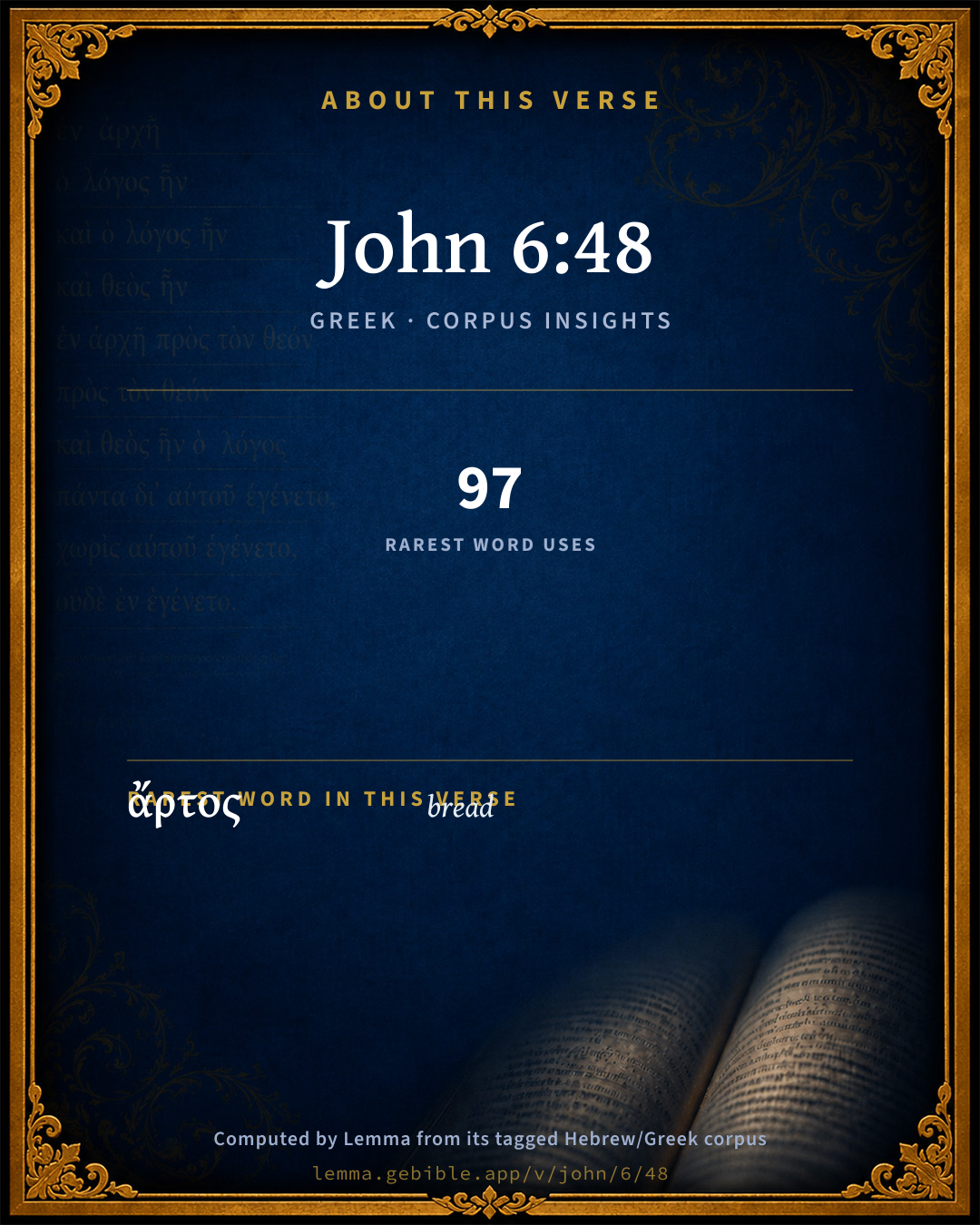
John 6:48

Greek (Tischendorf 8th ed.) John 6:48 appears in the Greek New Testament. The text above is from the Tischendorf 8th edition. Each word links to its Strong’s number and a concise gloss. Click any word for its full Thayer’s Greek Lexicon entry.
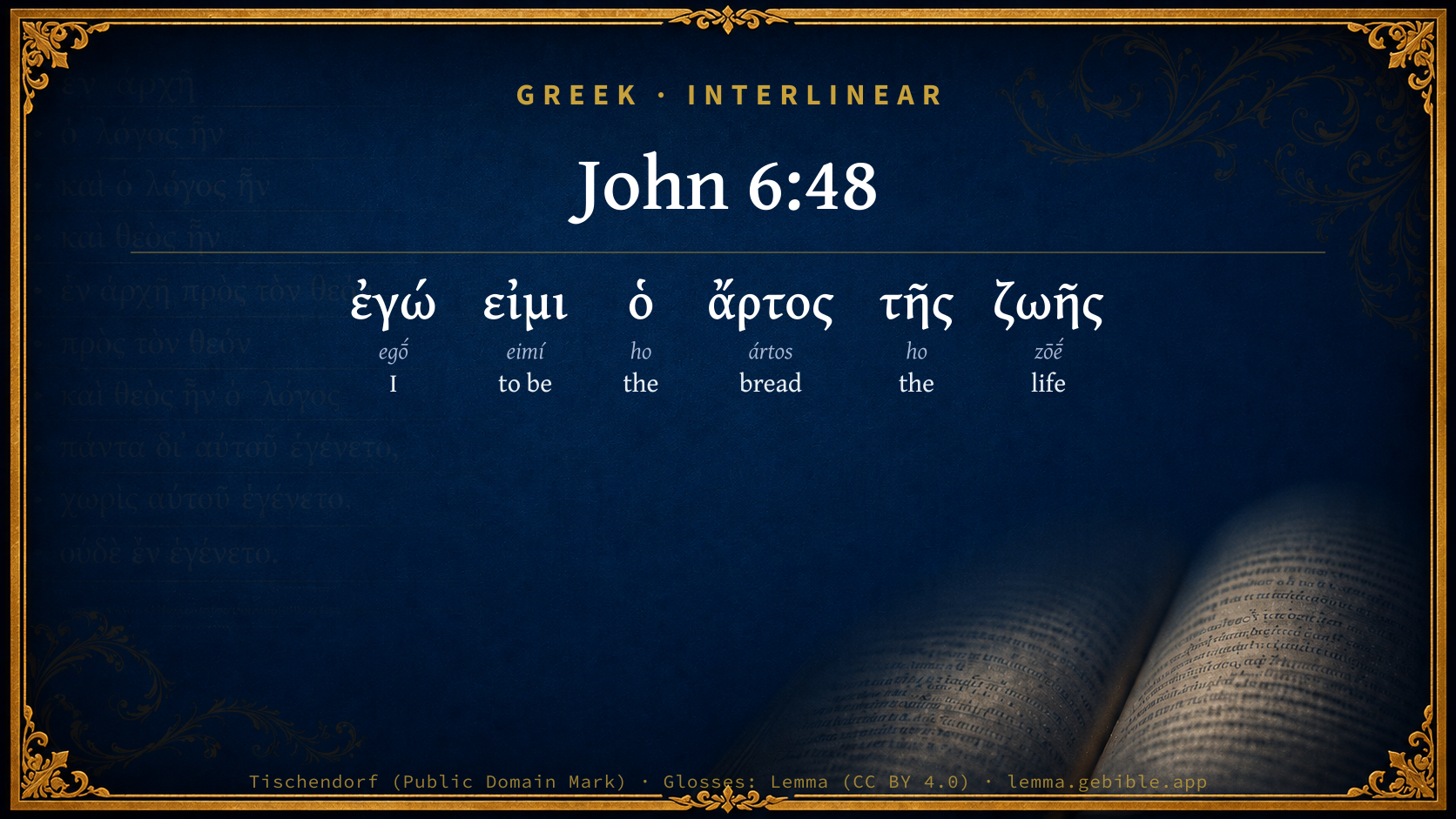
Download image
Cite this verse

John 6:48 (World English Bible). Public Domain. Lemma interlinear Bible study tool, https://lemma.gebible.app/v/john/6/48.

Show BibTeX & RIS
BibTeX
RIS
English Translation
I am the bread of life.
World English Bible · Public Domain
Download a study sheet

One document with this verse’s original text, its word-by-word gloss line, the meaning frame, cross-references with their text, attributed commentary, and full source and license credits — printable, and it pastes into notes with its structure intact.

This verse Autodidact and up

Study sheet (.html) Plain text (.txt)

A passage Seminary Student

Up to 50 verses in one chapter. A passage sheet keeps up to 6 commentary sources and 12 cross-references per verse, in the order this page ranks them, and says so on the sheet whenever that leaves anything out. Ask for a single verse and you get the Autodidact verse sheet above.

Everything on this page stays free to read, with no account — the sheet is a download of what is already on screen, not access to it.

Want to remove ads? Support Godless Engineer
Compare translations 3

The same verse in 3 English versions, stacked beneath the original-language interlinear above. Click any original word for its lexicon entry.

Each is an independent rendering of the whole verse — the interlinear is not word-aligned to these translations.

Highlighted words mark where these versions differ — a whole-verse word diff, not a word-by-word alignment.

  • World English Bible Public Domain
    I am the bread of life.
  • King James Version Public Domain
    I am that bread of life.
  • unfoldingWord Literal Text CC BY-SA 4.0
    I am the bread of life.

unfoldingWord Literal Text — © unfoldingWord, licensed CC BY-SA 4.0. Word-aligned USFM3 via Door43 (git.door43.org/unfoldingWord/en_ult).

Versions to compare (up to 4)

3 of 4 selected

Show all 19 translations

Every available English version of this verse, each an independent rendering of the whole verse.

  • World English Bible Public Domain
    I am the bread of life.
  • Berean Standard Bible Public Domain
    I am the bread of life.
  • Majority Standard Bible Public Domain
    I am the bread of life.
  • King James Version Public Domain
    I am that bread of life.
  • American Standard Version (1901) Public Domain
    I am the bread of life.
  • Revised Version (1885) Public Domain
    I am the bread of life.
  • Geneva Bible (1599) Public Domain
    I am that bread of life.
  • Douay-Rheims (1899) Public Domain
    I am the bread of life.
  • Young's Literal Translation Public Domain
    I am the bread of the life;
  • Literal Standard Version CC BY-SA 4.0
    I AM the bread of life;
  • Unlocked Literal Bible CC BY-SA 4.0
    I am the bread of life.
  • unfoldingWord Literal Text CC BY-SA 4.0
    I am the bread of life.
  • Darby Bible Public Domain
    I am the bread of life.
  • World Messianic Bible Public Domain
    I am the bread of life.
  • Webster's Bible Public Domain
    I am that bread of life.
  • Free Bible Version CC BY-SA 4.0
    I am the bread of life.
  • Bible in Basic English Public Domain
    I am the bread of life.
  • Text-Critical English NT CC BY 4.0
    I am the bread of life.
  • Tyndale New Testament (1534) Public Domain
    I am that breed of lyfe.

Literal Standard Version (2020), Covenant Press — licensed CC BY-SA 4.0. Text via the HelloAO Bible API (eBible.org). Unlocked Literal Bible (unfoldingWord) — licensed CC BY-SA 4.0. Text via the HelloAO Bible API (eBible.org). unfoldingWord Literal Text — © unfoldingWord, licensed CC BY-SA 4.0. Word-aligned USFM3 via Door43 (git.door43.org/unfoldingWord/en_ult). Free Bible Version, Dr. Jonathan Gallagher — licensed CC BY-SA 4.0. Text via the HelloAO Bible API (eBible.org).

Word by word

More ways to search: Search by grammar → Find every occurrence → Compare this word →

Practice this passage: Drill this verse → Learn its vocabulary →

ἄρτος
ártos
G740
“bread”
Noun, Nominative, Singular, Masculine
Part of Speech
Noun
Case
Nominative
Number
Singular
Gender
Masculine
Full Thayer's Definition

Origin: from G142

TDNT: 08:57,8

1. food composed of flour mixed with water and baked a. the Israelites made it in the form of an oblong or round cake, as thick as one's thumb, and as large as a plate or platter hence it was not to be cut but broken b. loaves were consecrated to the Lord c. of the bread used at the love-feasts and at the Lord's Table 2. food of any kind
  1. ἐγώ egṓ G1473 “I” Personal pronoun, 1st person, Nominative, Singular
  2. εἰμι eimí G1510 “to be” Verb, Present, Active, Indicative, 1st person, Singular
  3. ὁ ho G3588 “the” Article, Nominative, Singular, Masculine
  4. τῆς ho G3588 “the” Article, Genitive, Singular, Feminine
  5. ζωῆς zōḗ G2222 “life” Noun, Genitive, Singular, Feminine

About this verse

These counts appear in no published source. They are computed here, from the morphology-tagged text and Lemma’s own curated glosses. What Lemma adds →

6
words
5
distinct lemmas
Gospels
section

Repetition

A word recurs within this verse:

Cross-references

5

Topical passages linked to John 6:48 in the Treasury of Scripture Knowledge — connected by theme and wording, ordered by reader-vote popularity; previews shown in the World English Bible.

  • John 6:51 I am the living bread which came down out of heaven. If anyone eats of this bread, he will live forever. Yes, the bread which I will give for the life of the world is my flesh."
  • 1 Corinthians 11:24–25 When he had given thanks, he broke it, and said, "Take, eat. This is my body, which is broken for you. Do this in memory of me."
  • John 6:41 The Jews therefore murmured concerning him, because he said, "I am the bread which came down out of heaven."
  • 1 Corinthians 10:16–17 The cup of blessing which we bless, isn't it a communion of the blood of Christ? The bread which we break, isn't it a communion of the body of Christ?
  • John 6:33–35 For the bread of God is that which comes down out of heaven, and gives life to the world."

Cross-references courtesy of OpenBible.info (CC BY 4.0).

Commentary

Notes on John 6:48 from classic Christian and Jewish commentators (each source and its license shown beneath its notes). The classic Christian expositions comment on the surrounding passage and are grouped to its opening verse, so a note may address several verses; the Jewish commentaries on the Tanakh (Rashi and others) are per-verse, so they appear only where the commentator wrote on this verse.

Lemma curates 59 commentaries, every one of them public domain or Creative Commons licensed, each selected and text-cleaned for this edition rather than reprinted as found. About our sources →

Joseph Benson's Commentary

Joh 6:48-50. I am the bread of life — Jesus, having explained the nature of the dignity which he had claimed in the foregoing part of his discourse, (Joh 6:33-40,) and demonstrated that it really belonged to him, here repeats what he had said Joh 6:35, and then runs a comparison between himself, considered as the bread from heaven, and the manna which Moses provided for their fathers in the desert, and which they admired so greatly, saying, Your fathers did eat manna, and are dead — The manna did not preserve them, either from spiritual, or temporal, or eternal death. This is the bread — That of which I now speak is the true bread; which cometh down from heaven — And is of such a nature, that a man may eat of it and not die — Not spiritually, not eternally. His soul, being quickened and made alive to God by partaking of it, shall, by continuing to feed on it, be preserved in spiritual life, and nourished to life eternal; and the death of his body will be only a short sleep, which will soon terminate in a resurrection to immortal glory.

Joseph Benson's Commentary on the Old and New Testaments (1811–1818) — public domain. Text from a community e-Sword module.

MacLaren's Expositions of Holy Scripture

Alexander MacLaren

John

THE MANNA

Joh 6:48 - Joh 6:50.

‘This is of a truth that Prophet,’ said the Jews, when Christ had fed the five thousand on the five barley loaves and the two small fishes. That was the kind of Teacher for them; they were quite unaffected by the wisdom of His words and the beauty of His deeds, but a miracle that found food precisely met their wants, and so there was excited an impure enthusiasm, very unwelcome to Jesus. Therefore He withdrew Himself from it, and when the people followed Him, all full of expectation, to get some more loaves and see some more miracles, He met them with a douche of cold water that cooled their enthusiasm and flung them back into a critical, questioning mood. They pointed to the miracle of the manna, and hinted that, if He expected them to accept Him, He must do as Moses had done, or something like it. Probably there was a Jewish tradition in existence then to the effect that the Messiah was to repeat the miracle of the manna. But, at all events, Christ lays hold of the reference that they put into His hands, and He said in effect, ‘Manna? Yes; I give, and am, the true Manna.’

So this is the third of the instances in this Gospel in which our Lord pointed to Old Testament incidents and institutions as symbolising Himself. In the first of them, when He likened Himself to the ladder that Jacob saw, He claimed to be the Medium of communication between heaven and earth. In the second of them, when He likened Himself to the brazen serpent lifted in the camp, He claimed to be the Healer of a sin-stricken and poisoned world. And now, with an allusion both to the miracle and to the Jewish demand for the repetition of the manna sign, He claims to be the true Food for a starving world. So there are three things in my text: Christ’s claim, His requirements, and His promise; the bread, the eating, the issues.

I. Here is a claim of Christ’s.

As I have already said, in the whole wonderful conversation of which I have selected a portion for my text, there is a double reference to the miracle of the loaves and of the manna. What our Lord means to assert for Himself is that which is common to both of these-viz. that He supplies the great primal wants of humanity, the hunger of the heart. There may be another reference also, which I just notice without dwelling upon it. Barley loaves were the coarsest and least valuable form of bread. They were not only of little worth, but altogether inadequate to feeding the five thousand. The palates, unaccustomed to the stinging savours of the garlic and the leeks of Egypt, loathed the light bread. And so Jesus Christ comes into the world in lowly form, like the barley loaf or the light bread from which men whose tastes have been vitiated by the piquant savours of more earthly nourishment turn away as insipid. And yet He in His lowliness, He in His savourlessness, is that which meets the deepest wants of humanity, and is every man’s fare because He will be any man’s satisfaction.

But I wish to bring before your notice the wonderful way in which our Lord, in this great dissertation concerning Himself as the Bread of Life, gradually unfolds the depths of His meaning and of His offer. He began with saying that He, the Son of Man, will give to men the bread that ‘endures to everlasting life.’ And then when that saying is but dimly understood, and yet awakes some strange new desires and appetites in the hearers, and they come to Him and ask, ‘Lord, evermore give us this bread,’ He answers them with opening another finger of His hand, as it were, and showing them a little more of the treasure that lies in His palm. For He says, ‘I am that Bread of Life.’ That is an advance on the previous saying. He gives bread, and any man that was conscious of possessing some great truth or some great blessing which, believed and accepted, would refresh and nourish humanity, might have said the same thing. But now we pass into the penumbra of a greater mystery: ‘I am that Bread of Life.’ You cannot separate what Christ gives from what Christ is. You can take the truths that another man proclaims, altogether irrespective of him and his personality. That only disturbs, and the sooner it is got rid of, the firmer and the purer our possession of the message for which he is only the medium. You can take Plato’s teaching and do as you like with Plato. But you cannot take Christ’s teaching and do as you like with Christ. His personality is the centre of His gift to the world. ‘I am that Bread of Life.’ That He should give it is much; that He should be it is far more.

And notice how, when He has thus drawn us a little further into the magic circle of the light, He not only asserts the inseparableness of His gift from His Person, but also asserts, with a reference, no doubt, to the manna, ‘I am the Bread that came down from heaven.’ The listeners immediately laid hold of that one point, and neglected for the moment all the rest, and they fixed with a true instinct-although it was for the purpose of contradicting it-on this central point, ‘that came down from heaven.’ They said one to the other, ‘How can this man say that He came down from heaven? Is not this Jesus the Son of Joseph, whose father and mother we know?’ So, brethren, as the manna that descended from above in the dew of the night was to the bread that was baked in a baker’s oven, so is the Christ to the manhood that has its origin in the natural processes of birth. The Incarnation of the Son of God, becoming Son of Man for us and for our salvation, is involved in this great claim. You do not get to the heart of Christ’s message unless you have accepted this as the truth concerning Him, that ‘in the beginning was the Word, and the Word was with God, and the Word was God,’ and that at a definite point in the long process of the ages, ‘the Word became flesh, and dwelt amongst us.’ He will never be ‘the Bread of Life’ unless He is ‘the Bread that came down from heaven.’ For humanity needs that the blue heavens that bend remote above should come down; and we cannot be lifted ‘out of the horrible pit and the miry clay’ unless a Hand from above be reached down into the depths of our degradation, and lift us from our lowness. Heaven must come to earth, if earth is to rise to heaven. The ladder must be let down from above, if ever from the lower levels men are to ascend thither where at the summit the face of God can be seen.

But that is not all. Our Lord, if I may recur to a former figure, went on to open another finger of His hand, and to show still more of the gift. For He not only said, ‘the Son of Man gives the bread,’ and ‘I am the Bread that came down from heaven,’ but He went on to say, in a subsequent stage of the conversation, ‘the Bread that I will give is My flesh, which I will give for the life of the world.’ Now, notice that ‘will give.’ Then, though the Word was made flesh, and the manna came down from heaven, the especial gift of His flesh for the life of the world was, at the time of His speaking, a future thing. And what He meant is still more clearly brought out, when we read other words which are the very climax of this conversation, when He declares that the condition of our having life in ourselves is our ‘eating the flesh and drinking the blood of the Son of Man.’ The figure is made repulsive on purpose, in order that it may provoke us to penetrate to its meaning. It was even more repulsive to the Jew, with his religious horror of touching or tasting anything in which the blood was. And yet our Lord not only speaks of Himself as the Bread, but of His flesh and blood as being the Food of the world. The separation of the two clearly indicates a violent death, and I, for my part, have no manner of doubt that, in these great words in which our Lord lays bare the deepest foundations of His claim to be the Food of humanity, there is couched, in the veiled language which was necessary at the then stage of His mission, a distinct reference to His death, as being the Sacrifice on which a hunger-stricken world may feed and be satisfied.

So here we have, in three steps, the great central truth of the Gospel set forth in symbolical aspect: the Son that gives, the Son that is, the Bread of the world, and the death whereby His flesh and blood are separated and become the nourishment of all sin-stricken souls. I do not say one word to enforce these claims, but I beseech you deal fairly with these Gospel narratives, and do not go on picking out of them bits of Christ’s actions or words, which commend themselves to you, and ignoring all the rest. There is no more reason to believe that Jesus Christ ever said, ‘As ye would that men should do to you, do ye even so to them likewise,’ or any other part of that Sermon on the Mount which some people take as their Christianity, than there is to believe that He said, ‘The bread which I give is My flesh, which I will give for the life of the world.’ Believe it or not, it is not dealing with the Scripture records as you deal with other historical records if, for subjective reasons, you brush aside all that department of our Lord’s teaching. And if you do accept it, what becomes of His ‘sweet reasonableness’? What becomes of His meekness and lowliness of heart? I was going to say what becomes of His sanity, that He should stand up, a youngish man from Nazareth, in the synagogue of Capernaum, and should say, ‘I, heaven-descended, and slain by men, am the Bread of Life to the whole world’?

I was going to make another observation, which I must just pass with the slightest notice, and that is that, taking this point of view and giving full weight to these three stages of our Lord’s progressive revelation of Himself, we have the answer to the question, What is the connection between these discourses and the ordinance of the Lord’s Supper? Our modern sacramentarian friends will have it that Jesus Christ is speaking of the Communion in this chapter. I take it, and I venture to think it the reasonable explanation, that He is not speaking about the Communion, but that this discourse and that rite are dealing with the same truths-the one in articulate words, the other in equivalent symbols. And so we have not to read into the text any allusion to the rite, but to see in the text and in the rite the proclamation of the same thing-viz. that the flesh and the blood of the Sacrifice for sins is the food on which a sinful and cleansed world may feed.

II. So, secondly, let me ask you to note our Lord’s requirement here.

He carries on the metaphor. ‘This is the Bread which cometh down from heaven, that a man may eat thereof and not die.’ The eating necessarily follows from the symbol of the bread, as the designation of the way by which we all, with our hungry hearts, may feed upon this Bread of God. I need not remind you that in many a place, and in this whole context, we find the explanation of the symbol very plainly. In another part of this conversation we read, under another metaphor which comes to the same thing, ‘He that cometh unto Me shall never hunger, and he that believeth on Me shall never thirst. So the eating and the coming are diverse symbols for the one thing, the believing. When a man eats he appropriates to himself, and incorporates into his very being, the food of which he partakes. And when a man trusts Christ he appropriates to himself, and incorporates into his inmost being, the very life of Jesus Christ. You say, ‘That is mysticism’; but it is the New Testament teaching, that when I trust Christ I get more than His gifts-I get Himself; that when my faith goes out to Him it not only rests me on Him, but it brings Him into me, and that food of the spirit becomes the life, as we shall see, of my spirit.

That condition is indispensable. It is useless to have food on your table or your plate or in your hand, it does not nourish you there: you must eat it, and then you gain sustenance from it. Many a hungry man has died at the door of a granary. Some of us are starving, though beside us there is ‘the Bread of God that came down from heaven.’ Brethren, you must eat, and I venture to put the question to you-not Do you believe that Jesus Christ is the world’s Saviour? not Do you believe in an Incarnation? not Do you believe in an Atonement? but Have you claimed your portion in the Bread? Have you taken it into your own lips? Crede et manducasti, said Augustine, ‘believe’-or, rather, trust-’and thou hast eaten.’ Have you?

Further, let me remind you that under this eating is included not only some initial act of faith, but a continuous course of partaking. The dinner you ate this day last year is of no use for to-day’s hunger. The act of faith done long ago will not bring the Bread to nourish you now. You must repeat the meal. And very strikingly and beautifully in the last part of this conversation our Lord varies the word for eating, and substitutes-as if He were speaking to those who had fulfilled the previous condition-another one which implies the ruminant action of certain animals. And that is what Christian men have to do, to feed over and over and over again on the ‘Bread of God which came down from heaven.’ Christ, and especially in and through His death for us, can nourish and sustain our wills, giving them the pattern of what they should desire, and the motive for which they should desire it. Christ, and especially through His death, can feed our consciences, and take away from them all the painful sense of guilt, while He sharpens them to a far keener sensitiveness to evil. Christ, and especially through His death, can feed our understandings, and unveil therein the deepest truths concerning God and man, concerning man’s destiny and God’s mercy. Christ, and especially in His death, can feed our affections, and minister to love and desire and submission and hope their celestial nourishment. He is ‘the Bread of God,’ and we have but to eat of that which is laid before us.

III. So, lastly, we have here the issues.

‘Your fathers did eat manna in the wilderness, and are dead.’ This Bread secures that if ‘a man eat thereof he shall not die.’ The bread that perishes feeds a life that perishes; but this Bread not only sustains but creates a life that cannot perish, and, taken into the spirits of men that are ‘dead in trespasses and sins,’ imparts to them a life that has no affinity to evil, and therefore no dread of extinction.

If ‘a man eats thereof he shall not die,’ Christ annihilates for us the mere accident of physical death. That is only a momentary jolt on the course. That may all be crammed into a parenthesis. ‘He shall not die,’ but live the true life which comes from the possession of union with Him who is the Life. The bread which we eat sustains life; the Bread which He gives originates it. The bread which we eat is assimilated to our bodily frame, the Bread which He gives assimilates our spiritual nature to His. And so it comes to be the only food that stills a hungry heart, the only food that satisfies and yet never cloys, which, eating, we are filled, and being filled are made capable of more, and, being capable of more, receive more. In blessed and eternal alternation, fruition and desire, satisfaction and appetite, go on.

‘Why do ye spend money for that which is not bread?’ You cannot answer the question with any reasonable answer. Oh, dear friends! I beseech you, listen to that Lord who is saying to each of us, ‘Take, eat, this is My body, which is broken for you.’

Alexander MacLaren, Expositions of Holy Scripture (1904–1910) — public domain. Text from a community e-Sword module.

Godet's Commentaries

Frédéric Louis Godet

Ver. 48. The affirmations follow each other in the way of asyndeton, like oracles. That of Joh 6:48 justifies that of Joh 6:47. By that of Joh 6:49 He gives back to His hearers their own word of Joh 6:31. The manna which their fathers ate was so far from the bread of life that it did not prevent them from dying. This word undoubtedly denotes physical death; but as being the effect of a divine condemnation.

Frédéric Louis Godet — Commentaries on Luke, John, Romans, and 1 Corinthians — English translation (T&T Clark, Edinburgh, 1870s–1890s) — public domain. Text from a community e-Sword module.

Geneva Bible (1599)

Geneva Bible translators

The true use of Sacraments, is to ascend from them to the thing itself, that is to Christ: and by the partaking of whom only, we get everlasting life.

Geneva Bible (1599) marginal notes — public domain. Text via Bolls.life.

Jamieson, Fausset & Brown

Robert Jamieson, A. R. Fausset & David Brown

I am the bread of life--"As he that believeth in Me hath everlasting life, so I am Myself the everlasting Sustenance of that life." (Repeated from Joh 6:35).

Jamieson, Fausset & Brown — Commentary Critical and Explanatory on the Whole Bible (1871) — public domain (CC PDM 1.0). Text via the HelloAO Bible API.

Adam Clarke's Commentary

Verse 48. I am that bread of life.] I alone afford, by my doctrine and Spirit, that nourishment by which the soul is saved unto life eternal.

Adam Clarke's Commentary on the Bible (1810–1826) — public domain. Text from a community e-Sword/MySword module.

John Calvin's Commentaries

48. I am the bread of life Besides what he formerly said, that he is the life-giving bread, by which our souls are nourished, in order to explain it more fully, he likewise repeats the contrast between this bread and the ancient manna, together with a comparison of the men.

John Calvin's Commentaries (1540-1563) — public domain. Text from the Calvin Translation Society English edition (1840s-50s) via the Christian Classics Ethereal Library (ccel.org). Calvin's coverage is partial (roughly two-thirds of the Bible); uncommented books and verses are honest gaps, never fabricated. The 19th-century editor's footnotes and remarks are omitted so the notes are faithfully Calvin's own voice.

Ellicott's Commentary for English Readers

(48) I am that bread of life.—Better, I am the bread of life. The words, which seem to them so hard to fathom (Joh_6:41), are only an expression of this truth in the form of their own demand (Joh_6:31). The essence of life is unseen; bread is the visible form which contains and imparts it. The invisible God is the source of eternal life; the human nature of the Son of God is the visible form which contains and imparts this to the souls of men.

A Bible Commentary for English Readers, edited by Charles John Ellicott (1878–1897) — public domain. Text from a community e-Sword module.

The Cambridge Bible for Schools and Colleges

gen. ed. J. J. S. Perowne

48. that bread of life] Better, the Bread of life. Comp. Joh_6:32, Joh_1:21; Joh_1:25, Joh_6:14, where the same exaggerated translation of the Greek article occurs.

The Cambridge Bible for Schools and Colleges (gen. ed. J. J. S. Perowne; Cambridge University Press, 1878–1918) — public domain. Text from a community e-Sword module.

John Gill's Exposition

This is the bread which cometh down from heaven,.... Namely, that of which he had spoken Joh 6:32, meaning himself:

that a man may eat thereof, and not die; for this heavenly bread is soul quickening, soul strengthening, and soul satisfying food; nor can there be any want where this is: eating of it is not to be understood corporeally, as these Capernaites took it; nor sacramentally, as if it was confined to the ordinance of the Lord's supper, which was not, as yet, instituted; but more largely of eating and feeding upon Christ spiritually by faith: he is, by the believer, to be fed upon wholly, and only; all of him, and none but him, and that daily; for there is the same need of daily bread for our souls, as for our bodies; and also largely and freely, as such may do; and likewise joyfully, with gladness and singleness of heart: such as are Christ's beloved, and his friends, "may" eat; they have liberty, a hearty welcome to eat; and so have everyone that have a will, an inclination, a desire to eat; and all overcomers, whom Christ makes more than conquerors, Sol 5:1 Rev 2:7; which liberty is owing to Christ's gracious invitation, and to his and the Father's free gift; and to the openness and ease of access of all sensible sinners to him: and the consequence and effect of such eating is, that it secures from dying, not from a corporeal death, to which men are appointed, and saints themselves are subject; though it is indeed abolished by Christ as a penal evil; nor shall his people continue under the power of it, but shall rise again to everlasting life: but then they are, through eating this bread, secured from a spiritual death; for though there may be a decline, as to the exercise of grace, and a want of liveliness, and they may fear they are ready to die, and conclude they are free among the dead, and that their strength and hope are perished; yet he that lives and believes in Christ, the resurrection, and the life, shall never die; and such are also secure from an eternal death, on them the second death shall have no power, nor shall they ever be hurt by it.

John Gill's Exposition of the Whole Bible (1746–1763) — public domain (CC PDM 1.0). Text via the HelloAO Bible API.

Trapp's Complete Commentary

John Trapp

48 I am that bread of life.

Ver. 48. I am that bread of life] That not only uphold and maintain spiritual life, but do also begin and beget it. And this our Saviour often inculcateth here, as most needful to be known and most comfortable to be considered.

John Trapp, A Commentary or Exposition upon All the Books of the Old and New Testament (1647–1656) — public domain. Text from a community e-Sword module.

Albert Barnes' Notes on the Bible

I am that bread of life - My doctrines and the benefits of my mediation are that real support of spiritual life of which the manna in the wilderness was the faint emblem. See Joh 6:32-33.

Albert Barnes' Notes on the Bible (1834–1885) — public domain. Text from a community e-Sword/MySword module.

Haydock's Catholic Bible Commentary

Because the multitude still insisted in begging for their corporal nourishment and remembering the food that was given to their fathers, Christ, to shew that all were figures of the present spiritual food, answered, that he was the bread of life. (Theophylactus) --- Here Jesus Christ proceeds to the second part of his discourse, in which he fully explains what that bread of life is, which he is about to bestow upon mankind in the mystery of the holy Eucharist. He declares then, in the first place, that he is the bread of eternal life, and mentions its several properties; and secondly, he applies to his own person, and to his own flesh, the idea of this bread, such as he has defined it.

George Leo Haydock (1774–1849), Haydock's Catholic Family Bible and Commentary, 1859 edition — public domain. Excludes Psalms (Douay-Rheims chapter numbering differs from Protestant) and Deuterocanonical books (Catholic canon only).

The Pulpit Commentary

Ver. 48 repeats once more the statement of vers. 32, 35 (see notes): I am the Bread of life. Not only do I give you more than Moses gave your fathers, but I am the Father"s Gift. I myself am the Gift I am the Bread of which, if you partake, you will hunger no more, you will need no more, you will die no more: the life then thrilling through you will be eternal. "The invisible God is the Source of eternal life; the human nature of the Son of God is the visible form which contains and imparts this to the souls of men" (Archdeacon Watkins).

The Pulpit Commentary (1880–1919), ed. H.D.M. Spence-Jones & Joseph S. Exell — public domain. Text from a community e-Sword module.

Burkitt's Expository Notes on the New Testament

William Burkitt

In these verses our blessed Saviour resumes his former doctrine, namely, that he is the object of saving faith, and the bread of life, which he compares with the manna, the bread of Israel. Your fathers did eat manna in the wilderness, which manna was an illustrious type of Christ. Thus both came down from heaven; both were freely given of God without any merit or desert of men; both in a miraculous manner; both at first unknown what they were, and whence they came; both equally belonging to all: both sufficient for all, poor and rich.

The manna, white in colour, so clear is our Lord’s innocence; pleasant like honey, so sweet are his benefits: beaten and broken before eaten, Christ on his cross, bleeding and dying; giving only in the wilderness, and ceasing as soon as they came in to the land of promise, as sacraments shall vanish, when we enjoy the substance, in heaven. But though manna was thus excellent, yet the eaters of it were dead; but such as feed upon Christ, the bread of life, shall live eternally in bliss and glory. I am the living bread which came down from heaven, if any man may eat of this bread, he shall live for ever.

Here we learn, 1. What a miserable creature man naturally is, in a pining and starved condition, under the want of soul food.

2. That Jesus Christ is the food of souls, which quickens them that are dead, and is unto the needy soul all that it can need; such spiritual food as will prove a remedy and preservative against death, both spiritual and eternal. I am the living bread.

William Burkitt's Expository Notes on the New Testament (1700–1703) — public domain. Text from a community e-Sword module.

unfoldingWord translationNotes

Door43 World Missions Community

I am the bread of life

Just as bread is necessary for our physical life, Jesus is necessary for our spiritual life. See how you translated this in John 6:35. AT: "Just like food that keeps you alive physically, I can give you spiritual life that lasts forever" (See: Metaphor)

Your fathers

"Your forefathers" or "Your ancestors"

died

This refers to physical death.

translationWords

ancestor

manna

desert

die

unfoldingWord translationNotes — © Distant Shores Media and the Door43 World Missions Community, licensed CC BY-SA 4.0. Source: git.door43.org/Door43/en_tn.

Cambridge Greek Testament for Schools and Colleges

48. ἐγώ εἰμι. See on Joh 6:35 and Joh 1:21.

Cambridge Greek Testament for Schools and Colleges (Cambridge University Press, 1896; 21 vols, various authors incl. Carr, Maclear, Plummer, Farrar, Lumby, Moule, M. R. James, Simcox) — public domain. Text from a community e-Sword module.

Alford’s Greek Testament

Henry Alford

48.] If so, (see ver. 47,) there is full reason for my naming Myself the Bread of Life.

Henry Alford, The Greek Testament (1849–1861) — public domain. Text from a community e-Sword module.

International Critical Commentary

48. ἐγώ εἰμι ὁ ἄρτος τῆς ζωῆς (cf. v. 35). That is, the believer in Christ has eternal life, because He is the spiritual Bread which gives life. Notice the repetition of the main theme, not always in exactly the same words (vv. 35, 41, 48, 51); see on 3:16.

International Critical Commentary — older volumes (1896–1929), various authors — public domain. Text from a community e-Sword module.

Lesson kit

Teaching starters — assembled from the data on this page, not authored interpretation. Every prompt links to the verse data it draws on. Edit before teaching.

John, in the Gospels, opens this verse with 6 words (5 distinct Greek lemmas). Its most distinctive word is ártos (“bread”). A historical commentator’s framing appears above. Read the whole chapter for the surrounding context.

Discussion questions

  1. What does “bread” (ártos) contribute to the verse as a whole?
  2. How does John 6:51, which shares this passage’s theme, read alongside this verse?
  3. What does the repetition of “the” (2× in this one verse) do in this verse?
  4. Compare how Joseph Benson's Commentary and MacLaren's Expositions of Holy Scripture read this verse. Where do they agree or differ?

Things to notice

Reading settings

Reading text

Shown beneath each verse's original-language words.

Old Testament
Old Testament edition

Read the OT as the Masoretic Hebrew (MT) or the Greek Septuagint (LXX).

English shown for the Greek Septuagint (in the Hebrew ↔ Greek comparison).

Comparing translations? Open the Compare panel on any verse page to stack up to four side by side.