John 1:50

Greek (Tischendorf 8th ed.) John 1:50 appears in the Greek New Testament. The text above is from the Tischendorf 8th edition. Each word links to its Strong’s number and a concise gloss. Click any word for its full Thayer’s Greek Lexicon entry.
Download image
Cite this verse

John 1:50 (World English Bible). Public Domain. Lemma interlinear Bible study tool, https://lemma.gebible.app/v/john/1/50.

Show BibTeX & RIS
BibTeX
RIS
English Translation
Jesus answered him, "Because I told you, 'I saw you underneath the fig tree,' do you believe? You will see greater things than these!"
World English Bible · Public Domain
Download a study sheet

One document with this verse’s original text, its word-by-word gloss line, the meaning frame, cross-references with their text, attributed commentary, and full source and license credits — printable, and it pastes into notes with its structure intact.

This verse Autodidact and up

Study sheet (.html) Plain text (.txt)

A passage Seminary Student

Up to 50 verses in one chapter. A passage sheet keeps up to 6 commentary sources and 12 cross-references per verse, in the order this page ranks them, and says so on the sheet whenever that leaves anything out. Ask for a single verse and you get the Autodidact verse sheet above.

Everything on this page stays free to read, with no account — the sheet is a download of what is already on screen, not access to it.

Want to remove ads? Support Godless Engineer
Compare translations 3

The same verse in 3 English versions, stacked beneath the original-language interlinear above. Click any original word for its lexicon entry.

Each is an independent rendering of the whole verse — the interlinear is not word-aligned to these translations.

Highlighted words mark where these versions differ — a whole-verse word diff, not a word-by-word alignment.

  • World English Bible Public Domain
    Jesus answered him, "Because I told you, 'I saw you underneath the fig tree,' do you believe? You will see greater things than these!"
  • King James Version Public Domain
    Jesus answered and said unto him, Because I said unto thee, I saw thee under the fig tree, believest thou? thou shalt see greater things than these.
  • unfoldingWord Literal Text CC BY-SA 4.0
    Jesus replied and said to him, “Because I said to you that I saw you underneath the fig tree, do you believe? You will see greater things than these.”

unfoldingWord Literal Text — © unfoldingWord, licensed CC BY-SA 4.0. Word-aligned USFM3 via Door43 (git.door43.org/unfoldingWord/en_ult).

Versions to compare (up to 4)

3 of 4 selected

Show all 19 translations

Every available English version of this verse, each an independent rendering of the whole verse.

  • World English Bible Public Domain
    Jesus answered him, "Because I told you, 'I saw you underneath the fig tree,' do you believe? You will see greater things than these!"
  • Berean Standard Bible Public Domain
    Jesus said to him, “Do you believe just because I told you I saw you under the fig tree? You will see greater things than these.”
  • Majority Standard Bible Public Domain
    Jesus said to him, “Do you believe just because I said to you, ‘I saw you under the fig tree’? You will see greater things than these.”
  • King James Version Public Domain
    Jesus answered and said unto him, Because I said unto thee, I saw thee under the fig tree, believest thou? thou shalt see greater things than these.
  • American Standard Version (1901) Public Domain
    Jesus answered and said unto him, Because I said unto thee, I saw thee underneath the fig tree, believest thou? thou shalt see greater things than these.
  • Revised Version (1885) Public Domain
    Jesus answered and said unto him, Because I said unto thee, I saw thee underneath the fig tree, believest thou? thou shalt see greater things than these.
  • Geneva Bible (1599) Public Domain
    Iesus answered, and sayde vnto him, Because I sayde vnto thee, I sawe thee vnder the figtree, beleeuest thou? thou shalt see greater things then these.
  • Douay-Rheims (1899) Public Domain
    Jesus answered, and said to him: Because I said unto thee, I saw thee under the fig tree, thou believest: greater things than these shalt thou see.
  • Young's Literal Translation Public Domain
    Jesus answered and said to him, `Because I said to thee, I saw thee under the fig-tree, thou dost believe; greater things than these thou shalt see;'
  • Literal Standard Version CC BY-SA 4.0
    Jesus answered and said to him, “Because I said to you, I saw you under the fig tree, you believe; you will see greater things than these”;
  • Unlocked Literal Bible CC BY-SA 4.0
    Jesus replied and said to him, “Because I said to you, 'I saw you underneath the fig tree,' do you believe? You will see greater things than this.”
  • unfoldingWord Literal Text CC BY-SA 4.0
    Jesus replied and said to him, “Because I said to you that I saw you underneath the fig tree, do you believe? You will see greater things than these.”
  • Darby Bible Public Domain
    Jesus answered and said to him, Because I said to thee, I saw thee under the fig-tree, believest thou? Thou shalt see greater things than these.
  • World Messianic Bible Public Domain
    Yeshua answered him, “Because I told you, ‘I saw you underneath the fig tree,’ do you believe? You will see greater things than these!”
  • Webster's Bible Public Domain
    Jesus answered and said to him, Because I said to thee, I saw thee under the fig-tree, dost thou believe? thou shalt see greater things than these.
  • Free Bible Version CC BY-SA 4.0
    “You believe this just because I told you I saw you under the fig tree?” Jesus replied. “You'll get to see much more than that!”
  • Bible in Basic English Public Domain
    In answer Jesus said to him, You have faith because I said to you, I saw you under the fig-tree. You will see greater things than these.
  • Text-Critical English NT CC BY 4.0
    Jesus answered him, “Do yoʋ believe because I said to yoʋ, ‘I saw yoʋ under the fig tree’? Yoʋ will see greater things than these.”
  • Tyndale New Testament (1534) Public Domain
    Iesus answered and sayd vnto him: Because I sayde vnto the I sawe the vnder the fygge tree thou belevest. Thou shalt se greater thinges then these.

Literal Standard Version (2020), Covenant Press — licensed CC BY-SA 4.0. Text via the HelloAO Bible API (eBible.org). Unlocked Literal Bible (unfoldingWord) — licensed CC BY-SA 4.0. Text via the HelloAO Bible API (eBible.org). unfoldingWord Literal Text — © unfoldingWord, licensed CC BY-SA 4.0. Word-aligned USFM3 via Door43 (git.door43.org/unfoldingWord/en_ult). Free Bible Version, Dr. Jonathan Gallagher — licensed CC BY-SA 4.0. Text via the HelloAO Bible API (eBible.org).

Word by word

More ways to search: Search by grammar → Find every occurrence → Compare this word →

Practice this passage: Drill this verse → Learn its vocabulary →

Ναθαναήλ
Nathanaḗl
G3482
“Nathanael”
Noun, Proper, indeclinable
Part of Speech
Noun · Proper, indeclinable
Full Thayer's Definition

Origin: of hebrew origin H5417

TDNT: None

Nathanael = "gift of God" 1. an intimate disciple of Jesus Christ, he is commonly thought to be the same person as Bartholomew
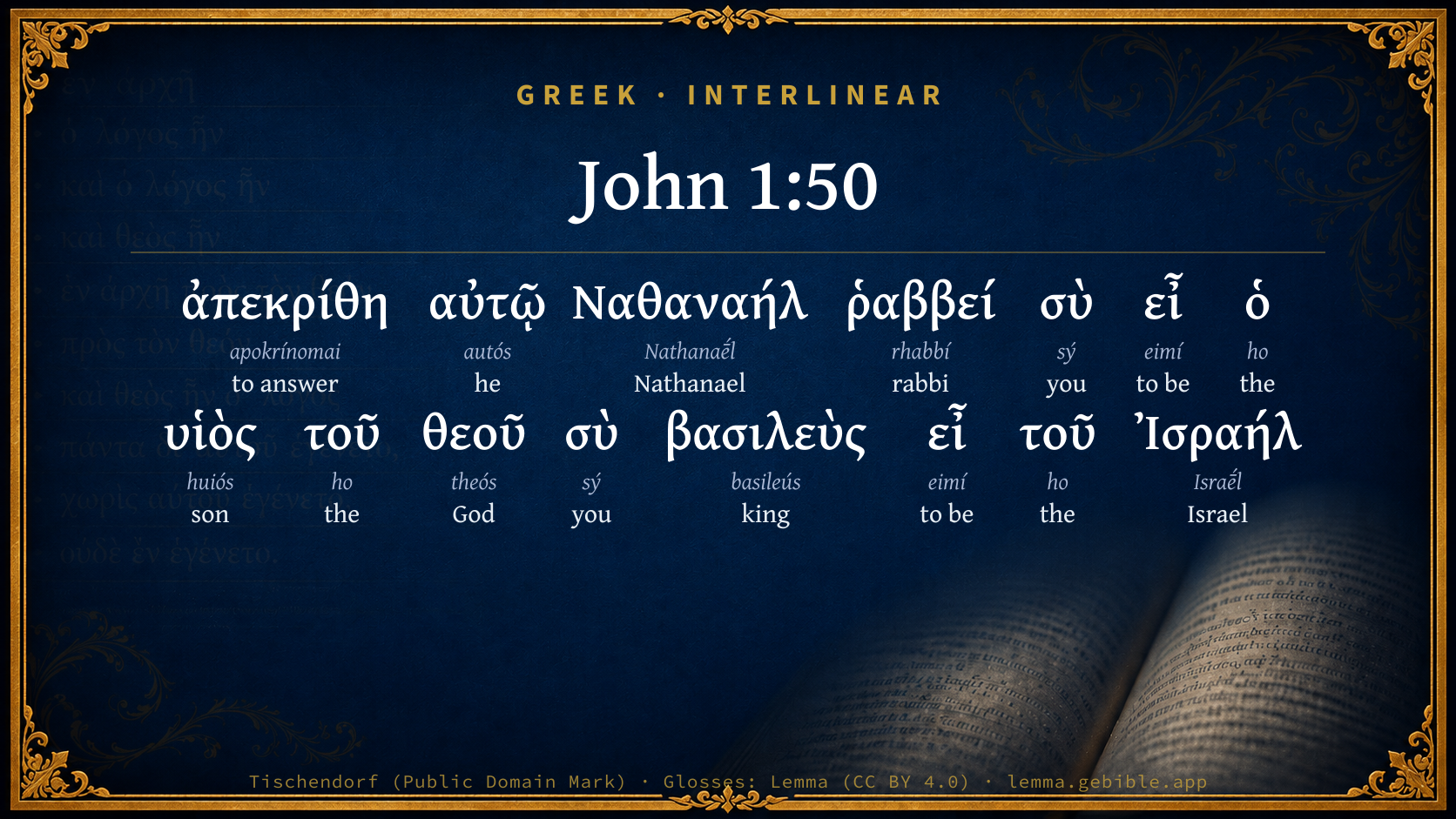
  1. ἀπεκρίθη apokrínomai G611 “to answer” Verb, Aorist, Middle deponent, Indicative, 3rd person, Singular
  2. αὐτῷ autós G846 “he” Personal pronoun, Dative, Singular, Masculine
  3. ῥαββεί rhabbí G4461 “rabbi” Hebrew transliteration
  4. σὺ sý G4771 “you” Personal pronoun, 2nd person, Nominative, Singular
  5. εἶ eimí G1510 “to be” Verb, Present, Active, Indicative, 2nd person, Singular
  6. ὁ ho G3588 “the” Article, Nominative, Singular, Masculine
  7. υἱὸς huiós G5207 “son” Noun, Nominative, Singular, Masculine
  8. τοῦ ho G3588 “the” Article, Genitive, Singular, Masculine
  9. θεοῦ theós G2316 “God” Noun, Genitive, Singular, Masculine
  10. σὺ sý G4771 “you” Personal pronoun, 2nd person, Nominative, Singular
  11. βασιλεὺς basileús G935 “king” Noun, Nominative, Singular, Masculine
  12. εἶ eimí G1510 “to be” Verb, Present, Active, Indicative, 2nd person, Singular
  13. τοῦ ho G3588 “the” Article, Genitive, Singular, Masculine
  14. Ἰσραήλ Israḗl G2474 “Israel” Noun, Proper, indeclinable

About this verse

These counts appear in no published source. They are computed here, from the morphology-tagged text and Lemma’s own curated glosses. What Lemma adds →

15
words
11
distinct lemmas
Gospels
section

Notable vocabulary

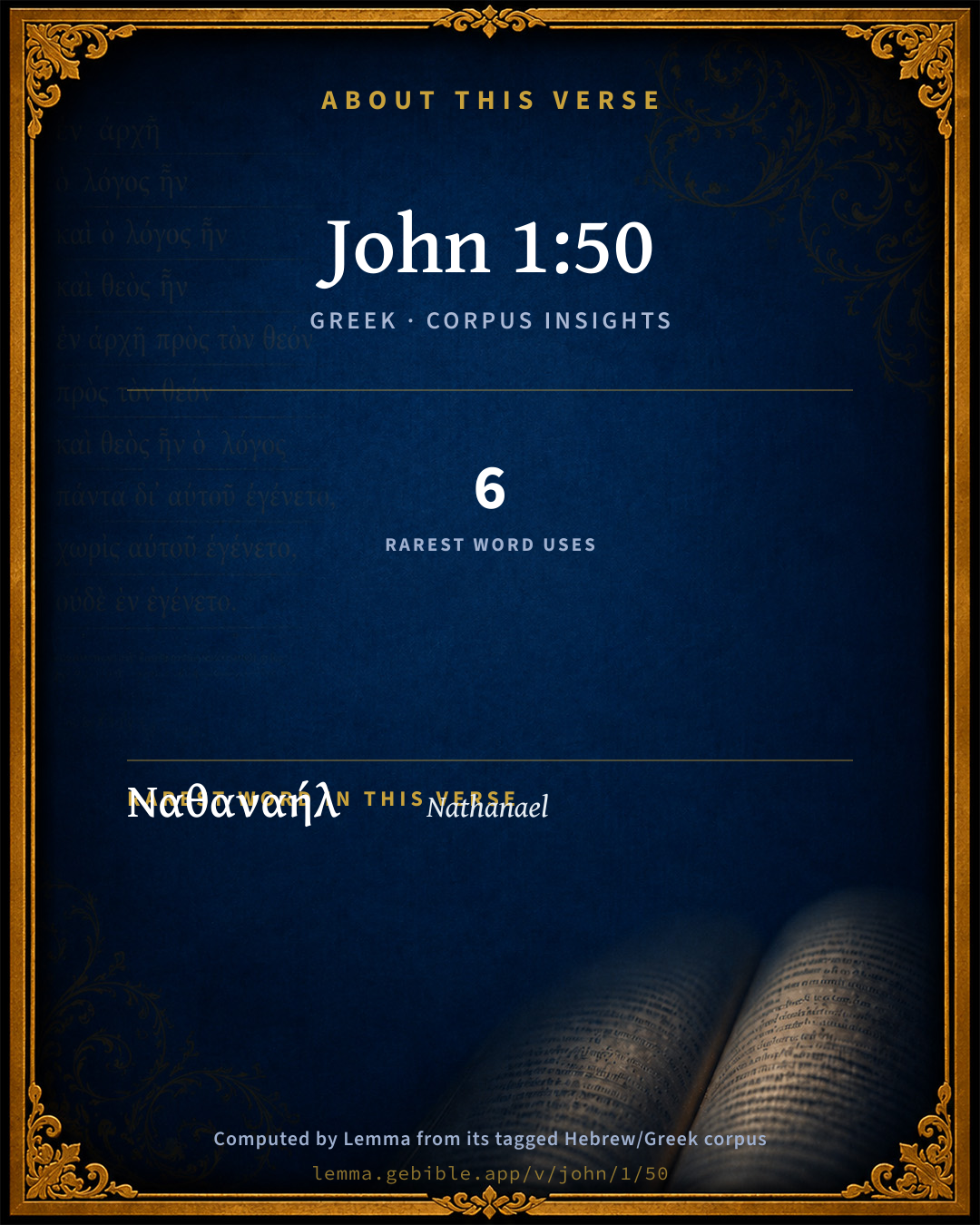
The rarest word here is Ναθαναήλ Nathanael G3482 — appearing just 6 times in the whole Greek New Testament.

Shared distinctive vocabulary

Ναθαναήλ Nathanael G3482 occurs in 6 verses of the Greek New Testament. Also found in:

Repetition

Words recur within this verse:

Cross-references

4

Topical passages linked to John 1:50 in the Treasury of Scripture Knowledge — connected by theme and wording, ordered by reader-vote popularity; previews shown in the World English Bible.

  • John 20:29 Jesus said to him, "Because you have seen me, you have believed. Blessed are those who have not seen, and have believed."
  • John 11:40 Jesus said to her, "Didn't I tell you that if you believed, you would see God's glory?"
  • Luke 1:45 Blessed is she who believed, for there will be a fulfillment of the things which have been spoken to her from the Lord!"
  • Matthew 25:29 For to everyone who has will be given, and he will have abundance, but from him who has not, even that which he has will be taken away.

Cross-references courtesy of OpenBible.info (CC BY 4.0).

Commentary

Notes on John 1:50 from classic Christian and Jewish commentators (each source and its license shown beneath its notes). The classic Christian expositions comment on the surrounding passage and are grouped to its opening verse, so a note may address several verses; the Jewish commentaries on the Tanakh (Rashi and others) are per-verse, so they appear only where the commentator wrote on this verse.

Lemma curates 59 commentaries, every one of them public domain or Creative Commons licensed, each selected and text-cleaned for this edition rather than reprinted as found. About our sources →

The Biblical Illustrator

Joseph S. Exell

Joh_1:50-51

Greater things than these

I.

THIS FAVOURED MAN.

1. He was a man who honestly made inquiries which fairly suggested themselves. He did not invent doubts and raise questions. When Philip said Nazareth his mind went to the prophecy about Bethlehem; hence his question. When Christ read him he naturally asked for the sources of Christs knowledge.

2. A man who honestly yielded to the force of truth. Christs omniscient knowledge he felt to be an irresistible proof of His Messiahship.

3. A man who in simple honesty believes much upon the evidence of one assured fact. Prom Christs knowledge he infers His teachership; His Divine Sonship; His sovereignty. Such is the man who obtains the blessing of the text.

II. THE GRACIOUS REWARD. The words imply

1. That his perceptions would be more vivid. Believest thou thou shalt see. Faith develops into experience, experience into actual vision.

2. That other truths should be discovered.

(1) More of Christs Godhead. From omniscience to omnipotence; from knowledge of the heart to power to change the heart.

(2) Christs human sonship. Godhead not half so wonderful as when it comes to be united to humanity.

(3) An opened heaven. He who knew the secrets of his heart would establish relations between his heart and heaven. These blessings are for guileless believers only. Christ cannot do mighty works because of unbelief.

III. THE SPECIAL SIGHT. Intercourse between earth and heaven by way of the Mediator.

1. The angels ascend first to carry Christs upward messages and our prayers and praises.

2. Angels descend with blessings to man through Christ. (C. H. Spurgeon.)

The first promise

Notice this incident

I. AS A GLORIOUS END WHICH MERGES INTO A STILL MORE GLORIOUS BEGINNING.

1. The Lord who receives His disciples. He first appears as walking alone, waiting for the Fathers first gift. The preparations for the kingdom are complete, but as yet He is without an avowed disciple. How will He win them?

(1) The first announcement which sent men to Christ was Behold the Lamb of God. This is the sovereign secret of our Lords attraction all through time.

(2) But He who takes away our sins also seeks. Two disciples follow Him, but find Him not till He turns with the searching question: then He finds Philip.

2. Those who come to Him.

(1) They are representatives of the devout in Israel waiting for His coming.

(2) They represent those who are prepared by repentance and faith.

(3) They illustrate the manner in which His disciples come to Him. Two by the preaching of another. Two seek their fellows and communicate the glad tidings. One is directly sought by Himself.

3. The communion between Christ and His disciples that day begun. It was reserved for the last to declare on behalf of all what Jesus was to their devotion: Divine Son, Supreme Lord. This, however, to them was but the beginning of joys, and the Redeemer promises greater things.

II. THIS FIRST PROMISE is an encouragement to the faith of these humble disciples, and a prologue to all the wonders of redemption.

1. Our Lord here utters in figurative language the mystery of His mediation between heaven and earth. Christ here gives us in His first exposition of those Scriptures which testify of Him the meaning of Jacobs vision. The disciples were to see the Son of Man opening heaven and earth.

2. But though the Son of Man is the great word here, the angels have their specific meaning, viz., that heaven is always open to earth, that abundant blessing answers to abundant prayer, and that Christs servants have all heaven ministering to their good. Both worlds are thus made one, and earth to us, as to Jacob, becomes the gate of heaven. What an encouragement to expect larger communications! We need not make the angels the bearers of our prayer: that office Christ appropriates We need not make them bearers of the Divine response that office the Holy Spirit appropriates. They are nevertheless the symbols and instruments of the providence of God. Their ministry to Christ he has transferred to us.

3. This glorious introductory saying which passed from prophecy to promise now returns to pure prophecy again, and our Lord fore-announces the day when heaven and earth shall in the fullest sense be made one. (W. B. Pope, D. D.)

Believing and seeing

I. OUR LORDS PROMISE TO HIS NEW DISCIPLES. The words may be translated either as a question or an affirmation. In either case they are a solemn and glad recognition of Nathanaels belief. Here is the first time that Christ uses the word. It was the epoch in history when Christ first claimed and then accepted a mans faith. The greater things have a proper fuifilment in the gradual manifestation of Christs person and character which lay all unrevealed yet. If you continue to trust in Me, you shall see unrolled before your eyes the great facts which will make the manifestation of God to the world. Light is here thrown upon

1. The relation between faith and discipleship.

(1) The two terms are synonymous.

(2) Our Lord uses the word without any definition of what they were to believe: He Himself, and not thoughts about Him, is the true object of faith.

(3) Nathanaels creed was widely different from ours, and yet his faith and ours are identical.

2. The connection between faith and sight. There is a great deal about seeing in the context. A double antithesis:

(1) I saw thee--thou shalt see Me.

(2) Thou believest--thou shalt see; i.e, in the loftiest region of spiritual experience you must believe first in order that you may see.

(a) Unless we trust Christ and take our illumination from Him, we shall never behold a whole set of truths which when once we trust Him are all plain to us: God, man, yourselves, duty, destiny.

(b) If we trust Him we get light on things which are mist and darkness except to faith. The world says,Seeing is believing,--which is true in regard to outward things. Believing is seeing in regard to God and spiritual truth.

3. The connection between faith and progress. Christ like a wise Teacher stimulates His disciples with the promise of greater things. Here is something which will give you ever new powers and acquirements, and ensure you against stagnation. Everything else gets worn out sooner or later.

II. OUR LORDS WITNESS TO HIMSELF. Mark how with superbly autocratic lips He bases this great utterance upon nothing else but His own word. From henceforth, i.e, from the first hour of His official work. The promise is that in no vision of the night like Jacob, hut in practical, working reality ye shall see that ladder again, and the angels moving upon it in their errands of mercy. The ladder is Christ; He is the sole medium of communication between earth and heaven, the ladder with its foot on the earth, in His humanity, and its top in the heavens.

(1) Christ is the medium of all revelation. (.2) In Him the sense and reality of separation between heaven and earth through sin are swept away.

(3) By Him all Divine blessings angel-like descend.

(4) By Him prayers and desires rise to God.

(5) If we ever enter heaven at all we shall enter it through Him alone. (A. Maclaren, D. D.)

The glory of the Mediator

I. THE OMNISCIENCE OF HIS INTELLECT.

II. THE WONDERFULNESS OF HIS DISCLOSURES.

1. The heavenly world.

2. This world in connection with angelic agency.

3. This angelic agency is rendered through His mediation.

III. THE PROGRESSIVENESS OF HIS CAUSE. Hereafter, etc. Because

1. Time develops prophetic truth concerning Him.

2. Time affords opportunity to execute the mighty plan on which every victory is sketched.

3. It is future time that must and will unfold the results of His great undertaking. (J. H. Hill.)

The dawn of faith and its consummation

Christianity is not a mere set of doctrines, but a life of faith in and through Christ. This is well illustrated in this chapter. These early disciples differed in temperament and in their methods of reaching Christ, but they had one faith in common. Men have been ever asking, How does this faith begin? To what does it lead? These questions are answered here.

I. THE DAWN OF FAITH. Christs words imply the great fact of experience from which faith rises.

1. What was that fact?

(1) Not the proof of Christs miraculous power contained in the fact that Christ saw him although unseen. This might prove Christ to be a teacher sent from God, but no such miracle could prove Him to be the Redeemer and object of saving trust. Christ rejected belief founded exclusively on miracles. Miracles were imperative in the case of the Jews.

(2) But the fact that Christ saw into him and penetrated the deep necessities of his heart. Nathanael had probably been praying under the fig-tree. Prayer unveiling the soul before the heartsearching glance of God reveals the real man. Nathanael knew therefore at once that Christ was acquainted with his doubts, sorrows, aspirations. He therefore who thus knew him could deliver him. The same heart-searching glance rests upon us. Here, then, faith begins. Lord, Thou knowest all things, Thou art the Son of God.

2. That fact is the dawning of a faith that must continually grow. Two things necessary to the strengthening of belief.

(1) Its evidence must be certain. Faith in Christ rests upon the deepest of all kinds of certainty--experimental evidence. The evidence of testimony may fail, the certainty of reasoning may be destroyed. But when we know whom we have believed nothing can overturn our conviction. Here is the only cure for doubt.

(2) Its power must advance with advancing life. When faith in Christ as the only satisfier of the souls need is reached, every new experience in life brings new proofs of its power.

II. THE CONSUMMATION OF FAITH. Christ declares Jacobs dream to be fulfilled in Him. The greater things are those which Jacob dimly realized.

1. The felt presence of God.

2. The sacredness of life. How dreadful is this place! etc.

3. Union with the angelic world. (E. L. Hull, B. A.)

Israel and the Israelite

I. THE NARRATIVE IN EVERY LINE THROWS US BACK ON NATHANAELS GREAT ANCESTOR

1. We may learn how hard it is for a life to get rid of moral stain. Jacobs life was purified by hard afflictions ere it was changed to Israel, the prince that prevailed with God.

2. A character may be so cleansed from moral stain that opposite virtues may be associated with the life. Jacob the supplanter was recovered from his guile.

3. The reflection cast upon the old patriarchal life is full of grace when one is welcomed to the love of Christ by the words, Behold an Israelite indeed.

II. NATHANAEL.

1. His requirements. We are apt to have no great thoughts of a simple guileless life. We associate it with a kind of weakness, and think of it as likely to be imposed upon and led astray. No doubt there is danger. This, like every other grace, wants cultivating; pruning as well as developing. And Christ expects cultivating in this disciple just as in the zealous Peter, the ambitious James, the thoughtful Andrew and Philip.

2. The promise that met that requirement. How helpful the vision was to Jacob! The reality was still more helpful to Nathanael.

(1) Literally it was fulfilled at the baptism, after the temptation, in the agony, and at the resurrection and ascension.

(2) Morally it was fulfilled in the establishment of relations with heaven through the Lamb of God.

3. Circumstantially it was fulfilled in the fruits of Nathanaels missionary life. (T. Gasquoine, B. A.)

The Biblical Illustrator, edited by Joseph S. Exell (c. 1880s–1900s) — public domain. Text from a community e-Sword module.

MacLaren's Expositions of Holy Scripture

Alexander MacLaren

John

THE FIRST DISCIPLES: V. BELIEVING AND SEEING

Joh 1:50 - Joh 1:51.

Here we have the end of the narrative of the gathering together of the first disciples, which has occupied several sermons. We have had occasion to point out how each incident in the series has thrown some fresh light upon two main subjects, namely, upon some phase or other of the character and work of Jesus Christ, or upon the various ways by which faith, which is the condition of discipleship, is kindled in men’s souls. These closing words may be taken as the crowning thoughts on both these matters.

Our Lord recognises and accepts the faith of Nathanael and his fellows, but, like a wise Teacher, lets His pupils at the very beginning get a glimpse of how much lies ahead for them to learn; and in the act of accepting the faith gives just one hint of the great tract of yet uncomprehended knowledge of Him which lies before them; ‘Because I said unto thee, I saw thee under the fig tree, believest thou? thou shalt see greater things than these.’ He accepts Nathanael’s confession and the confession of his fellows. Human lips have given Him many great and wonderful titles in this chapter. John called Him ‘the Lamb of God’; the first disciples hailed Him as the ‘Messias, which is the Christ’; Nathanael fell before Him with the rapturous exclamation, ‘Thou art the Son of God; Thou art the King of Israel!’ All these crowns had been put on His head by human hands, but here He crowns Himself. He makes a mightier claim than any that they had dreamed of, and proclaims Himself to be the medium of all communication and intercourse between heaven and earth: ‘Hereafter ye shall see heaven opened, and the angels of God ascending and descending upon the Son of Man.’

So, then, there are two great principles that lie in these verses, and are contained in, first, our Lord’s mighty promise to His new disciples, and second, in our Lord’s witness to Himself. Let me say a word or two about each of these.

I. Our Lord’s promise to His new disciples.

Christ’s words here may be translated either as a question or as an affirmation. It makes comparatively little difference to the substantial meaning whether we read ‘believest thou?’ or ‘thou believest.’ In the former case there will be a little more vivid expression of surprise and admiration at the swiftness of Nathanael’s faith, but in neither case are we to find anything of the nature of blame or of doubt as to the reality of his belief. The question, if it be a question, is no question as to whether Nathanael’s faith was a genuine thing or not. There is no hint that he has been too quick with his confession, and has climbed too rapidly to the point that he has attained. But in either case, whether the word be a question or an affirmation, we are to see in it the solemn and glad recognition of the reality of Nathanael’s confession and belief.

Here is the first time that that word ‘belief’ came from Christ’s lips; and when we remember all the importance that has been attached to it in the subsequent history of the Church, and the revolution in human thought which followed upon our Lord’s demand of our faith, there is an interest in noticing the first appearance of the word. It was an epoch in the history of the world when Christ first claimed and accepted a man’s faith.

Of course the second part of this verse, ‘Thou shalt see greater things than these,’ has its proper fulfilment in the gradual manifestation of His person and character, which followed through the events recorded in the Gospels. His life of service, His words of wisdom, His deeds of power and of pity, His death of shame and of glory, His Resurrection and His Ascension, these are the ‘greater things’ which Nathanael is promised. They all lay unrevealed yet, and what our Lord means is simply this: ‘If you will continue to trust in Me, as you have trusted Me, and stand beside Me, you will see unrolled before your eyes and comprehended by your faith the great facts which will make the manifestation of God to the world.’ But though that be the original application of the words, yet I think we may fairly draw from them some lessons that are of importance to ourselves; and I ask you to look at the hint that they give us about three things,-faith and discipleship, faith and sight, faith and progress. ‘Believest thou? thou shalt see greater things than these.’

First, here is light thrown upon the relation between faith and discipleship. It is clear that our Lord here uses the word for the first time in the full Christian sense, that He regards the exercise of faith as being practically synonymous with being a disciple, that from the very first, believers were disciples, and disciples were believers.

Then, notice still further that our Lord here employs the word ‘belief’ without any definition of what or whom it is that they were to believe. He Himself, and not certain thoughts about Him, is the true object of a man’s faith. We may believe a proposition, but faith must grasp a person. Even when the person is made known to us by a proposition which we have to believe before we can trust the person, still the essence of faith is not the intellectual process of laying hold upon a certain thought, and acquiescing in it, but the moral process of casting myself in full confidence upon the Being that is revealed to me by the thought,-of laying my hand, and leaning my weight, on the Man about whom it tells me. And so faith, which is discipleship, has in it for its very essence the personal element of trust in Jesus Christ.

Then, further, notice how widely different from our creed was Nathanael’s creed, and yet how identical with our faith, if we are Christians, was Nathanael’s faith. He knew nothing about the very heart of Christ’s work, His atoning death. He knew nothing about the highest glory of Christ’s person, His divine Sonship, in its unique and lofty sense. These lay unrevealed, and were amongst the greater things which he was yet to see; but though thus his knowledge was imperfect, and his creed incomplete as compared with ours, his faith was the very same. He laid hold upon Christ, he clave to Him with all his heart, he was ready to accept His teaching, he was willing to do His will, and as for the rest-’Thou shalt see greater things than these.’ So, dear brethren, from these words of my text here, from the unhesitating attribution of the lofty notion of faith to this man, from the way in which our Lord uses the word, are gathered these three points that I beseech you to ponder: there is no discipleship without faith; faith is the personal grasp of Christ Himself; the contents of creeds may differ whilst the element of faith remains the same. I beseech you let Christ come to you with the question of my text, and as He looks you in the eyes, hear Him say to you, ‘Believest thou?’

Secondly, notice how in this great promise to the new disciples there is light thrown upon another subject, viz. the connection between faith and sight. There is a great deal about seeing in this context. Christ said to the first two that followed Him, ‘Come and see.’ Philip met Nathanael’s thin film of prejudice with the same words, ‘Come and see.’ Christ greeted the approaching Nathanael with ‘When thou wast under the fig tree I saw thee.’ And now His promise is cast into the same metaphor: ‘Thou shalt see greater things than these.’

There is a double antithesis here. ‘I saw thee,’ ‘Thou shalt see Me.’ ‘Thou wast convinced because thou didst feel that thou wert the passive object of My vision. Thou shalt be still more convinced when illuminated by Me. Thou shalt see even as thou art seen. I saw thee, and that bound thee to Me; thou shalt see Me, and that will confirm the bond.’

There is another antithesis, namely-between believing and seeing. ‘Thou believest-that is thy present; thou shalt see, that is thy hope for the future.’ Now I have already explained that, in the proper primary meaning and application of the words, the sight which is here promised is simply the observance with the outward eye of the historical facts of our Lord’s life which were yet to be learned. But still we may gather a truth from this antithesis which will be of use to us. ‘Thou believest-thou shalt see’; that is to say, in the loftiest region of spiritual experience you must believe first, in order that you may see.

I do not mean, as is sometimes meant, by that statement that a man has to try to force his understanding into the attitude of accepting religious truth, in order that he may have an experience which will convince him that it is true. I mean a very much simpler thing than that, and a very much truer one, viz. this, that unless we trust to Christ and take our illumination from Him, we shall never behold a whole set of truths which, when once we trust Him, are all plain and clear to us. It is no mysticism to say that. What do you know about God?-I put emphasis upon the word ‘know’-What do you know about Him, however much you may argue and speculate and think probable, and fear, and hope, and question, about Him? What do you know about Him apart from Jesus Christ? What do you know about human duty, apart from Him? What do you know of all that dim region that lies beyond the grave, apart from Him? If you trust Him, if you fall at His feet and say ‘Rabbi! Thou art my Teacher and mine illumination,’ then you will see. You will see God, man, yourselves, duty; you will see light upon a thousand complications and perplexities; and you will have a brightness above that of the noonday sun, streaming into the thickest darkness of death and the grave and the awful hereafter. Christ is the Light. In that ‘Light shall we see light.’ And just as it needs the sun to rise in order that my eye may behold the outer world, so it needs that I shall have Christ shining in my heaven to illuminate the whole universe, in order that I may see clearly. ‘Believe and thou shalt see.’ For only when we trust Him do the mightiest truths that affect humanity stand plain and clear before us.

And besides that, if we trust Christ, we get a living experience of a multitude of facts and principles which are all mist and darkness to men except through their faith; an experience which is so vivid and brings such certitude as that it may well be called vision. The world says, ‘Seeing is believing.’ So it is about the coarse things that you can handle, but about everything that is higher than these invert the proverb, and you get the truth. ‘Seeing is believing.’ Yes, in regard to outward things. Believing is seeing in regard to God and spiritual truth. ‘Believest thou? thou shalt see.’

Then, thirdly, there is light here about another matter, the connection between faith and progress. ‘Thou shalt see greater things than these.’ A wise teacher stimulates his scholars from the beginning, by giving them glimpses of how much there is ahead to be learnt. That does not drive them to despair; it braces all their powers. And so Christ, as His first lesson to these men, substantially says, ‘You have learnt nothing yet, you are only beginning.’ That is true about us all. Faith at first, both in regard to its contents and its quality, is very rudimentary and infantile. A man when he is first converted-perhaps suddenly-knows after a fashion that he himself is a very sinful, wretched, poor creature, and he knows that Jesus Christ has died for him, and is his Saviour, and his heart goes out to Him, in confidence and love and obedience. But he is only standing at the door and peeping in as yet. He has only mastered the alphabet. He is but on the frontier of the promised land. His faith has brought him into contact with infinite power, and what will be the end of that? He will indefinitely grow. His faith has started him on a course to which there is no natural end. As long as it keeps alive he will be growing and growing, and getting nearer and nearer to the great centre of all.

So here is a grand possibility opened out in these simple words, a possibility which alone meets what you need, and what you are craving for, whether you know it or not, namely, something that will give you ever new powers and acquirements; something which will ensure your closer and ever closer approach to an absolute object of joy and truth; something that will ensure you against stagnation and guarantee unceasing progress. Everything else gets worn out, sooner or later; if not in this world, then in another. There is one course on which a man can enter with the certainty that there is no end to it, that it will open out, and out, and out as he advances-with the certainty that, come life, come death, it is all the same.

When the plant grows too tall for the greenhouse they lift the roof, and it grows higher still. Whether you have your growth in this lower world, or whether you have your top up in the brightness and the blue of heaven, the growth is in one direction. There is a way that secures endless progress, and here lies the secret of it: ‘Thou believest! thou shalt see greater things than these.’

Now, brethren, that is a grand possibility, and it is a solemn lesson for some of you. You professing Christian people, are you any taller than you were when you were born? Have you grown at all? Are you growing now? Have you seen any further into the depths of Jesus Christ than you did on that first day when you fell at His feet and said, ‘Thou art the Son of God, Thou art the King of Israel’? His promise to you then was, ‘Thou believest, thou shalt see greater things.’ If you have not seen greater things it is because your faith has broken down, if it has not expired.

II. Now let me turn to the second thought which lies in these great words.

We have here, as I said, our Lord crowning Himself by His own witness to His own dignity. ‘Hereafter ye shall see the heavens opened.’ Mark how, with superbly autocratic lips, He bases this great utterance upon nothing else but His own word. Prophets ever said, ‘Thus saith the Lord.’ Christ ever said: ‘Verily, verily, I say unto you.’ ‘Because He could swear by no greater, He sware by Himself.’ He puts His own assurance instead of all argument and of all support to His words.

‘Hereafter.’ A word which is possibly not genuine, and is omitted, as you will observe, in the Revised Version. If it is to be retained it must be translated, not ‘hereafter,’ as if it were pointing to some indefinite period in the future, but ‘from henceforth,’ as if asserting that the opening heavens and the descending angels began to be manifested from that first hour of His official work. ‘Ye shall see heaven open, and the angels of God ascending and descending.’ That is an allusion from the story of Jacob at Bethel. We have found reference to Jacob’s history already in the conversation with Nathanael, ‘An Israelite indeed, in whom is no guile.’ And here is an unmistakable reference to that story, when the fugitive, with his head on the stony pillow, and the violet Syrian sky, with all its stars, rounding itself above him, beheld the ladder on which the angels of God ascended and descended. ‘So,’ says Christ, ‘you shall see, in no vision of the night, in no transitory appearance, but in a practical waking reality, that ladder come down again, and the angels of God moving upon it in their errands of mercy.’

And who, or what, is this ladder? Christ. Do not read these words as meaning that the angels of God were to come down on Him to help, and to honour, and to succour Him as they did once or twice in His life, but as meaning that they are to ascend and descend by Him for the help and blessing of the whole world.

That is to say, to put it into plain words, Christ is the sole medium of communication between heaven and earth, the ladder with its foot upon the earth in His humanity, and its top in the heavens. ‘No man hath ascended up into heaven save He which came down from heaven, even the Son of Man which is in heaven.’

My time will not allow me to expand these thoughts as I would have done; let me put them in the briefest outline. Christ is the medium of all communication between heaven and earth, inasmuch as He is the medium of all revelation. I have spoken incidentally about that in the former part of this sermon, so I do not dwell on it now. Christ is the ladder between heaven and earth, inasmuch as in Him the sense of separation, and the reality of separation, are swept away. Sin has shut heaven; there comes down from it many a blessing upon unthankful heads, but between it in its purity and the earth in its muddy foulness ‘there is a great gulf fixed.’ It is not because God is great and I am small, or because He is Infinite and I am a mere pin-point as against a great continent, it is not because He lives for ever, and my life is but a hand-breadth, it is not because of the difference between His Omniscience and my ignorance, His strength and my weakness, that I am parted from Him. ‘Your sins have separated between you and your God,’ and no man, build he Babels ever so high, can reach thither. There is one means by which the separation is at an end, and by which all objective hindrances to union, and all subjective hindrances, are alike swept away. Christ has come, and in Him the heavens have bended down to touch, and touching to bless, this low earth, and man and God are at one once more.

He is the ladder, or sole medium of communication, inasmuch as by Him all divine blessings, grace, helps, and favours, come down angel-like, into our weak and needy hearts. Every strength, every mercy, every spiritual power, consolation in every sorrow, fitness for duty, illumination in darkness, all gifts that any of us can need, come to us down on that one shining way, the mediation and the work of the Divine-Human Christ, the Lord.

He is the ladder, the sole medium of communication between heaven and earth, inasmuch as by Him my poor desires and prayers and intercessions, my wishes, my sighs, my confessions rise to God. ‘No man cometh to the Father but by Me.’ He is the ladder, the means of all communication between heaven and earth, inasmuch as at the last, if ever we enter there at all, we shall enter through Him and through Him alone, who is ‘the Way, the Truth, and the Life.’

Ah, dear brethren! men are telling us now that there is no connection between earth and heaven except such as telescopes and spectroscopes can make out. We are told that there is no ladder, that there are no angels, that possibly there is no God, or if that there be, we have nothing to do with Him nor He with us; that our prayers cannot get to His ears, if He have ears, nor His hand be stretched out to help us, if He have a hand. I do not know how this cultivated generation is to he brought back again to faith in God and delivered from that ghastly doubt which empties heaven and saddens earth to its victims, but by giving heed to the word which Christ spoke to the whole race while He addressed Nathanael, ‘Ye shall see heaven open, and the angels of God ascending and descending upon the Son of Man.’ If He be the Son of God, then all these heavenly messengers reach the earth by Him. If He be the Son of Man, then every man may share in the gifts which through Him are brought into the world, and His Manhood, which evermore dwelt in heaven, even while on earth, and was ever girt about by angel presences, is at once the measure of what each of us may become, and the power by which we may become it.

One thing is needful for this wonderful consummation, even our faith. And oh! how blessed it will be if in waste solitudes we can see the open heaven, and in the blackest night the blaze of the glory of a present Christ, and hear the soft rustle of angels’ wings filling the air, and find in every place ‘a house of God and a gate of heaven,’ because He is there. All that may be yours on one condition: ‘Believest thou? Thou shalt see heaven open, and the angels of God ascending and descending upon the Son of Man.’

Alexander MacLaren, Expositions of Holy Scripture (1904–1910) — public domain. Text from a community e-Sword module.

Bengel's Gnomon

Johann Albrecht Bengel

Joh 1:50. εἶδον, I saw) The repetition confirms [the assertion]: as at ch. Joh 4:17-18.—πιστεύεις) Others read it without the interrogation, which however the succeeding sentence, as being without the particle οὖν or any other such like particle, requires, μείζω τούτων ὄψει. The same figure [the interrogation expressing surprise, rather than a query] occurs, Luk 22:52. At the same time the admiration of the Lord at the prompt faith of Nathanael is expressed; as in Mat 8:10, at the faith of the centurion; and the Lord shows by a new proof, that Nathanael is intimately known to Him, and He [thereby] confirms his faith.—μείζω, greater things) concerning which [see what is contained] in the following verse, and in ch. Joh 21:25 [There are also many other things, which Jesus did, the which, if they should be written every one, I suppose that even the world itself could not contain the books that should be written]. [To him that hath it is given. There is a perpetual (principle of) increase (in the case) of Divine gifts, works, and testimonies: ch. Joh 5:20; Joh 5:35 (The Father showeth Him all things, that Himself doeth: and He will show Him greater works than these:—John was a burning and a shining light, etc., But I have greater witness than that of John). Ch. Joh 14:12 “He that believeth on Me, the works that I do, shall he do also; and greater works than these shall he do; because I go unto the Father.” Avail yourself of the means which first offer themselves: if you do not so, you are wanting to yourself by delaying.—V. g.]—ὄψει, thou shah see) In this word is contained [the assurance of] Nathanael’s staying with Jesus.

Bengel's Gnomon of the New Testament — English translation (T&T Clark, Edinburgh, 1860) — public domain. Text from a community e-Sword module.

Meyer's Critical & Exegetical Commentary

Heinrich August Wilhelm Meyer

Joh_1:50. The double designation is uttered in the excitement of joyful certainty. The simple faith in the Messiah, expressed in Joh_1:41, is here intensified, not as to its subject-matter, but in its outward expression. Comp. Luthardt, p. 344. The second designation is the more definite of the two; and therefore the first, in the sense in which Nathanael used it, is not as yet to be apprehended metaphysically (against Hengstenberg) in Johns sense, but is simply theocratic, presupposing the national view (Psa_2:7; Joh_11:27) of the promised and expected theocratic King (comp. Riehm in the Stud. u. Krit. 1865, p. 63 ff.), and not perhaps implying the teaching of the Baptist (Olshausen). The early occurrence of such confessions therefore conflicts the less with that later one of Peters in Mat_16:3, which implies, however, a consciousness of the higher import of the words (against Strauss).

Meyer — Critical and Exegetical Commentary on the New Testament — English translation by Peter Christie, edited by Frederick Crombie (T&T Clark, 1880) — public domain. Text from a community e-Sword module.

Expositor's Greek Testament

ed. W. Robertson Nicoll

Joh 1:50 . Ῥαββεί , he exclaims, σὺ εἶ ὁ υἱὸς τοῦ θεοῦ , σὺ βασιλεὺς εἶ του Ἰσραήλ . Nathanael had been praying for the manifestation of the Messiah: now he exclaims Thou art He. That Nathanael used both expressions, Son of God, and King of Israel, we may well believe, for he found both in the second Psalm. And it is probable that he used both as identifying Jesus with the Messiah (see chap. Joh 11:27 , Joh 12:13-15 ). It is not likely that he would pass from a higher designation to a lower; more probable that by the second title he means more closely to define the former. Thou art the Son of God, fulfilling the ideal of sonship and actually realising all that prophecy has uttered regarding the Son of God: Thou art the ideal, long-expected King of Israel, in whom God’s reign and kingdom are realised on earth. “The words are an echo of the testimony of the Baptist. Nothing can be more natural than to suppose that the language of John had created strange questionings in the hearts of some whom it had reached, and that it was with such thoughts Nathanael was busied when the Lord ‘saw’ him. If this were so, the confession of Nathanael may be an answer to his own doubts” (Westcott).

The Expositor's Greek Testament, edited by W. Robertson Nicoll (1897–1910) — public domain. Text from a community e-Sword module.

Jamieson, Fausset & Brown

Robert Jamieson, A. R. Fausset & David Brown

Because I said, &c.--"So quickly convinced, and on this evidence only?"--an expression of admiration.

Jamieson, Fausset & Brown — Commentary Critical and Explanatory on the Whole Bible (1871) — public domain (CC PDM 1.0). Text via the HelloAO Bible API.

Adam Clarke's Commentary

Verse 50. Because I said - I saw thee, &c.] As thou hast credited my Divine mission on this simple proof, that I saw thee when and where no human eye, placed where mine was, could see thee, thy faith shall not rest merely upon this, for thou shalt see greater things than these - more numerous and express proofs of my eternal power and Godhead.

Adam Clarke's Commentary on the Bible (1810–1826) — public domain. Text from a community e-Sword/MySword module.

John Calvin's Commentaries

50. Jesus answered. He does not reprove Nathanael as if he had been too easy of belief, but rather approving of his faith, promises to him and to others that he will confirm it by stronger arguments. Besides, it was peculiar to one man that he was seen under a fig-tree by Christ, when absent and at a distance from him; but now Christ brings forward a proof which would be common to all, and thus — as if he had broken off from what he originally intended — instead of addressing one man, he turns to address all.

John Calvin's Commentaries (1540-1563) — public domain. Text from the Calvin Translation Society English edition (1840s-50s) via the Christian Classics Ethereal Library (ccel.org). Calvin's coverage is partial (roughly two-thirds of the Bible); uncommented books and verses are honest gaps, never fabricated. The 19th-century editor's footnotes and remarks are omitted so the notes are faithfully Calvin's own voice.

Ellicott's Commentary for English Readers

(50) Believest thou.—This is not necessarily a question, and a fuller sense is obtained by taking it as an assertion. (Comp. the same word in Joh_16:31; Joh_20:29.) On this evidence thou believest; the use of the faith-faculty strengthens it. Thou shalt see greater things than these.

A Bible Commentary for English Readers, edited by Charles John Ellicott (1878–1897) — public domain. Text from a community e-Sword module.

The Cambridge Bible for Schools and Colleges

gen. ed. J. J. S. Perowne

50. believest thou?] Or possibly, thou believest. Comp. Joh_16:31, Joh_20:29. The interrogative form is here best: He who marvelled at the unbelief of the people of Nazareth here expresses joyous surprise at the ready belief of the guileless Israelite of Cana.

The Cambridge Bible for Schools and Colleges (gen. ed. J. J. S. Perowne; Cambridge University Press, 1878–1918) — public domain. Text from a community e-Sword module.

John Gill's Exposition

Jesus answered and said unto him,.... Not as reproving him for his faith, as if he was too credulous, and too easily gave into the belief of Christ, as the Son of God, and true Messiah, upon these single expressions of his; but as approving of it, and surprised at it:

because I said unto thee, I saw thee under the fig tree, believest thou? some read the words, not by way of interrogation, but as an assertion; "thou believest", or "hast believed", as the Vulgate Latin, Arabic, and Persic versions:

thou shall see greater things than these; meaning that he should have larger discoveries of his person, nature, and perfections, and should see things done by him, much more surprising than any thing he had seen yet; referring to the miracles of raising the dead, casting out devils, and healing all manner of diseases.

John Gill's Exposition of the Whole Bible (1746–1763) — public domain (CC PDM 1.0). Text via the HelloAO Bible API.

Trapp's Complete Commentary

John Trapp

49 Nathanael answered and saith unto him, Rabbi, thou art the Son of God; thou art the King of Israel.

50 Jesus answered and said unto him, Because I said unto thee, I saw thee under the fig tree, believest thou? thou shalt see greater things than these.

Ver. 50. Thou shalt see greater things] Strange sights, marvellous light, matchless mysteries, multifarious wisdom, even the wisdom of God in a mystery: heaven opened, and angels of God ascending and descending, Joh 1:51, and curiously prying {1Pe 1:12} into that great mystery of godliness, God manifested in the flesh, &c.

John Trapp, A Commentary or Exposition upon All the Books of the Old and New Testament (1647–1656) — public domain. Text from a community e-Sword module.

Albert Barnes' Notes on the Bible

Greater things - Fuller proof of his Messiahship, particularly what is mentioned in the following verse.

Albert Barnes' Notes on the Bible (1834–1885) — public domain. Text from a community e-Sword/MySword module.

Haydock's Catholic Bible Commentary

Greater things than these. Greater miracles and proofs that I am the Messias, and the true Son of God. (Witham)

George Leo Haydock (1774–1849), Haydock's Catholic Family Bible and Commentary, 1859 edition — public domain. Excludes Psalms (Douay-Rheims chapter numbering differs from Protestant) and Deuterocanonical books (Catholic canon only).

Matthew Poole's English Annotations

Christ encourages the beginnings of faith in the souls of his people, and magnifies Nathanael’s faith from the revelation which he had, which was but imperfect; for Christ had said no more, than that he had seen him under the fig tree before Philip called him. He tells him that he should

see greater things than these. To him that hath, shall be given. What those greater things are, which our Lord here meaneth, he telleth him, in part at least, Joh 1:51.

Matthew Poole's English Annotations on the Holy Bible (1683–1685) — public domain. Text from a community e-Sword/MySword module.

Whedon's Commentary on the Bible

Daniel D. Whedon

50. Greater things than these—Greater than this, the Lord’s knowledge of his secret prayer. That should be but the beginning of wonders.

Daniel D. Whedon (gen. ed.), Commentary on the Old and New Testaments (1874–1909) — public domain. Text from a community e-Sword module.

The Pulpit Commentary

Vers. 50, 51. (d) The Son of man, the link between heaven and earth.

Jesus answered and said to him, Because I said unto thee, that I saw thee underneath the fig tree, thou believest. There is no need to transform this into a question, as though Jesus smiled a gentle reproof upon the rapidity with which Nathanael espoused his cause. (cf. Joh_16:31 Joh_20:29) The Lord, on the contrary, congratulates him upon the sincerity with which he had at once admitted claims which had never been more explicitly expressed. Thou hast believed because I have made thee feel that I have sounded the depths of thy heart, by means which pass understanding. There are profounder abysses than the human heart. There are powers at my disposal calculated to create a more tender and inspiring faith, one which shall carry thee into other worlds as well as through this. Thou shalt see greater things than these. There shall be vouchsafed a fuller, clearer revelation of what I am, which shall pour new and deeper meaning into the confession thou hast made. Hitherto the Lord was speaking to the one man; but now he says what would be applicable, not only to Nathanael, but to all who had found him, and accepted that outline of his functions and claims which had formed the substance of the latest teaching of John the Baptist.

The Pulpit Commentary (1880–1919), ed. H.D.M. Spence-Jones & Joseph S. Exell — public domain. Text from a community e-Sword module.

Cambridge Greek Testament for Schools and Colleges

50. ὁ υἱὸς τ. θ. Experience of His miraculous knowledge convinces Nathanael, as it convinces the Samaritan woman (Joh 4:29) and S. Thomas (Joh 20:28), that Jesus must stand in the closest relation to God: hence he uses this title of the Messiah (Joh 11:27; Mat 26:63; Mar 3:11; Mar 5:7; Luk 4:41) rather than the more common ‘Son of David.’

βας. εἶ τ. Ἰσρ. No article. The title is not synonymous with ‘the Son of God,’ though both apply to the same person, and it points to hopes of an earthly king, which since the destruction of Jerusalem even Jews must have ceased to cherish. How could a Christian of the second century have thrown himself back to this?

Cambridge Greek Testament for Schools and Colleges (Cambridge University Press, 1896; 21 vols, various authors incl. Carr, Maclear, Plummer, Farrar, Lumby, Moule, M. R. James, Simcox) — public domain. Text from a community e-Sword module.

International Critical Commentary

50. ἀπεκρίθη Ἰη. καὶ εἶπεν. In the Synoptists (except at Mar 7:28) the formula is ὁ ἀποκριθεὶς εἶπεν, but in Jn. the almost invariable use is “answered and said,” two co-ordinate verbs being used (see on v. 26). In the LXX both constructions are found.

Burney (Aramaic Origin, etc., p. 53) claims ἀπεκρίθη Ἰη. καὶ εἶπεν as a literal rendering of an Aramaic original, as it is in Theodotion’s Daniel. The constr., however, is common in the LXX, where the original is Hebrew (not Aramaic), e.g. 1Sa 14:28, 1Sa 14:19:22, 2Ch 29:31, 2Ch 34:15, Joe 2:19 (of Yahweh). A more plausible argument for an Aramaic original of Jn. is found by Burney in the large number of asyndeton sentences. This is a specially Aramaic (not a Hebrew) characteristic. If, however, the narrative parts of the Gospel were dictated (as we hold to be probable) by one to whom Aramaic was his native language, we should expect to find them reproduced sometimes in Greek with an Aramaic flavour.

Ἰησοῦς often—perhaps generally—takes the def. art. in Jn. (see on v. 29); but the phrase ἀπεκρίθη Ἰησοῦς is common, e.g. 4:10, 8:14, 54, 9:3, 13:7, 36, 18:34, 36, etc.

ὅτι εἶπόν σοι ὅτι κτλ. The second ὅτι introduces the words actually said. The first ὅτι is “because,” a favourite use with Jn., and is here employed suspensively at the beginning of the sentence, as again at 14:19, 15:19, 16:6, 20:29 (and also in the Apocalypse; cf. Abbott, Diat. 2176).

ὑποκάτω is not found again in Jn.; it is more emphatic than ὑπό of v. 48, and perhaps indicates concealment “under the cover of the fig tree.” But the variation ὑπὸ τὴν συκῆν ̣ ̣ ̣ ὑποκάτω τῆς συκῆς is thoroughly Johannine; when repeating a phrase, Jn. is apt to alter it slightly, either by a change in the order of the words, or by using a different word.

μείζω τούτων ὅψῃ. Perhaps there is an allusion here to the designation of Nathanael as ἀληθῶς Ἰσραηλείτης (v. 47). Jacob, to whom the name of “Israel” was given, was pre-eminently a man of vision. The ancient (although erroneous) interpretation of his new name equated it with אִישׁ רֹאֶה אֵל, uir uidens Deum. This etymology was adopted by Philo, who, commenting on the story of Jacob at Peniel (Gen_32), says (de somn. 1. 21): “He compels him to wrestle, until He has imparted to him irresistible strength, having changed his ears into eyes, and called this newly modelled type, Israel, i. e. one who sees” (Ἰσραήλ, ὁρῶιτα)

Nathanael, who is “an Israelite indeed,” must also be a man of vision, and the vision which is promised him is greater even than that which he has already recognised, viz. that Jesus is “the King of Israel” (v. 49).

International Critical Commentary — older volumes (1896–1929), various authors — public domain. Text from a community e-Sword module.

Godet's Commentaries

Frédéric Louis Godet

Ver. 50. “Nathanael answered and said to him:Master, thou art the Son of God; thou art the King of Israel.”

By the title Son of God, he expresses the thrilling impression which was made within his mind by the intimate relation between Jesus and God, of which he had himself just had experience. Lucke, Meyer, and most others maintain that this title is here equivalent to that of Messiah. They regard this as proved by the following expression:the King of Israel.

But it is precisely this juxtaposition which implies a difference of meaning. At all events, if the two titles had exactly the same sense, the second would be joined to the first as a simple apposition, while the repetition of the pronoun σύ, thou, and of the verb εἶ, art, before the second title, absolutely excludes this synonymy. Besides, the title which Nathanael here gives must be the vivid and fresh expression of the moral agitation which he has just experienced, and not, like that of Messiah, the result of reflection. If the latter is added afterwards, it is to do justice to the affirmation of Philip (Joh 1:46); but still, it can only come in the second place. In general, we believe that the equivalence of the term, Son of God, with that of Messiah, even in the form in which Weiss makes it out, who understands by Son of God the man well-beloved of God, never wholly corresponds with reality. In this passage, in particular, the title Son of God, can only be connected with the proof of supernatural knowledge which Jesus has just given, and consequently, it contains the feeling of an exceptional relation between Jesus and God. Undoubtedly, it is a vague impression; but it is, nevertheless, rich and full, as is everything which is a matter of feeling, even more than if it were already reduced to a dogmatic formula.

As Luthardt observes: “Nathanael’s faith will never possess more than that which it embraces at this moment” (the living person of Jesus), it will only be able to possess it more distinctly. The seeker for gold puts his hand on an ingot; when he has coined it he has it better, but not more. The two titles complete each other: Son of God bears on the relation of Jesus to God; King of Israel on His relation to the chosen people. The second title is the logical consequence of the first. The personage who lives in so intimate a relation with God can only be the King of Israel.This title is undoubtedly the response to that of true Israelite, with which Jesus had saluted Nathanael. The faithful subject has recognized and salutes his King. Jesus feels indeed, that he has just taken the first step in a new career—that of miraculous signs, of which His life had been completely destitute up to this time; and His answer breathes the most elevated feeling of the grandeur of the moment.

Frédéric Louis Godet — Commentaries on Luke, John, Romans, and 1 Corinthians — English translation (T&T Clark, Edinburgh, 1870s–1890s) — public domain. Text from a community e-Sword module.

Lesson kit

Teaching starters — assembled from the data on this page, not authored interpretation. Every prompt links to the verse data it draws on. Edit before teaching.

John, in the Gospels, opens this verse with 15 words (11 distinct Greek lemmas). Its most distinctive word is Nathanaḗl (“Nathanael”). A historical commentator’s framing appears above. Read the whole chapter for the surrounding context.

Discussion questions

  1. How does “Nathanael” (Nathanaḗl) shape what this verse is saying?
  2. How does John 1:46, which shares the word «Nathanael», read alongside this verse?
  3. What does the repetition of “to be” (2× in this one verse) do in this verse?
  4. The translations on this page render this verse differently — a whole-verse word diff, not a word-by-word alignment. What might account for the different wordings?
  5. Compare how The Biblical Illustrator and MacLaren's Expositions of Holy Scripture read this verse. Where do they agree or differ?

Things to notice

Reading settings

Reading text

Shown beneath each verse's original-language words.

Old Testament
Old Testament edition

Read the OT as the Masoretic Hebrew (MT) or the Greek Septuagint (LXX).

English shown for the Greek Septuagint (in the Hebrew ↔ Greek comparison).

Comparing translations? Open the Compare panel on any verse page to stack up to four side by side.