
Matthew 1:3

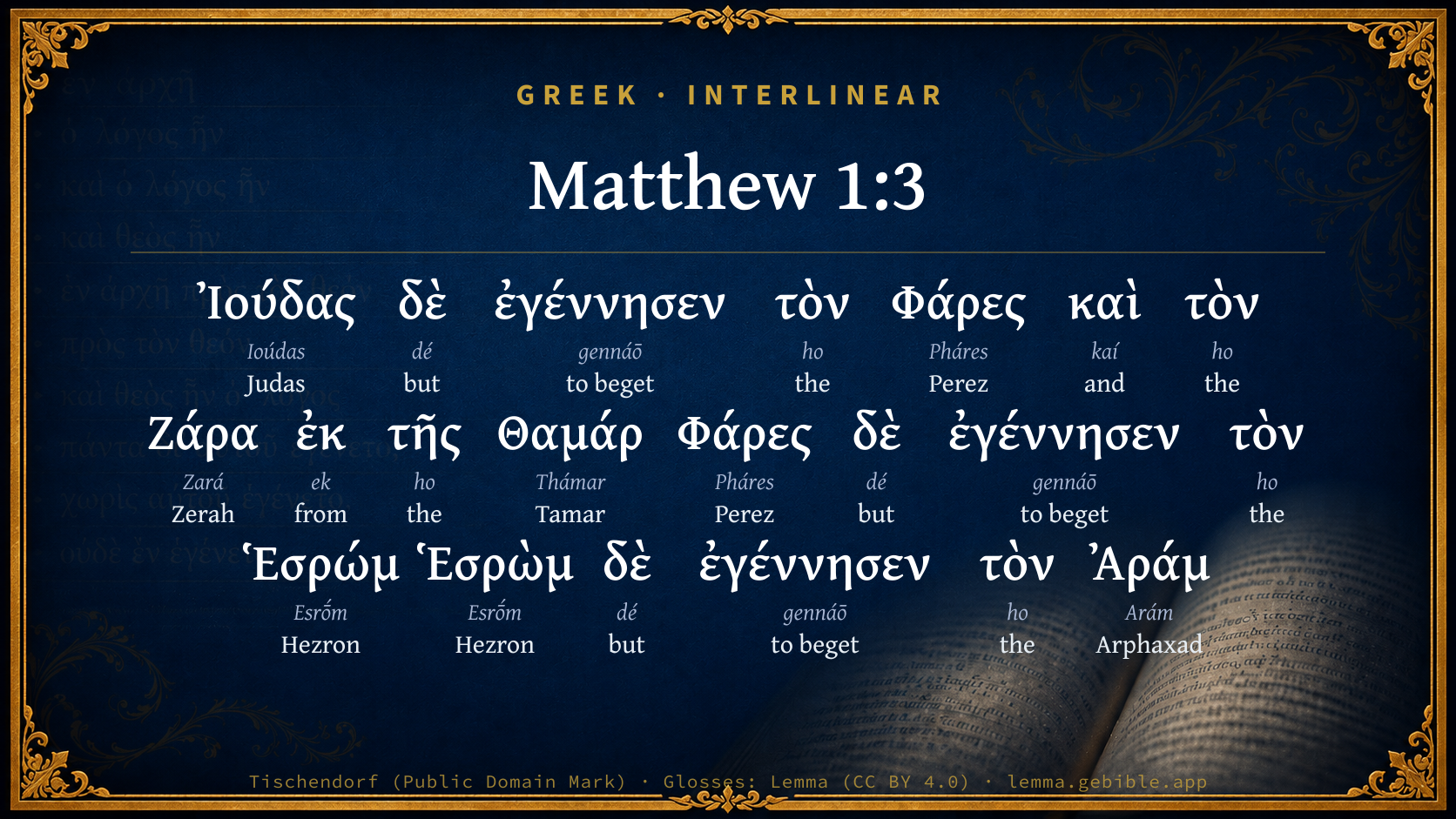
Greek (Tischendorf 8th ed.) Matthew 1:3 appears in the Greek New Testament. The text above is from the Tischendorf 8th edition. Each word links to its Strong’s number and a concise gloss. Click any word for its full Thayer’s Greek Lexicon entry.
Download image
Cite this verse

Matthew 1:3 (World English Bible). Public Domain. Lemma interlinear Bible study tool, https://lemma.gebible.app/v/matthew/1/3.

Show BibTeX & RIS
BibTeX
RIS
English Translation
Judah became the father of Perez and Zerah by Tamar. Perez became the father of Hezron. Hezron became the father of Ram.
World English Bible · Public Domain
Highlights
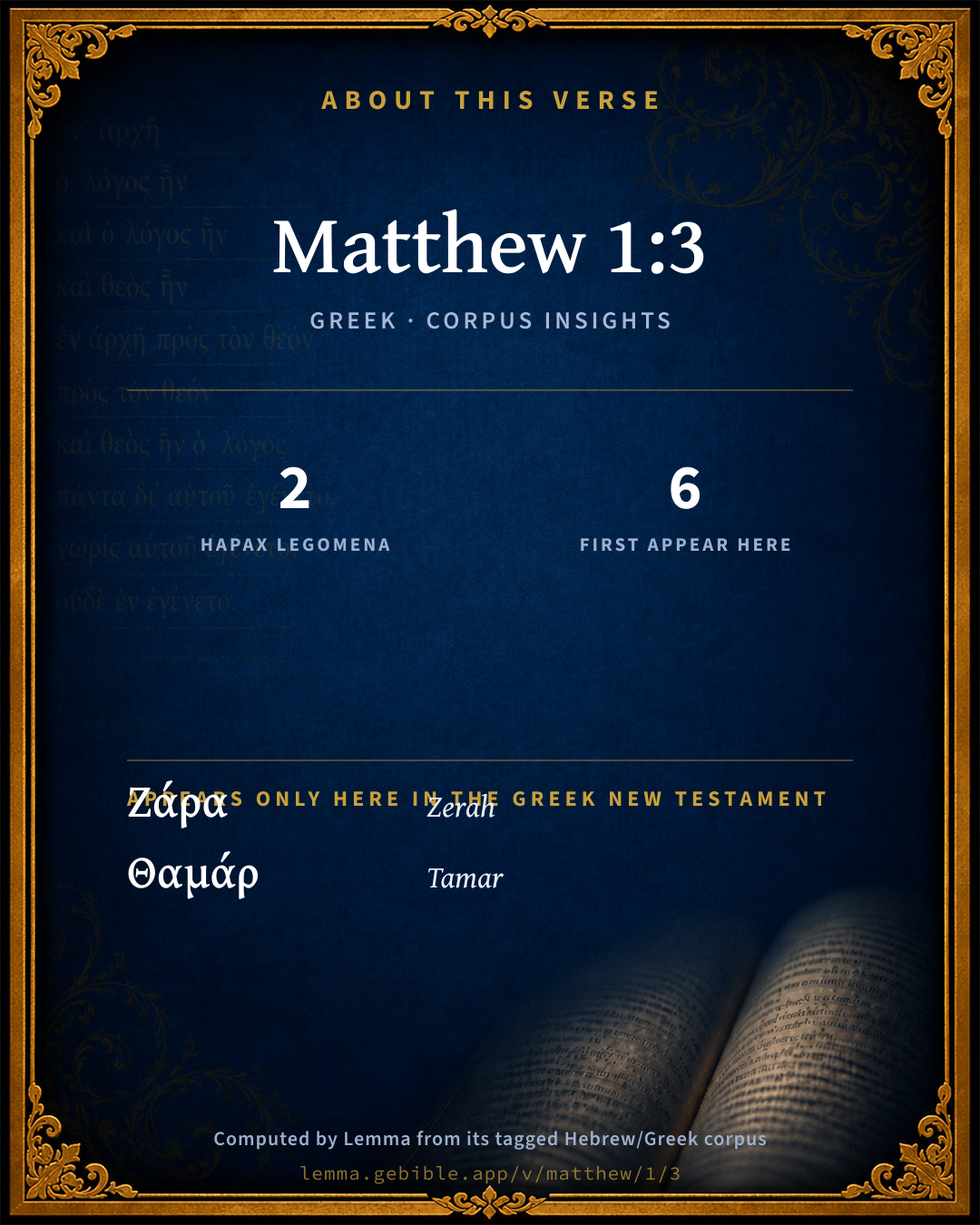
  • 2 hapax legomena — only here in the Greek New Testament
  • 6 first appearances in the Greek New Testament
Full analysis ↓
Download a study sheet

One document with this verse’s original text, its word-by-word gloss line, the meaning frame, cross-references with their text, attributed commentary, and full source and license credits — printable, and it pastes into notes with its structure intact.

This verse Autodidact and up

Study sheet (.html) Plain text (.txt)

A passage Seminary Student

Up to 50 verses in one chapter. A passage sheet keeps up to 6 commentary sources and 12 cross-references per verse, in the order this page ranks them, and says so on the sheet whenever that leaves anything out. Ask for a single verse and you get the Autodidact verse sheet above.

Everything on this page stays free to read, with no account — the sheet is a download of what is already on screen, not access to it.

Want to remove ads? Support Godless Engineer
Compare translations 3

The same verse in 3 English versions, stacked beneath the original-language interlinear above. Click any original word for its lexicon entry.

Each is an independent rendering of the whole verse — the interlinear is not word-aligned to these translations.

Highlighted words mark where these versions differ — a whole-verse word diff, not a word-by-word alignment.

  • World English Bible Public Domain
    Judah became the father of Perez and Zerah by Tamar. Perez became the father of Hezron. Hezron became the father of Ram.
  • King James Version Public Domain
    And Judas begat Phares and Zara of Thamar; and Phares begat Esrom; and Esrom begat Aram;
  • unfoldingWord Literal Text CC BY-SA 4.0
    and Judah fathered Perez and Zerah by Tamar, and Perez fathered Hezrom, and Hezrom fathered Aram,

unfoldingWord Literal Text — © unfoldingWord, licensed CC BY-SA 4.0. Word-aligned USFM3 via Door43 (git.door43.org/unfoldingWord/en_ult).

Versions to compare (up to 4)

3 of 4 selected

Show all 19 translations

Every available English version of this verse, each an independent rendering of the whole verse.

  • World English Bible Public Domain
    Judah became the father of Perez and Zerah by Tamar. Perez became the father of Hezron. Hezron became the father of Ram.
  • Berean Standard Bible Public Domain
    Judah was the father of Perez and Zerah by Tamar, Perez the father of Hezron, and Hezron the father of Ram.
  • Majority Standard Bible Public Domain
    Judah was the father of Perez and Zerah by Tamar, Perez the father of Hezron, and Hezron the father of Ram.
  • King James Version Public Domain
    And Judas begat Phares and Zara of Thamar; and Phares begat Esrom; and Esrom begat Aram;
  • American Standard Version (1901) Public Domain
    and Judah begat Perez and Zerah of Tamar; and Perez begat Hezron; and Hezron begat Ram;
  • Revised Version (1885) Public Domain
    and Judah begat Perez and Zerah of Tamar; and Perez begat Hezron; and Hezron begat Ram;
  • Geneva Bible (1599) Public Domain
    And Iudas begate Phares, and Zara of Thamar. And Phares begate Esrom. And Esrom begate Aram.
  • Douay-Rheims (1899) Public Domain
    And Judas begot Phares and Zara of Thamar. And Phares begot Esron. And Esron begot Aram.
  • Young's Literal Translation Public Domain
    and Judah begat Pharez and Zarah of Tamar, and Pharez begat Hezron, and Hezron begat Ram,
  • Literal Standard Version CC BY-SA 4.0
    and Judah begot Perez and Zerah of Tamar, and Perez begot Hezron, and Hezron begot Ram,
  • Unlocked Literal Bible CC BY-SA 4.0
    Judah was the father of Perez and Zerah by Tamar, Perez the father of Hezron, and Hezron the father of Ram.
  • unfoldingWord Literal Text CC BY-SA 4.0
    and Judah fathered Perez and Zerah by Tamar, and Perez fathered Hezrom, and Hezrom fathered Aram,
  • Darby Bible Public Domain
    and Juda begat Phares and Zara of Thamar; and Phares begat Esrom, and Esrom begat Aram,
  • World Messianic Bible Public Domain
    Judah became the father of Perez and Zerah by Tamar. Perez became the father of Hezron. Hezron became the father of Ram.
  • Webster's Bible Public Domain
    And Judah begat Phares and Zara of Thamar; and Phares begat Esrom; and Esrom begat Aram;
  • Free Bible Version CC BY-SA 4.0
    and Judah the father of Perez and Zerah (their mother was Tamar); and Perez the father of Hezron; and Hezron the father of Ram;
  • Bible in Basic English Public Domain
    And the sons of Judah were Perez and Zerah by Tamar; and the son of Perez was Hezron; and the son of Hezron was Ram;
  • Text-Critical English NT CC BY 4.0
    Judah was the father of Perez and Zerah by Tamar, Perez was the father of Hezron, Hezron was the father of Ram,
  • Tyndale New Testament (1534) Public Domain
    Iudas begat Phares and zaram of Thamar: Phares begat Hesrom: Hesrom begat Aram:

Literal Standard Version (2020), Covenant Press — licensed CC BY-SA 4.0. Text via the HelloAO Bible API (eBible.org). Unlocked Literal Bible (unfoldingWord) — licensed CC BY-SA 4.0. Text via the HelloAO Bible API (eBible.org). unfoldingWord Literal Text — © unfoldingWord, licensed CC BY-SA 4.0. Word-aligned USFM3 via Door43 (git.door43.org/unfoldingWord/en_ult). Free Bible Version, Dr. Jonathan Gallagher — licensed CC BY-SA 4.0. Text via the HelloAO Bible API (eBible.org).

Word by word

More ways to search: Search by grammar → Find every occurrence → Compare this word →

Practice this passage: Drill this verse → Learn its vocabulary →

Ζάρα
Zará
G2196
“Zerah”
Noun, Proper, indeclinable
Part of Speech
Noun · Proper, indeclinable
Full Thayer's Definition

Origin: of hebrew origin H2226

TDNT: None

Zara = "a rising (as the sun)" 1. the son of Judah, ancestor of Christ
  1. Ἰούδας Ioúdas G2455 “Judas” Noun, Nominative, Singular, Masculine
  2. δὲ dé G1161 “but” Conjunction
  3. ἐγέννησεν gennáō G1080 “to beget” Verb, Aorist, Active, Indicative, 3rd person, Singular
  4. τὸν ho G3588 “the” Article, Accusative, Singular, Masculine
  5. Φάρες Pháres G5329 “Perez” Noun, Proper, indeclinable
  6. καὶ kaí G2532 “and” Conjunction
  7. τὸν ho G3588 “the” Article, Accusative, Singular, Masculine
  8. ἐκ ek G1537 “from” Preposition
  9. τῆς ho G3588 “the” Article, Genitive, Singular, Feminine
  10. Θαμάρ Thámar G2283 “Tamar” Noun, Proper, indeclinable
  11. Φάρες Pháres G5329 “Perez” Noun, Proper, indeclinable
  12. δὲ dé G1161 “but” Conjunction
  13. ἐγέννησεν gennáō G1080 “to beget” Verb, Aorist, Active, Indicative, 3rd person, Singular
  14. τὸν ho G3588 “the” Article, Accusative, Singular, Masculine
  15. Ἑσρώμ Esrṓm G2074 “Hezron” Noun, Proper, indeclinable
  16. Ἑσρὼμ Esrṓm G2074 “Hezron” Noun, Proper, indeclinable
  17. δὲ dé G1161 “but” Conjunction
  18. ἐγέννησεν gennáō G1080 “to beget” Verb, Aorist, Active, Indicative, 3rd person, Singular
  19. τὸν ho G3588 “the” Article, Accusative, Singular, Masculine
  20. Ἀράμ Arám G689 “Arphaxad” Noun, Proper, indeclinable

About this verse

These counts appear in no published source. They are computed here, from the morphology-tagged text and Lemma’s own curated glosses. What Lemma adds →

21
words
11
distinct lemmas
Gospels
section

Notable vocabulary

2 hapax legomena — words that appear only here in the entire Greek New Testament:

First appearance in Scripture

These words make their first canonical appearance in the Greek New Testament here:

Shared distinctive vocabulary

Ἀράμ Arphaxad G689 occurs in 2 verses of the Greek New Testament. Also found in:
Repetition

Words recur within this verse:

  • ἐγέννησεν to beget G1080 ×3
  • Φάρες Perez G5329 ×2
  • Ἑσρώμ Hezron G2074 ×2
  • τὸν the G3588 ×5
  • δὲ but G1161 ×3

Cross-references

10

Topical passages linked to Matthew 1:3 in the Treasury of Scripture Knowledge — connected by theme and wording, ordered by reader-vote popularity; previews shown in the World English Bible.

  • Genesis 38:24–27 It happened about three months later, that it was told Judah, saying, "Tamar, your daughter-in-law, has played the prostitute; and moreover, behold, she is with child by prostitution." Judah said, "Bring her forth, and let her be burnt."
  • Genesis 38:29–30 It happened, as he drew back his hand, that behold, his brother came out, and she said, "Why have you made a breach for yourself?" Therefore his name was called Perez.
  • Genesis 46:12 The sons of Judah: Er, Onan, Shelah, Perez, and Zerah; but Er and Onan died in the land of Canaan. The sons of Perez were Hezron and Hamul.
  • Ruth 4:18–22 Now this is the history of the generations of Perez: Perez became the father of Hezron,
  • 1 Chronicles 4:1 The sons of Judah: Perez, Hezron, and Carmi, and Hur, and Shobal.
  • Numbers 26:20–21 The sons of Judah after their families were: of Shelah, the family of the Shelanites; of Perez, the family of the Perezites; of Zerah, the family of the Zerahites.
  • Luke 3:33 the son of Amminadab, the son of Aram, the son of Joram, the son of Hezron, the son of Perez, the son of Judah,
  • Genesis 38:6 Judah took a wife for Er, his firstborn, and her name was Tamar.
  • 1 Chronicles 2:1–15 These are the sons of Israel: Reuben, Simeon, Levi, and Judah, Issachar, and Zebulun,
  • 1 Chronicles 9:6 Of the sons of Zerah: Jeuel, and their brothers, six hundred ninety.

Cross-references courtesy of OpenBible.info (CC BY 4.0).

Commentary

Notes on Matthew 1:3 from classic Christian and Jewish commentators (each source and its license shown beneath its notes). The classic Christian expositions comment on the surrounding passage and are grouped to its opening verse, so a note may address several verses; the Jewish commentaries on the Tanakh (Rashi and others) are per-verse, so they appear only where the commentator wrote on this verse.

Lemma curates 59 commentaries, every one of them public domain or Creative Commons licensed, each selected and text-cleaned for this edition rather than reprinted as found. About our sources →

Joseph Benson's Commentary

Mat 1:3. And Judas begat Phares and Zara — Some have observed that these sons of Judah are mentioned together because they were twins born at the same time: but if this had been a reason for assigning Zara the honour of being named in this genealogy, Esau, the twin brother of Jacob, ought to have obtained it likewise. He seems rather to be mentioned to prevent any mistake. For if he had not, considering the infamy of Pharez’s birth, we might have been apt to imagine that not the Pharez whom Judah begat in incest, but another son of Judah, called Pharez, was our Lord’s progenitor, it being no uncommon thing among the Jews to have several children of the same name. Wherefore, to put the matter beyond doubt, Thamar, as well as Zara, is mentioned in the genealogy, if her name be not rather added because she was remarkable in the sacred history. This reason certainly must be assigned why three other women are named in this catalogue, viz., Rahab, Ruth, and Bathsheba. They were all remarkable characters, and their story is particularly related in the Old Testament. This seems much more probable than the opinion of those who think they are mentioned, either because they were great sinners, to teach us that Christ came to save such, or with a view to obviate the cavils of the Jews against the mean condition of the mother of our Lord; their renowned ancestors, such as even David and Solomon, being descended of women whose quality rendered them much meaner than she was. It was, however, one degree of our Saviour’s humiliation, that he would be born of such sinners, and it certainly may encourage the vilest to come unto him, and expect salvation from him. Nor shall they be disappointed, if, in true repentance and lively faith, they turn from their sins to God.

Joseph Benson's Commentary on the Old and New Testaments (1811–1818) — public domain. Text from a community e-Sword module.

Bengel's Gnomon

Johann Albrecht Bengel

Mat 1:3. καὶ τὸν Ζαρὰ, and Zara) the twin-brother of Pharez.—ἐκ τῆς Θάμαρ, of Thamar) St Matthew, in the course of his genealogy, makes mention of women who were joined to the race of Abraham by any peculiar circumstance. Thamar ought to have become the wife of Shelah (see Gen 38:11; Gen 38:26), and Judah became by her the father of Pharez and Zara: Rahab, though a Canaanitess, became the wife of Salmon: Ruth was a Moabitess, yet Boaz married her. The wife of Uriah became the wife of David.

Bengel's Gnomon of the New Testament — English translation (T&T Clark, Edinburgh, 1860) — public domain. Text from a community e-Sword module.

Expositor's Greek Testament

ed. W. Robertson Nicoll

Mat 1:3 . τὸν φαρὲς καὶ τὸν Ζαρὰ : Zerah added to Perez the continuator of the line, to suggest that it was by a special providence that the latter was first born (Gen 38:27-30 ). The evangelist is on the outlook for the unusual or preternatural in history as prelude to the crowning marvel of the virgin birth (Gradus futurus ad credendum partum e virgine. Grot.). ἐκ τῆς Θάμαρ . Mention of the mother wholly unnecessary and unusual from a genealogical point of view, and in this case one would say, primâ facie , impolitic, reminding of a hardly readable story (Gen 38:13-26 ). It is the first of four references to mothers in the ancestry of Jesus, concerning whom one might have expected the genealogy to observe discreet silence: Tamar, Rahab, Ruth, Bathsheba; three of them sinful women, and one, Ruth, a foreigner. Why are they mentioned? By way of defence against sinister misconstruction of the birth of Jesus? So Wetstein: Ut tacitæ Judaeorum objectioni occurreretur. Doubtless there is a mental reference to that birth under some aspect, but it is not likely that the evangelist would condescend to apologise before the bar of unbelief, even though he might find means of doing so in the Jewish habit of glorying over the misdeeds of ancestors (Wetstein). Much more probable is the opinion of the Fathers, who found in these names a foreshadowing of the gracious character of the Gospel of Jesus, as it were the Gospel in the genealogy . Schanz follows the Fathers, except that he thinks they have over-emphasised the sinful element. He finds in the mention of the four women a hint of God’s grace in Christ to the sinful and miserable : Rahab and Bathsheba representing the one, Tamar and Ruth the other. This view commends itself to many interpreters both Catholic and Protestant. Others prefer to bring the four cases under the category of the extraordinary exemplified by the case of Perez and Zerah. These women all became mothers in the line of Christ’s ancestry by special providence (Weiss-Meyer). Doubtless this is at least part of the moral. Nicholson ( New Comm. ) thinks that the introduction of Tamar and Ruth is sufficiently explained by Rth 4:11-12 , viewed as Messianic; of Rahab by her connection with the earlier Jesus (Joshua), and of Bathsheba because she was the mother of a second line culminating in Christ, as Ruth of a first culminating in David.

The Expositor's Greek Testament, edited by W. Robertson Nicoll (1897–1910) — public domain. Text from a community e-Sword module.

Jamieson, Fausset & Brown

Robert Jamieson, A. R. Fausset & David Brown

And Judas begat Phares and Zara of Thamar; and Phares begat Esrom; and Esrom begat Aram; 4. And Aram begat Aminadab; and Aminadab begat Naasson; and Naasson begat Salmon; 5. And Salmon begat Booz of Rachab; and Booz begat Obed of Ruth; and Obed begat Jesse; 6. And Jesse begat David the king; and David the king begat Solomon of her of Urias--Four women are here introduced; two of them Gentiles by birth--Rachab and Ruth; and three of them with a blot at their names in the Old Testament--Thamar, Rachab, and Bath-sheba. This feature in the present genealogy--herein differing from that given by Luke--comes well from him who styles himself in his list of the Twelve, what none of the other lists do, "Matthew the publican"; as if thereby to hold forth, at the very outset, the unsearchable riches of that grace which could not only fetch in "them that are afar off," but teach down even to "publicans and harlots," and raise them to "sit with the princes of his people." David is here twice emphatically styled "David the king," as not only the first of that royal line from which Messiah was to descend, but the one king of all that line from which the throne that Messiah was to occupy took its name--"the throne of David." The angel Gabriel, in announcing Him to His virgin-mother, calls it "the throne of David His father," sinking all the intermediate kings of that line, as having no importance save as links to connect the first and the last king of Israel as father and son. It will be observed that Rachab is here represented as the great-grandmother of David (see Rut 4:20-22; Ch1 2:11-15) --a thing not beyond possibility indeed, but extremely improbable, there being about four centuries between them. There can hardly be a doubt that one or two intermediate links are omitted.

Jamieson, Fausset & Brown — Commentary Critical and Explanatory on the Whole Bible (1871) — public domain (CC PDM 1.0). Text via the HelloAO Bible API.

Adam Clarke's Commentary

Verse 3. Phares and Zara] The remarkable history of these twins may be seen, Gen. 38: Some of the ancients were of opinion, that the evangelist refers to the mystery of the youngest being preferred to the eldest, as prefiguring the exaltation of the Christian Church over the synagogue. Concerning the women whose names are recorded in this genealogy, see the note at the end of the chapter.

Adam Clarke's Commentary on the Bible (1810–1826) — public domain. Text from a community e-Sword/MySword module.

Ellicott's Commentary for English Readers

(3) Thamar.—The occurrence of the names of women in genealogies was the exception rather than the rule among the Jews; but there are instances enough in the Old Testament (e.g., Keturah, Gen_25:1; the wives of Esau, Gen_36:10; Timna, Gen_36:22; Mehetabel, Gen_36:39; Azubah, the wife of Caleb, 1Ch_2:18; Achsa, his daughter, 1Ch_2:49; and many others) to make the insertion of such names here quite natural, even without assuming any distinct purpose. It was enough that the women were historically notable. In the case of Thamar there were precedents enough for such an honourable mention. In the days of Ruth she was as much the heroine of the tribe of Judah as Rachel and Leah were of all Israel, and her name came into the formula of nuptial benediction (Rth_4:12). It appears also in the genealogies of 1Ch_2:4. It would appear from the language of the Talmud as if the Jews looked on her strange and to us revolting history with quite other feelings. To them she was as one who, at the risk of shame, and, it might be, death, had preserved the line of Judah from destruction, and “therefore was counted worthy to be the mother of kings and prophets.” The mention of Zara, though not in the line of succession, follows the precedent of 1Ch_2:47.

A Bible Commentary for English Readers, edited by Charles John Ellicott (1878–1897) — public domain. Text from a community e-Sword module.

The Cambridge Bible for Schools and Colleges

gen. ed. J. J. S. Perowne

3. Thamar] St Matthew also differs from St Luke in naming women in the genealogy. Of the four mentioned two—Rahab and Ruth—are foreigners, and three—Thamar, Rahab and Bathsheba—were stained with sin. The purpose of the Evangelist in recording their names may be to shew that He who came to save “that which was lost,” the Friend of sinners, does not scorn such descent.

The Cambridge Bible for Schools and Colleges (gen. ed. J. J. S. Perowne; Cambridge University Press, 1878–1918) — public domain. Text from a community e-Sword module.

John Gill's Exposition

And Judas begat Phares and Zara of Thamar,.... The genealogical account of Christ goes on from Judah in the line of Phares, with whom Zara is mentioned; not because they were twins, for so were Jacob and Esau, and yet the latter is taken no notice of; but it may be because of what happened at their birth, see Gen 38:28. But the line of the Messiah was in Phares, and very rightly is he put in the genealogy of Christ, the Jews themselves being witnesses; who expressly say, that "the Messiah comes from him." These two are said to be begotten of Thamar, daughter-in-law to Judah; who, though she was a Canaanitish woman, has the honour to be named in the genealogy of Christ, who came to save Gentiles as well as Jews: nor can the Jews reproach our Evangelist for putting her into the account; since they themselves frequently acknowledge that the Messiah was to spring from her: they say, (r).

"there are two women from whom come David the king, and Solomon, and the king Messiah; and these two are Thamar and Ruth.''

Jonathan Ben Uzziel on Gen 38:6 says, that Thamar was the daughter of Shem the great.

And Phares begat Esrom; called Hezron, Rut 4:18 where the same phrase is used as here. He had another son called Hamul, Ch1 2:5 but the account proceeds from Phares, in the line of Esrom.

And Esrom begat Aram; called Ram in Rut 4:18 where the same way of speaking is used as here. Esrom also besides him begat Jerahmeel, Chelubai, or Caleb, and Segub, Ch1 2:9 but these are not in the line. Elihu, who conversed with Job, is said to be of the kindred of Ram, Job 32:2 whether the same with Ram or Aram, may be inquired.

(r) Shemot Rabba, sect. 30. fol. 131. 4. Caphtor, fol. 122. 1.

John Gill's Exposition of the Whole Bible (1746–1763) — public domain (CC PDM 1.0). Text via the HelloAO Bible API.

Trapp's Complete Commentary

John Trapp

3 And Judas begat Phares and Zara of Thamar; and Phares begat Esrom; and Esrom begat Aram;

Ver. 3. And Judah begat Phares and Zarah] Jerome is deceived, that deriveth the pedigree of the Pharisees from this Phares. They took their name either of Pharash, to expound as interpreters of the law, Rom 2:18; or of Pharas, to separate with a-"Stand further off, for I am holier than thou." Josephus saith, that the Pharisees seemed to outstrip all others both in height of holiness and depth of learning: συνταγμα τι Ιουδαιων ευσεβεστερων τον βιον, και δοκουντωνακριβεστερον των αλλων τον νομον εφηγεισθαι. B. J. i. 4. As for Pharos, he was a breachmaker (whence also he had his name, Gen 38:29). He violently took the first birthright, and became both a father of the Messiah and a type. For Christ by his strength broke the power of death and hell; he broke down also the partition wall that was between the Jews and Gentiles, who when they shall be fully born, then shall the Jews, typified by Zarah, who thrust forth the hand first, as those that, willing to be justified by their works, and thinking to regenerate themselves, had the scarlet thread of the law’s condemnation bound upon their hands, which therefore they drew back and fell from God, -then shall they, I say, come forth again, Rom 11:11-12; Rom 11:25-26.

Of Thamar] A Canaanitess, but probably a proselyte. The Jews say she was Melchisedec’s daughter, the high priest, and was therefore to be burned, Lev 21:9. But this may well pass for a Jewish fable: howbeit, that Melchisedec was a Canaanite, but a most righteous king and priest of the most high God, and was therefore not molested or meddled with by Kedarlaomer and his accomplices, I judge not unlikely. This Thamar, out of desire, partly of revenge, and partly of issue, fell into the sin of incest. Rahab was a harlot, Bathsheba an adulteress: yet all these grandmothers to our Saviour; who, because he needed not to be ennobled by his stock, so neither was disparaged by his progenitors, but took flesh of these greatest sinners to show that we cannot commit more than he can remit; and that by his purity he washeth off all our spots, like as the sun wasteth and wipeth away all the ill vapours of the earth and air.

And Phares begat Esrom] When he was about fourteen years of age, the year before they went down to Egypt, say some: others view it otherwise. (Pareus in Gen.; Funccius in Chronol. Com., Anno 2273.) Let him that readeth understand as he can. Christ (the Arch-Prophet), when he comes again, shall teach us all things.

Esrom begat Aram] While they sojourned in the land of Egypt; a miserable home, where was nothing but bondage and tyranny. And yet in reference to it, Moses (who was likewise born there) calls his son Gershom, or a stranger there, because born in Midian. The sons of Ephraim, about the birth of Moses, sought to break prison before God’s delivery: but this proved a great mischief to themselves, and no small heart break to their aged father, 1Ch 7:21-22 Psa 78:9. Besides that, it gave occasion, likely, to that cruel edict of Pharaoh: "Let us deal wisely" (St Stephen saith sophistically, subtilly, κατασοφισαμενος, Act 7:19), "lest they multiply and join also to our enemies, and fight against us" (as now they have fought against the Gittites, their own enemies, who detained from them the promised land, till their sins were full), and "so get them up out of the land," as lately they had essayed to do. "Therefore they did set over them taskmasters to afflict them with their burdens," Exo 1:11, and to keep them from spawning so fast, after the manner of fishes (as the word imports), which multiply beyond measure. But God turned their wisdom into folly; they took a wrong course. For who knows not that your labouring men have the most and the strongest children? And notwithstanding this new Pharaoh’s craft and cruelty,

John Trapp, A Commentary or Exposition upon All the Books of the Old and New Testament (1647–1656) — public domain. Text from a community e-Sword module.

Haydock's Catholic Bible Commentary

See Genesis xxxviii, ver. 6. & dein. and Zera of Thamar, her daughter-in-law. (Haydock)

George Leo Haydock (1774–1849), Haydock's Catholic Family Bible and Commentary, 1859 edition — public domain. Excludes Psalms (Douay-Rheims chapter numbering differs from Protestant) and Deuterocanonical books (Catholic canon only).

Matthew Poole's English Annotations

That Judas begat Phares and Zara (they were twins begot of Thamar his daughter-in-law), the relict of his son Er whom God slew, Gen 38:7, appeareth from Gen 38:27-30. That

Phares begat Ezrom appeareth from Rth 4:18; 1Ch 2:5; and from the same texts appears also that

Ezrom begat Aram, Rth 4:19; 1Ch 2:9, where he is called Ram. Some may possibly be offended that amongst all the ancestors of Christ there are but three women named, and all of them such as had a great stain and blot upon their reputation. This

Thamar, the mother of Phares and Zara, was blotted with incest, and Phares was one of the children begot in that incest. Rahab also is mentioned, Mat 1:5, whom the Scripture calleth an harlot, Jos 2:1; and Bathsheba was stained with adultery. But we ought to consider:

1. That (abating original corruption, which we indeed all derive from our parents) no man derives any intrinsic badness from the vice of his parents, though he may derive a blot upon his honour and reputation from it.

2. That this was one degree of our Saviour’s humiliation.

3. That it was no way incongruous, that He who came into the world to die for great sinners, should be born of some that were such.

Matthew Poole's English Annotations on the Holy Bible (1683–1685) — public domain. Text from a community e-Sword/MySword module.

Whedon's Commentary on the Bible

Daniel D. Whedon

3. Phares and Zara — Gen_38:27. From Pharez to David the genealogy is furnished in Rth_4:18-22.

We present a comparative catalogue of the names in Matthew, and the Old Testament:

MATTHEWGEN . 5, 10, 11, and Ruth 41 CHR . 1, 2, 3.AbrahamAbram3AbrahamIsaac— —IsaacJacob— —IsraelJudas— —JudahPhares— —PharezEsromHezronHezronAramRamRamAminadabAmminadabAmminadabNaasonNahshonNahshonSalmonSalmonSalmaBoozBoazBoazObedObedObedJesseJesseJesseDavid, 14DavidDavid, 14Solomon— —SolomonRoboam— —RehoboamAbia— —AbiaAsa— —AsaJosaphat— —JehosaphatJoram— —Joram— —— —Ahazia— —— —Joash— —— —AmaziahOziasDavidAzariahJoatham— —JothamAchaz— —AhazEzekias— —HezekiahManasses— —ManassehAmon— —AmonJosias— —Josiah— — , 14— —JehoiakimJechonias— —JeconiahSalathiel— —Salathiel & PedaiahZorobabel— —Zerubbabel— —— —Hananiah— —— —Pelatiah & Rephaiah— —— —ArnanAbiud— —ObadiahEliakim— —Shechaniah— —— —Shemaiah— —— —NeariahAzor— —Elioenai & Azrikam— —— —Johanan & AnaniSadoc— —— —Acheim— —— —Elioud— —— —Eleazar— —— —Matthan— —— —Jacob— —— —Joseph— —— —Jesus, 14— —— —See an excellent article by Dr. Strong, in the Methodist Quarterly Review, October, 1852, for an investigation of these genealogies.

By comparing these lists, it will be seen that there are three names, Ahaziah, Joash, and Amaziah, which occur in the Old Testament, (namely, in Chronicles,) which are omitted in Matthew in making out the second of his three fourteens in Mat_1:17. If these were reckoned, the number would be seventeen. Upon this, we shall remark in our note on that verse.

In the article to which we have referred, Dr. Strong compares the genealogy of Matthew (which we might call the home family tree of Joseph) with those of Luke and Chronicles, in the third fourteen; he finds farther omissions in it; and after elaborately showing the fair agreement of names between the three catalogues of this fourteen, he makes the following statement:

“As the list in the Chronicles ends here, bringing down the lineage some nine generations after Zerubbabel, under whom the Jews returned from the Babylonian captivity, that is, to about B.C. 280, we have only the surprisingly short period of about two centuries and a half preceding Christ’s immediate parentage, during which his whole descent is not vouched for by the sacred archives of the Jewish nation.”

Daniel D. Whedon (gen. ed.), Commentary on the Old and New Testaments (1874–1909) — public domain. Text from a community e-Sword module.

The Pulpit Commentary

Of Thamar (Tamer, Revised Version). In this genealogy the only women mentioned beside the Virgin Mary herself, who must of necessity be introduced, are Tamar, Rahab, Ruth, and Bathsheba, and many explanations have been suggested why these should be specially singled out for notice. The most plausible reasons put forward have been that they are introduced because of the sins with which all but one of them were stained, and because two were not of the race of Israel. Thus, it has been thought, St. Matthew would, in the outset of his Gospel, proclaim Christ as the Friend, even the Kinsman, of sinners, and the Saviour offered to Gentiles as well as to Jews. It is probably wiser not to put so deep a meaning on the appearance of these names, but to consider that they are here because in each case the circumstances were different from the ordinary steps of the genealogy. Had they been in the same position as all the other wives and mothers who are unnamed, they also would have been left unnamed.

Vers. 3, 5. Strange links in genealogical chains.

It must strike every reader as singular, that the women introduced in the genealogies are of doubtful character or of foreign relations. "The mention of the four women, Tamar, Rahab, Ruth, and Bathsheba, in such a pedigree is very significant. Tamar, the forgotten one, twice left a childless widow; Rahab, not only of the accursed seed of the Canaanites, but moreover a harlot; Ruth, also a long-childless widow, and a stranger, and born of the stock of Moab, that nation of incestuous origin, forbidden to enter the house of the Lord unto the tenth generation; and lastly, the wife of Uriah, the very mention of whom, under this designation, only draws attention to her sin; all these are seen incorporated into the line of the children of Abraham, nay, more, into the holy genealogy of Christ." What can it be intended that these strange links should teach us?

I MAN"S WILFULNESS IS NOT ALLOWED TO HINDER. GOD"S PURPOSES. Marriage of Jews beyond the limits of the nation was strictly forbidden; and such marriages were a fruitful source of evil, as, is illustrated in the times of Balaam and of Nehemiah. We can clearly see man"s wilfulness in the marriages of Rahab and Ruth, who were both foreigners, and worse than wilfulness in David"s marrying Bathsheba. Such wilfulness we might expect would thwart the Divine purpose for the race; but instead, it was overruled. God"s thought cannot be frustrated. If man resists, he will simply be borne along on the current of God"s outworking purpose.

II GOD LETS CHARACTER TRIUMPH OVER MERE RACEDISABILITIES. This is illustrated in the cases of Rahab and Ruth, the fine illustrations of faith in God and of the loyalty of sincere love. That faith ennobled a Canaanite in the sight of God. That loyalty of love beautified a Moabite in the sight of God. And so our Lord taught that the humbled, penitent, believing "publicans and harlots" entered his kingdom rather than Abraham-born Jews, who had nothing to boast of but a pedigree.

III GENTILES HAVE A CLEAR CLAIM TO THE BENEFITS OF MESSIAH"S WORK. They have an actual part in him. The blood of two Gentile mothers is in the Saviour of the world. The Gentiles need rest in no mere permission to share Jewish privilege: they can claim their rights in Jesus. He is "a Light to lighten the Gentiles. R.T.

The Pulpit Commentary (1880–1919), ed. H.D.M. Spence-Jones & Joseph S. Exell — public domain. Text from a community e-Sword module.

John Wesley's Explanatory Notes

Of Thamar - St. Matthew adds the names of those women also, that were remarkable in the sacred history.

John Wesley, Explanatory Notes Upon the Whole Bible (1754–1765) — public domain. Text via the GEBible commentary corpus.

The People's New Testament

B. W. Johnson

3. Tamar. Three women are named in this list: Tamar, Rahab, and Ruth. These were all Gentile women, and are named for this reason, and for their remarkable history. There were stains upon the character of Tamar (Gen. 38:11–30) and of Rahab (Josh. 2:1), but Ruth is one of the sweetest women of the Bible.

B. W. Johnson's The People's New Testament with Notes (1889–1891) — public domain. Electronic text from the Christian Classics Ethereal Library (CCEL) ThML edition.

Cambridge Greek Testament for Schools and Colleges

3. Θάμαρ. St Matthew also differs from St Luke in naming women in the genealogy. Of the four mentioned two—Rahab and Ruth—are foreigners, and three—Thamar, Rahab and Bathsheba—were stained with sin. The purpose of the Evangelist in recording their names may be to show that He who came to save ‘that which was lost,’ the Friend of sinners, does not scorn such descent.

Cambridge Greek Testament for Schools and Colleges (Cambridge University Press, 1896; 21 vols, various authors incl. Carr, Maclear, Plummer, Farrar, Lumby, Moule, M. R. James, Simcox) — public domain. Text from a community e-Sword module.

Alford’s Greek Testament

Henry Alford

3.] These children of Judah were not born in marriage: see Gen. 28:16-30. Both the sons are named, probably as recalling the incident connected with their birth. The reason for the women (Thamar, Rahab, Ruth, and Bathsheba) being mentioned, has been variously assigned: by ., ut tacitæ Judæorum objectioni occurreretur: by Fritzsche, for the sake of minute accuracy. It most probably is that given by Maldonatus: ‘Prætermisit Evangelista quod ordinarium erat, quod autem singulare et dubium exposuit.’ There may be something also in that suggested by Grotius: ‘Mulieres in hoc sensu obiter paucæ nominantur, extraneo ortiaut criminibus nobiles, quarum historia ad vocationem idololatrarum et criminosorum per Christi evangelium proludit:’ as also in De Wette’s view, that they serve as types of the mother of our Lord, and are consequently named in the course of the genealogy, as she is at the end of it.

Henry Alford, The Greek Testament (1849–1861) — public domain. Text from a community e-Sword module.

International Critical Commentary

(E) 3. And Judah begat Phares and Zara from Tamar; and Phares begat Esrom; and Esrom begat Aram.] Clause a is from 1Ch 2:4 καὶ Θαμάρ ἡ νύμφη αὐτοῦ ἔτεκεν αὐτῷ τὸν Φάρες καὶ τὸν Ζαρὰ. The fact that the compiler adds καὶ τὸν Ζαρὰ ἐκ τῆς Θάμαρ, which is quite superfluous in a genealogy proper, shows that he had 1Ch 2:4 before him. Ζαρά is the Septuagintal form of זֶרַח. On the editor’s special reason for mentioning Tamar, see above.—Ἑσρώμ] In 1Ch 2:9 B has Ἑσερών, A Luc. Ἑσρώμ. In 1Ch 2:5 B has Ἁρσών, B a? b? Ἑσερών, A Luc. Ἑσρώμ. Elsewhere Ἑσρώμ is peculiar to A Luc., never appearing in B. Its use in Mt. shows that the compiler was using Septuagintal forms, and not trans literating the Hebrew.—Ἀράμ] In 1Ch 2:9 Ἀράμ appears as a son of Ἑσρώμ.

3. Ἰούδας] LXX. has Ἰουδάς or Ἰουδά. In 1Ch 2:1 Ἰουδά, B; Ἰούδας, Luc.; Ἰούδας, Josephus.—Ζαρά] B Ox Ζαρέ, LXX. Ζαρά, Josephus Ζάρασος or Ἐζελοός.—Φαρές] So LXX.; Josephus Φάρεσος.—Ἑσοώμ] LXX. has Ἑσρώμ (not B), Ἑσερών, Ἑσρών, Ἑζρών, Ἁρσών. In 1Ch 2:5 Ἁρσών, B; Ἑσρών, Ba? b? mg; Ἑσρώμ, A Luc. In 1Ch 2:9 Ἑσερών, B; Ἑσρών, Ba b; Ἑσρώμ, A Luc.—Ἀράμ] In 1Ch 2:9 LXX. B has Ἀράμ; in v. 10 Ἀρράν, but A Luc.Ἀράμ.

International Critical Commentary — older volumes (1896–1929), various authors — public domain. Text from a community e-Sword module.

Lesson kit

Teaching starters — assembled from the data on this page, not authored interpretation. Every prompt links to the verse data it draws on. Edit before teaching.

Matthew, in the Gospels, opens this verse with 21 words (11 distinct Greek lemmas). Its most distinctive word is Zará (“Zerah”). A historical commentator’s framing appears above. Read the whole chapter for the surrounding context.

Discussion questions

  1. The word Zará carries the sense “Zerah.” How does it shape the verse?
  2. This verse holds 2 words here found nowhere else in the Greek New Testament. What might the rare words draw attention to?
  3. 6 words here appear for the first time in Scripture. What is being introduced at this debut?
  4. Matthew 1:4 shares the word «Arphaxad» with this verse. How do the two illuminate each other?
  5. “to beget” occurs 3× in this one verse. What is the effect of the repetition?
  6. These translations render this verse differently; the difference is in the English rendering, not the original. What questions does that raise?
  7. Reading how Joseph Benson's Commentary and Bengel's Gnomon read this verse, where do the two commentators agree and where do they part?

Things to notice

  • 2 words in this verse appear nowhere else in the Greek New Testament.
  • 6 words make their first canonical appearance in Scripture here.
  • These translations choose different wording for 17 words in this verse.
  • “to beget” occurs 3× in this single verse.
  • 11 distinct Greek lemmas span 21 words in this verse.

Reading settings

Reading text

Shown beneath each verse's original-language words.

Old Testament
Old Testament edition

Read the OT as the Masoretic Hebrew (MT) or the Greek Septuagint (LXX).

English shown for the Greek Septuagint (in the Hebrew ↔ Greek comparison).

Comparing translations? Open the Compare panel on any verse page to stack up to four side by side.