John 6:54

Greek (Tischendorf 8th ed.) John 6:54 appears in the Greek New Testament. The text above is from the Tischendorf 8th edition. Each word links to its Strong’s number and a concise gloss. Click any word for its full Thayer’s Greek Lexicon entry.
Download image
Cite this verse

John 6:54 (World English Bible). Public Domain. Lemma interlinear Bible study tool, https://lemma.gebible.app/v/john/6/54.

Show BibTeX & RIS
BibTeX
RIS
English Translation
He who eats my flesh and drinks my blood has eternal life, and I will raise him up at the last day.
World English Bible · Public Domain
Download a study sheet

One document with this verse’s original text, its word-by-word gloss line, the meaning frame, cross-references with their text, attributed commentary, and full source and license credits — printable, and it pastes into notes with its structure intact.

This verse Autodidact and up

Study sheet (.html) Plain text (.txt)

A passage Seminary Student

Up to 50 verses in one chapter. A passage sheet keeps up to 6 commentary sources and 12 cross-references per verse, in the order this page ranks them, and says so on the sheet whenever that leaves anything out. Ask for a single verse and you get the Autodidact verse sheet above.

Everything on this page stays free to read, with no account — the sheet is a download of what is already on screen, not access to it.

Want to remove ads? Support Godless Engineer
Compare translations 3

The same verse in 3 English versions, stacked beneath the original-language interlinear above. Click any original word for its lexicon entry.

Each is an independent rendering of the whole verse — the interlinear is not word-aligned to these translations.

Highlighted words mark where these versions differ — a whole-verse word diff, not a word-by-word alignment.

  • World English Bible Public Domain
    He who eats my flesh and drinks my blood has eternal life, and I will raise him up at the last day.
  • King James Version Public Domain
    Whoso eateth my flesh, and drinketh my blood, hath eternal life; and I will raise him up at the last day.
  • unfoldingWord Literal Text CC BY-SA 4.0
    The one eating my flesh and drinking my blood has eternal life, and I will raise him up in the last day.

unfoldingWord Literal Text — © unfoldingWord, licensed CC BY-SA 4.0. Word-aligned USFM3 via Door43 (git.door43.org/unfoldingWord/en_ult).

Versions to compare (up to 4)

3 of 4 selected

Show all 19 translations

Every available English version of this verse, each an independent rendering of the whole verse.

  • World English Bible Public Domain
    He who eats my flesh and drinks my blood has eternal life, and I will raise him up at the last day.
  • Berean Standard Bible Public Domain
    Whoever eats My flesh and drinks My blood has eternal life, and I will raise him up at the last day.
  • Majority Standard Bible Public Domain
    Whoever eats My flesh and drinks My blood has eternal life, and I will raise him up at the last day.
  • King James Version Public Domain
    Whoso eateth my flesh, and drinketh my blood, hath eternal life; and I will raise him up at the last day.
  • American Standard Version (1901) Public Domain
    He that eateth my flesh and drinketh my blood hath eternal life: and I will raise him up at the last day.
  • Revised Version (1885) Public Domain
    He that eateth my flesh and drinketh my blood hath eternal life; and I will raise him up at the last day.
  • Geneva Bible (1599) Public Domain
    Whosoeuer eateth my flesh, and drinketh my blood, hath eternall life, and I will raise him vp at the last day.
  • Douay-Rheims (1899) Public Domain
    Then Jesus said to them: Amen, amen I say unto you: Except you eat the flesh of the Son of man, and drink his blood, you shall not have life in you.
  • Young's Literal Translation Public Domain
    he who is eating my flesh, and is drinking my blood, hath life age-during, and I will raise him up in the last day;
  • Literal Standard Version CC BY-SA 4.0
    he who is eating My flesh, and is drinking My blood, has continuous life, and I will raise him up in the last day;
  • Unlocked Literal Bible CC BY-SA 4.0
    Whoever eats my flesh and drinks my blood has everlasting life, and I will raise him up at the last day.
  • unfoldingWord Literal Text CC BY-SA 4.0
    The one eating my flesh and drinking my blood has eternal life, and I will raise him up in the last day.
  • Darby Bible Public Domain
    He that eats my flesh and drinks my blood has life eternal, and I will raise him up at the last day:
  • World Messianic Bible Public Domain
    He who eats my flesh and drinks my blood has eternal life, and I will raise him up at the last day.
  • Webster's Bible Public Domain
    Whoever eateth my flesh, and drinketh my blood, hath eternal life; and I will raise him up at the last day.
  • Free Bible Version CC BY-SA 4.0
    Those who eat my flesh and drink my blood have eternal life, and I will raise them up at the last day.
  • Bible in Basic English Public Domain
    He who takes my flesh for food and my blood for drink has eternal life: and I will take him up from the dead at the last day.
  • Text-Critical English NT CC BY 4.0
    Anyone who eats my flesh and drinks my blood has eternal life, and I will raise him up on the last day.
  • Tyndale New Testament (1534) Public Domain
    Whosoever eateth my flesshe and drinketh my bloude hath eternall lyfe: and I will rayse him vp at the last daye.

Literal Standard Version (2020), Covenant Press — licensed CC BY-SA 4.0. Text via the HelloAO Bible API (eBible.org). Unlocked Literal Bible (unfoldingWord) — licensed CC BY-SA 4.0. Text via the HelloAO Bible API (eBible.org). unfoldingWord Literal Text — © unfoldingWord, licensed CC BY-SA 4.0. Word-aligned USFM3 via Door43 (git.door43.org/unfoldingWord/en_ult). Free Bible Version, Dr. Jonathan Gallagher — licensed CC BY-SA 4.0. Text via the HelloAO Bible API (eBible.org).

Word by word

More ways to search: Search by grammar → Find every occurrence → Compare this word →

Practice this passage: Drill this verse → Learn its vocabulary →

τρώγων
trṓgō
G5176
“to chew”
Verb, Present, Active, Participle, Nominative, Singular, Masculine
Part of Speech
Verb
Tense
Present
Voice
Active
Mood
Participle
Case
Nominative
Number
Singular
Gender
Masculine
Full Thayer's Definition

Origin: probably strengthened from a collateral form of the base of G5134 and G5147 through the idea of corrosion or wear, or perhaps rather of a base of G5167 and G5149 through the idea of a crunching sound

TDNT: 11:56,1

1. to gnaw, crunch, chew raw vegetables or fruits (as nuts, almonds) a. of animals feeding b. of men 2. to eat
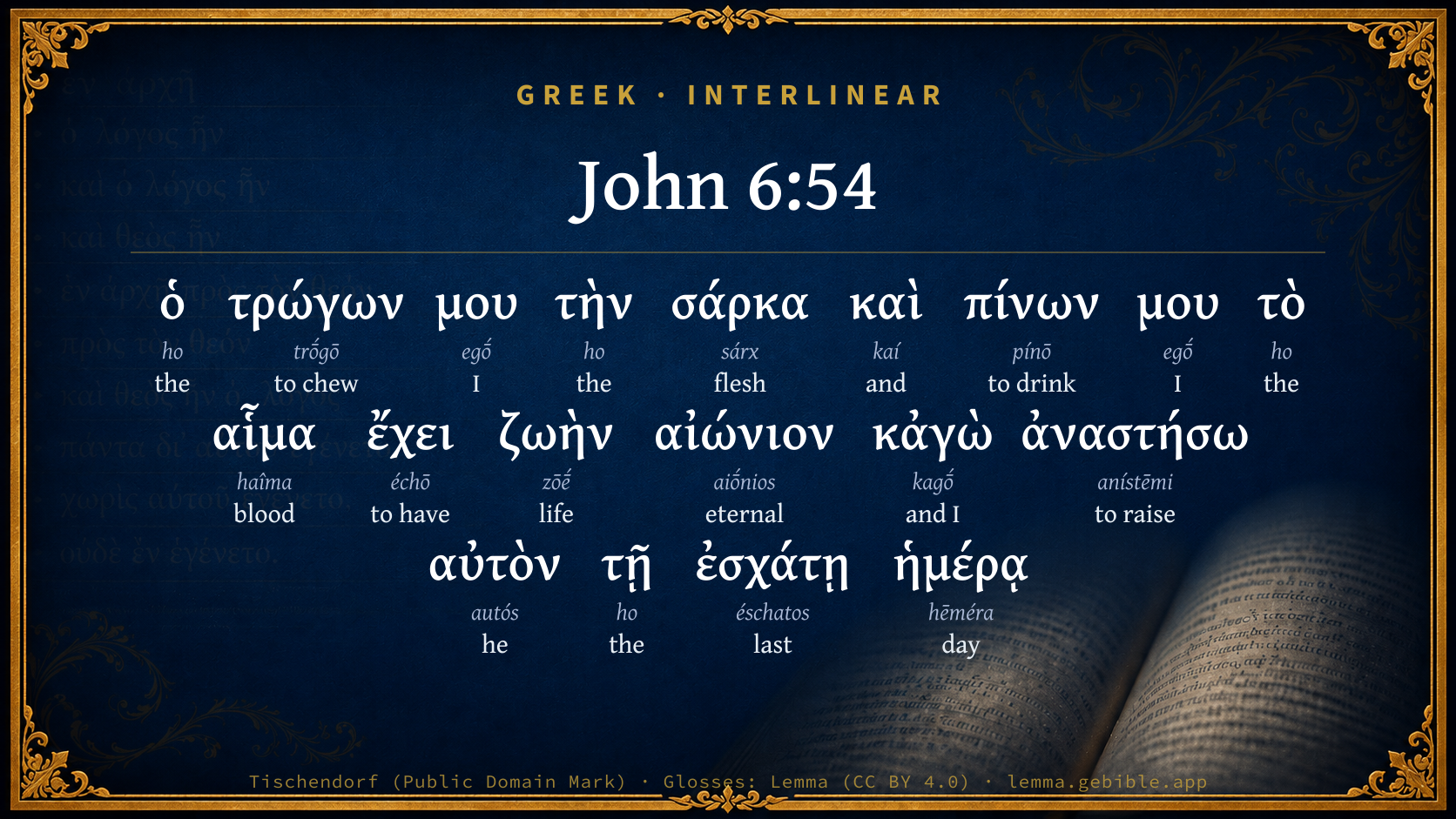
  1. ὁ ho G3588 “the” Article, Nominative, Singular, Masculine
  2. μου egṓ G1473 “I” Personal pronoun, 1st person, Genitive, Singular
  3. τὴν ho G3588 “the” Article, Accusative, Singular, Feminine
  4. σάρκα sárx G4561 “flesh” Noun, Accusative, Singular, Feminine
  5. καὶ kaí G2532 “and” Conjunction
  6. πίνων pínō G4095 “to drink” Verb, Present, Active, Participle, Nominative, Singular, Masculine
  7. μου egṓ G1473 “I” Personal pronoun, 1st person, Genitive, Singular
  8. τὸ ho G3588 “the” Article, Accusative, Singular, Neuter
  9. αἷμα haîma G129 “blood” Noun, Accusative, Singular, Neuter
  10. ἔχει échō G2192 “to have” Verb, Present, Active, Indicative, 3rd person, Singular
  11. ζωὴν zōḗ G2222 “life” Noun, Accusative, Singular, Feminine
  12. αἰώνιον aiṓnios G166 “eternal” Adjective, Accusative, Singular, Feminine
  13. κἀγὼ kagṓ G2504 “and I” Personal pronoun, 1st person, Nominative, Singular, Aramaic form
  14. ἀναστήσω anístēmi G450 “to raise” Verb, Future, Active, Indicative, 1st person, Singular
  15. αὐτὸν autós G846 “he” Personal pronoun, Accusative, Singular, Masculine
  16. τῇ ho G3588 “the” Article, Dative, Singular, Feminine
  17. ἐσχάτῃ éschatos G2078 “last” Adjective, Dative, Singular, Feminine, Superlative
  18. ἡμέρᾳ hēméra G2250 “day” Noun, Dative, Singular, Feminine

About this verse

These counts appear in no published source. They are computed here, from the morphology-tagged text and Lemma’s own curated glosses. What Lemma adds →

19
words
15
distinct lemmas
Gospels
section

Notable vocabulary

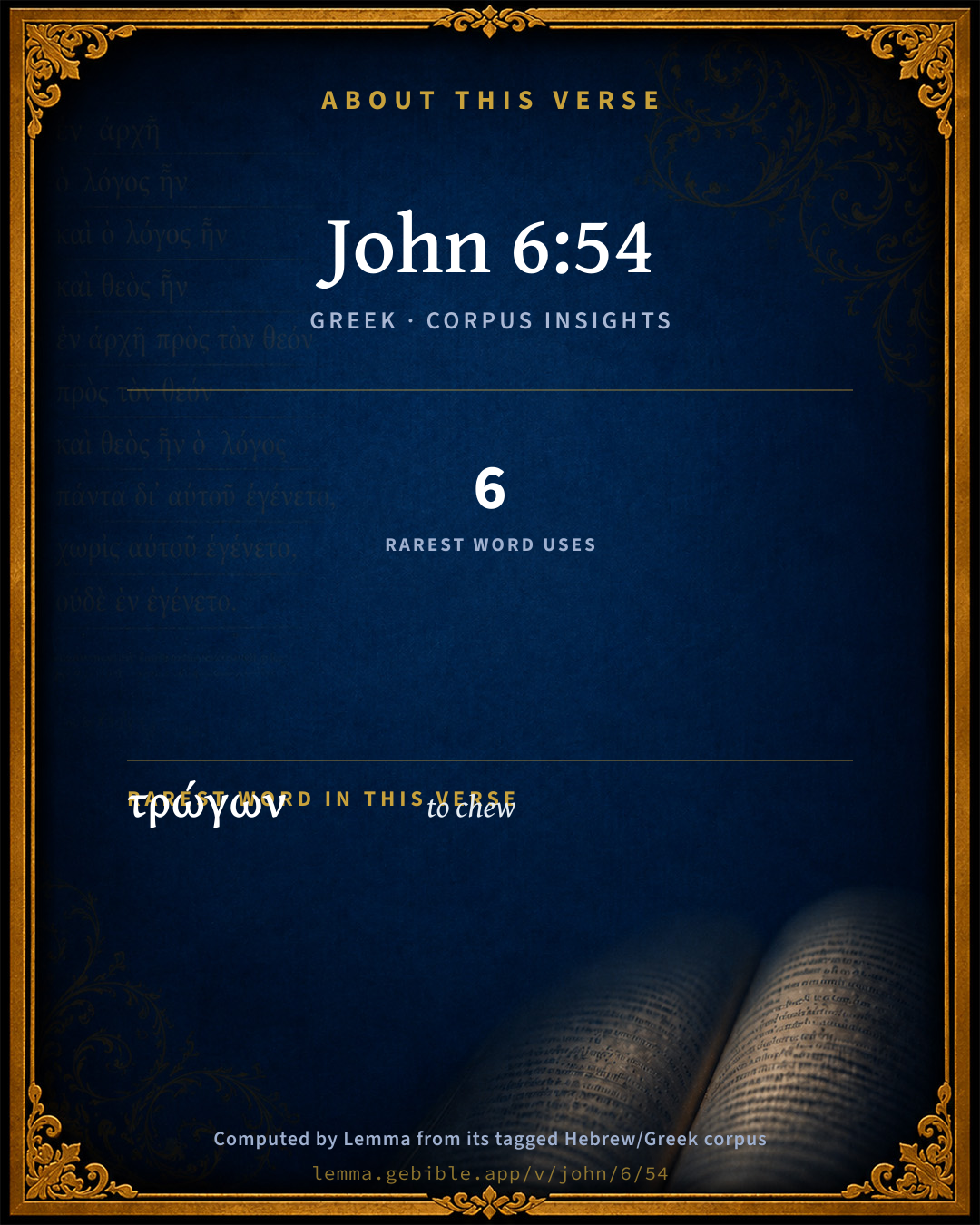
The rarest word here is τρώγων to chew G5176 — appearing just 6 times in the whole Greek New Testament.

Shared distinctive vocabulary

τρώγων to chew G5176 occurs in 6 verses of the Greek New Testament. Also found in:

Repetition

Words recur within this verse:

Cross-references

11

Topical passages linked to John 6:54 in the Treasury of Scripture Knowledge — connected by theme and wording, ordered by reader-vote popularity; previews shown in the World English Bible.

  • John 6:39–40 This is the will of my Father who sent me, that of all he has given to me I should lose nothing, but should raise him up at the last day.
  • Philippians 3:7–10 However, what things were gain to me, these have I counted loss for Christ.
  • John 6:27 Don't work for the food which perishes, but for the food which remains to eternal life, which the Son of Man will give to you. For God the Father has sealed him."
  • Galatians 2:20 I have been crucified with Christ, and it is no longer I that live, but Christ living in me. That life which I now live in the flesh, I live by faith in the Son of God, who loved me, and gave himself up for me.
  • Proverbs 9:4–6 "Whoever is simple, let him turn in here!" As for him who is void of understanding, she says to him,
  • Psalms 22:26 The humble shall eat and be satisfied. They shall praise Yahweh who seek after him. Let your hearts live forever.
  • Isaiah 55:1–3 Ho, everyone who thirsts, come you to the waters, and he who has no money; come you, buy, and eat; yes, come, buy wine and milk without money and without price.
  • John 4:14 but whoever drinks of the water that I will give him will never thirst again; but the water that I will give him will become in him a well of water springing up to eternal life."
  • John 6:47 Most assuredly, I tell you, he who believes in me has eternal life.
  • John 6:63 It is the spirit who gives life. The flesh profits nothing. The words that I speak to you are spirit, and are life.
  • Isaiah 25:6–8 In this mountain will Yahweh of Hosts make to all peoples a feast of fat things, a feast of wines on the lees, of fat things full of marrow, of wines on the lees well refined.

Cross-references courtesy of OpenBible.info (CC BY 4.0).

Commentary

Notes on John 6:54 from classic Christian and Jewish commentators (each source and its license shown beneath its notes). The classic Christian expositions comment on the surrounding passage and are grouped to its opening verse, so a note may address several verses; the Jewish commentaries on the Tanakh (Rashi and others) are per-verse, so they appear only where the commentator wrote on this verse.

Lemma curates 59 commentaries, every one of them public domain or Creative Commons licensed, each selected and text-cleaned for this edition rather than reprinted as found. About our sources →

Joseph Benson's Commentary

Joh 6:54-58. Whoso eateth my flesh, &c., hath eternal life — Has the principles of eternal life implanted in him, and shall enjoy it; for I will raise him up, &c. For my flesh is meat indeed, &c. — My flesh and blood are the true nutriment of the soul: they feed it and make it grow: they give vigour to all the faculties, preserve it in spiritual life, and make it fit for heaven. He that eateth my flesh, &c., dwelleth in me, and I in him — By an intimate and inseparable union. As the living Father — The great source of life and felicity; has sent me, and I live by the Father — Being one with him: or, as to my human nature, live by his support, protection, and care; he continually dwelling in me, and communicating his Spirit to me in the richest abundance of gifts and graces; so he that eateth me — That confides in, and cleaves to me, by a lively operative faith; shall live by me — A spiritual, holy, and happy life, through the Spirit which I will communicate to him: he shall be united to me by an internal and vital union. This is the bread — This, of which I speak, or, I am the bread; which came down from heaven — For the purposes aforesaid. Not as your fathers did eat manna, &c. — This bread is not like the manna which your fathers ate, who died notwithstanding; and it is not to be eaten the same way that your fathers did eat the manna, nor with the same effect; for he that eateth of this bread shall live for ever — He shall be so far from dying, as your fathers did in the wilderness, that his life and happiness shall have no end, but shall run parallel with the longest line of eternity itself.

Joseph Benson's Commentary on the Old and New Testaments (1811–1818) — public domain. Text from a community e-Sword module.

Meyer's Critical & Exegetical Commentary

Heinrich August Wilhelm Meyer

Joh_6:54-55. He now more fully explains Himself, onwards to Joh_6:58, with regard to the saving efficacy of this spiritual eating and drinking: He who eateth my flesh, etc.

ὁ τρώγων] Previously the word was φάγητε, but there is in the change no special intention as if to use a stronger term (to chew, to crunch), as the repetition of πίνων shows. Comp. Dem. 402. 21 : τρώγειν καὶ πίνειν. Plut. Mor. p. 613 B; Polyb. xxxii. 9. 9. Comp. also Joh_13:18; Mat_24:38.

ζωὴν αἰών.] Fuller definition of the general ζωή which precedes; it signifies the eternal Messianic life, but the development of this in time as spiritual life is included in the thought; therefore ἔχει (Joh_3:15), and the result of the possession of this life: ἀναστήσω, κ.τ.λ. Comp. Joh_6:40.

Joh_6:55. Proof of the assertion ἔχει … ἡμέρᾳ; for if the flesh of Jesus were not true food (something which in very deed has nourishing power), etc., the effect named in Joh_6:54 could not ensue. It is self-evident that food for the inner man is meant; but ἀληθής (see the critical notes) is not the same as ἀληθινή (this would mean genuine food, food that realizes its own ideal). It denotes the opposite of that which is merely apparent or so called, and therefore expresses the actual fact (1Jn_2:27; Act_12:9), which the Jews could not understand, since they asked πῶς δύναται, κ.τ.λ., Joh_6:52.

Meyer — Critical and Exegetical Commentary on the New Testament — English translation by Peter Christie, edited by Frederick Crombie (T&T Clark, 1880) — public domain. Text from a community e-Sword module.

Cambridge Greek Testament for Schools and Colleges

54. The gracious positive of the previous minatory negative. From warning as to the ruinous consequences of not partaking He goes on to declare the blessed consequences of partaking, viz. eternal life, and that at once, with resurrection among the just hereafter.

ὁ τρώγων. Present; it is a continuous action, not one that may be done once for all (Joh 6:45). Φαγεῖν has no present, so that the same word could not be used; but the change to τρῶγειν rather than to ἐσθίειν is not meaningless: τρώγειν is ‘to eat with enjoyment’ (Mat 24:38); see on Joh 13:18. Excepting these two texts the word occurs here only (Joh 6:54-58) in N.T.

Cambridge Greek Testament for Schools and Colleges (Cambridge University Press, 1896; 21 vols, various authors incl. Carr, Maclear, Plummer, Farrar, Lumby, Moule, M. R. James, Simcox) — public domain. Text from a community e-Sword module.

Jamieson, Fausset & Brown

Robert Jamieson, A. R. Fausset & David Brown

Whoso eateth . . . hath, &c.--The former verse said that unless they partook of Him they had no life; this adds, that whoever does so "hath eternal life."

and I will raise him up at the last day--For the fourth time this is repeated (see Joh 6:39-40, Joh 6:44) --showing most clearly that the "eternal life" which such a man "hath" cannot be the same with the future resurrection life from which it is carefully distinguished each time, but a life communicated here below immediately on believing (Joh 3:36; Joh 5:24-25); and giving to the resurrection of the body as that which consummates the redemption of the entire man, a prominence which in the current theology, it is to be feared, it has seldom had. (See Rom 8:23; 1Co. 15:1-58, throughout).

Jamieson, Fausset & Brown — Commentary Critical and Explanatory on the Whole Bible (1871) — public domain (CC PDM 1.0). Text via the HelloAO Bible API.

Adam Clarke's Commentary

Verse 54. Hath eternal life] This can never be understood of the sacrament of the Lord's supper.

1. Because this was not instituted till a year after; at the last Passover.

2. It cannot be said that those who do not receive that sacrament must perish everlastingly.

3. Nor can it be supposed that all those who do receive it are necessarily and eternally saved.

On the contrary, St. Paul intimates that many who received it at Corinth perished, because they received it unworthily, not discerning the Lord's body: not distinguishing between it and a common meal; and not properly considering that sacrifice for sin, of which the sacrament of the Lord's super was a type: see 1Co 11:30.

Adam Clarke's Commentary on the Bible (1810–1826) — public domain. Text from a community e-Sword/MySword module.

John Calvin's Commentaries

54. He who eateth my flesh. This is a repetition, but is not superfluous; for it confirms what was difficult to be believed, That souls feed on his flesh and blood, in precisely the same manner that the body is sustained by eating and drinking Accordingly, as he lately testified that nothing but death remains for all who seek life anywhere else than in his flesh, so now he excites all believers to cherish good hope, while he promises to them life in the same flesh.

And I will raise him up at the last day. It ought to be observed, that Christ so frequently connects the resurrection with eternal life, because our salvation will be hidden till that day. No man, therefore, can perceive what Christ bestows on us, unless, rising above the world, he places before his eyes the last resurrection From these words, it plainly appears that the whole of this passage is improperly explained, as applied to the Lord’s Supper. For if it were true that all who present themselves at the holy table of the Lord are made partakers of his flesh and blood, all will, in like manner, obtain life; but we know that there are many who partake of it to their condemnation. And indeed it would have been foolish and unreasonable to discourse about the Lord’s Supper, before he had instituted it. It is certain, then, that he now speaks of the perpetual and ordinary manner of eating the flesh of Christ, which is done by faith only. And yet, at the same time, I acknowledge that there is nothing said here that is not figuratively represented, and actually bestowed on believers, in the Lord’s Supper; and Christ even intended that the holy Supper should be, as it were, a seal and confirmation of this sermon. This is also the reason why the Evangelist John makes no mention of the Lord’s Supper; and therefore Augustine follows the natural order, when, in explaining this chapter, he does not touch on the Lord’s Supper till he comes to the conclusion; and then he shows that this mystery is symbolically represented, whenever the Churches celebrate the Lord’s Supper, in some places daily, and in other places only on the Lord’s day.

John Calvin's Commentaries (1540-1563) — public domain. Text from the Calvin Translation Society English edition (1840s-50s) via the Christian Classics Ethereal Library (ccel.org). Calvin's coverage is partial (roughly two-thirds of the Bible); uncommented books and verses are honest gaps, never fabricated. The 19th-century editor's footnotes and remarks are omitted so the notes are faithfully Calvin's own voice.

Ellicott's Commentary for English Readers

(54) Whoso eateth my flesh, and drinketh my blood.—The thought advances from the negative to the positive. The previous verse stated the condition without which they could not have life. This verse declares that they who thus eat and drink possess that life now, and that it is eternal. (Comp. Note on Joh_6:47.) The thought advances, too, from the “ye” of those immediately addressed to the “whoso,” which has no limit but the fulfilment of the condition. The word for “eateth” is a stronger word than that before used, meaning literally the act of dividing the food by the teeth; but this meaning is not to be pressed. It is simply the present tense, which describes the process of eating, and is the same word which is used in Joh_6:56-58, and in Joh_13:18. The sense of the word in the only other place in the New Testament where it occurs (Mat_24:38) confirms this.

And I will raise him up at the last day.—The thought of the eternal life, which is the present possession of the spirit in communion with God, leads on once again to the fuller expansion of that life in the final victory over death. (Comp. Joh_6:40; Joh_6:44.)

A Bible Commentary for English Readers, edited by Charles John Ellicott (1878–1897) — public domain. Text from a community e-Sword module.

The Cambridge Bible for Schools and Colleges

gen. ed. J. J. S. Perowne

54. The gracious positive of the previous minatory negative. From the warning as to the disastrous consequences of not partaking He passes to a declaration of the blessed consequences of partaking, viz. eternal life, and that at once, with resurrection among the just hereafter.

The Cambridge Bible for Schools and Colleges (gen. ed. J. J. S. Perowne; Cambridge University Press, 1878–1918) — public domain. Text from a community e-Sword module.

John Gill's Exposition

He that eateth my flesh, and drinketh my blood,.... In the sense above given; See Gill on Joh 6:53;

dwelleth in me, and I in him. There is a mutual indwelling of Christ, and believers; Christ is the habitation, or dwelling place of his people: there is a secret dwelling in Christ; so the elect of God dwelt in the heart, and in the hands, and arms of Christ from everlasting; and as members in their head in election grace; and representatively in him, as the Mediator of the covenant; and they secretly and safely dwelt in him, when all mankind fell in Adam; and when he was on the cross, in the grave, and now he is in heaven; all which is owing to his own love, his Father's gift, and to secret union to him. But there is an open dwelling in him in time, which is here meant: God's elect, as in their natural state, are without Christ, and lie open to the law and justice of God; the Spirit of God convinces them of this state, and directs them to flee to Christ, as a city of refuge; when they find him a stronghold, a place of defence, and a proper dwelling for them, where they resolve to abide, and do abide; and where they dwell safely, peaceably, comfortably, and pleasantly; and from which dwelling place they will never be turned out. Likewise, the saints are the habitation or dwelling place of Christ; he dwells not in their heads and to tongues, but in their hearts, and by faith; which is here expressed, by eating his flesh, and drinking his blood; and which, though it is not the cause of Christ's dwelling here, yet is the means or instrument by which men receive him into their hearts, and retain him, and have communion with him; for he dwells in believers, not in such sense as he dwells in the world, by his omnipresence, and power; or in the human nature, by hypostatical union to it; but by his Spirit, and by faith, which is an instance of wonderful condescending grace, and is owing to union to him, and is expressive of communion with him, and is what will continue for ever.

John Gill's Exposition of the Whole Bible (1746–1763) — public domain (CC PDM 1.0). Text via the HelloAO Bible API.

Trapp's Complete Commentary

John Trapp

54 Whoso eateth my flesh, and drinketh my blood, hath eternal life; and I will raise him up at the last day.

Ver. 54. Whoso eateth my flesh] Because this was a hard point to believe, therefore it is so often repeated and inculcated. Verba toties inculcata viva sunt, vera sunt, sana sunt, plana sunt.

John Trapp, A Commentary or Exposition upon All the Books of the Old and New Testament (1647–1656) — public domain. Text from a community e-Sword module.

Haydock's Catholic Bible Commentary

Unless you eat ... and drink, &c. To receive both the body and blood of Christ, is a divine precept, insinuated in this text; which the faithful fulfil, though they receive but in one kind; because in one kind they receive both the body and blood, which cannot be separated from each other. Hence life eternal is here promised to the worthy receiving, though but in one kind: (ver. 52.) If any man eat of this bread he shall life for ever: and the bread which I will give, is my flesh for the life of the world: (ver. 58.) He that eateth me, the same also shall live by me: (ver. 59.) He that eateth this bread shall live for ever. (Challoner)

George Leo Haydock (1774–1849), Haydock's Catholic Family Bible and Commentary, 1859 edition — public domain. Excludes Psalms (Douay-Rheims chapter numbering differs from Protestant) and Deuterocanonical books (Catholic canon only).

Matthew Poole's English Annotations

Hath eternal life; he hath it in a sure and just right title, and he shall have it in a certain actual possession: and in order to it, he shall have a joyful resurrection unto it at the last day. This is no more than what our Saviour had often said, particularly Joh 3:18,36, admitting what was before said, that by eating the flesh and drinking the blood of Christ, is to be meant believing in him; only here is a clearer discovery than was there, of the true object of that faith which justifieth, viz. a Christ crucified, for that is signified by the flesh and blood mentioned.

Matthew Poole's English Annotations on the Holy Bible (1683–1685) — public domain. Text from a community e-Sword/MySword module.

Whedon's Commentary on the Bible

Daniel D. Whedon

54. Eateth my flesh… drinketh my blood—The truth which underlies these words lies as the basis of the bread and wine of the Lord’s Supper. Here is the thought clothed in symbolical words; there it is clothed in symbolical objects and actions. Christ, in order to live and die, must possess flesh and blood. His death must be by the breaking of his flesh; and its manifestation is by the shedding of blood, for the blood is the life. By faith in the merit of that death so presented, we appropriate its efficacy to the present salvation of our souls and the ultimate glorification of soul and body. Figure this in powerful emblematic words, and we have it that, by eating that flesh and drinking that blood, we eat and drink eternal life to our soul and body. The emblem of words prepares us for the emblem of action. We take for the flesh the fleshless bread, and for the blood the bloodless wine; and by eating one and drinking the other we set forth the truth, that by the propitiatory death of our blessed Lord Christ we have eternal life to our soul and body. There is, then, no support in this passage for the dismaying doctrine invented by the Romish Church that men actually devour the flesh of Christ’s real body.

Raise him up… last day—The glorification of the body is the last grand result to the believer of Christ’s atonement. The work begins in regeneration; it is continued in the bliss of the disembodied spirit in paradise; it terminates in the resurrection glory of the last day.

Daniel D. Whedon (gen. ed.), Commentary on the Old and New Testaments (1874–1909) — public domain. Text from a community e-Sword module.

unfoldingWord translationNotes

Door43 World Missions Community

Connecting Statement:

Jesus continues speaking to all those listening to him.

Whoever eats my flesh and drinks my blood has everlasting life

The phrases "eats my flesh" and "drinks my blood" are metaphors. Just as one requires food and drink in order to have physical life, those who trust in Jesus will have spiritual life. AT: "whoever trusts me for their spiritual food and drink will have eternal life" (See: Metaphor)

raise him up

Here to raise up is an idiom for causing someone who has died to become alive again. AT: "cause him to live again" (See: Idiom)

at the last day

"on the day when God judges everyone"

my flesh is true food ... my blood is true drink

The words "true food" and "true drink" are metaphors that mean Jesus provides spiritual food and drink to those who trust in him. Receiving Jesus in faith provides everlasting life the same way food and drink nourish the physical body. AT: "I am truly spiritual food and drink" (See: Metaphor)

remains in me, and I in him

"has a close relationship with me"

translationWords

flesh

blood

raise

last day

unfoldingWord translationNotes — © Distant Shores Media and the Door43 World Missions Community, licensed CC BY-SA 4.0. Source: git.door43.org/Door43/en_tn.

International Critical Commentary

54. ὁ τρώγων μου τὴν σάρκα καὶ πίνων μου τὸ αἷμα (the whole phrase is repeated verbatim in v. 56) seems to mean, “he who continually feeds with enjoyment upon my Flesh and continually drinks my Blood,” or “he who is in the habit of feeding, etc.,” for the present participles must be given their force. See above on v. 29.

ἔχει ζωὴν αἰώνιον (sc. in the present), κἀγὼ ἀναστήσω αὐτὸν τῇ ἐσχάτῃ ἡμέρα, which is the promise of life in the future. The twofold assurance is repeated from v. 40, the difference being that while there it is for him who has spiritual vision of Christ and believes in Him, here it is given to the man who “eats His Flesh and drinks His Blood.” See above on v. 53.

For the refrain κἀγὼ ἀναστήσω αὐτὸν τῇ ἐσχάτῃ ἡμέρᾳ, see on v. 39, and cf. Introd., p. clxvii.

The rec. text inserts ἐν before ἐσχάτῃ, but om. אBDΘ. See on v. 39.

International Critical Commentary — older volumes (1896–1929), various authors — public domain. Text from a community e-Sword module.

Vincent's Word Studies in the New Testament

Marvin R. Vincent

Eateth [τρωγων] . Another verb for eating is used. With the exception of Mt 24:38, it is found only in John, and always in connection with Christ. No special significance can be fairly attached to its use here. It seems to be taken as a current word, and efagon is resumed in ver. 58.

Marvin R. Vincent, Word Studies in the New Testament (1887–1900) — public domain. Text from a community e-Sword/MySword module.

Godet's Commentaries

Frédéric Louis Godet

Ver. 54. After having given this explanation in a negative form (without this eating and this drinking, impossibility of living), Jesus completes the expression of His thought by adding: By this eating and this drinking, assured possession of life. Then He raises the eye of the believer even to the glorious limit of this impartation of life—the resurrection of the body. The relation between these last words: “And I will raise him up ...,” and the preceding ones is so close that it is difficult to avoid seeing an organic connection between the possession of the spiritual life and the final resurrection; comp. Rom 8:10-11. However this may be, the bodily resurrection is by no means a useless superfetation relatively to the spiritual life, according to the thought which Reuss ascribes to John. Here is the fourth time that Jesus promises it in this discourse as the consummation of the salvation which He brings to mankind; comp. Joh 6:39-40; Joh 6:44. Nature restored and glorified is the end of the victory gained by the divine grace over sin.

The Joh 6:55 justifies the preceding negation and affirmation. If to eat this flesh and to drink this blood are the condition of life, it is because this flesh and this blood are, in all reality, food and drink. A part of the critical authorities present the reading ἀληθῶς, “is truly;” the rest read ἀληθής : is true food... true drink. The former reading is more in conformity with the style of John. As Lucke observes, John ordinarily makes ἀληθής refer to moral veracity, in contrast to ψεῦδος (falsehood), but he also connects the adverb ἀληθῶς with a substantive (Joh 1:48 : ἀληθῶς᾿Ισραηλίτης; perhaps Joh 8:31 : ἀληθῶς μαθηταί). Moreover, the sense of the two readings is not sensibly different. The adverb or the adjective expresses the full reality of the vital communication effected by these elements, which are truly for the soul what food is for the body. Joh 6:56-57 explain how this communication of life is effected. By this food of the soul Christ dwells in us and we in Him (Joh 6:56), and this is to live (Joh 6:57).

Frédéric Louis Godet — Commentaries on Luke, John, Romans, and 1 Corinthians — English translation (T&T Clark, Edinburgh, 1870s–1890s) — public domain. Text from a community e-Sword module.

Lesson kit

Teaching starters — assembled from the data on this page, not authored interpretation. Every prompt links to the verse data it draws on. Edit before teaching.

John, in the Gospels, opens this verse with 19 words (15 distinct Greek lemmas). Its most distinctive word is trṓgō (“to chew”). A historical commentator’s framing appears above. Read the whole chapter for the surrounding context.

Discussion questions

  1. What does “to chew” (trṓgō) contribute to the verse as a whole?
  2. Matthew 24:38 shares the word «to chew» with this verse. How do the two illuminate each other?
  3. “the” occurs 4× in this one verse. What is the effect of the repetition?
  4. The translations on this page render this verse differently — a whole-verse word diff, not a word-by-word alignment. What might account for the different wordings?
  5. Reading how Joseph Benson's Commentary and Meyer's Critical & Exegetical Commentary read this verse, where do the two commentators agree and where do they part?

Things to notice

Reading settings

Reading text

Shown beneath each verse's original-language words.

Old Testament
Old Testament edition

Read the OT as the Masoretic Hebrew (MT) or the Greek Septuagint (LXX).

English shown for the Greek Septuagint (in the Hebrew ↔ Greek comparison).

Comparing translations? Open the Compare panel on any verse page to stack up to four side by side.