
Genesis 1:21

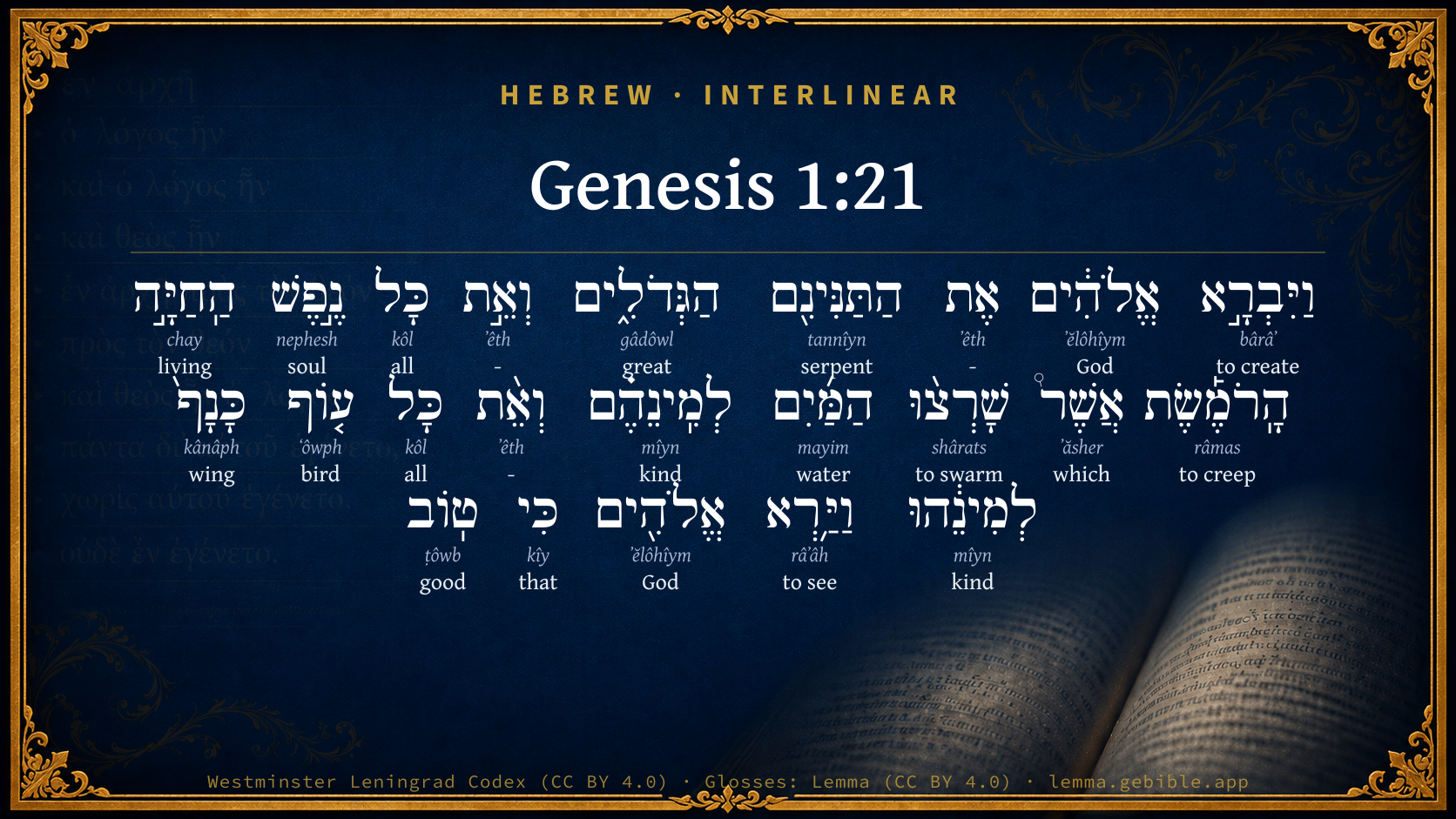
Hebrew (Westminster Leningrad Codex) Genesis 1:21 appears in the Hebrew Old Testament. The text above is from the Westminster Leningrad Codex. Each word links to its Strong’s number, a concise gloss, and parsing drawn from the Open Scriptures Hebrew Bible morphology. Click any word for its full Brown-Driver-Briggs (BDB) entry.
Download image
Cite this verse

Genesis 1:21 (World English Bible). Public Domain. Lemma interlinear Bible study tool, https://lemma.gebible.app/v/genesis/1/21.

Show BibTeX & RIS
BibTeX
RIS
English Translation
God created the large sea creatures, and every living creature that moves, with which the waters swarmed, after their kind, and every winged bird after its kind. God saw that it was good.
World English Bible · Public Domain
Highlights
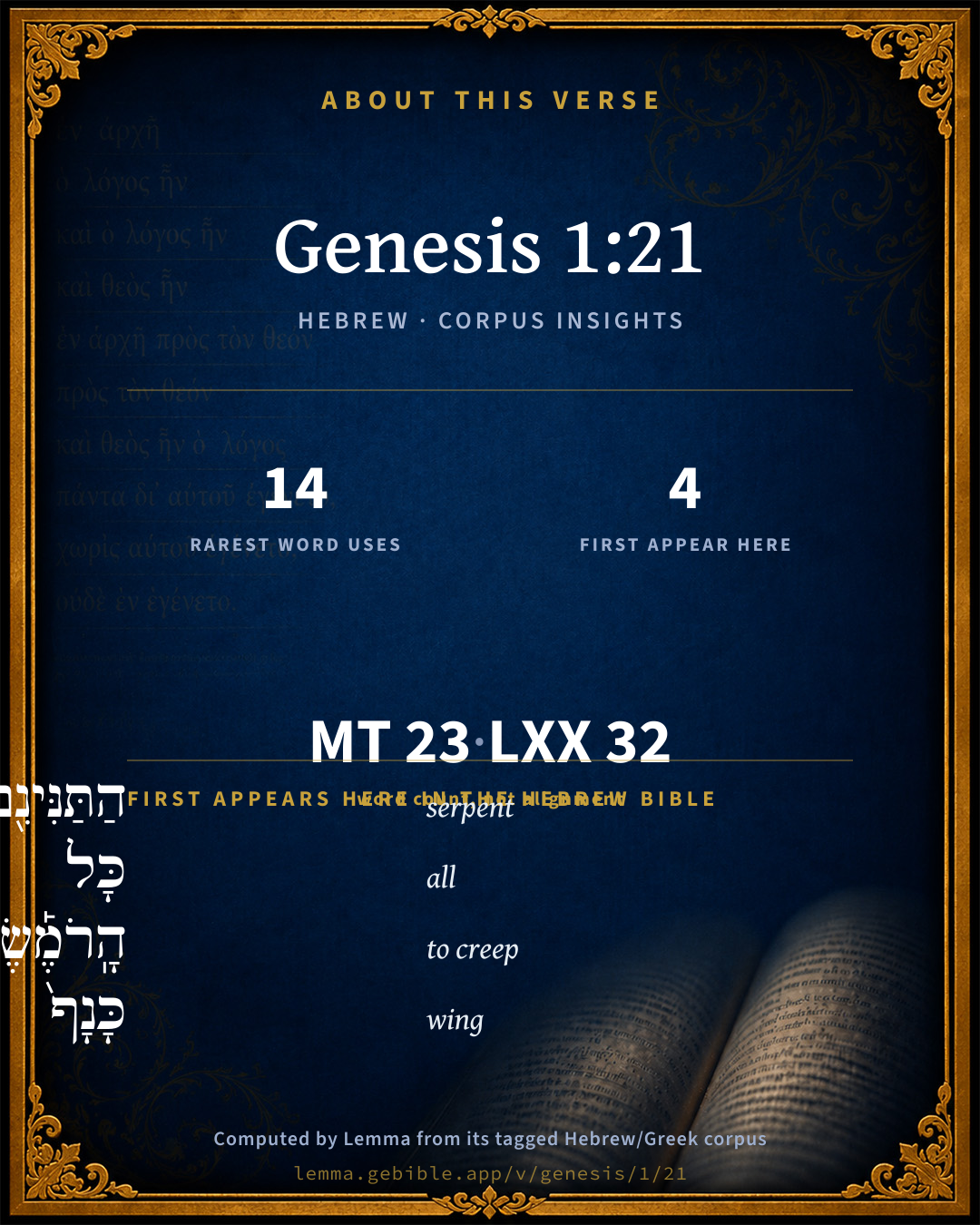
  • 4 first appearances in the Hebrew Bible
Full analysis ↓
Download a study sheet

One document with this verse’s original text, its word-by-word gloss line, the meaning frame, cross-references with their text, attributed commentary, and full source and license credits — printable, and it pastes into notes with its structure intact.

This verse Autodidact and up

Study sheet (.html) Plain text (.txt)

A passage Seminary Student

Up to 50 verses in one chapter. A passage sheet keeps up to 6 commentary sources and 12 cross-references per verse, in the order this page ranks them, and says so on the sheet whenever that leaves anything out. Ask for a single verse and you get the Autodidact verse sheet above.

Everything on this page stays free to read, with no account — the sheet is a download of what is already on screen, not access to it.

Want to remove ads? Support Godless Engineer
Compare translations 3

The same verse in 3 English versions, stacked beneath the original-language interlinear above. Click any original word for its lexicon entry.

Each is an independent rendering of the whole verse — the interlinear is not word-aligned to these translations.

Highlighted words mark where these versions differ — a whole-verse word diff, not a word-by-word alignment.

  • World English Bible Public Domain
    God created the large sea creatures, and every living creature that moves, with which the waters swarmed, after their kind, and every winged bird after its kind. God saw that it was good.
  • King James Version Public Domain
    And God created great whales, and every living creature that moveth, which the waters brought forth abundantly, after their kind, and every winged fowl after his kind: and God saw that it was good.
  • unfoldingWord Literal Text CC BY-SA 4.0
    So God created the great sea creatures and every living creature that moves which the waters swarm with according to their kind, and every winged bird according to its kind. And God saw that good.

unfoldingWord Literal Text — © unfoldingWord, licensed CC BY-SA 4.0. Word-aligned USFM3 via Door43 (git.door43.org/unfoldingWord/en_ult).

Versions to compare (up to 4)

3 of 4 selected

Show all 18 translations

Every available English version of this verse, each an independent rendering of the whole verse.

  • World English Bible Public Domain
    God created the large sea creatures, and every living creature that moves, with which the waters swarmed, after their kind, and every winged bird after its kind. God saw that it was good.
  • Berean Standard Bible Public Domain
    So God created the great sea creatures and every living thing that moves, with which the waters teemed according to their kinds, and every bird of flight after its kind. And God saw that it was good.
  • Majority Standard Bible Public Domain
    So God created the great sea creatures and every living thing that moves, with which the waters teemed according to their kinds, and every winged bird after its kind. And God saw that it was good.
  • King James Version Public Domain
    And God created great whales, and every living creature that moveth, which the waters brought forth abundantly, after their kind, and every winged fowl after his kind: and God saw that it was good.
  • American Standard Version (1901) Public Domain
    And God created the great sea-monsters, and every living creature that moveth, wherewith the waters swarmed, after their kind, and every winged bird after its kind: and God saw that it was good.
  • Revised Version (1885) Public Domain
    And God created the great sea-monsters, and every living creature that moveth, which the waters brought forth abundantly, after their kinds, and every winged fowl after its kind: and God saw that it was good.
  • Geneva Bible (1599) Public Domain
    Then God created the great whales, and euery thing liuing and mouing, which the waters brought foorth in abundance according to their kinde, and euery fethered foule according to his kinde: and God sawe that it was good.
  • Douay-Rheims (1899) Public Domain
    And God created the great whales, and every living and moving creature, which the waters brought forth, according to their kinds, and every winged fowl according to its kind. And God saw that it was good.
  • Young's Literal Translation Public Domain
    And God prepareth the great monsters, and every living creature that is creeping, which the waters have teemed with, after their kind, and every fowl with wing, after its kind, and God seeth that `it is' good.
  • Literal Standard Version CC BY-SA 4.0
    And God creates the great dragons, and every living creature that is creeping, which the waters have teemed with, after their kind, and every bird with wing, after its kind, and God sees that [it is] good.
  • Unlocked Literal Bible CC BY-SA 4.0
    God created the great sea creatures, as well as every living creature after its kind, creatures that move and which fill the waters everywhere, and every winged bird after its kind. God saw that it was good.
  • unfoldingWord Literal Text CC BY-SA 4.0
    So God created the great sea creatures and every living creature that moves which the waters swarm with according to their kind, and every winged bird according to its kind. And God saw that good.
  • Darby Bible Public Domain
    And God created the great sea monsters, and every living soul that moves with which the waters swarm, after their kind, and every winged fowl after its kind. And God saw that it was good.
  • World Messianic Bible Public Domain
    God created the large sea creatures and every living creature that moves, with which the waters swarmed, after their kind, and every winged bird after its kind. God saw that it was good.
  • Webster's Bible Public Domain
    And God created great whales, and every living creature that moveth, which the waters brought forth abundantly after their kind, and every winged fowl after his kind: and God saw that it was good.
  • Free Bible Version CC BY-SA 4.0
    So God created huge sea creatures and all the living things that swim and fill the waters, each one according to its own kind; and every bird that flies, each one according to its own kind. God saw that it was good.
  • Bible in Basic English Public Domain
    And God made great sea-beasts, and every sort of living and moving thing with which the waters were full, and every sort of winged bird: and God saw that it was good.
  • JPS Tanakh (1917) Public Domain
    And God created the great sea-monsters, and every living creature that creepeth, wherewith the waters swarmed, after its kind, and every winged fowl after its kind; and God saw that it was good.

Literal Standard Version (2020), Covenant Press — licensed CC BY-SA 4.0. Text via the HelloAO Bible API (eBible.org). Unlocked Literal Bible (unfoldingWord) — licensed CC BY-SA 4.0. Text via the HelloAO Bible API (eBible.org). unfoldingWord Literal Text — © unfoldingWord, licensed CC BY-SA 4.0. Word-aligned USFM3 via Door43 (git.door43.org/unfoldingWord/en_ult). Free Bible Version, Dr. Jonathan Gallagher — licensed CC BY-SA 4.0. Text via the HelloAO Bible API (eBible.org).

Word by word

More ways to search: Search by grammar → Find every occurrence → Compare this word →

Practice this passage: Drill this verse → Learn its vocabulary →

שָׁרְצ֨וּ
shârats
H8317
“to swarm”
Verb, Qal, Perfect, 3rd Person, Common, Plural
Part of Speech
Verb
Stem
Qal
Form
Perfect
Person
3rd Person
Gender
Common
Number
Plural
Full BDB Definition

Origin: a primitive root

TWOT: 2467

(Qal) to teem, swarm, multiply - to swarm, teem - to swarm
  1. וַיִּבְרָ֣א bârâʼ H1254 “and · to create” Conjunction + Verb, Qal, Sequential Imperfect, 3rd Person, Masculine, Singular
  2. אֱלֹהִ֔ים ʼĕlôhîym H430 “God(s)” Noun, Common, Masculine, Plural, Absolute
  3. אֶת ʼêth H853 “-” Particle, Direct Object
  4. הַתַּנִּינִ֖ם tannîyn H8577 “the · serpents” Particle, Definite Article + Noun, Common, Masculine, Plural, Absolute
  5. הַגְּדֹלִ֑ים gâdôwl H1419 “the · great” Particle, Definite Article + Adjective, Adjective, Masculine, Plural, Absolute
  6. וְאֵ֣ת ʼêth H853 “and · -” Conjunction + Particle, Direct Object
  7. כָּל kôl H3605 “all of” Noun, Common, Masculine, Singular, Construct
  8. נֶ֣פֶשׁ nephesh H5315 “soul” Noun, Common, Both, Singular, Absolute
  9. הַֽחַיָּ֣ה chay H2416 “the · living” Particle, Definite Article + Adjective, Adjective, Feminine, Singular, Absolute
  10. הָֽרֹמֶ֡שֶׂת râmas H7430 “the · creeping” Particle, Definite Article + Verb, Qal, Participle Active, Feminine, Singular, Absolute
  11. אֲשֶׁר֩ ʼăsher H834 “which” Particle, Relative
  12. הַמַּ֜יִם mayim H4325 “the · water(s)” Particle, Definite Article + Noun, Common, Masculine, Plural, Absolute
  13. לְמִֽינֵהֶ֗ם mîyn H4327 “to/for · kind · their” Preposition + Noun, Common, Masculine, Singular, Construct + Suffix, Personal, 3rd Person, Masculine, Plural
  14. וְאֵ֨ת ʼêth H853 “and · -” Conjunction + Particle, Direct Object
  15. כָּל kôl H3605 “all of” Noun, Common, Masculine, Singular, Construct
  16. ע֤וֹף ʻôwph H5775 “bird” Noun, Common, Masculine, Singular, Absolute
  17. כָּנָף֙ kânâph H3671 “wing” Noun, Common, Feminine, Singular, Absolute
  18. לְמִינֵ֔הוּ mîyn H4327 “to/for · kind · his” Preposition + Noun, Common, Masculine, Singular, Construct + Suffix, Personal, 3rd Person, Masculine, Singular
  19. וַיַּ֥רְא râʼâh H7200 “and · to see” Conjunction + Verb, Qal, Sequential Imperfect, 3rd Person, Masculine, Singular
  20. אֱלֹהִ֖ים ʼĕlôhîym H430 “God(s)” Noun, Common, Masculine, Plural, Absolute
  21. כִּי kîy H3588 “that” Conjunction
  22. טֽוֹב ṭôwb H2896 “good” Adjective, Adjective, Masculine, Singular, Absolute

About this verse

These counts appear in no published source. They are computed here, from the morphology-tagged text and Lemma’s own curated glosses. What Lemma adds →

23
words
18
distinct lemmas
Pentateuch
section

Notable vocabulary

The rarest word here is שָׁרְצ֨וּ to swarm H8317 — appearing just 14 times in the whole Hebrew Bible.

First appearance in Scripture

These words make their first canonical appearance in the Hebrew Bible here:

  • הַתַּנִּינִ֖ם serpent H8577
  • כָּל all H3605
  • הָֽרֹמֶ֡שֶׂת to creep H7430
  • כָּנָף֙ wing H3671

Shared distinctive vocabulary

שָׁרְצ֨וּ to swarm H8317 occurs in 14 verses of the Hebrew Bible. Also found in:

Grammatical profile

  • 4 verbs
  • 11 nouns
  • 3 adjectives
  • 1 conjunction
  • 4 particles

Verb forms

  • וַיִּבְרָ֣א Qal · Sequential Imperfect
  • הָֽרֹמֶ֡שֶׂת Qal · Participle Active
  • שָׁרְצ֨וּ Qal · Perfect
  • וַיַּ֥רְא Qal · Sequential Imperfect

Repetition

Words recur within this verse — often emphatic in Hebrew:

  • אֱלֹהִ֔ים God H430 ×2
  • כָּל all H3605 ×2
  • לְמִֽינֵהֶ֗ם kind H4327 ×2

Hebrew & Septuagint length

In English translation the verse runs 33 words from the Hebrew and 36 from the Septuagint (LXX English) — closely comparable.

A rough comparison of the two English renderings, which tokenize alike — not a word-level alignment.

Word counts can differ between the Hebrew and the Greek without any difference in meaning — e.g. the Hebrew direct-object marker אֵת has no separate Greek word, and Greek often adds the article ὁ.

In the original languages it is 23 Hebrew tokens and 32 Greek tokens — but the two are counted differently (Hebrew bundles its prefixes and suffixes into one token; the Greek is in lemma form), so that isn’t a like-for-like length.

Cross-references

13

Topical passages linked to Genesis 1:21 in the Treasury of Scripture Knowledge — connected by theme and wording, ordered by reader-vote popularity; previews shown in the World English Bible.

  • Psalms 104:24–26 Yahweh, how many are your works! In wisdom have you made them all. The earth is full of your riches.
  • Genesis 1:25 God made the animals of the earth after their kind, and the cattle after their kind, and everything that creeps on the ground after its kind. God saw that it was good.
  • Genesis 8:19 Every animal, every creeping thing, and every bird, whatever moves on the earth, after their families, went forth out of the ark.
  • Genesis 8:17 Bring forth with you every living thing that is with you of all flesh, including birds, cattle, and every creeping thing that creeps on the earth; that they may breed abundantly in the earth, and be fruitful, and multiply on the earth."
  • Genesis 6:20 Of the birds after their kind, of the cattle after their kind, of every creeping thing of the ground after its kind, two of every sort shall come to you, to keep them alive.
  • Genesis 7:14 they, and every animal after its kind, all the cattle after their kind, every creeping thing that creeps on the earth after its kind, and every bird after its kind, every bird of every sort.
  • Genesis 9:7 Be fruitful, and multiply. Bring forth abundantly in the earth, and multiply in it."
  • Exodus 1:7 The children of Israel were fruitful, and increased abundantly, and multiplied, and grew exceedingly mighty; and the land was filled with them.
  • Exodus 8:3 and the river shall swarm with frogs, which shall go up and come into your house, and into your bedchamber, and on your bed, and into the house of your servants, and on your people, and into your ovens, and into your kneading-troughs:
  • Genesis 1:18 and to rule over the day and over the night, and to divide the light from the darkness. God saw that it was good.
  • Genesis 1:31 God saw everything that he had made, and, behold, it was very good. There was evening and there was morning, the sixth day.
  • Job 7:12 Am I a sea, or a sea-monster, That you put a guard over me?
  • Job 26:5 "Those who are deceased tremble, Those beneath the waters and all that live in them.

Cross-references courtesy of OpenBible.info (CC BY 4.0).

Hebrew and Greek witnesses Masoretic Hebrew ↔ Greek Septuagint

The same verse in the two great witnesses to the Old Testament, shown verse-for-verse.

These are two independent witnesses, not word-aligned to each other, and the Septuagint is shown in lemma (dictionary) form.

Hebrew Genesis 1:21 Masoretic · Westminster Leningrad Codex

וַיִּבְרָ֣א אֱלֹהִ֔ים אֶת הַתַּנִּינִ֖ם הַגְּדֹלִ֑ים וְאֵ֣ת כָּל נֶ֣פֶשׁ הַֽחַיָּ֣ה הָֽרֹמֶ֡שֶׂת אֲשֶׁר֩ שָׁרְצ֨וּ הַמַּ֜יִם לְמִֽינֵהֶ֗ם וְאֵ֨ת כָּל ע֤וֹף כָּנָף֙ לְמִינֵ֔הוּ וַיַּ֥רְא אֱלֹהִ֖ים כִּי טֽוֹב

God created the large sea creatures, and every living creature that moves, with which the waters swarmed, after their kind, and every winged bird after its kind. God saw that it was good.

World English Bible · Public Domain

Greek LXX Genesis 1:21 Septuagint · lemma form

καί ποιέω ὁ θεός ὁ κῆτος ὁ μέγας καί πᾶς ψυχή ζῷον ἑρπετόν ὅς ἐκἄγω ὁ ὕδωρ κατά γένος αὐτός καί πᾶς πετεινόν πτερωτός κατά γένος καί ὁράω ὁ θεός ὅτι καλός

And God made great whales, and every living reptile, which the waters brought forth according to their kinds, and every creature that flies with wings according to its kind, and God saw that they were good.

LXX2012 (modern English Septuagint) · Public Domain

On this verse, The Cambridge Bible for Schools and Colleges discusses the Septuagint’s reading. Read the note in Commentary ↓

Hebrew: Westminster Leningrad Codex (CC BY 4.0). Greek: Septuagint (public domain); English from LXX2012 (modern English Septuagint) (Public Domain). How the Septuagint differs from the Hebrew →

Targum (Aramaic paraphrase)

2

The Targum is the ancient Jewish Aramaic paraphrase of the Hebrew Scriptures — an interpretive translation, not the Hebrew text itself. Onkelos (literal) and Pseudo-Jonathan (expansive) render the Torah, and Jonathan the Prophets. Coverage is partial: where no permissively-licensed English translation exists for a verse, only the Aramaic is shown. This is verse-level text, not a word-by-word alignment to the Hebrew.

  1. Targum Onkelos Torah (Genesis–Deuteronomy)
    וּבְרָא יְיָ יָת תַּנִּינַיָּא רַבְרְבַיָּא וְיָת כָּל נַפְשָׁא חַיְתָא דִּרְחִשָׁא דִּי אַרְחִישׁוּ מַיָּא לִזְנֵיהוֹן וְיָת כָּל עוֹפָא דְפָרַח לִזְנוֹהִי וַחֲזָא יְיָ אֲרֵי טָב

    (no public-domain English translation for this verse)

    Targum Onkelos — Aramaic: “Onkelos Genesis” (public domain); “Onkelos Exodus” (public domain); “Onkelos Leviticus” (public domain); “Onkelos Numbers” (public domain); “Onkelos Deuteronomy” (public domain). English: “Sefaria Community Translation” (CC0 1.0 (public-domain dedication)); “J.W. Etheridge. The Targums of Onkelos and Jonathan Ben Uzziel on the Pentateuch. London: Longmans, Green, 1862” (public domain). Text via Sefaria.

  2. Targum Pseudo-Jonathan Torah (Genesis–Deuteronomy)
    וּבְרָא יְיָ יַת תַּנִינַיָא רַבְרְבַיָא יַת לִוְיָתָן וּבַר זוּגֵיהּ דְמִתְעַתְּדִין לְיוֹם נֶחֱמָתָא וְיַת כָּל נַפְשָׁתָא חַיְתָא דְרִיחֲשָׁא דְאַרְחִישׁוּ מַיָא צְלִילְתָּא לִזְנֵיהוֹן זְנֵי דַכְיָין וּזְנֵי דְלָא דַכְיָין וְיַת כָּל עוֹף דְטַיֵיס בְּגַדְפִין לִזְנוֹהִי זְנֵי דַכְיָין וּזְנֵי דְלָא דַכְיָין וַחֲמָא יְיָ אֲרוּם טָב

    And the Lord created the great tanins, the lev-ya-than and his yoke-fellow which are prepared for the day of consolation, and every living animal which creepeth, and which the clear waters had swarmed forth after their kind; the kinds which are clean, and the kinds which are not clean; and every fowl which flieth with wings after their kinds, the clean and the unclean. And the Lord beheld that it was good.

    Targum Pseudo-Jonathan — Aramaic: “Targum Jonathan on Genesis” (public domain); “Targum Jonathan on Exodus” (public domain); “Targum Jonathan on Leviticus” (public domain); “Targum Jonathan on Numbers” (public domain); “Targum Jonathan on Deuteronomy” (public domain). English: “The Targum of Jonathan ben Uzziel, trans. J. W. Etheridge, London, 1862” (public domain). Text via Sefaria.

Commentary

Notes on Genesis 1:21 from classic Christian and Jewish commentators (each source and its license shown beneath its notes). The classic Christian expositions comment on the surrounding passage and are grouped to its opening verse, so a note may address several verses; the Jewish commentaries on the Tanakh (Rashi and others) are per-verse, so they appear only where the commentator wrote on this verse.

Lemma curates 59 commentaries, every one of them public domain or Creative Commons licensed, each selected and text-cleaned for this edition rather than reprinted as found. About our sources →

Trapp's Complete Commentary

John Trapp

Gen 1:21 And God created great whales, and every living creature that moveth, which the waters brought forth abundantly, after their kind, and every winged fowl after his kind: and God saw that [it was] good.

Ver. 21. And God created great whales.] In creating whereof, {creavit Deus vastitates et stupores.} For, as Pliny {a} writes of them, when they swim and show themselves above water, they seem to be so many islands, an nare insulas putes and have been so esteemed by seafaring men, to their great danger and disadvantage. Into the rivers of Arabia, saith Pliny, {b} there have come whales 600 feet long, and 360 feet broad. This is "that leviathan" that plays in the sea, besides other "creeping" or moving "things innumerable". {Psa 104:25} This one word of God’s mouth, Fiat, hath made such infinite numbers of fishes, that their names may fill a dictionary. Philosophers tell us that whatsoever creature is upon the earth, there is the like thereof in the sea, yea, many that are nowhere else to be found; but with this difference, that those things that on the earth are hurtful, the like thereunto in the waters are hurtless, as eels, those water snakes, are without poison, &c., yea, they are wholesome and delicious food. Piscis comes of paseo; and in Hebrew the same word ברכה signifieth a pond or fishpool, and blessing. Many islands are maintained, and people fed by fish, besides the wealth of the sea. The ill-favoured oyster hath sometimes a bright pearl in it. In allusion whereunto "we have our treasure," that pearl of price, the gospel, saith Paul, οστραξινοις σξευασιν, "in oyster-shells". {2Co 4:7} And albeit now "every creature of God is good," and "to be received with thanksgiving of them which believe"; {1Ti 4:3-4} yet under the Law, those fish only were reputed clean that had fins and scales. {Deu 14:9} So saith St. Bernard, {c} are those only clean in the sight of God, that have the scales of patience, and fins of cheerfulness. {qui squamas et loricam habent patientiae, et pinnulas hilaritatis}

And every winged fowl.] Birds were made of all Sour elements, yet have more of the earth. {Gen 2:19} And therefore that they are so light, and do so delight in the air, it is so much the more marvellous. They sing not at all till they have taken up a stand to their mind; nor shall we praise God till content with our estate. They use not to sing when they are on the ground, but when got into the air, or on the tops of trees. Nor can we praise God aright, unless weanedly affected to the world. It was a good speech of heathen Epictetus, {d} {Si luscinia essem, facerem quod luscinia. Cure autem homo rationalis sim, quid faciam? Laudabo Deum, nec cessabo unquam; vos vero, ut idem faciatis, hortor.} But concerning the creation of birds, there is in Macrobius {e} a large dispute and disquisition, whether were first, the egg or the bird? And here reason cannot resolve it, since neither can the egg be produced without the bird, nor yet the bird without the egg. But now both Scripture and nature determine it, that all things were at first produced in their essential perfection.

{a} Pliny, l. ix. c. 3. - Ad quas nautae appellentes nonnunquam magnum incurrunt discrimen.

{b} Pliny, l. xxxii, c. 1. - Cur pisces vocat reptiles? Repere communiter dicuntur omnia αποδα, vel quae habent pedes breviores ut mures, &c.

{c} Bern., Serm. in Dei Sancti Andreae

{d} Epist. Enchirid

{e} Morneus, De Verit. Relig. c. 9.

John Trapp, A Commentary or Exposition upon All the Books of the Old and New Testament (1647–1656) — public domain. Text from a community e-Sword module.

Joseph Benson's Commentary

Gen 1:21. Great whales — The Hebrew word here rendered whales is sometimes put to signify great dragons of the wilderness; (see Jer 9:11; Jer 14:6; Mal 1:3;) but it undoubtedly here means some very large inhabitants of the waters, and probably what we call whales, whose astonishing bulk and prodigious strength are amazing proofs of the power and glory of the Creator.

Joseph Benson's Commentary on the Old and New Testaments (1811–1818) — public domain. Text from a community e-Sword module.

The Preacher's Complete Homiletical Commentary

Joseph S. Exell (gen. ed.)

CRITICAL NOTES.—

Gen_1:26. Man] Heb. ’âdhâm (Adam). The reader of the Heb. can scarcely resist the impression that a close connection was meant to be seen between ’âdhâm “man,” and, adhâmâh “earth,” “ground.” Guided by this, and by 1Co_15:47, we cannot doubt that “earth-born” (Kalisch) rather than “red,” “ruddy” (Ges. “perh”) gives the rad. conception of the word. Dominion] The orig., radhah, signifies to lay low, overthrow, tread down; hence subdue, rule.

Gen_1:28. Replenish] Simply “fill,” therefore, supporting no inference that the earth had previously been filled, and was afterwards emptied, wh. may or may not have been the case.

MAIN HOMILETICS OF THE PARAGRAPH.—Gen_1:21-28

THE CREATION OF MAN

I. That the Creation of Man was preceded by a Divine consultation. “And God said, Let us make man,” &c.

1. This consultation was Divine. It was a consultation held by the three Persons of the ever Blessed Trinity, who were one in the creative work. We are not now listening to the voice of angels; they cannot create an atom, much less a man. They were themselves created. But now the Uncreated Ones are contemplating the existence of man, to give completion and meaning to their previous work. Man is the explanation of the universe.

2. This consultation was solemn. The light, the waters and dry land, the heavenly bodies, and the brute world, had all heard the voice of God, and obeyed it. But no consultation had been held prior to their entrance into the world. Why? because they were matter; dumb, and impotent. But now is to be created a Being endowed with mind and volition, capable even of rebellion against his Creator. There must be a pause before such a being is made. The project must be considered. The probable issue must be calculated. His relation to heaven and earth must be contemplated. It is a solemn event. The world is to have an intelligent occupant, the first of a race, endowed with superior power and influence over the future of humanity. In him terrestrial life will reach its perfection; in him Deity will find the child of its solicitude; in him the universe will centre its mystery. Truly this is the most solemn moment of time, the occasion is worthy the council chambers of eternity.

3. This consultation was happy. The Divine Being had not yet given out, in the creative work, the highest thought of His mind; He had not yet found outlet for the larger sympathies of His heart in the universe He had just made and welcomed into being. The light could not utter all His beneficence. The waters could not articulate all His power. The stars did but whisper His name But the being of man is vocal with God, as is no other created object. He is a revelation of his Maker in a very high degree. In him the Divine thought and sympathy found welcome outlet. The creation of man was also happy in its bearing toward the external universe. The world is finished. It is almost silent. There is only the voice of the animal creation to break its stillness. But man steps forth into the desolate home. He can sing a hymn—he can offer a prayer—he can commune with God—he can occupy the tenantless house. Hence the council that contemplated his creation would be happy.

II. That man was created in the image of God. “And God said, Let us make man in our image, after our likeness.” Man was originally God-like, with certain limitations. In what respect was man created after the image of God?—

1. In respect to his intelligence. God is the Supreme Mind. He is the Infinite Intelligence. Man is like Him in that he also is gifted with mind and intelligence; he is capable of thought. But the human intelligence, in comparison with the Divine, is but as a spark in comparison with the fontal source of light. The great Thinkers of the age are a proof of the glory of the human intellect.

2. In respect to his moral nature. Man is made after the image of God, in righteousness and true holiness. He was made with a benevolent disposition, with happy and prayerful spirit, and with a longing desire to promote the general good of the universe; in these respects he was like God, who is infinitely pure, Divinely happy in His life, and in deep sympathy with all who are within the circle of His Being.

3. In respect to his dominion. God is the Supreme Ruler of all things in heaven and in earth. Both angels and men are His subjects. Material Nature is part of His realm, and is under His authority. In this respect, man is made in the image of God. He is the king of this world. The brute creation is subject to his sway. Material forces are largely under his command. Man is the deity of the inferior creation. He holds a sceptre that has been Divinely placed in his hand.

4. In respect to his immortality. God is eternal. He is immortal. Man partakes of the Divine immortality. Man, having commenced the race of being, will run toward a goal he can never reach. God, angels and men are the only immortalities of which we are cognizant. What an awful thing is life.

5. In respect to the power of creatorship. Man has, within certain limits, the power of creatorship. He can design new patterns of work. He can induce new combinations, and from them can evoke results hitherto unknown. By the good use of certain materials, he can make many wonderful and useful things calculated to enhance the welfare of mankind. Think of the inventive and productive genius of George Stevenson, and others who have enriched society by their scientific or mechanical labours. There is in all this—though it falls far short of Creation—a something that marks man as in the image of God.

III. That the creation of man in the Divine image is a fact well attested. “So God created man in his own image” (Gen_1:27). This perfection of primeval manhood is not the fanciful creation of artistic genius—it is not the dream of poetic imagination—it is not the figment of a speculative philosophy; but it is the calm statement of Scripture.

1. It is attested by the intention and statement of the Creator. It was the intention of God to make man after His own image, and the workman generally follows out the motive with which he commences his toil. And we have the statement of Scripture that He did so in this instance. True, the image was soon marred and broken, which could not have been the case had it not previously existed. How glorious must man have been in his original condition.

2. It is attested by the very fall of man. How wonderful are the capabilities of even our fallen manhood. The splendid ruins are proof that once they were a magnificent edifice. What achievements are made by the intellect of man—what loving sympathies are given out from his heart—what prayers arise from his soul—of what noble activities is he capable; these are tokens of fallen greatness, for the being of the most splendid manhood is but the rubbish of an Adam. Man must have been made in the image of God, or the grandeur of his moral ruin is inexplicable. Learn:—

1. The dignity of man’s nature.

2. The greatness of man’s fall.

3. The glory of man’s recovery by Christ.

WHAT IS THE IMAGE OF GOD IN WHICH MAN WAS CREATED?

I. Negatively. Let us see wherein the image of God in man does NOT consist. Some, for instance, the Socinians, maintain that it consists in that power and dominion that God gave Adam over the creatures. True, man was vouched God’s immediate deputy upon earth, the viceroy of the Creation. But that this power and dominion is not adequately and completely the image of God is clear from two considerations:—

1. Then he that had most power and dominion would have most of God’s image, and consequently Nimrod had more of it than Noah, Saul than Samuel, Cæsar than Christ—which is a blasphemous paradox.

2. Self-denial and humility will make us unlike.

II. Positively. Let us see wherein the image of God in man DOES consist. It is that universal rectitude of all the faculties of the soul—by which they stand, act, and dispose their respective offices and operations, which will be more fully set forth by taking a distinct survey of it in the several faculties belonging to the soul; in the understanding, in the will, in the passions or affections.

1. In the understanding. At its first creation it was sublime, clear, and inspiring. It was the leading faculty. There is as much difference between the clear representations of the understanding then, and the obscure discoveries that it makes now, as there is between the prospect of landscape from a casement, and from a keyhole. This image was apparent:—(i.) In the understanding speculative. (ii.) In the practical understanding.

2. In the will. The will of man in the state of innocence had an entire freedom to accept or not the temptation. The will then was ductile and pliant to all the motions of right reason. It is in the nature of the will to follow a superior guide—to be drawn by the intellect. But then it was subordinate, not enslaved; not as a servant to a master, but as a queen to her king, who both acknowledges her subjection and yet retains her majesty.

3. In the passion. Love. Now, this affection in the state of innocence, was happily pitched upon its right object; it flamad up in direct fervours of devotion to God, and in collateral emissions of charity to its neighbour. Hatred. It was then like aloes, bitter, but wholesome. Anger. Joy. Sorrow. Hope. Fear. The use of this point—that man was created in the image of God—might be various; but it shall be twofold:—(i.) To remind us of the irreparable loss we have sustained by sin. (ii) To teach us the excellency of the Christian religion [Robert South, D.D.]

SUGGESTIVE COMMENTS ON THE VERSES

Gen_1:26. Man God’s last work:—

1. Then man is God’s greatest care.

2. Then let man give him the best service.

God has provided all things needful for man’s supply.

Works that are important ought to be undertaken with counsel:—

1. We see not all things.

2. Others are willling to help us.

3. The welfare of others may be concerned in our actions.

Man hath no maker but God alone:—

1. Then let us praise Him alone.

2. Let us serve Him entirely.

3. Let us seek to know Him fully.

God’s image in man is his greatest glory:—

1. Not his ancestry.

2. Not his wealth.

3. Not his fame.

God hath advanced man to have dominion over all the works of His hands:—

1. To enjoy the benefit of them.

2. To take care of them.

3. To make a good use of them.

4. To live superior to them.

Man’s dominion is God’s free gift:—

1. Therefore we are to recognise God’s authority in its use.

2. Remember that we are only stewards.

3. Be thankful for our kingship.

God hath made Himself known in trinity of relation, as well as unity of being from the beginning.

God the Father, Son, and Spirit, put forth wisdom, power, and goodness, eminently in making man.

Man in his first estate was a creature bearing the most exact image of God’s rectitude.

The image of God in man was made and created, not begotten, as in the Eternal Son.

Made, in this image, was the best of terrestial creatures, for whom all the rest were made.

The image of God resting upon man did fit him to rule over all the creatures subjected.

Gen_1:27-28. Male and female are the ordination of God.

It is by God’s blessing that man must be sustained, as well as by His power that he was created.

God will have men to understand the blessings He gives them.

God can easily bring multitudes out of one.

All men and nations in the world are of one blood, and have one Father.

Man:—

1. He has to replenish the earth.

2. To subdue it.

3. To rule it.

Those who have possessions in the earth must use and husband them, that they may be useful and fruitful.

All the creatures of the earth are the servants of man by the appointment of God.

The Preacher's Complete Homiletical Commentary (gen. ed. Joseph S. Exell; Funk & Wagnalls, c. 1892) — public domain (pre-1929). A full-Bible homiletical/sermon-outline anthology covering 65 of 66 books (2 John is absent from the source module). Text from a community e-Sword module.

Tyndale Open Study Notes

Tyndale Open Resources

1:21 Contrary to the pagan idea that the great sea creatures were co-eternal with God, Genesis states that God created them and is sovereign over them. The Hebrew word tanninim (“creatures”) elsewhere refers to crocodiles (Ezek 29:3), powerful monsters (Jer 51:34), or the sea creature Leviathan (Isa 27:1; cp. Job 41:1-34).

Tyndale Open Study Notes — © Tyndale Open Resources, licensed CC BY-SA 4.0. Text via the HelloAO Bible API.

Geneva Bible (1599)

Geneva Bible translators

The fish and fowls had both one beginning, wherein we see that nature giveth place to God’s will, forasmuch as the one sort is made to fly about in the air, and the other to swim beneath in the water.

Geneva Bible (1599) marginal notes — public domain. Text via Bolls.life.

Adam Clarke's Commentary

Verse 21. And God created great whales] התנינם הגדלים hattanninim haggedolim. Though this is generally understood by the different versions as signifying whales, yet the original must be understood rather as a general than a particular term, comprising all the great aquatic animals, such as the various species of whales, the porpoise, the dolphin, the monoceros or narwal, and the shark. God delights to show himself in little as well as in great things: hence he forms animals so minute that 30,000 can be contained in one drop of water; and others so great that they seem to require almost a whole sea to float in.

Adam Clarke's Commentary on the Bible (1810–1826) — public domain. Text from a community e-Sword/MySword module.

John Calvin's Commentaries

21. And God created A question here arises out of the word created. For we have before contended, that because the world was created, it was made out of nothing; but now Moses says that things formed from other matter were created. They who truly and properly assert that the fishes were created because the waters were in no way sufficient or suitable for their production, only resort to a subterfuge: for, in the meantime, the fact would remain that the material of which they were made existed before; which, in strict propriety, the word created does not admit. I therefore do not restrict the creation here spoken of to the work of the fifth day, but rather suppose it to refer to that shapeless and confused mass, which was as the fountain of the whole world. God then, it is said, created whales (balaenas) and other fishes, not that the beginning of their creation is to be reckoned from the moment in which they receive their form; but because they are comprehended in the universal matter which was made out of nothing. So that, with respect to species, form only was then added to them; but creation is nevertheless a term truly used respecting both the whole and the parts. The word commonly rendered whales (cetos vel cete) might in my judgment be not improperly translated thynnus or tunny fish, as corresponding with the Hebrew word thaninim.

When he says that “the waters brought forth,” he proceeds to commend the efficacy of the word, which the waters hear so promptly, that, though lifeless in themselves, they suddenly teem with a living offspring, yet the language of Moses expresses more; namely, that fishes innumerable are daily produced from the waters, because that word of God, by which he once commanded it, is continually in force.

John Calvin's Commentaries (1540-1563) — public domain. Text from the Calvin Translation Society English edition (1840s-50s) via the Christian Classics Ethereal Library (ccel.org). Calvin's coverage is partial (roughly two-thirds of the Bible); uncommented books and verses are honest gaps, never fabricated. The 19th-century editor's footnotes and remarks are omitted so the notes are faithfully Calvin's own voice.

Ellicott's Commentary for English Readers

(21) God created great whales.—Whales, strictly speaking, are mammals, and belong to the creation of the sixth day. But tannin, the word used here, means any long creature, and is used of serpents in Exo_7:9-10 (where, however, it may mean a crocodile), and in Deu_32:33; of the crocodile in Psa_74:13, Isa_51:9, Eze_29:3; and of sea monsters generally in Job_7:12. It thus appropriately marks the great Saurian age. The use, too, of the verb bârâ, “he created,” is no argument against its meaning to produce out of nothing, because it belongs not to these monsters, which may have been “evolved,” but to the whole verse, which describes the introduction of animal life; and this is one of the special creative acts which physical science acknowledges to be outside its domain.

After their kind.—This suggests the belief that the various genera and species of birds, fishes, and insects were from the beginning distinct, and will continue so, even if there be some amount of free play in the improvement and development of existing species.

A Bible Commentary for English Readers, edited by Charles John Ellicott (1878–1897) — public domain. Text from a community e-Sword module.

The Cambridge Bible for Schools and Colleges

gen. ed. J. J. S. Perowne

21. And God created] Observe the use of the word “create” (Heb. bârâ). It signalizes a new departure of the Divine work, when the principle of animal life (nephesh) is first communicated on earth, and living animals are formed: cf. note on Gen_1:1.

The writer does not directly speak of fish; but the water animals are described under two main classes, which would include all marine and fresh-water creatures.

the great sea-monsters] Better, “the great monsters.” The word in the Hebrew is applied to monsters, or creatures of strange and monstrous size, such as occur in mythological and poetical pictures, e.g. the Dragon, Behemoth, and Leviathan; cf. Psa_74:13; Psa_148:7, Isaiah 27; Isa_51:9. It was also used of the crocodile (cf. Eze_29:3), and of snakes (Exo_7:9). The Hebrew did not know of the megatherium, ichthyosaurus, iguanodon, &c. But the expression here used is singularly appropriate to them.

The translation of the A.V., “great whales,” was based upon the versions LXX τὰ κήτη τὰ μεγάλα, Vulg. cete grandia; but the word is used of any animals of vast size. Moreover, there is no probability that the warm-blooded marine animal, which we call a “whale,” was known to the Israelites.

every living creature] Literally, “and all the living soul that moveth with which the waters swarmed.” This is the second main class of water animals, viz. all the things in which is the principle of animal life, and with which the waters teem. They are further described by their motion, “that moveth.” The Hebrew word denotes the gliding, swift movement of the fish for which there is no adequate English equivalent.

The LXX, πᾶσαν ψυχὴν ζώων ἑρπετῶν, gives too restricted a sense and suggests only lizards and reptiles: while the Vulg. omnem animam viventem atque motabilem, like the R.V., is too general.

which … brought forth abundantly] Better, “with which the waters teemed” or “swarmed.”

after their kinds] Cf. Gen_1:11-12; the expression has reference to the great variety of species of water animals.

and every winged fowl] or “and every winged flying thing”: LXX πᾶν πετεινὸν πτερωτόν. The actual word “bird” is not used, doubtless intentionally, in order that the class may comprehend as many varieties as possible of winged creatures.

The assignment of the creation of birds and fishes to the second day after that of vegetation is probably due to the view that an ascending scale of vitality is represented by plants, heavenly bodies, fish, and birds. Clearly the Israelite drew a very sharp line of distinction between the vegetable and the animal world. Modern science has shewn how infinitely fine is this line; and geology has shewn that, in the earliest rock formations which contain fossils, it is difficult to decide whether vegetable or animal life recedes into the most distant antiquity.

The Cambridge Bible for Schools and Colleges (gen. ed. J. J. S. Perowne; Cambridge University Press, 1878–1918) — public domain. Text from a community e-Sword module.

John Gill's Exposition

And God created great whales,.... Which the Targums of Jonathan and Jarchi interpret of the Leviathan and its mate, concerning which the Jews have many fabulous things: large fishes are undoubtedly meant, and the whale being of the largest sort, the word is so rendered. Aelianus, from various writers, relates many things of the extraordinary size of whales; of one in the Indian sea five times bigger than the largest elephant, one of its ribs being twenty cubits (r); from Theocles, of one that was larger than a galley with three oars (s); and from Onesicritus and Orthagoras, of one that was half a furlong in length (t); and Pliny (u) speaks of one sort called the "balaena", and of one of them in the Indian sea, that took up four aces of land, and so Solinus (w); and from Juba, he relates there were whales that were six hundred feet in length, and three hundred sixty in breadth (x) but whales in common are but about fifty, seventy, eighty, or at most one hundred feet. Some interpret these of crocodiles, see Eze 29:3 some of which are twenty, some thirty, and some have been said to be an hundred feet long (y) The word is sometimes used of dragons, and, if it has this sense here, must be meant of dragons in the sea, or sea serpents, leviathan the piercing serpent, and leviathan the crooked serpent, Isa 27:1 so the Jews (z); and such as the bishop of Bergen (a) speaks of as in the northern seas of a hundred fathom long, or six hundred English feet; and who also gives an account of a sea monster of an enormous and incredible size, that sometimes appears like an island at a great distance, called "Kraken" (b); now because creatures of such a prodigious size were formed out of the waters, which seemed so very unfit to produce them; therefore the same word is here made use of, as is in the creation of the heaven and the earth out of nothing, Gen 1:1 because this production, though not out of nothing, yet was an extraordinary instance of almighty power,

And every living creature that moveth, which the waters brought forth abundantly after their kind; that is, every living creature that swims in the waters of the great sea, or in rivers, whose kinds are many, and their numbers not to be reckoned; see Gill on Gen 1:20.

and every winged fowl after his kind; every fowl, and the various sorts of them that fly in the air; these were all created by God, or produced out of the water and out of the earth by his wonderful power:

and God saw that it was good; or foresaw that those creatures he made in the waters and in the air would serve to display the glory of his perfections, and be very useful and beneficial to man, he designed to create. (Some of the creatures described by the ancients must refer to animals that are now extinct. Some of these may have been very large dinasours. Ed.)

(r) Hist. Animal. l. 16. c. 12. (s) Ib. l. 17. c. 6. (t) Ibid. (u) Nat. Hist. l. 9. c. 3. (w) Polyhistor. c. 65. (x) Plin. Nat. Hist. l. 32. c. 1. (y) See Thevenot's Travels, par. 1. c. 72. p. 246. Harris's Voyages, &c. vol. 1. p. 287, 485, 759. (z) T. Bab. Bava Bathra, fol. 74. 2. (a) History of Norway, p. 199. (b) Ibid. p. 210, &c.

John Gill's Exposition of the Whole Bible (1746–1763) — public domain (CC PDM 1.0). Text via the HelloAO Bible API.

Matthew Poole's English Annotations

God created, i.e. produced out of most unfit matter, as if a man should out of a stone make bread, which requires as great a power as that which is properly called creation.

Great whales; those vast sea monsters known by that name, though elsewhere this word be applied to great dragons of the earth.

After his kind; in such manner as is declared in the first note upon Gen 1:20. See Poole on "Gen 1:20".

Matthew Poole's English Annotations on the Holy Bible (1683–1685) — public domain. Text from a community e-Sword/MySword module.

Whedon's Commentary on the Bible

Daniel D. Whedon

21. Great whales — תנינם, dragons, sea-serpents, or some other of the great monsters of the deep. The Septuagint has τα κητη; the Revised Version, great sea monsters.

Daniel D. Whedon (gen. ed.), Commentary on the Old and New Testaments (1874–1909) — public domain. Text from a community e-Sword module.

The Pulpit Commentary

And God created (bara, is in ver. 1, to indicate the introduction of an absolutely new thing, viz., the principle of animal life) great whales. Tanninim, from tanan; Greek, teinw; Latin, tendo ; Sansc., tan, to stretch. These were the first of the two classes into which the sheretzim of the previous verse were divided. The word is used of serpents (Exo_7:9; Deu_32:33; Psa_91:13; Jer_51:34) of the crocodile, (Eze_29:3 Eze_32:2) and may therefore here describe "great sea monsters" in general: tath tala (LXX); "monstrous crawlers that wriggle through the water or scud along the banks (Murphy); whales, crocodiles, and other sea monsters (Delitzsch); gigantic aquatic and amphibious reptiles (Kalisch, Macdonald). And every living creature (nephesh chayyah) which moveth. Literally, the moving, from ramas, to move or creep. This is the second class of sheretzim. The term remes is specially descriptive. of creeping animals, (Gen_9:2) either on land (Gen_7:14) or in water, (Psa_69:35) though here it clearly signifies aquatic tribes. Which the waters brought forth abundantly after their kind. The generic terms are thus seen to include many distinct orders and species, created each after its kind. And every winged fowl after his kind. Why fowls and fish were created on the same day is rot to be explained by any supposed similarity between the air and the water (Luther, Lyra, Calvin. etc. or any fancied resemblance between the bodily organisms of birds and fishes, but by the circumstance that the firmament and the waters were separated on the second day, to which it was designed that this day should have a correspondence. And God saw that it was good. As in every other instance, the productions of this day approve themselves to the Divine Creator"s judgment; but on this day he marks his complacency by a step which he takes for the first time, viz., that of pronouncing a benediction on the newly-created tribes. Nothing could more evince the importance which, in the Creator"s judgment, attached to this day"s work.

The Pulpit Commentary (1880–1919), ed. H.D.M. Spence-Jones & Joseph S. Exell — public domain. Text from a community e-Sword module.

Scofield Reference Notes

C. I. Scofield

every living creature

The second clause, "every living creature," as distinguished from fishes merely, is taken up again in Gen 1:24, showing that in the second creative act all animal life is included.

The Scofield Reference Bible (1917 edition), notes by C. I. Scofield — public domain. Text from a community e-Sword module.

Rashi

Rabbi Shlomo Yitzchaki (Rashi)

התנינים THE HUGE CREATURES — the large fishes that are in the sea; and according to the statement of the Agada (Bava Batra 74b) it means here the Leviathan and its consort which He created male and female. He, however, killed the female and preserved it in salt for the benefit of the righteous in the time to come, for had they been permitted to be fruitful and to multiply the world could not have endured because of them.

נפש חיה — that have vitality.

Rashi on the Tanakh — English translations: “The Judaica Press complete Tanach with Rashi, translated by A. J. Rosenberg” (CC BY 4.0); “Pentateuch with Rashi's commentary by M. Rosenbaum and A.M. Silbermann, 1929-1934” (public domain); “The Metsudah Tanach series, Lakewood, N.J” (CC BY 4.0); and “The Book of Joshua, Metsudah Publications, 1997” (CC BY 4.0). Text via Sefaria.

Ramban (Nachmanides)

Rabbi Moshe ben Nachman (Ramban / Nachmanides)

AND G-D CREATED THE GREAT SEA-MONSTERS. Because of the great size of these creatures, some consisting of many Persian miles — the Greeks in their books even relate that they knew some of them to be 500 Persian miles long, and our Rabbi likewise spoke of them in magnifying terms — on account of that, Scripture explicitly ascribes their creation to G-d for He brought them forth from nought from the beginning, as I have explained the expression b’riyah (creation). Similarly, Scripture does so in the case of man. on account of his exaltedness, thus informing us that man, with his mind and reason, also came forth from nought.I wonder why it does not say “and it was so” on this day? Perhaps it would not have been possible to mention And He created after saying, “and it was so,” since it refers to the preceding., etc.) would have concluded with the expression and it was so, it would have implied the creation of the sea-monster, since they also swarm in the waters. How then could it say in the following verse, And G-d created the sea-monster, as if it were another act of creation? To say, and it was so after vayibra (And He created) is also not possible for this would be redundant. Hence on the fifth day, the expression and it was so does not appear in Scripture.Our Rabbis have said that the great sea-monsters are the Leviathan and its mate which He created male and female. He then slew the female and preserved it in salt for the benefit of the righteous in the hereafter. It is possible that on account of this it would not have been appropriate to say concerning their creation, “and it was so,” since they did not continue to exist [in the form in which they were created].

Ramban (Nachmanides) on the Tanakh — English translation: “Commentary on the Torah by Ramban (Nachmanides). Translated and annotated by Charles B. Chavel. New York, Shilo Pub. House, 1971-1976” (CC BY 4.0). Text via Sefaria.

Radak

Rabbi David Kimhi (Radak)

ויברא אלוקים את התנינים, we do not find the expression ויהי כן in this paragraph. The reason that the Torah had to introduce this paragraph with the words ויברא אלוקים, “G’d created,” as distinct from “the waters brought forth,” or something similar, is that the waters were not capable of producing creatures of such dimensions and capabilities without additional input by G’d Himself. Both G’d and the waters combined to produce these monsters, hence their creation is described by the word ויברא.

אשר שרצו המים, you should know that in parts of the oceans which are far distant from the dry land there are no fish, seeing the waters by themselves are unable to sustain their lives by supplying the fish with additional food such as plants which grow on land or vegetation on rocks which are close to land, or refuse left by man as food for the fish by the passing ships. Fishermen do not explore the areas we have mentioned, as it is impossible for their boats to enter such waters without risking their lives. Fishermen are alerted to the fact that they approach such areas by the absence of fish in the regions close to the ones described. The oceans are constantly stormy in such regions.

הגדולים, this description is justified seeing that on the dry land there are no creatures which are of a size comparable to whales, etc. Compare the stories told in the Book of Job (chapters 40-41) extolling the size and power of these creatures. Some people believe that the various names by which these creatures are described refer to a species and a sub-species, whereas others believe that the descriptions refer to a single species or specimen. Still others believe that all the large sea monsters are known by the collective name of “Leviathan.” The scholar Rabbi Avraham bar Chiya wrote that the reason why the Torah employs the word ויברא in connection with the fish instead of writing ויעש, “He made (completed),” is because fish are not truly fully developed living creatures, seeing they do not possess a lung with which to breathe, and due to their inability to live on land. G’d blessed all these creatures in the water at the time they were created, as we know from Genesis 1,22, although a similar blessing is not recorded in connection with the creation of either domesticated beasts or free-roaming beasts. It was due to this blessing that the various fish and water-based creatures survived the deluge without having to take refuge in Noach’s ark. Furthermore, it is due to this blessing that these marine creatures increase and multiply at all times of the year, seeing the blessing contained the words “be fruitful and multiply, and fill the waters in the oceans, and also the birds shall multiply on earth in a similar fashion (during any period of the year).” In this respect both the fish and the birds behave in a manner similar to human beings who can and do mate and fertilise their female partners without regard to the season of the year. The mammals which did not receive this blessing from G’d are only able to create progeny at certain times of the year, something called “the mating season” (compare Rosh Hashanah 11).

הרמשת, its mobility testifies to it being a living creature.

Radak on the Tanakh — English translations: “Sefaria Community Translation” (CC0 1.0 (public-domain dedication)); “Eliyahu Munk, HaChut Hameshulash” (CC BY 4.0); “Rabbi Mike Feuer, Jerusalem Anthology” (CC BY 4.0); and “R. David Kimhi on the first book of Psalms, Translated by R.G. Finch, London, 1919” (public domain). Text via Sefaria.

Lesson kit

Teaching starters — assembled from the data on this page, not authored interpretation. Every prompt links to the verse data it draws on. Edit before teaching.

Genesis, in the Pentateuch, opens this verse with 23 words (18 distinct Hebrew lemmas). Its most distinctive word is shârats (“to swarm”). A historical commentator’s framing appears above. Read the whole chapter for the surrounding context.

Discussion questions

  1. The word shârats carries the sense “to swarm.” How does it shape the verse?
  2. 4 words here appear for the first time in Scripture. What is being introduced at this debut?
  3. Genesis 1:20 shares the word «to swarm» with this verse. How do the two illuminate each other?
  4. “God” occurs 2× in this one verse. What is the effect of the repetition?
  5. These translations render this verse differently; the difference is in the English rendering, not the original. What questions does that raise?
  6. The verb «וַיִּבְרָ֣א» is Qal Sequential Imperfect. How does its form color the action?
  7. Reading how Trapp's Complete Commentary and Joseph Benson's Commentary read this verse, where do the two commentators agree and where do they part?

Things to notice

Reading settings

Reading text

Shown beneath each verse's original-language words.

Old Testament
Old Testament edition

Read the OT as the Masoretic Hebrew (MT) or the Greek Septuagint (LXX).

English shown for the Greek Septuagint (in the Hebrew ↔ Greek comparison).

Comparing translations? Open the Compare panel on any verse page to stack up to four side by side.