John 6:56

Greek (Tischendorf 8th ed.) John 6:56 appears in the Greek New Testament. The text above is from the Tischendorf 8th edition. Each word links to its Strong’s number and a concise gloss. Click any word for its full Thayer’s Greek Lexicon entry.
Download image
Cite this verse

John 6:56 (World English Bible). Public Domain. Lemma interlinear Bible study tool, https://lemma.gebible.app/v/john/6/56.

Show BibTeX & RIS
BibTeX
RIS
English Translation
He who eats my flesh and drinks my blood lives in me, and I in him.
World English Bible · Public Domain
Download a study sheet

One document with this verse’s original text, its word-by-word gloss line, the meaning frame, cross-references with their text, attributed commentary, and full source and license credits — printable, and it pastes into notes with its structure intact.

This verse Autodidact and up

Study sheet (.html) Plain text (.txt)

A passage Seminary Student

Up to 50 verses in one chapter. A passage sheet keeps up to 6 commentary sources and 12 cross-references per verse, in the order this page ranks them, and says so on the sheet whenever that leaves anything out. Ask for a single verse and you get the Autodidact verse sheet above.

Everything on this page stays free to read, with no account — the sheet is a download of what is already on screen, not access to it.

Want to remove ads? Support Godless Engineer
Compare translations 3

The same verse in 3 English versions, stacked beneath the original-language interlinear above. Click any original word for its lexicon entry.

Each is an independent rendering of the whole verse — the interlinear is not word-aligned to these translations.

Highlighted words mark where these versions differ — a whole-verse word diff, not a word-by-word alignment.

  • World English Bible Public Domain
    He who eats my flesh and drinks my blood lives in me, and I in him.
  • King James Version Public Domain
    He that eateth my flesh, and drinketh my blood, dwelleth in me, and I in him.
  • unfoldingWord Literal Text CC BY-SA 4.0
    The one eating my flesh and drinking my blood remains in me, and I in him.

unfoldingWord Literal Text — © unfoldingWord, licensed CC BY-SA 4.0. Word-aligned USFM3 via Door43 (git.door43.org/unfoldingWord/en_ult).

Versions to compare (up to 4)

3 of 4 selected

Show all 19 translations

Every available English version of this verse, each an independent rendering of the whole verse.

  • World English Bible Public Domain
    He who eats my flesh and drinks my blood lives in me, and I in him.
  • Berean Standard Bible Public Domain
    Whoever eats My flesh and drinks My blood remains in Me, and I in him.
  • Majority Standard Bible Public Domain
    Whoever eats My flesh and drinks My blood remains in Me, and I in him.
  • King James Version Public Domain
    He that eateth my flesh, and drinketh my blood, dwelleth in me, and I in him.
  • American Standard Version (1901) Public Domain
    He that eateth my flesh and drinketh my blood abideth in me, and I in him.
  • Revised Version (1885) Public Domain
    He that eateth my flesh and drinketh my blood abideth in me, and I in him.
  • Geneva Bible (1599) Public Domain
    Hee that eateth my flesh, and drinketh my blood, dwelleth in me, and I in him.
  • Douay-Rheims (1899) Public Domain
    For my flesh is meat indeed: and my blood is drink indeed.
  • Young's Literal Translation Public Domain
    he who is eating my flesh, and is drinking my blood, doth remain in me, and I in him.
  • Literal Standard Version CC BY-SA 4.0
    he who is eating My flesh, and is drinking My blood, remains in Me, and I in him.
  • Unlocked Literal Bible CC BY-SA 4.0
    He who eats my flesh and drinks my blood remains in me, and I in him.
  • unfoldingWord Literal Text CC BY-SA 4.0
    The one eating my flesh and drinking my blood remains in me, and I in him.
  • Darby Bible Public Domain
    He that eats my flesh and drinks my blood dwells in me and I in him.
  • World Messianic Bible Public Domain
    He who eats my flesh and drinks my blood lives in me, and I in him.
  • Webster's Bible Public Domain
    He that eateth my flesh, and drinketh my blood, dwelleth in me, and I in him.
  • Free Bible Version CC BY-SA 4.0
    Those who eat my flesh and drink my blood remain in me, and I remain in them.
  • Bible in Basic English Public Domain
    He who takes my flesh for food and my blood for drink is in me and I in him.
  • Text-Critical English NT CC BY 4.0
    Whoever eats my flesh and drinks my blood abides in me, and I in him.
  • Tyndale New Testament (1534) Public Domain
    He that eateth my flesshe and drynketh my bloude dwelleth in me and I in him.

Literal Standard Version (2020), Covenant Press — licensed CC BY-SA 4.0. Text via the HelloAO Bible API (eBible.org). Unlocked Literal Bible (unfoldingWord) — licensed CC BY-SA 4.0. Text via the HelloAO Bible API (eBible.org). unfoldingWord Literal Text — © unfoldingWord, licensed CC BY-SA 4.0. Word-aligned USFM3 via Door43 (git.door43.org/unfoldingWord/en_ult). Free Bible Version, Dr. Jonathan Gallagher — licensed CC BY-SA 4.0. Text via the HelloAO Bible API (eBible.org).

Word by word

More ways to search: Search by grammar → Find every occurrence → Compare this word →

Practice this passage: Drill this verse → Learn its vocabulary →

τρώγων
trṓgō
G5176
“to chew”
Verb, Present, Active, Participle, Nominative, Singular, Masculine
Part of Speech
Verb
Tense
Present
Voice
Active
Mood
Participle
Case
Nominative
Number
Singular
Gender
Masculine
Full Thayer's Definition

Origin: probably strengthened from a collateral form of the base of G5134 and G5147 through the idea of corrosion or wear, or perhaps rather of a base of G5167 and G5149 through the idea of a crunching sound

TDNT: 11:56,1

1. to gnaw, crunch, chew raw vegetables or fruits (as nuts, almonds) a. of animals feeding b. of men 2. to eat
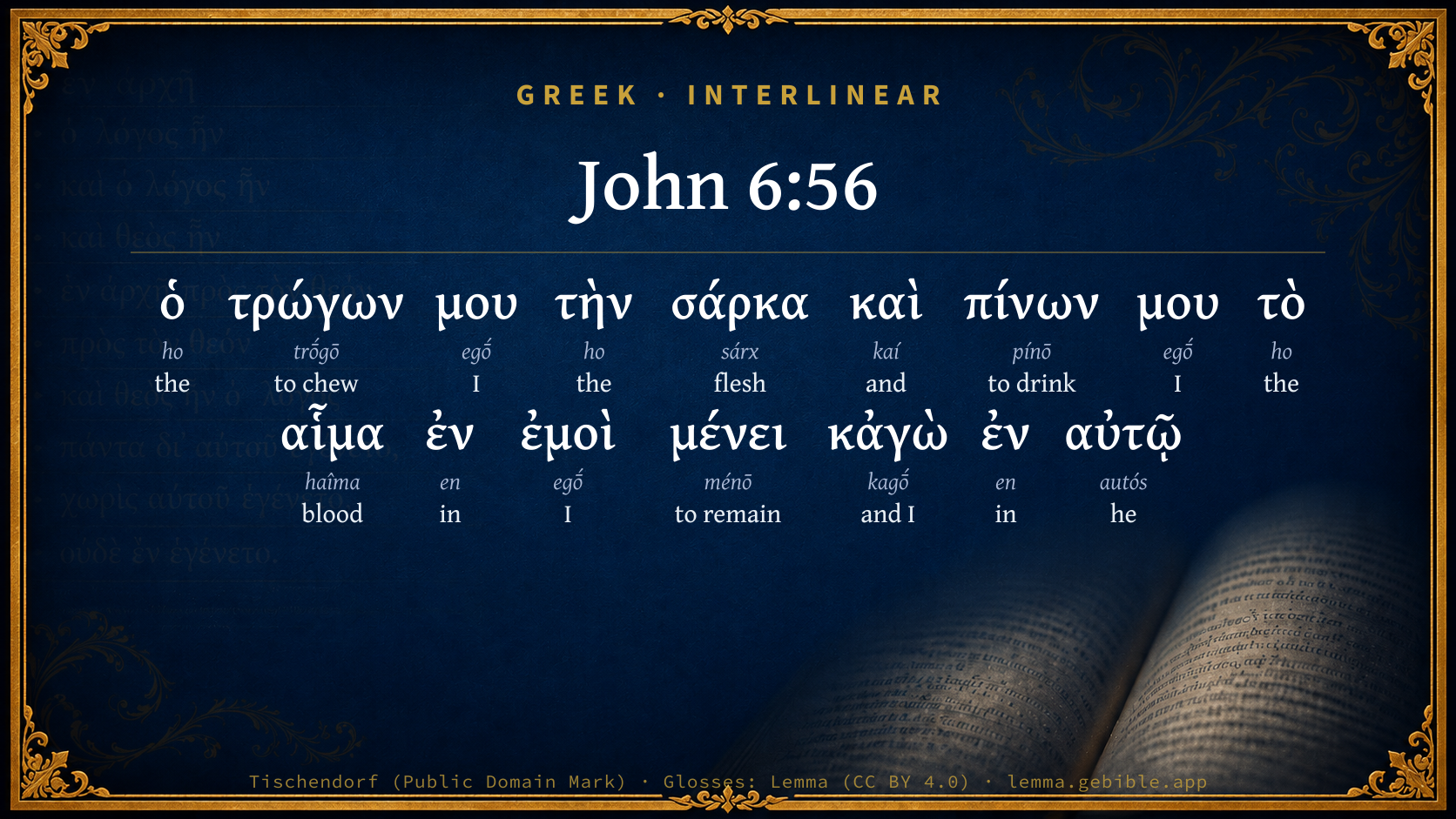
  1. ὁ ho G3588 “the” Article, Nominative, Singular, Masculine
  2. μου egṓ G1473 “I” Personal pronoun, 1st person, Genitive, Singular
  3. τὴν ho G3588 “the” Article, Accusative, Singular, Feminine
  4. σάρκα sárx G4561 “flesh” Noun, Accusative, Singular, Feminine
  5. καὶ kaí G2532 “and” Conjunction
  6. πίνων pínō G4095 “to drink” Verb, Present, Active, Participle, Nominative, Singular, Masculine
  7. μου egṓ G1473 “I” Personal pronoun, 1st person, Genitive, Singular
  8. τὸ ho G3588 “the” Article, Accusative, Singular, Neuter
  9. αἷμα haîma G129 “blood” Noun, Accusative, Singular, Neuter
  10. ἐν en G1722 “in” Preposition
  11. ἐμοὶ egṓ G1473 “I” Personal pronoun, 1st person, Dative, Singular
  12. μένει ménō G3306 “to remain” Verb, Present, Active, Indicative, 3rd person, Singular
  13. κἀγὼ kagṓ G2504 “and I” Personal pronoun, 1st person, Nominative, Singular, Aramaic form
  14. ἐν en G1722 “in” Preposition
  15. αὐτῷ autós G846 “he” Personal pronoun, Dative, Singular, Masculine

About this verse

These counts appear in no published source. They are computed here, from the morphology-tagged text and Lemma’s own curated glosses. What Lemma adds →

16
words
11
distinct lemmas
Gospels
section

Notable vocabulary

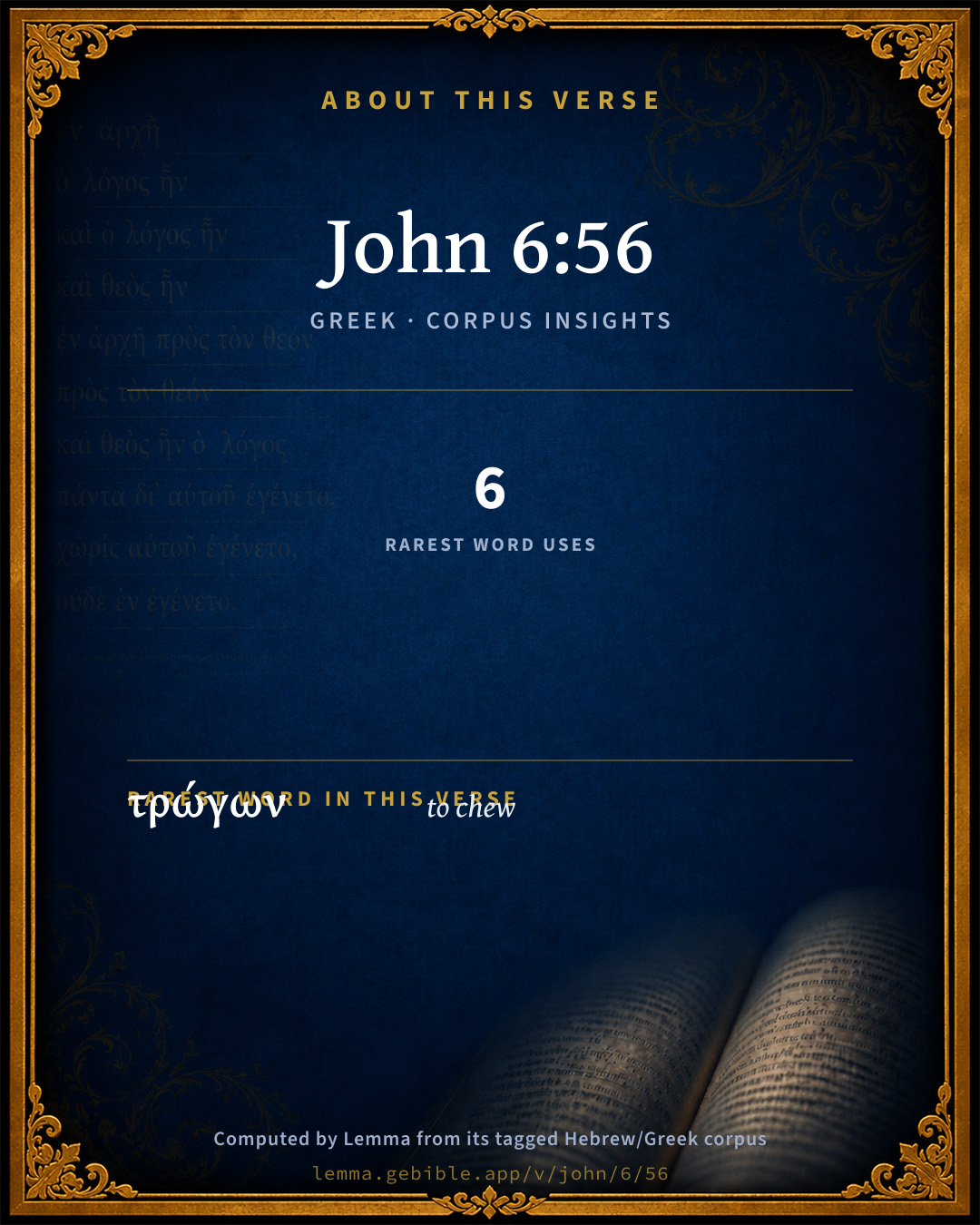
The rarest word here is τρώγων to chew G5176 — appearing just 6 times in the whole Greek New Testament.

Shared distinctive vocabulary

τρώγων to chew G5176 occurs in 6 verses of the Greek New Testament. Also found in:

Repetition

Words recur within this verse:

Cross-references

14

Topical passages linked to John 6:56 in the Treasury of Scripture Knowledge — connected by theme and wording, ordered by reader-vote popularity; previews shown in the World English Bible.

  • 1 John 3:24 He who keeps his commandments remains in him, and he in him. By this we know that he remains in us, by the Spirit which he gave us.
  • John 15:4–5 Remain in me, and I in you. As the branch can't bear fruit by itself, unless it remains in the vine, so neither can you, unless you remain in me.
  • Revelation 3:20 Behold, I stand at the door and knock. If anyone hears my voice and opens the door, then I will come in to him, and will dine with him, and he with me.
  • John 14:20 In that day you will know that I am in my Father, and you in me, and I in you.
  • Psalms 91:9 Because you have made Yahweh your refuge, And the Most High your dwelling place,
  • John 17:21–23 that they may all be one; even as you, Father, are in me, and I in you, that they also may be one in us; that the world may believe that you sent me.
  • John 14:23 Jesus answered him, "If a man loves me, he will keep my word. My Father will love him, and we will come to him, and make our home with him.
  • 1 John 4:15–16 Whoever confesses that Jesus is the Son of God, God remains in him, and he in God.
  • Lamentations 3:24 Yahweh is my portion, says my soul; therefore will I hope in him.
  • 2 Corinthians 6:16 What agreement has a temple of God with idols? For you are a temple of the living God. Even as God said, "I will dwell in them, and walk in them; and I will be their God, and they will be my people."
  • 1 John 4:12 No one has seen God at any time. If we love one another, God remains in us, and his love has been perfected in us.
  • Psalms 91:1 He who dwells in the secret place of the Most High Will rest in the shadow of the Almighty.
  • Psalms 90:1 Lord, you have been our dwelling place for all generations.
  • Ephesians 3:17 that Christ may dwell in your hearts through faith; to the end that you, being rooted and grounded in love,

Cross-references courtesy of OpenBible.info (CC BY 4.0).

Commentary

Notes on John 6:56 from classic Christian and Jewish commentators (each source and its license shown beneath its notes). The classic Christian expositions comment on the surrounding passage and are grouped to its opening verse, so a note may address several verses; the Jewish commentaries on the Tanakh (Rashi and others) are per-verse, so they appear only where the commentator wrote on this verse.

Lemma curates 59 commentaries, every one of them public domain or Creative Commons licensed, each selected and text-cleaned for this edition rather than reprinted as found. About our sources →

Bengel's Gnomon

Johann Albrecht Bengel

Joh 6:56. Ὁ τρώγων, he who eateth) He who eateth, and that which is eaten, in very deed are intimately joined together.

Bengel's Gnomon of the New Testament — English translation (T&T Clark, Edinburgh, 1860) — public domain. Text from a community e-Sword module.

Meyer's Critical & Exegetical Commentary

Heinrich August Wilhelm Meyer

Joh_6:56-57. A statement parallel with what precedes, concerning him who eats, etc., and explaining how that comes to pass which is said of him in Joh_6:54.

ἐν ἐμοὶ μένει κἀγὼ ἐν αὐτῷ] an expression distinctively Johannean of abiding, inner, and mutual fellowship (Joh_15:4 ff., Joh_17:23; 1Jn_3:24; 1Jn_4:16), by virtue of which we live and move continually in Christ, and Christ works and rules in our minds, so that thus Christs life is the centre and circumference, i.e. the all-determining power of our life.

Joh_6:57. Consequence of this spiritual union: life, i.e. true imperishable life, as proceeding from the Father to the Son, so from the Son to believers. Observe (1) that the consequent clause does not begin with κἀγώ (Chrysostom and his followers); but, as Joh_6:56 requires, with κ. ὁ τρώγ. με, so also he that eateth me; (2) that in the antecedent clause the emphasis is on ζῶν and ζῶ (therefore ἀπέστειλε does not introduce any strange or unnatural thought, as Rückert supposes), while in the consequent it is upon the subject, which accordingly is made prominent by κἀκεῖνος, he also.

ὁ ζῶν πατήρ] the living Father (comp. Joh_6:26), the Living One absolutely, in whose nature there is no element of death, but all is life.

κἀγὼ ζῶ διὰ τ. πατ.] and Iby virtue of my community of essence with the Fatheram alive because of the Father. διά with the accus. does not denote the cause (Castalio, Beza, De Wette, Gess, Rückert, and several), per patrem; nor for the Father (Paulus, Lange); but, according to the context, the reason: because of the Father, i.e. because my Father is the Living One. See on Joh_15:3; Plat. Conv. p. 203 E: ἀναβιώσκεται διὰ τὴν τοῦ πατρὸς φύσιν; and see Nägelsbach, Ilias, p. 39 ff. ed. 3.

ὁ τρώγων με] This sufficed to denote the relation, and is in keeping with the transition to Joh_6:58; whereas, if the discourse referred to the Lords Supper, the eating and drinking of the flesh and blood should again have been mentioned, as in Joh_6:53-56. Note also that ὁ τρώγων με expresses a permanent, continuous relation, not one taking place from time to time, as in the Lords Supper.

ζήσει] in contrast with spiritual and eternal death.

διʼ ἐμέ] on account of me, because he thus takes up my life into himself.

Meyer — Critical and Exegetical Commentary on the New Testament — English translation by Peter Christie, edited by Frederick Crombie (T&T Clark, 1880) — public domain. Text from a community e-Sword module.

Jamieson, Fausset & Brown

Robert Jamieson, A. R. Fausset & David Brown

He that eateth . . . dwelleth in me and I in him--As our food becomes incorporated with ourselves, so Christ and those who eat His flesh and drink His blood become spiritually one life, though personally distinct.

Jamieson, Fausset & Brown — Commentary Critical and Explanatory on the Whole Bible (1871) — public domain (CC PDM 1.0). Text via the HelloAO Bible API.

Adam Clarke's Commentary

Verse 56. Dwelleth in me, and I in him.] Of all connections and unions, none is so intimate and complete as that which is effected by the digestion of aliments, because they are changed into the very substance of him who eats them; and this our Lord makes the model of that union which subsists between himself and genuine believers. He lives in them, and they in him; for they are made partakers of the Divine nature: 2Pe 1:4. To this verse the following addition is made in the Codex Bezae, three copies of the Itala, and Victorinus. After these words-dwelleth in me, and I in him, they add, as the Father in me, and I in the Father. Verily, verily, I say unto you, that unless ye receive the body of the Son of man as the bread of life, ye have not life in him. This is a very remarkable addition, and is between thirteen and fourteen hundred years old.

Adam Clarke's Commentary on the Bible (1810–1826) — public domain. Text from a community e-Sword/MySword module.

John Calvin's Commentaries

56. He who eateth my flesh. This is another confirmation; for while he alone has life in himself, he shows how we may enjoy it, that is, by eating his flesh; as if he had affirmed that there is no other way in which he can become ours, than by our faith being directed to his flesh. For no one will ever come to Christ as God, who despises him as man; and, therefore, if you wish to have any interest in Christ, you must take care, above all things, that you do not disdain his flesh.

Dwelleth in me, and I in him. When he says that he dwelleth in us, the meaning is the same as if he had said, that the only bond of union, and the way by which he becomes one with us, is, when our faith relies on his death. We may likewise infer from it, that he is not now speaking of the outward symbol, which many unbelievers receive equally with believers, and yet continue separated from Christ. It enables us also to refute the dream of those who say, that Judas received the body of Christ as well as the other apostles, when Christ gave the bread to all; for as it is a display of ignorance to limit this doctrine to the outward sign, so we ought to remember what I have formerly said, that the doctrine which is here taught is sealed in the Lord’s Supper. Now, it is certain, in the first place, that Judas never was a member of Christ; secondly, it is highly unreasonable to imagine the flesh of Christ to be dead and destitute of the Holy Spirit; and, lastly, it is a mockery to dream of any way of eating the flesh of Christ without faith, since faith alone is the mouth — so to speak — and the stomach of the soul.

John Calvin's Commentaries (1540-1563) — public domain. Text from the Calvin Translation Society English edition (1840s-50s) via the Christian Classics Ethereal Library (ccel.org). Calvin's coverage is partial (roughly two-thirds of the Bible); uncommented books and verses are honest gaps, never fabricated. The 19th-century editor's footnotes and remarks are omitted so the notes are faithfully Calvin's own voice.

Ellicott's Commentary for English Readers

(56) Dwelleth in me, and I in him.—Abideth gives the sense more fully. (Comp. Joh_14:2-23; Joh_15:4 et seq.; Joh_17:23; 1Jn_3:24; 1Jn_4:16.) It is one of those deeper thoughts which meet us only in the words of the beloved disciple. The union which results from the communication of life is not temporary, but is one that remaineth. By virtue of it we abide in Christ, and He in us. It is our home life, that of every day, and will be the life of the eternal home (Joh_14:2). (Comp. Note on Joh_5:38, and the contrast in Joh_3:36.)

A Bible Commentary for English Readers, edited by Charles John Ellicott (1878–1897) — public domain. Text from a community e-Sword module.

The Cambridge Bible for Schools and Colleges

gen. ed. J. J. S. Perowne

56. dwelleth in me, and I in him] Or, abideth in Me and I in him. This is one of S. John’s very characteristic phrases to express the most intimate mutual fellowship and union. The word ‘abide’ is also characteristic, as we have seen. Comp. Joh_14:10; Joh_14:20, Joh_15:4-5, Joh_17:21; 1Jn_3:24; 1Jn_4:16. Christ is at once the centre and circumference of the life of the Christian; the source from which it springs, and the ocean into which it flows; its starting-point and its goal.

The Cambridge Bible for Schools and Colleges (gen. ed. J. J. S. Perowne; Cambridge University Press, 1878–1918) — public domain. Text from a community e-Sword module.

John Gill's Exposition

This is that bread which came down from heaven,.... That true bread, the bread of God, the bread of life, living bread; meaning himself, as in Joh 6:32;

not as your fathers did eat manna, and are dead: this is bread of a quite different nature from that; that was only typical bread, this true; that was the bread of angels, but this is the bread of God; that came but from the air, this from the third heaven; that men ate of, and died; but whoever eats of this, lives for ever; see Joh 6:49; as follows:

he that eateth of this bread shall live for ever; See Gill on Joh 6:51.

John Gill's Exposition of the Whole Bible (1746–1763) — public domain (CC PDM 1.0). Text via the HelloAO Bible API.

Trapp's Complete Commentary

John Trapp

56 He that eateth my flesh, and drinketh my blood, dwelleth in me, and I in him.

Ver. 56. He that eateth my flesh, &c.] That is, that partaketh of my person, merits, passions, privileges; he that receiveth me in all mine offices and efficacies.

John Trapp, A Commentary or Exposition upon All the Books of the Old and New Testament (1647–1656) — public domain. Text from a community e-Sword module.

Albert Barnes' Notes on the Bible

Dwelleth in me - Is truly and intimately connected with me. To dwell or abide in him is to remain in the belief of his doctrine, and in the participation of the benefits of his death. Compare Joh 15:1-6; Joh 17:21-23.

I in him - Jesus dwells in believers by his Spirit and doctrine. When his Spirit is given them to sanctify them; when his temper, his meekness, his humility, and his love pervade their hearts; when his doctrine is received by them and influences their life, and when they are supported by the consolations of the gospel, it may be said that he abides or dwells in them.

Albert Barnes' Notes on the Bible (1834–1885) — public domain. Text from a community e-Sword/MySword module.

Matthew Poole's English Annotations

He that acknowledgeth and receiveth me, though he seeth me as a man, consisting of flesh and blood, and that particularly applies himself to me as dying for the sins of the world, and committeth his soul in all its concerns for life and salvation to me, is united to me, and I to him: he is united to me by faith and love, Eph 3:17; 1Jo 3:23,24; 4:16; and I am united to him by a mutual love, Joh 14:23, and by my Holy Spirit. As our bread and meat, which we are nourished by, doth not dwell in us, and nourish, unless we eat it; so neither doth Christ do good to any soul, unless such a soul as by faith receiveth him, and believeth in him. What is said in this verse maketh it evident that these verses cannot be understood of any sacramental eating, for it is not true that Christ dwelleth in every soul, or that every soul dwelleth and abideth in Christ, who doth sacramentally eat the flesh and drink the blood of Christ. All unions are either natural or political unions. The strictest natural union is that of the head and members, the vine and the branches. The strictest political union is that of the husband and wife, Gen 2:24. The union betwixt Christ and a believing soul is set out by all these, Joh 15:1; Eph 5:30,31; Col 1:18. For the nature of this union, see divines who have wrote on this argument.

Matthew Poole's English Annotations on the Holy Bible (1683–1685) — public domain. Text from a community e-Sword/MySword module.

The Pulpit Commentary

He that eateth my flesh and drinketh my blood, dwelleth in me, and I (dwell) in him. This mutual indwelling is illustrated elsewhere (Joh_15:1-5) by the image of the vine and its branches. The vine abides in the branch in the virtue of its life-giving forces. Cut away from the parent stem, it can do nothing. Fruitlessness condemns and fire consumes it. The branch abides in the vine, as deriving all its worth, its true place, its possibility of growth and fruit, from the vine. (cf. also Joh_17:23 1Jn_3:24 1Jn_4:16) The dwelling of the believer in Christ involves an utter self-surrender to him, a recognition of the supreme claims of the God-Man and his work, a complete trust in him as the Source of all life, a sound and abiding place of rest, a justification before God as one with Christ, as one identified with him in his well pleasing to the Father. The dwelling of Christ in the believer is the fulness and riches of the Divine life. Christ liveth in him, (Gal_2:20) thinks in his thoughts, moves through his will. This is sanctification. The believer is in Christ as the members are in the body. Christ is in the believer as God is in his temple. What is the condition of this mutual indwelling? Christ puts the condition of this Divine interpretation thus: "He that eateth my flesh and drinketh my blood, dwelleth in me, and I in him."The verb is in the present tense, implying the continuous appropriation of the Divine sustenance.

The Pulpit Commentary (1880–1919), ed. H.D.M. Spence-Jones & Joseph S. Exell — public domain. Text from a community e-Sword module.

Cambridge Greek Testament for Schools and Colleges

56. ἐν ἐμοὶ μένει, κἀγὼ ἐν αὐτῷ. This is one of S. John’s very characteristic phrases to express the most intimate mutual fellowship and union; Joh 14:10; Joh 14:20, Joh 15:4-5, Joh 17:21; 1Jn 3:24; 1Jn 4:15-16. Christ is at once the centre and the circumference of the life of the Christian; the source from which it springs and the ocean into which it flows. see on Joh 1:33.

Cambridge Greek Testament for Schools and Colleges (Cambridge University Press, 1896; 21 vols, various authors incl. Carr, Maclear, Plummer, Farrar, Lumby, Moule, M. R. James, Simcox) — public domain. Text from a community e-Sword module.

Alford’s Greek Testament

Henry Alford

56.] He who thus lives upon Me, abides in Me (see ch. 15:5 and note);—and I (that living power and nourishment conveyed by the ἄρτος τῆς ζωῆς which = ἐγώ) abide in him. Beware of imagining, as Bp. Wordsw. again (see note on Mat 16:18), that there is any especial emphasis on μου because of its position.

Henry Alford, The Greek Testament (1849–1861) — public domain. Text from a community e-Sword module.

International Critical Commentary

56. ὁ τρώγων … τὸ αἷμα is repeated from v. 54, the reason for that promise being now given. The man who spiritually feeds on Christ “abides in Him,” and so he has the assurance of eternal life.

μένειν is a favourite word with Jn., and he uses it much more frequently than the Synoptists do. They have not the phrase “to abide in Christ,” or “in God,” which is thoroughly characteristic of Johannine doctrine. This phrase is used in a general mystical sense in 1Jn 2:6, 1Jn 2:27, 1Jn 2:28, 1Jn 2:3:6, 1Jn 2:24, 1Jn 2:4:12, 1Jn 2:16; but in the Fourth Gospel it is found only here and at 15:4-7, both passages having reference to the Eucharist (see on 15:1), the purpose of which is that “we may dwell in Him, and He in us” (cf. 15:4). In Jn. the one “abiding” involves the other, and to this thought reference is made several times (15:5, 1Jn 3:24, 1Jn 3:4:13, 1Jn 3:16; cf. 14:20, and see on 5:38).

The external token of a man’s “abiding” in Christ, is that he keeps His commandments (1Jn 3:24); and, as to love God and to love man are the great commandments, he that abides in love abides in God (1Jn 4:16)1 More generally, he that abides in Christ ought to walk after His example (1Jn 2:6); in other words, he “bears fruit” (15:2). Of one who has perfectly realised this “abiding,” it is said “he sinneth not” (1Jn 3:6). Such an one has the secret of efficacious prayer (15:7). He has life (6:57), and naturally will have confidence at the Great Parousia (1Jn 2:28).

D adds after αὐτῷ: καθὼς ἐν ἐμοὶ ὁ πατήρ, κἀγὼ ἐν τῷ πατρί (cf. 14:10). ἀμὴν ἀμὴν λέγω ὑμῖν, ἐὰν μὴ λάβητε τὸ σῶμα τοῦ υἱοῦ τοῦ ἀνθρώπου ὡς τὸν ἄρτον τῆς ζωῆς, οὐκ ἔχετε ζωὴν ἐν αὐτῷ. This interpolation2 is supported by aff2. With D’s substitution of λάβητε τὸ σῶμα for φάγητε τὴν σάρκα (v. 53), compare its substitution of λάβητε for φάγητε in v. 53.

International Critical Commentary — older volumes (1896–1929), various authors — public domain. Text from a community e-Sword module.

Vincent's Word Studies in the New Testament

Marvin R. Vincent

Dwelleth [μενει] . Render, as Rev., abideth. The word is a favorite one with John, occurring more frequently than in all the rest of the New Testament.

Marvin R. Vincent, Word Studies in the New Testament (1887–1900) — public domain. Text from a community e-Sword/MySword module.

Godet's Commentaries

Frédéric Louis Godet

Vv. 56, 57. “He who eats my flesh and drinks my blood abides in me, and I in him. 57. As the living Father sent me, and I live by the Father, so he who eats me, he also shall live by me.”

By drinking through faith at the fountain of the expiation obtained by the blood of Christ and by nourishing oneself through the Spirit on the life realized in His flesh, we contract a union with Him through which His person dwells in us and we in it. This dwellingof the believer in Jesus is for his moral being, as it were, a transplanting from the soil of his own life into the new soil which the perfect righteousness and the holy strength of Christ offer him: renunciation of all merit, all force, all wisdom derived from what belongs to himself, and absolute confidence in Christ, as in Him who possesses all that is needed in order to fill the void. The abiding of Christ, which corresponds to this abiding of the believer in Him, expresses the real effective communication which Christ makes of His own personality (“he who eats me” Joh 6:57). This mutual relation being formed, the believer lives: why? This is what Joh 6:57 explains.

Frédéric Louis Godet — Commentaries on Luke, John, Romans, and 1 Corinthians — English translation (T&T Clark, Edinburgh, 1870s–1890s) — public domain. Text from a community e-Sword module.

Lesson kit

Teaching starters — assembled from the data on this page, not authored interpretation. Every prompt links to the verse data it draws on. Edit before teaching.

John, in the Gospels, opens this verse with 16 words (11 distinct Greek lemmas). Its most distinctive word is trṓgō (“to chew”). A historical commentator’s framing appears above. Read the whole chapter for the surrounding context.

Discussion questions

  1. How does “to chew” (trṓgō) shape what this verse is saying?
  2. Matthew 24:38 shares the word «to chew» with this verse. How do the two illuminate each other?
  3. “the” occurs 3× in this one verse. What is the effect of the repetition?
  4. The translations on this page render this verse differently — a whole-verse word diff, not a word-by-word alignment. What might account for the different wordings?
  5. Reading how Bengel's Gnomon and Meyer's Critical & Exegetical Commentary read this verse, where do the two commentators agree and where do they part?

Things to notice

Reading settings

Reading text

Shown beneath each verse's original-language words.

Old Testament
Old Testament edition

Read the OT as the Masoretic Hebrew (MT) or the Greek Septuagint (LXX).

English shown for the Greek Septuagint (in the Hebrew ↔ Greek comparison).

Comparing translations? Open the Compare panel on any verse page to stack up to four side by side.