John 6:62

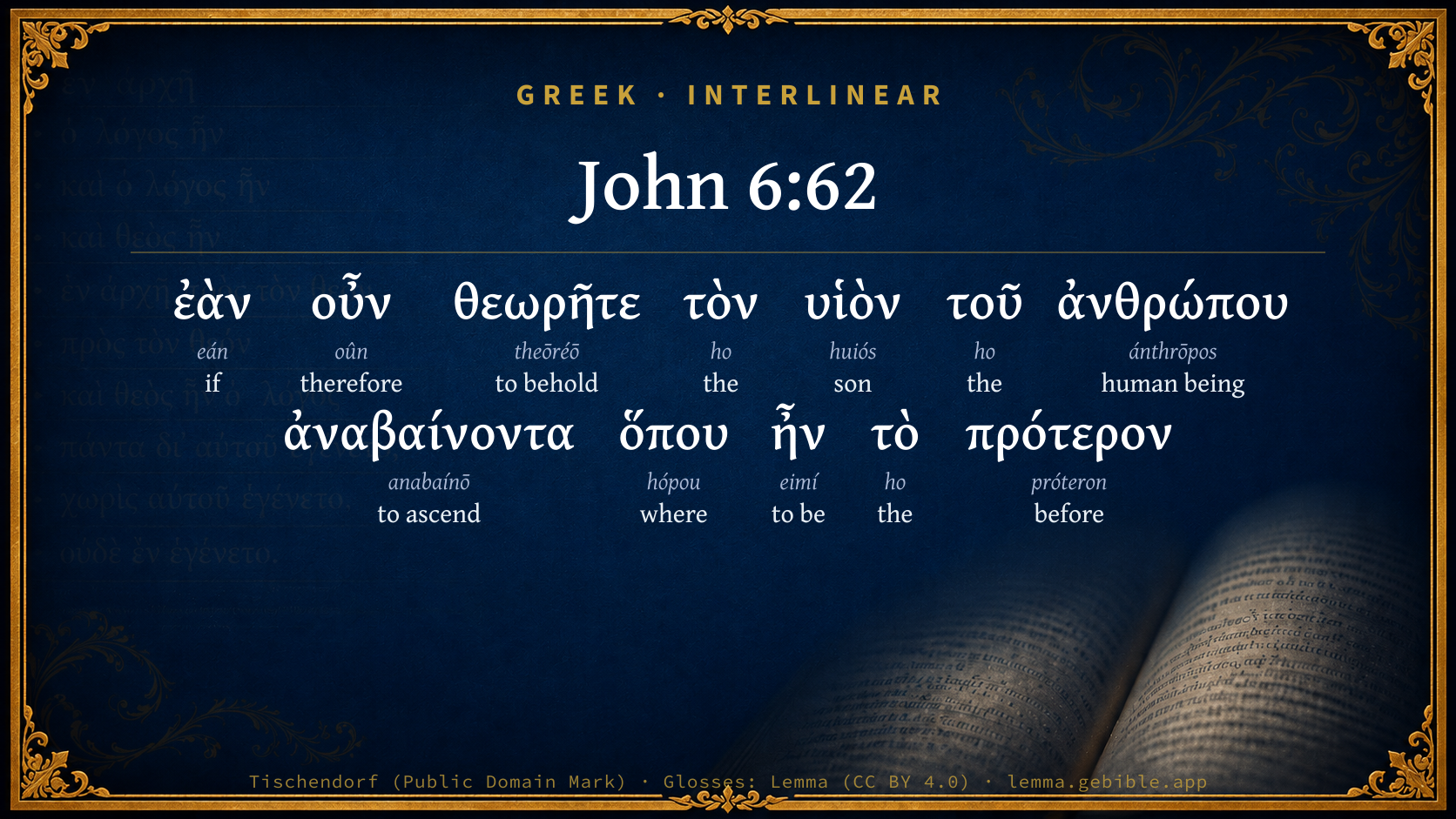
Greek (Tischendorf 8th ed.) John 6:62 appears in the Greek New Testament. The text above is from the Tischendorf 8th edition. Each word links to its Strong’s number and a concise gloss. Click any word for its full Thayer’s Greek Lexicon entry.
Download image
Cite this verse

John 6:62 (World English Bible). Public Domain. Lemma interlinear Bible study tool, https://lemma.gebible.app/v/john/6/62.

Show BibTeX & RIS
BibTeX
RIS
English Translation
Then what if you would see the Son of Man ascending to where he was before?
World English Bible · Public Domain
Highlights
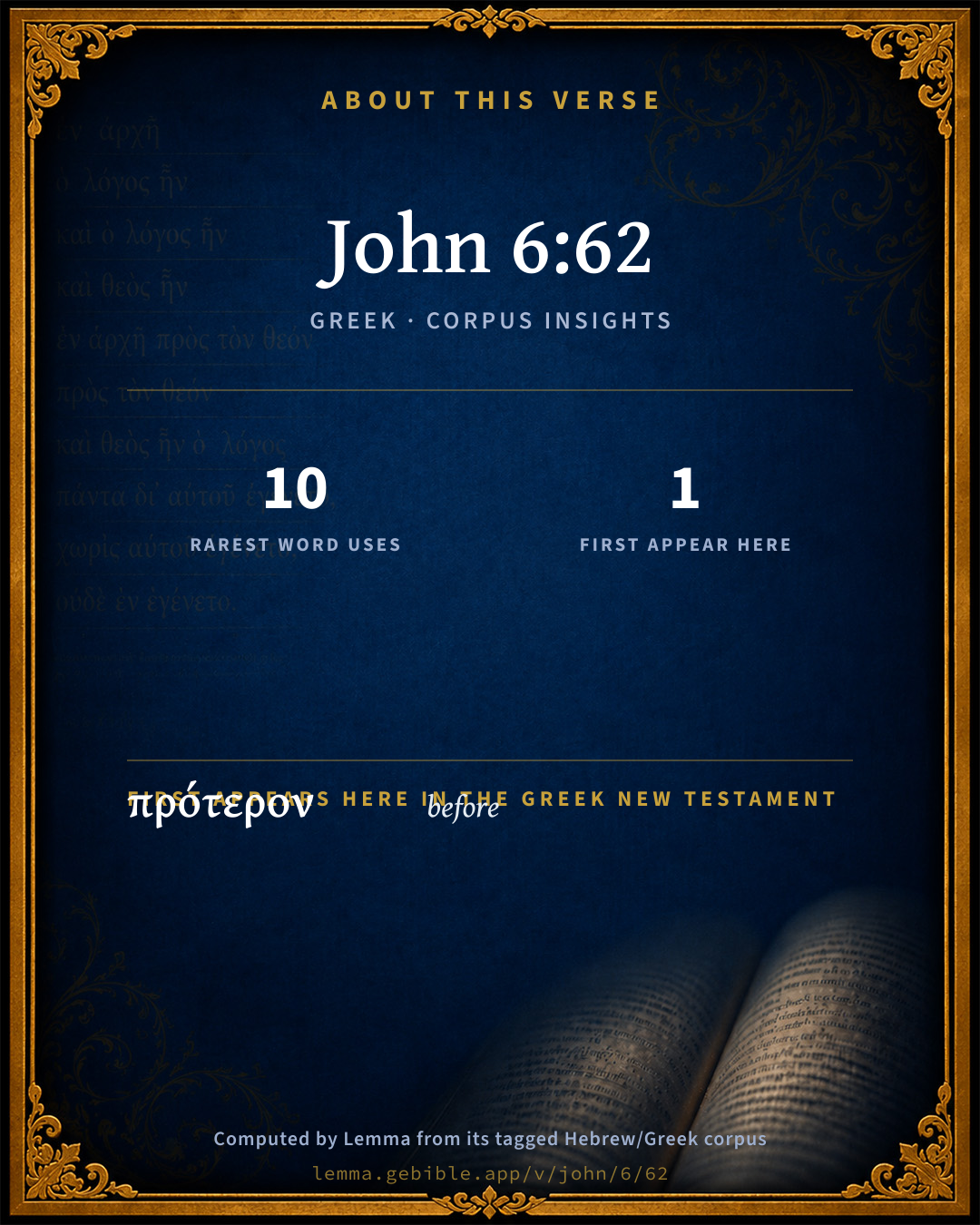
  • 1 first appearance in the Greek New Testament
Full analysis ↓
Download a study sheet

One document with this verse’s original text, its word-by-word gloss line, the meaning frame, cross-references with their text, attributed commentary, and full source and license credits — printable, and it pastes into notes with its structure intact.

This verse Autodidact and up

Study sheet (.html) Plain text (.txt)

A passage Seminary Student

Up to 50 verses in one chapter. A passage sheet keeps up to 6 commentary sources and 12 cross-references per verse, in the order this page ranks them, and says so on the sheet whenever that leaves anything out. Ask for a single verse and you get the Autodidact verse sheet above.

Everything on this page stays free to read, with no account — the sheet is a download of what is already on screen, not access to it.

Want to remove ads? Support Godless Engineer
Compare translations 3

The same verse in 3 English versions, stacked beneath the original-language interlinear above. Click any original word for its lexicon entry.

Each is an independent rendering of the whole verse — the interlinear is not word-aligned to these translations.

Highlighted words mark where these versions differ — a whole-verse word diff, not a word-by-word alignment.

  • World English Bible Public Domain
    Then what if you would see the Son of Man ascending to where he was before?
  • King James Version Public Domain
    What and if ye shall see the Son of man ascend up where he was before?
  • unfoldingWord Literal Text CC BY-SA 4.0
    Then if you would see the Son of Man going up to where he was before…?

unfoldingWord Literal Text — © unfoldingWord, licensed CC BY-SA 4.0. Word-aligned USFM3 via Door43 (git.door43.org/unfoldingWord/en_ult).

Versions to compare (up to 4)

3 of 4 selected

Show all 19 translations

Every available English version of this verse, each an independent rendering of the whole verse.

  • World English Bible Public Domain
    Then what if you would see the Son of Man ascending to where he was before?
  • Berean Standard Bible Public Domain
    Then what will happen if you see the Son of Man ascend to where He was before?
  • Majority Standard Bible Public Domain
    Then what will happen if you see the Son of Man ascend to where He was before?
  • King James Version Public Domain
    What and if ye shall see the Son of man ascend up where he was before?
  • American Standard Version (1901) Public Domain
    `What' then if ye should behold the Son of man ascending where he was before?
  • Revised Version (1885) Public Domain
    What then if ye should behold the Son of man ascending where he was before?
  • Geneva Bible (1599) Public Domain
    What then if yee should see that Sonne of man ascend vp where he was before?
  • Douay-Rheims (1899) Public Domain
    But Jesus, knowing in himself, that his disciples murmured at this, said to them: Doth this scandalize you?
  • Young's Literal Translation Public Domain
    if then ye may behold the Son of Man going up where he was before?
  • Literal Standard Version CC BY-SA 4.0
    If then you may behold the Son of Man going up where He was before?
  • Unlocked Literal Bible CC BY-SA 4.0
    Then what if you should see the Son of Man going up to where he was before?
  • unfoldingWord Literal Text CC BY-SA 4.0
    Then if you would see the Son of Man going up to where he was before…?
  • Darby Bible Public Domain
    If then ye see the Son of man ascending up where he was before?
  • World Messianic Bible Public Domain
    Then what if you would see the Son of Man ascending to where he was before?
  • Webster's Bible Public Domain
    What if ye shall see the Son of man ascend up where he was before?
  • Free Bible Version CC BY-SA 4.0
    Then what if you were to see the Son ascend to where he was before?
  • Bible in Basic English Public Domain
    What then will you say if you see the Son of man going up to where he was before?
  • Text-Critical English NT CC BY 4.0
    Then what if you see the Son of Man ascending to where he was before?
  • Tyndale New Testament (1534) Public Domain
    What and yf ye shall se the sonne of man ascede vp where he was before?

Literal Standard Version (2020), Covenant Press — licensed CC BY-SA 4.0. Text via the HelloAO Bible API (eBible.org). Unlocked Literal Bible (unfoldingWord) — licensed CC BY-SA 4.0. Text via the HelloAO Bible API (eBible.org). unfoldingWord Literal Text — © unfoldingWord, licensed CC BY-SA 4.0. Word-aligned USFM3 via Door43 (git.door43.org/unfoldingWord/en_ult). Free Bible Version, Dr. Jonathan Gallagher — licensed CC BY-SA 4.0. Text via the HelloAO Bible API (eBible.org).

Word by word

More ways to search: Search by grammar → Find every occurrence → Compare this word →

Practice this passage: Drill this verse → Learn its vocabulary →

About this verse

These counts appear in no published source. They are computed here, from the morphology-tagged text and Lemma’s own curated glosses. What Lemma adds →

12
words
10
distinct lemmas
Gospels
section

Notable vocabulary

The rarest word here is πρότερον before G4386 — appearing just 10 times in the whole Greek New Testament.

First appearance in Scripture

This word makes its first canonical appearance in the Greek New Testament here:

  • πρότερον before G4386

Shared distinctive vocabulary

πρότερον before G4386 occurs in 10 verses of the Greek New Testament. Also found in:

Repetition

A word recurs within this verse:

Cross-references

10

Topical passages linked to John 6:62 in the Treasury of Scripture Knowledge — connected by theme and wording, ordered by reader-vote popularity; previews shown in the World English Bible.

  • John 3:13 No one has ascended into heaven, but he who descended out of heaven, the Son of Man, who is in heaven.
  • Mark 16:19 So then the Lord Jesus, after he had spoken to them, was received up into heaven, and sat down at the right hand of God.
  • Luke 24:51 It happened, while he blessed them, that he withdrew from them, and was carried up into heaven.
  • Ephesians 4:8–10 Therefore he says, "When he ascended on high, he led captivity captive, and gave gifts to men."
  • John 16:28 I came out from the Father, and have come into the world. Again, I leave the world, and go to the Father."
  • John 17:4–5 I glorified you on the earth. I have accomplished the work which you have given me to do.
  • Acts 1:9 When he had said these things, as they were looking, he was taken up, and a cloud received him out of their sight.
  • 1 Peter 3:22 who is at the right hand of God, having gone into heaven, angels and authorities and powers being made subject to him.
  • John 17:11 I am no more in the world, but these are in the world, and I am coming to you. Holy Father, keep them through your name which you have given me, that they may be one, even as we are.
  • John 6:27 Don't work for the food which perishes, but for the food which remains to eternal life, which the Son of Man will give to you. For God the Father has sealed him."

Cross-references courtesy of OpenBible.info (CC BY 4.0).

Commentary

Notes on John 6:62 from classic Christian and Jewish commentators (each source and its license shown beneath its notes). The classic Christian expositions comment on the surrounding passage and are grouped to its opening verse, so a note may address several verses; the Jewish commentaries on the Tanakh (Rashi and others) are per-verse, so they appear only where the commentator wrote on this verse.

Lemma curates 59 commentaries, every one of them public domain or Creative Commons licensed, each selected and text-cleaned for this edition rather than reprinted as found. About our sources →

Bengel's Gnomon

Johann Albrecht Bengel

Joh 6:62. Ἐὰν οὖν, if then) ἐάν, if, has as the Apodosis to be understood, what shall be? [Engl. Vers. what and if, etc.] That is, there are far greater things, which will follow: if ye do not believe this, how would you believe those things, if I were to tell you them? (A similar passage occurs, ch. Joh 3:12, “If I have told you earthly things and ye believe not, how shall ye believe if I tell you of heavenly things?”) And yet, when ye shall see that, ye will acknowledge that the things which I have spoken are true; and ye will wonder, not at My doctrine, but at your own slowness of comprehension: ch. Joh 8:28, “When ye have lifted up the Son of man, then shall ye know that I am He, and that I do nothing of Myself; but as My Father hath taught Me, I speak these things;” Mat 26:64, “Hereafter shall ye see the Son of man sitting on the right hand of power, and coming in the clouds of heaven.”—ἀναβαίνοντα, ascending) See on ch. Joh 3:13, note, “No man hath ascended up to heaven, but He that came down from heaven, even the Son of man, which is in heaven.”—τὸ πρότερον, previously) before that He descended.

Bengel's Gnomon of the New Testament — English translation (T&T Clark, Edinburgh, 1860) — public domain. Text from a community e-Sword module.

Adam Clarke's Commentary

Verse 62. If ye shall see the Son of man ascend] Ye need not be stumbled at what I say concerning eating my flesh and drinking my blood, for ye shall soon have the fullest proof that this is figuratively spoken, for I shall ascend with the same body with which I shall arise from the dead; therefore my flesh and blood, far from being eaten by men, shall not even be found among them.

Adam Clarke's Commentary on the Bible (1810–1826) — public domain. Text from a community e-Sword/MySword module.

John Calvin's Commentaries

62. What if you shall see the Son of man ascend to where he was before? The mean and despicable condition of Christ which they saw before their eyes, while, clothed with flesh, he was not at all different from other men, prevented them from submitting to his Divine power; but now — by withdrawing, as it were, the veil — he calls them to behold his heavenly glory, as if he had said, “Because I converse among men without honor, I am despised by you, and you recognize in me nothing that is Divine; but ere long God will adorn me with splendid power, and, withdrawing me from the contemptible state of mortal life, will raise me above the heavens.” For, in the resurrection of Christ, so great was the power displayed by the Holy Spirit, that it plainly showed Christ to be the Son of God, as Paul also shows, (Romans 1:4.) And when it is said,

Thou art my Son, today have I begotten thee, (Psalm 2:7,)

the resurrection is brought forward as a proof from which that glory of Christ ought to be acknowledged, and his ascension to heaven was the completion of that glory. When he says that he was formerly in heaven, this does not apply strictly to his human nature, and yet he speaks of the Son of man; but since the two natures in Christ constitute one person, it is not an unusual way of speaking to transfer to one nature what is peculiar to the other.

John Calvin's Commentaries (1540-1563) — public domain. Text from the Calvin Translation Society English edition (1840s-50s) via the Christian Classics Ethereal Library (ccel.org). Calvin's coverage is partial (roughly two-thirds of the Bible); uncommented books and verses are honest gaps, never fabricated. The 19th-century editor's footnotes and remarks are omitted so the notes are faithfully Calvin's own voice.

Ellicott's Commentary for English Readers

(62) What and if ye shall see . . .?—Our version adds the word “what,” as will be seen from the italics, but it rightly expresses the sense. Literally, we should read, If then ye should behold the Son of Man ascending up where He was before? The Ascension would be the proof of the coming down from heaven (Joh_6:58), which is part of the teaching they cannot now accept. The margin refers to the more formal statement of this in Joh_3:13. The reader should also compare Joh_20:17, where the Ascension is again assumed, and Eph_4:9-10. Comments on these incidental references by St. John to an event he does not record have been made too frequently without noting that, in each case, the speaker is Jesus, to whose thoughts this end of subjection to earthly laws, in subjecting them to Himself, was ever present. St. John, in his own narrative, nowhere mentions the fact of the Ascension, nor does he in any way refer to it. That he could write these words without doing so is an assurance of his own knowledge of the glorious sequel of the Resurrection, and of its unquestioned acceptance in the Church.

A Bible Commentary for English Readers, edited by Charles John Ellicott (1878–1897) — public domain. Text from a community e-Sword module.

The Cambridge Bible for Schools and Colleges

gen. ed. J. J. S. Perowne

62. What and if, &c.] Literally, If therefore ye should behold the Son of man ascending where He was before? The sentence breaks off (aposiopesis) leaving something to be understood: but what is to be understood? The answer to this depends on the meaning assigned to ‘behold the Son of man ascending.’ The most literal and obvious interpretation is of an actual beholding of the Ascension: and in that case we supply; ‘Would ye still take offence then?’ Against this interpretation it is urged (1) That S. John does not record the Ascension. But it is assumed, if not here and Joh_3:13, yet certainly Joh_20:17 as a fact; and in all three cases it is in the words of our Lord that the reference occurs. S. John throughout assumes that the main events of Christ’s life and the fundamental elements of Christianity are well known to his readers. (2) That none but the Twelve witnessed the Ascension, while this is addressed to a multitude of doubting disciples. But some of the Twelve were present: and Christ speaks hypothetically; ‘if ye should behold,’ not ‘when ye shall behold.’ (3) That in this case we should expect ‘but’ instead of ‘therefore.’ Possibly, but not necessarily. The alternative interpretation is to make the ‘ascending’ refer to the whole drama which led to Christ’s return to glory, especially the Passion (comp. Joh_7:33, Joh_13:3, Joh_14:12; Joh_14:28, Joh_16:5; Joh_16:28, Joh_17:11; Joh_17:13): and in that case we supply; ‘Will not the sight of a suffering Messiah offend you still more?’

The Cambridge Bible for Schools and Colleges (gen. ed. J. J. S. Perowne; Cambridge University Press, 1878–1918) — public domain. Text from a community e-Sword module.

John Gill's Exposition

But there are some of you that believe not,.... Notwithstanding the ministry they sat under, and the words they heard; for though they professed to believe in Jesus, as the Messiah, yet they did not truly believe in him; their faith was not a living faith, or of a spiritual kind, but a mere historical and temporary one, and was feigned and hypocritical:

for Jesus knew from the beginning; of his ministry, and of their profession of him, being God omniscient, and the searcher of hearts:

who they were that believed not; i.e. in him, as the Arabic version reads: notwithstanding their following him, and professing to believe in him, and the great outward respect and esteem they showed to him, he could see through all those masks they put on, and knew they had no true faith of him in them; and the same knowledge he has of every professor of his name: he knows whether their faith is of the right kind or not; whether they have obtained the like precious faith with God's elect; or whether their profession is only a verbal one. In some copies it is read, "who they were that believed"; who were true believers, as well as who were hypocrites.

And who should betray him: he not only knew how it was with the multitude of the disciples that professed love to him, and faith in him; but he also particularly knew the case of the twelve apostles, and that one of them should betray him, and who he was. This was determined in the decrees of God, and was foretold in the prophecies of the Old Testament, and was predicted by Christ; and the person was pointed at by him before it was done.

John Gill's Exposition of the Whole Bible (1746–1763) — public domain (CC PDM 1.0). Text via the HelloAO Bible API.

Trapp's Complete Commentary

John Trapp

62 What and if ye shall see the Son of man ascend up where he was before?

Ver. 62. What and if ye shall see the Son of man ascend] Then you shall not be scandalized (so some sense it); or then you shall much more be scandalized, so Maldonat, who saith he could like the other sense well enough, but that it is the Calvinists’. So George, Duke of Saxony, said, he could have thought well of a reformation, if Luther had not wrought it. (Grinaeus in Hagg. praefat.)

John Trapp, A Commentary or Exposition upon All the Books of the Old and New Testament (1647–1656) — public domain. Text from a community e-Sword module.

Albert Barnes' Notes on the Bible

What and if ... - Jesus does not say that those who were then present would see him ascend, but he implies that he would ascend. They had taken offence because he said he came down from heaven. Instead of explaining that away, he proceeds to state another doctrine quite as offensive to them - that he would reascend to heaven. The apostles only were present at his ascension, Act 1:9. As Jesus was to ascend to heaven, it was clear that he could not have intended literally that they should eat his flesh.

Albert Barnes' Notes on the Bible (1834–1885) — public domain. Text from a community e-Sword/MySword module.

Haydock's Catholic Bible Commentary

If you cannot believe that I can give you my flesh to eat, now that I am living amongst you, how will you believe, that, after my ascension, I can give you to eat my glorified and immortal flesh, seated on the right hand of the majesty of God? (Bible de Vence)

George Leo Haydock (1774–1849), Haydock's Catholic Family Bible and Commentary, 1859 edition — public domain. Excludes Psalms (Douay-Rheims chapter numbering differs from Protestant) and Deuterocanonical books (Catholic canon only).

Matthew Poole's English Annotations

Our Saviour by these words may seem rather to increase than to abate their offence. That which stumbled them was, his calling himself the bread of life; his affirming that he came down from heaven; that he gave life to the world; that the way to obtain this life was eating his flesh and drinking his blood. How doth what he now tells them any way tend to satisfy them? He now speaks of ascending up to heaven, and asserts that he was there before.

Answer. The former assertions were no way to be justified but upon this foundation, that though he appeared now in the form and shape of a man, and was indeed the Son of man, yet he was also God, the eternal Son of God: he therefore here plainly asserts, that he was in heaven before he appeared as the Son of man upon the earth; and descending from thence, did assume the form of a servant; and for a further proof of this, he refers them to what they were to see or hear (to know) within some few months after this discourse, (for this was after his third passover, which was to be the last year of his life), viz. that he should ascend up to heaven; which it is very probable that some of them did see with their bodily eyes; for he was in Galilee when he ascended, and Capernaum was a city of that province; and when he ascended, the men of Galilee stood gazing up to heaven after him, as appears from Act 1:11, and had a revelation, that they should see him so come again, and descend from heaven, as they had seen him go up.

Matthew Poole's English Annotations on the Holy Bible (1683–1685) — public domain. Text from a community e-Sword/MySword module.

Whedon's Commentary on the Bible

Daniel D. Whedon

62. See the Son of man ascend—What if your own eyes shall hereafter witness, in my ascension to the abode whence I came, the full proof that I did descend, the living Saviour, from heaven? Jesus assumes to be speaking, not to gainsayers, but to believers troubled by a mysterious saying. He reminds them that a time of exaltation is in the future, which should prevent their hasty irritability in the present.

Daniel D. Whedon (gen. ed.), Commentary on the Old and New Testaments (1874–1909) — public domain. Text from a community e-Sword module.

The Pulpit Commentary

If it does put difficulties in your way, then how will it be if you behold the Son of man ascending up to where he was before? This unfinished and ambiguous sentence and query have been variously interpreted. Some have argued that our Lord here simply refers to the "resurrection;" that he told his hearers they would have an opportunity of observing that, after death, he would return to where he was before, that is, to the conditions of earthly life. The striking antithesis between "descending from" and "ascending" almost compels the repudiation of this view. Did Christ, however, mean to ask them whether, under the new condition of things, all ground of offence would not be taken away? or to imply that their faith would have to be put to a still greater strain, and that they would stumble at length irretrievably? Lucke, De Wette, Kuinoel, Meyer, chiefly urge the latter, and on the ground:

(1) That in John"s Gospel the death of Christ is always looked at as his real glorification, and that therefore by anabainein , he was referring in his euphemistic fashion to his death in the true Johannine phrase as a going to God. (cf. Joh_13:3, a return to the Father; Joh 14 Joh_16:5, Joh_16:28)

(2) That John does not describe the Ascension as a physical fact. Meyer does not allow that Joh_3:13 and 20:17 are sufficient with this phrase to justify such a reference to the great event referred to by Mark, Luke, and Paul, and the author of the Epistle to the Hebrews. Against Meyer and those who agree with him it should be noticed that anabainein is never used for "death" of Christ. The phrases, upagein tw Patri , and elyein , etc., are used for this purpose. Moreover, when a phrase was wanted to denote the twofold idea of uplifting on the cross and ascension to the skies, uqwyhnai , is the word twice used in the Fourth Gospel. (Joh_3:14 Joh_12:32-34) Moreover, if death could be realized as such a yewrein of glory and fulness of life, the offence of the cross, and scandal of participation in and dependence upon the flesh and blood of Christ, would be reduced and not augmented. To Meyer"s objection that these Galilaean disciples would not see the ascending Christ, and therefore the supposition would be tantalizing, it is sufficient to reply

(1) that, in a similar sense, there was no reason to suppose they would see the Lord suffer and die upon the cross;

(2) that, as Christ Jesus was evidently "set forth as crucified" among the Galatians, (Gal_3:1) so these Galilaean disciples, through the vision of the apostles, would verily see the Son of man suffer, die, and ascend. Apart also from the inappropriateness of the word anabainein convey the subtle thought of the transfiguration of death as such, there was not, apart from resurrection and ascension to glory which is the additional matter to which our Lord referred any justification of the phrase, whereas it coincides decidedly with the expressions used of the preexisting glory of the great Personality who, though calling himself "Son of man," yet consciously refers to his existence before the world was. (cf. Joh_8:58 Joh_17:5, 24 Col_1:17) Again, the anabainein of these words stands in imposing antithesis to the repeated use of katabainein of the previous discourse. He had been sent "from heaven," "sent by the living Father," he had "come down from heaven," "to give himself and his flesh for the life of the world" and he now leads his disciples to suspend their murmuring at the form of his discourse. They may behold and see a greater marvel yet, such a losing of his humanity in God and glory, that they will be able to apprehend more fully what he means by eating his flesh and drinking his blood. Of course, there might be some who are so entirely obtuse to the conception of this close identification with him during the time of his manifestation in the flesh, that they will be still more powerless to receive the spiritual interpretation when, for believing minds, the idea would become clear. John recorded this discourse a generation after the mighty effects of the Resurrection and Ascension had been produced. We know that long before he presented these outlines the ideas presented in it had been widely diffused. St. Paul had spoken of Christ as "the second Man from heaven," as invested and clothed in a "spiritual body," as "the last Adam," as "a life-giving Spirit," and the Epistle to the Hebrews had represented him as "having passed through the heavens that he might fill all things. Whence came such august ideas about the Man Jesus, if not from himself? The offence of the cross has never ceased, and Athenians and many since have mocked at the story of the Resurrection and Ascension; but notwithstanding this, there is an ever-increasing multitude who from the day of his ascension till now have been finally convinced. They have understood, as they would never have done without such help, that it was possible, since he had passed through these heavens that he might fill all things, to hold the most entire and intimate communion with him, both as the God-Man and as the Paschal Lamb. Moreover, the prince of this world has been cast out and judged because Christ has gone to the Father. He has been lifted up, and is drawing all men to himself. When the Son of man in the continuity of his Person shall be beheld as ascending into the glory from which he in his Divine nature descended, then those who stumbled at the idea of intimate life-giving participation in himself will "come to see that the words can only be understood spiritually" (Moulton). The ascension of the humanity to the life and glory of the preexistent Deity of the Son of God was a conception firmly grasped by St. Paul, (Eph_4:10 Php_2:6-9) and must have been based on the Lord"s own words. It is only by the exaltation of the man into God that we are able to participate in the Divine humanity. Weiss, unfortunately, cannot believe that there was any reference to the visible ascent to heaven, but simply to the termination of his earthly labours. The question, then, of ver. 62 is left to find its own answer and to give its own suggestion. But the interpretation here offered is strongly confirmed by

The Ascension foretold.

The aim of our Lord"s conversation with the Jews was to convince those who were prepared for the revelation, that he was the Divine Mediator, and that union with him was the one hope of salvation for sinful men. An inferior claim he could not have made. Yet this assertion of his power and dignity was an offence to many who heard the Saviour"s language, and who could not believe that the lowly Nazarene occupied a place so exalted in the counsels of the Eternal. Jesus, perceiving that both the cavillers and the disciples were perplexed by his statements and demands, instead of withdrawing anything that he had said, asked them how they would be impressed should they witness his ascension to his proper abode? Although the evangelist John does not record the Ascension, this is not the only passage in which he attributes to Christ language referring to that great event; a fact in favour both of the actual occurrence of the Ascension and of John"s acquaintance with it. This great and final event in our Lord"s earthly ministry was

I A SUITABLE CONCLUSION TO HIS CAREER ON EARTH. As his birth had been supernatural and his ministry likewise, as his resurrection from the dead had in this respect corresponded with all that had gone before, it was proper that his final departure from earth should be distinguished by what was more than human in incident and in power. He could not die a second time; how could he disappear from among men more appropriately than in the manner he himself had foretold?

II AN EVIDENT PROOF OF THE DIVINITY OF HIS PERSON AND MISSION. And this in two ways.

1. Jesus had expressly and repeatedly foretold that he should ascend into heaven; the fact of his doing so proved his Divine foreknowledge.

2. At the same time, his ascension distinguished him from all others. He was not even, like Elijah, taken up; he ascended in the exercise of his own native power.

III A NECESSARY CONDITION OF THE OUTPOURING OF THE SPIRIT. He himself had said, "If I go not away, the Comforter will not come." His work was to be completed in the bestowal of spiritual influence for the enlightenment and conversion of mankind. It was when he ascended on high that he led captivity captive, and received gifts for men.

IV A PREPARATION FOR THE ESPECIALLY CHRISTIAN LIFE OF FAITH AND SPIRITUALITY. Through the Ascension Christ"s friends and followers realize their union with an unseen Saviour. The invisible sphere, which apart from this seems so remote, is thus brought near, Christians, risen with Christ, set their affections upon things above.

V A POINT OF DEPARTURE FOR THE CHURCH"S LABOURS, No one can read the Book of the Acts of the Apostles without feeling that the ascension of Christ, recorded in the first chapter, is the key to the whole of the narrative. The Lord went into heaven, but left his servants upon earth, to carry out his instructions, and to advance his cause and kingdom. The trust came home to their hearts, and animated their ministry.

VI THE GROUND OF A BLESSED HOPE. Jesus departed with his hands outstretched in the attitude of blessing. Blessing his people, he ascended; blessing them, he lives and reigns above; and blessing them, he will return. It is his own assurance, "I will come again;" it is the assurance of his angels, "He shall so come in like manner as ye beheld him go into heaven.

APPLICATION. If, as our Lord"s language intimates, his ascension must needs awaken surprise, still more should it enkindle gratitude, arouse to consecration, and inspire hope. T.

The Pulpit Commentary (1880–1919), ed. H.D.M. Spence-Jones & Joseph S. Exell — public domain. Text from a community e-Sword module.

John Wesley's Explanatory Notes

What if ye shall see the Son of man ascend where he was before? - How much more incredible will it then appear to you, that he should give you his flesh to eat?

John Wesley, Explanatory Notes Upon the Whole Bible (1754–1765) — public domain. Text via the GEBible commentary corpus.

The People's New Testament

B. W. Johnson

62. If ye shall see the Son of man ascend? He points forward to a greater marvel than the one that now staggered before them, the Ascension of the Son of man.

B. W. Johnson's The People's New Testament with Notes (1889–1891) — public domain. Electronic text from the Christian Classics Ethereal Library (CCEL) ThML edition.

unfoldingWord translationNotes

Door43 World Missions Community

Then what if you should see the Son of Man going up to where he was before?

Jesus offers this remark in the form of a question to emphasize that his disciples will see other things that are also hard to understand. AT: "Then you will not know what to think when you see me, the Son of Man, going up into heaven!" (See: Rhetorical Question)

profits

The word "profit" means to cause good things to happen.

words

Possible meanings are 1) Jesus' words in John 6:32-58 or 2) everything Jesus teaches. (See: Metonymy)

The words that I have spoken to you

"What I have told you"

are spirit, and they are life

Possible meanings are 1) "are about the Spirit and eternal life" or 2) "are from the Spirit and give eternal life" or 3) "are about spiritual things and life."

translationWords

Son of Man

Holy Spirit

flesh

profit

word

spirit

life

unfoldingWord translationNotes — © Distant Shores Media and the Door43 World Missions Community, licensed CC BY-SA 4.0. Source: git.door43.org/Door43/en_tn.

Cambridge Greek Testament for Schools and Colleges

62. ἐὰν οὖν θ. Literally, If therefore ye should behold the Son of man ascending where He was before? The sentence breaks off (aposiopesis) leaving something to be understood: but what is to be understood? The answer to this depends on the meaning assigned to ‘behold the Son of man ascending.’ The most literal and obvious interpretation is of an actual beholding of the Ascension: and in that case we supply; ‘Would ye still take offence then?’ The Ascension would prove that their carnal interpretation of the eating and drinking must be wrong. Against this interpretation it is urged (1) that S. John does not record the Ascension. But it is assumed, if not here and Joh 3:13, yet certainly Joh 20:17 as a fact; and in all three cases it is in the words of our Lord that the reference occurs. S. John throughout assumes that the main events of Christ’s life and the fundamental elements of Christianity are well known to his readers. (2) That none but the Twelve witnessed the Ascension, while this is addressed to a multitude of doubting disciples. But some of the Twelve were present: and Christ speaks hypothetically; ‘if ye should behold,’ not ‘when ye shall behold.’ (3) That in this case we should expect ἀλλά instead of οὖν. Possibly, but not necessarily. The alternative interpretation is to make the ‘ascending’ refer to the whole drama which led to Christ’s return to glory, especially the Passion (comp. Joh 7:33, Joh 13:3, Joh 14:12; Joh 14:28, Joh 16:5; Joh 16:28, Joh 17:11; Joh 17:13): and in that case we supply; ‘Will not the sight of a suffering Messiah offend you still more?’ Winer, p. 750.

Cambridge Greek Testament for Schools and Colleges (Cambridge University Press, 1896; 21 vols, various authors incl. Carr, Maclear, Plummer, Farrar, Lumby, Moule, M. R. James, Simcox) — public domain. Text from a community e-Sword module.

Alford’s Greek Testament

Henry Alford

62.] ἐὰν οὖν θεωρ., what then, if ye see … not meaning ‘will ye not then be much more scandalized?’ or, ‘what will ye say (or do), then?’—but appealing to an event which they should witness, as a certain proof of one part of the σκληρὸς λόγος, with which indeed the rest of it was bound up,—His having descended from heaven. All attempts (as those of Lücke, De Wette, and others) to explain this otherwise than of His ascent into heaven, are simply dishonest,—and spring from laxity of belief in the historical reality of that event. That it is not recorded by John, is of no moment here: see Prolegomena. And that none but the Twelve saw it, is unimportant; for how do we know that our Lord was not here speaking to some among the Twelve? To explain it of His death, as part of His going up where He was before, is hardly less disingenuous. Lücke maintains that θεωρεῖν need not mean bodily sight: which is true enough in some constructions in John (ch. 8:51 .); but surely, as joined with ἀναβαίνοντα, it must. The whole exegesis of the passage in the above-named Commentators is a remarkable instance of the warping of the judgment by unsoundness of belief in the historical truth of the evangelistic testimony.

Henry Alford, The Greek Testament (1849–1861) — public domain. Text from a community e-Sword module.

International Critical Commentary

62. ἐὰν οὖν θεωρῆτε κτλ. The passage is an aposiopesis, the apodosis being omitted. “If then you should see the Son of Man (see on 1:51) ascending where He was before (will you be offended?).” We should expect τί οὖν ἐὰν θεωρῆτε κτλ., and the omission of τί is awkward. But the meaning is hardly doubtful. Jesus does not imply that those addressed would certainly see the Ascension, but that it was a possibility. According to Lk., the Eleven were witnesses of the Ascension (Luk 24:51, Act 1:9), and they were among those to whom Jesus was here speaking in reply to doubts (see on v. 60). θεωρεῖν (see on 2:23) is used here of bodily vision; and ἀναβαίνειν is used again of the Ascension 20:17 (cf. 3:13, Eph 4:10, Act 2:34).

τὸ πρότερον, “before,” is rare in the N.T.; but cf. 9:8 and Gal 4:13.

ὅπου ἦν τὸ πρότερον. The Personality of the Lord remained unchanged through His Incarnation and subsequent Ascension. Here is suggested the pre-existence of the “Son of Man,” as before at 3:13, where see note.

The meaning of vv. 62, 63 is best brought out if we take them in connexion with v. 58 (cf. v. 51), which had seemed to the hearers of Jesus to be hard of acceptance. He had said two things: (1) that He was the Bread which came down from heaven, and (2) that the man who ate of it should live for ever. There are two distinct points of difficulty, and they are taken separately.

(1) That One moving among men in the flesh had descended from heaven seemed incredible, but is it not still less credible that He should ascend to heaven? Yet the former had happened (in the Incarnation); the latter will happen at the Ascension, and some of those present might be there to see it.

(2) There is a real difficulty in believing that the eating of “bread” or “flesh” (v. 52) can give life for ever (v. 58). “The flesh profiteth nothing.” Flesh cannot transcend its own limitations. But to those who feed on the Flesh of the Son of Man, He will impart eternal life (v. 57), for although He “became flesh” (1:14), His origin and essential being is spiritual, and it is the characteristic of spirit to give life: τὸ πνεῦμά ἐστιν τὸ ζωοποιοῦν. This is the promise to all future believers (see on 7:39). The words which He had spoken to them, and to which they took exception, are Spirit and Life: these are the key words of His teaching about Himself and His salvation.

Some commentators, e.g. Meyer of a former generation, and Abbott (Diat. 2211b), take ἀναβαίνειν in this verse as referring to the Death of Jesus, as the beginning of His passage from the earthly to the heavenly sphere. But the usage of the verb in the N.T. is decisive against this. It never refers to the Crucifixion, but to the Ascension, and it provides a notable illustration of Jn.’s manner of writing, that here and at 20:17 he introduces an allusion to the Ascension of Christ, whilst he does not state explicitly that it took place.

International Critical Commentary — older volumes (1896–1929), various authors — public domain. Text from a community e-Sword module.

Vincent's Word Studies in the New Testament

Marvin R. Vincent

What and if ye shall see [εαν ουν θεωρητε] . The question is marked by an aposiopesis, i e., a breaking off of the sentence and leaving the hearer to complete it for himself. Literally, if then ye should behold, etc. - the completion would be, would not this still more cause you to stumble ?

Ascend [αναβαινοντα] . Rev., properly, renders the participle, ascending. I speak [λαλω] . But the correct reading is lelalhka, the perfect tense, I have spoken, or I have just spoken, referring to the preceding discourse.

Marvin R. Vincent, Word Studies in the New Testament (1887–1900) — public domain. Text from a community e-Sword/MySword module.

Lesson kit

Teaching starters — assembled from the data on this page, not authored interpretation. Every prompt links to the verse data it draws on. Edit before teaching.

John, in the Gospels, opens this verse with 12 words (10 distinct Greek lemmas). Its most distinctive word is próteron (“before”). A historical commentator’s framing appears above. Read the whole chapter for the surrounding context.

Discussion questions

  1. How does “before” (próteron) shape what this verse is saying?
  2. This is the first place “before” appears in Scripture (first appears here). What does its debut here establish?
  3. How does John 9:8, which shares the word «before», read alongside this verse?
  4. What does the repetition of “the” (3× in this one verse) do in this verse?
  5. These translations render this verse differently; the difference is in the English rendering, not the original. What questions does that raise?
  6. Compare how Bengel's Gnomon and Adam Clarke's Commentary read this verse. Where do they agree or differ?

Things to notice

  • 1 word makes its first canonical appearance in Scripture here.
  • These translations choose different wording for 8 words in this verse.
  • “the” occurs 3× in this single verse.
  • 10 distinct Greek lemmas span 12 words in this verse.

Reading settings

Reading text

Shown beneath each verse's original-language words.

Old Testament
Old Testament edition

Read the OT as the Masoretic Hebrew (MT) or the Greek Septuagint (LXX).

English shown for the Greek Septuagint (in the Hebrew ↔ Greek comparison).

Comparing translations? Open the Compare panel on any verse page to stack up to four side by side.