John 4:15

Greek (Tischendorf 8th ed.) John 4:15 appears in the Greek New Testament. The text above is from the Tischendorf 8th edition. Each word links to its Strong’s number and a concise gloss. Click any word for its full Thayer’s Greek Lexicon entry.
Download image
Cite this verse

John 4:15 (World English Bible). Public Domain. Lemma interlinear Bible study tool, https://lemma.gebible.app/v/john/4/15.

Show BibTeX & RIS
BibTeX
RIS
English Translation
The woman said to him, "Sir, give me this water, so that I don't get thirsty, neither come all the way here to draw."
World English Bible · Public Domain
Download a study sheet

One document with this verse’s original text, its word-by-word gloss line, the meaning frame, cross-references with their text, attributed commentary, and full source and license credits — printable, and it pastes into notes with its structure intact.

This verse Autodidact and up

Study sheet (.html) Plain text (.txt)

A passage Seminary Student

Up to 50 verses in one chapter. A passage sheet keeps up to 6 commentary sources and 12 cross-references per verse, in the order this page ranks them, and says so on the sheet whenever that leaves anything out. Ask for a single verse and you get the Autodidact verse sheet above.

Everything on this page stays free to read, with no account — the sheet is a download of what is already on screen, not access to it.

Want to remove ads? Support Godless Engineer
Compare translations 3

The same verse in 3 English versions, stacked beneath the original-language interlinear above. Click any original word for its lexicon entry.

Each is an independent rendering of the whole verse — the interlinear is not word-aligned to these translations.

Highlighted words mark where these versions differ — a whole-verse word diff, not a word-by-word alignment.

  • World English Bible Public Domain
    The woman said to him, "Sir, give me this water, so that I don't get thirsty, neither come all the way here to draw."
  • King James Version Public Domain
    The woman saith unto him, Sir, give me this water, that I thirst not, neither come hither to draw.
  • unfoldingWord Literal Text CC BY-SA 4.0
    The woman says to him, “Sir, give me this water so that I might not thirst and might not come here to draw.”

unfoldingWord Literal Text — © unfoldingWord, licensed CC BY-SA 4.0. Word-aligned USFM3 via Door43 (git.door43.org/unfoldingWord/en_ult).

Versions to compare (up to 4)

3 of 4 selected

Show all 19 translations

Every available English version of this verse, each an independent rendering of the whole verse.

  • World English Bible Public Domain
    The woman said to him, "Sir, give me this water, so that I don't get thirsty, neither come all the way here to draw."
  • Berean Standard Bible Public Domain
    The woman said to Him, “Sir, give me this water so that I will not get thirsty and have to keep coming here to draw water.”
  • Majority Standard Bible Public Domain
    The woman said to Him, “Sir, give me this water so that I will not get thirsty and have to keep coming here to draw water.”
  • King James Version Public Domain
    The woman saith unto him, Sir, give me this water, that I thirst not, neither come hither to draw.
  • American Standard Version (1901) Public Domain
    The woman saith unto him, Sir, give me this water, that I thirst not, neither come all the way hither to draw.
  • Revised Version (1885) Public Domain
    The woman saith unto him, Sir, give me this water, that I thirst not, neither come all the way hither to draw.
  • Geneva Bible (1599) Public Domain
    The woman said vnto him, Syr, giue me of that water, that I may not thirst, neither come hither to drawe.
  • Douay-Rheims (1899) Public Domain
    The woman saith to him: Sir, give me this water, that I may not thirst, nor come hither to draw.
  • Young's Literal Translation Public Domain
    The woman saith unto him, `Sir, give me this water, that I may not thirst, nor come hither to draw.'
  • Literal Standard Version CC BY-SA 4.0
    The woman says to Him, “Lord, give me this water, that I may not thirst, nor come here to draw.”
  • Unlocked Literal Bible CC BY-SA 4.0
    The woman said to him, “Sir, give me this water so that I may not become thirsty and not have to come here to draw water.”
  • unfoldingWord Literal Text CC BY-SA 4.0
    The woman says to him, “Sir, give me this water so that I might not thirst and might not come here to draw.”
  • Darby Bible Public Domain
    The woman says to him, Sir, give me this water, that I may not thirst nor come here to draw.
  • World Messianic Bible Public Domain
    The woman said to him, “Sir, give me this water, so that I don’t get thirsty, neither come all the way here to draw.”
  • Webster's Bible Public Domain
    The woman saith to him, Sir, give me this water, that I may not thirst, neither come hither to draw.
  • Free Bible Version CC BY-SA 4.0
    “Sir,” replied the woman, “Please give me this water so I won't be thirsty, and I won't have to come here to fetch water!”
  • Bible in Basic English Public Domain
    The woman said to him, Sir, give me this water, so that I may not be in need again of drink and will not have to come all this way for it.
  • Text-Critical English NT CC BY 4.0
    The woman said to him, “Sir, give me this water so that I will not get thirsty again and have to come here to draw water.”
  • Tyndale New Testament (1534) Public Domain
    The woman sayd vnto him: Syr geve me of that water that I thyrst not nether come hedder to drawe.

Literal Standard Version (2020), Covenant Press — licensed CC BY-SA 4.0. Text via the HelloAO Bible API (eBible.org). Unlocked Literal Bible (unfoldingWord) — licensed CC BY-SA 4.0. Text via the HelloAO Bible API (eBible.org). unfoldingWord Literal Text — © unfoldingWord, licensed CC BY-SA 4.0. Word-aligned USFM3 via Door43 (git.door43.org/unfoldingWord/en_ult). Free Bible Version, Dr. Jonathan Gallagher — licensed CC BY-SA 4.0. Text via the HelloAO Bible API (eBible.org).

Word by word

More ways to search: Search by grammar → Find every occurrence → Compare this word →

Practice this passage: Drill this verse → Learn its vocabulary →

ἀντλεῖν
antléō
G501
“to draw water”
Verb, Present, Active, Infinitive
Part of Speech
Verb
Tense
Present
Voice
Active
Mood
Infinitive
Full Thayer's Definition

Origin: from antlos (the hold of a ship)

TDNT: None

1. to draw out of a ship's bilge-water, to bale or pump out 2. to draw water
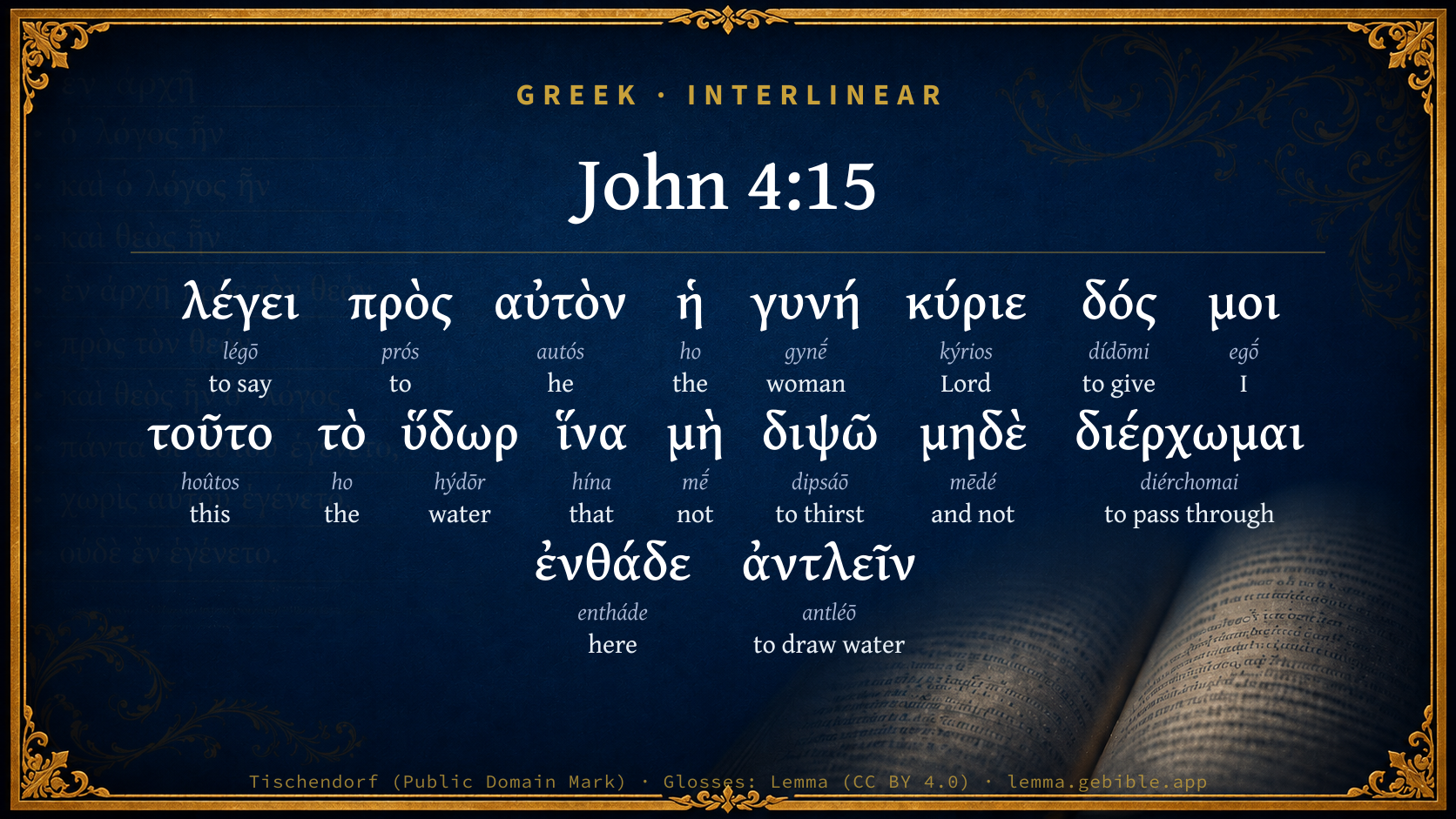
  1. λέγει légō G3004 “to say” Verb, Present, Active, Indicative, 3rd person, Singular
  2. πρὸς prós G4314 “to” Preposition
  3. αὐτὸν autós G846 “he” Personal pronoun, Accusative, Singular, Masculine
  4. ἡ ho G3588 “the” Article, Nominative, Singular, Feminine
  5. γυνή gynḗ G1135 “woman” Noun, Nominative, Singular, Feminine
  6. κύριε kýrios G2962 “Lord” Noun, Vocative, Singular, Masculine
  7. δός dídōmi G1325 “to give” Verb, Aorist, Active, Imperative, 2nd person, Singular
  8. μοι egṓ G1473 “I” Personal pronoun, 1st person, Dative, Singular
  9. τοῦτο hoûtos G3778 “this” Demonstrative pronoun, Accusative, Singular, Neuter
  10. τὸ ho G3588 “the” Article, Accusative, Singular, Neuter
  11. ὕδωρ hýdōr G5204 “water” Noun, Accusative, Singular, Neuter
  12. ἵνα hína G2443 “that” Conjunction
  13. μὴ mḗ G3361 “not” Particle, Negative
  14. διψῶ dipsáō G1372 “to thirst” Verb, Present, Active, Subjunctive, 1st person, Singular
  15. μηδὲ mēdé G3366 “and not” Conjunction, Negative
  16. διέρχωμαι diérchomai G1330 “to pass through” Verb, Present, Middle or Passive deponent, Subjunctive, 1st person, Singular
  17. ἐνθάδε entháde G1759 “here” Adverb

About this verse

These counts appear in no published source. They are computed here, from the morphology-tagged text and Lemma’s own curated glosses. What Lemma adds →

18
words
17
distinct lemmas
Gospels
section

Notable vocabulary

The rarest word here is ἀντλεῖν to draw water G501 — appearing just 4 times in the whole Greek New Testament.

Shared distinctive vocabulary

ἀντλεῖν to draw water G501 occurs in 4 verses of the Greek New Testament. Also found in:

Repetition

A word recurs within this verse:

Cross-references

8

Topical passages linked to John 4:15 in the Treasury of Scripture Knowledge — connected by theme and wording, ordered by reader-vote popularity; previews shown in the World English Bible.

  • John 6:34 They said therefore to him, "Lord, always give us this bread."
  • Psalms 4:6 Many say, "Who will show us any good?" Yahweh, let the light of your face shine on us.
  • Romans 8:5 For those who live according to the flesh set their minds on the things of the flesh, but those who live according to the Spirit, the things of the Spirit.
  • John 6:26 Jesus answered them, "Most assuredly I tell you, you seek me, not because you saw signs, but because you ate of the loaves, and were filled.
  • John 17:2–3 even as you gave him authority over all flesh, he will give eternal life to all whom you have given him.
  • Romans 6:23 For the wages of sin is death, but the free gift of God is eternal life in Christ Jesus our Lord.
  • James 4:3 You ask, and don't receive, because you ask with wrong motives, so that you may spend it for your pleasures.
  • 1 John 5:20 We know that the Son of God has come, and has given us an understanding, that we know him who is true, and we are in him who is true, in his Son Jesus Christ. This is the true God, and eternal life.

Cross-references courtesy of OpenBible.info (CC BY 4.0).

Commentary

Notes on John 4:15 from classic Christian and Jewish commentators (each source and its license shown beneath its notes). The classic Christian expositions comment on the surrounding passage and are grouped to its opening verse, so a note may address several verses; the Jewish commentaries on the Tanakh (Rashi and others) are per-verse, so they appear only where the commentator wrote on this verse.

Lemma curates 59 commentaries, every one of them public domain or Creative Commons licensed, each selected and text-cleaned for this edition rather than reprinted as found. About our sources →

The Biblical Illustrator

Joseph S. Exell

Joh_4:15

Sir, give me this water, that I thirst not.

--

The thirst of life and its satisfaction in Christ

I. The poor sinful heart--astray and deceived--UNSATISFIED.

II. The soul led aright and brought to itself by repentance--BEGINNING TO BE SATISFIED.

III. The soul transformed into purity and blessed life by grace--PARTIALLY SATISFIED.

IV. The soul in glory rejoicing in the beatific vision--FULLY SATISFIED.

The water of life

I. I AM TO TRY TO EXCITE YOUR DESIRE BY A DESCRIPTION OF THIS WATER. Spiritual things must be described by natural analogies. You must have water or you die. So must you have grace. Water is

1. Thirst removing.

2. Life preserving.

3. Filth purging.

4. Softening. The hardest heart yields before the power of the love of God.

5. Fire quenching. The fire of lust, envy, malice, anger, and unholy desire.

6. Spring creating. Wherever the water of life falls it makes a new spring, and never gets fiat, dull, or dead.

7. Fruit producing in proportion to the quantity we drink.

8. Heaven ascending. Water rises to its level. If we have grace that began with us it will never get higher than ourselves. If grace which the priest gave, no higher than the priest. But the true grace of God comes down from heaven, and will carry us whence it came.

II. TO CHEER YOUR HEARTS WITH SOME REFLECTIONS UPON THE LIKELIHOOD OF YOUR GETTING THIS LIVING WATER. Supposing that you want it.

1. No ordinary man would deny another water. The giving of grace by the Saviour no more than the giving of water by you.

2. If you would refuse water to some, you would not refuse it to the thirsty; and Jesus never refused a thirsty sinner yet.

3. There is plenty of it, and it is free. John speaks of a river. Who fears to exhaust the Thames? The source may be private, but as soon as it gets a considerable stream it becomes a public highway and water supply.

4. It flows on purpose for the thirsty. What could Christ have made an atonement for but for sinners?

5. No one has been refused yet.

6. It is to Christs glory to give it, and therefore be sure that He will not withhold it. The more a physician cures the greater his fame; the more Christ saves the higher His honour.

III. TO URGE YOU TO PRAY THIS PRAYER. A desire is like seed in the sack, but prayer sows it in the furrow: like water in the bottle, but prayer drinks thereof.

1. Begin, then, by honouring Christ. The woman gave Him the highest title she knew. You call Him Lord; for if you reject His divinity you shut yourself out from His kingdom.

2. Confess your undeservingness. Give, not sell. Mercy must be given.

3. Make this a personal prayer. Give it me. Never mind your neighbours or your children just now. Look after their salvation when you are saved.

4. Offer it in the present tense. The worst of most men is that they would serve the devil all their lives and then cheat him of their souls at last. If God be God serve Him now. (C. H. Spurgeon.)

Spiritual laziness

The spirit of the second reason for this request animates men to this day. The prevalent disposition is to seek religious benefit in some way which does not involve endeavour and responsibility.

I. MEN DO NOT EXPECT PHYSICAL RESULTS EXCEPT BY APPROPRIATE EFFORT. Parents do not pray that God would inspire their boys with a useful trade. They apprentice them and pray God that they may attend to their business and take proper steps to learn. Skill of hand is to be developed by training and not by praying. There are those who still speak of luck, but the number decreases with intelligence and enterprise.

II. MEN DO NOT LOOK FOR INTELLECTUAL RESULTS EXCEPT BY THE APPLICATION OF MEANS TO ENDS.

1. We never pray for general knowledge, nor teach our children to do so; but to use their eyes and ears, to keep company with intelligent persons. And this is not inconsistent with the prayer that God will sustain us in the exertion of our natural faculties. So no one prays for books, or the results of professional skill without the drill which leads to them.

2. There is one apparent exception, that of genius. But genius is only what belongs to one whose organization is so fine and large that it acts by its own stimulus. If on the art side, we have an art genius. A man is a genius in the direction in which his faculties are highly organized. Such work more easily than others, but they have to work much. The eagle moves faster and easier than the ant, but both move by the same (muscular) power. And the greatest geniuses in poetry (Milton), in music (Handel), in war (Frederick and Napoleon), have been the hardest workers.

III. BUT MEN DO LOOK FOR RELIGIOUS RESULTS WITHOUT PERSONAL EFFORT.

1. There is an impression that God works irresistibly by His Spirit, and that the distinguishing qualities of Christian life fall down upon us of their own accord like dewdrops on the flowers. Now we must pray for everything that it is proper for us to have, for the highest as well as for the lowest; but there is no more reason that we should pray for morality than for corn, for meekness than for flowers.

2. Religiousness is rightmindedness towards God and man. To be religious is to act in accordance with the laws of the mind from the highest to the lowest of its endowments. I should have, of course, no hope as a minister without a belief in the all-prevalent vitalizing Spirit, and should as soon attempt to raise flowers where there was no atmosphere, and fruits without light and heat, as to regenerate men without the Holy Ghost. Nevertheless this Divine influence is not irresistible in such a sense as to relieve men from the responsibility of developing every one of the spiritual elements. God wakes up the soul and then says, Work out what I work in Php_2:12-13).

3. Conversion is not a completed work. Here is a lazy vagabond, depending on his relations, and he is taken to the West and put upon 150 acres of ground and told to work out his own living. The ground is not converted yet; but he goes to work and brings it under cultivation. He has been converted from a street beggar into a man of means and respectability; but his own conversion is no more complete than that of his farm. When a man is converted he has a new start and has to go forward. If a man, therefore, expects there is any labour-saving conversion he is greatly mistaken.

4. Conversion makes a man a disciple, and places him in Christs school, where he has to learn and place himself under discipline. And the experiences of Christs school are not to be had by prayer only. If an intemperate man wants to be temperate, a passionate man meek, a proud man humble, he must not only pray, but tame himself. (H. W. Beecher.)

Carnal pleasures tire

Hilly ways are wearisome ways, and tire the ambitious man. Carnal pleasures are dirty ways, and tire the licentious man. Desires of gain are thorny ways, and tire the covetous man. Emulations of higher men are dark and blind ways, and tire the envious man. Every way that is out of the way wearies us. Lassati sumus, et lassis non datur requies; we labour, and have no rest when we have done; we are wearied with our sins, and have no satisfaction in them; we go to bed to-night, weary of our sinful labours, and we will rise freshly to-morrow to the same sinful labours again (Lam_5:5; Isa_5:18). (Dr. Donne.)

The heavenly and the earthly mind

Never was there such a contrast in a conversation as that presented in the conversation between Christ and the woman of Samaria. Christ speaking from the top of all spiritual apprehension, the woman from the bottom of sensuous knowledge. (H. W.Beecher.)

Spiritual thirst prepares us to receive the living water

They say that the water of the Nile is very sweet. We have heard some of our fellow-countrymen assert that a very little of it was too much for them, and that they never wished to drink of it again. There is no use in disputing about tastes, but surely people might agree upon the quality of the water. Yet some praise this Nile water to the skies, and others call it muddy stuff. The reason why the water of the Nile is so sweet to Egyptians is that their climate is dry, and the people are thirsty, and other water is scarce. Under a burning sun a drink of water is very refreshing. To the soul that is thirsty after mercy and reconciliation and eternal life, every promise of the Lord is delightful. Nothing puts such a savour and flavour into the gospel as that work of the Holy Spirit, by which we are made to feel our great need of it. (C. H.Spurgeon.)

Mercy a free gift

It is not Sell me this water, but Give me this water. Confess that it is a gift: thou shalt never have it otherwise. Mercy must be given, or thou shalt never have it. Sir, give me, give me, give me of Thy free mercy, give it me, Lord. I come empty-handed, naked, poor and miserable, Give it me. I have nought to buy it with. Friend, does your pride kick at this? Be wise, I pray thee, and bow thy neck to the yoke of grace. (C. H. Spurgeon.)

Salvation must be realized by the soul

You go to the throne of grace; to a fountain deeper than Jacobs well; you draw water, living water, from it; but, instead of drinking the water, as you should, you are satisfied with having raised the bucket to the ground, and you retire. The end of drawing water is to drink it: the meaning of praying is to reach something beyond it. Prayer is not a religious duty, but the means of attaining spiritual blessings. (J. Cumming, D. D.)

The Biblical Illustrator, edited by Joseph S. Exell (c. 1880s–1900s) — public domain. Text from a community e-Sword module.

Tyndale Open Study Notes

Tyndale Open Resources

4:15 The woman asked Jesus for this water, but she did not grasp the spiritual implications of his words. To overcome the spiritual barrier, Jesus addressed her sin (4:16-18).

Tyndale Open Study Notes — © Tyndale Open Resources, licensed CC BY-SA 4.0. Text via the HelloAO Bible API.

Bengel's Gnomon

Johann Albrecht Bengel

Joh 4:15. Δός μοι, give me) The woman asks for the water, as the Jews asked bread, ch. Joh 6:34, “Lord evermore give us this bread,” for the support of the body. By this time the matter is come to that point, that the woman says, give; to whom before the same word had been addressed [by Jesus] “Give Me to drink,” Joh 4:7.—ἔνθαδε, hither) with toil. She wishes to have at home that fountain.

Bengel's Gnomon of the New Testament — English translation (T&T Clark, Edinburgh, 1860) — public domain. Text from a community e-Sword module.

Meyer's Critical & Exegetical Commentary

Heinrich August Wilhelm Meyer

Joh_4:15-16. The woman as yet having no apprehension of the higher meaning of the water spoken of (against B. Crusius, Lange), yet being in some degree perplexed, asks, not in irony, as Lightfoot and Tholuck think, but sincerely, for this wonderful water, which at any rate must be of great use to her.

Jesus breaks off suddenly, and commences, by a seemingly unimportant request, Call thy husband, to lay hold of the woman in her inner life, so that the beginnings of faith in Him might be connected with His supernatural knowledge of her peculiar moral relations. This process must be accompanied with the awakening in her of a sense of guilt (see Joh_4:29), and thus pave the way for μετάνοια; and who dare deny that, besides the immediate object, this may have been included in the purposes of Jesus? though He does not directly rebuke, but leaves the feeling to operate of itself (against Strauss and most others).

φώνησ. τ. ἄνδρα σου] We are not to ask here what the husband was to do (Chrysostom, Euthymius Zigabenus: that he might partake with her of the gift of salvation that was before her; so also Lücke); because the command was only an apparent one, not seriously intended, for Jesus knew the relations of the woman, and did not merely discover His prophetic gift by the answer she gave, as Lücke and Godet quite gratuitously assume. The τ. ἄνδρα σου was the sore spot where the healing was to begin. According to Lange, L. J. II. p. 530 f., it would have been unseemly if Jesus, now that the woman showed a willingness to become His disciple (?), had continued to converse longer with her in her husbands absence; His desire, therefore, was in keeping with the highest and finest sense of social propriety. But the husband was nothing more than a paramour!

ἐλθέ] in the sense of come back, as the context shows. See Hom. Od. a. 408, β. 30; Xen. Anab. ii. 1. 1, v. 1. 4; Bar_4:37; Tob_1:18; Heind. ad Plat. Prot. p. 310 C. Comp. Joh_14:18; Luk_19:13.

Meyer — Critical and Exegetical Commentary on the New Testament — English translation by Peter Christie, edited by Frederick Crombie (T&T Clark, 1880) — public domain. Text from a community e-Sword module.

Expositor's Greek Testament

ed. W. Robertson Nicoll

Joh 4:15 . The woman, with her mind still running on actual water, says Κύριε … ἀντλεῖν . She is attracted by the two qualities of the water, and asks it (1) ἵνα μὴ διψῶ , (2) μηδὲ ἔρχωμαι ἐνθάδε ἀντλεῖν .

The Expositor's Greek Testament, edited by W. Robertson Nicoll (1897–1910) — public domain. Text from a community e-Sword module.

Jamieson, Fausset & Brown

Robert Jamieson, A. R. Fausset & David Brown

give me this water, &c.--This is not obtuseness--that is giving way--it expresses a wondering desire after she scarce knew what from this mysterious Stranger.

Jamieson, Fausset & Brown — Commentary Critical and Explanatory on the Whole Bible (1871) — public domain (CC PDM 1.0). Text via the HelloAO Bible API.

Adam Clarke's Commentary

Verse 15. Give me this water] She did not as yet comprehend our Lord's meaning; but her curiosity was much excited, and this was the design of our Lord, that he might have her mind properly prepared to receive the great truths which he was about to announce.

Adam Clarke's Commentary on the Bible (1810–1826) — public domain. Text from a community e-Sword/MySword module.

John Calvin's Commentaries

15. Give me this water. This woman undoubtedly is sufficiently aware that Christ is speaking of spiritual water; but because she despises him, she sets at naught all his promises; for so long as the authority of him who speaks is not acknowledged by us, his doctrine is not permitted to enter. Indirectly, therefore, the woman taunted Christ, saying, “Thou boastest much, but I see nothing: show it in reality, if thou canst.”

John Calvin's Commentaries (1540-1563) — public domain. Text from the Calvin Translation Society English edition (1840s-50s) via the Christian Classics Ethereal Library (ccel.org). Calvin's coverage is partial (roughly two-thirds of the Bible); uncommented books and verses are honest gaps, never fabricated. The 19th-century editor's footnotes and remarks are omitted so the notes are faithfully Calvin's own voice.

Ellicott's Commentary for English Readers

(15) Come hither.—The Sinaitic and Vatican and some other MSS. read, “come through hither,” or as Alford, who adopts the reading, renders it, “come all the way hither.” Godet also adopts the reading, but renders it, in the service of a forced explanation, “pass by here,” thinking that the woman was on her way home from work at meal-time, and that this accounts for her presence at the well at noon. He regards this as sans doute, but the reading itself is at least uncertain, and is probably to be explained by its first syllable being added from the last syllable of the previous word; and the translation is more than uncertain.

The woman understands the words in their physical sense. How many a toilsome hour, how many a weary journey would she be saved!

A Bible Commentary for English Readers, edited by Charles John Ellicott (1878–1897) — public domain. Text from a community e-Sword module.

The Cambridge Bible for Schools and Colleges

gen. ed. J. J. S. Perowne

15. She still does not understand, but does not wilfully misunderstand. This wonderful water will at any rate be worth having, and she asks quite sincerely (not ironically) for it. Had she been a Jew, she could scarcely have thus misunderstood, this metaphor of ‘water’ and ‘living water’ is so frequent in the Prophets. Comp. Isa_12:3; Isa_44:3; Jer_2:13; Zec_13:1; Zec_14:8. But the Samaritans rejected all but the Pentateuch.

to draw] Same word as in Joh_2:8-9; peculiar to this Gospel.

The Cambridge Bible for Schools and Colleges (gen. ed. J. J. S. Perowne; Cambridge University Press, 1878–1918) — public domain. Text from a community e-Sword module.

John Gill's Exposition

The woman saith unto him, Sir,.... See Gill on Joh 4:11;

give me this water, that I thirst not. The Syriac and Persic versions add, "again":

neither come hither; the Ethiopic version adds here, "again";

to draw. This she said also, in the same sneering and scoffing way, as her talking of not thirsting and coming thither to draw water, shows; and it is as if she had said, pray give me some of this fine water you talk of, that I may never thirst again; and so have no occasion to be at all this fatigue and trouble, to come daily to this well for water: though some think, that she now spoke seriously, having some little knowledge of what our Lord meant by living water, but with a mixture of much ignorance, and that she heartily desired it; but the reason she gives, shows the contrary.

John Gill's Exposition of the Whole Bible (1746–1763) — public domain (CC PDM 1.0). Text via the HelloAO Bible API.

Trapp's Complete Commentary

John Trapp

15 The woman saith unto him, Sir, give me this water, that I thirst not, neither come hither to draw.

Ver. 15. Sir, give me this water] We would all have immortality, but here on earth. Some think she jeers our Saviour here; who therefore in the next words arouseth her conscience.

John Trapp, A Commentary or Exposition upon All the Books of the Old and New Testament (1647–1656) — public domain. Text from a community e-Sword module.

Albert Barnes' Notes on the Bible

The woman said ... - It may seem strange that the woman did not yet understand him, but it shows how slow sinners are to understand the doctrines of religion.

Albert Barnes' Notes on the Bible (1834–1885) — public domain. Text from a community e-Sword/MySword module.

Haydock's Catholic Bible Commentary

Sir, give me this water. The woman, says St. Augustine, does not yet understand his meaning, but longs for water, after which she should never thirst. (Witham)

George Leo Haydock (1774–1849), Haydock's Catholic Family Bible and Commentary, 1859 edition — public domain. Excludes Psalms (Douay-Rheims chapter numbering differs from Protestant) and Deuterocanonical books (Catholic canon only).

Matthew Poole's English Annotations

I am not of their mind, who think that this woman understood our Saviour speaking about spiritual water, only she had a mind to talk; and indeed it is hard to conceive how a woman of her education, and way of life, should understand any such thing; but it is plain that she did not understand him in what he was discoursing about, but doth, as it were, deride him, believing that he had no such thing to bestow. She taketh no notice of the water which our Saviour had spoken of, springing up to eternal life; but regarding only the present life, and her ease in that, desires favour of Christ only to supply her wants in this life, and that she might live more at ease: so true is that of the apostle, Rom 8:5, They that are after the flesh do mind the things of the flesh.

Matthew Poole's English Annotations on the Holy Bible (1683–1685) — public domain. Text from a community e-Sword/MySword module.

Whedon's Commentary on the Bible

Daniel D. Whedon

15. Sir, give me this water—Her reverent Sir, or Lord, indicates that this is no feigned or sarcastic supplication. Yet there is scarce anything truly spiritual in her request. She asks only a divine draught that shall give exemption from bodily thirst, and from this labour of coming, drawing, and carrying. She is reluctant to rise to the full spirituality of his words or of his character. Jesus will now so direct the conversation as to furnish her proof that he is a prophet of God, and that his words express divine spiritual truth.

Daniel D. Whedon (gen. ed.), Commentary on the Old and New Testaments (1874–1909) — public domain. Text from a community e-Sword module.

The Pulpit Commentary

The woman has not yet emerged out of the region of her physical desires and her daily requirements, and needs a deeper apprehension of her real necessities. By reason of the subsequent narrative she ought not to be credited now with impertinence or irony (Lightfoot, Tholuck). She could not understand the miraculous water of which the Stranger spake, but had some dim notion that he might be able to deliver her from her toilsome and exhausting life. She replies to him, Sir, give me this water, that I thirst not, neither come all the way hither to draw.

The Lord had spoken of eternal life, and she is content to have temporal satisfaction to the extent of thirsting no more. Some commentators, with Lange and Hengstenberg, suppose that the journey to Jacob"s well was in her mind a quasi-religious act, the insufficiency of which to meet her case is at length becoming apparent. This view seems to us inconsistent with the sudden change of metaphor and alteration of his method of approach to this woman"s consciousness and need. He resolved rather to search her heart and reveal her to herself to bring forth from its hiding place the torpid conscience, and reveal to her the grievous need in which she stood of that Divine cleansing, healing, nutrition, refreshment, which he had been sent into the world to supply. This reflection renders the reply of Jesus less obscure than its abrupt transition seems to imply.

Vers. 15-20. A serious turn to the conversation.

I THE ARRESTED ATTITUDE OF THE SAMARITAN WOMAN. "Sir, give me this water, that I thirst not, neither pass this way to draw." She is still ignorant of the meaning of his words, but she begins to have a dim apprehension of something behind them profoundly touching her life. We cannot otherwise understand the next phase of the conversation.

II OUR LORD LIFTS THE VEIL FROM HER PAST LIFE, AND THUS REVEALS HIMSELF AS A PROPHET, AND MORE THAN A PROPHET. "Go, call thy husband.

1. He desires to link with her in the coming blessing the man whose life was then unworthily linked with her own.

(1) He aims to purify family life.

(2) He desires to make the regenerate family the nucleus of evangelistic effort.

2. Mark the sincerity of her answer. "I have no husband." It signifies that she was not wholly depraved, or that her heart had already begun to respond to the searching ordeal of Christ. There is sadness in the confession.

3. The answer of Jesus lays bare the secrets of her past life. "Thou hast well said, I have no husband: for thou hast had five husbands; and he whom thou now hast is not thy husband.

(1) She had probably lost her five husbands, not by death, but by her personal misconduct, as may be inferred from the circumstances of her present relation; for the Samaritans, unlike the Jews, allowed divorce for no other cause than adultery.

(2) The conduct of Christ in this case suggests that

(a) private sins are to be rebuked privately;

(b) without passion or severity;

(c) and with a particular application of the Word to the conscience of the transgressor.

III THE SINGULAR TURN WHICH THE WOMAN GIVES TO THE CONVERSATION. "Sir, I perceive that thou art a Prophet. Our fathers worshipped in this mountain; and ye say, that in Jerusalem is the place where men ought to worship.

1. The words may have been spoken to parry the stroke at her conscience, though she implicitly confesses her sin, and does not attempt to deny or excuse it.

2. Yet her discovery of a prophet, who knows the depths of her soul, suggests the religious question that seems to have already occupied her mind (ver. 25), and especially the question respecting the true worship of the Lord.

3. She submits to our Lord the antagonism between Samaritan tradition and Jewish practice.

(1) Gerizim, which was the centre of Samaritan worship, dated its sacredness from the time of Nehemiah. Though it had an earlier history, it was dear to the Samaritans as the site of their worship for at least five hundred years.

(2) She is fully aware of the exclusive claims of the Jewish temple at Jerusalem.

(3) She looks to the Prophet, who has disclosed her inner life, to determine the rival claims of Gerizim and Jerusalem.

The Suppliant supplicated.

Our Lord Jesus was so truly Divine that he had only to be in the society of human beings who had any spiritual susceptibility and power of appreciation, in order to awaken their reverence and to call forth their confidence. Such proved to be the case in this memorable incident.

I A CHANGE OF SPIRITUAL ATTITUDE IS HERE EXHIBITED. At first Jesus had asked water from the Samaritan woman, who seemed almost reluctant to grant so small a favour, and who laid stress upon nationality rather than upon humanity. But a short conversation wrought a marvellous change. And soon the woman came to beg for living water from him who had just before asked from her a draught from Jacob"s well. How many have listened to the gospel, have turned their gaze towards Christ, with indifference, and even with a kind of ignorant condescension, who, upon knowing more of him, have exchanged indifference and contempt for reverence and faith! There are those who consider that a favour is asked from them by the ministers of religion when they are urged to accept the Lord Jesus; who seem to suppose that their adhesion would be a boon, if not to the Saviour, yet to his people. Let such persons really come into spiritual contact with Christ, and the case will be altogether changed. They will then see that they have nothing to give, and all to gain, and the Divine Benefactor of humanity will be approached with humble entreaty.

II THE ATTRACTION EXERCISED BY THE DIVINE WATER OF LIFE IS HERE ILLUSTRATED.

1. We discern, on the part of the Samaritan woman, the desire for personal satisfaction. "That I thirst not" is a plea that personal cravings may be stilled and personal wants supplied. Let Christ"s gift be understood, and the approach of it will excite the longing of the needy spirit.

2. We perceive also the desire to take to others, by a ministry of help, a Divine satisfaction. "Neither come hither to draw" is language which reminds us that the woman came to the well, not only to supply her own need, but to fetch water for her household. Could Jesus help her to minister to the wants of others in some way more satisfactory and less tedious than that to which she was accustomed? Experience shows that to realize, not only our own wants, but the wants of those connected with and dependent upon us, is increasingly to appreciate that spiritual provision which is symbolized by the living water.

III APPLICATION TO THE TRUE SOURCE FOR THE WATER OF LIFE IS HERE EXEMPLIFIED. With all her faults, there were in this woman a clearness of thinking, a directness of language, and a candour of disposition which we cannot but admire. Once convinced that the mysterious Stranger before her had great gifts to confer, she promptly sought the promised good. The directness of her appeal, in which was no qualification, is an example to all who approach Christ. Those whom the gospel reaches, and who are convinced that the Lord Jesus is the Spring of life eternal to mankind, are reminded that they should apply without delay to the Personal and Divine Source of the highest blessing, with the assurance, which his character inspires, that they cannot ask of him in vain. T.

The Pulpit Commentary (1880–1919), ed. H.D.M. Spence-Jones & Joseph S. Exell — public domain. Text from a community e-Sword module.

John Wesley's Explanatory Notes

That I thirst not - She takes him still in a gross sense.

John Wesley, Explanatory Notes Upon the Whole Bible (1754–1765) — public domain. Text via the GEBible commentary corpus.

Burkitt's Expository Notes on the New Testament

William Burkitt

These words set forth unto us, 1.What manner of person this woman was, whose conversion Christ sought so industriously after.

2. The means he used in order to that end.

Observe, 1. What manner of person this woman was; besides that she was an idolater, as being a Samaritan, she was also an adultress, and lived now in the sin of uncleanness with one that was not her husband, after she had five husbands before.

Whence we learn, That the ice of old age will not quench the fire of lust, concupiscentia non senescit: such is the pollution of our nature, that lust will be insatiable, if grace doth not restrain it. This woman, after five marriages, yet lives in the sin of uncleanness.

Observe, 2. The way and manner our Lord takes, the method and means our Lord uses, in order to her conversion.

1. He deals very tenderly and gently with her; he doth not call her whore, nor upbraid her for her impudent lewdness, in living with a man that was none of her husbands, but only gives her to understand that he knew the sin she lived in; yet this he did likewise with all imaginable privacy, whilst his disciples were away, and no body by but they two only.

Hence learn, 1. That private sins are not to be reproved publicly.

2. That, in reproving sin, all sharpness and bitterness of expression must be avoided; the pill of reproof must be wrapped up in sugar; for if they to whom it is given, taste the bitterness of gall and passion mixed with it, they will certainly spit it out before, it may be upon, our faces. Our Lord’s practice here instructs us, that sin is to be so reproved, as that the credit and estimation of the sinner may be preserved as much as may be.

Note, 2. That as Christ dealt with this woman tenderly and gently, so he discovers her sin to her particularly, and sets her secret sin before the face of her conscience distinctly. If ever the ministry of the word works upon the minds of men to their conversion, it must be by a particular and close application of the word to every man’s conscience: generals will not affect.

Note, 3. What the particular sin is, which Christ charges home upon the conscience of this woman: it is the sin of uncleanness, that the man she kept with, was not her husband.

Learn hence, That, amongst all sins, the sin of uncleanness will lie heaviest upon the conscience, and wound the soul most deeply, when the Spirit of God once effectually discovers it, and charges it home upon the conscience. For there is no sin so directly opposite to sanctificaton and holiness, as this sin: no sin that quenches the Holy Spirit of God like this.

William Burkitt's Expository Notes on the New Testament (1700–1703) — public domain. Text from a community e-Sword module.

The People's New Testament

B. W. Johnson

15. Sir, give me this water, that I thirst not. The mysterious words of the Jewish stranger she cannot yet understand, but she is deeply stirred, and one thing seemed plain—if she could have this water she would thirst no more.

B. W. Johnson's The People's New Testament with Notes (1889–1891) — public domain. Electronic text from the Christian Classics Ethereal Library (CCEL) ThML edition.

unfoldingWord translationNotes

Door43 World Missions Community

Sir

In this context, the Samaritan woman is addressing Jesus as "Sir," which is a term of respect or politeness.

draw water

"get water" or "pull water up from the well" using a container and rope

translationWords

lord

water

unfoldingWord translationNotes — © Distant Shores Media and the Door43 World Missions Community, licensed CC BY-SA 4.0. Source: git.door43.org/Door43/en_tn.

Cambridge Greek Testament for Schools and Colleges

15. She still does not understand, but does not wilfully misunderstand. This wonderful water will at any rate be worth having, and she asks quite sincerely (not ironically) for it. Had she been a Jew, she could scarcely have thus misunderstood; this metaphor of ‘water’ and ‘living water’ is so frequent in the Prophets. Comp. Isa 12:3; Isa 44:3; Jer 2:13; Zec 13:1; Zec 14:8. But the Samaritans rejected all but the Pentateuch. With διέρχωμαι comp. Luk 2:15; Act 9:38.

Cambridge Greek Testament for Schools and Colleges (Cambridge University Press, 1896; 21 vols, various authors incl. Carr, Maclear, Plummer, Farrar, Lumby, Moule, M. R. James, Simcox) — public domain. Text from a community e-Sword module.

Alford’s Greek Testament

Henry Alford

15.] This request seems to be made still under a misunderstanding, but not so great an one as at first sight appears. She apprehends this water as something not requiring an ἄντλημα to draw it;—as something whose power shall never fail;—which shall quench thirst for ever;—and half in banter, half in earnest, wishing perhaps besides to see whether the gift would after all be conferred, and how,—she mingles in with the τοῦτο τὸ ὕδωρ,—implying some view of its distinct nature,—her ‘not coming hither to draw,’—her willing avoidance of the toil of her noonday journey to the well. We must be able to enter into the complication of her character, and the impressions made on her by the strange things which she has heard, fully to appreciate the spirit of this answer.

Henry Alford, The Greek Testament (1849–1861) — public domain. Text from a community e-Sword module.

International Critical Commentary

15. λέγει πρὸς αὐτόν. For the constr., see on 2:3. For κύριε. Cf. v. 11.

δός μοι τοῦτο τὸ ὕδωρ. Cf. 6:34 δὸς ἡμῖν τὸν ἄρτον τοῦτον. The woman did not understand Jesus, words about the Water which assuages thirst for ever; and her reply is a puzzled request: “Give me this water, that I may not be thirsty, and need not come hither continually to draw from the well.” She speaks half in irony; for she does not believe in any πηγὴ ὕδατος such as Jesus had incomprehensibly spoken of as being “in” the recipient of His gift.

The rec. text has ἔρχωμαι with ACDWΓΔΘ; but א*B support διέρχωμαι. As Field points out, διέρχωμαι may have arisen from a mistake in transcribing μηδεερχωμαι; but in any case the prep. διά does not add special force to the verb here (cf. Luk 2:15).

ἵνα μὴ διψῶ κτλ. For ἵνα with the pres. subj., cf. 6:29, 1Jn 1:2, 1Jn 2:27, 1Jn 5:3.

International Critical Commentary — older volumes (1896–1929), various authors — public domain. Text from a community e-Sword module.

Godet's Commentaries

Frédéric Louis Godet

Ver. 15. “The woman says to him: Sir, give me this water, that I may not thirst, neither pass this way to draw.”

This woman’s request has certainly a serious side. The respectful address, Sir, is sufficient to prove this. It follows likewise from the grave character of the answer of Jesus. Even though the absence of spiritual wants causes her not to understand, she is impressed; can this man indeed have the power of working such a miracle? Nevertheless, the expression of the desire which she experiences to have her life made more comfortable has in it something naive and almost humorous.—The last words reproduce the promise of Jesus: “shall not thirst.” The reading of the two oldest MSS.: “that I pass no more this way,” instead of: that I come hither no more, should undoubtedly be adopted. No one would have substituted this for the received reading. It confirms the idea that we have expressed: namely, that the woman was merely passing that way, as she returned to her house.

The first phase of the conversation is closed. But Jesus has raised a sublime ideal in this woman’s imagination—that of eternal life. Could he abandon her before having taught her more on this subject, since she had thus far shown herself teachable.

Frédéric Louis Godet — Commentaries on Luke, John, Romans, and 1 Corinthians — English translation (T&T Clark, Edinburgh, 1870s–1890s) — public domain. Text from a community e-Sword module.

Lesson kit

Teaching starters — assembled from the data on this page, not authored interpretation. Every prompt links to the verse data it draws on. Edit before teaching.

John, in the Gospels, opens this verse with 18 words (17 distinct Greek lemmas). Its most distinctive word is antléō (“to draw water”). A historical commentator’s framing appears above. Read the whole chapter for the surrounding context.

Discussion questions

  1. How does “to draw water” (antléō) shape what this verse is saying?
  2. How does John 2:8, which shares the word «to draw water», read alongside this verse?
  3. What does the repetition of “the” (2× in this one verse) do in this verse?
  4. These translations render this verse differently. What is at stake in choosing one wording over another?
  5. Compare how The Biblical Illustrator and Tyndale Open Study Notes read this verse. Where do they agree or differ?

Things to notice

Reading settings

Reading text

Shown beneath each verse's original-language words.

Old Testament
Old Testament edition

Read the OT as the Masoretic Hebrew (MT) or the Greek Septuagint (LXX).

English shown for the Greek Septuagint (in the Hebrew ↔ Greek comparison).

Comparing translations? Open the Compare panel on any verse page to stack up to four side by side.