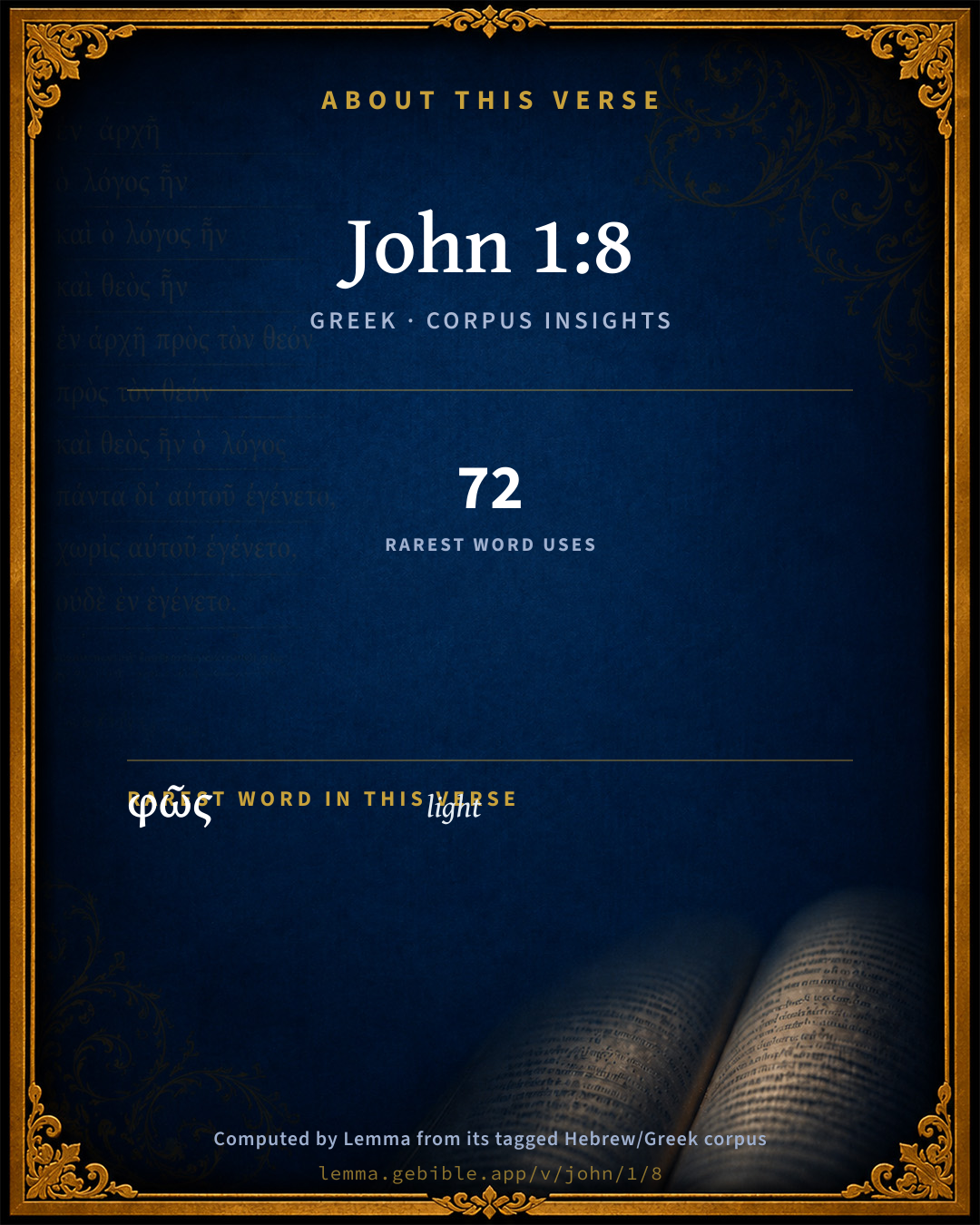
John 1:8

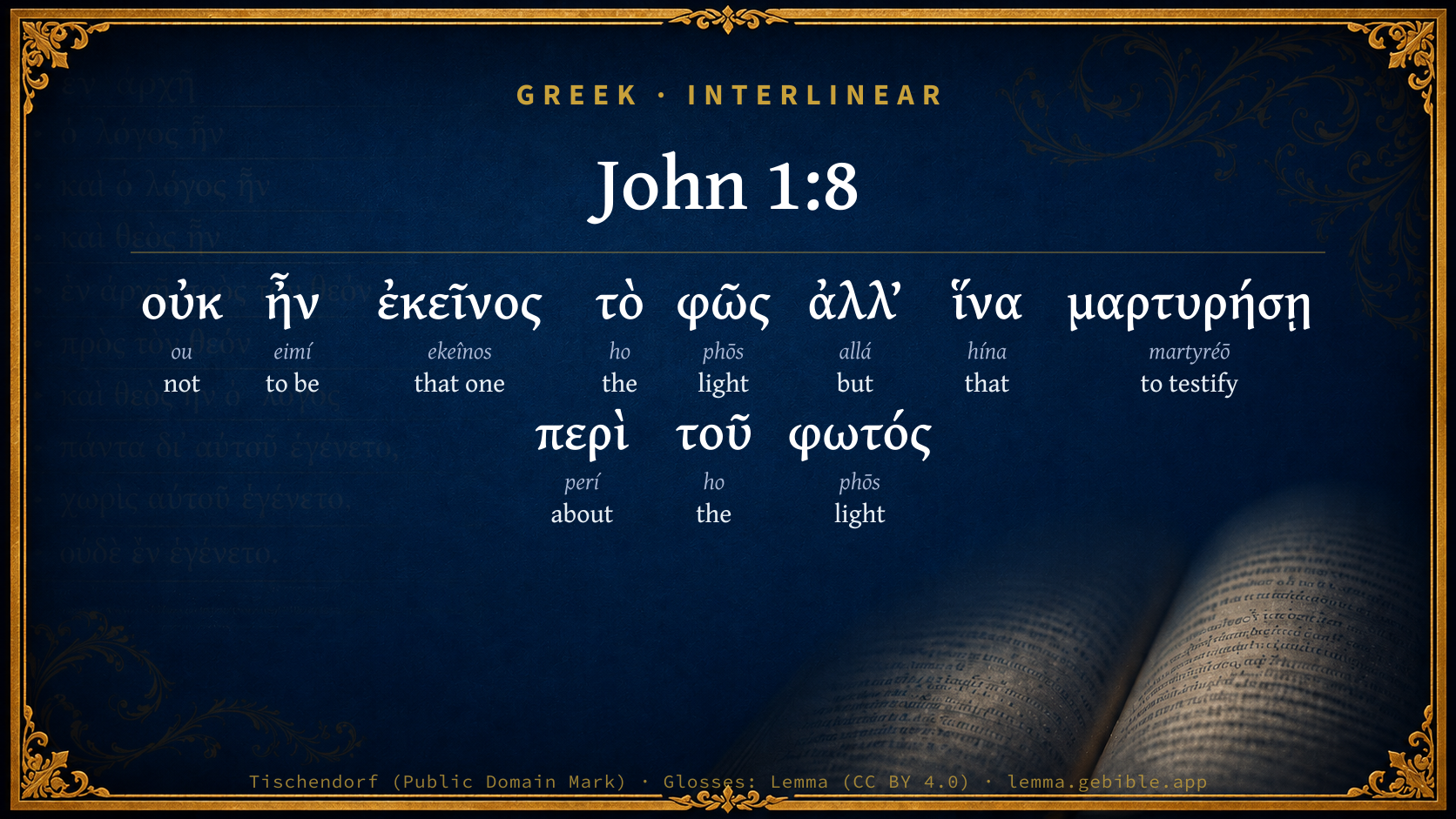
Greek (Tischendorf 8th ed.) John 1:8 appears in the Greek New Testament. The text above is from the Tischendorf 8th edition. Each word links to its Strong’s number and a concise gloss. Click any word for its full Thayer’s Greek Lexicon entry.
Download image
Cite this verse

John 1:8 (World English Bible). Public Domain. Lemma interlinear Bible study tool, https://lemma.gebible.app/v/john/1/8.

Show BibTeX & RIS
BibTeX
RIS
English Translation
He was not the light, but was sent that he might testify about the light.
World English Bible · Public Domain
Download a study sheet

One document with this verse’s original text, its word-by-word gloss line, the meaning frame, cross-references with their text, attributed commentary, and full source and license credits — printable, and it pastes into notes with its structure intact.

This verse Autodidact and up

Study sheet (.html) Plain text (.txt)

A passage Seminary Student

Up to 50 verses in one chapter. A passage sheet keeps up to 6 commentary sources and 12 cross-references per verse, in the order this page ranks them, and says so on the sheet whenever that leaves anything out. Ask for a single verse and you get the Autodidact verse sheet above.

Everything on this page stays free to read, with no account — the sheet is a download of what is already on screen, not access to it.

Want to remove ads? Support Godless Engineer
Compare translations 3

The same verse in 3 English versions, stacked beneath the original-language interlinear above. Click any original word for its lexicon entry.

Each is an independent rendering of the whole verse — the interlinear is not word-aligned to these translations.

Highlighted words mark where these versions differ — a whole-verse word diff, not a word-by-word alignment.

  • World English Bible Public Domain
    He was not the light, but was sent that he might testify about the light.
  • King James Version Public Domain
    He was not that Light, but was sent to bear witness of that Light.
  • unfoldingWord Literal Text CC BY-SA 4.0
    That one was not the light, but so that he might testify about the light.

unfoldingWord Literal Text — © unfoldingWord, licensed CC BY-SA 4.0. Word-aligned USFM3 via Door43 (git.door43.org/unfoldingWord/en_ult).

Versions to compare (up to 4)

3 of 4 selected

Show all 19 translations

Every available English version of this verse, each an independent rendering of the whole verse.

  • World English Bible Public Domain
    He was not the light, but was sent that he might testify about the light.
  • Berean Standard Bible Public Domain
    He himself was not the Light, but he came to testify about the Light.
  • Majority Standard Bible Public Domain
    He himself was not the Light, but he came to testify about the Light.
  • King James Version Public Domain
    He was not that Light, but was sent to bear witness of that Light.
  • American Standard Version (1901) Public Domain
    He was not the light, but `came' that he might bear witness of the light.
  • Revised Version (1885) Public Domain
    He was not the light, but came that he might bear witness of the light.
  • Geneva Bible (1599) Public Domain
    He was not that light, but was sent to beare witnesse of that light.
  • Douay-Rheims (1899) Public Domain
    He was not the light, but was to give testimony of the light.
  • Young's Literal Translation Public Domain
    that one was not the Light, but -- that he might testify about the Light.
  • Literal Standard Version CC BY-SA 4.0
    that one was not the Light, but—that he might testify about the Light.
  • Unlocked Literal Bible CC BY-SA 4.0
    John was not the light, but came that he might testify about the light.
  • unfoldingWord Literal Text CC BY-SA 4.0
    That one was not the light, but so that he might testify about the light.
  • Darby Bible Public Domain
    *He* was not the light, but that he might witness concerning the light.
  • World Messianic Bible Public Domain
    He was not the light, but was sent that he might testify about the light.
  • Webster's Bible Public Domain
    He was not that Light, but was sent to bear testimony of that Light.
  • Free Bible Version CC BY-SA 4.0
    He himself was not the light, but he came to witness to the light.
  • Bible in Basic English Public Domain
    He himself was not the light: he was sent to give witness about the light.
  • Text-Critical English NT CC BY 4.0
    He himself was not the light, but he came to testify about the light.
  • Tyndale New Testament (1534) Public Domain
    He was not that lyght: but to beare witnes of the lyght.

Literal Standard Version (2020), Covenant Press — licensed CC BY-SA 4.0. Text via the HelloAO Bible API (eBible.org). Unlocked Literal Bible (unfoldingWord) — licensed CC BY-SA 4.0. Text via the HelloAO Bible API (eBible.org). unfoldingWord Literal Text — © unfoldingWord, licensed CC BY-SA 4.0. Word-aligned USFM3 via Door43 (git.door43.org/unfoldingWord/en_ult). Free Bible Version, Dr. Jonathan Gallagher — licensed CC BY-SA 4.0. Text via the HelloAO Bible API (eBible.org).

Word by word

More ways to search: Search by grammar → Find every occurrence → Compare this word →

Practice this passage: Drill this verse → Learn its vocabulary →

φῶς
phōs
G5457
“light”
Noun, Nominative, Singular, Neuter
Part of Speech
Noun
Case
Nominative
Number
Singular
Gender
Neuter
Full Thayer's Definition

Origin: from an obsolete phao (to shine or make manifest, especially by rays, cf G5316 , G5346 )

TDNT: 14:10,1

1. light a. the light 1. emitted by a lamp 2. a heavenly light such as surrounds angels when they appear on earth b. anything emitting light 1. a star 2. fire because it is light and sheds light 3. a lamp or torch c. light, i.e brightness 1. of a lamp 2. metaph. a. God is light because light has the extremely delicate, subtle, pure, brilliant quality b. of truth and its knowledge, together with the spiritual purity associated with it c. that which is exposed to the view of all, openly, publicly d. reason, mind 1. the power of understanding esp. moral and spiritual truth
  1. οὐκ ou G3756 “not” Particle, Negative
  2. ἦν eimí G1510 “to be” Verb, Imperfect, Active, Indicative, 3rd person, Singular
  3. ἐκεῖνος ekeînos G1565 “that one” Demonstrative pronoun, Nominative, Singular, Masculine
  4. τὸ ho G3588 “the” Article, Nominative, Singular, Neuter
  5. ἀλλ’ allá G235 “but” Conjunction
  6. ἵνα hína G2443 “that” Conjunction
  7. μαρτυρήσῃ martyréō G3140 “to testify” Verb, Aorist, Active, Subjunctive, 3rd person, Singular
  8. περὶ perí G4012 “about” Preposition
  9. τοῦ ho G3588 “the” Article, Genitive, Singular, Neuter
  10. φωτός phōs G5457 “light” Noun, Genitive, Singular, Neuter

About this verse

These counts appear in no published source. They are computed here, from the morphology-tagged text and Lemma’s own curated glosses. What Lemma adds →

11
words
9
distinct lemmas
Gospels
section

Repetition

Words recur within this verse:

Cross-references

3

Topical passages linked to John 1:8 in the Treasury of Scripture Knowledge — connected by theme and wording, ordered by reader-vote popularity; previews shown in the World English Bible.

  • John 1:20 He confessed, and didn't deny, but he confessed, "I am not the Christ."
  • John 3:28 You yourselves testify that I said, 'I am not the Christ,' but, 'I have been sent before him.'
  • Acts 19:4 Paul said, "John indeed baptized with the baptism of repentance, saying to the people that they should believe in the one who would come after him, that is, in Jesus."

Cross-references courtesy of OpenBible.info (CC BY 4.0).

Commentary

Notes on John 1:8 from classic Christian and Jewish commentators (each source and its license shown beneath its notes). The classic Christian expositions comment on the surrounding passage and are grouped to its opening verse, so a note may address several verses; the Jewish commentaries on the Tanakh (Rashi and others) are per-verse, so they appear only where the commentator wrote on this verse.

Lemma curates 59 commentaries, every one of them public domain or Creative Commons licensed, each selected and text-cleaned for this edition rather than reprinted as found. About our sources →

The Biblical Illustrator

Joseph S. Exell

Joh_1:8

He was not that Light

The personality of the Baptist

I.

John the Baptist was WELL BORN. The best Jewish blood flowed in his veins. Hereditary forces are the conservative forces of society. Voice, stature, longevity, mental and moral qualities descend from one generation to another. It is not true, however, that inherited tendencies necessarily make character. If this were so there could be no advance or retrogression. A child could be no better, no worse than his parent. Every mind is an original power for good or evil. Still, be thankful, Timothy, that Eunice was your mother; John, that Zacharias and Elizabeth were your parents.

II. He was WELL TRAINED. Jewish homes did not let go the training of children. Training tells more than birth in formation of character. Faith, reverence, obedience, courage, humility, are elements of a soldierly training. Let a child see love illustrated at home, and if he cannot be scolded into the Lords ranks he may be won.

III. He was A MAN OF COURAGE (Mat_3:1-10). Witness his treatment of the dominant Jewish parties and Herod. This was a real quality, not an affectation. Ask for no trimmers in the pulpit. In the long run the brave man is popular.

IV. He was A MAN OF HUMILITY (verses 29-36). How hard for one preacher to be overshadowed by another, not in some remote town, but round the corner! Let every man do his level best, and, if beaten honourably, rejoice in anothers success.

V. He was A MAN OF DOUBT. But he took his doubts to Jesus, and had them resolved. Doubter, let Jesus speak for Himself. (B. J. Hoadley.)

The danger of mistaking John for Christ

To mistake the forerunner for the Messiah, the Baptist for the Christ, the man for the Lord, was not the first characteristic blunder of the Church against her Divine Head. It repeated Eves mistake of her firstborn for the firstborn of God. If we had not seen the subsequent errors of the Church, we should have been almost tempted to count Johns statement unnecessary, perhaps gratuitous, that the Baptist was not that Light. The only true relation of any ordinance is that of testimony to Christ. At the point where an ordinance ceases to testify of Christ, there it begins to betray Him. Then the betrayal of a Judas is followed by the denial of a Peter. The agency of priestcraft is at the bottom in either case. A false apostle sells, false priests buy, and Christ is crucified between them. The symbol of the thirty pieces of silver is, the nominal Christian barters to the nominal Jew the Divine reality. And so it has been in all ages and with every heresy. You cannot reconcile priestcraft and Christ-craft: they are the antagonism of God and mammon. The process is in every case essentially the same, confounding the testifier with the thing testified. Men began first to mingle representative rites with spiritual realities, then inseparably to unite them, and lastly to identify forms with the spiritual facts which they symbolized. Hence arose the transubstantiation of one sacrament, and the transpiritualism of the other. Transubstantiation, which identifies the Lords body with the bread and wine which He appointed as its symbolic testifiers, and transpiritualism, which identifies the baptism of the Spirit with that of water, are cognate heresies. The ordinance, in either case, displacing the Ordainer, the form neutralizing the fact, and compelling us to protest against sacramentalism on behalf of the sacraments, as well as on the part of the Saviour, that sacramental elements are not that Light, but sent to bear witness of that Light. (J. B. Owen, M. A.)

The secondary light

The brightest light which the hand of man can enkindle is instantly paled when the sun shineth in his strength. Beautiful indeed is that secondary light when shining alone, and not beautiful only, but precious, exceedingly to men who without it would be in darkness; yet, could it speak, it would say, I am but a spark of another fire; your admiration of my splendour will cease when you see the sun. Such is the speech of the most luminous men. Our light is lunar, not solar, or solar only because Christ is in us; and according to the measure of our capacity He sheds His glory through our life. (J. Parker, D. D.)

A witness to the Light

He is content to claim for his master as for himself the noblest human work, to bear witness of that Light. No one may add to it; all may, in word and life, bear witness to it. Every discovery in science and advance in truth is a removal of some cloud which hides it from men; every noble character is bearing it about; every conquest of sin is extending it. It has been stored in mines of deepest thought in all ages. The heedless puss over the surface unconscious of it. The worlds benefactors are they who bring it forth to men as the light and warmth of the rays of the Sun of Righteousness. (H. W. Watkins, D. D.)

The exact position of John in relation to Christ

Just as when we see some object lit up by the suns beams, we are aware that the sun has risen, though we may not be able actually to see him ourselves; and just as a man, however weak may be his power of sight, at any rate is able to look at a mountain or tree shone upon by the sun, though he may not yet be able to look at the glorious luminary itself; so in like manner did John give light to those who as yet were not able to look at Christ, and through him, while he acknowledged that his light was that cast upon him by the rays of another, the shining and enlightening One Himself was perceived and recognized. (Augustine.)

Other witnesses to Christ besides St. John

Was the saying less true of Jeremiah preaching beside the temple that was to be desolate, of Ezekiel preaching by the river of Chebar? Was it less true of St. Peter on the day of Pentecost, of St. Paul at Antioch? Was it less true of Bernard, of Francis of Assisi, of Luther, of any man who in later days has awakened men out of the slumber of death? What can be said of each except this, The same came for a witness? What would each have said of himself but this, I am not that Light, but am come to bear witness of that Light? (F. D. Maurice.)

The true glory of John

John is something truly great, of vast merit, of exceeding grace, placed on a high eminence. Admire him we must, but how? as a mountain height, which, unless irradiated by the sun, abides in darkness. Therefore raise your thoughts to Him, who illumines this mountain top, elevated for the very purpose of first receiving the light, and so of imparting it to your eyes otherwise pained with so great a glare. John was a light lighted; Christ was a light-giving Light. (Augustine.)

The Biblical Illustrator, edited by Joseph S. Exell (c. 1880s–1900s) — public domain. Text from a community e-Sword module.

MacLaren's Expositions of Holy Scripture

Alexander MacLaren

John

THE WORD IN ETERNITY, IN THE WORLD, AND IN THE FLESH

THE LIGHT AND THE LAMPS

Joh 1:8. - Joh 5:35.

My two texts both refer to John the Baptist. One of them is the Evangelist’s account of him, the other is our Lord’s eulogium upon him. The latter of my texts, as the Revised Version shows, would be more properly rendered, ‘He was a lamp’ rather than ‘He was a light,’ and the contrast between the two words, the ‘light’ and ‘the lamps,’ is my theme. I gather all that I would desire to say into three points: ‘that Light’ and its witnesses; the underived Light and the kindled lamps; the undying Light and the lamps that go out.

I. First of all, then, the contrast suggested to us is between ‘that Light’ and its witnesses.

John, in that profound prologue which is the deepest part of Scripture, and lays firm and broad in the depths the foundation-stones of a reasonable faith, draws the contrast between ‘that Light’ and them whose business it was to bear witness to it. As for the former, I cannot here venture to dilate upon the great, and to me absolutely satisfying and fundamental, thoughts that lie in these eighteen first verses of this Gospel. ‘The Word was with God,’ and that Word was the Agent of Creation, the Fountain of Life, the Source of the Light which is inseparable from all human life. John goes back, with the simplicity of a child’s speech, which yet is deeper than all philosophies, to a Beginning, far anterior to ‘the Beginning’ of which Genesis speaks, and declares that before creation that Light shone; and he looks out over the whole world, and declares, that before and beyond the limits of the historical manifestation of the Word in the flesh, its beams spread over the whole race of man. But they are all focussed, if I may so speak, and gathered to a point which burns as well as illuminates, in the historical manifestation of Jesus Christ in the flesh. ‘That was the true Light which lighteth every man that cometh into the world.’

Next, he turns to the highest honour and the most imperative duty laid, not only upon mighty men and officials, but upon all on whose happy eyeballs this Light has shone, and into whose darkened hearts the joy and peace and purity of it have flowed, and he says, ‘He was sent’-and they are sent-’to bear witness of that Light.’ It is the noblest function that a man can discharge. It is a function that is discharged by the very existence through the ages of a community which, generation after generation, subsists, and generation after generation manifests in varying degrees of brightness, and with various modifications of tint, the same light. There is the family character in all true Christians, with whatever diversities of idiosyncrasies, and national life or ecclesiastical distinctions. Whether it be Francis of Assisi or John Wesley, whether it be Thomas a Kempis or George Fox, the light is one that shines through these many-coloured panes of glass, and the living Church is the witness of a living Lord, not only before it, and behind it, and above it, but living in it. They are ‘light’ because they are irradiated by Him. They are ‘light’ because they are ‘in the Lord.’ But not only by the fact of the existence of such a community is the witness-bearing effected, but it comes as a personal obligation, with immense weight of pressure and immense possibilities of joy in the discharge of it, to every Christian man and woman.

What, then, is the witness that we all are bound to bear, and shall bear if we are true to our obligations and to our Lord? Mainly, dear brethren, the witness of experience. That a Christian man shall be able to stand up and say, ‘I know this because I live it, and I testify to Jesus Christ because I for myself have found Him to be the life of my life, the Light of all my seeing, the joy of my heart, my home, and my anchorage’-that is the witness that is impregnable. And there is no better sign of the trend of Christian thought to-day than the fact that the testimony of experience is more and more coming to be recognised by thoughtful men and writers as being the sovereign attestation of the reality of the Light. ‘I see’; that is the proof that light has touched my eyeballs. And when a man can contrast, as some of us can, our present vision with our erstwhile darkness, then the evidence, like that of the sturdy blind man in the Gospels, who had nothing to say in reply to the subtleties and Rabbinical traps and puzzles but only ‘I was blind; now I see’-his experience is likely to have the effect that it had in another miracle of healing: ‘Beholding the man which was healed standing amongst them, they could say nothing against it.’ I should think they could not.

But there is one thing that will always characterise the true witnesses to that Light, and that is self-suppression. Remember the beautiful, immovable humility of the Baptist about whom these texts were spoken: ‘What sayest thou of thyself?’ ‘I am a Voice,’ that is all. ‘Art thou that Prophet?’ ‘No!’ ‘Art thou the Christ?’ ‘No! I am nothing but a Voice.’ And remember how, when John’s disciples tried to light the infernal fires of jealousy in his quiet heart by saying, ‘He whom thou didst baptise, and to whom thou didst give witness’-He whom thou didst start on His career-’is baptising,’ poaching upon thy preserves, ‘and all men come unto Him,’ the only answer that he gave was, ‘The friend of the Bridegroom’-who stands by in a quiet, dark corner-’rejoices greatly because of the Bridegroom’s voice.’ Keep yourself out of sight, Christian teachers and preachers; put Christ in the front, and hide behind Him.

II. Now let me ask you to look at the other contrast that is suggested by our other text. The underived light and the kindled lamps.

It is possible to read the words of that second text thus-’He was a lamp kindled and {therefore} shining.’ But whether that be the meaning, or whether the usual rendering is correct, the emblem itself carries the same thought, for a lamp must be lit by contact with a light, and must be fed with oil, if its flame is to be sustained. And so the very metaphor-whatever the force of the ambiguous word-in its eloquent contrast between the Light and the lamp, suggests this thought, that the one is underived, self-fed, and therefore undying, and that the other owes all its flame to the touch of that uncreated Light, and burns brightly only on condition of its keeping up the contact with Him, and being fed continually from His stores of radiance.

I need not say more than a word with regard to the former member of that contrast suggested here. That unlit Light derives its brilliancy, according to the Scriptural teaching, from nothing but its divine union with the Father. So that long before there were eyes to see, there was the eradiation and outshining of the Father’s glory. I do not enter into these depths, but this I would say, that what is called the ‘originality’ of Jesus is only explained when we reverently see in that unique life the shining through a pure humanity, as through a sheet of alabaster, of that underived, divine Light. Jesus is an insoluble problem to men who will not see in Him the Eternal Light which ‘in the beginning was with God.’ You find in Him no trace of gradual acquisition of knowledge, or of arguing or feeling His way to His beliefs. You find in Him no trace of consciousness of a great horizon of darkness encompassing the region where He sees light. You find in Him no trace of a recognition of other sources from which He has drawn any portion of His light. You find in Him the distinct declaration that His relation to truth is not the relation of men who learn, and grow, and acquire, and know in part; for, says He, ‘I am the Truth.’ He stands apart from us all, and above us all, in that He owes His radiance to none, and can dispense it to every man. The question which the puzzled Jews asked about Him, ‘How knoweth this Man letters, having never learned?’ may be widened out to all the characteristics of His human life. To me the only answer is: ‘Thou art the King of glory, O Christ! Thou art the Everlasting Son of the Father.’

Dependent on Him are the little lights which He has lit, and in the midst of which He walks. Union with Jesus Christ-’that Light’-is the condition of all human light. That is true over all regions, as I believe. ‘The inspiration of the Almighty giveth understanding.’ The candle of the Lord shines in every man, and ‘that true Light lighteth every man that cometh into the world.’ Thinker, student, scientist, poet, author, practical man-all of them are lit from the uncreated Source, and all of them, if they understand their own nature, would say, ‘In Thy light do we see Light.’

But especially is this great thought true and exemplified within the limits of the Christian life. For the Christian to be touched with Christ’s Promethean finger is to flame into light. And the condition of continuing to shine is to continue the contact which first illuminated. A break in the contact, of a finger’s breadth, is as effectual as one of a mile. Let Christian men and women, if they would shine, remember, ‘Ye are light in the Lord’; and if we stray, and get without the circle of the Light, we pass into darkness, and ourselves cease to shine.

Brethren, it is threadbare truth, that the condition of Christian vitality and radiance is close and unbroken contact with Jesus Christ, the Source of all light. Threadbare; but if we lived as if we believed it, the Church would be revolutionised and the world illuminated; and many a smoking wick would flash up into a blazing torch. Let Christian people remember that the words of my text define no special privilege or duty of any official or man of special endowments, but that to all of us has been said, ‘Ye are My witnesses,’ and to all of us is offered the possibility of being ‘burning and shining lights’ if we keep ourselves close to that Light.

III. Lastly, the second of my texts suggests-the contrast between the Undying Light and the lamps that go out.

‘For a season ye were willing to rejoice in His light.’ There is nothing in the present condition of the civilised and educated world more remarkable and more difficult for some people to explain than the contrast between the relation which Jesus Christ bears to the present age, and the relation which all other great names in the past-philosophers, poets, guides of men-bear to it. There is nothing in the world the least like the vividness, the freshness, the closeness, of the personal relation which thousands and thousands of people, with common sense in their heads, bear to that Man who died nineteen hundred years ago. All others pass, sooner or later, into the darkness. Thickening mists of oblivion, fold by fold, gather round the brightest names. But here is Jesus Christ, whom all classes of thinkers and social reformers have to reckon with to-day, who is a living power amongst the trivialities of the passing moment, and in whose words and in the teaching of whose life serious men feel that there lie undeveloped yet, and certainly not yet put into practice, principles which are destined to revolutionise society and change the world. And how does that come?

I am not going to enter upon that question; I only ask you to think of the contrast between His position, in this generation, to communities and individuals, and the position of all other great names which lie in the past. Why, it does not take more than a lifetime such as mine, for instance, to remember how the great lights that shone seventy years ago in English thinking and in English literature, have for the most part gone out, and what we young men thought to be bright particular stars, this new generation pooh-poohs as mere exhalations from the marsh or twinkling and uncertain tapers, and you will find their books in the twopenny-box at the bookseller’s door. A cynical diplomatist, in one of our modern dramas, sums it up, after seeing the death of a revolutionary, ‘I have known eight leaders of revolts.’ And some of us could say, ‘We have known about as many guides of men who have been forgotten and passed away.’ ‘His Name shall endure for ever. His name shall continue as long as the sun, and men shall be blessed in Him; all generations shall call Him blessed.’ Even Shelley had the prophecy forced from him-

‘The moon of Mahomet

Arose and it shall set,

While blazoned as on heaven’s eternal noon,

The Cross leads generations on.’

We may sum up the contrast between the undying Light and the lamps that go out in the old words: ‘They truly were many, because they were not suffered to continue by reason of death, but this Man, because He continueth ever . . . is able to save unto the uttermost them that come unto God through Him.’

So, brethren, when lamps are quenched, let us look to the Light. When our own lives are darkened because our household light is taken from its candlestick, let us lift up our hearts and hopes to Him that abideth for ever. Do not let us fall into the folly, and commit the sin, of putting our heart’s affections, our spirit’s trust, upon any that can pass and that must change. We need a Person whom we can clasp, and who never will glide from our hold. We need a Light uncreated, self-fed, eternal. ‘Whilst ye have the Light, believe in the Light, that ye may be the children of light.’

Alexander MacLaren, Expositions of Holy Scripture (1904–1910) — public domain. Text from a community e-Sword module.

Tyndale Open Study Notes

Tyndale Open Resources

1:8 Some Jews speculated that John the Baptist was the Messiah; some of his followers were even reluctant to follow Jesus (3:22-30). However, John the Baptist was not the light; his role was to announce Jesus (1:19-34).

Tyndale Open Study Notes — © Tyndale Open Resources, licensed CC BY-SA 4.0. Text via the HelloAO Bible API.

Bengel's Gnomon

Johann Albrecht Bengel

Joh 1:8. Ἐκεῖνος, That One) Some had suspected, that John was the Light: ἐκεῖνος, that One points out a more remote object.

Bengel's Gnomon of the New Testament — English translation (T&T Clark, Edinburgh, 1860) — public domain. Text from a community e-Sword module.

Meyer's Critical & Exegetical Commentary

Heinrich August Wilhelm Meyer

Joh_1:8. ἦν is emphatic, and is therefore placed in the front: he was not the Light, but he was to bear witness of the Light; and hence, in the second clause, μαρτυρήσῃ emphatically takes the lead. The object of making this antithesis prominent is not controversy, nor has it the slightest reference to the disciples of John (see the Introduction), but to point out[80] the true position of the Baptist in face of the historical fact, that when he first appeared, men took him for the Messiah Himself (comp. Joh_1:20; Luk_3:15), so that his witnessshall appear in its proper historical aspect. Comp. Cyril.

ἀλλʼ ἵνα, κ.τ.λ.] From what precedes, we must understand ἦλθεν before ἵνα; a rapid hastening away to the main thought (comp. Joh_9:3, Joh_13:18, Joh_15:25; 1Jn_2:19; Fritzsche, ad Matt. 840 f.; Winer, p. 297 [E. T. p. 398]); not imperative (De Wette), nor dependent upon ἦν (Lücke, Lange, Godet): not the latter, because εἶναι, ἵνα (instead of εἰς τό), even if it were linguistically possible, is here untenable on account of the emphasis placed upon the ἦν; while to take ἦν in the sense of aderat, as again understood before ἵνα (Godet), would be more forced and arbitrary than to supply ἦλθεν from Joh_1:7.

[80] Not: to bring more fully to light the greatness of Christ, through the subordination to Him of the greatest men and prophets, as Hengstenb. asserts. In this case John ought to have been described according to his own greatness and rank, and not simply as in ver. 6.

Meyer — Critical and Exegetical Commentary on the New Testament — English translation by Peter Christie, edited by Frederick Crombie (T&T Clark, 1880) — public domain. Text from a community e-Sword module.

Expositor's Greek Testament

ed. W. Robertson Nicoll

Joh 1:8 . οὐκ ἦν ἐκεῖνος … φωτός , the thought of the previous verse is here put in a negative form for the sake of emphasis; and with the same object οὐκ ἦν is made prominent that it may contrast with the ἵνα μαρτυρήση . He (or, that man) was not the light, but he appeared that he might bear witness regarding the light. Why say this of John? Was there any danger that he should be mistaken for the light? Some did think he was the Christ. See Joh 1:19-20 .

The Expositor's Greek Testament, edited by W. Robertson Nicoll (1897–1910) — public domain. Text from a community e-Sword module.

Geneva Bible (1599)

Geneva Bible translators

That light which we spake of, to wit, Christ, who only can lighten our darkness.

Geneva Bible (1599) marginal notes — public domain. Text via Bolls.life.

Jamieson, Fausset & Brown

Robert Jamieson, A. R. Fausset & David Brown

not that Light--(See on Joh 5:35). What a testimony to John to have to explain that "he was not that Light!" Yet was he but a foil to set it off, his night-taper dwindling before the Dayspring from on high (Joh 3:30).

Jamieson, Fausset & Brown — Commentary Critical and Explanatory on the Whole Bible (1871) — public domain (CC PDM 1.0). Text via the HelloAO Bible API.

Ellicott's Commentary for English Readers

(8) He was not that Light, but was sent.—It is necessary to repeat the statement of John’s position and work in an emphatic form. Now first for 400 years a great teacher had appeared in Israel. The events of his birth and life had excited the attention of the masses; his bold message, like the cry of another Elias, found its way in burning words to the slumbering hearts of men; and even from the least likely classes, from Pharisee and Sadducee, from publican and soldier, there came the heart’s question, “What shall we do?” The extent of the religious revival does not impress us, because it passed into the greater which followed, but the statement of a publican living at the time is that “Jerusalem, and all Judæa, and all the region round about Jordan, went out to Him, and were baptized of Him in Jordan, confessing their sins” (Mat_3:5-6). But what was this power in their midst? Who could be the person uttering these more than human words? A comparison of Joh_1:19-20 in this chapter with Luk_3:15 shows a widespread opinion that he was at least possibly the Messiah. He himself with true greatness recognised the greater, but as in many a like case in after days, the followers had not all the leader’s nobility of soul. We shall meet signs of this in Joh_3:26; Joh_4:1. We find traces of it in Mat_9:14, &c. (see Note at this place), and even in Ephesus, as late as St. Paul’s third missionary journey, we find “certain disciples” knowing nothing more than “John’s baptism” (Act_19:1-6). It was at Ephesus that this Gospel was written and the existence of a body of such “disciples” may have led to the full statement in this verse made by one who had himself been among the Baptist’s earliest followers.

It was otherwise with the disciple who wrote these words. He is content to claim for his master as for himself the noblest human work, “to bear witness of that Light.” No one may add to it; all may, in word and life, bear witness to it. Every discovery in science and advance in truth is a removal of some cloud which hides it from men; every noble character is bearing it about; every conquest of sin is extending it. It has been stored in mines of deepest thought in all ages. The heedless pass over the surface unconscious of it. The world’s benefactors are they who bring it forth to men as the light and warmth of the rays of the Sun of Righteousness. (Comp. Joh_5:35, and Note there.)

A Bible Commentary for English Readers, edited by Charles John Ellicott (1878–1897) — public domain. Text from a community e-Sword module.

The Cambridge Bible for Schools and Colleges

gen. ed. J. J. S. Perowne

8. not that Light] Better, not the Light. The Baptist was not the Light, but ‘the lamp that is lighted and shineth’ (see on Joh_5:35). He was lumen illuminatum, not lumen illuminans. At the close of the first century it was still necessary for S. John to insist on this. At Ephesus, where this Gospel was written, S. Paul in his third missionary journey had found disciples still resting in ‘John’s baptism,’ Act_19:1-6. ‘By lamp-light we may advance to the day’ (Augustine).

but was sent to ‘was sent’ is not in the Greek. ‘But (in order) that’ is an elliptical phrase occurring several times in this Gospel. It calls attention to the Divine purpose. Comp. Joh_9:3, Joh_13:18, Joh_14:31, Joh_15:25.

The Cambridge Bible for Schools and Colleges (gen. ed. J. J. S. Perowne; Cambridge University Press, 1878–1918) — public domain. Text from a community e-Sword module.

John Gill's Exposition

He was not that light,.... He was a light; he was the forerunner of the sun of righteousness, the "phosphorus" of the Gospel day; he had great light in him; he knew that the Messiah was ready to come, and declared it; and upon his baptism he knew him personally, and signified him to others: he had great light into the person and work of Christ; and into the way of salvation by him, and remission of sins through him; into the doctrines of faith in Christ, and of evangelical repentance towards God; and into the abolition of the legal Mosaic and Jewish dispensation; and was an instrument of giving light to others; yea, he was a burning and shining light, in whose light the Jews rejoiced, at least for a season: but then he was not that light, the word and wisdom of God; that uncreated light that dwelt with him from all eternity; nor that which was the light of men, from the creation; nor that light, which was of old promised to the saints and patriarchs of the Old Testament, and shone in the ordinances and predictions of that state; nor that fountain and giver of light, of every sort, to men; not that light in which is no darkness, and always shines; not that true light, or sun of righteousness, the Messiah, or that lightens every man that comes into the world:

but was sent to bear witness of that light; which is repeated, to distinguish him from that light; to show what he was sent for, and that he acted according to his mission; and to express the honourableness to his work.

John Gill's Exposition of the Whole Bible (1746–1763) — public domain (CC PDM 1.0). Text via the HelloAO Bible API.

Trapp's Complete Commentary

John Trapp

8 He was not that Light, but was sent to bear witness of that Light.

Ver. 8. He was not that light] As some sinisterly conceited, which therefore occasioned that most necessary digression, Joh 1:6-10, and drew afterwards, from the Baptist himself, that most vehement profession, Joh 1:20; "He confessed and denied not, but confessed," &c. He knew well the danger of detracting in the least degree from God’s glory. To look upon it only, and lust after it, is to commit spiritual fornication with it in our hearts; for it is God’s beloved spouse, and he being jealous, cannot bear a co-rival. Look upon it therefore but with a single eye, Mat 6:22, and in all addresses to God, give the honour to him; take humility to thyself, as Austin well adviseth, {a} Let that be thy motto that was his, Propter te, Domine, propter re. Study God’s ends, and we may have anything of him, as Moses, Exo 32:30-35.

{a} Illi da claritatem, tibi humilitatem. Aug. ad Bonifac., Eph 205.

John Trapp, A Commentary or Exposition upon All the Books of the Old and New Testament (1647–1656) — public domain. Text from a community e-Sword module.

Haydock's Catholic Bible Commentary

He; that is John the Baptist, was not the true light: but the word was the true light. In the translation, it is necessary to express that the word was the true light, lest any one should think that John the Baptist was this light. (Witham)

George Leo Haydock (1774–1849), Haydock's Catholic Family Bible and Commentary, 1859 edition — public domain. Excludes Psalms (Douay-Rheims chapter numbering differs from Protestant) and Deuterocanonical books (Catholic canon only).

Matthew Poole's English Annotations

He was not that Light: John the Baptist was a light, as all saints are light in the Lord, Eph 5:8; nay, in a peculiar sense our Saviour beareth him witness, that he was a burning and shining light; but he was not that Light before mentioned, Joh 1:5, that shineth in darkness; and again Joh 1:9 which lighteth every man that cometh into the world. John borrowed his light from that original Light; that Light was God, he was but a man sent from God. The men of the world are ordinarily in extremes, either wholly rejecting God’s ministers and witnesses, or else adoring them; as the world is concerned to take heed of the former, so the ministers of Christ are also highly concerned not to admit the latter. See Luk 7:33; Act 14:13,14; but both John here, and Paul there, were very cautious not to rob their Master of the honour due unto him alone.

But was sent to bear witness of that Light: John, as was said before, came only to bear witness of that Light, that he was come, and shined forth, and was the true Light, as it followeth.

Matthew Poole's English Annotations on the Holy Bible (1683–1685) — public domain. Text from a community e-Sword/MySword module.

Whedon's Commentary on the Bible

Daniel D. Whedon

8. Witness of that Light—The Logos, as incarnate, is now by the Evangelist identified as the living Light. We have, then, Jesus and John as the Light and its witness. The entire body of prophets and the whole Old Testament were indeed witnesses to this Light; but John, the last of the prophets, was the only living personal witness to the living and personal Light. The term Light here becomes personal, and is rightly commenced with a capital.

Daniel D. Whedon (gen. ed.), Commentary on the Old and New Testaments (1874–1909) — public domain. Text from a community e-Sword module.

The Pulpit Commentary

A solemn warning is given, which forever discriminates the ministry of man from the eternal ministry of the Logos. He (John, and with him all the prophetic, Levitical, ascetic teachers in all ages) was not the Light, but he was or came that he might bear witness of the Light. The ina depends upon some unexpressed verbal thought; for even in the passages where it stands alone (Joh 9:3Jn_1:13:18 Joh_14:31 Joh_15:25) the reference is not obscure to some pre-existing or involved verb. The distinction here drawn between John and the Light is thought by some expositors to point to the condition of the Ephesian Church, in the neighbourhood of which there still lingered some who placed John in even a higher position than that accorded to Jesus; (Act_19:3, Act_19:4) but the teaching of the evangelist is far more comprehensive than this. The Light of men has higher source and wider range of operation than that of any prophetic man. All that he, that any seer whatsoever can do, is to bear witness to it. The prophets, from Moses to John, derived all their power, their sanction, and the corroboration of their message, from the Logos light shining through conscience and blazing through providential events and burning up the stubble of human action with unquenchable fire. The prophets are not the light of God; they are sent to bear witness to it.

The Pulpit Commentary (1880–1919), ed. H.D.M. Spence-Jones & Joseph S. Exell — public domain. Text from a community e-Sword module.

Cambridge Greek Testament for Schools and Colleges

8. ἐκεῖνος. A favourite pronoun with S. John, often used merely to emphasize the main subject instead of denoting some one more remote, which is its ordinary use. ‘It was not he who was the Light, but &c.’ Comp. Joh 2:21, Joh 5:19; Joh 5:35; Joh 5:46-47, Joh 6:29, Joh 8:42; Joh 8:44, Joh 11:9; Joh 11:11; Joh 11:25; Joh 11:36, &c. As in Joh 1:3, though not quite in the same way, S. John adds a negation to his statement to give clearness and incisiveness.

τὸ φῶς. The Baptist was not τὸ φῶς but ὁ λύχνος ὁ καιόμενος καὶ φαίνων (Joh 1:35); he was lumen illuminatum, not lumen illuminans. At the close of the first century it was still necessary for S. John to insist on this. At Ephesus, where this Gospel was written, S. Paul in his third missionary journey had found disciples still resting in ‘John’s Baptism;’ Act 19:1-6. And we learn from the Clementine Recognitions (I. LIV., LX) that some of John’s disciples, perhaps the Hemerobaptists, proclaimed their own master as the Christ, for Jesus had declared John to be greater than all the Prophets. Translate ‘the Light,’ not ‘that Light,’ as A.V.

ἀλλ’ ἵνα. No need to supply anything: ἵνα may depend on ἦν. ‘John was in order to bear witness.’ If anything is supplied, it should be ‘came’ rather than ‘was sent.’ Ἵνα is one of the particles of which S. John is specially fond, not only in cases where another particle or construction would have done equally well, but also where ἵνα is apparently awkward. This is frequently the case where the Divine purpose is indicated, as here. Cf. Joh 4:34; Joh 4:47, Joh 6:29, Joh 11:50, Joh 12:23, Joh 13:1, Joh 15:8; Joh 15:12-13; Joh 15:17, and Winer, p. 425. For the elliptical ἀλλ’ ἵνα comp. Joh 1:31, Joh 9:3, Joh 13:18, Joh 14:31, Joh 15:25; 1Jn 2:19.

Cambridge Greek Testament for Schools and Colleges (Cambridge University Press, 1896; 21 vols, various authors incl. Carr, Maclear, Plummer, Farrar, Lumby, Moule, M. R. James, Simcox) — public domain. Text from a community e-Sword module.

Alford’s Greek Testament

Henry Alford

8.] John was himself ὁ λύχνος ὁ καιόμενος καὶ φαίνων (ch. 5:35), see note on Mat 5:14, but not τὸ φῶς.

On ἵνα, see reff.: it belongs to ἦν, not to ἦλθεν above. And thus there is no ellipsis of ‘came’ or ‘was sent:’ John simply was, in order to &c.

Henry Alford, The Greek Testament (1849–1861) — public domain. Text from a community e-Sword module.

International Critical Commentary

8. ἐκεῖνος is used substantially, whether as subject or obliquely, with unusual frequency in Jn., the figures for its occurrence is the four Gospels being (according to Burney4) Mat_4, Mar_3, Luk_4, Jn. 51. Jn. uses it often to express emphasis, or to mark out clearly the person who is the main subject of the sentence, as here. It is used of Christ, 1:18, 2:21, 5:11, 1Jn 2:6, 1Jn 2:3:5, 1Jn 2:7, 1Jn 2:16.

οὐκ ἦν ἐκεῖνος τὸ φῶς. The Baptist was only ὁ λύχνος, the lamp; cf. 5:35.

ἀλλʼ ἵνα μαρτυρήσῃ περι τοῦ φωτός. This is an elliptical constr. of which somewhat similar examples occur 9:3, 13:18, 15:25, 1Jn 2:19 (Abbott, Diat. 2106 f.). The meaning is, “but he came that he might bear witness, etc. The repetition of the whole phrase ἵνα μαρτυρήσῃ περὶ τοῦ φωτός is thoroughly Johannine.

Burney suggests1 that here (as also at 5:7, 6:50, 9:36, 14:16) ἵνα is a mistranslation of an Aramaic relative, דְּ, “who.” The rendering then is simple, “he was not the Light, but one who was to bear witness of the Light”; but the correction is unnecessary.

International Critical Commentary — older volumes (1896–1929), various authors — public domain. Text from a community e-Sword module.

Godet's Commentaries

Frédéric Louis Godet

[See also the "General Considerations on the Prologue" in the comments of Joh 1:18.]

Ver. 8. “He was not the light; but [he came] to bear witness to the light.”

The emphasis is not, as Meyerand Weiss think, on the verbal idea, was, but on the subject He, in contrast with the other personage (Joh 1:9). Hence the choice of the pronoun ἐκεῖνος, which has always with John a strongly emphatic and even oftentimes exclusive sense. It is in vain, as it seems to me, that Weiss denies this special use of the pronoun ἐκεῖνος in our Gospel. In a multitude of cases, this commentator is obliged to have recourse to veritable feats of skill in order to maintain that this pronoun always designates a subject or an object which is more remote, in opposition to one that is nearer; comp. e.g., Joh 1:40;Joh 5:39; Joh 7:45, and many other passages which we shall notice, and where the sense which is claimed by Weiss is not applicable. The ἵνα, in order that, depends, according to Meyer and Weiss, on an ἦλθε(came) understood, or it is even, according to Luthardt, independent of any verb, as often in John (Joh 9:3; Joh 13:18; Joh 15:25). But this independence can never be other than apparent; a purpose must always depend on some action. And it is unnatural to go very far in search of the verb ἦλθε, came, while the verb ἦν, was, can easily take the sense of “was there” (aderat) and serve as a point of support for the in order that; comp. Joh 7:39, where Weiss himself renders ἦν by aderat.

It appears to me scarcely admissible that by this remark John desires simply to set forth the absolute superiority of Jesus to John the Baptist, (Meyer, Hengstenberg); or that, as Weiss thinks, we have here again a point merely describing the experience of the author himself as an old disciple of the forerunner. The negative form is too emphatic to be explained thus, and the analogous passages Joh 1:20; Joh 3:25 ff., compared with Act 13:25, and with the remarkable fact related in Act 19:3-4, lead us rather to suppose a polemic design in opposition to persons who attributed to the forerunner the dignity of Messiah (comp. Introd. pp. 213, 214).

The testimony of John should have opened the door of faith to all, and rendered unbelief impossible. And yet the impossibility is realized, and even under the most monstrous form. This is what is developed in Joh 1:9-11.

Frédéric Louis Godet — Commentaries on Luke, John, Romans, and 1 Corinthians — English translation (T&T Clark, Edinburgh, 1870s–1890s) — public domain. Text from a community e-Sword module.

Lesson kit

Teaching starters — assembled from the data on this page, not authored interpretation. Every prompt links to the verse data it draws on. Edit before teaching.

John, in the Gospels, opens this verse with 11 words (9 distinct Greek lemmas). Its most distinctive word is phōs (“light”). A historical commentator’s framing appears above. Read the whole chapter for the surrounding context.

Discussion questions

  1. The word phōs carries the sense “light.” How does it shape the verse?
  2. John 1:20 shares this passage’s theme. How do the two illuminate each other?
  3. “light” occurs 2× in this one verse. What is the effect of the repetition?
  4. These translations render this verse differently; the difference is in the English rendering, not the original. What questions does that raise?
  5. Reading how The Biblical Illustrator and MacLaren's Expositions of Holy Scripture read this verse, where do the two commentators agree and where do they part?

Things to notice

  • These translations choose different wording for 7 words in this verse.
  • “light” occurs 2× in this single verse.
  • 9 distinct Greek lemmas span 11 words in this verse.

Reading settings

Reading text

Shown beneath each verse's original-language words.

Old Testament
Old Testament edition

Read the OT as the Masoretic Hebrew (MT) or the Greek Septuagint (LXX).

English shown for the Greek Septuagint (in the Hebrew ↔ Greek comparison).

Comparing translations? Open the Compare panel on any verse page to stack up to four side by side.