John 5:10

Greek (Tischendorf 8th ed.) John 5:10 appears in the Greek New Testament. The text above is from the Tischendorf 8th edition. Each word links to its Strong’s number and a concise gloss. Click any word for its full Thayer’s Greek Lexicon entry.
Download image
Cite this verse

John 5:10 (World English Bible). Public Domain. Lemma interlinear Bible study tool, https://lemma.gebible.app/v/john/5/10.

Show BibTeX & RIS
BibTeX
RIS
English Translation
So the Jews said to him who was cured, "It is the Sabbath. It is not lawful for you to carry the mat."
World English Bible · Public Domain
Download a study sheet

One document with this verse’s original text, its word-by-word gloss line, the meaning frame, cross-references with their text, attributed commentary, and full source and license credits — printable, and it pastes into notes with its structure intact.

This verse Autodidact and up

Study sheet (.html) Plain text (.txt)

A passage Seminary Student

Up to 50 verses in one chapter. A passage sheet keeps up to 6 commentary sources and 12 cross-references per verse, in the order this page ranks them, and says so on the sheet whenever that leaves anything out. Ask for a single verse and you get the Autodidact verse sheet above.

Everything on this page stays free to read, with no account — the sheet is a download of what is already on screen, not access to it.

Want to remove ads? Support Godless Engineer
Compare translations 3

The same verse in 3 English versions, stacked beneath the original-language interlinear above. Click any original word for its lexicon entry.

Each is an independent rendering of the whole verse — the interlinear is not word-aligned to these translations.

Highlighted words mark where these versions differ — a whole-verse word diff, not a word-by-word alignment.

  • World English Bible Public Domain
    So the Jews said to him who was cured, "It is the Sabbath. It is not lawful for you to carry the mat."
  • King James Version Public Domain
    The Jews therefore said unto him that was cured, It is the sabbath day: it is not lawful for thee to carry thy bed.
  • unfoldingWord Literal Text CC BY-SA 4.0
    So the Jews said to the one healed, “It is the Sabbath and not permitted for you to carry your bed.”

unfoldingWord Literal Text — © unfoldingWord, licensed CC BY-SA 4.0. Word-aligned USFM3 via Door43 (git.door43.org/unfoldingWord/en_ult).

Versions to compare (up to 4)

3 of 4 selected

Show all 19 translations

Every available English version of this verse, each an independent rendering of the whole verse.

  • World English Bible Public Domain
    So the Jews said to him who was cured, "It is the Sabbath. It is not lawful for you to carry the mat."
  • Berean Standard Bible Public Domain
    so the Jews said to the man who had been healed, “This is the Sabbath! It is unlawful for you to carry your mat.”
  • Majority Standard Bible Public Domain
    so the Jews said to the man who had been healed, “This is the Sabbath! It is unlawful for you to carry your mat.”
  • King James Version Public Domain
    The Jews therefore said unto him that was cured, It is the sabbath day: it is not lawful for thee to carry thy bed.
  • American Standard Version (1901) Public Domain
    So the Jews said unto him that was cured, It is the sabbath, and it is not lawful for thee to take up thy bed.
  • Revised Version (1885) Public Domain
    So the Jews said unto him that was cured, It is the sabbath, and it is not lawful for thee to take up thy bed.
  • Geneva Bible (1599) Public Domain
    The Iewes therefore said to him that was made whole, It is the Sabbath day: it is not lawfull for thee to cary thy bed.
  • Douay-Rheims (1899) Public Domain
    The Jews therefore said to him that was healed: It is the sabbath; it is not lawful for thee to take up thy bed.
  • Young's Literal Translation Public Domain
    the Jews then said to him that hath been healed, `It is a sabbath; it is not lawful to thee to take up the couch.'
  • Literal Standard Version CC BY-SA 4.0
    the Jews then said to him that has been healed, “It is a Sabbath; it is not lawful to you to take up the pallet.”
  • Unlocked Literal Bible CC BY-SA 4.0
    So the Jews said to him who was healed, “It is the Sabbath and you are not permitted to carry your mat.”
  • unfoldingWord Literal Text CC BY-SA 4.0
    So the Jews said to the one healed, “It is the Sabbath and not permitted for you to carry your bed.”
  • Darby Bible Public Domain
    The Jews therefore said to the healed [man], It is sabbath, it is not permitted thee to take up thy couch.
  • World Messianic Bible Public Domain
    So the Judeans said to him who was cured, “It is the Sabbath. It is not lawful for you to carry the mat.”
  • Webster's Bible Public Domain
    The Jews therefore said to him that was cured, it is the sabbath; it is not lawful for thee to carry thy bed.
  • Free Bible Version CC BY-SA 4.0
    So the Jews said to the man who'd been healed, “This is the Sabbath! It's against the law to carry a mat!”
  • Bible in Basic English Public Domain
    So the Jews said to the man who had been made well, It is the Sabbath; and it is against the law for you to take up your bed.
  • Text-Critical English NT CC BY 4.0
    So the Jews said to the man who had been healed, “It is the Sabbath; it is not lawful for yoʋ to pick up yoʋr mat.”
  • Tyndale New Testament (1534) Public Domain
    The Iewes therfore sayde vnto him that was made whole. It is the Saboth daye it is not laufull for the to cary thy beed.

Literal Standard Version (2020), Covenant Press — licensed CC BY-SA 4.0. Text via the HelloAO Bible API (eBible.org). Unlocked Literal Bible (unfoldingWord) — licensed CC BY-SA 4.0. Text via the HelloAO Bible API (eBible.org). unfoldingWord Literal Text — © unfoldingWord, licensed CC BY-SA 4.0. Word-aligned USFM3 via Door43 (git.door43.org/unfoldingWord/en_ult). Free Bible Version, Dr. Jonathan Gallagher — licensed CC BY-SA 4.0. Text via the HelloAO Bible API (eBible.org).

Word by word

More ways to search: Search by grammar → Find every occurrence → Compare this word →

Practice this passage: Drill this verse → Learn its vocabulary →

κράβαττόν
krábbatos
G2895
“pallet”
Noun, Accusative, Singular, Masculine
Part of Speech
Noun
Case
Accusative
Number
Singular
Gender
Masculine
Full Thayer's Definition

Origin: probably of foreign origin

TDNT: None

1. a pallet, camp bed (a rather simple bed holding only one person)
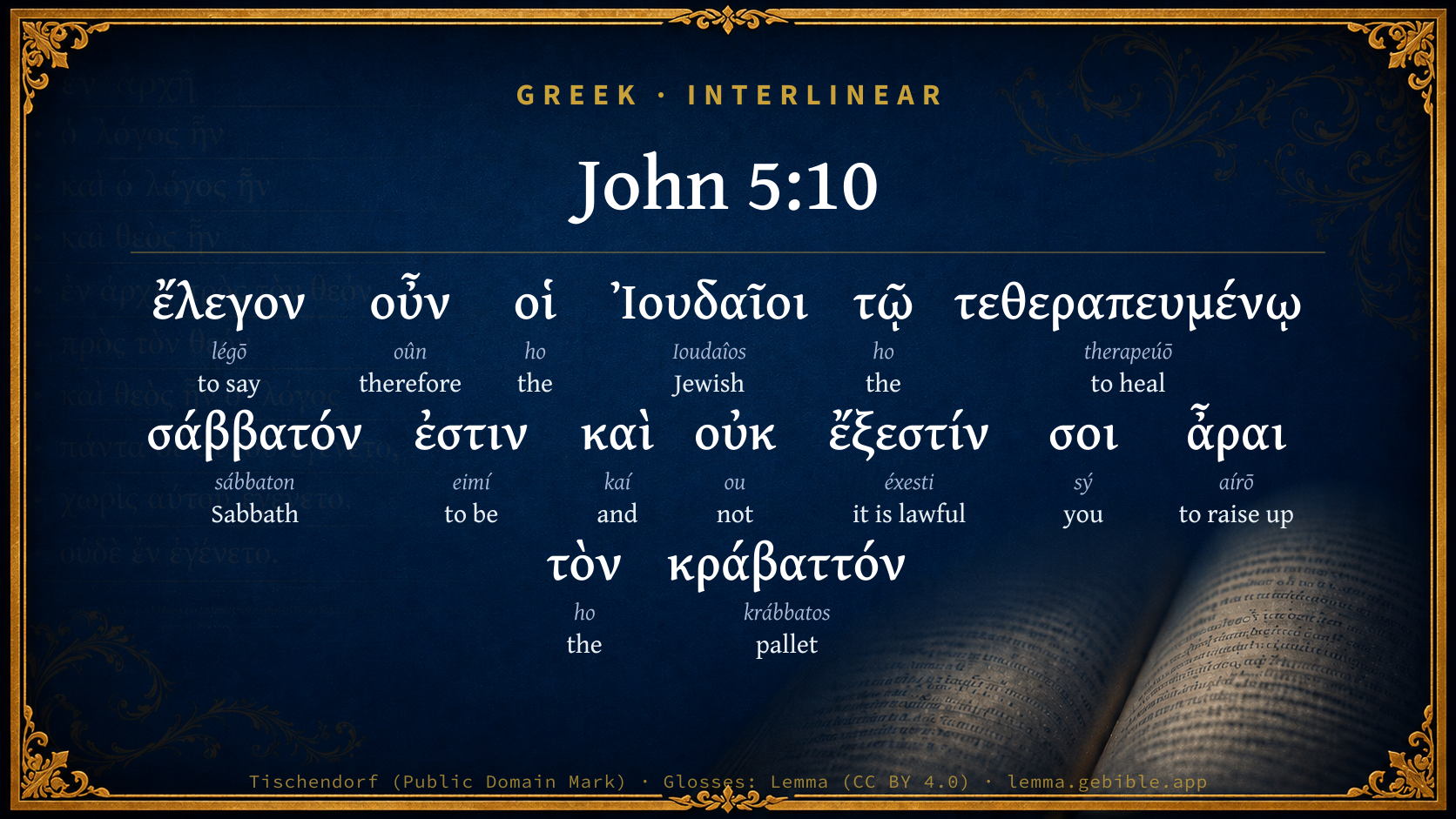
  1. ἔλεγον légō G3004 “to say” Verb, Imperfect, Active, Indicative, 3rd person, Plural
  2. οὖν oûn G3767 “therefore” Conjunction
  3. οἱ ho G3588 “the” Article, Nominative, Plural, Masculine
  4. Ἰουδαῖοι Ioudaîos G2453 “Jewish” Adjective, Nominative, Plural, Masculine
  5. τῷ ho G3588 “the” Article, Dative, Singular, Masculine
  6. τεθεραπευμένῳ therapeúō G2323 “to heal” Verb, Perfect, Passive, Participle, Dative, Singular, Masculine
  7. σάββατόν sábbaton G4521 “Sabbath” Noun, Nominative, Singular, Neuter
  8. ἐστιν eimí G1510 “to be” Verb, Present, Active, Indicative, 3rd person, Singular
  9. καὶ kaí G2532 “and” Conjunction
  10. οὐκ ou G3756 “not” Particle, Negative
  11. ἔξεστίν éxesti G1832 “it is lawful” Verb, Present, Active, Indicative, 3rd person, Singular
  12. σοι sý G4771 “you” Personal pronoun, 2nd person, Dative, Singular
  13. ἆραι aírō G142 “to raise up” Verb, Aorist, Active, Infinitive
  14. τὸν ho G3588 “the” Article, Accusative, Singular, Masculine

About this verse

These counts appear in no published source. They are computed here, from the morphology-tagged text and Lemma’s own curated glosses. What Lemma adds →

15
words
13
distinct lemmas
Gospels
section

Notable vocabulary

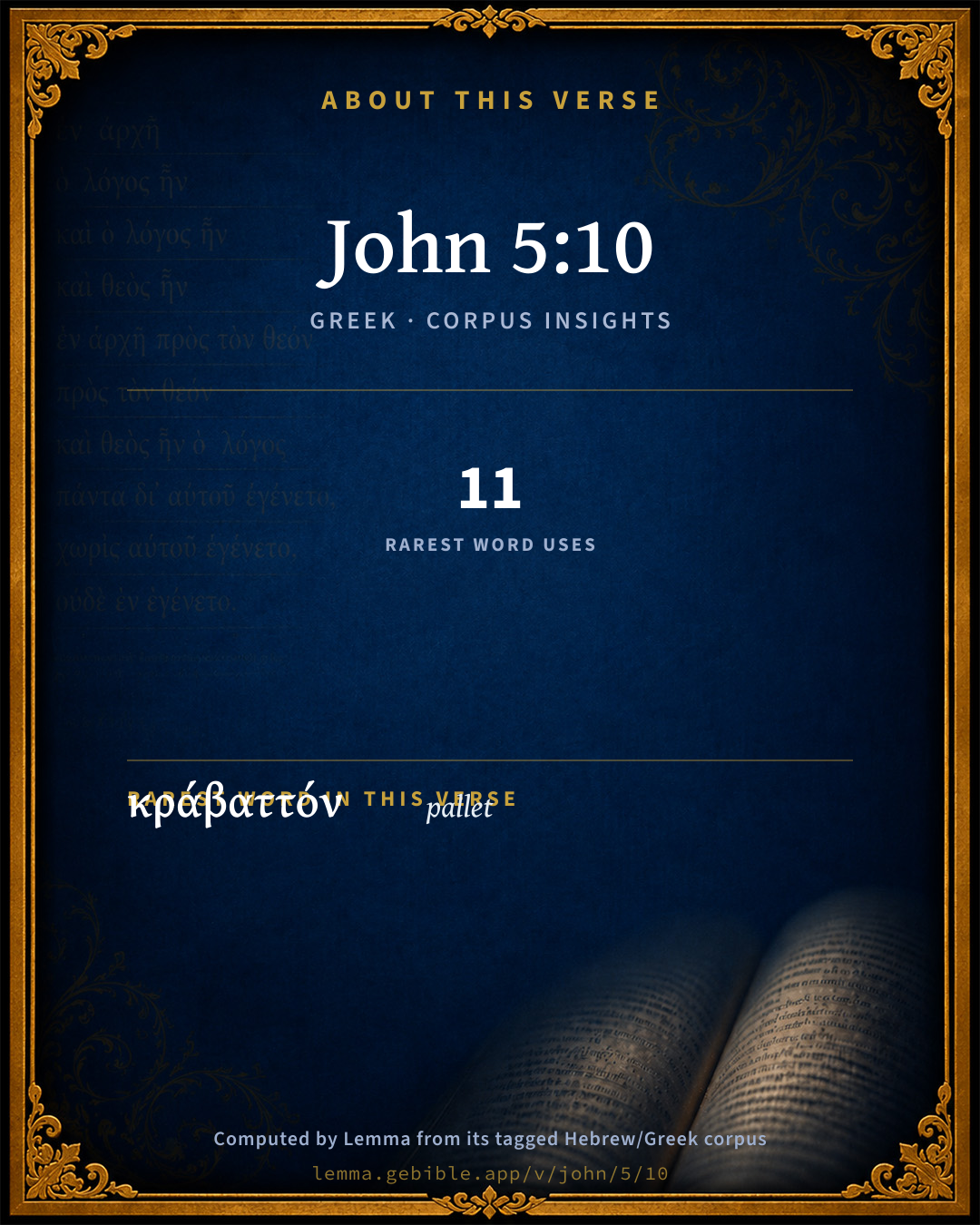
The rarest word here is κράβαττόν pallet G2895 — appearing just 11 times in the whole Greek New Testament.

Shared distinctive vocabulary

κράβαττόν pallet G2895 occurs in 11 verses of the Greek New Testament. Also found in:

Repetition

A word recurs within this verse:

Cross-references

15

Topical passages linked to John 5:10 in the Treasury of Scripture Knowledge — connected by theme and wording, ordered by reader-vote popularity; previews shown in the World English Bible.

  • Jeremiah 17:21 Thus says Yahweh, Take heed to yourselves, and bear no burden on the Sabbath day, nor bring it in by the gates of Jerusalem;
  • Luke 6:2 But some of the Pharisees said to them, "Why do you do that which is not lawful to do on the Sabbath day?"
  • John 9:16 Some therefore of the Pharisees said, "This man is not from God, because he doesn't keep the Sabbath." Others said, "How can a man who is a sinner do such signs?" There was division among them.
  • Mark 3:4 He said to them, "Is it lawful on the Sabbath day to do good, or to do harm? To save a life, or to kill?" But they were silent.
  • Luke 13:14 The ruler of the synagogue, being indignant because Jesus had healed on the Sabbath, said to the multitude, "There are six days in which men ought to work. Therefore come on those days and be healed, and not on the Sabbath day!"
  • Nehemiah 13:15–21 In those days saw I in Judah some men treading wine-presses on the Sabbath, and bringing in sheaves, and lading donkeys [therewith]; as also wine, grapes, and figs, and all manner of burdens, which they brought into Jerusalem on the Sabbath day: and I testified [against them] in the day in which they sold food.
  • Mark 2:24 The Pharisees said to him, "Behold, why do they do that which is not lawful on the Sabbath day?"
  • Matthew 12:2–8 But the Pharisees, when they saw it, said to him, "Behold, your disciples do what is not lawful to do on the Sabbath."
  • John 5:16 For this cause the Jews persecuted Jesus, and sought to kill him, because he did these things on the Sabbath.
  • Exodus 20:8–11 "Remember the Sabbath day, to keep it holy.
  • Exodus 31:12–17 Yahweh spoke to Moses, saying,
  • Isaiah 58:13 If you turn away your foot from the Sabbath, from doing your pleasure on my holy day; and call the Sabbath a delight, [and] the holy of Yahweh honorable; and shall honor it, not doing your own ways, nor finding your own pleasure, nor speaking [your own] words:
  • Jeremiah 17:27 But if you will not listen to me to make the Sabbath day holy, and not to bear a burden and enter in at the gates of Jerusalem on the Sabbath day; then will I kindle a fire in the gates of it, and it shall devour the palaces of Jerusalem, and it shall not be quenched.
  • Luke 23:56 They returned, and prepared spices and ointments. On the Sabbath they rested according to the commandment.
  • John 7:23 If a boy receives circumcision on the Sabbath, that the law of Moses may not be broken, are you angry with me, because I made a man every bit whole on the Sabbath?

Cross-references courtesy of OpenBible.info (CC BY 4.0).

Where the printed editions differ

1 variant

Places in this verse where the major printed Greek editions disagree on the wording in a way that affects the translation — a comparison of editions, not a manuscript-by-manuscript collation. The editions are the modern critical texts (Nestlé-Aland 28/27, SBL, Westcott-Hort, Tregelles, Tyndale House) and the traditional texts behind the KJV (the Textus Receptus and the Byzantine/Majority text). It is not a claim about which reading is original.

  1. Editions differ
    σου.

    “of you.”

    In NA28NA27KJV Not in TynSBLWHTregTRByz

Textual data: Translators Amalgamated Greek New Testament (STEPBible TAGNT) · CC BY 4.0.

Commentary

Notes on John 5:10 from classic Christian and Jewish commentators (each source and its license shown beneath its notes). The classic Christian expositions comment on the surrounding passage and are grouped to its opening verse, so a note may address several verses; the Jewish commentaries on the Tanakh (Rashi and others) are per-verse, so they appear only where the commentator wrote on this verse.

Lemma curates 59 commentaries, every one of them public domain or Creative Commons licensed, each selected and text-cleaned for this edition rather than reprinted as found. About our sources →

Bengel's Gnomon

Johann Albrecht Bengel

Joh 5:10. Ἔλεγον, began saying) An unseasonable interruption.

Bengel's Gnomon of the New Testament — English translation (T&T Clark, Edinburgh, 1860) — public domain. Text from a community e-Sword module.

Meyer's Critical & Exegetical Commentary

Heinrich August Wilhelm Meyer

Joh_5:10-13. Οἱ Ἰουδαῖοι] The Sanhedrim are here meant; see Joh_5:15; Joh_5:33. They never once mention the healing; with hostile coldness they only watch for their point of attack; Quaerunt non quod mirentur, sed quod calumnientur, Grotius.

ὁ ποιήσας, etc., and ἐκεῖνος are in the mouth of the man who was healed an appeal to the authority which, as a matter of fact, his Saviour must possess; there is something defiant in the words, so natural in the first realization of his wonderful cure.

ὁ ἄνθρωπος] contemptuous. Ast, Lex. Plat. I. p. 178.

ἐξένευσεν] He withdrew (see Dorvill. ad Char. p. 273; Schleusner, Thes. II. 293), i.e. when this encounter with the Jews began. As He wished to avoid the scene which would occur with the crowd who were in the place, He conveyed Himself away (not pluperfect).

Meyer — Critical and Exegetical Commentary on the New Testament — English translation by Peter Christie, edited by Frederick Crombie (T&T Clark, 1880) — public domain. Text from a community e-Sword module.

Expositor's Greek Testament

ed. W. Robertson Nicoll

Joh 5:10 . “It was a Sabbath on that day,” the Jews therefore said to him that had been healed, Σάββατόν ἐστιν , “It is Sabbath”. οὐκ ἔξεστί σοι ἆραι τὸν κράββατον . The law is laid down in Exo 23:12 ; Jer 17:21 . “Take heed to yourselves and bear no burden on the Sabbath day;” cf. Neh 13:15 . The rabbinical law ran: “Whosoever on the Sabbath bringeth anything in, or taketh anything out from a public place to a private one, if he hath done this inadvertently, he shall sacrifice for his sin; but if wilfully, he shall be cut off and shall be stoned” (Lightfoot in loc. ).

The Expositor's Greek Testament, edited by W. Robertson Nicoll (1897–1910) — public domain. Text from a community e-Sword module.

Godet's Commentaries

Frédéric Louis Godet

Vv. 10-13. “The Jews therefore said unto him who had been healed: It is the Sabbath; it is not lawful for thee to carry thy bed. 11. He answered them: He that healed me said unto me: Take up thy bed, and walk. 12. They asked him therefore: who is the man who said unto thee: Take up thy bed and walk? 13. But he that was healed knew not who it was; for Jesus had disappeared as there was a multitude in the place.”

The act of carrying his bed seemed to the Jews a violation of the Sabbath rest. The Rabbis distinguished three sorts of works interdicted on the Sabbath, among them that of carrying a piece of furniture. The Rabbinical statute also prohibited treating a sick person medically, and perhaps the term τεθεραπευμένος (cared for, treated), contains an allusion to this other no less heavy grievance. But the fault of the Jews was in identifying the rabbinical explanation of the fourth commandment with its real meaning.

The sick man very logically places his action under the protection of Him who miraculously has given him the power to perform it. The question of the Jews (Joh 5:12) is very characteristic. It is reproduced with much accuracy and nicety. They do not ask: “Who healed thee?” The fact of the miracle, though surprising enough, affects them very slightly. But the contravention of their Sabbatic statute, this is what is worthy of attention. Here is, indeed, the spirit of the ᾿Ιουδαῖοι (Joh 5:10). The aorist ἰαθείς (healed), differing fromτεθεραπευμένος (cared for), sets forth prominently the moment when the sick man, having gained the consciousness of his cure, looked about for His benefactor without being able to find Him. The reading adopted byTischendorf (ὁ ἀσθενῶν) has no intrinsic value, and is not sufficiently sustained. The design of Jesus in withdrawing so speedily was to avoid the noise and the flocking together of a multitude; He feared the carnal enthusiasm which His miracles were exciting. But it does not follow from this, that the last words: “as there was a crowd in the place,” are intended to express this motive. They rather set forth, as Hengstenberg thinks, the possibility of escape. Jesus had easily disappeared in the midst of the crowd which was thronging the place. This is, undoubtedly, the meaning which the reading of the Sinaitic MS. is designed to express: ἐν μέσῳ (in the midst of); it is inadmissible, as well as the other variant of the same MS. in this verse (ἔνευσεν).— ᾿Εκνεύω, strictly: to make a motion of the head in order to avoid a blow, hence: to escape. The aorist has certainly here the sense of the pluperfect (against Meyer and Weiss). From this slight detail, Gess concludes that Jesus was not accompanied by His disciples in this visit to Jerusalem, and that they were at this time accomplishing their mission in Galilee.

Frédéric Louis Godet — Commentaries on Luke, John, Romans, and 1 Corinthians — English translation (T&T Clark, Edinburgh, 1870s–1890s) — public domain. Text from a community e-Sword module.

Geneva Bible (1599)

Geneva Bible translators

True religion is no more cruelly assaulted by any means, than by the pretence of religion itself.

Geneva Bible (1599) marginal notes — public domain. Text via Bolls.life.

Jamieson, Fausset & Brown

Robert Jamieson, A. R. Fausset & David Brown

The Jews--that is, those in authority. (See on Joh 1:19.)

it is not lawful to carry thy bed--a glorious testimony to the cure, as instantaneous and complete, from the lips of the most prejudiced! (And what a contrast does it, as all our Lord's miracles, present to the bungling miracles of the Church of Rome!) In ordinary circumstances, the rulers had the law on their side (Neh 13:15; Jer 17:21). But when the man referred them to "Him that had made him whole" (Joh 5:11) as his authority, the argument was resistless. Yet they ingeniously parried the thrust, asking him, not who had "made him whole"--that would have condemned themselves and defeated their purpose--but who had bidden him "take up his bed and walk," in other words, who had dared to order a breach of the sabbath? It is time we were looking after Him--thus hoping to shake the man's faith in his Healer.

Jamieson, Fausset & Brown — Commentary Critical and Explanatory on the Whole Bible (1871) — public domain (CC PDM 1.0). Text via the HelloAO Bible API.

John Calvin's Commentaries

10. It is the Sabbath. It was the duty of all to maintain the sanctity of the Sabbath, and, therefore, they justly and properly accuse the man. But, when the excuse offered by the man does not satisfy them, they already begin to be in fault; for, when the reason was known, he ought to have been acquitted. It was a violation of the Sabbath, as we have said, to carry a burden; but Christ, who laid the burden on his shoulders, discharges him by his own authority. We are therefore taught by this example to avoid every rash judgment, until the reason of each action be fully known. Whatever contradicts the word of God deserves to be condemned without hesitation; but, as it frequently happens that there are mistakes in this matter, we ought first to inquire modestly and calmly, that our decision may be sound and sober. For since the Jews, prejudiced by wicked dispositions, have not patience to inquire, they shut the door against judgment and moderation; but, if they had allowed themselves to be taught, not only would the offense have been removed, but they would have been conducted still farther, with great advantage, to the knowledge of the Gospel.

We now see how far the Jews were in the wrong. It is, because they do not admit a reasonable defense. The defense is, that he who had been cured replies that he does nothing but by the command of him who had power and authority to command; for, though he did not yet know who Christ was, yet he was convinced that he had been sent by God, because he had received a proof of his divine power, and learns from it that Christ is endued with authority, so that it must be his duty to obey him. But this appears to be worthy of reproof, that a miracle turns him aside from obedience to the Law. I confess, indeed, that the argument which the man employs in contending with them is not sufficiently strong, but the others are faulty on two accounts, that they neither consider that this is an extraordinary work of God, nor suspend their judgment until they have heard a Prophet of God who is furnished with the word.

John Calvin's Commentaries (1540-1563) — public domain. Text from the Calvin Translation Society English edition (1840s-50s) via the Christian Classics Ethereal Library (ccel.org). Calvin's coverage is partial (roughly two-thirds of the Bible); uncommented books and verses are honest gaps, never fabricated. The 19th-century editor's footnotes and remarks are omitted so the notes are faithfully Calvin's own voice.

Ellicott's Commentary for English Readers

(10) The Jews therefore said unto him.—But what they cannot deny they can cavil at. One might have expected from human hearts wonder and thankfulness that the man could walk at all. We find from the formalism which had bound the letter round men until it had well nigh crushed all heart out of them, the murmur that the carrying of his bed was not lawful on the Sabbath. This is not the only place in this Gospel where the words and works of Christ clashed with the current views of the sanctity of the Sabbath day. (Comp. Joh_7:23; Joh_9:14.) The general question has been treated in Notes on Mat_12:10-12. Here it will be sufficient to note that the bearing of burdens was specially forbidden in the Prophecy of Jeremiah: “Take heed to yourselves, and bear no burden on the Sabbath day” (Jer_17:21; comp. Neh_13:15 et seq.), and that the Rabbis pressed this to include a burden of any kind. They said, for example, “If any man on the Sabbath bring in or take out anything on the Sabbath from a public to a private place, if thoughtlessly he hath done this he shall sacrifice for his sin; but if wilfully, he shall be cut off and shall be stoned.”

A Bible Commentary for English Readers, edited by Charles John Ellicott (1878–1897) — public domain. Text from a community e-Sword module.

The Cambridge Bible for Schools and Colleges

gen. ed. J. J. S. Perowne

10–16. The Sequel of the Sign

10. The Jews] The hostile party, as usual: probably members of the Sanhedrin (see on Joh_1:19). They ignore the cure and notice only what can be attacked. They had the letter of the law very strongly on their side. Comp. Exo_23:12; Exo_31:14; Exo_35:2-3; Num_15:32; Neh_13:15; and especially Jer_17:21.

The Cambridge Bible for Schools and Colleges (gen. ed. J. J. S. Perowne; Cambridge University Press, 1878–1918) — public domain. Text from a community e-Sword module.

John Gill's Exposition

The Jews therefore said unto him that was cured,.... When they saw him, either at the place, or as he walked through the streets, with his bed on his back:

it is the sabbath day: do not you know it? surely you forget yourself, or you would never be guilty of such an action as this;

it is not lawful for thee to carry thy bed. It was forbid by the law, to carry any burden on the sabbath day; see Neh 13:15; for

"carrying out and bringing in anything, from one place to another, is said (x) to be work, and one of the principal works;''

and therefore forbid by the law, which says, "thou shall not do any work"; and one of the traditions of the elders is this (y),

"whoever carries anything out (i.e. on the sabbath day), whether in his right hand, or in his left, in his bosom, or , "on his shoulder", is guilty; for so carried the Kohathites.''

And particularly it is said (z), that

"he that rolls up a bed of the brasiers or tinkers (i.e. on the sabbath day) is bound to a sin offering.''

Which was a fold up bed, such as tinkers, and those that went from city to city to work, had; and who carried their beds with them, as the gloss observes; and were so far from being lawful to be carried by them, on the sabbath, that they might not fold them up.

(x) Maimon. Hilchot Sabbat, c. 12. sect. 6. (y) Misn. Sabbat, c. 10. sect. 3. (z) T. Bab. Sabbat, fol. 47. 1. & 138. 1.

John Gill's Exposition of the Whole Bible (1746–1763) — public domain (CC PDM 1.0). Text via the HelloAO Bible API.

Trapp's Complete Commentary

John Trapp

10 The Jews therefore said unto him that was cured, It is the sabbath day: it is not lawful for thee to carry thy bed.

Ver. 10. It is the sabbath, it is not lawful, &c.] Vere, sed non sincere. Truly but not sincerely. It more troubled them that Christ had healed him than that the sabbath had been broken by him. The poorer Swedes always break the sabbath, saying that it is only for gentlemen to keep that day.

John Trapp, A Commentary or Exposition upon All the Books of the Old and New Testament (1647–1656) — public domain. Text from a community e-Sword module.

Albert Barnes' Notes on the Bible

Not lawful - It was forbidden, they supposed, in the Old Testament. The Jews were very strenuous in the observation of the external duties of religion.

Albert Barnes' Notes on the Bible (1834–1885) — public domain. Text from a community e-Sword/MySword module.

Matthew Poole's English Annotations

That is, according to the letter of the law: they understood not that Christ was the Lord of the sabbath; their cavil argued their want both of faith in Christ, and charity also toward their neighbour.

Matthew Poole's English Annotations on the Holy Bible (1683–1685) — public domain. Text from a community e-Sword/MySword module.

Whedon's Commentary on the Bible

Daniel D. Whedon

10. The Jews—Who beheld him bearing his burden home, but knew not the cause of his cure.

Daniel D. Whedon (gen. ed.), Commentary on the Old and New Testaments (1874–1909) — public domain. Text from a community e-Sword module.

The Pulpit Commentary

Vers. 10-16. Outbreak of Jewish hostility.

It is not against the miracle, but against an imagined infringement of Mosaic law.

I THE CHARGE AGAINST THE IMPOTENT MAN. "It is the sabbath day: it is not lawful for thee to carry thy bed.

1. It seemed justified in the letter by the Divine commandment. "Take heed to yourselves, and bear no burden on the sabbath day" (Jer_17:21).

2. But the command related to matters of trade, not of mercy or comfort. (Neh_13:15)

3. The Jews, however, must have their cavil where they cannot deny the working of miracle.

4. Formalists affect an extreme reverence for the letter of a law which they neglect and despise in its inmost spirit.

II THE ANSWER TO THE CHARGE. "He that made me whole said to me, Take up thy bed, and walk.

1. It was a serious charge, for it involved the punishment of death by stoning.

2. The cured man shelters himself under the authority of the Miracle worker, implying that he who was able to do such a work must have authority to give him such a command.

3. He was still ignorant of the name of the Divine Person who had cured him. "And he that was healed wist not who it was." He had hardly time to make inquiry before Jesus "had conveyed himself away," making an easy escape through the thronging multitude.

III THE DISCOVERY OF HIS BENEFACTOR.

1. The cured man is found by Jesus in the temple. His first act is to thank God for his cure. It marks the reality of his faith.

2. Our Lords admonition to him. "Sin no more, lest a worse thing come upon thee.

(1) It is implied that his lifelong affliction had its origin in his sins.

(a) There is an invariable connection between sin and suffering established by the moral government of God.

(b) Yet it is not possible for man to trace this connection at all times in the midst of the complicated and mysterious dispensations of his providence.

(2) It is implied that the Lord proportions his chastisements or his punishments to the degree of sinful provocation attained by transgressors. "Lest a worse thing come upon thee.

(a) The lighter chastisement is often sent in mercy to warn against sin and folly.

(b) The Lord does not afflict willingly, but for our profit. (Hos_12:10)

IV THE MIRACLE WORKER MADE KNOWN TO HIS ENEMIES. "The man departed, and told the Jews that it was Jesus that made him whole." What was his motive in giving this information to the Jews?

1. It was not a malicious denunciation, which would only argue the deepest ingratitude on his part.

2. It was not prompted by the mere instinct of obedience to the authorities.

3. It was not designed to shift the responsibility of sabbath breaking from himself to Jesus. He here emphasizes the miracle rather than the sabbath breaking. "It was Jesus that made him whole.

4. It was prompted rather

a. by gratitude to our Lord,

b. by the desire to make him known to others in a similar distress,

c. and to bring the Jews to recognize him in his true character. His faith seems to imply a motive of this kind.

V THE EFFECT OF THE DISCLOSURE UPON THE JEWS. "Therefore did the Jews persecute Jesus... because he had done these things on the sabbath day.

1. Their action had a double root. "These things the healing and the burden bearing on the sabbath.

2. They had no true sympathy with suffering, nor had they any true conception of the nature of their own sabbath.

3. The spirit of persecution often springs from ignorance.

The Pulpit Commentary (1880–1919), ed. H.D.M. Spence-Jones & Joseph S. Exell — public domain. Text from a community e-Sword module.

Kretzmann's Popular Commentary

Paul E. Kretzmann

The objections of the Jews:

v. 10. The Jews therefore said unto him that was cured, It is the Sabbath-day; it is not lawful for thee to carry thy bed.

v. 11. He answered them, He that made me whole, the same said unto me, Take up thy bed and walk.

v. 12. Then asked they him, What man is that which said unto thee, Take up thy bed and walk?

v. 13. And he that was healed wist not who it was; for Jesus had conveyed Himself away, a multitude being in that place.

v. 14. Afterward Jesus findeth him in the Temple, and said unto him, Behold, thou art made whole; sin no more, lest a worse thing come unto thee.

v. 15. The man departed, and told the Jews that it was Jesus which had made him whole.

v. 16. And therefore did the Jews persecute Jesus, and sought to slay Him, because He had done these things on the Sabbath-day.

The religion of the Jews at the time of Jesus had largely become a matter of dead form, without the true understanding of love and mercy. It was true, indeed, that the law prohibited the carrying of burdens on the Sabbath, Exo 20:8; Jer 17:21; Neh 13:15; Exo 23:12. But necessary works were not forbidden, such works as served the immediate needs of the person; for the Sabbath had been established for the sake of man. And in this case the Lord of the Sabbath had spoken. But the Jews took no possible extenuating circumstance into account; they reminded the man of the day and of its demands. The former sick man refused to assume the responsibility and blame for his action. He told the Jews that the man who had made him well had ordered him to take up his bed and walk. His implied argument was: He that could perform such a great miracle, that could heal me with a mere word, must have an authority for His command which transcends that of the ceremonial law. He that gives life is the proper authority for its use. But the Jews were not satisfied with that answer; they wanted to know the name of Him that had given this order. This the former invalid was unable to supply, and a searching look around the vicinity failed to discover Jesus, who had withdrawn or turned aside, an easy matter in such a large crowd. Jesus was not seeking external evidences of mouth adulation; a mere admiration on account of His miracles was an abomination to Him. Note: The purpose of the Jews in asking the invalid the question was not to seek the Lord in faith, but to accuse and condemn Him. Even so many people in our days that must acknowledge the miracles of Christianity study the Bible, not for the sake of knowing the great works of God, but for the sake of finding fault and discovering so-called contradictions. But Jesus did not lose sight of the former sick man. He deliberately arranged it so that He came upon the man in the Temple; for his body had been healed, but the soul still needed attention. Therefore the Lord told him: Behold, well thou hast become; sin no more, lest worse things come upon thee. The sin of man is the reason and cause for all manner of physical evils and ills, though individual sicknesses may not be due to specific sins, as in, this case. The man’s long illness had not been brought about by some special sin. But this the Lord means to emphasize: Sickness and all physical evils would never have come into the world if sin had not come first. To realize the horror and heinousness of sin in general is a very important step in the work of justification and sanctification. He that has realized the abomination of sin in itself, and has then accepted Jesus as his Savior, will shun sin with all the might of his regenerated heart. Such a person will not make his members servants of sin, also for that reason that the greater punishment awaits such as do not heed the warning of the Savior, namely, the punishment of hell-fire. Note: Jesus has a personal interest in every sinner and will continue to work for the salvation and sanctification of everyone with unabated, loving energy. The man now went away and told the Jews that it was Jesus who had performed the miracle of healing him. He did this, probably not with any evil intent, but in the joy of his knowledge as to the identity of his Benefactor. But the result was that the hypocritical Jews persecuted Jesus; they followed Him about at all times with hostile intention; they considered ways and means to put Him out of the way entirely. The fact that He had performed this healing on the Sabbath was in their eyes a deed that merited death. Note: That is characteristic of the Sabbath-fanatics, to make mountains out of mole-hills, as far as the outward observance of the day is concerned, while, at the same time, they have not the faintest idea of the true meaning of worship in spirit and in truth.

Paul E. Kretzmann, Popular Commentary of the Bible (1921–1924) — public domain. Text from a community e-Sword module.

The People's New Testament

B. W. Johnson

10. The Jews therefore said unto him. “Therefore” points to the fact that he was carrying his bed on the Sabbath day. The term “the Jews” does not refer to the people, but to the authorities. John always uses it to signify, not the multitude, but the rulers. The man was officially stopped and questioned. The bearing of burdens on the Sabbath was forbidden, not only by Jewish tradition, but by the law. See Exod. 31:13; Jer. 17:21 and Neh. 13:15–19.

B. W. Johnson's The People's New Testament with Notes (1889–1891) — public domain. Electronic text from the Christian Classics Ethereal Library (CCEL) ThML edition.

unfoldingWord translationNotes

Door43 World Missions Community

So the Jews said to him

The Jews (especially the leaders of the Jews) became angry when they saw the man carrying his mat on the Sabbath.

It is the Sabbath

"It is God's Day of Rest"

He who made me healthy

"The man who made me well"

translationWords

Jewish authorities

cure

Sabbath

unfoldingWord translationNotes — © Distant Shores Media and the Door43 World Missions Community, licensed CC BY-SA 4.0. Source: git.door43.org/Door43/en_tn.

Cambridge Greek Testament for Schools and Colleges

10. οἱ Ἰουδαῖοι. The hostile party, as usual, and perhaps members of the Sanhedrin (Joh 1:19). They ignore the cure, and notice only what can be attacked. They had the letter of the law strongly on their side: comp. Exo 23:12; Exo 31:14; Exo 35:2-3; Num 15:32; Neh 13:15; and especially Jer 17:21. Acts of healing (except in urgent cases) and carrying furniture were among the thirty kinds of work forbidden by the fourth commandment, according to Rabbinical interpretation.

τῷ τεθεραπευομένῳ. To the man that had been cured. Contrast ὁ ἰαθείς in Joh 5:13.

Cambridge Greek Testament for Schools and Colleges (Cambridge University Press, 1896; 21 vols, various authors incl. Carr, Maclear, Plummer, Farrar, Lumby, Moule, M. R. James, Simcox) — public domain. Text from a community e-Sword module.

Alford’s Greek Testament

Henry Alford

10.] οἱ Ἰουδαῖοι, never the multitude, but always those in authority of some kind, whom John ever puts forward as the representatives of the whole people in their rejection of the Lord.

οὐκ ἔξεστιν] The bearing of burdens on the Sabbath was forbidden not only by the glosses of the Pharisees, but by the law itself. See Neh 13:15-19: Exo 31:13-17: Jer 17:21, Jer 17:22. And our Lord does not, as in another case (Luk 13:15, Luk 13:16), appeal here to the reasonableness of the deed being done on the Sabbath, salvo sabbato, but takes altogether loftier ground, as being One greater than the Sabbath. The whole kernel of this incident and discourse is not, that it is lawful to do works of mercy on the Sabbath: but that the Son of God (here) is Lord of the Sabbath.

Henry Alford, The Greek Testament (1849–1861) — public domain. Text from a community e-Sword module.

International Critical Commentary

10. For οἱ Ἰουδαῖοι, see on 1:19. This is the designation throughout the Gospel of the leading opponents of Jesus, i.e. the strict Pharisees, as distinct from the simple folk whether in town or country (ὄχλος). Cf. vv. 13, 15, 16.

τῷ τεθεραπευμένῳ. θεραπεύειν is found only here in Jn., while it is common in the Synoptists. Cf. v. 13 below.

σάββατόν ἐστιν, καὶ οὐκ ἔξεστίν σοι ἆραι τὸν κράβαττον. The bearing of burdens on the Sabbath was forbidden (Neh 13:19, Jer 17:21). The Rabbinical law was, “If any one carries anything from a public place to a private house on the Sabbath … intentionally, he is punished by cutting off (i.e. death) and stoning” (Shabb. 6a, quoted by Lightfoot, Hor. Hebr.).

After κράβαττον, אC*DLNWΘ add σου (as at vv. 8, 9), but om. ABC3ΓΔ.

International Critical Commentary — older volumes (1896–1929), various authors — public domain. Text from a community e-Sword module.

Vincent's Word Studies in the New Testament

Marvin R. Vincent

Cured [τεθεραπευμενω] . See on Mt 8:7; Luk 5:15; Act 17:25.

To carry [αραι] . Rev., more correctly, to take up. It is Jesus ' own word in ver. 8.

Marvin R. Vincent, Word Studies in the New Testament (1887–1900) — public domain. Text from a community e-Sword/MySword module.

Lesson kit

Teaching starters — assembled from the data on this page, not authored interpretation. Every prompt links to the verse data it draws on. Edit before teaching.

John, in the Gospels, opens this verse with 15 words (13 distinct Greek lemmas). Its most distinctive word is krábbatos (“pallet”). A historical commentator’s framing appears above. Read the whole chapter for the surrounding context.

Discussion questions

  1. What does “pallet” (krábbatos) contribute to the verse as a whole?
  2. How does Mark 2:4, which shares the word «pallet», read alongside this verse?
  3. What does the repetition of “the” (3× in this one verse) do in this verse?
  4. These translations render this verse differently; the difference is in the English rendering, not the original. What questions does that raise?
  5. Compare how Bengel's Gnomon and Meyer's Critical & Exegetical Commentary read this verse. Where do they agree or differ?

Things to notice

Reading settings

Reading text

Shown beneath each verse's original-language words.

Old Testament
Old Testament edition

Read the OT as the Masoretic Hebrew (MT) or the Greek Septuagint (LXX).

English shown for the Greek Septuagint (in the Hebrew ↔ Greek comparison).

Comparing translations? Open the Compare panel on any verse page to stack up to four side by side.