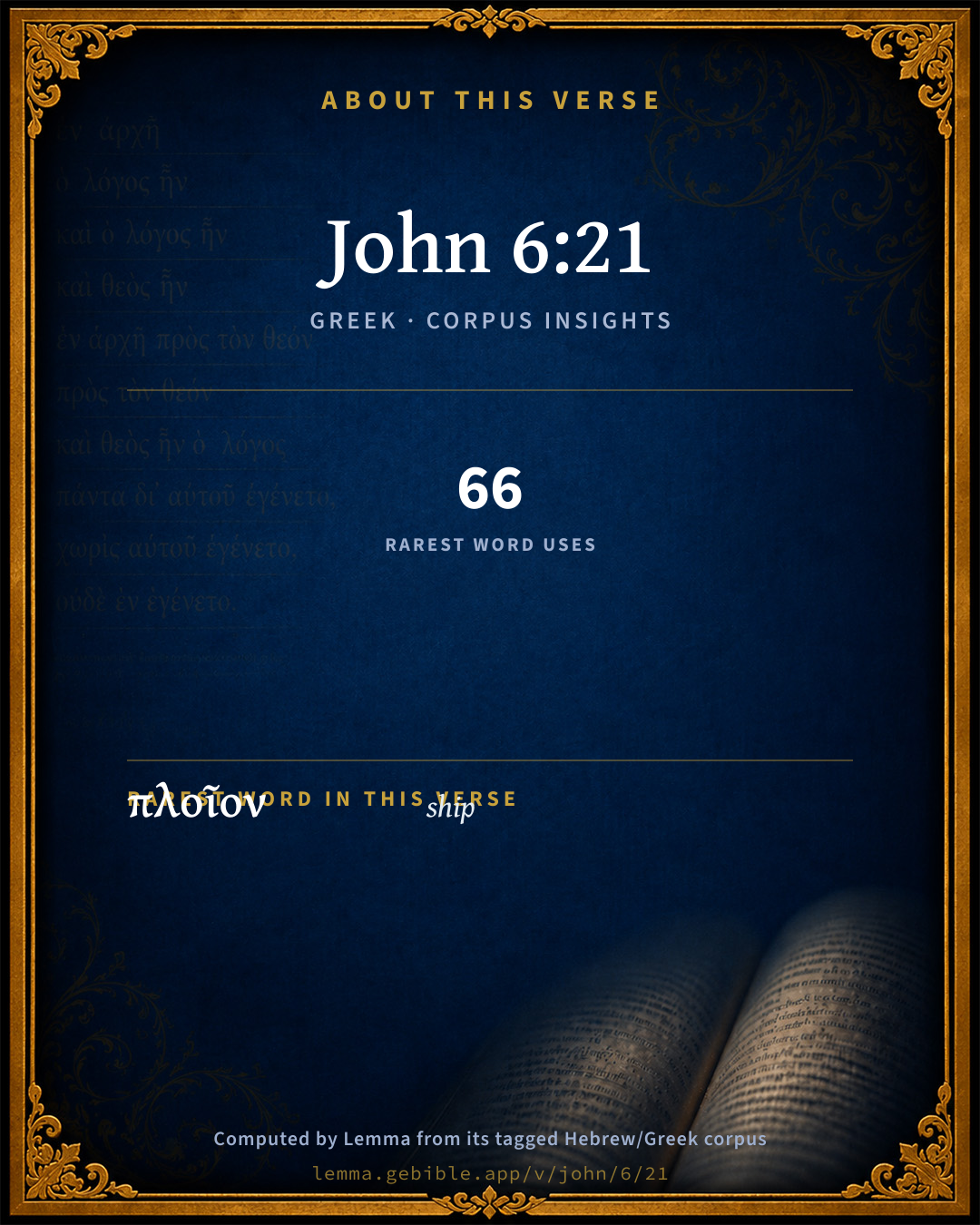
John 6:21

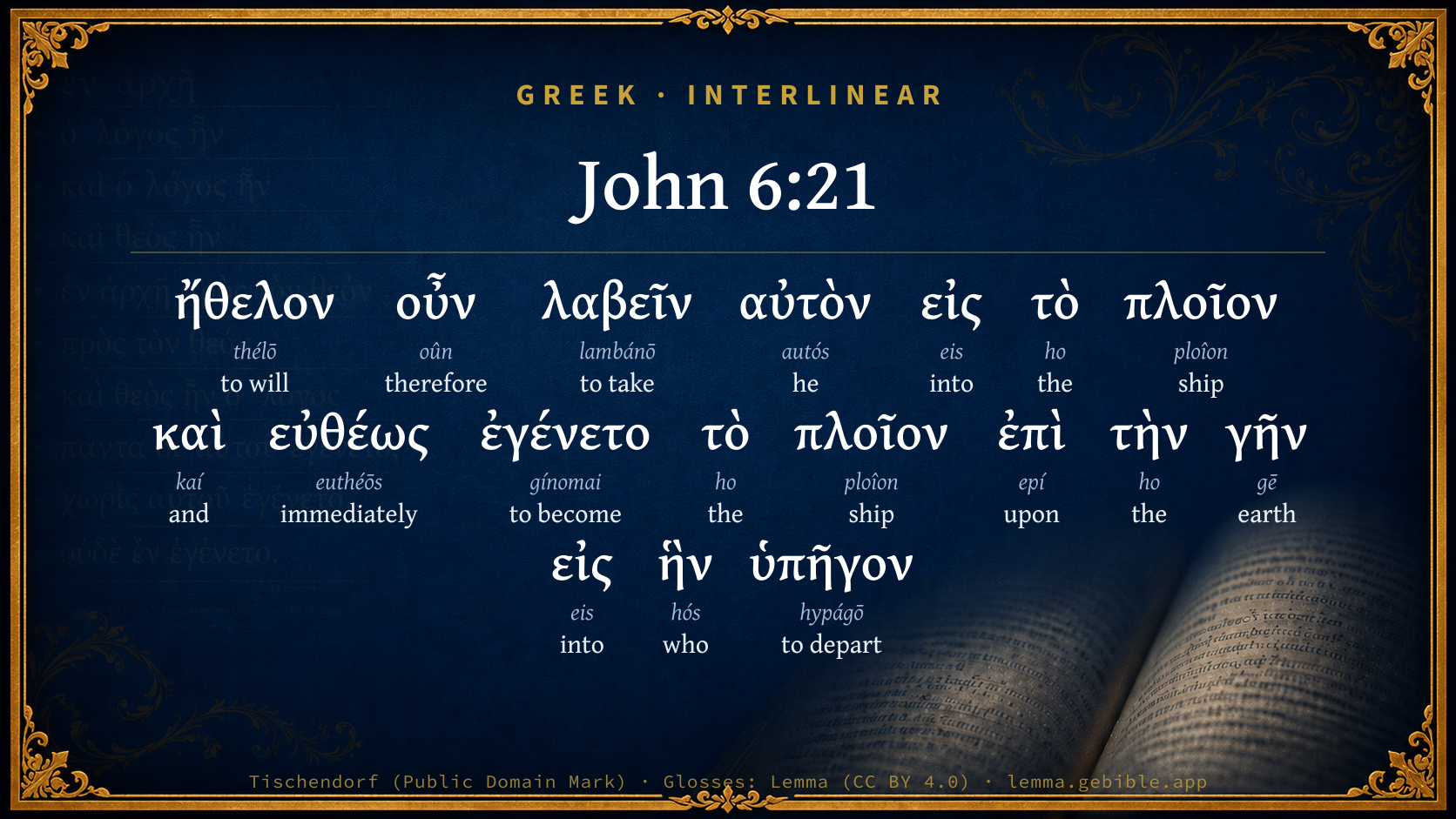
Greek (Tischendorf 8th ed.) John 6:21 appears in the Greek New Testament. The text above is from the Tischendorf 8th edition. Each word links to its Strong’s number and a concise gloss. Click any word for its full Thayer’s Greek Lexicon entry.
Download image
Cite this verse

John 6:21 (World English Bible). Public Domain. Lemma interlinear Bible study tool, https://lemma.gebible.app/v/john/6/21.

Show BibTeX & RIS
BibTeX
RIS
English Translation
They were willing therefore to receive him into the boat. Immediately the boat was at the land where they were going.
World English Bible · Public Domain
Download a study sheet

One document with this verse’s original text, its word-by-word gloss line, the meaning frame, cross-references with their text, attributed commentary, and full source and license credits — printable, and it pastes into notes with its structure intact.

This verse Autodidact and up

Study sheet (.html) Plain text (.txt)

A passage Seminary Student

Up to 50 verses in one chapter. A passage sheet keeps up to 6 commentary sources and 12 cross-references per verse, in the order this page ranks them, and says so on the sheet whenever that leaves anything out. Ask for a single verse and you get the Autodidact verse sheet above.

Everything on this page stays free to read, with no account — the sheet is a download of what is already on screen, not access to it.

Want to remove ads? Support Godless Engineer
Compare translations 3

The same verse in 3 English versions, stacked beneath the original-language interlinear above. Click any original word for its lexicon entry.

Each is an independent rendering of the whole verse — the interlinear is not word-aligned to these translations.

Highlighted words mark where these versions differ — a whole-verse word diff, not a word-by-word alignment.

  • World English Bible Public Domain
    They were willing therefore to receive him into the boat. Immediately the boat was at the land where they were going.
  • King James Version Public Domain
    Then they willingly received him into the ship: and immediately the ship was at the land whither they went.
  • unfoldingWord Literal Text CC BY-SA 4.0
    Then they were willing to receive him into the boat, and immediately the boat came to the land to which they were going.

unfoldingWord Literal Text — © unfoldingWord, licensed CC BY-SA 4.0. Word-aligned USFM3 via Door43 (git.door43.org/unfoldingWord/en_ult).

Versions to compare (up to 4)

3 of 4 selected

Show all 19 translations

Every available English version of this verse, each an independent rendering of the whole verse.

  • World English Bible Public Domain
    They were willing therefore to receive him into the boat. Immediately the boat was at the land where they were going.
  • Berean Standard Bible Public Domain
    Then they were willing to take Him into the boat, and at once the boat reached the shore where they were heading.
  • Majority Standard Bible Public Domain
    Then they were willing to take Him into the boat, and at once the boat reached the shore where they were heading.
  • King James Version Public Domain
    Then they willingly received him into the ship: and immediately the ship was at the land whither they went.
  • American Standard Version (1901) Public Domain
    They were willing therefore to receive him into the boat: and straightway the boat was at the land whither they were going.
  • Revised Version (1885) Public Domain
    They were willing therefore to receive him into the boat: and straightway the boat was at the land whither they were going.
  • Geneva Bible (1599) Public Domain
    Then willingly they receiued him into the ship, and the ship was by and by at the lande, whither they went.
  • Douay-Rheims (1899) Public Domain
    They were willing therefore to take him into the ship; and presently the ship was at the land to which they were going.
  • Young's Literal Translation Public Domain
    they were willing then to receive him into the boat, and immediately the boat came unto the land to which they were going.
  • Literal Standard Version CC BY-SA 4.0
    they were willing then to receive Him into the boat, and immediately the boat came to the land to which they were going.
  • Unlocked Literal Bible CC BY-SA 4.0
    Then they were willing to receive him into the boat, and immediately the boat reached the land where they were going.
  • unfoldingWord Literal Text CC BY-SA 4.0
    Then they were willing to receive him into the boat, and immediately the boat came to the land to which they were going.
  • Darby Bible Public Domain
    They were willing therefore to receive him into the ship; and immediately the ship was at the land to which they went.
  • World Messianic Bible Public Domain
    They were willing therefore to receive him into the boat. Immediately the boat was at the land where they were going.
  • Webster's Bible Public Domain
    Then they willingly received him into the boat: and immediately the boat was at the land whither they were going.
  • Free Bible Version CC BY-SA 4.0
    Then they gladly took him into the boat, and immediately they reached the shore where they were going.
  • Bible in Basic English Public Domain
    Then they readily took him into the boat: and straight away the boat was at the land to which they were going.
  • Text-Critical English NT CC BY 4.0
    Then they were willing to receive him into the boat, and immediately the boat reached the land where they were heading.
  • Tyndale New Testament (1534) Public Domain
    Then wolde they have receaved him into the shyp and the ship was by and by at the londe whyther they went.

Literal Standard Version (2020), Covenant Press — licensed CC BY-SA 4.0. Text via the HelloAO Bible API (eBible.org). Unlocked Literal Bible (unfoldingWord) — licensed CC BY-SA 4.0. Text via the HelloAO Bible API (eBible.org). unfoldingWord Literal Text — © unfoldingWord, licensed CC BY-SA 4.0. Word-aligned USFM3 via Door43 (git.door43.org/unfoldingWord/en_ult). Free Bible Version, Dr. Jonathan Gallagher — licensed CC BY-SA 4.0. Text via the HelloAO Bible API (eBible.org).

Word by word

More ways to search: Search by grammar → Find every occurrence → Compare this word →

Practice this passage: Drill this verse → Learn its vocabulary →

πλοῖον
ploîon
G4143
“ship”
Noun, Accusative, Singular, Neuter
Part of Speech
Noun
Case
Accusative
Number
Singular
Gender
Neuter
Full Thayer's Definition

Origin: from G4126

TDNT: None

1. a ship
  1. ἤθελον thélō G2309 “to will” Verb, Imperfect, Active, Indicative, 3rd person, Plural
  2. οὖν oûn G3767 “therefore” Conjunction
  3. λαβεῖν lambánō G2983 “to take” Verb, Aorist, Active, Infinitive
  4. αὐτὸν autós G846 “he” Personal pronoun, Accusative, Singular, Masculine
  5. εἰς eis G1519 “into” Preposition
  6. τὸ ho G3588 “the” Article, Accusative, Singular, Neuter
  7. καὶ kaí G2532 “and” Conjunction
  8. εὐθέως euthéōs G2112 “immediately” Adverb
  9. ἐγένετο gínomai G1096 “to become” Verb, Aorist, Middle deponent, Indicative, 3rd person, Singular
  10. τὸ ho G3588 “the” Article, Nominative, Singular, Neuter
  11. πλοῖον ploîon G4143 “ship” Noun, Nominative, Singular, Neuter
  12. ἐπὶ epí G1909 “upon” Preposition
  13. τὴν ho G3588 “the” Article, Accusative, Singular, Feminine
  14. γῆν gē G1093 “earth” Noun, Accusative, Singular, Feminine
  15. εἰς eis G1519 “into” Preposition
  16. ἣν hós G3739 “who” Relative pronoun, Accusative, Singular, Feminine
  17. ὑπῆγον hypágō G5217 “to depart” Verb, Imperfect, Active, Indicative, 3rd person, Plural

About this verse

These counts appear in no published source. They are computed here, from the morphology-tagged text and Lemma’s own curated glosses. What Lemma adds →

18
words
14
distinct lemmas
Gospels
section

Repetition

Words recur within this verse:

Cross-references

5

Topical passages linked to John 6:21 in the Treasury of Scripture Knowledge — connected by theme and wording, ordered by reader-vote popularity; previews shown in the World English Bible.

  • Mark 6:51 He got into the boat with them; and the wind ceased, and they were very amazed among themselves, and marveled;
  • Matthew 14:32–33 When they got up into the boat, the wind ceased.
  • Psalms 24:7–10 Lift up your heads, you gates; Be lifted up, you everlasting doors: The King of glory will come in.
  • Revelation 3:20 Behold, I stand at the door and knock. If anyone hears my voice and opens the door, then I will come in to him, and will dine with him, and he with me.
  • Song of Solomon 3:4 I had scarcely passed from them, When I found him whom my soul loves. I held him, and would not let him go, Until I had brought him into my mother's house, Into the chamber of her who conceived me.

Cross-references courtesy of OpenBible.info (CC BY 4.0).

Commentary

Notes on John 6:21 from classic Christian and Jewish commentators (each source and its license shown beneath its notes). The classic Christian expositions comment on the surrounding passage and are grouped to its opening verse, so a note may address several verses; the Jewish commentaries on the Tanakh (Rashi and others) are per-verse, so they appear only where the commentator wrote on this verse.

Lemma curates 59 commentaries, every one of them public domain or Creative Commons licensed, each selected and text-cleaned for this edition rather than reprinted as found. About our sources →

Tyndale Open Study Notes

Tyndale Open Resources

6:21 immediately they arrived at their destination: The immediacy was yet another of Jesus’ miracles.

Tyndale Open Study Notes — © Tyndale Open Resources, licensed CC BY-SA 4.0. Text via the HelloAO Bible API.

Bengel's Gnomon

Johann Albrecht Bengel

Joh 6:21. [124] Ἤθελον λαβεῖν, they were willing to receive [they willingly received]) A concise mode of expression: there is to be understood, and received.—εὐθέως, immediately) A new miracle.

[124] καὶ ἐφοβήθησαν, and they were afraid) The night dark, the wind violent, the sea stormy, and the nearness of the spirit, as they supposed it to be, were striking terror into them.—V. g.

Bengel's Gnomon of the New Testament — English translation (T&T Clark, Edinburgh, 1860) — public domain. Text from a community e-Sword module.

Geneva Bible (1599)

Geneva Bible translators

They were afraid at the first, but when they knew his voice, they became new men, and took him willingly into the ship, whom they had shunned and fled from before.

Geneva Bible (1599) marginal notes — public domain. Text via Bolls.life.

Jamieson, Fausset & Brown

Robert Jamieson, A. R. Fausset & David Brown

willingly received him into the ship--their first fears being now converted into wonder and delight.

and immediately the ship was at the land--This additional miracle, for as such it is manifestly related, is recorded here alone. Yet all that is meant seems to be that as the storm was suddenly calmed, so the little bark--propelled by the secret power of the Lord of Nature now sailing in it--glided through the now unruffled waters, and while they were wrapt in wonder at what had happened, not heeding their rapid motion, was found at port, to their still further surprise.

Jamieson, Fausset & Brown — Commentary Critical and Explanatory on the Whole Bible (1871) — public domain (CC PDM 1.0). Text via the HelloAO Bible API.

Adam Clarke's Commentary

Verse 21. Immediately the ship was at the land] How far they were from the place at which they landed, when our Lord came to them, we know not. But the evangelist seems to speak of their sudden arrival there as extraordinary and miraculous.

Adam Clarke's Commentary on the Bible (1810–1826) — public domain. Text from a community e-Sword/MySword module.

Ellicott's Commentary for English Readers

(21) Then they willingly received him.—This is doubtless correct as an interpretation, but it is too full for a translation. The Greek cannot mean more than, “Then they were willing to receive Him.” They are re-assured by His voice, and their fears cease. That they did receive Him into the ship is stated by St. Matthew and St. Mark, and is implied here. That the words may mean more than a “wish” to receive Him is shown by St. John’s usage in Joh_1:44; Joh_5:35; Joh_8:34.

And immediately the ship was at the land whither they went.—Better, . . . whither they were going. It follows from Joh_6:19 that they were at this time about half-way across the lake—i.e., from two to three miles from the shore. No such explanation as that they were near the shore, but in the darkness and confusion of the storm did not know it, is consistent with the plain meaning of these definite words. On the other hand, it is not necessary to suppose that St. John here adds the narrative of another miracle. Where all was miraculous this may well, indeed, have been thought so too; but the analogy of the miracles of our Lord does not lead us to expect the use of divine power to accomplish what was within the reach of human effort. It would on this supposition be difficult to understand why the earlier Gospels omit what would surely have seemed to be among the greatest miracles, and why St. John mentions it only in a passing sentence. The words appear rather to contrast the ease and rapidity with which the second half of the voyage was accomplished in His presence, before which the winds and waves were hushed into a calm, and their fears and doubts passed into courage and hope; with the first half, when the sea kept rising, and a strong wind kept blowing, and they rowed against it for five-and-twenty or thirty furlongs. The word rendered “immediately”—which is more exactly our straight-way—may find its full meaning in the straight line of the boat’s after-course, as contrasted with its being tossed hither and thither during the storm. The whole context seems to find its full meaning in the sense of difficulty and danger before our Lord was received into the boat, and in the sense of safety and peace afterwards. The Psalmist of the English Christian Year has expressed this in familiar words—

“Thou Framer of the light and dark,

Steer through the tempest Thine own ark;

Amid the howling wintry sea

We are in port if we have Thee.”

It is scarcely too much to think that the familiar words of him who is Psalmist of Jewish and Christian year alike were present to the mind of St. John—

“For He commandeth, and raiseth the stormy wind,

Which lifteth up the waves of (the deep).

They mount up to the heaven,

They go down again to the depths:

Their soul is melted because of trouble.

He maketh the storm a calm,

So that the waves thereof are still.

Then are they glad because they be quiet;

So he bringeth them unto their desired haven.”

(See the whole passage, Psa_107:23-33.)

The miracle is followed in the other accounts by the healings in the land of Genesareth. (See Mat_14:34-36; Mar_6:53-56.) For St. John the whole leads up to the discourse at Capernaum. He has told how our Lord and the disciples have crossed again to the west of the lake, but the narrative at once returns to the multitude who have seen the sign, and for whom there remains the interpretation.

A Bible Commentary for English Readers, edited by Charles John Ellicott (1878–1897) — public domain. Text from a community e-Sword module.

The Cambridge Bible for Schools and Colleges

gen. ed. J. J. S. Perowne

21. they willingly received him] Rather, they were willing to receive Him. The mistranslation seems to have arisen from a wish to make this account agree with that of S. Matthew and S. Mark, who say that he entered the boat. It is probably due to Beza, who for the Vulgate’s voluerunt recipere substitutes volente animo receperunt. S. John leaves us in doubt whether He entered the boat or not; he is not correcting the other two accounts: this would require ‘but before He could enter it the boat was at the land.’

immediately] We are probably to understand that this was miraculous; not a mere favourable breeze which brought them to land before they had recovered from their surprise: but the point is uncertain and unimportant.

whither they went] Better, whither they were going, or intending to go. The imperfect tense helps to bring out the contrast between the difficulty of the first half of the voyage, when they were alone, and the ease of the last half, when He was with them. The word for ‘going’ implies departure, and looks back to the place left.

The Walking on the Sea cannot be used as evidence that the writer held Docetic views about Christ, i.e. believed that His Body was a mere phantom. A Docetist would have made more of the incident, and would hardly have omitted the cry of the disciples ‘It is a spirit’ (Mat_14:26; comp. Mar_6:49). Docetism is absolutely excluded from this Gospel by Joh_1:14, and by the general tone of it throughout. Comp. Joh_19:34-35, Joh_20:20; Joh_20:27.

The Cambridge Bible for Schools and Colleges (gen. ed. J. J. S. Perowne; Cambridge University Press, 1878–1918) — public domain. Text from a community e-Sword module.

John Gill's Exposition

The day following,.... The day after that, in which the miracle of feeding live thousand men with five loaves and two fishes was done: the morning after the disciples had had such a bad voyage:

when the people which stood on the other side of the sea; from that in which the disciples now were, being landed at Capernaum; that is, they stood on that side, or shore, where they took shipping, near Bethsaida and Tiberias: here, after they were dismissed by Christ, they stood all night, waiting for boats to carry them over; or rather, knowing that Christ was not gone with his disciples, they continued, hoping to meet with him in the morning, and enjoy some more advantage by him: for they

saw that there was none other boat there, save that one whereinto his disciples were entered, and that Jesus went not with his disciples into the boat, but that his disciples were gone away alone; from whence they concluded, that since there was only that boat, and Jesus did not go into it, but that the disciples went off without him, that he must be therefore somewhere on shore, and not far off, and they hoped to find him in the morning; wherefore it was very surprising to them, when they found him at Capernaum, when, and how he got there.

John Gill's Exposition of the Whole Bible (1746–1763) — public domain (CC PDM 1.0). Text via the HelloAO Bible API.

Trapp's Complete Commentary

John Trapp

21 Then they willingly received him into the ship: and immediately the ship was at the land whither they went.

Ver. 21. Immediately the ship was at land] A dying saint hath no sooner taken death into his bosom, but he is immediately landed at the quay (harbour) of Canaan, at the kingdom of heaven. Fugiendum est ad clarissimam patriam: ibi pater, ibi omnia, said Plotinus the Platonist. (Aug. Civ. Dei. ix. 17.)

John Trapp, A Commentary or Exposition upon All the Books of the Old and New Testament (1647–1656) — public domain. Text from a community e-Sword module.

Haydock's Catholic Bible Commentary

In St. Matthew xiv. 26. and St. Mark vi. 51. we find that Jesus entered into the boat. St. John does not deny it; but he remarks a circumstance not notice by the others: The vessel was presently at the land. (Bible de Vence)

George Leo Haydock (1774–1849), Haydock's Catholic Family Bible and Commentary, 1859 edition — public domain. Excludes Psalms (Douay-Rheims chapter numbering differs from Protestant) and Deuterocanonical books (Catholic canon only).

Whedon's Commentary on the Bible

Daniel D. Whedon

21. Willingly—As they had before dreaded his approach, so now they are eager to receive him on board; and as soon as his feet touched the deck the ship is at land. How, says the querist, was this miracle performed? We suppose that both the miracle of walking on the sea and moving the ship to land was performed, just as a writer moves his pen, by an act of will—of a will supernaturally, divinely powerful. Gravitation, so far as we can see, is the immediate effect of the divine volition holding the spheres in their places. That same volition could hold the water solid beneath the feet of Jesus, or cause his body to glide over the undisturbed surface.

Daniel D. Whedon (gen. ed.), Commentary on the Old and New Testaments (1874–1909) — public domain. Text from a community e-Sword module.

The Pulpit Commentary

Then they were willing to receive him into the ship: and straightway the ship was at the land whither they were going. Some expositors, who find discrepancy between this statement and that of the synoptists, say, "they were willing, but did not do it," because the vessel is said by some remarkable process to have been miraculously propelled to the shore (so Lucke, Meyer). There are many passages, however, where a similar expression is used, and where no doubt arises that that which the actors were willing to do they actually did. (see Mar_12:38; certainly scribes were not only willing to, but actually did, wear long robes) Chrysostom felt this difficulty, and actually proposed to read hlyon instead of hyelon , which would remove the difficulty; and a veritably contains this reading, but it has every appearance of an unauthorized correction. The imperfect tense implies a lengthened willingness supervening on fear and outcry a willingness or wish increased by the sound of his voice, following his first action, his apparent resolve to pass by them; and, still more, by the incident described in Matthew"s Gospel, of Peter"s desire to display the strength of his faith and the eminence of his position among the twelve. This occupied time, during which the wind may have been bearing them briskly in their true direction. They willed, wished, to take him into the ship, and did so, and the calm supervened as described in Matthew and Mark. Their wish is not frustrated by the fact now mentioned, but accompanied by it. "Straightway," etc. Most expositors confess this to be an additional miracle, that the twenty furlongs or thereabouts (two miles and a half) were suddenly traversed and miraculously abolished. There would be a greater miracle in this than in the two events which preceded. The annihilation of space and time is the obliteration of the very categories of thought, and would, if conveyed by the statement, suggest a stupendous and, so far as we can see, a useless portent. It would strongly tempt us to accept the rationalistic interpretation. Euyewv does not always mean "instantaneously," but simply that the next thing to notice or observe was the fact described. Take Mar_1:21, 29. It does not mean that any miraculous rapidity characterized the movement of Christ to the house of Simon and Andrew. (Mar_4:17 Gal_1:16 3Jn_1:14 Joh_13:32; and many other passages) The author of the "Christian Year" has consecrated in sweet lines the supposed addition to the miracle"Thou Framer of the light and dark, Steer through the tempest thine own ark; Amid the howling wintry sea, We are in port, if we have thee.

But there are so many ways in which this "straightway" may be reconciled with an ordinary disembarkation, that there is no necessity to regard it as implied in John"s narrative. John so often leaves gaps unfilled in his chronology and horology that no peat emphasis need be laid upon the annihilation (save in his adoring thought) of the hour before the dawn.

The Pulpit Commentary (1880–1919), ed. H.D.M. Spence-Jones & Joseph S. Exell — public domain. Text from a community e-Sword module.

Cambridge Greek Testament for Schools and Colleges

21. ἤθελον. They were willing therefore to receive Him. The ‘willingly received’ of A.V. is perhaps due to Beza, who substitutes volente animo receperunt for the Vulgate’s voluerunt recipere. Ἤθελον λαβεῖν αὐτόν here seems to contrast with ἤθελεν παρελθεῖν αὐτούς in Mar 6:48. His will to pass them by was changed by their will to receive Him. But (comp. Joh 1:43, Joh 5:35) S. John does not mean that He did not enter the boat: he is not correcting S. Matthew and S. Mark: this would require ἀλλ’ εὐθέως κ.τ.λ., ‘but (before He could enter) the boat was at the land.’ Ἠλθον conjectured by Michaelis for ἤθελον, and found in the Sinaiticus, is an attempt to avoid a difficulty. Εὐθέως probably points to something miraculous: He who had just imparted to S. Peter His own royal power over gravity and space, now does the like to the boat which bore them all.

ὑπῆγον. Were going, or intending to go; comp. ἤρχοντο (Joh 6:17). The imperfects mark the contrast between the difficulty of the first part of the voyage, when they were alone, with the ease of the last part, when He was with them. ‘Then are they glad, because they are at rest: and so He bringeth them unto the haven where they would be.’ Ὑπάγειν implies departure, and looks back to the place left (Joh 6:67, Joh 7:33, Joh 12:11, Joh 18:8).

The Walking on the Sea is no evidence that the writer was a Docetist, i.e. believed that Christ’s Body was a mere phantom: on the contrary, the event is narrated as extraordinary, quite different from their usual experience of His bodily presence. A Docetist would have presented it otherwise, and would hardly have omitted the disciples’ cry, φάντασμά ἐστι (Mat 14:26; comp. Mar 6:49). Docetism is absolutely excluded from this Gospel by Joh 1:14 and by the general tone throughout; see on Joh 19:34-35, Joh 20:20; Joh 20:27. The whole incident should be compared with Luk 24:36-41; in both Christ’s supernatural return aggravates their distress, until they know who He is. And the meaning of both is the same. In times of trouble Jesus is near His own, and His presence is their deliverance and protection.

Cambridge Greek Testament for Schools and Colleges (Cambridge University Press, 1896; 21 vols, various authors incl. Carr, Maclear, Plummer, Farrar, Lumby, Moule, M. R. James, Simcox) — public domain. Text from a community e-Sword module.

International Critical Commentary

21. ἤθελον οὖν λαβεῖν αὐτὸν εἰς τὸ πλ., “they were wishing to receive Him into the boat, and straightway the boat was at the land.” ἤθελον is used here as at 7:44, 16:19, the wish not being translated into action. Here Jn. is at variance with Mk. (6:51), who says, as also Mt. does (with an amplification about Peter’s going to Jesus on the water, Mat 14:28-32), that Jesus climbed into the boat. The narrative of Jn. is simpler.

It has been objected to this view that we should expect ἀλλὰ εὐθέως τὸ. πλ. κτλ. rather than καὶ εὐθέως, if the meaning intended is that they did not receive Jesus into the boat, because they found their voyage already ended. But Jn. is prone to use καὶ, where ἀλλά or δέ would be employed by another writer (see on 1:11).

For εὐθέως in Jn. see on 5:9.

The People Cross the Lake and Find Jesus at Capernaum (Vv. 22-25)

22 ff. The readings of א* in vv. 22-24 are curiously aberrant, and the text from א* must be transcribed in full: τῇ ἐπαύριον ὁ ὄχλος ὁ ἑστὼς πέραν τῆς θαλάσσης εἶδεν ὅτι πλοιάριον ἄλλο οὐκ ἦν ἐκεῖ εἰ μὴ ἕν, ἐκεῖνο εἰς ὃ ἐνέβησαν οἱ μαθηταὶ τοῦ Ἰησοῦ, καὶ ὅτι οὐ συνεληλύθει αὐτοῖς ὁ Ἰησοῦς εἰς τὸ πλοῖον ἀλλὰ μόνοι οἱ μαθηταὶ αὐτοῦ· ἐπελθόντων οὖν τῶν πλοιῶν ἐκ Τιβεριάδος ἐγγὺς οὔσης ὅπου καὶ ἔφαγον ἄρτον, εὐχαριστήσαντος τοῦ κυρίου, καὶ ἴδοντες ὅτι οὐκ ἦν ἐκεῖ ὁ Ἰησοῦς οὐδὲ οἱ μαθηταὶ ἀνέβησαν εἰς τὸ πλοῖον καὶ ἦλθον κτλ. This is evidently a rewriting of the original, which has a clumsy parenthesis at v. 23.

Other variants are ἰδών (rec. reading with ΓΔW, a casus pendens) for εἶδον (ABLNΘ), אD having εἶδεν; א*ΓΔΘ interpolate the explanatory gloss ἐκεῖνο εἰς ὃ ἐνέβησαν οἱ μαθηταί of the rec. text; for πλοῖον (the true reading) at the end of v. 22, ΓΔΘ give πλοιάριον; after ἀλλά, the rec. text with AΓΔΘ inserts δέ; BW have πλοῖα for πλοιάρια (the true reading; see exegetical note) in v. 23; for gratias agente domino, many Latin texts have gratias agentes domino, as if it was the multitude that had given thanks; and in v. 24, the rec. text with AΓΔΘ has πλοῖα for πλοιάρια (אcBDLNW).

International Critical Commentary — older volumes (1896–1929), various authors — public domain. Text from a community e-Sword module.

Vincent's Word Studies in the New Testament

Marvin R. Vincent

They willingly received [ηθελον λαβειν] . Wrong. Rev., correctly, they were willing to receive; after being reassured by His voice. The imperfect denotes a continuous state of feeling, not a mere impulsive and temporary wish.

Immediately [ευθεως] . Whether Jesus actually entered the boat or not, John does not say. The more natural inference is that he did. Both Matthew and Mark say so. Their immediate and miraculous arrival at the shore was simultaneous either with their entertaining the wish to receive Him, or with His actually coming on board. Only John mentions this incident. Matthew and Mark say that the wind ceased.

They went [υπηγον] . Imperfect : were going. Literally, were going away. The verb has the sense of retiring from something. Compare ver. 67; Joh 7:33, on which see note; Joh 12:11; Joh 18:8.

Marvin R. Vincent, Word Studies in the New Testament (1887–1900) — public domain. Text from a community e-Sword/MySword module.

Lesson kit

Teaching starters — assembled from the data on this page, not authored interpretation. Every prompt links to the verse data it draws on. Edit before teaching.

John, in the Gospels, opens this verse with 18 words (14 distinct Greek lemmas). Its most distinctive word is ploîon (“ship”). A historical commentator’s framing appears above. Read the whole chapter for the surrounding context.

Discussion questions

  1. The word ploîon carries the sense “ship.” How does it shape the verse?
  2. Mark 6:51 shares this passage’s theme. How do the two illuminate each other?
  3. “into” occurs 2× in this one verse. What is the effect of the repetition?
  4. These translations render this verse differently. What is at stake in choosing one wording over another?
  5. Reading how Tyndale Open Study Notes and Bengel's Gnomon read this verse, where do the two commentators agree and where do they part?

Things to notice

Reading settings

Reading text

Shown beneath each verse's original-language words.

Old Testament
Old Testament edition

Read the OT as the Masoretic Hebrew (MT) or the Greek Septuagint (LXX).

English shown for the Greek Septuagint (in the Hebrew ↔ Greek comparison).

Comparing translations? Open the Compare panel on any verse page to stack up to four side by side.