John 1:41

Greek (Tischendorf 8th ed.) John 1:41 appears in the Greek New Testament. The text above is from the Tischendorf 8th edition. Each word links to its Strong’s number and a concise gloss. Click any word for its full Thayer’s Greek Lexicon entry.
Download image
Cite this verse

John 1:41 (World English Bible). Public Domain. Lemma interlinear Bible study tool, https://lemma.gebible.app/v/john/1/41.

Show BibTeX & RIS
BibTeX
RIS
English Translation
He first found his own brother, Simon, and said to him, "We have found the Messiah!" (which is, being interpreted, Christ).
World English Bible · Public Domain
Download a study sheet

One document with this verse’s original text, its word-by-word gloss line, the meaning frame, cross-references with their text, attributed commentary, and full source and license credits — printable, and it pastes into notes with its structure intact.

This verse Autodidact and up

Study sheet (.html) Plain text (.txt)

A passage Seminary Student

Up to 50 verses in one chapter. A passage sheet keeps up to 6 commentary sources and 12 cross-references per verse, in the order this page ranks them, and says so on the sheet whenever that leaves anything out. Ask for a single verse and you get the Autodidact verse sheet above.

Everything on this page stays free to read, with no account — the sheet is a download of what is already on screen, not access to it.

Want to remove ads? Support Godless Engineer
Compare translations 3

The same verse in 3 English versions, stacked beneath the original-language interlinear above. Click any original word for its lexicon entry.

Each is an independent rendering of the whole verse — the interlinear is not word-aligned to these translations.

Highlighted words mark where these versions differ — a whole-verse word diff, not a word-by-word alignment.

  • World English Bible Public Domain
    He first found his own brother, Simon, and said to him, "We have found the Messiah!" (which is, being interpreted, Christ).
  • King James Version Public Domain
    He first findeth his own brother Simon, and saith unto him, We have found the Messias, which is, being interpreted, the Christ.
  • unfoldingWord Literal Text CC BY-SA 4.0
    This one first finds his own brother Simon and says to him, “We have found the Messiah” (which is translated “Christ”).

unfoldingWord Literal Text — © unfoldingWord, licensed CC BY-SA 4.0. Word-aligned USFM3 via Door43 (git.door43.org/unfoldingWord/en_ult).

Versions to compare (up to 4)

3 of 4 selected

Show all 19 translations

Every available English version of this verse, each an independent rendering of the whole verse.

  • World English Bible Public Domain
    He first found his own brother, Simon, and said to him, "We have found the Messiah!" (which is, being interpreted, Christ).
  • Berean Standard Bible Public Domain
    He first found his brother Simon and told him, “We have found the Messiah” (which is translated as Christ).
  • Majority Standard Bible Public Domain
    He first found his brother Simon and told him, “We have found the Messiah” (which is translated as Christ).
  • King James Version Public Domain
    He first findeth his own brother Simon, and saith unto him, We have found the Messias, which is, being interpreted, the Christ.
  • American Standard Version (1901) Public Domain
    He findeth first his own brother Simon, and saith unto him, We have found the Messiah (which is, being interpreted, Christ).
  • Revised Version (1885) Public Domain
    He findeth first his own brother Simon, and saith unto him, We have found the Messiah (which is, being interpreted, Christ).
  • Geneva Bible (1599) Public Domain
    The same founde his brother Simon first, and said vnto him, We haue founde that Messias, which is by interpretation, that Christ.
  • Douay-Rheims (1899) Public Domain
    He findeth first his brother Simon, and saith to him: We have found the Messias, which is, being interpreted, the Christ.
  • Young's Literal Translation Public Domain
    this one doth first find his own brother Simon, and saith to him, `We have found the Messiah,' (which is, being interpreted, The Anointed,)
  • Literal Standard Version CC BY-SA 4.0
    this one first finds his own brother Simon and says to him, “We have found the Messiah,” (which is, being interpreted, Anointed One),
  • Unlocked Literal Bible CC BY-SA 4.0
    He first found his own brother Simon and said to him, “We have found the Messiah” (which translated is: Christ).
  • unfoldingWord Literal Text CC BY-SA 4.0
    This one first finds his own brother Simon and says to him, “We have found the Messiah” (which is translated “Christ”).
  • Darby Bible Public Domain
    He first finds his own brother Simon, and says to him, We have found the Messias (which being interpreted is Christ).
  • World Messianic Bible Public Domain
    He first found his own brother, Simon, and said to him, “We have found the Messiah!” (which is, being interpreted, Anointed One ).
  • Webster's Bible Public Domain
    He first findeth his own brother Simon, and saith to him, We have found the Messiah; which is, being interpreted, the Christ.
  • Free Bible Version CC BY-SA 4.0
    He went at once to find his brother Simon and told him, “We've found the Messiah!” (which means “Christ”).
  • Bible in Basic English Public Domain
    Early in the morning he came across his brother and said to him, We have made discovery! It is the Messiah! (which is to say, the Christ).
  • Text-Critical English NT CC BY 4.0
    Andrew first found his own brother Simon and said to him, “We have found the Messiah” (which means “Christ”),
  • Tyndale New Testament (1534) Public Domain
    The same founde his brother Simon fyrst and sayde vnto him: we have founde Messias which is by interpretacion annoynted:

Literal Standard Version (2020), Covenant Press — licensed CC BY-SA 4.0. Text via the HelloAO Bible API (eBible.org). Unlocked Literal Bible (unfoldingWord) — licensed CC BY-SA 4.0. Text via the HelloAO Bible API (eBible.org). unfoldingWord Literal Text — © unfoldingWord, licensed CC BY-SA 4.0. Word-aligned USFM3 via Door43 (git.door43.org/unfoldingWord/en_ult). Free Bible Version, Dr. Jonathan Gallagher — licensed CC BY-SA 4.0. Text via the HelloAO Bible API (eBible.org).

Word by word

More ways to search: Search by grammar → Find every occurrence → Compare this word →

Practice this passage: Drill this verse → Learn its vocabulary →

Ἀνδρέας
Andréas
G406
“Andrew”
Noun, Nominative, Singular, Masculine
Part of Speech
Noun
Case
Nominative
Number
Singular
Gender
Masculine
Full Thayer's Definition

Origin: from G435

TDNT: None

Andrew = "manly" 1. A native of Bethsaida in Galilee, brother of Simon Peter, a disciple of John the Baptist, and afterwards an apostle of Christ. He is said to have been crucified at Patrae in Archaia.
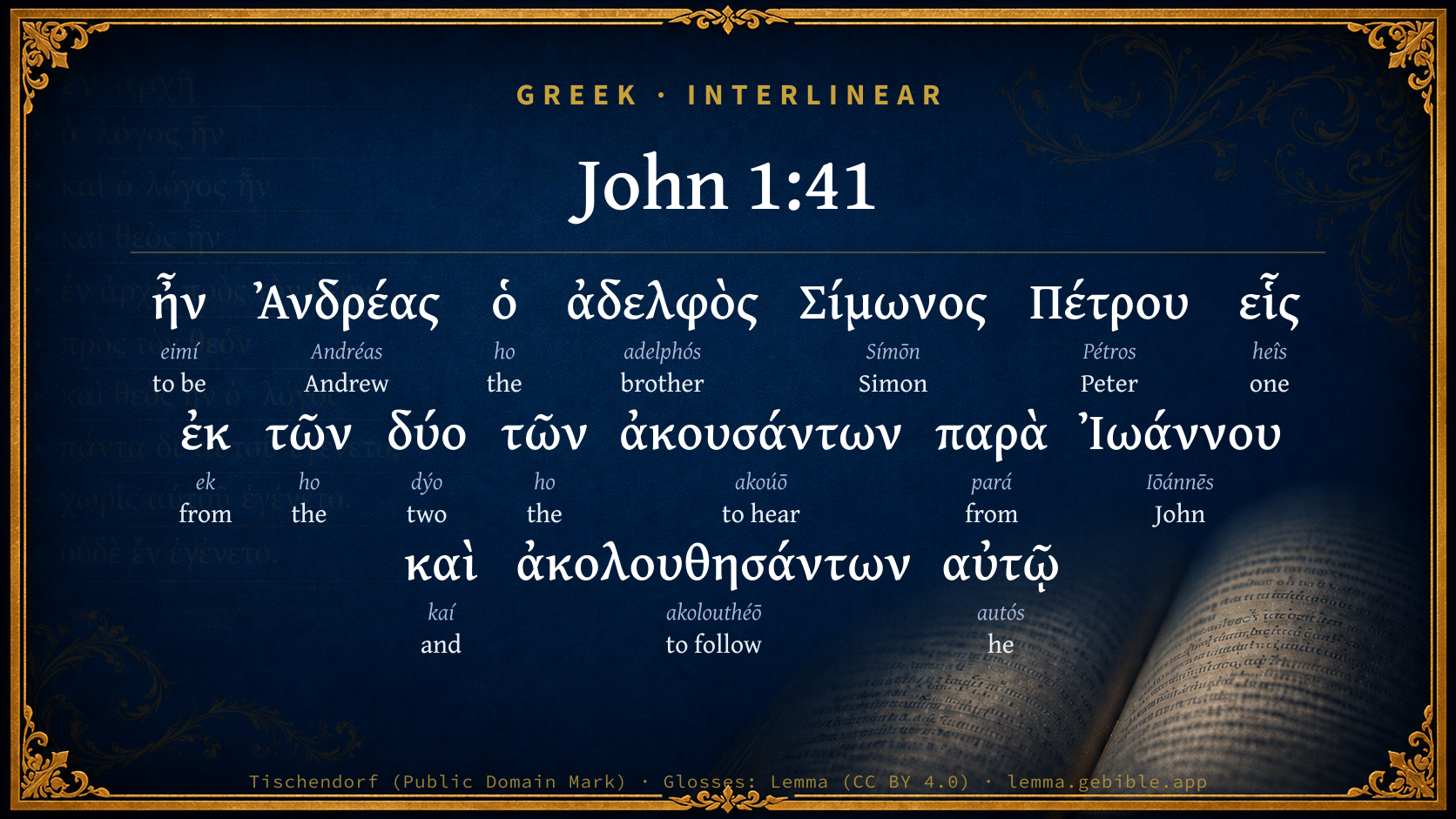
  1. ἦν eimí G1510 “to be” Verb, Imperfect, Active, Indicative, 3rd person, Singular
  2. ὁ ho G3588 “the” Article, Nominative, Singular, Masculine
  3. ἀδελφὸς adelphós G80 “brother” Noun, Nominative, Singular, Masculine
  4. Σίμωνος Símōn G4613 “Simon” Noun, Genitive, Singular, Masculine
  5. Πέτρου Pétros G4074 “Peter” Noun, Genitive, Singular, Masculine
  6. εἷς heîs G1520 “one” Adjective, Nominative, Singular, Masculine
  7. ἐκ ek G1537 “from” Preposition
  8. τῶν ho G3588 “the” Article, Genitive, Plural, Masculine
  9. δύο dýo G1417 “two” Adjective, Numeral (indeclinable)
  10. τῶν ho G3588 “the” Article, Genitive, Plural, Masculine
  11. ἀκουσάντων akoúō G191 “to hear” Verb, Aorist, Active, Participle, Genitive, Plural, Masculine
  12. παρὰ pará G3844 “from” Preposition
  13. Ἰωάννου Iōánnēs G2491 “John” Noun, Genitive, Singular, Masculine
  14. καὶ kaí G2532 “and” Conjunction
  15. ἀκολουθησάντων akolouthéō G190 “to follow” Verb, Aorist, Active, Participle, Genitive, Plural, Masculine
  16. αὐτῷ autós G846 “he” Personal pronoun, Dative, Singular, Masculine

About this verse

These counts appear in no published source. They are computed here, from the morphology-tagged text and Lemma’s own curated glosses. What Lemma adds →

17
words
15
distinct lemmas
Gospels
section

Notable vocabulary

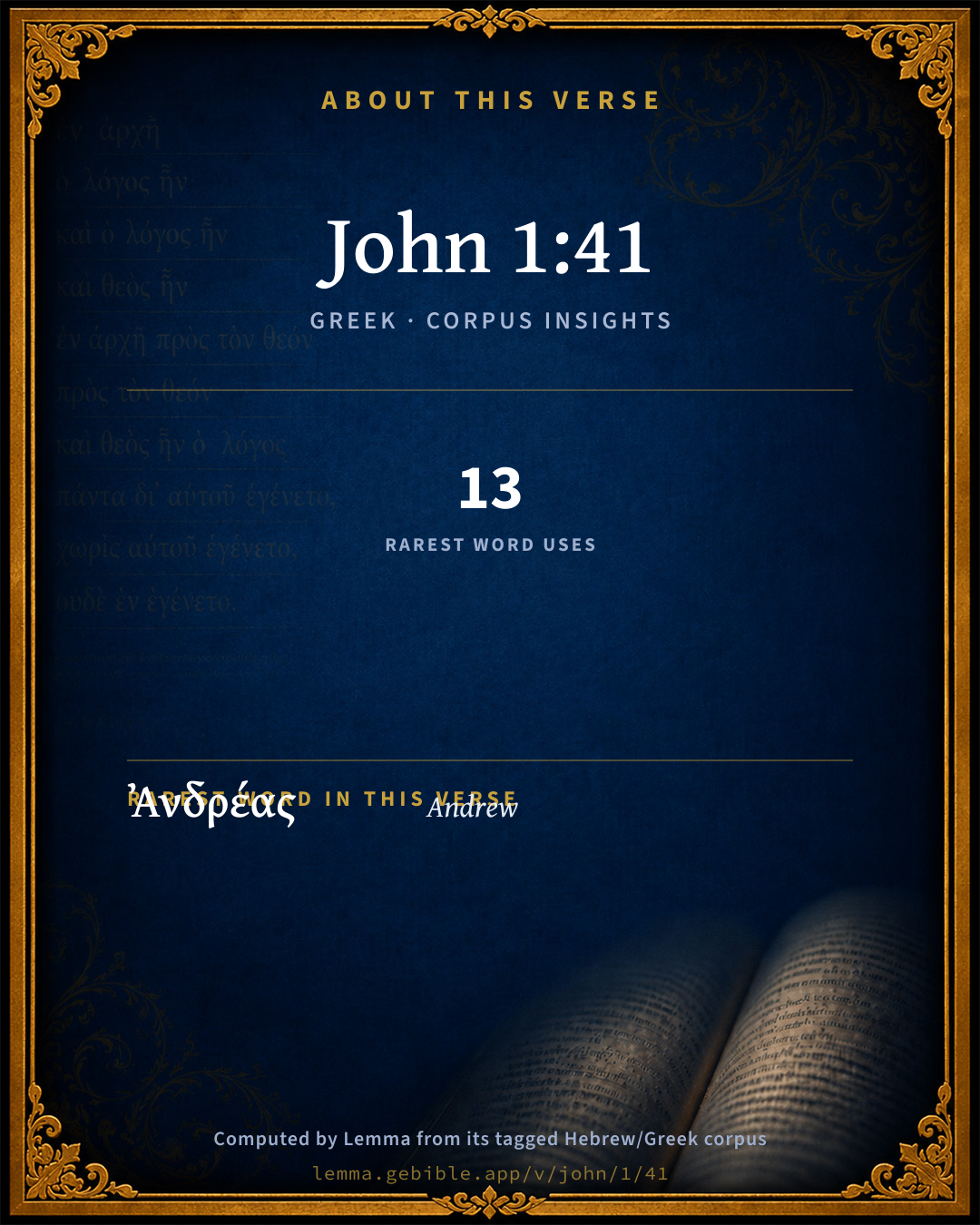
The rarest word here is Ἀνδρέας Andrew G406 — appearing just 13 times in the whole Greek New Testament.

Shared distinctive vocabulary

Ἀνδρέας Andrew G406 occurs in 12 verses of the Greek New Testament. Also found in:

Repetition

A word recurs within this verse:

Cross-references

18

Topical passages linked to John 1:41 in the Treasury of Scripture Knowledge — connected by theme and wording, ordered by reader-vote popularity; previews shown in the World English Bible.

  • John 4:25 The woman said to him, "I know that Messiah comes," (he who is called Christ). "When he has come, he will declare to us all things."
  • John 1:45 Philip found Nathanael, and said to him, "We have found him, of whom Moses in the law, and the prophets, wrote: Jesus of Nazareth, the son of Joseph."
  • Isaiah 2:3–5 Many peoples shall go and say, "Come, let's go up to the mountain of Yahweh, To the house of the God of Jacob; And he will teach us of his ways, And we will walk in his paths. For out of Zion the law shall go forth, And the word of Yahweh from Jerusalem.
  • Acts 13:32–33 We bring you good news of the promise made to the fathers,
  • Psalms 89:20 I have found David, my servant. I have anointed him with my holy oil,
  • Daniel 9:25–26 Know therefore and discern, that from the going forth of the commandment to restore and to build Jerusalem to the Anointed One, the prince, shall be seven weeks, and sixty-two weeks: it shall be built again, with street and moat, even in troubled times.
  • Luke 2:17 When they saw it, they publicized widely the saying which was spoken to them about this child.
  • John 1:36–37 and he looked at Jesus as he walked, and said, "Behold, the Lamb of God!"
  • John 4:28–29 So the woman left her water pot, and went away into the city, and said to the people,
  • Acts 10:38 even Jesus of Nazareth, how God anointed him with the Holy Spirit and with power, who went about doing good and healing all who were oppressed by the devil, for God was with him.
  • 2 Kings 7:9 Then they said one to another, We aren't doing right. This day is a day of good news, and we hold our peace: if we wait until the morning light, punishment will overtake us; now therefore come, let us go and tell the king's household.
  • Psalms 2:2 The kings of the earth take a stand, And the rulers take counsel together, Against Yahweh, and against his anointed, saying,
  • Psalms 45:7 You have loved righteousness, and hated wickedness. Therefore God, your God, has anointed you with the oil of gladness above your fellows.
  • Isaiah 11:2 The Spirit of Yahweh shall rest on him, the spirit of wisdom and understanding, the spirit of counsel and might, the spirit of knowledge and of the fear of Yahweh.
  • Isaiah 61:1 The Spirit of the Lord Yahweh is on me; because Yahweh has anointed me to preach good news to the humble; he has sent me to bind up the broken-hearted, to proclaim liberty to the captives, and the opening [of the prison] to those who are bound;
  • Luke 2:38 Coming up at that very hour, she gave thanks to the Lord, and spoke of him to all those who were looking for redemption in Jerusalem.
  • Luke 4:18–21 "The Spirit of the Lord is on me, Because he has anointed me to preach good news to the poor. He has sent me to heal the brokenhearted, To proclaim release to the captives, Recovering of sight to the blind, To deliver those who are crushed,
  • Acts 4:27 For truly, in this city against your holy servant, Jesus, whom you anointed, both Herod and Pontius Pilate, with the Gentiles and the people of Israel, were gathered together

Cross-references courtesy of OpenBible.info (CC BY 4.0).

Commentary

Notes on John 1:41 from classic Christian and Jewish commentators (each source and its license shown beneath its notes). The classic Christian expositions comment on the surrounding passage and are grouped to its opening verse, so a note may address several verses; the Jewish commentaries on the Tanakh (Rashi and others) are per-verse, so they appear only where the commentator wrote on this verse.

Lemma curates 59 commentaries, every one of them public domain or Creative Commons licensed, each selected and text-cleaned for this edition rather than reprinted as found. About our sources →

Ellicott's Commentary for English Readers

[(2) JESUS MANIFESTS HIMSELF TO INDIVIDUALS (John Joh_1:41 to Joh_2:11):

(a) To the first disciples—the witness of man (Joh_1:41-51);

(b) At Cana of Galilee—the witness of nature (Joh_1:1-11).]

(41) He first findeth his own brother.—The probable explanation of this verse, and the only one which gives an adequate meaning to “first” and “his own,” is that each of the two disciples in the fulness of his fresh joy went to seek his own brother, that Andrew found Peter first, and that John records this, and by the form in which he does so implies, but does not state, that he himself found James. To have stated this would have been to break through the personal reserve which he imposed upon himself. (Comp. Mat_4:18-21; Mar_1:16-19; Luk_5:1-10.)

We have found.—Implying a previous seeking, and that both were under the impulse of the general movement leading men to expect the Messiah. It is implied, too, that Simon was near, and therefore probably a hearer of the Baptist.

Messias.—The Hebrew form of the name occurs in the New Testament only here and in Joh_4:25, in both cases in a vivid picture of events fixed in the memory. Elsewhere, John, as the other sacred writers, uses the LXX. translation, “Christ,” and even here he adds it (comp., e.g., in this John Joh_1:20; Joh_1:25). Both words mean “anointed” (see margin, and comp. Psa_45:8).

A Bible Commentary for English Readers, edited by Charles John Ellicott (1878–1897) — public domain. Text from a community e-Sword module.

Bengel's Gnomon

Johann Albrecht Bengel

Joh 1:41. Εὑρίσκει, findeth) With the festival-like [joyous] freshness of those days beautifully corresponds the word findeth, which is used here more frequently [than elsewhere].—πρῶτος, first) It is to be presumed, that both of them sought Simon by different roads.[40]—τὸν ἀδελφὸν, his brother) He afterwards became superior to Andrew, who, it is probable, was the elder born; Joh 1:44 [the order there is, “Andrew and Peter”].—εὑρήκαμεν, we have found) Joh 1:45, “We have found Him, of whom Moses in the law and the prophets did write” [Philip to Nathanael]. A great and joyful εὓρημα, treasure-found, expected by the world for about forty centuries. They had learned from John, that He was close at hand.—ὅ, which) This is an addition of the Evangelist, as at Joh 1:42.

[40] Rather, as Andrew first of the two disciples found his own brother and brought him to Jesus; so the other disciple, who was probably John, did the same, and brought his brother, James, to the Saviour.—E. and T.

Bengel's Gnomon of the New Testament — English translation (T&T Clark, Edinburgh, 1860) — public domain. Text from a community e-Sword module.

Meyer's Critical & Exegetical Commentary

Heinrich August Wilhelm Meyer

Joh_1:41-43. Still on the same day (not on the following, as, after the early expositors, De Wette, Baur, Luthardt, Ewald, and most others suppose; see, on the contrary, the ἐπαύριον which again appears, but not till Joh_1:44), Andrew first meets his brother Simon.

πρῶτος] We must understand the matter thus: Both disciples go out from the lodging-place (at the same time, or perhaps Andrew first), still in the first fresh glow of joy at having found the Messias,[122] in order that each of them may seek his own brother (we must assume that both brothers were known to be in the neighbourhood), in order to inform him of the new joy, and to bring him to Christ. Andrew is the first (ΠΡῶΤΟς, not ΠΡῶΤΟΝ, an inelegant change adopted by Lachmann, after A. B. M. X. א **) who finds his brother. John, however, does not say that he also sought his brother James, found him, and brought him to Jesus; and this is in keeping with the delicate reserve which prevents him from naming either himself or those belonging to him (even the name of James does not occur in the Gospel). Still this may be clearly seen from the ΠΡῶΤΟς, and is confirmed by the narrative of the Synoptics, in so far that both James and John are represented as being called at the same time by Jesus (Mar_1:19 and parallels). Bengel, Tholuck, De Wette, Hengstenberg, wrongly say that Andrew and John had both sought out Simon. The ΤῸΝ ἼΔΙΟΝ is against this; as it neither here nor elsewhere (comp. Joh_5:18) occurs as a mere possessive (against Lücke, Maier, De Wette, and others), but in opposition to that which is foreign. Any antithetic relation to the spiritual brotherhood in which John as well as Andrew stood to Simon (Hengstenberg), is quite remote from the passage.

εὑρήκαμεν] placed emphatically at the beginning of the clause, and presupposing the feeling of anxious desire excited by the Baptist. The plural is used because Andrew had in mind the other disciple also.

ἐμβλέψας, κ.τ.λ.] This fixed look (Joh_1:36) on the countenance of Simon pierces his inner soul. Jesus, as the Searcher of hearts (Joh_2:25; Weiss, Lehrbegr. p. 263), sees in him one who should hereafter be called to be the rock of the church, and calls him by the name which he was henceforth to bear as His disciple (not first in Mat_16:18, as Luthardt thinks). A rock is the emblem of firmness as early as Homer (Od. xvii. 463); comp. Eze_3:9. There is no contradiction here with Mat_16:18 (it is otherwise with Mar_3:16), as if John had transferred the giving of the name to this place (Hilgenfeld, comp. Baur and Scholten), for in Mat_16:18 the earlier giving of the name is really presupposed, confirmed, and applied. See on Matt.

σὺ εἶ Σίμων, κ.τ.λ.] This belongs to the circumstantiality of the solemn ceremony of the name-giving; it is first said who he is, and what in future he should be called. Comp. Gen_32:28; Gen_35:10; Gen_17:5. Σὺ εἶ Σίμων is not, as Ewald thinks, a question; and there is no ground whatever for supposing that Jesus immediately recognised him (Cyril, Chrysostom, Augustine, Aretius, Maldonatus, Cornelius a Lapide, Bengel, Luthardt, and many, comp. Strauss), for Andrew introduced his brother to Jesus. Grotius and Paulus[123] give arbitrary explanations of the reading Ἰωνᾶ, but see the critical notes. For the rest, we must not say, with Hilgenfeld, Peter here attains the pre-eminence of the first called disciple; but Peter is first given this pre-eminence in the synoptical accounts (Mat_4:18 and parallels); the personal recollection of John, however, must take precedence of these. See especially the note following Joh_1:51.

[122] Johns use here and in Joh_4:25 of τὸν Μεσσίαν (משיה) is accounted for by the depicting of the scene exactly as it occurred; whereas in Joh_1:20; Joh_1:25, when he simply writes historically, he uses the ordinary translation Χριστός. The genre picture is specially minute; so here. According to Baur, N. T. Theol. p. 393, the author has given an antiquarian notice, as it were, of this Hebrew name which occurs nowhere else in the N. T.

[123] The fantastic play upon the words in Langes L. J. II. 469, is of this sort. He renders: Now thou art the son of the timid dove of the rock; in future shalt thou be called the sheltering rock of the dove (the church). According to the true reading of the passage, the name of Peters father contained in Βαριωνά which occurs in Matthew, must be regarded as an abbreviation for John, and has nothing whatever to do with dove. See on Mat_16:17.

Meyer — Critical and Exegetical Commentary on the New Testament — English translation by Peter Christie, edited by Frederick Crombie (T&T Clark, 1880) — public domain. Text from a community e-Sword module.

Expositor's Greek Testament

ed. W. Robertson Nicoll

Joh 1:41 . ἦν Ἀνδρέας … Σίμωνος . One of the two who thus first followed Christ was Andrew, known not so much in his own name as being the brother of Simon Πέτρου is here proleptic. We are left to infer that the other disciple was the evangelist.

The Expositor's Greek Testament, edited by W. Robertson Nicoll (1897–1910) — public domain. Text from a community e-Sword module.

Geneva Bible (1599)

Geneva Bible translators

That is, anointed, and King after the manner of the Jewish people.

Geneva Bible (1599) marginal notes — public domain. Text via Bolls.life.

Jamieson, Fausset & Brown

Robert Jamieson, A. R. Fausset & David Brown

have found the Messias--The previous preparation of their simple hearts under the Baptist's ministry, made quick work of this blessed conviction, while others hesitated till doubt settled into obduracy. So it is still.

Jamieson, Fausset & Brown — Commentary Critical and Explanatory on the Whole Bible (1871) — public domain (CC PDM 1.0). Text via the HelloAO Bible API.

Adam Clarke's Commentary

Verse 41. Findeth his own brother Simon] Every discovery of the Gospel of the Son of God produces benevolence, and leads those to whom it is made to communicate it to others. Those who find Jesus find in him a treasure of wisdom and knowledge, through which they may not only become rich themselves, but be instruments, in the hand of God, of enriching others. These disciples, having tasted the good word of Christ, were not willing to eat their bread alone, but went and invited others to partake with them. Thus the knowledge of Christ became diffused-one invited another to come and see: Jesus received all, and the number of disciples was increased, and the attentive hearers were innumerable. Every man who has been brought to an acquaintance with God should endeavour to bring, at least, another with him; and his first attention should be fixed upon those of his own household.

Adam Clarke's Commentary on the Bible (1810–1826) — public domain. Text from a community e-Sword/MySword module.

John Calvin's Commentaries

41. We have found the Messiah. The Evangelist has interpreted the Hebrew word Messiah (Anointed) by the Greek word Christ, in order to publish to the whole world what was secretly known to the Jews. It was the ordinary designation of kings, as anointing was observed by them as a solemn rite. But still they were aware that one King would be anointed by God, under whom they might hope to obtain perfect and eternal happiness; especially when they should learn that the earthly kingdom of David would not be permanent. And as God raised their minds, when subdued and weighed down by various calamities, to the expectation of the Messiah, so he more clearly revealed to them that his coming was at hand. The prediction of Daniel is more clear and forcible than all the rest, so far as relates to the name of Christ; for he does not, like the earlier Prophets, ascribe it to kings, but appropriates it exclusively to the Redeemer, (Daniel 9:25, 26.) Hence this mode of expression became prevalent, so that when the Messiah or Christ was mentioned, it was understood that no other than the Redeemer was meant. Thus we shall find the woman of Samaria saying, the Messiah will come, (John 4:25;) which makes it the more wonderful that he who was so eagerly desired by all, and whom they had constantly in their mouths, should be received by so small a number of persons.

John Calvin's Commentaries (1540-1563) — public domain. Text from the Calvin Translation Society English edition (1840s-50s) via the Christian Classics Ethereal Library (ccel.org). Calvin's coverage is partial (roughly two-thirds of the Bible); uncommented books and verses are honest gaps, never fabricated. The 19th-century editor's footnotes and remarks are omitted so the notes are faithfully Calvin's own voice.

The Cambridge Bible for Schools and Colleges

gen. ed. J. J. S. Perowne

41. He first findeth, &c.] The meaning of ‘first’ becomes almost certain when we remember S. John’s characteristic reserve about himself. Both disciples hurry to tell their own brothers the good tidings, that the Messiah has been found: S. Andrew finds his brother first, and afterwards S. John finds his; but we are left to infer the latter point.

S. Andrew thrice brings others to Christ; Peter, the lad with the loaves (Joh_6:8), and certain Greeks (Joh_12:22); and excepting Mar_13:3 we know scarcely anything else about him. Thus it would seem as if in these three incidents S. John had given us the key to his character. And here we have another characteristic of this Gospel—the lifelike way in which the less prominent figures are sketched. Besides Andrew we have Philip, Joh_1:44, Joh_6:5, Joh_12:21, Joh_14:8; Thomas, Joh_11:16, Joh_14:5; Joh_20:24-29; Nathanael, Joh_1:45-51; Nicodemus, Joh_3:1-12, Joh_7:50-52, Joh_19:39; Martha and Mary, 11, Joh_12:1-3.

We have found] This does not prove that S. John is still with him, only that they were together when their common desire and expectation were fulfilled.

Messias] The Hebrew form of this name is used by S. John only, here and Joh_4:25. Elsewhere the LXX. translation, ‘the Christ,’ is used. Here ‘the’ before ‘Christ’ should be omitted.

The Cambridge Bible for Schools and Colleges (gen. ed. J. J. S. Perowne; Cambridge University Press, 1878–1918) — public domain. Text from a community e-Sword module.

John Gill's Exposition

He first findeth his own brother Simon,.... Either before the other disciple, or before he found any other person: after he and the other disciple departed from Christ, being affected with the grace bestowed upon him, and his heart warm with the conversation he had had with him, and transported with joy at finding the Messiah, goes in all haste in search of his relations, friends, and acquaintance, to communicate what he had seen and heard, in order to bring them to the knowledge of the same; for such is the nature of grace, it is very communicative, and those that have it, are very desirous that all others should be partakers of it: and the first person he lighted on was Simon, who was afterwards called Peter, who was his own brother; not a brother-in-law, but his own brother, by father and mother's side, and so dear unto him by the ties of nature and blood:

and saith unto him; with all eagerness imaginable, and in a rapture of joy:

we have found the Messias; I, and a fellow disciple have had the Messiah, so often foretold by the prophets, and so long expected by our fathers, pointed out to us; and we have followed him, and have had conversation with him, and are well assured he is that illustrious person:

which is, being interpreted, the Christ; which, as in Joh 1:38, are the words of the evangelist, and not Andrew, and are therefore left out in the Syriac version; the word Messiah needing no interpretation in that language, and which was the language in which Andrew spoke. This name, Messiah, was well known among the Jews, for that who was promised, and they expected as a Saviour and Redeemer; though it is not very often mentioned in the books of the Old Testament, chiefly in the following places, Psa 2:2; but is very much used in the Chaldee paraphrases: Elias Levita (g) says, he found it in more than fifty verses; and Buxtorf (h) has added others to them, and the word appears in "seventy one" places, which he takes notice of, and are worthy of regard; for they show the sense of the ancient synagogue, concerning the passages of the Old Testament, respecting the Messiah: this Hebrew word is interpreted by the Greek word, "Christ"; and both signify "anointed", and well agree with the person to whom they belong, to which there is an allusion in Sol 1:3, "thy name is as ointment poured forth": he is so called, because he was anointed from everlasting, to be prophet, priest, and king; see Psa 2:6 Pro 8:22, and he was anointed as man, with the oil of gladness, with the graces of the Spirit, without measure, Psa 45:7. And it is from him the saints receive the anointing, or grace in measure; and are from him called Christians, and are really anointed ones; see Jo1 2:27, hence it is a name precious to the saints, and savoury to them. These words were delivered by Andrew, in a very exulting strain, expressing great joy; as indeed what can be greater joy to a sensible soul, than to find Christ? which in a spiritual sense, is to have a clear sight of him by faith, to go unto him, and lay hold on him, as the only Saviour and Redeemer: who is to be found in the Scriptures of truth, which testify of him; in the promises of grace, which are full of him and in the Gospel, of which he is the sum and substance; and in the ordinances of it, where he shows himself; for he is not to be found by the light of nature, or by carnal reason, nor by the law of Moses, but by means of the Gospel, and the Spirit of God attending that, as a spirit of wisdom and revelation, in the knowledge of him: and happy are those souls that find Christ under his direction; for they find life, spiritual and eternal, in him; a justifying righteousness; free and full pardon of their sins; spiritual food for their souls; and peace, comfort, joy, and rest, and eternal glory: wherefore this must needs be matter of joy unto them, since such a finding is a rich one, a pearl of great price, riches durable and unsearchable; and which a man that has found, would not part with for all the world; but parts with all he has for it; and is what can never be lost again; and, particularly to two sorts of persons, finding Christ must give a peculiar pleasure, and an inexpressible joy; to such as are under a sense of sin and damnation, and to such who have been under desertion. The phrase of "finding" a person, twice used in this text, and hereafter in some following verses, is frequent in Talmudic and Rabbinic writings; as

“he went, , "and found him with Rab" (i).

(g) Prefat ad Methurgemen, & in voce (h) Lexicon Talmud p. 1268. (i) T. Bab. Sabbat, fol. 108. 1. Zohar in Lev. fol. 15. 3.

John Gill's Exposition of the Whole Bible (1746–1763) — public domain (CC PDM 1.0). Text via the HelloAO Bible API.

Trapp's Complete Commentary

John Trapp

41 He first findeth his own brother Simon, and saith unto him, We have found the Messias, which is, being interpreted, the Christ.

Ver. 41. He first findeth] Yet afterwards Peter outstripped Andrew in faith and forwardness for Christ; as likewise Luther did Staupicius, &c. So the first become last, and the last first. But charity is no churl; Andrew calleth Simon, and Philip, Nathanael, &c.; as a loadstone draws to itself one iron ring, and that another, and a third, so, &c.

We have found the Messiah] Little it was that he could say of Christ’s person, office, value, virtue, &c., but brings him to Christ. So let us do ours to the public ordinances. Do the office of the sermon bell at least, we know not what God may there do for them. Bring them as they did, the palsy man upon his bed, and lay them before the Lord for healing.

John Trapp, A Commentary or Exposition upon All the Books of the Old and New Testament (1647–1656) — public domain. Text from a community e-Sword module.

Albert Barnes' Notes on the Bible

He first findeth - He found him and “told him about Jesus” before he brought him to Jesus.

We have found the Messias - They had learned from the testimony of John, and now had been more fully convinced from conversation with Jesus, that he was the Messiah. The word “Messiah,” or “Messias,” is Hebrew, and means the same as the Greek word “Christ,” “anointed.” See the notes at Mat 1:1. From the conduct of Andrew we may learn that it is the nature of religion to desire that others may possess it. It does not lead us to monopolize it or to hide it under a bushel, but it seeks that others also may be brought to the Saviour. It does not “wait” for them to come, but it goes “for” them; it seeks them out, and tells them that a Saviour is found. Young converts should “seek” their friends and neighbors, and tell them of a Saviour; and not only their relatives, but all others as far as possible, that all may come to Jesus and be saved.

Albert Barnes' Notes on the Bible (1834–1885) — public domain. Text from a community e-Sword/MySword module.

Matthew Poole's English Annotations

It should seem that both the disciples (after their converse with Christ at the place where he lodged) went together to look for Peter, Andrew’s brother. Andrew first found him, and tells him (with great joy) that he and that other disciple had found the Messiah, prophesied of by Daniel, and in the expectation of whom the disciples and the Jews lived. The term Messiah in Hebrew is the same with Christ in Greek, and both signify the same with Anointed in English. The article in this place is emphatic, not merely prepositive, as in other places, but signifying, that Anointed; for other kings, and priests, and prophets were also anointed, and God’s people are called anointed; but he was anointed with the oil of gladness above his fellows, having the Spirit not given him by measure.

Matthew Poole's English Annotations on the Holy Bible (1683–1685) — public domain. Text from a community e-Sword/MySword module.

Whedon's Commentary on the Bible

Daniel D. Whedon

41. Findeth his own brother Simon—A circle of friends, it would seem, from Galilee, mostly from Bethsaida, are now at the Jordan, drawn by the ministry of the Baptist, and in more or less close connection with him. Of these Jesus will now form the nucleus of his apostolic college. But they are special disciples rather than apostles.

The Messias… the Christ—Inasmuch as our Evangelist writes for Gentiles, in a city distant from Palestine, he interprets the term.

Daniel D. Whedon (gen. ed.), Commentary on the Old and New Testaments (1874–1909) — public domain. Text from a community e-Sword module.

The Pulpit Commentary

(a) The Messiah. He (Andrew) firstfindeth his own brother Simon. Dr. Plummer here observes, "In Church history St. Peter is everything, and St. Andrew nothing: but would there have been an Apostle Peter but for Andrew?" Hengstenberg, De Wette, and others have explained the curious word "first," as though both the unnamed disciple and Andrew had gone together to search out Simon, and that Andrew had been the first of the two to be successful. This would leave the idion less satisfactorily accounted for than the simple supposition that each of the disciples started in different directions to find "his own" brother, and that Andrew was more fortunate than his companion. The two pairs of brothers are frequently mentioned as being together. James and John, Andrew and Simon, are partners on the lake of Galilee in their fishing business, and are finally called into full discipleship and apostolate after the visit to Jerusalem. (Mar_1:19, 11) The four are specially mentioned as being together, (see Mar_13:3) so that it is not unreasonable to suggest that when Andrew first sought "his own" brother Simon, John also sought for "his own" brother James. It is worthy of note that the evangelist never mentions his own name, nor that of James, nor that of their mother Salome, although he does imply their presence. Andrew saith to him (Simon), We have found the Messias the article is omitted, as Cristov is merely the translation of" Messiah (which, adds the evangelist, is, being interpreted, Christ). Andrew is described on two additional occasions as bringing others to Jesus. (Joh_6:8 Joh_12:22) Here the rapidity and depth of his convictions are noted. The writer"s own impression is implied rather than given. He hides his own faith under the bolder and more explicit utterance of his friend. This was the result upon the mind of two disciples of the first conference with Jesus. Marvellous enough that such a thought should have possessed them, however imperfect their ideas were as yet concerning the Christ! The eurhkamen implies that they had long been waiting for the Consolation of Israel, looking for his coming, seeking his appearing. "We have sought," they say, "and we have found." A more wonderful Eurhka than that of Archimedes. The plural does not necessitate the presence of John, though it does suggest the agreement of Andrew and his friend in the same august conclusion. What sense of Divine things must have come from the words and looks of Jesus! He who produced such impression on the Baptist as that which the four evangelists report, had done even more with the susceptible spirits of his two disciples. The Baptist never actually called Jesus "the Christ." But when he had testified to the pre-existing glory, the heavenly origin, the sublime functions of the great ercomenov , and by special revelation on his forewarned spirit had declared that he was the Son of God, the Lamb of God, and the Baptizer with the Holy Ghost and fire: what must not the inference be when his two disciples came into yet closer and more intimate relations with Jesus? The Jewish idea of "Messiah", (Messiav , only occurring here Joh_4:25) equivalent to ajyvim, Aramaized form, the stat. emphat, of jyvim (Hebrew jyvim); cf. Iessai for yvyi (Kautzsch, "Gram. des Bib. Aram.," p. 10), was the term used among all classes to denote One who should, as anointed by God, fulfil the functions of Prophet, Priest and King, who should realize the splendid visions of the ancient prophecies, and combine in himself a wonderful exhibition of Divine majesty and even of awful suffering. We see that the Baptist understood what was meant by the title, but denied its applicability to himself. The Samaritans believe in a coming Prophet and Saviour. (Joh_4:25, Joh_4:29) The people believe that Messiah will work miracles, that he will be born in Bethlehem, that he will abide forever, that he would prove to be the Son of God. The King Messiah is a pre-existing power and presence in their past history. He will come in the clouds, and reign forever and ever. (see Joh_7:26, Joh_7:31, 42 12:34) According to Wiinsche ("Neue Beitrage zurerlauterung der Ev., aus Talmud und Midrasch," pp. 499, 500), the Talmud ("Pesachim," 54, and "Nedavim," 39) declares that Messias, or his Name, was one of the seven things created before the world; and Midrasch ("Schemoth," par. 19) Exo_4:22 declares that the King Messias was the Firstborn of God. The more spiritual ideas of John the Baptist have prepared the two disciples to see, even in the travel-stained, lowly Man, "the Messiah." Of course, their idea of Messiah and their idea of Jesus would suffer wonderful development, and be harmonized and blended into a sublime unity by later instructions; but they had made this great discovery, and hastened to impart it.

Vers. 41, 42. The reception of Peter by Christ.

Andrew"s first action is to make his discovery of the Messiah known to his brother.

I MARK THE PROMPT ZEAL, THE QUIET HELPFULNESS, THE YEARNING FAITH, OF ANDREW. "He first findeth his own brother Simon implying that he afterwards found John"s brother, James, for a like object brought him to Jesus.

1. Andrew follows a natural instinct in carrying the glad tidings of salvation to his brother. Simon was one of the nearest and the dearest in life. It was an instinct of grace likewise that Andrew should desire his brother to share in the blessings of the common salvation.

2. How much good is often done by the private suggestion or inquiry of a Christian friend!

3. What momentous consequences flowed from Andrew"s loving act! He was not

(1) the writer of an Epistle,

(2) nor the founder of a Church,

(3) but the opener of a new career to one of the greatest of the apostles. He was the instrument by whom Peter was first led into the paths of truth, and on that account is to be held in "everlasting remembrance.

(4) Our last notice of Andrew is equally characteristic of him, for, it he found Peter first, he found others afterwards. It was he and Philip who introduced the Greek strangers to Christ. (Joh_12:20)

II MARK THE MODE OF OUR LORD"S RECEPTION OF PETER. "Thou art Simon, the son of Jona: thou shalt be called Cephas, which is by interpretation, A stone.

1. Our Lord knew Peters character. The Jews regarded the knowledge of the hearts of men as an attribute of the Messiah.

2. The change of name implies a change of character or position. So it was in the cases of Abraham, Sarah, and Jacob. The Master here takes possession of his servant, and consecrates him at once and wholly to his service.

3. The name Cephas by which Peter was exclusively known to the Corinthians, and, perhaps, to other Churches implies strength of character, vigour of resolution, and the power of aggression, which had their place side by side with an honest-hearted impulsiveness.

4. The selection of disciples, like Peter and Andrew, for the propagation of the gospel, unlearned as they were in the worlds scholarship, is a powerful evidence of the truth of Christianity.

The great discovery.

Universal interest and pleasure are connected with all striking discoveries; e.g. in geographical knowledge, in physical science, in the arts of life. A new possession, either material or intellectual, is thus acquired. But all discoveries pale before that described in the simple language of the text. To find Christ is better than to find a gold mine, a continent, a faithful wife, a happy home.

I THE PROCESS OF THIS DISCOVERY. There is here no chance, no accident, no caprice. There are involved:

1. The seeking soul. The soul that is satisfied with itself and its state is not in the way to the great discovery; but the soul that is conscious of destitution, ignorance, and sinfulness is in the right direction. The soul that feels how insufficient is the discovery and acquisition of earthly goods and human friends is prepared to appreciate a Divine revelation.

2. The self-discovering Saviour. It is often represented that the mere desire and aspiration of the soul is sufficient to secure its highest good. But hunger is not enough to secure our satisfaction; there must be bread to correspond with, to supply, the want. So the heart may yearn to little purpose unless the Divine heart of the Saviour respond to the yearning. Now, Jesus is willing to be found, and, indeed, came to earth in order that in him the favour, fellowship, and life of God might be made accessible to man. From the beginning of his ministry he welcomed all who sought him. And still his promise is, "Seek, and ye shall find;" "Come unto me,...and ye shall find rest.

3. The Spirit of God is the Divine Guide that leads the soul to the Saviour. A Divine influence prompts the spiritual quest, sets the glorious Object of that quest before the vision, and urges to a fervent and immediate application for blessing.

II THE VALUE OF THIS DISCOVERY. Christ is the Treasure hidden, the Pearl of price.

1. They who find him find the mind and heart of the God in whom "we live and move and have our being." As Simon and Nathanael soon found that the Rabbi of Nazareth was the Son of God; so many who have been prejudiced against Jesus have learned how unjust were their prejudices. Time has revealed to them the fulness from which they have received grace for grace.

2. They find in Christ supply for all their wants and satisfaction for all their cravings. He becomes to those who find him, not only Prophet, Priest, and King, but also Counsellor, Friend, and Brother.

III THE RESULT OF THIS DISCOVERY.

1. Joy. Finding Christ is being found by Christ; and, as he rejoices over the lost ones who are found, so they rejoice in him whom to find is life eternal.

2. Proclamation. It is a discovery which the discoverer cannot keep to himself. In this narrative we observe the happy finders of the Messiah communicating to kindred and to friends their unspeakable happiness. The impulse of glowing benevolence urges to the spiritual ministry of compassion, and thus soul after soul is brought to enter upon that pursuit which is ever rewarded by success and satisfaction. T.

The Pulpit Commentary (1880–1919), ed. H.D.M. Spence-Jones & Joseph S. Exell — public domain. Text from a community e-Sword module.

John Wesley's Explanatory Notes

He first findeth his own brother Simon - Probably both of them sought him: Which is, being interpreted, the Christ - This the evangelist adds, as likewise those words in ver. 38, that is, being interpreted, Master.

John Wesley, Explanatory Notes Upon the Whole Bible (1754–1765) — public domain. Text via the GEBible commentary corpus.

Cambridge Greek Testament for Schools and Colleges

41. ὁ ἀδελφὸς Σ. Π. Before the end of the first century, therefore, it was natural to describe Andrew by his relationship to his far better known brother. In Church History Peter is everything and Andrew nothing: but would there have been an Apostle Peter but for Andrew? In the lists of the Apostles Andrew is always in the first group of four, but outside the chosen three, in spite of this early call.

Cambridge Greek Testament for Schools and Colleges (Cambridge University Press, 1896; 21 vols, various authors incl. Carr, Maclear, Plummer, Farrar, Lumby, Moule, M. R. James, Simcox) — public domain. Text from a community e-Sword module.

Alford’s Greek Testament

Henry Alford

41.] Who the other disciple was, is not certain: but considering (1) that the Evangelist never names himself in his Gospel, and (2) that this account is so minutely accurate as to specify even the hours of the day, and in all respects bears marks of an eye-witness, and again (3) that this other disciple, from this last circumstance, certainly would have been named, had not the name been suppressed for some especial reason, we are justified in inferring that it was the Evangelist himself. And such has been the general opinion. Euthymius gives an alternative which is hardly probable: ἢ διότι οὐκ ἦν τῶν ἐπισήμων καὶ γνωρίμων ἐκεῖνος, ἢ ὅτι αὐτὸς ἦν ὁ ταῦτα γράφων.

Henry Alford, The Greek Testament (1849–1861) — public domain. Text from a community e-Sword module.

International Critical Commentary

41. The text is uncertain. א*LWΓΔ give πρῶτος. This would mean that Andrew was the first to find his brother Peter; implying that the unnamed disciple had also set out to find his brother (i.e., presumably, James, the elder son of Zebedee), and that he did find him, but later. But if the sentence means all this, it is very obscurely expressed.

πρῶτον, accepted by most modern editors, is supported by אcABTbΘ fam. 13, and the vss. generally. This would mean that Andrew found Peter first, before he did anything else, there being no suggestion of John looking for any one, or of any other disciple being found by either of them. The emphasis on ἵδιον “his own brother,” would be consistent with this.

Whether we read πρῶτος or πρῶτον, a good deal of time elapses between v. 39 and v. 43. Andrew and the innominatus, presumably, have a full and convincing conversation with Jesus, staying with Him for the afternoon and night; Andrew goes out and finds Peter, who is brought back to Jesus, welcomed, and renamed Kephas. Modern editors (Alford is an exception) try to find time for all this between 4 p.m. and the next morning (ἐπαύριον, v. 43), although this is not stated. It would be easier to understand the sequence of events if we suppose “that day” (v. 39) to mean a full day of twenty-four hours, from sunset to sunset, and allow two nights, instead of one only, to intervene between ἐπαύριον of v. 35 and ἐπαύριον of v. 43. This would be consistent either with πρῶτος or πρῶτον, both being awkward on any hypothesis.

But there is another reading, πρωί, supported by the O.L. texts b, e, and (apparently) r, all of which have mane.1 An original πρωιτοναδελφον would readily be corrupted to πρωτοναδελφον, which leads to πρωτοντοναδελφον. We conclude that πρωί is the true reading. Jn. uses this form (not πρωΐα) again at 18:28, 20:1; and it gives an excellent sense here. here. “He finds early in the morning his own brother Simon,” having stayed the night at the lodging where Jesus was. Then ἐπαύριον in v. 43 stands for the day after the finding of Simon, which occupies Day 4. of the spiritual diary covered by this chapter (see on v. 29 above). This is certain if πρωί be accepted as the true reading, and even if we read πρῶτον it is highly probable.

εὑρήκαμεν τὸν Μεσσίαν. This was (and is) the Great Discovery. Andrew speaks for his unnamed companion as well as for himself: “We have found the Messiah.”

τὸν Μεσσίαν. The Aramaic title נָמשׁיח is found in the N.T.

elsewhere only at 4:25. see on v. 38 for the preservation of such Aramaic forms in Jn., although not in the Synoptists, the Greek interpretation being added. Cf. Psa 2:2, Dan 9:25, 28.

According to Jn., the recognition of Jesus as the Christ by Andrew, by Philip (v. 45), and by Nathanael (v. 49) was swift and unhesitating; although it is noteworthy that nothing of this kind is told of Peter, whose confession of faith is not recorded until 6:68, 6:9. The Synoptists suggest, as is probable a priori, that the disciples did not reach full conviction all at once, but that it came to them gradually, the critical point being Peter’s confession (Mar 8:29, Mat 16:16, Luk 9:20). Perhaps we should regard the full assurance which Jn. ascribes to Andrew, Philip, and Nathanael on their first meeting with Jesus as antedated. It is, however, legitimate to treat their utterances (vv. 41, 45, 49) as the expressions of an enthusiasm which became dulled, as the novelty of their intercourse with Jesus passed away, and which did not become a reasoned conviction until later.1

International Critical Commentary — older volumes (1896–1929), various authors — public domain. Text from a community e-Sword module.

Godet's Commentaries

Frédéric Louis Godet

Vv. 41, 42. “Andrew, Simon Peter’s brother, was one of the two who heard John’s words and followed Jesus. 42. As the first, he findeth his own brother Simon, and saith to him: We have found the Messiah (which means: the Christ).”

At this point of the narrative, the author names his companion Andrew. It is because the moment has come to point out his relationship to Simon Peter, a relationship which exercised so decisive an influence on the latter and on the work which is beginning. The designation of Andrew as Simon Peter’s brother, is so much the more remarkable, since Simon Peter has not as yet figured in the narrative, and since the surname Peter did not as yet belong to him. This future apostle, is, therefore, treated from the first as the most important personage of this history. Let us remark, also, that this manner of designating Andrew assumes a full acquaintance already on the part of the readers with the Gospel history. Did Peter’s visit to Jesus take place on the same evening? Weiss and Keil declare that this is impossible, because of the expression that day (Joh 1:40), which leaves no place for this new visit.Westcott, on the contrary says: “All this evidently happened on the same day.” This second view, which is that ofMeyer and Bruckner, seems to me the only admissible one. It follows, by a kind of necessity, from the exact enumeration of the days in this passage. See: the next day, Joh 1:29; Joh 1:35; Joh 1:44, and also Joh 2:1. Towards evening, the two disciples left Jesus for some moments, and Peter was brought by Andrew to Him while it was not yet night.

How are we to explain the expressions “first” (or in the first-place) and “his own brother”? These words have always presented a difficulty to interpreters. They contain, in fact, one of those small mysteries with which John’s narrative, at once so subtle and so simple, is full. The Mjj. which read the adverb or the accusative πρῶτον, are six in number, among them the Vatican: “He finds his own brother first (or in the first-place).” But with what brother would he be contrasted by this first? With the disciples who were found later, Philip and Nathanael? But it was not Andrew who found these; Jesus found Philip, and Philip Nathanael. And yet this would be the only possible sense of the accusative or the adverb πρῶτον . The nominative πρῶτος, therefore, must necessarily be read, with the Sinaitic MS. and the majority of the Mjj.: “As the first, Andrew finds his own brother.” This might strictly mean that they both set about seeking for Simon, and that Andrew was the first to find him, because, Simon being his brother, he knew better where to seek him; this would in a manner explain the τὸν ἴδιον, his own, but in a manner very far-fetched. As it is impossible to make this very emphatic expression a mere periphrasis of the possessive pronoun his, the author’s thought must be acknowledged to have been as follows: “On leaving, each one of them seeks his own brother: Andrew seeks Simon, and John his brother James; and it is Andrew who first succeeds in finding his own.” The πρῶτον may have been substituted for πρῶτος under the influence of the four following words in ον .

The term Messiah, that is, the Anointed, from maschach, to anoint, was very popular; it was used even in Samaria (Joh 4:25). The Greek translation of this title, Χριστός, again implies Greek readers. John had twice employed the Greek term in the preceding narrative (Joh 1:20; Joh 1:25); but here, in this scene of so personal a character, he likes to reproduce the Hebrew title (as he had done at Joh 1:39, as he is to do again in Joh 4:25), in order to preserve for his narrative its dramatic character. If we have properly explained this verse, we must conclude from it that James, the brother of John, was also among the young Galilean disciples of John the Baptist, and that John is not willing to name him any more than he is to name himself, or afterwards to name his mother, Joh 19:25.

Frédéric Louis Godet — Commentaries on Luke, John, Romans, and 1 Corinthians — English translation (T&T Clark, Edinburgh, 1870s–1890s) — public domain. Text from a community e-Sword module.

Lesson kit

Teaching starters — assembled from the data on this page, not authored interpretation. Every prompt links to the verse data it draws on. Edit before teaching.

John, in the Gospels, opens this verse with 17 words (15 distinct Greek lemmas). Its most distinctive word is Andréas (“Andrew”). A historical commentator’s framing appears above. Read the whole chapter for the surrounding context.

Discussion questions

  1. What does “Andrew” (Andréas) contribute to the verse as a whole?
  2. How does Matthew 4:18, which shares the word «Andrew», read alongside this verse?
  3. What does the repetition of “the” (3× in this one verse) do in this verse?
  4. These translations render this verse differently; the difference is in the English rendering, not the original. What questions does that raise?
  5. Compare how Ellicott's Commentary for English Readers and Bengel's Gnomon read this verse. Where do they agree or differ?

Things to notice

Reading settings

Reading text

Shown beneath each verse's original-language words.

Old Testament
Old Testament edition

Read the OT as the Masoretic Hebrew (MT) or the Greek Septuagint (LXX).

English shown for the Greek Septuagint (in the Hebrew ↔ Greek comparison).

Comparing translations? Open the Compare panel on any verse page to stack up to four side by side.