John 1:33

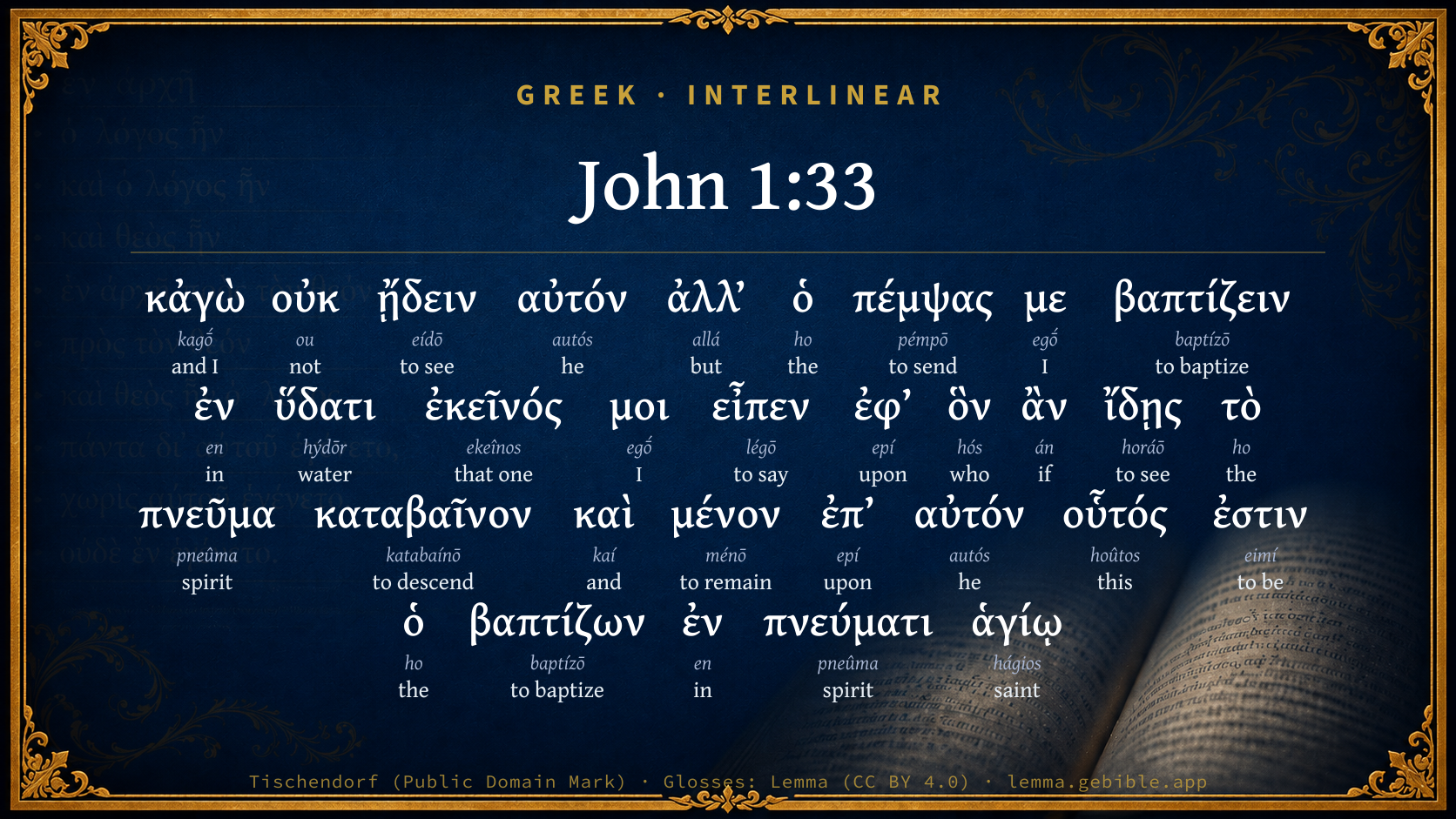
Greek (Tischendorf 8th ed.) John 1:33 appears in the Greek New Testament. The text above is from the Tischendorf 8th edition. Each word links to its Strong’s number and a concise gloss. Click any word for its full Thayer’s Greek Lexicon entry.
Download image
Cite this verse

John 1:33 (World English Bible). Public Domain. Lemma interlinear Bible study tool, https://lemma.gebible.app/v/john/1/33.

Show BibTeX & RIS
BibTeX
RIS
English Translation
I didn't recognize him, but he who sent me to baptize in water, he said to me, 'On whomever you will see the Spirit descending, and remaining on him, the same is he who baptizes in the Holy Spirit.'
World English Bible · Public Domain
Download a study sheet

One document with this verse’s original text, its word-by-word gloss line, the meaning frame, cross-references with their text, attributed commentary, and full source and license credits — printable, and it pastes into notes with its structure intact.

This verse Autodidact and up

Study sheet (.html) Plain text (.txt)

A passage Seminary Student

Up to 50 verses in one chapter. A passage sheet keeps up to 6 commentary sources and 12 cross-references per verse, in the order this page ranks them, and says so on the sheet whenever that leaves anything out. Ask for a single verse and you get the Autodidact verse sheet above.

Everything on this page stays free to read, with no account — the sheet is a download of what is already on screen, not access to it.

Want to remove ads? Support Godless Engineer
Compare translations 3

The same verse in 3 English versions, stacked beneath the original-language interlinear above. Click any original word for its lexicon entry.

Each is an independent rendering of the whole verse — the interlinear is not word-aligned to these translations.

Highlighted words mark where these versions differ — a whole-verse word diff, not a word-by-word alignment.

  • World English Bible Public Domain
    I didn't recognize him, but he who sent me to baptize in water, he said to me, 'On whomever you will see the Spirit descending, and remaining on him, the same is he who baptizes in the Holy Spirit.'
  • King James Version Public Domain
    And I knew him not: but he that sent me to baptize with water, the same said unto me, Upon whom thou shalt see the Spirit descending, and remaining on him, the same is he which baptizeth with the Holy Ghost.
  • unfoldingWord Literal Text CC BY-SA 4.0
    And I did not recognize him, but the one having sent me to baptize in water, that one said to me, ‘Upon whomever you might see the Spirit descending and remaining on him, he is the one baptizing in the Holy Spirit.’

unfoldingWord Literal Text — © unfoldingWord, licensed CC BY-SA 4.0. Word-aligned USFM3 via Door43 (git.door43.org/unfoldingWord/en_ult).

Versions to compare (up to 4)

3 of 4 selected

Show all 19 translations

Every available English version of this verse, each an independent rendering of the whole verse.

  • World English Bible Public Domain
    I didn't recognize him, but he who sent me to baptize in water, he said to me, 'On whomever you will see the Spirit descending, and remaining on him, the same is he who baptizes in the Holy Spirit.'
  • Berean Standard Bible Public Domain
    I myself did not know Him, but the One who sent me to baptize with water told me, ‘The man on whom you see the Spirit descend and rest is He who will baptize with the Holy Spirit.’
  • Majority Standard Bible Public Domain
    I myself did not know Him, but the One who sent me to baptize with water told me, ‘The man on whom you see the Spirit descend and rest is He who will baptize with the Holy Spirit.’
  • King James Version Public Domain
    And I knew him not: but he that sent me to baptize with water, the same said unto me, Upon whom thou shalt see the Spirit descending, and remaining on him, the same is he which baptizeth with the Holy Ghost.
  • American Standard Version (1901) Public Domain
    And I knew him not: but he that sent me to baptize in water, he said unto me, Upon whomsoever thou shalt see the Spirit descending, and abiding upon him, the same is he that baptizeth in the Holy Spirit.
  • Revised Version (1885) Public Domain
    And I knew him not: but he that sent me to baptize with water, he said unto me, Upon whomsoever thou shalt see the Spirit descending, and abiding upon him, the same is he that baptizeth with the Holy Spirit.
  • Geneva Bible (1599) Public Domain
    And I knewe him not: but he that sent me to baptize with water, he saide vnto me, Vpon whom thou shalt see that Spirit come downe, and tary still on him, that is he which baptizeth with the holy Ghost.
  • Douay-Rheims (1899) Public Domain
    And I knew him not; but he who sent me to baptize with water, said to me: He upon whom thou shalt see the Spirit descending, and remaining upon him, he it is that baptizeth with the Holy Ghost.
  • Young's Literal Translation Public Domain
    and I did not know him, but he who sent me to baptize with water, He said to me, On whomsoever thou mayst see the Spirit coming down, and remaining on him, this is he who is baptizing with the Holy Spirit;
  • Literal Standard Version CC BY-SA 4.0
    and I did not know Him, but He who sent me to immerse in water, He said to me, On whomsoever you may see the Spirit coming down, and remaining on Him, this is He who is immersing in the Holy Spirit;
  • Unlocked Literal Bible CC BY-SA 4.0
    I did not recognize him, but he who sent me to baptize in water said to me, 'Upon whom you shall see the Spirit descending and remaining on him, he is the one baptizing in the Holy Spirit.'
  • unfoldingWord Literal Text CC BY-SA 4.0
    And I did not recognize him, but the one having sent me to baptize in water, that one said to me, ‘Upon whomever you might see the Spirit descending and remaining on him, he is the one baptizing in the Holy Spirit.’
  • Darby Bible Public Domain
    And I knew him not; but he who sent me to baptise with water, *he* said to me, Upon whom thou shalt see the Spirit descending and abiding on him, he it is who baptises with [the] Holy Spirit.
  • World Messianic Bible Public Domain
    I didn’t recognize him, but he who sent me to immerse in water said to me, ‘On whomever you will see the Spirit descending and remaining on him is he who immerses in the Holy Spirit.’
  • Webster's Bible Public Domain
    And I knew him not: but he that sent me to baptize with water, the same said to me, Upon whom thou shalt see the Spirit descending and remaining on him, the same is he who baptizeth with the Holy Spirit.
  • Free Bible Version CC BY-SA 4.0
    I wouldn't have known him except he who sent me to baptize with water had told me, ‘The one you see the Spirit descend to and rest upon, he is the one who baptizes with the Holy Spirit.’
  • Bible in Basic English Public Domain
    I had no knowledge who he was, but he who sent me to give baptism with water said to me, The one on whom you see the Spirit coming down and resting, it is he who gives baptism with the Holy Spirit.
  • Text-Critical English NT CC BY 4.0
    I myself did not recognize him, but he who sent me to baptize with water said to me, ‘He upon whom yoʋ see the Spirit descend and remain is the one who baptizes with the Holy Spirit.’
  • Tyndale New Testament (1534) Public Domain
    and I knewe him not. But he that sent me to baptise in water the same sayde vnto me: apon whom thou shalt se the sprete descende and tary styll on him the same is he which baptiseth with the holy goost.

Literal Standard Version (2020), Covenant Press — licensed CC BY-SA 4.0. Text via the HelloAO Bible API (eBible.org). Unlocked Literal Bible (unfoldingWord) — licensed CC BY-SA 4.0. Text via the HelloAO Bible API (eBible.org). unfoldingWord Literal Text — © unfoldingWord, licensed CC BY-SA 4.0. Word-aligned USFM3 via Door43 (git.door43.org/unfoldingWord/en_ult). Free Bible Version, Dr. Jonathan Gallagher — licensed CC BY-SA 4.0. Text via the HelloAO Bible API (eBible.org).

Word by word

More ways to search: Search by grammar → Find every occurrence → Compare this word →

Practice this passage: Drill this verse → Learn its vocabulary →

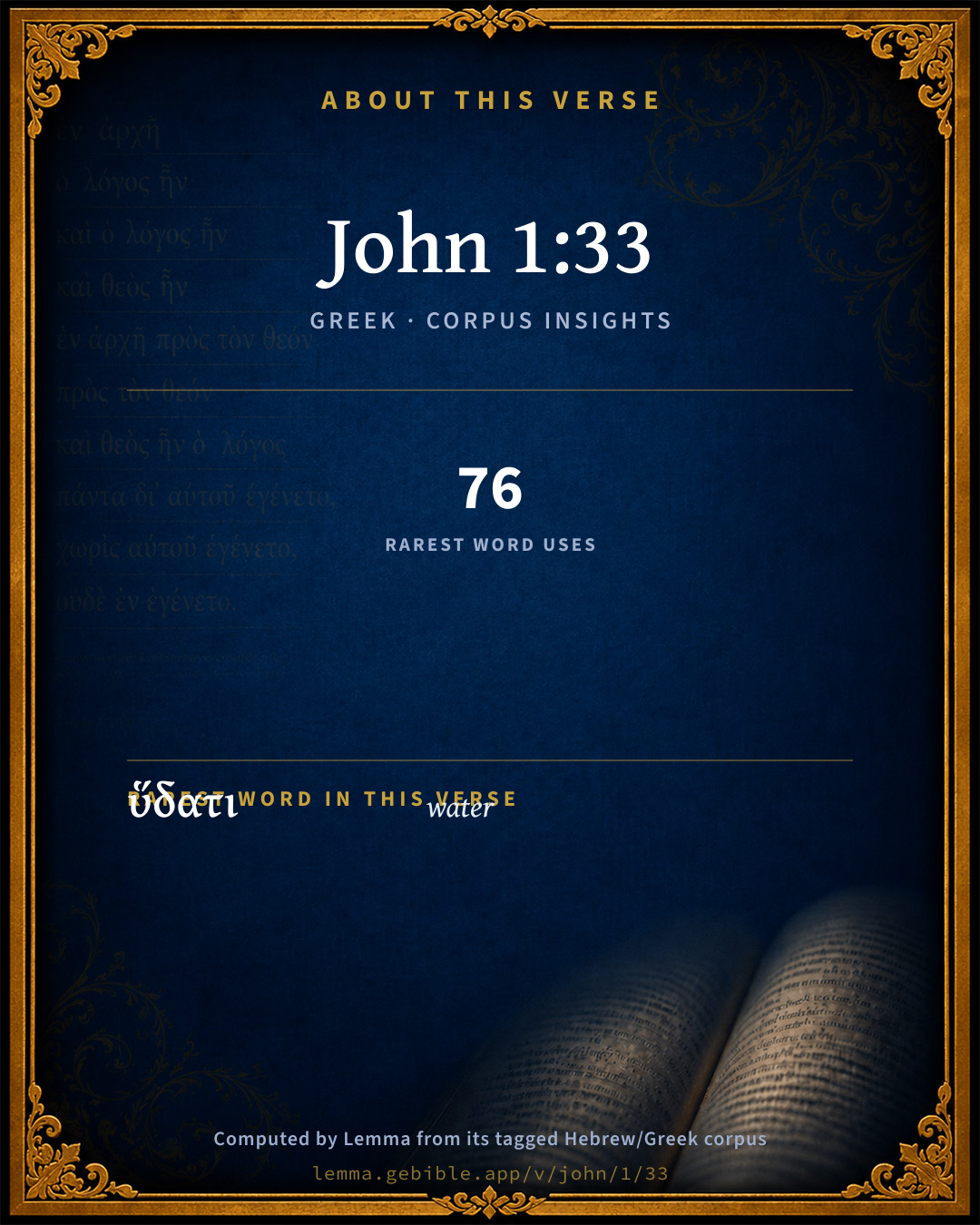
ὕδατι
hýdōr
G5204
“water”
Noun, Dative, Singular, Neuter
Part of Speech
Noun
Case
Dative
Number
Singular
Gender
Neuter
Full Thayer's Definition

Origin: genitive case, hudatos hoo'-dat-os, etc., from the base of G5205

TDNT: 13:14,1

1. water a. of water in rivers, in fountains, in pools b. of the water of the deluge c. of water in any of the earth's repositories d. of water as the primary element, out of and through which the world that was before the deluge, arose and was compacted e. of the waves of the sea f. fig. used of many peoples
  1. κἀγὼ kagṓ G2504 “and I” Personal pronoun, 1st person, Nominative, Singular, Aramaic form
  2. οὐκ ou G3756 “not” Particle, Negative
  3. ᾔδειν eídō G1492 “to see” Verb, Pluperfect, Active, Indicative, 1st person, Singular
  4. αὐτόν autós G846 “he” Personal pronoun, Accusative, Singular, Masculine
  5. ἀλλ’ allá G235 “but” Conjunction
  6. ὁ ho G3588 “the” Article, Nominative, Singular, Masculine
  7. πέμψας pémpō G3992 “to send” Verb, Aorist, Active, Participle, Nominative, Singular, Masculine
  8. με egṓ G1473 “I” Personal pronoun, 1st person, Accusative, Singular
  9. βαπτίζειν baptízō G907 “to baptize” Verb, Present, Active, Infinitive
  10. ἐν en G1722 “in” Preposition
  11. ἐκεῖνός ekeînos G1565 “that one” Demonstrative pronoun, Nominative, Singular, Masculine
  12. μοι egṓ G1473 “I” Personal pronoun, 1st person, Dative, Singular
  13. εἶπεν légō G3004 “to say” Verb, Aorist, Active, Indicative, 3rd person, Singular
  14. ἐφ’ epí G1909 “upon” Preposition
  15. ὃν hós G3739 “who” Relative pronoun, Accusative, Singular, Masculine
  16. ἂν án G302 “if” Particle
  17. ἴδῃς horáō G3708 “to see” Verb, Aorist, Active, Subjunctive, 2nd person, Singular
  18. τὸ ho G3588 “the” Article, Accusative, Singular, Neuter
  19. πνεῦμα pneûma G4151 “spirit” Noun, Accusative, Singular, Neuter
  20. καταβαῖνον katabaínō G2597 “to descend” Verb, Present, Active, Participle, Accusative, Singular, Neuter
  21. καὶ kaí G2532 “and” Conjunction
  22. μένον ménō G3306 “to remain” Verb, Present, Active, Participle, Accusative, Singular, Neuter
  23. ἐπ’ epí G1909 “upon” Preposition
  24. αὐτόν autós G846 “he” Personal pronoun, Accusative, Singular, Masculine
  25. οὗτός hoûtos G3778 “this” Demonstrative pronoun, Nominative, Singular, Masculine
  26. ἐστιν eimí G1510 “to be” Verb, Present, Active, Indicative, 3rd person, Singular
  27. ὁ ho G3588 “the” Article, Nominative, Singular, Masculine
  28. βαπτίζων baptízō G907 “to baptize” Verb, Present, Active, Participle, Nominative, Singular, Masculine
  29. ἐν en G1722 “in” Preposition
  30. πνεύματι pneûma G4151 “spirit” Noun, Dative, Singular, Neuter
  31. ἁγίῳ hágios G40 “saint” Adjective, Dative, Singular, Neuter

About this verse

These counts appear in no published source. They are computed here, from the morphology-tagged text and Lemma’s own curated glosses. What Lemma adds →

32
words
24
distinct lemmas
Gospels
section

Repetition

Words recur within this verse:

  • βαπτίζειν to baptize G907 ×2
  • ἐφ’ upon G1909 ×2
  • πνεῦμα spirit G4151 ×2
  • ὁ the G3588 ×3
  • αὐτόν he G846 ×2
  • με I G1473 ×2
  • ἐν in G1722 ×2

Cross-references

14

Topical passages linked to John 1:33 in the Treasury of Scripture Knowledge — connected by theme and wording, ordered by reader-vote popularity; previews shown in the World English Bible.

  • Acts 1:5 For John indeed baptized in water, but you will be baptized in the Holy Spirit not many days from now."
  • Matthew 3:11 I indeed baptize you in water for repentance, but he who comes after me is mightier than I, whose shoes I am not worthy to carry. He will baptize you in the Holy Spirit.
  • Luke 3:16 John answered them all, "I indeed baptize you with water, but he comes who is mightier than I, the latchet of whose sandals I am not worthy to loosen. He will baptize you in the Holy Spirit and fire,
  • Titus 3:5–6 not by works of righteousness, which we did ourselves, but according to his mercy, he saved us, through the washing of regeneration and renewing by the Holy Spirit,
  • John 3:34 For he whom God has sent speaks the words of God; for God gives the Spirit without measure.
  • Acts 10:44–47 While Peter was still speaking these words, the Holy Spirit fell on all those who heard the word.
  • Acts 19:2–6 He said to them, "Did you receive the Holy Spirit when you believed?" They said to him, "No, we haven't even heard that there is a Holy Spirit."
  • Mark 1:7–8 He preached, saying, "After me comes he who is mightier than I, the thong of whose sandals I am not worthy to stoop down and loosen.
  • John 3:5 Jesus answered, "Most assuredly I tell you, unless one is born of water and spirit, he can't enter into the Kingdom of God!
  • Acts 11:15–16 As I began to speak, the Holy Spirit fell on them, even as on us at the beginning.
  • 1 Corinthians 12:13 For in one Spirit we were all baptized into one body, whether Jews or Greeks, whether bond or free; and were all given to drink into one Spirit.
  • John 1:31 I didn't know him, but for this reason I came baptizing in water: that he would be revealed to Israel."
  • Acts 2:4 They were all filled with the Holy Spirit, and began to speak with other languages, as the Spirit gave them the ability to speak.
  • Matthew 3:13–15 Then Jesus came from Galilee to the Jordan to John, to be baptized by him.

Cross-references courtesy of OpenBible.info (CC BY 4.0).

Commentary

Notes on John 1:33 from classic Christian and Jewish commentators (each source and its license shown beneath its notes). The classic Christian expositions comment on the surrounding passage and are grouped to its opening verse, so a note may address several verses; the Jewish commentaries on the Tanakh (Rashi and others) are per-verse, so they appear only where the commentator wrote on this verse.

Lemma curates 59 commentaries, every one of them public domain or Creative Commons licensed, each selected and text-cleaned for this edition rather than reprinted as found. About our sources →

Bengel's Gnomon

Johann Albrecht Bengel

Joh 1:33. Οὐκ ᾔδειν) I knew Him not, before that I saw the Spirit descending.—ὁ πέμψας με, He that sent me) God.

Bengel's Gnomon of the New Testament — English translation (T&T Clark, Edinburgh, 1860) — public domain. Text from a community e-Sword module.

Meyer's Critical & Exegetical Commentary

Heinrich August Wilhelm Meyer

Joh_1:33. Johns recognition of Jesus as the Messiah (whom he had not before known as such) rested upon a revelation previously made to him with this intent; and this he now states, solemnly repeating, however, the declaration of his own ignorance (κἀγὼ οὐκ ᾔδειν αὐτόν).

ἐκεῖνος] in emphatic contrast with his own reflection.

εἶπεν] i.e. by express revelation. We cannot tell the precise time or manner of this prior revelation. By it John was referred to some outwardly visible σημεῖον (ἴδῃς) of the Spirit, in a general way, without any definition of its form. He was to see it descending, and this descent took place in the form of a dove, and after that divine intimation there was no room for doubt. Comp. on Mat_3:17, note.

ἐφʼ ὃν ἂν ἴδῃς] that is, when thou baptizest Him with water. This is not expressly stated in the divine declaration, but John could not fail so to understand it, because, being sent to baptize, he would naturally expect the appearance of the promised sign while fulfilling his mission; comp. Joh_1:31. He therefore describes the giver of the revelation as ὁ πέμψας με, κ.τ.λ., and the evangelist puts the statement in the conditional form: ἐφʼ ὃν ἂν, κ.τ.λ., i.e., according to the connection of the narrative: When, in the fulfilment of this your mission, you shall see the Spirit descending upon one of those whom thou baptizest, this is He, etc.

ἐν πνεύμ. ἁγίῳ] by communicating it to those who believe upon Him. See on Mat_3:11. The designation of this communication as a baptism very naturally arose from its close relation to the work of the Baptists mission (comp. Mat_3:11; Mar_1:8; Luk_3:16; Act_1:5; Act_11:16), because the gift of the Spirit, according to the prophetic figure (Joe_3:1; Isa_44:3), had been promised under the form of an outpouring (comp. Act_2:33). The contrast itself distinctly sets before us the difference between the two baptisms: the one was a preparation for the Messianic salvation by μετάνοια; the other, an introduction thereto by the divine principle of life and salvation, the communication of which presupposes the forgiveness of sins (see on Mar_1:4).

Meyer — Critical and Exegetical Commentary on the New Testament — English translation by Peter Christie, edited by Frederick Crombie (T&T Clark, 1880) — public domain. Text from a community e-Sword module.

Expositor's Greek Testament

ed. W. Robertson Nicoll

Joh 1:33 . κἀγὼ οὐκ ᾔδειν … ἐκεῖνός μοι εἶπεν . Because of the importance of the identification of the Messiah the Baptist reiterates that his proclamation of Jesus was not a private idea for which he alone was responsible. On the contrary, He who had sent him to baptise had given him this sign by which to recognise the Christ. ἐφʼ ὃν ἂν ἴδῃς … πνεύματι ἁγίῳ . Lk. (Luk 3:16 ) adds καὶ πυρί , which occasions the well-known utterance in Ecce Homo : “Baptism means cleansing, and fire means warmth. How can warmth cleanse? The answer is that moral warmth does cleanse. No heart is pure that is not passionate; no virtue is safe that is not enthusiastic. And such an enthusiastic virtue Christ was to introduce.” In affirming that the Christ baptises with the Holy Spirit, and that this is what distinguishes the Christ, the Baptist steps on to grouud where his affirmations can be tested by experience. This is the fundamental article of the Christian creed. Has Christ power to make men holy? History gives the answer. The essence of the Holy Spirit is communication: Jesus being the Christ, the anointed with the Spirit, must communicate it.

The Expositor's Greek Testament, edited by W. Robertson Nicoll (1897–1910) — public domain. Text from a community e-Sword module.

Adam Clarke's Commentary

Verse 33. He that sent me - said unto me] From this we may clearly perceive that John had a most intimate acquaintance with the Divine Being; and received not only his call and mission at first, but every subsequent direction, by immediate, unequivocal inspiration. Who is fit to proclaim Jesus, but he who has continual intercourse with God; who is constantly receiving light and life from Christ their fountain; who bears a steady, uniform testimony to Jesus, even in the presence of his enemies; and who at all times abases himself, that Jesus alone may be magnified! Reformation of manners, and salvation of souls, will accompany such a person's labours whithersoever he goeth.

Adam Clarke's Commentary on the Bible (1810–1826) — public domain. Text from a community e-Sword/MySword module.

John Calvin's Commentaries

33. Upon whom thou shalt see the Spirit descending. Here a difficult question arises; for if John did not know Christ, why does he refuse to admit him to baptism? To a person whom he did not know he would not say, I ought rather to be baptized by thee, (Matthew 3:14.) Some reply, that he knew him to such an extent as to regard him with the reverence due to a distinguished Prophet, but was not aware that he was the Son of God. But this is a poor solution of the difficulty, for every man ought to obey the calling of God without any respect of persons. No rank or excellence of man ought to prevent us from doing our duty, and therefore John would have shown disrespect to God and to his baptism, if he had spoken in this manner to any other person than the Son of God. it follows that he must have previously known Christ.

In the first place, it ought to be observed, that the knowledge here mentioned is that which arises from personal and long acquaintance. Although he recognizes Christ whenever he sees him, still it does not cease to be true that they were not known to each other according to the ordinary custom of men, for the commencement of his knowledge proceeded from God. But the question is not yet fully answered; for he says that the sight of the Holy Spirit was the mark by which he was pointed out to him. Now he had not yet seen the Spirit, when he had addressed Christ as the Son of God. For my own part, I willingly embrace the opinion of those who think that this sign was added for confirmation, and that it was not so much for the sake of John as for the sake of us all. John indeed saw it, but it was rather for others than for himself. Bucer appropriately quotes that saying of Moses,

This shall be a sign to you, that after three days journey, you shall sacrifice to me on the mountain, (Exodus 3:12.)

Undoubtedly, when they were going out, they already knew that God would conduct and watch over their deliverance; but this was a confirmation a posteriori, as the phrase is; that is, from the event, after it had taken place. In like manner, this came as an addition to the former revelation which had been given to John.

John Calvin's Commentaries (1540-1563) — public domain. Text from the Calvin Translation Society English edition (1840s-50s) via the Christian Classics Ethereal Library (ccel.org). Calvin's coverage is partial (roughly two-thirds of the Bible); uncommented books and verses are honest gaps, never fabricated. The 19th-century editor's footnotes and remarks are omitted so the notes are faithfully Calvin's own voice.

The Cambridge Bible for Schools and Colleges

gen. ed. J. J. S. Perowne

33. And I knew him not] Or, as before, I also knew Him not. The Baptist again protests, that but for a special revelation he was as ignorant as others that Jesus was the Messiah.

he that sent me] The special mission of a Prophet. Comp. Joh_1:6.

the same said unto me] Better, he said unto me: see on Joh_10:1. When this revelation was made we are not told.

and remaining on him] Better, and abiding on Him. It is the same word as is used in Joh_1:32, and one of which S. John is very fond; but our translators have obscured this fact by capriciously varying the translation, sometimes in the same verse (Joh_1:39, Joh_4:40; 1Jn_2:24; 1Jn_3:24). Thus, though most often rendered ‘abide,’ it is also rendered ‘remain’ (Joh_9:41, Joh_15:11; Joh_15:16), ‘dwell’ (Joh_1:39, Joh_6:56, Joh_14:10; Joh_14:17), ‘continue’ (Joh_2:12, Joh_8:31), ‘tarry’ (Joh_4:40, Joh_21:22-23), ‘endure’ (Joh_6:27), ‘be present’ (Joh_14:25). In 1Jn_2:24 it is translated in three different ways. See on Joh_15:9.

which baptizeth with the Holy Ghost] See on Joh_14:26. This phrase, introduced without explanation or comment, assumes that the readers of this Gospel are well aware of this office of the Messiah, i.e. are well-instructed Christians. The word baptizeth is appropriate, (1) to mark the analogy and contrast between the office of the Baptist and that of the Messiah; (2) because the gift of the Spirit is constantly represented as an out-pouring. ‘With,’ as in Joh_1:26; Joh_1:31, is literally ‘in.’

The Cambridge Bible for Schools and Colleges (gen. ed. J. J. S. Perowne; Cambridge University Press, 1878–1918) — public domain. Text from a community e-Sword module.

John Gill's Exposition

And I knew him not,.... That is, before he came to be baptized by him; when it was secretly suggested to him who he was, and the following signal was given him, to confirm him in it:

but he that sent me to baptize with water; or "in water"; that is, God; for John's mission was from God, as in Joh 1:6, and his baptism from heaven; he had a divine warrant and commission for what he did:

the same said unto me; either by an articulate voice, or by a divine impulse on his mind, or by the revelation of the Spirit:

upon whom thou shalt see the Spirit descending and remaining on him, the same is he which baptizeth with the Holy Ghost; that is, the Messiah; See Gill on Mat 3:11, Mat 3:16.

John Gill's Exposition of the Whole Bible (1746–1763) — public domain (CC PDM 1.0). Text via the HelloAO Bible API.

Trapp's Complete Commentary

John Trapp

33 And I knew him not: but he that sent me to baptize with water, the same said unto me, Upon whom thou shalt see the Spirit descending, and remaining on him, the same is he which baptizeth with the Holy Ghost.

Ver. 33. And I knew him not] i.e. Not so perfectly till I heard that testimony from heaven. Christ is not known all at once: but as by steps and stairs men went up to Solomon’s temple; and as the trumpet in the mount sounded lower at first, and then louder and louder, till at last it was heard all the camp over; so is it here. "The path of the just is as the shining light, that shineth more and more unto the perfect day," Pro 4:18.

John Trapp, A Commentary or Exposition upon All the Books of the Old and New Testament (1647–1656) — public domain. Text from a community e-Sword module.

Albert Barnes' Notes on the Bible

The same said ... - This was the sign by which he was to know the Messiah. He was to see the Spirit descending like a dove and abiding on him. It does not follow, however, that he had no intimation before this that Jesus was the Christ, but it means that by this he should know it infallibly. From Mat 3:13-14, it seems that John supposed, before the baptism of Jesus, that he claimed to be the Messiah, and, that he believed it; but the infallible, certain testimony in the case was the descent of the Holy Spirit on him at his baptism.

That this is the Son of God - This was distinctly declared by a voice from heaven at his baptism, Mat 3:17. This John heard, and he testified that he had heard it.

Albert Barnes' Notes on the Bible (1834–1885) — public domain. Text from a community e-Sword/MySword module.

Matthew Poole's English Annotations

And I knew him not; I was a stranger to him; I knew him in a sense, when I leaped in my mother’s womb, upon his mother’s coming to see my mother, Luk 1:41; but that (as impressions made upon infants use to do) wore off. I had some impression upon me at that time when he came towards me to be baptized, which made me say to him, (as Mat 3:14)

I have need to be baptized of thee, and comest thou to me? But yet I was not certain, though I knew he was in the crowd of people, that he was the person designed, and whose work it should be to baptize with the Holy Ghost, until the same God that had given me that sign fulfilled it to me.

Matthew Poole's English Annotations on the Holy Bible (1683–1685) — public domain. Text from a community e-Sword/MySword module.

Whedon's Commentary on the Bible

Daniel D. Whedon

33. The same is he—Though John may have recognized Jesus, even as the Messiah, at the moment before his baptism, by spiritual insight or divine prophetic impulse; yet he was bound to wait the divine sign, which marked the Christ out from all the race as the very one and no other, before he could officially know him as Messiah.

Daniel D. Whedon (gen. ed.), Commentary on the Old and New Testaments (1874–1909) — public domain. Text from a community e-Sword module.

Cambridge Greek Testament for Schools and Colleges

33. κἀγὼ οὐκ ᾔ. αὐ. I also knew Him not. The Baptist again protests that but for a special revelation he was as ignorant as others that Jesus was the Messiah. Therefore he is here giving not his own opinion about Jesus, but the evidence of a sign from heaven.

ὁ πέμψας. In Joh 1:6 the verb used was ἀποστέλλω. Πέμπειν is the most general word for ‘send,’ implying no special relation between sender and sent: ἀποστέλλειν adds the notion of a delegated authority constituting the person sent the envoy or representative of the sender (Joh 1:19; Joh 1:24). Both verbs are used of the mission of Christ and of the mission of the disciples, as well as that of John. Ἀποστέλλειν is used of the mission of Christ, Joh 3:17; Joh 3:34, Joh 5:38, Joh 6:29; Joh 6:57, Joh 7:29, Joh 8:42, Joh 10:36, Joh 11:42, Joh 17:3; Joh 17:8; Joh 17:18; Joh 17:21; Joh 17:23; Joh 17:25; of the mission of the disciples, Joh 4:38, Joh 17:18. Πέμπειν is used of the mission of Christ (always in the aorist participle) Joh 4:34, Joh 5:23-24; Joh 5:30; Joh 5:37, Joh 6:38-40; Joh 6:44, Joh 7:16; Joh 7:18; Joh 7:28; Joh 7:33, &c. &c.; of that of the disciples, Joh 13:20, Joh 20:21. Πέμπειν is also used of the mission of the Spirit, Joh 14:26, Joh 16:7.

ἐκεῖνος. ‘That one Himself and no other;’ see on Joh 1:8; Joh 1:18. Ἐφ’ ὃν ἄν. The widest possibility; ‘whosoever he may be on whom.’

μένον. Another of S. John’s favourite words, a fact which the A.V. obscures by translating it in seven different ways. ‘Abide’ is the most common and the best translation (Joh 1:32, Joh 3:36, Joh 4:40): besides this we have ‘remain’ (here, Joh 9:41, Joh 15:11; Joh 15:16), ‘dwell’ (Joh 1:39, Joh 6:56, Joh 14:10; Joh 14:17) ‘continue’ (Joh 2:12, Joh 8:31), ‘tarry’ (Joh 4:40, Joh 21:22-23), ‘endure’ (Joh 6:27), ‘be present’ (Joh 14:25). In Joh 1:39, Joh 4:40, 1Jn 3:24, it is translated in two different ways; in 1Jn 2:24 in three different ways.—The Baptist and the Prophets were moved by the Spirit at times; ‘the Spirit of the Lord came upon’ them from time to time. With Jesus he abode continually.

ὁ βαπτ. ἐν πν. ἁγ. This phrase introduced without explanation assumes that the readers are well aware of this office of the Messiah, i.e. are well-instructed Christians. Βαπτίζων is appropriate, (1) to mark the analogy and contrast between the office of the Baptist and that of the Messiah; the one by baptism with water awakens the longing for holiness; the other by baptism with the Spirit satisfies this longing: (2) because the gift of the Spirit is an out-pouring.

ἐν πνεύματι ἁγίῳ. The epithet ἅγιον is given to the Spirit thrice in this Gospel; here, Joh 14:26, and Joh 20:22 (in Joh 7:39 the ἅγιον is very doubtful). It is not frequent in any Gospel but the third; 5 times in S. Matthew , 4 in S. Mark 12 in S. Luke. S. Luke rarely omits the epithet, which he uses about 40 times in the Acts. Here and Joh 20:22 neither substantive nor epithet has the article, in Joh 14:26 both have it.

Cambridge Greek Testament for Schools and Colleges (Cambridge University Press, 1896; 21 vols, various authors incl. Carr, Maclear, Plummer, Farrar, Lumby, Moule, M. R. James, Simcox) — public domain. Text from a community e-Sword module.

Alford’s Greek Testament

Henry Alford

33.] “Quæ sequuntur, erant testimonii: quæ ex ver. 29 sq. dicuntur, erant demonstrationis ex testimonio. Cohærentibus Baptistæ verbis Evangelista quasi parenthesin interponit: καὶ ἐμαρτύρησεν Ἰωάννης λέγων.” Bengel.

The occurrence related by John happened at the baptism of Jesus, which is therefore here pre-supposed as known. Although this has been questioned (Usteri, Nachrichten über den Täufer J. u.s.w., cited by Lücke, i. 423), I cannot see how it can be reasonably doubted. We cannot surely suppose that such a sign was twice shewn. On the appearance itself, see note Mat 3:16. The account here given confirms the view which I have there maintained, that the appearance was confined to our Lord and the Baptist: he was to receive the sign, and then to testify to the others, who were not themselves yet the bearers, but the recipients of testimony:—κατά τινα πνευματικὴν θεωρίαν ὤφθη μόνῳ τῷ Ἰωάννῃ. Theod. Mops. p. 736.

τεθέαμαι, perf. I have seen, in reference to the sign divinely intimated to him, in the abiding fulfilment of which he now stood. So again below, ver. 34.

ἔμεινεν ἐπʼ αὐτ.] By some appearance which is not described, the Holy Spirit was manifested to John as not removing from Jesus again, but abiding on Him. But we are not to understand that he had seen the Spirit descending on others, and not abiding; for (see ch. 7:39: Act 1:5; Act 19:2 ff.) the gift of the Holy Spirit did not ordinarily accompany John’s baptism, but only in this one case; and its occurrence was to point out to him the Messiah.

οὗτ. ἐστ. ὁ βαπτ. ἐν πν. ἁγ.] Here again we seem to have a reference to the synoptic cycle of narratives, for our Evangelist has not before mentioned this office of the Messiah.

Henry Alford, The Greek Testament (1849–1861) — public domain. Text from a community e-Sword module.

International Critical Commentary

33. κἀγὼ οὐκ ᾔδειν αὐτόν, repeated from v. 31. John the Baptist repeats, as an essential part of his witness, that he did not recognise Jesus for what He was until the dove lit upon Him; and he recognised Him then only because he had been divinely warned that there would be a sign. The Baptist is not represented as saying that he knew that the sign would be forthcoming in the case of a candidate for baptism.

ὁ πέμψας με. Cf. v. 6. John’s mission to baptize was from God.

ἐκεῖνός (explicit and emphatic, see on v. 8) μοι εἶπεν κτλ. The Hebrew prophets had claimed that “the word of Yahweh” came to them, and John, the last of them, makes the same claim. “God said to me”; of that he was assured.

ἐφʼ ὃν ἂν ἴδῃς τὸ πνεῦμα καταβ. κτλ. Upon whomsoever the Spirit descended and abode, He would be the minister of a greater baptism than that of John. John had doubtless (although this is not recorded) had many opportunities of observing the intense spirituality of the early life of Jesus, and his intercourse with Jesus previous to His baptism (according to Mat 3:14) had led John to see something of His unique personality. But, as the story is told, the Baptist was not finally assured of the Messiahship of Jesus until the dove rested upon Him. He had not been told that the descent of the Spirit would thus be indicated; but the sign was sufficient, and he accepted it joyfully.

οὗτός ἐστιν ὁ βαπτίζων ἐν πνεύματι ἁγίῳ. For οὗτος, cf. 1:2, and note that βαπτίζων is a prophetic present (cf. αἴρων in v. 29). The Spirit descended on Jesus, so that He might baptize men therewith, and that the Spirit might rest on them as it rested on Him, although not in the same plenitude (cf. 3:34).

ἐν ὕδατι … ἐν πνεύματι ἁγίῳ. Baptism as administered by John was, according to the Synoptists, symbolical of purification of the soul. It was, according to Mar 1:4, βάπτισμα μετανοίας εἰς ἄφεσιν ἁμαρτιῶν. There may be a hint at 3:25 of some association of John’s ministry with the idea of purification, but there is no suggestion anywhere in the Fourth Gospel that his baptism was one “of repentance with a view to the remission of sins.” It has been pointed out1 that the language of Josephus (Antt. xviii. 5. 2) about John’s ministry of baptism suggests that it was not addressed so much to penitents as to those who were dedicating themselves very specially to an ascetic life of virtue. That it was symbolical, at any rate, of dedication, as well as of purification, is plain from the circumstance that Jesus submitted, at the beginning of His ministry, to be baptized by John.

In all the Gospels the primary contrast between the ministry of John and the ministry of Jesus is that the first was ἐν ὕδατι, the second ἐν πνεύματι ἁγίῳ. Jn. makes the Baptist insist three times (vv. 26, 31, 33) that his baptism was only ἐν ὕδατι—that is, it was only the symbol of a baptism ἐν πνεύματι which he could not minister. In the prophets water is used several times as an image of the Spirit (cf. Isa 44:3, Eze 36:25, and note the verb in Joe 2:28, “I will pour out my Spirit upon all flesh”). Jn. is fond of this image (cf. 4:14, 7:38); and the contrast of “water” and “spirit” in the Baptist’s references to his ministry of baptism is intended to convey that it was only preparatory to, and symbolical of, a greater ministry that was at hand.

Mat 3:11 and Luk 3:16 (but not Mar 1:8 or Act 1:5) speak of the ministry of Jesus as a baptizing “with the Holy Spirit and with fire.” But Jn. says nothing about a baptism with fire. Fire is the symbol of judgment, and Jesus “came not to judge the world, but to save the world” (12:47; cf. 9:39), in the Johannine presentation of His teaching.

International Critical Commentary — older volumes (1896–1929), various authors — public domain. Text from a community e-Sword module.

Godet's Commentaries

Frédéric Louis Godet

Ver. 33. “And neither did I know him; but he who sent me to baptize with water, he said to me: The man on whom thou shalt see the Spirit descend and abide, is he who baptizeth with the Holy Spirit.”

Not only was a sign given (Joh 1:32); but this sign was that which had been promised, and the meaning of which had been indicated beforehand. No human arbitrariness can, therefore, mingle itself with this testimony which John renders to Jesus.Κἀγώ : And I repeat it to you: When He presented Himself, I did not know Him any more than you now know Him. I have then placed here nothing of my own. The expression ὁ πέμψας, He who sent me, has something solemn and mysterious in it; John evidently means to designate thereby God Himself who had spoken to him in the desert and given him his commission. This commission included: 1. The command to baptize; 2. The promise to reveal to him the Messiah on the occasion of the baptism; 3. The indication of the sign by which He should be manifested to him; 4. The command to bear testimony to Him in Israel. The emphatic resumption of the subject by the pronoun ἐκεῖνος, he, with its meaning which is so emphatic in John, makes prominent this idea: That everything in this testimony proceeds from Jehovah, and Jehovah only. Weiss, who is not willing to acknowledge the special and commonly exclusive sense which this pronoun has in the fourth Gospel, thinks that it serves here to place God, as the more remote subject, in contrast with Jesus, as the nearest object.

But to what purpose mark a contrast between Jesus and God? The pronoun indisputably signifies: “He and not another.” The sign had been announced by God Himself. The words ἐφ᾿ ὃν ἄν (on whom), indicate the most unlimited contingency: Whoever he may be, though he be the poorest of the Israelites. The act of baptizing with the Holy Spirit is indicated here as the peculiar work of the Messiah. By the baptism of water, John gives to the repentant sinner the pledge of pardon and the promise of sanctification; by the gift of the Holy Spirit, the Messiah realizes this last promise, and accomplishes thereby the highest destiny of the human soul.

Frédéric Louis Godet — Commentaries on Luke, John, Romans, and 1 Corinthians — English translation (T&T Clark, Edinburgh, 1870s–1890s) — public domain. Text from a community e-Sword module.

Lesson kit

Teaching starters — assembled from the data on this page, not authored interpretation. Every prompt links to the verse data it draws on. Edit before teaching.

John, in the Gospels, opens this verse with 32 words (24 distinct Greek lemmas). Its most distinctive word is hýdōr (“water”). A historical commentator’s framing appears above. Read the whole chapter for the surrounding context.

Discussion questions

  1. How does “water” (hýdōr) shape what this verse is saying?
  2. Acts 1:5 shares this passage’s theme. How do the two illuminate each other?
  3. “to baptize” occurs 2× in this one verse. What is the effect of the repetition?
  4. The translations on this page render this verse differently — a whole-verse word diff, not a word-by-word alignment. What might account for the different wordings?
  5. Reading how Bengel's Gnomon and Meyer's Critical & Exegetical Commentary read this verse, where do the two commentators agree and where do they part?

Things to notice

  • These translations choose different wording for 19 words in this verse.
  • “to baptize” occurs 2× in this single verse.
  • 24 distinct Greek lemmas span 32 words in this verse.

Reading settings

Reading text

Shown beneath each verse's original-language words.

Old Testament
Old Testament edition

Read the OT as the Masoretic Hebrew (MT) or the Greek Septuagint (LXX).

English shown for the Greek Septuagint (in the Hebrew ↔ Greek comparison).

Comparing translations? Open the Compare panel on any verse page to stack up to four side by side.