John 5:39

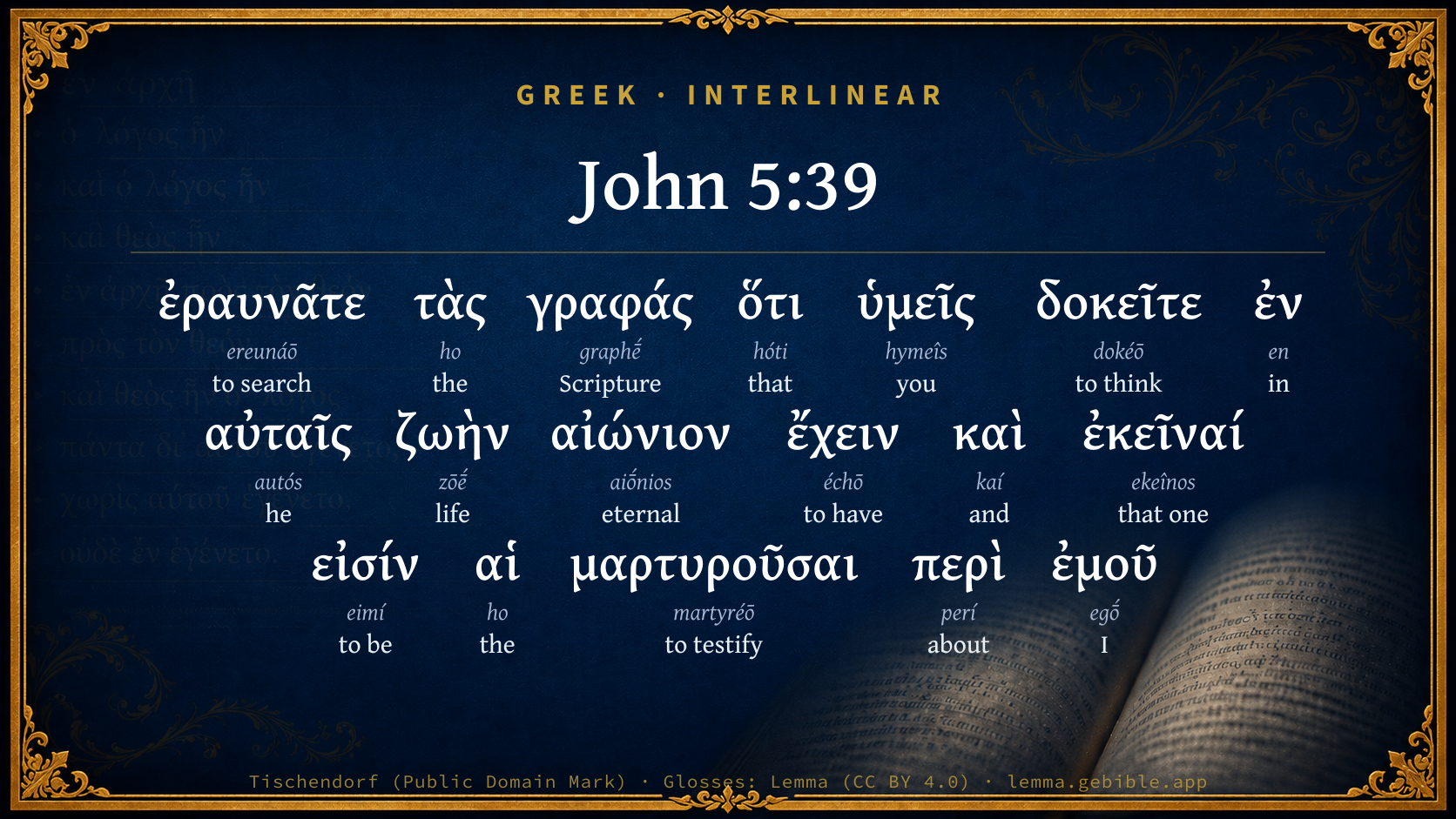
Greek (Tischendorf 8th ed.) John 5:39 appears in the Greek New Testament. The text above is from the Tischendorf 8th edition. Each word links to its Strong’s number and a concise gloss. Click any word for its full Thayer’s Greek Lexicon entry.
Download image
Cite this verse

John 5:39 (World English Bible). Public Domain. Lemma interlinear Bible study tool, https://lemma.gebible.app/v/john/5/39.

Show BibTeX & RIS
BibTeX
RIS
English Translation
"You search the Scriptures, because you think that in them you have eternal life; and these are they which testify about me.
World English Bible · Public Domain
Highlights
  • 1 first appearance in the Greek New Testament
Full analysis ↓
Download a study sheet

One document with this verse’s original text, its word-by-word gloss line, the meaning frame, cross-references with their text, attributed commentary, and full source and license credits — printable, and it pastes into notes with its structure intact.

This verse Autodidact and up

Study sheet (.html) Plain text (.txt)

A passage Seminary Student

Up to 50 verses in one chapter. A passage sheet keeps up to 6 commentary sources and 12 cross-references per verse, in the order this page ranks them, and says so on the sheet whenever that leaves anything out. Ask for a single verse and you get the Autodidact verse sheet above.

Everything on this page stays free to read, with no account — the sheet is a download of what is already on screen, not access to it.

Want to remove ads? Support Godless Engineer
Compare translations 3

The same verse in 3 English versions, stacked beneath the original-language interlinear above. Click any original word for its lexicon entry.

Each is an independent rendering of the whole verse — the interlinear is not word-aligned to these translations.

Highlighted words mark where these versions differ — a whole-verse word diff, not a word-by-word alignment.

  • World English Bible Public Domain
    "You search the Scriptures, because you think that in them you have eternal life; and these are they which testify about me.
  • King James Version Public Domain
    Search the scriptures; for in them ye think ye have eternal life: and they are they which testify of me.
  • unfoldingWord Literal Text CC BY-SA 4.0
    You search the Scriptures because you think that in them you have eternal life, and these are the ones testifying about me,

unfoldingWord Literal Text — © unfoldingWord, licensed CC BY-SA 4.0. Word-aligned USFM3 via Door43 (git.door43.org/unfoldingWord/en_ult).

Versions to compare (up to 4)

3 of 4 selected

Show all 19 translations

Every available English version of this verse, each an independent rendering of the whole verse.

  • World English Bible Public Domain
    "You search the Scriptures, because you think that in them you have eternal life; and these are they which testify about me.
  • Berean Standard Bible Public Domain
    You pore over the Scriptures because you presume that by them you possess eternal life. These are the very words that testify about Me,
  • Majority Standard Bible Public Domain
    You pore over the Scriptures because you presume that by them you possess eternal life. These are the very words that testify about Me,
  • King James Version Public Domain
    Search the scriptures; for in them ye think ye have eternal life: and they are they which testify of me.
  • American Standard Version (1901) Public Domain
    Ye search the scriptures, because ye think that in them ye have eternal life; and these are they which bear witness of me;
  • Revised Version (1885) Public Domain
    Ye search the scriptures, because ye think that in them ye have eternal life; and these are they which bear witness of me;
  • Geneva Bible (1599) Public Domain
    Searche the Scriptures: for in them ye thinke to haue eternall life, and they are they which testifie of me.
  • Douay-Rheims (1899) Public Domain
    Search the scriptures, for you think in them to have life everlasting; and the same are they that give testimony of me.
  • Young's Literal Translation Public Domain
    `Ye search the Writings, because ye think in them to have life age-during, and these are they that are testifying concerning me;
  • Literal Standard Version CC BY-SA 4.0
    You search the Writings, because you think in them to have continuous life, and these are they that are testifying concerning Me;
  • Unlocked Literal Bible CC BY-SA 4.0
    You search the scriptures because you think that in them you have eternal life, and these same scriptures testify about me,
  • unfoldingWord Literal Text CC BY-SA 4.0
    You search the Scriptures because you think that in them you have eternal life, and these are the ones testifying about me,
  • Darby Bible Public Domain
    Ye search the scriptures, for ye think that in them ye have life eternal, and they it is which bear witness concerning me;
  • World Messianic Bible Public Domain
    “You search the Scriptures, because you think that in them you have eternal life; and these are they which testify about me.
  • Webster's Bible Public Domain
    Search the scriptures; for in them ye think ye have eternal life: and they are they which testify of me.
  • Free Bible Version CC BY-SA 4.0
    You search the Scriptures because you think that through them you'll gain eternal life. But the evidence they give is in support of me!
  • Bible in Basic English Public Domain
    You make search in the holy Writings, in the belief that through them you get eternal life; and it is those Writings which give witness about me.
  • Text-Critical English NT CC BY 4.0
    You search the Scriptures because you think that in them you have eternal life, and it is these that testify about me,
  • Tyndale New Testament (1534) Public Domain
    Searche the scriptures for in them ye thinke ye have eternall lyfe: and they are they which testify of me.

Literal Standard Version (2020), Covenant Press — licensed CC BY-SA 4.0. Text via the HelloAO Bible API (eBible.org). Unlocked Literal Bible (unfoldingWord) — licensed CC BY-SA 4.0. Text via the HelloAO Bible API (eBible.org). unfoldingWord Literal Text — © unfoldingWord, licensed CC BY-SA 4.0. Word-aligned USFM3 via Door43 (git.door43.org/unfoldingWord/en_ult). Free Bible Version, Dr. Jonathan Gallagher — licensed CC BY-SA 4.0. Text via the HelloAO Bible API (eBible.org).

Word by word

More ways to search: Search by grammar → Find every occurrence → Compare this word →

Practice this passage: Drill this verse → Learn its vocabulary →

ἐραυνᾶτε
ereunáō
G2045
“to search”
Verb, Present, Active, Indicative, 2nd person, Plural
Part of Speech
Verb
Tense
Present
Voice
Active
Mood
Indicative
Person
2nd person
Number
Plural
Full Thayer's Definition

Origin: apparently from G2046 (through the idea of enquiry)

TDNT: 12:55,3

1. to search, examine into
  1. τὰς ho G3588 “the” Article, Accusative, Plural, Feminine
  2. γραφάς graphḗ G1124 “Scripture” Noun, Accusative, Plural, Feminine
  3. ὅτι hóti G3754 “that” Conjunction
  4. ὑμεῖς hymeîs G5210 “you” Personal pronoun, 2nd person, Nominative, Plural
  5. δοκεῖτε dokéō G1380 “to think” Verb, Present, Active, Indicative, 2nd person, Plural
  6. ἐν en G1722 “in” Preposition
  7. αὐταῖς autós G846 “he” Personal pronoun, Dative, Plural, Feminine
  8. ζωὴν zōḗ G2222 “life” Noun, Accusative, Singular, Feminine
  9. αἰώνιον aiṓnios G166 “eternal” Adjective, Accusative, Singular, Feminine
  10. ἔχειν échō G2192 “to have” Verb, Present, Active, Infinitive
  11. καὶ kaí G2532 “and” Conjunction
  12. ἐκεῖναί ekeînos G1565 “that one” Demonstrative pronoun, Nominative, Plural, Feminine
  13. εἰσίν eimí G1510 “to be” Verb, Present, Active, Indicative, 3rd person, Plural
  14. αἱ ho G3588 “the” Article, Nominative, Plural, Feminine
  15. μαρτυροῦσαι martyréō G3140 “to testify” Verb, Present, Active, Participle, Nominative, Plural, Feminine
  16. περὶ perí G4012 “about” Preposition
  17. ἐμοῦ egṓ G1473 “I” Personal pronoun, 1st person, Genitive, Singular

About this verse

These counts appear in no published source. They are computed here, from the morphology-tagged text and Lemma’s own curated glosses. What Lemma adds →

18
words
17
distinct lemmas
Gospels
section

Notable vocabulary

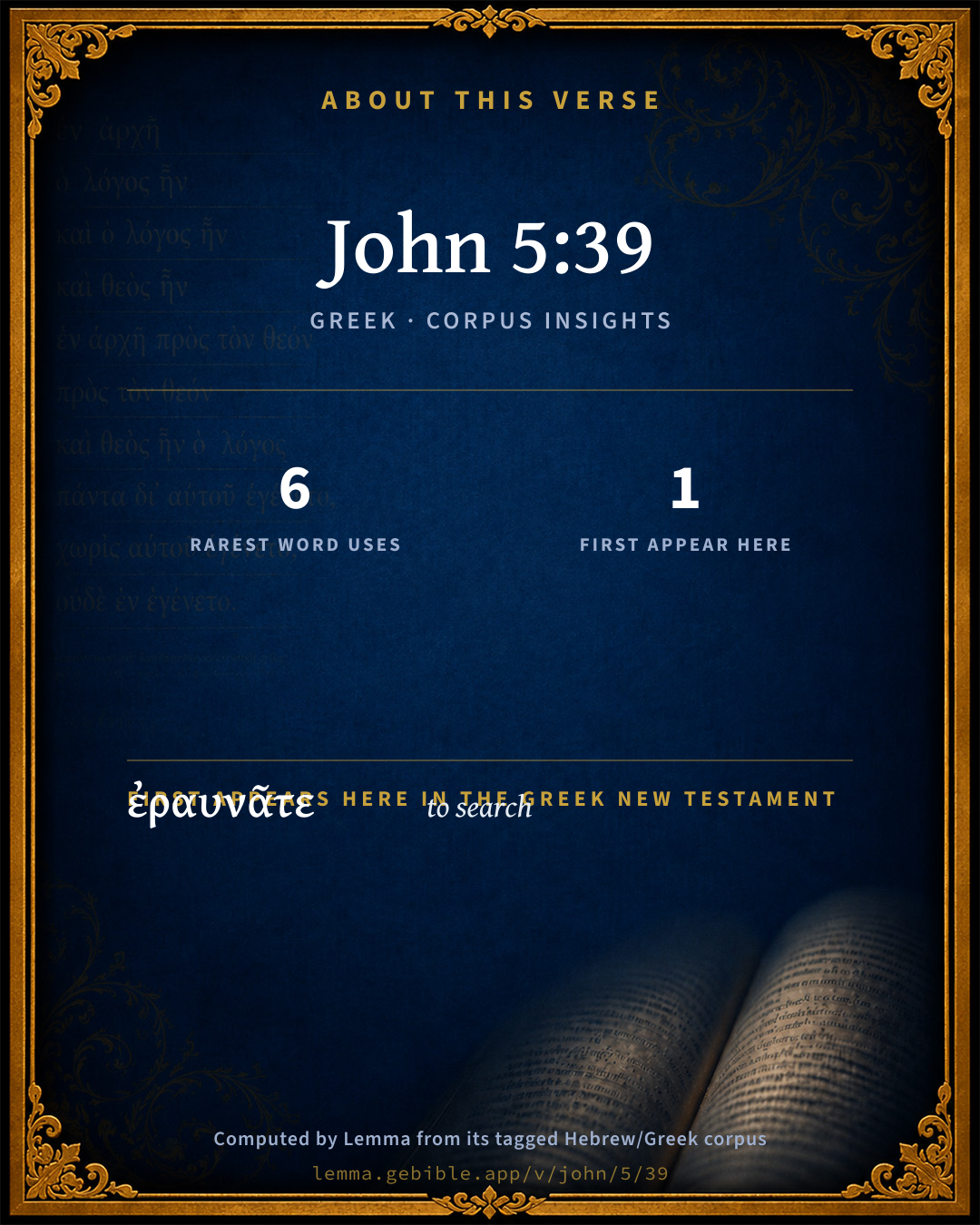
The rarest word here is ἐραυνᾶτε to search G2045 — appearing just 6 times in the whole Greek New Testament.

First appearance in Scripture

This word makes its first canonical appearance in the Greek New Testament here:

  • ἐραυνᾶτε to search G2045

Shared distinctive vocabulary

ἐραυνᾶτε to search G2045 occurs in 6 verses of the Greek New Testament. Also found in:

Repetition

A word recurs within this verse:

Cross-references

47

Topical passages linked to John 5:39 in the Treasury of Scripture Knowledge — connected by theme and wording, ordered by reader-vote popularity; previews shown in the World English Bible.

  • Luke 24:27 Beginning from Moses and from all the prophets, he explained to them in all the Scriptures the things concerning himself.
  • Luke 24:44 He said to them, "This is what I told you, while I was still with you, that all things which are written in the law of Moses, the prophets, and the psalms, concerning me must be fulfilled."
  • 2 Peter 1:19–21 We have the more sure word of prophecy; whereunto you do well that you take heed, as to a lamp shining in a dark place, until the day dawns, and the day star arises in your hearts:
  • Acts 26:22–23 Having therefore obtained the help that is from God, I stand to this day testifying both to small and great, saying nothing but what the prophets and Moses said would happen,
  • Proverbs 8:33–34 Hear instruction, and be wise. Don't refuse it.
  • Matthew 22:29 But Jesus answered them, "You are mistaken, not knowing the Scriptures, nor the power of God.
  • Isaiah 34:16 Seek you out of the book of Yahweh, and read: no one of these shall be missing, none shall want her mate; for my mouth, it has commanded, and his Spirit, it has gathered them.
  • 2 Timothy 3:14–17 But you remain in the things which you have learned and have been assured of, knowing from whom you have learned them.
  • John 5:46 For if you believed Moses, you would believe me; for he wrote about me.
  • Acts 13:27 For those who dwell in Jerusalem, and their rulers, because they didn't know him, nor the voices of the prophets which are read every Sabbath, fulfilled them by condemning him.
  • Acts 17:11 Now these were more noble than those in Thessalonica, in that they received the word with all readiness of the mind, examining the Scriptures daily to see whether these things were so.
  • 1 Peter 1:10–11 Concerning this salvation, the prophets sought and searched diligently, who prophesied of the grace that would come to you,
  • Psalms 119:97–99 How love I your law! It is my meditation all day.
  • Jeremiah 8:9 The wise men are disappointed, they are dismayed and taken: behold, they have rejected the word of Yahweh; and what manner of wisdom is in them?
  • Acts 8:32–35 Now the passage of the Scripture which he was reading was this, "He was led as a sheep to the slaughter. As a lamb before his shearer is silent, So he doesn't open his mouth.
  • Romans 3:2 Much in every way! Because first of all, they were entrusted with the oracles of God.
  • Mark 12:10 Haven't you even read this Scripture: 'The stone which the builders rejected, The same was made the head of the corner.
  • Deuteronomy 18:15 Yahweh your God will raise up to you a prophet from the midst of you, of your brothers, like me; to him you shall listen;
  • Deuteronomy 18:18 I will raise them up a prophet from among their brothers, like you; and I will put my words in his mouth, and he shall speak to them all that I shall command him.
  • Psalms 36:9 For with you is the spring of life. In your light shall we see light.
  • John 5:32 It is another who testifies about me. I know that the testimony which he testifies about me is true.
  • John 7:52 They answered him, "Are you also from Galilee? Search, and see that no prophet has arisen out of Galilee."
  • Acts 26:27 King Agrippa, do you believe the prophets? I know that you believe."
  • Romans 1:2 which he promised before through his prophets in the holy Scriptures,
  • Revelation 19:10 I fell down before his feet to worship him. He said to me, "Look! Don't do it! I am a fellow bondservant with you and with your brothers who hold the testimony of Jesus. Worship God, for the testimony of Jesus is the Spirit of Prophecy."
  • Psalms 16:11 You will show me the path of life. In your presence is fullness of joy. In your right hand there are pleasures forevermore.
  • Psalms 119:11 I have hidden your word in my heart, That I might not sin against you.
  • John 5:36 But the testimony which I have is greater than that of John, for the works which the Father gave me to accomplish, the very works that I do, testify about me, that the Father has sent me.
  • Deuteronomy 11:18–20 Therefore shall you lay up these my words in your heart and in your soul; and you shall bind them for a sign on your hand, and they shall be for symbols between your eyes.
  • Deuteronomy 32:47 For it is no vain thing for you; because it is your life, and through this thing you shall prolong your days in the land, where you go over the Jordan to possess it.
  • Proverbs 6:23 For the commandment is a lamp, And the law is light. Reproofs of instruction are the way of life,
  • Luke 10:25–29 Behold, a certain lawyer stood up and tested him, saying, "Teacher, what shall I do to inherit eternal life?"
  • Luke 16:31 "He said to him, 'If they don't listen to Moses and the prophets, neither will they be persuaded if one rises from the dead.'"
  • Joshua 1:8 This book of the law shall not depart out of your mouth, but you shall meditate thereon day and night, that you may observe to do according to all that is written therein: for then you shall make your way prosperous, and then you shall have good success.
  • Daniel 12:2 Many of those who sleep in the dust of the earth shall awake, some to everlasting life, and some to shame and everlasting contempt.
  • Matthew 19:16–20 Behold, one came to him and said, "Good teacher, what good thing shall I do, that I may have eternal life?"
  • Luke 16:29 "But Abraham said to him, 'They have Moses and the prophets. Let them listen to them.'
  • Romans 2:17–18 Indeed you bear the name of a Jew, and rest on the law, and glory in God,
  • Colossians 3:16 Let the word of Christ dwell in you richly; in all wisdom teaching and admonishing one another with psalms, hymns, and spiritual songs, singing with grace in your heart to the Lord.
  • Hebrews 11:16 But now they desire a better country, that is, a heavenly one. Therefore God is not ashamed of them, to be called their God, for he has prepared a city for them.
  • John 1:45 Philip found Nathanael, and said to him, "We have found him, of whom Moses in the law, and the prophets, wrote: Jesus of Nazareth, the son of Joseph."
  • Deuteronomy 17:18–19 It shall be, when he sits on the throne of his kingdom, that he shall write him a copy of this law in a book, out of [that which is] before the priests the Levites:
  • Psalms 1:2 But his delight is in Yahweh's law; On his law he meditates day and night.
  • Psalms 21:4 He asked life of you, you gave it to him, Even length of days forever and ever.
  • Isaiah 8:20 To the law and to the testimony! if they don't speak according to this word, surely there is no morning for them.
  • Psalms 133:3 Like the dew of Hermon, That comes down on the hills of Zion: For there Yahweh gives the blessing, Even life forevermore.
  • Hebrews 11:35 Women received their dead by resurrection. Others were tortured, not accepting their deliverance, that they might obtain a better resurrection.

Cross-references courtesy of OpenBible.info (CC BY 4.0).

Commentary

Notes on John 5:39 from classic Christian and Jewish commentators (each source and its license shown beneath its notes). The classic Christian expositions comment on the surrounding passage and are grouped to its opening verse, so a note may address several verses; the Jewish commentaries on the Tanakh (Rashi and others) are per-verse, so they appear only where the commentator wrote on this verse.

Lemma curates 59 commentaries, every one of them public domain or Creative Commons licensed, each selected and text-cleaned for this edition rather than reprinted as found. About our sources →

Ellicott's Commentary for English Readers

(39) Search the scriptures.—Better, Ye search the Scriptures. The question whether the mood is imperative or indicative, whether we have here a commandment to examine the writings of the Old Testament canon, or a reference to their habit of doing so, is one which has been discussed through the whole history of New Testament exposition, and one on which the opinion of those best qualified to judge has been, and is, almost equally divided. It is not a question of the form of the Greek word, for it may certainly be either. The English reader therefore is in a position to form his own opinion, and is in possession of almost all the evidence. He should observe that all the parallel verbs in the context are in the indicative—“Ye have neither heard” . . . “nor have seen” (Joh_5:37); “Ye have not His Word . . . ye believe not” (Joh_5:38); “Ye think that . . . ye have” (Joh_5:39); “Ye will not . . ye might have” (Joh_5:40). Why should there be a sudden change of construction in this instance only?

We find, then, this order of thought. (1) God has in the Old Testament witnessed of Me, but ye, with unreceptive hearts, have never heard a voice nor seen a shape of God (Joh_5:37). (2) Ye have not His word dwelling in you, or it would have witnessed of Me (Joh_5:38). (3) Instead of receiving the Scriptures as a living power within you, ye search and explain the letter of them from without (Joh_5:39). (4) Ye think they contain eternal life, and hence your reverence for them (Joh_5:39). (5) They really are witnesses of Me, and yet you; seeking in them eternal life, are not willing to come to Me that ye may have this life.

It is believed that this is the most natural interpretation of the words, and that it gives a fuller meaning than any other to the teaching of Christ.

The only objection to it of weight is that the Greek word for “search” (ἐρευνᾶτε) is one which would not have implied blame. It means to search after, track, inquire after (comp. Joh_7:52); but, surely, this is just the expression for the literal spirit in which the Rabbis treated their Scriptures. Moreover, it is not the searching which is matter for blame, but the fact of the searching and not finding, which is matter for wonder.

Here, too, as elsewhere, the argument from the meaning of a Greek word must be pressed only within strict limits when we remember that it represents in translation a late Hebrew original. The Hebrew language had a word which just at that time was frequent on every Rabbi’s lips, and which exactly corresponds to it. As early as the Book of Chronicles we find mention of the Midrashim, or Commentaries in the sense in which this word is used, e.g., in “Cæsar’s Commentaries.” The rest of the Acts of Abijah are “written in the Midrash of the prophet Iddo” (2Ch_13:22). More than we now know of the history of Joash is “written in the Midrash of the Book of Kings” (2Ch_24:27). In both cases our Authorised version renders the word by “story;” but this was at a time when its connection with “history” as involving “inquiry” was not forgotten. (Comp. The Translators to the Reader:—“This will be easily granted by as many as know story, or have any experience.”) These Midrashim sprang up after the Captivity, when the people had lost the older language of the Law and the Prophets; and paraphrases, expositions, and homilies, became at first indeed necessary, but grew into a vast and intricate system with “Secrets” and “Precepts,” and “Fences” and “Traditions of Elders” (Mat_15:2; Mar_7:3), which gave abundant room for the learning and pride of men, but made the word of God of none effect (Mat_15:6; Mar_7:13). Now, the period of the arrangement of the Midrashim of the Law commenced half a century before the ministry of Christ. Hillel the First succeeded to the presidency of the Sanhedrin, B.C. 30, and Akiba, his successor in the compilation of the Mishna, was a boy when these words were spoken. The influence of the former was all-powerful among those who now accused Jesus of breaking what the Law did not contain but the Midrash did. Those who now listened to Christ were disciples or assistants of the great Rabbi whose school of a thousand pupils left eighty names of note.

May it not be, then, that the true meaning of these words is to be found in their bearing upon these Rabbinic lives and works?—“Ye make your Midrashim on the Scriptures; ye explain, and comment, and seek for hidden mystic meaning; ye do all this because ye think they contain eternal life; their true meaning is not hidden; they tell of life, and ye who seek it do not hear them, and will not come unto Me that ye might have life.”

A Bible Commentary for English Readers, edited by Charles John Ellicott (1878–1897) — public domain. Text from a community e-Sword module.

Joseph Benson's Commentary

Joh 5:39-40. Search the Scriptures — Because the Jews were exceedingly averse to acknowledge Jesus for their Messiah, notwithstanding that the evidences of his mission were so unexceptionable, he appeals, lastly, to their own scriptures, which, for further proof, and their full satisfaction, he desires them to search, because these writings, as they justly supposed, contained the knowledge of eternal life, and of the way leading to it, and therefore the knowledge of the Messiah. As if he had said, I can with confidence refer you to them, knowing that they confirm my pretensions in the most ample manner, the characters of the Messiah pointed out by them, being all fulfilled in my person. It must be observed that the word ερευνατε, here rendered imperatively, search, may with equal propriety be translated as Le Clerc, L’Enfant, Vitringa, Raphelius, &c., contend it ought to be, in the present tense, ye search, the ambiguity of the word justifying either translation. If thus rendered, the sense of the passage will be; Ye search the Scriptures, because in them ye think ye have eternal life, or, infallible directions from God, concerning the true way of obtaining it. Now they testify of me; yet, or, nevertheless, ye will not come to me that ye might have life. — Dr. Doddridge, who reads the clause in that manner, observes, he thinks the following words, which express their high opinion of the Scriptures, rather suit this translation than the common one, and that it is exceeding probable that, at a time when the Pharisees were so impatient of the Roman yoke, they would with great diligence search the sacred oracles for predictions relating to the Messiah; though it is too plain they had an unhappy bias on their minds, which prevented the good effects which might have been expected from that inquiry, had it been impartial. It must be observed, however, that Origen, Chrysostom, and Austin, confirm our version, which certainly is fully as agreeable to the scope of the passage; for having told them that they would find abundant evidence of his mission in the Scriptures, he observed, that their want of faith was not owing to any deficiency in the proofs of his mission, but to the wickedness and obstinacy of their own dispositions. It is justly observed by Grotius, on the word ερευνατε, search, or, ye search, that it does not merely mean to read, but to weigh and consider with an attentive mind, as it is taken Joh 7:52, where the Jews bid Nicodemus search and look; and 1Pe 1:10-11, where we read of the ancient prophets inquiring and searching diligently, respecting the salvation to be received through the Messiah, and the time of its manifestation, of which they had prophesied. The expression means the same with that used Act 17:11, namely, ανακρινειν τας γραφας, where we read of the Jews at Berea searching the Scriptures daily, to know whether the things declared to them by Paul and Silas really accorded with those divine oracles or not. For in them ye think — Or rather, as δοκειτε evidently means, ye know, or, are assured; ye have eternal life — Ye know they show you the way to eternal life; and these very Scriptures testify of me, and of the necessity of believing in, receiving and obeying me, in order thereto. And yet, such is the obstinacy of your hearts, that, notwithstanding you profess so great a regard for them, ye will not come to me — Will not believe in, and make application to me; that ye may have life — Even that eternal life which they direct you to seek, and assure you may be obtained in this way; but you rather choose to die under the force of your inveterate prejudices. It is justly observed by Dr. Whitby here, that if the Jews were justified in supposing that the doctrine of eternal life was contained in the scriptures of the Old Testament, and that they, by searching, might find it there, it must be to them a sufficient rule of faith and practice: but that, if in this they erred, it behooved Christ to correct in them an error so pernicious.

Joseph Benson's Commentary on the Old and New Testaments (1811–1818) — public domain. Text from a community e-Sword module.

Whedon's Commentary on the Bible

Daniel D. Whedon

39. Search the Scriptures—Whether the word search should be, as it is in our translation, imperative, or whether it should be in the indicative, is a matter on which commentators differ. We prefer the indicative. It is one of a series of indicatives, in the plural second person, both preceding and succeeding. It is given as a proof of the last preceding proposition. Joh_5:38 says the word abides not in you, since ye believe not Him whom the word declares. Joh_5:39, expanding and confirming the same thought, says, Ye do indeed search the Scriptures, because ye think therein is eternal life; and yet, though they contain me, ye will not come to me to obtain that same eternal life revealed by them as being in me.

Daniel D. Whedon (gen. ed.), Commentary on the Old and New Testaments (1874–1909) — public domain. Text from a community e-Sword module.

Tyndale Open Study Notes

Tyndale Open Resources

5:39-40 Jesus’ fourth witness was the Scriptures. The Old Testament pointed to the Messiah, and Jesus fulfilled its prophecies (see Luke 24:25-27).

Tyndale Open Study Notes — © Tyndale Open Resources, licensed CC BY-SA 4.0. Text via the HelloAO Bible API.

Bengel's Gnomon

Johann Albrecht Bengel

Joh 5:39. Ἐρυνᾶτε, ye search) Hafenreffer, in his edition of the New Testament, Greek and Latin, translates, Ye inquire into [inquiritis] the Scriptures. He thereby has guarded against any one understanding search into [scrutamini] as an Imperative. Of the ancients, Athanasius also recognises it as an Indicative, Profecti in pagum, T. i., f. 989: and Nonnus. For which reason Cyril need not have been afraid of being left alone in giving, or being about to give, that explanation. Brentius says, that there are interpreters of great judgment, who decide for the Indicative: and the whole structure of the discourse certainly confirms it: comp. Joh 5:33, etc., and especially that clause, because ye think. Jesus approves of their search into the Scriptures, which they were not wanting in, inasmuch as at that very feast they read much of them in public; just as He approves of the embassy to John, Joh 5:33, and their high estimation of Moses, Joh 5:45; but He adds, that none of these are enough by themselves. Wherefore this explanation is attended with no loss to the sense: and they are usually, to say the least, equally diligent searchers of the Scriptures, who decide on the Indicative (which very lately has been adopted by Zeltner and Walchius), as those who decide on the Imperative. This clause, Ye search and ye will not come, Paul has rendered by synonymous expressions, 2Co 3:15-16, “Even to this day, when Moses is read, the veil is upon their heart. Nevertheless, when it shall turn to the Lord, the veil shall be taken away.” Some one has demanded, that similar instances of the second person plural indicative, closing a period, should be brought forward. See therefore ch. Joh 7:28, κἀμὲ οἴδατε, καὶ οἴδατε πόθεν εἰμί; Joh 12:19; Mat 22:29; Mat 24:6; Mat 27:65; 2Co 8:9; Jas 4:2-3. On the other hand, the imperative occurs with ὑμεῖς, ye, Mat 28:5, μὴ φοβεῖσθε ὑμεῖς; Mar 13:23. The imperative, Search ye, “Seek ye out of the book of the Lord and read,” Isa 34:16. The hearers of Jesus Christ (though they had not heard the testimony even of John, who was greater than the prophet, and though they had not read the Scriptures) might at that time have derived faith from the words alone of Jesus Christ.—τὰς γραφάς, the Scriptures) of Moses, Joh 5:46, “He wrote of Me;” and of the prophets.—ὑμεῖς, ye) This is joined rather with the word think than with search, and contains the proof, and is put as it were by Anaphora [repetition of the same word in the beginnings of clauses]: comp. the notes, Joh 5:33. So also ye, Joh 5:45, “Moses, in whom ye trust.”—δοκεῖτε ἔχειν, ye appear to have) In antithesis to ἵνα ἔχητε, that you may really have, Joh 5:40, “Ye will not come to Me, that ye may have life.” Akin to this is that clause, Joh 5:45, Ye have placed your trust in Moses.—ἐν αὐταῖς, in them) By the mere fact alone, that you search them, ye think that you have life.—ζωήν, life) Why dost thou deny, O Socinian, that there was known to the ancients the hope of eternal life?—καὶ ἐκεῖναι—καὶ οὐ θέλετε, and those—and ye will not) A double Epicrisis [an enunciation added to a sentence, to make the subject in hand the more clear]: the one, καὶ ἐκεῖναι εἰσιν αἱ μαρτυροῦσαι περὶ ἐμοῦ, approves of the search and trust of the Jews; the other, καὶ οὐ θέλετε ἐλθεῖν πρός με, etc., shows their defect. Ἐκεῖναι, those, subjoined to the αὐταῖς, in them, has in some measure the force of removing to a distance. Life is to be had more nigh at hand in Christ than in the Scriptures.

Bengel's Gnomon of the New Testament — English translation (T&T Clark, Edinburgh, 1860) — public domain. Text from a community e-Sword module.

Meyer's Critical & Exegetical Commentary

Heinrich August Wilhelm Meyer

Joh_5:39-40 bring out to view the complete perversity of this unbelief. The Scriptures testify of me, as the Mediator of eternal life; he, therefore, who searches the Scriptures, because in them he thinks he has eternal life, will by that witness be referred to me; ye search the Scriptures, because, etc., and yet refuse to follow me according to their guidance. How inconsistent and self-contradictory is this! That ἐρευνᾶτε is Indicative (Cyril, Erasmus, Casaubon, Beza, Bengel, and many moderns, also Kuinoel, Lücke, Olshausen, Klee, De Wette, Maier, Hilgenfeld, Brückner, Godet), and not Imperative (Chrysostom, Augustine, Theophylact, Euthymius Zigabenus, Luther, Calvin, Aretius, Maldonatus, Cornelius a Lapide, Grotius, Calovius, Wolf, Wetstein, Paulus, B. Crusius, Tholuck, Hofmann, Luthardt, Baeumlein, Ewald, Hengstenberg, arguing from Isa_34:16), is thus clear from the context, in which the Imperative would introduce a foreign element, especially out of keeping with the correlative καὶ οὐ θέλετε. Comp. also Lechler in the Stud. u. Krit. 1854, p. 795. The searching of the Scriptures might certainly be attributed to the Jews, comp. Joh_7:52 (against B. Crusius and Tholuck); but a special significance is wrongly attached to ἐρευνᾶτε (a study which penetrates into the subject itself, and attains a truly inward possession of the word, Luthardt); and the contradiction of Joh_5:40, which forms such a difficulty, is really nothing but the inconsistency which Jesus wishes to bring out to view.

ὑμεῖς] emphatic, for you, ye on your part, are the people who think this. Still there lies in δοκεῖτε neither blame,[222] nor (as Ewald maintains, though Joh_5:45 is different) a delicate sarcastic reference to their exaggerated and scholastic reverence for the letter of Scripture, but certainly a contrast to the actual ἔχειν, which Jesus could not affirm concerning them, because they did not believe in Him who was testified of in the Scriptures as the Mediator of eternal life. Comp. Hofmann, Schriftbeweis, I. 671. Theoretically considered, they were right in their δοκεῖν, but practically they were wrong, because Christ remained hidden from them in the Scriptures. Comp. as to the thing itself, 2Co_3:15-16; and on ἔχειν ζωὴν αἰ., Joh_3:15.

ἐν αὐταῖς] The possession of Messianic life is regarded as contained in the Scriptures, in so far as they contain that by which this possession is brought about, that which is not given outside the Scriptures, but only in them.

καὶ ἐκεῖναι, κ.τ.λ.] Prominence assigned to the identity of the subject, in order to bring out the contrast more fully: and they, those very Scriptures which ye search, are they which, etc.

καὶ οὐ θέλετε] καὶ does not mean and yet, but simply and. This simplicity is all the more striking, more striking and tragic even than the interrogative interpretation (Ewald). On ἐλθεῖν πρός με, denoting a believing adherence to Christ, comp. Joh_6:35. They stood aloof from Him, and this depended on their will, Mat_23:37.

ἵνα ζωήν ἔχ.] in order that that δοκεῖν of yours might become a reality.

[222] According to Hilgenfeld, Lehrbegr. p. 213 (comp. his Evang. p. 272, and Zeitschr. 1863, p. 217), directed against the delusion of the Jews, that they possessed the perfect source of blessedness in the literal sense of the O. T. which proceeded from the Demiurge, and was intended by him. Even Rothe, in the Stud. u. Krit. 1860, p. 67, takes δοκεῖτε in the sense of a delusion, viz. that they possessed eternal life in a book. Such explanations are opposed to the high veneration manifested by Jesus towards the Holy Scriptures, especially apparent in John, though here even Weiss, p. 106, approves of the interpretation of an erroneous δοκεῖν.

Vers. 4144. I do not utter these reproaches against you from (disappointed) ambition, but because I have perceived what a want of all right feeling towards God lies at the root of your unbelief.

δόξαν παρὰ ἀνθρ.] These words go together, and stand emphatically at the beginning of the sentence, because there is presupposed the possibility of an accusation on this very point. Comp. Plato, Phaedr. p. 232 A; see also 1Th_2:6.

οὐ λαμβ.] i.e. I reject it, as in Joh_5:34.

ἔγνωκα ὑμᾶς] cognitos vos habeo; hoc radio penetrat corda auditorum, Bengel.

τ. ἀγάπ. τ. θεοῦ] If they had love to God in their hearts (this being the summary of their law!), they would have felt sympathy towards the Son, whom the Father (Joh_5:43) sent, and would have received and recognised Him. The article is generic; what they lacked was love to God.

ἐν ἑαυτοῖς] in your own hearts; it was an excellence foreign to them, of which they themselves were destitutea mere theory, existing outside the range of their inner life.

Joh_5:43. Actual result of this deficiency with reference to their relation towards Jesus, who had come in His Fathers name, i.e. as His appointed representative, and consequently as the true Christ (comp. Joh_7:28, Joh_8:42), but who was unbelievingly despised by them, whereas, on the other hand, they would receive a false Messiah.

ἐν τῷ ὀνόματι τῷ ἰδίῳ] in his own name, i.e. in his own authority and self-representations, not as one commissioned of God (which He of course is alleged to be), consequently a false Messiah;[223] ψευδώνυμος ἀνὴρ ἀντίθεος, Nonnus. He will be received, because he satisfies the opposite of the love of God, viz. self-love (by promising earthly glory, indulgence towards sin, etc.). For a definite prophecy of false Messiahs, see Mat_24:24. To suppose a special reference to Barkochba (Hilgenfeld), is arbitrarily to take for granted the uncritical assumption of the post-apostolic origin of this Gospel. According to Schudt, Jüdische Merkwurdigkeit. vi. 2730 (in Bengel), sixty-four such deceivers have been counted since the time of Christ.

Joh_5:44. The reproach of unbelief now rises to its highest point, for Jesus in a wrathful question denies to the Jews even the ability to believe.

ὑμεῖς] has a deeply emotional emphasis: How is it possible for you people to believe? And the ground of this impossibility is: because ye receive honour one of another (δόξαν παρὰ ἀλλ. are taken together), because ye reciprocally give and take honour of yourselves. This ungodly desire of honour (comp. Joh_12:43; Mat_23:5 sqq.), and the indifference, necessarily concomitant therewith, towards the true honour, which comes from God, must so utterly blight and estrange the heart from the divine element of life, that it is not even capable of faith. That divine δόξα is indeed the true glory of Israel (Luthardt), comp. Rom_2:29, but it is not here designated as such, as also the δόξαν παρὰ ἀλλ. λαμβ. does not appear as a designation of the spurious-Judaism, which latter is in general a wider conception (Rom_2:17 ff.).

τὴν παρὰ, κ.τ.λ.] for it consists in this, that one knows himself to be recognised and esteemed of God. Comp. as to the thing itself, Joh_12:43; Rom_2:29; Rom_3:23.

παρὰ τοῦ μόνου θεοῦ] not from God alone (Grotius, De Wette, Godet, and most others, from an erroneous reference to Mat_4:4; Mat_4:10), but from, the alone (only) God. Cf. Joh_17:3; Rom_16:26; 1Ti_6:15. The adj. shows the exclusive value of this honour.

οὐ ζητεῖτε] The transition from the participle to the finite tense gives greater independence and impressiveness to the second clause.

[223] This reference of the text to false Messiahs is not too narrow (Luthardt, Brückner), because ἔλθῃ corresponds to the ἐλήλυθα; and this, as the entire context shows, indicates that the appearance of the Messiah had taken place. This also tells against Tholucks general reference to false prophets. Many of the Fathers have taken the words to refer to Antichrist.

Meyer — Critical and Exegetical Commentary on the New Testament — English translation by Peter Christie, edited by Frederick Crombie (T&T Clark, 1880) — public domain. Text from a community e-Sword module.

Jamieson, Fausset & Brown

Robert Jamieson, A. R. Fausset & David Brown

Search the scriptures, &c.--"In the Scriptures ye find your charter of eternal life; go search them then, and you will find that I am the Great Burden of their testimony; yet ye will not come to Me for that life eternal which you profess to find there, and of which they tell you I am the appointed Dispenser." (Compare Act 17:11-12). How touching and gracious are these last words! Observe here (1) The honor which Christ gives to the Scriptures, as a record which all have a right and are bound to search--the reverse of which the Church of Rome teaches; (2) The opposite extreme is, resting in the mere Book without the living Christ, to direct the soul to whom is its main use and chiefest glory.

Jamieson, Fausset & Brown — Commentary Critical and Explanatory on the Whole Bible (1871) — public domain (CC PDM 1.0). Text via the HelloAO Bible API.

Adam Clarke's Commentary

Verse 39. Search the Scriptures] ερευνατε τας γραφας. This should be translated, not in the imperative, but in the indicative mood-thus, Ye search the Scriptures diligently. That these words are commonly read in the imperative mood is sufficiently known; but this reading can never accord well with the following verse, nor can the force and energy of the words be perceived by this version.

The rabbins strongly recommend the study of the Scriptures. The Talmud, Tract. Shabbath, fol. 30, brings in God thus addressing David: "I am better pleased with one day in which thou sittest and studiest the law, than I shall be with a thousand sacrifices which thy son Solomon shall offer upon my altar."

Perhaps the Scriptures were never more diligently searched than at that very time: first, because they were in expectation of the immediate appearing of the Messiah; secondly, because they wished to find out allegories in them; (see Philo;) and, thirdly, because they found these scriptures to contain the promise of an eternal life. He, said they, who studies daily in the law, is worthy to have a portion in the world to come, Sohar. Genes. fol. 31. Hence we may infer: 1st. That the Jews had the knowledge of a future state before the coming of Christ; and 2ndly. That they got that knowledge from the Old Testament Scriptures.

The word ερευνατε, which might be translated, Ye search diligently, is very expressive. Homer, IL. xviii. l. 321, applies it to a lion deprived of his whelps, who "scours the plains, and traces the footsteps of the man." And in ODYSS. xix. l. 436, to dogs tracing their game by the scent of the foot.

In the Septuagint, the verb ερευναω answers to the Hebrew חפש chapash, to search by uncovering; to חקר chakar, to search minutely, to explore; to חשף chashaph, to strip, make bare; and to משש mashash, to feel, search by feeling. It is compounded of ερεω, I seek, and ευνη, a bed; "and is, "says St. Chrysostom, "a metaphor taken from those who dig deep, and search for metals in the bowels of the earth. They look for the bed where the metal lies, and break every clod, and sift and examine the whole, in order to discover the ore." Those who read the verse in the imperative mood consider it an exhortation to the diligent study of the Sacred Writings. Search; that is, shake and sift them, as the word also signifies: search narrowly, till the true force and meaning of every sentence, yea, of every word and syllable, nay, of every letter and yod therein, be known and understood. Confer place with place; the scope of one place with that of another; things going before with things coming after: compare word with word, letter with letter, and search the whole thoroughly. See Parkhurst, Mintert, and Leigh.

Leaving every translation of the present passage out of the question, this is the proper method of reading and examining the Scriptures, so as to become wise unto salvation through them.

Adam Clarke's Commentary on the Bible (1810–1826) — public domain. Text from a community e-Sword/MySword module.

John Calvin's Commentaries

39. Search the Scriptures. We have said that the statement which Christ formerly made — that he has the Father for a witness in heaven — refers to Moses and the Prophets. Now follows a clearer explanation; for he says that that testimony is to be found in the Scriptures. He again reproves them for their foolish boasting, because, while they acknowledged that they had life in the Scriptures, they perceived nothing in them but the dead letter. For he does not absolutely blame them for seeking life in the Scriptures, since they were given to us for that end and use, but because the Jews thought that the Scriptures gave them life, while they were widely opposed to its natural meaning, and — what is worse — while they quenched the light of life which was contained in them; for how can the Law bestow life without Christ, who alone gives life to it?

Again, we are taught by this passage, that if we wish to obtain the knowledge of Christ, we must seek it from the Scriptures; for they who imagine whatever they choose concerning Christ will ultimately have nothing instead of him but a shadowy phantom. First, then, we ought to believe that Christ cannot be properly known in any other way than from the Scriptures; and if it be so, it follows that we ought to read the Scriptures with the express design of finding Christ in them. Whoever shall turn aside from this object, though he may weary himself throughout his whole life in learning, will never attain the knowledge of the truth; for what wisdom can we have without the wisdom of God? Next, as we are commanded to seek Christ in the Scriptures, so he declares in this passage that our labors shall not be fruitless; for the Father testifies in them concerning his Son in such a manner that He will manifest him to us beyond all doubt. But what hinders the greater part of men from profiting is, that they give to the subject nothing more than a superficial and cursory glance. Yet it requires the utmost attention, and, therefore, Christ enjoins us to search diligently for this hidden treasure. Consequently, the deep abhorrence of Christ which is entertained by the Jews, who have the Law constantly in their hands, must be imputed to their indolence. For the lustre of the glory of God shines brightly in Moses, but they choose to have a vail to obscure that lustre. By the Scriptures, it is well known, is here meant the Old Testament; for it was not in the Gospel that Christ first began to be manifested, but, having received testimony from the Law and the Prophets, he was openly exhibited in the Gospel.

John Calvin's Commentaries (1540-1563) — public domain. Text from the Calvin Translation Society English edition (1840s-50s) via the Christian Classics Ethereal Library (ccel.org). Calvin's coverage is partial (roughly two-thirds of the Bible); uncommented books and verses are honest gaps, never fabricated. The 19th-century editor's footnotes and remarks are omitted so the notes are faithfully Calvin's own voice.

The Cambridge Bible for Schools and Colleges

gen. ed. J. J. S. Perowne

39. Search the Scriptures] It will never be settled beyond dispute whether the verb here is imperative or indicative. As far as the Greek shews it may be either, ‘search,’ or ‘ye search,’ and both make sense. The question is, which makes the best sense, and this the context must decide. The context seems to be strongly in favour of the indicative, ye search the Scriptures. All the verbs on either side are in the indicative; and more especially the one with which it is so closely connected, ‘and ye will not come.’ Ye search the Scriptures, and (instead of their leading you to Me) ye are not willing to come to Me. The tragic tone once more: see on Joh_1:5. The reproach lies not in their searching, but in their searching to so little purpose. Jewish study of the Scriptures was too often learned trifling and worse; obscuring the text by frivolous interpretations, ‘making it of none effect’ by unholy traditions.

for in them ye think] ‘Ye’ is emphatic; because ye are the people who think; it is your own opinion. Not that they were wrong in thinking that eternal life was to be found in the Scriptures; their error was in thinking that they, who rejected the Messiah, had found it. Had they searched aright they would have found both the Messiah and eternal life.

they are they] See on Joh_10:1.

The Cambridge Bible for Schools and Colleges (gen. ed. J. J. S. Perowne; Cambridge University Press, 1878–1918) — public domain. Text from a community e-Sword module.

John Gill's Exposition

Search the Scriptures,.... The writings of Moses, and the prophets, which were of divine inspiration and authority, and are often appealed unto by Christ, and his apostles, for the truth of what they delivered; and were the standard of faith, and the test of doctrines; and therefore to be searched diligently into, for finding divine knowledge and improvement in it, and for the trial of doctrines. The words may be rendered in the indicative, as an assertion, "ye do search the Scriptures": the Jews had the sacred oracles committed to them, and these they read, not only their kings, princes, and judges, but the common people, who brought up their children to the reading of them, and instructed them in them: and besides this, these writings were read, and expounded publicly in their synagogues every sabbath day; and at this time especially these records were examined, and particularly those of them which respected the Messiah, since there was now a general expectation of him: and certain it is, that the chief priests, Scribes, and elders, or the sanhedrim, were very much versed in the Scriptures, and could readily refer to those which concerned the Messiah; see an instance of this in Mat 2:4;

for in them ye think ye have eternal life; not the doctrine of eternal life, nor the promises of it, nor the way to it; though all these are contained in them, and pointed out by them: for though life and immortality are brought to light by the Gospel, and the promise of eternal life belongs to the covenant of grace, and the way of life and righteousness by Christ is manifested without the law, and not by it; yet there is much of the Gospel, and an exhibition of the covenant of grace, and its promises, and Christ, the way of life, is directed to typically by the tree of life, and the brazen serpent, and other things in those writings. But the meaning here is, that they imagined, by having these writings in their hands, and by their reading them, and hearing them expounded every sabbath day, they should obtain and inherit everlasting life: hence they call (r) the law eternal life, and say (s) concerning the reading of it, that

"he that begins to read in the book of the law is obliged to bless after this manner: blessed be he that has chosen us above all nations, and hath given us his law.--And he that finishes blesses after him in this manner: blessed is he who hath given us his law, the law of truth, and has planted "eternal life" in the midst of us.''

This was an opinion of theirs: so the Persic version reads, "for such is your opinion"; and though this was a very vain one, yet it shows what a very high opinion they had of the Scriptures: and now to these our Lord appeals as witnesses for him, and against which they could not object, upon their own principles:

and they are they which testify of me; as they do of his proper deity and divine sonship, calling him Jehovah, God, the mighty God, and the Son of God; and of his offices as prophet, priest, and King; and of his incarnation of a virgin; and of the tribe, family, and place of his birth; of the miracles which he should work; of the treatment he should meet with from men; of his sufferings and death; of the circumstances leading on to them, and attending them; as his riding on an ass into Jerusalem, the betraying him by one of his familiar acquaintance, the selling him for thirty pieces of silver, the spitting upon, and scourging him, giving him gall for his meat, and vinegar for his drink, and parting his garments, and casting lots for his vesture, and the crucifixion of him, and that between two thieves; and of his burial, resurrection from the dead, ascension to heaven, and session at the right hand of God, and of his future coming to judgment.

(r) Zohar in Gen. fol. 100. 3. (s) Maimon. in Misn. Megilla, c. 4. sect. 1.

John Gill's Exposition of the Whole Bible (1746–1763) — public domain (CC PDM 1.0). Text via the HelloAO Bible API.

Trapp's Complete Commentary

John Trapp

39 Search the scriptures; for in them ye think ye have eternal life: and they are they which testify of me.

Ver. 39. Search the Scriptures] Audite saeculares, comparate vobis Biblia, animae pharmaca, Listen to the world, compare with your Bibles, the medicine of our souls, saith Chrysostom. But Bibles lie (like old almanacs) moulding in corners, while play books (the devil’s catechisms) are even worn out with overly diligent perusal. It is a sad complaint which Reverend Moulin makes of his countrymen, the French Protestants; While they burned us, saith he, for reading the Scriptures, we burnt with zeal to be reading from them. Now with our liberty is bred also negligence and disesteem of God’s word. Is it not so also with us?

They are they which testify of me] The babe of Bethlehem is bound up in these swathing bands. He is both author and matter of the Scriptures, and is therefore called the Word. The dignity of the Scriptures (saith one) and the majesty of Christ mutually look on one another: as the sun doth on the stars, and the stars on the sun. For as the excellency of the sun appears by the glory of the stars, to whom it giveth light; so the majesty of Christ is manifest by the Scriptures, to whom he giveth credit. On the other side, as the glory of the star is magnified, because it is the light of the sun; so the credit of the Scriptures is exalted, because they concern the Son of God.

John Trapp, A Commentary or Exposition upon All the Books of the Old and New Testament (1647–1656) — public domain. Text from a community e-Sword module.

Albert Barnes' Notes on the Bible

Search the scriptures - The word translated “search” here means to “search diligently” or “search anxiously.” It was applied to miners, who search for precious metals - who look anxiously for the “bed” of the ore with an intensity or anxiety proportionate to “their sense” of the value of the metal. Compare the notes at Job 28:3. It is applied by Homer to a lioness robbed of her whelps, and who “searches” the plain to “trace out” the footsteps of the man who has robbed her. It is also applied by him to dogs tracing their game by searching them out by the scent of the foot. It means a diligent, faithful, anxious investigation The word may be either in the indicative or imperative mood. In our translation it is in the imperative, as if Jesus commanded them to search the Scriptures. Cyril, Erasmus, Beza, Bengel, Kuinoel, Tholuck, DeWette, and others, give it as in the indicative: Chrysostom, Augustine, Luther, Calvin, Wetstein, Stier, Alford, and others, regard it as in the imperative, or as a command. It is impossible to determine which is the true interpretation. Either of them makes good sense, and it is proper to use the passage in either signification. There is abundant evidence that the Jews did search the books of the Old Testament. It is equally clear that all people ought to do it.

The scriptures - The writings or books of the Old Testament, for those were all the books of revelation that they then possessed.

In them ye think ye have eternal life - The meaning of this is: “Ye think that by studying the Scriptures you will obtain eternal life. You suppose that they teach the way to future blessedness, and that by diligently studying them you will attain it.” We see by this:

That the Jews in the time of Jesus were expecting a future state. The Scriptures teach the way of life, and it is our duty to study them.

The Bereans are commended for searching the Scriptures Act 17:11; and Timothy is said from a child to have “known the holy scriptures, which are able to make us wise unto salvation,” 2Ti 3:15. Early life is the proper time to search the Bible, for they who seek the Lord early shall find him.

They are they ... - They bear witness to the Messiah. They predict his coming, and the manner of his life and death, Isa 53:1-12; Dan 9:26-27, etc. See the notes at Luk 24:27.

Albert Barnes' Notes on the Bible (1834–1885) — public domain. Text from a community e-Sword/MySword module.

Haydock's Catholic Bible Commentary

Or, You search the Scriptures: (scrutamini; Greek: ereunate). It is not a command for all to read the Scriptures; but a reproach to the Pharisees, that reading the Scriptures as they did, and thinking to find everlasting life in them, they would not receive him to whom all those Scriptures gave testimony, and through whom alone they could have that true life. (Challoner) --- This hope is the cause and motive which leads to this study; and eternal life is the end they propose to themselves in it. Hence, from the context and mode of argumentation made use of, the indicative, you search, instead of the imperative mood, search ye, is best supported. Catholics are most unjustly accused of depriving the faithful of the use of the holy Scriptures. The council of Trent, (Session v. canon i. de reform.) makes this proviso; that in churches where there exists a prebendary, or benefice, set apart for lectures on sacred Scripture, the bishops, &c. shall compel those holding such benefice to expound the sacred Scriptures themselves, should they be equal to the duty; or, by a proper substitute, chosen by the bishop or local ordinary. Also in monasteries of monks, it is prescribed that if abbots neglect, let the bishops of the places compel their compliance; and in convents where studies can be conveniently prosecuted, let there be also a lecturer on Scripture appointed, to be chosen from the most able professors. Moreover, in public universities, where this most honorable and most necessary of all lectures has not been instituted, let the piety and charity of religious princes and governments provide for it; so that the Catholic faith may be defended and strengthened, and sound doctrine protected and propagated. And where the lecture has been instituted, but discontinued, let it be re-established. Moreover, no one was to be appointed to this office, whose life, morals, and learning had not been examined and approved by the bishop of the place, &c.

George Leo Haydock (1774–1849), Haydock's Catholic Family Bible and Commentary, 1859 edition — public domain. Excludes Psalms (Douay-Rheims chapter numbering differs from Protestant) and Deuterocanonical books (Catholic canon only).

Matthew Poole's English Annotations

Search the Scriptures; the words may be read either imperatively (as our translation readeth them) or indicatively, You do search the Scriptures; that is, of the Old Testament, for the books of the New Testament were not at that time written; but as they had the books of the Old Testament, so they made use of them: Moses was read in the synagogues every sabbath day; and they (the Pharisees especially) were very well versed both in the law and the prophets.

For in them ye think ye have eternal life; they did agree that the way of salvation and everlasting life was revealed unto them in the Holy Scriptures; nay, they did judge, that eternal life was to be obtained by their observation of the law.

They are they which testify of me: they (saith our Saviour) are my principal testimony; he doth not only say, they testify, but they are they which testify. No writings but those testify of me; I principally appeal to them to give you an account of me.

Matthew Poole's English Annotations on the Holy Bible (1683–1685) — public domain. Text from a community e-Sword/MySword module.

The Pulpit Commentary

Vers. 39, 40. (d) The witness of the Scriptures.

Ye search the Scriptures. A large number of commentators, from Chrysostom and Augustine to Luther, Tholuck, Hengstenberg, M"Clellan, Luthardt, and Ewald, with the Authorized Version, regard this as an imperative command. This is grammatical, and corresponds to the language of Isa_34:16; but with Cyril, Bengel, De Wette, Meyer, Godet, Lange, Westcott, Plummer, Watkins, we think the whole context demands the indicative. The second clause, "because in them," etc., follows far more obviously upon an assertion than upon a precept. The "ye will not" that follows is far more in harmony with the indicative than with the supposed command. The Lord says, "You have a third great testimony to my claim, and yet you are not prepared to accept it." Ye search the Scriptures. The verb ereunan is used (Joh_7:52 1Pe_1:11 Rom_8:27 1Co_2:10) for minute, prolonged search. The kind of investigation which the rabbis spent upon the text and letter of the Holy Scriptures is a proverb, and led to the allegorical mystical meanings of the Genesisaras and other Hebrew literature. "Ye search the Scriptures" rather than the living Word, rather than the Divine meaning and message from the living God which they do contain. This is one term out of many which the Lord employed for the sacred literature which was the great heritage of the Hebrew people. Elsewhere he called it "the Law," "the Law and prophets," "Moses and the prophets," "your Law," "the wisdom of God." He admits their study, prolonged and eager, of the sacred writings, and he justifies the ground and motive of such search, viz.: because ye think in them ye have eternal life; or, ye shall have, or shall find, eternal life. Some powerful critics, like Meyer, urge that our Lord agrees so far with the Jews, that he sympathizes with their search, and that censure or ironical language would be inconsistent with the Saviour"s reverence for the Scriptures. But the expression is very unusual on that hypothesis, "Ye think or, "imagine ye have in them," rather than "ye have through them." Surely our Lord is here condemning the superstitious idea that, in the mere possession of the letter, they were possessors of the eternal life; that, apart from the indwelling Word, apart from the heart of the message itself, some magical advantage was springing. Hillel, whoso view of Scripture may be expressed in a saying ("Aboth," 2:8), "He who has gotten to himself words of the Law hath gotten to himself the life of the world to come," here differs utterly from the Lord, who, on the doctrine of Holy Scripture, takes ground similar to that which he had taken with reference to the temple and the sabbath. It is not the bare possession of the Scriptures, nor the prolonged examination of its mere letter, that is the condition of eternal life. "Search" which is originated and stimulated by a vague idea of the life-giving force of the letter, is illusive. We may think that in them we have eternal life, but our Lord would undeceive us. Moreover, from the depths of his own consciousness and knowledge of his own mission, he adds: And they are they which testify concerning me. This is one of the keynotes of New Testament teaching, viz. Christ"s idea of the Old Testament, that it was a sketch or portraiture drawn in successive ages and on various material of himself that it was an outline of great principles which he was about, not to rub out, but to fill in, not "to destroy, but to fulfil." The histories, the experiences, the ceremonial, the dynasties; the offices, the songs and prayers, the predictive and typical sorrows there depicted, were all prelibations and unconscious prophecies of himself. "They testify concerning me," and, together with my works and with my forerunner and, more than all, with my Father"s own voice speaking and my Father"s own face shining through all, they complete the manifold testimony to the fact that I have come to do his will, to work with him, to deliver, to restore, to give life, and to execute judgment also, when my hour is come. If this be so, then strange, inconsistent, and tragic is the ultimate issue

The Scriptures and the Christ.

Jesus is expostulating with the Jews, who refuse to admit his claims, to accept his salvation. The course of his argument and censure is somewhat thus: "You revere and examine the canonical Scriptures. You profess to think of them so highly that you regard them as the source of eternal life for men. Yet you will not yield faith and allegiance to me. What inconsistency is here! The true value of the Scriptures lies just in this, that they bear witness to me, that they are intended to lead you and all who read them to me. The fact is, that you rest in the Scriptures, instead of being led by the Scriptures to me, who am Life Eternal. Thus the Word fails to fulfil in your case its intended purpose.

I THE SCRIPTURES WITNESS TO JESUS AS THE CHRIST.

1. This is so with the Old Testament, which was in our Lord"s mind when he used this language. In the Old Testament there are recorded some explicit and direct predictions which are fulfilled in Jesus; whilst the symbols, sacrifices, and services of the old economy in many instances point to him who should come. No Christian can read certain of the psalms, or certain passages from the writings of Isaiah and of Daniel, without tracing prophetic outlines of the sufferings and of the reign of the Messiah.

2. It is obvious that this is still more strikingly the case with the New Testament, to which, of course, our Lord could not be referring here, but which we are bound to search, and in which we are sure to find abundant witness to Jesus as the Christ of God and the Saviour of men. The Gospels and Epistles are full of Christ; they relate facts, they offer doctrinal explanations, they draw practical inferences, all of which have a bearing upon human salvation.

II THE SCRIPTURES ARE THUS THE MEANS OF ETERNAL LIFE TO MANKIND. By "eternal life," the most comprehensive of all phrases employed to denote spiritual enrichment and blessing, we are to understand the life of the soul, the life which is Divine. Now, this is a boon which the knowledge of the mere letter of Scripture can never impart. It must be communicated by the quickening Spirit of God, and is conveyed through that Mediator, who is in himself the life of God, and who becomes, by his humiliation, obedience, and sacrifice, the life of man. tie himself professed and promised to bestow this boon: "Come unto me, that ye may have life;" "This is life eternal, to know thee the only true God, and Jesus Christ, whom thou hast sent." If we know Christ in and through the Scriptures, we may be justly said to owe to them the incomparable gift of life eternal.

III THE SCRIPTURES SHOULD THEREFORE BE STUDIED AND SEARCHED BY EVERY ONE DESIROUS OF SPIRITUAL BLESSING.

1. In what spirit? With a reverent sense of their Divine origin and authority, and with a high conviction of their priceless value.

2. With what intent and view? Not for curiosity"s sake, nor for secular ends, but for spiritual improvement.

3. In what manner? Systematically, and not in a desultory fashion; with all accessible human aids, and with prayer for Divine enlightenment and assistance. T.

Vers. 39, 40. A commendable search and a sad failure.

We have here

I A COMMENDABLE SEARCH. Commendable because:

1. It is a search for the proper object. "Eternal life.

(1) This is mans greatest spiritual need. This he lost by sin. When he sinned, he died spiritually. He became dead to God and virtue. But when he lost his spiritual life, the craving for it remained. Eternal life is felt by man to be his greatest spiritual need.

(2) This is mans highest good. It is his greatest spiritual need, and is calculated to develop all his spiritual capacities and satisfy all his spiritual wants. This is the climax of being. Nothing higher can be given, nothing higher can be desired.

(3) This is the most important object that can engage the attention of man. His greatest need, his highest good, and any attention bestowed upon it and any effort put forth to secure it is praiseworthy.

2. It is a search.for the proper object in the proper field. "The Scriptures.

(1) Eternal life is a subject of revelation. This is natural and essential; it must be so. It is evidently beyond human discovery. "Eye hath not seen," etc. Eternal life and the way to obtain it must come from the source of life.

(2) Men in all ages have looked for it in connection with some kind of revelation, either oral or written. The human race have instinctively looked for it in the direction of the Divine; they searched for it in every voice and book purporting to be Divine communications, as instanced in the oracles of the Greeks and Romans, the Shasters of the Hindoos, etc.

(3) This search for it is made in the true revelation. "Ye search the Scriptures." All other revelations are false and imaginary, but the Scriptures are the true revelation of God"s will and gracious purposes a revelation of eternal life. They are "they which testify of me.

3. The chief object is sought in a praiseworthy manner. "Ye search," etc. The Scriptures, as the revelation of God"s will, are worthy of the most diligent search. No search can be too minute and no effort can be too thorough. Eternal life is a pearl to be found by search. These people searched the Scriptures, and in the time and efforts they bestowed on this, they were patterns to the present age.

II A SAD FAILURE.

1. They failed to recognize Christ as the great Theme of the Scriptures.

2. They failed to learn the testimony of Scripture to Christ as the Life ofthe world.

a. As the Source of life.

b. As the Author and Giver of life.

c. As the Support of life.

d. As the perfect Pattern of life, in its development, progress, struggles, and final triumph.

The very Scriptures which they searched emphatically and unitedly bear witness to Christ as the Life of the world, and as the Author and Giver of spiritual life in the soul. This witness they failed to recognize, this testimony they failed to understand.

3. They failed to come to Christ to have life. Our Lord suggests the reasons for this.

(1) Want of inward religious integrity. "I know you, that ye have not the love of God in you." "You have not the Word of God abiding in you;" and, having neither his love nor his Word in them, they failed to accept his most precious gift.

(2) Want of spiritual discernment. They could not see through the letter to the Spirit; could not see the Son of God in the Son of man, nor the Divine Saviour in Jesus of Nazareth.

(3) Want of self-surrender. "Ye wilt not," etc. Surrender of their prejudices, of their carnal notions, and of their wicked conduct. This was the chief reason of their terrible failure in relation to Christ and eternal life.

4. This failure is very sad. Because:

(1) Their best energies were wasted. There was much search, but all in vain. Their labour was spent for that which satisfieth not, and their money for that which is not bread. This is life wasted, energies misapplied.

(2) The chief good was lost. "Eternal life." How sad, after so much search!

(3) Lost while so near to them. In the very Scriptures they so diligently searched. The Author and Giver of eternal life was in their nature, in their midst, preaching in their streets, teaching in their synagogues, performing mighty deeds before their very eyes, and uttering the words of eternal life in their ears. Still they lost the highest good. They were in the field, but missed the pearl; they had the casket, but missed the jewel.

(4) Lost while they ought to find it. They had the best advantages the testimony of Scriptures, of John, of the Father, and of the mighty works of Christ himself. To lose an important thing through misfortune, or through something which could not be helped, is sad enough, but to lose eternal life while it could be easily attained is sadder still. This was the case with the Jews, as well as with all who have the gospel.

LESSONS.

1. The chief good may be very near and yet missed. This was the case with regard to the majority of Christ"s hearers, and this is the case still. It is so near, but how often missed!

2. Much commendable search of Scripture may be made in vain. M any students of the Bible are scripturally rich but spiritually poor. "Ever learning," etc.

3. It is not enough to search the Scriptures, but we must search them with the proper end in view with open eyes and open hearts. We should not stop with the letter, but dive down to the spirit and drink of the living water, accept the Life the Christ of the Bible.

4. How little is enough to keep us from the chief good! A want of will is sufficient. Look at the rich young man; only one thing was lacking. And look at these Jews; it was only the "will not" that stood between them and eternal life.

5. In Christ alone eternal life is to be found.

6. We must come to him, for it, or be without it.

7. The importance of the subject and the Divine aids should ever decide the will in favour of Christ. To know the Scriptures and not know the Christ of the Scriptures is very sad. B.T.

The Pulpit Commentary (1880–1919), ed. H.D.M. Spence-Jones & Joseph S. Exell — public domain. Text from a community e-Sword module.

John Wesley's Explanatory Notes

Search the Scriptures - A plain command to all men. In them ye are assured ye have eternal life - Ye know they show you the way to eternal life. And these very Scriptures testify of me.

John Wesley, Explanatory Notes Upon the Whole Bible (1754–1765) — public domain. Text via the GEBible commentary corpus.

Kretzmann's Popular Commentary

Paul E. Kretzmann

The authority of the Scriptures:

v. 39. Search the Scriptures; for in them ye think ye have eternal life; and they are they which testify of Me.

v. 40. And ye will not come to Me that ye might have life.

v. 41. I receive not honor from men.

v. 42. But I know you that ye have not the love of God in you.

v. 43. I am come in My Father’s name, and ye receive Me not; if another shall come in his own name, him ye will receive.

v. 44. How can ye believe, which receive honor one of another, and seek not the honor that cometh from God only?

v. 45. Do not think that I will accuse you to the Father; there is one that accuseth you, even Moses, in whom ye trust.

v. 46. For had ye believed Moses, ye would have believed Me; for he wrote of Me.

v. 47. But if ye believe not his writings, how shall ye believe My words?

A most diligent perusal, a ceaseless searching of Scriptures is recommended by Jesus. The Scriptures, as the Jews had them in those days, as they were used by them in synagogue and Temple, contained the historical books of the Old Testament, the books of the prophets, and the Psalms. This book was complete in the days of Jesus, it bore that collective title; the Jews knew exactly to what Jesus was referring. And to the Scriptures Jesus appeals as to an authority. He thereby acknowledges and confesses the inspiration and the inerrancy of the Old Testament. And this fact was accepted without question also by the Jewish teachers. For that reason their belief that they could find in it eternal life, that they had in it the revelation of the way to heaven, was well founded. But one thing they no longer knew, or else ignored most shamefully, namely this, that the Scriptures contain eternal life only because they testify of Jesus the Savior. Jesus Christ is the Alpha and the Omega, the beginning and the end of the Old Testament revelation. The Jews should therefore have gotten a correct picture of the Messiah, and they should have applied the Old Testament prophecy to this great Teacher. But their evil will refused to come to Jesus; they rejected the life which He was offering to them. They deliberately spurned His offer of grace and mercy and chose rather the way of damnation than to accept the Holy One of God. And, incidentally, they had no reason for their rejection, so far as the behavior of Jesus was concerned. For He did not seek honor from men. His methods did not savor of the schemes of the modern evangelists that seek honor and get notoriety. Christ wanted no glory from men, would not receive it from them. So they cannot make that a reason for rejecting Him. Jesus has a full understanding of them and of their case, and His words are a merciless exposure of the thoughts of their mind. There was no real love of God in their hearts, They dissembled, they proved their hypocrisy at every turn. For if such love were truly in their hearts, they would have felt obliged to accept Christ, the Minister of God in a most peculiar sense. He did not come in His own name, seeking His own aggrandizement, any benefit from men; His motives were altogether unselfish. But such is the perversity of their hearts that they refused Him a decent hearing and were far from accepting Him, whereas they would be easily taken in by a deceiver who would come in his own name. This was shown in a number of instances in the history of the Jews. Again and again false Messiahs arose, among whom Bar Cochba and Shabbatai Sebi are notable, who found no difficulty in getting many adherents. The Jews were altogether insane in their eagerness to follow these deceivers. But Jesus, who came in His Father’s name, was rejected. That fact characterized the Jews of the time of Jesus, and also since: they sought their own honor, they were very much concerned about honor before men, and wanted flattery and received homage from one another. This spirit is diametrically opposed to the spirit of the Christ, who scorned all such flimsy subterfuge. Far better to seek the honor which God alone can give, and which comes only to the meek and lowly in heart! That is the real reason for unbelief, that men seek their own advantage and care nothing about God and about His opinion concerning their sinfulness and their need of regeneration. Therefore the final judgment of unbelief will be all the more severe.

Under these circumstances, it will not be necessary for Jesus to bring any accusation against the Jews at the court of God, for their own Moses, their lawgiver, of whom they boast, will condemn them in his own writings. They hoped to be saved by the works of, the Law, not knowing that Moses himself in no way taught that they could be saved by such deeds, but that he pointed forward, in type and prophecy, to the Messiah and His salvation. Really to believe the message of Moses is to believe in Jesus the Savior. For Moses had prophesied of Jesus and had urged his people that they give Him honor and obedience. It would be Moses, therefore, that would condemn them. The writings of Moses they would not believe; how. then, would they believe the sayings of Christ? Things that had been written and codified and taught for centuries they refused to believe, although they pointed directly forward to only one Man. There was therefore little hope of their believing the words of this one Man, though all the circumstances of prophecy and fulfillment could be shown to agree. The same facts hold true today. Many people refuse to believe Scriptural sermons because they refuse to believe that the Bible is the inspired Word of God.

Summary.Jesus heals the sick ma n

of Bethesda, answers the objection of the Jews to this Sabbath healing, shows the relation between Him and His Father, and proves that He has the witness both of the works and of the Word of the Father for His divine mission.

Paul E. Kretzmann, Popular Commentary of the Bible (1921–1924) — public domain. Text from a community e-Sword module.

Burkitt's Expository Notes on the New Testament

William Burkitt

The next testimony which Christ appeals to, is the testimony of the scriptures; that is, the writings of Moses and the prophets, which Christ bids the Jews diligently search, and they shall find that they abundantly testified of him, and that all the prophecies and types were fulfilled in him. The word (search) signifying to search, as men do for a golden mine in the bowels of the earth, which they must dig deep for, before they can come at.

It intimates, 1. That there is an inestimable treasure lying hid in the holy scriptures, which we shall never fathom by a slight, superficial search.

2. That this inestimable treasure may be found out by the painful searcher: and it is the duty of all the members of the visible church to read and search the scriptures, which point out the way to eternal life.

William Burkitt's Expository Notes on the New Testament (1700–1703) — public domain. Text from a community e-Sword module.

The People's New Testament

B. W. Johnson

39–41. Search the scriptures. Rather, as in the Revision, “Ye search the Scriptures” for eternal life. Yet they were full of testimony of Christ. Yet they turned away from him who is the life of whom their Scriptures spoke.

I receive not honour from men. This perhaps is a reply to some expression of disapproval on their part.

B. W. Johnson's The People's New Testament with Notes (1889–1891) — public domain. Electronic text from the Christian Classics Ethereal Library (CCEL) ThML edition.

unfoldingWord translationNotes

Door43 World Missions Community

in them you have eternal life

"you will find eternal life if you read them" or "the scriptures will tell you how you can have eternal life"

you are not willing to come to me

"you refuse to believe my message"

translationWords

word of God

eternity

life

testimony

unfoldingWord translationNotes — © Distant Shores Media and the Door43 World Missions Community, licensed CC BY-SA 4.0. Source: git.door43.org/Door43/en_tn.

Cambridge Greek Testament for Schools and Colleges

39. ἐραυνᾶτε τ. γρ. It will never be settled beyond dispute whether the verb here is imperative or indicative. As far as the Greek shews, it may be either, ‘search,’ or ‘ye search,’ and both make sense. Comp. Joh 12:19, Joh 16:31. The question is, which makes the best sense, and this the context must decide. The context seems to be strongly in favour of the indicative, ye search the Scriptures. All the verbs on either side are in the indicative; and more especially the one with which it is so closely connected, οὐ θέλετε. Ye search the Scriptures, and (instead of their leading you to Me) ye are not willing to come to Me. The tragic tone once more: see on Joh 1:5. The reproach lies not in their searching, but in their searching to so little purpose. Jewish study of the Scriptures was too often learned trifling and worse; obscuring the text by frivolous interpretations, ‘making it of none effect’ by unholy traditions. Ὑμιε͂ς is emphatic: because ye are the people who think. Not that they were wrong in thinking that eternal life was contained in the Scriptures: their error was in thinking that by their dissection of them, letter by letter, they had found it. They had scrutinised with the utmost minuteness the written word (γραφαί), and missed the living word (λόγος) which spoke of the Messiah; ἐκεῖναι (Joh 1:8; Joh 1:18), precisely they, the very books ye study so diligently.

Cambridge Greek Testament for Schools and Colleges (Cambridge University Press, 1896; 21 vols, various authors incl. Carr, Maclear, Plummer, Farrar, Lumby, Moule, M. R. James, Simcox) — public domain. Text from a community e-Sword module.

International Critical Commentary

39. The rec. text has ἐρευνᾶτε, but אB*N have ἐραυνᾶτε, which is the better form.

αἱ γραφαί, in the plural, stands for the collected books of the O.T. Canon (so Mat 21:42, Luk 24:27); but elsewhere in Jn. we find always ἡ γραφή with reference to a particular passage (see on 2:22).

The verb ἐραυνᾶν is found again in Jn. only at 7:52 (where see note), and is not used elsewhere in the N.T. of searching the Scriptures (in Act 17:11 the word used is ἀνακρίνειν); but we have in Psa 119:2 μακρίοι οἱ ἐξεραυνῶντες τὰ μαρτύρια αὐτοῦ.

It has been much debated whether ἐραυνᾶτε in this passage is to be taken as an imperative, or as a present indicative. Origen (c. Celsum, v. 16) and Tertullian (de Præscript. 8) take it as imperative, so that the familiar exhortation “Search the Scriptures” goes back at any rate to the end of the second century. This is the rendering of the older English versions, as also of the Latin Vulgate, and (apparently) of Irenæus (Hær. iv. 10. 1). But, despite this early tradition, it is preferable to follow the R.V. in translating “Ye search the Scriptures, for in them, etc.,” for the argument seems to halt if ἐραυνᾶτε is imperative. Jesus is not exhorting the Jews here; He is arguing with them, and rebuking them for their stubborn rejection of Him. Their fault is οὐ θέλετε ἐλθεῖν πρός με.

It was a Rabbinical saying that “he who has acquired the words of the Law has acquired eternal life“;1 and it is this kind of superstition to which the words “Ye search the Scriptures, for in them ye think ye have eternal life,” refer. ζωὴ αἰώνιος here means “the future life,” as often in Jn. (see on 3:15), and the word δοκεῖτε is significant. In categorical sentences δοκεῖν in Jn. (see 5:45, 11:13, 31, 13:29, 16:2, 20:15) always2 indicates a mistaken or inaccurate opinion: ὑμεῖς δοκεῖτε means “you think, wrongly.”

It is not possible to treat ἐραυνᾶτε as an imperative, and do justice to these considerations. Why should the Jews be bidden to search the Scriptures because they held a wrong opinion about their sanctity? The reading of them in the formal manner of the Rabbis did not carry with it the possession of eternal life. Their true sanctity lay in their pointing onward to the Christ. ἐκεῖναί (these very Scriptures, which you misuse) εἰσιν αἱ μαρτυροῦσαι περὶ ἐμοῦ, which the Jews did not appreciate.

The argument, then, is, “You search the Scriptures because of your mistaken belief that this close scrutiny of words and syllables in the sacred books assures you of the life to come. There you are wrong. The true value of the Scriptures is that they bear witness of me. And you are doubly wrong, for you will not come to me in person, when the opportunity is given.”3

International Critical Commentary — older volumes (1896–1929), various authors — public domain. Text from a community e-Sword module.

Vincent's Word Studies in the New Testament

Marvin R. Vincent

Search [ερευνατε] . Rev., rightly, ye search. Jesus is appealing to a familiar practice of which for in them ye think is explanatory. See 1Pe 1:11; Rom 8:27; 1Co 2:10; Rev 2:23.

The scriptures [τας γραφας] . Literally, the writings; possibly with a hint at the contrast with the word (ver. 38).

They [εκειναι] . Those very scriptures.

Marvin R. Vincent, Word Studies in the New Testament (1887–1900) — public domain. Text from a community e-Sword/MySword module.

Lesson kit

Teaching starters — assembled from the data on this page, not authored interpretation. Every prompt links to the verse data it draws on. Edit before teaching.

John, in the Gospels, opens this verse with 18 words (17 distinct Greek lemmas). Its most distinctive word is ereunáō (“to search”). A historical commentator’s framing appears above. Read the whole chapter for the surrounding context.

Discussion questions

  1. How does “to search” (ereunáō) shape what this verse is saying?
  2. The word “to search” first appears here in Scripture. What is being introduced at this debut?
  3. John 7:52 shares the word «to search» with this verse. How do the two illuminate each other?
  4. “the” occurs 2× in this one verse. What is the effect of the repetition?
  5. The translations on this page render this verse differently — a whole-verse word diff, not a word-by-word alignment. What might account for the different wordings?
  6. Reading how Ellicott's Commentary for English Readers and Joseph Benson's Commentary read this verse, where do the two commentators agree and where do they part?

Things to notice

  • 1 word makes its first canonical appearance in Scripture here.
  • These translations choose different wording for 7 words in this verse.
  • “the” occurs 2× in this single verse.
  • 17 distinct Greek lemmas span 18 words in this verse.

Reading settings

Reading text

Shown beneath each verse's original-language words.

Old Testament
Old Testament edition

Read the OT as the Masoretic Hebrew (MT) or the Greek Septuagint (LXX).

English shown for the Greek Septuagint (in the Hebrew ↔ Greek comparison).

Comparing translations? Open the Compare panel on any verse page to stack up to four side by side.