
Luke 1:80

Greek (Tischendorf 8th ed.) Luke 1:80 appears in the Greek New Testament. The text above is from the Tischendorf 8th edition. Each word links to its Strong’s number and a concise gloss. Click any word for its full Thayer’s Greek Lexicon entry.
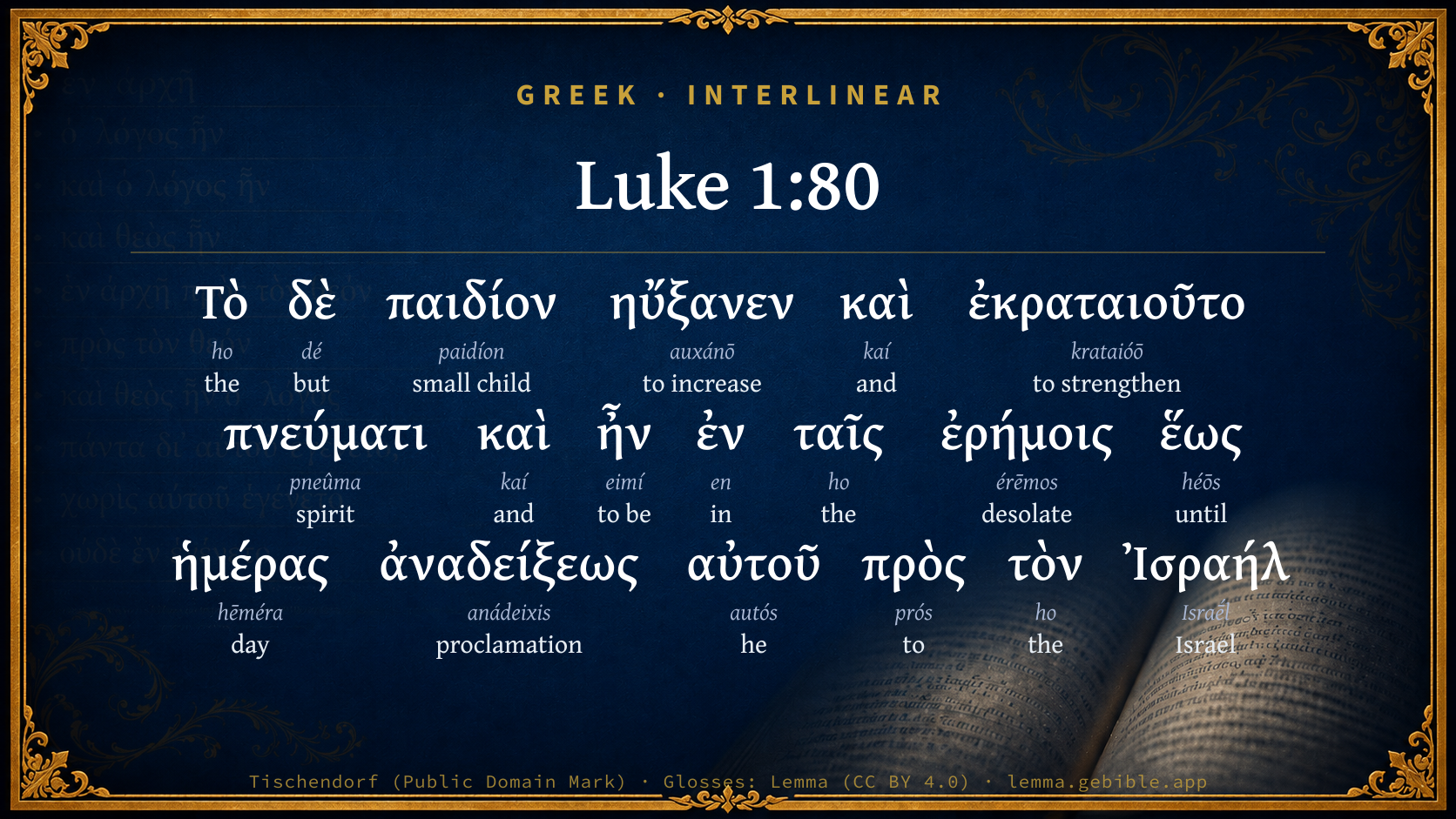
Download image
Cite this verse

Luke 1:80 (World English Bible). Public Domain. Lemma interlinear Bible study tool, https://lemma.gebible.app/v/luke/1/80.

Show BibTeX & RIS
BibTeX
RIS
English Translation
The child was growing, and becoming strong in spirit, and was in the desert until the day of his public appearance to Israel.
World English Bible · Public Domain
Highlights
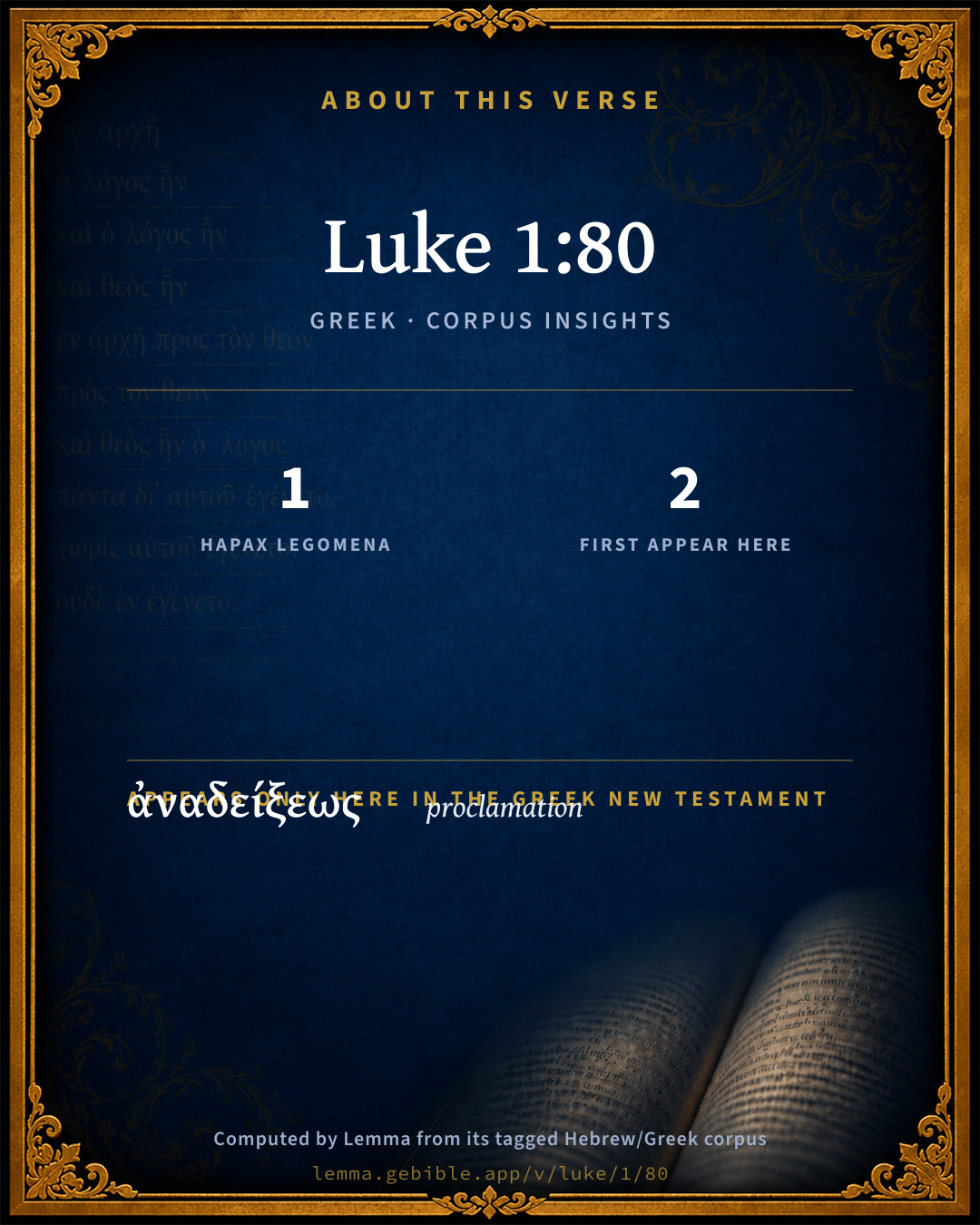
  • 1 hapax legomenon — only here in the Greek New Testament
  • 2 first appearances in the Greek New Testament
Full analysis ↓
Download a study sheet

One document with this verse’s original text, its word-by-word gloss line, the meaning frame, cross-references with their text, attributed commentary, and full source and license credits — printable, and it pastes into notes with its structure intact.

This verse Autodidact and up

Study sheet (.html) Plain text (.txt)

A passage Seminary Student

Up to 50 verses in one chapter. A passage sheet keeps up to 6 commentary sources and 12 cross-references per verse, in the order this page ranks them, and says so on the sheet whenever that leaves anything out. Ask for a single verse and you get the Autodidact verse sheet above.

Everything on this page stays free to read, with no account — the sheet is a download of what is already on screen, not access to it.

Want to remove ads? Support Godless Engineer
Compare translations 3

The same verse in 3 English versions, stacked beneath the original-language interlinear above. Click any original word for its lexicon entry.

Each is an independent rendering of the whole verse — the interlinear is not word-aligned to these translations.

Highlighted words mark where these versions differ — a whole-verse word diff, not a word-by-word alignment.

  • World English Bible Public Domain
    The child was growing, and becoming strong in spirit, and was in the desert until the day of his public appearance to Israel.
  • King James Version Public Domain
    And the child grew, and waxed strong in spirit, and was in the deserts till the day of his shewing unto Israel.
  • unfoldingWord Literal Text CC BY-SA 4.0
    And the child was growing and was being strengthened in spirit, and he was in the wilderness until the day of his public appearance to Israel.

unfoldingWord Literal Text — © unfoldingWord, licensed CC BY-SA 4.0. Word-aligned USFM3 via Door43 (git.door43.org/unfoldingWord/en_ult).

Versions to compare (up to 4)

3 of 4 selected

Show all 19 translations

Every available English version of this verse, each an independent rendering of the whole verse.

  • World English Bible Public Domain
    The child was growing, and becoming strong in spirit, and was in the desert until the day of his public appearance to Israel.
  • Berean Standard Bible Public Domain
    And the child grew and became strong in spirit; and he lived in the wilderness until the time of his public appearance to Israel.
  • Majority Standard Bible Public Domain
    And the child grew and became strong in spirit; and he lived in the wilderness until the time of his public appearance to Israel.
  • King James Version Public Domain
    And the child grew, and waxed strong in spirit, and was in the deserts till the day of his shewing unto Israel.
  • American Standard Version (1901) Public Domain
    And the child grew, and waxed strong in spirit, and was in the deserts till the day of his showing unto Israel.
  • Revised Version (1885) Public Domain
    And the child grew, and waxed strong in spirit, and was in the deserts till the day of his shewing unto Israel.
  • Geneva Bible (1599) Public Domain
    And the childe grewe, and waxed strong in spirit, and was in the wildernesse, til the day came that he should shewe him selfe vnto Israel.
  • Douay-Rheims (1899) Public Domain
    And the child grew, and was strengthened in spirit; and was in the deserts until the day of his manifestation to Israel.
  • Young's Literal Translation Public Domain
    And the child grew, and was strengthened in spirit, and he was in the deserts till the day of his shewing unto Israel.
  • Literal Standard Version CC BY-SA 4.0
    And the child grew, and was strengthened in spirit, and he was in the deserts until the day of his showing to Israel.
  • Unlocked Literal Bible CC BY-SA 4.0
    Now the child grew and became strong in spirit, and he was in the wilderness until the day of his public appearance to Israel.
  • unfoldingWord Literal Text CC BY-SA 4.0
    And the child was growing and was being strengthened in spirit, and he was in the wilderness until the day of his public appearance to Israel.
  • Darby Bible Public Domain
    -- And the child grew and was strengthened in spirit; and he was in the deserts until the day of his shewing to Israel.
  • World Messianic Bible Public Domain
    The child was growing and becoming strong in spirit, and was in the desert until the day of his public appearance to Israel.
  • Webster's Bible Public Domain
    And the child grew, and became strong in spirit, and was in the deserts till the day of his showing to Israel.
  • Free Bible Version CC BY-SA 4.0
    The boy John grew and became spiritually strong. He lived in the desert until the time came for his public ministry to Israel.
  • Bible in Basic English Public Domain
    And the child became tall, and strong in spirit; and he was living in the waste land till the day when he came before the eyes of Israel.
  • Text-Critical English NT CC BY 4.0
    And the child grew and became strong in spirit, and he was in the wilderness until the day of his public appearance to Israel.
  • Tyndale New Testament (1534) Public Domain
    And the chylde grew and wexed stronge in sprete and was in wyldernes tyll the daye cam when he shuld shewe him sylfe vnto the Israhelites.

Literal Standard Version (2020), Covenant Press — licensed CC BY-SA 4.0. Text via the HelloAO Bible API (eBible.org). Unlocked Literal Bible (unfoldingWord) — licensed CC BY-SA 4.0. Text via the HelloAO Bible API (eBible.org). unfoldingWord Literal Text — © unfoldingWord, licensed CC BY-SA 4.0. Word-aligned USFM3 via Door43 (git.door43.org/unfoldingWord/en_ult). Free Bible Version, Dr. Jonathan Gallagher — licensed CC BY-SA 4.0. Text via the HelloAO Bible API (eBible.org).

Word by word

More ways to search: Search by grammar → Find every occurrence → Compare this word →

Practice this passage: Drill this verse → Learn its vocabulary →

ἀναδείξεως
anádeixis
G323
“proclamation”
Noun, Genitive, Singular, Feminine
Part of Speech
Noun
Case
Genitive
Number
Singular
Gender
Feminine
Full Thayer's Definition

Origin: from G322

TDNT: 02:31,1

1. a pointing out, a public showing forth 2. a proclaiming, announcing, inaugurating of such as are elected to office
  1. Τὸ ho G3588 “the” Article, Nominative, Singular, Neuter
  2. δὲ dé G1161 “but” Conjunction
  3. παιδίον paidíon G3813 “small child” Noun, Nominative, Singular, Neuter
  4. ηὔξανεν auxánō G837 “to increase” Verb, Imperfect, Active, Indicative, 3rd person, Singular
  5. καὶ kaí G2532 “and” Conjunction
  6. ἐκραταιοῦτο krataióō G2901 “to strengthen” Verb, Imperfect, Passive, Indicative, 3rd person, Singular
  7. πνεύματι pneûma G4151 “spirit” Noun, Dative, Singular, Neuter
  8. καὶ kaí G2532 “and” Conjunction
  9. ἦν eimí G1510 “to be” Verb, Imperfect, Active, Indicative, 3rd person, Singular
  10. ἐν en G1722 “in” Preposition
  11. ταῖς ho G3588 “the” Article, Dative, Plural, Feminine
  12. ἐρήμοις érēmos G2048 “desolate” Adjective, Dative, Plural, Feminine
  13. ἕως héōs G2193 “until” Adverb
  14. ἡμέρας hēméra G2250 “day” Noun, Genitive, Singular, Feminine
  15. αὐτοῦ autós G846 “he” Personal pronoun, Genitive, Singular, Masculine
  16. πρὸς prós G4314 “to” Preposition
  17. τὸν ho G3588 “the” Article, Accusative, Singular, Masculine
  18. Ἰσραήλ Israḗl G2474 “Israel” Noun, Proper, indeclinable

About this verse

These counts appear in no published source. They are computed here, from the morphology-tagged text and Lemma’s own curated glosses. What Lemma adds →

19
words
16
distinct lemmas
Gospels
section

Notable vocabulary

1 hapax legomenon — a word that appears only here in the entire Greek New Testament:

  • ἀναδείξεως proclamation G323

First appearance in Scripture

These words make their first canonical appearance in the Greek New Testament here:

  • ἐκραταιοῦτο to strengthen G2901
  • ἀναδείξεως proclamation G323

Shared distinctive vocabulary

ἐκραταιοῦτο to strengthen G2901 occurs in 4 verses of the Greek New Testament. Also found in:
Repetition

Words recur within this verse:

Cross-references

9

Topical passages linked to Luke 1:80 in the Treasury of Scripture Knowledge — connected by theme and wording, ordered by reader-vote popularity; previews shown in the World English Bible.

  • Luke 2:40 The child was growing, and was becoming strong in spirit, being filled with wisdom, and the grace of God was upon him.
  • Mark 1:3–4 The voice of one crying in the wilderness, 'Make ready the way of the Lord! Make his paths straight!'"
  • Luke 2:52 And Jesus increased in wisdom and stature, and in favor with God and men.
  • 1 Samuel 3:19–20 Samuel grew, and Yahweh was with him, and did let none of his words fall to the ground.
  • Matthew 3:1 In those days, John the Baptizer came, preaching in the wilderness of Judea, saying,
  • Judges 13:24–25 The woman bore a son, and named him Samson: and the child grew, and Yahweh blessed him.
  • John 1:31 I didn't know him, but for this reason I came baptizing in water: that he would be revealed to Israel."
  • Matthew 11:7 As these went their way, Jesus began to say to the multitudes concerning John, "What did you go out into the wilderness to see? A reed shaken by the wind?
  • Luke 1:15 For he will be great in the sight of the Lord, and he will drink no wine nor strong drink. He will be filled with the Holy Spirit, even from his mother's womb.

Cross-references courtesy of OpenBible.info (CC BY 4.0).

Commentary

Notes on Luke 1:80 from classic Christian and Jewish commentators (each source and its license shown beneath its notes). The classic Christian expositions comment on the surrounding passage and are grouped to its opening verse, so a note may address several verses; the Jewish commentaries on the Tanakh (Rashi and others) are per-verse, so they appear only where the commentator wrote on this verse.

Lemma curates 59 commentaries, every one of them public domain or Creative Commons licensed, each selected and text-cleaned for this edition rather than reprinted as found. About our sources →

The Biblical Illustrator

Joseph S. Exell

Luk_1:80

And the child grew

Johns secluded life

Not in sandy deserts like those of Arabia, but in the wild, waste region south of Jericho and the fords of Jordan to the shores of the Dead Sea.

This was known as Araboth or ha.Arabah. This region, especially where it approached the Ghor and the Dead Sea, was lonely and forbidding in its physical features, and would suit the stern spirit on which it also reacted. In 1Sa_23:19, it is called Jeshimon, or the Horror. John was by no means the only hermit. The political unsettlement, the shamelessness of crime, the sense of secular exhaustion, the widespread Messianic expectation, marked the fulness of time. Banus the Pharisee also lived a life of ascetic hardness in the Arabah, and Josephus tells us that he lived with him for three years in his mountain cave on fruits and water. But there is not in the Gospels the faintest trace of any intercourse between John or our Lord and His disciples, with the Essenes. The great Italian painters follow a right conception when they paint even the boy John as emaciated with early asceticism. In 2Es_9:24, the seer is directed to go into a field where no house is, and to taste no flesh, drink no wine, and eat only the flowers of the field, as a preparation for talking with the Most High. (Archdeacon Farter.)

Satisfactions of solitude

Charles the Fifth, after a life spent in military exploits and the active and energetic prosecution of ambitious projects, resigned, as is well known, his crown, sated with its enjoyment. He left these words, as a testimony, behind him:--I have tasted more satisfaction in my solitude in one day than in all the triumphs of my former reign. The sincere study, profession, and practice of the Christian religion have in them such joy as is seldom found in courts and grandeur. (Baxendales Anecdotes.)

Solitude a good teacher

St. Bernard said, in writing to a pious friend, If you are seeking less to satisfy a vain curiosity than to get true wisdom, you will sooner find it in deserts than in books. The silence of the rocks and the pathless forests will teach you better than the eloquence of the most gifted men. (Fenelon.)

Solitude helps to mature thought

Whenever Michael Angelo, that divine madman, as Richardson once wrote on the back of one of his drawings, was meditating on some great design, he closed himself up from the world. Why do you lead such a solitary life? asked a friend. Art, replied the sublime artist, is a jealous god; it requires the whole and entire man. During his mighty labour in the Sistine Chapel he refused to have any communication with any person, even at his own house. (L DIsraeli.)

The youth of John the Baptist

I. INQUIRE INTO THE REASONS WHY THE YOUTH OF JOHN WAS SPENT IN OBSCURITY.

1. Purity of his mind shrank from a society so devoid of true religion

2. Privations fitted him for the self-denial with which he afterwards attracted the people.

3. Arrangements also well adapted to prevent any such intimacy with Christ in His youth, as might have excited suspicion of a collusion betwixt them.

4. In such retirement John enjoyed, undisturbed, that communion with the Deity so delightful to eminent piety like his.

II. CONSIDER THE INSTRUCTIONS WHICH THIS ACCOUNT OF JOHNS YOUTH HOLDS OUT TO THOSE WHOSE VIEWS ARE POINTED TO THE CHRISTIAN MINISTRY. Entire seclusion not required of them, but let them retire as often as they can, and prefer the calm of solitude to the bustle of dissipation.

III. CONSIDER THE LESSONS HELD FORTH BY THE YOUTH OF JOHN TO THE YOUNG IN GENERAL. The wisdom and advantage of frequent retirement.

1. What opportunities of improvement solitude will present to you.

2. From what temptations it will detach you.

3. To what solidity of character it will form you.

4. How it will prepare you for the seclusion of days of darkness. (Dr. Belfrage.)

The retirement of John was

I. A RENUNCIATION OF HIS PRIESTLY RIGHTS.

II. A BREAKING-OFF FROM THE THEN JUDAISM.

III. A UNIQUE REALIZATION OF THE TRUE NATURE OF GOD. He believed that there, in the desert, as really as in the Temple, was the God of the Temple to be found and worshipped.

IV. Observe that GOD THE HOLY SPIRIT MINISTERED TO HIM IN THE DESERTS. (A. B. Grosart, LL. D)

Every life has its desert period

Those grand solemn days when God calls us out of the worlds noises to commune in deep consultation with Him until the souls purposes are shaped, and the characters of our immortal spirits formed. These are the days of destiny, the birth-hours of all that is really great in us, times when we are truly born again, if we will be, or when we rush back and plunge into the troubled sea of unregenerate existence, never to find rest. If we look back down the long line of Gods heroic ones, each had his wilderness. Enoch, Noah, Abraham, Isaac, Jacob, Joseph, dwelt all their lives in the grand deserts of existence, and tabernacled with God. Moses, David, Daniel, Elijah, Jeremiah, yea, all Gods great ones, were caused to turn their backs on a world and face the truths of the living God, until those truths rose up to them to march in triumph, through the opposition of men and devils, to glorious victory. Now, as then, God calls us to the wilderness-school--calls us out to uncover the great purposes of truth before us, and sends us back to stand up for Him, regardless of all the surgings of sin, applause, fear, or death. Here, and here alone, is the safety of any Church, age, or man, in the kingdom of God within, trueness to the ideal of life realized, as the soul in its lone consecration stretches itself on the naked will of God, and feels the strong beatings of His eternal purposes of truth, justice, and love. (Bishop Penriek,)

Waxed strong in spirit

We need strong men--Elijah-like, John-the-Baptist-like men in these perilous times, and spiritual strength is incomparably the strongest, the most celestial, the most Christly of all strength. (A. B. Grosart, LL. D.)

.

The Biblical Illustrator, edited by Joseph S. Exell (c. 1880s–1900s) — public domain. Text from a community e-Sword module.

Joseph Benson's Commentary

Luk 1:80. And the child grew, &c. — The years of John’s infancy expiring, he grew daily in wisdom and stature; and was in the deserts, &c. — During the whole course of his private life, he continued in the deserts, or hill- country of Judea, Luk 1:39, till his ministry commenced, about the thirtieth year of his age. It is probable that the deserts here mentioned were those of Ziph and Maon, where Saul pursued David. Though there were several country towns and villages in these deserts, yet, as they were but thinly inhabited, they were in the Jewish idiom called deserts. Now it was wisely ordered, to prevent a personal acquaintance between Jesus and John, that the latter should continue in one of these deserts, at the distance of probably one hundred miles from Nazareth, till the time of his entering upon his ministry. There, in a state of solitude and retirement from the world, he lived an austere and mortified life, that his character might be suited to his office — the preaching of repentance, self-denial, and deadness to the world and sin.

Joseph Benson's Commentary on the Old and New Testaments (1811–1818) — public domain. Text from a community e-Sword module.

MacLaren's Expositions of Holy Scripture

Alexander MacLaren

Luke

ZACHARIAS’S HYMN

Luk 1:67 - Luk 1:80.

Zacharias was dumb when he disbelieved. His lips were opened when he believed. He is the last of the Old Testament prophets, [Footnote: In the strictest sense, John the Baptist was a prophet of the Old dispensation, even though he came to usher in the New. {See Mat 11:9 - Mat 11:11.} In the same sense, Zacharias was the last prophet of the Old dispensation, before the coming of his son to link the Old with the New.] and as standing nearest to the Messiah, his song takes up the echoes of all the past, and melts them into a new outpouring of exultant hope. The strain is more impassioned than Mary’s, and throbs with triumph over ‘our enemies,’ but rises above the mere patriotic glow into a more spiritual region. The complete subordination of the personal element is very remarkable, as shown by the slight and almost parenthetical reference to John. The father is forgotten in the devout Israelite. We may take the song as divided into three portions: the first {Luk 1:68 - Luk 1:75} celebrating the coming of Messiah, with special reference to its effect in freeing Israel from its foes; the second {Luk 1:76 - Luk 1:77}, the highly dramatic address to his unconscious ‘child’; the third {Luk 1:78 - Luk 1:79} returns to the absorbing thought of the Messiah, but now touches on higher aspects of His coming as the Light to all who sit in darkness.

I. If we remember that four hundred dreary years, for the most part of which Israel had been groaning under a foreign yoke, had passed since the last of the prophets, and that during all that time devout eyes had looked wearily for the promised Messiah, we shall be able to form some faint conception of the surprise and rapture which filled Zacharias’s spirit, and leaps in his hymn at the thought that now, at last, the hour had struck, and that the child would soon be born who was to fulfil the divine promises and satisfy fainting hopes. No wonder that its first words are a burst of blessing of ‘the God of Israel.’ The best expression of joy, when long-cherished desires are at last on the eve of accomplishment, is thanks to God. How short the time of waiting seems when it is past, and how needless the impatience which marred the waiting! Zacharias speaks of the fact as already realised. He must have known that the Incarnation was accomplished; for we can scarcely suppose that the emphatic tenses ‘hath visited, hath redeemed, hath raised’ are prophetic, and merely imply the certainty of a future event. He must have known, too, Mary’s royal descent; for he speaks of ‘the house of David.’

‘A horn’ of salvation is an emblem taken from animals, and implies strength. Here it recalls several prophecies, and as a designation of the Messiah, shadows forth His conquering might, all to be used for deliverance to His people. The vision before Zacharias is that of a victor king of Davidic race, long foretold by prophets, who will set Israel free from its foreign oppressors, whether Roman or Idumean, and in whom God Himself ‘visits and redeems His people.’ There are two kinds of divine visitations-one for mercy and one for judgment. What an unconscious witness it is of men’s evil consciences that the use of the phrase has almost exclusively settled down upon the latter meaning! In Luk 1:71 - Luk 1:75, the idea of the Messianic salvation is expanded and raised. The word ‘salvation’ is best construed, as in the Revised Version, as in apposition with and explanatory of ‘horn of salvation.’ This salvation has issues, which may also be regarded as God’s purposes in sending it. These are threefold: first, to show mercy to the dead fathers of the race. That is a striking idea, and pictures the departed as, in their solemn rest, sharing in the joy of Messiah’s coming, and perhaps in the blessings which He brings. We may not too closely press the phrase, but it is more than poetry or imagination. The next issue is God’s remembrance of His promises, or in other words, His fulfilment of these. The last is that the nation, being set free, should serve God. The external deliverance was in the eyes of devout men like Zacharias precious as a means to an end. Political freedom was needful for God’s service, and was valuable mainly as leading to that. The hymn rises far above the mere impatience of a foreign yoke. ‘Freedom to worship God,’ and God worshipped by a ransomed nation, are Zacharias’s ideal of the Messianic times.

Note his use of the word for priestly ‘service.’ He, a priest, has not forgotten that by original constitution all Israel was a nation of priests; and he looks forward to the fulfilment at last of the ideal which so soon became impracticable, and possibly to the abrogation of his own order in the universal priesthood. He knew not what deep truths he sang. The end of Christ’s coming, and of the deliverance which He works for us from the hand of our enemies, cannot be better stated than in these words. We are redeemed that we may be priests unto God. Our priestly service must be rendered in ‘holiness and righteousness,’ in consecration to God and discharge of all obligations; and it is to be no interrupted or occasional service, like Zacharias’s, which occupied but two short weeks in the year, and might never again lead him within the sanctuary, but is to fill with reverent activity and thankful sacrifice all our days. However this hymn may have begun with the mere external conception of Messianic deliverance, it rises high above that here, and will still further soar beyond it. We may learn from this priest-prophet, who anticipated the wise men and brought his offerings to the unborn Christ, what Christian salvation is, and for what it is given us.

II. There is something very vivid and striking in the abrupt address to the infant, who lay, all unknowing, in his mother’s arms. The contrast between him as he was then and the work which waited him, the paternal wonder and joy which yet can scarcely pause on the child, and hurries on to fancy him in the years to come, going herald-like before the face of the Lord, the profound prophetic insight into John’s work, are all noteworthy. The Baptist did ‘prepare the way’ by teaching that the true ‘salvation’ was not to be found in mere deliverance from the Roman yoke, but in ‘remission of sin.’ He thus not only gave ‘knowledge of salvation,’ in the sense that he announced the fact that it would be given, but also in the sense that he clearly taught in what it consisted. John was no preacher of revolt, as the turbulent and impure patriots of the day would have liked him to be, but of repentance. His work was to awake the consciousness of sin, and so to kindle desires for a salvation which was deliverance from sin, the only yoke which really enslaves. Zacharias the ‘blameless’ saw what the true bondage of the nation was, and what the work both of the Deliverer and of His herald must be. We need to be perpetually reminded of the truth that the only salvation and deliverance which can do us any good consist in getting rid, by pardon and by holiness, of the cords of our sins.

III. The thoughts of the Forerunner and his office melt into that of the Messianic blessings from which the singer cannot long turn away. In these closing words, we have the source, the essential nature, and the blessed results of the gift of Christ set forth in a noble figure, and freed from the national limitations of the earlier part of the hymn. All comes from the ‘bowels of mercy of our God,’ as Zacharias, in accordance with Old Testament metaphor, speaks, allocating the seat of the emotions which we attribute to the heart. Conventional notions of delicacy think the Hebrew idea coarse, but the one allocation is just as delicate as the other. We can get no deeper down or farther back into the secret springs of things than this-that the root cause of all, and most especially of the mission of Christ, is the pitying love of God’s heart. If we hold fast by that, the pain of the riddle of the world is past, and the riddle itself more than half solved. Jesus Christ is the greatest gift of that love, in which all its tenderness and all its power are gathered up for our blessing.

The modern civilised world owes most of its activity to the quickening influence of Christianity. The dayspring visits us that it may shine on us, and it shines that it may guide us into ‘the way of peace.’ There can be no wider and more accurate description of the end of Christ’s mission than this-that all His visitation and enlightenment are meant to lead us into the path where we shall find peace with God, and therefore with ourselves and with all mankind. The word ‘peace,’ in the Old Testament, is used to include the sum of all that men require for their conscious well-being. We are at rest only when all our relations with God and the outer world are right, and when our inner being is harmonised with itself, and supplied with appropriate objects. To know God for our friend, to have our being fixed on and satisfied in Him, and so to be reconciled to all circumstances, and a friend of all men-this is peace; and the path to such a blessed condition is shown us only by that Sun of Righteousness whom the loving heart of God has sent into the darkness and torpor of the benighted wanderers in the desert. The national reference has faded from the song, and though it still speaks of ‘us’ and ‘our,’ we cannot doubt that Zacharias both saw more deeply into the salvation which Christ would bring than to limit it to breaking an earthly yoke, and deemed more worthily and widely of its sweep, than to confine it within narrower bounds than the whole extent of the dreary darkness which it came to banish from all the world.

Alexander MacLaren, Expositions of Holy Scripture (1904–1910) — public domain. Text from a community e-Sword module.

Tyndale Open Study Notes

Tyndale Open Resources

1:80 John grew up and became strong in spirit: Cp. 2:40, 52; 1 Sam 2:21, 26; 3:19. • John probably lived in the wilderness west of the Jordan River and southeast of Jerusalem. It was a place of testing (Deut 8:2; Pss 78, 95, 107) as well as spiritual retreat and preparation (Exod 3; 1 Kgs 19:4-6, 11-18; Isa 40:3).

Tyndale Open Study Notes — © Tyndale Open Resources, licensed CC BY-SA 4.0. Text via the HelloAO Bible API.

Bengel's Gnomon

Johann Albrecht Bengel

Luk 1:80. Ηὔξανε, grew) in body.—ἐν ταῖς ἐρήμοις, in the deserts) Here the more inward and remote parts of the desert are denoted; but in Mat 3:1 [“the wilderness of Judea,” where John began his preaching]: it is the exterior desert that is meant. He remained exempt from contact with [lit. rubbing with] life in its ordinary and polluted forms. The Forerunner of Christ, and Christ Himself, had experience themselves, and gave a specimen to others, of both kinds of life; and indeed, first, of a solitary mode of life, afterwards also of a public one.—ἓως, even up to) Ch. Luk 3:2-3.

Bengel's Gnomon of the New Testament — English translation (T&T Clark, Edinburgh, 1860) — public domain. Text from a community e-Sword module.

Meyer's Critical & Exegetical Commentary

Heinrich August Wilhelm Meyer

Luk_1:80. A summary account (comp. Jdg_13:24) of the further development of John. More particular accounts were perhaps altogether wanting, but were not essential to the matter here.

ηὔξανε] the bodily growing up, and, connected therewith: ἐκρατ. πνεύμ., the mental gaining of strength that took place εἰς τὸν ἔσω ἄνθρωπ. (Eph_3:16). Comp. the description of the development of Jesus, Luk_2:40; Luk_2:52. ψυχῇ is not mentioned, for the πνεῦμα is the ἡγεμονικόν, in whose vigour and strength the ψυχή shares. Comp. Delitzsch, Psychol. p. 217.

ἦν ἐν τοῖς ἐρήμοις] in the well-known desert regions. It is the desert of Judah ἐξοχήν that is meant (see on Mat_3:1). In that desert dwelt also the Essenes (Plin. N. H. v. 17). How far their principles and askesis, which at least could not have remained unknown to John, may have indirectly exercised an influence on his peculiar character, cannot be determined; a true Essene this greatest and last phenomenon of Israelitish prophecy certainly was not; he belonged, like some God-sent prophet higher than all partisan attitudes in the people, to the whole nation.

ἀναδείξεως αὐτοῦ πρὸς τ. Ἰσρ.] His being publicly made known to Israel, when he was announced to the Israelites as the forerunner of the Messiah. This was done on the command of God by John himself. See Luk_3:2-6. ἀνάδειξις is the making known (renuntiatio) of official nomination; Polyb. xv. 26. 4; Plut. Mark 8; see Wetstein. Comp. Luk_10:1.

Meyer — Critical and Exegetical Commentary on the New Testament — English translation by Peter Christie, edited by Frederick Crombie (T&T Clark, 1880) — public domain. Text from a community e-Sword module.

Expositor's Greek Testament

ed. W. Robertson Nicoll

Luk 1:80 . Conclusion : being a summary statement on John’s history from childhood to manhood. πνεύματι : the growing strength of John’s spirit, the development of a remarkable moral individuality, the main point in the view of the evangelist. ἐν ταῖς ἐρήμοις , in the desert places: not far to go from his home to find them; visits to them frequent in early boyhood; constant abode when youth had passed into manhood; love of solitude grown into a passion. Meet foster-mother for one who is to be the censor of his time. Essenes not far off, but no indication of contact, either outwardly or inwardly, with them.

The Expositor's Greek Testament, edited by W. Robertson Nicoll (1897–1910) — public domain. Text from a community e-Sword module.

Godet's Commentaries

Frédéric Louis Godet

Ver. 80. The historical conclusion, Luk 1:80, corresponds with that in Luk 1:66. As the latter sketches with a stroke of the pen the childhood of John, so this gives a picture of his youth, and carries us forward to the time when he began his ministry. The term he grew refers to his physical development, and the expression following, waxed strong in spirit, to his spiritual development, that is to say, religious, moral, and intellectual. The predominant feature of this development was force, energy (he grew strong in spirit). Luke, doubtless, means by this the power of the will over the instincts and inclinations of the body. The spirit is here certainly that of John himself; but when a man developes in a right way, it is only by communion with the Divine Spirit that his spirit unfolds, as the flower only blows when in contact with the light.

This spiritual development of John was due to no human influence. For the child lived in the deserts. Probably the desert of Judea is meant here, an inhabited country, whose deeply creviced soil affords an outlet to several streams that empty themselves into the Dead Sea. This country, abounding in caves, has always been the refuge of anchorites. In the time of John the Baptist there were probably Essenran monasteries there; for history says positively that these cenobites dwelt upon both shores of the Dead Sea. It has been inferred from this passage that John, during his sojourn in the desert, visited these sages, and profited by their teaching. This opinion is altogether opposed to the design of the text, which is to attribute to God alone the direction of the development of the forerunner. But more than this. If John was taught by the Essenes, it must be admitted that the only thing their instructions did for him was to lead him to take entirely opposite views on all points. The Essenes had renounced every Messianic expectation; the soul of John’s life and ministry was the expectation of the Messiah and the preparation for His work. The Essenes made matter the seat of sin; John, by his energetic calls to conversion, shows plainly enough that he found it in the will. The Essenes withdrew from society, and gave themselves up to mystic contemplation; John, at the signal from on high, threw himself boldly into the midst of the people, and to the very last took a most active and courageous part in the affairs of his country. If, after all, any similarities are found between him and them, John’s originality is too well established to attribute them to imitation; such similarities arise from the attempt they both made to effect a reform in degenerate Judaism. The relation of John to the Essenes is very similar to that of Luther to the mystics of the middle ages. On the part of the Essenes, as of the mystics, there is the human effort which attests the need; on the part of John, as well as of Luther, the divine work which satisfies it.

The abstract plural in the deserts proves that this observation is made with a moral and not a geographical aim.

The word ἀνάδειξις, showing, denotes the installation of a servant into his office, his official institution into his charge. The author of this act, unnamed but understood, is evidently God. It follows from Luk 3:2, and from Joh 1:31-33, that a direct communication from on high, perhaps a theophany, such as called Moses from the desert, was the signal for John to enter upon his work. But we have no account of this scene which took place between God and His messenger. Our evangelists only relate what they know.

Frédéric Louis Godet — Commentaries on Luke, John, Romans, and 1 Corinthians — English translation (T&T Clark, Edinburgh, 1870s–1890s) — public domain. Text from a community e-Sword module.

Jamieson, Fausset & Brown

Robert Jamieson, A. R. Fausset & David Brown

And the child, &c.--"a concluding paragraph, indicating, in strokes full of grandeur, the bodily and mental development of the Baptist; and bringing his life up to the period of his public appearance" [OLSHAUSEN].

in the deserts--probably "the wilderness of Judea" (Mat 3:1), whither he had retired early in life, in the Nazarite spirit, and where, free from rabbinical influences and alone with God, his spirit would be educated, like Moses in the desert, for his future high vocation.

his showing unto Israel--the presentation of himself before his nation, as Messiah's forerunner.

Next: Luke Chapter 2

Jamieson, Fausset & Brown — Commentary Critical and Explanatory on the Whole Bible (1871) — public domain (CC PDM 1.0). Text via the HelloAO Bible API.

Adam Clarke's Commentary

Verse 80. The child grew] Increased in stature and bodily vigour. And waxed strong in spirit-had his understanding Divinely illuminated and confirmed in the truths of God. And was in the deserts-the city of Hebron, the circumjacent hill country, and in or near Nazareth. Till the time of his showing, or manifestation - till he was thirty years of age, before which time the law did not permit a man to enter into the public ministry, Nu 4:3. See also Lu 3:23.

So much has already been said, by way of practical improvement of the different subjects in this important chapter, as to preclude the necessity of any addition here.

Adam Clarke's Commentary on the Bible (1810–1826) — public domain. Text from a community e-Sword/MySword module.

Ellicott's Commentary for English Readers

(80) And the child grew.—We have no materials for filling up this brief outline of the thirty years that followed in the Baptist’s life. The usual Jewish education, the observance of the Nazarite vow, the death of his parents while he was comparatively young, an early retirement from the world to the deserts that surrounded the western shores of the Dead Sea, study and meditation given to the Law and the Prophets, the steadfast waiting for the consolation of Israel, possible intercourse with the Essenes who lived in that region, or with hermit-teachers, like Banus, the master of Josephus (Life, c. 1), whose form of life was after the same fashion as his own: this we may surmise as probable, but we cannot say more. Whatever may have been the surroundings of his life, he entered upon his work in a spirit which was intensely personal and original.

A Bible Commentary for English Readers, edited by Charles John Ellicott (1878–1897) — public domain. Text from a community e-Sword module.

The Cambridge Bible for Schools and Colleges

gen. ed. J. J. S. Perowne

80. the child grew, and waxed strong in spirit] The description resembles that of the childhood of Samuel (1Sa_2:26) and of our Lord (Luk_2:40-52). Nothing however is said of ‘favour with men.’ In the case of the Baptist, as of others, ‘the boy was father to the man,’ and he probably shewed from the first that rugged sternness which is wholly unlike the winning grace of the child Christ. “The Baptist was no Lamb of God. He was a wrestler with life, one to whom peace does not come easily, but only after a long struggle. His restlessness had driven him into the desert, where he had contended for years with thoughts he could not master, and from whence he uttered his startling alarms to the nation. He was among the dogs rather than among the lambs of the Shepherd.” (Ecce Homo.)

was in the deserts] Not in sandy deserts like those of Arabia, but in the wild waste region south of Jericho and the fords of Jordan to the shores of the Dead Sea. This was known as Araboth or ha-Arabah, 2Ki_25:4-5 (Heb.); Jer_39:5; Jer_52:8. See on Luk_1:39. This region, especially where it approached the Ghôr and the Dead Sea, was lonely and forbidding in its physical features, and would suit the stern spirit on which it also reacted. In 1Sa_23:19 it is called Jeshimon or ‘the Horror.’ John was by no means the only hermit. The political unsettlement, the shamelessness of crime, the sense of secular exhaustion, the wide-spread Messianic expectation, marked ‘the fulness of time.’ Banus the Pharisee also lived a life of ascetic hardness in the Arabah, and Josephus tells us that he lived with him for three years in his mountain-cave on fruits and water. (Jos. Vit. 2.) But there is not in the Gospels the faintest trace of any intercourse between John, or our Lord and His disciples, with the Essenes. The great Italian painters follow a right conception when they paint even the boy John as emaciated with early asceticism. In 2Es_9:24 the seer is directed to go into a field where no house is and to “taste no flesh, drink no wine, and eat only the flowers of the field,” as a preparation for ‘talking with the Most High.’ It is doubtful whether Christian Art is historically correct in representing the infant Jesus and John as constant friends and playmates. Zacharias and Elizabeth, being aged, must have early left John an orphan, and his desert life began with his boyish years. Further, the habits of Orientals are exceedingly stationary, and when once settled it is only on the rarest occasions that they leave their homes. The training of the priestly boy and the ‘Son of the Carpenter’ (Mat_13:55) of Nazareth had been widely different, nor is it certain that they had ever met each other until the Baptism of Jesus (Joh_1:31).

his shewing] his public ministry, literally, “appointment” or manifestation. The verb (anedeixen) occurs in Luk_10:1; Act_1:24. Thus St John’s life, like that of our Lord, was spent first in hallowed seclusion, then in public ministry.

At this point ends the first very interesting document of which St Luke made use. The second chapter, though in some respects analogous to it, is less imbued with the Hebraic spirit and phraseology.

The Cambridge Bible for Schools and Colleges (gen. ed. J. J. S. Perowne; Cambridge University Press, 1878–1918) — public domain. Text from a community e-Sword module.

John Gill's Exposition

And the child grew, and waxed strong in spirit,.... That is, John, the son of Zacharias and Elisabeth, grew in stature of body, and increased in wisdom and knowledge, and fortitude in his soul:

and was in the deserts; or "desert", as the Syriac, Persic, and Ethiopic versions read; not in the wilderness of Judea, where he came preaching, but either of Ziph or Maon, which were near to Hebron; see Sa1 23:14 he was not brought up in the schools of the prophets, nor in the academies of the Jews, or at the feet of any of their Rabbins and doctors; that it might appear he was not taught and sent of men, but of God: nor did he dwell in any of the cities, or larger towns, but in deserts; partly that he might be fitted for that gravity and austerity of life, he was to appear in; and that it might be clear he had no knowledge of, nor correspondence with Jesus, whose forerunner he was, and of whom he was to bear testimony, till such time he did it; and in this solitude he remained,

till the day of his showing unto Israel; either till the time came that he was to appear before, and be examined by the sanhedrim, that judged of persons fitness and qualifications for the priesthood, in order to be admitted to it; which should have been when he was thirty years of age, but that he was designed for other service; or rather therefore till he appeared in his prophetic office, and showed himself to the people of Israel; to whom he came preaching the doctrine of repentance and remission of sins, administering the ordinance of baptism, giving notice of the near approach of the Messiah, and pointing him out unto the people.

Next: Luke Chapter 2

John Gill's Exposition of the Whole Bible (1746–1763) — public domain (CC PDM 1.0). Text via the HelloAO Bible API.

Trapp's Complete Commentary

John Trapp

80 And the child grew, and waxed strong in spirit, and was in the deserts till the day of his shewing unto Israel.

Ver. 80. And the child grew] Though his meat was but coarse, and not so nourishing. The blessing of God is the staff of bread: bread would no more nourish without it, than a piece of earth.

John Trapp, A Commentary or Exposition upon All the Books of the Old and New Testament (1647–1656) — public domain. Text from a community e-Sword module.

Albert Barnes' Notes on the Bible

Waxed strong in spirit - That is, in courage, understanding, and purposes of good, fitting him for his future work. The word “wax” means to “increase, to grow,” from an old Saxon word.

In the deserts - In Hebron, and in the hill country where his father resided. He dwelt in obscurity, and was not known publicly by the people.

Until the day of his showing - Until he entered on his public ministry, as recorded in Matt. 3 - that is, probably, until he was about 30 years of age. See Luke 3.

Albert Barnes' Notes on the Bible (1834–1885) — public domain. Text from a community e-Sword/MySword module.

Haydock's Catholic Bible Commentary

St. John remained in the desert till the 30th year of his age. The reason why he concealed himself so long was because he feared the cruelty of Herod; for, though he was not under his jurisdiction, not being on the confines of Bethlehem, yet on account of the remarkable events that took place at his birth, by which he was declared the precursor of the Messias, he had reason to dread the cruelty of the jealous and suspicious Herod. Peter of Alexandria, Nicephorus, Baronius, and others, say, that when he was yet in his mother’s arms, he was conveyed into the desert, and there concealed in the caves and fissures of the rocks, where people concealed themselves on the approach of their enemies. Cedrinus adds, that 40 days after their flight, the mother of St. John died; after which, an angel is said to have undertaken the care of the Baptist; but most probably this office was performed by some attendant on St. Elizabeth. (Tirinus) ---The Baptist remained in the desert till he began his public ministry, which by a law of the Jews could not be much before he had attained his 30th years. He is styled by antiquity the first hermit. See St. Jerome in Vita Pauli.

George Leo Haydock (1774–1849), Haydock's Catholic Family Bible and Commentary, 1859 edition — public domain. Excludes Psalms (Douay-Rheims chapter numbering differs from Protestant) and Deuterocanonical books (Catholic canon only).

Matthew Poole's English Annotations

The evangelist having done with Zacharias’s prophetical song, now cometh to tell us what became of John. He saith, the child grew, and waxed strong in spirit. He did not only grow in his bodily dimensions, but in the endowments of his mind.

And was in the deserts, that is, in places very thinly inhabited, (some will have this to have been the deserts of Ziph and Maon),

till the day of his showing unto Israel; that is, in all probability, till he was about thirty years of age, when he came forth as a public preacher to those parts of Israel where he spent the small remaining part of his life, of which we shall hear more hereafter.

Matthew Poole's English Annotations on the Holy Bible (1683–1685) — public domain. Text from a community e-Sword/MySword module.

Whedon's Commentary on the Bible

Daniel D. Whedon

80. Grew—In body, as waxed strong refers to mind. Similar description of the growth of Samson, Jdg_13:2; of Jesus, Luk_2:40.

The deserts—Not strictly deserts, but the rural region, little inhabited, of his native hill country. “They are mistaken,” says Grotius, “who think that this only indicates his country home, for his home was a city;” it signifies that resigning home he dwelt in the solitudes. So his severer food comported with his wilderness life to express his Elijah-like mission to preach repentance. This was his preparatory schooling, in which silence, study of God’s word, and prayer, with meditation, nourished his spiritual strength. This concealment stands in contrast to his showing, or manifestation, when the fullness of time arrived.

Daniel D. Whedon (gen. ed.), Commentary on the Old and New Testaments (1874–1909) — public domain. Text from a community e-Sword module.

The Pulpit Commentary

And the child grew, and waxed strong in spirit. We have here another of St. Luke"s solemn pauses in his narrative one of those little passages in which, in a few words, he sets before us a picture clear and vivid of the events of long years. "The description," writes Dr. Farrar, "resembles that of the childhood of Samuel (1Sa_2:26) and of our Lord. (Luk_2:40-52) Nothing, however, is said of "favor with men." In the case of the Baptist, as of others, "the boy was father to the man;" and he probably showed from the first that rugged sternness which is wholly unlike the winning grace of the child Christ. "The Baptist was no lamb of God. He was a wrestler with life, one to whom peace does not come easily, but only after a long struggle. His restlessness had driven him into the desert, where he had contended for years with thoughts he could not master, and from whence he uttered his startling alarms to the nation. He was among the dogs rather than among the lambs of the Shepherd" ("Ecce Homo")." And was in the deserts till the day of his showing unto Israel. "The deserts" here alluded to were that desolate waste country south of Jericho and along the shores of the Dead Sea. We know nothing of the details of the life of the boy, the wonderful circumstances of whose birth are related so circumstantially in this opening chapter of St. Luke"s Gospel. Mary, whose "memories," we believe, are recounted almost in her own words, was herself a witness of some of the circumstances narrated; from her friend and cousin Elisabeth she doubtless received the true history of the rest. But Zacharias and Elisabeth, we know, were aged persons when John was born. They probably lived only a short time after his birth. Hence his solitary desert life. Of it we know nothing. In those wild regions at that time dwelt many grave ascetics and hermit teachers, like the Pharisee Banus, the matter of Josephus. From some of these the orphan boy probably received his training. It is clear, from such passages as Joh_1:31-33 and Luk_3:2, that some direct communication from the Highest put an end to the ascetic desert life and study. Some theophany, perhaps, like the appearance of the burning bush which called Moses to his great post, summoned the pioneer of Christ to his dangerous and difficult work. But we possess no account of what took place on this occasion when God spoke to his servant John, the evangelist simply recording the fact, "The word of God came unto the son of Zacharias in the wilderness". (Luk_3:2)

The service of solitude.

"And was in the deserts till the day of his showing unto Israel." John the Baptist had a long period of retirement before he began the active work of life; and we may be sure that the time spent in the wilderness was not lost. The communion he had there with God, and his prolonged reflection on the worth and purpose of human life, must have had much to do with the character he formed and the work he afterwards accomplished. Then good seed was sown which bore much fruit in later years. We should do well to "be in the desert" more than we are to seek the solitary place where we are alone with God and with ourselves more than we do. "The world is too much with us." We cannot hear the stiller and deeper voices that speak to us, for its perpetual sound is in our ear the hum of its activity, the rattle of its pleasures, the wail of its distress. Solitude would render an essential service if we would but ensure it and employ it.

I THE SERVICES SOLITUDE WOULD RENDER US.

1. It would bring God near to us. When man is quite removed from us, and his voice is completely hushed; when we are alone, whether it be in the folds of the hill, or in the depth of the valley, or in our own chamber; we have a sense of God"s nearness to us which we have not amid the crowd. And what an inestimable advantage it would be to us to let the consciousness of God"s own presence often fill our soul, and then to hold sustained communion with him!

2. It would place our past in full view before our soul. It is not well to be very often looking back on that which has gone. There is deep wisdom in "forgetting those things which are behind," both past follies and past successes. Yet is it well sometimes to review the way we have been taking to consider how much there is that should humble us, and how much that should teach us our weakness and cast us on the mercy and the help of God.

3. It would confront us with the future. It would make us ask whither we are going, what there remains for us to do before we die, how well we are prepared for death and the great day of account.

4. It would lead us to estimate our present spiritual condition how good a use we have made of our privileges, whether we have been progressing or receding in our course, whether we are what our Divine Lord would have us be, how we stand in the sight of perfect truth and purity.

II THE OCCASIONS WHEN IT IS MOST APPROPRIATE.

1. Between the night and the morning; when the soul has to address itself to new duties, new difficulties, new opportunities.

2. Between the evening and the night; before a man commits himself to the "great Guardian of his sleeping hours," his hours of utter helplessness and unconsciousness.

3. Before leaving the shelter of the home; when the young heart goes forth into deeper waters who shall say how deep? of temptation and trial; when all, and far more than all, its resources will be required for the stern struggle before it.

4. In the crises of our career; when in the innermost chamber of the soul it is determined whether the heart and life shall be yielded to the holy Savior and rightful Sovereign, or shall be withheld from him.

5. At the time of religious avowal; when a human being takes upon himself the vows of God, and makes open declaration of attachment to the Lord his Redeemer.

6. Before special services which demand the full strength of the soul to meet them bravely and to render them worthily. At such times as these does it most become us to shut our doors upon ourselves and be long alone with God. C.

The Pulpit Commentary (1880–1919), ed. H.D.M. Spence-Jones & Joseph S. Exell — public domain. Text from a community e-Sword module.

Burkitt's Expository Notes on the New Testament

William Burkitt

Here we have a short account of John’s private life before he entered upon his public ministry, which was at thirty years of age; "He grew," that is, in bodily stature, "and waxed strong in spirit;" that is, in the gifts and graces of the Holy Spirit, which increased with his age, and shewed themselves in him every day more and more. "And he was in the deserts; "that is, in the mountainous country of Judea, where he was born, till the time of his preaching to and amongst the Jews; not that he lived like a hermit, recluse from all society with men, but contented himself to continue in an obscure privacy, till called forth to promulge and preach the gospel: and when that time was come, John leaves the hill country, and enters with resolution and unwearied diligence upon his public ministry; teaching us, by his example, that when we are fit and ripe for public service, we should no less willingly leave our obscurity, than we took the benefit of it for our preparation. John abode in the deserts till his shewing unto Israel; that is, till the time of his setting forth to execute his office among the Jews.

William Burkitt's Expository Notes on the New Testament (1700–1703) — public domain. Text from a community e-Sword module.

The People's New Testament

B. W. Johnson

80. The child … was in the deserts. In the wilderness of Judea where he could have ample opportunity for communion with God.

B. W. Johnson's The People's New Testament with Notes (1889–1891) — public domain. Electronic text from the Christian Classics Ethereal Library (CCEL) ThML edition.

unfoldingWord translationNotes

Door43 World Missions Community

General Information:

This tells briefly about John's growing years.

Now

This word is used here to mark a break in the main story line. Luke quickly moves from the birth of John to the beginning of his ministry as an adult.

became strong in spirit

"became spiritually mature" or "strengthened his relationship with God"

was in the wilderness

"lived in the wilderness." Luke does not say at what age John began to live in the wilderness.

until

This does not necessarily mark a stopping point. John continued to live out in the desert even after he started preaching publicly.

the day of his public appearance

"when he began to preach in public"

the day

This is used here in the general sense of "the time" or "the occasion."

translationWords

spirit

desert

Israel

unfoldingWord translationNotes — © Distant Shores Media and the Door43 World Missions Community, licensed CC BY-SA 4.0. Source: git.door43.org/Door43/en_tn.

Cambridge Greek Testament for Schools and Colleges

80. Τὸ δὲ παιδίον ηὔξανεν καὶ ἐκραταιοῦτο πνεύματι. The ηὔξανεν refers to bodily, and the ἐκραταιοῦτο to mental growth. The description resembles that of the childhood of Samuel (1Sa 2:26) and of our Lord (Luk 2:40-52). Nothing however is said of ‘favour with men.’ In the case of the Baptist, as of others, ‘the boy was father to the man,’ and he probably shewed from the first that rugged sternness which is wholly unlike the winning grace of the child Christ. “The Baptist was no Lamb of God. He was a wrestler with life, one to whom peace does not come easily, but only after a long struggle. His restlessness had driven him into the desert, where he had contended for years with thoughts he could not master, and from whence he uttered his startling alarms to the nation. He was among the dogs rather than among the lambs of the Shepherd.” (Ecce Homo.)

ἦν ἐν ταῖς ἐρήμοις. Not in sandy deserts like those of Arabia, but in the wild waste region south of Jericho and the fords of Jordan as far as the shores of the Dead Sea. This was known as Araboth or ha-Arabah, 2Ki 25:4-5 (Heb.); Jer 39:5; Jer 52:8; Mat 3:1. See on Luk 1:39. This region, especially where it approached the Ghôr and the Dead Sea, was lonely and forbidding in its physical features, and would suit the stern spirit on which it also reacted. In 1Sa 23:19 it is called Jeshimon or ‘the Horror.’ The political unsettlement, the shamelessness of crime, the sense of secular exhaustion, the widespread Messianic expectation, marked ‘the fulness of time,’ and drove men to desire solitude. John was by no means the only hermit. Banus the Pharisee also lived a life of ascetic hardness in the Arabah, and Josephus tells us that he lived with him for three years in his mountain-cave on fruits and water. (Jos. Vit. 2.) But there is not in the Gospels the faintest trace of any intercourse between John, or our Lord and His disciples, and the Essenes. John has Messianic hopes; the Essenes had laid them aside. The Essenes were recluse ascetics; St John is a preacher, a reformer, a missionary. The Essenes were mystics; St John is intensely practical (see Godet, p. 145). The great Italian painters follow a right conception when they paint even the boy John as emaciated with early asceticism. In 2Es 9:24 the seer is directed to go into a field where no house is, and to “taste no flesh, drink no wine, and eat only the flowers of the field,” as a preparation for ‘talking with the Most High.’ It is doubtful whether Christian Art is historically correct in representing the infant Jesus and John as constant friends and playmates. Zacharias and Elizabeth, being aged, must have early left John an orphan, and his desert life began with his boyish years. Further, the habits of Orientals are exceedingly stationary, and when once settled it is only on the rarest occasions that they leave their homes. The training of the son of the priest and the ‘Son of the Carpenter’ (Mat 13:55) of Nazareth had been widely different, nor is it certain that they had ever met each other until the Baptism of Jesus (Joh 1:31).

ἀναδείξεως αὐτοῦ. His public ministry, literally, “appointment” or manifestation. The verb (ἀνέδειξεν) occurs in Luk 10:1; Act 1:24. Thus St John’s life, like that of our Lord, was spent first in hallowed seclusion, then in public ministry.

At this point ends the first very interesting document of which St Luke made use. The second chapter, though in some respects analogous to it, is less imbued with the Hebraic spirit and phraseology.

Cambridge Greek Testament for Schools and Colleges (Cambridge University Press, 1896; 21 vols, various authors incl. Carr, Maclear, Plummer, Farrar, Lumby, Moule, M. R. James, Simcox) — public domain. Text from a community e-Sword module.

Alford’s Greek Testament

Henry Alford

80.] A very similar conclusion to those in ch. 2:40, 52, and denoting probably the termination of that record or document of the birth of the Baptist, which the Evangelist has hitherto been translating, or perhaps transcribing already translated.

That this first chapter is such a separate document, appears from its very distinct style. Whether it had been preserved in the holy family, or how otherwise obtained by Luke, no trace now appears. It has a certain relation to, and at the same time is distinguished from, the narration of the next chapter. The Old Testament spirit is stronger here, and the very phraseology more in unison with Hebrew usage.

ταῖς ἐρ.] The ὀρεινή of Judæa was very near this wilderness, and from the character of John’s official life afterwards, it is probable that in youth he would be given to solitude and abstemiousness. It cannot be supposed that the Essenes, dwelling in those parts, had any, or only the most general kind of influence over him, as their views were wholly different from his.

ἀναδ., opening of his official life: see note on ch. 10:1.

Henry Alford, The Greek Testament (1849–1861) — public domain. Text from a community e-Sword module.

International Critical Commentary

80. τὸ δὲ παιδίον ηὔξανε καὶ ἐκραρταιοῦτο πνεῦματι. The verse forms a set conclusion to the narrative, as if here one of the Aramaic documents used by Lk. came to an end. Comp. 2:40, 52; Jdg 13:24, Jdg 13:25; 1Sa 2:26. In LXX αὐξάνω is never, as here, intrans. Thus αὐξανῶ σε σφόδρα (Gen 17:6); ηὐξήθη τὸ παιδίον (Gen 21:8). In N.T. it is used of physical growth (2:40, 12:27, 13:19), and of the spread of the Gospel (Act 6:7, Act 12:24, Act 19:20). With ἐκραταιοῦτο πνεύματι comp. Eph 3:16; and for the dat. Rom 4:20? and 1Co 14:20.

ἦν ἐν ταῖς ἐρήμοις. The wilderness of Judaea, west of the Dead Sea, is no doubt meant. But the name is not given, because the point is, not that he lived in any particular desert, but that he lived in desert places and not in towns or villages. He lived a solitary life. Hence nothing is said about his being “in favour with men”; for he avoided men until his ἀνάδειξις brought him disciples. This fact answers the question whether John was influenced by the Essenes, communities of whom lived in the wilderness of Judæa. We have no reason to believe that he came in contact with them. Excepting the ascetic life, and a yearning for something better than obsolete Judaism, there was little resemblance between their principles and his. He preached the Kingdom of God; they reached isolation. They abandoned society; he strove to reform it. See Godet in loco and D. B.2 art. “Essenes.” Lk. alone uses the plur. αἱ ἔρημοι (5:16, 8:29).

ἕως ἡμέρας ἀναδείξεως αὐτοῦ πρὸς τὸν Ἰσραήλ . John probably went up to Jerusalem for the feasts, and on those occasions he and the Messiah may have met, but without John’s recognizing Him as such. Here only in N.T. does ἀνάδειξις occur. In Ecclus. 43:6 we have ἀνάδειξιν χρόνων as a function of the moon. In Plut. the word is used of the proclaiming or inauguration of those who are appointed to office (Mar. viii.; C. Grac. xii.). It is also used of the dedication of a temple (Strabo, viii. 5. 23, p. 381). Comp. ἀνέδειξεν of the appointment of the Seventy (10:1). It was John himself who proclaimed the inauguration of his office by manifesting himself to the people at God’s command (3:2).

Note on the Use of ἐγένετο

More than any other Evangelist Lk. makes use of the Hebr. formula, ἐγένετε δέ or ἐγένετο. But with it he uses a variety of constructions, some of which are modelled on the classical use of συνέβη, which Lk. himself employs Act 21:35. The following types are worth noting.

(α) The ἐγέντο and that which came to pass are placed side by side as parallel statements in the indicative mood without a conjunction.

1:8. ἐγένετο δὲ ἐν τῷ ἱερατεύειν αὐτὸν … ἔλαχε τοῦ θυμιᾶσαι.

1:23. καὶ ἐγένετο ὡς ἐπλήσθησαν αἱ ἡμέραι τῆς λειτου ργίας αὐτοῦ, ἀπῆλθεν.

1:41. καὶ ἐγένετο ὼς ἤκουσεν τὸν ἀσπασμὸν τῆς Μ.ἡἘ., ἐσκίρτησεν τὸ βρέφος.

2:1. ἐγέντο δὲ ἐν ταῖς ἡμέραις ἐκείναις ἐξῆλθεν δόγμα.

Of the same type are 1:59, 2:6, 15, 46, 7:11, 9:18, 28, 29, 33, 37, 11:1, 14, 27, 17:14, 18:35, 19:29, 20:1, 24:30, 51. In 8:40, 9:57, 10:38 the ἐγένετο δέ is probably spurious. In the Acts this type does not occur.

(β) The ἐγένετο and that which came to pass are coupled together by καί, which may be regarded as (1) uniting two co-ordinate statements; or (2) epexegetic, “It came to pass, namely”; or (3) introducing the apodosis, as often in class. Grk., “It came to pass that.”

5:1. ἐγένετο δὲ ἐν τῷ τὸν ὄχλον ἐπικεῖσθαι αὐτῷ … καὶ αὐτὸς ἦν ἑστώς.

5:17. καὶ ἐγένετο ἐν μιᾷ τῶν ἡμερῶν καὶ αὐτὸς ἦν διδάσκων.

8:1. καὶ ἐγένετο ἐν τῷ καθεξῆς καὶ αὐτὸς διώδευεν.

8:22. ἐγένετο δὲ ἐν μιᾷ τῶν ἠμερῶν καὶ αὐτὸς ἐνέβη εἰς πλοῖον.

Of the same type are 5:12, 9:51, 14:1, 17:11, 19:15, 24:4 ; Act 5:7. It will be observed that in nearly all cases the καί is followed by αὐτός or αὐτοί. In 5:12 and 24:4 it is followed by the Hebraistic ἰδού and in 19:15 we have simply καὶ εἶπεν.

(γ) That which takes place is put in the infinitive mood, and this depends upon ἐγένετο.

3:21. ἐγένετο δέ ἐν τῷ βαπτισθῆναι ἄπαντα τὸν λαὸν … ἀνεῳχθῆναι τὸν οὐρανόν.

6:1. ἐγένετο δὲ ἐν σαββάτῳ διαπορεύεσθαι αὐτὸν διὰ σπορίμων.

6:12. ἐγένετο δὲ ἐν ταῖς ἡμέραις ταύταις ἐξελθεῖν αὐτὸν εἰς τὸ ὄρος.

14:22. ἐγένετο δὲ ἀποθανεῖν τὸν πτωχόν.

This type of construction is common in the Acts: 4:5, 9:32, 37, 43, 11:26, 14:1, 16:16, 19:1, 22:6, 17, 28:8, 17.

(δ) In the Acts we have several other forms still more closely assimilated to classical constructions, the ἐγένετο being placed later in the sentence, or being preceded by ὡς or ὅτε.

9:3. ἐν δὲ τῷ πορεύεσθαι ἐγένετο αὐτὸν ἐγγίζειν τῇ Δαμασκῷ.

21:1. ὡς δὲ ἐγένετο ἀναχθῆναι ἡμᾶς … ἤλθομεν εἰς τὴν Κῶ.

21:5. ὅτε δὲ ἐγένετο ἐξαρτίσαι ἡμᾶς τὰς ἡμέρας, ἐξέλθοντες ἐπορευόμεθα.

10:25. ὡς δὲ ἐγένετο τοῦ εἰσελθεῖν τὸν Πέτρον, … προσεκύνησεν.

In these last three instances we are far removed from the Hebraistic types (α) and (β). The last is very peculiar; but comp. 27:1 and the exact parallel in Acta Barnab. Apocryp. vii. quoted by Lumby, ὡς δὲ ἐγένετο τοῦ τελέσαι αὐτοὺς διδάσκοντας.

We have obtained in this analysis the following results. Of the two Hebraistic types, (α) is very common in the first two chapters of the Gospel, where Lk. is specially under the influence of Hebrew thought and literature, and is probably translating from the Aramaic; but (α) is not found at all in the Acts, and (β) occurs there only once. On the other hand, of the more classical types, (γ) is much less common in the Gospel than in the Acts, while the forms grouped under (δ) do not occur in the Gospel at all. All which is quite what we might have expected. In the Acts there Is much less room for Hebrew influences than there is in the Gospel; and thus the more classical forms of construction become there the prevailing types.

אԠא Cod. Sinaiticus, sæc. iv. Brought by Tischendorf from the Convent of St. Catherine on Mt. Sinai; now at St. Petersburg. Contains the whole Gospel complete.

B B. Cod. Vaticanus, sæc. 4. In the Vatican Library certainly since 15331 (Batiffol, La Vaticane de Paul 3, etc., p. 86).

F F. Cod. Boreeli, sæc. ix. In the Public Library at Utrecht. Contains considerable portions of the Gospel.

A A. Cod. Alexandrinus, sæc. v. Once in the Patriarchal Library at Alexandria; sent by Cyril Lucar as a present to Charles 1. in 1628, and now in the British Museum. Complete.

C

C. Cod. Ephraemi Rescriptus, sæc. 5. In the National Library at Paris. Contains the following portions of the Gospel: 1:2-2:5, 2:42-3:21, 4:25-6:4, 6:37-7:16, or 17, 8:28-12:3, 19:42-20:27, 21:21-22:19, 23:25-24:7, 24:46-53.

These four MSS. are parts of what were once complete Bibles, and are designated by the same letter throughout the LXX and N.T.

D D. Cod. Bezae, sæc. vi. Given by Beza to the University Library at Cambridge 1581. Greek and Latin. Contains the whole Gospel.

Ξ̠Ξ. Cod. Zacynthius Rescriptus, sæc. viii. In the Library of the Brit. and For. Bible Soc. in London. Contains 1:1-9, 19-23, 27, 28, 30-32, 36-66, 1:77-2:19, 21, 22, 33-39, 3:5-8, 11-20, 4:1, 2, 6-20, 32-43, 5:17-36, 6:21-7:6, 11-37, 39-47, 8:4-21, 25-35, 43-50, 9:1-28, 32, 33, 35, 9:41-10:18, 21-40, 11:1, 2, 3, 4, 24-30, 31, 32, 33.

Iren. Irenæus.

Latt. Latin.

Luth. Luther.

Wic. Wiclif.

Tyn. Tyndale.

Cov. Coverdale.

Gen. Geneva.

Rhem. Rheims (or Douay).

AV. Authorized Version.

RV. Revised Version.

Vulg. Vulgate.

D. B. Smith’s Dictionary of the Bible, 2nd edition.

Trench, Trench, New Testament Synonyms.

Jos. Josephus.

1 Timpus quoque Herodis alienigenæ videlicet regis etiam ipsum Domenice attestatur adventui. Præictdum namque fuerat, quia non deficiet princeps exjuda, donec veniat qui mittendus erat (Bede). See Farrar, The Herods. ch. vi., vii.

L. & T. Edersheim, Life and Times of Jesus the Messiah.

Wetst. Wetstein.

Win. Winer, Grammar of N.T. Greek (the page refers to Moulton’s edition).

Eus. Eusebius of Cæsarea

Wsctt. Westcott.

Cod. Am. Codex Amiatimus.

Syr Syriac.

Sin. Sinaitic.

1 Life, written by himself, sub fin., pp. 171 ff. ed. 1792, pp. 241 ff., ed. 1824.

WH. Westcott and Hort.

G G. Cod. Harleianus, sæc. ix. In the British Museum. Contains considerable portions.

Lat. Vet. Vetus Latina.

Beng. Bengel.

1 “It has been argued that the different modes in which God is recorded to have communicated with men, in St. Matthew by dreams and in St. Luke by Angels, show the extent of the subjective influence of the writer’s mind upon the narrative. But surely those are right who see in this difference the use of various means adapted to the peculiar state of the recipient. Moreover, as St. Matthew recognizes the ministry of Angels (28:2), so St. Luke relates Visions (Act 10:9-16, Act 10:16:9, Act 10:18:9, Act 10:10). … It is to be noticed that the contents of the divine messages (Mat 1:20, Mat 1:21 ; Luk 1:30-33) are related conversely to the general character of the Gospels, as a consequence of the difference of character in those to whom they are addressed. The promise of Redemption is made to Joseph; of a glorious Kingdom to the Virgin” (Wsctt. Int. to Gospels, p. 317, 7th ed.). See Hastings, D.B. 1. p. 93.

1 The Ave Maria as a liturgical address to the Virgin consists of three two of which are scriptural and one not. The first two parts, “Hail, Mary full of grace; the Lord is with thee,” and “Blessed art thou among women, and blessed is the fruit of thy womb” (ver. 42), are first found in the Liber Antiphonianus attributed to Gregory the Great; and they were authorized as a formula to be taught with the Creed and the Lord’s Prayer, c. a.d. 1198. The third part, “Holy Mary, Mother of God, pray for us sinners now and at the hour of death,” was added in the fifteenth century, and was authorized by Pope Pius v. in 1568.

X X. Cod. Monacensis, sæc. ix. In the University Library at Munich. Contains 1:1-37, 2:19-3:38, 4:21-10:37, 11:1-18:43, 20:46-24:53.

Δ̠Δ. Cod. Sangallensis, sæc. ix. In the monastery of St. Gall in Switzerland. Greek and Latin. Contains the whole Gospel.

Aeth. Ethiopic.

Goth. Gothic.

Tert. Tertullian.

L L. Cod. Regius Parisiensis, sæc. viii. National Library at Paris. Contains the whole Gospel.

Aegyptt. Egyptian.

Arm. Armenian.

1 H. Lasserre renders puisgue je n’ai nul rapport avec mon mari, and explains that ἀνήρ signifie mari, epoux; et la phrase marque la voeu de virginite conjugale fait par Marie (pp. 265, 564, ed. 1887). It is impossible that ἄνδρα, without either article or possessive pronoun, can mean “my husband.”

1 P. Didon inaccurately renders this, Comment se fait-il que la mère de man Dieu vienne à moi (p. 111).

1 1Sa 2:1.

2 1Sa 1:11.

3 Gen 30:13.

4 Deu 10:21.

5 Psa 111:9.

6 Psa 103:17.

1 Psa 89:11.

2 Job 12:19.

3 Job 5:11.

4 1Sa 2:7.

5 Psa 107:9.

6 Isa 41:8.

7 Psa 98:3.

8 Mic 7:20.

9 2Sa 22:51.

10

On the structure of Hebrew poetry, see Driver, Literature of the O. T. pp. 338-345. T. & T. Clark, 1891.

On the use of the Magnificat, first at Lauds in the Gallican Church, from a.d. 507, and then at Vespers on Saturday in the Sarum Breviary, see Blunt, Annotated Prayer-Book.

M M. Cod. Campianus, sæc. ix. In the National Library at Paris. Contains the whole Gospel.

S S. Cod. Vaticanus, sæc. x. In the Vatican. The earliest dated MS. of the Greek Testament. Contains the whole Gospel.

1

Didon has some excellent remarks on the poetical portion of this narrative. La poésie est le langage des impressions véhémentes et des idées sublimes. Chez les Juifs, comme chez tous les peuples d’Orient, elle jaillait d’inspiration. Tout âme est poète, la joie ou la douleur la fait chanter. Si jamais un coeur a diû faire explosion dans quelque hymne inspirée, c’est bien celui de la jeune fille élue de Dieu pour être la mère du Messie.

Elle emprunte à l’histoire biblique des femmes qui, avant elle, ont tressailli dans leur maternité, comme Liah et la mère de Samuel des expressions qu’ elle élargit et transfigure. Les hymnes nationaux qui célèbrent la gloire de son peuple, la miséricorde, la puissance, la sagesse et la fidélité de Dieu, reviennent sur ses lèures habituées à les chanter (Jésus Christ, p. 112, ed. 1891). The whole passage is worth consulting.

1 Like most of the canticles, the Benedictus was originally said at Lauds: and it is still said at Lauds, in the Roman Church daily, in the Greek Church on special occasions. See footnote on p. 67.

1 Ps. 41:14, Psa 72:18, Psa 106:48.

2 Psa 111:9.

3 Psa 132:17.

4 Eze 29:21.

5 1Sa 2:10.

6 Psa 106:10.

7 Mic 7:20.

8 Psa 106:45.

9 Exo 2:24.

10 Jer 11:5

11 Psa 105:8, Psa 105:9.

12 Mal 3:1.

13 Isa 40:3.

14 Isa 42:7.

15 Isa 9:1.

16 Psa 107:10.

1 This is the reading of א B Syr. Arm. Goth. Bob. and virtually of L, which has ἐπεσκέψαιται. Godet defends ἐπεσκέψατο, because Zacharias would not suddenly turn from the past to the future; but this thought would lead tc the corruption of the more difficult reading.

International Critical Commentary — older volumes (1896–1929), various authors — public domain. Text from a community e-Sword module.

Vincent's Word Studies in the New Testament

Marvin R. Vincent

The deserts [ταις ερημοις] . The article indicating a well known place.

Shewing [ααδειξεως] . The word was used of the public announcement of an official nomination; hence of the public inauguration of John's ministry. p

Marvin R. Vincent, Word Studies in the New Testament (1887–1900) — public domain. Text from a community e-Sword/MySword module.

Lesson kit

Teaching starters — assembled from the data on this page, not authored interpretation. Every prompt links to the verse data it draws on. Edit before teaching.

Luke, in the Gospels, opens this verse with 19 words (16 distinct Greek lemmas). Its most distinctive word is anádeixis (“proclamation”). A historical commentator’s framing appears above. Read the whole chapter for the surrounding context.

Discussion questions

  1. The word anádeixis carries the sense “proclamation.” How does it shape the verse?
  2. This verse holds 1 word here found nowhere else in the Greek New Testament. What might the rare word draw attention to?
  3. 2 words here appear for the first time in Scripture. What is being introduced at this debut?
  4. Luke 2:40 shares the word «to strengthen» with this verse. How do the two illuminate each other?
  5. “the” occurs 3× in this one verse. What is the effect of the repetition?
  6. The translations on this page render this verse differently — a whole-verse word diff, not a word-by-word alignment. What might account for the different wordings?
  7. Reading how The Biblical Illustrator and Joseph Benson's Commentary read this verse, where do the two commentators agree and where do they part?

Things to notice

  • 1 word in this verse appears nowhere else in the Greek New Testament.
  • 2 words make their first canonical appearance in Scripture here.
  • These translations choose different wording for 15 words in this verse.
  • “the” occurs 3× in this single verse.
  • 16 distinct Greek lemmas span 19 words in this verse.

Reading settings

Reading text

Shown beneath each verse's original-language words.

Old Testament
Old Testament edition

Read the OT as the Masoretic Hebrew (MT) or the Greek Septuagint (LXX).

English shown for the Greek Septuagint (in the Hebrew ↔ Greek comparison).

Comparing translations? Open the Compare panel on any verse page to stack up to four side by side.