
Genesis 1:12

Hebrew (Westminster Leningrad Codex) Genesis 1:12 appears in the Hebrew Old Testament. The text above is from the Westminster Leningrad Codex. Each word links to its Strong’s number, a concise gloss, and parsing drawn from the Open Scriptures Hebrew Bible morphology. Click any word for its full Brown-Driver-Briggs (BDB) entry.
Download image
Cite this verse

Genesis 1:12 (World English Bible). Public Domain. Lemma interlinear Bible study tool, https://lemma.gebible.app/v/genesis/1/12.

Show BibTeX & RIS
BibTeX
RIS
English Translation
The earth brought forth grass, herbs yielding seed after their kind, and trees bearing fruit, with its seed in it, after their kind: and God saw that it was good.
World English Bible · Public Domain
Highlights Full analysis ↓
Download a study sheet

One document with this verse’s original text, its word-by-word gloss line, the meaning frame, cross-references with their text, attributed commentary, and full source and license credits — printable, and it pastes into notes with its structure intact.

This verse Autodidact and up

Study sheet (.html) Plain text (.txt)

A passage Seminary Student

Up to 50 verses in one chapter. A passage sheet keeps up to 6 commentary sources and 12 cross-references per verse, in the order this page ranks them, and says so on the sheet whenever that leaves anything out. Ask for a single verse and you get the Autodidact verse sheet above.

Everything on this page stays free to read, with no account — the sheet is a download of what is already on screen, not access to it.

Want to remove ads? Support Godless Engineer
Compare translations 3

The same verse in 3 English versions, stacked beneath the original-language interlinear above. Click any original word for its lexicon entry.

Each is an independent rendering of the whole verse — the interlinear is not word-aligned to these translations.

Highlighted words mark where these versions differ — a whole-verse word diff, not a word-by-word alignment.

  • World English Bible Public Domain
    The earth brought forth grass, herbs yielding seed after their kind, and trees bearing fruit, with its seed in it, after their kind: and God saw that it was good.
  • King James Version Public Domain
    And the earth brought forth grass, and herb yielding seed after his kind, and the tree yielding fruit, whose seed was in itself, after his kind: and God saw that it was good.
  • unfoldingWord Literal Text CC BY-SA 4.0
    So the land brought out vegetation, plant yielding seed according to its kind, and tree bearing fruit that its seed inside it, according to its kind. And God saw that good.

unfoldingWord Literal Text — © unfoldingWord, licensed CC BY-SA 4.0. Word-aligned USFM3 via Door43 (git.door43.org/unfoldingWord/en_ult).

Versions to compare (up to 4)

3 of 4 selected

Show all 18 translations

Every available English version of this verse, each an independent rendering of the whole verse.

  • World English Bible Public Domain
    The earth brought forth grass, herbs yielding seed after their kind, and trees bearing fruit, with its seed in it, after their kind: and God saw that it was good.
  • Berean Standard Bible Public Domain
    The earth produced vegetation: seed-bearing plants according to their kinds and trees bearing fruit with seed according to their kinds. And God saw that it was good.
  • Majority Standard Bible Public Domain
    The earth produced vegetation: seed-bearing plants according to their kinds and trees bearing fruit with seed according to their kinds. And God saw that it was good.
  • King James Version Public Domain
    And the earth brought forth grass, and herb yielding seed after his kind, and the tree yielding fruit, whose seed was in itself, after his kind: and God saw that it was good.
  • American Standard Version (1901) Public Domain
    And the earth brought forth grass, herbs yielding seed after their kind, and trees bearing fruit, wherein is the seed thereof, after their kind: and God saw that it was good.
  • Revised Version (1885) Public Domain
    And the earth brought forth grass, herb yielding seed after its kind, and tree bearing fruit, wherein is the seed thereof, after its kind: and God saw that it was good.
  • Geneva Bible (1599) Public Domain
    And the earth brought foorth the bud of the herbe, that seedeth seede according to his kind, also the tree that beareth fruit, which hath his seed in it selfe according to his kinde: and God saw that it was good.
  • Douay-Rheims (1899) Public Domain
    And the earth brought forth the green herb, and such as yieldeth seed according to its kind, and the tree that beareth fruit having seed each one according to its kind. And God saw that it was good.
  • Young's Literal Translation Public Domain
    And the earth bringeth forth tender grass, herb sowing seed after its kind, and tree making fruit (whose seed `is' in itself) after its kind; and God seeth that `it is' good;
  • Literal Standard Version CC BY-SA 4.0
    And the earth brings forth tender grass, herb sowing seed after its kind, and tree making fruit (whose seed [is] in itself) after its kind; and God sees that [it is] good;
  • Unlocked Literal Bible CC BY-SA 4.0
    The earth produced vegetation, plants producing seed after their kind, and trees bearing fruit whose seed was in it, after their kind. God saw that it was good.
  • unfoldingWord Literal Text CC BY-SA 4.0
    So the land brought out vegetation, plant yielding seed according to its kind, and tree bearing fruit that its seed inside it, according to its kind. And God saw that good.
  • Darby Bible Public Domain
    And the earth brought forth grass, herb producing seed after its kind, and trees yielding fruit, the seed of which is in them, after their kind. And God saw that it was good.
  • World Messianic Bible Public Domain
    The earth yielded grass, herbs yielding seed after their kind, and trees bearing fruit, with their seeds in it, after their kind; and God saw that it was good.
  • Webster's Bible Public Domain
    And the earth brought forth grass, and herb yielding seed after its kind, and the tree yielding fruit, whose seed was in itself, after its kind: and God saw that it was good.
  • Free Bible Version CC BY-SA 4.0
    The earth produced vegetation—plants that produce seeds and trees that produce seeded fruit—each one according to its own kind. God saw that it was good.
  • Bible in Basic English Public Domain
    And grass came up on the earth, and every plant producing seed of its sort, and every tree producing fruit, in which is its seed, of its sort: and God saw that it was good.
  • JPS Tanakh (1917) Public Domain
    And the earth brought forth grass, herb yielding seed after its kind, and tree bearing fruit, wherein is the seed thereof, after its kind; and God saw that it was good.

Literal Standard Version (2020), Covenant Press — licensed CC BY-SA 4.0. Text via the HelloAO Bible API (eBible.org). Unlocked Literal Bible (unfoldingWord) — licensed CC BY-SA 4.0. Text via the HelloAO Bible API (eBible.org). unfoldingWord Literal Text — © unfoldingWord, licensed CC BY-SA 4.0. Word-aligned USFM3 via Door43 (git.door43.org/unfoldingWord/en_ult). Free Bible Version, Dr. Jonathan Gallagher — licensed CC BY-SA 4.0. Text via the HelloAO Bible API (eBible.org).

Word by word

More ways to search: Search by grammar → Find every occurrence → Compare this word →

Practice this passage: Drill this verse → Learn its vocabulary →

דֶּ֠שֶׁא
desheʼ
H1877
“grass”
Noun, Common, Masculine, Singular, Absolute
Part of Speech
Noun
Type
Common
Gender
Masculine
Number
Singular
State
Absolute
Full BDB Definition

Origin: from H1876

TWOT: 456a

grass, new grass, green herb, vegetation, young
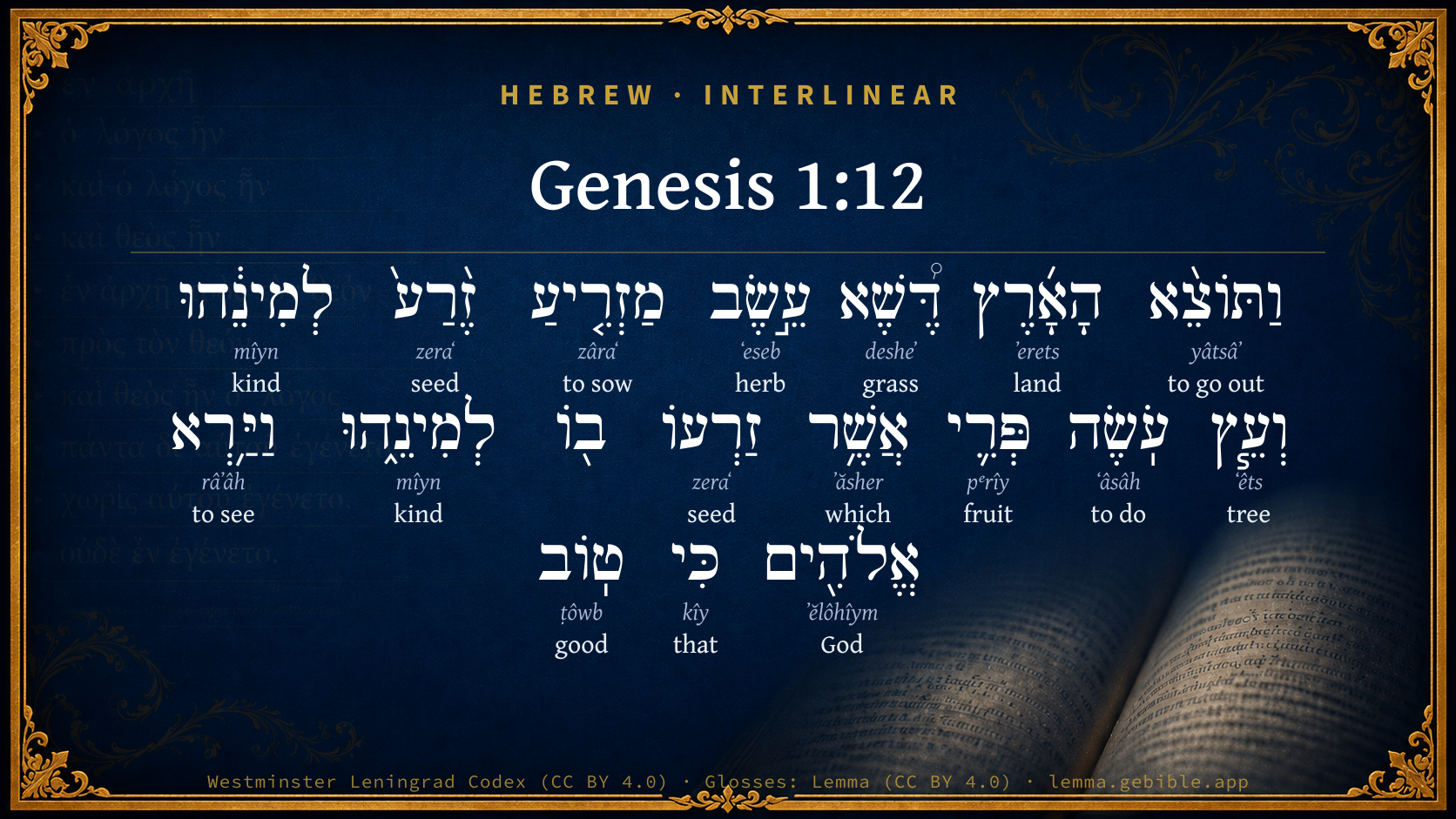
  1. וַתּוֹצֵ֨א yâtsâʼ H3318 “and · to go out” Conjunction + Verb, Hiphil, Sequential Imperfect, 3rd Person, Feminine, Singular
  2. הָאָ֜רֶץ ʼerets H776 “the · land” Particle, Definite Article + Noun, Common, Both, Singular, Absolute
  3. עֵ֣שֶׂב ʻeseb H6212 “herb” Noun, Common, Masculine, Singular, Absolute
  4. מַזְרִ֤יעַ zâraʻ H2232 “sowing” Verb, Hiphil, Participle Active, Masculine, Singular, Absolute
  5. זֶ֨רַע֙ zeraʻ H2233 “seed” Noun, Common, Masculine, Singular, Absolute
  6. לְמִינֵ֔הוּ mîyn H4327 “to/for · kind · his” Preposition + Noun, Common, Masculine, Singular, Construct + Suffix, Personal, 3rd Person, Masculine, Singular
  7. וְעֵ֧ץ ʻêts H6086 “and · tree” Conjunction + Noun, Common, Masculine, Singular, Absolute
  8. עֹֽשֶׂה ʻâsâh H6213 “doing” Verb, Qal, Participle Active, Masculine, Singular, Absolute
  9. פְּרִ֛י pᵉrîy H6529 “fruit” Noun, Common, Masculine, Singular, Absolute
  10. אֲשֶׁ֥ר ʼăsher H834 “which” Particle, Relative
  11. זַרְעוֹ zeraʻ H2233 “seed · his” Noun, Common, Masculine, Singular, Construct + Suffix, Personal, 3rd Person, Masculine, Singular
  12. לְמִינֵ֑הוּ mîyn H4327 “to/for · kind · his” Preposition + Noun, Common, Masculine, Singular, Construct + Suffix, Personal, 3rd Person, Masculine, Singular
  13. וַיַּ֥רְא râʼâh H7200 “and · to see” Conjunction + Verb, Qal, Sequential Imperfect, 3rd Person, Masculine, Singular
  14. אֱלֹהִ֖ים ʼĕlôhîym H430 “God(s)” Noun, Common, Masculine, Plural, Absolute
  15. כִּי kîy H3588 “that” Conjunction
  16. טֽוֹב ṭôwb H2896 “good” Adjective, Adjective, Masculine, Singular, Absolute

About this verse

These counts appear in no published source. They are computed here, from the morphology-tagged text and Lemma’s own curated glosses. What Lemma adds →

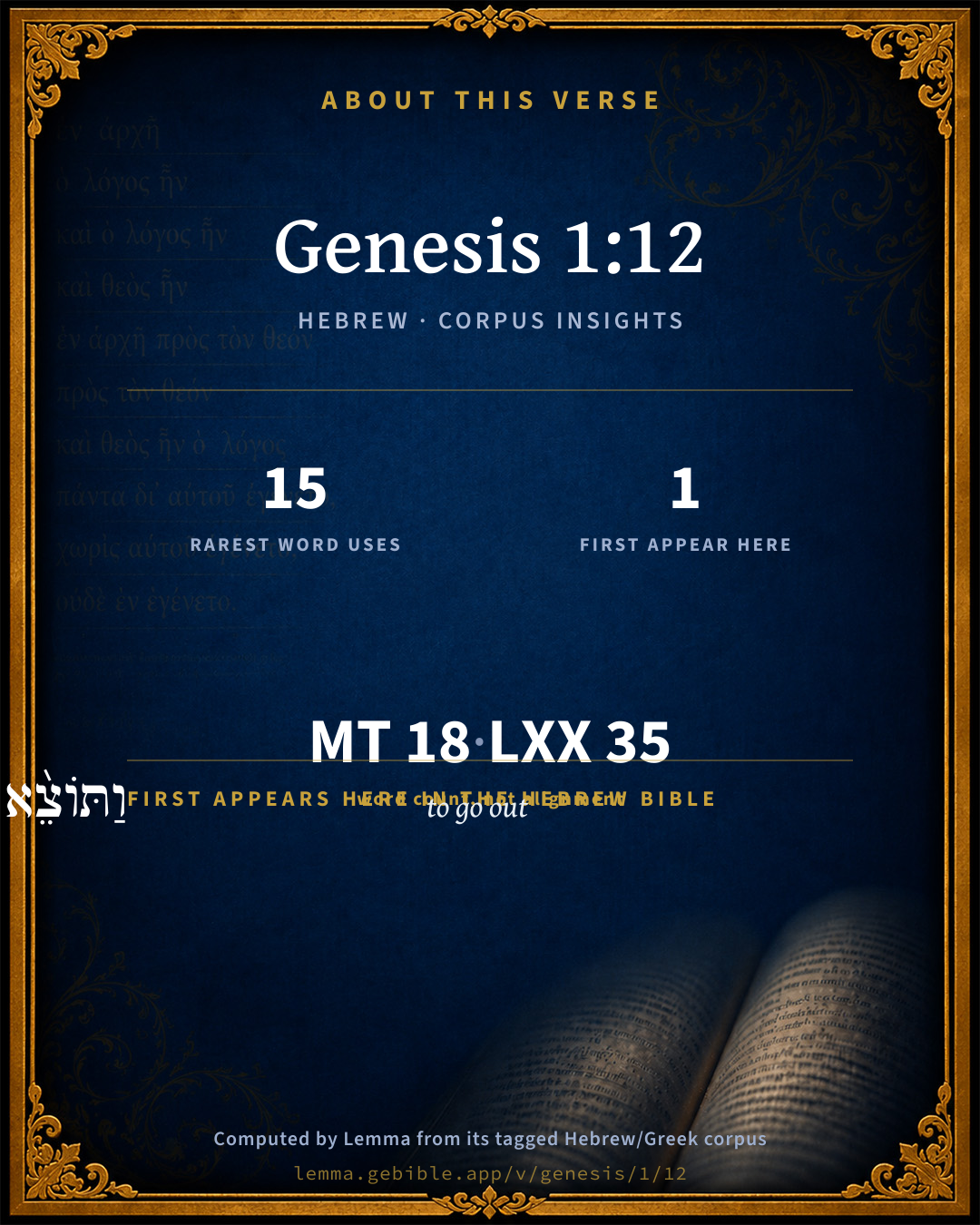
18
words
15
distinct lemmas
Pentateuch
section

Notable vocabulary

The rarest word here is דֶּ֠שֶׁא grass H1877 — appearing just 15 times in the whole Hebrew Bible.

First appearance in Scripture

This word makes its first canonical appearance in the Hebrew Bible here:

  • וַתּוֹצֵ֨א to go out H3318

Shared distinctive vocabulary

דֶּ֠שֶׁא grass H1877 occurs in 15 verses of the Hebrew Bible. Also found in:

Grammatical profile

  • 4 verbs
  • 10 nouns
  • 1 adjective
  • 1 preposition
  • 1 conjunction
  • 1 particle

Verb forms

  • וַתּוֹצֵ֨א Hiphil · Sequential Imperfect
  • מַזְרִ֤יעַ Hiphil · Participle Active
  • עֹֽשֶׂה Qal · Participle Active
  • וַיַּ֥רְא Qal · Sequential Imperfect

Repetition

Words recur within this verse — often emphatic in Hebrew:

  • זֶ֨רַע֙ seed H2233 ×2
  • לְמִינֵ֔הוּ kind H4327 ×2

Hebrew & Septuagint length

In English translation the verse runs 30 words from the Hebrew and 45 from the Septuagint (LXX English) — the Septuagint runs noticeably longer here. See the side-by-side →

A rough comparison of the two English renderings, which tokenize alike — not a word-level alignment.

Word counts can differ between the Hebrew and the Greek without any difference in meaning — e.g. the Hebrew direct-object marker אֵת has no separate Greek word, and Greek often adds the article ὁ.

In the original languages it is 18 Hebrew tokens and 35 Greek tokens — but the two are counted differently (Hebrew bundles its prefixes and suffixes into one token; the Greek is in lemma form), so that isn’t a like-for-like length.

Cross-references

7

Topical passages linked to Genesis 1:12 in the Treasury of Scripture Knowledge — connected by theme and wording, ordered by reader-vote popularity; previews shown in the World English Bible.

  • Mark 4:28 For the earth bears fruit: first the blade, then the ear, then the full grain in the ear.
  • Isaiah 55:10–11 For as the rain comes down and the snow from the sky, and doesn't return there, but waters the earth, and makes it bring forth and bud, and gives seed to the sower and bread to the eater;
  • Matthew 13:24–26 He set another parable before them, saying, "The Kingdom of Heaven is like a man who sowed good seed in his field,
  • Luke 6:44 For each tree is known by its own fruit. For people don't gather figs from thorns, nor do they gather grapes from a bramble bush.
  • Galatians 6:7 Don't be deceived. God is not mocked, for whatever a man sows, that will he also reap.
  • Isaiah 61:11 For as the earth brings forth its bud, and as the garden causes the things that are sown in it to spring forth; so the Lord Yahweh will cause righteousness and praise to spring forth before all the nations.
  • 2 Corinthians 9:10 Now may he who supplies seed to the sower and bread for food, supply and multiply your seed for sowing, and increase the fruits of your righteousness;

Cross-references courtesy of OpenBible.info (CC BY 4.0).

Hebrew and Greek witnesses Masoretic Hebrew ↔ Greek Septuagint

The same verse in the two great witnesses to the Old Testament, shown verse-for-verse.

Here the Septuagint runs noticeably longer than the Hebrew — LXX2012 (modern English Septuagint) 45 words vs World English Bible 30. A rough length comparison of the two English translations, not a word-level alignment — read both below.

These are two independent witnesses, not word-aligned to each other, and the Septuagint is shown in lemma (dictionary) form.

Hebrew Genesis 1:12 Masoretic · Westminster Leningrad Codex

וַתּוֹצֵ֨א הָאָ֜רֶץ דֶּ֠שֶׁא עֵ֣שֶׂב מַזְרִ֤יעַ זֶ֨רַע֙ לְמִינֵ֔הוּ וְעֵ֧ץ עֹֽשֶׂה פְּרִ֛י אֲשֶׁ֥ר זַרְעוֹ ב֖וֹ לְמִינֵ֑הוּ וַיַּ֥רְא אֱלֹהִ֖ים כִּי טֽוֹב

The earth brought forth grass, herbs yielding seed after their kind, and trees bearing fruit, with its seed in it, after their kind: and God saw that it was good.

World English Bible · Public Domain

Greek LXX Genesis 1:12 Septuagint · lemma form

καί ἐκφέρω ὁ γῆ βοτάνη χόρτος σπείρω σπέρμα κατά γένος καί κατά ὁμοιότης καί ξύλον κάρπιμος ποιέω καρπός ὅς ὁ σπέρμα αὐτός ἐν αὐτός κατά γένος ἐπί ὁ γῆ καί ὁράω ὁ θεός ὅτι καλός

And the earth brought forth the herb of grass bearing seed according to its kind and according to its likeness, and the fruit tree bearing fruit whose seed is in it, according to its kind on the earth, and God saw that it was good.

LXX2012 (modern English Septuagint) · Public Domain

Hebrew: Westminster Leningrad Codex (CC BY 4.0). Greek: Septuagint (public domain); English from LXX2012 (modern English Septuagint) (Public Domain). How the Septuagint differs from the Hebrew →

Targum (Aramaic paraphrase)

2

The Targum is the ancient Jewish Aramaic paraphrase of the Hebrew Scriptures — an interpretive translation, not the Hebrew text itself. Onkelos (literal) and Pseudo-Jonathan (expansive) render the Torah, and Jonathan the Prophets. Coverage is partial: where no permissively-licensed English translation exists for a verse, only the Aramaic is shown. This is verse-level text, not a word-by-word alignment to the Hebrew.

  1. Targum Onkelos Torah (Genesis–Deuteronomy)
    וְאַפֵּקַת אַרְעָא דִּיתְאָה עִסְבָּא דְּבַר זַרְעֵהּ מִזְדְּרַע לִזְנוֹהִי וְאִילַן עָבֵד פֵּירִין דְּבַר זַרְעֵהּ בֵּהּ לִזְנוֹהִי וַחֲזָא יְיָ אֲרֵי טָב

    (no public-domain English translation for this verse)

    Targum Onkelos — Aramaic: “Onkelos Genesis” (public domain); “Onkelos Exodus” (public domain); “Onkelos Leviticus” (public domain); “Onkelos Numbers” (public domain); “Onkelos Deuteronomy” (public domain). English: “Sefaria Community Translation” (CC0 1.0 (public-domain dedication)); “J.W. Etheridge. The Targums of Onkelos and Jonathan Ben Uzziel on the Pentateuch. London: Longmans, Green, 1862” (public domain). Text via Sefaria.

  2. Targum Pseudo-Jonathan Torah (Genesis–Deuteronomy)
    וְהַנְפָקַת אַרְעָא דִיתְאִין עִיסְבָא דְבִזְרֵיהּ מִזְדְרַע וְאִילָן עַבִיד פֵּירֵי לִזְנֵיהּ וַחֲמָא יְיָ אֲרוּם טָב

    And the earth produced grasses (and) herbage whose seed seedeth, and the tree making fruit after its kind. And the Lord saw that it was good.

    Targum Pseudo-Jonathan — Aramaic: “Targum Jonathan on Genesis” (public domain); “Targum Jonathan on Exodus” (public domain); “Targum Jonathan on Leviticus” (public domain); “Targum Jonathan on Numbers” (public domain); “Targum Jonathan on Deuteronomy” (public domain). English: “The Targum of Jonathan ben Uzziel, trans. J. W. Etheridge, London, 1862” (public domain). Text via Sefaria.

Commentary

Notes on Genesis 1:12 from classic Christian and Jewish commentators (each source and its license shown beneath its notes). The classic Christian expositions comment on the surrounding passage and are grouped to its opening verse, so a note may address several verses; the Jewish commentaries on the Tanakh (Rashi and others) are per-verse, so they appear only where the commentator wrote on this verse.

Lemma curates 59 commentaries, every one of them public domain or Creative Commons licensed, each selected and text-cleaned for this edition rather than reprinted as found. About our sources →

Trapp's Complete Commentary

John Trapp

Gen 1:12 And the earth brought forth grass, [and] herb yielding seed after his kind, and the tree yielding fruit, whose seed [was] in itself, after his kind: and God saw that [it was] good.

Ver. 12. And the earth brought forth, &c.] Augustine {a} thinks that thorns and thistles, brambles and briers were before the fall, though not in the same abundance as now. Basil thinks otherwise, and that till sin came in, the rose was without prickles. It is likely there were such shrubs at first created, {non ut loederent hominem non peccantem, sed peccaturum,} saith Pareus. Now since the fall, all creatures are armed against man: as that sword which Hector gave Ajax, which, so long as he used against men, his enemies, served for help and defence; but after he began to abuse it to the hurt of haemless beasts, it turned into his own bowels.

Yielding fruit after his kind.] So that men do not "gather grapes of thorns, or figs of thistles". {Luk 6:44} "Can a fig tree," saith James, "bear olive berries? or a vine, figs?"; {Jas 3:12} that were monstrous. And should not every man in like manner bear his own fruit, proper to his kind, to his calling? do his own work? weed his own gardens. "walk within his own house with a perfect heart," {Psa 101:2} till God come unto him? Come he will, and look for fruit in its season. When he comes, he will turn up your leaves; and look that, like the tree of life, {Rev 22:21} we bear fruit every month: or that we be like the lemon tree, which ever and anon sendeth forth new lemons as soon as the former are fallen down with ripeness; or the Egyptian fig tree, which, saith Solinus, {b} beareth fruit seven times a year; pull off a fig, and another breaks forth in the place shortly after. Now if we be found like the barren fig tree, {Luk 13:6-9} that had leaves only; or the cypress tree, which is said to be fair and tall, but altogether fruitless; or the cyparittree, of which Pliny {c} affirms, that it is always fruitless; {natu morosa, fructu supervacanea, baccis parva, foliis amara, odore violenta, ac ne umbra quidem gratiosa} what can we expect, but that he should set down his basket, and taking up his axe, hew us down as fuel for the fire of hell? Spain is said to have nothing barren in it, or not some way useful; {d} and why should Christ’s orchard, the Church? He pares and prunes {αιρει χαηαιρει, Joh 15:2} his leaves and luxuriancies; yea, cuts and slashes where need requires; and all that we may bear more fruit. Sincerity alone will not comfort a man, unless it grow up to fruitfulness; which, springing from the exercise of grace, hath a sweet reflection on the soul, as in sick Hezekiah; {Isa 38:3} and sweetly seals up our "calling to glory and virtue," {2Pe 1:3} as the budding of Aaron’s rod did his calling to the priesthood: whereupon one well observeth, that not only all the plants of God’s setting, but the very boughs cut off from the body of them will flourish. Here some demand, Were the trees so created at first, that if sin had never entered, they had ever flourished, laden with fruit? Answer is made by a worthy divine, {e} that the allusion {Rev 22:2} seems to intimate some such matter. And perhaps Christ would else never have cursed the fruitless fig tree, since the time of figs was not yet come. {Mar 11:13}

{a} Augustine, De Gen. ad Literam, l. iii. c. 18.

{b} Unde pomum decerpseris, alterum sine mora protuberat - Sol. in Polyhist., c. 45.

{c} Pliny, l. x.

{d} In Hispania nihil ignavum, nihil sterile. - Solin

{e} Brightm. On Rev.

John Trapp, A Commentary or Exposition upon All the Books of the Old and New Testament (1647–1656) — public domain. Text from a community e-Sword module.

Geneva Bible (1599)

Geneva Bible translators

This sentence is so oft repeated, to signify that God made all his creatures to serve to his glory, and to the profit of man: but for sin they were accursed, yet to the elect, by Christ they are restored, and serve to their wealth.

Geneva Bible (1599) marginal notes — public domain. Text via Bolls.life.

Adam Clarke's Commentary

Verse 12. Whose seed was in itself] Which has the power of multiplying itself by seeds, slips, roots, c., ad infinitum which contains in itself all the rudiments of the future plant through its endless generations. This doctrine has been abundantly confirmed by the most accurate observations of the best modern philosophers. The astonishing power with which God has endued the vegetable creation to multiply its different species, may be instanced in the seed of the elm. This tree produces one thousand five hundred and eighty-four millions of seeds; and each of these seeds has the power of producing the same number. How astonishing is this produce! At first one seed is deposited in the earth; from this one a tree springs, which in the course of its vegetative life produces one thousand five hundred and eighty-four millions of seeds. This is the first generation. The second generation will amount to two trillions, five hundred and nine thousand and fifty-six billions. The third generation will amount to three thousand nine hundred and seventy-four quadrillions, three hundred and forty-four thousand seven hundred and four trillions! And the fourth generation from these would amount to six sextillions two hundred and ninety-five thousand three hundred and sixty-two quintillions, eleven thousand one hundred and thirty-six quadrillions! Sums too immense for the human mind to conceive; and, when we allow the most confined space in which a tree can grow, it appears that the seeds of the third generation from one elm would be many myriads of times more than sufficient to stock the whole superfices of all the planets in the solar system! But plants multiply themselves by slips as well as by seeds. Sir Kenelm Digby saw in 1660 a plant of barley, in the possession of the fathers of the Christian doctrine at Paris, which contained 249 stalks springing from one root or grain, and in which he counted upwards of 18,000 grains. See my experiments on Tilling in the Methodist Magazine.

Adam Clarke's Commentary on the Bible (1810–1826) — public domain. Text from a community e-Sword/MySword module.

John Gill's Exposition

And the earth brought forth grass,.... In great abundance at once; the hills and vales were clothed with it, and so a rich provision was made the beasts and cattle of the earth two or three days before they were created:

and herb yielding seed after his kind, and the tree yielding fruit, whose seed was in itself after his kind: wholesome and healthful herbs and plants, and delicious fruit to be meat and food for man, ready prepared for him when created; see Gen 1:29 on this day, though after related, were made the garden of Eden, and all the trees in it, pleasant for sight, and good for food; and particularly the tree of life, and the tree of knowledge of good and evil,

and God saw that it was good; which he had now caused to spring forth, grass, herbs, and fruit trees, which were good for men and beast, and this he foresaw would be so; See Gill on Gen 1:4.

John Gill's Exposition of the Whole Bible (1746–1763) — public domain (CC PDM 1.0). Text via the HelloAO Bible API.

Matthew Poole's English Annotations

This clause is so often added, to show that all the disorders, evil and hurtful qualities, that now are in the creatures, are not to be imputed to God, who made all of them good; but to man’s sin, which hath corrupted their nature, and perverted their use.

Matthew Poole's English Annotations on the Holy Bible (1683–1685) — public domain. Text from a community e-Sword/MySword module.

The Pulpit Commentary

And the earth brought forth grass, and herb yielding seed after his kind, and the tree yielding fruit, whose seed was in itself, after his kind. It is noticeable that the vegetation of the third day sprang from the soil in the same natural manner in which all subsequent vegetation has done, viz., by growth, which seems to resolve the well-known problem of whether the tree was before the seed, or the seed before the tree, in favor of the latter alternative, although in the order of nature the parent is always before the offspring. In all probability the seed forms were in the soil from the first, only waiting to be vitalized by the Ruach Elohim The Spirit of God; or they may have been then created. Certainly they were not evolved from the dead matter of the dry land. Scripture, no more than science, is acquainted with Abiogenesis. Believing that "if it were given to her to- look beyond the abyss of geologically recorded time, she might "witness the evolution of living protoplasm from not living matter," science yet honestly affirms "that she sees no reason for believing that the feat (of vitalizing dead matter) has been performed yet" (Huxley"s "Brit. Association Address, 1871); and Scripture is emphatic that, if it is protoplasm which makes organized beings, the power which manufactures protoplasm is the Ruach Elohim, acting in obedience to the Divine Logos. The time when the earth put forth its verdure, viz., towards the close of the third day, after light, air, earth, and water had been prepared and so adjusted as to minister to the life of plants, was a signal proof of the wisdom of the Creator and of the naturalness of his working.

The Pulpit Commentary (1880–1919), ed. H.D.M. Spence-Jones & Joseph S. Exell — public domain. Text from a community e-Sword module.

Rashi

Rabbi Shlomo Yitzchaki (Rashi)

ותוצא הארץ וגו AND THE EARTH BROUGHT FORTH etc. — Although the expression למינהו according to its kind, was not used when the various kinds of herbage were bidden to come forth, they heard that the trees were so commanded and they applied to themselves the argument à fortiore (ק"ו), as it is explained in an Aggadic passage in (Chullin 60a).

Rashi on the Tanakh — English translations: “The Judaica Press complete Tanach with Rashi, translated by A. J. Rosenberg” (CC BY 4.0); “Pentateuch with Rashi's commentary by M. Rosenbaum and A.M. Silbermann, 1929-1934” (public domain); “The Metsudah Tanach series, Lakewood, N.J” (CC BY 4.0); and “The Book of Joshua, Metsudah Publications, 1997” (CC BY 4.0). Text via Sefaria.

Ramban (Nachmanides)

Rabbi Moshe ben Nachman (Ramban / Nachmanides)

AND G-D SAW THAT IT WAS GOOD. This affirms the existence of the various kinds forever.There was no special day assigned for this command for vegetation alone, since it is not a unique work. The earth, whether it brings forth anything or is salt land, is one.

Ramban (Nachmanides) on the Tanakh — English translation: “Commentary on the Torah by Ramban (Nachmanides). Translated and annotated by Charles B. Chavel. New York, Shilo Pub. House, 1971-1976” (CC BY 4.0). Text via Sefaria.

Radak

Rabbi David Kimhi (Radak)

ותוצא הארץ, had the Torah written [in verbatim response to G’d’s directive]ותדשא הארץ, I would not have known that it was only one, as we explained on verse 11. The Torah wanted to make sure that we did not get the impression that the earth suddenly proliferated with a carpet of herbs. The remarkable thing was that although the earth produced only a single herb, ויהי כן, it endured, i.e. survived until it had many others added after the sun had become strong on the fourth day. Alternatively, the meaning of this formulation is that from this moment on the earth always produced all these kinds of plants in their unadulterated form, each true to its species. There never was an occasion when nature suddenly produced a tree combining the properties of two different species. This only happened when man deliberately introduced an additional species through grafting it onto a tree. This is the reason why G’d commanded man not to crossbreed plants or animals. Both Adam and Noach were commanded this as our sages (Sanhedrin 60) state in conjunction with the verseאת חקותי תשמרו בהמתך לא ים, שדך לא תזרע כלאים, “do not crossbreed animals, nor seed your field with a mixture of more than one seed (trees).” (Leviticus 19,19). This referred to statutes G’d had already promulgated prior to the revelation at Mount Sinai. Concerning the mixing of seeds of herbs, no such prohibition exists for gentiles. Concerning the uprooting of such hybrids gentiles are not commanded to do this, and even Israelites are only obliged to do this in the Land of Israel. The entire subject revolves around deliberately upsetting the way in which G’d created His universe.[in the Sefer Hachinuch the applicability of part of this legislation to gentiles is described as מפי הקבלה, “based on tradition.” Ed.] This is also why a scholar questioned what the halachah is according to Rabbi Chanina bar Pappa who had quoted the herbs arriving at the conclusion that they must maintain the purity of their species although the Torah had not written anything about למינו in connection with the herbs. The scholar wanted to know what the situation would be if someone had deliberately crossbred two species of herbs. According to the opinion of Ravina one could not hold such a person culpable for such an innovation. Alternatively, the question it that seeing that the herbs had voluntarily taken it upon themselves to maintain the same standards as did the trees and plants which carried their seed in them, would anyone violating that standard be held responsible for violating a law of nature which G’d had approved even though it was instigated by nature itself? The question was left open.

וירא אלוקים כי טוב, even though there are herbs which generate heat, they too are included in what is described here as “good,” seeing that they have therapeutic value and by being applied as bandages to injuries serve to cure such injuries.

Radak on the Tanakh — English translations: “Sefaria Community Translation” (CC0 1.0 (public-domain dedication)); “Eliyahu Munk, HaChut Hameshulash” (CC BY 4.0); “Rabbi Mike Feuer, Jerusalem Anthology” (CC BY 4.0); and “R. David Kimhi on the first book of Psalms, Translated by R.G. Finch, London, 1919” (public domain). Text via Sefaria.

Lesson kit

Teaching starters — assembled from the data on this page, not authored interpretation. Every prompt links to the verse data it draws on. Edit before teaching.

Genesis, in the Pentateuch, opens this verse with 18 words (15 distinct Hebrew lemmas). Its most distinctive word is desheʼ (“grass”). The Greek Septuagint runs longer here. A historical commentator’s framing appears above. Read the whole chapter for the surrounding context.

Discussion questions

  1. The word desheʼ carries the sense “grass.” How does it shape the verse?
  2. The word “to go out” first appears here in Scripture. What is being introduced at this debut?
  3. Genesis 1:11 shares the word «grass» with this verse. How do the two illuminate each other?
  4. “seed” occurs 2× in this one verse. What is the effect of the repetition?
  5. Compared with the Hebrew, the Septuagint runs longer here. What questions does that raise?
  6. These translations render this verse differently; the difference is in the English rendering, not the original. What questions does that raise?
  7. The verb «וַתּוֹצֵ֨א» is Hiphil Sequential Imperfect. How does its form color the action?
  8. Reading how Trapp's Complete Commentary and Geneva Bible (1599) read this verse, where do the two commentators agree and where do they part?

Things to notice

Reading settings

Reading text

Shown beneath each verse's original-language words.

Old Testament
Old Testament edition

Read the OT as the Masoretic Hebrew (MT) or the Greek Septuagint (LXX).

English shown for the Greek Septuagint (in the Hebrew ↔ Greek comparison).

Comparing translations? Open the Compare panel on any verse page to stack up to four side by side.