
John 4:25

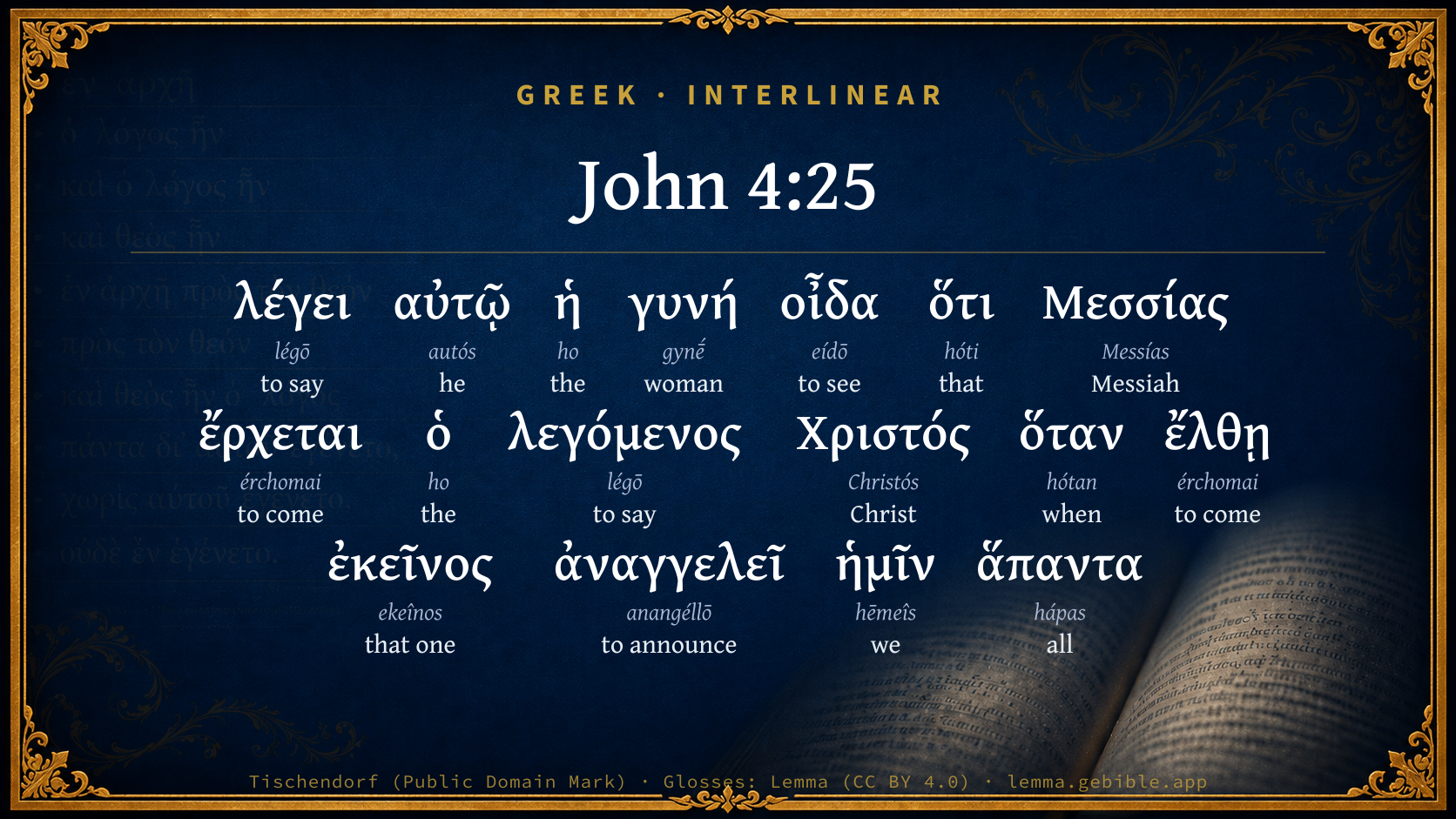
Greek (Tischendorf 8th ed.) John 4:25 appears in the Greek New Testament. The text above is from the Tischendorf 8th edition. Each word links to its Strong’s number and a concise gloss. Click any word for its full Thayer’s Greek Lexicon entry.
Download image
Cite this verse

John 4:25 (World English Bible). Public Domain. Lemma interlinear Bible study tool, https://lemma.gebible.app/v/john/4/25.

Show BibTeX & RIS
BibTeX
RIS
English Translation
The woman said to him, "I know that Messiah comes," (he who is called Christ). "When he has come, he will declare to us all things."
World English Bible · Public Domain
Highlights
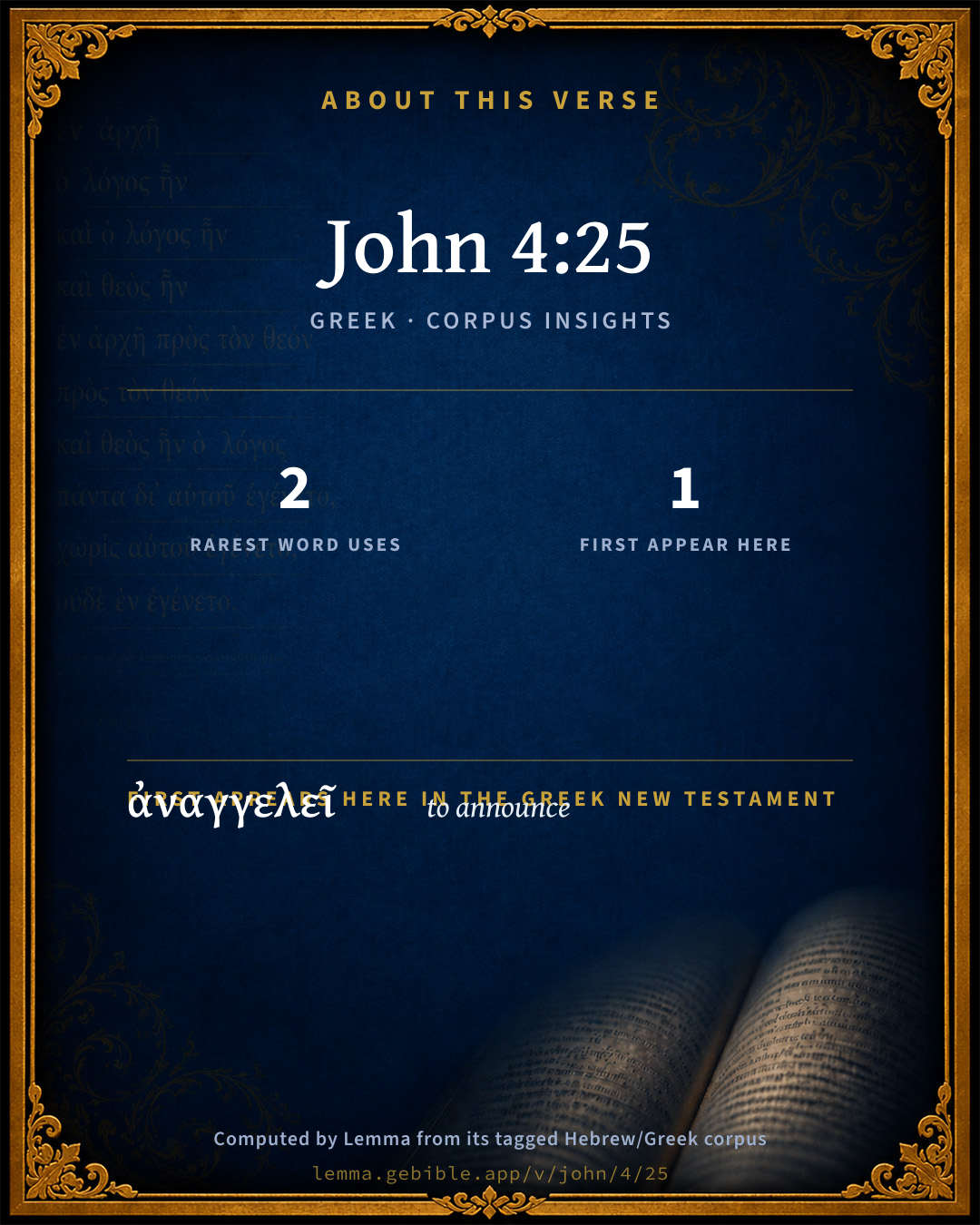
  • 1 first appearance in the Greek New Testament
Full analysis ↓
Download a study sheet

One document with this verse’s original text, its word-by-word gloss line, the meaning frame, cross-references with their text, attributed commentary, and full source and license credits — printable, and it pastes into notes with its structure intact.

This verse Autodidact and up

Study sheet (.html) Plain text (.txt)

A passage Seminary Student

Up to 50 verses in one chapter. A passage sheet keeps up to 6 commentary sources and 12 cross-references per verse, in the order this page ranks them, and says so on the sheet whenever that leaves anything out. Ask for a single verse and you get the Autodidact verse sheet above.

Everything on this page stays free to read, with no account — the sheet is a download of what is already on screen, not access to it.

Want to remove ads? Support Godless Engineer
Compare translations 3

The same verse in 3 English versions, stacked beneath the original-language interlinear above. Click any original word for its lexicon entry.

Each is an independent rendering of the whole verse — the interlinear is not word-aligned to these translations.

Highlighted words mark where these versions differ — a whole-verse word diff, not a word-by-word alignment.

  • World English Bible Public Domain
    The woman said to him, "I know that Messiah comes," (he who is called Christ). "When he has come, he will declare to us all things."
  • King James Version Public Domain
    The woman saith unto him, I know that Messias cometh, which is called Christ: when he is come, he will tell us all things.
  • unfoldingWord Literal Text CC BY-SA 4.0
    The woman says to him, “I know that Messiah is coming (the one called Christ). When he comes, that one will declare everything to us.”

unfoldingWord Literal Text — © unfoldingWord, licensed CC BY-SA 4.0. Word-aligned USFM3 via Door43 (git.door43.org/unfoldingWord/en_ult).

Versions to compare (up to 4)

3 of 4 selected

Show all 19 translations

Every available English version of this verse, each an independent rendering of the whole verse.

  • World English Bible Public Domain
    The woman said to him, "I know that Messiah comes," (he who is called Christ). "When he has come, he will declare to us all things."
  • Berean Standard Bible Public Domain
    The woman said, “I know that Messiah” (called Christ) “is coming. When He comes, He will explain everything to us.”
  • Majority Standard Bible Public Domain
    The woman said, “I know that Messiah” (called Christ) “is coming. When He comes, He will explain everything to us.”
  • King James Version Public Domain
    The woman saith unto him, I know that Messias cometh, which is called Christ: when he is come, he will tell us all things.
  • American Standard Version (1901) Public Domain
    The woman saith unto him, I know that Messiah cometh (he that is called Christ): when he is come, he will declare unto us all things.
  • Revised Version (1885) Public Domain
    The woman saith unto him, I know that Messiah cometh (which is called Christ): when he is come, he will declare unto us all things.
  • Geneva Bible (1599) Public Domain
    The woman said vnto him, I knowe well that Messias shall come which is called Christ: when he is come, he will tell vs all things.
  • Douay-Rheims (1899) Public Domain
    The woman saith to him: I know that the Messias cometh (who is called Christ); therefore, when he is come, he will tell us all things.
  • Young's Literal Translation Public Domain
    The woman saith to him, `I have known that Messiah doth come, who is called Christ, when that one may come, he will tell us all things;'
  • Literal Standard Version CC BY-SA 4.0
    The woman says to Him, “I have known that Messiah comes, who is called Christ, when that One may come, He will tell us all things”;
  • Unlocked Literal Bible CC BY-SA 4.0
    The woman said to him, “I know that the Messiah is coming (the one called Christ). When he comes, he will explain everything to us.”
  • unfoldingWord Literal Text CC BY-SA 4.0
    The woman says to him, “I know that Messiah is coming (the one called Christ). When he comes, that one will declare everything to us.”
  • Darby Bible Public Domain
    The woman says to him, I know that Messias is coming, who is called Christ; when *he* comes he will tell us all things.
  • World Messianic Bible Public Domain
    The woman said to him, “I know that Messiah is coming, he who is called Messiah. When he has come, he will declare to us all things.”
  • Webster's Bible Public Domain
    The woman saith to him, I know that Messiah cometh, who is called Christ; when he is come, he will tell us all things.
  • Free Bible Version CC BY-SA 4.0
    The woman said, “Well, I know that the Messiah is coming,” (the one who is called Christ). “When he comes he will explain it all to us.”
  • Bible in Basic English Public Domain
    The woman said to him, I am certain that the Messiah, who is named Christ, is coming; when he comes he will make all things clear to us.
  • Text-Critical English NT CC BY 4.0
    The woman said to him, “I know that Messiah is coming” (who is called Christ). “When he comes, he will explain everything to us.”
  • Tyndale New Testament (1534) Public Domain
    The woman sayde vnto him: I wot well Messias shall come which is called Christ. When he is come he will tell vs all thinges.

Literal Standard Version (2020), Covenant Press — licensed CC BY-SA 4.0. Text via the HelloAO Bible API (eBible.org). Unlocked Literal Bible (unfoldingWord) — licensed CC BY-SA 4.0. Text via the HelloAO Bible API (eBible.org). unfoldingWord Literal Text — © unfoldingWord, licensed CC BY-SA 4.0. Word-aligned USFM3 via Door43 (git.door43.org/unfoldingWord/en_ult). Free Bible Version, Dr. Jonathan Gallagher — licensed CC BY-SA 4.0. Text via the HelloAO Bible API (eBible.org).

Word by word

More ways to search: Search by grammar → Find every occurrence → Compare this word →

Practice this passage: Drill this verse → Learn its vocabulary →

Μεσσίας
Messías
G3323
“Messiah”
Noun, Nominative, Singular, Masculine
Part of Speech
Noun
Case
Nominative
Number
Singular
Gender
Masculine
Full Thayer's Definition

Origin: of hebrew origin H4899 see G5547 christos

TDNT: 9:493, 1322

Messias = "anointed" 1. the Greek form of Messiah 2. a name of Christ
  1. λέγει légō G3004 “to say” Verb, Present, Active, Indicative, 3rd person, Singular
  2. αὐτῷ autós G846 “he” Personal pronoun, Dative, Singular, Masculine
  3. ἡ ho G3588 “the” Article, Nominative, Singular, Feminine
  4. γυνή gynḗ G1135 “woman” Noun, Nominative, Singular, Feminine
  5. οἶδα eídō G1492 “to see” Verb, Perfect, Active, Indicative, 1st person, Singular
  6. ὅτι hóti G3754 “that” Conjunction
  7. ἔρχεται érchomai G2064 “to come” Verb, Present, Middle or Passive deponent, Indicative, 3rd person, Singular
  8. ὁ ho G3588 “the” Article, Nominative, Singular, Masculine
  9. λεγόμενος légō G3004 “to say” Verb, Present, Passive, Participle, Nominative, Singular, Masculine
  10. Χριστός Christós G5547 “Christ” Noun, Nominative, Singular, Masculine
  11. ὅταν hótan G3752 “when” Conjunction
  12. ἔλθῃ érchomai G2064 “to come” Verb, Aorist, Active, Subjunctive, 3rd person, Singular
  13. ἐκεῖνος ekeînos G1565 “that one” Demonstrative pronoun, Nominative, Singular, Masculine
  14. ἀναγγελεῖ anangéllō G312 “to announce” Verb, Future, Active, Indicative, 3rd person, Singular
  15. ἡμῖν hēmeîs G2249 “we” Personal pronoun, 1st person, Dative, Plural
  16. ἅπαντα hápas G537 “all” Adjective, Accusative, Plural, Neuter

About this verse

These counts appear in no published source. They are computed here, from the morphology-tagged text and Lemma’s own curated glosses. What Lemma adds →

17
words
14
distinct lemmas
Gospels
section

Notable vocabulary

The rarest word here is Μεσσίας Messiah G3323 — appearing just 2 times in the whole Greek New Testament.

First appearance in Scripture

This word makes its first canonical appearance in the Greek New Testament here:

  • ἀναγγελεῖ to announce G312

Shared distinctive vocabulary

Μεσσίας Messiah G3323 occurs in 2 verses of the Greek New Testament. Also found in:
Repetition

Words recur within this verse:

  • λέγει to say G3004 ×2
  • ἔρχεται to come G2064 ×2
  • ἡ the G3588 ×2

Cross-references

7

Topical passages linked to John 4:25 in the Treasury of Scripture Knowledge — connected by theme and wording, ordered by reader-vote popularity; previews shown in the World English Bible.

  • John 1:49 Nathanael answered him, "Rabbi, you are the Son of God! You are King of Israel!"
  • Daniel 9:24–26 Seventy weeks are decreed on your people and on your holy city, to finish disobedience, and to make an end of sins, and to make reconciliation for iniquity, and to bring in everlasting righteousness, and to seal up vision and prophecy, and to anoint the most holy.
  • Matthew 1:16 Jacob became the father of Joseph, the husband of Mary, from whom was born Jesus, who is called Christ.
  • John 1:41–42 He first found his own brother, Simon, and said to him, "We have found the Messiah!" (which is, being interpreted, Christ).
  • John 4:29 "Come, see a man who told me everything that I did. Can this be the Christ?"
  • John 4:42 They said to the woman, "Now we believe, not because of your speaking; for we have heard for ourselves, and know that this is indeed the Christ, the Savior of the world."
  • Deuteronomy 18:15–18 Yahweh your God will raise up to you a prophet from the midst of you, of your brothers, like me; to him you shall listen;

Cross-references courtesy of OpenBible.info (CC BY 4.0).

Commentary

Notes on John 4:25 from classic Christian and Jewish commentators (each source and its license shown beneath its notes). The classic Christian expositions comment on the surrounding passage and are grouped to its opening verse, so a note may address several verses; the Jewish commentaries on the Tanakh (Rashi and others) are per-verse, so they appear only where the commentator wrote on this verse.

Lemma curates 59 commentaries, every one of them public domain or Creative Commons licensed, each selected and text-cleaned for this edition rather than reprinted as found. About our sources →

The Biblical Illustrator

Joseph S. Exell

Joh_4:25-26

I know that Messias cometh … I… am He

Second evasion and reply

The stricken deer tries once more to wrench the arrow from the wound; the wanderer thus caught amid the entangling thorns makes yet one other effort to escape the pursuing shepherd; the bold transgressor, unable to discuss these high spiritual themes, tries to stifle her convictions by the new plea of procrastination, wishing to break off the conversation in the spirit of conscious-stricken Felix.

I. POSTPONING THE QUESTION OF SALVATION TO AN INDEFINITE CONVENIENT SEASON, THE CRY OF THE CONVICTED SOUL IS GIVE ME THIS WATER!--BUT NOT YET.

1. Give me this water! is the cry of youth--but not yet. Disturb not my bright sunny morning; wait till I reach the threshold of manhood.

2. Give me this water! is the cry of ripening manhood--but not yet. Disturb me not in the burden and heat of the day; wait till I have leisure and breathing-time; wait till the eventide sets in, and the shadows are lengthening, and the drawers of water stand with their pitchers around lifes fountains.

3. Give me this water! is the cry of old age--but not yet. Though far advanced in the pilgrimage journey, my strength is yet firm. I have a long evening ere the sunset hour. I may linger yet a while amid these olive-glades ere the flagon be let down for a draught.

4. Give me this water! is the cry of the dying. But postponement cannot be pled now; procrastination merges into despair. Give me this water! but it is too late.

II. IN HER ATTEMPTS AT EVASION THE WOMAN HAD NOT BEEN ABLE TO SHAKE OFF HER CONVICTIONS THAT SHE STOOD BEFORE A SUPERIOR BEING.

1. She had called Him prophet. The Jews looked for a kingly Messiah, the Samaritans for a prophetic. As she listened to His wondrous disclosures did the thought flash across her mind, Can this be He? The world was then expecting a Divine advent. Besides the prediction of Moses, her own Pentateuch had told her of the prophet who fifteen hundred years before had lifted up his voice on the hills on which she could now gaze. Caravans passing daily Jacobs well must have brought tidings of Johns testimony.

2. The crisis of her life had come. Will the Saviour abandon her to her procrastination and say, as was said of her tribe, Ephraim is joined to his idols, let him alone? or will He disclose His Divine Person? Such a disclosure may be fraught with peril. But the destiny of a human soul depends upon it; He will save others, but not Himself.

III. WHAT A REJOINDER TO HER QUESTION--Art Thou greater than our father Jacob? Yes, I am the Shiloh of whom he spake, the ladder he beheld, the angel with whom he wrestled. The Baptists words have their first echo and fulfilment, He will gather His wheat into the garner. She understands all now--the penetrating revelations, the living water, salvation. The Giver of all stands by her and offers them to her. She requires no miracles.

IV. THE IMMEDIATE SEQUEL IS UNRECORDED. Her feelings are left to our imagination. She may have been dumb with silence or tears. But angels rejoiced over this returning sinner as she starts on an errand of mercy to her native town. Lessons:

1. Christ stands at the door of every heart.

2. None need despair; the first may be last and the last first; for Samaritan as well as Jerusalem sinners may find mercy.

3. Christ speaks in many ways--in the mercies He bestows, in the blessings He withholds; in lifes storms and sunshine.

4. Christ speaks at every season.

(1) Early in the morning to His disciples on the lake shore--to youth in lifes early morning.

(2) At midday as here--in the hot noon of day to manhood and womanhood.

(3) At eventide on the way to Emmaus--in lifes evening to the aged.

(4) At night to Nicodemus--to the dying. (J. R. Macduff, D. D.)

Messias

Messiah

The Hebrew, Messias in the Syriac, and Christ in the Greek, means the Anointed One. Anointing with oil was the ancient form of consecration. Christ was anointed with the Holy Ghost.

I. THE PROOFS OF CHRISTS MESSIAHSHIP.

1. He was generally expected.

(1) Among the Jews.

(2) Among the Gentiles, as attested by the visit of the Magi and the testimony of classical writers. This is due to the settlement of the Jews among the heathen.

2. The miracles of Christ were the proof to which He always referred. These were

(1) Performed in public.

(2) Wrought in different places.

(3) Many in number.

(4) Not denied by His enemies.

3. The prophecies of the Old Testament were fulfilled in Him and in no one else.

(1) These were too jealously guarded for the evangelists to tamper with them.

(2) An impostor could not have fulfilled them. A man cannot arrange the place of his birth and his family, and would not have been diligent to fulfil prophecies which related to persecution and death.

4. The character of our Lord. Which of you convinceth Me of sin? Some have thought that if Virtue were to walk on earth all men would immediately worship her. Plato knew better. He says the good man would be tortured, spit upon, have his eyes put out, and be crucified.

II. THE NATURE AND BLESSINGS OF CHRISTS MESSIAHSHIP.

1. He is the true prophet.

(1) Note the characteristics of His teaching.

(a) How weighty His lessons--life and immortality, faith, self-denial, prayer, humility, love.

(b) How beautiful His illustrations--cornfields, lilies, leaven, fishing.

(c) How kind His manner--what tenderness to young and afflicted, what encouragement to the timid.

(d) How faithful His warnings. Never man spake like this man.

(2) He taught by example as well as precept.

(3) What is the testimony of believers to His teaching?

(a) When He spoke to our hearts it was with power.

(b) We learned more from Him in five minutes than in all our lives from others.

2. Christ is High Priest.

(1) The priests were washed in water and anointed with oil. Christ was baptized and imbued with the Spirit.

(2) The priestly functions were sacrifice, intercession, benediction. Christ offered Himself; ever liveth to make intercession for us; gives the Spirit.

3. Christ is King.

(1) By personal right.

(2) By donation from the Father.

(3) By purchase.

(4) By conquest.

(5) By voluntary surrender. (J. M. Randall)

The woman of Samaria

And in bringing a man to this state, we may observe that, commonly, some one particular sin, gross in its nature, and to which he has been addicted, is charged home upon the conscience. But a broad surface is not likely to penetrate; it must be pointed to enter. The indictment which arraigns this criminal, like every other, exhibits some specific charge; and the man exclaims, O my swearing, my lying, my Sabbath-breaking, my prayerless life! Jesus saith unto her, Go, call thy husband, and come hither. But she exclaims, Sir, I perceive that thou art a prophet. Our fathers worshipped in this mountain; and ye say that in Jerusalem is the place where men ought to worship. Two reasons may be assigned for her proposing this question so instantly and abruptly. It has been supposed

1. That it was by way of diversion. But it has also been supposed

2. That her aim was to seize the present moment to gain information as to what was deemed important, and which she concluded this know- ing one might afford. Herein two things are observable

(1) That it should cool us, in many of our contests, to remember that the things we are contending about are of short duration; and that while we are disputing, they are vanishing away. There are things which cannot be shaken, but must remain.

(2) The best way to make up differences in little things is to be zealous about great ones. To these, therefore, the Scripture always directs our regards, knowing that if these supremely occupy the mind, we shall have neither time nor inclination for comparative trifling.

1. Observe the omniscience of our Lord, and bring it home to yourselves.

2. Let us worship the Lord, in the beauties of holiness; and in order to this, never forget the information which our Saviour has given us.

3. Let us inquire whether He has manifested Himself to us. (W. Jay.)

Why this revelation of Messiahship was made to the woman and not to the Pharisees

The eagle has to strive hard and swoop round a great deal before he soars above the clouds, the weight of his body being a disadvantage to him to ascend. The lark, however, though smaller of stature and feebler of wing, soars up with rapidity and ease, the slightness of her body greatly facilitating her ascent. Thus minds of powerful calibre, heavily equipped with native and educational endowments, find it difficult to make their way up to the calm presence of God, their very ability being an impediment to them. Seeing every difficulty and feeling the force of every objection, they have to turn round and round and ascend laboriously in spiral columns. But many souls, small as larks, shoot up easily and gracefully, almost in a straight line, carolling all the way as they go, to the pure serene blue of the Divine Presence. To the Samaritan woman, and not to the learned Pharisees, did Christ openly avow His Messiahship, and present Himself in the majestic nakedness of His Divine mission. (J. C. Jones, D. D.)

The Samaritan view of the Messiah

The Samaritans still expect a Messiah to whom they give the name of Assaief (from שׁרב, to return), which means he who brings back or converts, or else, he who returns; because the waiting of the Samaritans being founded on Deu_18:18, the Messiah is in their view a Moses who returns. At the present day they call him El-Muhdy. There is a remarkable contrast between this womans notion and that of the worldly and political Jews. The Samaritan idea was incomplete; the Messiah was a prophet, not a king. But it did not contain anything else; and hence Jesus can appropriate itself to Himself, and here declare Himself the Christ, which He never did in Israel till the last moment (Joh_17:3; Mat_26:64). (F. Godet, D. D.)

Christ earnestly desired is quickly found

No sooner do we think of Christ with the least true desire after Him, but He is presently with us. He invited Himself to Zaccheus table. (J. Trapp.)

The Biblical Illustrator, edited by Joseph S. Exell (c. 1880s–1900s) — public domain. Text from a community e-Sword module.

Joseph Benson's Commentary

Joh 4:25-26. The woman saith, I know that Messias cometh — She probably meant from among the Jews. The Jews and Samaritans, though so much at variance in other things, agreed in the expectation of the Messiah and his kingdom. This the Samaritans probably grounded on the writings of Moses, which, as has been observed, they received as of divine authority. It was also, doubtless, strengthened by the slight acquaintance which they had with the writings of the prophets, and by the hopes which they knew were entertained by the Jewish nation, not to mention the general expectation which now prevailed in many parts of the East, that a great prince was soon to arise in Judea; which is called Christ — It would appear from the manner in which this clause is expressed, that it was spoken by the woman; and yet it is manifest that could not have been the case. “Our Lord and the woman spoke a dialect of the Chaldee, at that time the language of the country, and in the New Testament called Hebrew, wherein Messiah was the proper term, and consequently needed not to be explained to either of them into Greek, which they were not speaking, and which was a foreign language to both. But it was very proper for the evangelist, who wrote in Greek, and in the midst of those who did not understand Chaldee, when introducing an oriental term, to explain it for the sake of his Greek readers.” — Campbell. When he is come, he will tell us all things — Relating to the service of God, which it is necessary for us to know: he will supply our defects of knowledge, rectify our mistakes, and put an end to all our disputes, and will make us fully acquainted with the mind and will of God. The woman seems to have spoken this with joy for what she had already learned, and with a desire of fuller instruction. Jesus saith — Hasting to satisfy her desire before his disciples came; I that speak unto thee am he — Our Lord did not speak of himself thus plainly to the Jews, because, as they were full of expectation that the Messiah, when he came, would erect a glorious temporal kingdom, and constitute them a free, happy, and prosperous people, if Jesus had openly professed to be that expected deliverer of their nation, many of them would doubtless have taken up arms in his favour, and others have accused him to the Roman governor. Yet he did, in effect, declare what implied it, though he declined using and applying to himself the particular title. For in a multitude of places he represented himself both as the Son of man, and as the Son of God: both which expressions were generally understood by the Jews as peculiarly applicable to the Messiah.

Joseph Benson's Commentary on the Old and New Testaments (1811–1818) — public domain. Text from a community e-Sword module.

Bengel's Gnomon

Johann Albrecht Bengel

Joh 4:25. Λέγει, [the woman] saith) with joy at the truth which she had come to know, and with earnestness and hope of coming to the full knowledge, concerning Messiah Himself.—ὁ λεγόμενος Χριστός, who is called Christ) The evangelist adds this, as an interpretation. Chrysost. on the passage, Whence was it, that the Samaritans were expecting the Christ, seeing that they admitted the authority of Moses alone? It was from Moses himself.

Bengel's Gnomon of the New Testament — English translation (T&T Clark, Edinburgh, 1860) — public domain. Text from a community e-Sword module.

Meyer's Critical & Exegetical Commentary

Heinrich August Wilhelm Meyer

Joh_4:25-26. The woman is struck by Christs answer, but she does not yet understand it, and she appeals to the Messiah; Χριστῷ Χριστὸν ἔλεξεν, Nonnus. Well says Chrysostom: εἰλιγγίασεν ἡ γυνὴ (she grew dizzy) πρὸς τὰ λεχθέντα, καὶ ἀπηγόρευσε πρὸς τὸ ὕψος τῶν εἰρημένεν, καὶ καμοῦσα ἄκουσον τί φησιν, κ.τ.λ. The presentiment that Jesus Himself was the Messiah is not to be recognised in her words (against Luthardt); yet these are neither evasive nor abrupt (Lücke, de Wette), but the expression of the need of the manifestation of the Messiah, which was deeply felt in this moment of profound impression,a need which Jesus perceived, and immediately satisfied by the declaration that followed. The Samaritans, sharing the national hope of the Jews, and taking their stand upon the Messianic passages in the Pentateuch (such as Genesis 15; Gen_49:10, Numbers 24, and especially Deu_18:15), were expecting the Messiah,[193] whom they called הַשָּׁהֵב or הַתָּהֵב (now el Muhdy; see Robinson, III. 320), whose mission they apprehended less in a political aspect, though also as the restoration of the kingdom of Israel, and the re-establishment of the Gerizim-worship, yet merely as the result of human working. See Gesen. de theol. Sam. p. 41 ff., and ad carmina Sam. p. 75 f.; Bargès, passim; Vilmar, passim. Against B. Bauers unhistorical assertion, that at that time the Samaritans had no Messianic belief (Evang. Gesch. Joh. Beil. p. 415 ff.), see B. Crusius. Μεσσίας (without the article, as in Joh_1:42) is uttered by the woman as a proper name, and thus she adopted the Jewish title, which was doubtless well known in Samaria, and the use of which might be so closely connected with a feeling of respect for the highly gifted Jew with whom she was conversing, that there is no adequate ground for the assumption that the evangelist puts the word into her mouth (Ammon).

ΠΆΝΤΑ] used in a popular indefinite sense.

ἘΓΏ ΕἸΜΙ] I am He, i.e. the Messiah, Joh_4:25, the simple usual Greek expression, and not in imitation of Deu_32:39. Observe the plain and direct avowal, in answer to the guilelessness of the Samaritan woman, whose faith was now ready to acknowledge Him (comp. Chrysostom). The consideration of the special circumstances, and of the fact that here there was no danger of a political abuse of the avowal (Joh_6:15), obviates the seeming contradiction between this early confession and Mat_8:4; Mat_16:20.

[193] The Samaritan name השׁהב or התהב is by some rendered the converter (so Gesenius and Ewald), and by others the returning one (Moses), as Sacy, Juynboll (Commentar. in hist. gentis Sam. L. B. 1846), Hengstenberg. Both are linguistically admissible; the latter, considering Deu_18:15, is the most probable.

Meyer — Critical and Exegetical Commentary on the New Testament — English translation by Peter Christie, edited by Frederick Crombie (T&T Clark, 1880) — public domain. Text from a community e-Sword module.

Expositor's Greek Testament

ed. W. Robertson Nicoll

Joh 4:25 . This great statement rather overwhelms and bewilders the woman. Ἰλιγγίασε πρὸς τὸ τῶν ῥηθέντων ὕψος , Euthymius, after Chrysostom. Somewhat helplessly she appeals to the final authority, οἶδα ὅτι Μεσσίας … πάντα . The Samaritan expectation of a Messiah was based on their knowledge of Deu 18 , and other allusions in the Pentateuch, and on their familiarity with Jewish ideas. He was known as Hashab or Hathab, the Converter, or as El Muhdy, the Guide. For the sources of information, see Westcott’s Introd. to Gospels , chap. ii., note 2. “It appears from Josephus ( Ant. , xviii. 4, 1) that in the later years of the procuratorship of Pilate, there was an actual rising of the Samaritans, who assembled on Mount Gerizim, under the influence of these Messianic expectations. Who can say that they may not have been originally set in motion by the event recorded in the Fourth Gospel?” Sanday. It was His prophetic endowment which this woman especially believed in, “He will tell us all”; and for Him she was willing to wait.

The Expositor's Greek Testament, edited by W. Robertson Nicoll (1897–1910) — public domain. Text from a community e-Sword module.

Jamieson, Fausset & Brown

Robert Jamieson, A. R. Fausset & David Brown

I know Messias cometh . . . when He is come, &c.--If we take our Lord's immediate disclosure of Himself, in answer to this, as the proper key to its meaning to His ear, we can hardly doubt that the woman was already all but prepared for even this startling announcement, which indeed she seems (from Joh 4:29) to have already begun to suspect by His revealing her to herself. Thus quickly, under so matchless a Teacher, was she brought up from her sunken condition to a frame of mind and heart capable of the noblest revelations.

tell us all things--an expectation founded probably on Deu 18:15.

Jamieson, Fausset & Brown — Commentary Critical and Explanatory on the Whole Bible (1871) — public domain (CC PDM 1.0). Text via the HelloAO Bible API.

Adam Clarke's Commentary

Verse 25. I know that Messias cometh] Instead of οιδα I know, several excellent MSS. and versions read, οιδαμεν, we know; as if she had said that all the Samaritans expected the advent of the Messiah. Though they did not receive the prophetic writings, yet the tradition of the advent of the Messiah, which was common among the Jews, and founded on promises contained even in the books of Moses, was generally received among the Samaritans also.

Which is called Christ] This appears to be the evangelist's explanation of the Hebrew word, according to his custom; Joh 1:38; Joh 1:41-42; Joh 9:7, c. for we cannot suppose that the woman understood Greek, so as to translate the Hebrew word to our word; or that she should suppose that a person who was a Jew, Joh 4:9, and a prophet, Joh 4:19, could stand in need of this interpretation.

He will tell us all things.] Relative to the nature of God, the nature of his worship, and the proper place to adore him in. In a word, he will settle the great national question between Gerizim and Ebal; and we shall then know certainly where we ought to worship.

Adam Clarke's Commentary on the Bible (1810–1826) — public domain. Text from a community e-Sword/MySword module.

John Calvin's Commentaries

25. The Messiah is about to come. Although religion among the Samaritans was corrupted and mixed up with many errors, yet some principles taken from the Law were impressed on their minds, such as that which related to the Messiah. Now it is probable that, when the woman ascertained from Christ’s discourse that a very extraordinary change was about to take place in the Church of God, her mind instantly recurred to the recollection of Christ, under whom she hoped that all things would be fully restored. When she says that the Messiah is about to come, she seems to speak of the time as near at hand; and, indeed, it is sufficiently evident from many arguments, that the minds of men were everywhere aroused by the expectation of the Messiah, who would restore the affairs which were wretchedly decayed, or rather, which were utterly ruined.

This, at least, is beyond all controversy, that the woman prefers Christ to Moses and to all the Prophets in the office of teaching; for she comprehends three things in a few words. First, that the doctrine of the Law was not absolutely perfect, and that nothing more than first principles was delivered in it; for if there had not been some farther progress to be made, she would not have said that the Messiah will tell us all things. There is an implied contrast between him and the Prophets, that it is his peculiar office to conduct his disciples to the goal, while the Prophets had only given them the earliest instructions, and, as it were, led them into the course. Secondly, the woman declares that she expects such a Christ as will be the interpreter of his Father, and the teacher and instructor of all the godly. Lastly, she expresses her belief that we ought not to desire any thing better or more perfect than his doctrine, but that, on the contrary, this is the farthest object of wisdom, beyond which it is unlawful to proceed.

I wish that those who now boast of being the pillars of the Christian Church, would at least imitate this poor woman, so as to be satisfied with the simple doctrine of Christ, rather than claim I know not what power of superintendence for putting forth their inventions. For whence was the religion of the Pope and Mahomet collected but from the wicked additions, by which they imagined that they brought the doctrine of the Gospel to a state of perfection? As if it would have been incomplete without such fooleries. But whoever shall be well taught in the school of Christ will ask no other instructors, and indeed will not receive them.

John Calvin's Commentaries (1540-1563) — public domain. Text from the Calvin Translation Society English edition (1840s-50s) via the Christian Classics Ethereal Library (ccel.org). Calvin's coverage is partial (roughly two-thirds of the Bible); uncommented books and verses are honest gaps, never fabricated. The 19th-century editor's footnotes and remarks are omitted so the notes are faithfully Calvin's own voice.

Ellicott's Commentary for English Readers

(25) I know that Messias cometh.—She is puzzled by these new doctrines. “Father!” “Spirit!” what did all this mean? Was God in any real sense like the father who in childhood’s happy days had protected, and forgiven, and loved? Was the divine nature in any real sense approached by human nature in its highest and best moments, when it seemed lifted above earth, and things of the earth? Was there for her a Father who could still forgive, a Spirit whom her spirit could still love, and in the grasp of that love lift itself to virtue and truth? How different are His words to any she has ever heard before! She, as others, feels half unconsciously their power. Her answer is also a question. He, whom her countrymen called “The Converter,” or “The Returner,” and expected from such passages as Gen_49:10 and Deu_18:15, and whom the Hebrews called “Messias,” and Hellenists called “Christ,” would come, and with Him the answer to every question. She uses the present tense, “Messias cometh.” Can it be that He stands before her now? (Comp. Joh_4:29.)

A Bible Commentary for English Readers, edited by Charles John Ellicott (1878–1897) — public domain. Text from a community e-Sword module.

The Cambridge Bible for Schools and Colleges

gen. ed. J. J. S. Perowne

25. Messias] See note on Joh_1:41. There is nothing at all improbable in her knowing the Jewish name and using it to a Jew. The word being so rare in N.T. we are perhaps to understand that it was the very word used; but it may be S. John’s equivalent for what she said. Comp. Joh_4:29. Throughout this discourse it is impossible to say how much of it is a translation of the very words used, how much merely the substance of what was said. S. John would obtain his information from Christ, and possibly from the woman also during their two days’ stay. The idea that S. John was left behind by the disciples, and heard the conversation, is against the whole tenour of the narrative and is contradicted by Joh_4:8; Joh_4:27.

which is called Christ] Probably a parenthetic explanation of the Evangelist’s (but contrast Joh_1:41), not the woman’s. The Samaritan name for the expected Saviour was ‘the Returning One,’ or (according to a less probable derivation) ‘the Converter.’ ‘The Returner’ points to the belief that Moses was to appear again.

when he is come] Or, when He comes. ‘He’ is in emphatic contrast to other teachers.

all things] In a vague colloquial sense.

The Cambridge Bible for Schools and Colleges (gen. ed. J. J. S. Perowne; Cambridge University Press, 1878–1918) — public domain. Text from a community e-Sword module.

John Gill's Exposition

The woman saith unto him,.... Not knowing well what to say to these things Christ had been discoursing about, as the place, object, and manner of worship; and being undetermined in her judgment of them, by what he had said, was willing to refer them to the Messiah's coming; of which she, and the Samaritans, had some knowledge,

I know that Messias cometh which is called Christ: the last clause, "which is called Christ", are not the words of the woman explaining the Hebrew word Messiah; for as, on the one hand, she did not understand Greek, so, on the other, she could not think that the person she was conversing with, who she knew was a Jew, needed that word to be explained to him; but they are the words of the evangelist, interpreting the Hebrew word "Messiah", by the Greek word "Christ", in which language he wrote: hence this clause is left out in the Syriac version, as unnecessary to a Syriac reader, not needing the word to be explained to him. The Arabic and Ethiopic versions, and some copies, read in the plural number, "we know that Messias cometh"; the knowledge of the coming of the Messiah was not peculiar to this woman, but was common to all the Samaritans; for as they received the five books of Moses, they might learn from thence, that a divine and excellent person was to come, who is called the seed of the woman, that should bruise the serpent's head; Shiloh, to whom the gathering of the people should be; and a prophet like unto Moses: and though the word "Messiah" is not found in those books, yet, as it was usual with the Jews to call the same person by this name, they might easily take it from them, and make use of it; and they not only knew that there was a Messiah to come, and expected him, but that he was coming, just ready to come; and this they might conclude, not only from the general expectation of the Jewish nation about this time, but from Gen 49:10. And it is certain, that the Samaritans to this day do expect a Messiah, though they know not his name, unless it be the meaning of which they do not understand (m) to me it seems to be an abbreviation of or , "he that is to come"; by which circumlocution the Jews understand the Messiah; see Mat 11:3; and to which this Samaritan woman seems to have some respect:

when he is come he will tell us all things; the whole mind and will of God; all things relating to the worship of God, and to the salvation of men. This the Samaritans might conclude from his general character as a prophet, like unto Moses, to whom men were to hearken, Deu 18:15, and from a common prevailing notion among the Jews, that the times of the Messiah would be times of great knowledge, founded on several prophecies, as Isa 2:3, and which they sometimes express in the following manner (n):

"in the days of the Messiah, even the little children in the world shall find out the hidden things of wisdom, and know in it the ends and computations (of times), and at that time he shall be made manifest unto all.''

And again (o),

"says R. Judah, the holy blessed God will reveal the deep mysteries of the law in the times of the King Messiah; for "the earth shall be filled with the knowledge of the Lord", &c. and it is written, "they shall not teach every man his brother", &c.''

And elsewhere (p),

"the whole world shall be filled with the words of the Messiah, and with the words of the law, and with the words of the commandments; and these things shall extend to the isles afar off; to many people, the uncircumcised in heart, and the uncircumcised in flesh; and they shall deal in the secrets of the law.--And there shall be no business in the world, but to know the Lord only; wherefore the Israelites shall be exceeding wise, and know secret things, and comprehend the knowledge of their Creator, as much as is possible for a man to do, as it is said, "the earth shall be filled with the knowledge of the Lord", &c.''

Accordingly, the Messiah is come, who lay in the bosom of the Father, and has made known all things to his disciples, he hath heard of him; he has declared him to them, his love, grace, and mercy. God has spoken all he has to say that appertains to his own worship, and the salvation of the children of men by his Son Jesus Christ.

(m) 1 Epist. Samar. ad Scaliger, in Antiq. Eccl. Oriental, p. 125. (n) Zohar in Gen. fol, 74. 1. (o) Zohar in Lev. x. 1. (p) Maimon. Hilch. Melachim, c. 11. sect. 4. & 12. 5.

John Gill's Exposition of the Whole Bible (1746–1763) — public domain (CC PDM 1.0). Text via the HelloAO Bible API.

Trapp's Complete Commentary

John Trapp

25 The woman saith unto him, I know that Messias cometh, which is called Christ: when he is come, he will tell us all things.

Ver. 25. I know that Messias, &c.] As who should say, we are not altogether so ignorant as you would make us, Joh 4:23. A dead woman must have four men to carry her out, as the proverb is: we are apt to think our penny good silver.

John Trapp, A Commentary or Exposition upon All the Books of the Old and New Testament (1647–1656) — public domain. Text from a community e-Sword module.

Albert Barnes' Notes on the Bible

I know that Messias cometh - As the Samaritans acknowledged the five books of Moses, so they expected, also, the coming of the Messiah.

Which is called Christ - These are probably the words of the evangelist, as it is not likely that the woman would explain the name on such an occasion.

Will tell us all things - Jesus had decided the question proposed to him Joh 4:20 in favor of the Jews. The woman does not seem to have been satisfied with this answer, and said that the Messiah would tell them all about this question. Probably she was expecting that he would soon appear.

Albert Barnes' Notes on the Bible (1834–1885) — public domain. Text from a community e-Sword/MySword module.

Haydock's Catholic Bible Commentary

I know that the Messias cometh. So that even the Samaritans, at that time, expected the coming of the great Messias. (Witham)

Ver 26. Jesus saith to her: I am he. Christ was pleased to own this truth in the plainest terms to this Samaritan woman, having first by his words, and more by his grace, disposed her heart to believe it. (Witham)

George Leo Haydock (1774–1849), Haydock's Catholic Family Bible and Commentary, 1859 edition — public domain. Excludes Psalms (Douay-Rheims chapter numbering differs from Protestant) and Deuterocanonical books (Catholic canon only).

Matthew Poole's English Annotations

The woman by this reply, though a woman of Samaria, showeth herself to be a Jew, for she was one of them who lived in an expectation of one whom the Jews called the Messiah, prophesied of by Daniel under this notion, Dan 9:25,26, and by the psalmist, Psa 2:2; which term Messiah signifieth Christ (that is, anointed) in the Greek. She had a further notion, that this Messiah should be a great Prophet, Deu 18:15; yea, she appears to have had a further notion of the Messiah, viz. that when he came he should reveal to them the whole will of God as to the salvation of man, and the worship of God: this lets us know, that she was none of the Assyrian part of the inhabitants of Samaria. If any ask, how she, being a Samaritan, should know any thing of the Messiah, the Samaritans receiving only the five books of Moses? It is easily answered, That even the five books of Moses make mention of the Messiah, under the notion of the seed of the woman, Gen 3:15, the seed of Abraham, Gen 12:3, Shiloh, Gen 49:10, the Prophet like to Moses, Deu 18:15. And for the name Messiah, she might easily learn it from other Jews, that the Person called Shiloh, and the Prophet, was called by Daniel the Messiah.

Matthew Poole's English Annotations on the Holy Bible (1683–1685) — public domain. Text from a community e-Sword/MySword module.

Whedon's Commentary on the Bible

Daniel D. Whedon

25. Messias—The Greek form of the Hebrew word Messiah. See note on Mat_1:1.

Messias cometh—The Samaritans drew their conceptions of the Messiah not from the prophets or Psalms, but from the Pentateuch. Gen_49:10; Num_24:17; Deu_18:15. It is certain that anciently they expected a Restorer under the title of the Converter. And even at this day, they expect him under the epithet el-Mudy, the Guide. So full and authoritative seemed to be the revelations Jesus makes to her, that her query arises, Is not this the great Revealer?

When he is come—Jesus had said the hour now is; and the woman speaks also in the present tense, is come; as if she had a presentiment of the declaration about to follow.

Daniel D. Whedon (gen. ed.), Commentary on the Old and New Testaments (1874–1909) — public domain. Text from a community e-Sword module.

The Pulpit Commentary

Vers. 25, 26. (e) The Christ as conceived by Samaria.

We probably do not possess here the whole of the conversation. It is clear, however, that strange presentiments of something more precious than any sanctuary, or any ritual, dawned upon the Samaritan woman. "A prophet" might tell her and her people where men ought to worship. The Prophet she discovered answered a desire for the "where" by revealing the "how" they are to worship. But there are many other lessons they need, and she gives expression to an idea of the Messiah, and of his coming, which startles us by its boldness. The woman saith unto him, I know (oida , I know as a matter of current opinion and with intuitive certainty) that Messias cometh (which is called Christ). This parenthetical clause by the evangelist is the explanatory translation into Greek of the Aramaic word. This must be so, unless we could be certain, with Hug, Diodati, and Roberts, that Jesus and the woman were speaking Greek to each other. The woman turns from a theme which she has partially understood. How should a woman have been able at a moment to discharge and dispense with the traditions of a life, and the prejudices hoary with age? We know that the Samaritans anticipated One who should be a "converter," or "restorer" (Gesenius, "Anecdota Samaritana," p. 65, translates the Samaritan word bheVh by conversor (so Ewald); Hengstenberg, Tholuck, Meyer, by restitutor), and cherished a hope of his appearance, upon the faith of the great promise (Deu_18:15) that One would arise who would make known to them the Divine will. It is remarkable, but not unreasonable, that she should have adopted the Hebrew word in common use among all the Jewish people. In ver. 29 it is given in Greek without any reference to the original speech. Samaritans and Jews alike anticipated a Christ an Anointed One, a Plenipotentiary, a Guide. The more spiritual apprehension which follows becomes some explanation of the fact that our blessed Lord should have admitted to her what he afterwards, in Galilee, kept reticently in reserve. The Galilaeans would have come, on his slightest encouragement, and against his will have made him a king. This would have forced on him a position and dignity which, from their standpoint, would have wrecked his spiritual mission and frustrated his design. This woman, here and later on, made it obvious that her notion of the "Restitutor" or "Messiah" was One who, when he is come, will declare to us all things; in ver. 29 One who can read the secrets of the heart, and knows her and others altogether; while from ver. 42 we learn that she and her friends were anticipating there and then "the Saviour of the world." Luthardt here points back to Gen_5:29 as part of the origin of the Samaritan idea.

Vers. 25-29. Our Lord"s revelation of himself, and its remarkable effects.

The woman longs for fuller information.

I HER PRESENT IDEA OF THE MESSIAH "I know that Messias cometh.

1. She expected, like all the Samaritans, the advent of a Messiah, according to the ancient prophecy, "God will raise them up a Prophet from among their brethren, like unto thee". (Deu_18:18)

2. Her conception of his character and office entirely differed from that of the Jews. "When he comes, he will tell us all things." She recognized him as a Prophet, not as a King.

(1) Her idea was true, but incomplete; for Messiah possesses dominion as well as truth.

(2) Her growing faith sees in him

(a) an authoritative Expounder of truth, as the Greek word signifies;

(b) and assigns no limits to the extent of his revelations.

II OUR LORD"S REVELATION OF HIMSELF ANSWERS TO THE RECEPTIVITY OF HER FAITH. "I that speak unto thee am he.

1. He reveals himself to her as he never revealed himself to the Jews till the last moment, (Joh_17:3 Mat_26:64) because he saw that she was not subject to the dangerous illusions of the Jews. She did not ask, like the Jews, "If thou be the Messias, tell us plainly". (Joh_10:24)

2. It is the Lords delight to reveal himself fully to those with an honest simplicity of heart, who desire to know him.

III THE WOMAN"S SILENT BUT EXPRESSIVE RESPONSE TO THE REVELATION.

1. She made no answer to Jesus, but her soul was immediately filled with a new hope, and her life took on a new interest.

2. She communicated at once to her neighbours the substance of her own remarkable discovery. "She left her water pot," as a sort of pledge of her speedy return, "and went her way into the city, and saith to the men, Come, see a man who told me all things that ever I did. This cannot be the Christ, can he?

(1) She becomes the missionary of Jesus to her countrymen, not to her husband only.

(2) She is not ashamed to awaken painful memories of her own past life.

(3) She believes more than her words imply, for her question suggests the affirmative answer of hope.

The Pulpit Commentary (1880–1919), ed. H.D.M. Spence-Jones & Joseph S. Exell — public domain. Text from a community e-Sword module.

John Wesley's Explanatory Notes

The woman saith - With joy for what she had already learned, and desire of fuller instruction.

John Wesley, Explanatory Notes Upon the Whole Bible (1754–1765) — public domain. Text via the GEBible commentary corpus.

Kretzmann's Popular Commentary

Paul E. Kretzmann

Belief and missionary effort:

v. 25. The woman saith unto Him, I know that Messias cometh, which is called Christ; when He is come, He will tell us all things.

v. 26. Jesus saith unto her, I that speak unto thee am He.

v. 27. And upon this came His disciples, and marveled that He talked with the woman; yet no man said, What seekest Thou? or, Why talkest Thou with her?

v. 28. The woman then left her water-pot, and went her way into the city, and saith to the men,

v. 29. Come, see a man which told me all things that ever I did; is not this the Christ?

v. 30. Then they went out of the city and came unto Him.

The woman had listened to Jesus with increasing understanding, not unmixed, however, with some measure of bewilderment over the depth of wisdom which lay in the words of Jesus. But the drift of the Lord’s speech seemed to be that the time of Messianic glory was about to be revealed. Now the Samaritans had some dim and uncertain idea of the promised Messiah out of the Pentateuch. And the woman now voices her hope in this Messiah, who is called the Christ; with His coming, she knows, all type, symbol, and prophecy would be at an end, for He would bring them a full and complete message, clear and unmistakable to their understanding, without type and external worship. Jesus now revealed Himself to the woman in a few simple words: I am He, the man that is speaking with thee. Jesus is the one Savior that can and will give to all men the full Gospel of salvation; He is the Savior of the world. There was no danger in this announcement of the Lord in Samaria; for, unlike the Jews, the Samaritans did not regard the promised Messiah as a king who was to inaugurate political changes, but as a prophet and teacher who would give them the full revelation of God’s Word and will. But the plain words of Jesus had taught the woman the true meaning of the Messiah, and she, the sinner, believed Him to be the Savior of sinners. Just as Jesus had revealed Himself to the woman, His disciples returned from the city with the food that they had bought. The fact that Jesus was speaking with a Samaritan woman caused them to wonder as to the reason for this unconventional behavior. And yet none of them inquired as to His object in speaking with her or as to the subject of the conversation. They had learned so much that they must not interfere with His methods. But the woman, now that the interruption had taken place, forgot the object of her coming to the well. She was so excited over the revelation she had received and so anxious to tell her news in the city that she left her vessel standing at the well and hurried cityward. The faith which had just been kindled in her heart yearned for expression, it constrained her to become a missionary for the Lord. She went away to the city, where at this time of day there was an intermission in labor, and where groups of men could easily be found. Her missionary call was: Come and see! See Joh 1:46. And she based her invitation upon the fact that Christ had uncovered her past to her. Her saying was not an unconscious declaration of her sin. It was a humble confession of sin, combined with a free confession of her belief in Jesus as the Messiah. The people of the city should come and see for themselves whether this was not the Christ. She is sure that they will gain the same conviction which she has gotten from her interview. Note: That is always the first fruit, the first result, of conversion, that a person acknowledges himself to be a poor sinner and confesses Jesus, his Savior. The woman’s announcement was not without results: the men left the city and came to Jesus. A missionary may not have the quick success which the woman here was pleased to see, but the word of confession concerning the Savior, the proclamation of the Gospel, is never without fruit; it will not return to the Lord void.

Paul E. Kretzmann, Popular Commentary of the Bible (1921–1924) — public domain. Text from a community e-Sword module.

Burkitt's Expository Notes on the New Testament

William Burkitt

Observe here, 1. What a general expectation there was in the minds of all persons (at the time of our Saviour’s appearing) of one whom the Jews call the Messiah. I know that Messiah cometh. This woman, though a Samaritan, yet knew that the Messiah should come, and that he was now expected.

Observe, 2. What the work and office of the Messias was apprehended and believed to be, namely, to reveal the whole mind and will of God to a lost world: When the Messiah is come, he will tell us all things.

Learn hence, That the Lord Jesus Christ, the promised and true Messiah, being called and appointed by God to be the great Prophet of his church, hath fully and perfectly revealed all things needful to be known for our salvation, All things that I have heard of the Father, I have made known unto you. Joh 15:15

Observe lastly, How freely and fully Christ reveals himself to this poor woman; he tells her plainly, that he was the Messias. When the Jews asked him, If thou be the Christ, tell us plainly, Joh 10:24 Christ did not in plain terms tell them who he was; nay, when John Baptist sent two of his disciples to ask him, whether he were, He that should come; he gave them no direct answer: yet behold he makes himself plainly known to this poor woman; he discerning her humility and great simplicity, that she was willing to be instructed by him, and did not come to him as the Jews and Pharisees did, captiously, with a design to entangle and ensnare him.

Hence learn, That the Lord Jesus Christ delights to reveal himself, and make known his mind and will to such as with an humble mind, and an honest simplicity of heart, do desire to know him, and understand their duty to him.

William Burkitt's Expository Notes on the New Testament (1700–1703) — public domain. Text from a community e-Sword module.

The People's New Testament

B. W. Johnson

25, 26. I know that Messias cometh, which is called Christ. Her heart had been made lighter with the great hope of the world. The words of Jesus Christ carried her thoughts to that hope. He had told her much; the Messiah would tell her all things, and give light on every dark question. She perhaps began to suspect that Jesus was the Messiah. The admission that Jesus makes, I am he, is the first recorded.

B. W. Johnson's The People's New Testament with Notes (1889–1891) — public domain. Electronic text from the Christian Classics Ethereal Library (CCEL) ThML edition.

unfoldingWord translationNotes

Door43 World Missions Community

I know that the Messiah ... Christ

Both of these words mean "God's promised king."

he will explain everything to us

The words "explain everything" imply all that the people need to know. AT: "he will tell us everything we need to know" (See: Assumed Knowledge and Implicit Information)

translationWords

Christ

unfoldingWord translationNotes — © Distant Shores Media and the Door43 World Missions Community, licensed CC BY-SA 4.0. Source: git.door43.org/Door43/en_tn.

Cambridge Greek Testament for Schools and Colleges

25. Μεσσίας. See on Joh 1:41. There is nothing improbable in her knowing the Jewish name and using it to a Jew. The word being rare in N.T. we are perhaps to understand that it was the very word used; but it may be S. John’s equivalent for what she said. Comp. Joh 4:29. Throughout this discourse it is impossible to say how much of it is a translation of the very words used, how much merely the substance of what was said. S. John would obtain his information from Christ, and possibly from the woman also during their two days’ stay. The idea that S. John was left behind by the disciples, and heard the conversation, is against the tenour of the narrative and is contradicted by Joh 4:8; Joh 4:27.

ὁ λ. Χριστός. Probably the Evangelist’s parenthetic explanation (but contrast Joh 1:42), not the woman’s. The Samaritan name for the expected Saviour was ‘the Returning One,’ or (according to a less probable derivation) ‘the Converter.’ ‘The Returner’ points to the belief that Moses was to appear again. Comp. Joh 11:16, Joh 20:24.

ἐκεῖνος. Emphatic; in contrast with other Prophets and teachers; the pronoun implies the exclusion of her present Teacher also.

ἀναγγελεῖ. He will announce to us all things: the revelation will be complete.

Cambridge Greek Testament for Schools and Colleges (Cambridge University Press, 1896; 21 vols, various authors incl. Carr, Maclear, Plummer, Farrar, Lumby, Moule, M. R. James, Simcox) — public domain. Text from a community e-Sword module.

Alford’s Greek Testament

Henry Alford

25.] These words again seem uttered under a complicated feeling. From her λαλιά, ver. 29, she certainly had some suspicion (in her own mind, perhaps over and beyond His own assertion of the fact: but see note there) that He who had told her all things, &c., was the Christ; and from her breaking in with this remark after the weighty truth which had been just spoken, it seems as if she thought thus, ‘How these matters may be, I cannot understand;—they will be all made clear when the Christ shall come.’ The question of ver. 20 had not been answered to her liking or expectation: she therefore puts aside, as it were, what has been said, by a remark on that suspicion which was arising in her mind. It is not certain what expectations the Samaritans had regarding the Messiah. The view here advanced might be well derived from Deu 18:15;—and the name, and much that belonged to it, might have been borrowed from the Jews originally.

ὁ λεγόμ. χριστός appear to me to be the words of the woman, not of the Evangelist; for in this latter case he would certainly have used ὁ μεσσίας again in ver. 29. See also the difference of expression where he inserts an interpretation, ch. 1:42; 19:13, 17. It is possible that the name ὁ χριστός had become common in popular parlance, like many other Greek words and names.

ἀναγγέλλω is used especially of enouncing or propounding by divine or superior authority,—see reff.

Henry Alford, The Greek Testament (1849–1861) — public domain. Text from a community e-Sword module.

International Critical Commentary

25. Little is known about the Messianic doctrine of the Samaritans, but that they cherished Messianic hopes, although less clearly than the Jews did, is known from other sources, Josephus (Antt. XVIII. iv. 1) tells of a rising in Samaria, quelled by Pilate, which was evidently due to a kind of fanaticism, similar to that of Simon Magus in the same district (Act 8:9) who gave himself out to be “some great one.”1 The Samaritan woman thought of Messiah as a prophet, like the prophet foretold in Deu 18:18 (cf. v. 29 below). This was common to Jew and Samaritan, that Messiah was to be a Revealer of new truths about God and man: ὅταν ἔλθῃ ἐκεῖνος, ἀναγγελεῖ (cf. 16:13) ἡμῖν ἅπαντα. Thus in the Similitudes of Enoch (xlvi. 3) there is a description of the Son of Man “who reveals all the treasures of that which is hidden, because the God of spirits hath chosen Him.”

οἶδα. אcL fam. 13 have οἴδαμεν.

The Samaritan woman had already confessed that Jesus was “a prophet” (v. 19); but now she begins to wonder if He may not be more. “I know,” she says it wistfully, “that Messiah is coming; when He comes, He will declare all things to us.” Her words are almost a query; they invite a further declaration on the part of Jesus, which He gives forthwith.

Messiah is here without the article, and the title may have been used as a kind of proper name. At 1:41 (where see note) it has the article, and there as here is explained by Jn. for his Greek readers (cf. 1:38). ὁ λεγόμενος is not “which is interpreted” (ὅ ἐστιν μεθερμηνευόμενον, 1:41), but is equivalent to “which is commonly called,” χριστός being used like a proper name by the time that the Fourth Gospel was written. See, for a similar usage, 11:16 and cf. 5:2.

International Critical Commentary — older volumes (1896–1929), various authors — public domain. Text from a community e-Sword module.

Vincent's Word Studies in the New Testament

Marvin R. Vincent

Messiah cometh. The woman uses the Jewish name, which was known in Samaria. The Samaritans also expected the Messiah, basing their hopes on such Scriptures as Gen 3:15; Gen 49:10; Num 24:17; Deu 18:15. They looked for Him to restore the kingdom of Israel and to re - establish the worship on Gerizim, where they supposed that the tabernacle was hidden. They called Him Hushab or Hathab, meaning the Converter, or, according to some, the Returning One. The Samaritan idea was less worldly and political than the Jewish.

Which is called Christ. Added by the Evangelist. Compare Joh 1:41.

He is come [εκεινος] . Emphatic; pointing to Messiah as contrasted with all other teachers.

He will tell [αναγγελει] . Literally, proclaim or announce. The compounded preposition ajna, the radical meaning of which is up, signifies throughout, from bottom to top. The verb is used in Joh 16:13, of the revelations of the Comforter.

Marvin R. Vincent, Word Studies in the New Testament (1887–1900) — public domain. Text from a community e-Sword/MySword module.

Godet's Commentaries

Frédéric Louis Godet

Ver. 25. “The woman says to him, I know that Messiah cometh (he who is called Christ); when he is come, he will declare unto us all things.”

The woman’s answer bears witness of a certain desire for light. Her Spirit yearns for the perfect revelation. This is the reason why we were not wrong in interpreting Joh 4:15; Joh 4:20 in a sense favorable to her character. According to modern accounts, the Samaritans actually expect a Messiah, to whom they give the name Assaef (from שׁוּב, H8740, to return); this word signifies, according to Gesenius, he who brings back, who converts; according to de Sacy and Hengstenberg, he who returns, in the sense that, as the expectation of the Samaritans was founded on Deu 18:18: “God will raise up for you another prophet from among your brethren, like unto me,” the Messiah to their view is a Moses who returns. At the present day, they call him el-Muhdy. There is a striking contrast between the notion of the Messiah, as it is expressed by the mouth of this woman, and the earthly and political notions on this subject which Jesus encountered in Israel.

The Samaritan idea was imperfect, no doubt; the Messiah was a prophet, not a king. But it contained nothing false; and for this reason Jesus is able to appropriate it to Himself, andhere declare Himself the Christ, which He did in Israel only at the last moment (Joh 17:3; Mat 26:64). The translation ὁ λεγόμενος Χριστός, who is called Christ, belongs to the evangelist. He repeats this explanation, already given in Joh 1:42, unquestionably because of the complete strangeness of this word Μεσσίας to Greek readers. It has been said that the Jewish term Messiah could not have been ascribed by John to this foreign woman. But this popular name might easily have passed from the Jews to the Samaritans, especially in the region of Shechem, which was inhabited by Jewish fugitives (Joseph. Antiq. 11.8. 6). Perhaps, the very absence of the article before the word Μεσσίας, indicates that the woman uses this word as a proper name, as is done in the case of foreign words (comp. Joh 1:42). The word ἔρχεται (comes) is an echo of the two ἔρχεται of Joh 4:21; Joh 4:23; she surrenders herself to the impulse towards the new era which Jesus has impressed on her soul. The pronoun ἐκεῖνος, he, has, as ordinarily with John, an exclusive sense; it serves to place this revealer in contrast with all others; to that very one whom she had before her. The preposition in the verb ἀναγγελεῖ marks the perfect clearness, and the object, πάντα or ἅπαντα, the complete character of the Messiah’s expected revelation.

Frédéric Louis Godet — Commentaries on Luke, John, Romans, and 1 Corinthians — English translation (T&T Clark, Edinburgh, 1870s–1890s) — public domain. Text from a community e-Sword module.

Lesson kit

Teaching starters — assembled from the data on this page, not authored interpretation. Every prompt links to the verse data it draws on. Edit before teaching.

John, in the Gospels, opens this verse with 17 words (14 distinct Greek lemmas). Its most distinctive word is Messías (“Messiah”). A historical commentator’s framing appears above. Read the whole chapter for the surrounding context.

Discussion questions

  1. The word Messías carries the sense “Messiah.” How does it shape the verse?
  2. The word “to announce” first appears here in Scripture. What is being introduced at this debut?
  3. John 1:42 shares the word «Messiah» with this verse. How do the two illuminate each other?
  4. “to say” occurs 2× in this one verse. What is the effect of the repetition?
  5. These translations render this verse differently; the difference is in the English rendering, not the original. What questions does that raise?
  6. Reading how The Biblical Illustrator and Joseph Benson's Commentary read this verse, where do the two commentators agree and where do they part?

Things to notice

  • 1 word makes its first canonical appearance in Scripture here.
  • These translations choose different wording for 17 words in this verse.
  • “to say” occurs 2× in this single verse.
  • 14 distinct Greek lemmas span 17 words in this verse.

Reading settings

Reading text

Shown beneath each verse's original-language words.

Old Testament
Old Testament edition

Read the OT as the Masoretic Hebrew (MT) or the Greek Septuagint (LXX).

English shown for the Greek Septuagint (in the Hebrew ↔ Greek comparison).

Comparing translations? Open the Compare panel on any verse page to stack up to four side by side.