
John 5:16

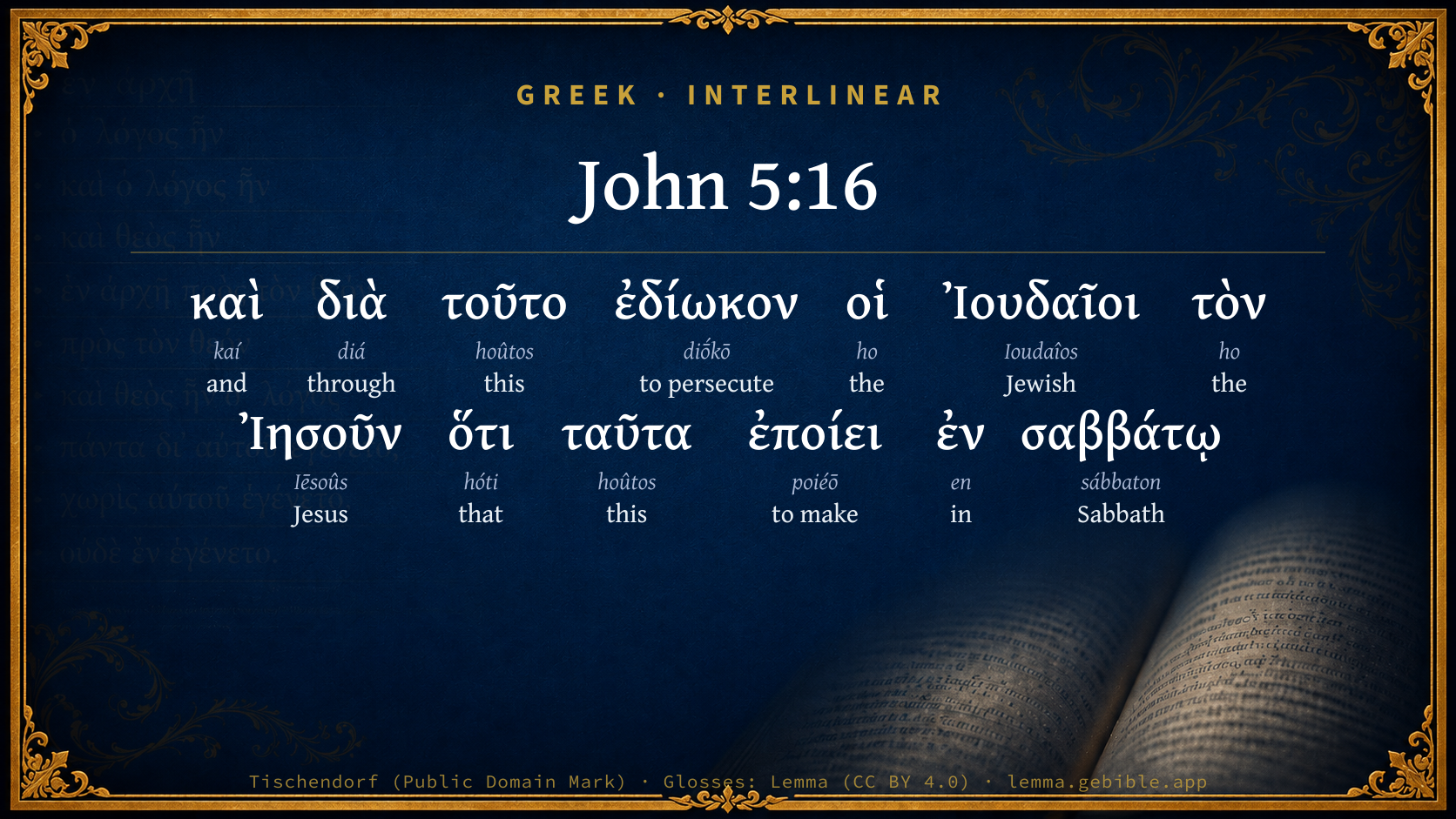
Greek (Tischendorf 8th ed.) John 5:16 appears in the Greek New Testament. The text above is from the Tischendorf 8th edition. Each word links to its Strong’s number and a concise gloss. Click any word for its full Thayer’s Greek Lexicon entry.
Download image
Cite this verse

John 5:16 (World English Bible). Public Domain. Lemma interlinear Bible study tool, https://lemma.gebible.app/v/john/5/16.

Show BibTeX & RIS
BibTeX
RIS
English Translation
For this cause the Jews persecuted Jesus, and sought to kill him, because he did these things on the Sabbath.
World English Bible · Public Domain
Download a study sheet

One document with this verse’s original text, its word-by-word gloss line, the meaning frame, cross-references with their text, attributed commentary, and full source and license credits — printable, and it pastes into notes with its structure intact.

This verse Autodidact and up

Study sheet (.html) Plain text (.txt)

A passage Seminary Student

Up to 50 verses in one chapter. A passage sheet keeps up to 6 commentary sources and 12 cross-references per verse, in the order this page ranks them, and says so on the sheet whenever that leaves anything out. Ask for a single verse and you get the Autodidact verse sheet above.

Everything on this page stays free to read, with no account — the sheet is a download of what is already on screen, not access to it.

Want to remove ads? Support Godless Engineer
Compare translations 3

The same verse in 3 English versions, stacked beneath the original-language interlinear above. Click any original word for its lexicon entry.

Each is an independent rendering of the whole verse — the interlinear is not word-aligned to these translations.

Highlighted words mark where these versions differ — a whole-verse word diff, not a word-by-word alignment.

  • World English Bible Public Domain
    For this cause the Jews persecuted Jesus, and sought to kill him, because he did these things on the Sabbath.
  • King James Version Public Domain
    And therefore did the Jews persecute Jesus, and sought to slay him, because he had done these things on the sabbath day.
  • unfoldingWord Literal Text CC BY-SA 4.0
    And because of this, the Jews began to persecute Jesus, because he was doing these things on the Sabbath.

unfoldingWord Literal Text — © unfoldingWord, licensed CC BY-SA 4.0. Word-aligned USFM3 via Door43 (git.door43.org/unfoldingWord/en_ult).

Versions to compare (up to 4)

3 of 4 selected

Show all 19 translations

Every available English version of this verse, each an independent rendering of the whole verse.

  • World English Bible Public Domain
    For this cause the Jews persecuted Jesus, and sought to kill him, because he did these things on the Sabbath.
  • Berean Standard Bible Public Domain
    Now because Jesus was doing these things on the Sabbath, the Jews began to persecute Him.
  • Majority Standard Bible Public Domain
    Now because Jesus was doing these things on the Sabbath, the Jews began to persecute Him and were seeking to kill Him.
  • King James Version Public Domain
    And therefore did the Jews persecute Jesus, and sought to slay him, because he had done these things on the sabbath day.
  • American Standard Version (1901) Public Domain
    And for this cause the Jews persecuted Jesus, because he did these things on the sabbath.
  • Revised Version (1885) Public Domain
    And for this cause did the Jews persecute Jesus, because he did these things on the sabbath.
  • Geneva Bible (1599) Public Domain
    And therefore the Iewes did persecute Iesus, and sought to slay him, because he had done these things on the Sabbath day.
  • Douay-Rheims (1899) Public Domain
    Therefore did the Jews persecute Jesus, because he did these things on the sabbath.
  • Young's Literal Translation Public Domain
    and because of this were the Jews persecuting Jesus, and seeking to kill him, because these things he was doing on a sabbath.
  • Literal Standard Version CC BY-SA 4.0
    and because of this were the Jews persecuting Jesus, and seeking to kill Him, because these things He was doing on a Sabbath.
  • Unlocked Literal Bible CC BY-SA 4.0
    Now because of these things the Jews persecuted Jesus, because he did these things on the Sabbath.
  • unfoldingWord Literal Text CC BY-SA 4.0
    And because of this, the Jews began to persecute Jesus, because he was doing these things on the Sabbath.
  • Darby Bible Public Domain
    And for this the Jews persecuted Jesus [and sought to kill him], because he had done these things on sabbath.
  • World Messianic Bible Public Domain
    For this cause the Judeans persecuted Yeshua and sought to kill him, because he did these things on the Sabbath.
  • Webster's Bible Public Domain
    And therefore the Jews persecuted Jesus, and sought to slay him, because he had done these things on the sabbath.
  • Free Bible Version CC BY-SA 4.0
    So the Jews started to harass Jesus because he was doing things on the Sabbath.
  • Bible in Basic English Public Domain
    And for this reason the Jews were turned against Jesus, because he was doing these things on the Sabbath.
  • Text-Critical English NT CC BY 4.0
    So the Jews began persecuting Jesus and seeking to kill him, because he was doing these things on the Sabbath.
  • Tyndale New Testament (1534) Public Domain
    And therfore the Iewes dyd persecute Iesus and sought the meanes to slee him because he had done these thinges on the Saboth daye.

Literal Standard Version (2020), Covenant Press — licensed CC BY-SA 4.0. Text via the HelloAO Bible API (eBible.org). Unlocked Literal Bible (unfoldingWord) — licensed CC BY-SA 4.0. Text via the HelloAO Bible API (eBible.org). unfoldingWord Literal Text — © unfoldingWord, licensed CC BY-SA 4.0. Word-aligned USFM3 via Door43 (git.door43.org/unfoldingWord/en_ult). Free Bible Version, Dr. Jonathan Gallagher — licensed CC BY-SA 4.0. Text via the HelloAO Bible API (eBible.org).

Word by word

More ways to search: Search by grammar → Find every occurrence → Compare this word →

Practice this passage: Drill this verse → Learn its vocabulary →

ἐδίωκον
diṓkō
G1377
“to persecute”
Verb, Imperfect, Active, Indicative, 3rd person, Plural
Part of Speech
Verb
Tense
Imperfect
Voice
Active
Mood
Indicative
Person
3rd person
Number
Plural
Full Thayer's Definition

Origin: "a prolonged (and causative) form of a primary verb dio (to flee; cf the base of G1169 and G1249 )"

TDNT: 05:49,2

1. to make to run or flee, put to flight, drive away 2. to run swiftly in order to catch a person or thing, to run after a. to press on: figuratively of one who in a race runs swiftly to reach the goal b. to pursue (in a hostile manner) 3. in any way whatever to harass, trouble, molest one a. to persecute b. to be mistreated, suffer persecution on account of something 4. without the idea of hostility, to run after, follow after: someone 5. metaph., to pursue a. to seek after eagerly, earnestly endeavour to acquire
  1. καὶ kaí G2532 “and” Conjunction
  2. διὰ diá G1223 “through” Preposition
  3. τοῦτο hoûtos G3778 “this” Demonstrative pronoun, Accusative, Singular, Neuter
  4. οἱ ho G3588 “the” Article, Nominative, Plural, Masculine
  5. Ἰουδαῖοι Ioudaîos G2453 “Jewish” Adjective, Nominative, Plural, Masculine
  6. τὸν ho G3588 “the” Article, Accusative, Singular, Masculine
  7. Ἰησοῦν Iēsoûs G2424 “Jesus” Noun, Accusative, Singular, Masculine
  8. ὅτι hóti G3754 “that” Conjunction
  9. ταῦτα hoûtos G3778 “this” Demonstrative pronoun, Accusative, Plural, Neuter
  10. ἐποίει poiéō G4160 “to make” Verb, Imperfect, Active, Indicative, 3rd person, Singular
  11. ἐν en G1722 “in” Preposition
  12. σαββάτῳ sábbaton G4521 “Sabbath” Noun, Dative, Singular, Neuter

About this verse

These counts appear in no published source. They are computed here, from the morphology-tagged text and Lemma’s own curated glosses. What Lemma adds →

13
words
11
distinct lemmas
Gospels
section

Shared distinctive vocabulary

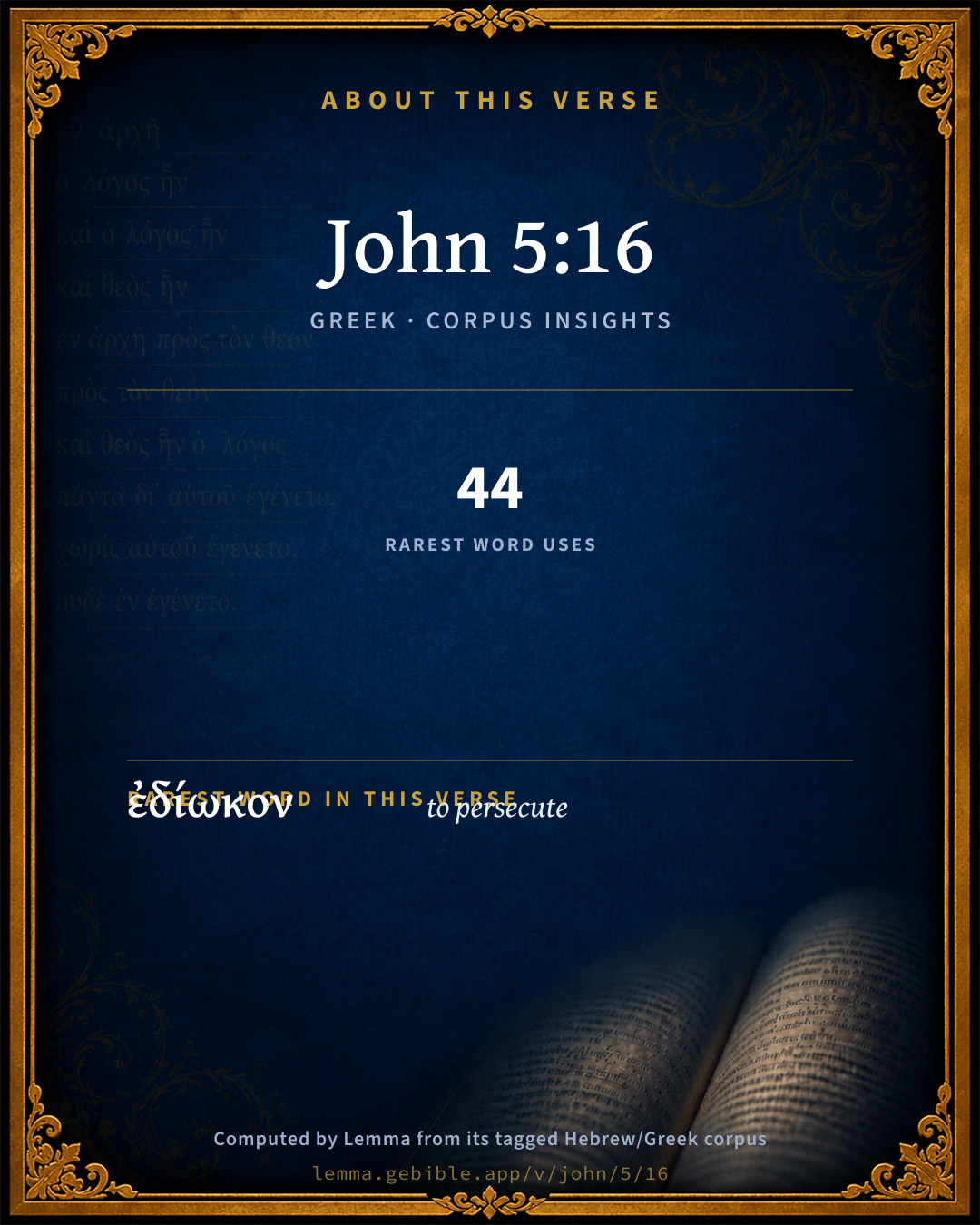
ἐδίωκον to persecute G1377 occurs in 43 verses of the Greek New Testament. Also found in:
Repetition

Words recur within this verse:

Cross-references

9

Topical passages linked to John 5:16 in the Treasury of Scripture Knowledge — connected by theme and wording, ordered by reader-vote popularity; previews shown in the World English Bible.

  • John 10:39 They sought again to seize him, and he went out of their hand.
  • Acts 9:4–5 He fell on the earth, and heard a voice saying to him, "Saul, Saul, why do you persecute me?"
  • Matthew 12:13 Then he told the man, "Stretch out your hand." He stretched it out; and it was restored whole, just like the other.
  • Mark 3:6 The Pharisees went out, and immediately conspired with the Herodians against him, how they might destroy him.
  • Luke 6:11 But they were filled with rage, and talked with one another about what they might do to Jesus.
  • John 5:13 But he who was healed didn't know who it was, for Jesus had withdrawn, a crowd being in the place.
  • John 7:19–20 Didn't Moses give you the law, and yet none of you keeps the law? Why do you seek to kill me?"
  • John 7:25 Therefore some of them of Jerusalem said, "Isn't this he whom they seek to kill?
  • John 15:20 Remember the word that I said to you: 'A servant is not greater than his lord.' If they persecuted me, they will also persecute you. If they kept my word, they will keep yours also.

Cross-references courtesy of OpenBible.info (CC BY 4.0).

Where the printed editions differ

1 variant

Places in this verse where the major printed Greek editions disagree on the wording in a way that affects the translation — a comparison of editions, not a manuscript-by-manuscript collation. The editions are the modern critical texts (Nestlé-Aland 28/27, SBL, Westcott-Hort, Tregelles, Tyndale House) and the traditional texts behind the KJV (the Textus Receptus and the Byzantine/Majority text). It is not a claim about which reading is original.

  1. Extra text
    καὶ ἐζήτουν αὐτὸν ἀποκτεῖναι,

    “and were seeking him to kill”

    In TRByz Not in NA28NA27TynSBLWHTreg

    καὶ ἐζήτουν αὐτὸν ἀποκτεῖναι, (kai ezētoun auton apokteinai) 'and were seeking him to kill' is only in traditional manuscripts (TR+Byz)

Textual data: Translators Amalgamated Greek New Testament (STEPBible TAGNT) · CC BY 4.0.

Commentary

Notes on John 5:16 from classic Christian and Jewish commentators (each source and its license shown beneath its notes). The classic Christian expositions comment on the surrounding passage and are grouped to its opening verse, so a note may address several verses; the Jewish commentaries on the Tanakh (Rashi and others) are per-verse, so they appear only where the commentator wrote on this verse.

Lemma curates 59 commentaries, every one of them public domain or Creative Commons licensed, each selected and text-cleaned for this edition rather than reprinted as found. About our sources →

Bengel's Gnomon

Johann Albrecht Bengel

Joh 5:16. Ἐδίωκοι) they attempted to thrust Him out [began to persecute].—καὶ ἐξήτουν αὐτὸι ἀποκτεῖναι) More modern copies have inserted this here from Joh 5:18.[104] The attempt to kill is opposed to persecution, properly so called.

[104] BCDL Vulg. and Memph. Versions omit it. A and Hilary, however, have it.—E. and T.

And so also the margin of Ed. 2 sets aside this clause more decidedly than the Ed. Maj., and the Germ. Vers. has altogether omitted it.—E. B.

Bengel's Gnomon of the New Testament — English translation (T&T Clark, Edinburgh, 1860) — public domain. Text from a community e-Sword module.

Meyer's Critical & Exegetical Commentary

Heinrich August Wilhelm Meyer

Joh_5:16-17. Διὰ τοῦτο] on account of this notice referring to Jesus, and then ὅτι, because He that is. See on Joh_10:17.

ἐδίωκ.] not judicially, by means of the law (Lampe, Rosenmüller, Kuinoel), of which the sequel says nothing, but in a general way: they made Him the object of their persecutions.

ταῦτα] these things, such as the healing of the paralytic.

ἐποίει] he did, not ἐποίησεν.

ἀπεκρίνατο] The means by which He met the διώκειν of the Jews, whether that then showed itself in accusations, reproaches, machinations, or otherwise in overt acts of hostility. This Aorist occurs in John only here, Joh_5:19; Joh_12:23.

ὁ πατήρ μου, κ.τ.λ.] My Father is working even to this moment; I also work. This expression is not borrowed from Philo (Strauss); Jesus alludes to the unresting activity of God for human salvation[205] since the creation was finished, notwithstanding the divine rest of the Sabbath (Gen_2:1-3) observed after the six days work. This distinct reference (not generally to the sustaining and government of the world) is presented in the activity of Christ answering to that of God the Father. As the Father, that is, says Jesus, has not ceased from the beginning to work for the worlds salvation, but ever works on even to the present moment,[206] so of necessity and right, notwithstanding the law of the Sabbath, does He also, the Son, who as such (by virtue of His essentially divine relationship of equality with the Father) cannot in this His activity be subject to the sabbatical law, but is Lord of the Sabbath (comp. Mat_12:8; Mar_2:28). Olshausen and de Wette import this in the words: As in God rest and action are united, so in Christ are contemplation and activity. But there is no mention of rest and contemplation. According to Godet, Jesus says, Jusquà chaque dernier moment où mon père agit, jagis aussi; the Son can only cease His work when He sees the Father cease. But in this case we should have simply ἕως (Joh_9:4), and not ἕως ἄρτι; ἕως ἄρτι means nothing more nor less than usque adhuc (Joh_2:10, Joh_16:24; 1Jn_2:9), the now limiting it still more distinctly than ἕως τοῦ νῦν (Lobeck, ad Phryn. pp. 19, 20).

κἀγὼ ἐργάζομαι] is not to be again supplemented by ἕως ἄρτι. I also (do not rest, but) work. The relation of both sentences is not that of imitation (Grotius), nor of example (Ewald), but of necessary equality of will and procedure. The asyndeton (instead of because my Father, etc.) makes the statement all the more striking. See on 1Co_10:17.

[205] Jesus accordingly does not deny that God rested on the seventh day after the six days of creation (against Ammon); but He affirms that since then He is ever active, even on the Sabbath-days, for mans redemption. Nor does He speak of the law concerning the Sabbath as not of divine institution (Baur), as of no obligation, or as abrogated; but He as the Son stands above it, and is as little bound by it as the Father, who ever continues to work, even on the Sabbath. This against Hilgenfeld (Lehrbegriff, p. 81; Evang. p. 270; and in his Zeitschrift 1863, p. 218), who considers that, according to this Gospel, Jesus, passing by the O. T. representation of God, rises to the absolutely transcendental essence, exalted above all contact with the finite, and manifest only to the Son; and that the evangelist, following the Gnostics, refers the history of the creation to the Demiurge, as distinct from the most high God. This is not the eagle height of Johns theology.

[206] ἓως ἄρτι carries our view of Gods working, which began with the creation, onwards to the present moment, the moment wherein Jesus has to defend Himself on account of Sabbath-breaking. In conformity with this redemptive work of God the Father onwards until now, and which was interrupted by no rest, He also works. The inference that herein is implied a divine rest at a future period, as Luthardt thinks,who regards the day of Christs resurrection as the then approaching Sabbath of Gods redemptive work,is quite remote from the text. Ἕως ἄρτι includes the survey of the entire past down to the moment then present, without any intimation of a change in the future, which, if intended, should appear in the context, as in Joh_16:24.

Meyer — Critical and Exegetical Commentary on the New Testament — English translation by Peter Christie, edited by Frederick Crombie (T&T Clark, 1880) — public domain. Text from a community e-Sword module.

Expositor's Greek Testament

ed. W. Robertson Nicoll

Joh 5:16 . The consequence however was that “the Jews persecuted Jesus,” ἐδίωκον , not in the technical sense; but, as the imperfect also suggests, they began from this point to meditate hostile action; cf. Mar 3:6 . καὶ ἐζήτουν αὐτὸν ἀποκτεῖναι , on the ground that He was a Sabbath-breaker, and therefore worthy of death; ὅτι ταῦτα ἐποίει ἐν σαββάτῳ . The plural and the imperfect show that the cure of the impotent man was not the only case they had in view. Their allies in the provinces had made them acquainted with similar cases. It would almost seem as if He was in the habit of thus signalising the Sabbath.

The Expositor's Greek Testament, edited by W. Robertson Nicoll (1897–1910) — public domain. Text from a community e-Sword module.

Jamieson, Fausset & Brown

Robert Jamieson, A. R. Fausset & David Brown

because he had done these things on the sabbath day--What to these hypocritical religionists was the doing of the most glorious and beneficent miracles, compared with the atrocity of doing them on the sabbath day! Having given them this handle, on purpose to raise the first public controversy with them, and thus open a fitting opportunity of laying His claims before them, He rises at once to the whole height of them, in a statement which for grandeur and terseness exceeds almost anything that ever afterwards fell from Him, at least to His enemies.

Jamieson, Fausset & Brown — Commentary Critical and Explanatory on the Whole Bible (1871) — public domain (CC PDM 1.0). Text via the HelloAO Bible API.

Adam Clarke's Commentary

Verse 16. And sought to slay him] This clause is omitted by BCDL, some others, and several ancient versions. Griesbach has left it out of the text; and Professor White says, certissime delenda: but it does not appear to me that it should be omitted. However, it was true of the Jews, whether the words were originally in the evangelist or not. For what cause did these persons seek to destroy our Lord? Because he had healed a poor man, who had been diseased thirty-eight years, and ordered him to carry home the couch on which he lay! How implacable must their malice have been! The spirit of religious persecution has always been the most fell and dangerous of all on this side perdition. Every other disposition appears to have its moderator; but this is wholly abandoned to the guidance of Satan, and has for its objects the men who know the truth, and who live to the glory of their God, and for the benefit of mankind. How strange that such should ever be objects of malice and hatred! But the Satanic nature in fallen man is ever opposed to whatever comes from God.

Adam Clarke's Commentary on the Bible (1810–1826) — public domain. Text from a community e-Sword/MySword module.

Ellicott's Commentary for English Readers

(16) The words, “and sought to slay Him,” should be omitted. They have been inserted in some MSS. to explain the first clause of Joh_5:18. For “He had done,” read He was doing. The word is in the imperfect tense, expressing continuance or custom. It is either that from this one instance they generalise a law of practice to justify their persecution, or that some of the earlier unrecorded miracles were also performed on the Sabbath. (Comp. Luk_6:1-11.)

A Bible Commentary for English Readers, edited by Charles John Ellicott (1878–1897) — public domain. Text from a community e-Sword module.

The Cambridge Bible for Schools and Colleges

gen. ed. J. J. S. Perowne

16. And therefore] Better, And on this account, or, and for this cause (Joh_12:18; Joh_12:27). It is not St John’s favourite particle ‘therefore.’ but a preposition and pronoun. Comp. Joh_5:18.

and sought to slay him] These words are not genuine here, but have been inserted from Joh_5:18. The other two verbs are both in the imperfect tense expressing continued action; ‘used to persecute, continued to persecute;’ ‘used to do, habitually did.’ From which we may infer that some of the unrecorded miracles (Joh_2:23, Joh_4:45) were wrought on the Sabbath: unless the Evangelist is speaking from their point of view; ‘because (as they said) He habitually did these things on the Sabbath.’

The Cambridge Bible for Schools and Colleges (gen. ed. J. J. S. Perowne; Cambridge University Press, 1878–1918) — public domain. Text from a community e-Sword module.

John Gill's Exposition

And therefore did the Jews persecute Jesus,.... With their tongues, reproaching and reviling him, as a sabbath breaker, a destroyer of the law, and a sinful wicked man:

and sought to slay him; either in a violent way, by setting the zealots, a sort of ruffians under the pretence of religion, upon him; or rather in a judicial way, summoning him before the sanhedrim, in order to condemn him to death for the breach of the sabbath, which by the law of Moses was punishable with death:

because he had done these things on the sabbath day; because he had cured the man of his disease, under which he had laboured eight and thirty years, and had ordered him to take up his bed, and walk home with it on his back on the sabbath day. This drew upon him their resentment to such a degree, that they not only persecuted him with their tongues, but sought to take away his life. Nothing would satisfy them but his blood.

John Gill's Exposition of the Whole Bible (1746–1763) — public domain (CC PDM 1.0). Text via the HelloAO Bible API.

Trapp's Complete Commentary

John Trapp

16 And therefore did the Jews persecute Jesus, and sought to slay him, because he had done these things on the sabbath day.

Ver. 16. Therefore did the Jews persecute Jesus] This he foreknew would follow, and yet he forbore not. In the discharge of our consciences (tightly informed and regulated) we must not stand to cast perils; but do our duties zealously, whatever come of it. This courage in Christians, heathens counted obstinacy, but they knew not the power of the Spirit, nor the privy armour of proof that saints have about their hearts.

John Trapp, A Commentary or Exposition upon All the Books of the Old and New Testament (1647–1656) — public domain. Text from a community e-Sword module.

Albert Barnes' Notes on the Bible

Persecuted Jesus - They opposed him; attempted to ruin his character; to destroy his popularity; and probably held him up before the people as a violator of the law of God. Instead of making inquiry whether he had not given proof that he was the Messiah, they “assumed” that he must be wrong, and ought to be punished. Thus every bigot and persecutor does in regard to those who differ from them.

To slay him - To put him to death. This they attempted to do because it was directed in the law of Moses, Exo 31:15; Exo 35:2. See Luk 6:7, Luk 6:11; Luk 13:14. We see here,

1. How full of enmity and how bloody was the purpose of the Jews, All that Jesus had done was to restore an infirm man to health - a thing which they would have done for their cattle Luk 6:7, and yet they sought. his life because he had done it for a sick “man.”

2. Men are often extremely envious because good is done by others, especially if it is not done according to the way of their denomination or party.

3. Here was an instance of the common feelings of a hypocrite. He often covers his enmity against the power of religion by great zeal for the form of it. He hates and persecutes those who do good, who seek the conversion of sinners, who love revivals of religion and the spread of the gospel, because it is not according to some matter of form which has been established, and on which he supposes the whole safety of the church to hang. There was nothing that Jesus was more opposed to than hypocrisy, and nothing that he set himself more against than those who suppose all goodness to consist in “forms,” and all piety in the “shibboleths” of a party.

Albert Barnes' Notes on the Bible (1834–1885) — public domain. Text from a community e-Sword/MySword module.

Matthew Poole's English Annotations

But the Jews made another use of it, seeking from hence an advantage against him, because he had violated the sabbath, which they often made a capital crime.

Matthew Poole's English Annotations on the Holy Bible (1683–1685) — public domain. Text from a community e-Sword/MySword module.

The People's New Testament

B. W. Johnson

16. The Jews persecute Jesus. The word is literally rendered “pursued Jesus.” At once they hunted Jesus and attacked him. They did not at first seek to slay him. This is omitted in the Revision and does not appear in the old MSS. But the officials now come to Jesus to learn why he has done this act.

B. W. Johnson's The People's New Testament with Notes (1889–1891) — public domain. Electronic text from the Christian Classics Ethereal Library (CCEL) ThML edition.

unfoldingWord translationNotes

Door43 World Missions Community

Now

The writer uses the word "now" to show that the words that follow are background information. (See: Background Information)

is working

This refers to doing labor, including anything that is done to serve other people.

the Jews

Here "the Jews" is a synecdoche which represent the "Jewish leaders." AT: "the Jewish leaders" (See: Synecdoche)

making himself equal to God

"saying that he was like God" or "saying that he had as much authority as God"

My Father

This is an important title for God. (See: Translating Son and Father)

translationWords

Jewish authorities

persecute

Jesus

Sabbath

God the Father

works

God

unfoldingWord translationNotes — © Distant Shores Media and the Door43 World Missions Community, licensed CC BY-SA 4.0. Source: git.door43.org/Door43/en_tn.

Cambridge Greek Testament for Schools and Colleges

16. Omit καὶ ἐζήτουν αὐτὸν ἀποκτεῖναι (inserted from Joh 5:18) with אBCDL against A.

16. διὰ τοῦτο. For this cause. We should mark the difference between διὰ τοῦτο (Joh 5:18, Joh 6:65, Joh 7:21-22, Joh 8:47, Joh 9:23, Joh 10:17, Joh 12:39, Joh 13:11, Joh 15:19, Joh 16:15) and οὖν, therefore.

ἐδίωκον. Once more we have contrasted effects of Christ’s work (see on Joh 2:16). The man healed returns thanks in the Temple, and maintains the authority of Jesus over the Sabbath: ‘the Jews’ persecute Him. This is the first declaration of hostility, and it comes very early in the ministry. Note the imperfects ἐδίωκον, ‘continued to persecute’; the hostility is permanent: ἐποίει, ‘was wont to do’; He went counter to the Law on principle. Ὅτι ἐποίει may be either the Jews’ or S. John’s statement. Perhaps some of the unrecorded miracles (Joh 2:23, Joh 4:45) were wrought on the Sabbath. His having convicted them of publicly profaning the Temple (Joh 2:14) would make them the more eager to retaliate for a public profanation of the Sabbath. Comp. a similar result in Galilee (Luk 6:1-11).

Cambridge Greek Testament for Schools and Colleges (Cambridge University Press, 1896; 21 vols, various authors incl. Carr, Maclear, Plummer, Farrar, Lumby, Moule, M. R. James, Simcox) — public domain. Text from a community e-Sword module.

Alford’s Greek Testament

Henry Alford

16.] ἐδίωκον is not used in the sense of legal prosecution in the N.T.:—persecuted is the best word for it.

Henry Alford, The Greek Testament (1849–1861) — public domain. Text from a community e-Sword module.

International Critical Commentary

16. καὶ διὰ τοῦτο ἐδίωκον κτλ., “And for this cause the Jews began to persecute Jesus, because, etc.” The force of the imperfects, ἐδίωκον, ἐποίει, ἐζήτουν (v. 18), must not be overlooked. This was the first open declaration of hostility to Jesus by the Pharisees of Jerusalem, and its immediate cause was His first open violation of the Sabbatical law. ἐδίωκον, “they began to persecute Him”; ὅτι ταῦτα ἐποίει ἐν σαββάτῳ, “because He began to do these things on the Sabbath.” Cf. Mar 3:6, where a similar cause is assigned for the first exhibition of enmity to Him in Galilee.

διὰ τοῦτο, “for this cause,” referring to what follows (not, as more commonly, to what precedes, e.g. 6:65), is a favourite opening phrase with Jn. Cf. v. 18, 8:47, 10:17, 12:18, 39, 1Jn 3:1, and Isa 24:6 διὰ τοῦτο ἀρὰ ἔδεται τὴν γῆν, ὅτι ἡμάρτοσαν οἱ κατοικοῦντες αὐτὸν.

After τὸν Ἰησοῦν the rec. with AΓΔΘ inserts καὶ ἐξζήτουν αὐτὸν ἀποκτεῖναι (from v. 18), but om. here אBCDLW

International Critical Commentary — older volumes (1896–1929), various authors — public domain. Text from a community e-Sword module.

Vincent's Word Studies in the New Testament

Marvin R. Vincent

Did the Jews persecute. The imperfect tense [εδιωκον] might be rendered began to persecute, as this is an opening of hostilities against Jesus, or, more probably, corresponds with the same tense in ejpoiei, he did, or better, was wont to do. Diwkw, to persecute, is originally to run after, to pursue with hostile purpose, and thence to harass.

And sought to kill Him. The best texts omit.

He did. See above. Godet observes : "the imperfect malignantly expresses the idea that the violation of the Sabbath has become with Him a sort of maxim."

Marvin R. Vincent, Word Studies in the New Testament (1887–1900) — public domain. Text from a community e-Sword/MySword module.

Godet's Commentaries

Frédéric Louis Godet

Ver. 16. “For this cause did the Jews persecute Jesus, because he did these things on the Sabbath day.”

Διὰ τοῦτο (for this cause), resumes what precedes, and, at the same time, is explained by the phrase which closes the verse: because ...The word διώκειν (persecute), indicates the seeking of the means to injure. In favor of the authenticity of the following words in the T. R.: and they sought to kill him, the μᾶλλον (yet more), of Joh 5:18, can be alleged. But it is still more probable that it is these words in Joh 5:18 which have occasioned this interpolation. The imperfect ἐποίει (He did), malignantly expresses the idea that the violation of the Sabbath has henceforth passed with Him into a rule: He is accustomed to do it. This idea is entirely lost in the inaccurate translation of Ostervald and of Rilliet: “because He had done this.” The plural ταῦτα (these things), refers to the double violation of the Sabbath, the healing and the bearing of the burden.

Let us notice here two analogies between John and the Synoptics: 1. In the latter also, Jesus is often obliged to perform His miracles as it were by stealth, and even to impose silence on those whom He has healed. 2. It is on occasion of the Sabbatic healings wrought in Galilee, that, according to them also, the conflict breaks out (Luk 6:1-11).

Frédéric Louis Godet — Commentaries on Luke, John, Romans, and 1 Corinthians — English translation (T&T Clark, Edinburgh, 1870s–1890s) — public domain. Text from a community e-Sword module.

Lesson kit

Teaching starters — assembled from the data on this page, not authored interpretation. Every prompt links to the verse data it draws on. Edit before teaching.

John, in the Gospels, opens this verse with 13 words (11 distinct Greek lemmas). Its most distinctive word is diṓkō (“to persecute”). A historical commentator’s framing appears above. Read the whole chapter for the surrounding context.

Discussion questions

  1. What does “to persecute” (diṓkō) contribute to the verse as a whole?
  2. How does Matthew 5:10, which shares the word «to persecute», read alongside this verse?
  3. What does the repetition of “this” (2× in this one verse) do in this verse?
  4. These translations render this verse differently; the difference is in the English rendering, not the original. What questions does that raise?
  5. Compare how Bengel's Gnomon and Meyer's Critical & Exegetical Commentary read this verse. Where do they agree or differ?

Things to notice

Reading settings

Reading text

Shown beneath each verse's original-language words.

Old Testament
Old Testament edition

Read the OT as the Masoretic Hebrew (MT) or the Greek Septuagint (LXX).

English shown for the Greek Septuagint (in the Hebrew ↔ Greek comparison).

Comparing translations? Open the Compare panel on any verse page to stack up to four side by side.