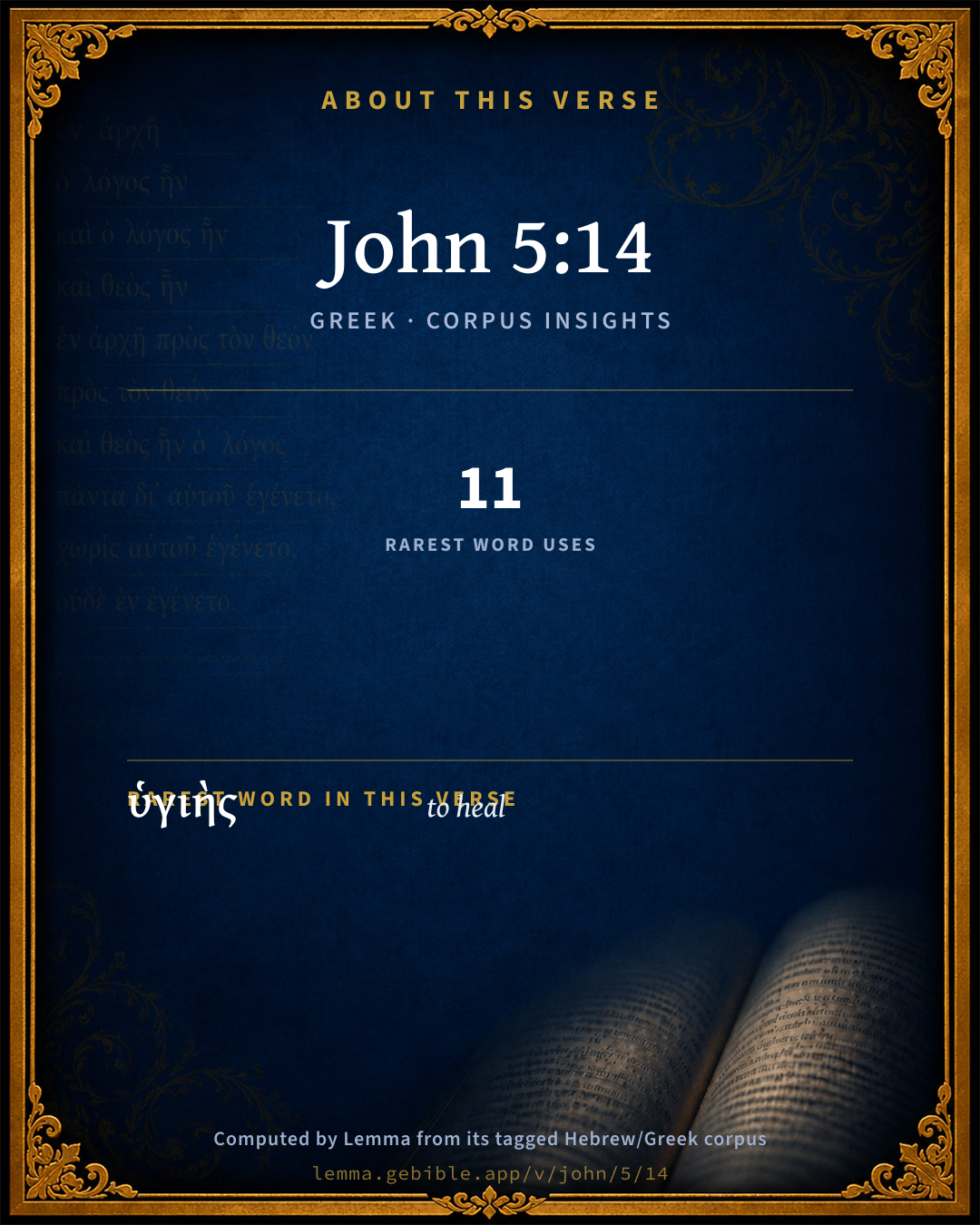
John 5:14

Greek (Tischendorf 8th ed.) John 5:14 appears in the Greek New Testament. The text above is from the Tischendorf 8th edition. Each word links to its Strong’s number and a concise gloss. Click any word for its full Thayer’s Greek Lexicon entry.

Download image
Cite this verse

John 5:14 (World English Bible). Public Domain. Lemma interlinear Bible study tool, https://lemma.gebible.app/v/john/5/14.

Show BibTeX & RIS
BibTeX
RIS
English Translation
Afterward Jesus found him in the temple, and said to him, "Behold, you are made well. Sin no more, so that nothing worse happens to you."
World English Bible · Public Domain
Download a study sheet

One document with this verse’s original text, its word-by-word gloss line, the meaning frame, cross-references with their text, attributed commentary, and full source and license credits — printable, and it pastes into notes with its structure intact.

This verse Autodidact and up

Study sheet (.html) Plain text (.txt)

A passage Seminary Student

Up to 50 verses in one chapter. A passage sheet keeps up to 6 commentary sources and 12 cross-references per verse, in the order this page ranks them, and says so on the sheet whenever that leaves anything out. Ask for a single verse and you get the Autodidact verse sheet above.

Everything on this page stays free to read, with no account — the sheet is a download of what is already on screen, not access to it.

Want to remove ads? Support Godless Engineer
Compare translations 3

The same verse in 3 English versions, stacked beneath the original-language interlinear above. Click any original word for its lexicon entry.

Each is an independent rendering of the whole verse — the interlinear is not word-aligned to these translations.

Highlighted words mark where these versions differ — a whole-verse word diff, not a word-by-word alignment.

  • World English Bible Public Domain
    Afterward Jesus found him in the temple, and said to him, "Behold, you are made well. Sin no more, so that nothing worse happens to you."
  • King James Version Public Domain
    Afterward Jesus findeth him in the temple, and said unto him, Behold, thou art made whole: sin no more, lest a worse thing come unto thee.
  • unfoldingWord Literal Text CC BY-SA 4.0
    After these things, Jesus finds him in the temple and said to him, “Behold, you have become healthy! No longer sin, so that something worse might not happen to you.”

unfoldingWord Literal Text — © unfoldingWord, licensed CC BY-SA 4.0. Word-aligned USFM3 via Door43 (git.door43.org/unfoldingWord/en_ult).

Versions to compare (up to 4)

3 of 4 selected

Show all 19 translations

Every available English version of this verse, each an independent rendering of the whole verse.

  • World English Bible Public Domain
    Afterward Jesus found him in the temple, and said to him, "Behold, you are made well. Sin no more, so that nothing worse happens to you."
  • Berean Standard Bible Public Domain
    Afterward, Jesus found the man at the temple and said to him, “See, you have been made well. Stop sinning, or something worse may happen to you.”
  • Majority Standard Bible Public Domain
    Afterward, Jesus found the man at the temple and said to him, “See, you have been made well. Stop sinning, or something worse may happen to you.”
  • King James Version Public Domain
    Afterward Jesus findeth him in the temple, and said unto him, Behold, thou art made whole: sin no more, lest a worse thing come unto thee.
  • American Standard Version (1901) Public Domain
    Afterward Jesus findeth him in the temple, and said unto him, Behold, thou art made whole: sin no more, lest a worse thing befall thee.
  • Revised Version (1885) Public Domain
    Afterward Jesus findeth him in the temple, and said unto him, Behold, thou art made whole: sin no more, lest a worse thing befall thee.
  • Geneva Bible (1599) Public Domain
    And after that, Iesus founde him in the Temple, and said vnto him, Beholde, thou art made whole: sinne no more, lest a worse thing come vnto thee.
  • Douay-Rheims (1899) Public Domain
    Afterwards, Jesus findeth him in the temple, and saith to him: Behold thou art made whole: sin no more, lest some worse thing happen to thee.
  • Young's Literal Translation Public Domain
    After these things, Jesus findeth him in the temple, and said to him, `Lo, thou hast become whole; sin no more, lest something worse may happen to thee.'
  • Literal Standard Version CC BY-SA 4.0
    After these things, Jesus finds him in the temple and said to him, “Behold, you have become whole; sin no more, lest something worse may happen to you.”
  • Unlocked Literal Bible CC BY-SA 4.0
    Afterward, Jesus found him in the temple and said to him, “See, you have become healthy! Do not sin anymore, so that something worse will not happen to you.”
  • unfoldingWord Literal Text CC BY-SA 4.0
    After these things, Jesus finds him in the temple and said to him, “Behold, you have become healthy! No longer sin, so that something worse might not happen to you.”
  • Darby Bible Public Domain
    After these things Jesus finds him in the temple, and said to him, Behold, thou art become well: sin no more, that something worse do not happen to thee.
  • World Messianic Bible Public Domain
    Afterward Yeshua found him in the temple and said to him, “Behold, you are made well. Sin no more, so that nothing worse happens to you.”
  • Webster's Bible Public Domain
    Afterward Jesus findeth him in the temple, and said to him, Behold, thou art cured: sin no more, lest a worse thing come to thee.
  • Free Bible Version CC BY-SA 4.0
    Later on Jesus found the man in the Temple, and told him, “Look, now you've been healed. So stop sinning or something worse may happen to you.”
  • Bible in Basic English Public Domain
    After a time Jesus came across him in the Temple and said to him, See, you are well and strong; do no more sin for fear a worse thing comes to you.
  • Text-Critical English NT CC BY 4.0
    After this Jesus found the man in the temple courts and said to him, “Behold, yoʋ have been made well; do not sin anymore, lest something worse happen to yoʋ.”
  • Tyndale New Testament (1534) Public Domain
    And after that Iesus founde him in the temple and sayd vnto him: beholde thou arte made whole synne no moore lest a worsse thinge happen vnto the.

Literal Standard Version (2020), Covenant Press — licensed CC BY-SA 4.0. Text via the HelloAO Bible API (eBible.org). Unlocked Literal Bible (unfoldingWord) — licensed CC BY-SA 4.0. Text via the HelloAO Bible API (eBible.org). unfoldingWord Literal Text — © unfoldingWord, licensed CC BY-SA 4.0. Word-aligned USFM3 via Door43 (git.door43.org/unfoldingWord/en_ult). Free Bible Version, Dr. Jonathan Gallagher — licensed CC BY-SA 4.0. Text via the HelloAO Bible API (eBible.org).

Word by word

More ways to search: Search by grammar → Find every occurrence → Compare this word →

Practice this passage: Drill this verse → Learn its vocabulary →

ὑγιὴς
hygiḗs
G5199
“to heal”
Adjective, Nominative, Singular, Masculine
Part of Speech
Adjective
Case
Nominative
Number
Singular
Gender
Masculine
Full Thayer's Definition

Origin: from the base of G837

TDNT: 13:08,1

1. sound a. of a man who is sound in body 2. to make one whole i.e. restore him to health 3. metaph. teaching which does not deviate from the truth
  1. μετὰ metá G3326 “with” Preposition
  2. ταῦτα hoûtos G3778 “this” Demonstrative pronoun, Accusative, Plural, Neuter
  3. εὑρίσκει heurískō G2147 “to find” Verb, Present, Active, Indicative, 3rd person, Singular
  4. αὐτὸν autós G846 “he” Personal pronoun, Accusative, Singular, Masculine
  5. ὁ ho G3588 “the” Article, Nominative, Singular, Masculine
  6. Ἰησοῦς Iēsoûs G2424 “Jesus” Noun, Nominative, Singular, Masculine
  7. ἐν en G1722 “in” Preposition
  8. τῷ ho G3588 “the” Article, Dative, Singular, Neuter
  9. ἱερῷ hierón G2411 “temple” Noun, Dative, Singular, Neuter
  10. καὶ kaí G2532 “and” Conjunction
  11. εἶπεν légō G3004 “to say” Verb, Aorist, Active, Indicative, 3rd person, Singular
  12. αὐτῷ autós G846 “he” Personal pronoun, Dative, Singular, Masculine
  13. ἴδε horáō G3708 “to see” Verb, Aorist, Active, Imperative, 2nd person, Singular
  14. γέγονας gínomai G1096 “to become” Verb, Perfect, Active, Indicative, 2nd person, Singular
  15. μηκέτι mēkéti G3371 “no longer” Adverb, Negative
  16. ἁμάρτανε hamartánō G264 “to sin” Verb, Present, Active, Imperative, 2nd person, Singular
  17. ἵνα hína G2443 “that” Conjunction
  18. μὴ mḗ G3361 “not” Particle, Negative
  19. χεῖρόν cheírōn G5501 “worse” Adjective, Nominative, Singular, Neuter
  20. σοί sý G4771 “you” Personal pronoun, 2nd person, Dative, Singular
  21. τι tìs G5100 “a certain” Indefinite pronoun, Nominative, Singular, Neuter
  22. γένηται gínomai G1096 “to become” Verb, Aorist, Middle deponent, Subjunctive, 3rd person, Singular

About this verse

These counts appear in no published source. They are computed here, from the morphology-tagged text and Lemma’s own curated glosses. What Lemma adds →

23
words
20
distinct lemmas
Gospels
section

Notable vocabulary

The rarest word here is ὑγιὴς to heal G5199 — appearing just 11 times in the whole Greek New Testament.

Shared distinctive vocabulary

ὑγιὴς to heal G5199 occurs in 11 verses of the Greek New Testament. Also found in:

Repetition

Words recur within this verse:

  • γέγονας to become G1096 ×2
  • αὐτὸν he G846 ×2
  • ὁ the G3588 ×2

Cross-references

20

Topical passages linked to John 5:14 in the Treasury of Scripture Knowledge — connected by theme and wording, ordered by reader-vote popularity; previews shown in the World English Bible.

  • John 8:11 She said, "No one, Lord." Jesus said, "Neither do I condemn you. Go your way. From now on, sin no more."
  • Leviticus 26:23–24 "'If by these things you won't be reformed to me, but will walk contrary to me;
  • Psalms 118:18 Yah has punished me severely, But he has not given me over to death.
  • Nehemiah 9:28 But after they had rest, they did evil again before you; therefore left you them in the hand of their enemies, so that they had the dominion over them: yet when they returned, and cried to you, you heard from heaven; and many times did you deliver them according to your mercies,
  • Matthew 12:45 Then he goes, and takes with himself seven other spirits more evil than he is, and they enter in and dwell there. The last state of that man becomes worse than the first. Even so will it be also to this evil generation."
  • Psalms 107:20–22 He sends his word, and heals them, And delivers them from their graves.
  • Revelation 2:21–23 I gave her time to repent, but she refuses to repent of her sexual immorality.
  • Isaiah 38:20 Yahweh is [ready] to save me: Therefore we will sing my songs with stringed instruments All the days of our life in the house of Yahweh.
  • Psalms 27:6 Now my head will be lifted up above my enemies around me. I will offer sacrifices of joy in his tent. I will sing, yes, I will sing praises to Yahweh.
  • Leviticus 26:27 "'If you in spite of this won't listen to me, but walk contrary to me;
  • 2 Chronicles 28:22 In the time of his distress did he trespass yet more against Yahweh, this same king Ahaz.
  • Mark 2:5 Jesus, seeing their faith, said to the paralytic, "Son, your sins are forgiven you."
  • Ezra 9:13–14 After all that is come on us for our evil deeds, and for our great guilt, seeing that you our God have punished us less than our iniquities deserve, and have given us such a remnant,
  • Psalms 66:13–15 I will come into your temple with burnt offerings. I will pay my vows to you,
  • John 5:5 A certain man was there, who had been sick for thirty-eight years.
  • Psalms 9:13 Have mercy on me, Yahweh. See my affliction by those who hate me, And lift me up from the gates of death;
  • Psalms 116:12–19 What will I give to Yahweh for all his benefits toward me?
  • Leviticus 7:12 If he offers it for a thanksgiving, then he shall offer with the sacrifice of thanksgiving unleavened cakes mixed with oil, and unleavened wafers anointed with oil, and cakes mixed with oil.
  • 1 Peter 4:3 For we have spent enough of our past time doing the desire of the Gentiles, and having walked in lewdness, lusts, drunken binges, orgies, carousings, and abominable idolatries.
  • Isaiah 38:22 Hezekiah also had said, What is the sign that I shall go up to the house of Yahweh?

Cross-references courtesy of OpenBible.info (CC BY 4.0).

Commentary

Notes on John 5:14 from classic Christian and Jewish commentators (each source and its license shown beneath its notes). The classic Christian expositions comment on the surrounding passage and are grouped to its opening verse, so a note may address several verses; the Jewish commentaries on the Tanakh (Rashi and others) are per-verse, so they appear only where the commentator wrote on this verse.

Lemma curates 59 commentaries, every one of them public domain or Creative Commons licensed, each selected and text-cleaned for this edition rather than reprinted as found. About our sources →

Joseph Benson's Commentary

Joh 5:14-16. Afterward, Jesus findeth him in the temple — The same day, probably, in which he was healed, whither, it is likely, he had repaired to return thanks to God for his signal recovery. Thus, when God has, at any time, restored us to our health, we ought to attend him with solemn praises; and the sooner the better; while the sense of the mercy is fresh in our minds. Jesus, happening to be now in the temple, and meeting with the man, that he might render the mercy he had conferred on him complete, takes this opportunity to put him in mind of his having brought the distemper upon himself by his wicked courses; and said, Behold, thou art made whole — By the singular mercy of God, thou art now restored to health and vigour; sin no more — Guard against all known sin; lest a worse thing come unto thee — Lest some heavier judgment should be inflicted on thee: for the deliverance thou hast now received would be a dreadful aggravation of any future guilt thou mightest contract. The man — Having received information from those that stood by who it was that spoke to him, and knowing him to be the person to whom he was indebted for his cure; departed — From the temple; and told the Jews — Who had before examined him, that it was Jesus who had made him whole, expecting, no doubt, by this discovery, to have procured him that honour and respect which were due to so much power and goodness. And therefore did the Jews persecute Jesus — One would have expected, that as soon as the man who had been thus miraculously healed had published the name of his benefactor, crowds would have immediately thronged about Jesus to have heard the words of his mouth, and to have received the blessings of his gospel. But, instead of this, behold the malignity of our fallen nature, and force of stubborn prejudice! They surround him with a hostile intent; they even conspire against his life; and, for an imagined transgression in point of ceremony, would have put out this Light of Israel. Let us not wonder, then, if our good be evil spoken of; if even candour, benevolence, and usefulness, do not disarm the enmity of those who have been taught to prefer sacrifice to mercy; and who, dis-relishing the genuine gospel, naturally seek to slander and persecute the professors, and especially the defenders of it.

Joseph Benson's Commentary on the Old and New Testaments (1811–1818) — public domain. Text from a community e-Sword module.

Tyndale Open Study Notes

Tyndale Open Resources

5:14 stop sinning: Though the man had been healed physically, he still needed to learn obedience to the Lord. The man’s next action (5:15) might indicate that he didn’t listen.

Tyndale Open Study Notes — © Tyndale Open Resources, licensed CC BY-SA 4.0. Text via the HelloAO Bible API.

Bengel's Gnomon

Johann Albrecht Bengel

Joh 5:14. Μετὰ ταῦτα, afterwards) either on the same or another day, or a Sabbath.—ἐν τῷ ἱερῷ, in the temple) The participation in public Divine worship more affects him, who had been a long time ill, than it does all the rest.—μηκέτι, do not hereafter) Therefore the man had been previously a sinner; nor was he free from great danger of falling into sin again. Comp. ch. Joh 8:11, [To the woman caught in adultery] “Go and sin no more.” This admonition, now that some interval bad elapsed since his healing, was the more necessary.—χεῖρόν τι, something worse) some heavier calamity than the infirmity even of thirty-eight years’ standing.—γένηται, befall) owing to a new, and that a heavier visitation of God’s wrath.

Bengel's Gnomon of the New Testament — English translation (T&T Clark, Edinburgh, 1860) — public domain. Text from a community e-Sword module.

Meyer's Critical & Exegetical Commentary

Heinrich August Wilhelm Meyer

Joh_5:14-15. Μετὰ ταῦτα] whether or not on the same day does not appear. But it is psychologically probable that the new feeling of restored health led the man at once into the sanctuary.

μηκέτι ἁμάρτ.] Jesus therefore knew (by direct intuition) that the sickness of this sufferer had been brought about (see on Mat_9:2-3) by special sin (of what kind does not appear); and this particular form of sin is what He refers to, not generally to the universal connection between sin and physical evil (Neander, following the early expositors), or between sin and sickness (Hengstenberg), which would not be in keeping with the character of this private interview, the design of which was the good of the mans soul. The mans own conscience would necessarily give an individual application to the μηκέτι ἁμάρτ. Comp. Joh_8:11.

χεῖρον] to be left indefinite; for if the ἁμαρτάνειν recurred, it might bring with it a worse sickness (so Nonnus), and other divine punishment, even the loss of eternal salvation. See generally Mat_12:45; 2Pe_2:20.

Joh_5:15. ἀνήγγειλε, κ.τ.λ.] The motive was neither malice (Schleiermacher, Paulus, comp. Ammon), nor gratitude, to bring Jesus into notice and recognition among the Jews (Cyril, Chrysostom, Theophylact, Euthymius Zigabenus, Grotius, and many early writers; also Maier and Hengstenberg), nor obedience to the rulers (Bengel, Lücke, de Wette, Luthardt), under the influence of stupidity (Tholuck) or fear (Lange), but, in keeping with Joh_5:11, and the designation ὁ ποιήσας αὐτὸν ὑγιῆ (comp. Joh_5:11): the supplementary vindication of the authority in obedience to which he had acted, though it was the Sabbath (Joh_5:9-10), and which he was unable to name to the Jews. This authority is with him decidedly higher than that of the Sanhedrim; and he not only employs it for his own acquittal, but even defies them with it. Comp. the man born blind, Joh_9:17; Joh_9:31 ff. But for this purpose how easily could he ascertain the name of Jesus!

Meyer — Critical and Exegetical Commentary on the New Testament — English translation by Peter Christie, edited by Frederick Crombie (T&T Clark, 1880) — public domain. Text from a community e-Sword module.

Expositor's Greek Testament

ed. W. Robertson Nicoll

Joh 5:14 . Though the healed man had failed to keep hold of Jesus, Jesus does not lose hold of him, but εὑρίσκει αὐτὸν ἐν τῷ ἱερῷ , “finds him,” as if He had been looking out for him, cf. Joh 1:44 ; Joh 1:46 , “in the temple,” where he may have gone to give God thanks. Jesus says to him Ἱδε ὑγιὴς γέγονας … γένηται . μηκέτι ἀμάρτανε , present imperative, “continue no longer in sin”. χεῖρον . There is then some worse consequence of sin than thirty-eight years’ misery and uselessness. Apparently Jesus feared that health of body might only lead the man to further sin. His physical weakness was seemingly the result of sin, cf. Mar 2:5-10 . Jesus is not satisfied with giving him physical health. Oscar Holtzmann observes that we have here the two leading Pauline ideas, that the Saviour frees from many O.T. precepts, and yet that His emancipation is a call to strive against sin ( Johan. , p. 60).

The Expositor's Greek Testament, edited by W. Robertson Nicoll (1897–1910) — public domain. Text from a community e-Sword module.

Jamieson, Fausset & Brown

Robert Jamieson, A. R. Fausset & David Brown

findeth him in the temple--saying, perhaps, "I will go into Thy house with burnt offerings, I will pay my vows which my lips have uttered and my mouth hath spoken when I was in trouble" (Psa 66:13-14). Jesus, there Himself for His own ends, "findeth him there"--not all accidentally, be assured.

sin no more, &c.--a glimpse this of the reckless life he had probably led before his thirty-eight years' infirmity had come upon him, and which not improbably had brought on, in the just judgment of God, his chronic complaint. Fearful illustration this of "the severity of God," but glorious manifestation of our Lord's insight into "what was in man."

Jamieson, Fausset & Brown — Commentary Critical and Explanatory on the Whole Bible (1871) — public domain (CC PDM 1.0). Text via the HelloAO Bible API.

Adam Clarke's Commentary

Verse 14. Jesus findeth him in the temple] The man being conscious that it was through the mercy of God that he was restored, (though he did not as yet know distinctly who Christ was,) went to the temple to return thanks to God for his cure. Whether this was on the same day, or some other, does not distinctly appear: it was probably the same day, after he had carried home his couch. How many, when they are made well, forget the hand that has healed them, and, instead of gratitude and obedience to God, use their renewed health and strength in the service of sin! Those who make this use of God's mercies may consider their restoration as a respite only from perdition.

Sin no more, lest a worse thing come unto thee.] Our Lord, intending to discover to this man who he was, gave him two proofs of the perfection of his knowledge.

1. He showed him that he knew the secret of the past-sin no more: thereby intimating that his former sins were the cause of his long affliction.

2. He showed him that he knew the future-lest a worse thing come unto thee: if thy iniquity be repeated, thy punishment will be increased.

Adam Clarke's Commentary on the Bible (1810–1826) — public domain. Text from a community e-Sword/MySword module.

John Calvin's Commentaries

14. After these things Jesus found him. These words show still more clearly that, when Christ concealed himself for a time, it was not in order that the remembrance of the kindness which he had conferred might perish, for he now appears in public of his own accord; only he intended that the work should first be known, and that he should afterwards be declared to be the Author of it. This passage contains a highly useful doctrine; for when Christ says, lo, thou art made whole, his meaning is, that we make an improper use of the gifts of God, if we are not excited to gratitude. Christ does not reproach the man with what he had given him, but only reminds him that he had been cured in order that, remembering the favor which he had received, he might all his life serve God his Deliverer. Thus, as God by stripes instructs and spurs us on to repentance, so he invites us to it by his goodness and forbearance; and, indeed, it is the universal design both of our redemption and of all the gifts of God, to keep us entirely devoted to Him. Now this cannot be done, unless the remembrance of the past punishment remain impressed on the mind, and unless he who has obtained pardon be employed in this meditation throughout his whole life.

This admonition teaches us also, that all the evils which we endure ought to be imputed to our sins; for the afflictions of men are not accidental, but are so many stripes for our chastisement. First, then, we ought to acknowledge the hand of God which strikes us, and not to imagine that our distresses arise from a blind impetuosity of fortune; and next we ascribe this honor to God, that, since He is a Father full of goodness, He does not take pleasure in our sufferings, and therefore does not treat us more harshly than he has been offended by our sins. When he charges him, sin no more, he does not enjoin him to be free from all sin, but speaks comparatively as to his former life; for Christ exhorts him henceforth to repent, and not to do as he had done before.

Lest something worse befall thee. If God does not succeed in doing us good by the stripes with which he gently chastises us, as the kindest father would chastise his tender and delicate children, He is constrained to assume a new character, and a character which, so to speak, is not natural to Him. He therefore seizes the whip to subdue our obstinacy, as He threatens in the Law, (Leviticus 26:14; Deuteronomy 28:15; Psalm 32:9;) and indeed throughout the Scriptures passages of the same kind are to be found. Thus, when we are incessantly pressed down by new afflictions, we ought to trace this to our obstinacy; for not only do we resemble restive horses and mules, but we are like wild beasts that cannot be tamed. There is no reason to wonder, therefore, if God make use of severer punishment to bruise us, as it were, by mallets, when moderate punishment is of no avail; for it is proper that they who will not endure to be corrected should be bruised by strokes. In short, the use of punishments is, to render us more cautious for the future. If, after the first and second strokes, we maintain obstinate hardness of heart, he will strike us seven times more severely. If, after having showed signs of repentance for a time, we immediately return to our natural disposition, he chastises more sharply this levity which proves us to be forgetful, and which is full of sloth.

Again, in the person of this man it is of importance for us to observe with what gentleness and condescension the Lord bears with us. Let us suppose that the man was approaching old age, in which case he must have been visited by disease in the very prime of life, and perhaps had been attacked by it from his earliest infancy; and now let us consider how grievous to him must have been this punishment continued through so many years. It is certain that we cannot reproach God with excessive severity in causing this man to languish, and to be half-dead, for so long a period; and, therefore, when we are punished more lightly, let us learn that it is because the Lord, in his infinite goodness, moderates the extreme rigour of the punishments which we would have well deserved. Let us also learn that no punishments are so rigorous and severe, that the Lord cannot make additions to them whenever he pleases. Nor can it be doubted that wretched men by their wicked complaints, often draw down upon themselves dreadful and shocking tortures, when they assert that it is not possible to endure heavier distresses, and that God cannot send them any thing more. Are not these things hidden among my treasures? saith the Lord, (Deuteronomy 32:34.) We ought also to observe how slow we are in deriving benefit from God’s chastisements; for if Christ’s exhortation was not superfluous, we may learn from it that the soul of this man was not yet fully purified from every vice. Indeed, the roots of vices are too deep in us to be capable of being torn out in a single day, or in a few days; and the cure of the diseases of the soul is too difficult to be effected by remedies applied for a short time.

John Calvin's Commentaries (1540-1563) — public domain. Text from the Calvin Translation Society English edition (1840s-50s) via the Christian Classics Ethereal Library (ccel.org). Calvin's coverage is partial (roughly two-thirds of the Bible); uncommented books and verses are honest gaps, never fabricated. The 19th-century editor's footnotes and remarks are omitted so the notes are faithfully Calvin's own voice.

Ellicott's Commentary for English Readers

(14) Afterward.—There is no mark of time. Probably it was on the same day. Perhaps the first use of his restored power was to go to the Temple and pay his thank-offering to God.

Sin no more.—These words connect his past sufferings with individual sin. He has been freed from the effects, but if they have been truly remedial he has been freed from the cause too. He is in God’s house. Let him accept restored powers as God’s gift, and let their devotion be the true thank-offering. The imperative is present, and points to a permanent condition of life—“Be not any more a sinner.”

A worse thing.—There is, then, something worse than a life of unmoving helplessness. There is a sadness of tone even as He says, “Behold, thou art made whole;” just as there is a sigh when He says, “Ephphatha: Be opened!” (Mar_7:34). There are men for whom it had been good never to have been born (Mat_26:24). There are limbs that had better never have moved. There are lives that had better have sunk in the negative inaction of death, than have cursed themselves and others in positive deed and speech and thought of life. The power of existence is of infinite grandeur, but it is also of infinite responsibility. It has within its reach the highest good for self and for mankind; but if the God-given power is sacrificed to sin there is within its reach an unutterable depth of woe.

A Bible Commentary for English Readers, edited by Charles John Ellicott (1878–1897) — public domain. Text from a community e-Sword module.

The Cambridge Bible for Schools and Colleges

gen. ed. J. J. S. Perowne

14. Afterward] Literally, after these things, as in Joh_5:1. Probably the same day; we may suppose that one of his first acts after his cure would be to offer his thanks in the Temple. On Joh_5:13-14 Augustine writes, ‘It is difficult in a crowd to see Christ; a certain solitude is necessary for our mind; it is by a certain solitude of contemplation that God is seen … He did not see Jesus in the crowd, he saw Him in the Temple. The Lord Jesus indeed saw him both in the crowd and in the Temple. The impotent man, however, does not know Jesus in the crowd; but he knows Him in the Temple.’

sin no more] Or perhaps, continue no longer in sin. Comp. [Joh_8:11,] Joh_20:17. The man’s conscience would tell him what sin. Comp. [Joh_8:7]. What follows shews plainly not merely that physical suffering in the aggregate is the result of sin in the aggregate, but that this man’s 38 years of sickness were the result of his own sin. This was known to Christ’s heart-searching eye (Joh_2:24-25), but it is a conclusion which we may not draw without the clearest evidence in any given case. Suffering serves other ends than being a punishment for sin: ‘whom the Lord loveth He chasteneth;’ and comp. Joh_9:3.

a worse thing] Not necessarily hell: even in this life there might be a worse thing than the sickness which had consumed more than half man’s threescore and ten. So terrible are God’s judgments; so awful is our responsibity. Comp. Mat_12:45; 2Pe_2:20.

The Cambridge Bible for Schools and Colleges (gen. ed. J. J. S. Perowne; Cambridge University Press, 1878–1918) — public domain. Text from a community e-Sword module.

John Gill's Exposition

Afterward Jesus findeth him in the temple,.... Perhaps on the same day; for as soon as he had been at home, and laid down his bed, it is very likely he went directly to the temple, there to show himself, attend the worship of the place, and return thanks to God for the great mercy bestowed on him:

and said unto him, behold thou art made whole; cured of the disease that had attended him so many years; and a wonderful cure it was; well may a "behold" be prefixed; though this is here not only a note of admiration, but of attention, to what he was about to say to him: sin is a disease, which is original, natural, and hereditary to men; it is an epidemical one, all are affected with it, and all the powers and faculties of the soul; and it is a nauseous and loathsome one; and what is mortal and incurable in itself, and only to be cured by the great physician, Jesus Christ: God's elect are attended with it as others, and being made sensible thereof, they come to Christ for a cure, and receive one, as this man did, to whom he said,

sin no more; intimating, that as all diseases of the body spring from sin, so had his; and that the time past of his life should suffice, for a course of sinning; and that the mercy he had received, laid him under an obligation to guard against it, to which there would still be a proneness in him; nor did our Lord imagine, that he could hereafter live without sin, but that he should not indulge himself in it, and give up himself unto it, and live in it: so all the diseases of the soul arise from sin; and when a person is converted, he ought not to walk as others do, or he himself has done; and though there is a propensity to sin and backslide from God after conversion, yet the grace of God teaches men to deny sin, and to live righteously; and though it cannot be thought that they should be, and act without sin, yet it becomes them not to live in sin, or go on in a course of it, as heretofore:

lest a worse thing come unto thee; for God could send a worse disease, or a sorer affliction, than he had yet done; an heavier punishment, either in this world, or that to come: and apply this to a good man, a converted man, one called by grace and cured by Christ, and a worse thing through sin may come unto him than a bodily disorder, namely, the hidings of God's face; for as his presence is life, his absence is death, to such persons; and as for such who only make a profession of religion, and are externally reformed only, such, if they sin and fall away, their latter end is worse than the beginning.

John Gill's Exposition of the Whole Bible (1746–1763) — public domain (CC PDM 1.0). Text via the HelloAO Bible API.

Trapp's Complete Commentary

John Trapp

14 Afterward Jesus findeth him in the temple, and said unto him, Behold, thou art made whole: sin no more, lest a worse thing come unto thee.

Ver. 14. Findeth him in the temple] Praising God, likely, for his unexpected recovery. So Hezekiah, the first work he did when off his sick bed, Isa 38:22.

Behold, thou art made whole, &c.] Here Isa 1:1-31. Commemoratio beneficii. Remember kndnesses. 2. Commonitio officii. Admonish duties. 3. Comminatio supplicii. Ingentia beneficia, ingentia flagitia, ingentia supplicia. {a} Threaten punishment. Unnatural kindnesses, unnatural shame, unnatural punishment.

{a} Magdeburgens praef, ad cent. 5.

John Trapp, A Commentary or Exposition upon All the Books of the Old and New Testament (1647–1656) — public domain. Text from a community e-Sword module.

Albert Barnes' Notes on the Bible

Findeth him - Fell in with him, or saw him.

In the temple - The man seems to have gone at once to the temple - perhaps a privilege of which he had been long deprived. They who are healed from sickness should seek the sanctuary of God and give him thanks for his mercy. Compare the notes at Isa 38:20. There is nothing more improper, when we are raised up from a bed of pain, than to forget God our benefactor, and neglect to praise him for his mercies.

Thou art made whole - Jesus calls to his remembrance the fact that he was healed, in order that he might admonish him not to sin again.

Sin no more - By this expression it was implied that the infirmity of this man was caused by sin - perhaps by vice in his youth. His crime or dissipation had brought on him this long and distressing affliction. Jesus shows him that he knew the cause of his sickness, and takes occasion to warn him not to repeat it. No man who indulges in vice can tell what may be its consequences. It must always end in evil, and not unfrequently it results in loss of health, and in long and painful disease. This is always the case with intemperance and all gross pleasures. Sooner or later, sin will always result in misery.

Sin no more - Do not repeat the vice. You have had dear-bought experience, and if repeated it will be worse. When a man has been restored from the effects of sin, he should learn to avoid the very appearance of evil. He should shun the place of temptation; he should not mingle again with his old companions; he should touch not, taste not, handle not. God visits with heavier judgment those who have been once restored from the ways of sin and who return again to it. The drunkard that has been reformed, and that returns to his habits of drinking, becomes more beastly; the man that professes to have experienced a change of heart, and who then indulges in sin, sinks deeper into pollution, and is seldom restored. The only way of safety in all such cases is to “sin no more;” not to be in the way of temptation; not to expose ourselves; not to touch or approach that which came near to working our ruin. The man who has been intemperate and is reformed, if he tastes the poison at all, may expect to sink deeper than ever into drunkenness and pollution.

A worse thing - A more grievous disease, or the pains of hell. “The doom of apostates is a worse thing than thirty-eight years’ lameness” (Henry).

Albert Barnes' Notes on the Bible (1834–1885) — public domain. Text from a community e-Sword/MySword module.

Haydock's Catholic Bible Commentary

Sin no more, &c. By these words our Saviour shews, that his infirmity was sent in punishment of his sins. When our souls are covered with the leprosy of sin, we are frequently insensible of our misfortune; whereas, as soon as the body is attacked with sickness, though ever so inconsiderable, we are not to be pacified till the physician has been consulted, and some remedy applied to remove, if possible, the complaint. (St. John Chrysostom, hom. xxxvii. in Joan.) --- Men are astonished that God, for so short a pleasure as is found in the perpetration of sin, should have decreed an everlasting punishment in the fire of hell; for they say, Shall I be punished for ever, for having indulged a sinful thought for a single moment? But their astonishment will cease, when they consider that punishments are not inflicted on sins in proportion to the length of time that was spent in their perpetration, but that they are proportioned to their malice. Now the malice of sin being infinite, aimed against the infinite majesty and infinity sanctity of God, the punishment, to be any ways commensurate, must be infinite. If, therefore, the sinner dies charged with the infinite debt of mortal sin unrepented of, as the time of mercy and repentance finishes with the present life, the sin must necessarily remain, God’s hatred for sin must necessarily remain, and the punishment justly inflicted must necessarily continue. (Haydock) --- These words are applicable to every penitent sinner, when he returns from the tribunal of confession, and shew how careful he ought to be not to relapse into his former sins. "For he who after pardon sins again, is unworthy of mercy; who being cured, makes himself sick again, and who being cleansed, defiles himself again." (Tom. ii. St. John Chrysostom, de lapsu prim. hom.)

George Leo Haydock (1774–1849), Haydock's Catholic Family Bible and Commentary, 1859 edition — public domain. Excludes Psalms (Douay-Rheims chapter numbering differs from Protestant) and Deuterocanonical books (Catholic canon only).

Matthew Poole's English Annotations

Jesus findeth him in the temple; walking in the outward court of the temple, or some part of it, where people ordinarily walked. He charges him to

sin no more, lest a worse thing betided him; hereby letting him and us know that sin is the usual cause of diseases, and a holy walking the best preservative of health; and that God hath further revelations of his wrath against sin and sinners, than what do or can befall them in this life.

Matthew Poole's English Annotations on the Holy Bible (1683–1685) — public domain. Text from a community e-Sword/MySword module.

Whedon's Commentary on the Bible

Daniel D. Whedon

14. Afterward—A day or so.

In the temple—A fit place to offer thanks to Jehovah for his cure. He knew not that Jehovah incarnate was present in that temple.

And said—A recognition of Jesus by the man took place and converse ensued, from which the man was enabled to identify Jesus as the celebrated prophet of the day.

Sin no more—Blessed and Christ-like advice! How should the forgiven soul dread the sin by which it has once been exposed to eternal death!

A worse thing—A paralysis from which no pool can restore, and no Saviour will deliver; the most terrible catastrophe of the soul’s eternal history.

Daniel D. Whedon (gen. ed.), Commentary on the Old and New Testaments (1874–1909) — public domain. Text from a community e-Sword module.

The Pulpit Commentary

After these things (see ver. 1). Westcott thinks that a looser connection between the foregoing and subsequent events is denoted by meta tauta than by the expression meta touto . Consequently, the persecution referred to in the remainder of the chapter may have occurred several days after the foregoing conversation. Jesus found himin the temple. Some have inferred from this, the recognition by the healed man of the hand of God in his cure, and his desire to express his gratitude in the house of God by some appropriate conduct or service; and, granting this explanation, much charm is observable in the tact that Jesus found him. and found him there. The Lord"s habit of visiting the temple, and the penetrating glance which he casts over all the frequenters of his Father"s house might then fairly be deduced from the passage; but the motive of the man is quite conjectural. From the words of Jesus one might as reasonably suppose that the man was treading at the time on dangerous moral ground, making some kind of gain from his notoriety. The healing was, at least, imperfect until the man had learned its spiritual significance. Every gift of God is doubled in value when its source is recognized. God"s signature on his own mercies gives them their true meaning. Christ found the healed man in the precincts of the temple, whether his motive was pure or mixed in going thither. And he said unto him, Beheld, thou art made whole (hast become sound and healthy throughout thy physical system; cf. for the form of this description of his case, the query, ver. 6): no longer continue to sin. The form of the sentence points to something special and persistent in this man"s habits, rather than to the general corruption of human nature. Christ"s penetrating glance discovered all the hidden misery and bleeding wound and putrefying sore of the man"s soul. Apart from the obliteration of the consequences of his bad life, and without a clean and free condition of things, the future would have proved hopeless, and deliverance from the yoke of fear and concupiscence impossible; but now this new chance is given. He was made whole, born again physically. As Naaman"s flesh became like that of a little child, so this man once bent, crippled, distorted by his self-indulgence, and now made whole is to "sin no longer." It would not be reasonable to conclude from this that Christ"s doctrine, like that of Job"s friends, involved the indissoluble connection of sin with sickness, or made the amount of pain in any case the criterion of individual sin. Our Lord repudiates this position in Joh_9:3 and in Luk_13:1-5; but special calamities have unquestionably followed wrong doing, and can, in many instances, be referred to obvious transgressions, to specific acts, or inveterate habits. The man"s own conscience would respond to the charge. Jesus added: Lest a worse thing befall thee. There is, then, something worse than thirty-eight years of apparently hopeless wretchedness! Jesus said, even as reported by the apostle of love, the most terrible things that ever fell from human lips. The "sin no longer" makes it seem as though man"s will could accomplish much, (Isa_1:16, "Cease," etc.) and as though all the future of our life were, so far as human responsibility goes, dependent upon ourselves. We are to act as if it were. Let it be noticed that he who said, "Sin no more," said, "Rise up, take thy bed, and walk." Three things, which appeared utterly beyond the power of the impotent man, were, nevertheless, done by him through the grace of Christ, which he then and there appropriated.

Suffering alleviated by the removal of sin.

Notice

I THAT IT WAS THE GREAT AIM OF JESUS TO ALLEVIATE THE SUFFERINGS OF THE HUMAN FAMILY, AND MAKE THEM WHOLE. We see:

1. That the human family are subject to great sufferings. This is too patent to require proof. It is the universal experience of all. These are various and great.

(1) Physical sufferings those arising from the infirmities, diseases, and ultimate mortality of physical life.

(2) Mental sufferings those arising from personal and social afflictions, bereavements, disappointments, slander, failures of every description, and the mysterious problems of being.

(3) Moral sufferings arising from a sense of guilt; the unreconciliation of the soul with God, and its consequent unsettled and painful spiritual state.

2. It was the great object of Christ to alleviate and remove these. To this he devoted his life and energy. He did this by sympathizing and guiding words, by merciful deeds, and by his vicarious death. In all his life and death, "surely he bore our griefs, and carried our sorrows.

II TO ATTAIN THIS AIM IT IS ABSOLUTELY NECESSARY THAT SIN SHOULD BE DONE AWAY WITH. "Sin no more.

1. Sin is the direct or indirect cause of all sufferings. All the sufferings of the human family, whether physical, mental, or moral, are traceable to sin. "The wages of sin is death" in all the departments of human being. The sufferings of this poor cripple were the direct consequence of his sin. Physical and spiritual nature invariably punishes the violation of its laws with suffering.

2. The cause must be removed in order to remove the effects. You must dry the fountain before you can dry the stream. As long as there is a fountain there must be a stream. As long as there is sin there must be suffering. Effects must follow causes.

3. The removal of the cause must be followed with the removal of the effect. Dry the fountain, there will be no stream. "Sin no more," there will be no suffering. We have a practical illustration of this in this world. In the degree sin is lessened suffering is lessened, and even with regard to the extent of suffering for which we are not directly responsible the pain is not unnatural. We have a revealed illustration of this from the other world. In heaven there is no sin, and there is no suffering. In hell there is unmixed sin, and there is unmixed suffering. Suffering must end with sin, not before; but then it will.

III TO DO AWAY WITH SIN REQUIRES DIVINE AND HUMAN COOPERATION. "Sin no more." This is the Divine voice appealing to man for his consent and cooperation against sin.

1. This appeal presupposes two things at least.

(1) That to resist sin effectually is a possibility. In connection with what Christ has done and is doing, and what man can do, this is possible. We are

not asked to perform impossibilities. A similar help which accompanied the effort to rise and walk, wilt accompany the effort to resist sin.

(2) That to resist sin is a most binding duty. It is each man"s duty to God, to himself, and to others.

2. This Divine appeal is made to mans moral nature.

(1) To his individual consciousness. "Sin no more." Men are to be restored, not in the abstract, but in the concrete. Not as multitudes, but as individuals. Each man is directly appealed to.

(2) To his individual sinful consciousness. "Sin no more." Thou hast sinned, thou art a sinner. The Divine voice appeals to man as a sinner; thus his sin is brought home to him. This is an essential step to its removal, and unless an assenting echo comes from within, the Divine power has nothing to work upon.

(3) To the powers in man which can distinguish and resist sin. His conscience and will. The one can distinguish between good and evil, and the other can say yes or no to its dictates, as well as to the dictates of Heaven. Conscience is ever on the side of good, and against evil and such. The will is not; hence to educate the conscience, and stir up and gain the human will to the right side, is the chief aim of Christ and his gospel.

3. This Divine appeal is made through the most powerful motives.

(1) Those arising from considerations of sin itself.

(a) Experience of its evil consequences in the past. "Lest a worse thing come unto thee implying that its consequences in the past were bad. The sin of this man had cost him thirty-eight years of untold suffering and misery; only a taint shadow of its spiritual consequences. Every hell is against sin, and sin really is against itself. Man should learn from his failures, and grow wiser by experience.

(b) Its certain worse consequences in the future. "Lest a worse thing," etc.

(i) However bad has been the experience of sin, its worst has notbeen yet felt; there is something worse in store.

(ii) A repetition of sin tends to its final issue.

Every repetition fixes it deeper in the character, and makes it more difficult of cure. It is in the very nature of sin to go from bad to worse, and the next step in it may lead to the worst of all to utter inability to resist, and the consequent impossibility of relief. This should be a strong motive against sin, and a mighty influence to incline the will against it.

(2) Those motives arising from considerations of the Divine goodness.

"Behold, thou art made whole.

(a) Deliverance from the painful consequences of sin is not a sufficient guarantee against falling into it again. The danger may be greater. It will be a point at which the man will be specially attacked; and if it becomes strong, it must become so by special watchfulness and prayer.

(b) Deliverance from the painful consequences of sin should be a strong motive not to commit it again. "Behold, thou," etc. This should awake

(i) a sense of special duty not to sin.

(ii) A sense of special obligations to the Deliverer.

(iii) A sense of special gratitude to him for the deliverance. And thiscan never be manifested while sin is wilfully committed, for it is as detestable to God as it is ruinous to man.

(iv) All the special and general goodness of God in providence and grace is in order to keep us from sin. With Divine eloquence it tells each man, "Sin no more." This is the case especially with regard to our personal deliverances. And if these will not keep us from sin, what will?

LESSONS.

1. Christ cured bodies in order to cure souls. His physical cures were introductory to the spiritual. He performed the miracle of Bethesda in order to teach the lesson of the temple: "Sin no more.

2. No cure is complete unless the soul is cured of the disease of sin. Jesus sought the man in order to finish his work. At Bethesda it was incomplete. How many are satisfied with the introduction! But Divine goodness is wasted unless it is carried out to its natural issues, the restoration of the soul.

3. To keep away from sin is better than to be delivered from it. Prevention is easier and safer than cure. Prevention is ever possible, cure is not. It is possible to be in the palsy of sin where there is no Divine Physician.

4. Jesus helps man in order that man should help himself. He helped this man and did for him what he himself could not do. He made him whole. He was then in a position and under an obligation to do something for himself. "Sin no more.

5. In order to keep away from sin, we should ever remember its terrible consequences and our gracious deliverances. We should be reminded of these, for we are very forgetful. There was a danger that this man should forget this between Bethesda and the temple; therefore the first thing Christ did was to remind him, "Thou hast been made," etc. B.T.

The Healer"s warning.

I HE WHO WARNS HAS THE RIGHT TO SPEAK. It is not a mere stranger who comes up. He who speaks has rendered the greatest services to the man he addresses, and his warning for the future is based on his service in the past. So to speak, the healing would have been incomplete but for the giving of the warning. There are diseases the origin of which is not traceable; there are other diseases distinctly traceable to the evil doing of those who suffer from them. This man might surely have said, even as did the Samaritan woman, "Here is One who told me all that ever I did." Many would speak to the healed man, and their utterances would only move him to say that they knew not what they were talking about. "Sin no more," says Jesus. That seemed to point back to. some act or course of evil doing far away in the past, forgotten by most who had ever known it, and to many not known at all. But he who had the power to heal had also the power to know. If in after years this man neglected the warning and fell into suffering, all the bitterer would that suffering be in recollecting that he was so clearly forewarned against it.

II JESUS WOULD HAVE HEALTH RESTORED, WHATEVER THE CAUSE OF ITS LOSS MIGHT BE. Jesus did not come first of all to the impotent man, reminding him that all these long years of infirmity were the consequence of his own evil doing. The man knew that well enough, and in all likelihood lamented bitterly over his folly. All sufferers demand sympathy; sufferers through their sin most of all. Jesus did not bean lecturing the impotent man as he lay by the pool. He healed him first, and then spoke plainly, even severely, to him after.

III WHAT JESUS GIVES MAN MUST GUARD. While this poor man lay helpless, many temptations passed him by. Now that he was well again, temptations would crowd in upon him. The tempter says, "You are getting old; the years are few: make up for what you lost all the time you were so helpless." Jesus could easily make fresh physical energy pour into every organ and member of this disabled man. But when it; was a question of making him spiritually strong, then he had to be appealed to in a very warning way. What a dreadful possibility Jesus presents to the man! "A worse thing may happen to thee." What can be worse than a life of physical suffering? And yet there are degrees even in that. More sin might mean even worse bodily suffering, though it is almost certain Jesus meant the ruin of the whole nature.

IV THE RESPONSIBILITIES OF HEALTH. Those in full vigour of body and mind must not be astonished when they are spoken to plainly. If they are not careful, their very strength and capability work out all the more evil. When we mourn over promising lives made useless by bodily infirmity, we must remember another aspect of bodily infirmity, namely, that people who might have done great mischief have thereby been made harmless. Y.

The Pulpit Commentary (1880–1919), ed. H.D.M. Spence-Jones & Joseph S. Exell — public domain. Text from a community e-Sword module.

John Wesley's Explanatory Notes

Sin no more - It seems his former illness was the effect or punishment of sin.

John Wesley, Explanatory Notes Upon the Whole Bible (1754–1765) — public domain. Text via the GEBible commentary corpus.

Scofield Reference Notes

C. I. Scofield

sin

Sin. (See Scofield "Rom 3:23").

The Scofield Reference Bible (1917 edition), notes by C. I. Scofield — public domain. Text from a community e-Sword module.

Burkitt's Expository Notes on the New Testament

William Burkitt

These words are our Saviour’s seasonable advice and counsel to the poor impotent cripple, whom he had miraculously restored to health and soundness.

Whence observe, 1. The person admonishing, Jesus; he that had been his physician before, is his monitor and teacher now: Behold, thou art made whole, sin no more. Oh, how much is it the duty, but seldom the practice, of those whom God makes instruments for recovering bodily health, to put their patients in mind of their obligations to thankfulness and new obedience! Thus did our Saviour. The recovered man’s physician gave him instruction: his healer became his monitor. Sin no more.

Observe, 2. The person admonished, the recovered cripple: Thou art made whole. But what was he? Not a disciple, not a believer; For he that was healed wist not who Jesus was, ver 13. he knew not Christ, therefore believed not on him, and yet was healed by him.

Thence learn, That there are many outward mercies and common blessings, which Christ bestows upon those that have no spiritual knowledge of him, or saving acquiantance with him. The man that was healed, wist not who he was that had healed him.

Observe, 3. The place where Christ meets this his recovered patient; not at the tavern, but in the temple, returning thanks to God for his recovered health: when God sends forth his word and healeth us, it is our duty to make our first visit to God’s house, and to pay our vows in the great congregation and sound forth the praises of our great and gracious deliverer.

Observe, 4. The circumstance of time when Christ found him in the temple soon after his recovery. Afterwards Jesus findeth him in the temple. We must not be clamorous and importunate to receive mercies, and dumb and tongue-tied in returning thanks: but make haste, and not delay the time to pay our acknowledgments to him that healeth.

Observe, 5. The admonition itself; Behold, thou art made whole; sin no more, lest a worse thing come unto thee; where it is farther implied, that Almighty God has sorer plagues and severer judgments in store for those sinners who go on obstinately in a course of sin and rebellion against God, notwithstanding all the signal rebukes of his avenging anger.

From the whole note, That when the Lord doth greaciously heal a person or a people, it is a mercy to be much observed, and thankfully acknowledged.

William Burkitt's Expository Notes on the New Testament (1700–1703) — public domain. Text from a community e-Sword module.

The People's New Testament

B. W. Johnson

14. Sin no more, lest a worse thing come unto thee. His own sins, thirty-eight years before, had brought on this infirmity. What was their nature we are not informed, but we know that often our fleshly ills can thus be accounted for.

B. W. Johnson's The People's New Testament with Notes (1889–1891) — public domain. Electronic text from the Christian Classics Ethereal Library (CCEL) ThML edition.

unfoldingWord translationNotes

Door43 World Missions Community

Jesus found him

"Jesus found the man he had healed"

See

The word "See" is used here to draw attention to the words that follow.

translationWords

Jesus

temple

sin

Jewish authorities

unfoldingWord translationNotes — © Distant Shores Media and the Door43 World Missions Community, licensed CC BY-SA 4.0. Source: git.door43.org/Door43/en_tn.

Cambridge Greek Testament for Schools and Colleges

14. μετὰ ταῦτα. see on Joh 3:22, Joh 9:35. Probably the same day; we may suppose that one of his first acts after his cure would be to offer his thanks in the Temple. On Joh 5:13-14 S. Augustine writes, “It is difficult in a crowd to see Christ; a certain solitude is necessary for our mind; it is by a certain solitude of contemplation that God is seen.… He did not see Jesus in the crowd, he saw Him in the Temple. The Lord Jesus indeed saw him both in the crowd and in the Temple. The impotent man, however, does not know Jesus in the crowd; but he knows Him in the Temple.” For ἴδε see on Joh 1:29.

μηκέτι ἁμάρτανε. Present imperative; continue no longer in sin. Comp. [Joh 8:11,] Joh 20:17; 1Jn 3:6 The man’s conscience would tell him what sin. Comp. [Joh 8:7]. What follows shews plainly not merely that physical suffering in the aggregate is the result of sin in the aggregate, but that this man’s 38 years of sickness were the result of his own sin. This was known to Christ’s heart-searching eye (Joh 2:24-25), but it is a conclusion which we may not draw without the clearest evidence in any given case. Suffering serves other ends than punishment: ‘whom the Lord loveth He chasteneth;’ and comp. Joh 9:3.

χεῖρον. Not necessarily hell: even in this life there might be a worse thing than the sickness which had consumed more than half man’s threescore and ten. So terrible are God’s judgments; so awful is our responsibility. Comp. Mat 12:45; 2Pe 2:20.

Cambridge Greek Testament for Schools and Colleges (Cambridge University Press, 1896; 21 vols, various authors incl. Carr, Maclear, Plummer, Farrar, Lumby, Moule, M. R. James, Simcox) — public domain. Text from a community e-Sword module.

Alford’s Greek Testament

Henry Alford

14.] The knowledge of our Lord extended even to the sin committed thirty-eight years ago, from which this long sickness had resulted, for so it is implied here. The χεῖρόν τι, as Trench observes (Mir. 254, edn. 2), “gives us an awful glimpse of the severity of God’s judgments:”—see Mat 12:45.

Henry Alford, The Greek Testament (1849–1861) — public domain. Text from a community e-Sword module.

International Critical Commentary

14. μετὰ ταῦτα, i.e. subsequently, not immediately afterwards. See Introd., p. cviii.

εὑρίσκει αὐτὸν ὁ Ἰησοῦς ἐν τῷ ἱερῷ. Apparently, Jesus sought out the man, as He sought for the blind man whom He cured on a later occasion (9:35; cf. 1:43). It has been conjectured that the man had gone to the Temple to offer thanks for his recovery, but there is no evidence for this. The ἱερόν, or sacred precinct, was a common place of resort; and Jesus, finding him there, gave him a word of grave counsel.

ἴδε (a favourite word with Jn.; see on 1:29) ὑγιὴς γέγονας· μηκέτι ἁμάρτανε κτλ. For μηκέτι ἀμάρτανε, see [8:11]. We cannot tell what the man’s sin had been, but quite possibly it had been the immediate occasion of his loss of health; if so, it had been terribly punished by an infirmity continuing for thirty-eight years. There was a prevalent belief that sickness was always due to sin (cf. Psa 38:5, 107:17, 1Co 11:30), and a Talmudic saying asserts that “the sick ariseth not from his sickness until his sins be forgiven.” But the moral of the Book of Job is that sickness is not always to be regarded as punishment for sin, and this seems to have been suggested by Jesus, when the case of the man born blind was put to Him (see on 9:3). In the absence of knowledge as to the antecedents of the impotent man of the text, “Sin no more, lest a worse thing befall thee” is not susceptible of complete explanation.

Cyprian (Test. iii. 27) quotes “jam noli peccare, ne quid tibi deterius fiat,” to illustrate the danger of sin after baptism, by which a man has been “made whole”—a characteristic comment.

J. H. Moulton1 has called attention to the curious fact that the Greek words here fall naturally into anapæsts:

ὑγιὴς γέγονας· μηκέθʼ ἁμάρτανε,

ἵνα μὴ χεῖρόν σοί τι γένηται

—a tolerable, if not perfect, couplet. This is, of course, a mere accident. Cf. 4:35.

International Critical Commentary — older volumes (1896–1929), various authors — public domain. Text from a community e-Sword module.

Vincent's Word Studies in the New Testament

Marvin R. Vincent

Findeth - said. Note the lively interchange of the tenses, as in ver. 13.

Sin no more [μηκετι αμαρτανε] . No longer continue to sin. See on Mt 1:21. Jesus thus shows His knowledge that the sickness was the result of sin.

A worse thing. Than even those thirty - eight years of suffering.

Come unto thee [σοι γενηται] . Rev., better, befall thee. Literally, come to pass.

Marvin R. Vincent, Word Studies in the New Testament (1887–1900) — public domain. Text from a community e-Sword/MySword module.

Godet's Commentaries

Frédéric Louis Godet

Vv. 14, 15. “Afterward, Jesus finds him in the temple and said to him: Behold, thou art made whole; sin no more, lest a worse thing befall thee. 15.The man went away and told the Jews that it was Jesus who had healed him.”

The sick man had, undoubtedly, come into the temple to pray or offer a thank- offering. The warning which Jesus addresses to him certainly implies that his malady had been the effect of some particular sin; but we need not infer from this that every malady results from an individual and special sin; it may have as its cause, in many cases, the debasement of the collective life of humanity by means of sin (see on Joh 9:3). By something worse than thirty-eight years of suffering, Jesus can scarcely mean anything but damnation.

In the revelation which the impotent man gives to the Jews, we need not see either a communication dictated by thankfulness and the desire to bring the Jews to faith (Chrysostom, Grotius, etc.), nor an ill-disposed denunciation (Schleiermacher, Lange), nor an act of obedience to the Jewish authorities (Lucke, de Wette, Luthardt), nor, finally, the bold desire of making known to them a power superior to their own (Meyer). It is quite simply the reply which he was not able to give, at Joh 5:13, and which he now gives to discharge his own responsibility; for he remained himself under the complaint so long as he could not refer it to the author of the act, and this violation of the Sabbath might draw upon him the penalty of death (Joh 5:16; Joh 5:18); comp. Num 15:35.

Frédéric Louis Godet — Commentaries on Luke, John, Romans, and 1 Corinthians — English translation (T&T Clark, Edinburgh, 1870s–1890s) — public domain. Text from a community e-Sword module.

Lesson kit

Teaching starters — assembled from the data on this page, not authored interpretation. Every prompt links to the verse data it draws on. Edit before teaching.

John, in the Gospels, opens this verse with 23 words (20 distinct Greek lemmas). Its most distinctive word is hygiḗs (“to heal”). A historical commentator’s framing appears above. Read the whole chapter for the surrounding context.

Discussion questions

  1. How does “to heal” (hygiḗs) shape what this verse is saying?
  2. How does Matthew 12:13, which shares the word «to heal», read alongside this verse?
  3. What does the repetition of “to become” (2× in this one verse) do in this verse?
  4. These translations render this verse differently; the difference is in the English rendering, not the original. What questions does that raise?
  5. Compare how Joseph Benson's Commentary and Tyndale Open Study Notes read this verse. Where do they agree or differ?

Things to notice

  • These translations choose different wording for 23 words in this verse.
  • “to become” occurs 2× in this single verse.
  • 20 distinct Greek lemmas span 23 words in this verse.

Reading settings

Reading text

Shown beneath each verse's original-language words.

Old Testament
Old Testament edition

Read the OT as the Masoretic Hebrew (MT) or the Greek Septuagint (LXX).

English shown for the Greek Septuagint (in the Hebrew ↔ Greek comparison).

Comparing translations? Open the Compare panel on any verse page to stack up to four side by side.