John 2:11

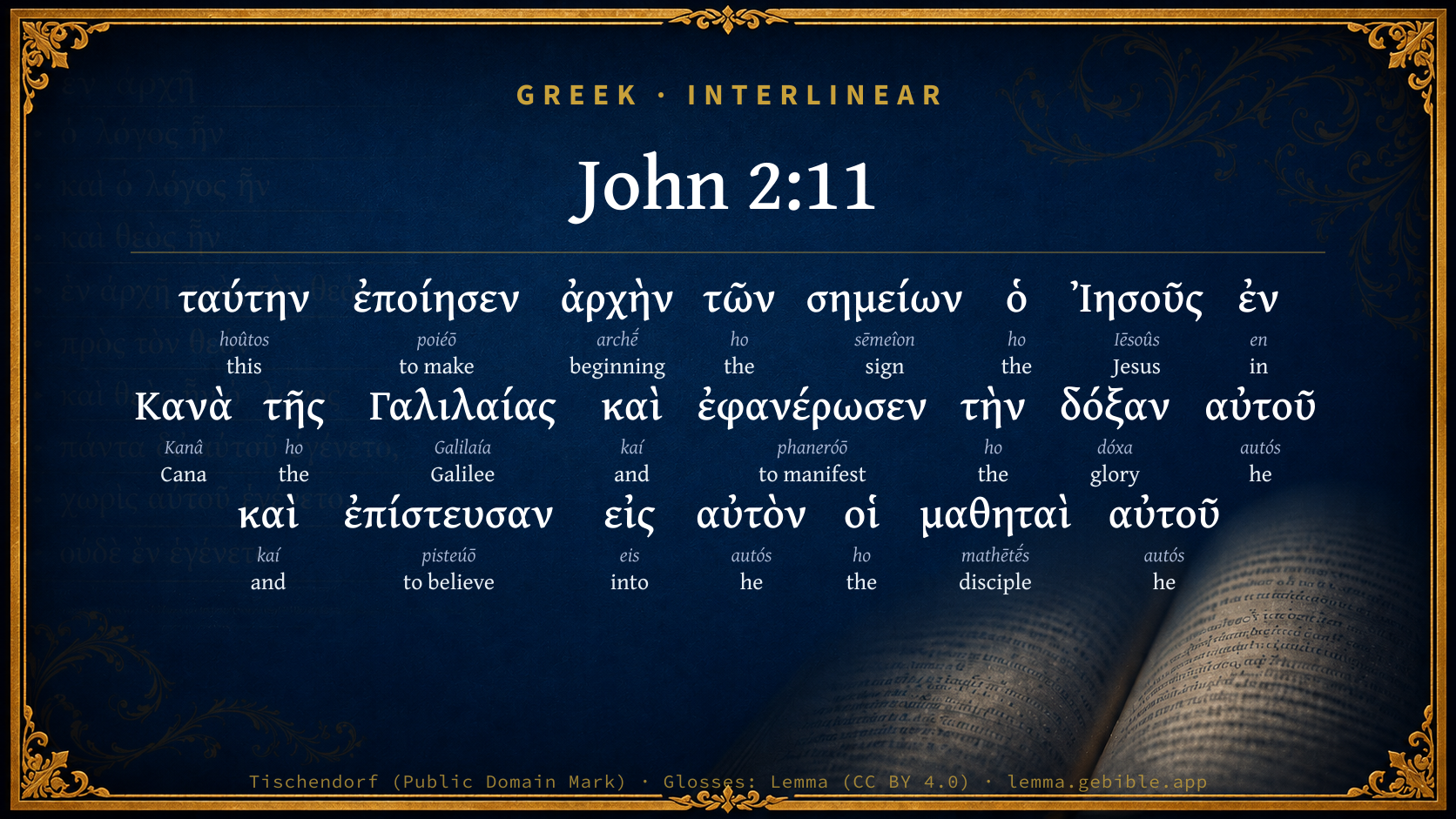
Greek (Tischendorf 8th ed.) John 2:11 appears in the Greek New Testament. The text above is from the Tischendorf 8th edition. Each word links to its Strong’s number and a concise gloss. Click any word for its full Thayer’s Greek Lexicon entry.
Download image
Cite this verse

John 2:11 (World English Bible). Public Domain. Lemma interlinear Bible study tool, https://lemma.gebible.app/v/john/2/11.

Show BibTeX & RIS
BibTeX
RIS
English Translation
This beginning of his signs Jesus did in Cana of Galilee, and revealed his glory; and his disciples believed in him.
World English Bible · Public Domain
Download a study sheet

One document with this verse’s original text, its word-by-word gloss line, the meaning frame, cross-references with their text, attributed commentary, and full source and license credits — printable, and it pastes into notes with its structure intact.

This verse Autodidact and up

Study sheet (.html) Plain text (.txt)

A passage Seminary Student

Up to 50 verses in one chapter. A passage sheet keeps up to 6 commentary sources and 12 cross-references per verse, in the order this page ranks them, and says so on the sheet whenever that leaves anything out. Ask for a single verse and you get the Autodidact verse sheet above.

Everything on this page stays free to read, with no account — the sheet is a download of what is already on screen, not access to it.

Want to remove ads? Support Godless Engineer
Compare translations 3

The same verse in 3 English versions, stacked beneath the original-language interlinear above. Click any original word for its lexicon entry.

Each is an independent rendering of the whole verse — the interlinear is not word-aligned to these translations.

Highlighted words mark where these versions differ — a whole-verse word diff, not a word-by-word alignment.

  • World English Bible Public Domain
    This beginning of his signs Jesus did in Cana of Galilee, and revealed his glory; and his disciples believed in him.
  • King James Version Public Domain
    This beginning of miracles did Jesus in Cana of Galilee, and manifested forth his glory; and his disciples believed on him.
  • unfoldingWord Literal Text CC BY-SA 4.0
    This beginning of the signs Jesus did in Cana of Galilee, and he revealed his glory, and his disciples believed in him.

unfoldingWord Literal Text — © unfoldingWord, licensed CC BY-SA 4.0. Word-aligned USFM3 via Door43 (git.door43.org/unfoldingWord/en_ult).

Versions to compare (up to 4)

3 of 4 selected

Show all 19 translations

Every available English version of this verse, each an independent rendering of the whole verse.

  • World English Bible Public Domain
    This beginning of his signs Jesus did in Cana of Galilee, and revealed his glory; and his disciples believed in him.
  • Berean Standard Bible Public Domain
    Jesus performed this, the first of His signs, at Cana in Galilee. He thus revealed His glory, and His disciples believed in Him.
  • Majority Standard Bible Public Domain
    Jesus performed this, the first of His signs, at Cana in Galilee. He thus revealed His glory, and His disciples believed in Him.
  • King James Version Public Domain
    This beginning of miracles did Jesus in Cana of Galilee, and manifested forth his glory; and his disciples believed on him.
  • American Standard Version (1901) Public Domain
    This beginning of his signs did Jesus in Cana of Galilee, and manifested his glory; and his disciples believed on him.
  • Revised Version (1885) Public Domain
    This beginning of his signs did Jesus in Cana of Galilee, and manifested his glory; and his disciples believed on him.
  • Geneva Bible (1599) Public Domain
    This beginning of miracles did Iesus in Cana a towne of Galile, and shewed forth his glorie: and his disciples beleeued on him.
  • Douay-Rheims (1899) Public Domain
    This beginning of miracles did Jesus in Cana of Galilee; and manifested his glory, and his disciples believed in him.
  • Young's Literal Translation Public Domain
    This beginning of the signs did Jesus in Cana of Galilee, and manifested his glory, and his disciples believed in him;
  • Literal Standard Version CC BY-SA 4.0
    This [is the] beginning of the signs Jesus did in Cana of Galilee, and revealed His glory, and His disciples believed in Him;
  • Unlocked Literal Bible CC BY-SA 4.0
    This first sign Jesus did in Cana of Galilee, and he revealed his glory, and his disciples believed in him.
  • unfoldingWord Literal Text CC BY-SA 4.0
    This beginning of the signs Jesus did in Cana of Galilee, and he revealed his glory, and his disciples believed in him.
  • Darby Bible Public Domain
    This beginning of signs did Jesus in Cana of Galilee, and manifested his glory; and his disciples believed on him.
  • World Messianic Bible Public Domain
    This beginning of his signs Yeshua did in Cana of Galilee, and revealed his glory; and his disciples believed in him.
  • Webster's Bible Public Domain
    This beginning of miracles Jesus performed in Cana of Galilee, and manifested his glory; and his disciples believed on him.
  • Free Bible Version CC BY-SA 4.0
    This was the very first of Jesus' miraculous signs, and was performed in Cana of Galilee. Here he revealed his glory, and his disciples put their trust in him.
  • Bible in Basic English Public Domain
    This, the first of his signs, Jesus did at Cana in Galilee and let his glory be seen openly; and his disciples put their faith in him.
  • Text-Critical English NT CC BY 4.0
    Jesus did this in Cana of Galilee as the first of his signs. He revealed his glory, and his disciples believed in him.
  • Tyndale New Testament (1534) Public Domain
    This beginnynge of miracles dyd Iesus in Cana of Galile and shewed his glory and his disciples beleved on him.

Literal Standard Version (2020), Covenant Press — licensed CC BY-SA 4.0. Text via the HelloAO Bible API (eBible.org). Unlocked Literal Bible (unfoldingWord) — licensed CC BY-SA 4.0. Text via the HelloAO Bible API (eBible.org). unfoldingWord Literal Text — © unfoldingWord, licensed CC BY-SA 4.0. Word-aligned USFM3 via Door43 (git.door43.org/unfoldingWord/en_ult). Free Bible Version, Dr. Jonathan Gallagher — licensed CC BY-SA 4.0. Text via the HelloAO Bible API (eBible.org).

Word by word

More ways to search: Search by grammar → Find every occurrence → Compare this word →

Practice this passage: Drill this verse → Learn its vocabulary →

Κανὰ
Kanâ
G2580
“Cana”
Noun, Proper, indeclinable
Part of Speech
Noun · Proper, indeclinable
Full Thayer's Definition

Origin: of hebrew origin, cf G7071

TDNT: None

Cana = "place of reeds" 1. a village in Galilee about 5 miles (8 km) NW from Nazareth
  1. ταύτην hoûtos G3778 “this” Demonstrative pronoun, Accusative, Singular, Feminine
  2. ἐποίησεν poiéō G4160 “to make” Verb, Aorist, Active, Indicative, 3rd person, Singular
  3. ἀρχὴν archḗ G746 “beginning” Noun, Accusative, Singular, Feminine
  4. τῶν ho G3588 “the” Article, Genitive, Plural, Neuter
  5. σημείων sēmeîon G4592 “sign” Noun, Genitive, Plural, Neuter
  6. ὁ ho G3588 “the” Article, Nominative, Singular, Masculine
  7. Ἰησοῦς Iēsoûs G2424 “Jesus” Noun, Nominative, Singular, Masculine
  8. ἐν en G1722 “in” Preposition
  9. τῆς ho G3588 “the” Article, Genitive, Singular, Feminine
  10. Γαλιλαίας Galilaía G1056 “Galilee” Noun, Genitive, Singular, Feminine
  11. καὶ kaí G2532 “and” Conjunction
  12. ἐφανέρωσεν phaneróō G5319 “to manifest” Verb, Aorist, Active, Indicative, 3rd person, Singular
  13. τὴν ho G3588 “the” Article, Accusative, Singular, Feminine
  14. δόξαν dóxa G1391 “glory” Noun, Accusative, Singular, Feminine
  15. αὐτοῦ autós G846 “he” Personal pronoun, Genitive, Singular, Masculine
  16. καὶ kaí G2532 “and” Conjunction
  17. ἐπίστευσαν pisteúō G4100 “to believe” Verb, Aorist, Active, Indicative, 3rd person, Plural
  18. εἰς eis G1519 “into” Preposition
  19. αὐτὸν autós G846 “he” Personal pronoun, Accusative, Singular, Masculine
  20. οἱ ho G3588 “the” Article, Nominative, Plural, Masculine
  21. μαθηταὶ mathētḗs G3101 “disciple” Noun, Nominative, Plural, Masculine
  22. αὐτοῦ autós G846 “he” Personal pronoun, Genitive, Singular, Masculine

About this verse

These counts appear in no published source. They are computed here, from the morphology-tagged text and Lemma’s own curated glosses. What Lemma adds →

23
words
16
distinct lemmas
Gospels
section

Notable vocabulary

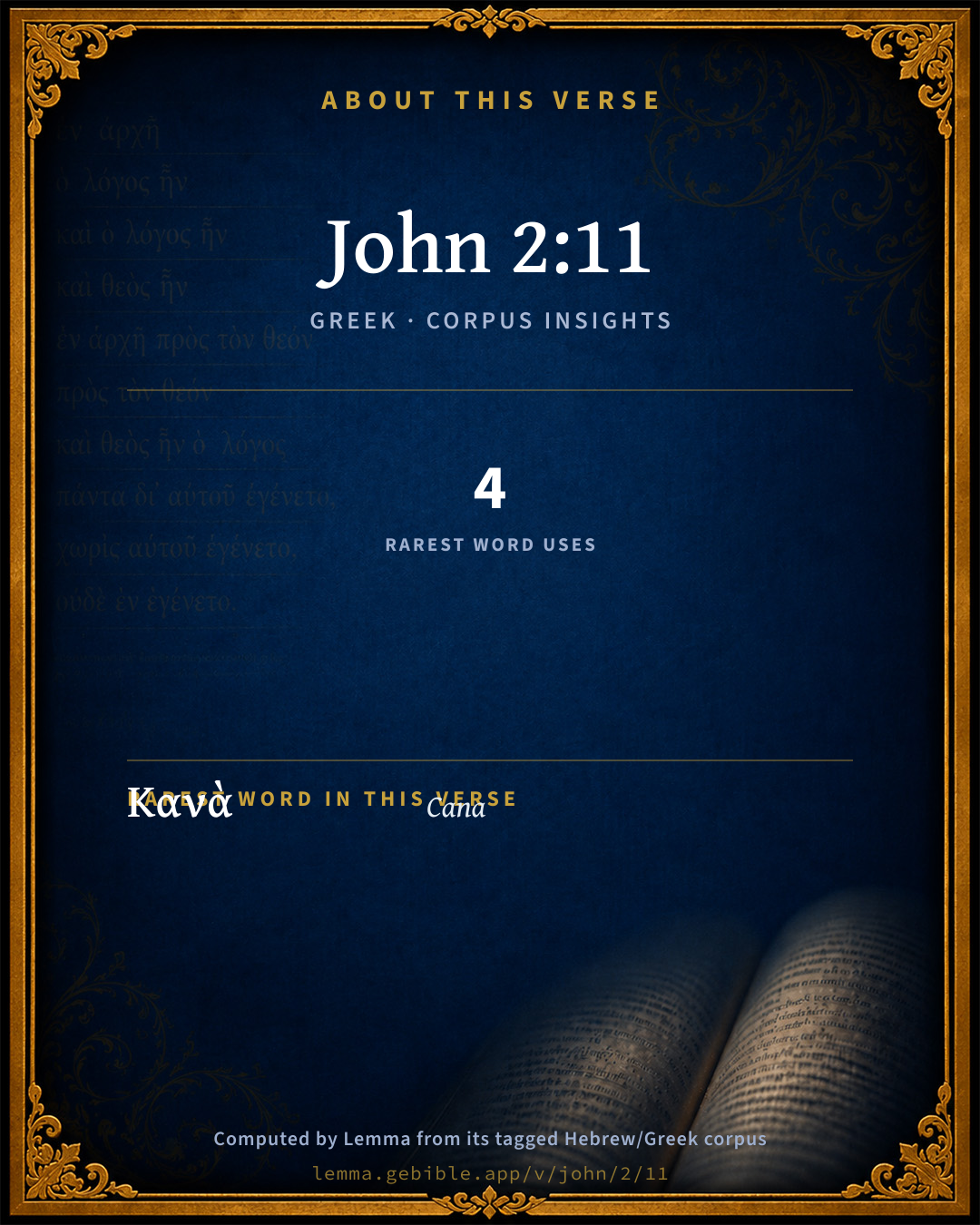
The rarest word here is Κανὰ Cana G2580 — appearing just 4 times in the whole Greek New Testament.

Shared distinctive vocabulary

Κανὰ Cana G2580 occurs in 4 verses of the Greek New Testament. Also found in:

Repetition

Words recur within this verse:

  • τῶν the G3588 ×5
  • αὐτοῦ he G846 ×3
  • καὶ and G2532 ×2

Cross-references

29

Topical passages linked to John 2:11 in the Treasury of Scripture Knowledge — connected by theme and wording, ordered by reader-vote popularity; previews shown in the World English Bible.

  • John 20:30–31 Therefore Jesus did many other signs in the presence of his disciples, which are not written in this book;
  • John 1:14 The Word became flesh, and lived among us. We saw his glory, such glory as of the one and only Son of the Father, full of grace and truth.
  • John 3:2 The same came to him by night, and said to him, "Rabbi, we know that you are a teacher come from God, for no one can do these signs that you do, unless God is with him."
  • John 6:2 A great multitude followed him, because they saw his signs which he did on those who were sick.
  • Isaiah 40:5 and the glory of Yahweh shall be revealed, and all flesh shall see it together; for the mouth of Yahweh has spoken it.
  • John 6:14 When therefore the people saw the sign which Jesus did, they said, "This is truly the prophet who comes into the world."
  • John 6:26 Jesus answered them, "Most assuredly I tell you, you seek me, not because you saw signs, but because you ate of the loaves, and were filled.
  • John 6:30 They said therefore to him, "What then do you do for a sign, that we may see, and believe you? What work do you do?
  • Psalms 96:3 Declare his glory among the nations, His marvelous works among all the peoples.
  • 2 Corinthians 4:17 For our light affliction, which is for the moment, works for us more and more exceedingly an eternal weight of glory;
  • John 12:41 Isaiah said these things when he saw his glory, and spoke of him.
  • John 14:13 Whatever you will ask in my name, that will I do, that the Father may be glorified in the Son.
  • John 1:50 Jesus answered him, "Because I told you, 'I saw you underneath the fig tree,' do you believe? You will see greater things than these!"
  • John 2:23 Now when he was in Jerusalem at the Passover, during the feast, many believed in his name, observing his signs which he did.
  • John 12:37 But though he had done so many signs before them, yet they didn't believe in him,
  • John 4:46 Jesus came therefore again to Cana of Galilee, where he made the water into wine. There was a certain nobleman whose son was sick at Capernaum.
  • 1 John 5:13 These things I have written to you who believe in the name of the Son of God, that you may know that you have eternal life, and that you may continue to believe in the name of the Son of God.
  • Exodus 4:9 It will happen, if they will not believe even these two signs, neither listen to your voice, that you shall take of the water of the river, and pour it on the dry land. The water which you take out of the river will become blood on the dry land."
  • Deuteronomy 5:24 and you said, Behold, Yahweh our God has shown us his glory and his greatness, and we have heard his voice out of the midst of the fire: we have seen this day that God does speak with man, and he lives.
  • Psalms 72:19 Blessed be his glorious name forever! Let the whole earth be filled with his glory! Amen and amen.
  • Ecclesiastes 9:7 Go your way--eat your bread with joy, and drink your wine with a merry heart; for God has already accepted your works.
  • John 5:23 that all may honor the Son, even as they honor the Father. He who doesn't honor the Son doesn't honor the Father who sent him.
  • 2 Corinthians 4:6 seeing it is God who said, "Light will shine out of darkness," who has shone in our hearts, to give the light of the knowledge of the glory of God in the face of Jesus Christ.
  • Exodus 7:19–21 Yahweh said to Moses, "Tell Aaron, 'Take your rod, and stretch out your hand over the waters of Egypt, over their rivers, over their streams, and over their pools, and over all their ponds of water, that they may become blood; and there shall be blood throughout all the land of Egypt, both in vessels of wood and in vessels of stone.'"
  • John 1:17 For the law was given through Moses. Grace and truth came through Jesus Christ.
  • John 11:15 I am glad for your sakes that I was not there, so that you may believe. Nevertheless, let's go to him."
  • 2 Corinthians 3:18 But we all, with unveiled face beholding as in a mirror the glory of the Lord, are transformed into the same image from glory to glory, even as from the Lord, the Spirit.
  • Galatians 3:10–13 For as many as are of the works of the law are under a curse. For it is written, "Cursed is everyone who doesn't continue in all things that are written in the book of the law, to do them."
  • Malachi 2:2 If you will not listen, and if you will not lay it to heart, to give glory to my name," says Yahweh of Hosts, "then will I send the curse on you, and I will curse your blessings. Indeed, I have cursed them already, because you do not lay it to heart.

Cross-references courtesy of OpenBible.info (CC BY 4.0).

Commentary

Notes on John 2:11 from classic Christian and Jewish commentators (each source and its license shown beneath its notes). The classic Christian expositions comment on the surrounding passage and are grouped to its opening verse, so a note may address several verses; the Jewish commentaries on the Tanakh (Rashi and others) are per-verse, so they appear only where the commentator wrote on this verse.

Lemma curates 59 commentaries, every one of them public domain or Creative Commons licensed, each selected and text-cleaned for this edition rather than reprinted as found. About our sources →

The Biblical Illustrator

Joseph S. Exell

Joh_2:11

This beginning of miracles

The miracles of Christ

Miracles are not only a proof but a part of revelation, and carry their own weight of truth quite independent of their testimony to the authority of the whole.

Christs miracles

I. IDENTIFY THE GOD OF NATURE WITH THE CHRIST OF THE GOSPEL, and show that the Word was God, and that all things were made by Him. Believers in Christ do not need their witness, but should follow up their teaching, and study in nature the wisdom and power and goodness of Christ.

II. ILLUSTRATE THE WIDE BENEFICENCE OF THE GOSPEL. They would have been equally cogent as proofs of His Divine authority if there had been no element of mercy in them; and it is humiliating to reflect that had they been miracles of judgment the people would have been more willing to listen to His words. As it was, they were the outcome of the wealth of compassion that filled His heart, and teach us something of the present range of His love.

III. PROVE THE ILLIMITABLE POWER BY WHICH EVERY GOSPEL PURPOSE WILL BE ACCOMPLISHED. The words, the promise, and the power that performs are eternally linked together. No power, therefore, can prevent the accomplishment of the great purposes of salvation. All fears, then, should be banished. There is no danger that the miracles of Christ do not prove to be under His control.

IV. SHOW THE DIVINE EARNESTNESS WITH WHICH GOD PRESSES UPON THE ATTENTION OF SINFUL MEN THE CLAIMS AND MERCY OF HIS GOSPEL. (W. H. King.)

The miracles of nature

Men cry out for signs, but we may see miracles enough every day. I read that Aarons rod budded, and I am astonished. But last spring I saw a cause of greater astonishment--thousands of bare rods budding and blooming blossoms in the hedges. I saw no one do it, and yet the trees were being daily clothed with thicker foliage. Was not that wonderful? I read that the manna came down daily from heaven to the wilderness, and I am amazed. But I see a cause of greater amazement every year: I see your bread coming, not down from heaven, but up from the earth, a much more unlikely place, every day in the spring. Is not that wonderful? I read that Elijah, hiding by the brook Cherith, was daily fed by two carnivorous ravens, and I am filled with wonder. But there is a cause of much greater wonderment in the fact that millions upon millions are daily fed with abundance of bread and meat, without a single raven under Gods sun to cater for them. I read that Jesus Christ multiplied the loaves and fishes, and that the fragments that remained filled twelve baskets full--there was more at the end of the meal than at the beginning. But thisyear I witnessed a greater miracle: I saw the barley and the wheat increasing, some thirty, some sixty, and some a hundred fold; and the loaves and the fishes, notwithstanding the enormous consumption, are more numerous to-day than they have ever been before. Nature is a standing miracle. (J. C. Jones, D. D.)

The beginning of miracles

There are five reasons why this should be the first.

1. As marriage was the first institution ordained by God, so at a marriage was Christs first miracle.

2. As Christ had showed Himself miraculous a little while ago by a fast, so He cloth now by an extraordinary provision at a feast. When He would not makes stones bread, it was not because He could not.

3. He would not make stones into bread to satisfy Satan, but He was willing to turn water into wine to show forth His glory.

4. The first miracle wrought in the world by man was transformation Exo_7:9), and the first miracle wrought by the Son of Man was of the same nature.

5. The first time you hear of John the Baptist, you hear of his strict diet, and so the first time you hear of Christ in His public ministry, you hear of Him at a marriage feast. (Lightfoot.)

This miracle cannot but have a representative character. We may observe

I. ITS ESSENTIAL CHARACTER. A sign of sovereign power wrought on inorganic nature, not on a living body.

II. ITS CIRCUMSTANTIAL CHARACTER. The change of the simpler to the richer element. In this respect it may be contrasted with the first public miracle of Moses, which commences the record of Old Testament miracles.

III. ITS MORAL CHARACTER.

1. The answer of love to faith.

2. Ministering to human joy in one of its simplest and most natural forms (cf. Mat_11:18-19)

.

In each respect the character of the sign answers to the general character of Christ as

1. A new creation.

2. A transfiguration of the ceremonial law into a spiritual gospel.

3. An ennobling of the whole life. In addition, notice that the scene of the sign--a marriage feast--is that under which the accomplishment of Christs work is most characteristically prefigured (Joh_3:29; Mat_22:2; Mat_25:1; Rev_19:7; Rev_21:2). (Bishop Westcott.)

The water made wine

Let us now look at the FACT, the mode, and the motive of this miraculous act. That it was a miracle, a creation-miracle, the turning of water into wine, stands on the face of the record. Every attempt to reconcile belief in the record with an evasion of the creative act implied in it has been a failure. Such suppositions as that the spiritual elevation of the guests under the power of the Lords discourse made them think that to be wine which was only water (Ewald)

, or that He gave to that which still remained water the force and sap of wine (Neander)

or even that this was a supply of wine produced in the ordinary way and providentially arriving in the nick of time at the believing prayer or omniscient foresight of the Saviour (Weiss)

, will not satisfy the fact, nor the plain and honest meaning of the recording Evangelist, an eye-witness of the wonder. Some of those who rest in the fact of the miracle and regard it as creative have vainly attempted to conceive and describe the MODE in which it was wrought. It has long been usual to suggest that this act may be thought of on the analogy of natures work; that what was done here in a moment was the same thing which is done in countless vineyards year by year. The essence of the miracle, says Olshausen, consists in divinely effecting the acceleration of the natural process. So also Augustine long ago. The analogy is tempting, but we gain nothing by it as an explanation. Indeed, it is impossible, and after all inept. There is no real parallel. We can trace these processes in nature; but here we can trace no process. We should have to imagine not only accelerated processes of nature, but also those artificial changes, anticipated and condensed, by which the fruit of the vine becomes a beverage--the ripening of the wine as well as of the grape.

There are no natural laws by which water in a well or in a jar will change into wine. Nature never would do this, however long time you gave her. Finally, for the PURPOSE. One of the main difficulties, according to some expositors, is the absence of sufficient motive. This is a miracle, they say, without a moral end. It is placed at the outset of the Fourth Gospel, with the evident intention of showing

1. That Jesus struck a key-note to His ministry so entirely contrasted with that of the Baptist, whose disciples these first followers of Jesus had originally been.

2. Nor can the objection about the triviality of the occasion justify itself, as if it were the mere relieving of a dinner-table dilemma. Rather the reverse is the true inference. The gracious Lord has sympathy with all needs, the finer as well as the commoner. He who multiplied the loaves for the relief of a hungry congregation might increase the store of wine for the resolving of a social perplexity. The minor graces and courtesies of life are taken account of, in Christianity, as well as the stern realities.

3. But, indeed, to search for an exact necessity as motive here is to miss the whole point. These wedding guests could have done without more and better wine. It is a miracle of superfluity if you will. The well-spring of grace and truth in Jesus Christ overflows at the first onset. He is come to give life, and more abundant. It is placed in the front of the miracle-record not merely to point a contrast between the Saviours ministry and that of the Baptist, but to show how the new economy surpasses the old. This whole transaction reveals His glory as the Bringer of the final and highest dispensation. In Jesus Christ, God has kept His best till last. In fine, it is plainly meant that we should see in this work an epitome of the Lords entire miraculous activity. In it, all His glory is His grace and love. In the Nature miracles we are to note how always He is not ministered unto, but ministers. (J. Laidlaw, D. D.)

The beginning of miracles

All beginnings have a wonderful interest to us. There is a peculiar pleasure in tracing a broad deep river, that bears upon its bosom the commerce of a nation, to its source far up among the mountains, in a little well whose overflowing waters a childs hand could stop; or in going back to the origin of a mighty nation like the Roman, in the drifting ashore, at the foot of the Palatine Hill, of the ark that contained the infant founders. Institutions, social or benevolent, that have been established for ages, derive a fresh charm from the consideration of their first feeble commencement, and the contrast between what they were then and what they are now. There is a mystery about a cloud coming all at once into the blue sky, a star appearing suddenly amid the twilight shades, a spring welling up in the midst of a sandy plain. It seems as if something new were being created before our eyes. A sense of awe comes over us, as if brought into contact with another world. I have had this curious feeling when coming unexpectedly upon the habitat of a very rare plant. This peculiar charm of novelty belongs especially to the origin of sacred institutions-to the beginning of the gospel of Jesus Christ, the performance of the first miracle, the formation of the Christian Church, and the production of the New Testament writings. The thought that there was a time when these things had no existence, that for thirty years Jesus wrought no miracle, that the first believers in the gospel in Judea, Corinth, and Rome had no New Testament, gives a vividness to the feelings with which we regard them, brings back the freshness that has evaporated with long familiarity. The miracle of Cana comes into the midst of the previous natural life of Jesus like a star out of the blue profound, like a well out of the dry mountain side, like a rare, unknown flower appearing among the common indigenous plants of a spot. It brings us out of the narrow wall that hems us round, to the verge of Gods infinity, where we can look over into the fathomless gulf. It is the first act of the new creation, in which a new life-potency entered into what at the time existed, and called forth a new development. It gave to the stream of the worlds course a new motion and a new direction, without which it would have become a stagnant bog--a dead sea. It is the base of that wonderful miracle structure of the gospel, of which the resurrection is the pinnacle. (H. Macmillan, D. D.)

The first miracle

How well fitted this miracle is, in its character, to introduce the train which succeeded it; to open the wonderful order of instructions, doctrines, and works which was afterwards developed; to be, as it was, the first miracle. The glory of the natural day is not manifested forth in the morning by a blaze of meridian splendour. The light is mild and soft which first peeps from behind the hill-tops, or flushes from the bed of ocean. So it was with the glorious gospel of the blessed God. Its first manifestation by miracle was like the spreading dawn. It blended with the joyous accompaniments of a festive occasion and the kind sympathies of domestic life: It came like a nuptial blessing to a young pair who were just commencing the journey of life together. By-and-by we shall see it among the sick, the maimed, and the blind, healing infirmities, and restoring the lost faculties of sense. By-and-by we shall see it in the dark death chamber and the darker tomb, dispelling the darkness and raising the dead. Then we shall find no want of elevation. Then our minds will be filled and overpowered by its sublimity. But now let us do justice to its loveliness, and admire its first approach to the children of men. (F. W. P. Greenwood, D. D.)

Christs first miracle

The first of a series gives the key to the whole. The first animals or plants have been combining types, i.e, have united in themselves the characters of several familes now widely separated. So the earliest human lives were typical. The first notes of a song suggest all that is necessary to make the harmony. And the first miracle enters into all the other miracles that Jesus did, and combines in itself the elements of them all.

1. It is a work of mercy.

2. It is an emblem of a higher spiritual blessing.

3. It is a prophecy of the new genesis.

Like an illuminated initial letter, which contains in itself an illustrated epitome of the contents of the whole chronicle, it appropiately begins the series of Christs beneficent works by a beautiful picture of the nature and design of them all.

I. IT LINKS THE WORK OF THE SECOND ADAM WITH THAT OF THE FIRST. Adams disobedience turned paradise into a wilderness. Christs obedience turns the wilderness into paradise.

II. IT SHOWS THE RESTORATION OF NATURE AS WELL AS HUMANITY. Mans sin brought barrenness: Christs work restores fruitfulness. And as nature shared the effects of the fall with man, it will participate also in the effects of redemption. This miracle is the first step in the process.

III. IT COMBINES THE GOSPEL WITH THE PRECEDING DISPENSATIONS. Moses could only sweeten the waters of Marsh--only ameliorate the bitter spring of human sin, and reform men. Jesus turns the water into wine and regenerates men.

IV. THE OCCASION WAS ONE OF TRANSCENDENT IMPORTANCE. In this respect it is the first in order of rank as well as time.

1. As a human institution marriage stands at the head of all others, originating in paradise and surviving the wreck of the fall.

2. As a type of heavenly mystery it stands first in importance and significance.

(1) The union of those attributes of love and power in God, from which creation had its birth and has its continuance.

(2) The union of Divine influences and human experiences in the soul which forms the kingdom of heaven within.

(3) The union of the Saviour and the Church.

V. THE MIRACLE WAS THE MOST DIFFICULT OF ALL, if any gradation can be allowed. There was here no co-operation of faith. It was not the purification and assistance of a natural function, but a creation de novo. (H. Macmillan, LL. D.)

The miracle as a sign

I. OF CHRISTS MISSION. It was none the less significant because wrought for a temporary purpose. Mans need of Christ appears in trifling as well as conspicuous ways. Food is common-place, but it is an universal need.

1. The act was significant of the joyous and abundant feast He was about to spread for all people.

2. The moment in which it was wrought, when the wine had failed, is a sign of the fact that Christ waits till mans own powers are exhausted before giving His grace. Hence He delayed His advent till the world was exhausted with its efforts to find peace and holiness. The pagan religions were exhausted. Philosophy had failed to solve the problems of life. So we do not receive the fuiness of Christ till convinced of our helplessness and ready to depend on Divine grace.

3. The nature of the miracle, the creation of the wine out of water, not out of nothing, is a sign that

(1) He had come not to create a new world, but to transform the old;

(2) Not to establish a new religion, but to transform Judaism;

(3) Not to produce new characters, but to regenerate stoners. He has poor material to work upon. Human nature is as weak and cold as water. But as He made good and warming wine, so He will strengthen our humanity and fill it with the love of God.

II. OF THE CHARACTER OF CHRIST.

1. Of His grace and glory (Joh_1:14; Joh_1:17).

2. Of His naturalness. He was thoroughly at home, and revealed the natural union of a pure humanity with a Divine life; sympathizing with human joys, as at Bethany with human griefs. Religion does not break the sweet ties which God has formed between man and man.

3. Of His mindfulness of His great object. We see this in His conversation with His mother, which shows us to remember in society that the chief end of man is to glorify God, and that no earthly joy or work must be allowed to unfit us for that. (G. T. Purves.)

The miracle as a sign

In respect of

I. NATURE.

1. It was a miracle in itself, apart from all surrounding circumstances. What is an everyday occurrence in one climate may be a rare wonder in another. To an inhabitant of the tropic the freezing of water would be a miracle. The feats of a chemist would pass for supernatural in the first, but be put down as strictly natural in the nineteenth century. But Christs miracles are miracles all the world over and all the ages through.

2. The miracle was not performed till nature was exhausted. His hour did not come till the wine had actually failed. This always characterizes His interpositions. All He cured were incurable. This is a sign that we may calculate on His presence in extremity. When your earthly wine is all gone, He will come to your relief.

3. This miracle in its results is repeated every year. Miracles are explanatory notes revealing the secret processes of material phenomena, signs of the power that is everywhere and always at work. He turned the water into wine once; He does so still.

II. SOCIETY.

1. It was performed in a wedding. John the Baptist was an ascetic; will Christ be one? The Jews looked for a king; will Christ then claim the throne? Christ was not an ascetic, for He went to a wedding. He was not a dignitary, for it was a wedding of ordinary people. This was a sign then that He belonged to Society.

2. The miracle was performed at the feast. Jesus was always the antagonist of suffering and the source of joy. The thing here signified is that if there is a time to weep there is also a time to rejoice.

3. It was performed at a marriage feast for the purpose of beneficence, to point out the difference between the Old Testament miracles and those of the New, and to show the different character of the two dispensations.

4. It was a miracle of luxury. Wine was not needful to maintain life; loaves and fishes were. This is a sign then that man does not live by bread alone, but is permitted to go after the beautiful in every form. Is it sinful to have pictures whilst the heathen be unreclaimed? There is no reason why Englishmen should be half-civilized because Kaffirs are altogether barbarous. Because the potato is the more useful plant of the two, that is not to say that the rose is unnecessary.

5. The miracle is a sign that self-restraint should be practiced in the midst of abundance.

III. CHRISTS PERSON.

1. He had not to acquire glory, bat only to manifest it. He manifested it here as the Sovereign of nature.

2. As a consequence His disciples believed in Him. They did so before. This confirmed them. Miracles cannot convince unbelievers. It was the disciples, not the guests, who believed. (J. Cynddylan Jones, D. D.)

The first miracle of Christ the sneaking expression of His life and work

I. OF HIS PERSON, in which the earthly human nature becomes a heavenly: the essential, genuine Vine (Joh_15:1).

II. OF THE POWER OF HIS LOVE which transformed the water of earthly need into the wine of heavenly joy: brings forth judgment unto victory, makes blessedness out of Divine sorrow.

III. OF HIS DIVINE WORKS, in which is everywhere reflected His main work of bringing to pass the new birth of mankind from the earthly kingdom into the heavenly.

IV. OF HIS LAST WORK The glorification of the world. (J. P. Lange.)

The beginning of signs: or the sacredness of common life

I. CHRISTS SYMPATHY WITH THE RELATIONSHIPS AND GLADNESS OF MANS LIFE. That was a new thing in the world, the sign of a new spirit that was to pervade mankind. There is a strong tendency in human nature to associate lofty morality with rigorous sternness of life: the prophets; John the Baptist; monks. But here Christ mingles with the gladness of a wedding feast, and exerts His supernatural power to supply a festive need. This implied

1. That earthly life was to be glorified by the heavenly.

2. That human love is not to be carnalized, but made Divine.

3. That human relationships do not clash with the love of God, but are to become powerful instruments for aiding it.

4. That no sphere is too common for Christ to sanctify.

II. CHRIST BESTOWED ON COMMON THINGS A HIGHER POWER IN ORDER TO AWAKEN HUMAN GLADNESS. This signifies the elevation by Him of the natural into the Divine, of the common into the uncommon. Here again was a new thing to the world. To Christs eye nothing was commonplace; not the lowest man nor the plainest life. His mission was to glorify the old and familiar.

III. Combining these two features, we see that LIFE IN ALL ITS COMMON RELATIONSHIPS AND COMMON TOILS IS TO BE A MANIFESTATION AND SERVICE OF CHRIST. In human friendship we are to serve Christ, and in our daily work to glorify Him. Life throughout, with its joys and sorrows, is to be transformed. How is this to be done? Notice

1. That the character of a mans deeds is determined by their inner motive, not by their outward form.

2. This sanctity is attained through the power of Christs love.

IV. THE RESULTS WHICH WOULD FLOW FROM THE ATTAINMENT OF THIS.

1. Life would become a constant manifestation of Christ.

2. Life would be a constant education for the heavenly.

3. It would give us the assurance of eternal fellowship. (E. L. Hull, B. A.)

Miracles as signs

The term sign denotes in its simplest usage

1. A means of identification (Luk_2:12; 2Th_3:17).

2. A proof or evidence furnished by one set of facts to the reality and genuineness of another (2Co_12:12).

3. A symbol or emblem (Eze_4:3). Now the miracles of Christ were signs in all these three senses. They identified Him as the Messiah foretold in prophecy; they authenticated Him as the Son of God, and furnished evidence of the truth of the claims which He put forth; and they were emblems in the material sphere of the blessings which He came to bestow in the spiritual, and of the manner in which they were to be received by those whom He designed to benefit. (W. M. Taylor, D. D.)

Manifested forth His glory

The first miracle an Epiphany of Christ

This glory is undoubtedly Christs Divine glory full of grace and truth; the effulgence of His perfections translated so as to bring them within the reach of sense. And when John says that Christ manifested forth His glory he implies that although it had been almost entirely hidden for years, yet, like the sun behind the clouds, it had all along been lying below the surface. The miracle rolled away the clouds from the face of the sun.

I. CHRISTS GLORY WAS SEEN IN HIS ENTIRE CONTROL OVER NATURE. Power over nature always excites our admiration. But why is it that the man of science, whose genius can tame or discipline steam or electricity, wins so deep and universal an enthusiasm? Not because the feat has the charm of novelty, nor because it is an enrichment of mans life and an addition to his comfort, but because there is in him, at an immeasurable distance, an approximation to God. And yet we can explain it by natural causes which fall within the range of experience. But a miracle passes that line. And since we know that order is a principle which belongs to the very life of the Creator as well as to His administration, we conclude that He will not depart from His ordinary rules without some reason, and that no one but Himself can dispense with them. And thus in a miracle God is actively present, not as authorizing anarchy, but suspending some lower law to give play to some higher. The outward miracle arrests mans reason and imagination to behold in it the manifested glory of the Lord of Nature. Had we witnessed it, should we have recognized it as what it was? Yes, if we can say with the Te Deum that earth as well as heaven is full of the majesty of Gods glory. No, if we see in nature only the operation of self-existent laws.

II. THE GLORY OF SPIRITUAL TRUTH, an unveiling of the laws whereby the King of the new spiritual empire would govern His subjects.

1. Nature is ever being silently changed into something higher and better than when Christ found it. What is Holy Scripture but the water of what might have been a human literature changed by the Spirit of Christ into the inspired Word of God? That which was mere good-nature becomes Divine charity by grace: that which was only well-exercised reason or farsighted judgment becomes faith: all the natural virtues are transformed into the spiritual. So it was at the first. The Sanhedrim were perplexed at the intellectual and moral power of the illiterate apostles. The Roman proconsuls were bewildered at the majestic constancy of poor men and weak women and children. And so it is now.

2. The law of continuous improvement from good to better and from better to best. The real Giver of the good wine does not fascinate by the charm of His earliest gifts and then give to the jaded faculties His poorer graces. In His service the spiritual senses do not follow the law of bodily decay, they gain with advancing years, and require and receive higher nutriment.

III. THE GLORY OF HIS CONDESCENDING AND TENDER CHARITY.

1. Christ here began that life of condescension before men which was involved in His incarnation, and which He followed heedless of slander and misconstruction.

2. Christ here shot forth a ray of that glorious love which redeemed the world. His whole action is marked with tender consideration; He saves this poor couple from the disappointment of being unable to entertain their friends; He adds to their store, but in such a manner as to lay them under no embarrassing obligation to Himself. So God bestows His blessings so unobtrusively that we forget the Giver, but here, as ever, would teach us to imitate Him when we bestow ours. (Canon Liddon.)

The lesson of Epiphany--peace and plenty through Christ

Consider this miracle in the light of the service for the Second Sunday in Epiphany.

I. THE COLLECT, which is a prayer for peace. The Collects are supposed to collect the subject of the Gospel and Epistle. But the gospel is a miracle of plenty, a contrasted idea to that of peace. There may be lavish plenty when there is no peace--there may be deep peace when there is little plenty. And yet in the deepest, truest sense of the terms they are one. Their separation is only temporary and accidental. For what is peace? Perfectly satisfied desire. Disquiet is want of satisfaction. But in spiritual and intelligent creatures there must be the satisfaction of the whole nature. If man be body, spirit, and soul, if any one of these be unsatisfied, he cannot be at rest. In vain you satisfy animal appetite and intellectual craving, if the hunger of the spirit be unappeased. And men are not at peace, because of the first great mistake that man made in his first sin when he withdrew the food for his soul. This food is God. Mans sin was the determination to have the feast of body and mind without this spiritual element, and the sin and misery of man ever since has been to sit down to a banquet from which he has banished God. And God forbid that without Him there should ever be peace: because it is the lack of this plenty disquieting his soul that leads him to God. God teaches this truth in

1. His Word.

2. His providence. Lest man should lose himself in sensual delights God drove him from Eden. Sometimes God shows us how poor the gift is without the Giver; sometimes how blessed the Giver is without the gift, and better by giving Himself with the gift. This is the highest of all states, even heaven itself. This the true peace and plenty our Father meant us to have. It is our sin that has set them in antagonism.

II. Now turn to the Gospel. We see Christ giving back to men the lacking plenty of their feasts. The wine had run low. He renews it in lavish abundance that He may tell as in symbol that for the renovated man the amplest enjoyment of Gods gift is consistent with perfect peace. Christ has come to tell us that we need Him and may have Him in all our joys.

III. THE EPISTLE teaches us that there is an Epiphany amongst men as there was once an Epiphany to men. In the Gospel Christ gave Himself and His best gift to us. In the Epistle Christ calls upon us to show Him forth to men by giving ourselves and our gifts to others. That is the very reason He gave Himself to us. Freely ye have received; freely gird; fill to the brim the means of helping anothers need: your material, intellectual, and spiritual wealth. (Bp. Magee.)

The glory of the Virgin Mother

1. For thirty years Christ had done no miracle: which is itself worthy to be called a miracle. He was content to live in obscurity till His hour was come. This is true greatness. In all the works of God there is a conspicuous absence of haste. Six slow days and nights of creative force before man was made. Two thousand years to discipline and form a Jewish people: four thousand years of darkness, ignorance, and crime before the fulness of the time. Whatever contradicts the Divine plan must pay the price of haste--brief duration.

2. St. Paul speaks of the glory of woman as distinct from that of man. Their provinces are not the same, and the qualities which are prominent and beautiful in the one are the reverse in the other. The glory of her who was highly favoured among women was different from that of her Son in degree--the one was human, the other was more: in order the one manifesting the grace of womanhood, the other the majesty and wisdom of manhood in which God dwelt. The glory of the Virgin consisted in

I. HER CONSIDERATENESS. There is gentle womanly tact in the words They have no wine. Unselfish thoughtfulness about others comforts; delicate anxiety to save a straitened family from the exposure of their poverty. So in old times, with thoughtful hospitality, Rebekah offered water to Abrahams wayworn servant. So Martha showed her devotion even to excess. So the women ministered of their substance.

II. SUBMISSION. Whatsoever He saith unto you, do it. Here is the true spirit of obedience. Not slavishness, but loyalty to and trust in a person whom we reverence. Submission at the outset of the Bible is revealed as womans lot and destiny. The curse of obedience, as that of labour, transformed by Christ into a blessing. This blessing twofold.

1. Freedom from doubt. Mary felt no perplexity at the rebuke. A more masculine mind would have been made sullen and sceptical. Mary could not understand, but she could trust and wait. So with the Syro-Phoenician woman, Mental doubt rarely touches women. Soldiers and sailors do not doubt. Prompt, unquestioning obedience is the soil for faith.

2. Prevailing power with God. The Saviours look promised, probably, more than His words. Prayer is a deep mystery to the masculine intellect. How, says Logic, can mans will modify the will of God? Where, then, lies the use of it? But there is something mightier than intellect, truer than logic--the faith that works by love.

III. PURITY OF HEART AND LIFE.

1. Gradually the recognition of this became idolatry. Why? Before Christ the qualities honoured as Divine were probably masculine--Courage, Wisdom, Truth, Strength. But Christ proclaimed Meekness, Obedience, Affection, Purity--graces distinctly feminine. Men sought to give these new ideas embodiment, and they found them embodied in the Virgin Mother.

2. The only corrective for this idolatry is the perfect humanity of Jesus Christ. His heart had in it the blended qualities of both sexes, and when we have learned that in Christ there is all that is manly and all that is womanly, we are safe from Mariolatry. (F. W. Robertson, M. A.)

The glory of the Divine Son

I. THIS GLORY DID NOT BEGIN WITH THE MIRACLE, THE, MIRACLE ONLY MANIFESTED IT. And if instead of rousing men to see the glory of Christ the miracle merely fastened attention on itself, the whole intention of a miracle is lost. To the wise man the lightning only manifests the electric force which is everywhere, and which for one moment has become visible. As often as he sees it it reminds him that the lightning Slumbers in the dewdrop, in the mist, and in the cloud, and binds together every atom of water that he uses in daily life. But to the vulgar mind the lightning is unique, a something which has no existence until it appears. So to the half-believer a miracle is the one solitary evidence of God. But to the true disciple a miracle only manifests the power and love which are at work everywhere. It is not more glory, but only glory more manifested when water at His bidding passes at once into wine. And if you do not feel as David felt, Gods presence in the annual miracle, and that it is God which in the vintage causeth wine to make glad the heart of man, this miracle would not have given you conviction of His presence. If you hear not Moses and the prophets, etc. This deep truth of miracles most men miss. They believe that Jesus was Divine because He worked miracles. But it is by power less Divine that the same Being bears witness to truth, forgives His enemies, makes it His meat and drink to do His Fathers will?

II. IT WAS THE GLORY OF CHRIST TO DECLARE THE SACREDNESS OF ALL THINGS NATURAL.

1. All natural relationships. John the Baptists was the highest form of religious life known to Israel. His was a life of solitariness. Christ goes to a marriage to declare the sacredness of feelings which had been reckoned carnal and low. For it is through our human affections that the soul first yearns after God, and it is to them that the Infinite reveals Himself: and by an earthly relationship God has typified to us the only true espousal--the marriage of the soul to her eternal Lord.

2. The sacredness of all natural enjoyments. To say that this was a religious ceremony is sophistry; and to say that although Christ was there it would not be safe for us to go, is to overlook the fact that His disciples were there. No! the temptation was past, the ministry of John was over; and now the Bridegroom comes into She world in the true glory of the Messiah--not in a life of asceticism, but in a life of godliness; not separating from life, but consecrating it. The ascetic life is more striking, easier, add more reputable. But the life of Him who was called a man gluttonous and a wine bibber, a friend of publicans and sinners was far harder, but it was heavenlier. (F. W. Robertson, M. A.)

The manifestation of Christs glory

I. The manifestation of Jesus Christ is the only true essence of our Christianity.

II. The manifestation of Jesus Christ is the true evidence of our Christianity.

III. The manifestation of Christ to others is the one great evangelistic duty of the Christian and of the Church. (Bishop Barry.)

The peculiar glory of Christ

Moses was not said to manifest his glory when he turned water into blood; nor Paul, nor Peter, nor any of the apostles, to manifest their glory in the miracles which they wrought. Why this peculiarity of language in the ease of Christ? Was it not from the peculiarity of His person--God as well as man? (J. Fawcett, M. A.)

The glory of conquest

As the first ray of the morning reveals the glorious light which is soon to flood heaven and earth, so the first miracle of Jesus revealed the glory of Him who had come to subdue all things unto Himself. (G. T. Purves.)

Christ at a wedding

You nowhere read of His being at a funeral. Why? Because marriage belongs to the primeval order of creation, but funerals do not. Marriage is a part of the original programme of the universe, but death is an intrusion. He, therefore, went to a marriage to vindicate the Divine order; He did not attend funerals because they are incursions upon that order. He was the Everlasting Life, and consequently could not join in the procession of death. Indeed, each time He met death in His sojourn through the world, He could not but grapple with him and compel him to give up his prey. (J. C. Jones.)

The Biblical Illustrator, edited by Joseph S. Exell (c. 1880s–1900s) — public domain. Text from a community e-Sword module.

Joseph Benson's Commentary

Joh 2:11. This beginning of miracles did Jesus, &c. — Grotius supposes the meaning to be, that this was the first miracle wrought at Cana, another being afterward mentioned, Joh 4:46. But it is plain there must have been a long series of miracles wrought here to justify such a manner of speaking, which doth not at all appear to have been the case. The sense of the expression seems much rather to be, that this was the first of Christ’s public miracles; for probably the necessities of the family might sometimes have engaged him to have done something miraculous in private for its relief. And manifested forth his glory — And that in such an illustrious manner, that his fame was spread over all the neighbouring country; and his disciples believed on him — Namely, more steadfastly than before. Being the first miracle they had ever seen Jesus perform, it tended not a little to the confirmation of their faith.

Joseph Benson's Commentary on the Old and New Testaments (1811–1818) — public domain. Text from a community e-Sword module.

MacLaren's Expositions of Holy Scripture

Alexander MacLaren

John

JESUS THE JOY-BRINGER

THE FIRST MIRACLE IN CANA - THE WATER MADE WINE

Joh 2:11.

The keynote of this Gospel was struck in the earlier verses of the first chapter in the great words, ‘The Word was made flesh and dwelt among us, and we beheld His glory, full of grace and truth.’ To these words there is an evident reference in this language. The Evangelist regards Christ’s first miracle as the first ray of that forth-flashing glory of the Incarnate Word. To this Evangelist all miracles are especially important as being signs, which is the word he generally employs to designate them. They are not mere portents, but significant revelations as well as wonders. It is not, I think, accidental that there are just seven miracles of our Lord’s, before His crucifixion, recorded by John, and one of the Risen Lord.

These signs are all set forth by the Evangelist as manifestations of various aspects of that one white light, of uncreated glory which rays from Christ. They are, if I may so say, the sevenfold colours into which the one beam is analysed. Each of them might be looked at in turn as presenting some fresh thought of what the ‘glory . . . full of grace and truth’ is.

I begin with the first of the series. What, then, is the ‘glory of the only Begotten Son’ which flashes forth upon us from the miracle? My object is simply to try to answer that question for you.

I. First, then, we see here the revelation of His creative power.

It is very noteworthy that the miraculous fact is veiled entirely in the narrative. Not a word is said of the method of operation, it is not even said that the miracle was wrought; we are only told what preceded it, and what followed it. Itself is shrouded in deep silence. The servants fill the water-pots.-’Draw out now,’ and they draw, ‘and bear it to the governor of the feast.’ Where the miraculous act comes in we do not know; what was its nature we cannot tell. How far it extended is left obscure. Was all the large quantity of water in these six great vessels of stone transformed into wine, or was the change effected in the moment when the portion that was wanted was drawn from them and on that portion only? We cannot answer the question. Probably, I think, the latter; but at all events a veil is dropped over the fact.

Only this, we see that in this miracle, even more conspicuously than in any other of our Lord’s, there are no means at all employed. Sometimes He used material vehicles, anointing a man’s eyes with clay, or moistening the ear with the spittle; sometimes sending a man to bathe in the Pool of Siloam; sometimes laying His hand on the sick; sometimes healing from a distance by the mere utterance of His word. But here there is not even a word; no means of any kind employed, but the silent forth-putting of His will, which, without token, without visible audible indication of any sort, passes with sovereign power into the midst of material things and there works according to His own purpose. Is not this the signature of divinity, that without means the mere forth-putting of the will is all that is wanted to mould matter as plastic to His command? It is not even, ‘He spake and it was done,’ but silently He willed, and ‘the conscious water knew its Lord, and blushed.’ This is the glory of the Incarnate Word.

Now that was no interruption of the order of things established in the Creation. There was no suspension of natural laws here. What happened was only this, that the power which generally works through mediating links came into immediate connection with the effect. What does it matter whether your engine transmits its powers through half a dozen cranks, or two or three less? What does it matter whether the chain be longer or shorter? Some parenthetical links are dropped here, that is all that is unusual. For in all ordinary natural operations, as we call them, the profound prologue of this Gospel teaches us to believe that Christ, the Eternal Word, works according to His will. He was the Agent of creation. He is the Agent of that preservation which is only a continual creation. In Him is life, and all living things live because of the continual presence and operation upon them of His divine power. And again I say, what is phenomenal and unusual in this miracle is but the suppression of two or three of the connecting links between the continual cause of all creatural existences, and its effect. So let us learn that whether through a long chain of so-called causes, or whether close up against the effect, without the intervention of these parenthetical and transmitting media, the divine power works. The power is one, and the reason for the effect is one, that Christ ever works in the world, and is that Eternal Word, ‘without whom was not anything made that was made.’ ‘This beginning of miracles did Christ . . . and manifested His glory.’

II. Then, again, we see here, I think, the revelation of one great purpose of our Lord’s coming, to hallow all common, and especially all family, life.

What a strange contrast there is between the simple gladness of the rustic village wedding and the tremendous scene of the Temptation in the wilderness, which preceded it only by a few days! What a strange contrast there is between the sublime heights of the first chapter and the homely incident which opens the ministry! What a contrast between the rigid asceticism of the Forerunner, ‘who came neither eating nor drinking,’ and the Son of Man, who enters thus freely and cheerfully into the common joys and relationships of human nature! How unlike the scene at the marriage-feast must have been to the anticipations of the half-dozen disciples that had gathered round Him, all a-tingling with expectation as to what would be the first manifestation of His Messianic power! The last thing they would have dreamed of would have been to find Him in the humble home in Cana of Galilee. Some people say ‘this miracle is unworthy of Him, for it was wrought upon such a trivial occasion.’ And was it a trivial occasion that prompted Him thus to commence His career, not by some high and strained and remote exhibition of more than human saintliness or power, but by entering like a Brother into the midst of common, homespun, earthly joys, and showing how His presence ennobled and sanctified these? Surely the world has gained from Him, among the many gifts that He has given to it, few that have been the fountain of more sacred sweetness and blessedness than is opened in that fact that the first manifestation of His glory had for its result the hallowing of the marriage tie.

And is it not in accordance with the whole meaning and spirit of His works that ‘forasmuch as the brethren were partakers of’ anything, ‘He Himself likewise should take part of the same,’ and sanctify every incident of life by His sharing of it? So He protests against that faithless and wicked division of life into sacred and secular, which has wrought such harm both in the sacred and in the secular regions. So He protests against the notion that religion has to do with another world rather than with this. So He protests against the narrowing conception of His work which would remove from its influence anything that interests humanity. So He says, as it were, at the very beginning of His career, ‘I am a Man, and nothing that is human do I reckon foreign to Myself.’

Brethren! let us learn the lesson that all life is the region of His Kingdom; that the sphere of His rule is everything which a man can do or feel or think. Let us learn that where His footsteps have trod is hallowed ground. If a prince shares for a few moments in the festivities of his gathered people on some great occasion, how ennobled the feast seems! If he joins in their sports or in their occupations for a while as an act of condescension, how they return to them with renewed vigour! And so we. We have had our King in the midst of all our family life, in the midst of all our common duties; therefore are they consecrated. Let us learn that all things done with the consciousness of His presence are sacred. He has hallowed every corner of human life by His presence; and the consecration, like some pungent and perennial perfume, lingers for us yet in the else scentless air of daily life, if we follow His footsteps.

Sanctity is not singularity. There is no need to withdraw from any region of human activity and human interest in order to develop the whitest saintliness, the most Christlike purity. The saint is to be in the world, but not of it; like the Master, who went straight from the wilderness and its temptations to the homely gladness of the rustic marriage.

III. Still further, we have here a symbol of Christ’s glory as the ennobler and heightener of all earthly joys.

That may be taken with perhaps a permissible play of fancy as one meaning, at any rate, of the transformation of water into wine; the less savoury and fragrant and powerful liquid into the more so. Wine, in the Old Testament especially, is the symbol of gladness, and though it received a deeper and a sacreder meaning in the New Testament as being the emblem of His blood shed for us, it is the Old Testament point of view that prevails here. And therefore, I say, we may read in the incident the symbol of His transforming power. He comes, the Man of Sorrows, with the gift of joy in His hand. It is not an unworthy object-not unworthy, I mean, of a divine sacrifice-to make men glad. It is worth His while to come from Heaven to agonise and to die, in order that He may sprinkle some drops of incorruptible and everlasting joy over the weary and sorrowful hearts of earth. We do not always give its true importance to gladness in the economy of our lives, because we are so accustomed to draw our joys from ignoble sources that in most of our joys there is something not altogether creditable or lofty. But Christ came to bring gladness, and to transform its earthly sources into heavenly fountains; and so to change all the less sweet, satisfying, and potent draughts which we take from earth’s cisterns into the wine of the Kingdom; the new wine, strong and invigorating, ‘making glad the heart of man.’

Our commonest blessings, our commonest joys, if only they be not foul and filthy, are capable of this transformation. Link them with Christ; be glad in Him. Bring Him into your mirth, and it will change its character. Like a taper plunged into a jar of oxygen, it will blaze up more brightly. Earth, at its best and highest, without Him is like some fair landscape lying in the shadow; and when He comes to it, it is like the same scene when the sun blazes out upon it, flashes from every bend of the rippling river, brings beauty into many a shady corner, opens all the flowering petals and sets all the birds singing in the sky. The whole scene changes when a beam of light from Him falls upon earthly joys. He will transform them and ennoble them and make them perpetual. Do not meddle with mirth over which you cannot make the sign of the Cross and ask Him to bless it; and do not keep Him out of your gladness, or it will leave bitterness on your lips, howsoever sweet it tastes at first.

Ay! and not only can this Master transform the water at the marriage feast into the wine of gladness, but the cups that we all carry, into which our tears have dropped-upon these too He can lay His hand and change them into cups of blessing and of salvation.

‘Blessed are they . . . who, passing through the valley of weeping, gather their tears into a well; the rain also covereth it with blessings.’ So the old Psalm put the thought that sorrow may be turned into a solemn joy, and may lie at the foundation of our most flowery fruitfulness. And the same lesson we may learn from this symbol. The Christ who transforms the water of earthly gladness into the wine of heavenly blessedness, can do the same thing for the bitter waters of sorrow, and can make them the occasions of solemn joy. When the leaves drop we see through the bare branches. Shivering and cold they may look, but we see the stars beyond, and that is better. ‘This beginning of miracles’ will Jesus repeat in every sad heart that trusts itself to Him.

IV. And last of all, we have here a token of His glory as supplying the deficiencies of earthly sources.

‘His mother saith unto Him, “They have no wine.”‘ The world’s banquet runs out, Christ supplies an infinite gift. These great water-pots that stood there, if the whole contents of them were changed, as is possible, contained far more than sufficient for the modest wants of the little company. The water that flowed from each of them, in obedience to the touch of the servant’s hand, if the change were effected then, as is possible, would flow on so long as any thirsted or any asked. And Christ gives to each of us, if we choose, a fountain that will spring unto life eternal. And when the world’s platters are empty, and the world’s cups are all drained dry, He will feed and satisfy the immortal hunger and the blessed thirst of every spirit that longs for Him.

The rude speech of the governor of the feast may lend itself to another aspect of this same thought. He said, in jesting surprise, ‘Thou hast kept the good wine until now,’ whereas the world gives its best first, and when the palate is dulled and the appetite diminished, then ‘that which is worse.’ How true that is; how tragically true in some of our lives! In the individual the early days of hope and vigour, when all things were fresh and wondrous, when everything was apparelled in the glory of a dream, contrast miserably with the bitter experiences of life that most of us have made. Habit comes, and takes the edge off everything. We drag remembrance, like a lengthening chain, through all our life; and with remembrance come remorse and regret. ‘The vision splendid’ no more attends men, as they plod on their way through the weariness of middle life, or pass down into the deepening shadows of advancing and solitary old age. The best comes first, for the men who have no good but this world’s. And some of you have got nothing in your cups but dregs that you scarcely care to drink.

But Jesus Christ keeps the best till the last. His gifts become sweeter every day. No time can cloy them. Advancing years make them more precious and more necessary. The end is better in this course than the beginning. And when life is over, and we pass into the heavens, the word will come to our lips, with surprise and with thankfulness, as we find how much better it all is than we had ever dreamed it should be: ‘Thou hast kept the good wine until now.’

Oh, my brother! do not touch that cup that is offered to you by the harlot world, spiced and fragrant and foaming; ‘at the last it biteth like a serpent, and stingeth like an adder.’ But take the pure joys which the Christ, loved, trusted, obeyed, summoned to your feast and welcomed in your heart, will bring to you; and these shall grow and greaten until the perfection of the Heavens.

Alexander MacLaren, Expositions of Holy Scripture (1904–1910) — public domain. Text from a community e-Sword module.

Tyndale Open Study Notes

Tyndale Open Resources

2:11 Jesus had offered his first miraculous sign. In it, he revealed the glory of God (see also 1:14; 11:4, 40).

Tyndale Open Study Notes — © Tyndale Open Resources, licensed CC BY-SA 4.0. Text via the HelloAO Bible API.

Bengel's Gnomon

Johann Albrecht Bengel

Joh 2:11. Ταύτην, this) The early miracles of Christ are put before us in singular abundance; because the beginnings of faith rested on them. [And indeed the first miracles, in this place, and ch. Joh 5:8, “Rise, take up thy bed and walk” (Jesus to the impotent man); Mat 8:13, “Jesus said to the centurion, Go thy way, and as thou hast believed, so be it done unto thee,” He did not perform by His hand, but by words: in order that it might be manifest, His healing power teas divine. A natural force is sometimes in men, so that even rather severe infirmities of body yield to their hands. But Jesus’ healing power was of a different character; since, when subsequently He stretched out His hands, or employed other ceremonials, in miraculous healings, He did so for the sake of those on whom the benefit was conferred: Mar 7:33, etc. (The deaf mute; whom Jesus “took aside, put His fingers into his ears, spit, and touched His tongue”); ch. Joh 8:23 (The blind man; whom Jesus “led out of the town, spit upon his eyes, and put His hands upon him”), etc.—Harm., p. 159, etc.]—ἀρχήν, beginning) Whence now it might be supposed, that more [miracles] would follow.—καὶ ἐφανέρωσε, and manifested) And thus began to manifest His glory. Previously He had not wrought miracles. [He, it seems, gave [præmisit] doctrine before signs. When He made this beginning of signs, the beginning of His doctrine had been previously made with His disciples, who became confirmed in their faith by this very miracle, as also with others, through John the Baptist, and also through Jesus Himself. John 1.—Harm., p. 160.]—ἐπίστευσαν) They believed the more fully [comp. ch. Joh 1:50, a “Because I said, etc., believest thou? Thou shalt see greater things than these.” Even in a marriage-feast a progress in faith is to be sought after. Thenceforth the disciples were prepared to embrace whatever their Lord was about to do and say.—μαθηταί, the disciples) His mother had previously believed: Luk 1:45, “Blessed is she that believed, for there shall be a performance,” etc.

Bengel's Gnomon of the New Testament — English translation (T&T Clark, Edinburgh, 1860) — public domain. Text from a community e-Sword module.

Meyer's Critical & Exegetical Commentary

Heinrich August Wilhelm Meyer

Joh_2:11. The τὴν before ἀρχήν being spurious (see critical notes), we must translate: This, as beginning of His miracles, did Jesus at Cana. See on Joh_4:54, and Bernhardy, p. 319; Stallbaum, ad Plat. Gorg. p. 510 D. From this it is clear that it is the first miracle in general, and not merely the first of those that were wrought in Cana (Joh_4:46 sqq.), that is meant (so already τινές in Chrysostom and Paulus). This concluding remark of Johns simply serves to express, on occasion of the first of them, the teleological nature of the miracles of Jesus generally.

τὴν δόξαν αὐτοῦ] not His excellent humanity (Paulus), but His divine Messianic majesty, as in Joh_1:14. The miracles of Jesus, as He Himself testified, had for their object not only the δόξα of the Father, but also His own, Joh_11:4 (in opposition to Weizsäcker, Jahrb. f. Deutsche Theol. 1857, p. 165). The former is really the latter, and the latter the former. Observe how in John (as well as in the Synoptics) Jesus begins His Messianic ministry in Galilee, even in this His first miracle.

καὶ ἐπίστευσαν, κ.τ.λ.] and His disciples became believers in Him. The faith which they already had (Joh_1:35-51) was only introductory, belonging to the commencement of their connection with Jesus; now, upon the basis of this manifestation of His glory (Joh_1:14), came the more advanced and fuller decision, a new epoch in their faith, which, moreover, still continued susceptible of and requiring fresh additions even to the end (Joh_11:15, Joh_14:11). There is no hint here of any contrast with the unbelief afterwards manifested by the people (Brückner), nor can this be inferred from Joh_2:12 ff. Comp. Weiss, Lehrbegriff, p. 102.

Note.

This turning of the water into wine must be regarded as an actual miracle, for John as an eye-witness (see on Joh_1:41-42), in the most simple and definite manner (comp. Joh_4:46), represents it as such, and as the first manifestation of the divine glory dwelling in Christ in the direction of miraculous working (not as portraying beforehand the heavenly marriage supper, Rev_19:8, Mat_26:29, as Hofmann, Schriftbeweis, II. 2, p. 407, and Baumgarten, p. 99, take it). Every exposition which explains away the miraculous element contradicts the words and the purpose of St. John, infringes on his credibility and capacity for simple observation, and places even the character of Jesus in an ambiguous light. The physical inconceivability, which nevertheless is not identical with absolute impossibility (against Scholten, p. 215), pertains to this work in common only with every miracle;[137] and hence the appeal made to a supposed accelerated process of nature (Olshausen, comp. already Augustine and Chrysostom), which must have been at the same time an artificial process, is only a superfluous crutch on which the representation is made to lean, inapplicable to the other miracles, and as arbitrary as it is (in the absence of a vine) inadequate. Its inconceivableness in a telic point of view John himself removes in Joh_2:11; and remembering its design as there stated, the miracle was not an act of luxury (De Wette), but of abounding human kindness in blessing (see on Joh_2:6). To suppose another design, viz. that Jesus wished to show how opposed He was to the strict asceticism of the Baptist (Flatt, Olshausen), is pure and arbitrary invention, in opposition to Joh_2:11. Further, the fact that the Synoptics have not the narrative really amounts to nothing, because John selected and wrote independently of the synoptical series of narrations; and as they have not the first, so neither have they the last and greatest miracle. We must, after all, abide by the simple statement that there was a change of substance (Joh_2:9), effected by the power of Jesus over the sphere of nature, in conformity with a higher law of causation. Granting this power, which the whole range of the Gospel miracles demands, there is no ground whatever for contenting oneself (against Joh_2:9) with the assumption of a change of attributes merely in the water, whereby (after the analogy of mineral waters) it may have received the colour and taste of wine (Neander). It is levity of an equally objectionable kind, and a wronging of a writer so serious as John, to explain what occurred as a wedding joke, as Paulus (Jesus had a quantity of wine brought into the house, and had it mixed with water out of the pitchers and put upon the tables, Joh_2:4 having been spoken jestingly) and Gfrörer (Mary brought the wine with her as a wedding present, and during the feast, at the right moment, she gave her son a sign to bring out and distribute the gift) have agreed to do. Thus, instead of the transmutation of the water, we have a frivolous transmutation of the history.[138] Lastly, the mythical explanation contradicts the trustworthiness and genuineness of the Gospel. According to it, fact is resolved into legenda legend derived from the analogies of the histories of Moses (Exo_15:23 sqq.) and Elisha (2Ki_2:19), as Strauss will have it, or from a misunderstood parable, as Weisse thinks; while De Wettewithout, however, adopting the mythical view, but not fully recognising the historic character of the narrativeregards the dispensing of the wine as an act corresponding with the dispensing of the bread, and both as answering to the bread and wine in the Lords Supper. This he holds to be the most appropriate explanation; but it is all the more inept, because there is not the least hint of it in the narrative, and because the Lords Supper is not once mentioned in John. According to Schweizer and Weisse, the paragraph is to be reckoned among certain interpolations which have been added to the genuine Johannean nucleus,an arbitrary assertion; whereas Baur, whose criticism rejects the whole Gospel, transforms the narrative into an allegory, wherein water is the symbol of the Baptist, wine of the Messiahs dignity (i.e. the bridegrooms), and the transformation typifies the transition from the preparatory stage of the Baptist to the epoch of Messianic activity and glory (comp. Baumgarten Crusius, p. 82); while Hilgenfeld (Evang. p. 248) looks upon the turning of the water into wine as intended as a counterpart to the synoptical narrative of the temptation, and to illustrate how Jesus was raised above all narrow asceticism. Thus, too, some of the Fathers (Cyril, Augustine, and many others) allegorize the miracle, without, however, surrendering its objective and historical character as a fact; whereas Ewald, while renouncing any investigation into the historic probability of the narrative, regards it as the gilding of the idea of the beneficent power of the Messianic spirit, whereby even now water ought to become wine. Luthardt holds, indeed, the objective historical reality, but regards the manifestation of the δόξα to have been in contrast with that given in the O. T.,the gift of God occupying the place of the command, and the higher life, which Jesus the bridegroom makes known in this miracle, the place of outward purification. Similarly Scholten, p. 164. But while the representation of Christ as bridegroom is quite remote from the narrative, John gives no support or sanction to the idea that the miracle was symbolical, either in the remark of Joh_2:6 (κατὰ τ. καθαρ. τ. Ἰουδ.) or in that of Joh_2:11 (ἘΦΑΝΈΡ. Τ. ΔΌΞ. ΑὐΤΟῦ).

The miracle at Cana is, finally, the only one to which the Synoptics have no one that corresponds. Therefore the miracles in John are all the less to be used in support of the assertion that, in John, Christ, after the manner of the Gnostics, announces another and higher God than the God of the O. T. (Hilgenfeld, Lehrbegr. 281). According to Keim, the marriage in Cana, the first great beaming forth of the divine glory, stands in John as a loving portrait of Christ, and designedly in place of the painful temptation in the wilderness. But this glory beamed forth still more grandly and more significantly in its bearing upon the Saviours whole ministry in the threefold triumph over Satan.

[137] It does not become more conceivable by Langes fiction (L. J. II. p. 479), which is quite unsupported by the text, viz. that the company were elevated to a higher tone of feeling, as the disciples were at a later time upon the mount of transfiguration, and that Christ, from the full spring of His highest life-power, made them drink creatively in the element of the higher feeling.

[138] Ammon also, L. J. I., falls back upon an erroneous idea and representation on the part of John: What took place in the intervening time, when the water-pitchers were empty, and soon after were filled to the brim, is unknown to us. The miracle is thus reduced into a natural event behind the scenes. Schenkel simply enough removes every miraculous element from the history, as being legendary adornments.

Meyer — Critical and Exegetical Commentary on the New Testament — English translation by Peter Christie, edited by Frederick Crombie (T&T Clark, 1880) — public domain. Text from a community e-Sword module.

Expositor's Greek Testament

ed. W. Robertson Nicoll

Joh 2:11 . No answer of the bridegroom is recorded, nor any detail of the impression made, but John notes the incident as “the beginning of signs”. ταύτην εποίησεν ἀρχήν , deleting the article with Tisch [34] and W.H [35] , and rendering “This as a beginning of signs did Jesus,” from which it can scarcely be gathered that no insight mentioned in the first chapter was considered by John to be supernatural. It is characteristic of this Gospel that the miracles are viewed as signs, or object lessons. The feeding of the five thousand presents Jesus as the bread of God; the strengthening of the impotent man exhibits Him as the giver of spiritual life; and so forth. So that when John here says that by this miracle Jesus ἐφανέρωσε τὴν δόξαν αὐτοῦ , we are prompted to ask what particular aspect of His glory was manifested here. What was there in it to elicit the faith and reverence of the disciples? (1) He appears as King in physical nature. He can use it for the furtherance of His purposes and man’s good. He is, as declared in the Prologue, that One in whom is life. (2) A hint is given of the ends for which this creative power is to be used. It is, that human joy may be full. These disciples of the Baptist perceive a new kind of power in their new Master, whose goodness irradiates the natural joys and domestic incidents of human life. (3) When John recorded this miracle he saw how fitly it stood as the first rehearsing as it did the entire work of Christ, who came that human happiness might not untimely close in shame. Wine had become the symbol of that blood which brought reconcilement and renewal. Seeing this sign and the glory manifested in it ἐπίστευσαν εἰς αὐτὸν οἱ μαθηταὶ αὐτοῦ . “Testimony (Joh 1:36 ) directs those who were ready to welcome Christ to Him. Personal intercourse converts followers into disciples (Joh 2:2 ). A manifestation of power, as a sign of divine grace, converts discipleship into personal faith” (Westcott). “Crediderunt amplius” (Bengel). The different grades, kinds, and types of faith alluded to in this Gospel are a study. Sanday remarks on the unlikelihood of a forger making such constant allusion to the disciples. That they believed would seem a truism. If they had not, they would not have been disciples. It would have been more to the point to tell us the effect on the guests, and a forger would hardly have failed to do so. But John writes from the disciples’ point of view. Not happy are the attempts to interpret this seeming miracle as a cleverly prepared wedding jest and gift (Paulus); or as a parable (Weisse), or as a hastened natural process (Augustine, Olshausen). Holtzmann finds here an artistic Lehrdichtung , an allegory rich in suggestion. Water represents all that is mere symbol as contrasted with spirit and reality. The period of symbolism is represented by the water baptism of John: this was to find its realisation in Jesus. The jars which had served for the outward washings of Judaism were by Jesus filled with heart-strengthening wine. The O.T. gift of water from the rock is superseded by the gift of wine. Wine becomes the symbol of the spiritual life and joy of the new kingdom. With this central idea the details of the incident agree: the helplessness of the old oeconomy, “they have no wine”; the mother of the Messiah is the O.T. community; and so forth. The historical truth consists simply in the joyful character ascribed to the beginning of Christ’s ministry. (1) Against all these attempts it is the obvious intention of John to relate a miracle, a surprising and extraordinary manifestation of power. (2) Where allegory exists he directs attention to it; as in this chapter, Joh 2:21 ; also in chapters 10, 15, etc. (3) That the incident can be allegorised is no proof that it is only allegory and not history. All incidents and histories may be allegorised. The life and death of Caesar have been interpreted as a sun myth.

[34] Tischendorf.

[35] Westcott and Hort.

Few, if any, incidents in the life of Jesus give us an equal impression of the width of His nature and its imperturbable serenity. He was at this juncture fresh from the most disturbing personal conflict, His work awaited Him, a work full of intense strife, hazard, and pain; yet in a mind occupied with these things the marriage joy of a country couple finds a fit place.

The Expositor's Greek Testament, edited by W. Robertson Nicoll (1897–1910) — public domain. Text from a community e-Sword module.

Godet's Commentaries

Frédéric Louis Godet

Ver. 11. “This first of his miracles Jesus did in Cana of Galilee, and he manifested his glory, and his disciples believed on him.”

John characterizes under four important relations the miracle which he has just related. 1. This was the first, not only of the miracles performed at Cana, but of all the miracles of Jesus. As here was a decisive moment in the revelation of the Lord and in the faith of the disciples, John brings out this fact with emphasis. The Alexandrian authorities have rejected the article τήν before ἀρχήν, without doubt as being superfluous on account of ταύτην.

But, as is frequently the case with them, when desiring to correct, they spoil. Without the article, the attention is rather drawn to the nature of the miracle: “It was by this prodigy that Jesus began to work miracles.” By the article the notion itself of a beginning is more strongly emphasized: “That fact ...was the true beginning...” The second of these ideas is as thoroughly an essential element in the context, as we shall see, as the first is foreign to it. 2. John recalls a second time, in closing, the place where the event occurred. The design of this repetition cannot be purely geographical. We shall see, in Joh 3:24 and Joh 4:54, how anxious John was to distinguish between the two returns of Jesus to Galilee (Joh 1:44 and Joh 4:1-3), which had been united in one by tradition, and this is the reason why he expressly points out how the one and the other of these two returns was signalized by a miracle accomplished at Cana. According toHengstenberg, the defining words of Galilee recall the prophecy of Isa 8:22 to Isa 9:1, according to which the glory of the Messiah was to be manifested in Galilee. This aim would be admissible in Matthew; it seems foreign to the narrative of John 3. John indicates the purpose of the miracle. He uses here, for the first time, the term sign (σημεῖον) which is in harmony with the following expression: “He manifested His glory.” The miracles of Jesus are not mere wonders (τέρατα), designed to strike the imagination.

A close relation exists between these marvelous acts and the person of Him who performs them. They are visible emblems of what He is and of what He comes to do, and, as Reuss says, “radiant images of the permanent miracle of the manifestation of Christ.” The glory of Christ is, above all, His dignity as Son and the eternal love which His Father has for Him. Now this glory is, in its very nature, concealed from the eyes of the inhabitants of the earth; but the miracles are the brilliant signs of it. They manifest the unlimited freedom with which the Son disposes of all things, and thus demonstrate the perfect love of the Father towards Him: “The Father loveth the Son and hath given all things into His hands” (Joh 3:35). The expression “His glory” makes a profound distinction between Jesus and all the divine messengers who had accomplished like wonders before Him. In the miracles of the other divine messengers the glory of Jehovah is seen (Exo 16:7); those of Jesus reveal His own, by bearing witness in concert with His words, to His filial position. The expression His glory contains, moreover, all of His own that Jesus puts into the act which He has just performed, the love full of tenderness with which He makes use of divine omnipotence in the service of His own. 4. John, finally, sets forth theresult of this miracle. Evoked at first by testimony, faith was strengthened by personal contact with Jesus, its object. Now in the course of this personal relation, it makes such experience of the power and goodness of Him to whom it is attached, that it finds itself thereby immovably confirmed. Doubtless it will grow every day in proportion as such experiences shall multiply; but from this moment it has passed through the three essential phases of its formation: testimony, personal contact and experience. This is what John expresses by the words: “And his disciples believed on him.” These glorious irradiations from the person of Jesus, which are called miracles, are, therefore, designed not only, as apologetics often assume, to strike the eyes of the still unbelieving multitude and to stimulate the delaying, but, especially, to illuminate the hearts of believers, by revealing to them, in this world of suffering, all the riches of the living object of their faith.

What took place in the minds of the other witnesses of this scene? John’s silence leads us to suppose that the impression produced was neither profound nor enduring. This is because the miracle, in order to act efficaciously, must be understood as a sign (Joh 6:26), and because to this end certain moral predispositions are necessary. The impression of astonishment which the guests experienced, not connecting itself with any spiritual need, with any struggle of conscience, was soon effaced by the distractions of life.

On the Miracle of Cana.

Objections of two sorts are raised against the reality of this event: the one class bear on miracles in general; the other, on this one in particular. We do not concern ourselves with the first. We think there is nothing more opposed to the sound method—the method called experimental—than to begin by declaring, as a principle, the impossibility of a miracle. To say that there has never been a miracle until now,—be it so. This is a point for examination. But to say that there cannot be one, is to make metaphysics, not history; it is to throw oneself into the a: priori, which is repudiated.

The objections which relate especially to the miracle of Cana are:

1. Its magical character (Schweizer). The difference between the magical and the miraculous is, that, in the former, the supernatural power works in vacuo, dispensing with already existing nature, while in the second, the divine force respects the first creation and always connects its working with material furnished by it. Now, in this case, Jesus does not use His power to create, as Mary undoubtedly was expecting; He contents Himself with transforming that which is. He remains, thus, within the limits of the Biblical supernatural.

2. The uselessness of the miracle is made an objection. It is “a miracle of luxury,” according to Strauss. Let us rather say with Tholuck, “a miracle of love.” We think we have shown this. It might even be regarded as the payment of a double debt: to the bridegroom, for whom the Lord’s arrival had caused this embarrassment, and to Mary, to whom Jesus, before leaving her, was paying His debt of gratitude. The miracle of Cana is the miracle of filial piety, as the resurrection of Lazarus is that of fraternal affection. The symbolic interpretations, by means of which it has been desired to explain the purpose of this miracle, seem to us artificial: to set the Gospel joy in opposition to the ascetic rigor of John the Baptist (Olshausen); to represent the miraculous transformation of the legal into spiritual life (Luthardt). Would not such intentions betray themselves in some word of the text?

3. This miracle is even charged with immorality. Jesus, it is said, countenanced the intemperance of the guests. “With the same right one might demand,” answers Hengstenberg, “that God should not grant good vintages because of drunkards.” The presence of Jesus and, afterwards, the thankful remembrance of his hosts would guarantee the holy use of this gift.

4. The omission of this story in the Synoptics seems to the adversaries the strongest argument against the reality of the event. But this miracle belongs still to the family life of Jesus; it does not form a part of the acts of His public ministry. Moreover, as we have seen, it has its place in an epoch of the ministry of Jesus, which, by reason of the confusion of the first two returns to Galilee, had disappeared from the tradition. The aim of John in restoring this event to light was precisely to re-establish the distinction between these two returns and, at the same time, to recall one of the first and principal landmaks of the development of the apostolic faith (comp. Joh 2:11).

Do not a multitude of proofs demonstrate the fragmentary character of the oral tradition which is recorded in the Synoptics? How can we explain the omission in our four Gospels of the appearance of the risen Jesus to the five hundred? And yet this fact is one of the most solidly attested (1Co 15:6).

If we reject the reality of the miracle as it is so simply related by the evangelist, what remains for us? Three suppositions:

1. The natural explanation of Paulus or of Gfrorer : Jesus had agreed with a tradesman to have wine brought secretly, during the feast, which He caused to be served to the guests mixed with water. By His reply to Mary, Joh 2:4, He wishes to induce her simply not to injure the success of the entertainment which He has prepared, and the hour for which has not yet come, through an indiscretion. “The glory of Jesus (Joh 2:11), is the exquisite humanity which characterizes His amiable proceeding (Paulus). Or it is to Mary herself that the honor of this attention is ascribed. She has had the wine prepared, in order to offer it as a wedding present; and at the propitious moment she makes a sign to Jesus to cause it to be served (Gfrorer). Renan seems not far from adopting the one or the other of these explanations. He says in vague terms: “Jesus went willingly to marriage entertainments. One of His miracles was performed, it is said, to enliven a village wedding” (p. 195). Weiss adopts a form of the natural explanation which is less incompatible with the seriousness of Jesus’ character (see above on Joh 2:3): nevertheless, he acknowledges that John believed that he was relating a miracle and meant to do so. But could this apostle, then, be so completely deceived respecting the nature of a fact which he himself related as an eye-witness? Jesus must, in that case, have intentionally allowed an obscurity to hover over the event, which was fitted to deceive His nearest friends. The seriousness of the Gospel history protests against these parodies which end in making Jesus a village charlatan.

2. The mythical explanation of Strauss: Legend invented this miracle after the analogy of certain facts related in the Old Testament, e.g., Exo 15:23 ff., where Moses purifies bitter waters by means of a certain sort of wood; 2Ki 2:19, where Elisha does something similar. But there is not the least real analogy between these facts and those before us here. Moreover, the perfect simplicity of the narrative, and even its obscurities, are incompatible with such an origin. “The whole tenor of the narrative,” says Baur himself (recalling the judgment of de Wette), “by no means authorizes us to assume the mythical character of the account.”

3. The ideal explanation of Baur, Keim, etc. According to the first, the pseudo-John made up this narrative as a pure invention, to represent the relation between the two baptisms, that of John (the water) and that of Jesus (the wine). According to the second, the evangelist invented this miracle on the basis of that saying of Jesus: “Can the friends of the bridegroom fast while the bridegroom is with them....They put new wine into new bottles” (Mat 9:15; Mat 9:17). The water in the vessels represents, thus, the insufficient purifications offered by Judaism and the baptism of John. The worse wine, with which ordinarily the beginning is made, is also Judaism, which was destined to give place to the better wine of the Gospel. The delay of Jesus represents the fact that His coming followed that of John the Baptist. His hour is that of His death, which substitutes for the previous imperfect purifications the true purification through the blood of Christ, in consequence of which is given the joyous wine of the Holy Spirit, etc....In truth, if our desire were to demonstrate the reality of the event as it is simply related by John, we could not do it in a more convincing way than by explanations like these, which seem to be the parody of criticism. What! shall this refined idealism, which was the foundation and source even of the narrative, betray itself nowhere in the smallest word of the story! Shall it envelop itself in the most simple, prosaic, sober narrative which carries conciseness even to obscurity! To our view, the apostolic narrative, by its character of simplicity and truth, will always be the most eloquent defender of the reality of the fact.

Before leaving this first cycle of narratives, we must further take notice of a judgment of Renan respecting this beginning of our Gospel (p. 109): “The first pages of the fourth Gospel are incongruous notes carelessly put together. The strict chronological order which they exhibit arises from the author’s taste for apparent precision.” But exegesis has shown, on the contrary, that if there is a passage in our Gospels where all things are linked together and are strictly consecutive, not only as to time, but also as to substance and idea, it is this one. The days are enumerated, the hours even mentioned: it is the description of a continuous week, answering to that of the final week. More than this: the intrinsic connection of the facts is so close that Baur could persuade himself that he had to deal with an ideal and systematic conception, presented under an historic form. The farther the Gospel narrative advances, the more does Renan himself render homage to its chronological exactness. He ends by taking it almost exclusively as a guide for his narration. And the beginning of such a story, whose homogeneity is evident, is nothing but an accidental collection of “notes carelessly put together!” This, at all events, has little probability.

Frédéric Louis Godet — Commentaries on Luke, John, Romans, and 1 Corinthians — English translation (T&T Clark, Edinburgh, 1870s–1890s) — public domain. Text from a community e-Sword module.

Jamieson, Fausset & Brown

Robert Jamieson, A. R. Fausset & David Brown

manifested forth his glory--Nothing in the least like this is said of the miracles of prophet or apostle, nor could without manifest blasphemy be said of any mere creature. Observe, (1) At a marriage Christ made His first public appearance in any company, and at a marriage He wrought His first miracle--the noblest sanction that could be given to that God-given institution. (2) As the miracle did not make bad good, but good better, so Christianity only redeems, sanctifies, and ennobles the beneficent but abused institution of marriage; and Christ's whole work only turns the water of earth into the wine of heaven. Thus "this beginning of miracles" exhibited the character and "manifested forth the glory" of His entire Mission. (3) As Christ countenanced our seasons of festivity, so also that greater fulness which befits such; so far was He from encouraging that asceticism which has since been so often put for all religion. (4) The character and authority ascribed by Romanists to the Virgin is directly in the teeth of this and other scriptures.

Jamieson, Fausset & Brown — Commentary Critical and Explanatory on the Whole Bible (1871) — public domain (CC PDM 1.0). Text via the HelloAO Bible API.

Adam Clarke's Commentary

Verse 11. This beginning of miracles] It was probably the first he ever wrought:-at any rate, it was the first he wrought after his baptism, and the first he wrought publicly.

His glory] His supreme Divinity: Joh 1:14.

His disciples believed on him.] Were more abundantly confirmed in their faith, that he was either the promised Messiah, or a most extraordinary prophet, in the fullest intercourse with the ever blessed God.

Adam Clarke's Commentary on the Bible (1810–1826) — public domain. Text from a community e-Sword/MySword module.

John Calvin's Commentaries

11. This beginning of miracles. The meaning is, that this was the first of Christ’s miracles; for when the angels announced to the shepherds that he was born in Bethlehem, (Luke 2:8,) when the star appeared to the Magi, (Matthew 2:2,) when the Holy Spirit descended on him in the shape of a dove, (Matthew 3:16; Mark 1:10; John 1:32,) though these were miracles, yet, strictly speaking, they were not performed by him; but the Evangelist now speaks of the miracles of which he was himself the Author. For it is a frivolous and absurd interpretation which some give, that this is reckoned the first among the miracles which Christ performed in Cana of Galilee; as if a place, in which we do not read that he ever was more than twice, had been selected by him for a display of his power. It was rather the design of the Evangelist to mark the order of time which Christ followed in the exercise of his power. For until he was thirty years of age, he kept himself concealed at home, like one who held no public office. Having been consecrated, at his baptism, to the discharge of his office, he then began to appear in public, and to show by clear proofs for what purpose he was sent by the Father. We need not wonder, therefore, if he delayed till this time the first proof of his Divinity. It is a high honor given to marriage, that Christ not only deigned to be present at a nuptial banquet, but honored it with his first miracle. There are some ancient Canons which forbid the clergy to attend a marriage. The reason of the prohibition was, that by being the spectators of the wickedness which was usually practiced on such occasions, they might in some measure be regarded as approving of it. But it would have been far better to carry to such places so much gravity as to restrain the licentiousness in which unprincipled and abandoned men indulge, when they are withdrawn from the eyes of others. Let us, on the contrary, take Christ’s example for our rule; and let us not suppose that any thing else than what we read that he did can be profitable to us.

And manifested his glory; that is, because he then gave a striking and illustrious proof, by which it was ascertained that he was the Son of God; for all the miracles which he exhibited to the world were so many demonstrations of his divine power. The proper time for displaying his glory was now come, when he wished to make himself known agreeably to the command of his Father. Hence, also, we learn the end of miracles; for this expression amounts to a declaration that Christ, in order to manifest his glory, performed this miracle. What, then, ought we to think of those miracles which obscure the glory of Christ?

And his disciples believed on him. If they were disciples, they must already have possessed some faith; but as they had hitherto followed him with a faith which was not distinct and firm, they began at that time to devote themselves to him, so as to acknowledge him to be the Messiah, such as he had already been announced to them. The forbearance of Christ is great in reckoning as disciples those whose faith is so small. And indeed this doctrine extends generally to us all; for the faith which is now full grown had at first its infancy, nor is it so perfect in any as not to make it necessary that all to a man should make progress in believing. Thus, they who now believed may be said to begin to believe, so far as they daily make progress towards the end of their faith. Let those who have obtained the first-fruits of faith labor always to make progress. These words point out likewise the advantage of miracles; namely, that they ought to be viewed as intended for the confirmation and progress of faith. Whoever twists them to any other purpose corrupts and debases the whole use of them; as we see that Papists boast of their pretended miracles for no other purpose than to bury faith, and to turn away the minds of men from Christ to the creatures.

John Calvin's Commentaries (1540-1563) — public domain. Text from the Calvin Translation Society English edition (1840s-50s) via the Christian Classics Ethereal Library (ccel.org). Calvin's coverage is partial (roughly two-thirds of the Bible); uncommented books and verses are honest gaps, never fabricated. The 19th-century editor's footnotes and remarks are omitted so the notes are faithfully Calvin's own voice.

Ellicott's Commentary for English Readers

(11) This beginning of miracles did Jesus in Cana of Galilee, or, more exactly, This did Jesus in Cana of Galilee as the beginning of His signs. The form of the sentence makes it certain that it is the absolutely first and not the first in Cana which is meant.

It is important to note here that St. John uses only once, and that in our Lord’s test of the courtier, and connected with “sign” (Joh_4:48), the word which represents “miracle,” “wonder,” “portent,” and that he nowhere uses the word which represents “powers” or “mighty works.” For him they are simply “works,” and these “works” are “signs.” He thinks of our Lord as the agent in all creation, and the source of all life (Joh_1:2-3); but this being so, no display of power impresses him, and no wonder startles him. All is the natural “work” of the divine worker; but like Himself, every work is also a word. It speaks to him who hath ears to hear. It is a “sign” to him who can spiritually interpret. That at His will water became wine, is as natural as that, by that will, the rain passing through earth and vine and grape should become wine. From his point of view both are equally explicable; from any other, both are in ultimate analysis equally inexplicable. “Voici le vin qui tombe du ciel!” is the French peasant’s expression for the one (comp. Trench’s note).

“The conscious water saw its God, and blushed,”

[“Nympha pudica Deum vidit, et erubuit”]

is the English poet’s expression for the other.

This gives the key, then, to the selection of “miracles” by St. John, and to their interpretation. He gives those which mark stages of fuller teaching. They are “signs” of a new revelation, and lead to a higher faith. What was the fuller teaching in this first sign? The heart must seek to read it. Words can only seek to guide. Would not those Jews remember the first miracle of Moses, and later, if not then, see here the contrast between the Law which came by Moses, and the grace and truth which came by Jesus Christ (Joh_1:17)? Would not those exact observers of traditional rites see a living principle growing out of the rite practised at every meal (comp. Mar_7:3, Note), and feel that it is the letter which killeth, it is the Spirit which giveth life? Would not those who thought of Him as the Messianic King of Israel read in His presence at the festal tide of family life the meaning of the claim to be Son of Humanity? Would not the followers of the hermit John learn that Christianity’s message is not for the wilderness, but for the hearts of men; and that its life is not one of seclusion from the world, but of moral power in it (Joh_17:15)? Would not those who had heard the Baptist’s record, and had felt and uttered their own convictions, hear now the secret voice of Nature joining in the witness? Some such thoughts as these came to them in a fulness of power they had not known before. It was to them as a new manifestation of His glory, and the disciples again believed.

The other signs recorded in this Gospel are, the Healing of the ruler’s son (Joh_4:46-54); and of the impotent man at Bethesda (Joh_5:1-9); the Feeding of the five thousand (Joh_6:5-59); the Walking on the sea (Joh_6:15-21); the Giving of sight to the man born blind (Joh_9:1-7); the Raising of Lazarus (John 11); the Draught of Fishes (Joh_21:1-8) See Notes on these passages, and on Joh_20:30.

[(3) JESUS MANIFESTS HIMSELF PUBLICLY (Joh_2:12 to Joh_4:54):

(a) In Jerusalem—the Temple (Joh_2:12-22);

(b) In Jerusalem—the city (Joh_2:23 to Joh_3:21);

Nicodemus: The new birth (Joh_2:1-8);

Belief (Joh_2:9-15);

Judgment (Joh_2:16-21);

(c) In Judœa (Joh_3:22-36). The Baptist.]

A Bible Commentary for English Readers, edited by Charles John Ellicott (1878–1897) — public domain. Text from a community e-Sword module.

The Cambridge Bible for Schools and Colleges

gen. ed. J. J. S. Perowne

11. This beginning, &c.] Better, this, as a beginning of His signs, did Jesus in Cana; i.e. it is the first miracle of all, not merely the first at Cana. Thus S. John agrees with the Synoptists in representing the Messianic career as beginning in Galilee. This verse is conclusive against the miracles of Christ’s childhood recorded in the Aprocryphal Gospels. See on Joh_4:48. Our translators often in this Gospel, though very rarely in the other three, turn ‘signs’ into ‘miracles.’

manifested] The same Greek word occurs in connexion with His last miracle, Joh_21:1; Joh_21:14, and the same English word should be used in all the passages. Comp. Joh_7:4 and see on Joh_1:31.

his glory] This is the final cause of Christ’s ‘signs,’ His own and His Father’s glory (Joh_11:4), and these two are one.

and his disciples believed on him] What a strange remark for a writer in the second century to make! His disciples believed on Him? Of course they did. Assume that a disciple himself is the writer, and all is explained: he well remembers how his own imperfect faith was confirmed by the miracle. A forger would rather have given us the effect on the guests. Three times in this chapter does S. John give us the disciples’ point of view, here, Joh_2:17 and Joh_2:22; very natural in a disciple, not natural in a later writer. See on Joh_11:15 and Joh_21:12.

Two objections have been made to this miracle (1) on rationalistic, (2) on ‘Temperance’ grounds. (1) It is said that it is a wasteful miracle, a parade of power, unworthy of a Divine Agent: a tenth of the quantity of wine would have been ample. But the surplus was not wasted any more than the twelve baskets of fragments (Joh_6:13); it would be a valuable present to a bridal pair. (2) It is urged that Christ would not have supplied the means for gross excess; and to avoid this supposed difficulty it is suggested that the wine made was not intoxicating, i.e. was not wine at all. But in all His dealings with men God allows the possibility of a temptation to excess. All His gifts may be thus abused. The 5000 might have been gluttonous over the loaves and fishes.

Christ’s honouring a marriage-feast with His first miracle gives His sanction (1) to marriage, (2) to times of festivity.

Four hundred years had elapsed since the Jews had seen a miracle. The era of Daniel was the last age of Jewish miracles. Since the three children walked in the burning fiery furnace, and Daniel had remained unhurt in the lions’ den, and had read the hand-writing on the wall, no miracle is recorded in the history of the Jews until Jesus made this beginning of His ‘signs’ at Cana of Galilee. No wonder therefore, that the almost simultaneous appearance of a Prophet like John and a worker of miracles like Jesus attracted the attention of all classes.

The Cambridge Bible for Schools and Colleges (gen. ed. J. J. S. Perowne; Cambridge University Press, 1878–1918) — public domain. Text from a community e-Sword module.

John Gill's Exposition

This beginning of miracles,.... This miracle of turning water into wine, was the first miracle Christ ever wrought, either in public or private; for as for what miracles he is said to do in his infancy, there is no reason to give credit to them: and this he

did in Cana of Galilee; not that this was only the first he did in that place; he afterwards working another there, namely, the cure of a nobleman's son, Joh 4:46, but the first he did any where, and it was in this place; and which the Syriac and Persic versions again call Kotne of Galilee; See Gill on Joh 2:1;

and manifested forth his glory; the glory of his deity and divine sonship, which was hid by his assumption of human nature, but broke forth and showed itself in his miraculous operations, and particularly in this:

and his disciples believed on him; the above five disciples; see Joh 2:2; whom he had called, and who were with him at this marriage, and were made acquainted with this miracle: and though they believed in him before, and had declared, and professed him to be the Messiah, Moses and the prophets spoke of, and the Son of God, and King of Israel; yet they were, by this miracle, more and more confirmed in the faith of these things: besides, others might be made his disciples at this time, and be hereby brought to believe in him.

John Gill's Exposition of the Whole Bible (1746–1763) — public domain (CC PDM 1.0). Text via the HelloAO Bible API.

Trapp's Complete Commentary

John Trapp

11 This beginning of miracles did Jesus in Cana of Galilee, and manifested forth his glory; and his disciples believed on him.

Ver. 11. This beginning, &c.] For as for his miraculous disputation with the doctors, and fasting forty days, these were rather miracles wrought upon Christ than by him. He works his first miracle for confirmation of God the Father’s first ordinance.

His disciples believed on him] So they did before, but now more. So 1Jn 5:13. The apostle writes to "them that believed on the name of the Son of God, that they might believe on the name of the Son of God," i.e. that they might be confirmed, continued, and increased in it. Faith is not like Jonah’s gourd that grew up in a night; or like a bullet in a mould, that is made in a moment. But as the sound of the trumpet grew louder and louder; and as they went up to Solomon’s throne by steps and stairs; so men proceed from faith to faith, till they come to full assurance.

John Trapp, A Commentary or Exposition upon All the Books of the Old and New Testament (1647–1656) — public domain. Text from a community e-Sword module.

Albert Barnes' Notes on the Bible

This beginning of miracles - This his first public miracle. This is declared by the sacred writer to be a “miracle” - that is, an exertion of divine power, producing a change of the substance of water into wine, which no human power could do.

Manifested forth - Showed; exhibited.

His glory - His power, and proper character as the Messiah; showed that he had divine power, and that God had certainly commissioned him. This is shown to be a real miracle by the following considerations:

Real water was placed in the vessels. This the servants believed, and there was no possibility of deception. The water was placed where it was not customary to keep wine. It could not be pretended that it was merely a mixture of water and wine. It was judged to be wine without knowing whence it came. There was no agreement between Jesus and the governor of the feast to impose on the guests. It was a change which nothing but divine power could effect. He that can change water into a substance like the juice of the grape must be clothed with divine power.

Believed on him - This does not mean that they did not believe on him beforehand, but that their faith was confirmed or strengthened. They saw a miracle, and it satisfied them that he was the Messiah. “Before this” they “believed” on the testimony of John, and from conversation with Jesus John 1:35-51; now they saw that he was invested with almighty power, and their faith was established.

From this narrative we may learn:

1. That marriage is honorable, and that Jesus, if sought, will not refuse his presence and blessing on such an occasion.

2. On such an occasion the presence and approbation of Christ should be sought. No compact formed on earth is more important; none enters so deeply into our comfort in this world; perhaps none will so much affect our destiny in the world to come. It should be entered into, then, in the fear of God.

3. On all such occasions, our conduct should be such that the presence of Jesus would be no interruption or disturbance. He is holy. He is always present in every place; and on all festival occasions our deportment should be such as that we should welcome the presence of the Lord Jesus Christ. “That is not a proper stale of feeling or employment which would be interrupted by the presence of the Saviour.”

4. Jesus delighted to do good. In the very beginning of his ministry he worked a miracle to show his benevolence. This was the appropriate commencement of a life in which he was to go about doing good. He seized every opportunity of doing it; and at a marriage feast, as well as among the sick and poor, he showed the character which he always sustained - that of a benefactor of mankind.

5. An argument cannot be drawn from this instance in favor of intemperate drinking. There is no evidence that any who were present on that occasion drank too freely.

6. Nor can an argument be drawn from this case in favor even of drinking wine such as we have. The common wine of Judea was the pure juice of the grape, without any mixture of alcohol, and was harmless. It was the common drink of the people, and did not tend to produce intoxication. “Our” wines are a “mixture” of the juice of the grape and of brandy, and often of infusions of various substances to give it color and taste, and the appearance of wine. Those wines are little less injurious than brandy, and the habit of drinking them should be classed with the drinking of all other liquid fires.

The following table will show the danger of drinking the “wines” that are in common use:

Wine

Alcohol Content

Brandy has fifty-three parts and 39 hundredths in a hundred of alcohol, or

53•39 percent

Rum

53•68 percent

Whisky Scotch..

54•32 percent

Holland Gin.

51•60 percent

Port Wine, highest kind

5•83 percent

Port Wine, lowest kind

1•40 percent

Madeira, highest kind

29•42 percent

Madeira, lowest kind

9•34 percent

Lisbon

8•94 percent

Malaga

7•26 percent

Red Champagne

1•30 percent

White

2•80 percent

Currant Wine

20•25 percent

It follows that a man who drinks two glasses of most of the wines used has taken as much alcohol as if he had taken one glass of brandy or whisky, and why should he not as well drink the alcohol in the brandy as in the wine? What difference can it make in morals? What difference in its effects on his system? The experience of the world has shown that water, pure water, is the most wholesome, safe, and invigorating drink for man.

Albert Barnes' Notes on the Bible (1834–1885) — public domain. Text from a community e-Sword/MySword module.

Haydock's Catholic Bible Commentary

This was the first miracle which Jesus had performed in public, and to manifest his glory; but Maldonatus is of opinion that he had before wrought many miracles, known to the blessed Virgin and St. Joseph; which gave her the confidence to ask one now. This opinion is no way contrary to the evangelist. His disciples believed in him. They had believed in him before or they would not have followed him. This confirmed their faith. (Calmet)

George Leo Haydock (1774–1849), Haydock's Catholic Family Bible and Commentary, 1859 edition — public domain. Excludes Psalms (Douay-Rheims chapter numbering differs from Protestant) and Deuterocanonical books (Catholic canon only).

Matthew Poole's English Annotations

The sense is not, that this was the first miracle which Christ wrought in Cana of Galilee; but this was the first miracle which Christ wrought after he was entered upon the public ministry, and it was wrought in that Cana which is within the confines of Galilee, either in the lot of Zebulun or Asher: yet there are some who would not have it the first miracle which Christ wrought, but the first which he wrought in that place; but there is no reason for such an interpretation; for then there had been no reason for the following words, for Christ did not manifest his glory there only; though some object those wonderful or miraculous things happening at our Saviour’s birth, of which we read, Mat 2:9; Luk 2:9. Yet as some distinguish between mira and miracula, so others give a more plain and satisfactory answer, telling us those were miraculous operations more proper to the Father and the Spirit, thereby attesting the Deity of Christ, than to Christ considered as God man. This was the first of those miraculous operations which were wrought by Christ Jesus as God man, by which he manifested his glory, the glory mentioned in Joh 1:14, as of the only begotten of the Father; his Divine majesty and power.

And his disciples, who before believed on him, Joh 1:41,45, now more firmly believed on him, Joh 14:1, as Mediator. In Scripture that is often said to be, which doth not commence, but increase from that time and occasion.

Matthew Poole's English Annotations on the Holy Bible (1683–1685) — public domain. Text from a community e-Sword/MySword module.

Whedon's Commentary on the Bible

Daniel D. Whedon

11. Beginning of miracles—”The Infancy of Jesus,” a book so called, written very anciently, but later than the Apostolic age, relates previous actions or miracles said to have been performed by Jesus in his childhood. They are of the most fantastic character. These compositions show, by their very nature, their vast inferiority, and the true divinity of the Gospels.

Manifested forth his glory—Glory is God’s own attribute; and Jesus, in putting forth the divine power resident in him, manifested forth his true, indwelling, divine glory.

His disciples believed on him—Believed on him, as he now manifested himself, as possessed of creative power. See note on Joh_2:22.

On this miracle we may remark:

(1.) It confers a divine honour on the institution of marriage. Dr. Clarke says that “it was the first Christian marriage that ever took place; that Christ, his apostles, his mother, the purest of virgins and most holy of witnesses, were all present.” Every wedding should be such as such company might attend. Ministers should be careful that the wedding ceremony be not hastily or irreverently performed, but with a solemn impressiveness. Nor is any place so suitable for such a ceremony as the sanctuary of God.

(2.) Our Lord’s attendance and miracle at this wedding, with its festivity of wine, were public proof that he had not, as some sceptics have maintained, any origin from, or connection with, the sect of Essenes. See note on Mat_3:7. Jesus was no model for anchorites, shakers, or dervizes, but a perfect example of serene, social, every-day piety.

(3.) As long ago as Augustine, it was said that Jesus in this miracle did rapidly what the God of nature does slowly every autumn. Christ only accelerated the process of nature in making water into wine. Olshausen adopts the idea; but Strauss replies that Jesus professedly did more than accelerate nature. He put to the water something besides the water. True. Still the vine does slowly what Jesus here does rapidly; namely, blends with the water those ingredients, collected from the surrounding elements, which constitute the wine. There is, therefore, evidently nothing impossible to divine power in selecting and putting together these elements, which amount to the desired vinous compound.

Daniel D. Whedon (gen. ed.), Commentary on the Old and New Testaments (1874–1909) — public domain. Text from a community e-Sword module.

The Pulpit Commentary

Jesus made this beginning of signs in Cana of Galilee, and manifested his glory. The beginning, the earliest of the tokens which he gave of his higher nature and lofty claims and faculties. The word shmeia , corresponding with the Hebrew twOa, is generally, in the Acts as well as in the LXX, associated with terata , or "portents;" when it occurs in the synoptists it is translated "signs." The word by itself does not connote miraculous energies, but any event, natural or human, which becomes a token or witness to unseen or Divine energies. When Christ"s wonderful actions (often called dunameiv by the synoptists) are referred to by John, he calls them simply erga ; so that operations which, if wrought by other persons, might have been portents, miracles, or marvels, are to him perfectly normal, and are called simply "works." Weiss leaves.the question of the manner in which this supply of wine was provided entirely unsettled, but declares that, whether by some fortunate providential opportunity, by the forecast of the mother, or by concealed methods of meeting the exigency, this great gift was brought about by the Son of Mary, the effect was the same as if it had been wrought by the Creator"s hand. The glory of his power and love and sympathy was manifested. This appears to us utterly inconsistent with the intention or idea of the evangelist. The impression previously made upon John the Baptist was of his supreme submission to the Divine will, his sacrificial yielding to that will for the taking away of sin; further, that in some sense he was Son of God, and Minister and Organ for the dispensation of the Spirit of God. The few disciples admitted that, by his penetration of their character and hidden inner life, his wisdom was of a different kind from that of men. Now, however, they see a manifestation of his glory as power. He has unlimited resources at his disposal, and his disciples believed on him to that extent. This expression asserts the truth of the selective and discriminating force of the mission of Christ, and the negative fact that the company assembled received no religious impression beyond the most superficial one. "The disciples" who came with him "believed" more than they had done before. It may be that they, especially John and Nathanael of Cana, were among the honorary diakonoi who were alone fully conscious of what happened on the occasion. They apprehend the "glory," and entirely trust themselves eiv auton , to him, and follow him with an added momentum. There are new and wonderful suggestions made in this passage which unveil the glory of the Divine love and power now wrought in man. A point of connection with the synoptic Gospels is that they too record Christ"s own description of the contrast between the austere prophet and the Son of man (Mat_11:18, Mat_11:19) in terms almost taken from this very scene. Compare also the mode in which Christ vindicated his own social freedom from Pharisaic exclusiveness, and the conduct of his own disciples from that of John the Baptist"s disciples in the matter of ceremonial purifications, by his parable of the old wine skins bursting with the new and potent fluid put into them. (Mat_9:14-17 and parallel passages) John gives here a deeper apprehension of the mystery, a keynote to a whole cycle of instructions, on the "glory" of his love. By manifesting his Divine sympathy with marriage, with human life and fellowship, with innocent gladness, he proves himself to be the same Christ of whom the synoptic tradition speaks, the same Jesus who took the children to his arms, and constituted a "marriage supper" the great type of the eternal union between God and man in the gospel of his love. (cf. Mat_22:2, etc.) But this same evangelist is filled with the same imagery dating back to experiences of Caua, when he describes the final victory of the "Lamb of God". (Rev_19:7 Rev_21:2)

"This beginning of his signs.

All that a man does may be regarded as significant of his character and aims in life. How far more obviously and instructively is this the case with the actions of the Son of God! Yet, though whatever Jesus did may be regarded thus, there are certain works of his which the evangelist notes especially as being signs. Of these works, the deed performed at Cana is remarked to be the first in point of time.

I WHAT THESE SIGNS WERE IN THEMSELVES.

1. They were works, and mighty works; such as implied great power on the part of the Worker; such as were not wrought by ordinary men.

2. They were wonders, or miracles, fitted to arrest the attention, awaken the inquiry, excite the surprise, of beholders.

3. As in this instance, they were deeds authoritative over nature, its elements, processes, and laws.

II OF WHAT THESE SIGNS WERE SIGNIFICANT. That they did speak to the minds and hearts of those who beheld them, is clear; they compelled the inquiry, "What manner of man is this?" The works led the witnesses to ask concerning the Worker; for they testified of him.

1. Of a Divine presence and power among men. The signs were as the cry of a herald, as a trumpet call summoning the attention of all who were capable of understanding. They spake in plainest language, and their voice and utterance was this: "The King of nature and the Lord of man is here!

2. Of Divine compassion and mercy. Observe the contrast between the mediators of the old covenant and the new. The first sign which Moses wrought was to turn water into blood; the first which Jesus presented to men was to turn water into wine. We see pity in its varying grades excited by human want and. misery, manifesting itself in the exercise of authority prompted and guided by love.

3. Of Divine adaptation to special needs of men. There was vast variety in the miraculous ministrations of Immanuel. The first sign proves that the same Lord who supplies the most urgent wants is not unmindful of the social pleasures and comforts of men. There is delicate discrimination and thoughtful adaptation and suitability in the marvels which Jesus wrought. Bread for the hungry, healing for the sick; yet also wine for the joyful and the festive.

III TO WHOM THESE SIGNS APPEALED.

1. Not primarily to unbelievers. Whether there were any such in the happy circle in whose midst and for whose benefit the first of the signs was exhibited, we do not know; probably all were friendly and receptive, and none more than partially enlightened. Jesus did not go into public and perform a wonder to amaze a multitude.

2. But to his disciples. There was no sign from heaven for the unspiritual, but for the believing and affectionate there were proofs given that their confidence and love were not misplaced. "His disciples believed on him," i.e. all the more as they saw more of the might of his word and the tenderness of his heart. T.

"Jesus... manifested forth his glory.

Does it seem to the reader of this simple narrative that this language is somewhat strained is pitched rather too high? An obscure village, a homely festival, a peasants" party; are these suggestive of, harmonious with, this great word "glory"? Ah! let us not be deceived by outward, appearances; but rather remember that, as the world judges, there was no glory in Jesus any more than in his surroundings, his associates. Be it ours to form a wiser, juster, truer judgment.

I GLORY WAS MANIFESTED IN CHRIST"S COMMAND AND CONTROL OF NATURE.

II GLORY WAS SHOWN FORTH IN THE REVELATION OF CHRIST"S OWN LOVE AND GRACE. To the purged vision of evangelists and apostles there was a higher glory in the pity of the Redeemer than could have been displayed by any sign from heaven. "They beheld his glory...full of grace and truth.

III GLORY WAS REFLECTED UPON THE COUNTENANCES AND THE HEARTS OF THE ASSEMBLED COMPANY. The master of the feast, the bride and the bridegroom, may little have known who and what manner of person they had invited and were entertaining in Jesus of Nazareth. But henceforth! surely henceforth he must have been to them the Divine Friend and Lord. Whosoever will welcome Jesus to his home and to his heart shall learn the mystery alike of his majesty and of his love.

IV GLORY WAS REVEALED TO CHRIST"S OWN DISCIPLES. These five newly found companions and pupils were soon privileged with intimations of the unique character and power of their Master. It was a lesson memorable and precious as being the first among many. They who learn from Jesus lessons of love and pity, lessons of wisdom and power, learn at the same time a lesson of moral splendour and majesty which shall prepare them for renewed manifestations in a long, an infinite series.

V GLORY WAS, THROUGH THIS RECORD, RADIATED TO ALL TIME AND TO THE WHOLE UNIVERSE, REVEALING THE CHARACTER AND THE MINISTRY OF IMMANUEL. T.

"His disciples believed on him.

There is singular simplicity and beauty in this statement, coming where it does at the close of this narrative.

I OF WHOM IS THIS BELIEF ASSENTED? Not, as might perhaps have been expected, of strangers, who witnessed the mighty work and sign, but of five men here named "the disciples" of Jesus.

II WHAT WAS THEIR PREPARATION FOR THIS BELIEF? Undoubtedly their admiration and affection for Jesus, who had sought them or welcomed them, and shown them the friendliness of his heart.

III WHAT WAS THE OCCASION OF THIS RELIEF? It was the "sign" they witnessed, the moral glory which they discerned in the Master"s sympathetic and gracious action. Coming to hearts so prepared, the wonder did its work effectually.

IV WHAT WERE THE RESULTS OF THIS BELIEF?

1. The satisfaction, rest, and joy of their own minds.

2. The resolve and ability to publish the Saviour"s fame, and bring men to behold his glory. T.

The Pulpit Commentary (1880–1919), ed. H.D.M. Spence-Jones & Joseph S. Exell — public domain. Text from a community e-Sword module.

John Wesley's Explanatory Notes

And his disciples believed - More steadfastly.

John Wesley, Explanatory Notes Upon the Whole Bible (1754–1765) — public domain. Text via the GEBible commentary corpus.

The People's New Testament

B. W. Johnson

11. Manifested forth his glory. This was the first supernatural manifestation of his divine power; that he by whom all things were made controlled the powers of nature. His disciples believed on him. They already believed, but their faith was made firmer.

B. W. Johnson's The People's New Testament with Notes (1889–1891) — public domain. Electronic text from the Christian Classics Ethereal Library (CCEL) ThML edition.

unfoldingWord translationNotes

Door43 World Missions Community

Connecting Statement:

This verse is not part of the main story line, but rather it gives a comment about the story. (See: Introduction of a New Event)

Cana

This is a place name. (See: How to Translate Names)

revealed his glory

Here "his glory" refers to the mighty power of Jesus. AT: "showed his power"

translationWords

miracle

Galilee

reveal

glory

disciple

believe

unfoldingWord translationNotes — © Distant Shores Media and the Door43 World Missions Community, licensed CC BY-SA 4.0. Source: git.door43.org/Door43/en_tn.

Cambridge Greek Testament for Schools and Colleges

11. ταύτην ἐπ. ἀρχ. τ. σ. This as a beginning of His signs did Jesus: it is the first miracle of all, not merely the first in Cana. This is quite conclusive against the miracles of Christ’s childhood recorded in the Apocryphal Gospels and is evidence of the truthfulness of the writer. If he were inventing, would he not also place miracles throughout the whole of Christ’s life? See on Joh 2:23, Joh 4:48; σημεῖον should throughout the Gospel be rendered ‘sign’ not ‘miracle.’ Δυνάμεις, so frequent in the Synoptists for ‘miracles,’ is never used by S. John; τέρατα only once (Joh 4:48), and then in conjunction with σημεῖα, a word which he uses 17 times. Christ’s miracles were ‘signs’ of His Divine mission: comp. Exo 4:8. They were evidence of a perfect humanity working in unison with a perfect Divinity. They were also symbolical of spiritual truths: see on Joh 9:39.

ἐν Κανᾷ τ. Γαλ. Thus S. John agrees with the Synoptists in representing the Messianic career as beginning in Galilee.

ἐφανέρωσεν. Another of S. John’s favourite words (see on Joh 1:31): the rendering should be kept uniform, especially here, Joh 7:4, Joh 17:6, Joh 21:1, where the active is used. In the other Gospels the word occurs only Mar 4:22 [Joh 16:12; Joh 16:14], always in the passive.

τὴν δόξαν αὐτοῦ. This is the final cause of Christ’s ‘signs,’ His own and His Father’s glory (Joh 11:4), and these two are one. Herein lies the difference between His miracles and those wrought by Prophets and others: they never manifested their own glory, but that of Jehovah (Exo 16:7).

ἐπιστ. εἰς αὐ. οἱ μαθ. αὐ. What a strange remark for a writer in the second century to make! His disciples believed on Him? Of course they did. Assume that a disciple himself is the writer, and all is explained: he well remembers how his own imperfect faith was confirmed by the miracle. A forger would rather have given us the effect on the guests. Three times in this chapter does S. John give us the disciples’ point of view, here, Joh 2:17 and Joh 2:22; very natural in a disciple, not natural in a later writer. See on Joh 11:15, Joh 21:12.

This verse gives us four facts respecting the sign; 1. it was the first; 2. it took place in Galilee; 3. its end was Christ’s glory; 4. its immediate result was the confirmation of the disciples’ faith.

Two objections have been made to this miracle (1) on rationalistic, (2) on ‘Temperance’ grounds. (1) It is said that it is a wasteful miracle, a parade of power, unworthy of a Divine Agent: a tenth of the quantity of wine would have been ample. But the surplus was not wasted any more than the twelve baskets of fragments (Joh 6:13); it would be a royal present to the bridal pair. (2) It is urged that Christ would not have supplied the means for gross excess; and to avoid this supposed difficulty it is suggested that the wine made was not intoxicating, i.e. was not wine at all. But in all His dealings with men God allows the possibility of a temptation to excess. All His gifts may be thus abused. The 5000 might have been gluttonous over the loaves and fishes.

Christ’s honouring a marriage-feast with His first miracle gives His sanction (1) to marriage, (2) to times of festivity. And here we see the contrast between O. and N.T. The miracles of O.T. are mostly miracles of judgment. Those of N.T. are nearly all miracles of blessing. Moses turns water into blood: Jesus turns water into wine.

Four hundred years had elapsed since the Jews had seen a miracle. The era of Daniel was the last age of Jewish miracles. Since the three children walked in the burning fiery furnace, and Daniel had remained unhurt in the lions’ den, and had read the handwriting on the wall, no miracle is recorded in the history of the Jews until Jesus made this beginning of His ‘signs’ at Cana of Galilee. No wonder that the almost simultaneous appearance of a Prophet like John and a Worker of miracles like Jesus attracted the attention of all classes.

On the symbolical meaning of this first sign see Introduction, chap. v. § 3.

Cambridge Greek Testament for Schools and Colleges (Cambridge University Press, 1896; 21 vols, various authors incl. Carr, Maclear, Plummer, Farrar, Lumby, Moule, M. R. James, Simcox) — public domain. Text from a community e-Sword module.

Alford’s Greek Testament

Henry Alford

11.] Without the article before ἀρχήν (see . in digest) it is This wrought Jesus as the beginning of his miracles:—ἀρχή being the predicate.

This assertion of John excludes all the apocryphal miracles of the Gospel of the Infancy, and such like works, from credit.

σημεῖον, which occasionally occurs in the other Gospels and the Acts in this absolute sense of a miracle (see reff.), is St. John’s ordinary word for it. Cf. Luthardt, p. 62.

τὴν δόξαν αὐτ.] The glory, namely, which is referred to in ch. 1:14, where see note. It was a miracle eminently shewing forth the glory of the λόγος, διʼ οὗ πάντα ἐγένετο, in His state of having become flesh. And this ‘believing on Him,’ here predicated of the disciples, was certainly a higher faith than that which first led them to Him. They obtained new insight into His power;—not yet reflectively, so as to infer what all this implied, but so as to increase their faith and trust in Him. Again and again ‘they believed:’ new degrees of faith being attained; just as this has since been the case, and will continue to be, in the Church, in the continual providential development of the Christian spirit,—the leavening of the whole lump by degrees.

This important miracle, standing as it does at the very entrance of the official life of Christ, has been the subject of many doubts, and attempts to get rid of, or explain away, the power which was here manifested. But never did a narrative present a more stubborn inflexibility to the wresters of Scripture:—never was simple historical veracity more strikingly stamped on any miracle than on this. And doubtless this is providentially so arranged: see the objections to it treated, and some admirable concluding remarks, in Lücke, i. 478.

To those who yet seek some sufficient cause for the miracle being wrought, we may—besides the conclusive answer that we are not in a position to treat this question satisfactorily,—assign the unmistakeable spiritual import of the change here made, as indicating the general nature of the beneficent work which the Lord came on earth to do. So Cornelius a Lapide (Trench, p. 113, edn. 2, note): “Christus initio suæ prædicationis mutans aquam in vinum significabat se legem Mosaicam, instar aquæ insipidam et frigidam, conversurum in Evangelium gratiæ quæ instar vini est, generosa, sapida, ardens, et efficax.” Similarly Eusebius, Augustine, Bernard, and Gregory the Great. Trench, ibid.

Henry Alford, The Greek Testament (1849–1861) — public domain. Text from a community e-Sword module.

International Critical Commentary

11. ταύτην ἐποίησεν ἀρχὴν τῶν σημείων. We have now passed from the “witness” of the Baptist to the “witness” of the works of Jesus (see on 1:7). The Miracle of Cana was the first of the “signs” which Jesus wrought during His earthly ministry. By them, according to Jn., “He made manifest His glory” (see on 1:14). They were not merely wonders or prodigies (τέρατα), but “signs” by which men might learn that He was the Christ (20:31) and “believe on Him.” (For the phrase πιστεύειν εἱς αὐτόν, see on 1:12.) The highest faith is that which can believe without a sign (20:29), but signs have a useful function as bearing their witness to the glory of Jesus. This aspect of His signs is asserted by Jesus Himself (5:36). When the tidings reached the disciples that Lazarus was dead, He said that it was well, for the miracle of his recovery would be all the greater (11:15). He rebuked the multitudes, because they followed Him for what they might get, and not because of His signs (6:26). Cf. 10:38, 14:11. And the same aspect of miracles appears in the Synoptists (Mar 2:10, Mat 11:20, etc.).1 See on 4:48 and 10:25.

The “disciples” who are here said to have “believed on Him” as a consequence of what they saw at Cana, or rather whose new faith was thus confirmed, were, as yet, few in number, Philip and Nathanael and John being among them (see on v. 2).

Additional Note on the Miracle at Cana

Some exegetes have supposed that this incident foreshadowed (or was intended by the evangelist to indicate) the replacement of the inferior dispensation by the superior, the Law by the Gospel. Such a view of Jn.’s literary method has been discussed in the Introduction (p. lxxxv); but it may be pointed out that the arguments assembled to prove that this particular narrative is an invention of the evangelist, designed to teach spiritual truth in an allegorical way, seem peculiarly weak.

(1) Six, it is said, is a significant number—the perfect number—and so there are 6 waterpots. But there is no number from 1 to 10 which could not be given a mystical interpretation; and the idea that 6 represents the 6 days of creation, which is the best that Origen1 can do with the waterpots, is not very convincing.

Origen also suggests that the “two or three firkins” in each waterpot of purification intimate that the Jews are purified by the word of Scripture, receiving sometimes “two firkins,” i.e. the psychical and spiritual sense of the Bible, and sometimes “three firkins,” i.e. the psychical, spiritual, and corporeal senses. That is, he thinks that on occasion the literal or corporeal sense is not edifying, although it generally is (see Introd., p. lxxxv). But Origen does not say that he abandons the literal or historical sense of Joh 2:1-11, and it is probable that he did not mean this, while he found allegorical meanings in some details of the story.2 In the same way, Gregory of Nyssa is not to be taken as questioning the historicity of the narrative when he says that “the Jewish waterpots which were filled with the water of heresy, He filled with genuine wine, changing its nature by the power of His faith.”3 That an incident can be treated by a commentator in an allegorical manner does not prove that he regards it as unhistorical, and still less that the narrator had invented it to serve a spiritual purpose.

For example, there must be few preachers who have not drawn out lessons of a spiritual sort from the incident of the wine that was served at the end of the wedding feast being the best. It is a law of nature, and therefore a law of God, that the best comes last, being that for which all that goes before has prepared. So it is, to take the illustration suggested by the story, in a happy marriage. The best wine of life comes last. The fruits of autumn are richer than the flowers of spring. So perhaps it will be in the next life:

“… the best is yet to be,

The last of life for which the first was made.”

Such reflexions are legitimate. But there is nothing to show that they were in the mind of the evangelist, or that the story of the Marriage at Cana was invented to teach them.

(2) A modern attempt to explain the story of the Sign at Cana as merely a parable of edification is that of E. A. Abbott.4 He finds the germ of the story in the account of Melchizedek given by Philo, as bringing forth “wine instead of water” (Leg. Alleg. iii. 26); and he explains that “the six waterpots represent the inferior dispensation of the weekdays, i.e. the Law, preparing the way for the perfect dispensation of the Sabbath, i.e. the Gospel, of which the wedding feast at Cana is a type.” He adds a Philonic quotation about the number 6 “being composed of 2 × 3, having the odd as male and the even as female, whence originate those things which are according to the fixed laws of nature. … What the number 6 generated, that the number 7 exhibited in full perfection” (de septen. 6).

Moffatt1 favours yet a third Philonic explanation of the number 6, suggesting that the six ὑδρίαι correspond to Philo’s principle that six is the “most productive” (γονιμωτάτη) of numbers (decal. 30).

These are desperate expedients of exegesis, and if Jn. really had any such notions in his mind when he said there were six waterpots prepared for the use of the wedding guests, he wrote more obscurely than is his wont. The truth is that mention of this unusually large number of ὑδρίαι is more reasonably to be referred to the observation of an eye-witness, who happened to remember the circumstance, than to elaborate symbolism of the narrative.

(3) The case for treatment of the whole story as due to a misunderstanding of some figurative saying can be put more plausibly. Wendt2 puts it thus: “It is quite possible that an utterance which the apostle originally made in a figurative sense—Jesus turned the water of legal purification into the wine of marriage joy—was afterwards interpreted by the circle of Johannine disciples as recording an actual conversion of such water of purification into wine for a marriage.” This is not to say that Jn. did not mean to narrate the incident as historical; it is to say, on the contrary, that he was mistaken in doing so, and that the story, in all its intimate detail, has been built up from vague hearsay. Quite different is such a theory from that which would regard the narrative as invented in order to teach that the wine of the Gospel, which Jesus provides, is better than the unsatisfying water of the Law; but it has its own difficulties. See Introd., p. clxxxii.

Interlude at Capernaum (V. 12)

International Critical Commentary — older volumes (1896–1929), various authors — public domain. Text from a community e-Sword module.

Vincent's Word Studies in the New Testament

Marvin R. Vincent

This beginning. Or, more strictly, this as a beginning.

Of miracles [σημειων] . Rev., correctly, signs. See on Mt 11:20; Mt 24:24. This act was not merely a prodigy [τερας] , nor a wonderful thing (qaumasion), nor a power [δυναμις] , but distinctively a sign, a mark of the doer's power and grace, and divine character. Hence it falls in perfectly with the words manifested His glory.

Believed on Him [επιστευσαν εις αυτον] . See on 1 12. Literally, believed into. Canon Westcott most aptly says that it conveys the idea of "the absolute transference of trust from one's self to another."

Marvin R. Vincent, Word Studies in the New Testament (1887–1900) — public domain. Text from a community e-Sword/MySword module.

Lesson kit

Teaching starters — assembled from the data on this page, not authored interpretation. Every prompt links to the verse data it draws on. Edit before teaching.

John, in the Gospels, opens this verse with 23 words (16 distinct Greek lemmas). Its most distinctive word is Kanâ (“Cana”). A historical commentator’s framing appears above. Read the whole chapter for the surrounding context.

Discussion questions

  1. How does “Cana” (Kanâ) shape what this verse is saying?
  2. How does John 2:1, which shares the word «Cana», read alongside this verse?
  3. What does the repetition of “the” (5× in this one verse) do in this verse?
  4. These translations render this verse differently. What is at stake in choosing one wording over another?
  5. Compare how The Biblical Illustrator and Joseph Benson's Commentary read this verse. Where do they agree or differ?

Things to notice

Reading settings

Reading text

Shown beneath each verse's original-language words.

Old Testament
Old Testament edition

Read the OT as the Masoretic Hebrew (MT) or the Greek Septuagint (LXX).

English shown for the Greek Septuagint (in the Hebrew ↔ Greek comparison).

Comparing translations? Open the Compare panel on any verse page to stack up to four side by side.