
John 2:8

Greek (Tischendorf 8th ed.) John 2:8 appears in the Greek New Testament. The text above is from the Tischendorf 8th edition. Each word links to its Strong’s number and a concise gloss. Click any word for its full Thayer’s Greek Lexicon entry.
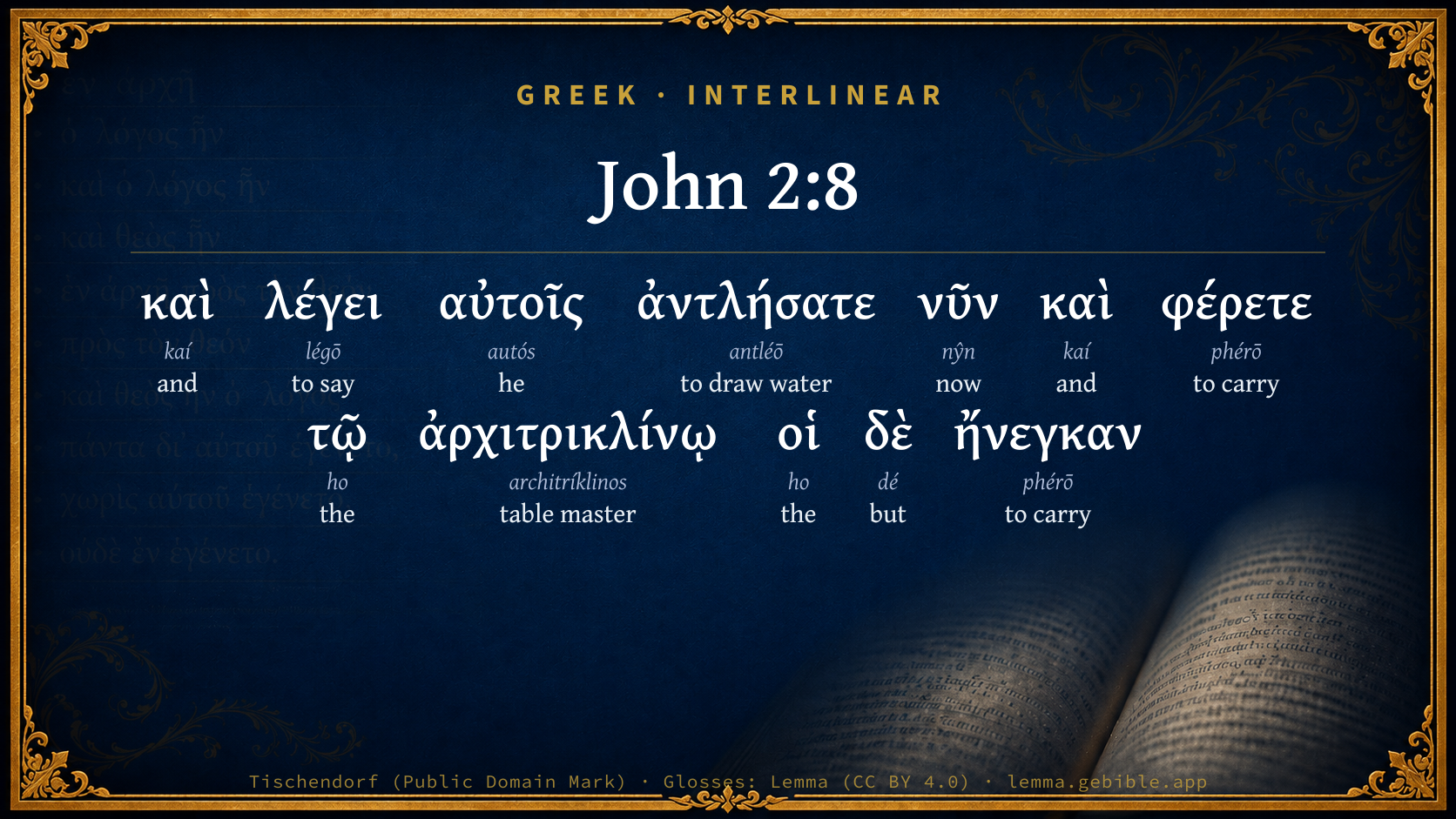
Download image
Cite this verse

John 2:8 (World English Bible). Public Domain. Lemma interlinear Bible study tool, https://lemma.gebible.app/v/john/2/8.

Show BibTeX & RIS
BibTeX
RIS
English Translation
He said to them, "Now draw some out, and take it to the ruler of the feast." So they took it.
World English Bible · Public Domain
Highlights
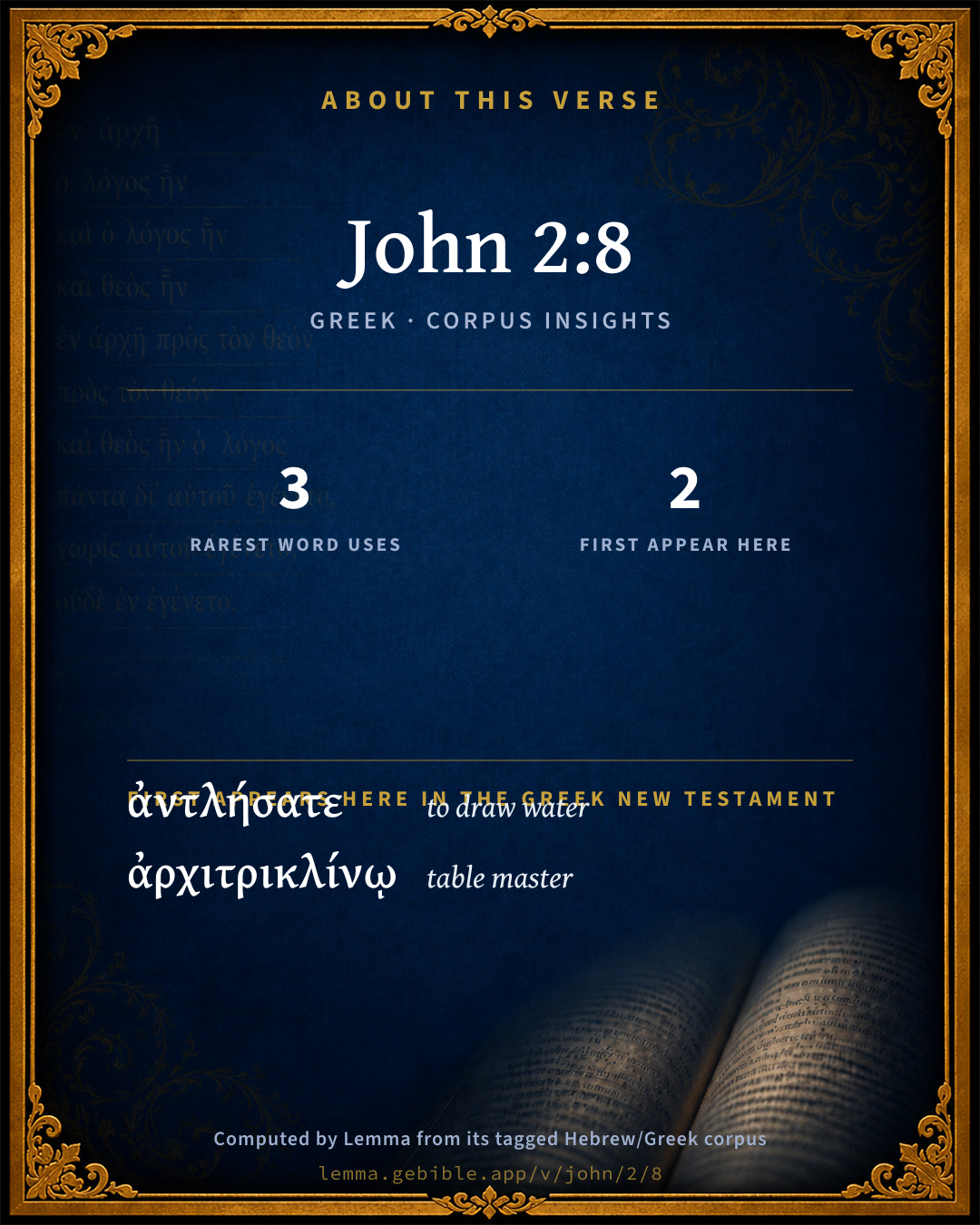
  • 2 first appearances in the Greek New Testament
Full analysis ↓
Download a study sheet

One document with this verse’s original text, its word-by-word gloss line, the meaning frame, cross-references with their text, attributed commentary, and full source and license credits — printable, and it pastes into notes with its structure intact.

This verse Autodidact and up

Study sheet (.html) Plain text (.txt)

A passage Seminary Student

Up to 50 verses in one chapter. A passage sheet keeps up to 6 commentary sources and 12 cross-references per verse, in the order this page ranks them, and says so on the sheet whenever that leaves anything out. Ask for a single verse and you get the Autodidact verse sheet above.

Everything on this page stays free to read, with no account — the sheet is a download of what is already on screen, not access to it.

Want to remove ads? Support Godless Engineer
Compare translations 3

The same verse in 3 English versions, stacked beneath the original-language interlinear above. Click any original word for its lexicon entry.

Each is an independent rendering of the whole verse — the interlinear is not word-aligned to these translations.

Highlighted words mark where these versions differ — a whole-verse word diff, not a word-by-word alignment.

  • World English Bible Public Domain
    He said to them, "Now draw some out, and take it to the ruler of the feast." So they took it.
  • King James Version Public Domain
    And he saith unto them, Draw out now, and bear unto the governor of the feast. And they bare it.
  • unfoldingWord Literal Text CC BY-SA 4.0
    And he says to them, “Draw now and take to the head waiter.” And they carried.

unfoldingWord Literal Text — © unfoldingWord, licensed CC BY-SA 4.0. Word-aligned USFM3 via Door43 (git.door43.org/unfoldingWord/en_ult).

Versions to compare (up to 4)

3 of 4 selected

Show all 19 translations

Every available English version of this verse, each an independent rendering of the whole verse.

  • World English Bible Public Domain
    He said to them, "Now draw some out, and take it to the ruler of the feast." So they took it.
  • Berean Standard Bible Public Domain
    “Now draw some out,” He said, “and take it to the master of the banquet.” They did so,
  • Majority Standard Bible Public Domain
    “Now draw some out,” He said, “and take it to the master of the banquet.” They did so,
  • King James Version Public Domain
    And he saith unto them, Draw out now, and bear unto the governor of the feast. And they bare it.
  • American Standard Version (1901) Public Domain
    And he saith unto them, Draw out now, and bear unto the ruler of the feast. And they bare it.
  • Revised Version (1885) Public Domain
    And he saith unto them, Draw out now, and bear unto the ruler of the feast. And they bare it.
  • Geneva Bible (1599) Public Domain
    Then he sayde vnto them, Draw out nowe and beare vnto the gouernour of the feast. So they bare it.
  • Douay-Rheims (1899) Public Domain
    And Jesus saith to them: Draw out now, and carry to the chief steward of the feast. And they carried it.
  • Young's Literal Translation Public Domain
    and he saith to them, `Draw out, now, and bear to the director of the apartment;' and they bare.
  • Literal Standard Version CC BY-SA 4.0
    and He says to them, “Draw out, now, and carry to the headwaiter”; and they bore.
  • Unlocked Literal Bible CC BY-SA 4.0
    Then he told the servants, “Take some out now and take it to the head waiter.” So they did.
  • unfoldingWord Literal Text CC BY-SA 4.0
    And he says to them, “Draw now and take to the head waiter.” And they carried.
  • Darby Bible Public Domain
    And he says to them, Draw out now, and carry [it] to the feast-master. And they carried [it].
  • World Messianic Bible Public Domain
    He said to them, “Now draw some out, and take it to the ruler of the feast.” So they took it.
  • Webster's Bible Public Domain
    And he saith to them, Draw out now, and bear to the governor of the feast. And they bore it.
  • Free Bible Version CC BY-SA 4.0
    Then he told them, “Pour some out, and take it to the master of ceremonies.” So they took him some.
  • Bible in Basic English Public Domain
    Then he said to them, Now take some, and give it to the master of the feast. So they took it to him.
  • Text-Critical English NT CC BY 4.0
    Then he said to them, “Now draw some out and take it to the master of the feast.” So they took it,
  • Tyndale New Testament (1534) Public Domain
    And he sayde vnto them: drawe out now and beare vnto the governer of the feaste. And they bare it.

Literal Standard Version (2020), Covenant Press — licensed CC BY-SA 4.0. Text via the HelloAO Bible API (eBible.org). Unlocked Literal Bible (unfoldingWord) — licensed CC BY-SA 4.0. Text via the HelloAO Bible API (eBible.org). unfoldingWord Literal Text — © unfoldingWord, licensed CC BY-SA 4.0. Word-aligned USFM3 via Door43 (git.door43.org/unfoldingWord/en_ult). Free Bible Version, Dr. Jonathan Gallagher — licensed CC BY-SA 4.0. Text via the HelloAO Bible API (eBible.org).

Word by word

More ways to search: Search by grammar → Find every occurrence → Compare this word →

Practice this passage: Drill this verse → Learn its vocabulary →

About this verse

These counts appear in no published source. They are computed here, from the morphology-tagged text and Lemma’s own curated glosses. What Lemma adds →

12
words
9
distinct lemmas
Gospels
section

Notable vocabulary

The rarest word here is ἀρχιτρικλίνῳ table master G755 — appearing just 3 times in the whole Greek New Testament.

First appearance in Scripture

These words make their first canonical appearance in the Greek New Testament here:

  • ἀντλήσατε to draw water G501
  • ἀρχιτρικλίνῳ table master G755

Shared distinctive vocabulary

ἀρχιτρικλίνῳ table master G755 occurs in 2 verses of the Greek New Testament. Also found in:
Repetition

Words recur within this verse:

  • φέρετε to carry G5342 ×2
  • καὶ and G2532 ×2
  • τῷ the G3588 ×2

Cross-references

3

Topical passages linked to John 2:8 in the Treasury of Scripture Knowledge — connected by theme and wording, ordered by reader-vote popularity; previews shown in the World English Bible.

  • Proverbs 3:5–6 Trust in Yahweh with all your heart, And don't lean on your own understanding.
  • John 2:9 When the ruler of the feast tasted the water now become wine, and didn't know where it came from (but the servants who had drawn the water knew), the ruler of the feast called the bridegroom,
  • Romans 13:7 Give therefore to everyone what you owe: taxes to whom taxes are due; customs to whom customs; respect to whom respect; honor to whom honor.

Cross-references courtesy of OpenBible.info (CC BY 4.0).

Commentary

Notes on John 2:8 from classic Christian and Jewish commentators (each source and its license shown beneath its notes). The classic Christian expositions comment on the surrounding passage and are grouped to its opening verse, so a note may address several verses; the Jewish commentaries on the Tanakh (Rashi and others) are per-verse, so they appear only where the commentator wrote on this verse.

Lemma curates 59 commentaries, every one of them public domain or Creative Commons licensed, each selected and text-cleaned for this edition rather than reprinted as found. About our sources →

Bengel's Gnomon

Johann Albrecht Bengel

Joh 2:8. Ἤνεγκαν, They bare) i.e. They drew and bare. [They exhibited a] beautiful obedience [to His directions].

Bengel's Gnomon of the New Testament — English translation (T&T Clark, Edinburgh, 1860) — public domain. Text from a community e-Sword module.

Expositor's Greek Testament

ed. W. Robertson Nicoll

Joh 2:8 . The second order might stagger them more, Ἀντλήσατε νῦν , καὶ φέρετε τῷ ἀρχιτρικλίνῳ . The ἀρχιτρίκλινος was originally the person who had charge of the triclinium or triple couch set round a dining table: “praefectus cui instruendi ornandique triclinii cura incumbit”; a butler or head waiter whose duty it was to arrange the table and taste the food and wine. Petron. Arb. 22, “Jam et Tricliniarches experrectus lucernis occidentibus oleum infuderat”. But apparently the person indicated in this verse is rather the συμποσιάρχης or συμποσίαρχος , the chairman elected by the company from among the guests, sometimes by lot. Cf. Horace’s “Arbiter bibendi,” Od., ii., 7. The requirements in such an official are described in Sir 32:1 ; Plato, Laws , p. 640; see also Reid’s edition of Cicero, De Senect. , p. 131. In general he regulated the course of the feast and the conduct of the guests. [Holtzmann and Weiss both retain the proper meaning of ἀρχιτρίκλινος .] Westcott suggests that the ἀντλήσατε νῦν may refer to drawing from the well, and that “the change in the water was determined by its destination for use at the feast”. “That which remained water when kept for a ceremonial use became wine when borne in faith to minister to the needs, even to the superfluous requirements of life,” a suggestive interpretation, but it evacuates of all significance the clause “they filled them up to the brim”. The servants obeyed, possibly encouraged by seeing that what they had poured in as water flowed out as wine; although if the words in the end of the ninth verse are to be taken strictly, it was still water when drawn from the water jars. But some refer the οἱ ἠντληκότες to drawing from the well. It is, however, more natural to refer it to the ἀντλήσατε νῦν of the eighth verse. Besides, drawing water from the well would be the business rather of the women than of the διάκονοι .

The Expositor's Greek Testament, edited by W. Robertson Nicoll (1897–1910) — public domain. Text from a community e-Sword module.

Adam Clarke's Commentary

Verse 8. Governor of the feast.] The original word, αρχιτρικλινος, signifies one who is chief or head over three couches, or tables. In the Asiatic countries, they take their meals sitting, or rather reclining, on small low couches. And when many people are present, so that they cannot all eat together, three of these low tables or couches are put together in form of a crescent, and some one of the guests is appointed to take charge of the persons who sit at these tables. Hence the appellation of architriclinus, the chief over three couches or tables, which in process of time became applied to the governor or steward of a feast, let the guests be many or few; and such person, having conducted the business well, had a festive crown put on his head by the guests, at the conclusion of the feast. See Ecclesiasticus, 32:1-3. It is very common for the Hindoos to appoint a person who is expert in conducting the ceremonies of a feast to manage as governor. This person is seldom the master of the house.

And they bare it.] A question has been asked, "Did our Lord turn all the water into wine which the six measures contained?" To which I answer: There is no proof that he did; and I take it for granted that he did not. It may be asked, "How could a part be turned into wine, and not the whole?" To which I answer: The water, in all likelihood, was changed into wine as it was drawn out, and not otherwise. "But did not our Lord by this miracle minister to vice, by producing an excess of inebriating liquor?" No; for the following reasons:

1. The company was a select and holy company, where no excess could be permitted. And,

2. Our Lord does not appear to have furnished any extra quantity, but only what was necessary. "But it is intimated in the text that the guests were nearly intoxicated before this miraculous addition to their wine took place; for the evangelist says, οτανμεθυσθωσι, when they have become intoxicated." I answer:

1. It is not intimated, even in the most indirect manner, that these guests were at all intoxicated.

2. The words are not spoken of the persons at that wedding at all: the governor of the feast only states that such was the common custom at feasts of this nature; without intimating that any such custom prevailed there.

3. The original word bears a widely different meaning from that which the objection forces upon it. The verbs μεθυσκω and μεθυω, from μεθυ, wine, which, from μετα θυειν, to drink after sacrificing, signify not only to inebriate, but to take wine, to drink wine, to drink enough: and in this sense the verb is evidently used in the Septuagint, Ge 43:34; So 5:1; 1 Macc. 16:16; Hag 1:6; Ecclus. 1:16. And the Prophet Isaiah, Isa 58:11, speaking of the abundant blessings of the godly, compares them to a watered garden, which the Septuagint translate, ως κηπος μεθυων, by which is certainly understood, not a garden drowned with water, but one sufficiently saturated with it, not having one drop too much, nor too little.

Adam Clarke's Commentary on the Bible (1810–1826) — public domain. Text from a community e-Sword/MySword module.

John Calvin's Commentaries

8. And carry to the master of the feast. For the same reason as before, Christ wished that the flavor of the wine should be tried by the master of the feast, before it had been tasted by himself, or by any other of the guests; and the readiness with which the servants obey him in all things shows us the great reverence and respect in which he was held by them. The Evangelist gives the name of the master of the feast to him who had the charge of preparing the banquet and arranging the tables; not that the banquet was costly and magnificent, but because the honorable appellations borrowed from the luxury and splendor of the rich are applied even to the marriages of the poor. But it is wonderful that a large quantity of wine, and of the very best wine, is supplied by Christ, who is a teacher of sobriety. I reply, when God daily gives us a large supply of wine, it is our own fault if his kindness is an excitement to luxury; but, on the other hand, it is an undoubted trial of our sobriety, if we are sparing and moderate in the midst of abundance; as Paul boasts that he had learned to know both how to be full and to be hungry, (Philippians 4:12.)

John Calvin's Commentaries (1540-1563) — public domain. Text from the Calvin Translation Society English edition (1840s-50s) via the Christian Classics Ethereal Library (ccel.org). Calvin's coverage is partial (roughly two-thirds of the Bible); uncommented books and verses are honest gaps, never fabricated. The 19th-century editor's footnotes and remarks are omitted so the notes are faithfully Calvin's own voice.

Ellicott's Commentary for English Readers

(8) Draw out now, and bear unto the governor of the feast.—A vessel was let down into the pitcher, and was then carried to the ruler of the feast, who would distribute the wine in it to the guests. Ruler rather than “governor.” The same English word should be used throughout the two verses. What exact office is denoted by the Greek word is uncertain, as it occurs nowhere else in the Bible, and is very rare in the classical authors. The chief English commentators (Alford, Wordsworth, Trench) are agreed that he was chosen by the guests from among their own number, but this opinion has not commanded the general assent of scholars; and there seems more reason to think that the person intended is what we should call the “head-waiter,” whose duty it was to taste the viands and wines, to arrange the tables and couches, and to be generally responsible for the feast.

A Bible Commentary for English Readers, edited by Charles John Ellicott (1878–1897) — public domain. Text from a community e-Sword module.

John Gill's Exposition

And he saith unto them, draw out now,.... As soon as ever the vessels were filled with water, without any more delay, he ordered the servants to draw out of those larger, into lesser vessels; he does not say what, water or wine:

and bear unto the governor of the feast; who either had the ordering and management of the feast, and the command of the whole affair; hence the Ethiopic version calls him, "the master of the waiters", or servants: or he was the chief guest, as the word seems to import, who sat, or rather lay, on the chief couch at the table; and so a proper person to begin with, and put the cup round: or else he might be doctor or chaplain: for such an one was necessary at a marriage; since there were six or seven benedictions to be pronounced; and particularly a blessing was said over the cup of wine; for if there was any wine, a cup of it was brought, and he blessed over it first, and ordered every thing concerning the cup: and this made up seven blessings at such a time (y); and therefore was a very fit person to bear the wine to first:

and they bore it; the servants having drawn out of the stone vessels, by cocks, into smaller ones, carried the liquor, as they were ordered, to the above person.

(y) Maimon. Hilchot Ishot, c. 10. sect. 3, 4.

John Gill's Exposition of the Whole Bible (1746–1763) — public domain (CC PDM 1.0). Text via the HelloAO Bible API.

Trapp's Complete Commentary

John Trapp

8 And he saith unto them, Draw out now, and bear unto the governor of the feast. And they bare it.

Ver. 8. The governor of the feast] The Jews had a sort of officers at their feasts, called praefecti morum, οινοπται, οφθαλμοι, the eyes and overseers of the feast, that took care that none should drink too much. The Latins called them dictators; the Greeks, symposiarchs. Howbeit, among the Greeks, those officers’ power extended no further than to see that at feasts or banquets men drank small draughts only at first, which by degrees they increased till they came to their height of intemperance; at which point, when they were arrived, they kept no rule nor order: whereas, before, to drink out of one’s turn, or beyond his allowance, was counted incivility. {a}

{a} Hinc pergraecari: and as merry as a Greek.

John Trapp, A Commentary or Exposition upon All the Books of the Old and New Testament (1647–1656) — public domain. Text from a community e-Sword module.

Albert Barnes' Notes on the Bible

Draw out now - This command was given to the servants. It showed that the miracle had been performed immediately. As soon as they were filled the servants were directed to take to the governor of the feast. Jesus made no parade about it, and it does not even appear that he approached the waterpots. He willed it, and it was done. This was a clear exertion of divine power, and made in such a manner as to leave no doubt of its reality.

The governor - One who presided on the occasion. The one who stood at the “head” or upper end of the table. He had the charge of the entertainment, provided the food, gave directions to the servants, etc.

Albert Barnes' Notes on the Bible (1834–1885) — public domain. Text from a community e-Sword/MySword module.

Matthew Poole's English Annotations

The Jews had one who was to order the affairs of their feast, and who is upon that account called the master, or

governor, of it; to whom our Saviour directs, that some of this newly made wine should be carried; either that they might not suspect it was by some art provided by him, or because he was of the best judgment in those affairs. The servants yield the same ready obedience to his commands which they had before yielded.

Matthew Poole's English Annotations on the Holy Bible (1683–1685) — public domain. Text from a community e-Sword/MySword module.

Whedon's Commentary on the Bible

Daniel D. Whedon

8. Governor of the feast—This was either one of the guests elected to the office of presiding over the occasion, or it was a professional functionary skilled in the business. He presided both over the sacred ceremonies of pronouncing the blessings, and the progress of the festivities.

Daniel D. Whedon (gen. ed.), Commentary on the Old and New Testaments (1874–1909) — public domain. Text from a community e-Sword module.

The Pulpit Commentary

Draw forth (the object of the verb is not in the sentence. He did not say the "water" which you placed there, nor the "wine" into which it has been transformed, but simply, "Draw forth"), and bear to the governor of the feast. The traditional interpretation, that the water jars were the source of the unwonted supply, and the measure of it, strongly commends itself in preference to the suggestions of Westcott, Moulton, as well as Barnes, Olshausen, and others. The arcitriklinov , the "master of the table," is the chief servant presiding over the arrangements of the feast. This was an Attic official, referred to by Athenaeus (4, 100, 70) as trapezopoiov (cf. Heliodor., 7:27). The "symposiarch," arbiter bibendi, is not to be confounded with him. The latter was one of the guests chosen to taste the wine, etc. (see Ecc 32:1, where he is called hgoumenov). The "governor" is one who occupies a still higher position of importance in Greek feasts. There is no other trace of the Attic usage among the Jews. As the passage in Ecclesiasticus indicates a different custom, and the references to something similar describe the officer by different names, no very sure conclusion can be drawn. Wunsche says that, ordinarily, the master of the house was bound to serve his guests, and preside over the distribution of food and presents. Thus, at the marriage of his son, Rabbi Gamaliel served all his invited guests. Trench, Alford, and Wordsworth think that the governor here was one of the invited guests, from the freedom with which he addressed the bridegroom. Meyer, Godet, take the view that he was not. And they hear it, conscious of a wondrous fact, which must have filled them with consternation. At first the order must have seemed like felly, as when Moses called on Israel to "go forward" into the Red Sea, or as when Jesus said to the paralytic, "Take up thy bed, and walk." "They bear it."

The Pulpit Commentary (1880–1919), ed. H.D.M. Spence-Jones & Joseph S. Exell — public domain. Text from a community e-Sword module.

The People's New Testament

B. W. Johnson

8. He saith, Draw out now, and bear unto the governor of the feast. “He that had made wine that day in those six water-pots does the same every year in the vines. For as what the servants put in the water-pots was changed into wine by the operation of the Lord, just so what the clouds pour forth is changed into wine by the operation of the same law.—Augustine.

B. W. Johnson's The People's New Testament with Notes (1889–1891) — public domain. Electronic text from the Christian Classics Ethereal Library (CCEL) ThML edition.

Cambridge Greek Testament for Schools and Colleges

8. ἀρχιτρ. Manager of the feast (triclinium) rather than ruler: but it is doubtful whether the head-waiter, who managed the feast and tasted the meat and drink, is meant, or the rex convivii, arbiter bibendi, the guest elected by the other guests to preside. The bad taste of his remark inclines one to the former alternative: Sir 32:1-2 is in favour of the second. In any case the translation should be uniform in these two verses, not sometimes ‘governor,’ sometimes ‘ruler.’ The word occurs nowhere else in N.T. Ὑδρία and ἀντλέω are also peculiar to this Gospel, and occur again Joh 4:7; Joh 4:15; Joh 4:28.

Cambridge Greek Testament for Schools and Colleges (Cambridge University Press, 1896; 21 vols, various authors incl. Carr, Maclear, Plummer, Farrar, Lumby, Moule, M. R. James, Simcox) — public domain. Text from a community e-Sword module.

Alford’s Greek Testament

Henry Alford

8.] The ἀρχιτρίκλινος (συμποσίαρχος, ἐπιμελητὴς τοῦ συμποσίου, Euthym.) seems to be the same with the ἡγούμενος spoken of, Sir. 35 (32:) 1, and with the Latin rex, or magister, convivii. It would seem (from Sir. l. c.) that he was one of the guests raised to the post of presiding over the arrangements of the feast. This is however doubted by the older Commentators (Severus in the Catena, Lücke, i. 472), who make him not one of the guests, but a person holding this especial office, and attending on feasts. Here, he tastes the wine; and therefore probably was a guest himself. Lücke quotes from Petronius “triclinarches.”

Henry Alford, The Greek Testament (1849–1861) — public domain. Text from a community e-Sword module.

International Critical Commentary

8. ἀντλήσατε νῦν κτλ. “Draw out now, and bear to the governor of the feast.” The ἀρχιτρίκλινος is called the ἡγούμενος in Ecclus. 32:1. It was customary for one of the principal guests to preside as arbiter bibendi (Horace, Od. ii. 7) or συμποσίαρχος, and it is this person who is indicated here by ἀρχιτρίκλινος, a word which elsewhere means a butler who arranged the triclinium, or three couches, each for three, at the table.

ἀντλήσατε νῦν has been generally taken to mean that the servants were bidden to draw water from the great jars and convey it in pitchers to the ruler of the feast. Westcott argues that ἀντλήσατε νῦν means rather “draw out now from the well,” whence water had previously been taker to fill the jars “up to the brim”; and that no miracle was wrought upon the water in the jars, but only upon water freshly drawn from the well in response to the command of Jesus. It is true that ἀντλεῖν is naturally used of drawing water from a well (cf. 4:7 and Gen 24:20, Exo 2:19, Isa 12:3). But the difficulties of this interpretation are considerable:

(1) If Westcott’s view be taken, the act (v. 7) of filling the large jars with water was quite otiose and has nothing to do with the story. There was no reason to mention the waterpots at all, if the miracle consisted in the conversion to wine of water freshly drawn from the well in pitchers1 and brought direct to the ἀρχιτρίκλινος.

(2) ἀντλεῖν can quite properly be used of drawing or pouring a liquid from a large vessel into a smaller one; and in its compounds ἐξαντλεῖν, καταντλεῖν, it means “to pour out,” “to pour over.” The drawing from the large hydriæ in the story would have been done by ladles (κύαθοι).2

(3) That ἀντλεῖν could be used of drawing wine appears from a passage in the comic poet Pherecrates (see D.C.G. ii. 815); and that a hydria was sometimes used to hold wine can be shown from Pollux, Onomasticon, x. § 74, … ἔφη Ὑδρίαν δανείζειν πεντέχουν ἢ μείζονα, ὥστʼ οὐ μόνον ὕδατος ἀλλὰ καὶ οἴνου ἂν εἴη ἀγγεῖον ἡ ὑδρία. This last quotation shows that the ἀρχιτρίκλινος would have had no reason for being surprised at wine being brought from the waterpots.

Jn. clearly means his readers to believe that what was served to the ruler of the feast was drawn from the water—jars; and that it was then served as a beverage. Had it been brought by the attendants for the purpose of pouring it on the hands of the ἀρχιτρίκλινος, it would have been brought in a different kind of vessel, and he would not have proceeded to taste it.

We must further notice that Jn. does not say that either the ruler of the feast, or the wedding guests generally, found anything miraculous in the wine that was served at the end. It was the disciples only who are said to have “believed” in Jesus, in consequence of this “sign.” See Introd., p. clxxxii.

International Critical Commentary — older volumes (1896–1929), various authors — public domain. Text from a community e-Sword module.

Vincent's Word Studies in the New Testament

Marvin R. Vincent

Draw out [αντλησατε] . From antlov, the hold of a ship where the bilge - water settles, and hence, the bilge - water itself. The verb, therefore, originally, means to bale out bilge - water; thence, generally, to draw, as from a well (iv. 15). Canon Westcott thinks that the water which was changed into wine was not taken from the vessels of purification, but that the servants were bidden, after they had filled the vessels with water, to continue drawing from the well or spring.

Ruler of the feast [αρχιτρικλινω] . From arcw, to be chief, and triklinon, Latin, triclinium, a banqueting - hall with three couches (see on Mr 6:39). Some explain the word as meaning the superintendent of the banqueting - chamber, a servant whose duty it was to arrange the table - furniture and the courses, and to taste the food beforehand. Others as meaning one of the guests selected to preside at the banquet according to the Greek and Roman usage. This latter view seems to be supported by a passage in Ecclesiasticus (xxxv. 1, 2) : "If thou be made the master of a feast, lift not thyself up, but be among them as one of the rest; take diligent care for them, and so sit down. And when thou hast done all thy office, take thy place, that thou mayst be merry with them, and receive a crown for thy well ordering of the feast." According to the Greek and Roman custom, the ruler of the feast was chosen by throwing the dice. Thus Horace, in his ode to his friend Sestius, says, moralizing on the brevity of life : "Soon the home of Pluto will be thine, nor wilt thou cast lots with the dice for the presidency over the wine." He prescribed the proportions of wine and water, and could also impose fines for failures to guess riddles, etc. As the success of the feast depended largely upon him, his selection was a matter of some delicacy. Plato says, "Must we not appoint a sober man and a wise to be our master of the revels? For if the ruler of drinkers be himself young and drunken, and not over - wise, only by some special good fortune will he be saved from doing some great evil" (" Laws, " 640). The word occurs only here and ver. 9. Wyc. simply transcribes : architriclyn.

Marvin R. Vincent, Word Studies in the New Testament (1887–1900) — public domain. Text from a community e-Sword/MySword module.

Lesson kit

Teaching starters — assembled from the data on this page, not authored interpretation. Every prompt links to the verse data it draws on. Edit before teaching.

John, in the Gospels, opens this verse with 12 words (9 distinct Greek lemmas). Its most distinctive word is architríklinos (“table master”). A historical commentator’s framing appears above. Read the whole chapter for the surrounding context.

Discussion questions

  1. The word architríklinos carries the sense “table master.” How does it shape the verse?
  2. 2 words make their first appearance in Scripture here. What does this debut establish?
  3. How does John 2:9, which shares the word «table master», read alongside this verse?
  4. What does the repetition of “to carry” (2× in this one verse) do in this verse?
  5. These translations render this verse differently. What is at stake in choosing one wording over another?
  6. Compare how Bengel's Gnomon and Expositor's Greek Testament read this verse. Where do they agree or differ?

Things to notice

  • 2 words make their first canonical appearance in Scripture here.
  • These translations choose different wording for 14 words in this verse.
  • “to carry” occurs 2× in this single verse.
  • 9 distinct Greek lemmas span 12 words in this verse.

Reading settings

Reading text

Shown beneath each verse's original-language words.

Old Testament
Old Testament edition

Read the OT as the Masoretic Hebrew (MT) or the Greek Septuagint (LXX).

English shown for the Greek Septuagint (in the Hebrew ↔ Greek comparison).

Comparing translations? Open the Compare panel on any verse page to stack up to four side by side.