John 3:34

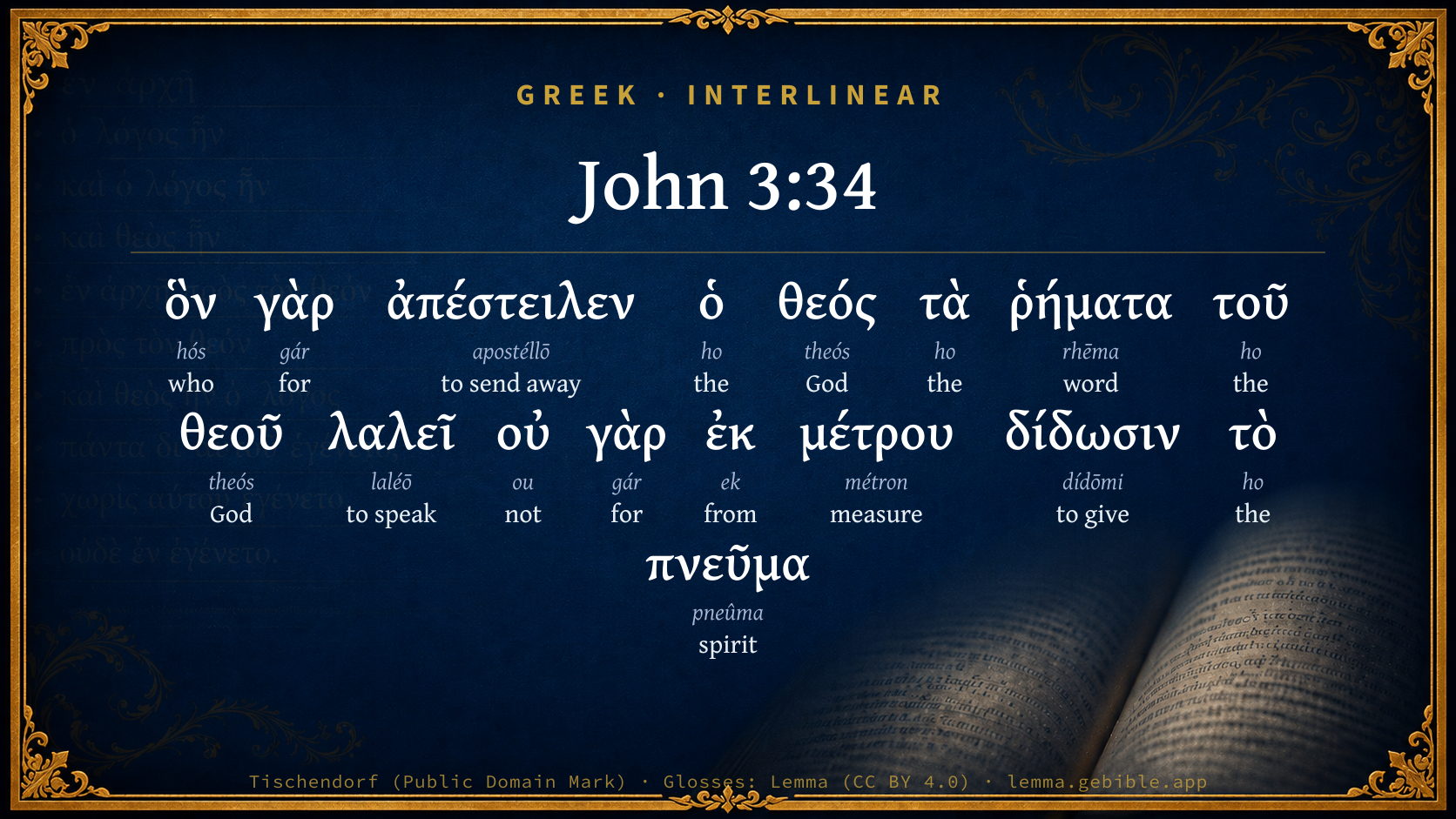
Greek (Tischendorf 8th ed.) John 3:34 appears in the Greek New Testament. The text above is from the Tischendorf 8th edition. Each word links to its Strong’s number and a concise gloss. Click any word for its full Thayer’s Greek Lexicon entry.
Download image
Cite this verse

John 3:34 (World English Bible). Public Domain. Lemma interlinear Bible study tool, https://lemma.gebible.app/v/john/3/34.

Show BibTeX & RIS
BibTeX
RIS
English Translation
For he whom God has sent speaks the words of God; for God gives the Spirit without measure.
World English Bible · Public Domain
Download a study sheet

One document with this verse’s original text, its word-by-word gloss line, the meaning frame, cross-references with their text, attributed commentary, and full source and license credits — printable, and it pastes into notes with its structure intact.

This verse Autodidact and up

Study sheet (.html) Plain text (.txt)

A passage Seminary Student

Up to 50 verses in one chapter. A passage sheet keeps up to 6 commentary sources and 12 cross-references per verse, in the order this page ranks them, and says so on the sheet whenever that leaves anything out. Ask for a single verse and you get the Autodidact verse sheet above.

Everything on this page stays free to read, with no account — the sheet is a download of what is already on screen, not access to it.

Want to remove ads? Support Godless Engineer
Compare translations 3

The same verse in 3 English versions, stacked beneath the original-language interlinear above. Click any original word for its lexicon entry.

Each is an independent rendering of the whole verse — the interlinear is not word-aligned to these translations.

Highlighted words mark where these versions differ — a whole-verse word diff, not a word-by-word alignment.

  • World English Bible Public Domain
    For he whom God has sent speaks the words of God; for God gives the Spirit without measure.
  • King James Version Public Domain
    For he whom God hath sent speaketh the words of God: for God giveth not the Spirit by measure unto him.
  • unfoldingWord Literal Text CC BY-SA 4.0
    For the one whom God has sent speaks the words of God. For he does not give the Spirit by measure.

unfoldingWord Literal Text — © unfoldingWord, licensed CC BY-SA 4.0. Word-aligned USFM3 via Door43 (git.door43.org/unfoldingWord/en_ult).

Versions to compare (up to 4)

3 of 4 selected

Show all 19 translations

Every available English version of this verse, each an independent rendering of the whole verse.

  • World English Bible Public Domain
    For he whom God has sent speaks the words of God; for God gives the Spirit without measure.
  • Berean Standard Bible Public Domain
    For the One whom God has sent speaks the words of God, for God gives the Spirit without limit.
  • Majority Standard Bible Public Domain
    For the One whom God has sent speaks the words of God, for God gives the Spirit without limit.
  • King James Version Public Domain
    For he whom God hath sent speaketh the words of God: for God giveth not the Spirit by measure unto him.
  • American Standard Version (1901) Public Domain
    For he whom God hath sent speaketh the words of God: for he giveth not the Spirit by measure.
  • Revised Version (1885) Public Domain
    For he whom God hath sent speaketh the words of God: for he giveth not the Spirit by measure.
  • Geneva Bible (1599) Public Domain
    For hee whome God hath sent, speaketh the woordes of God: for God giueth him not the Spirit by measure.
  • Douay-Rheims (1899) Public Domain
    For he whom God hath sent, speaketh the words of God: for God doth not give the Spirit by measure.
  • Young's Literal Translation Public Domain
    for he whom God sent, the sayings of God he speaketh; for not by measure doth God give the Spirit;
  • Literal Standard Version CC BY-SA 4.0
    for He whom God sent, He speaks the sayings of God; for God does not give the Spirit by measure;
  • Unlocked Literal Bible CC BY-SA 4.0
    For the one whom God has sent speaks the words of God. For he does not give the Spirit by measure.
  • unfoldingWord Literal Text CC BY-SA 4.0
    For the one whom God has sent speaks the words of God. For he does not give the Spirit by measure.
  • Darby Bible Public Domain
    for he whom God has sent speaks the words of God, for God gives not the Spirit by measure.
  • World Messianic Bible Public Domain
    For he whom God has sent speaks the words of God; for God gives the Spirit without measure.
  • Webster's Bible Public Domain
    For he whom God hath sent, speaketh the words of God: for to him God giveth not the Spirit by measure.
  • Free Bible Version CC BY-SA 4.0
    For the one God sent speaks God's words, because God doesn't restrict the Spirit.
  • Bible in Basic English Public Domain
    For he whom God has sent says God's words; and God does not give him the Spirit by measure.
  • Text-Critical English NT CC BY 4.0
    For he whom God sent speaks the words of God, for God gives the Spirit without measure.
  • Tyndale New Testament (1534) Public Domain
    For he whom God hath sent speaketh the wordes of God. For God geveth not the sprete by measure.

Literal Standard Version (2020), Covenant Press — licensed CC BY-SA 4.0. Text via the HelloAO Bible API (eBible.org). Unlocked Literal Bible (unfoldingWord) — licensed CC BY-SA 4.0. Text via the HelloAO Bible API (eBible.org). unfoldingWord Literal Text — © unfoldingWord, licensed CC BY-SA 4.0. Word-aligned USFM3 via Door43 (git.door43.org/unfoldingWord/en_ult). Free Bible Version, Dr. Jonathan Gallagher — licensed CC BY-SA 4.0. Text via the HelloAO Bible API (eBible.org).

Word by word

More ways to search: Search by grammar → Find every occurrence → Compare this word →

Practice this passage: Drill this verse → Learn its vocabulary →

μέτρου
métron
G3358
“measure”
Noun, Genitive, Singular, Neuter
Part of Speech
Noun
Case
Genitive
Number
Singular
Gender
Neuter
Full Thayer's Definition

Origin: an apparently primary word

TDNT: 14:32,6

1. measure, an instrument for measuring a. a vessel for receiving and determining the quantity of things, whether dry or liquid b. a graduated staff for measuring, a measuring rod c. proverbially, the rule or standard of judgment 2. determined extent, portion measured off, measure or limit a. the required measure, the due, fit, measure
  1. ὃν hós G3739 “who” Relative pronoun, Accusative, Singular, Masculine
  2. γὰρ gár G1063 “for” Conjunction
  3. ἀπέστειλεν apostéllō G649 “to send away” Verb, Aorist, Active, Indicative, 3rd person, Singular
  4. ὁ ho G3588 “the” Article, Nominative, Singular, Masculine
  5. θεός theós G2316 “God” Noun, Nominative, Singular, Masculine
  6. τὰ ho G3588 “the” Article, Accusative, Plural, Neuter
  7. ῥήματα rhēma G4487 “word” Noun, Accusative, Plural, Neuter
  8. τοῦ ho G3588 “the” Article, Genitive, Singular, Masculine
  9. θεοῦ theós G2316 “God” Noun, Genitive, Singular, Masculine
  10. λαλεῖ laléō G2980 “to speak” Verb, Present, Active, Indicative, 3rd person, Singular
  11. οὐ ou G3756 “not” Particle, Negative
  12. γὰρ gár G1063 “for” Conjunction
  13. ἐκ ek G1537 “from” Preposition
  14. δίδωσιν dídōmi G1325 “to give” Verb, Present, Active, Indicative, 3rd person, Singular
  15. τὸ ho G3588 “the” Article, Accusative, Singular, Neuter
  16. πνεῦμα pneûma G4151 “spirit” Noun, Accusative, Singular, Neuter

About this verse

These counts appear in no published source. They are computed here, from the morphology-tagged text and Lemma’s own curated glosses. What Lemma adds →

17
words
12
distinct lemmas
Gospels
section

Notable vocabulary

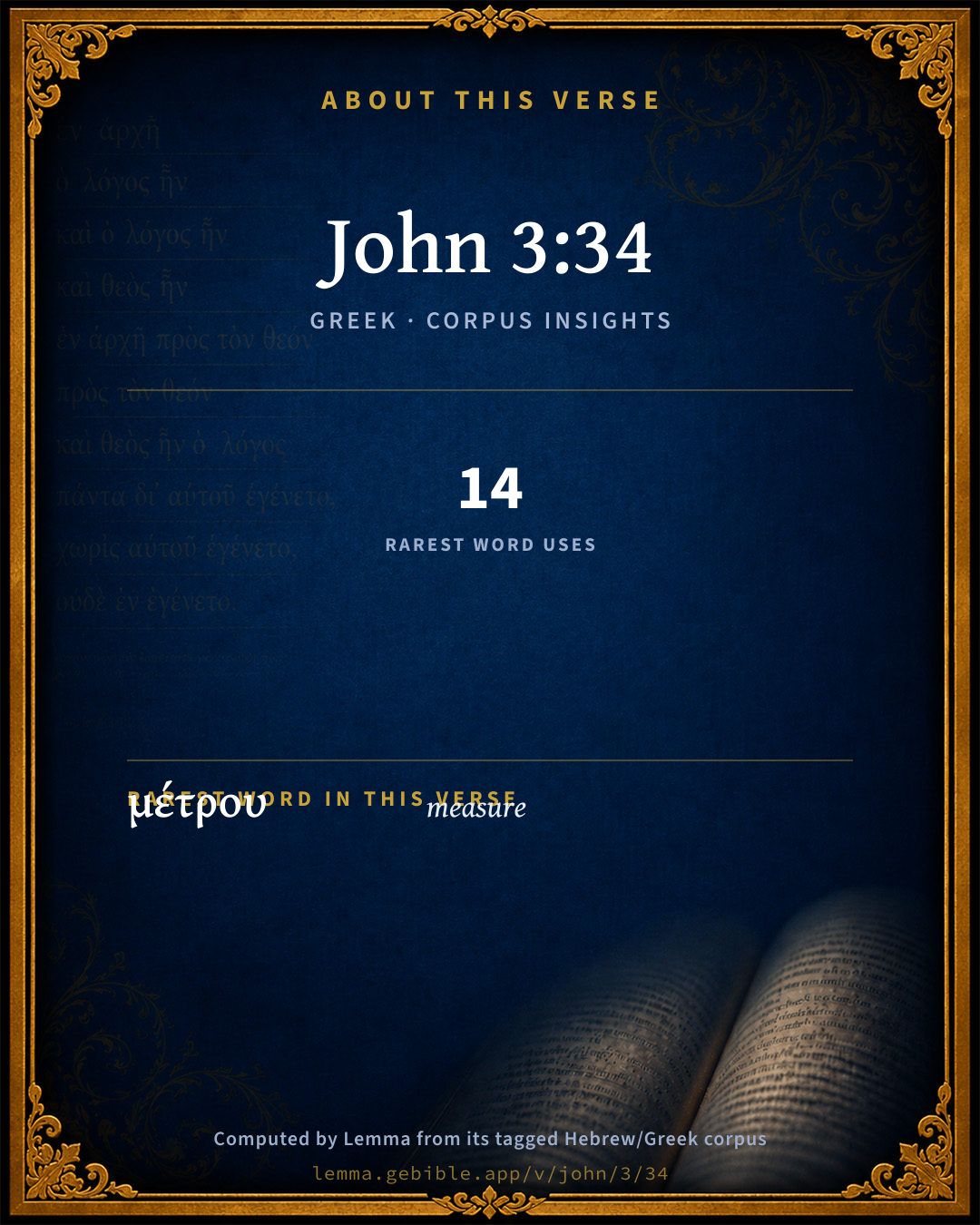
The rarest word here is μέτρου measure G3358 — appearing just 14 times in the whole Greek New Testament.

Shared distinctive vocabulary

μέτρου measure G3358 occurs in 12 verses of the Greek New Testament. Also found in:

Repetition

Words recur within this verse:

Cross-references

25

Topical passages linked to John 3:34 in the Treasury of Scripture Knowledge — connected by theme and wording, ordered by reader-vote popularity; previews shown in the World English Bible.

  • Acts 10:38 even Jesus of Nazareth, how God anointed him with the Holy Spirit and with power, who went about doing good and healing all who were oppressed by the devil, for God was with him.
  • Matthew 12:18 "Behold, my servant whom I have chosen; My beloved in whom my soul is well pleased: I will put my Spirit on him. He will proclaim justice to the Gentiles.
  • John 15:26 "When the Counselor has come, whom I will send to you from the Father, the Spirit of truth, who proceeds from the Father, he will testify about me.
  • John 5:26 For as the Father has life in himself, even so he gave to the Son also to have life in himself.
  • Isaiah 11:2–5 The Spirit of Yahweh shall rest on him, the spirit of wisdom and understanding, the spirit of counsel and might, the spirit of knowledge and of the fear of Yahweh.
  • Colossians 2:9 For in him all the fullness of the Godhead dwells bodily,
  • Luke 4:18 "The Spirit of the Lord is on me, Because he has anointed me to preach good news to the poor. He has sent me to heal the brokenhearted, To proclaim release to the captives, Recovering of sight to the blind, To deliver those who are crushed,
  • John 7:37–39 Now on the last and greatest day of the feast, Jesus stood and cried out, "If anyone is thirsty, let him come to me and drink!
  • John 7:16 Jesus therefore answered them, "My teaching is not mine, but his who sent me.
  • Romans 8:2 For the law of the Spirit of life in Christ Jesus made me free from the law of sin and of death.
  • Colossians 1:19 For all the fullness was pleased to dwell in him;
  • John 1:16 From his fullness we all received grace upon grace.
  • John 3:17 For God didn't send his Son into the world to judge the world, but that the world should be saved through him.
  • John 8:47 He who is of God hears the words of God. For this cause you don't hear, because you are not of God."
  • Ephesians 3:8 To me, the very least of all saints, was this grace given, to preach to the Gentiles the unsearchable riches of Christ,
  • Numbers 11:25 Yahweh came down in the cloud, and spoke to him, and took of the Spirit that was on him, and put it on the seventy elders: and it happened that when the Spirit rested on them, they prophesied, but they did so no more.
  • Psalms 45:7 You have loved righteousness, and hated wickedness. Therefore God, your God, has anointed you with the oil of gladness above your fellows.
  • John 16:7 Nevertheless I tell you the truth: It is to your advantage that I go away, for if I don't go away, the Counselor won't come to you. But if I go, I will send him to you.
  • Revelation 22:1 He showed me a river of water of life, clear as crystal, proceeding out of the throne of God and of the Lamb,
  • 2 Kings 2:9 It happened, when they had gone over, that Elijah said to Elisha, Ask what I shall do for you, before I am taken from you. Elisha said, please let a double portion of your spirit be on me.
  • Isaiah 59:21 As for me, this is my covenant with them, says Yahweh: my Spirit who is on you, and my words which I have put in your mouth, shall not depart out of your mouth, nor out of the mouth of your seed, nor out of the mouth of your seed's seed, says Yahweh, from henceforth and forever.
  • John 8:26–28 I have many things to speak and to judge concerning you. However he who sent me is true; and the things which I heard from him, these I say to the world."
  • John 8:40 But now you seek to kill me, a man who has told you the truth, which I heard from God. Abraham didn't do this.
  • Revelation 21:6 He said to me, "It is done! I am the Alpha and the Omega, the Beginning and the End. I will give freely to him who is thirsty from the spring of the water of life.
  • Revelation 22:16–17 I, Jesus, have sent my angel to testify these things to you for the assemblies. I am the root and the offspring of David; the Bright and Morning Star."

Cross-references courtesy of OpenBible.info (CC BY 4.0).

Where the printed editions differ

1 variant

Places in this verse where the major printed Greek editions disagree on the wording in a way that affects the translation — a comparison of editions, not a manuscript-by-manuscript collation. The editions are the modern critical texts (Nestlé-Aland 28/27, SBL, Westcott-Hort, Tregelles, Tyndale House) and the traditional texts behind the KJV (the Textus Receptus and the Byzantine/Majority text). It is not a claim about which reading is original.

  1. Extra text
    ὁ θεὸς

    “<the> God”

    In TregTRByz Not in NA28NA27TynSBLWH

    ὁ θεὸς (ho theos) ' God' is only in traditional manuscripts (Treg+TR+Byz)

Textual data: Translators Amalgamated Greek New Testament (STEPBible TAGNT) · CC BY 4.0.

Commentary

Notes on John 3:34 from classic Christian and Jewish commentators (each source and its license shown beneath its notes). The classic Christian expositions comment on the surrounding passage and are grouped to its opening verse, so a note may address several verses; the Jewish commentaries on the Tanakh (Rashi and others) are per-verse, so they appear only where the commentator wrote on this verse.

Lemma curates 59 commentaries, every one of them public domain or Creative Commons licensed, each selected and text-cleaned for this edition rather than reprinted as found. About our sources →

The Biblical Illustrator

Joseph S. Exell

Joh_3:34-36

He whom God hath sent speaketh the words of God

The Mediator

I.

CHRISTS EXCELLENCY IN HIS PROPHETICAL OFFICE (Joh_3:34).

1. He is the sent of God. His mission is the measure of Divine love to the world. God sent other messengers, the prophets, John, ministers; but as there is but one sun in the firmament, though men have furnished themselves with many derived lights, so there is but one messenger from God--one great centre of illumination for the use of all who are beyond the limits of the unapproachable light.

2. They are the words of God which He speaketh. The same is true of every true minister, hut they are derived. Christ spoke the very oracles of God.

3. God giveth not the Spirit by measure to His Son. The prophets had the Spirit to discharge their commissions, but under such limitations as were necessary to their limited capacities and occasions. But there was no such limit in regard to Christ.

II. CHRISTS DIGNITY AS THE APPOINTED SOURCE OF ALL GOOD TO THE CHURCH (verse 35). For the use of this language the Baptist had Old Testament warrant.

1. The Father loveth the Son. He loves the world--some with a love of good will, others with a love of delight, hut not even angels share such a love as this; and indeed they and men are loved for and in the Son.

2. All things have been given into Christs hands. If God so loved the world that He gave His Son, He so loves the Son that He hath given Him all things--all government, all the economy of redemption.

3. What obedience then is due to the Son! If God hath withheld nothing, shall we?

III. THE SAFETY OF THE SOUL IS DEPENDENT ON CHRIST (verse 36).

1. Salvation is laid up in Christ as its fountain and dispensing author.

2. This salvation is to be sought in Christ by faith.

3. No salvation without faith. Unbelief refuses Christs testimony, declines all personal alliance with Christ, opposes Gods purpose, and is the fruit of an evil heart.

4. The unbeliever shall not see life.

5. Upon the unbeliever the wrath of God abides. (A. Beith, D. D.)

The Father loveth the Son, and hath given all things into His hand

I. CHRISTS RELATION TO THE FATHER AND TO MAN.

1. The excellency of Christ above all other ambassadors is that He is the Son and they are but servants.

2. Christ is the object of the Fathers love in a peculiar way: as a Son, and not a servant in respect of His Person; and as Mediator, He is pointed out as the beloved Son in whom God will be found well pleased (Mat_3:17); as He who is beloved, and hath purchased love to others because of His death (Joh_10:17) (so willing was the Father to be reconciled), as He whose being beloved answereth our being unworthy of love, and is a pledge of the Fathers love to us (Joh_17:23).

3. In carrying on the redemption of sinners, as the matter is accorded betwixt the Father and the Son, so the redeemed are not left to themselves, but are put on Christs hand, to purchase and be forthcoming for them; and all things are concredited to Him that may tend to their good. Under all things we are to comprehend the elect themselves, together with all the gills and graces of the Spirit (verse 34) needful for their conversion and salvation, which are not entrusted to ourselves, but to Him who can keep us And them, and let them out as we need; and a dominion over all things that may contribute to help or hinder His peoples happiness, that He may order them so as may be for their good. And this power He hath as God with the Father, and as Man and Mediator, by donation and gift from the Father (Mat_11:27; Mat_28:18). And thus the believers happiness is firm, being transacted between such parties, the Father being satisfied in the Mediator, and they entrusted to Him whose dear purchase they are, and therefore He will not lose them, who hath capacity to receive their furniture far above what they could hold, power to maintain, wisdom to guide and dispense their allowance, dominion to curb all enemies and opposition, and a commission and charge to be answerable for them. All which may invite us to be content that we be nothing, and that we and all our furniture be in His hand. (G. Hutcheson.)

All things in Christs hand

The verse gives us the following teachings

1. The Father is the Origin and Arranger of all things.

2. In His arrangements all things are put into the hands of His Son.

3. One reason of this is the love of the Father towards the Son.

4. Ere Christ came to men there had been a sublime transaction in which a vast administration had been entrusted on the one hand and accepted on the other. To confine ourselves to our point

What things are put into the Redeemers hand?

I. THE ACT OF CREATION. All things were made by Him. Thus He is clearly marked off from aught that is created. This fact establishes His essential equality with God and His official subordination to God.

II. REVELATION. Creation had to do with all worlds; revelation with this. God indeed reveals Himself by His works, the laws of social life, the voice of conscience. But we want a revelation fuller and clearer. Here it is: He that hath seen Me hath seen the Father.

III. PROPITIATION. Where sin is, a revelation of God is not enough: but the Revealer says, No man cometh unto the Father but by Me. A serious state of things when a mans way to his Father is blocked up save as a Mediator clears it! Yet so it is; but He has put away sin by the sacrifice of Himself.

IV. HEART CONQUEST. A power is needed to make the mediation effective manward. At the same moment that the herald says Behold the Lamb of God, He declares This is He which baptizeth with the Holy Ghost. The bestowment of the Spirit to convict, convert, and train the Church, is the prerogative of Christ.

V. ADMINISTRATION. When won over to Christ, men have to be governed and sanctified. The subjects of the kingdom of grace have to be inspired with a supreme desire to leaven the world with righteousness. His holy inspiration is begun and sustained by Christ. As He formed the kingdom of grace, so He administers it.

VI. THE CONSUMMATION OF ALL THINGS. He who sent Peter to reap the first-fruits will send forth His angels to reap the harvest. (C. Clemance, D. D.)

What things?

I. LIGHT for your mind.

II. LIFE for your souls.

III. LOVE for your hearts.

IV. RIGHTEOUSNESS for your nature.

V. ATONEMENT for your sins.

VI. GRACE for strengthening.

VII. COMFORT for sorrow.

VIII. HEAVEN. (Bp. Gregg.)

The Father loveth the Son

Therefore faith may have firm footing. God hath laid help upon one that is mighty that our faith and hope may be in God. (J. Trapp.)

He who has Christ has all things

King Porus, when Alexander asked him, being then his prisoner, how he would be used, answered in one word, Basilikeios, that is, Like a king. Alexander again replying, Do you desire nothing else? No, said he, all things are in this one word, Like a king. Whereupon Alexander restored him again. But this has not always been the happiness of kings and princes. Yet, however, he that hath God hath all things, because God is all things. Take a pen, and write down riches, honours, preferments, they are but as so many ciphers--they signify nothing; but write down God alone, and He will raise them to thousands--hundreds of thousands. And then it is that a Christian is truly happy, when he can find himself, and all things, in his God.

The Biblical Illustrator, edited by Joseph S. Exell (c. 1880s–1900s) — public domain. Text from a community e-Sword module.

Tyndale Open Study Notes

Tyndale Open Resources

3:34-35 The Father gives the Son the Spirit without limit as a sign of his profound love (3:35). It also illustrates Jesus’ divinity. John presents the one God as three persons (cp. 1 Jn 5:5-12).

Tyndale Open Study Notes — © Tyndale Open Resources, licensed CC BY-SA 4.0. Text via the HelloAO Bible API.

Bengel's Gnomon

Johann Albrecht Bengel

Joh 3:34. Ἀπέστειλεν) hath sent from Himself.—οὐ γὰρ ἐκ μέτρου, for not by measure) The giving of the Spirit is one, and that, made to Christ; under which we are contained, to whomsoever a measure is imparted, Eph 4:7, “Unto every one of us is given grace, according to the measure of the gift of Christ;” Joh 1:16, “Of His fulness have all we received, and grace for grace.” In order that we might be able to receive a measure, it was befitting that there should be some one, who would take, and in the first instance receive [the fulness of grace] without measure, being about [being thereby qualified] to baptize all the others with the same Spirit: nay, even we shall hereafter have it without measure: 1Co 13:10; 1Co 13:12, “When that which is perfect is come, then that which is in part shall be done away;—Now I know in part, but then shall I know even as also I am known.” Christopher Cartwright: The Hebrews observe, the Spirit was given to the prophets in measure; Even the Holy Spirit, say they, which rests on the prophets, does not rest save in measure. Even the words of the law, which was given from above, were not given, save in measure. Mellif. Hebr. on this passage. Further, since Christ received the Spirit without measure, he expresses the words of God most perfectly.

Bengel's Gnomon of the New Testament — English translation (T&T Clark, Edinburgh, 1860) — public domain. Text from a community e-Sword module.

Meyer's Critical & Exegetical Commentary

Heinrich August Wilhelm Meyer

Joh_3:34. The first γάρ serves to state the reason for the ἐσφράγισεν, ὅτι, etc.; the second, for the τὰ ῥήματα τ. θεοῦ λαλεῖ, so far, that is, as it would be doubtful, if God gave the Spirit ἐκ μέτρου, whether what Gods ambassador spoke was a divine revelation or not; it might in this case be wholly or in part the word of man

ὃν γὰρ ἀπέστ. ὁ θεός] not a general statement merely, appropriate to every prophet, but, following Joh_3:31, to be taken more precisely as a definition of a heavenly (ἄνωθεν, ἐκ τοῦ οὐρανοῦ) mission, and referring strictly to Jesus. This the context demands. But the following οὐ γὰρ ἐκ μέτρου, κ.τ.λ., must be taken as a general statement, because there is no αὐτῷ. Commentators would quite arbitrarily supply αὐτῷ,[177] so as to render it, not by measure or limitation, but without measure and in complete fulness, God gives the Holy Spirit to Christ. This supplement, unsuitable in itself, should have been excluded by the present δίδωσιν, because we must regard Christ as possessing the Spirit long before. The meaning of this general statement is rather: He does not give the Spirit according to measure (as if it consequently were out of His power, or He were unwilling to give the Spirit beyond a certain quantitative degree, determined by a definite measure); He proceeds herein independently of any μέτρον, confined and limited by no restricting standard. The way in which this is to be applied to Jesus thus becomes plain, viz. that God must have endowed Him[178] when He sent Him from heaven (Joh_3:31), in keeping with His nature and destination, with the richest spiritual gifts, namely, with the entire fulness of the Spirit (πᾶν τὸ πλήρωμα, Col_1:19), more richly, therefore, than prophets or any others;which He could not have done had He been fettered by a measure in the giving of the Spirit.[179]

ἐκ μέτρου] ἘΚ used of the rule. See Bernhardy, p. 230; comp. on 1Co_12:27. Finally, the οὐ γὰρ ἐκ μέτρου must not be regarded as presenting a different view to Joh_3:32 (comp. Weiss, p. 269); for the Spirit was in Christ the principle whereby He communicated (the λαλεῖν) to men that which He had beheld with God. See on Joh_6:63-64; Act_1:2.

[177] The subterfuge of Hengstenberg is no better: we must supply, in the case before us. See also Lange.

[178] οὐ γὰρ μέτρα λόγοιο [or rather πνεύματος] φέρει λόγος.Nonnus.

[179] Hitzig, in Hilgenfelds Zeitschr. 1859, p. 152 ff., taking the first half of the verse as a general statement, applicable to every prophet, would read the relative οὗ instead of οὐ, according to the measure, that is, in which He gives the Spirit. Considering the γάρ, this rendering is impossible.Ewald and Brückner come nearest to our interpretation. B. Crusius and Ebrard (on Olshausen) erroneously make ὅν ἀπέστ. κ.τ.λ. the subject of δίδωσιν (ὁ θιός is spurious, see the critical notes); but this yields a thought neither true in itself, nor in keeping with the context. Godet puts an antithetical but purely imported emphasis upon δίδωσιν: to other messengers of God the Spirit is not given, but only lent by a visite momentanée; but when God gives the Spirit, He does so without measure, and this took place on the first occasion at the baptism of Jesus. This is exegetical poetizing.

Meyer — Critical and Exegetical Commentary on the New Testament — English translation by Peter Christie, edited by Frederick Crombie (T&T Clark, 1880) — public domain. Text from a community e-Sword module.

Expositor's Greek Testament

ed. W. Robertson Nicoll

Joh 3:34 . The reason assigned for the truth and trustworthiness of Christ’s words is scarcely the reason we expect: οὐ γὰρ … Πνεῦμα . John has told us that Christ is to be believed because He testifies of what He hath seen and heard: now, because the Spirit is given without measure to Him. The meaning of the clause is contested. The omission of ὁ θεός does not materially affect the sense, for ὁ θεός would naturally be supplied as the nominative to δίδωσι from τοῦ θεοῦ of the preceding clause. There are four interpretations. (1) Augustine, Calvin, Lücke, Alford, suppose the clause means that God, instead of giving occasional and limited supplies of the Spirit as had been given to the prophets, gives to Christ the fulness of the Spirit. (2) Meyer thinks that the primary reference is not to Christ but that the statement is general, that God gives the Spirit freely and abundantly, and does thus dispense it to Christ. (3) Westcott, following Cyril, makes Christ the subject and understands the clause as meaning that He proves His Messiahship by giving the Spirit without measure. (4) Godet makes τὸ πνεῦμα the subject, not the object, and supposes the meaning to be that the Spirit gives to Christ the words of God without measure. The words of Joh 3:35 seem to weigh in favour of the rendering of A.V [47] : “God giveth not the Spirit by measure unto Him”. The R.V [48] is ambiguous. ἐκ μέτρου , out of a measure, or, by measure, that is, sparingly. So ἐν μέτρῳ in Eze 4:11 . Wetstein quotes: “R. Achan dixit: etiam Spiritus S. non habitavit super Prophetas nisi mensura quadam: quidam enim librum unum, quidam duos vaticiniorum ediderunt”. The Spirit was given to Jesus not in the restricted and occasional manner in which it had been given to the O.T. prophets, but wholly, fully, constantly. It was by this Spirit His human nature was enlightened and guided to speak things divine; and this Spirit, interposed as it were between the Logos and the human nature of Christ, was as little cumbrous in its operation or perceptible in consciousness as our breath which is interposed between the thinking mind and the words which utter it.

[47] Authorised Version.

[48] Revised Version.

The Expositor's Greek Testament, edited by W. Robertson Nicoll (1897–1910) — public domain. Text from a community e-Sword module.

Jamieson, Fausset & Brown

Robert Jamieson, A. R. Fausset & David Brown

for God giveth not the Spirit by measure--Here, again, the sharpest conceivable line of distinction is drawn between Christ and all human-inspired teachers: "They have the Spirit in a limited degree; but God giveth not [to Him] the Spirit by measure." It means the entire fulness of divine life and divine power. The present tense "giveth," very aptly points out the permanent communication of the Spirit by the Father to the Son, so that a constant flow and reflow of living power is to be understood (Compare Joh 1:15) [OLSHAUSEN].

Jamieson, Fausset & Brown — Commentary Critical and Explanatory on the Whole Bible (1871) — public domain (CC PDM 1.0). Text via the HelloAO Bible API.

Adam Clarke's Commentary

Verse 34. For God giveth not the Spirit by measure] He is the most perfect of all teachers, as having received the Holy Spirit as none before him ever did. Without measure-not for a particular time, people, purpose, c., but for the whole compass of time, and in reference to all eternity. Former dispensations of the Holy Spirit made partial discoveries of infinite justice and mercy but now the sum of justice, in requiring such a sacrifice, and the plenitude of mercy, in providing it, shall, by that Spirit with which he baptizes, be made manifest to all the children of men. It is worthy of remark that this was fully done after the outpouring of the Spirit on the day of pentecost, Ac 2:1, c., as may be clearly seen in all the apostolic epistles. The Jews observe, that the Holy Spirit was given only in certain measures to the prophets some writing only one book, others two. So Rab. Acba.

Adam Clarke's Commentary on the Bible (1810–1826) — public domain. Text from a community e-Sword/MySword module.

John Calvin's Commentaries

34. For he whom God hath sent speaketh the words of God. He confirms the preceding statement, for he shows that we have actually to do with God, when we receive the doctrine of Christ; because Christ proceeded from none else than from the Heavenly Father. It is, therefore, God alone who speaks to us by him; and, indeed, we do not assign to the doctrine of Christ all that it deserves, unless we acknowledge it to be divine.

For God giveth not the Spirit by measure. This passage is explained in two ways. Some extend it to the ordinary dispensation in this manner: that God, who is the inexhaustible fountain of all benefits, does not in the least degree diminish his resources, when he largely and plentifully bestows his gifts on men. They who draw from any vessel what they give to others come at last to the bottom; but there is no danger that any thing of this sort can happen with God, nor will the abundance of his gifts ever be so large that he cannot go beyond it, whenever he shall be pleased to make a new exercise of liberality. This exposition appears to have some plausibility, for the sentence is indefinite; that is, it does not expressly point out any person.

But I am more disposed to follow Augustine, who explains that it was said concerning Christ. Nor is there any force in the objection, that no express mention is made of Christ in this clause, since all ambiguity is removed by the next clause, in which that which might seem to have been said indiscriminately about many is limited to Christ. For these words were unquestionably added for the sake of explanation, that the Father hath given all things into the hand of his Son, because he loveth him, and ought therefore to be read as placed in immediate connection. The verb in the present tense — giveth — denotes, as it were, a continued act; for though Christ was all at once endued with the Spirit in the highest perfection, yet, as he continually flows, as it were, from a source, and is widely diffused, there is no impropriety in saying that Christ now receives him from the Father. But if any one choose to interpret it more simply, it is no unusual thing that there should be a change of tenses in such verbs, and that giveth should be put for hath given

The meaning is now plain, that the Spirit was not given to Christ by measure, as if the power of grace which he possesses were in any way limited; as Paul teaches that

to every one is given according to the measure of the gift, (Ephesians 4:7,)

so that there is no one who alone has full abundance. For while this is the mutual bond of brotherly intercourse between us, that no man separately considered has every thing that he needs, but all require the aid of each other, Christ differs from us in this respect, that the Father has poured out upon him an unlimited abundance of his Spirit. And, certainly, it is proper that the Spirit should dwell without measure in him, that we may all draw out of his fullness, as we have seen in the first chapter. And to this relates what immediately follows, that the Father hath given all things into his hand; for by these words John the Baptist not only declares the excellence of Christ, but, at the same time, points out the end and use of the riches with which he is endued; namely, that Christ, having been appointed by the Father to be the administrator, he distributes to every one as he chooses, and as he finds to be necessary; as Paul explains more fully in the fourth chapter of the Epistle to the Ephesians, which I lately quoted. Although God enriches his own people in a variety of ways, this is peculiar to Christ alone, that he has all things in his hand

John Calvin's Commentaries (1540-1563) — public domain. Text from the Calvin Translation Society English edition (1840s-50s) via the Christian Classics Ethereal Library (ccel.org). Calvin's coverage is partial (roughly two-thirds of the Bible); uncommented books and verses are honest gaps, never fabricated. The 19th-century editor's footnotes and remarks are omitted so the notes are faithfully Calvin's own voice.

Ellicott's Commentary for English Readers

(34) For he whom God hath sent.—Better, he whom God sent. The acceptance of the witness of things seen and heard is the attestation by the human spirit of the truthfulness of God, for Jesus is as one sent from God to declare Him. It is the divine image in man which recognises divinity. Every human faculty finds its true work, and true satisfaction, and the true object of its being, in Him; and therefore the whole man knows that His words are true, and recognises that He speaks the words of God. (Comp. 1Jn_5:10.)

For God giveth not the Spirit by measure unto him.—The italics will show that the words “unto Him” are added in our version; and it is probable that the word “God,” which has been repeated from the first clause of the verse, should be also omitted here. We have then to read, “For He giveth not the Spirit by measure;” or, possibly, “For the Spirit giveth not by measure.” If, however, we remember that John the Baptist is the speaker, and that he had seen “the Spirit of God descending like a dove, and coming upon Him” (see Note on Mat_3:16, and comp. such passages as Luk_11:13, and in this Gospel Joh_14:16; Joh_15:26), we shall still interpret the words in the sense which our version gives. The words “by measure,” in the sense of limitation, are frequent in the classical and rabbinical writings. The Rabbis seem to have applied the phrase to prophets and teachers, saying that the Spirit dwelt in the prophets only in a certain measure. Comp. 2Ki_2:9, where Elisha prays for “a double portion,” or, more exactly, a portion of two—the portion of the first-born son (Deu_21:17)—of the spirit of Elijah. The same thought meets us in St. Paul (himself a pupil of Gamaliel), who speaks of “the self-same Spirit dividing to every man severally as He will” (see 1Co_12:4-12). The opposite of this thought, then, is before us here. God gives in this case not as in others. The Son who cometh from above is above all. There is no gift of prophet, or of teacher, which is not given to Him. He has the fulness of the spiritual gifts which in part are given to men, and He speaks the very words of God. It will be noted that John is still expounding to his disciples the meaning of his own declaration, “He must increase, but I must decrease.”

A Bible Commentary for English Readers, edited by Charles John Ellicott (1878–1897) — public domain. Text from a community e-Sword module.

The Cambridge Bible for Schools and Colleges

gen. ed. J. J. S. Perowne

34. whom God hath sent] Better, whom God sent, viz. Christ ‘who cometh from above,’ Joh_3:31.

God giveth not the Spirit by measure unto him] ‘God’ is of doubtful authority; ‘unto Him’ is not in the Greek. We must translate He giveth not the Spirit by measure; or, the Spirit giveth not by measure. The former is better, and ‘He’ probably means God; so that the only question is whether ‘unto Him’ is rightly supplied or not. In translation it is best to omit the words, although there is a direct reference to Jesus. ‘Not by measure giveth He the Spirit,’ least of all to Jesus, ‘for it pleased (the Father) that in Him the whole plenitude (of Divinity) should have its permanent abode,’ Col_1:19. Some take ‘He’ as meaning Christ, who gives the Spirit fully to His disciples.

The Cambridge Bible for Schools and Colleges (gen. ed. J. J. S. Perowne; Cambridge University Press, 1878–1918) — public domain. Text from a community e-Sword module.

John Gill's Exposition

The Father loveth the Son,.... There is such a relation as that of Father and Son subsisting between the first and second persons in the Trinity; which is not by constitution and appointment: or arbitrary, arising from, and depending on the will of the first, but is natural and necessary; the second person being begotten by the first, and is of the same nature, and equally a divine person: and which relation is the foundation of the distinction of their persons; and which existed from all eternity, and co-existed with their being and essence; and is what no other stand in, angels or men, in such sense as the second person does; and is not to be conceived of, expressed and explained by us: and from this relation arises love; hence, the Son of the Father is his dear Son, the Son of his love; as he must needs be, since he is of the same nature, has the same perfections he has, and is the brightness of his glory, and the express image of his person: and hence he continues to love him in every form and appearance of his; in every office he sustains; in every state and condition into which he comes: he delighted in him as his elect, as chosen and appointed by him to be the Saviour of his people; he took pleasure in him as the surety of them, and when he saw him engaging as such, and declaring it was his heart to do his will, and work out their salvation; he loved him when he appeared in human nature, the form of a servant; and in his state of humiliation, more than once he declared, by a voice from heaven, that he was his beloved Son, and particularly at his baptism: and indeed, as in that, so in every thing else, he always did the things that pleased him; he loved him when he laid down his life for the sheep: when he was bruised, and his soul made an offering for sin; he loved him when on the cross, and even when he hid his face from him; when lay in the grave he left him not, nor would he suffer him to see corruption; he raised him front the dead, and gave him glory; exalted him, and received him into heaven with a welcome, and placed him at his right hand; and now looks with pleasure upon him, upon his person, his sacrifice, blood, and righteousness: and this love is a love of complacency and delight, and is from everlasting to everlasting; the evidence of which lows,

and hath given all things into his hand; or "by his hand"; as the doctrines of the Gospel, the gifts of the Spirit, grace, and glory: or rather, "into his hand"; with which he, being the Son of God, a divine person, is fit to be entrusted, which otherwise he would not be: "all", includes "all persons"; all the angels, the good angels which are chosen in him, and he is the head of; and by whom they are confirmed in the state they are: and who are at his command and beck, and minister to him and his. The evil angels, though they have broke away from God, and rebelled against him, yet are, in some sense, in the hands of Christ, and under his power: as appears by his dispossessing them from the bodies of men on earth, his spoiling them on the cross, and triumphing over them in his ascension to heaven, and by his binding Satan a thousand years. All men are given to him; the elect in a special sense, as his bride and spouse, as his children, and as his sheep; hence, he died for them, and effectually calls them, and brings them to himself; and they shall never perish, or be plucked out of his hands, but shall have eternal life. And wicked men are, in a sense, given to him; their wrath he restrains, and makes it to praise him; he rules then with a rod of iron, and breaks them in pieces as a potter's vessel. And "all things" also are given into his hands; all temporal things, the things of nature and providence; the light of nature, and all the gifts and attainments of it; all the good things of the world, and which are wisdom's left hand blessings; and Christ disposes of them to his people in mercy, and as covenant ones: all spiritual things are in his hands; all the gifts of the Spirit, and the fulness of all grace, sanctifying, justifying, pardoning, adopting, and persevering grace; all the promises and blessings of the covenant; the government of the church, and the judgment of the world; all power, both in heaven and in earth; the salvation of the elect, and their eternal inheritance, happiness, and glory. For all which, creature, angels or men, are fit, only the Son of God.

John Gill's Exposition of the Whole Bible (1746–1763) — public domain (CC PDM 1.0). Text via the HelloAO Bible API.

Trapp's Complete Commentary

John Trapp

34 For he whom God hath sent speaketh the words of God: for God giveth not the Spirit by measure unto him.

Ver. 34. Speaketh the words of God] This the true believer is convinced of; and therefore sets to his seal, as to an undoubted truth. He is fully persuaded, as St Luke was, Luk 1:1.

John Trapp, A Commentary or Exposition upon All the Books of the Old and New Testament (1647–1656) — public domain. Text from a community e-Sword module.

Albert Barnes' Notes on the Bible

Whom God hath sent - The Messiah.

Speaketh the words of God - The truth, or commands of God.

For God giveth not the Spirit - The Spirit of God. Though Jesus was God as well as man, yet, as Mediator, God anointed him, or endowed him with the influences of his Spirit, so as to be completely qualified for his great work.

By measure - Not in a small degree, but fully, completely. The prophets were inspired on particular occasions to deliver special messages. The Messiah was continually filled with the Spirit of God. “The Spirit dwelt in him, not as a vessel, but as in a fountain, as in a bottomless ocean (Henry).

Albert Barnes' Notes on the Bible (1834–1885) — public domain. Text from a community e-Sword/MySword module.

Haydock's Catholic Bible Commentary

Doth not give the Spirit by measure. Christ, even as man, has a plenitude of graces. See chapt. i. ver. 14. And all things, all creatures, both in heaven and earth, are given into his hands, and made subject to him, as man. See 1 Corinthians xv. 26. (Witham)

George Leo Haydock (1774–1849), Haydock's Catholic Family Bible and Commentary, 1859 edition — public domain. Excludes Psalms (Douay-Rheims chapter numbering differs from Protestant) and Deuterocanonical books (Catholic canon only).

Matthew Poole's English Annotations

He whom God hath sent out of heaven, out of his bosom, not merely authorizing him as a minister, as the prophets and as John were sent, speaketh nothing but the words of God. The prophets and the apostles were sent of God in a sense, but not as Christ was sent; they sometimes spake the words of God, when the Spirit of God came upon them; but they sometimes spake their own words, as Nathan did to David, when he encouraged his thoughts to build a house to the Lord; and Paul, when he said, To the rest speak I, not the Lord; but whatsoever Christ spake was the words of God: for God did not give out the Spirit to him sparingly, (as out of a measure), as he doth to his ministers or saints, who have but their proportion of revelations and graces, as was requisite for their offices to which they were called, and the several periods of time that were gradually illuminated. But in him the fulness of the Godhead dwelt bodily; he was anointed with the oil of gladness above his fellows; he had the spring of all in himself, not the streams only.

Matthew Poole's English Annotations on the Holy Bible (1683–1685) — public domain. Text from a community e-Sword/MySword module.

Whedon's Commentary on the Bible

Daniel D. Whedon

34. For he—The Baptist here expressly means Jesus.

Not the Spirit by measure—As to the highest of the ancient prophets. In Christ dwelt all the fulness of the Godhead bodily.

Daniel D. Whedon (gen. ed.), Commentary on the Old and New Testaments (1874–1909) — public domain. Text from a community e-Sword module.

The Pulpit Commentary

The gar shows that the former utterance is sustained. For he whom God sent uttereth the words of God. The full, many-sided, abundant expression of the thought of God. He has been sent for this purpose. Some take this clause to refer to all the ambassadors of God, and pre-eminently to the "man (Joh_1:6) sent from God, whose name was John." But, on the ether hand, observe that throughout the Gospel, apostellw and pempw are used of the "Lord from heaven" (ver. 17). Christ certainly is apestalmenov as well as ercomenov , and this great statement, viz. that Christ speaks the words of God, is a justification of the fact that, in accepting the witness of Christ to invisible and eternal things, and in the admission that he has been sent from heaven charged with the words of God, every separate believer becomes a seal, a ratification, of the veracity of God. The clause that follows (seeing that to him" is unquestionably a gloss of translators, and is not found in any manuscripts) may be translated in three different ways.

(1) For God giveth not the Spirit by measure; for if o Yeov is omitted, still the same subject, "God," might be and is generally supplied, and the object, supposed to be either Christ or any of his servants to whom in these days of the baptism of the Spirit, the Holy Ghost is poured forth from an inexhaustible treasure. Augustine and Calvin urged that it was said concerning Christ; for we read in ver. 35 that "the Father hath given all things into his hand;" but exclusively to limit the object of didwsi to Christ is more than the passage will justify.

(2) For he (the Messiah, sc. ) giveth not the Spirit by measure; i.e. He is exalted to pour forth from the heart of the Deity the Spirit of the Father and Son. This is preferred by Westcott, and by those who see in the entire passage the reflections of the author of the Gospel. (cf. Joh_15:26)

(3) For the Spirit giveth not by measure; the object (sc. ) being "the words of God," which he who is sent and is coming from heaven, and is above all, is now lavishing upon the world. This translation (Godet) is in harmony with the vision of John at the baptism, when the Holy Spirit after the manner of a dove descended and abode upon him. With an unmeasurable supply of spiritual energy was the humanity of him who came (qua his Divine nature and personality) from heaven enriched for his prophetic and Messianic functions as the beloved Son of God on earth. I see no difficulty in this last interpretation.

(a) The present tense is justified by the statement of the abiding of the Holy Spirit upon Jesus, and the continuous operation of the gift in the "words of God," which were flowing from his lips.

(b) The autw is easily supplied in thought.

(c) The connection is thus instituted with the thirty-fifth verse. Meyer and Lange prefer a wider significance being given to the words, seeing in them a broad reference to the affluence and measureless capacity of the gift of the Spirit. Luthardt: "This is true of all God"s messengers, but especially of him of whom the Baptist speaks". (cf. 1Co_12:4-12) The Lord from heaven receives all the gifts of the Spirit.

Unmeasured gifts.

If this passage describes the fulness of spiritual gifts and powers bestowed by God upon the Lord Jesus, then there is here implicit or explicit mention of the Three Persons of the Trinity. Impossible though it is for the finite intellect thoroughly to understand the statement, Christians receive it in faith, and believe that the Father bestows the Spirit upon the Son, and that in unstinted liberality.

I A CONTRAST IS HERE IMPLIED BETWEEN CHRIST AND THE PROPHETS,

1. The immediate suggestion seems to be the language in which John the Baptist acknowledged the superiority of the Messiah, whose herald and forerunner he was appointed to be. John was inspired in such measure as was requisite in order to the accomplishment of his mission. But the compass of his revelation was limited, and, powerful as was his preaching, it was of necessity human, and by its very aim one-sided. The inspiration of Christ was very different; for his ministry was Divine and perfect, and needed qualifications altogether transcending those which sufficed for his forerunner.

2. The same was the case with the earlier prophets of the olderdispensation. They could, indeed, truly preface their prophecies with the declaration, "The Spirit of the Lord was upon me." But they were commissioned for a purpose, and they were inspired accordingly; and when they foretold the advent of the Messiah, they foretold that that advent should be accompanied by a Divine effusion of blessing a very flood of spiritual energy and life. And they, as well as John, testified beforehand of the higher gifts of him who should come.

II REASONS ARE APPARENT FOR THE BESTOWAL OF THE SPIRIT IN UNLIMITED MEASURE UPON THE CHRIST.

1. The Lord Jesus was, by virtue of his Divine nature, capable of receiving the Spirit in a larger degree than all who went before him, than all who followed him.

2. The Father"s approval and love of the Son were unlimited; for Christ did always those things that pleased the Father, and the Father declared himself to be well pleased with him.

3. Inasmuch as the Father sent his Son upon a mission altogether unique, one requiring most peculiar qualifications, it was evidently necessary that there should be a corresponding impartation of spiritual power, that the work might be not only performed, hut performed in a manner wanting in no respect. The greatest of all works needed the greatest of all gifts.

III THERE WERE PROOFS IN OUR LORD"S CHARACTER AND MINISTRY THAT HE POSSESSED AN INEXHAUSTIBLE SUPPLY OF THE SPIRIT OF GOD. The whole of the Gospels might be quoted in support of this assertion. Upon Christ rested the Spirit, as the Spirit of wisdom, of power, and of love. His discourses, his mighty works, his demeanour under suffering and wrong, his willing death, his glorious exaltation, all evinced the presence and indwelling of the immortal power that pervades and hallows to highest ends the spiritual universe of God.

IV THE UNIQUE OUTPOURING OF THE DIVINE SPIRIT UPON OUR LORD ACCOUNTS FOR THE UNIQUE RESULTS WHICH FOLLOWED HIS MISSION TO EARTH. Thus:

1. Christ"s ministry was perfectly acceptable to the Father, who both commissioned and qualified him to become the Mediator.

2. The perfect efficiency of this wonderful ministry was thus secured.

3. The glorious results of Christ"s coming into the world were thus accounted for. Why did the Pentecostal effusion, and the subsequent dispensation of the Holy Ghost, follow the exaltation of the Mediator to the throne of dominion? Evidently because in Christ the Spirit overflowed from himself to his people, and to the race for whom he died; because he "received gifts for men." Himself participating in unlimited supply in the graces of the Holy Spirit, he became the glorious agent through whom copious blessings were conferred upon the Church and upon the world. He received, not for himself merely, but for us also. The gifts were unto him, but they were for us. T.

The Pulpit Commentary (1880–1919), ed. H.D.M. Spence-Jones & Joseph S. Exell — public domain. Text from a community e-Sword module.

John Wesley's Explanatory Notes

God giveth not him the Spirit by measure - As he did to the prophets, but immeasurably. Hence he speaketh the words of God in the most perfect manner.

John Wesley, Explanatory Notes Upon the Whole Bible (1754–1765) — public domain. Text via the GEBible commentary corpus.

unfoldingWord translationNotes

Door43 World Missions Community

Connecting Statement:

John the Baptist finishes speaking.

For the one whom God has sent

"This Jesus, whom God has sent to represent him"

For he does not give the Spirit by measure

"For he is the one to whom God gave all the power of his Spirit"

Father ... Son

These are important titles that describe the relationship between God and Jesus. (See: Translating Son and Father)

given ... into his hand

This means to be put in his power or control. (See: Idiom)

He who believes

"A person who believes" or "Anyone who believes"

the wrath of God stays on him

The abstract noun "wrath" can be translated with the verb "punish." AT: "God will continue to punish him"

translationWords

Holy Spirit

God the Father

Son of God

hand

eternity

wrath

unfoldingWord translationNotes — © Distant Shores Media and the Door43 World Missions Community, licensed CC BY-SA 4.0. Source: git.door43.org/Door43/en_tn.

Cambridge Greek Testament for Schools and Colleges

34. Omit ὁ θεός (gloss) after δίδωσιν, with אBC1L against Acts 2D.

34. τὰ ῥήματα. S. John uses this word only in the plural (Joh 5:47, Joh 6:63; Joh 6:68, Joh 8:47, Joh 12:47, Joh 15:7); it means the separate utterances, as distinct from ὁ λόγος (Joh 6:60, Joh 8:43; Joh 8:51, Joh 12:48, Joh 15:3), which is the communication as a whole.

οὐ γὰρ ἐκ μ. Ὁ Θεός is a gloss of interpretation. Omitting it, we translate, He giveth not the Spirit by measure; or, the Spirit giveth not by measure. The former is better, and ‘He’ is probably God. ‘Unto Him’ should not be supplied, though there is a direct reference to Jesus. ‘Not by measure’ (first for emphasis) ‘giveth He the Spirit,’ least of all to Jesus, ‘for it pleased (the Father) that in Him the whole plenitude (of Divinity) should have its permanent abode’ (Col 1:19). Some make Christ the nominative, as giving the Spirit fully to His disciples; but this does not agree with Joh 3:35.

Cambridge Greek Testament for Schools and Colleges (Cambridge University Press, 1896; 21 vols, various authors incl. Carr, Maclear, Plummer, Farrar, Lumby, Moule, M. R. James, Simcox) — public domain. Text from a community e-Sword module.

Alford’s Greek Testament

Henry Alford

34.] This exception shews the correctness of the sense just assigned to οὐδείς.

ὁ λαβὼν αὐτοῦ τὴν μαρτυρίαν καὶ πιστεύων αὐτῷ, ἐβεβαίωσεν, ἔδειξεν, ὅτι ὁ θεὸς ἀληθής ἐστιν ὁ ἀποστείλας αὐτόν, οὕτινός ἐστι τὰ ῥήματα ἃ λαλεῖ· ὁ δὲ μὴ λαβὼν αὐτὴν καὶ ἀπιστῶν αὐτῷ, τοὐναντίον ποιεῖ, καὶ οὐδὲν ἕτερον ἢ προδήλως θεομαχεῖ. Euthym.

The middle σφραγίζομαι is more usual in this signification. See instances in Wetstein.

ἀληθής, not as Wetstein, “Deum veracem esse, et quæ per Prophetas promiserat, præstitisse;” this does not suit the context, and besides would require πιστός, not ἀληθής (see 1Jn 1:9): but, as above from Euthym., true.

οὐ γὰρ ἐκ μ.…] Seeing that the contrast is between the unlimited gift of the Spirit to Him that comes from above, and the limited participation of Him by those who are of the earth; we must not understand the assertion generally, but supply αὐτῷ, as has usually been done, after δίδωσιν. “Spiritus sanctus non habitavit super Prophetas, nisi mensura quadam; quidam enim librum unum, quidam duos vaticiniorum ediderunt.” (Vajikra Rabba, in Wetstein.) This unmeasured pouring of the Spirit on Him accounts for his speaking the words of God.

Henry Alford, The Greek Testament (1849–1861) — public domain. Text from a community e-Sword module.

International Critical Commentary

34. ὃν ἀπέστειλεν ὁ θεός. See, on this Divine mission of the Son, the note on v. 17 above. He whom God has sent speaks God’s words; cf. 8:26 and 17:8 τὰ ῥήματα ἃ ἔδωκάς μοι.

In Jn. ῥῆμα never occurs in the singular; we always have τὰ ῥήματα (no art. at 6:68), and in Jn. they are always “the” words of God (cf. 8:47) or of Christ Himself. In contradistinction to this, τὰ ῥήματα never occurs in the Apocalypse, while we have instead οἱ λόγοι, used for Divine words or sayings (cf. Introd., p. lxvi). In Jn., λόγος is always in the singular, except 10:19, 14:24 (see on 10:19).

τὰ ῥήματα τοῦ θεοῦ λαλεῖ, sc. Christ speaks the sayings, the full message, of God Himself; He does not merely proclaim fragments of that message. Cf. 17:8, and see on 3:11 for λαλεῖν.

οὐ γὰρ ἐκ μέτρου δίδωσιν τὸ πνεῦμα, “for [God] does not give the Spirit [to Him] by measure,” but in its fulness.

The rec., with AC2DΓΔΘ, adds ὁ θεός after δίδωσιν, but om. אBC*LTbW 33; it supplies, however, the correct interpretation of the words. Origen rightly understands “God” to be the subject of δίδωσιν, although some have supposed “Christ” to be the subject and the meaning to be that Christ gives the Spirit in its fulness to those who believe in Him: but this latter interpretation destroys the argument of the passage, and introduces a thesis which is very questionable. Christ gives the Spirit to His own (cf. 7:38, 15:26), but could it be said that He gives it οὐκ ἐκ μέτρου? Only of One could it be said that the Spirit was given in its fulness. The Talmudical saying that “the Spirit of God did not dwell upon the prophets, nisi mensura quadam,”1 is true, whether it be an original Jewish saying, or one which owes its form to Christian influence.

ἐκ μέτρου is, apparently, equivalent to μέτρῳ, “by measure”; but the constr. ἐκ μέτρου is not found again in the Greek Bible, nor has any parallel been produced from Greek literature.2

God the Father gives the Spirit in its fulness, and not “by measure,” to Christ, because He is His Beloved Son, as v. 35 explains.

International Critical Commentary — older volumes (1896–1929), various authors — public domain. Text from a community e-Sword module.

Lesson kit

Teaching starters — assembled from the data on this page, not authored interpretation. Every prompt links to the verse data it draws on. Edit before teaching.

John, in the Gospels, opens this verse with 17 words (12 distinct Greek lemmas). Its most distinctive word is métron (“measure”). A historical commentator’s framing appears above. Read the whole chapter for the surrounding context.

Discussion questions

  1. How does “measure” (métron) shape what this verse is saying?
  2. How does Matthew 7:2, which shares the word «measure», read alongside this verse?
  3. What does the repetition of “God” (2× in this one verse) do in this verse?
  4. These translations render this verse differently; the difference is in the English rendering, not the original. What questions does that raise?
  5. Compare how The Biblical Illustrator and Tyndale Open Study Notes read this verse. Where do they agree or differ?

Things to notice

Reading settings

Reading text

Shown beneath each verse's original-language words.

Old Testament
Old Testament edition

Read the OT as the Masoretic Hebrew (MT) or the Greek Septuagint (LXX).

English shown for the Greek Septuagint (in the Hebrew ↔ Greek comparison).

Comparing translations? Open the Compare panel on any verse page to stack up to four side by side.