Genesis 2:14

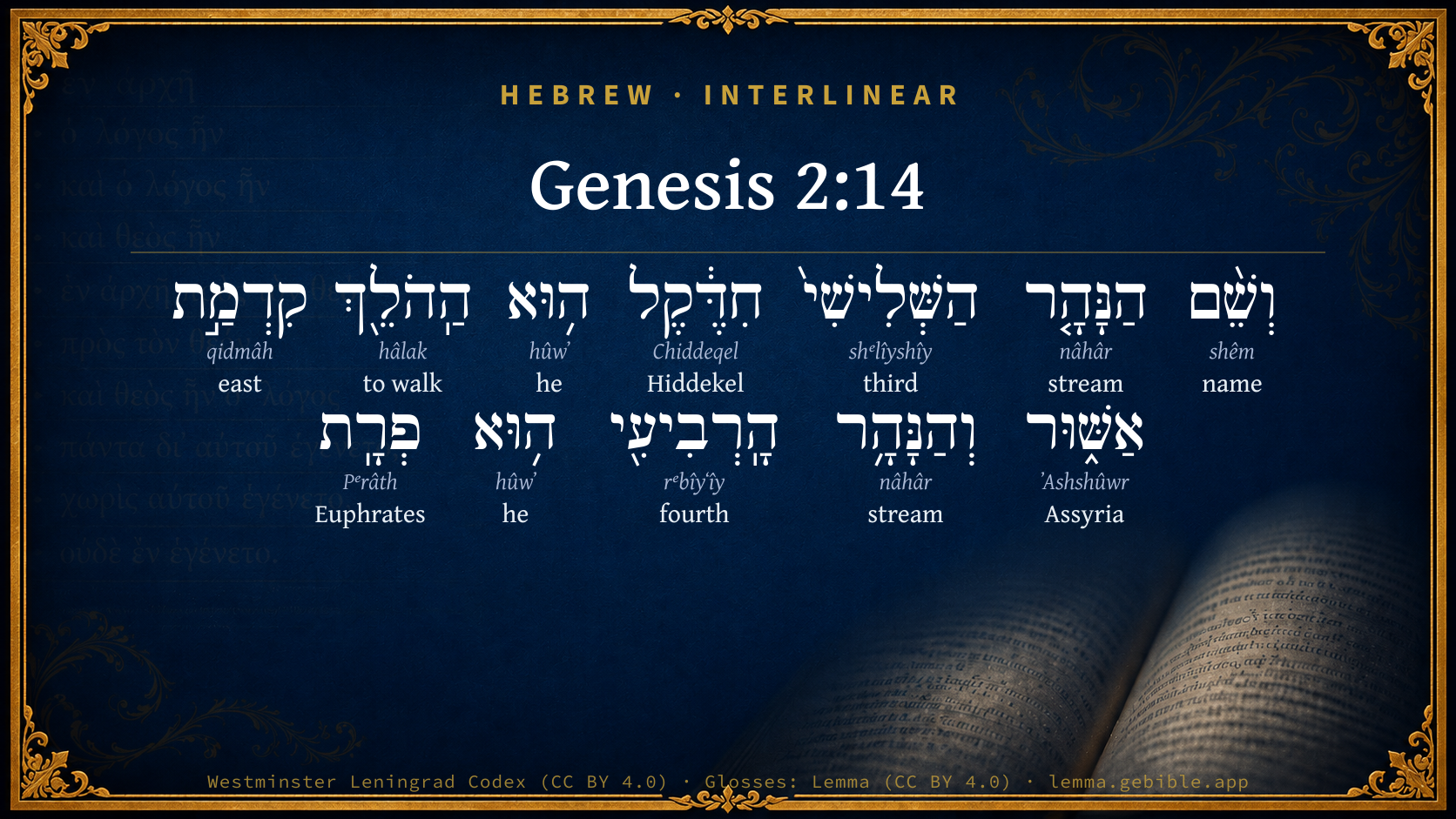
Hebrew (Westminster Leningrad Codex) Genesis 2:14 appears in the Hebrew Old Testament. The text above is from the Westminster Leningrad Codex. Each word links to its Strong’s number, a concise gloss, and parsing drawn from the Open Scriptures Hebrew Bible morphology. Click any word for its full Brown-Driver-Briggs (BDB) entry.
Download image
Cite this verse

Genesis 2:14 (World English Bible). Public Domain. Lemma interlinear Bible study tool, https://lemma.gebible.app/v/genesis/2/14.

Show BibTeX & RIS
BibTeX
RIS
English Translation
The name of the third river is Hiddekel: this is the one which flows in front of Assyria. The fourth river is the Euphrates.
World English Bible · Public Domain
Highlights
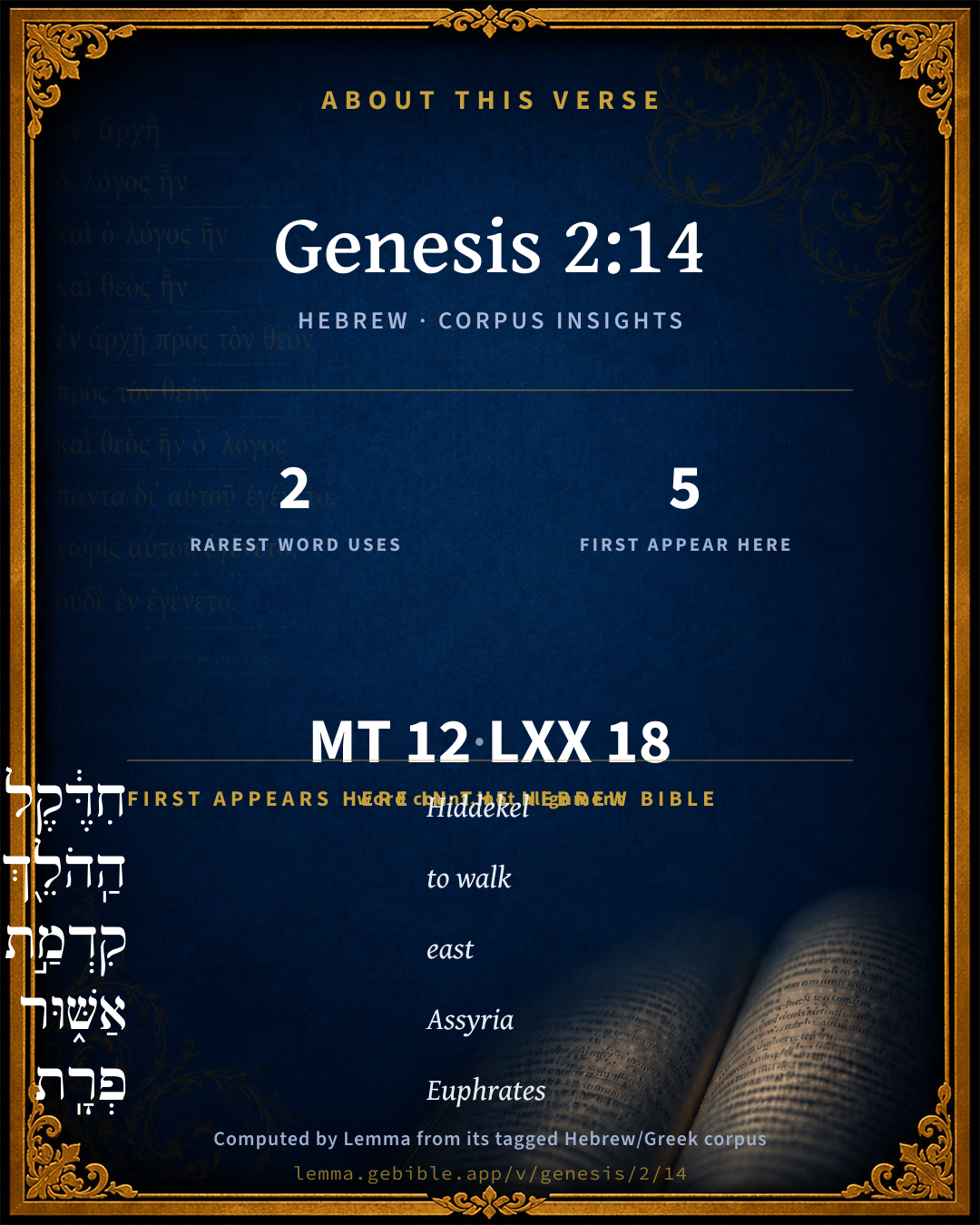
  • 5 first appearances in the Hebrew Bible
Full analysis ↓
Download a study sheet

One document with this verse’s original text, its word-by-word gloss line, the meaning frame, cross-references with their text, attributed commentary, and full source and license credits — printable, and it pastes into notes with its structure intact.

This verse Autodidact and up

Study sheet (.html) Plain text (.txt)

A passage Seminary Student

Up to 50 verses in one chapter. A passage sheet keeps up to 6 commentary sources and 12 cross-references per verse, in the order this page ranks them, and says so on the sheet whenever that leaves anything out. Ask for a single verse and you get the Autodidact verse sheet above.

Everything on this page stays free to read, with no account — the sheet is a download of what is already on screen, not access to it.

Want to remove ads? Support Godless Engineer
Compare translations 3

The same verse in 3 English versions, stacked beneath the original-language interlinear above. Click any original word for its lexicon entry.

Each is an independent rendering of the whole verse — the interlinear is not word-aligned to these translations.

Highlighted words mark where these versions differ — a whole-verse word diff, not a word-by-word alignment.

  • World English Bible Public Domain
    The name of the third river is Hiddekel: this is the one which flows in front of Assyria. The fourth river is the Euphrates.
  • King James Version Public Domain
    And the name of the third river is Hiddekel: that is it which goeth toward the east of Assyria. And the fourth river is Euphrates.
  • unfoldingWord Literal Text CC BY-SA 4.0
    And the name of the third river Tigris. It goes east of Asshur. And the fourth river Euphrates.

unfoldingWord Literal Text — © unfoldingWord, licensed CC BY-SA 4.0. Word-aligned USFM3 via Door43 (git.door43.org/unfoldingWord/en_ult).

Versions to compare (up to 4)

3 of 4 selected

Show all 18 translations

Every available English version of this verse, each an independent rendering of the whole verse.

  • World English Bible Public Domain
    The name of the third river is Hiddekel: this is the one which flows in front of Assyria. The fourth river is the Euphrates.
  • Berean Standard Bible Public Domain
    The name of the third river is Hiddekel; it runs along the east side of Assyria. And the fourth river is the Euphrates.
  • Majority Standard Bible Public Domain
    The name of the third river is the Tigris; it runs along the east side of Assyria. And the fourth river is the Euphrates.
  • King James Version Public Domain
    And the name of the third river is Hiddekel: that is it which goeth toward the east of Assyria. And the fourth river is Euphrates.
  • American Standard Version (1901) Public Domain
    And the name of the third river is Hiddekel: that is it which goeth in front of Assyria. And the fourth river is the Euphrates.
  • Revised Version (1885) Public Domain
    And the name of the third river is Hiddekel: that is it which goeth in front of Assyria. And the fourth river is Euphrates.
  • Geneva Bible (1599) Public Domain
    The name also of the third riuer is Hiddekel: this goeth toward the Eastside of Asshur: and the fourth riuer is Perath)
  • Douay-Rheims (1899) Public Domain
    And the name of the third river is Tigris: the same passeth along by the Assyrians. And the fourth river is Euphrates.
  • Young's Literal Translation Public Domain
    and the name of the third river `is' Hiddekel, it `is' that which is going east of Asshur; and the fourth river is Phrat.
  • Literal Standard Version CC BY-SA 4.0
    and the name of the third river [is] Hiddekel, it [is] that which is going east of Asshur; and the fourth river is the Euphrates.
  • Unlocked Literal Bible CC BY-SA 4.0
    The name of the third river is Tigris, which flows east of Ashur. The fourth river is the Euphrates.
  • unfoldingWord Literal Text CC BY-SA 4.0
    And the name of the third river Tigris. It goes east of Asshur. And the fourth river Euphrates.
  • Darby Bible Public Domain
    And the name of the third river is Hiddekel: that is it which flows forward toward Asshur. And the fourth river, that is Euphrates.
  • World Messianic Bible Public Domain
    The name of the third river is Hiddekel. This is the one which flows in front of Assyria. The fourth river is the Euphrates.
  • Webster's Bible Public Domain
    And the name of the third river is Hiddekel: which floweth toward the east of Assyria. And the fourth river is Euphrates.
  • Free Bible Version CC BY-SA 4.0
    The third branch was called the Tigris and it flowed east of the city of Asshur. The fourth branch was called the Euphrates.
  • Bible in Basic English Public Domain
    And the name of the third river is Tigris, which goes to the east of Assyria. And the fourth river is Euphrates.
  • JPS Tanakh (1917) Public Domain
    And the name of the third river is Tigris; that is it which goeth toward the east of Asshur. And the fourth river is the Euphrates.

Literal Standard Version (2020), Covenant Press — licensed CC BY-SA 4.0. Text via the HelloAO Bible API (eBible.org). Unlocked Literal Bible (unfoldingWord) — licensed CC BY-SA 4.0. Text via the HelloAO Bible API (eBible.org). unfoldingWord Literal Text — © unfoldingWord, licensed CC BY-SA 4.0. Word-aligned USFM3 via Door43 (git.door43.org/unfoldingWord/en_ult). Free Bible Version, Dr. Jonathan Gallagher — licensed CC BY-SA 4.0. Text via the HelloAO Bible API (eBible.org).

Word by word

More ways to search: Search by grammar → Find every occurrence → Compare this word →

Practice this passage: Drill this verse → Learn its vocabulary →

חִדֶּ֔קֶל
Chiddeqel
H2313
“Hiddekel”
Noun, Proper
Part of Speech
Noun
Type
Proper
Full BDB Definition

Origin: probably of foreign origin

TWOT: None

Hiddekel = "rapid" - one of the rivers of Eden which coursed east toward Assyria; better known as the Tigris (the LXX equivalent)
  1. וְשֵׁ֨ם shêm H8034 “and · name of” Conjunction + Noun, Common, Masculine, Singular, Construct
  2. הַנָּהָ֤ר nâhâr H5104 “the · stream” Particle, Definite Article + Noun, Common, Masculine, Singular, Absolute
  3. הַשְּׁלִישִׁי֙ shᵉlîyshîy H7992 “the · third” Particle, Definite Article + Adjective, Ordinal number, Masculine, Singular, Absolute
  4. ה֥וּא hûwʼ H1931 “he” Pronoun, Personal, 3rd Person, Masculine, Singular
  5. הַֽהֹלֵ֖ךְ hâlak H1980 “the · walking” Particle, Definite Article + Verb, Qal, Participle Active, Masculine, Singular, Absolute
  6. קִדְמַ֣ת qidmâh H6926 “east of” Noun, Common, Feminine, Singular, Construct
  7. אַשּׁ֑וּר ʼAshshûwr H804 “Assyria” Noun, Proper
  8. וְהַנָּהָ֥ר nâhâr H5104 “and · the · stream” Conjunction + Particle, Definite Article + Noun, Common, Masculine, Singular, Absolute
  9. הָֽרְבִיעִ֖י rᵉbîyʻîy H7243 “the · fourth” Particle, Definite Article + Adjective, Ordinal number, Masculine, Singular, Absolute
  10. ה֥וּא hûwʼ H1931 “he” Pronoun, Personal, 3rd Person, Masculine, Singular
  11. פְרָֽת Pᵉrâth H6578 “Euphrates” Noun, Proper

About this verse

These counts appear in no published source. They are computed here, from the morphology-tagged text and Lemma’s own curated glosses. What Lemma adds →

12
words
10
distinct lemmas
Pentateuch
section

Notable vocabulary

The rarest word here is חִדֶּ֔קֶל Hiddekel H2313 — appearing just 2 times in the whole Hebrew Bible.

First appearance in Scripture

These words make their first canonical appearance in the Hebrew Bible here:

  • חִדֶּ֔קֶל Hiddekel H2313
  • הַֽהֹלֵ֖ךְ to walk H1980
  • קִדְמַ֣ת east H6926
  • אַשּׁ֑וּר Assyria H804
  • פְרָֽת Euphrates H6578

Shared distinctive vocabulary

חִדֶּ֔קֶל Hiddekel H2313 occurs in 2 verses of the Hebrew Bible. Also found in:

Grammatical profile

  • 1 verb
  • 7 nouns
  • 2 adjectives
  • 2 pronouns

Verb forms

  • הַֽהֹלֵ֖ךְ Qal · Participle Active

Repetition

Words recur within this verse — often emphatic in Hebrew:

  • הַנָּהָ֤ר stream H5104 ×2
  • ה֥וּא he H1931 ×2

Hebrew & Septuagint length

In English translation the verse runs 24 words from the Hebrew and 22 from the Septuagint (LXX English) — closely comparable.

A rough comparison of the two English renderings, which tokenize alike — not a word-level alignment.

Word counts can differ between the Hebrew and the Greek without any difference in meaning — e.g. the Hebrew direct-object marker אֵת has no separate Greek word, and Greek often adds the article ὁ.

In the original languages it is 12 Hebrew tokens and 18 Greek tokens — but the two are counted differently (Hebrew bundles its prefixes and suffixes into one token; the Greek is in lemma form), so that isn’t a like-for-like length.

Cross-references

8

Topical passages linked to Genesis 2:14 in the Treasury of Scripture Knowledge — connected by theme and wording, ordered by reader-vote popularity; previews shown in the World English Bible.

  • Daniel 10:4 In the four and twentieth day of the first month, as I was by the side of the great river, which is Hiddekel,
  • Genesis 15:18 In that day Yahweh made a covenant with Abram, saying, "To your seed have I given this land, from the river of Egypt to the great river, the river Euphrates:
  • Genesis 10:11 Out of that land he went forth into Assyria, and built Nineveh, Rehoboth Ir, Calah,
  • Genesis 10:22 The sons of Shem: Elam, Asshur, Arpachshad, Lud, and Aram.
  • Genesis 25:18 They lived from Havilah to Shur that is before Egypt, as you go toward Assyria. He lived opposite all his relatives.
  • Deuteronomy 1:7 turn you, and take your journey, and go to the hill-country of the Amorites, and to all [the places] near thereunto, in the Arabah, in the hill-country, and in the lowland, and in the South, and by the sea-shore, the land of the Canaanites, and Lebanon, as far as the great river, the river Euphrates.
  • Deuteronomy 11:24 Every place whereon the sole of your foot shall tread shall be yours: from the wilderness, and Lebanon, from the river, the river Euphrates, even to the hinder sea shall be your border.
  • Revelation 9:14 saying to the sixth angel who had one trumpet, "Free the four angels who are bound at the great river Euphrates!"

Cross-references courtesy of OpenBible.info (CC BY 4.0).

Hebrew and Greek witnesses Masoretic Hebrew ↔ Greek Septuagint

The same verse in the two great witnesses to the Old Testament, shown verse-for-verse.

These are two independent witnesses, not word-aligned to each other, and the Septuagint is shown in lemma (dictionary) form.

Hebrew Genesis 2:14 Masoretic · Westminster Leningrad Codex

וְשֵׁ֨ם הַנָּהָ֤ר הַשְּׁלִישִׁי֙ חִדֶּ֔קֶל ה֥וּא הַֽהֹלֵ֖ךְ קִדְמַ֣ת אַשּׁ֑וּר וְהַנָּהָ֥ר הָֽרְבִיעִ֖י ה֥וּא פְרָֽת

The name of the third river is Hiddekel: this is the one which flows in front of Assyria. The fourth river is the Euphrates.

World English Bible · Public Domain

Greek LXX Genesis 2:14 Septuagint · lemma form

καί ὁ ποταμός ὁ τρίτος τίγρις οὗτος ὁ πορεύομαι κατέναντι ἀσσύριος ὁ δέ ποταμός ὁ τέταρτος οὗτος εὐφράτης

And the third river is Tigris, this is that which flows forth over against the Assyrians. And the fourth river is Euphrates.

LXX2012 (modern English Septuagint) · Public Domain

Hebrew: Westminster Leningrad Codex (CC BY 4.0). Greek: Septuagint (public domain); English from LXX2012 (modern English Septuagint) (Public Domain). How the Septuagint differs from the Hebrew →

Targum (Aramaic paraphrase)

2

The Targum is the ancient Jewish Aramaic paraphrase of the Hebrew Scriptures — an interpretive translation, not the Hebrew text itself. Onkelos (literal) and Pseudo-Jonathan (expansive) render the Torah, and Jonathan the Prophets. Coverage is partial: where no permissively-licensed English translation exists for a verse, only the Aramaic is shown. This is verse-level text, not a word-by-word alignment to the Hebrew.

  1. Targum Onkelos Torah (Genesis–Deuteronomy)
    וְשׁוּם נַהֲרָא תְּלִיתָאָה דִּיגְלַת הוּא מְהַלֵּךְ לְמַדִּינְחָא דְאַתּוּר וְנַהֲרָא רְבִיעָאָה הוּא פְרָת

    (no public-domain English translation for this verse)

    Targum Onkelos — Aramaic: “Onkelos Genesis” (public domain); “Onkelos Exodus” (public domain); “Onkelos Leviticus” (public domain); “Onkelos Numbers” (public domain); “Onkelos Deuteronomy” (public domain). English: “Sefaria Community Translation” (CC0 1.0 (public-domain dedication)); “J.W. Etheridge. The Targums of Onkelos and Jonathan Ben Uzziel on the Pentateuch. London: Longmans, Green, 1862” (public domain). Text via Sefaria.

  2. Targum Pseudo-Jonathan Torah (Genesis–Deuteronomy)
    וְשׁוּם נַהֲרָא תְּלִיתָאָה דִיגְלַת הוּא דִמְהֲלִיךְ לְמִידְנַח אַתּוּר וְנַהֲרָא רְבִיעָאָה הוּא פְּרָת

    And the name of the third river is Diglath; that is it which goeth to the east of Athoor. And the fourth river is Pherath.

    Targum Pseudo-Jonathan — Aramaic: “Targum Jonathan on Genesis” (public domain); “Targum Jonathan on Exodus” (public domain); “Targum Jonathan on Leviticus” (public domain); “Targum Jonathan on Numbers” (public domain); “Targum Jonathan on Deuteronomy” (public domain). English: “The Targum of Jonathan ben Uzziel, trans. J. W. Etheridge, London, 1862” (public domain). Text via Sefaria.

Commentary

Notes on Genesis 2:14 from classic Christian and Jewish commentators (each source and its license shown beneath its notes). The classic Christian expositions comment on the surrounding passage and are grouped to its opening verse, so a note may address several verses; the Jewish commentaries on the Tanakh (Rashi and others) are per-verse, so they appear only where the commentator wrote on this verse.

Lemma curates 59 commentaries, every one of them public domain or Creative Commons licensed, each selected and text-cleaned for this edition rather than reprinted as found. About our sources →

Trapp's Complete Commentary

John Trapp

Gen 2:14 And the name of the third river [is] Hiddekel: that [is] it which goeth toward the east of Assyria. And the fourth river [is] Euphrates.

Ver. 14. Hiddekel.] Or Tigris, which hath its name from the swiftness of the stream: Tigris in the Median tongue signifieth an arrow, saith Curtius, which flieth very swiftly. The tiger also is the swiftest of all beasts. Hiddekel signifieth sharp, swift. Contrariwise, Nile floweth gently, { Lene fluit Nilus} saith Claudian; so do the waters of Shiloah, {Isa 8:6} creeping and crooking" slowly" and slily, called therefore, as some think, "the dragon well". {Neh 2:13} And of the river Araris (probably Saone) in Germany, Caesar said, {a} whether it move forward, or backward, who can tell?

{a} Oculis in utram partem fluat, iudicari non potest . - De Bel. Gal., l. i.

John Trapp, A Commentary or Exposition upon All the Books of the Old and New Testament (1647–1656) — public domain. Text from a community e-Sword module.

Tyndale Open Study Notes

Tyndale Open Resources

2:14 Tigris . . . Euphrates: These well-known rivers flow from the mountains of eastern Turkey.

Tyndale Open Study Notes — © Tyndale Open Resources, licensed CC BY-SA 4.0. Text via the HelloAO Bible API.

Geneva Bible (1599)

Geneva Bible translators

Or, Tigris.

Or, Assyria.

Or, Euphrates.

Geneva Bible (1599) marginal notes — public domain. Text via Bolls.life.

Ellicott's Commentary for English Readers

(14) Of the “Hiddekel” and “Euphrates” there is no doubt: the former is the Tigris, or Tigres, which is a mere Graecising of its Oriental name, Daglath in Arabic, and Deklath in Syriac, and in the Targum of Onkelos. The word Hiddekel is startling as being a quadriliteral, but the Samaritan Codex reads the Dehel, that is, it has the article instead of the Hebrew Kheth. Mr. Sayce accepts the uncertain reading Hiddekel, and says (Chald. Gen., p. 84) that Hid is the Accadian name for river. Dekel, Tigris, is said to mean an arrow. The Samaritan reading is probably right.

Euphrates.—No description is given of this as being the largest and best known of Asiatic rivers. Hence, probably, the Pison and Gihon were but small streams. Euphrates is the Greek manner of pronouncing the Hebrew Phrath, the first syllable being simply a help in sounding the double consonant. In Accadian it is called Purrat, and means “the curving water,” being so named from its shape.

A Bible Commentary for English Readers, edited by Charles John Ellicott (1878–1897) — public domain. Text from a community e-Sword module.

The Cambridge Bible for Schools and Colleges

gen. ed. J. J. S. Perowne

14. Hiddekel] Tigris. The Assyrian name is “Idiklat,” or “Diklat,” the old Persian “Tigra,” whence the Greek “Tigris” (modern Digle). It is mentioned in the Bible elsewhere only in Dan_10:4 and Sir_24:25. This famous river rises not far from the source of the Euphrates, and flows at first east from Diarbekr and unites with the Bohtan Tsckai, after which it flows south-east. It approaches the Euphrates at Bagdad, but continues a separate course until it unites at Korna with that river, and enters the Persian Gulf as the Schatt-el-Arab. In earlier times the two rivers entered the sea at different points. The Tigris was so called from an old Persian word meaning “arrow,” and probably because of its swiftness.

in front of Assyria] The Hebrew expression rendered “in front of” generally denotes “to the east of,” cf. Gen_2:8, Gen_4:16, Gen_12:8 notes. The Hebrew standpoint is always that of a person facing east. That which is in front is east: towards his right hand is the south, towards his left the north, at his back the west. It is objected that Assyria was a country, through which the Tigris flowed, and that, as Assyrian territory lay on the east as well as the west bank of the Tigris, it would not be correct to describe the Tigris as “that which goeth towards the east of Assyria.” Hence Sayce conjectures that we should here understand, not the country “Assyria,” but the country’s old capital “Asshur” which gave its name to the country, and which lay on the west bank of the Tigris. But Asshur, the city, is not mentioned elsewhere in the Bible; presumably, therefore, it was little known to the Hebrews, and was not likely to be mentioned in a geographical description. On the other hand, “Asshur” is the regular Hebrew designation of the country “Assyria”1[4]; the mention here of “Assyria” is parallel to that of “Cush” in the preceding verse. There seems no sufficient reason for doubting that the name “Asshur” is here used, in its usual Biblical application, for the land of Assyria. If so, the geographical description of the Tigris may not be strictly accurate. Considering its remoteness from Palestine, this need not surprise us, especially in a writing dating from a period previous to the active Assyrian interference in the course of Israelite affairs.

[4] See Gen_10:22. The “Asshur” of Eze_27:23 is mentioned with “Sheba … and Chilmad.”

Euphrates] Heb. Prath. Assyrian “Puratu,” old Persian Ufrâtû, whence the Greek and Latin “Euphrates.” The Euphrates rises in the mountains near Erzerum, and, after following a tortuous course through the Taurus Mts., flows first in a southerly, and then, from Balis, in a S.E. direction, uniting with the Tigris before entering the Persian Gulf.

The Israelites seem to have regarded the Euphrates as “the river par excellence.” Hence “the River,” as a proper name, in Exo_23:31, 1Ki_4:21; 1Ki_4:24, Psa_72:8; Psa_80:11, Isa_8:7, Zec_9:10.

The Cambridge Bible for Schools and Colleges (gen. ed. J. J. S. Perowne; Cambridge University Press, 1878–1918) — public domain. Text from a community e-Sword module.

John Gill's Exposition

The name of the third river is Hiddekel,.... A river which ran by Shushan in Persia, and retained its name in the times of Daniel, Dan 10:4 where it is called the great river; and it seems it bears the same name now among the Persians; at least it did an hundred and fifty years ago, when Rauwolff (m) travelled in those parts. The Targum of Jonathan here calls it Diglath, the same with the Diglito of Pliny (n); and according to him it is called Tigris, from its swiftness, either from the tiger, a swift creature, or from "to dart", in the Chaldee language; and so Curtius (o) says, that in the Persian language they call a dart "tigris": and with this agrees the word "Hiddekel", which in the Hebrew language signifies sharp and swift, as a polished arrow is; and Jarchi says it is so called, because its waters are sharp and swift: though this is contradicted by some modern travellers (p) who say it is a slower stream than the Euphrates, and is not only very crooked, and full of meanders, but also choked up with islands, and great banks of stone:

that is it which goeth towards the east of Assyria: a country which had its name from Ashur, a son of Shem, Gen 10:11 it became a famous kingdom and monarchy, Nineveh was the metropolis of it, which was built on the river Tigris or Hiddekel; and, as before observed, it ran by Shushan in Persia; and so, as Diodorus Siculus (q) says, it passed through Media into Mesopotamia; and which very well agrees with its being, according to Moses, one of the rivers of Eden. Twelve miles up this river, from Mosul, near which Nineveh once stood, lies an island, called the island of Eden, in the heart of the Tigris, about ten English miles in circuit, and is said to be undoubtedly a part of paradise (r):

and the fourth river is Euphrates: or "Phrat", as in the Hebrew tongue. Reland (s) seems rightly to judge, that the syllable "eu", prefixed to it, is the Persian "au" or "cu", which in that language signifies "water"; so that "Euphrates" is no other than "the water of Phrat", so called from the fruitfulness of it; for its waters, as Jarchi says, fructify, increase, and fatten the earth; and who rightly observes that these names, and so those of other rivers, and of the countries here mentioned, are named by a prolepsis or anticipation, these being the names they bore when Moses wrote; unless it may be thought to be the Hebrew "Hu, the, that Phrat"; and which the Greeks have made an "eu" of. (After the global destruction of Noah's flood, it is doubtful that the location of these rivers could be determined with any degree of certainty today. Ed.)

(m) Travels, part. 2. c. 9. p. 159. ed. Ray. (n) Nat. Hist. l. 6. c. 27. (o) Hist. l. 4. c. 9. (p) De la Valle & Thevenot, apud Universal History, vol. 4. p. 248. (q) Bibliothec. l. 2. p. 99. (r) Cartwright's Preacher's Travels, p. 91. (s) Ut supra, (De Situ Paradisi) p. 45.

John Gill's Exposition of the Whole Bible (1746–1763) — public domain (CC PDM 1.0). Text via the HelloAO Bible API.

Matthew Poole's English Annotations

Hiddekel, i.e. Tigris, or an eminent branch of it. See Dan 10:4.

Matthew Poole's English Annotations on the Holy Bible (1683–1685) — public domain. Text from a community e-Sword/MySword module.

The Pulpit Commentary

And the name of the third river is the, Hiddekel, or "the darting," from dj and Lq,d, a sharp and swift arrow, referring to its rapidity. It is unanimously agreed that this must be identified with the Tigris; in the present language of the Persians designated tir, which signifies an arrow. It is styled in Aramaic diglath or diglah. That is it which goeth towards the east of Assyria. Its identity is thus placed beyond a question. And the fourth river is Euphrates, or "the sweet," from an unused root, parath, signifying to be sweet, referring to the sweet and pleasant taste of its waters. (Jer_2:18) Further description of this great water was unnecessary, being universally known to the Hebrews as "the great river" (Deu_1:7; Dan_10:4) and "the river" par excellence (Exo_23:31; Isa_7:20) The river still bears its early name. In the cuneiform inscriptions deciphered by Rawlinson it is called "Ufrata." Recurring now to the site of Eden, it must be admitted that, notwithstanding this description, the whole question is involved in uncertainty. The two solutions of the problem that hive the greatest claim on our attention are,

(1) that which places Eden near the head of the Persian Gulf, and

(2) that which looks for it in Armenia. The latter is favored by the close proximity to that region of the sources of both the Euphrates and the Tigris; but, on the other hand, it is hampered by the difficulty of discovering other two rivers that will correspond with the Gihon and the Pison, and the almost certainty that Cush and Havilah are to be sought for in the vicinity of the Persian Gulf. The former (Calvin, Kalisch, T. Lewis) is supported by this last consideration, that Cush and Havilah are not remote from the locality, though it too has its encumbrances. It seems to reverse the idea of aeYO, which according to Le Clerc indicates the direction of the stream. Then its advocates, no more than the supporters of the alternate theory, are agreed upon the Gihon and the Pison: Calvin finding them in the two principal mouths of the Euphrates and the Tigris, which Sir Charles Lyell declares to be of comparatively recent formation; Kalisch identifying them with the Indus and the Nile; and Taylor Lewis regarding them as the two sides of the Persian Gulf. Sir H. Rawlinson, from a study of the Assyrian texts, has pointed out the coincidence of the Babylonian region of Karduniyas or Garduniyas with the Eden of the Bible; and the late George Smith finds in its four rivers, Euphrates, Tigris, Surappi, and Ukui, its known fertility, and its name, Gandunu, so similar to Ganeden (the garden of Eden), "considerations all tending towards the view that it is the paradise of Genesis" ("Chald. Genesis," pp. 3-305).

The Pulpit Commentary (1880–1919), ed. H.D.M. Spence-Jones & Joseph S. Exell — public domain. Text from a community e-Sword module.

Scofield Reference Notes

C. I. Scofield

Hiddekel Hiddekel = ancient name of the Tigris.

The Scofield Reference Bible (1917 edition), notes by C. I. Scofield — public domain. Text from a community e-Sword module.

Rashi

Rabbi Shlomo Yitzchaki (Rashi)

חדקל TIGRIS — It is called חדקל because its waters are pungent in taste (חד) and light in weight (קל) (Berakhot 59b).

פרת EUPHRATES — It is called פרת because its waters grow (פרה) and increase and make men healthy (Berakhot 59b). כוש ואשור CUSH AND ASHUR did not then exist as countries, but Scripture writes with reference to the names which those districts would bear in the future (Ketubot 10b; Genesis Rabbah 16).

קדמת אשור means AT THE EAST OF ASHUR.

הוא פרת IS THE EUPHRATES — the most important of all, being mentioned in connection with the Land of Israel (Genesis Rabbah 16:3).

Rashi on the Tanakh — English translations: “The Judaica Press complete Tanach with Rashi, translated by A. J. Rosenberg” (CC BY 4.0); “Pentateuch with Rashi's commentary by M. Rosenbaum and A.M. Silbermann, 1929-1934” (public domain); “The Metsudah Tanach series, Lakewood, N.J” (CC BY 4.0); and “The Book of Joshua, Metsudah Publications, 1997” (CC BY 4.0). Text via Sefaria.

Radak

Rabbi David Kimhi (Radak)

ושם הנהר השלישי...קדמת אשור, it flows more or less in a continuous direction to the eastern region of what was the land of Ashur at the time the Torah was given. It does not circumvent that country but flows in a northerly direction, seeing that both Babylon and Ashur are situated north of Gan Eden. [In order to make even partial sense of all this, it helps to understand such definitions as “northerly, southerly, easterly,” as relative to the location of Eretz Yisrael, not as relative to the north and south poles of our globe. Rashi already found it necessary to describe the river Nile as running underground for a considerable distance in order to make the Biblical report compatible with the facts as known in his time, much earlier than Kimchi. Ed.] חידקל, this river is so called because its waters are clear and flow rapidly (Berachot 59).

והנהר הרביעי הוא פרת, our sages have divergent views on the identity of this river. According to Rabbi Yehudah it is the river Euphrates, whereas according to Rav Hunna it is the river כבר, also in Babylonia, the river where the prophet Ezekiel received prophetic revelations and instructions. (Ezekiel 1,1) The reason it is called פרת, according to Rabbi Yehudah, is that its waters keep increasing until it becomes a navigable stream, and it cannot be crossed on foot or raft, but must be crossed by ferry. Also, the word פרת alludes to these waters continuously increasing (due to its tributaries). According to Rav Hunna the rivers פרת and כבר are not 2 names for the same river, but refer to two entirely different rivers. Rabbi Yehoshua from Sakkinin, speaking in the name of Rabbi Levi, says that when people ask the river פרת why it does not make any sound, the river replies that it does not need to advertise its existence by being noisy, but that its deeds, i.e. the contribution it makes to the people living alongside it are sufficient to make it well known. It could say of itself that if someone plants a tree near its banks it will grow within 30 days, whereas if he plants seeds of vegetables it will sprout within three days. הוא פרת, this river is known by this name in the land of Israel. This is why the Torah did not need to add more details about the region in which this river flows. The river is further west than other countries which have been mentioned. Once this river has reached Eretz Yisrael, it ends up in the ים האחרון, the gulf of Basra. [the reader is reminded that the reference to the Euphrates reaching the land of Israel is most likely the author’s definition of the land of Israel consisting of the lands of 10 nations, not 7, i.e. as promised to Avraham Genesis 15,18. Ed.] The 4 rivers mentioned symbolise that the four directions on earth are all supplied with fresh water by these rivers. Seeing that the land of Israel is considered as in the center of the civilised world, all these rivers touch the land of Israel at one point or another The reason why all this was recorded here is to show how Moses, at his time, was able to provide all these details having been imbued with holy spirit. Otherwise, how would Moses have known all this, seeing that he had not been a world traveler but had spent almost all the 40 years that he was a leader in a narrow desert. Seeing that all these stories recorded in the Book of Genesis do not contain commandments either between G’d and man or between man and man, it is clear that unless G’d had endowed Moses with the requisite knowledge he could not have recorded all these details. G’d’s purpose was clearly, to implant in man knowledge of how the early years of man on earth had begun, after G’d had created the world and had placed Adam in Gan Eden. Our sages, looking for deeper allusions to man’s history in all this, also saw in the 4 rivers mentioned a reference to the four exiles the Jewish people would endure before being redeemed. (Bereshit Rabbah 16,4) There are more explanations about these 4 rivers (on verse 10) in the kabbalistic writings of our sages.

Radak on the Tanakh — English translations: “Sefaria Community Translation” (CC0 1.0 (public-domain dedication)); “Eliyahu Munk, HaChut Hameshulash” (CC BY 4.0); “Rabbi Mike Feuer, Jerusalem Anthology” (CC BY 4.0); and “R. David Kimhi on the first book of Psalms, Translated by R.G. Finch, London, 1919” (public domain). Text via Sefaria.

Lesson kit

Teaching starters — assembled from the data on this page, not authored interpretation. Every prompt links to the verse data it draws on. Edit before teaching.

Genesis, in the Pentateuch, opens this verse with 12 words (10 distinct Hebrew lemmas). Its most distinctive word is Chiddeqel (“Hiddekel”). A historical commentator’s framing appears above. Read the whole chapter for the surrounding context.

Discussion questions

  1. How does “Hiddekel” (Chiddeqel) shape what this verse is saying?
  2. 5 words make their first appearance in Scripture here. What does this debut establish?
  3. How does Daniel 10:4, which shares the word «Hiddekel», read alongside this verse?
  4. What does the repetition of “stream” (2× in this one verse) do in this verse?
  5. The translations on this page render this verse differently — a whole-verse word diff, not a word-by-word alignment. What might account for the different wordings?
  6. «הַֽהֹלֵ֖ךְ» is a Qal Participle Active verb. How does that grammatical form shape the action described?
  7. Compare how Trapp's Complete Commentary and Tyndale Open Study Notes read this verse. Where do they agree or differ?

Things to notice

Reading settings

Reading text

Shown beneath each verse's original-language words.

Old Testament
Old Testament edition

Read the OT as the Masoretic Hebrew (MT) or the Greek Septuagint (LXX).

English shown for the Greek Septuagint (in the Hebrew ↔ Greek comparison).

Comparing translations? Open the Compare panel on any verse page to stack up to four side by side.